Monthly Archives: November 2020

Righteousness

The righteousness of the perfect shall direct his way: but the wicked shall fall by his own wickedness. The righteousness of the upright shall deliver them: but transgressors shall be taken in their own naughtiness. When a wicked man dieth, his expectation shall perish: and the hope of unjust men perisheth. The righteous is delivered out of trouble, and the wicked cometh in his stead. An hypocrite with his mouth destroyeth his neighbour: but through knowledge shall the just be delivered. When it goeth well with the righteous, the city rejoiceth: and when the wicked perish, there is shouting. By the blessing of the upright the city is exalted: but it is overthrown by the mouth of the wicked. He that is void of wisdom despiseth his neighbour: but a man of understanding holdeth his peace. A talebearer revealeth secrets: but he that is of a faithful spirit concealeth the matter. Where no counsel is, the people fall: but in the multitude of counsellors there is safety. He that is surety for a stranger shall smart for it: and he that hateth suretiship is sure.

— Proverbs 11:5-15

I personally have faith that Joe Biden will make a great president. He has the contacts in Washington to hopefully get things done. Of course, it will be easier if both Democratic candidates win their run-off races in Georgia. However, the first few months will undoubtedly be difficult because he will enter the presidency in the middle of an ever-worsening pandemic and replace a president who refuses to concede or allow for Biden’s transition team to move forward. Republicans are claiming that Trump has the right to move through the court system to delegitimize the election. They claim, “What harm could it do?” The symbolism of a graceful concession is more important than the nuts and bolts of the handoff, especially for a president-elect with Biden’s vast experience, though especially in this pandemic, the nuts and bolts do matter. Hebrews 11:1 defines faith as “the substance of things hoped for, the evidence of things not seen.” Trump is petulantly weakening a divided nation’s faith in its hoped-for and unseen foundational ideals—and of all the terrible things this awful man has done to our country, this could be the worst.

What America is now experiencing is a massive failure of character—a nationwide blackout of integrity—among elected Republicans. From the president, a graceless and deceptive insistence on victory after a loss that was not even close. From congressional Republicans, a broad willingness to conspire in President Trump’s lies and slander the electoral system without considering the public good. Only a few have stood up against Republican peer pressure of contempt for the constitutional order. How could such a thing happen in the Republican Party? It is not an anomaly. It is the culmination of Trump’s influence among Republicans and White evangelical Christians in particular. Their primary justification for supporting Trump—that the president’s character should be ignored in favor of his policies—has become a serious danger to the republic. Trump never even presented the pretense of good character. His revolt against the establishment was always a revolt against the ethical ground rules by which the establishment played. When he mocked a reporter with a disability, urged violence at his rallies, or attacked a Gold Star family, Republicans accepted it as part of the Trump package. And some of his most impassioned defenses came from White evangelicals.

We have a serious problem in this country, and at the heart of that is White evangelicals. Evangelicalism has four distinctive aspects to their faith: conversionism (being “born again”), Biblicism (belief in biblical inerrancy and/or infallibility), crucicentrism (the belief that Christ died as a substitute for sinful humanity), and activism (includes preaching and social action). Two of these have become incredibly dangerous because of their interpretation by evangelicals: Biblicism and activism. Under Biblicism, they ignore all discussion of the Bible begin filled with allegory and metaphors. They believe it is entirely literal. The most significant problem with this is that they ignore the original language and meaning of the Bible, and they pick and choose what parts of the Bible they want to follow and which they would like to ignore. One example is the use of the word “homosexual” in the New Testament. The term “homosexual” is of modern origin, and it wasn’t until about a hundred years ago that it was first used. There is no word in biblical Greek or Hebrew that is equivalent to the English word homosexual. The 1946 Revised Standard Version (RSV) of the Bible was the first translation to use the word homosexual. However, evangelicals latched on to this translation’s use of homosexual for terms that were never meant to mean homosexual as we understand it today. Romans 1:24-27, 1 Corinthians 6:9, and 1 Timothy 1:10 are all used to condemn the LGBTQ+ community. However, these verses referred to temple prostitutes, male prostitutes, and pederasts, respectively. Yet, even though Jesus explicitly condemns divorce in Matthew 5:32 and Luke 16:18, White evangelicals are more likely than the average American to leave a marriage, with 17.2 percent being currently divorced. Despite their strong pro-family values, evangelical Christians have higher than average divorce rates being more likely to be divorced than Americans who claim no religion. White evangelicals also use these beliefs to excuse their discrimination against racial and sexual minorities.

White evangelicals were once seen as America’s pious and moral authority but have now become the least strict chaperone of Trump’s corruption. Under the president’s influence, White evangelicals went from the group most likely to believe personal morality matters in a politician to the least likely group. “We’re not electing a pastor in chief,” explained Jerry Falwell Jr., the disgraced former president of Liberty University. Robert Jeffress, the pastor of the Islamophobic, anti-Semitic, racist, and anti-LGBTQ+ First Baptist Dallas, argued that “outward policies” should matter more than “personal piety.” Ralph Reed of the Faith and Freedom Coalition made his case for Trump’s reelection based on conservative deliverables. “There has never been anyone,” Reed said, “who has defended us and who has fought for us, who we have loved more than Donald J. Trump.” This is politics at its most transactional. Trump was being hired by evangelicals to do a job — to defend their institutions, implement pro-life policies, and appoint conservative judges. The character of the president was irrelevant so long as he kept his part of the bargain. Which, sadly, Trump mostly did.

But now we know what a president without character looks like amid a governing crisis. We see a dishonest president, spinning lie after lie about the electoral system. We see a selfish president incapable of preferring any duty above his own narrow interests. We see a reckless president, undermining the transition between administrations and exposing the country to risk. We see a vain president unable to responsibly process an electoral loss. We see a corrupt president, willing to abuse federal power to serve his own ends. We see a spiteful president, taking revenge against officials who have resisted him. We see a faithless president, indifferent to constitutional principles and his oath of office. There is nothing in Donald Trump that Jesus might find redeemable. If you made a list of everything that Jesus taught, you could make a list of Trump’s character and see the opposite of everything Jesus wanted for humanity.

Two lessons can be drawn from the Republican failure of moral judgment. First, democracy is an inherently ethical enterprise. Yes, politics has a transactional element. But those transactions take place within a system of rules that depend on voluntary obedience. Our electoral system and our presidential transition process have flaws and holes that an unprincipled leader can exploit, which is a good reason to prefer principled leaders. And second, U.S. politics would be better off if White evangelicals consistently applied their moral tradition to public life. Not only Christians, of course, can stand for integrity. But consider what would happen if White evangelicals insisted on supporting honest, compassionate, decent, civil, self-controlled men and women for office. The alternative is our current reality, in which evangelicals have often been a malicious and malignant influence in U.S. politics.

White evangelicals are only 15 percent of the population, but their share of the electorate was 28 percent, making them a disproportionately vocal and influential group within American politics. White evangelicals have, in effect, skewed the electorate by masking the rise of a young, multiracial, and mostly secular voting population. Unfortunately, the White evangelicals’ overperformance also shows why the racist appeal Trump made in this campaign was effective. White evangelicals were fired up like no other group by Trump’s encouragement of white supremacy. Pre-election, 90 percent said they would vote, and nearly half of those voting for Trump said virtually nothing he could do would shake their approval. There was little evidence of differences among White evangelicals by gender, generation, or education. The good news might be that they are, as a group, dying out (median age in the late 50s), and their views are hardly recognizable to many other Americans. Majorities of White evangelical Protestants don’t see the pandemic as a critical issue (they’re less likely than others to wear masks), believe society has become too “soft and feminine,” oppose same-sex marriage, think Trump was called by God to lead, and don’t believe he encouraged white supremacist groups.

The unholy alliance of White evangelicals and Donald Trump is what a purely transactional politics has actually delivered — a lawless leader resisting a rightful electoral outcome. He is endangering American national security by causing chaos and instability in the United States at a time when our economy is on the brink, and a pandemic is raging stronger every day. The only adequate response, as President-elect Joe Biden seems to realize, is a politics of character. Let’s hope that politicians on both sides of the aisle realize they must work with Biden to heal the soul of the nation.


Pic of the Day


Moment of Zen: Jeeps

There is something about a Jeep that is so incredibly sexy.


Pic of the Day


Subverting Democracy

I think most of us knew that Donald Trump had no respect for democracy or the Constitution. So, it should come as no surprise that he’s lying, and lying, and lying again to claim he prevailed in the election that President-elect Joe Biden won decisively, fair and square. What no one knew for certain was whether the Republican Party would once again genuflect before Trump’s corruption and his indifference to the fate of our republican institutions. Some of us suspected they would, though I’d hoped they’d all have jumped ship by now. Sadly, the Republican Party has turned out to be as despicably ready to validate Trump’s falsehoods and authoritarian behavior as their worst critics feared. With precious few exceptions, Republican leaders have been quite happy to be complicit in Trump’s subversion. It’s absurd enough that managing Trump’s illusion that he didn’t lose is of such all-consuming importance in some quarters that we must endure even the possibility of extensive civic and governmental damage, all so that it can be slowly put out of its misery. That’s what we’ve come to, but it won’t be for much longer.

If it weren’t for Republicans trying to destroy the democratic ideals of the Constitution, all of this would be a comedy of errors, a satirical political movie filled with the absurd. But it’s very much real. When news broke last Saturday that Trump’s reign of terror was ending, the president was on a golf course that he owns in Virginia, playing his final round as a non-loser. In Washington, about 125 of his worshipful supporters gathered on the stoop of the Supreme Court to “stop the steal,” then circled the U.S. Capitol seven times, because that’s how the Israelites conquered Jericho, according to the Book of Joshua. And a pair of Trump’s most loyal surrogates made a defiant stand on the gravelly backside of a landscaping business (Four Seasons Total Landscaping that was likely mistakenly booked by the Trump campaign thinking it was the Four Seasons hotel). However, this Four Seasons is in an industrial stretch of Northeast Philadelphia, near a crematorium and an adult-video store called Fantasy Island, along State Road, which leads — as being associated with Trump sometimes does — to a prison. Trump’s campaign began on a golden escalator and ended in a dingy parking lot between a porn shop and a crematorium.

On every front, these legal efforts are already falling apart. Indeed, the Associated Press reports that senior officials and allies privately admit that claims of large-scale voter fraud — the basis for efforts to overturn the results — aren’t actually meant to be proved. The strategy to wage a legal fight against the votes tallied for Biden in Pennsylvania and other places is more to provide Trump with an off-ramp for a loss he can’t quite grasp and less about changing the election’s outcome, the officials said. That’s extraordinary: Trump allies are claiming in many high-profile forums that the lawfully cast votes of millions of Americans are illegitimate, mostly to create space for him to process his rage and grief over losing. It’s extraordinary that Republican senators and members of Congress, most of the conservative news media, and leaders of industry are all pretending like they think there might be election fraud just because the president’s feelings are hurt. All this sets up another possibility. With Trump unlikely to formally concede, you can see a kind of Lost Cause of Trumpism mythology on the horizon, in which many supporters continue believing the election was stolen from him and squeamish Republicans betrayed him by not fighting hard enough against it. These same people will ignore the fact that federal, state, and local election officials have said the election “was the most secure in American history” and that there was “no evidence” of any compromised voting systems. It simply won’t matter to them as they will see it as fake news, doing as Trump has trained them to do: ignore news they don’t like by claiming it’s fake news.

Republicans are backing Trump’s childish claims to make sure his voters in Georgia turn out for two Republican senators in the January 5 runoff election. For the next month and a half, Georgia is going to get nasty. The Republicans have already started their subversion of democracy. In Georgia, two GOP senators called on the state’s Republican secretary of state to resign, alleging irregularities and mismanagement without offering evidence. Only four of 53 Senate Republicans have congratulated Biden on his projected victory. Sen. Ron Johnson of Wisconsin recently told reporters, “there’s nothing to congratulate [Biden] about,” while Missouri’s Roy Blunt said the president “may not have been defeated at all.” It’s the latest sign of the Republican Party destabilizing our democratic ideals and practices. The journey towards authoritarianism predates the Trump administration, but Trump has accelerated these efforts. Now, according to data released by an international team of political scientists just before the November 3 election, we know it’s possible to quantify the extent to which the Republican Party no longer adheres to principles of democracy, the rule of law, and their commitment to free and fair elections. Under Trump, they have abandoned respectful treatment of political opponents and the avoidance of violent rhetoric. The Republican Party under Trumpism is dangerously close to fascism.

Republicans are turning their back on democracy, not only because of the Senate races in Georgia but also because they fear Trump. True to form, they are also doing it to weaken Biden and make it harder for him to govern. Republicans feel that if the party doesn’t fight for a recount and investigations of non-existent voter fraud, the Trump loyalists will leave the party. It seems to be less about the president than it is his voters. The Republican Party has to realize that Trump supporters need to be left behind. If the Republican Party wants these voters, they are encouraging their racism, homophobia, misogyny, conspiracy-driven hatred, etc. They represent the worst in America, and as long as the Republican Party humors them and Donald Trump, they are destroying the very fabric of American society and ideals. Sure, the Republican Party might lose ground, but then they could concentrate on rebuilding the party into a party that believes in the good of the country, even if we disagree on what that means.

Over the last few years, the willingness of many American voters to elect any clown with an R beside his or her name on a ballot, especially in my home state of Alabama and other solidly red states, has considerably dumbed down the already scarce pool of competent conservative candidates. But what I suspect is happening here is that this is merely another in a long line of absurd pandering from Republicans, hoping that fluff over substance will again win the day. When will Republicans in this country get tired of the constant bickering and nastiness? Many Democrats already have. Now, we are about to have a Democratic president who is agreeable to many people, especially blue-collar workers, because he’s promising to tone down the hatefulness and hostility, restore respect and decency to the White House, and be a president to all of America. Decency doesn’t keep the “oh my God, the liberal president is going to …” money rolling in.

Biden will very likely be a very popular president, even in very red places. It is clear to most voters that Biden won’t run for re-election so that he won’t be beholden to anyone. Republicans need a way to make Americans hate him. There’s a new day coming to America. There’s a chance for people to stop this insanity and put an end to the mind-numbing idiocy that has thrived in this country. We’re never going to agree on everything. Conservatives are still going to be conservative. Progressives are still going to be progressives. Moderates will still sway one way or another. But, hopefully, we can all agree that these sorts of stunts — in which elected officials blatantly lie and play upon phony emotion to sow division and anger — are intolerable. Because if these Trumpists are willing to lie to you about something as important and as sacred in this country as the election process, if they’re willing to undermine democracy and raise bogus questions about our elections, what won’t they lie about? What lie won’t they tell you to get your vote or your money? We all deserve better than this. And we should all demand it.

As Kenny Rogers sang:

You got to know when to hold ’em,
Know when to fold ’em,
Know when to walk away,
And know when to run.

There are words of wisdom there for Donald Trump. He’s holding onto a hand that he’s going to lose. He needs to fold and walk away. A lot of Trump’s resistance is his overinflated ego, but I suspect he’s also scared.  His creditors are about to call in his millions of dollars in debt. Four hundred million of which is about to come due, but Forbes estimates that he has a total debt of $1 billion.

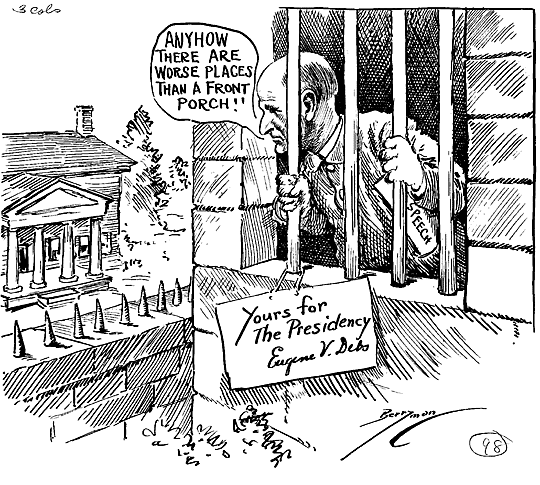
Clifford Berryman’s cartoon depiction of Debs’ 1920 presidential run from prison

Furthermore, the State of New York will be indicting him, and even if he pardons himself, which has dubious legal standing anyway, he would not be pardoned for any state crimes. So, when he leaves office, he may need to know “when to run” to a country without extradition treaties with the United States. His gamble in defrauding his creditors, the American people, and our allies are not going to pay off. Even if he is privately saying he will run again for president in 2024, it might just be from a prison cell. After all, Eugene V. Debs, the American socialist and five times presidential candidate for the Socialist Party of America, ran for president from behind bars in 1920, but that was a different world back then. Still, he received 919,799 votes (roughly 3.4%).

The end is near for Trump. His resistance to come to terms with the truth and his juvenile efforts to resist Biden’s transition are undermining democracy and endangering our country’s national security. Intelligence operatives have already admitted that the instability and confusion caused by the 2000 election were part of the reason they missed all the signs of the terrorist attack on 9/11. Trump is endangering all Americans for his fragile ego. The Republican Party needs to move on from Trump and expel him from the party to save the Republican Party from the destructive nature of Trumpism. It’s a house of cards at this point, and it’s about to come crashing down. Let’s just hope it doesn’t cause more damage than we can repair.


Pic of the Day


Not a Good Day Yesterday

I ended up going home early from work. I am usually in the museum on Wednesdays and work from home the rest of the week. Yesterday though, the bursitis in my hit was hurting something terrible. My stomach was cramping and in pain from the antibiotic for the abscessed tooth. For some reason, my neck was bothering me. My tooth is still hurting, even though it should be getting better, which caused me to have a bad headache all day. Basically, from the hip up, I was in pain. So, I headed home at lunch. I had to leave anyway for my COVID test that we have to take every three weeks per university policy. After the test, I just went home and worked for the rest of the day from home.

I hate days like yesterday. Nothing seems to be going right. Maybe today will be a better day. I’m sorry to be complaining about my health. I just didn’t feel well yesterday, and I didn’t have anything else to post.


Pic of the Day


Love In The Time Of “Don’t Ask, Don’t Tell

Mike Rudulph grew up near Birmingham, Alabama and enlisted in the Marines when he was 20 years old. At the time, he hoped that the military environment would bring him the sense of purpose he had been missing.

This was in 2000, during the era of “don’t ask, don’t tell,” when LGBTQ people in the military couldn’t serve openly.

Mike went on his first deployment to Iraq in 2003. When he got home, he met the man who would later become his husband, Neil Rafferty.

They got married in 2018, the same year that Neil ran for public office in Alabama — and won! He is the first openly gay man to serve in the Alabama State legislature. 

At StoryCorps in Birmingham, Alabama, Mike and Neil sat down to remember the early days of their relationship.

Originally aired August 15, 2020, on NPR’s Weekend Edition Saturday.


Honoring LGBTQ+ Veterans

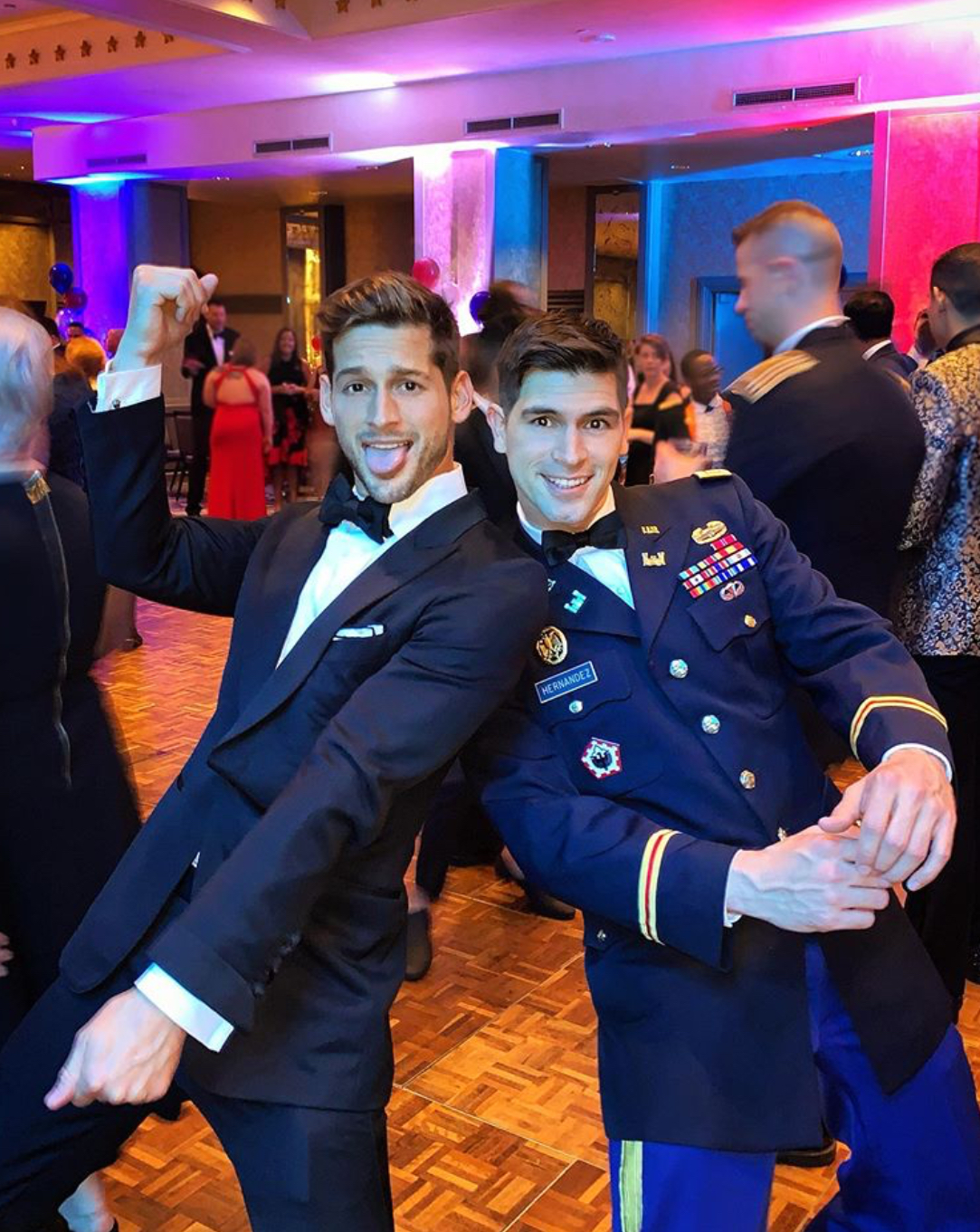
American model and actor Max Emerson and his boyfriend, Army veteran Capt. Andrés Camilo, at the American Military Partner Association National Gala, 2019*

While military service often demands sacrifices from those in uniform, historically, LGBTQ+ veterans have faced a unique set of challenges. Many of these veterans, following a call to serve, meant keeping their private lives entirely private, fearing that exclusionary policies would hold them back or end their careers altogether. There are an estimated 1 million lesbian, gay, bisexual, and transgender veterans in the United States. 

LGBTQ+ soldiers have always been part of the American military. In an era before gay marriage or open pride, military men fell in love, formed passionate friendships, and had same-sex encounters. Due to social and official discrimination, though, most of their stories have gone untold. But in the case of one of the military’s founding heroes, homosexuality was always part of the story. Baron Friedrich von Steuben, a Prussian military man hired by George Washington to whip the Continental Army into shape during the darkest days of the Revolutionary War, is known for his bravery and the discipline and grit he brought to the American troops. Historians also think he was homosexual—and served as an openly gay man in the military at a time when sex between men was punished as a crime. Benjamin Franklin recommended von Steuben to Washington and played up his qualifications. He also downplayed rumors that the baron had been dismissed from the Prussian military for homosexuality.

Von Steuben may have been one of early America’s most open LGBTQ+ figures, but he was hardly the only man whose love of other men was well known. And though he was to have helped save the American army, his contribution is mostly forgotten today. Even with an exception like von Steuben, few LGBTQ+ service members have served openly in the military until recently. However, exceptions were always made for LGBTQ+ individuals as long as they generally remained discreet and deemed useful to the US military. Since the Revolutionary War, homosexuality was grounds for discharge from all US military branches until 2010. During World War II, the military began enforcing specific policies based on sexual orientation. Homosexuality was a disqualifying trait as soon as the military added psychiatric screenings to its induction process. During the war, the blue discharge became the “discharge of choice” for homosexual service members — which, though neither honorable nor dishonorable, prevented former service members from utilizing the GI Bill and held extremely negative connotations, often preventing veterans from integrating back into civilian life.

Still, LGBTQ+ individuals continued to serve while in the closet. After World War II, members of the Mattachine Society, one of the earliest LGBT (gay rights) organizations in the United States, protested the US policy against gays serving in the military. They believed they should be able to serve their country in any capacity, whether it be in government or the military. They felt that service in the military would lead to more acceptance for gay men. However, that would change during the Vietnam War. Young gay men rebelled against early organizations like the Mattachine Society. Young gay men had to choose whether to reveal or conceal their homosexuality when they came before the draft board because with the draft board being composed of local citizens, this could mean being outed to friends, neighbors, or parents. The dilemma faced by gay youths polarized the gay liberation movement, and young gay men joined in on the antiwar protests. With the Vietnam War and the draft still very much a reality, gay rights groups turned their backs on the issue of military service because they did not want to be drafted. However, the government also turned their backs on the ban and forced many gay men who were drafted to serve, deciding that they needed the manpower more than they needed to uphold the ban on military service. When personnel shortages occurred, the US military was all too happy to allow LGBTQ+ individuals to serve, particularly gay men. 

The LGBTQ+ rights movement in the 1970s and 1980s once again changed positions and advocated for LGBTQ+ individuals to serve in the military. They raised the issue by publicizing several noteworthy dismissals of gay service members. Sgt. Leonard Matlovich appeared on the cover of Time in 1975. In 1982, the Department of Defense issued a policy stating, “Homosexuality is incompatible with military service.” It cited the military’s need “to maintain discipline, good order, and morale” and “to prevent breaches of security.” In 1988, in response to a campaign against lesbians at the Marines’ Parris Island Depot, activists launched the Gay and Lesbian Military Freedom Project (MFP) to advocate for an end to the exclusion of gays and lesbians from the armed forces. 

In 1989, reports commissioned by the Personnel Security Research and Education Center (PERSEREC), an arm of the Pentagon, were discovered in the process of Joseph Steffan’s lawsuit fighting his forced resignation from the US Naval Academy. One report said that “having a same-gender or an opposite-gender orientation is unrelated to job performance in the same way as is being left- or right-handed.” Other lawsuits fighting discharges highlighted the service record of service members like Tracy Thorne and Margarethe (Grethe) Cammermeyer. The MFP began lobbying Congress in 1990, and in 1991 Senator Brock Adams (D-Washington) and Rep. Barbara Boxer (D-California) introduced the Military Freedom Act, legislation to end the ban entirely. Adams and Rep. Pat Schroeder (D-Colorado) re-introduced it the next year. In July 1991, Secretary of Defense Dick Cheney, in the context of the outing of his press aide Pete Williams, dismissed the idea that gays posed a security risk as “a bit of an old chestnut” in testimony before the House Budget Committee. In response to his comment, several major newspapers endorsed ending the ban, including USA Today, the Los Angeles Times, and the Detroit Free Press. In June 1992, the General Accounting Office released a report that Congress members had requested two years earlier, estimating the costs associated with the ban on gays and lesbians in the military at $27 million annually.

During the 1992 US presidential election campaign, the civil rights of gays and lesbians, particularly their open service in the military, attracted some press attention, and all candidates for the Democratic presidential nomination supported ending the ban on military service by gays and lesbians. Republicans did not make a political issue of that position. In an August cover letter to all his senior officers, Gen. Carl Mundy, Jr., Commandant of the Marine Corps, praised a position paper authored by a Marine Corps chaplain that said that “In the unique, intensely close environment of the military, homosexual conduct can threaten the lives, including the physical (e.g., AIDS) and psychological well-being of others.” Mundy called it “extremely insightful” and said it offered “a sound basis for discussion of the issue.” The murder of gay US Navy petty officer Allen R. Schindler, Jr. on October 27, 1992, brought calls from advocates of allowing open service by gays and lesbians for prompt action from the incoming Clinton administration.

President Bill Clinton campaigned in 1992 on the promise to allow all citizens to serve in the military regardless of sexual orientation. Clinton called for legislation to overturn the ban but encountered intense opposition from the Joint Chiefs of Staff, Congress members, and portions of the public. Don’t Ask, Don’t Tell (DADT) emerged as a compromise policy. On December 21, 1993, the Clinton Administration issued Defense Directive 1304.26, which directed that military applicants were not to be asked about their sexual orientation. The full name of the policy at the time was “Don’t Ask, Don’t Tell, Don’t Pursue.” The “Don’t Ask” provision mandated that military or appointed officials will not ask about or require members to reveal their sexual orientation. The “Don’t Tell” stated that a member may be discharged for claiming to be a homosexual or bisexual or making a statement indicating a tendency towards or intent to engage in homosexual activities. The “Don’t Pursue” established what was minimally required for an investigation to be initiated. A “Don’t Harass” provision was added to the policy later. It ensured that the military would not allow harassment or violence against service members for any reason.

Fast-forward to the 2008 US presidential election campaign. Senator Barack Obama advocated a full repeal of the laws barring gays and lesbians from serving in the military. Nineteen days after his election, Obama’s advisers announced that plans to repeal the policy might be delayed until 2010 because Obama first wanted “to confer with the Joint Chiefs of Staff and his new political appointees at the Pentagon to reach a consensus, and then present legislation to Congress.” As president, he advocated a policy change to allow gay personnel to serve openly in the armed forces, stating that the US government has spent millions of dollars replacing troops expelled from the military, including language experts fluent in Arabic, because of DADT.

In December 2010, the House of Representatives and the Senate passed a bill repealing DADT, and President Obama signed the repeal into law on December 22, 2010. Restrictions on lesbian, gay, and bisexual service members ended in 2011. In 2016, the Obama Administration lifted the ban on transgender people serving in the military. However, under the Trump administration, transgender individuals have been banned from serving in the military. On July 26, 2017, Trump announced on his Twitter page that transgender individuals would no longer be allowed “to serve in any capacity in the US Military.” At the time, close to 15,000 transgender troops serve in the military, and Trump’s ban was denounced by former military leaders, Members of Congress from both parties, and the American Medical Association. 

For 234 years, the United States had anti-LGBTQ+ policies that prevented many thousands of brave, talented soldiers, sailors, and marines from stepping up to serve in national defense. Lesbians, gays, and bisexuals can now serve openly in the military, and once the Biden administration enters office, transgender individuals will once again be able to serve in the military. Just as we owe so much to heterosexual servicemembers, LGBTQ+ service members have not only sacrificed their lives for this country but, for most of its history, had to serve in silence. On this Veterans Day, let us not forget the millions of lesbian, gay, bisexual, and transgender veterans who have served in the United States military.

*The nation’s largest LGBTQ military event of the year, the American Military Partner Association National Gala celebrates and honors our modern military families for their service and sacrifice.