
Monthly Archives: March 2021

A Very Busy Thursday

Yesterday, I had my first COVID vaccine shot (Pfizer, if you’re wondering—I have faith in the Pfizer vaccine. They made Viagra after all. If they can raise the dead…they can save the living. 🤣). I got my vaccine at Kinney Drugs here in Vermont. It was so incredibly disorganized. I had been in a CVS the other day, which is also giving the vaccine. CVS was much more organized with a table just as you walk in to check people in and then a little cordoned-off place to give the shot. At Kinney Drugs, I had to ask someone where to go, and they directed me to the pharmacy counter. Once I made my way to the counter, I then stood in line forever, although there were only two people in front of me, and one of them was only transferring a prescription from Walgreens. Once I finally got to the front of the line, they took down again all the information I had filled out to get the appointment in the first place. My appointment was at 11:30, and it took about 20 minutes just to get checked in. I spent another 20 minutes waiting to be called back for the vaccine. Once I got the vaccine, I was given a 15 minute time to sit and wait to see if any side effects appeared. Once the timer went off, I was free to leave.

The vaccine shot was a bit more painful than a flu vaccine, but probably not as bad as the pneumonia vaccine. It was nowhere near as painful as the Emgality shots I used to take for my migraines. I did feel a bit flushed afterward for a few minutes. My face felt hot, and so did my arm, but it only lasted a few minutes. So far, I have experienced no other side effects. My arm wasn’t even sore last night unless I pressed on it. I am scheduled to take my second shot on April 15 and will be considered fully vaccinated two weeks later, on April 29. At least I know what to expect next time. I know this process was much better than the hours my parents sat in their car waiting in line for four or five hours to get their shots.

I also had to get my weekly COVID test for my university, which has become a pretty routine thing at this point. We just walk in and register, which involved giving our name and showing that we have the all-clear email from the university’s daily screening system. We then walk to a table where we are told to remove our masks and blow our nose. Then we put our masks back on, sanitize our hands, and move to the next available testing table. We are given a vial with our name and information on it and a cotton swab. We then move to the end of the table, take off our mask, swirl the swab around each nostril five times, and put it in the vial. Then we put our masks back on and once again sanitize our hands before leaving. I should receive my results sometime tomorrow.

It was a busy day, not just because I got the COVID vaccine and test. Wednesday night, the tooth that I had the root canal began to hurt worse than it had been hurting. It’s always been sensitive since the root canal, but it had started to be painful in the last several days, in addition to being sensitive. I called my dentist’s office, and at first, they just prescribed an antibiotic and set up an appointment for April 1. Luckily, they called back because they had a cancellation and could get me in at 3:15. I took the appointment right away. He took an x-ray and tapped around on my teeth and did some bite tests. He believes a crack in that tooth that would not show up in an x-ray is causing a recurring infection there. I discussed with him my trigeminal neuralgia diagnosis from my neurologist and what prescriptions I am on for that. He believes the tooth is aggravating my trigeminal nerve and that I don’t have full-blown trigeminal neuralgia. He said that if there is improvement after taking the antibiotic, he believes the tooth may be a significant part, if not the primary cause, of the pain I’ve been experiencing on the right side of my head. He said if the pain lessens in the tooth, he wants to extract the tooth in hopes that it will relieve the pain. 

I messaged my neurologist with what my dentist said, and I am waiting to hear back from her. She and I had discussed the tooth being the cause of the trigeminal neuralgia and what started this pain in the first place. I hope that she and my dentist can get to the bottom of this nerve and tooth pain. I desperately need relief. I have seen very little relief from the medicine prescribed for the trigeminal neuralgia, and the pain has been pretty constant. Since this whole thing began back in November of last year, the pain has always felt different from migraine pain, but it all started at the same time this tooth became abscessed. Now, I have to wait for what my neurologist says and if the antibiotic causes any improvement.


Pic of the Day


The Problem with Bottom Shaming

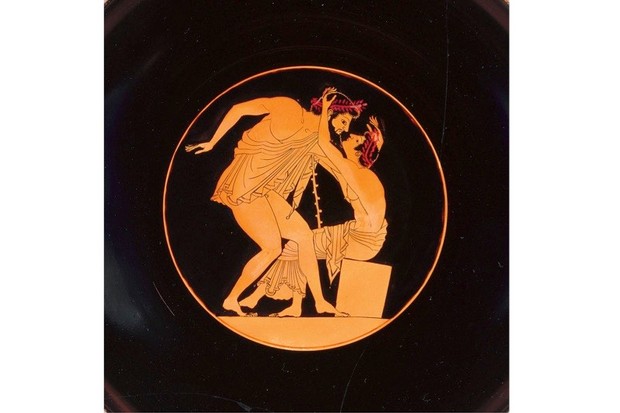
An Athenian red-figure kylix (cup) dating from around 510–500 BC depicts a young pentathlete pulling his older lover towards him for a kiss. In many of the city-states of ancient Greece, sex between a man and a youth was an accepted – even idealized – form of love, its virtues extolled in works by writers including Plato.

In Ancient Greece, some philosophical reflections even idealized same-sex love. We can find notable examples in the Symposium, the philosopher Plato’s description of an intellectually high-powered Athenian dinner party. One character, Phaedrus, extols the virtues of manly, same-sex love among warriors and legislators: “And if there were only some way of contriving that a state or an army should be made up of lovers and their loves, they would be the very best governors of their own city, abstaining from all dishonor, and emulating one another in honor; and when fighting at each other’s side, although a mere handful, they would overcome the world.” This, allegedly, was the inspiration for the Sacred Band of Thebes, comprising 150 pairs of male lovers, which fought heroically at the battle of Chaeronea in 338 BC before succumbing to the overwhelming forces of Philip II of Macedon.

Another dinner guest at Plato’s imagined symposium, Pausanias, contrasts “base” love (with women and boys) as merely for sexual gratification and therefore inferior, with “noble” love (with young men). The latter, he says, is “pure” and about instilling guidance and wisdom in a pedagogical relationship rather than sex. This rationalization of same-sex love, whether platonic or carnal, had an extraordinary resilience in western societies over the next couple of millennia and beyond. Take, for example, the famous defense by Oscar Wilde at his trial for sodomy and gross indecency in 1895: “The ‘love that dare not speak its name’ in this century is such a great affection of an elder for a younger man as there was between David and Jonathan, such as Plato made the very basis of his philosophy, and such as you find in the sonnets of Michelangelo and Shakespeare… It is beautiful, it is fine, it is the noblest form of affection. There is nothing unnatural about it.”

Throughout history, the receptive/penetrated partner in male same-sex relationships has often been seen as the lesser person in the relationship. One of the most famous examples of bottom shaming is Julius Caesar, who has often been portrayed as a macho, militaristic, elite Roman leader. Much of that masculine power revolved as much around his ability to demonstrate his sexual prowess (think Cleopatra) as it did around political prowess. However, his contemporary political rivals saw this masculinity differently and often commented on such. Julius Caesar was nicknamed the “bald adulterer,” which fit the Roman political stereotype perfectly by sleeping his way to power. As a young man, he spent a considerable amount of time at the court of King Nicomedes of Bithynia, fueling a series of rumors about an affair in which Caesar was the submissive party. His return to Bithynia just a few days after leaving to “collect a debt” further fanned the flames. Suetonius tells us that this was the only stain on Caesar’s masculinity. But it was a stain that proved difficult to wash out, and he would be reminded of it throughout his prematurely ended life. One colleague, Bibulus, addressed Caesar as “the queen of Bithynia.” During an assembly, a man named Octavius hailed his co-consul Pompey as “king” and Caesar as “queen.”  

Male sexuality and sexual masculinity have been defined throughout history by the role played by the receptive partner. Women have been seen by most of world history as the weaker sex, and because they take on the receptive role in sex, a man who is the penetrated partner for another man is seen as less of a man. A gay man’s position in the bedroom can extend to how he’s perceived in the LGBTQ+ community. Bottoms, those who are the receptive partner, are often not afforded the respect they deserve. Bottoms deserve a lot more respect than they usually receive. All too often, the terms “bottom” and “submissive” are used interchangeably. However, not all bottoms are submissive. Some bottoms can be quite aggressive, thus the term “power bottom.” 

Even versatile men can have a more submissive side because they may prefer those who bottom for them to be more aggressive, but versatile men may also like those who top them to be more aggressive. The opposite can also be true: a versatile gay man who is more dominant may prefer more submissive bottoms and to take control of sex when they are the bottom. Then there are the “strict tops” who refuse to bottom no matter what. These men are often the least respectful of bottoms, and “strict bottoms” may often feel (or be perceived as) inferior to tops for being the receptive partner. The dichotomy of the top/bottom relationship needs to be more respectful for both positions.

Most tops do not consider that being a bottom takes a lot of preparation before engaging in anal sex—something a top benefit from but seldom worries about. The idea of spontaneous sex might sound like a thrill, but it is an unrealistic fantasy of the gay community seen in depictions of gay life from m/m romance novels to gay porn. We don’t want to think about all the preparation available. It’s similar to something I once read about Henry James’s novels that no one ever goes to the bathroom in his novels, though that is true of most novels. However, for a bottom who hasn’t prepared for sex, it can be a stressful and uncomfortable experience. To avoid any awkward mishaps during sex, most bottoms will prepare for it—even if there’s only a tiny chance, they might have sex that day. Even with the most preparation and precautions taken, most bottoms will still hope and pray the entire time that no accidents happen.

Furthermore, it should come as no surprise to anyone that anal sex can be painful at times, and it can take a lot of getting used to before it becomes a fully satisfying sexual experience. When it’s been a while, it’s literally like sticking your finger in a Chinese finger trap, and we all know that isn’t the most enjoyable thing. Most gay men will prepare themselves for bottoming ahead of time. Still, if they don’t know their partner’s penis size, this could make the experience more satisfying if he has a larger than average girth but might be less enjoyable if his penis is less girthy. There is a lot to consider and be prepared for, but it’s also a gamble if you don’t know what to expect. A bottom might ask for “Size?” or “Pics?” from a potential partner while chatting online. Those are not just questions for size queens; they can also be a question so that the bottom can be more prepared for the top. Many men will just see those questions as crude, but the bottom may just be trying to prepare for a better experience for the top.

In the gay community, bottoms are still seen as the more feminine ones. Bottoms are looked at as less than tops in the community. If you doubt this is true, then ask yourself, when was the last time you heard someone refer to a “top” in a derogatory way. Gay men often have insecurities about being labeled a bottom because the gay community all too often engages in “bottom shaming.”  Why is this the case? It goes back to historical perceptions of gay sex which ingrained in men the idea that the receptive partner was lesser: either they were the younger partner, a slave, etc. Achilles and Patroclus were an example of this, while the exception was the relationship between Alexander the Great and Hephaestion. Yet, even with Alexander, all of his male lovers were not equal, such was the case with another of his favorite sexual partners, Bagoas, a eunuch “in the very flower of boyhood.” It’s a stereotype that we must work to change.

The fact is your sexual preference be it top, bottom, or versatile, doesn’t mean a damn thing when it comes to your masculinity. We should be proud if we are a bottom, a top, or a bit of both. We should be proud of our sexuality and not get bogged down in roles because why does it matter? You need to realize it doesn’t matter, and we are all a part of the same community and should uplift each other instead of trying to tear each other down. Tops come in all shapes and sizes, including short guys and feminine guys. Plenty of drag queens out there are tops. Don’t assume someone is a top or a bottom because of the way they present or because of their size. There are also plenty of well-endowed bottoms, and while many of us may find that a waste of a good penis, we should respect their preferences. It boils down to each of us respecting one another.


Pic of the Day


The Harm of “Masc4Masc”

……………………………………………. IYKYK …………………………………………….

From the moment we leave the womb, we are indoctrinated with ideas about what gender means. Real men don’t cry. They don’t ask for help. They don’t back down from a fight. Our culture teaches masculinity in ways both subtle and overt, through schoolyard taunts and gendered bathrooms. It carries over to sports, the gym, fraternities, and other male-only spaces. The result of this relentless social conditioning is that every gay man inherits an identity crisis: we must reconcile our sense of masculinity with our inability to conform to the world’s inherent enforced heterosexuality. While some resolve the conflict by rejecting gender norms altogether, a surprising number embrace the very customs they fall short of, striving to embody cultural notions of masculinity in how they speak, act, and dress. This is particularly true when it comes to dating.

In the gay community, a sexual premium is placed on masculinity, which puts pressure on gay men to be masculine. Dating (hook-up) apps often feature ads saying they are looking for “Masc4Masc” or describe themselves as “straight-acting.” More feminine-acting men are seen as less desirable sexual partners for these men. In one 2012 study about gay men’s attitudes toward masculinity, a majority of those surveyed said it was important not only for themselves to present as masculine but for their partners to look and act masculine as well. Other studies have found that gay men are more attracted to masculine-looking faces and muscular builds. The more masculine one rates oneself, the greater importance one places on masculinity in his partner.

I remember as a child being made fun of because I liked to play with the girls or that I walked with a swish or used my hands to talk. These were seen as feminine, but there was the unspoken belief that if others derided me for that behavior, I’d conform to the masculine ideal. I remember my father even made me play flag football during recess because that’s what all the other boys did, even though I hated it and felt uncomfortable playing football. He did not care. When I reached puberty, and my voice changed, it did not become very deep, and I was often made fun of for the way I talked. Other boys used to mock me with an over-effected gay voice. I spent most of my life in school trying to avoid being seen as feminine or gay. While some may dismiss the reverence of masculinity among gay men as “just a preference” or the ridicule of less than masculine men, both have been documented to have adverse mental health effects. Gay men who are more gender-nonconforming struggle more frequently with self-esteem and experience higher levels of depression and anxiety. Those who prize masculinity are more likely to be dissatisfied with their bodies, gestures, and voices.

A primary reason people in the LGBT community have more mental health issues is not only because they experience higher levels of marginalization from society at large but also because of the intense pressure to be, look, and act in a masculine way. However, there is also the larger issue of this social exclusion happening within the queer community itself. We’re judging and excluding one another because of perceived gender roles. Gay culture’s obsession with masculinity hurts both masculine and feminine men alike. Even gay men who endorse their own masculinity feel a degree of uncertainty about whether they are manly enough in the way others see them. There is a certain feeling that they will never be masculine enough.

While such feelings are most common earlier in the coming-out stages, masculine norms continue to affect gay men’s sense of self long after they’ve come out. Many gay men want to fit in and be seen as “normal,” not different. If you pay attention to gay social media personalities, you may notice that the strict division between masculine and feminine appears to be blurring. A majority of Millennials believe gender falls on a spectrum, and a survey from queer-rights organization GLAAD showed 12 percent of this generation identifies as gender non-conforming. Take, for example, the social media personality Tate Hoskins, who has grown in popularity by blurring the gender norms for young men by switching from an ultra-masculine country boy to a femme boy in a French maid outfit and cat ears. He’s taken a lot of flak for embracing a non-gender conforming attitude. Still, he continues to stay positive and have his message heard by his nearly 754K followers on TikTok and his close to 30K followers on Instagram. The following video has more than 2 million likes and has been viewed by many more:

Gay men know instinctually that that masculinity is fluid. Even the most “straight-acting” gay man can’t call everyone “bro” all the time. All gay men engage in code-switching, butching it up in a job interview but letting themselves “queen out” at the weekly Drag Race gathering. Much of this variation in behavior stems from a desire to avoid negative social repercussions from society at large, but gay men also tend to put on their straight faces to be more appealing to other gay men. As young people push the boundaries of gender, an increasing number of gay men feel comfortable questioning gay culture’s idolization of traditional masculinity—and the notion that desire is bound by it. It would take a whole new series of posts to discuss the gay obsession with straight men. In gay romance, you sometimes see the trope of the straight man who falls for a gay man either only to realize he was always gay or that he is gay for just one man. Then there is the genre of gay porn that uses gay for pay actors to get viewers or the gaybaiting of the bromosexual culture. Straight men can be a nice fantasy, but a diversity of gender norms (or lack thereof) can all be found within the gay community.

We should respect the diversity of the gay community more and quit looking outside our community for what is considered normal. Too many gay men only want a masculine, fit top with a large penis. Other gay men have an obsession with the myth of a six-pack gay (a straight man who will go gay after a six-pack of beer). It’s all unhealthy. And while some men exist out there who are very masculine, have a perfect body, and possess a huge dick, they are few and far between, and it’s an expectation that is found more often in porn than in real life. We need to look more for what is in a man’s heart than his outer appearance, whether that is his body, fashion sense, or mannerisms. 

_________

Tomorrow, I will discuss how bottom shaming has hurt gay men throughout world history.


Pic of the Day


A Prayer in Spring

A Prayer in Spring
By Robert Frost

Oh, give us pleasure in the flowers to-day;
And give us not to think so far away
As the uncertain harvest; keep us here
All simply in the springing of the year.

Oh, give us pleasure in the orchard white,
Like nothing else by day, like ghosts by night;
And make us happy in the happy bees,
The swarm dilating round the perfect trees.

And make us happy in the darting bird
That suddenly above the bees is heard,
The meteor that thrusts in with needle bill,
And off a blossom in mid air stands still.

For this is love and nothing else is love,
The which it is reserved for God above
To sanctify to what far ends He will,
But which it only needs that we fulfil.

Robert Frost’s “A Prayer in Spring” is a prayer in poetic form giving thanks and gratitude to God for the blessing of spring. The poem shows how spring is an expression of God’s love. The poet reminds us to give a prayer of thanks for receiving the happiness and pleasure that we experience in springtime because we are given spring as a gift from God. We should remember the present beauty and indulgence of spring and not think of the unpredictability of the future because the future is God’s secret. 

The overall theme of “A Prayer in Spring” is an expression of God’s love. Frost wants us to trust in God completely even during spring or times of change. God brings us the beauty of spring, and He has given us everything to reach Him and to ask for His guidance. Frost offers an uncomplicated prayer to God in this poem, focusing on love and gratitude that is traditionally on display during the season of Thanksgiving. As the poet prays to God, he is also inviting his audience to become as delighted in “the springing of the year” as they do in the later harvest which happens in autumn—two seasons away from spring.


Pic of the Day


Pic of the Day


Take Back the Conversation

He who does not love does not know God, for God is love.

—1 John 4:8

When I began accepting my sexuality, I did what I think many of those raised in a strict Christian environment did; I read everything I could about homosexuality in the Bible. I soon began to look at the deeper analyses of the original text of the Bible and the context surrounding the texts used to condemn homosexuality. I learned that the New Testament had nothing in it that condemned being gay and that there were many mistranslations of the Bible. As I historian, I began to study the Old Testament passages such as Leviticus 18:22 and Leviticus 20:13. Why were those passages in the Old Testament? Historically, civilizations, such as the Ancient Hebrews who were most concerned about population growth, condemned homosexuality. The laws of Leviticus mainly pertain to issues to promote health and population growth. Per-Christian civilizations, such as Ancient Greece who had a greater acceptance of homosexual practices, did not worry as much about population growth, and often had people to spare and colonized surrounding lands.

I studied all of these issues because I wanted to be able to explain, backward and forward, how I could “justify” being gay with the Bible, especially to my mother. I wanted to be able to answer every question and accusation. I wanted to be confident and secure. I wanted there to be no question in my mind and to be able to erase every question in my mother’s mind. I believed the Bible was my shield, my protection, to be used to defend myself from those like my mother who would use the Bible as a weapon. I wanted to protect myself.

I did not face the real issue (my own acceptance of myself) because I was too worried about what others would think of me. The perception of others caused a great deal of fear, depression, and hiding, and it took me years to change my thinking about that. I let other people lock me in a closet. Eventually, it took moving 1,400 miles from my family to a state where I made friends who accepted me unconditionally, before I could accept myself and stop worrying so much about what others thought. I realized that I shouldn’t have let other people set the rules of my sexuality and life. Not only that, I would never be able to change the minds of people like my mother, even if I possessed the perfect argument. Maybe one day, if I find a partner, my family will change their mind and accept me for the way God created me. But, I doubt it.

I no longer have to ask myself: “How do I explain my faith and my sexuality to people?” “How do I justify being gay?” I was raised in the Church of Christ, a church that believed their way was the ONLY way. All others who were not members of the Church of Christ were destined for Hell. The issue I had with that is I knew people who were very good people, like my maternal grandfather, who was not a member of the Church of Christ but a Baptist. I could never believe that he was going to Hell just because he did not belong to a particular congregation. It was more about if you were a good person, not the church you belonged to. Also, billions of people live on this earth who are not Christian but are good people, and billions have lived through history that never even heard of Christianity. Surely God did not mean that all of them went to Hell. I realized that there isn’t just one way to be a Christian, nor is Christianity the only path to salvation. The Bible does not have a monopoly on morality, and there are many different interpretations of the Bible. Throughout the centuries, in other countries, and in all of the various churches, there is a diversity of beliefs, thoughts, and practices that fall under Christianity’s very large banner.

We don’t have to defend ourselves against the hatred of those who pervert the meaning of the Bible. They are making the best argument against their own beliefs when they show their hatred, ignorance, and disgust because at the same time they ignore 1 John 4:8, “He who does not love does not know God, for God is love.” He who does not love does not know God: nine essential words that hold the essence of all the 783,137 that comprise the Bible. We don’t have to allow other people to set the limits of conversation or define acceptable discourse. We can simply walk away when the conversation makes us uncomfortable knowing our righteousness. We can prioritize our emotional and mental health over and above answering every question asked of us. “God is love, and your hate-filled beliefs go against God” is an acceptable answer in my book. It’s all that needs to be said, if you choose to say anything at all.

We also have the option to change the conversation to one about love and acceptance. Instead of letting someone else define how the conversation goes, we can tell them how our faith makes us feel, how it gives us life, and how it changes the way we live. Tell a story of how God has deepened your faith because of being gay. I know I understand my faith a lot more since I began studying the scriptures instead of just listening to a preacher every Sunday. The story of the Bible is our story, too. No one gets to define our faith for us. Our relationship with God is a personal relationship that no one can define for us. Religious leaders want to define that relationship because that gives them power over you and others. They are just men. They don’t have any relationship with God that is more special than your relationship with God.

Most anti-LGBTQ+ religious leaders will likely never understand or change, even if God appeared in a giant glowing light and told them they were wrong. Recently, the Family Research Council, an anti-LGBTQ+ hate group that serves as the lobbying arm of the religious right, describes LGBTQ+ people as “unnatural” and “immoral” in a message to supporters. They reminded recipients at the beginning of the message of a Bible verse that commands followers to kill gay people. David Closson, FRC’s Director of Christian Ethics and Biblical Worldview said, “The apostle Paul explains that humanity has rejected God, exchanging the truth about Him and the things He created for a lie.” Sadly, he is likely never to realize that Paul spoke of people like him who have rejected God’s unconditional love. Groups like the FRC and others like them are likely to ramp up their hateful rhetoric as the Equality Act is discussed more. They will become apoplectic if it passes. However, it’s time we stop allowing these people to control the conversation. It’s time we start telling our own stories in our own way.

We have to quit separating ourselves from religion and instead change the conversation. We have to oppose their hate-filled use of Christianity with the truth of God’s love. It is the only way we can take back the conversation. The religious right has strayed so far from God’s message that we cannot create the world Jesus was brought to this earth to save until we take back the conversation.