

Monthly Archives: May 2021
Benevolent Hatred

I grew up being taught that “If you don’t have something nice to say, don’t say anything at all.” Although, I prefer what Clairee Belcher (Olympia Dukakis, may she rest in peace) said in Steel Magnolias, “Well, you know what they say: if you don’t have anything nice to say about anybody, come sit by me!” 😂 I try to be a nice person, but sometimes, the gossipmonger in me comes out. I think it’s part of being a southerner. We love to gossip, which is often one of the worst things about the South. I grew up around people who never wanted to show outward hatred to anyone. Yes, in private, they would say horrible things about people, and they would often discriminate against people subtly, or sometimes not so subtly. They always wanted the outward appearance of being nice. That outward appearance was far more important than actually being kind. A kind person is loving and giving out of the goodness of their heart. Nice people often just want to avoid conflict at any cost. Charlie Ray, a gay Birmingham, Alabama, TikToker says it better than I can:
In the South, there are a few phrases that are meant to be nice, but are often anything but kind: “Bless your heart” and “Aren’t you precious?” Bless your heart as a phrase has multiple meanings. It can be used as a sincere expression of sympathy or genuine concern. It can be used as a precursor to an insult to soften the blow. It is also sometimes used to mean “you are an idiot, but you can’t help it” by individuals who wish to “be sweet” and do not wish to “act ugly.” It can also be a “pleasant” way of saying, “Fuck you.” I once heard that it was like aloha in Hawaii, there were many meanings according to the context. I think only true southerners can really interpret the meaning of how it’s being used at the moment. Then there is Aren’t you precious? Although this phrase sounds like a question, it can genuinely be a statement to compliment something cute or sweet. It’s usually intended as an interjection and generally in reference to a child’s outfit or behavior. But in the South, beware. If you hear someone saying, “Well aren’t you precious?” it’s probably being said sarcastically. It’s a phrase usually said if someone has said or done something you find stupid or insulting. The same goes for the phrase of calling someone “sweet.” When you see a baby that is just not attractive, I’ve often heard, “Well, isn’t he/she so sweet?” It means that the person did not want to say, “How beautiful!” or “What a pretty baby!” but they couldn’t outright say, “OMG! What an ugly child!” My mother used this one a lot.
One of the hardest things to handle when I lived in the South was when people were nice to me, but they never really accepted me because either they knew I was gay or perceived I was gay. They would hug me when I saw them. They’d ask about my day or my life and mean it. They would welcome me over for dinner and make sure I got more than enough to eat. They’d laugh with me (though often you could sense they were laughing at you). However, no matter how nice or kind they acted, they never accepted me. I remember one time I mentioned that I thought a guy was attractive (this was amongst a group that I was out to), and the husband of a friend of mine said, “I don’t have a problem with you being gay, I just don’t want to hear about it.”
It’s hardest when they are kind because then when they are not kind it cuts more deeply. When they ask about your life but then you see the tense jaw and the pursed lips as you answer. Even when you are telling about something that is incredibly important to you or that you are passionate about, they have a hard time actually feigning interest. You can see their tension if it goes against what they deem appropriate, proper, and/or Christian. They might respond with a “that’s nice” but you know they are thinking it’s anything but nice. Then, the next time they ask about your life you are more careful. You tell the sanitized version. You leave some stuff out. I did this a lot. When I felt someone’s judgement of me or was told I told too much (that they did not want to hear), then I’d censor myself around them from that point onward. It kills you a little bit each time it happens, each time you have to censor yourself. It wears away at you when they are nice because it’s harder to say, “Your behavior hurt me.” They will almost always say they didn’t mean to hurt you; they were just sharing their beliefs. Often, they will claim that you are being too sensitive.
Later on, when they realized that they missed a big part of your life, they might even call you dishonest. They will say you left too much out, that you deceived them. They will say that you are the one who shut them out of your life. They will never realize that they are the ones who set the boundaries on the acceptable conversation and behavior with their non-verbal gestures, with their snide comments back, with their clear disapproval. They will say that you hurt them, or you made them feel excluded. They tell you they love you and want to be in your life. Then we often try again to let them into our lives, but we get the same response, and it hurts even more this time. They will often claim you were the one who caused the rift. You weren’t respecting their feelings or beliefs. They will claim that you weren’t willing to compromise. Even though, for years, you were the only one to always compromise and kept your mouth shut and acted the way they wanted you to act. I have spent nearly forty years denying myself happiness because I spent so much of my life hiding parts of myself from my family.
Maybe you are someone who sits alone on a holiday or misses out on a family gathering because you simply cannot bear to go and hear people force you to be someone you are not for one more holiday. You cannot bear to smile even though you want to be weeping. You cannot bear to keep so much of yourself hidden. You become the one who is alone, and you feel like you are punishing yourself, when it is they who are punishing you. Maybe you know you did the right thing to save your sanity, but it still feels like you are the one being punished. For many of us, we realize that whenever we meet someone new, it’s their voice you hear in your head telling you that you aren’t worthy of love. But it’s a subtle voice with kind tones. This is benevolent homophobia. In racism, it’s akin to paternalism. People in positions of power restrict the freedom and responsibilities of those subordinate to them in the subordinates’ supposed best interest. The same is true of homophobia, they want to save us from ourselves by imposing their twisted beliefs of what they believe the Bible says to force us to conform to their twisted morality. Some people do this with “kindness,” but it is veiled hatred, and we cannot pretend it’s not.
Two Scenarios
For the past several months, when I have gone to my local pharmacy, I’ve noticed that they hired a new pharmacy tech. Most of the people who work at the pharmacy are women, including the two pharmacists, but they recently hired a male pharmacist and a new male pharmacy tech. The new tech is very cute. I’ve seen him around town a few times, and it always takes me a minute to remember where I know him from. I doubt that will be a problem after yesterday. So, my two scenarios start the same way. I went into the pharmacy to get some prescription refills. The new pharmacy tech got my prescriptions and checked me out at the register. When he got to the register, he said, “I see you every morning at Cumby’s.” (Cumby’s=Cumberland Farms convenience store.) I saw him in there Tuesday morning getting coffee as I was getting an iced coffee before going into the museum. I may have seen him in there once before, but I rarely go to Cumby’s in the morning. It’s the opposite way of the university. Then we had a short conversation about seeing each other out and about and what the weather was like outside. While everyone at the pharmacy is very nice, some are more talkative than others. He has never been particularly chatty to customers and is generally busy filling pill bottles. So, it was not only unusual for him to wait on me, but that he was so talkative. So, which scenario do you think is correct?
Scenario #1
Guys generally don’t flirt with me a lot, but he was more than a little flirty yesterday. You really can’t tell when someone has on a mask, but you can tell a lot about someone’s eyes. He seemed a little excited, so I am wondering was he flirting. Should I go by Cumby’s a few mornings to see if he flirts more there? Maybe I just have an overactive (and hopeful) imagination.
Scenario #2
He was just being nice. He saw me the day before, and now I was in the pharmacy, so he may have just been making conversation. This pharmacy has always been very friendly, so I don’t think they’d have hired someone who was not pleasant with the customers. So, maybe he was just being nice, but he’s never really paid any attention to me before yesterday. He seems to have noticed me at Cumby’s, so who knows?
How would you take it? Would you do anything? Maybe I am just deluding myself into thinking he was being anything more than just nice. It’s a small town. People see each other around town all the time. Besides, he’s probably out of my league and too young. He looks to be in his late twenties.
P.S. This post is all in fun. While this did happen, I don’t really think there is a possibility he was flirting with me. I think he was just being friendly to a customer, but it’s nice to daydream occasionally.

Return of Warmer Weather

As I said on Monday, I hate the heat. Vermont can get hot and humid in the summer. Vermont has warm and humid summers with average high temperatures of 75°F to 82°F in the peak of July. In contrast, Alabama summers have average high temperatures above 90°F and are among the hottest in the United States. Mississippi was just as hot and humid. Vermont usually only has a few days each year when the heat and humidity can be oppressive. Most people here don’t have air conditioners. I tried to live without an air conditioner for the first few years I lived here, but I just couldn’t take it. During those years without an air conditioner, I’d go to the museum, which is air conditioned and climate controlled, on the most oppressive of days. However, for the most part, I like the weather in Vermont. Yes, the winters can be brutal. Vermont winters are extremely cold and snowy, with average low temperatures during January from 2°F to 12°F range across the different regions in the state.
However, once the temperature rises above 60 degrees, the shorts come out and the shirts are put away, at least for men anyway. Technically, Vermont has no public nudity laws. We have public indecency laws, but no prohibition on public nudity. What this means is that anyone can be naked in public as long as they leave their house naked. If they undress once they leave their house, then it is considered public indecency. Vermont is an interesting state at times. In the last few weeks, we have had a warming of temperatures, and today, we are actually expected to be in the low 80s. This means we are likely to see a lot of skin. With the students mostly gone at my university, we won’t see a lot of shirtless guys here, but you will in Burlington.
The other day, I was in Burlington doing some shopping up there, when I saw a guy outside the grocery store unchaining his bike. He must have taken his shirt off as soon as he walked out of the store. He was a cute young blond guy. I didn’t get a good look at him at first, but once he got on his bike you could tell just how fit he was: nice chest, flat stomach, and broad shoulders. I had noticed the nice butt on him earlier. While I don’t often see shirtless guys on bikes in Vermont, I do often see shirtless guys out running. It’s always a welcomed sight. However, I read an article in GQ Fitness recently where the author said, “I’ve come to believe that, in most cases, running shirtless does look ridiculous. It’s an exercise in vanity, a sin against the unwitting bystanders who emphatically don’t need to see that.” My thought was, “Speak for yourself.” As long as the guy is in moderately good shape and doesn’t have a body like mine, I have no problem seeing him shirtless. In fact, it’s a very welcomed sight.

The article went on to give some guidelines for when to go shirtless and when not:
- Do wear a shirt if you’re running in a major American city with sidewalks where other, normal people are apt to brush against your slippery naked torso.
- Don’t wear a shirt if you’re in a place with population density ranging from “suburban bedroom community” to “more corn stalks than people.”
- Do wear a shirt if you’re at the gym, please. In fact, your gym should not even allow shirtless exercise. If everyone in a sweaty room is walking around topless, that room stretches the definition of “gym.”
- Don’t wear a shirt if you’re training for a Tough Mudder in the backwoods. You are clearly already insane and disinterested in hygiene. For you, wearing a shirt is just putting on airs. Don’t bother.
- Do wear a shirt if you commute to work by running. Obviously. And even then, we have to ask: Who exactly commutes to work by running? Do you people have showers in your offices? Isn’t that weird?
- Don’t wear a shirt if you’re at your local track. Anyone else committed enough to running to actually be at a track won’t mind if you’re shirtless. They’re probably shirtless, too.
- Do wear a shirt if you have a chest tattoo. We know you see this as your big opportunity to show it off to the world, but it’s cooler to be like Kevin Durant and keep the goods hidden most of the time.
- Don’t wear a shirt if you are—or physically resemble—Matthew McConaughey.
I wholeheartedly agree with the last statement. I’ve always found Matthew McConaughey to be very hot. While most people might name Magic Mike as a prime example, I have to say that McConaughey in A Time to Kill has been a particular fantasy of mine for the past twenty-five years.
There are a few drawbacks to the return of warmer weather. I will soon have to reinstall my air conditioner. That’s always a chore. It’s a window unit, so it’s quite heavy. Also, with the return of warmer days, we always have a large number of motorcyclists riding up and down the road. I have nothing against all motorcyclists, but I hate hearing the really loud engines that drown out the sound of my television even though I’m inside. I also have a problem with them blasting their radios. Not everyone wants to hear their (usually) crappy music. They make helmets with Bluetooth earphones, so it really bothers me that we either don’t have noise ordinances or no one enforces them.
Even with the drawbacks, I love this time of year in Vermont. There is something so incredibly sexy about seeing a hot guy shirtless, and I enjoy hearing the birds singing their songs and seeing the flowers and trees in bloom. Most people only consider the beauty of fall foliage in Vermont, but springtime, however short, can be just as beautiful.
The Mountain

The Mountain
By Laura Ding-Edwards
If the mountain seems too big today
then climb a hill instead
if the morning brings you sadness
it’s okay to stay in bed
If the day ahead weighs heavy
and your plans, feel like a curse
there’s no shame in rearranging
don’t make yourself feel worse
If a shower stings like needles
and a bath feels like you’ll drown
if you haven’t washed your hair for days
don’t throw away your crown
A day is not a lifetime
a rest is not defeat
don’t think of it as failure
just a quiet kind retreat
It’s okay to take a moment
from an anxious, fractured mind
the world will not stop turning
while you get realigned
The mountain will still be there
when you want to try again
you climb it in your own time
just love yourself til then
About the Author
Laura Ding-Edwards is an artist and writer from Herefordshire, UK. She started her business, Rainbird Roots, in 2016 and quickly went from painting as a hobby to full-time artist, commissioning pet portraits, unique wildlife artwork & typography pieces. The Rainbird Roots brand name comes from her mother’s beautiful maiden name of “Rainbird”. You can see Laura’s artwork by visiting RainbirdRoots.com. Her first poem, “The Mountain,” was written in a car back in January 2019 and details her experiences of living with anxiety. It rapidly gained momentum on social media, having had millions of views and shares across the world. From this, more poems were written and eventually The Mountain book was born.
Ding-Edwards’ book The Mountain tackles mental health, relationships, bullying, body image, hate, love, and everything in between. In her first collection of poetry and prose, she focusses on the importance of being human, in its rawest, purest forms. The book doesn’t have the answers to our most intricate complexities, but it does reassure you that you are only human, after all.
The LGBTQ+ South

“In states where legal climates are less supportive of LGBT people, social stigma toward them is also higher. Social and legal climates are generally intertwined such that supportive laws and social acceptance run hand in hand.”–Andrew R. Flores, Williams Institute, a public policy research institute based at the UCLA School of Law focused on sexual orientation and gender identities issues.
When I interviewed for this job in Vermont, they asked me, “You know it’s cold up here?” I responded, just like I’d responded during every interview in the North, “I hate the heat of the South.” When someone asks where my accent is from, and I say, “Alabama,” I always get the response, “That must have been a big change.” I tell them, “I hated the heat and I enjoy the cooler climate of New England. I hated stepping outside and being drenched in sweat within seconds of leaving the air conditioning and stepping into the oppressive heat and humidity.”
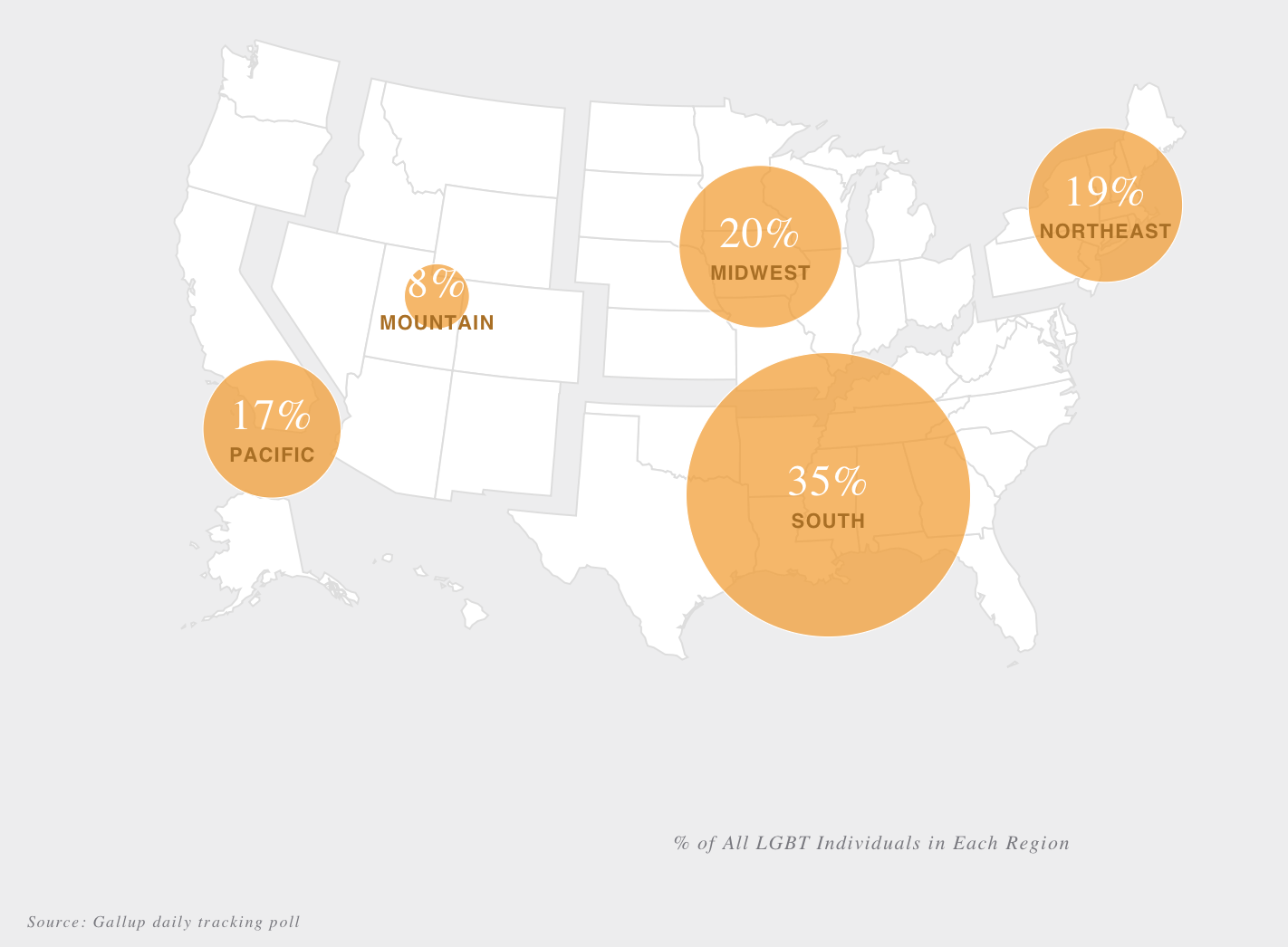
The heat of the South is not the only thing oppressive down there. The Republican Party and the Christian right are also oppressive if you are not white or heterosexual. If you are Black, Hispanic, Asian, or LGBTQ+ of any race, especially those who are transgender, the South can be a particularly unwelcoming place. Yet, even with that said, 35 percent of the United States’ LGBTQ+ population lives in the South, more than any other region in the country. They also make up some of the poorest in the LGBTQ+ population.
The South largely lacks employment protections. Like most states in the U.S., the South is largely at-will employment states; At-will employment is an employer’s ability to dismiss an employee for any reason and without warning, as long as the reason is not illegal (e.g., firing because of the employee’s race, religion or sexuality). No southern states have laws for LGBTQ+ non-discrimination protections. While Bostock v. Clayton County held that Title VII of the Civil Rights Act of 1964 protects employees against discrimination because they are gay or transgender, it is unlikely that these protections will be enforced until courts explicitly expand protections to other statutes. Each application of sex in the law to protect LGBTQ people will require litigation. And the Bostock decision itself includes a worrying deference to religious organizations. As soon as he took office, President Biden issued an Executive Order directing agencies to enforce federal laws that prohibit sex discrimination to include discrimination based on sexual orientation and gender identity, consistent with the Bostock decision. Time will tell how this will affect LGBTQ+ employees in states without explicit non-discrimination protections.
Employment protections are closely tied to economic security and well-being. LGBTQ+ people in the states without protections are more likely to report household incomes below $24,000 than those living in the states where workers are protected. Lower income also means that LGBTQ+ people face more issues with opportunities for better education, jobs, and healthcare. Any LGBTQ+ person in the South has been asked more than once, “If it’s so bad, why don’t you just leave?” The answer is: lack of opportunity. Lower income means decreased ability to move. In other words, it’s easier said than done. This does not mean that all LGBTQ+ people in the South struggle with income or education opportunities. Researchers have hypothesized that LGBTQ+ people may intentionally pursue higher education as a way to buffer themselves against discrimination in the workplace.
Some LGBTQ+ individuals have nice lives in the South. It’s not bad for everyone. However, fear lurks around every turn. If you are in the closet, then you have the fear of being outed. Even with some legal protections like those in Bostock, you still fear losing not only your job, but your family, religious life, friends, etc. when or if you choose to come out. Some LGBTQ+ people live in metropolitan areas and have more freedom and acceptance, but many do not. For those who do not, the South can be like sinking in quicksand. The more you try to help yourself, the more backlash from politicians and religious conservatives. I have been told it has gotten better in recent years, but that doesn’t seem to be the case for transgender individuals. They face increasing discrimination and hardships in the form of new laws targeting their rights, freedoms, and healthcare access.
I am glad I got out when I did. For the first few years I lived in Vermont, I dreamed of getting a job closer to home and moving back to the South or at least closer to the South. I no longer feel that way. I realized that as long as I lived in the South, I was living in quicksand. Each day I was sinking and suffocating more because of the oppression of the South. Vermont has the highest percentage of any states for LGBTQ+ identification at 5.3 percent. In contrast, Alabama ranks in the bottom 16 percent of states with only 3 percent, tying with Alaska, Arkansas, Montana, and South Carolina who also have 3 percent. Idaho, North Dakota, and South Dakota rank lower. Though not a state, Washington, D.C. has the highest percentage with 8.6 percent of its population identifying as LGBTQ+.


Authors
Recent Comments
noisilycool3bc985058… on Pic of the Day iameverywhere1 on Not Quite as Planned iameverywhere1 on Pic of the Day noisilycool3bc985058… on Not Quite as Planned Joe on Pic of the Day Top Posts & Pages



Amazon Associate

As an Amazon Associate I earn from qualifying purchases. So, if you click on a link that takes you to Amazon.com, I may earn a commission.
Trust me, it isn’t much, but every little bit helps.

 Joe
Joe


 The Closet Professor