

Monthly Archives: November 2023
Random Musings

Is it just me or does everyone feel like they look their worst when looking at themselves in the bathroom mirror in a hotel room? I don’t feel that way in other mirrors in the room or any other mirrors anywhere else. However, I always feel like the mirror in bathrooms add 10 pounds, sort of like the cliche about cameras. I mean it could be the cliche about cameras and the bathroom mirror phenomenon give more accurate portrayals, but I hope not. Anyway, that’s my random musing for today.
My conference is going really well. Yesterday, I went to a session about hosting drag shows in museums, similar to drag story hour at libraries. One of the speakers was from the Museum of Science in Boston, and he talked about their program Coleslaw’s Corner. Coleslaw being the name of the drag queen who hosts the events in their planetarium. They do about three a year and look really fun.
The other thing of note from yesterday was that I went to dinner with some of my colleagues from three other Vermont museums. We had a great time. There were three women, one who I know very well and another who I’ve met before. The other two men are both gay, so that was also a plus to last night. Both are exceedingly nice and also at least a dozen years younger than me. Still, it was a really fun night.
Tomorrow, I will head back home. I’m not particularly looking forward to the drive back after nearly a full day of conference events, but I will be glad to be home and back with Isabella. I was able to “sleep in” until 5:30 am this morning. I’m about to shower, get dressed and go down to breakfast.

Not Sleeping In

I’m in Portland, Maine, this week. You would think that without Isabella, I might be able to sleep in a bit, but no, my body is so used to waking up between 4 am and 5 am that I still woke at the same time (I may take a “nap” before I go down to meet my colleague for breakfast.
This is my first time in Maine. I’ve been to all of the other New England states, except Maine, so I can now cross that off my list. My colleague had to be in Kennebunkport yesterday afternoon, so I dropped her off and drove into Portland to familiarize myself with where our hotel is and have lunch. I had some really good Thai food. There are a surprising number of Thai restaurants in this city.
I decided that I’d go back to Kennebunkport to wait for my colleague to finish her event. I’d planned to visit a few museums, but yesterday was Election Day and the one museum that was open is next to the town hall, so there was no convenient parking. I decided that while here, I’d drive to the beach. There were signs everywhere for “Beaches,” so that’s what I did. I’ll be honest, East Coast beaches are not that beautiful when compared to the beaches along the Gulf of Mexico where I grew up going to the beach. However, while it may not have been sugar white beaches, it was nice. I enjoyed smelling the salt air and hearing the crashing of the waves.


[i carry your heart with me(i carry it in]

[i carry your heart with me(i carry it in]
By E. E. Cummings
i carry your heart with me(i carry it in
my heart)i am never without it(anywhere
i go you go,my dear;and whatever is done
by only me is your doing,my darling)
i fear
no fate(for you are my fate,my sweet)i want
no world(for beautiful you are my world,my true)
and it’s you are whatever a moon has always meant
and whatever a sun will always sing is you
here is the deepest secret nobody knows
(here is the root of the root and the bud of the bud
and the sky of the sky of a tree called life;which grows
higher than soul can hope or mind can hide)
and this is the wonder that’s keeping the stars apart
i carry your heart(i carry it in my heart)
About the Poem
“i carry your heart with me (i carry it in” by E.E. Cummings was first published in June 1952 in Poetry magazine. It is an unconventional sonnet, and as an unconventional poet, Cummings plays with the established styles of poetry for the benefit of meaning and aesthetics. It is important to note the aesthetics of his poetry play a role in the message being delivered, something which is clearly seen in this poem.
The poem details a powerful, romantic love from start to finish. Even the structure demonstrates this by breaking old-fashioned rules but still managing to be clear. The sweet intention is not lost; if anything, it is strengthened by the unconventionality. It mirrors the words of strength and unity, lack of fear. Everything in the speaker’s life, including the soul, rests in this love and in the very being of the person meant to receive the message. The unique structure of the poem also serves to demonstrate the oneness of the love the speaker feels. In addition, it also shows how the beauty of the love knows no bounds. In other words, it is not restricted by any old rules or traditions. Just as the speaker is not restricted in life due to the courage his or her love provides.
The overarching themes of this piece are love, admiration, and fortitude. The admiration of the speaker is not just assumed because he or she is in love, it is also evident in the writing itself. The line “for beautiful you are my world,my true)” shows the high esteem in which the lover is held. All three themes interweave and work with each other to make the poem even more beautiful, rather than each theme standing alone. This adds coherency to the fourth theme seen in the poem, unity. Though it may not be as explicit in the lines when read, unity is definitely a very present topic throughout the piece.
About the Poet
Edward Estlin (E.E.) Cummings was born in Cambridge, Massachusetts, on October 14, 1894. He began writing poems as early as 1904 and studied Latin and Greek at the Cambridge Latin High School.
He received his BA in 1915 and his MA in 1916, both from Harvard University. His studies there introduced him to the poetry of avant-garde writers, such as Gertrude Stein and Ezra Pound.
In 1917, Cummings published an early selection of poems in the anthology Eight Harvard Poets. The same year, Cummings left the United States for France as a volunteer ambulance driver in World War I. Five months after his assignment, however, he and a friend were interned in a prison camp by the French authorities on suspicion of espionage (an experience recounted in his novel, The Enormous Room) for his outspoken anti-war convictions.
After the war, he settled into a life divided between his lifetime summer home, Joy Farm in New Hampshire, and Greenwich Village, with frequent visits to Paris. He also traveled throughout Europe, meeting poets and artists, including Pablo Picasso, whose work he particularly admired.
In 1920, The Dial published seven poems by Cummings, including “Buffalo Bill’s.” Serving as Cummings’ debut to a wider American audience, these “experiments” foreshadowed the synthetic cubist strategy Cummings would explore in the next few years.
In his work, Cummings experimented radically with form, punctuation, spelling, and syntax, abandoning traditional techniques and structures to create a new, highly idiosyncratic means of poetic expression. Later in his career, he was often criticized for settling into his signature style and not pressing his work toward further evolution. Nevertheless, he attained great popularity, especially among young readers, for the simplicity of his language, his playful mode and his attention to subjects such as war and sex.
The poet and critic Randall Jarrell once noted that Cummings is “one of the most individual poets who ever lived—and, though it sometimes seems so, it is not just his vices and exaggerations, the defects of his qualities, that make a writer popular. But, primarily, Mr. Cummings’s poems are loved because they are full of sentimentally, of sex, of more or less improper jokes, of elementary lyric insistence.”
During his lifetime, Cummings received a number of honors, including an Academy of American Poets Fellowship, two Guggenheim Fellowships, the Charles Eliot Norton Professorship at Harvard, the Bollingen Prize in Poetry in 1958, and a Ford Foundation grant.
At the time of his death, September 3, 1962, he was the second most widely read poet in the United States, after Robert Frost. He is buried in Forest Hills Cemetery in Boston, Massachusetts.

Too Early
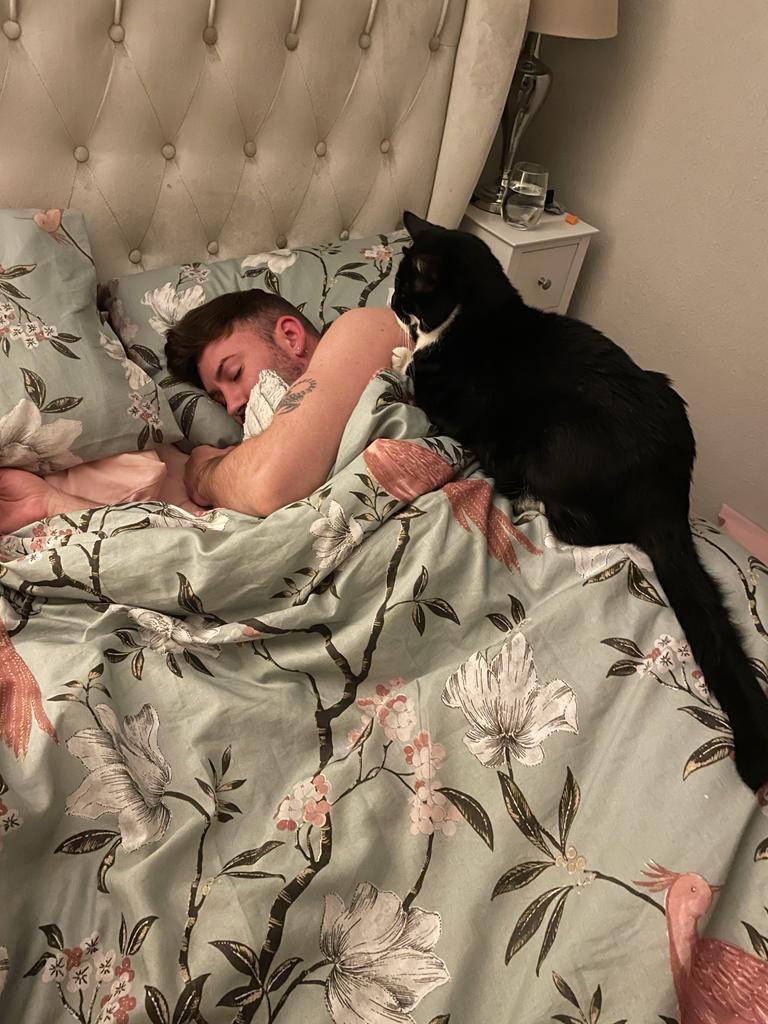
wish Isabella understood what the end Daylight Saving Time means. Sadly (frustratingly), Isabella only tells time with her internal clock. She doesn’t understand that it’s an hour earlier than she thinks it is. When it’s 4 AM for me, she (and her stomach) believes that it’s 5 AM. She only knows it’s time to eat. I wish we could understand each other. I’d love to ask her what food she wants because some days she’ll eat what I feed her, and a few days later when I feed her the same thing, she won’t eat it. If she could just say, “I want salmon, not chicken today” or “tuna, not salmon.” Sadly, I’m not Dr. Doolittle. Sigh!
While I can’t do anything about reading her mind about what she wants for her breakfast, she may get used to the time change while I’m away for work this week. My neighbor is feeding her, and he doesn’t come down first thing in the morning. Honestly, it doesn’t matter what time he comes down, she won’t eat her wet food if I don’t feed it to her. I mainly have my neighbor come down so she’s not completely lonely while I’m gone. He tries to get her to eat, but mostly he just plays with her. She’s very chatty with him while he’s here. She’s always happy to see him, but it doesn’t take the place of me being here. I wish I could just take her with me. She’d be much happier, but sadly, I can’t do that.
P.S. The picture above is not of me or Isabella. First, Isabella is solid black, and second, I would never have that comforter on my bed. I prefer more muted colors, and the one in the picture is too busy and too flowery for my tastes.

Grace to the Humble

Likewise you younger people, submit yourselves to your elders. Yes, all of you be submissive to one another, and be clothed with humility, for
“God resists the proud,
But gives grace to the humble.”Therefore humble yourselves under the mighty hand of God, that He may exalt you in due time, casting all your care upon Him, for He cares for you.
Be sober, be vigilant; because your adversary the devil walks about like a roaring lion, seeking whom he may devour. Resist him, steadfast in the faith, knowing that the same sufferings are experienced by your brotherhood in the world. But may the God of all grace, who called us to His eternal glory by Christ Jesus, after you have suffered a while, perfect, establish, strengthen, and settle you. To Him be the glory and the dominion forever and ever. Amen.
— 1 Peter 5:5-11
Often times, those who hate the LGBTQ+ community are the loudest and most vocal in their hatred. Sadly, because of the centuries of Christian persecution of LGBTQ+ people, it is acceptable to far too many people. Yet, other forms of discrimination, such as racism, are almost universally condemned. There is nothing humble about homophobia. Those who hate LGBTQ+ are hateful and loud about their hatred. As 1 Peter 5:8 says, our “adversary the devil walks about like a roaring lion,” and tells us to “be sober, be vigilant” because he is “seeking whom he may devour.”
Quite frankly, most of the homophobes of the world want us dead and are often not ashamed to say so. They want to ruin the lives of LGBTQ+ people. This week, the small-town mayor of Smith Station, Alabama, who was also a Baptist minister in Phenix City, committed suicide after a Christofascist hate group calling itself “1819 News” (1819 refers to the year Alabama became a state), published pictures of him wearing women’s clothes and makeup. The Phenix City School Superintendent Dr. Larry DiChiara wrote in a Facebook post, “I am so angry right now and heartbroken. I witnessed a good man be publicly ridiculed and crucified over the last few days to the point that he just took his own life today. I just want to ask you people who thought it humorous to publicly ridicule him, ‘Are you happy now?’ What crime did he commit?” Sadly, I have no doubt that those who publicly ridiculed him are happy.
The Alabama Baptist State Convention put out a statement that said, “We have become aware of the alleged unbiblical behavior related to the pastor of the First Baptist Church of Phenix City. We are praying for the leaders of the church family as they seek to determine the truth concerning these accusations.” The Baptist Convention referred to this man “wearing women’s clothes and makeup” as “alleged unbiblical behavior.” Yet, they were careful not to condemn 1819 News, the ones who made the pictures public, as committing what should be obvious to all Christians as “unbiblical behavior.”
Some might think this man, who was a Baptist minister, is not worthy of our pity because he lived a secret life, but that secret life made him happy. I know how conflicting and confusing it can be for someone to believe they are being forced to live a secret life. He probably felt he had no other choice. If someone had outed me while I worked at a small private school in Alabama, I’d have been devastated and humiliated. I’m not sure what I would have done. The internal pressures this man felt were there because of centuries of hatred for who he really was. I’m sure he had enough self-hatred without the help of 1819 News. I don’t know what kind of preacher this man was, but I hope that he was the kind who preached about love and kindness and that “sufferings are experienced by [our] brotherhood in the world.”
On the Wednesday night (southern churches often have Wednesday night services), the minister took to the pulpit at First Baptist Church to denounce the post about him, claiming he was a “victim of an internet attack.” He then read from the 23rd Psalm as he delivered a short sermon. “God will always protect you, take care of you,” he said. “He will see you through anything, absolutely anything.”
Our adversaries who walk about like a roaring lion, seeking whom they may devour are not humble people. Christ taught over and over that we should be humble. Jesus was clear in the Beatitudes:
“Blessed are the poor in spirit,
For theirs is the kingdom of heaven.
Blessed are those who mourn,
For they shall be comforted.
Blessed are the meek,
For they shall inherit the earth.
Blessed are those who hunger and thirst for righteousness,
For they shall be filled.
Blessed are the merciful,
For they shall obtain mercy.
Blessed are the pure in heart,
For they shall see God.
Blessed are the peacemakers,
For they shall be called sons of God.
Blessed are those who are persecuted for righteousness’ sake,
For theirs is the kingdom of heaven.
Blessed are you when they revile and persecute you, and say all kinds of evil against you falsely for My sake.” (Matthew 5:3-11)
Homophobic Christofascists hate us to the point that they want us dead and are more than happy to drive us to kill ourselves. They ruined this man’s life through their hatred, and while they should be prosecuted for what they did and charged with no less than accessory to murder, I know nothing will come of it. Yet, this man died because he was doing something that made him happy and did not harm anyone else. Sadly, the Speaker of the House of Representatives is a homophobic Christofascists. Like so many Republicans, especially those who are ardent supporters of the orange traitor, they walk about like roaring lions, seeking whom they may devour.
Remember, God “gives grace to the humble.”


Authors
Recent Comments
noisilycool3bc985058… on Dr. McDreamy Joe on Dr. McDreamy poetrybeautiful3d840… on Dr. McDreamy Joe on Dr. McDreamy noisilycool3bc985058… on Dr. McDreamy Top Posts & Pages


Amazon Associate

As an Amazon Associate I earn from qualifying purchases. So, if you click on a link that takes you to Amazon.com, I may earn a commission.
Trust me, it isn’t much, but every little bit helps.

 Joe
Joe


 The Closet Professor