Monthly Archives: April 2025

Drawn to Form: The Academic Nude and the Art School Mode

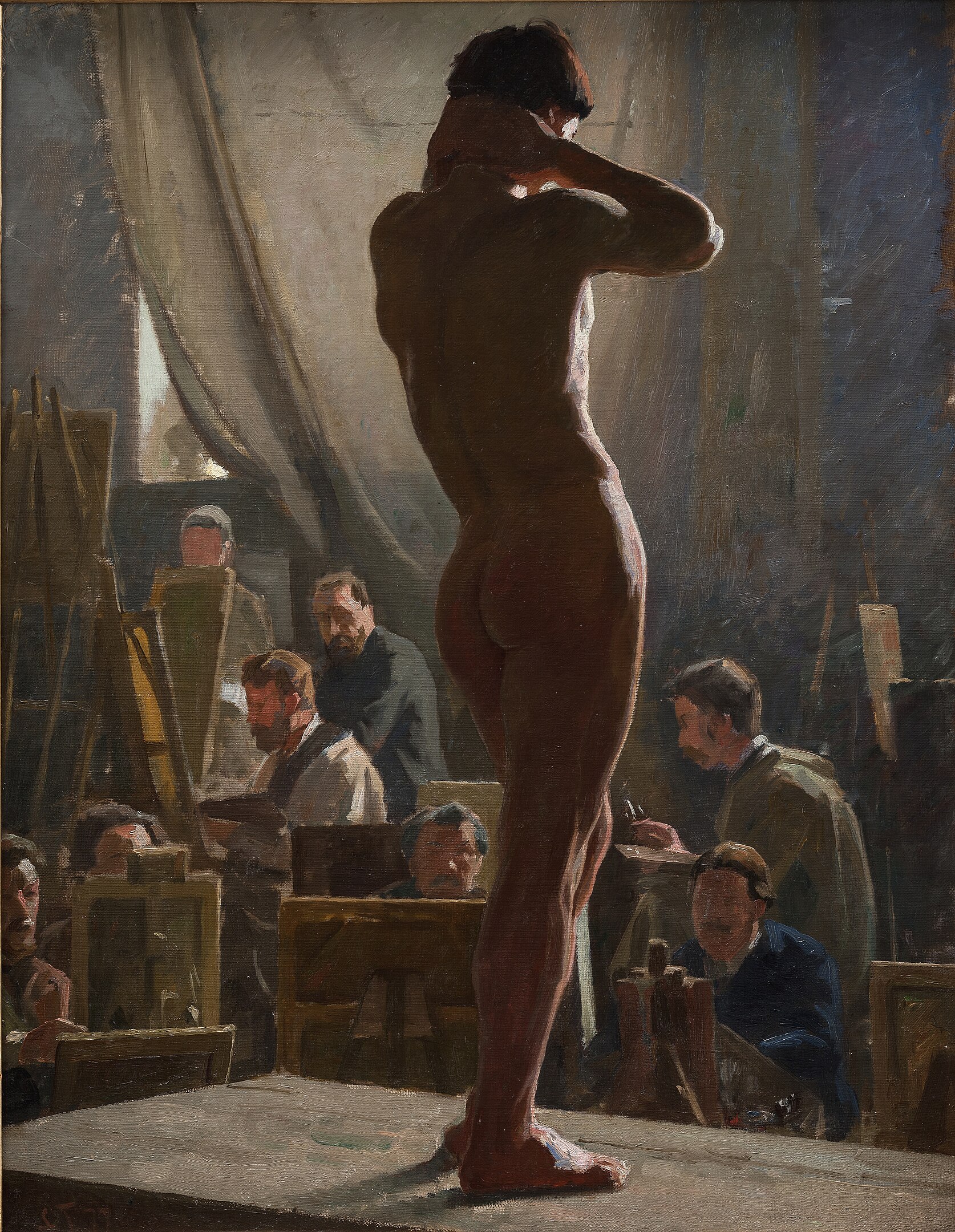
Male Nude in the Studio of Bonnat, Laurits Tuxen (1877)

Long before museums and galleries became the homes of the male nude, it lived in the studios. In the ateliers of the École des Beaux-Arts in Paris, the Royal Academy in London, and the Pennsylvania Academy of the Fine Arts in the United States, generations of students learned the ideal proportions of the human form not through imagination—but by closely observing the naked man before them.

Paul Delaroche’s Study of a Male Nude (c. 1835)

The academic nude wasn’t just a subject of study; it was a rite of passage. Drawing the male model became a disciplined practice that shaped not only artists’ technical skill, but also Western ideals of masculinity, beauty, and form. In the 19th century, the École des Beaux-Arts institutionalized the male nude as the pinnacle of artistic study. The male figure, more than the female, was thought to embody harmony and proportion, a living reference to both ancient sculpture and Renaissance anatomical studies. The famed “Concours de Torse,” or Torso Competition, showcased how aspiring painters honed their craft on the male body, rendering each muscle with academic precision. A striking example is Paul Delaroche’s Study of a Male Nude (c. 1835), a dramatically lit figure standing in a contrapposto pose, his flesh rendered with the same reverence one might apply to a marble Apollo. Here, individuality fades; the model becomes a type, a vessel for timeless ideals.
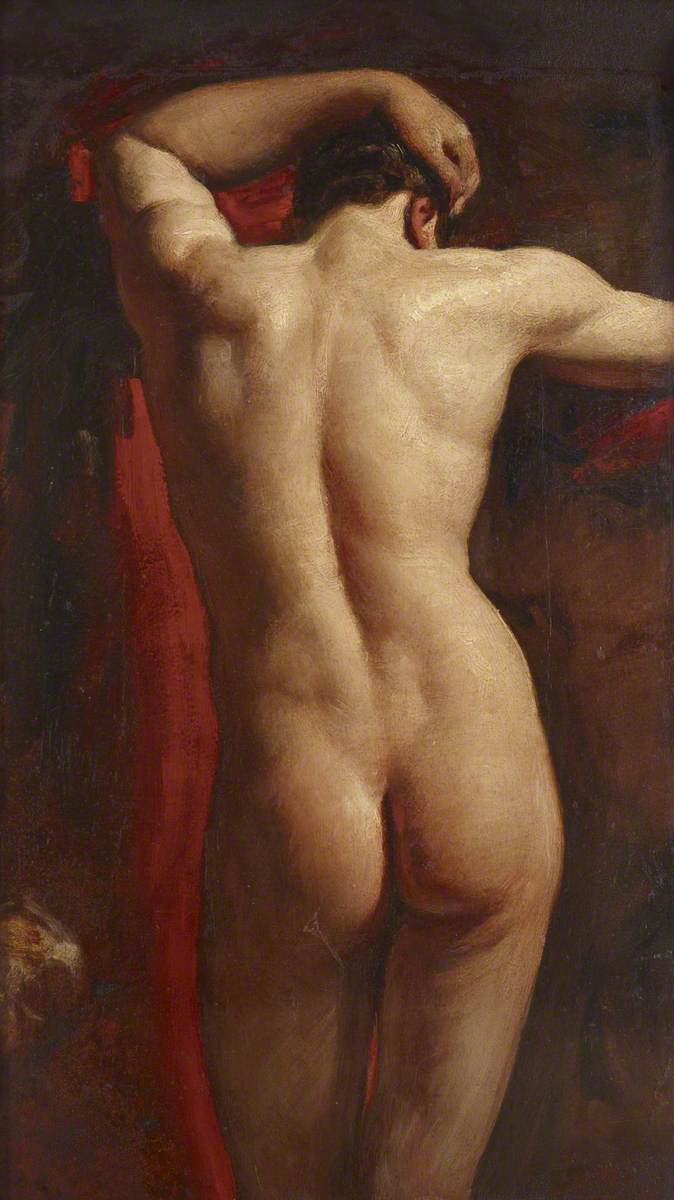
Study of a Male Nude Seen from Behind, William Etty (c. 1830s)

In London, the Royal Academy Schools upheld similar values. Students began by copying antique plaster casts, gradually earning the right to work in the Life Room, where a live male model stood nude on a platform under harsh light and stricter silence. These models often came from the working classes, their anonymity preserved even as their bodies were meticulously recorded in sketch after sketch. William Etty, a British painter committed to the nude in an often prudish art culture, created countless studies that quietly smuggled eroticism into the academic process. His Study of a Male Nude Seen from Behind (c. 1830s), now housed at Tate Britain, transforms a backlit model into an object of lyrical sensuality, every curve of the body rendered with lingering attention.
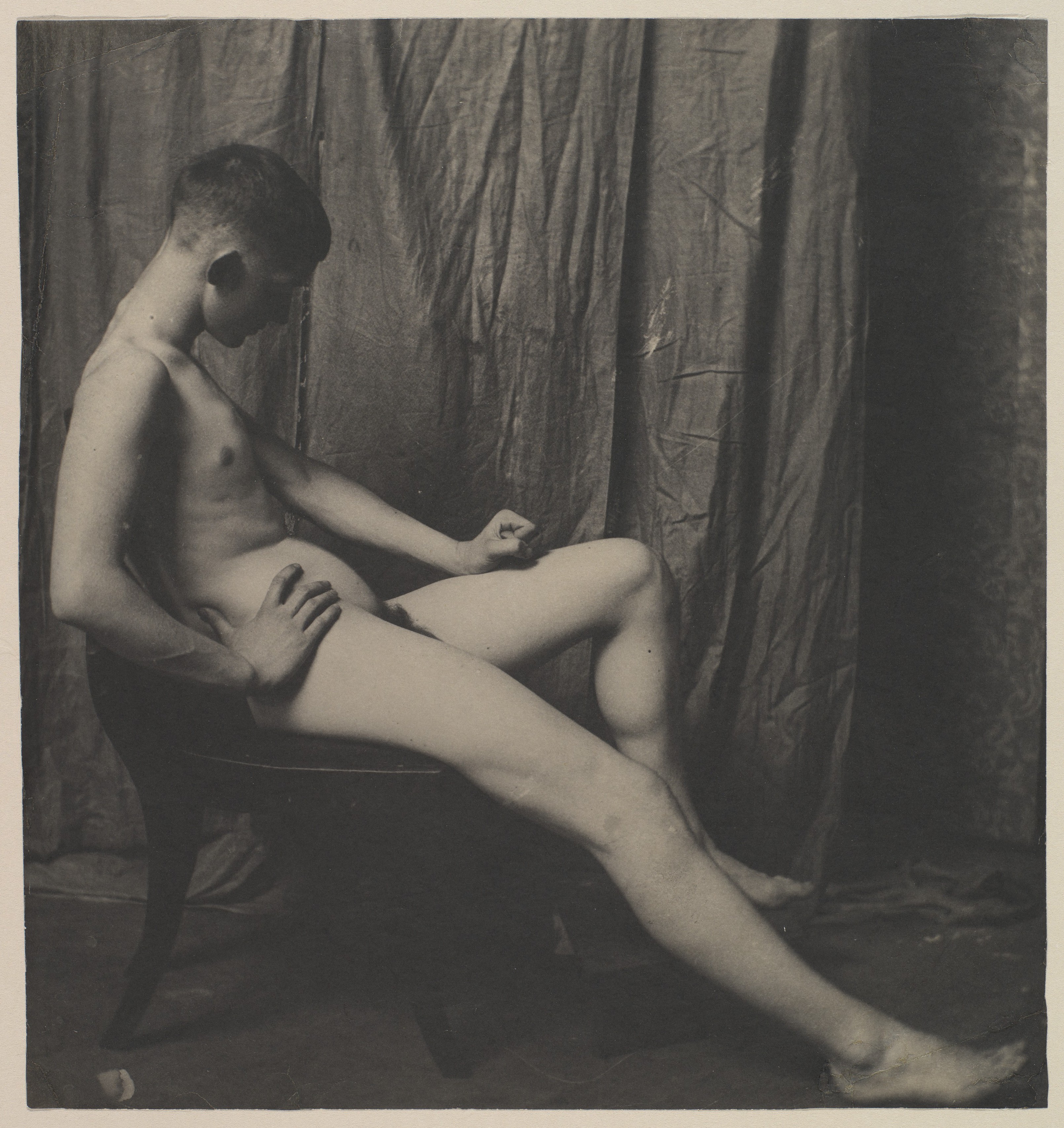
Bill Duckett Nude, Thomas Eakins (ca. 1889)

In the United States, Thomas Eakins redefined the academic nude—and ignited controversy. At the Pennsylvania Academy of the Fine Arts, Eakins encouraged both male and female students to observe fully nude male models, a practice that pushed the limits of American Victorian propriety. He sometimes posed nude himself, blurring the boundaries between instructor, artist, and subject. One of his oil sketches of which no photo exists, The Male Nude (c. 1885), strips away allegory or idealism entirely. A model sits awkwardly, raw and unguarded. There is no attempt to mythologize or elevate, only to observe. The tension in Eakins’s work lies in this realism—an almost clinical intimacy that reveals more than anatomy.
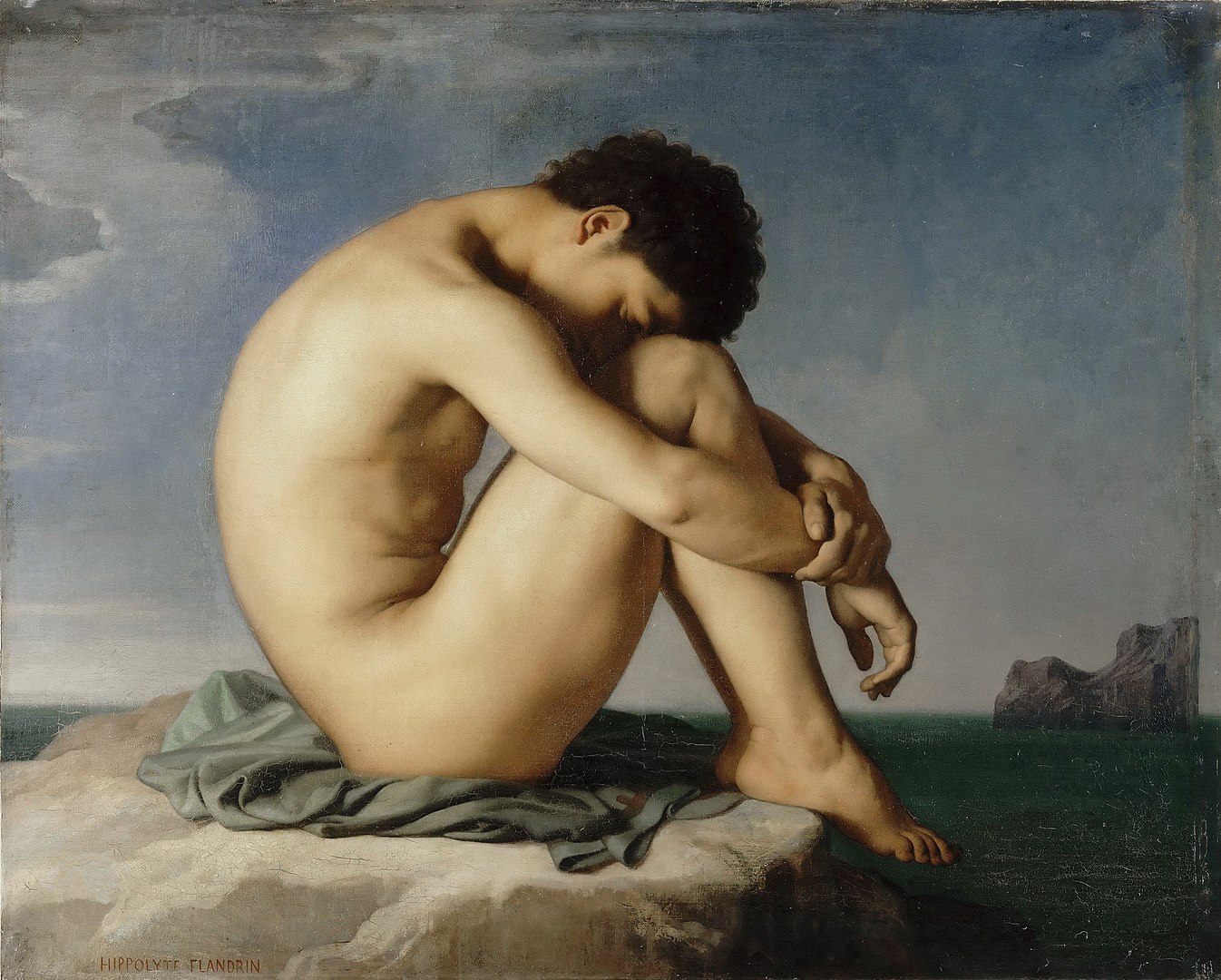
Young Male Nude Seated by the Sea, Jean-Hippolyte Flandrin  (1836)

Though most academic studies of the nude remained in the studio, some evolved into finished works for public exhibition. These retained the formal lessons of the academy while cloaking the nude in mythological or historical justification. Jean-Hippolyte Flandrin’s Young Male Nude Seated by the Sea (1836) exemplifies this genre. A solitary youth, nude and introspective, sits beside an imagined shore. The painting, while formally academic, gestures toward emotional vulnerability and latent desire. It is not just an ideal—it is a reverie. Often described as “the most beautiful boy in French painting,” the figure suggests a coded eroticism beneath its classical restraint.
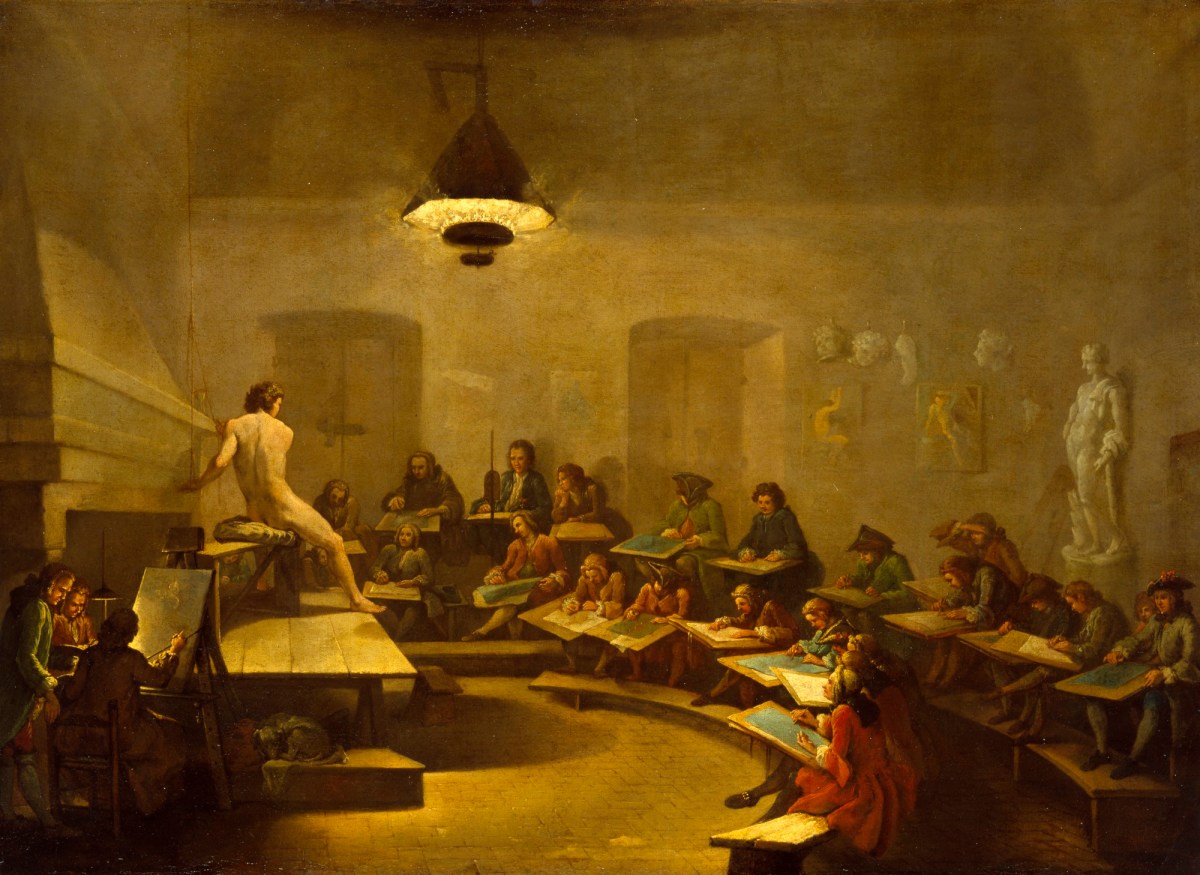
A Life Class, Unidentified artist and Formerly attributed to William Hogarth (c. early 19th century

The art school nude was shaped not just by technique, but by a complex social structure. The model—often unnamed—was a laborer in a rarefied world. In the archives of the École des Beaux-Arts or the Musée Rodin, one finds charcoal drawings of men reclining, lunging, or simply standing, their bodies lit and studied as if they were statues. An anonymous drawing from around 1890 captures a reclining male nude in dramatic foreshortening—an image at once clinical and intimate. These men were employed for their endurance, strength, and presence. Though rarely memorialized, their bodies shaped generations of artists’ understanding of the human form.

The academic nude may appear orderly or formulaic, but beneath its surface lies a subtle history of aesthetic pleasure, regulation, and coded longing. In the Life Room, artists were taught not only how to render the male body, but how to look at it—intently, repeatedly, and within the sanctioned space of artistic discipline. Today, those once-forgotten studies are being reconsidered—not just as technical exercises, but as visual records of how masculinity was taught, observed, and quietly desired.



Pic of the Day


Song of the Queen Bee

Song of the Queen Bee
By E.B. White

New Yorker Magazine 1945

“The breeding of the bee,” says a United States Department
of Agriculture bulletin on artificial insemination, “has
always been handicapped by the fact that the queen mates
in the air with whatever drone she encounters.”

When the air is wine and the wind is free
and the morning sits on the lovely lea
and sunlight ripples on every tree
Then love-in-air is the thing for me
I’m a bee,
I’m a ravishing, rollicking, young queen bee,
That’s me.
I wish to state that I think it’s great,
Oh, it’s simply rare in the upper air,
It’s the place to pair
With a bee.

Let old geneticists plot and plan,
They’re stuffy people, to a man;
Let gossips whisper behind their fan.
(Oh, she does?
Buzz, buzz, buzz!)
My nuptial flight is sheer delight;
I’m a giddy girl who likes to swirl,
To fly and soar
And fly some more,
I’m a bee.
And I wish to state that I’ll always mate
With whatever drone I encounter.

There’s a kind of a wild and glad elation
In the natural way of insemination;
Who thinks that love is a handicap
Is a fuddydud and a common sap,
For I am a queen and I am a bee,
I’m devil-may-care and I’m fancy-free,
The test tube doesn’t appeal to me,
Not me,
I’m a bee.
And I’m here to state that I’ll always mate
With whatever drone I encounter.

Mares and cows. by calculating,
Improve themselves with loveless mating,
Let groundlings breed in the modern fashion,
I’ll stick to the air and the grand old passion;
I may be small and I’m just a bee
But I won’t have science improving me,
Not me,
I’m a bee.
On a day that’s fair with a wind that’s free,
Any old drone is a lad for me.

I’ve no flair for love moderne,
It’s far too studied, far too stern,
I’m just a bee—I’m wild, I’m free,
That’s me.
I can’t afford to be too choosy;
In every queen there’s a touch of floozy,
And it’s simply rare
In the upper air
And I wish to state
That I’ll always mate
With whatever drone I encounter.

Man is a fool for the latest movement,
He broods and broods on race improvement;
What boots it to improve a bee
If it means the end of ecstasy?
(He ought to be there
On a day that’s fair,
Oh, it’s simply rare.
For a bee.)

Man’s so wise he is growing foolish,
Some of his schemes are downright ghoulish;
He owns a bomb that’ll end creation
And he wants to change the sex relation,
He thinks that love is a handicap,
He’s a fuddydud, he’s a simple sap;
Man is a meddler, man’s a boob,
He looks for love in the depths of a tube,
His restless mind is forever ranging,
He thinks he’s advancing as long as he’s changing,
He cracks the atom, he racks his skull,
Man is meddlesome, man is dull,
Man is busy instead of idle,
Man is alarmingly suicidal,
Me, I am a bee.

I am a bee and I simply love it,
I am a bee and I’m darn glad of it,
I am a bee, I know about love:
You go upstairs, you go above,
You do not pause to dine or sup,
The sky won’t wait —it’s a long trip up;
You rise, you soar, you take the blue,
It’s you and me, kid, me and you,
It’s everything, it’s the nearest drone,
It’s never a thing that you find alone.
I’m a bee,
I’m free.

If any old farmer can keep and hive me,
Then any old drone may catch and wife me;
I’m sorry for creatures who cannot pair
On a gorgeous day in the upper air,
I’m sorry for cows that have to boast
Of affairs they’ve had by parcel post,
I’m sorry for a man with his plots and guile,
His test-tube manner, his test-tube smile;
I’ll multiply and I’ll increase
As I always have—by mere caprice;
For I am a queen and I am a bee,
I’m devil-may-care and I’m fancy-free,
Love-in-air is the thing for me,
Oh, it’s simply rare
In the beautiful air,
And I wish to state
That I’ll always mate
With whatever drone I encounter.

About the Poem

E.B. White’s poem “Song of the Queen Bee,” first published in The New Yorker in 1945, is a clever and spirited satire that juxtaposes the natural instincts of bees with the scientific efforts of human intervention, particularly artificial insemination in agriculture. Written in the voice of a vivacious and unapologetically free-spirited queen bee, the poem champions instinct, spontaneity, and natural selection over modern, mechanized reproductive control. Beneath its playful rhymes and jaunty tone lies a poignant critique of mid-20th-century scientific rationalism and a celebration of freedom, joy, and natural order.

The poem opens with a dry quotation from a U.S. Department of Agriculture bulletin, which laments the uncontrolled nature of bee reproduction—namely that “the queen mates in the air with whatever drone she encounters.” White immediately counters this bureaucratic tone with a burst of lively verse, allowing the queen bee herself to take the stage in a whimsical monologue that is part burlesque, part manifesto. With lines like “I’m devil-may-care and I’m fancy-free,” the queen revels in her role as a creature of instinct and sensual freedom. She mocks the efforts of scientists (“Let old geneticists plot and plan”) and romanticizes the ecstasy of natural mating flights—elevating love, not as a sterile process, but as an exhilarating and sacred ritual in “the upper air.”

Throughout, White uses breezy rhymes and playful repetition to contrast the sterile control of modern science with the lyrical abandon of natural life. Phrases such as “I’ll always mate / With whatever drone I encounter” become refrains that assert autonomy and challenge-imposed order. Importantly, the poem does not argue against science wholesale—it critiques a specific kind of arrogance: mankind’s “test-tube manner” and the belief that all life should conform to rational systems. In White’s telling, this hubris leads to folly and even destruction: “He owns a bomb that’ll end creation / And he wants to change the sex relation.” The poem culminates in a bold affirmation of life lived on its own terms—wild, instinctual, and gloriously imperfect.

By adopting the perspective of a bee, White both satirizes and humanizes this argument. The queen is irreverent, humorous, and joyfully defiant, serving as a stand-in for nature herself—resisting reduction and refusing to be “improved.” Her message is clear: love, life, and freedom are too rare and too beautiful to be confined by the narrow vision of “improvers.”

About the Poet

E.B. White (1899–1985) was an American writer best known for his contributions to both children’s literature and essays that captured the American spirit with elegance and wit. Born in Mount Vernon, New York, White graduated from Cornell University in 1921, where he earned the nickname “Andy,” a name he carried throughout his life. He began his career as a journalist before joining The New Yorker magazine in its early days, where his clear, playful prose helped define the publication’s distinctive style.

White is perhaps most beloved for his classic children’s books, including Charlotte’s Web (1952), Stuart Little (1945), and The Trumpet of the Swan (1970), each celebrated for their humor, tenderness, and profound insights into life and friendship. In addition to his fiction, he co-authored the widely influential writing guide The Elements of Style with his former professor William Strunk Jr., further cementing his legacy as a master of prose. White’s work earned him numerous honors, including a Pulitzer Prize special citation in 1978.

Throughout his life, White combined a deep love of nature, animals, and rural life with a sharp observation of human nature. Whether reflecting on the bustle of city life or the quiet rhythms of his Maine farm, his writing remains enduring for its humanity, clarity, and understated wisdom.


Pic of the Day


Monday 😩

I do not want to go to work today. I woke up with a bit of a migraine and would have preferred to stay in bed. However, I have a few things I have to do this morning, but I may leave early if my migraine doesn’t improve.


Seen Through His Works

“For since the creation of the world God’s invisible qualities—his eternal power and divine nature—have been clearly seen, being understood from what has been made, so that people are without excuse.”

— Romans 1:20 (NIV)

I have never understood how someone could look around at the wonders of this world—the towering mountains, the delicate pattern of a snowflake, the mysterious depths of the oceans—and think, “Nothing but natural evolution is involved in the creation of all this beauty.” It seems impossible to me that all of this could be the result of mere happenstance. From the moment I was first aware of the world’s complexity and grandeur, I have believed that God’s hand was present in it all, guiding creation with care and intention.

I believe in evolution. There is ample evidence of it, and I do not believe the world is only four thousand years old, as strict creationists insist. Scientific discovery does not diminish my faith; instead, it enlarges my awe. To me, evolution is not a threat to God’s existence—it is a testament to His brilliance. A world that adapts, grows, and changes is far more magnificent than one that appeared rigid and finished. Creation was not a single act frozen in time, but a symphony, still unfolding under the quiet direction of a divine Composer.

And yet, my faith has not been without struggles. There have been seasons where I asked painful questions: Why, God?Why is there pain written into the bodies of newborns? Why are some born to suffer? Why was I given a body and a heart that do not always align with the world’s easy expectations? And perhaps most piercingly—why did You make me gay, when life would have been simpler, smoother, quieter if You had not?

In those moments of questioning, it would be easy to believe that creation was left adrift, as some philosophies suggest. During the Enlightenment, many embraced deism, a belief that God set the universe in motion like a master clockmaker and then stepped back, no longer involved in the daily unfolding of events. Many of the United States’ Founding Fathers were deists, believing that God could be known through nature and reason but doubting divine intervention in human affairs.

I understand the temptation of that view. And in part, I agree: I believe God set the laws of the universe into motion with extraordinary wisdom and creativity. Yet unlike the deists, I believe He still intervenes—not always, not predictably, but lovingly and purposefully. He has not abandoned His creation. He has not abandoned me.

When my heart wavers, I turn again to the promises written in Scripture. I cling to the words of Jeremiah 29:11“For I know the plans I have for you,” declares the Lord, “plans to prosper you and not to harm you, plans to give you hope and a future.”

I am not a mistake. You are not a mistake. We are part of a creation that, though marred by brokenness and mystery, still sings of a Creator whose fingerprints are everywhere. When I look inward, when I look outward, I see Him. His eternal power and divine nature have been clearly seen—from the beginning until now—and though I do not understand all His ways, I trust that His plan is full of hope, even when the path is hard.Today, may we open our eyes and see anew. slow down. Look closely. Listen carefully. Let the marvels of creation draw you nearer to the Creator. May we look upon the world, and even our own complicated selves, and recognize the divine artistry that we are part of in this universe. In doing so, we honor Him—and we fulfill a yearning that has been written into our souls since the beginning of time.


Pic of the Day


Moment of Zen: Sunflowers


Pic of the Day


Free Friday

I am using up one of my vacation days today and had hoped to sleep a bit later than usual. Isabella had a different agenda and, as usual, woke me up at an ungodly hour to feed her. I always have the intention of feeding her and going back to bed, but it rarely works out that way. Luckily, since I have the day off I can take a nap later if I want to.

I have a couple of small errands to run today and a few things to do around my apartment, but otherwise, I plan to either read or write. I’ve had a story developing in my head and I want to “put pen to paper” as the saying goes. It’s more a fun exercise for me than anything else, and I’m enjoying it: the research, the character development, and creating a story.

Anyway, I plan to do some reading, though I also have some grading that needs to be done before grades are due Tuesday. It is highly likely that at some point I’ll be like the guy in the picture:asleep on my bed with the book I was reading by my side.

Have a great weekend, everyone!