

For as long as the male nude has existed in art — from the Kouros statues of ancient Greece to the sketches of Michelangelo — the erotic potential of the male body has fascinated artists and viewers alike. But what happens when we turn our gaze to the realm of gay pornography? Can gay porn — films and photography explicitly created for sexual arousal — also be considered art?
It’s a provocative question, but a worthwhile one. In fact, the history of gay porn itself often parallels the history of queer art: pushing boundaries, challenging taboos, celebrating bodies, and telling truths about desire.
The Beginnings: Porn as Forbidden Art

Long before moving pictures, erotic images circulated as drawings, engravings, and photographs. In the 19th century, so-called “French postcards” depicted nude men as athletic models, though sometimes posed in implicitly homoerotic ways. One of the earliest and most influential figures to straddle the line between art and pornography was Wilhelm von Gloeden, whose photographs of Sicilian boys, taken between the 1880s and 1920s, combined classical references, soft lighting, and unabashed sensuality. These images were sold as art but carried undeniable erotic charge.
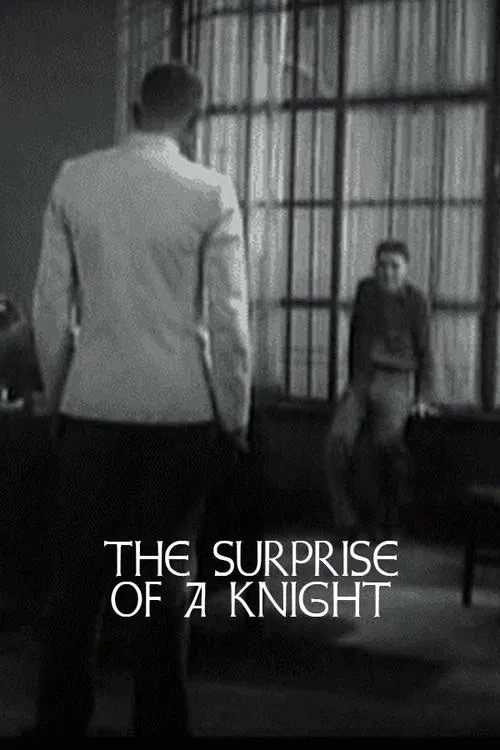
When film arrived, early pornography — called “stag films” — rarely included explicitly gay scenes. Still, there were clandestine reels from the 1920s–40s that showed male-male encounters. Though they were often anonymous and lacked narrative or polish, their very existence documented queer desire at a time when it was otherwise hidden. The Surprise of a Knight (1930), one of the earliest surviving gay stag films, is a fascinating precursor — a clandestine, playful short that captures queer desire in an era of strict censorship, showing how even in the shadows, erotic expression could hint at both art and resistance.
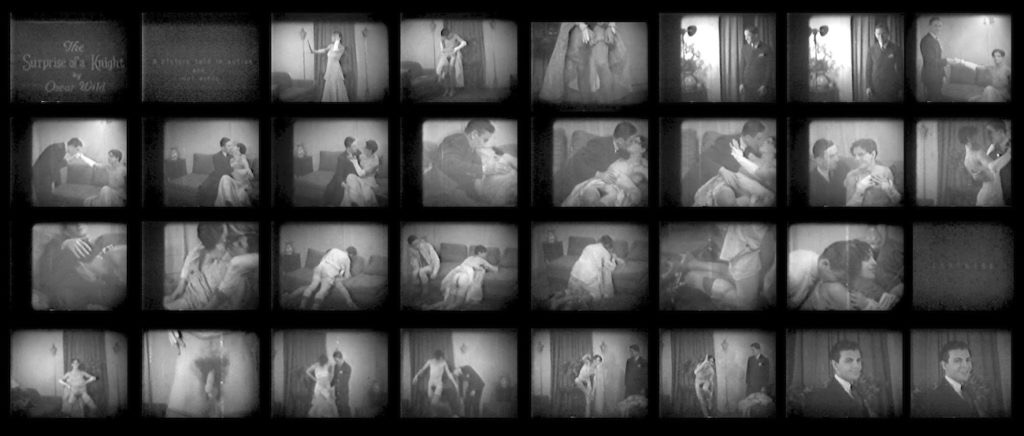
The Surprise of a Knight opens with an elegantly dressed “lady” preparing for a visit, who reveals a patch of pubic hair as an intertitle credits the screenplay to “Oscar Wild.” In the drawing room, the lady flirts and kisses her dapper “knight,” rebuffing his gropes before playfully slapping him and then performing oral sex. She then positions herself face-down on the sofa, and the knight simulates anal sex with her twice, both reaching climax. After he departs, the “lady” lifts her skirts to reveal he is actually a man, punctuated by an intertitle reading “Surprise.” The man dances nude, his penis visible, before the knight returns to help him undress completely; they dance together briefly, and in the final shot the man, now in business attire, winks at the camera before walking off.
The Classic Era: Porn as Provocation, Pleasure as Art
The so-called “Golden Age” of gay porn coincided with the sexual revolution of the late 1960s and 1970s. Explicit films were finally being made openly, screened in theaters, and even reviewed in mainstream publications. During this period, filmmakers experimented with narrative, cinematography, and symbolism — producing works that were undeniably pornographic but also clearly ambitious, aesthetically considered, and culturally significant. Some of these films are now preserved in archives and even screened in museums.

Perhaps the most famous of these was Boys in the Sand (1971), directed by Wakefield Poole, which portrayed erotic encounters on Fire Island in lush, painterly compositions. Poole’s film was groundbreaking for its beautiful cinematography and narrative flow — and it even premiered to a packed theater audience, signaling a new cultural visibility.

Around the same time, Fred Halsted’s LA Plays Itself (1972) took a radically different approach, presenting gay sex through a gritty, surrealist lens that reflected the urban experience of Los Angeles. In October 2023, New York’s IFC Center hosted a rare screening of Fred Halsted’s LA Plays Itself, shown on Friday, October 20 and Saturday, October 21. The IFC Center, a renowned independent art-house cinema in New York City, screening LA Plays Itself is significant because it affirms the film’s enduring status not just as underground pornography but as a provocative work of avant-garde queer art worthy of serious cultural recognition. This gritty, surreal classic of queer cinema was presented as part of a retrospective celebrating the film’s radical blend of explicit gay sexuality, avant-garde experimentation, and social critique — reminding audiences why it remains both controversial and artistically significant more than fifty years later.
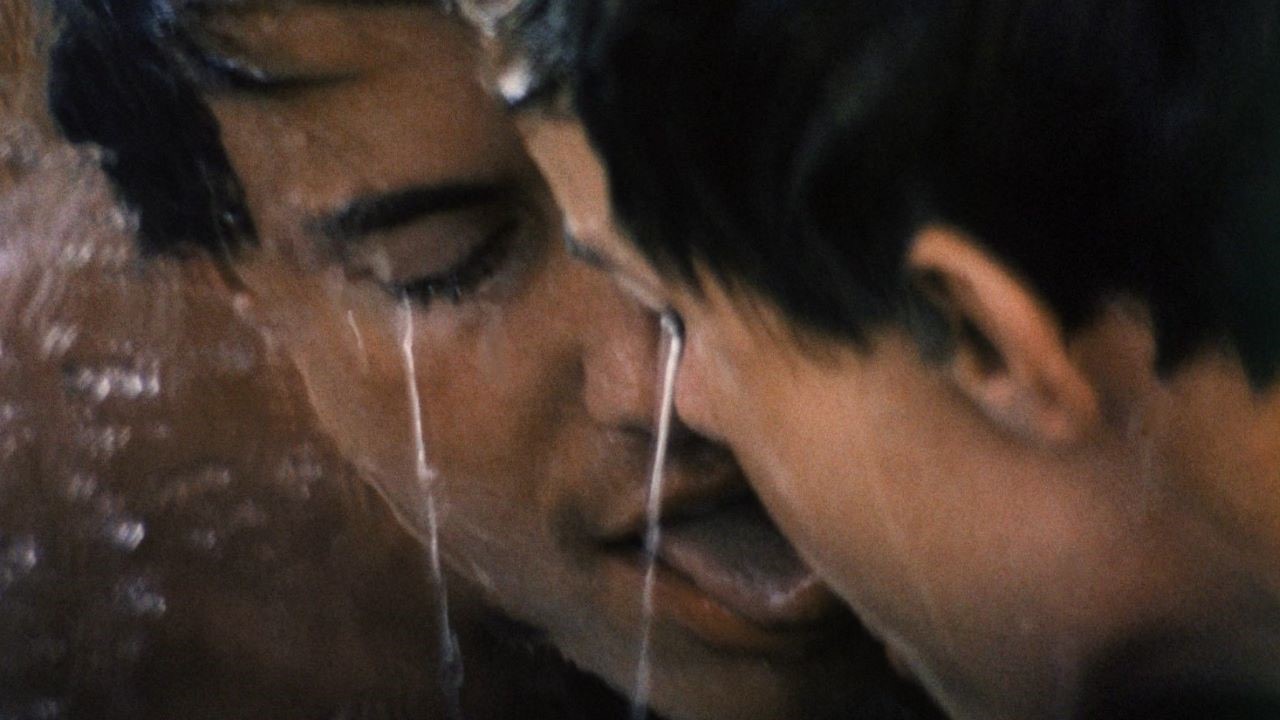
Other notable films of this era, such as Sex Garage and Drive!, blended explicit sex with experimental art-film techniques, offering a kind of avant-garde pornography. And beyond film, the hypermasculine, leather-clad drawings of Tom of Finland profoundly influenced the aesthetic of this era — his work infused pornographic imagery with style and self-confidence. These films treated sex not just as a physical act but also as an expression of fantasy, identity, and even politics — often blending sensuality with beauty and humor.
The Condom Era: Risk, Responsibility, and Reinvention

With the arrival of HIV/AIDS in the early 1980s, the landscape of gay porn changed dramatically. Fear and loss reshaped queer sexuality, and the industry adopted condoms both as a visual norm and as an ethical statement. Yet filmmakers continued to create works that were erotic, imaginative, and even moving. While the films of this era often retained the narrative ambition of the classic period, the urgent subtext of survival and safer sex advocacy gave them new weight. Many films explicitly incorporated education or chose to eroticize condoms themselves, making them part of the fantasy rather than an intrusion on it.

One example is More of a Man (1986), which managed to portray explicit gay sex as affirming and healthy during a time of crisis. Later films such as Oversized Load (1992) and Flashpoint (1994) demonstrated that high production values and eroticism could coexist with a commitment to showing safer sex. Directors like Chi Chi LaRue injected humor, camp, and even tenderness into their films while insisting on condoms, making the condom itself part of the fantasy rather than an obstacle. These works helped sustain gay erotic culture during a devastating epidemic, offering viewers both pleasure and reassurance. These films demonstrated how erotic art could adapt to a changed world, preserving desire while honoring safety and responsibility.
The Post-Condom Era: Emotional Realism and Erotic Storytelling

With the introduction of PrEP (pre-exposure prophylaxis) and better treatments for HIV, the last decade has seen a return to condomless (or “bareback”) porn. Some see this as a fetishization of risk; others view it as reflecting new realities where undetectable equals untransmittable (U=U) and consent is better understood. The artistry of the current era often lies in its diversity: high-definition cinematography, thoughtful storytelling, and a new openness about race, body types, and kink.

Studios like CockyBoys have embraced the idea of “art house porn” — their Answered Prayers series (2014–15) was highly conceptual, blending dreamlike imagery, emotional narratives, and striking cinematography with explicit sex. Meanwhile, queer filmmaker Bruce LaBruce has consistently created films that integrate hardcore gay sex into narrative art cinema, screened at film festivals and museums.

In addition, Davey Wavey’s Himeros project has taken the idea of porn-as-art even further, explicitly positioning itself at the intersection of eroticism, education, and body positivity. With its emphasis on advocacy and sensual exploration, Himeros aims to create porn that doesn’t just arouse but also affirms, teaching viewers to see their own bodies and desires as beautiful and worthy. And across the independent scene, more and more filmmakers are producing “post-porn” hybrids: installations, videos, and screenings in galleries that use pornographic elements to explore desire, identity, and politics.
What Makes Porn Art?
So, what distinguishes these works from “just porn”?
- Intent: Many of these works aim not just to arouse but to say something — about desire, about queerness, about the human condition.
- Aesthetic Vision: Careful cinematography, editing, sound design, and narrative ambition elevate the material.
- Cultural Context: In eras when mainstream culture erased queer desire, these films asserted its legitimacy and beauty.
- Emotional Resonance: Art moves us — and some of these films succeed in doing so even beyond the erotic charge.
Of course, not all gay porn is art — nor does it have to be. But these examples show that pornography can be artful, meaningful, and even beautiful. Whether you view it on a gallery wall, a festival screen, or your laptop at midnight, it is part of the long story of how queer people have imagined, celebrated, and preserved our desires.
What do you think? Where do you draw the line between porn and art? Or is there even a line at all? Share your thoughts in the comments.



 Joe
Joe





 The Closet Professor
Thank you for commenting. I always want to know what you have to say. However, I have a few rules: 1. Always be kind and considerate to others. 2. Do not degrade other people's way of thinking. 3. I have the right to refuse or remove any comment I deem inappropriate. 4. If you comment on a post that was published over 14 days ago, it will not post immediately. Those comments are set for moderation. If it doesn't break the above rules, it will post.