
When most people picture Art Deco, the mind goes to sleek skyscrapers, angular ornament, and those famous female dancer figurines with ivory faces and bronze limbs. But the 1920s and 1930s also produced a remarkable body of male imagery, especially in sculpture, where the male nude was celebrated as much for its athletic power as for its aesthetic beauty.
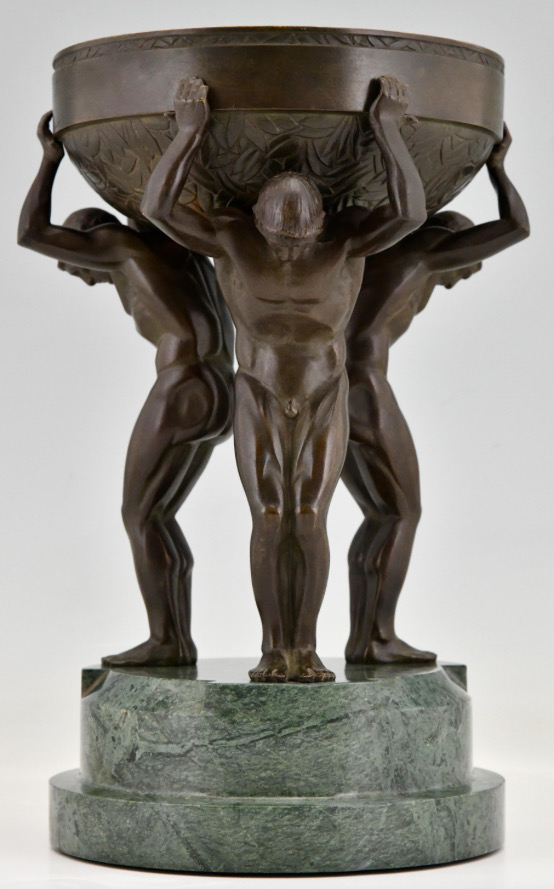
Sculptural Heroes
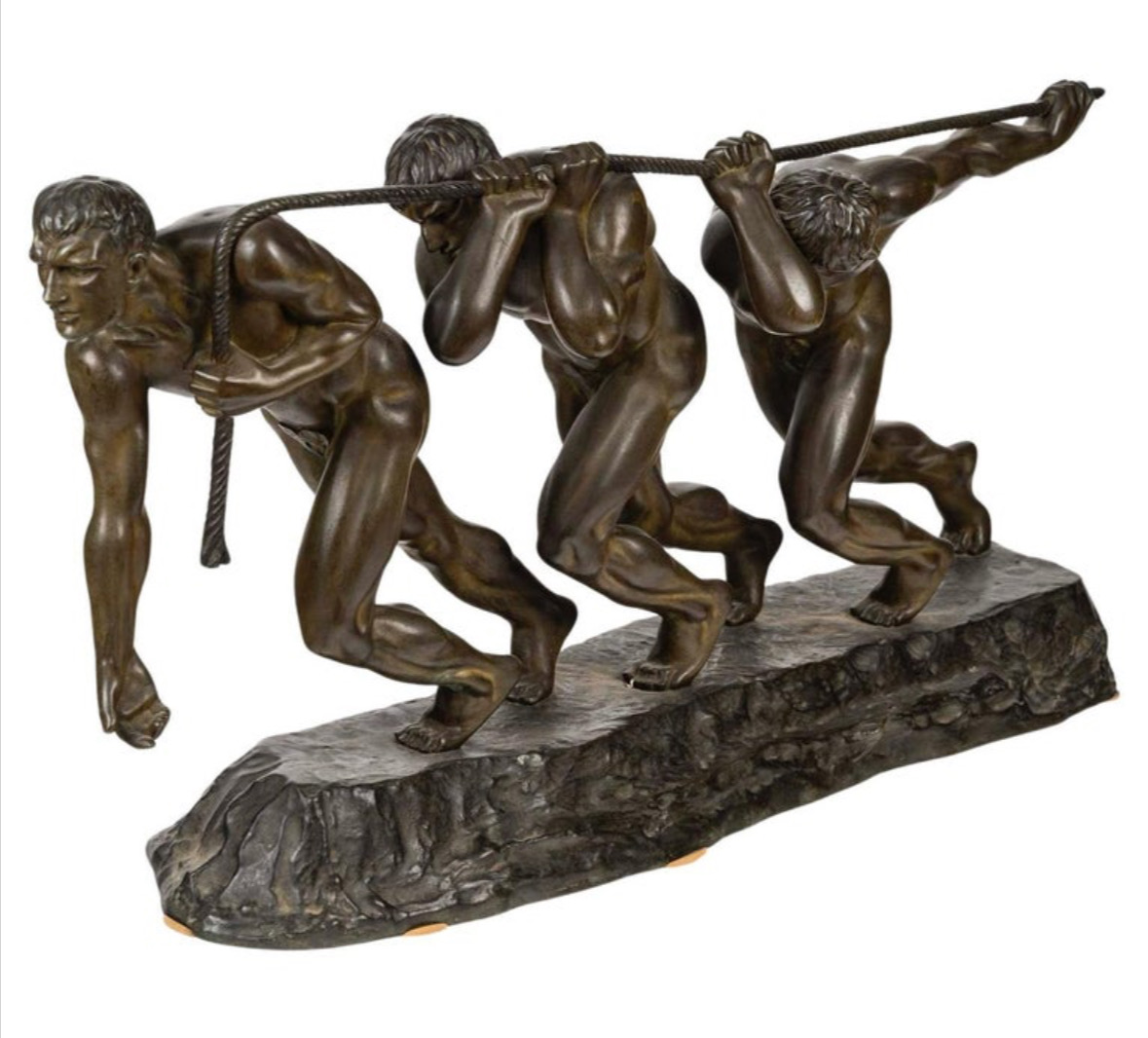
Auguste Durin crafted muscular athletes whose streamlined bodies recalled both ancient Greek statues and modern gymnasiums. His bronzes often highlight the flex of a thigh or the arc of a torso, creating men who feel both timeless and distinctly of their era. Maurice Guiraud-Rivière gave us dynamic bronzes of runners, discus throwers, and hunters; their bodies drawn into taut, geometric rhythms as if caught in perpetual motion.
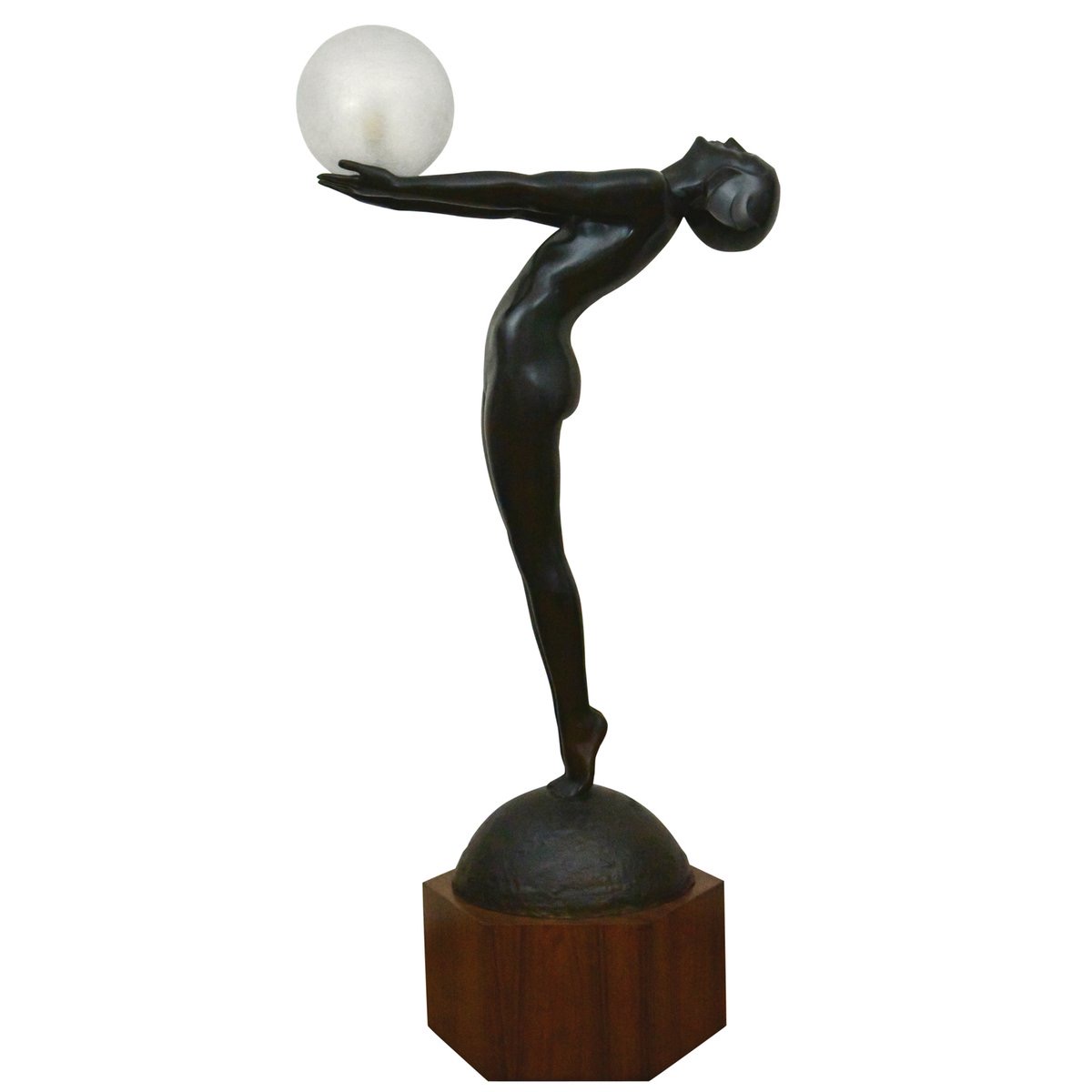
Demétre H. Chiparus, though famous for exotic female dancers, did not neglect men altogether—his Le Premier Pas shows a young nude stepping forward with deliberate grace, his body a harmony of energy and elegance. Max Le Verrier, perhaps the most recognizable name in Art Deco sculpture, created striking athletic youths such as Clarté, a lamp-bearing nude male who holds a glowing globe aloft like a modern Prometheus.
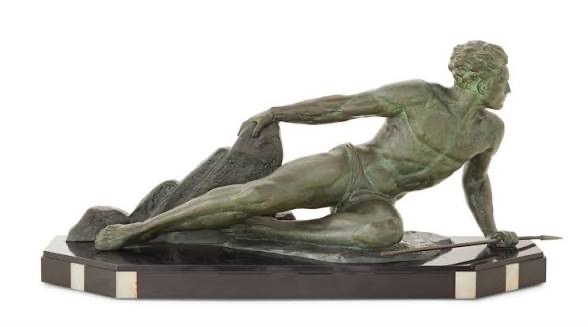
Jean de Roncourt’s works exude virility: his bronzes of hunters, wrestlers, and archers reveal every muscle in sharp definition, nude or scantily draped. Pierre Le Faguays, often working under pseudonyms like Fayral or Guerbe, produced vigorous male and female dancers alike; his Danseur Nu captures the twisting grace of a naked youth in motion. Even lesser-known sculptors like L. Valderi French contributed to this canon of heroic men, cast in bronze and spelter, embodying an age obsessed with strength and beauty.
Nudity and the Male Form
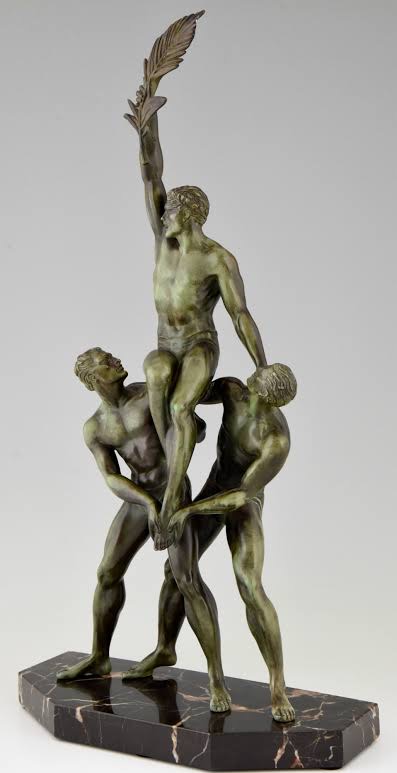
The nude male in Art Deco sculpture is strikingly different from the female nude of the same period. Where women are often allegorical or eroticized, men are athletic, disciplined, and powerful. Nudity was not scandal but symbol: the unclothed male body embodied health, modernity, and idealized masculinity. These weren’t portraits of individuals, but archetypes—youths who seemed to stride straight out of both the classical past and the Jazz Age future.
Two-Dimensional Visions
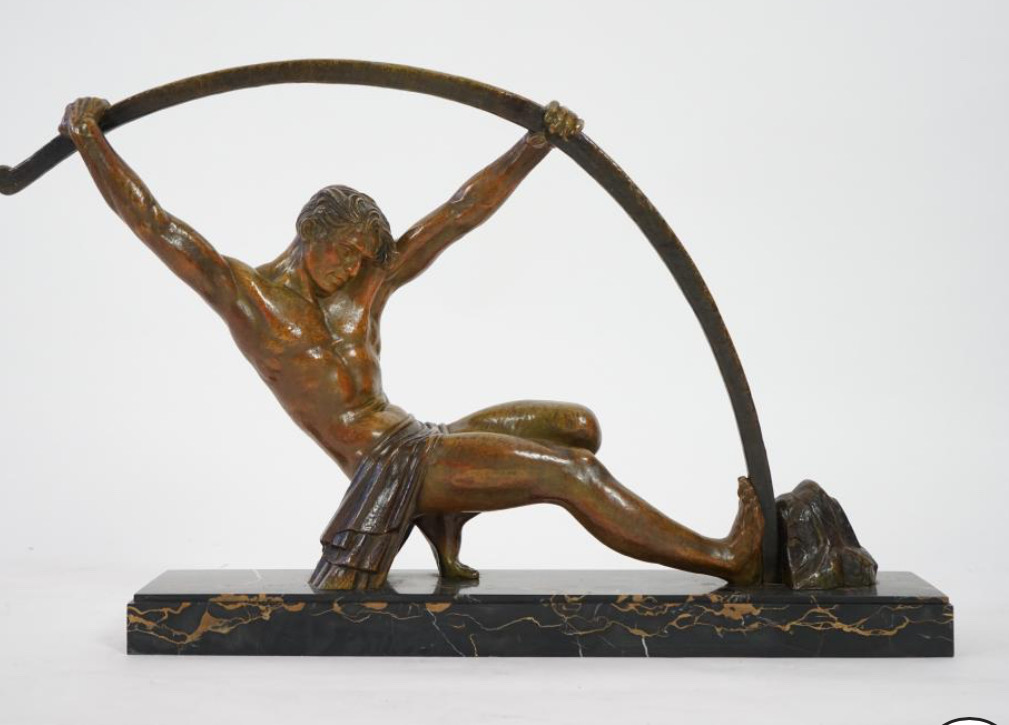
Art Deco depictions of men weren’t limited to bronze and stone. Painters, graphic artists, and muralists also took up the subject, often balancing sensuality with stylization. Tamara de Lempicka, best known for her cool, chic portraits of women, also painted striking male nudes, such as Nu Masculin (1929). In these canvases, bodies are sculptural and polished, more marble than flesh.
Jean Dupas, whose monumental panels adorned interiors of luxury liners, often depicted sailors, mythological heroes, and allegorical figures—sometimes draped, sometimes nude—his men elongated and stylized, their musculature arranged like architecture. In graphic art and advertising, artists such as Paul Colin infused male figures—whether jazz musicians, dancers, or athletes—with the same geometric vitality seen in sculpture.
Even in decorative arts, male forms appear: wall panels, book illustrations, and magazine covers showed sleek swimmers, runners, and workers, clothed or unclothed, embodying vigor and speed. The nude was celebrated not only in galleries but in the very fabric of modern life.
The Question of What’s Missing
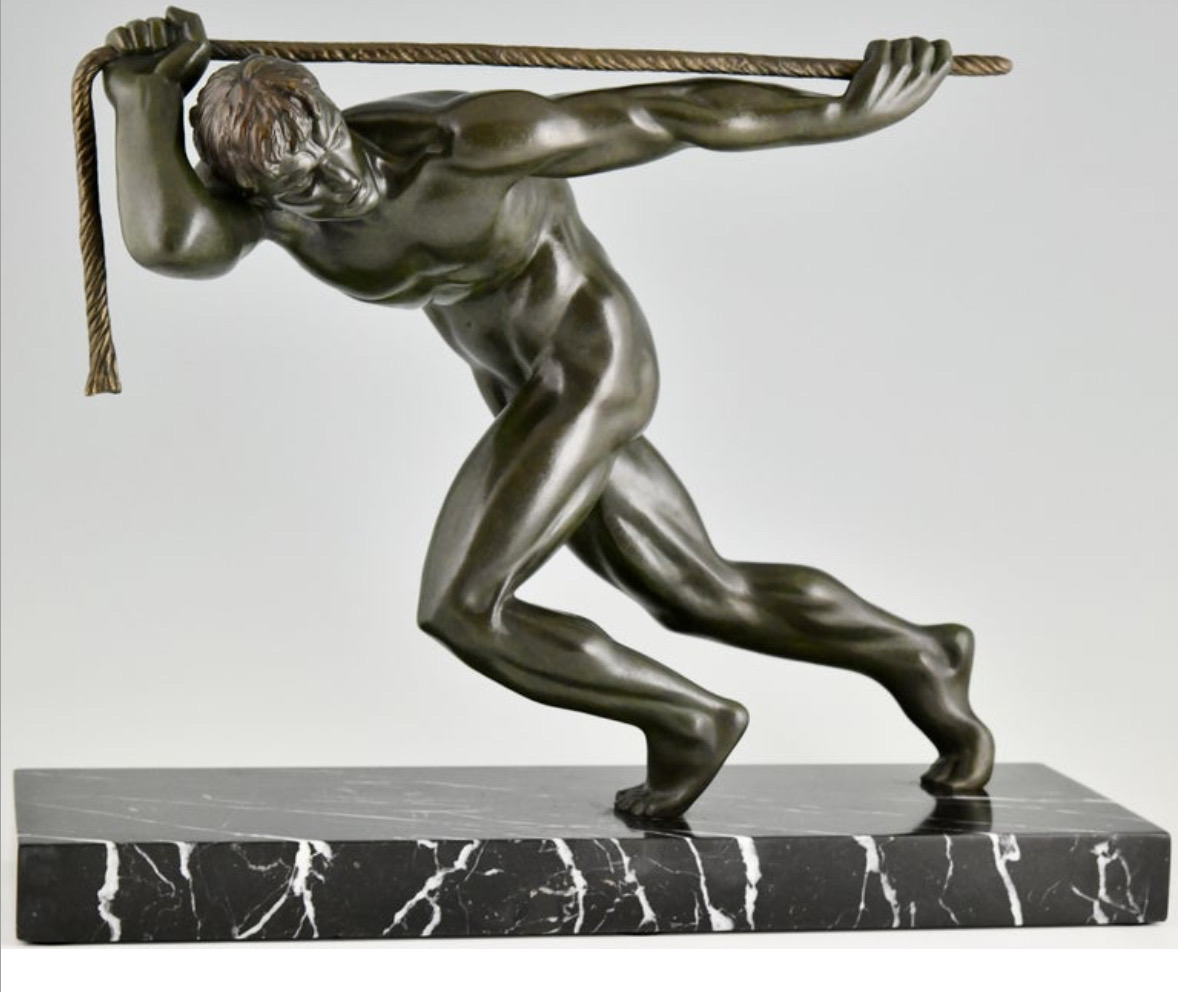
One detail that often strikes modern viewers is what is not shown. Many Art Deco male nudes either cover or minimize the penis. This wasn’t an accident—it was a deliberate choice shaped by several factors. The style drew heavily on classical precedents, where small, modest genitalia signaled refinement rather than vulgarity. Social propriety and marketability also mattered: a statuette with prominent genitals would not have graced many bourgeois mantelpieces. Moreover, the Art Deco aesthetic favored clean lines, streamlined geometry, and polished surfaces—the penis simply disrupted the ideal silhouette. And finally, there was the delicate matter of gender politics: a nude woman could be eroticized without scandal; a nude man, if too explicit, risked reading as homoerotic in a society uncomfortable with such implications.
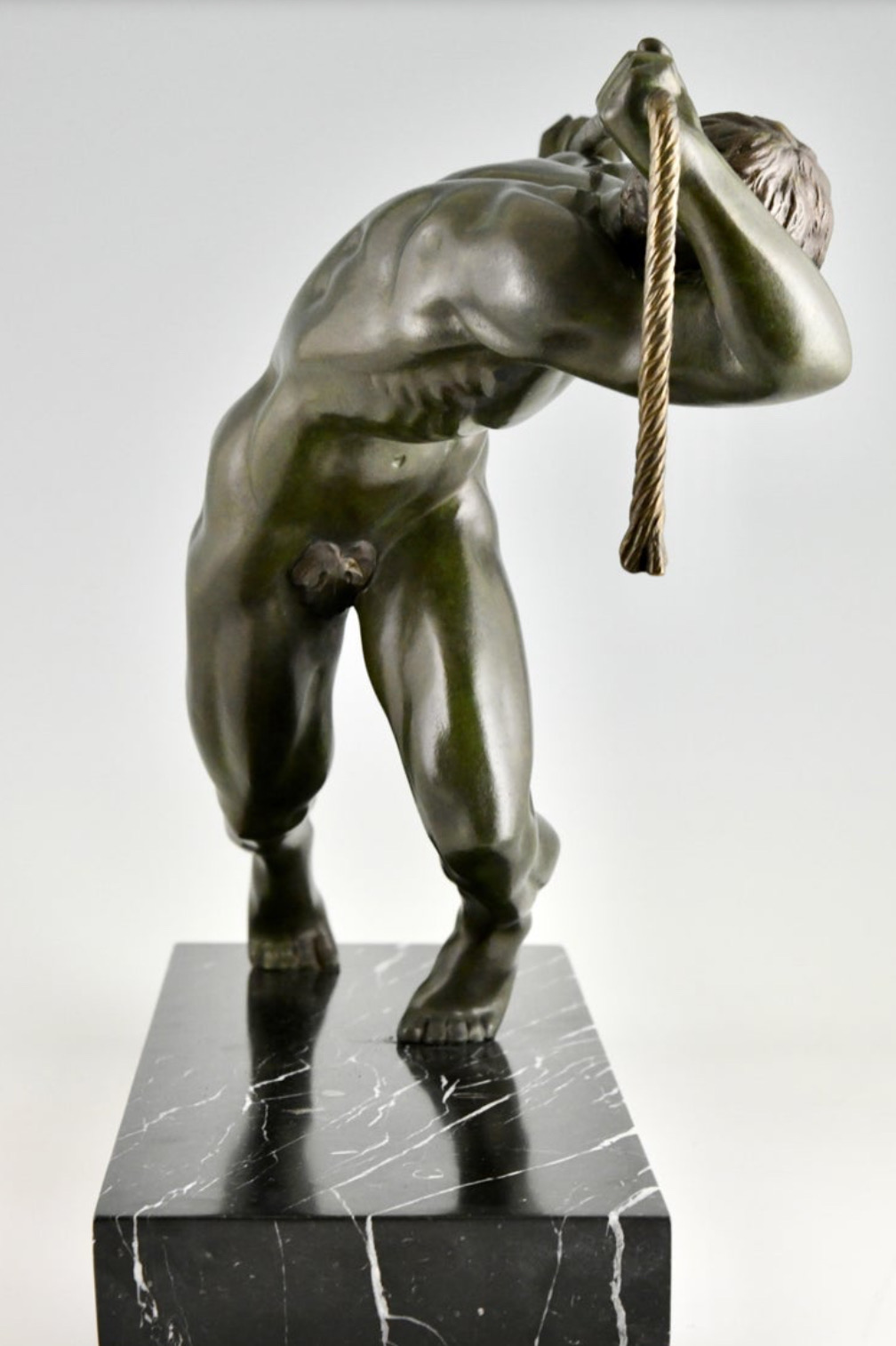
So while Art Deco exalted the male body, it often did so with strategic omissions. Muscles, movement, and idealized form took precedence over sexual detail. In this sense, the missing penis tells us as much about the cultural anxieties of the 1920s and 1930s as the stylized bodies tell us about its ideals of beauty and strength.



 Joe
Joe





 The Closet Professor
September 18th, 2025 at 6:32 am
Joe, The Greeks and the Roman sculptors lived in a society where public nudity was common – vide the Olympic Games and the public baths of Roman times.
Curiously, while public naked swimming was common at the turn of the 20th century and beyond, sculptural idylls had changed.