Monthly Archives: September 2025

Grace in Every Word

“Do not let any unwholesome talk come out of your mouths, but only what is helpful for building others up according to their needs, that it may benefit those who listen.”

—Ephesians 4:29

Words matter. For those of us in the LGBTQ+ community, we know all too well the pain that can come from words spoken carelessly—or cruelly. Many of us grew up hearing slurs hurled at us, sermons that condemned us, or even loved ones telling us we were “wrong.” These words linger. They can cut deep, echoing long after they are spoken. Ephesians 4:29 calls us to something radically different: to use our words not as weapons but as instruments of grace, to speak in ways that build up rather than tear down.

Proverbs 18:21 reminds us, “The tongue has the power of life and death.” That verse feels very real when you think of young people—especially LGBTQ+ youth—who are struggling with identity, acceptance, and belonging. We all know the statistics: depression, bullying, and suicide rates are higher among LGBTQ+ youth. In such cases, a kind or encouraging word isn’t just nice—it can literally mean the difference between despair and hope, even between life and death.

As a former teacher, I lived this reality. I could not be openly gay in the classroom, but my students suspected. They knew they could come talk to me. And many did. Sometimes all they needed was a listening ear or a gentle reminder that they mattered. Today, some teachers can be more open about their sexuality, but in too many states, laws are being passed that forbid even mentioning it. In some classrooms, a photo of a teacher’s spouse on a desk is considered “illegal.” Yet the presence of a safe adult—someone who is open, or at the very least welcoming—is a lifeline.

That’s why I proudly display a Safe Zone sign by my office door. It’s a silent but powerful word of welcome: “You are safe here. You are seen here. You are valued here.” Teachers have always had the ability to change lives, but in today’s climate, it is especially important to let students know: It Gets Better.

Jesus himself was often called “Teacher,” and his words reflect the very heart of Ephesians 4:29. He used his voice to uplift the poor, to comfort the outcast, and to challenge those who abused their power. His Sermon on the Mount gave hope to the weary; his parables painted visions of justice and mercy; his rebukes exposed hypocrisy and oppression. To be like Christ is to use our words in the same way—to heal rather than to harm, to invite rather than exclude, to proclaim God’s love in a world that too often echoes with condemnation.

And whether or not you stand at the front of a classroom, you have that same power. Words are not confined to teachers—they belong to parents, mentors, co-workers, supervisors, and friends. If you are guiding a child, mentoring a young adult, or training an employee, your words carry weight. A simple encouragement can inspire confidence; a harsh comment can wound deeply. Each of us has the power to change someone’s life through the way we speak. The question is whether we will use that power to tear down or to build up.

Scripture offers us a vision of speech that heals. Proverbs 15:1 says, “A gentle answer turns away wrath, but a harsh word stirs up anger.” James 1:19 adds, “Everyone should be quick to listen, slow to speak and slow to become angry.” Imagine if our leaders, our schools, our churches lived out those verses. Imagine if public discourse sought to build up those most vulnerable instead of exploiting them for power.

In Colossians 4:6, Paul exhorts us: “Let your conversation be always full of grace, seasoned with salt, so that you may know how to answer everyone.” Grace-filled speech doesn’t mean silence in the face of injustice—it means that even when we speak hard truths, we do so with the goal of healing, of justice, of love. And for teachers, mentors, and leaders of all kinds, that means modeling kindness and affirmation in every interaction, showing others by example that their worth is non-negotiable.

Ephesians 4:29 is not just about avoiding “bad language.” It is about cultivating a culture of love. It is about recognizing that our words can be lifelines—reminders of hope, courage, and belonging. When we choose words that build up, we are declaring to the world: we are here, we are loved, and we are worthy.

May we guard our tongues not out of fear, but out of love. May we speak words that carry the fragrance of Christ, words that heal the wounds so many of us have endured, and words that remind one another of the deep truth: we are made in God’s image. And may we especially use our words to build up the next generation, who are longing to hear that their lives matter and that their future is worth holding onto.



Pic of the Day


Moment of Zen: Hammocks


Pic of the Day


Not Thankful It’s Friday

Usually I look forward to Fridays, but not this week. I’m not even looking forward to Saturday. This weekend brings with it our big annual set of events at the museum, which means lots of tours, lots of visitors, and lots of chaos. Today I have multiple tours lined up, and tomorrow I’ll be back again for one or two more—yes, working on a Saturday. Yesterday I put in a twelve-hour day, came home, and went straight to bed. This morning I’m running on sheer habit and coffee.

If there’s a silver lining, it’s that today will “only” be an eight-hour day and tomorrow about six. That may not sound like much of a break, but after the marathon that was yesterday, it’s something to be thankful for. Really, I’ll only feel relief when Sunday finally rolls around and I can rest, free from the craziness and hoopla.

And here is your Isabella Pic of the Week. This is the look I get when I’m not petting her as much as she thinks I should. Normally she likes to curl up on my hip, but with my back problems she hasn’t been able to. Instead, she’s taken to lying on my chest. It’s her version of cuddling, and honestly, I’ll take it.


Pic of the Day


Bronze and Geometry: Art Deco’s Ideal Man

When most people picture Art Deco, the mind goes to sleek skyscrapers, angular ornament, and those famous female dancer figurines with ivory faces and bronze limbs. But the 1920s and 1930s also produced a remarkable body of male imagery, especially in sculpture, where the male nude was celebrated as much for its athletic power as for its aesthetic beauty.

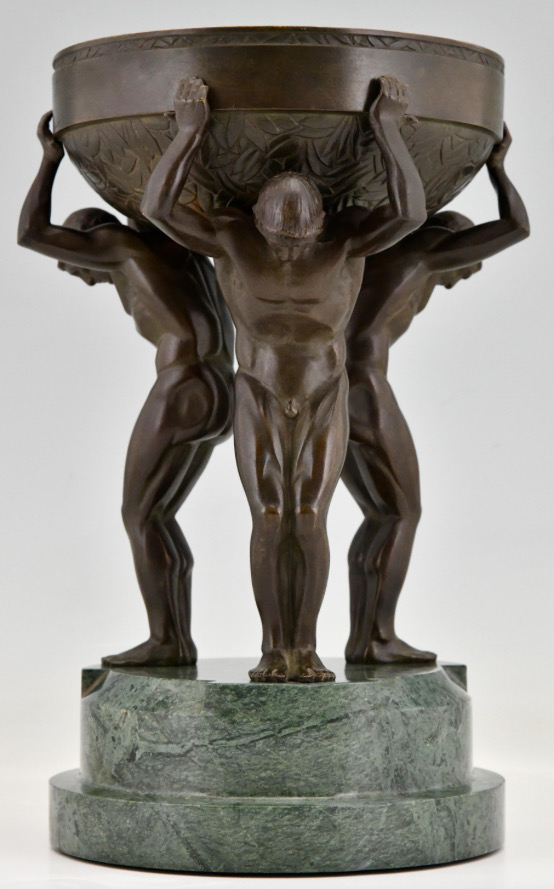
Maurice Guiraud Rivière, “Centerpiece Supported by Three Nude Male Figures,” c. 1930s

Sculptural Heroes

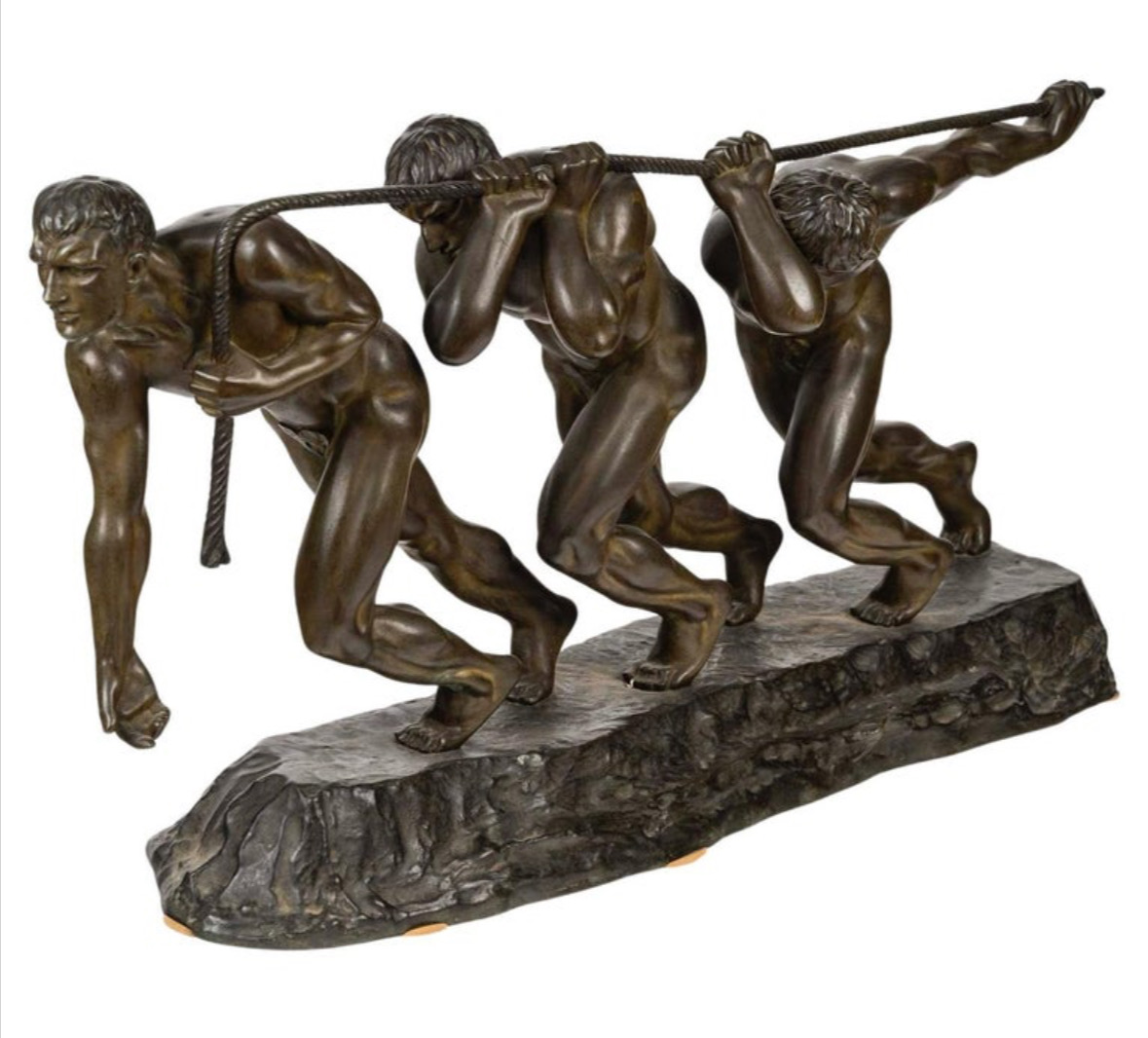
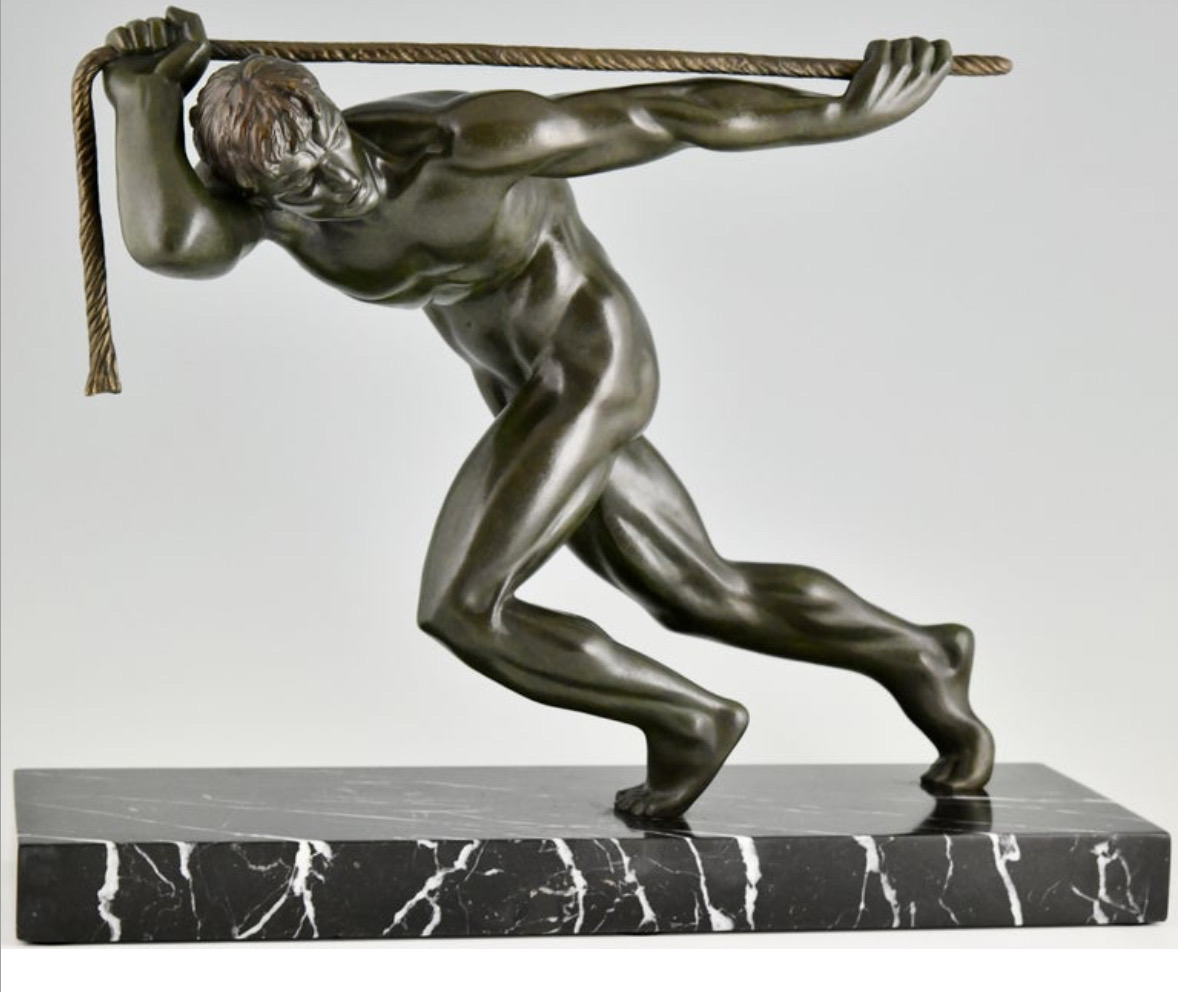
The Strength, A bronze group by Maurice Guiraud-Rivière (1881-1947), circa 1930

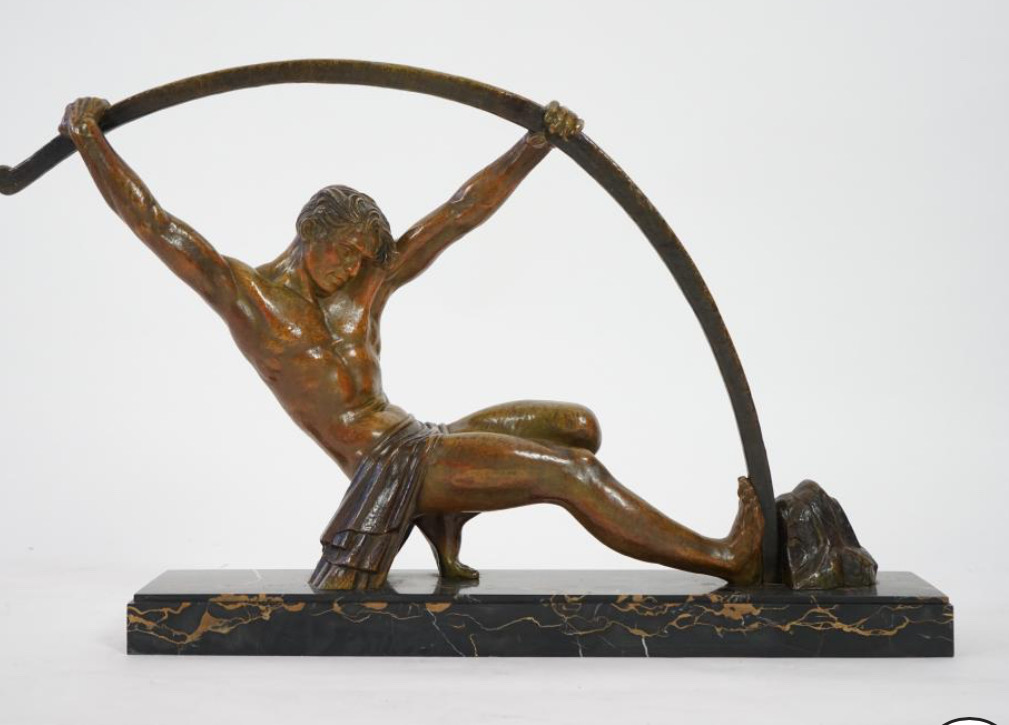
Auguste Durin crafted muscular athletes whose streamlined bodies recalled both ancient Greek statues and modern gymnasiums. His bronzes often highlight the flex of a thigh or the arc of a torso, creating men who feel both timeless and distinctly of their era. Maurice Guiraud-Rivière gave us dynamic bronzes of runners, discus throwers, and hunters; their bodies drawn into taut, geometric rhythms as if caught in perpetual motion.

Clarte Standing Nude with Globe by Max Le Verrier

Demétre H. Chiparus, though famous for exotic female dancers, did not neglect men altogether—his Le Premier Pas shows a young nude stepping forward with deliberate grace, his body a harmony of energy and elegance. Max Le Verrier, perhaps the most recognizable name in Art Deco sculpture, created striking athletic youths such as Clarté, a lamp-bearing nude male who holds a glowing globe aloft like a modern Prometheus.

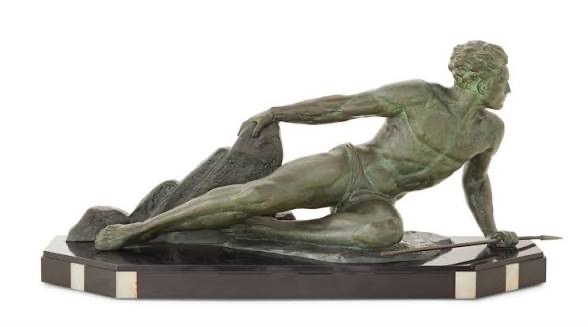
Jean de Roncourt’s “Lanceur de Lance,” 1930s

Jean de Roncourt’s works exude virility: his bronzes of hunters, wrestlers, and archers reveal every muscle in sharp definition, nude or scantily draped. Pierre Le Faguays, often working under pseudonyms like Fayral or Guerbe, produced vigorous male and female dancers alike; his Danseur Nu captures the twisting grace of a naked youth in motion. Even lesser-known sculptors like L. Valderi French contributed to this canon of heroic men, cast in bronze and spelter, embodying an age obsessed with strength and beauty.

Nudity and the Male Form

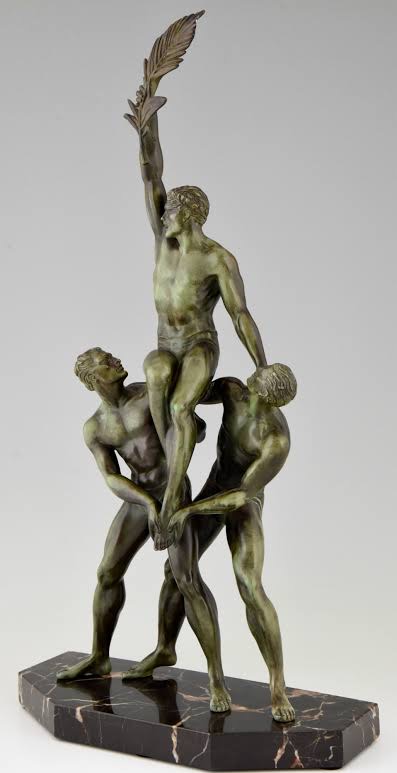
Pierre Le Faguays, “Three Athletes,” 1935

The nude male in Art Deco sculpture is strikingly different from the female nude of the same period. Where women are often allegorical or eroticized, men are athletic, disciplined, and powerful. Nudity was not scandal but symbol: the unclothed male body embodied health, modernity, and idealized masculinity. These weren’t portraits of individuals, but archetypes—youths who seemed to stride straight out of both the classical past and the Jazz Age future.

Two-Dimensional Visions

Demétre Haralamb Chiparus (1886-1947), ‘Le Bendeur’

Art Deco depictions of men weren’t limited to bronze and stone. Painters, graphic artists, and muralists also took up the subject, often balancing sensuality with stylization. Tamara de Lempicka, best known for her cool, chic portraits of women, also painted striking male nudes, such as Nu Masculin (1929). In these canvases, bodies are sculptural and polished, more marble than flesh.

Jean Dupas, whose monumental panels adorned interiors of luxury liners, often depicted sailors, mythological heroes, and allegorical figures—sometimes draped, sometimes nude—his men elongated and stylized, their musculature arranged like architecture. In graphic art and advertising, artists such as Paul Colin infused male figures—whether jazz musicians, dancers, or athletes—with the same geometric vitality seen in sculpture.

Even in decorative arts, male forms appear: wall panels, book illustrations, and magazine covers showed sleek swimmers, runners, and workers, clothed or unclothed, embodying vigor and speed. The nude was celebrated not only in galleries but in the very fabric of modern life.

The Question of What’s Missing

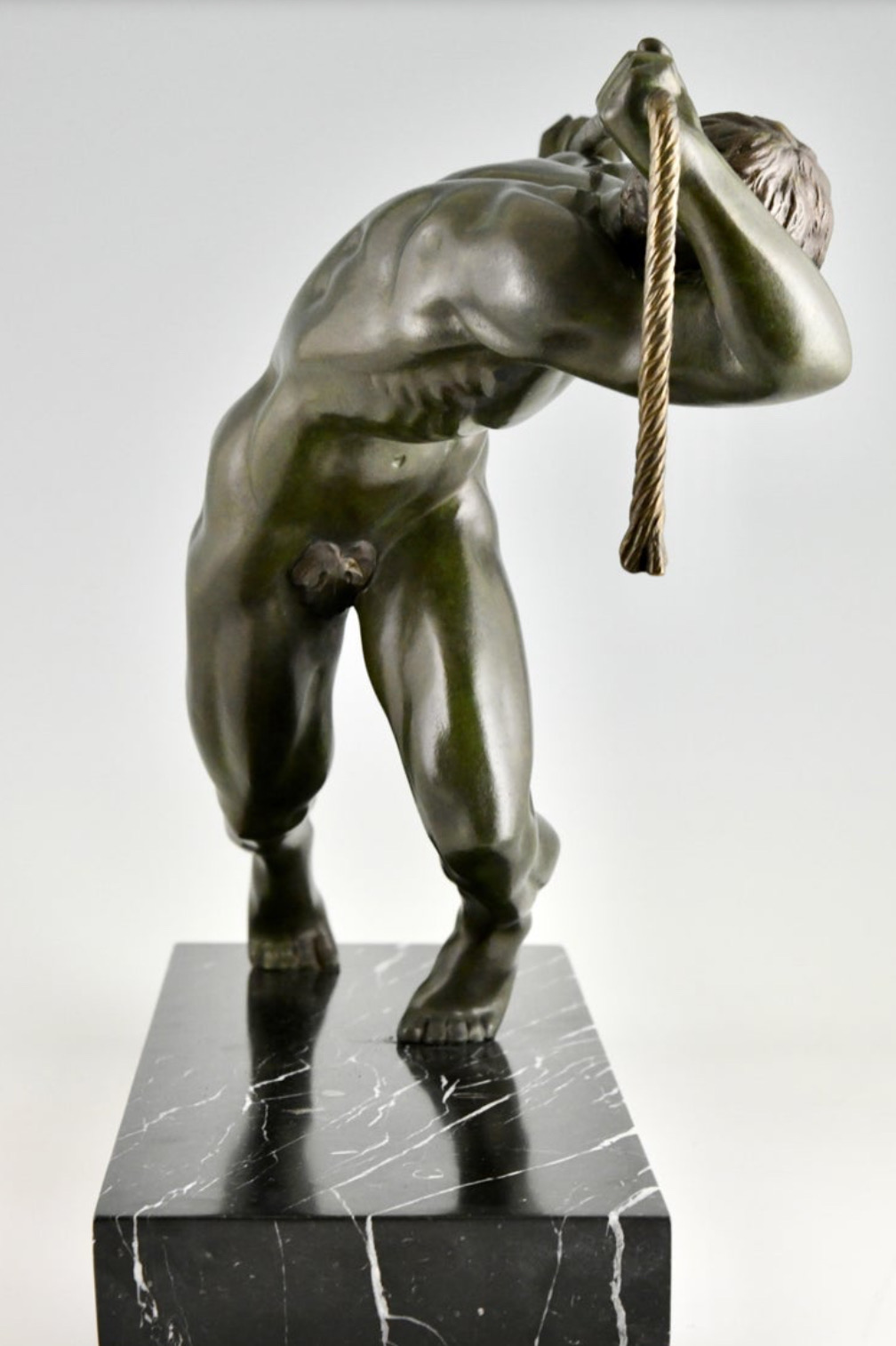
“Nude Athlete,” by Maurice Guiraud Rivière, 1930

One detail that often strikes modern viewers is what is not shown. Many Art Deco male nudes either cover or minimize the penis. This wasn’t an accident—it was a deliberate choice shaped by several factors. The style drew heavily on classical precedents, where small, modest genitalia signaled refinement rather than vulgarity. Social propriety and marketability also mattered: a statuette with prominent genitals would not have graced many bourgeois mantelpieces. Moreover, the Art Deco aesthetic favored clean lines, streamlined geometry, and polished surfaces—the penis simply disrupted the ideal silhouette. And finally, there was the delicate matter of gender politics: a nude woman could be eroticized without scandal; a nude man, if too explicit, risked reading as homoerotic in a society uncomfortable with such implications.

“Nude Athlete,” by Maurice Guiraud Rivière, 1930

So while Art Deco exalted the male body, it often did so with strategic omissions. Muscles, movement, and idealized form took precedence over sexual detail. In this sense, the missing penis tells us as much about the cultural anxieties of the 1920s and 1930s as the stylized bodies tell us about its ideals of beauty and strength.


Pic of the Day


MRI

Today is finally MRI day, and I’m both relieved and a little anxious. I had to be up earlier than usual this morning since my appointment at the hospital was at 6 a.m. Isabella didn’t seem to mind me stirring around at that hour—she was just happy to have breakfast a bit earlier. For weeks now my back has been bothering me, and while I’ve tried to push through the pain, it’s clear something isn’t right. Hopefully, the MRI will give me some answers and a clearer path forward. It’s one of those things where just knowing what’s going on will be a huge relief in itself.

Since I have the whole day off, I decided to make the most of it and head up to Burlington afterward. There are a few shoe stores there that carry some really nice options, and I’ve been needing a good pair of shoes for a while. It feels like a bit of a treat to mix something necessary with something enjoyable. After all, if I’m going to be dealing with back issues, I might as well do it in style with a comfortable (and hopefully sharp-looking) new pair of shoes.


Pic of the Day