

Author Archives: Joe
About Joe

Sunday Double Feature: Politics and Pride
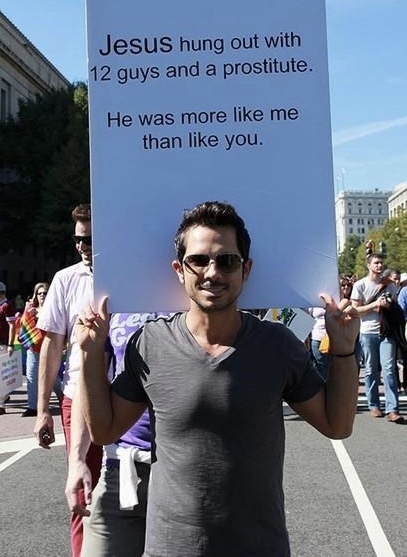
What Would Jesus Do?
He who is without sin among you, let him throw a stone at her first.
—John 8:7
Religion fanaticism fueled by hatred and hatred fueled by ignorance is destroying the United States. Fascist politicians are using hatred, just as they did in the 1920s and 1930s to further their power-hungry ambitions. All across the world, there are politicians who are either fighting against democracy or strengthening their existing authoritarian rule. Conservatives, whether Republican, Fascist, Nazi, etc., have used religious fanaticism to take away the rights of people. Religion was used to justify slavery, subjugate women, kill or imprison LGBTQ+ individuals, and any number of horrible inhumane actions.
For those who claim they are Christian and vote and support hatred-fueled religious fanaticism, they do not follow the teachings of Jesus. Jesus taught love, hope, charity, mercy, and acceptance. In John 4:3–39, Jesus was headed to Galilee from Judea. This was early in His ministry. He stopped to rest and refresh Himself at a well in Samaria during one of His journeys. A woman came to the well to draw water, and the Savior engaged her in conversation. She was astonished that He would speak with her, “for the Jews have no dealings with the Samaritans.” But He overlooked the traditions that devalued her in others’ eyes. He taught her about the living water of the gospel, and He testified to her, “I who speak to you am [the Messiah].”
Jesus did not teach hatred and discrimination like many modern Christians. Instead, he taught acceptance. There are two remarkable stories showing how Jesus cared for all types of people. The religious fanatics of his time called the Pharisees were offended because in their view God loved only the righteous who kept the law as they interpreted them. They, therefore, distanced themselves from so-called ‘unclean’ sinners in their delusions of self-righteousness. But Jesus was often eating and drinking with those the Pharisees deemed disreputable sinners. He met people where they were and healed them. He protected those who committed adultery and prostitutes. Jesus proclaimed that both law-keepers and law-breakers are sinners in need of forgiveness. In John 8:7, Jesus told the Pharisees who wanted to stone a woman to death for committing adultery, “He who is without sin among you, let him throw a stone at her first.” In Matthew 7:1-3, Jesus warned, “Judge not, that you be not judged. For with what judgment you judge, you will be judged; and with the measure you use, it will be measured back to you. And why do you look at the speck in your brother’s eye, but do not consider the plank in your own eye?”
A day of reckoning will come for those who use the name of God to further their hatred and claim that they do so in Jesus’s name. We can start by going to the polls in November and voting out the hypocrites and modern-day Pharisees. We need to vote in such great numbers that we make the elections of 1932 a minor Democratic victory. For anyone who is not familiar with the 1932 elections, Democratic New York Governor Franklin D. Roosevelt defeated Republican incumbent president Herbert Hoover in a landslide, with Hoover winning only six Northeastern states. In addition to Hoover’s defeat, the Republicans also suffered crushing defeats in both congressional chambers: they lost 101 seats in the House of Representatives, with the Democrats expanding their House majority to a supermajority (a gain of 97 seats), and also lost twelve seats in the Senate, giving Democrats a total of 58 out of 96 seats in the Senate (Alaska and Hawaii were not yet states). The other Senator, Henrik Shipstead of Minnesota, was a member of the Farmer-Labor Party before switching back to being a Republican in 1940. (He’d been a Republican prior to 1923.) This landslide election was the last time that an incumbent president lost re-election and his party lost control of both chambers of Congress in a single term until 2020.
If we don’t keep a majority in the House and gain at least 2 seats in the Senate (to counteract Manchin and Sinema) and do away with the filibuster, hate has won. Furthermore, we must expand the Supreme Court and institute ethics reforms in the federal government including SCOTUS. If you live in a state with a Republican majority, work as hard as you can to change that. We have to have election reforms and protections. We need stronger and sensible gun laws. We need meaningful reforms to healthcare and student loans. Most importantly we must preserve equality in the United States. We can no longer allow religious fanatics to have sway in this country. Republicans have pushed for overturning Roe v. Wade, and now they’ve done it. This will only empower conservatives and religious fanatics to push forward with taking away marriage equality, access to birth control, the right to privacy, and due process. In his concurring opinion, Justice Clarence Thomas wrote that the justices “should reconsider all of this Court’s substantive due process precedents, including Griswold, Lawrence, and Obergefell” — referring to three cases having to do with Americans’ fundamental privacy, due process, and equal protection rights. Anyone who did not see this coming with the overturning or Roe was incredibly naïve. I beg of you not only to vote but encourage all those who are sympathetic to equality to also vote. If someone needs a ride to the polls, give it to them. If someone is not registered to vote, get them registered.
I don’t think that the majority of people who claim to be Christian would follow Jesus if the Second Coming happened today. They set aside all of their values and beliefs to elect Donald Trump. They sold their souls to make sure that Roe was overturned. Now, we must come out fighting (peacefully, of course). Vote! Vote! Vote! Let’s take back our country and make it a country in which we can be proud to live.
Prayer for Pride 🙏🏻🏳️🌈
“And when you pray, you shall not be like the hypocrites. For they love to pray standing in the synagogues and on the corners of the streets, that they may be seen by men. Assuredly, I say to you, they have their reward. But you, when you pray, go into your room, and when you have shut your door, pray to your Father who is in the secret place; and your Father who sees in secret will reward you openly. And when you pray, do not use vain repetitions as the heathen do. For they think that they will be heard for their many words. Therefore, do not be like them. For your Father knows the things you have need of before you ask Him.”1
—Matthew 6:5-8
I love Pride because it shows the diversity of our communities. Different skin colors, different body types, different genders (and even more gender expressions!) From promiscuous to monogamous married couples, from kinky to vanilla, and everything in between. The LGBTQ+ community is varied and beautiful, and that’s what makes us such a fabulous community.
Recently, I received an email form Queer Theology which shared a wonderful prayer for Pride. I have adapted it a little to fit my situation better, and I encourage you to do the same. (My edits with notes are in parentheses.) So, I give you a Prayer for Pride:
There was a time when I prayed asking you to help me become straight. Thank you for ignoring that prayer. Or rather, for answering it differently than I expected:
“I will help you become more fully you.”
Thank you for the gift of queerness, for the liberation it has sparked in my own life (and in the lives of my family2).
Thank you for this body and for the courage to explore all the ways I can use it to make myself and others feel good, connected, healed, whole. (And let’s not forget sexy and desired.3)
Though my journey here has not been easy, I am grateful for it. Let the shame I felt with my body, with my desires, with my love, with myself, be a reminder to do everything I can to not contribute to another’s shame but to instead support them in their own self-love and self- determination.
I pray for those still living with shame, help them to shake it off; and embolden me to work to create a world which breeds pride, not shame.
I pray for those who, knowingly and unknowingly, fed my own shame. May they have everything they need in their lives and if they seek forgiveness, help them to know that they are forgiven.
And I pray for those in the in-between spaces–myself included, if I’m honest–give us strength to continue the journey, to lean into the tender places, to do the work, and to celebrate the victories.
Thank you for the victories. Though the Kingdom of Heaven is still not fully realized on earth, let us be glad in all the ways in which it is alive and present, here, and now.
In Christ’s name we pray,
Amen.
________________
Notes:
1. One of my greatest pet peeves is when people make a huge deal about praying in public. My sister’s in-laws always insisted on holding hands and praying when at a restaurant. And often, when people pray in church, they drone on and on. A simple prayer is always best, and in my opinion, it is much better to pray alone and in private. Prayer should be between you and God. It need not be with anyone else.
2. I hope that it has made positive changes in your family. Mine is still a work in progress.
3. This one I leave up to you.
I had planned on only posting the “Prayer for Pride” but with the SCOTUS news on Friday, I wanted to say more.







Wednesday Update

For the past two days, I’ve been suffering from a major migraine, so I’m going to have to make this a brief post. However, I wanted to address something from Monday’s post about my date Saturday night. I read everyone’s advice about not making a judgment based on a first date. Though we don’t seem to have much in common, I am open to the possibility of a second date. With that said, I will say there were a few red flags, maybe they were caused by nervousness or just minor quirks. There were several things I did not say in Monday’s post because I think they are too personal to discuss on my blog, but suffice to say, I will tread carefully. I’m continuing to converse with him over text, though I did not text much yesterday because I stayed in bed in a dark quiet room most of the day.

I, Lover

I, Lover
By Elsa Gidlow – 1898-1986
I shall never have any fear of love,
Not of its depth nor its uttermost height,
Its exquisite pain and its terrible delight.
I shall never have any fear of love.
I shall never hesitate to go down
Into the fastness of its abyss
Nor shrink from the cruelty of its awful kiss.
I shall never have any fear of love.
Never shall I dread love’s strength
Nor any pain it might give.
Through all the years I may live
I shall never have any fear of love.
I shall never draw back from love
Through fear of its vast pain
But build joy of it and count it again.
I shall never have any fear of love.
I shall never tremble nor flinch
From love’s moulding touch:
I have loved too terribly and too much
Ever to have any fear of love.

About the Poem
Today’s poem is by the early 20th century poet Elsa Gidlow, who famously came out as a lesbian in her autobiography. “I, Lover” originally appeared in On a Grey Thread (Will Ransom, 1923). In this poem, we see the speaker acknowledge the risk of love. But we also see her courage to commit to risking her heart again and again, no matter what the consequences. While it is a lesbian poem, I think it is universal for all LGBTQ+ love. It is an inspirational poem about not fearing who we love and shows Gidlow’s openness with her sexuality. I think it is a goal of all of us to “never have any fear of love.”
If you read “I, Lover” aloud, as poems are meant to be read, it would not work unless you started with the words, I, lover. It converts a shout into the void into a personal promise. A beloved is swearing fealty to love, to enter into a relationship unafraid of stinging reprisals of heartbreak. It is a weighty vow we are witnessing, and as we recite it, we become part of it.

About the Poet
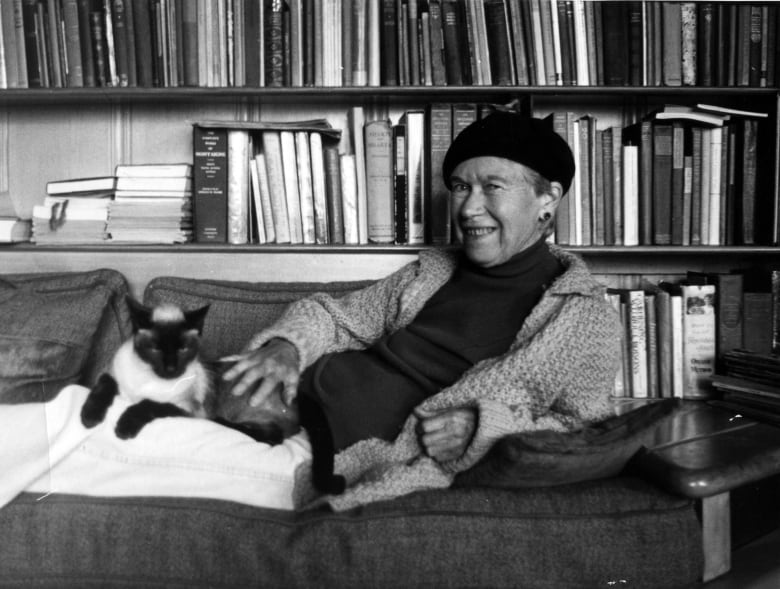
(GLBT Historical Society)
Elsa Gidlow, known to many as the “poet-warrior,” was unabashedly visible as an independent woman, a lesbian, a writer, and a bohemian-anarchist at a time when such visibility was both unusual and potentially dangerous. Gidlow was born on December 29, 1898, in Yorkshire, England. She was the eldest of seven children and immigrated with her family to a town near Montreal when she was six. Gidlow grew up in poverty and was largely self-educated. Throughout her career, despite often surviving on a meager income, she would struggle to support her family, including three siblings who suffered with mental illness, while maintaining her commitment to writing.
In 1920, after spending some time in Montreal’s art circles, Gidlow moved to Manhattan. Gidlow began her career as a freelance journalist and co-published the first North American newspaper that openly celebrated and discussed LGBTQ+ lives and issues within the community. After moving to Manhattan in the 1920s, she became poetry editor at Pearson’s Magazine. Six years later, she moved to San Francisco, where she befriended several poets, as well as the journalists and activists Phyllis Lyon and Del Martin—the first gay couple to be legally wed in California.
In the early 1950s, Gidlow was investigated as a suspected Communist, though she identified as an anarchist, and was forced to testify before the House Un-American Activities Committee (HUAC). At the time, Gidlow lived openly in a relationship with Isabel Grenfell Quallo, a biracial woman. Her cohabiting in an interracial, lesbian relationship may have provoked the investigation as much as her politics. Indeed, when she was questioned by the HUAC, she had nothing good to say about Communism, since her own political sympathies lay with the anarchists, who considered Marxism just another oppressive ideology.
Gidlow published around a dozen books of poetry and prose, some of which were self-published and released with a limited number of copies. Many of her works are currently out of print. Her poetry book, On a Grey Thread is, historians believe, the first collection of openly lesbian love poetry published in North America. Her autobiography, Elsa: I Come With My Songs (Booklegger Press, 1986), was the first lesbian autobiography not published under a pseudonym.
In 1954, Gidlow purchased a ranch at Muir Woods, north of San Francisco, called Druid Heights, which she used both as her personal residence and as a retreat for artists, bohemians, and feminists. Beat poets Allen Ginsberg and Gary Snyder were among the ranch’s various famous guests and residents. In 1962, Gidlow co-founded, with British philosopher and writer Alan Watts, the Society of Comparative Philosophy. In 1977, she appeared in Peter Adair’s 1977 documentary Word Is Out: Stories of Some of Our Lives, which featured LGBTQ+ individuals from a range of classes, ethnicities, and professional backgrounds.
Gidlow died at home on June 8, 1986. Her ashes are interred near the Moon Temple at Druid Heights.



Authors
Recent Comments
vandycolt on A Faith That Crosses Boun… Anonymous on Moment of Zen: Shorts Steve Davis on Pic of the Day noisilycool3bc985058… on Moment of Zen: Shorts iameverywhere1 on The Luxury of No Plans Top Posts & Pages




Amazon Associate

As an Amazon Associate I earn from qualifying purchases. So, if you click on a link that takes you to Amazon.com, I may earn a commission.
Trust me, it isn’t much, but every little bit helps.

 Joe
Joe


 The Closet Professor