

For those like me who are getting snow today, hang in there. Winter is almost over!


April Fools’ Day was once a time to pull a prank on both friends and enemies but has now turned into a day for corporations to try to fool customers with predictable internet hoaxes. Today, April 1, we can all count on an announcement about a fake new show, feature, or some other outrageous piece of news. In the town where I used to teach high school, guys would climb to the top of the water tower and paint a message (usually vulgar), or the seniors at the school I taught at would fill the school’s halls with balloons or some other crazy prank. But there have been many outrageous pranks throughout history.
Satirist Jonathan Swift (Gulliver’s Travels) decided to play an elaborate All Fools’ Day prank on John Partridge, a famous astrologer who sold bogus predictions to the public in almanacs. After Partridge predicted in his 1708 almanac that a fever would sweep London in early April, Swift published an almanac under a fake name predicting that on March 29 at 11 p.m., Partridge would die “of a raging fever.” The public was intrigued, but Partridge was irate, and he published a rebuttal to Swift’s almanac calling its author a fraud. Then, on the night of March 29, Swift published an elegy (again, under a fake name) announcing that Partridge—a “cobbler, Starmonger and Quack”—had died and admitted on his deathbed that he was a fraud. News of Partridge’s death spread over the next couple of days so that when Partridge walked down the street on April 1, people stared at him in surprise and confusion. Partridge angrily published a pamphlet saying he was alive. Swift again publicly asserted that Partridge was dead and claimed someone else wrote Partridge’s pamphlet. The whole escapade helped to discredit Partridge, who eventually stopped publishing almanacs.
Another prank also occurred in the 18th century. In January of 1749, London newspapers advertised that in an upcoming show, a man would squeeze his entire body into a wine bottle and then sing while inside of it. The ad promised that “during his stay in the bottle, any Person may handle it, and see plainly that it does not exceed a common Tavern Bottle.” The ad promised the show would feature other tricks as well, including communicating with the dead. Legend has it that the ad was the result of a bet between the Duke of Portland and the Earl of Chesterfield. Reportedly, the duke bet that he could advertise something impossible and still “find fools enough in London to fill a playhouse and pay handsomely for the privilege of being there.” And apparently, he was right. The night of the show, spectators filled every seat in the house, but no performer ever showed up. Realizing they had been duped, the audience rioted. With all the Republicans who believed Trump was the most Christian president in U.S. history, it just goes to show that people have been gullible for centuries.
The next prank comes from the early 20th century. Decades before the Bond villain Goldfinger plotted to nuke all of the United States’ gold at Fort Knox, a prankster dreamed up another heist that was just as ridiculous. On April 1, 1905, a German newspaper called the Berliner Tageblatt announced that thieves had dug a tunnel underneath the U.S. Federal Treasury in Washington, D.C., and stolen America’s silver and gold (this was before the U.S. built its Bullion Depository in Fort Knox, Kentucky). The Berliner Tageblatt said the heist was organized by American robber barons, whose burglars dug the tunnel over three years and made away with over $268 million; and that U.S. authorities were trying to hunt down the thieves while publicly covering up the fact that the country had been robbed. The story spread quickly through European newspapers before people realized that it was an April Fools’ Day prank by Louis Viereck, a New York correspondent for the Berliner Tageblatt who published the joke article under a fake name.
Sometimes the line between what’s a prank and what’s not isn’t always clear-cut. If an unlikely candidate runs for public office as a kind of protest prank but ends up winning, is it still a prank? Here’s one example: in 1959, students in São Paulo, Brazil, who were tired of the city’s overflowing sewers and inflated prices launched a campaign to elect a rhinoceros to the city council—and won. (Animals are routinely elected mayor in towns across Vermont.) The rhino’s name was Cacareco (Portuguese for “rubbish”), and she was already a popular figure in São Paulo when the students launched her campaign. The four-year-old had moved to the city from Rio de Janeiro when São Paulo’s zoo opened and was scheduled to return to Rio soon. When the students looked at the 540 candidates vying for São Paulo’s 45 city council seats and feared that none of them would address the city’s problems, they decided to make a point by asking people to vote for the famous rhino instead. Cacareco won a city council seat with a whopping 100,000 votes, far more than any other candidate (the closest runner-up only got about 10,000 votes). Of course, she didn’t end up serving on the city council because the election board disqualified her. Still, she remains one of the most famous protest votes in Brazilian history.
One of the most famous April Fools’ Day pranks is the BBC’s famous “spaghetti harvest” segment. On April 1, 1957, a news broadcaster told his British audience that Ticino, a Swiss region near the Italian border, had “an exceptionally heavy spaghetti crop” that year. The camera cut to footage of people picking spaghetti off of trees and bushes, then sitting down at a table to eat some of their “real, home-grown spaghetti.” At the time, spaghetti wasn’t necessarily a dish that British people would’ve known about. That doesn’t mean that no one realized the segment was a prank—some viewers were upset the BBC had aired a fictional segment during a serious news program. However, other viewers reportedly asked about how they could grow their own spaghetti at home.
Caltech has a long history of pranking other schools. One of its most famous pranks happened during the 1961 Rose Bowl football game in Pasadena, the location of Caltech. The game was between the University of Washington’s Huskies and the University of Minnesota’s Golden Gophers. During the game, Washington cheerleaders handed out colored cards to the Huskies’ side and told them that if they held the cards up at halftime, the cards would spell “Huskies.” But when halftime came and the fans held the cards up, they ended up spelling “Caltech.” It was so weird and unexpected (Caltech wasn’t even playing in the game!) that the band on the field stopped mid-song. It was later revealed that fourteen Caltech students had orchestrated the prank by breaking into the cheerleaders’ hotel rooms and switching the instruction sheets for the card stunt.
One of the best-selling erotic books in American history was actually written as a joke. No, it’s not Fifty Shades of Grey(though that did famously start as Twilight fan fiction)—it’s a 1969 parody called Naked Came the Stranger. The book’s author was listed as “Penelope Ashe,” but the real authors were a group of journalists at Newsday, a Long Island newspaper. The project’s ringleader was Mike McGrady, a Newsday journalist frustrated with the popular romance and erotic novelists he’d interviewed. “I saw the writing that was being accepted, and it seemed absurd,” he told the Associated Press. So McGrady rounded up about 25 journalists and asked each to contribute a ridiculous, over-the-top chapter to an erotic parody novel. He and columnist Harvey Aronson then patched these chapters together into a story about a Long Island housewife who suspects her husband is unfaithful and starts cheating on him. The hardcover sales earned it a number four spot on The New York Times’ bestseller list. Because it was exposed as a parody soon after publication, readers were likely in on the joke and bought it for the laughs (after one intimate encounter, a character says, “I’d forgotten there was more to life than mowing a lawn”). The following year, McGrady published a book about the experience called Stranger Than Naked, or How to Write Dirty Books for Fun & Profit.
Stranger Than Naked wasn’t the only prank journalists played in 1969. That year, Rolling Stone music critic Greil Marcus published a piece spoofing the trend of big-name rock stars forming “supergroups.” One of the most popular supergroups in the ’60s was Cream: its guitarist Eric Clapton was already famous for playing with the Yardbirds. At the same time, drummer Ginger Baker and bassist Jack Bruce were already known for playing in the Graham Bond Organisation. Marcus penned a gushing review to a nonexistent bootleg album by the “Masked Marauders,” a secret supergroup he said was made up of Bob Dylan, Mick Jagger, John Lennon, Paul McCartney, and George Harrison. The fake review garnered genuine interest in the album, and Marcus ended up writing and recording the songs he’d made up; then Warner Brothers bought the songs and released the album. “It was just an attempt to say, ‘This is stupid, and let’s make it even stupider,'” Marcus told MSNBC years later. But it was also a little prophetic. Two decades after the “Masked Marauders” review, Bob Dylan and George Harrison did join a supergroup with Tom Petty called the Traveling Wilburys.
Finally, Richard Branson, the billionaire founder of the Virgin Group, has a well-documented love of April Fools’ Day. But in 1989, his annual prank came a day early, on March 31. That evening, residents outside of London spotted a flying saucer that appeared to land in a nearby field in Surrey. Police officers went to the field to investigate the supposed UFO and were probably surprised when they actually found one. As they approached the flying saucer, a door opened, and a silver-clad figure walked out. The cops promptly ran away. Little did they know, Branson was hiding out in the UFO behind his silver-clad companion, whose name was Don Cameron. The two of them had taken off in the flying saucer—which was a hot-air balloon—and planned to land in Hyde Park on April 1 as a prank. However, changing winds forced them to land a little earlier in Surrey.
I hope those historic pranks gave you a laugh. While it is April Fools’ Day, each of these stories is true.

While the end of the pandemic that shook the world to its core is still hanging on, President Biden has surpassed his promise of 100 million vaccine shots in his first 100 days, and it looks like we will reach double that goal. The success of vaccine distribution has given many of us a bit of hope that life could resume to somewhat normal before 2022. By the end of this year, hopefully we will be heading back to the office, hugging loved ones (I miss hugs), and dating. While I have been on few dates since moving to Vermont, I was optimistic before the pandemic and going out and to gay events in Burlington, hoping to meet someone. As we move closer and closer to normal again, one has to wonder how we will navigate a return to the possibility of romance (and possibly sex) after a global pandemic?
One thing the COVID pandemic did was to give us a lot of free time. For many people, it was too much free time, especially in the beginning. When we weren’t scrambling for toilet paper and sanitizer wipes, we were sitting in our homes with every topic under the sun swirling around in our heads. It meant watching a lot of Netflix, Amazon Prime, Hulu, and Disney+, not to mention way too much online shopping. With more time than usual to sit and think, many of us have reconsidered what we find to be important in our lives. The loneliness of quarantines and lockdowns has made a lot of us realize just how much we would like to have a partner by our side.
As we begin moving forward once COVID is a memory, many of us who are single might be rethinking how to go about not only how we date, but who we date. It won’t be a surprise if people take their time and get to know people more often. I think people might be a little more careful and get to know someone better before moving forward. I think it will be important to think about whether this was a person who diligently wore a mask and observed social distancing because it will tell us whether he cares about the well-being of others or if he is just a selfish asshole. Of course, the alternative of just swiping right and setting up a quick hookup will still be available, but I think the COVID pandemic has taught us a lot about human nature. We’ve spent a year and some change with not much else but ourselves and our thoughts, and that longing for human connection could result in a wave of monogamy, something that technology and smartphones seemed to have left in the past.
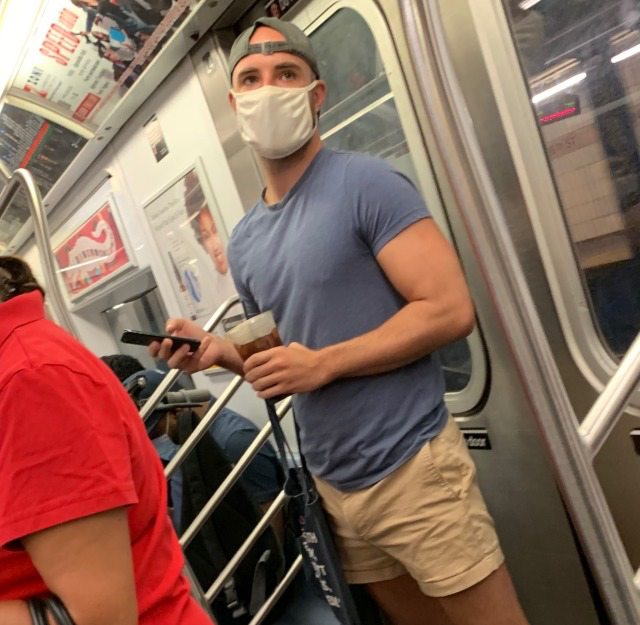
As the world starts to reopen and we can return to bars and clubs (I miss the monthly drag shows in Burlington), it’s important to remember that while we were alone during 2020, we should remember that it’s not a bad thing to want a solid foundation in terms of a relationship. However, there is a flip side to this because life is like a coin. There are always two sides to every situation. Yes, the lack of human connection has been dismal, but the nonexistent physical contact has been just as bad for many. Once people are vaccinated, we can once again get together with others without fear of contracting a disease that has killed over half a million people in the US alone. We might see a rise in not only monogamous relationships, but a whole lot of hookups because for a lot of people—that’s been off the table for over a year. I recently downloaded a few dating apps again, mostly to see if anything had changed and if the landscape of available men had changed. Men are definitely horny. I’ve seen a lot more interest than I usually do when I log into those apps, but I am looking for something more than just a quick one night stand.
Relationships are probably going to get deeper and more common but there is also going to be a sexual revolution of sorts with more people (dare I say, desperately) looking for hookups. With that, it’s wise to remain cautious not just because of COVID, but also keeping in mind that STDs have not ceased to exist. If you’re not the type that realized a need for a partner after this and just want to hookup, keep in mind that there are plenty of people exiting the pandemic with the same sexual needs. So, it’s always smart to practice safe sex—more so than ever because people are going to be screwing around like well, they haven’t fucked in over a year.
Throughout history, major events have always had an impact on our romance and sexual lives, and COVID is no different. Whether we’re seeing the reality of having someone close at all times, or the power of sex—the post-COVID world might be a wild one.

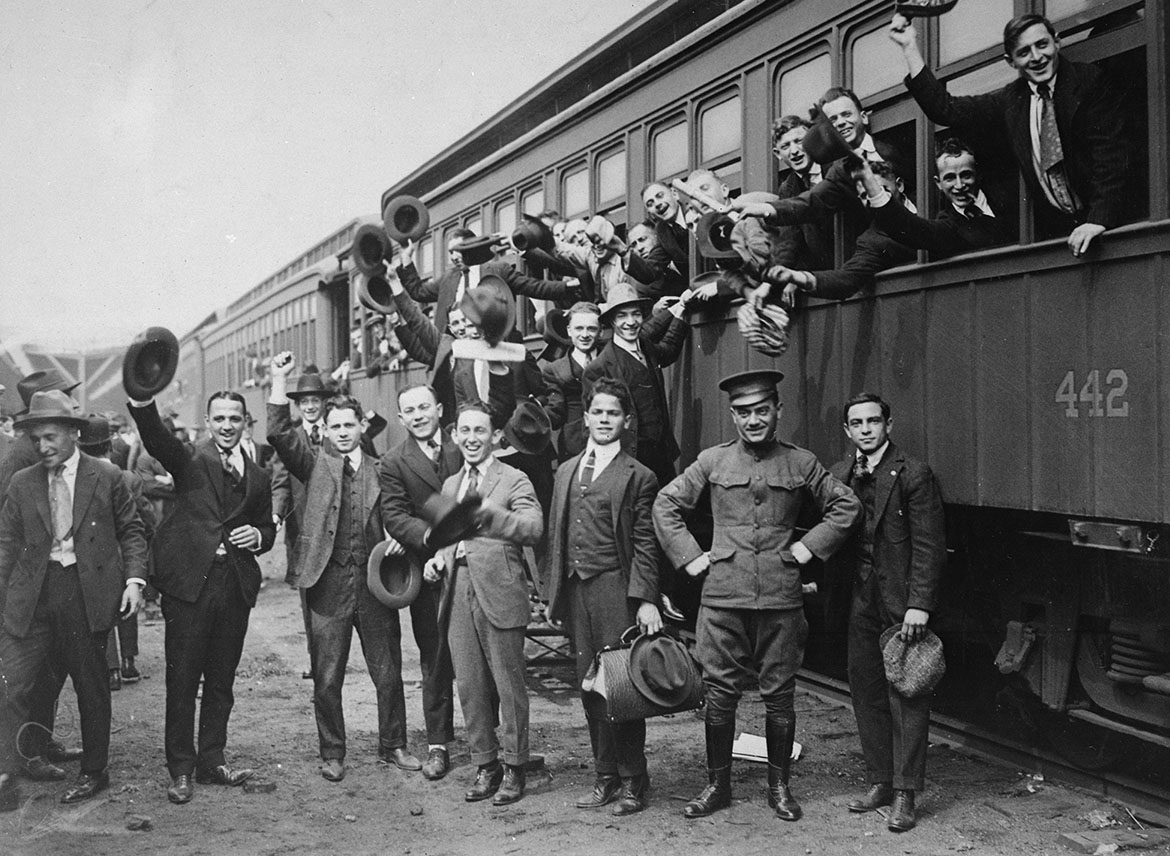
This picture is the reason I posted a poem with a theme related to trains this morning, but once I found a poem I wanted to use, this picture was no longer appropriate. So, here it is now.
The Send-off
By Wilfred Owen
Down the close, darkening lanes they sang their way
To the siding-shed,
And lined the train with faces grimly gay.
Their breasts were stuck all white with wreath and spray
As men’s are, dead.
Dull porters watched them, and a casual tramp
Stood staring hard,
Sorry to miss them from the upland camp.
Then, unmoved, signals nodded, and a lamp
Winked to the guard.
So secretly, like wrongs hushed-up, they went.
They were not ours:
We never heard to which front these were sent.
Nor there if they yet mock what women meant
Who gave them flowers.
Shall they return to beatings of great bells
In wild trainloads?
A few, a few, too few for drums and yells,
May creep back, silent, to still village wells
Up half-known roads.
___________________
“The Send-off” describes a group of new soldiers departing for the trenches of the Great War by train, ‘The Send-Off’ was not one of Wilfred Owen’s poems that I was familiar with until I came across it yesterday. Wilfred Owen is most often remembered as one of the more passionate and eloquent voices of the First World War poets. Most of the poems for which he is now famous were written in a period of intense creativity between 1917 and 1918. The poem I am most familiar with is “Dulce et Decorum Est,” which he wrote at Craiglockhart hospital near Edinburgh where he had been sent to recover from neurasthenia, better known as shellshock. While at the hospital, he would meet the poet and novelist, Siegfried Sassoon, who had a major impact upon his life and work and played a crucial role in publishing Owen’s poetry following Owen’s untimely death in 1918, aged 25. Only five of Owen’s poems were published in his lifetime. Owen wrote a number of his most famous poems at Craiglockhart.
“The Send-off” was written at Ripon, where there was a huge army camp. The poem describes a group of soldiers leaving for the Western Front by train. They had just come from a sending-off ceremony—cheering crowds, bells, drums, flowers given by strangers—and they were being packed into trains for an unknown destination. Note the effect of the early use of an oxymoron: the men are said to be “grimly gay.” They sang as they marched gayly from the upland camp to the siding shed, but the use of “grimly” suggests that they know enough about what lies ahead of them to feel somber and anxious.
The poem suggests that they may have been given flowers to celebrate the bravery of their commitment to the cause, but Owen emphatically compares the “wreath and spray” to flowers for the “dead.” Traditionally flowers have a double significance – colorful flowers for a celebration, white flowers for mourning. So, the women who stuck flowers on their breasts thought they were expressing support but were actually garlanding them for the slaughter of the Western Front. One of the things which make “The Send-Off” a masterful piece of poetry is the way in which Owen suggests the cracks already showing beneath the supposedly joyous and celebratory event of a group of soldiers being cheered on as they depart their homes and head for the Western Front.
“The Send-Off” correctly predicts that those soldiers who are lucky enough to return home alive will find their hometowns and villages to be very different (“half-known”) from the ones they left: there will be no crowds of girls to greet them and cheer them as there was to see them off, and no great celebration of their heroism. And many who returned would never be the same again, mentally scarred by shellshock, post-traumatic stress disorder, and the horrors witnessed. During and after the First World War, many people could not bear to watch a train moving away because this reminded them of a last meeting. His work is full of compassion and outrage and technically highly skillful. Perhaps more than any other poet of the First World War he was able to show the reality and horror of war.
Sadly, Owen was killed in action on November 4, 1918, during the crossing of the Sambre–Oise Canal, exactly one week (almost to the hour) before the signing of the Armistice which ended the war and was promoted to the rank of Lieutenant the day after his death. His mother received the telegram informing her of his death on Armistice Day, as the church bells in Shrewsbury were ringing out in celebration. Owen is buried at Ors Communal Cemetery, Ors, in northern France. The inscription on his gravestone, chosen by his mother Susan, is based on a quote from his poetry: “SHALL LIFE RENEW THESE BODIES? OF A TRUTH ALL DEATH WILL HE ANNUL” W.O.

The next day a great multitude that had come to the feast, when they heard that Jesus was coming to Jerusalem, took branches of palm trees and went out to meet Him, and cried out: “Hosanna! ‘Blessed is He who comes in the name of the Lord!’ The King of Israel!”
— John 12:12-13
Today is Palm Sunday, the Christian holiday that occurs on the Sunday before Easter. The holiday commemorates Jesus’ triumphal entry into Jerusalem, mentioned in each of the four Gospels. Jesus entered the city knowing He would be tried and crucified and welcomed His fate to rise from the grave and save us from our sins. Palm Sunday marks the beginning of Holy Week, which is a remembrance of Jesus’ last days before being crucified and rising from the dead on the third day.
Jesus’ entered Jerusalem riding on a donkey to the celebration and praise of the gathered crowd. Jesus’ triumphal entry fulfilled the Old Testament prophecies of Jesus as King and Messiah. Isaiah 62:11 calls for “Daughter of Zion” to watch for the Messiah, and Zechariah 9:9 depicts the King as “Lowly and riding on a donkey, A colt, the foal of a donkey.”
While most royal processions feature incredible extravagance, Jesus humbly entered the town on a simple donkey. While kings rode horses during times of war, rulers rode donkeys during times of peace as a sign of humility toward the people (1 Kings 1:38-40). Here, Jesus exemplified the peaceful return of a king to Jerusalem. By riding on a donkey, He showed that He came to bring grace and not judgment. Also, it is significant that Jesus rode a colt, which is a young and untrained donkey. Typically, it would be challenging for someone to ride an unbroken animal through a crowded and jubilant scene with an unfamiliar rider on its back, but Jesus was able to ride the colt easily.
Jesus’ entry into Jerusalem was meant to resemble a peaceful royal procession (2 Kings 9:13), yet up until this point, Jesus had consistently avoided anything resembling royal displays (Matthew 8:4, Matthew 9:30, Matthew 12:16). However, He was now ready to present Himself publicly as the Messiah and King. This was Jesus’ last trip to Jerusalem, and He chose to enter in such a way as to leave no doubt that He was the promised Messiah who had come to save the nation. No one in the city could miss the procession or the prophecy-fulfilling reference Jesus’ entry conveyed.
On Palm Sunday, parishioners are given palm fronds to represent the fronds that worshippers waved as Christ returned to Jerusalem for the final time before His death. Churches usually keep the palm fronds throughout the following year, burning them the day before Ash Wednesday. So, Palm Sunday does more than celebrate Jesus’ triumphal entry into Jerusalem and the beginning of Holy Week. It has a further significance that happens nearly a year later on Ash Wednesday, which marks the start of Lent, the solemn 40-day period of repentance and fasting that precedes Easter. The ashes used to make crosses on believers’ foreheads for Ash Wednesday come from burning the palms from the preceding year’s Palm Sunday.
Palm Sunday began in the Jerusalem Church during the late third century. Observances consisted of hymns, prayers, and Bible readings as people traveled through the many holy places within the city. At the final place, the site of Jesus’ ascent into heaven, the ministry would recite the biblical passage of Jesus’ victorious entrance into Jerusalem. Then as dusk neared, the people would return to the city, declaring: “Blessed is He that comes in the name of the Lord” (Matthew 21:9). This tradition continued until the sixth and seventh centuries when the ceremonial blessing of the palms was included. By the eighth century, a morning procession substituted the evening one, and the Western Church was celebrating what we now know as “Palm Sunday.”


 | noisilycool3bc985058… on Pic of the Day |
| noisilycool3bc985058… on Moment of Zen: A Room with a… |
 | Joe on Ah, Montreal… |
 | iameverywhere1 on Ah, Montreal… |


As an Amazon Associate I earn from qualifying purchases. So, if you click on a link that takes you to Amazon.com, I may earn a commission.
Trust me, it isn’t much, but every little bit helps.






 The Closet Professor