
Author Archives: Joe
About Joe

2025: Looking Back with Gratitude

As 2025 comes to a close, I find myself doing what I so often do here — pausing, reflecting, and trying to make sense of the year not as a list of accomplishments or failures, but as a lived experience. This was not an easy year. It was not a simple one either. It was a year of trials and triumphs, of weariness and growth, of quiet joy and hard-earned grace.

Beginnings and Intentions
I began 2025 with hope — not the loud, fireworks kind of hope, but a quieter one. The kind that says let’s keep going. I didn’t make grand resolutions. Instead, I carried forward an intention to keep writing honestly, to keep noticing beauty, and to keep showing up — even on days when that felt difficult. Looking back now, that intention mattered more than any checklist ever could.

The Daily Practice of Seeing
One of the anchors of this year was the simple, steady rhythm of posting — especially the Pic of the Day and Moment of Zen posts. They may seem small, but they were acts of attention. They reminded me — and hopefully some of you — that beauty still exists even on days when the world feels heavy or exhausting. Sometimes the most faithful thing we can do is simply notice what is right in front of us.
Some of those images invited stillness. Others invited contemplation. A few invited appreciative glances and thoughtful pauses. All of them were reminders that paying attention is never wasted time.

Health, Fatigue, and Hard Days
This year asked me to be honest about my limits. There were migraines, exhaustion, medication changes, and days when my body simply refused to cooperate. Writing about those moments wasn’t always easy, but it felt important. Too often we treat productivity as a moral virtue and rest as a failure. 2025 reminded me — sometimes forcefully — that listening to my body is not weakness. It is wisdom.

There were days when I had little to give, days when I skipped poems or kept posts short, days when getting through the workday felt like an accomplishment in itself. Those days count too.

Curiosity, Candor, and a Raised Eyebrow
I’d be remiss if I didn’t acknowledge another side of this blog — the one that surfaces apropos of nothing, usually with a raised eyebrow and a glint of something a bit more daring.
Every now and then, I let myself write something knowingly suggestive: a charged observation, a half-remembered erotic dream, a moment of attraction that refused to stay politely theoretical. I don’t do it often, and when I do, it’s never crude — but it is deliberate. Those posts are reminders that desire is not something to be edited out of a thoughtful life. It’s a signal, a pulse, a way of noticing that I am still very much alive in my body.
Posts like “Apropos of Nothing” or dream reflections such as “When Dreams Drop Hints” allow me to name that sensual undercurrent without apology. They exist alongside poems, devotionals, and reflections not as distractions from the spiritual, but as quiet provocations within it. I’ve come to believe that any faith worth keeping should be able to survive a knowing glance — and perhaps even enjoy it.

Memory, Loss, and Reflection
Some of the most meaningful posts this year came from looking backward — honoring friendships, remembering those who are no longer here, and acknowledging how grief never fully disappears but changes shape over time. Writing reflections like “In Memoriam: Ring Out, Wild Bells” reminded me that memory is not about being stuck in the past, but about carrying forward what still matters.
Another reflection, “A Quiet Table, a Full Heart,” became unexpectedly communal. It reminded me that gratitude, when shared, has a way of multiplying.
Everyday Joys and Connections
If there is one thing I want to name clearly as I look back on 2025, it is gratitude.
I am grateful for my friends — for conversations that made me laugh, for support that arrived exactly when I needed it, and for the steady presence of people who show up not just for the highlights, but for the ordinary days too. Friendship, I’ve learned again this year, is one of life’s quiet miracles.
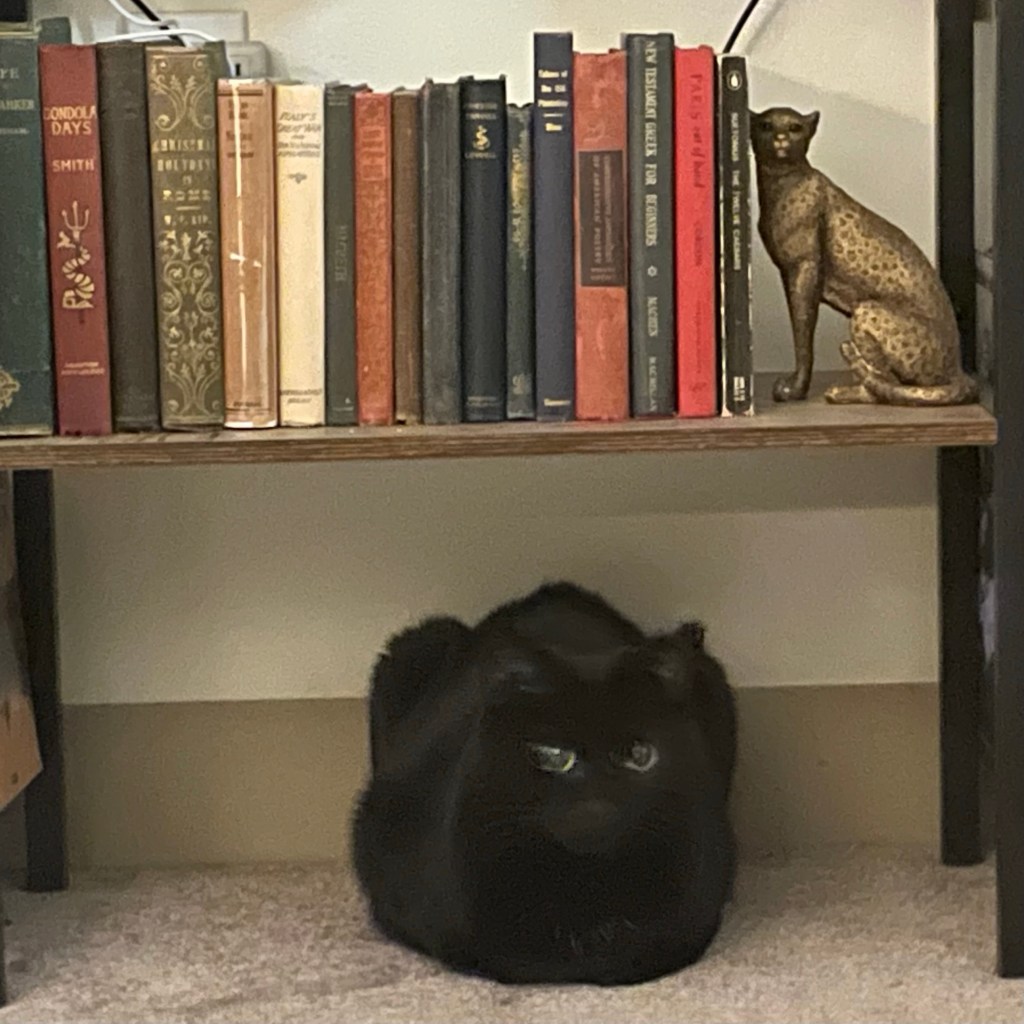
And I am endlessly grateful for my faithful companion, Isabella. She has been there for the early mornings, the long evenings, the days when I felt worn down, and the moments when a warm presence and a demanding meow were exactly what I needed. Her constancy, her personality, and yes — her diva tendencies — have been a daily reminder that love often shows up in small, furry, persistent ways.

A Word About Faith
Among this year’s Sunday devotionals, the one that most fully embodies the heart of The Closet Professor is “Sanctuary.” It returned to a message I hold close: that God is not confined to institutions, fear, or exclusion, but found in refuge, presence, and quiet faithfulness. That LGBTQ+ people do not need to leave parts of themselves behind to be welcomed by grace.
It’s a faith that makes room — for questions, for bodies, for desire, for rest.
And as I’ve realized again this year:
Paying attention — whether to beauty, grief, friendship, or the occasional knowing glance — is itself a kind of reverence.
What 2025 Taught Me
This year taught me that growth doesn’t always look like progress.
That strength can look like rest.
That honesty creates connection.
And that showing up — imperfectly, quietly, faithfully — is sometimes the bravest thing we can do.

Looking Ahead to 2026
As I step into 2026, I do so with gratitude rather than grand expectations. I carry forward what this year has given me: perspective, resilience, deeper appreciation for community, and a renewed commitment to writing truthfully — about faith, queerness, beauty, struggle, and joy.
Thank you for reading, for commenting, for being part of this space. You make this blog more than words on a screen. You make it a shared journey.
Here’s to whatever comes next — with grace, honesty, curiosity, and hope.
In Memoriam, [Ring out, wild bells]

In Memoriam, [Ring out, wild bells]
by Alfred, Lord Tennyson
Ring out, wild bells, to the wild sky,
The flying cloud, the frosty light:
The year is dying in the night;
Ring out, wild bells, and let him die.
Ring out the old, ring in the new,
Ring, happy bells, across the snow:
The year is going, let him go;
Ring out the false, ring in the true.
Ring out the grief that saps the mind
For those that here we see no more;
Ring out the feud of rich and poor,
Ring in redress to all mankind.
Ring out a slowly dying cause,
And ancient forms of party strife;
Ring in the nobler modes of life,
With sweeter manners, purer laws.
Ring out the want, the care, the sin,
The faithless coldness of the times;
Ring out, ring out my mournful rhymes
But ring the fuller minstrel in.
Ring out false pride in place and blood,
The civic slander and the spite;
Ring in the love of truth and right,
Ring in the common love of good.
Ring out old shapes of foul disease;
Ring out the narrowing lust of gold;
Ring out the thousand wars of old,
Ring in the thousand years of peace.
Ring in the valiant man and free,
The larger heart, the kindlier hand;
Ring out the darkness of the land,
Ring in the Christ that is to be.
About the Poem
“Ring Out, Wild Bells” appears as Canto 106 in In Memoriam A.H.H., Alfred, Lord Tennyson’s long elegy written after the death of his close friend Arthur Henry Hallam. Though In Memoriam is rooted in private grief, this section widens its gaze outward, turning the passage of the year into a moral reckoning.
The poem imagines the ringing of New Year’s bells as an act of judgment and intention. The bells are not sentimental. They are commands. Tennyson calls on them to ring out falsehood, greed, violence, and despair—and to ring in truth, kindness, justice, and a more humane future.
What makes this poem endure is that it refuses to treat time as neutral. A new year does not simply arrive; it must be claimed.
Reflections on the Poem
Several stanzas feel almost unnervingly current, especially when read at the close of 2025.
In stanza 6, Tennyson urges us to:
Ring out false pride in place and blood,
The civic slander and the spite;
Ring in the love of truth and right,
Ring in the common love of good.
This is a direct challenge to systems that elevate wealth, lineage, or power over decency. It speaks to a year in which money has purchased influence, policy, and silence—where hateful politics have been funded, amplified, and normalized. It speaks to economies shaped by bad decisions, reckless tariffs, and inflation that squeeze ordinary people while the rich continue to profit.
In stanza 7, the poem grows sharper still:
Ring out the lust of gold, the care
Of self, the thousand wars of old;
Ring in the thousand years of peace.
It is difficult not to hear this as an indictment of a world driven by hoarding, domination, and perpetual conflict. In 2025, we have seen how greed erodes empathy—and how fear is weaponized to strip away rights. LGBTQ+ lives and voices have once again been treated as expendable. Speech is constrained under the guise of “protection,” whether through laws silencing queer discussion in classrooms or the creeping normalization of censorship in digital spaces.
And yet, this poem does not collapse into despair.
Tennyson does not ask us to deny reality. He asks us to name it—and then to imagine its opposite loudly enough that it becomes possible.
To read “Ring Out, Wild Bells” at the end of this year is to acknowledge grief, anger, exhaustion, and frustration—and still insist that they are not the final word. Even if meaningful change requires patience. Even if justice must wait for ballots cast and counted in November. The act of hope itself becomes resistance.
About the Poet
Alfred, Lord Tennyson (1809–1892) served as Poet Laureate of the United Kingdom for more than forty years, a role that placed him at the intersection of private emotion and public moral imagination. His poetry often wrestles with grief, doubt, faith, progress, and the ethical responsibilities of humanity in a changing world.
Tennyson lived what appears, by historical evidence, to be a conventionally heterosexual life. He married Emily Sellwood in 1850 and had two sons. There is no reliable documentation that he engaged in sexual relationships with men, and historians rightly avoid assigning him a modern sexual identity.
And yet, In Memoriam A.H.H.—written after the sudden death of his closest friend, Arthur Henry Hallam—stands as one of the most emotionally intimate poetic works in the English language. The poem is saturated with longing, devotion, bodily absence, and an ache that reshapes Tennyson’s understanding of love, faith, and even God. The depth of that attachment has invited generations of readers to recognize something essential: queer meaning is not limited to queer identity.
In the Victorian era, intense same-sex emotional bonds were expressed in ways that do not map neatly onto modern categories of sexuality. What In Memoriam demonstrates is that love between men—whether or not it was sexual—could be central, formative, and life-altering. The poem refuses to minimize that bond or explain it away. Instead, it treats male–male love as morally serious, spiritually significant, and worthy of public language.
For LGBTQ+ readers today, this matters deeply. In Memoriam reminds us that queer resonance often exists before the language to name it. It lives in grief that society cannot fully acknowledge, in devotion that exceeds acceptable boundaries, and in love that quietly insists on its own legitimacy. The poem makes space for readers who recognize themselves not because the poet shared their identity, but because he articulated truths about love and loss that transcend labels.
Tennyson’s work endures not because it offers easy answers, but because it allows human affection—especially between men—to be expansive, dignified, and real. In doing so, In Memoriam continues to ring with meaning for those whose loves have so often been denied language, history, or blessing.

Dental Dread, With a Side of Ice

Tomorrow is not exactly shaping up to be my favorite day.
I have a root canal scheduled at 10 a.m., and I’ve been dreading it ever since it was put on the calendar. I know—modern dentistry, numbing, skilled professionals, all of that. I believe the reassurances. I still don’t like the idea.
As if that weren’t enough, we’re also under a Winter Weather Advisory and an Ice Storm Warning. The heaviest ice accumulation is expected between midnight and 10 a.m., which means I’ll be heading out right in the thick of it. Temperatures are supposed to drop quickly behind freezing, with gusty winds that could cause additional power outages into Tuesday. Honestly, I’m not thrilled about any part of that.
That said, I do have one small thing working in my favor: I’ve actually fallen asleep during a root canal before. Apparently, once I’m numb and reclined, my body just decides it’s nap time. So maybe that’s the plan tomorrow—carefully make it through the icy roads, close my eyes in the dentist’s chair, drift off, and wake up wondering when it’s all over. 😂
I’m hoping for a smooth procedure, minimal discomfort, safe travel, and maybe a well-earned afternoon of staying put afterward. If nothing else, I’ll remind myself that this is one of those days that’s unpleasant anticipating it, but usually manageable once you’re actually in it.
Here’s hoping tomorrow goes quickly—and quietly.
Wish me luck.
Update – 7:10 a.m.: My dentist appointment has been rescheduled due to the weather. The office will call me tomorrow to set a new date. I’m honestly very relieved that I don’t have to get out in this mess—driving in these conditions had me genuinely worried. Dental appointments can be difficult to reschedule, so we’ll see what happens next, but thankfully this root canal isn’t an emergency.

Looking Forward

“See, I am doing a new thing! Now it springs up; do you not perceive it?”
— Isaiah 43:19
There is something sacred about the space between years. It is a quiet doorway—one foot still planted in what has been, the other hovering over what has yet to take shape. The world often treats this moment as a demand for reinvention, but Scripture invites us instead to pay attention. As the psalmist prays in Psalm 90:12, “Teach us to number our days, that we may gain a heart of wisdom,” reminding us that reflection itself is a holy act.
As LGBTQ+ people of faith, we know that endings and beginnings are rarely tidy. This year may have held moments of joy and affirmation—or seasons of grief, fatigue, and survival. It may have asked more of you than you ever expected. And yet, here you are. Still breathing. Still standing. Still deeply loved.
When the prophet Isaiah speaks of God doing “a new thing,” it is not spoken to people who are confident or comfortable. It is spoken to a community worn thin by exile and uncertainty. God does not dismiss their past or minimize their fear. Instead, God promises presence right where they are: a way in the wilderness, streams in the wasteland (Isaiah 43:19). Renewal does not require perfect conditions—only God’s faithfulness.
The turning of the year does not erase what came before. It gathers it. Every hard-won truth, every boundary learned, every scar earned through survival becomes part of the soil from which new life grows. In the aftermath of devastation, Lamentations 3:22–23 offers this quiet assurance: “The steadfast love of the LORD never ceases; his mercies never come to an end; they are new every morning.” Newness, in Scripture, is not about forgetting—it is about being met again.
For many LGBTQ+ Christians, the arrival of a new year carries both hope and caution. We have learned that trust is not naive and that faith often carries memory with it. Still, the promise remains. Writing to a community living in uncertainty, Paul reminds them in Philippians 1:6 that “the one who began a good work among you will bring it to completion.” God is not finished with you—not at year’s end, and not at the beginning of what comes next.
And in the Gospel, we are given a final, steadying word—not a command, but a promise. At the close of Matthew’s Gospel, Jesus says simply, “I am with you always, to the end of the age” (Matthew 28:20). Not only in moments of clarity. Not only in seasons of confidence. But always—across thresholds, through uncertainty, and into whatever comes next.
So as this year closes, you are not asked to become someone else. You are invited to become more fully yourself—rooted in truth, shaped by grace, and steadied by the knowledge that you have never walked alone. As the next year opens, may you step forward gently, knowing that love has already gone ahead of you.
As this year fades into memory and a new one opens before you, may you carry forward what has shaped you and release what no longer gives life. May you trust that the love which sustained you this year does not disappear with the turning of the calendar. God is already present in what comes next—quietly, faithfully, and without condition. Wherever the new year leads, may you step into it knowing that you are held, you are seen, and you belong.

Moment of Zen: Home

Home at last. A delayed flight from Washington, DC had me walking in just before 3 a.m., but now I’m back where I belong—with Isabella, her morning wet food served, and the quiet comfort of home. A gentle Moment of Zen before I crawl back into bed. 😴🐾



Authors
Recent Comments
noisilycool3bc985058… on Pic of the Day vandycolt on Pic of the Day noisilycool3bc985058… on Pic of the Day furbirdsqueerly on A Nation’s Strength stupendousflower271b… on Pic of the Day Top Posts & Pages



 Joe
Joe


 The Closet Professor