

Or at least cute guys with fuzzy little bears.


I realize this one is a lion…lion, tigers, and bears, Oh my!






If you want to see the uncensored version, you know what to do.
Continue reading
Or at least cute guys with fuzzy little bears.
I realize this one is a lion…lion, tigers, and bears, Oh my!
If you want to see the uncensored version, you know what to do.
Continue reading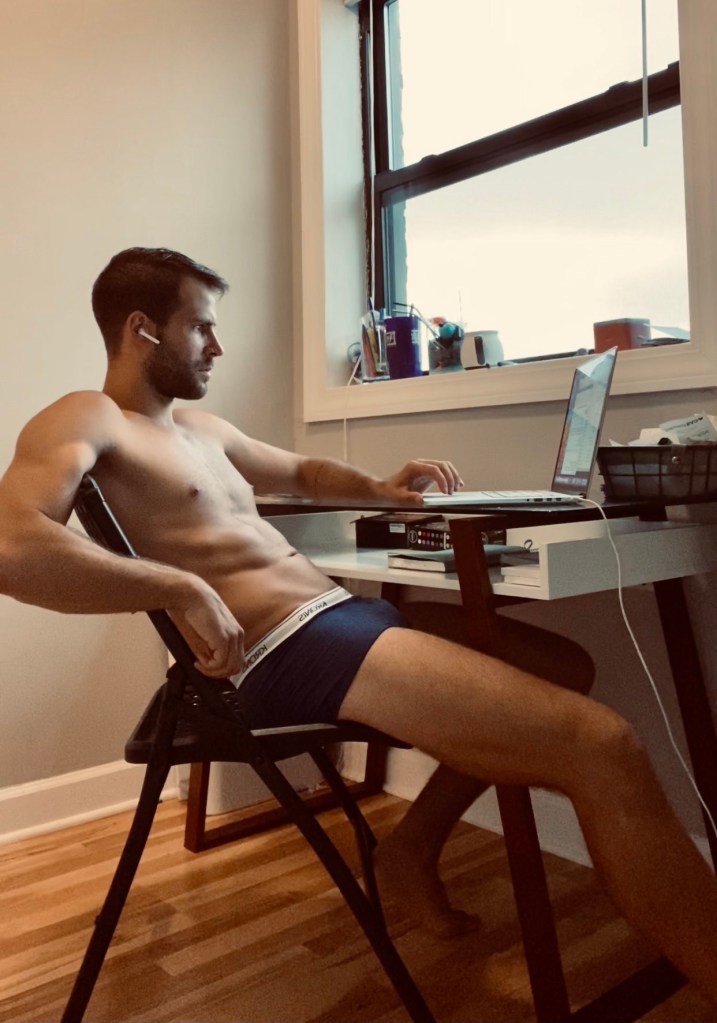
It’s Friday, and I’m back on my regular schedule of working from home today. It is so nice to be able to log into my work computer with my cup of tea in hand, in sweats and a t-shirt, knowing the weekend is just around the corner, and I don’t have to get out in the cold this morning. Working from home is more than just a shift in location, it’s a chance to set the tone for a productive yet relaxed day. It’s easier to focus without the buzz of the office, and the flexibility means I can finally tackle the laundry piling up. Mostly though, I will spend the day preparing for next week’s classes. I’m just glad I can do it while being more relaxed from home.
I feel bad for all the government workers out there who have lost the privilege of working from home. In this first week, the new administration in Washington has already begun to dismantle America, whether it’s revoking job offers and laying off all government employees who have worked less than a year to allowing ICE agents to invade schools to take away students. In the United States, don’t kids have enough to worry about with school shootings and not feeling safe in school, but now worrying that armed agents of the government are going to burst into classrooms and drag them away?
You haven’t heard much about the new administration on this blog because I find it so disheartening and depressing. It’s not like there isn’t a lack of things to say. Since a fascist oligarchy has assumed office on January 20, the new administration has enacted several policies that have raised concerns about the erosion of human rights and democratic principles:
Each of these actions have been widely criticized by human rights organizations and advocacy groups as undermining civil liberties and democratic norms. Legal challenges are anticipated as stakeholders seek to uphold protections against discrimination and preserve democratic principles. My fear is that with the current makeup of the Supreme Court, these policies will be upheld no matter how blatantly unconstitutional and undemocratic they are.

I wish I could stay home this morning, but I have a few things I need to be at the museum to do. If I had my work computer here, I’d call in sick. I left at lunch yesterday because I had a migraine. This morning, it’s not much better, in fact it’s not better at all. I may only go in for a partial day. I need my work computer to do much of what I need to do today. I have a school group coming today, but my boss could handle that. However, I need my computer for the rest of what’s on my agenda. I have some emails to answer; I need to prepare for my classes next week; and I need my computer to be able to work from home tomorrow. I could do all that at home on my personal laptop, but it only has Microsoft Word, not the rest of the Office Suite. I could access it through the online Microsoft 365, but I hate using Office through my browser. It always feels clumsy to me. Anyway, I’ll go in today for whatever length I need to, then, I’ll work from home tomorrow.
Here’s your Isabella pic of the week:
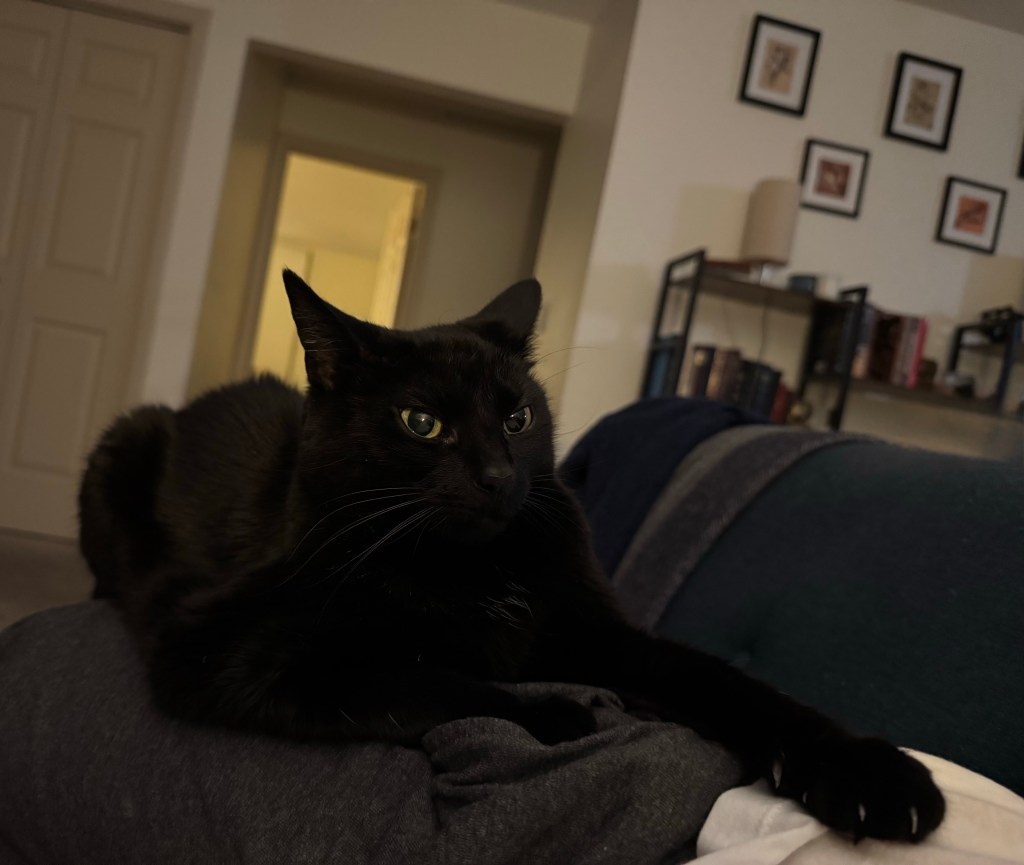
I’d rather be doing this today: laying on my couch with Isabella on my hip. I wish she’d lay in my lap or down my chest and stomach, which she’ll do on rare occasions, but her preference is my hip with me laying on my side. Sometimes, this is how I fall asleep at night, with her on my hip.

I don’t have much to say today. Yesterday was a long and busy day at work, and I came home, plopped down on my couch, and felt like I just melted into the cushions. Part of it was the cold outside and the warmth in my apartment helped to make me relax. It’s even colder today. Currently, it’s -4 degrees. I dread leaving my apartment today. I wish I could just go back to bed, but I can’t really do that. I have a list of things to do at work today, but I will be happy to get back home and just relax with a book for the evening.

PLEASURE
By Rick Barot
You are told to believe in one paradise
and then there is the paradise you come to know.
The shoes lined up in pairs by the door
and the herd moving with its mysterious intent
across a dark plain. The blue of the sky
which is the zenith of all colors
and the love of the man in the next room,
strong and rough as a hog’s back.
My mind has a slow metabolism, it is slow
to understand what anything means,
but it understands that if you look at something
long enough, it will have something
to say to you. The sun that is strangely bright
on some days, a poisoned canary,
and the crop of winter rocks in a meadow
in April. Learning decades later
the name of the hospital where you were born
and watching the child eat a mango
as though it is time he is eating, time shining
on his lips. On fewer days I agree
with the poet’s dread of being
the wrong person in the right world, and believe
in adhesion, in never showing up
empty-handed, even if the pleasure I know best
is fused with the abject. There is always
the other side of the heart, its coaxing:
You are here. You can begin again. You can rise.
About the Poem
Rick Barot’s poem “PLEASURE” is a reflective exploration of the complex, temporary nature of joy and its interplay with memory, desire, and loss. The poem’s tone, imagery, and structure create a layered meditation on how pleasure functions in human experience—often fleeting, tinged with regret, and deeply tied to the past. “PLEASURE” subtly incorporates LGBTQ+ elements through its exploration of desire, intimacy, identity, and memory. While the poem does not explicitly label its speaker or relationships as LGBTQ+, Barot’s own identity as a gay poet often informs his work with themes and perspectives that resonate with queer experiences.
Barot presents pleasure as a temporary force, one that is often recognized only in hindsight. This echoes the human tendency to grasp the beauty of a moment only when it has passed. The poem suggests that pleasure is rarely pure; it often exists alongside pain or regret. This duality underscores the richness and complexity of human emotions. Barot juxtaposes the immediate sensation of pleasure with the act of remembering it, highlighting how time alters our understanding of joy. Desire in “PLEASURE” is complex, nuanced, and layered with emotional resonance. For LGBTQ+ individuals, desire often carries added layers of significance due to societal stigmas or personal struggles with self-acceptance. Barot’s portrayal of pleasure as fleeting and bittersweet reflects how queer relationships and desires can feel both liberating and precarious, particularly in contexts of marginalization. The poem’s treatment of desire may symbolize the intricate ways LGBTQ+ individuals navigate their identities and relationships, often balancing joy and vulnerability.
The poem often reflects on past experiences of pleasure and how they linger in memory. This recalls a shared LGBTQ+ cultural experience of longing, whether for lost love, fleeting moments of intimacy, or the lives and relationships lost to societal rejection or historical events like the AIDS crisis. Barot’s treatment of memory as both a source of pain and beauty can resonate deeply with LGBTQ+ individuals who grapple with their histories. This focus on memory underscores the importance of queer histories and the act of preserving personal and collective joy in the face of erasure or loss.
Barot’s imagery is vivid and sensuous, often grounded in concrete details that evoke a visceral reaction. He uses specific, tactile language to anchor abstract ideas in the tangible world. For example, descriptions of physical experiences—food, touch, or natural beauty—become metaphors for broader emotional truths. The poem’s diction is precise, yet it leaves space for ambiguity, inviting the reader to linger on the lines and uncover deeper meanings. Barot’s work often resists conventional ideas of identity, intimacy, and relationships, favoring a more fluid and open-ended exploration. “PLEASURE” similarly resists simple definitions of joy, instead presenting it as fleeting, multifaceted, and tied to deeper emotional truths. For gay men, this fluidity may mirror their own experiences of rejecting or redefining societal norms around relationships, gender, and identity. The poem’s openness reflects the diversity of queer experiences, celebrating individuality and complexity rather than conforming to rigid frameworks.
Pleasure, especially that of the LGBTQ+ community—whether physical, emotional, or spiritual—has historically been policed or stigmatized. Barot’s meditation on pleasure as fleeting, beautiful, and tinged with melancholy resonates with how queer joy can feel both radical and fragile, particularly in a world that often marginalizes LGBTQ+ love and intimacy. The poem’s nuanced portrayal of pleasure invites LGBTQ+ readers to see their experiences of joy and desire as valid, even when they are complex or contradictory. “PLEASURE” carries a sense of wistfulness, as if the speaker is caught between the joy of past experiences and the pain of their transience. There’s a subtle mourning for moments that cannot be reclaimed, and yet a celebration of their existence. The poem seems to ask: How do we hold on to pleasure without being consumed by its loss?
Rick Barot’s “PLEASURE” is a poignant exploration of joy’s fleeting nature, filled with evocative language and deep emotional undercurrents. By examining the intersections of time, memory, and feeling, the poem invites readers to reflect on their own experiences of pleasure—how they shape us, linger within us, and ultimately remind us of our humanity. Barot’s ability to capture the ephemeral, bittersweet nature of pleasure speaks to the ways LGBTQ+ individuals navigate love, memory, and desire in a world that often denies them full expression. The poem becomes an affirmation of queer resilience, beauty, and the enduring power of joy, even when it is fleeting.
About the Poet
Born in the Philippines and raised in the United States, Rick Barot earned a BA from Wesleyan University and an MFA from the University of Iowa Writers’ Workshop. Barot is an acclaimed Filipino American poet known for his precise language, rich imagery, and meditative explorations of identity, memory, and the complexities of human experience. His work often combines lyrical introspection with sharp observations of the external world, weaving personal history with cultural and historical contexts.
He is the author of several celebrated poetry collections, including The Darker Fall (2002), which won the Kathryn A. Morton Prize in Poetry, Want (2008), Chord (2015), which received the UNT Rilke Prize and was a finalist for the Los Angeles Times Book Prize, and The Galleons (2020), a National Book Award longlist selection. He has also received numerous honors, including fellowships from the Guggenheim Foundation and the National Endowment for the Arts.
In addition to his poetry, Barot is an esteemed educator and serves as the poetry editor for The New England Review. He is currently the director of the Rainier Writing Workshop, a low-residency MFA program at Pacific Lutheran University in Tacoma, Washington.


 | Steve Davis on A Queen Was Born |
 | noisilycool3bc985058… on A Queen Was Born |
| noisilycool3bc985058… on Pic of the Day |
| noisilycool3bc985058… on Pic of the Day |
 | Joe on Pic of the Day |





As an Amazon Associate I earn from qualifying purchases. So, if you click on a link that takes you to Amazon.com, I may earn a commission.
Trust me, it isn’t much, but every little bit helps.







 The Closet Professor