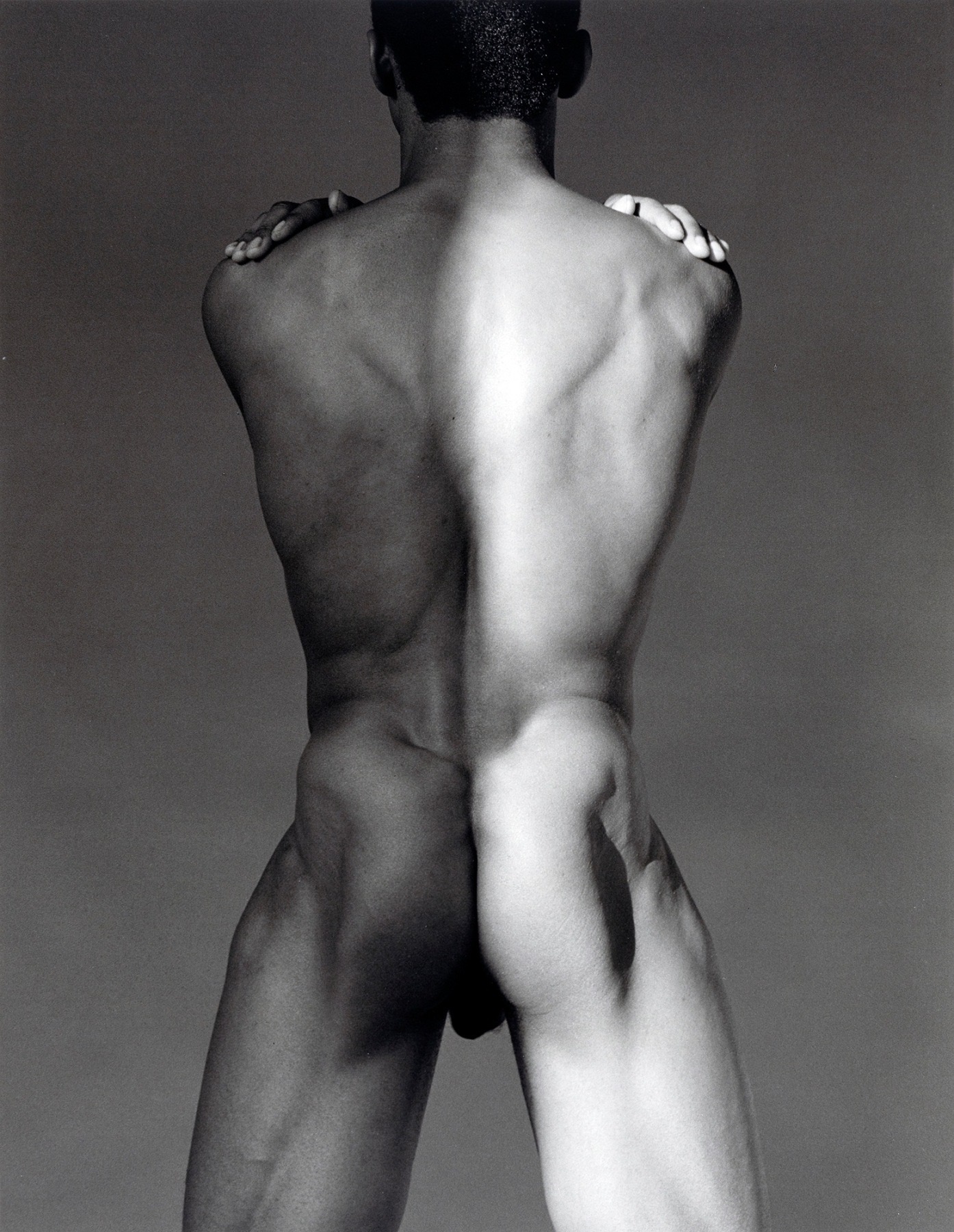
Category Archives: Art

Posing the Ideal: The Enduring Language of the Male Nude

From the marble gods of antiquity to the chiaroscuro of contemporary fine art photography, the male nude has long served as a canvas for ideals—beauty, heroism, eroticism, even vulnerability. While fashions shift and aesthetics evolve, certain poses recur again and again across centuries, connecting ancient sculptors with modern photographers, and Renaissance artists with queer creators exploring body and identity. These poses are not random; they are visual codes, passed down like a secret language. Below are ten of the most iconic, from the classical to the contemporary.

Contrapposto — The Classical Stand
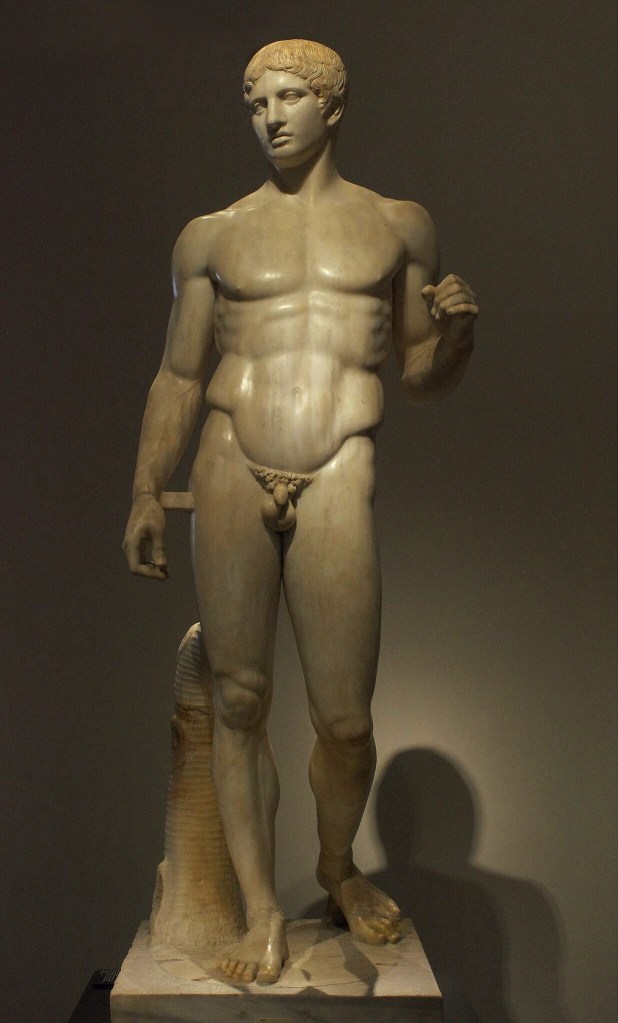
Doryphoros (Spear Bearer) by Polykleitos (c. 440 BCE)

The contrapposto is perhaps the most recognizable pose in Western art. One leg bears weight while the other relaxes, creating a subtle S-curve in the spine and a naturalistic opposition of shoulders and hips. It suggests calm confidence, inner balance, and effortless beauty—a divine masculinity grounded in the human form. This pose remains a standard in fine art photography, particularly in black-and-white portraiture where tension and repose dance together in the frame.

The Heroic Nude
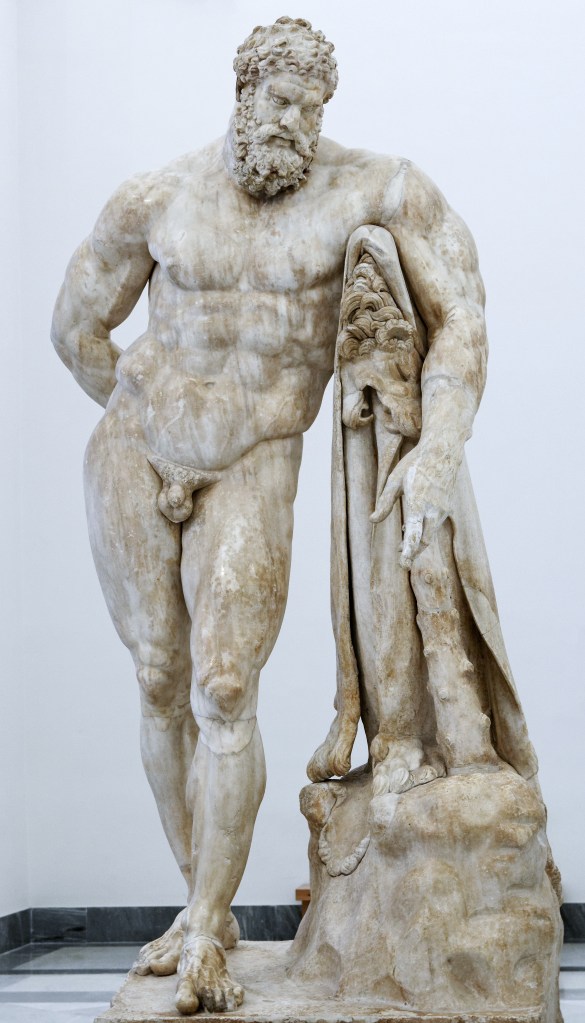
Farnese Hercules (Roman copy, 3rd century CE)

This pose stretches the body into exaggerated musculature—shoulders squared, stance wide, genitals often prominently displayed. In mythological sculptures and athletic statues, the heroic nude expressed power without armor, valor without shame. Modern echoes appear in Bruce Weber’s Calvin Klein ads or Tom of Finland’s hyper-masculine pinups, though with more erotic charge and often a wink of camp.

The Reclining Nude

Michelangelo’s Dying Slave (1513–16)

Lying down, one arm behind the head, the other draped or trailing—the reclining male body exudes sensuality. Unlike the upright hero, the reclining nude invites the viewer in. It’s a pose of leisure, of trust, of soft exposure. In contemporary photography, it appears in the work of Robert Mapplethorpe and Herb Ritts, sometimes erotic, sometimes contemplative, but always intimate.

The Standing Frontal Nude
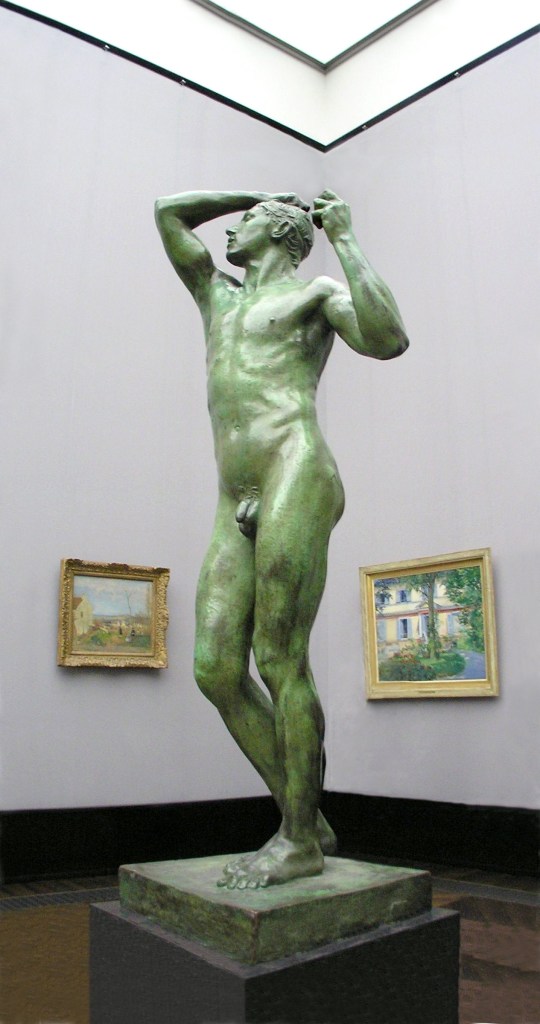
Auguste Rodin’s The Age of Bronze

The fully frontal male nude remains one of the boldest artistic statements. It can convey power, but also deep vulnerability. With no turn of the hip or modest shadow, the body is presented in full—often rigid, symmetrical, and deliberately confronting the viewer. In photography, artists like George Platt Lynes and John Dugdale have used this pose to explore identity and embodiment with quiet boldness.

The Crouching Nude
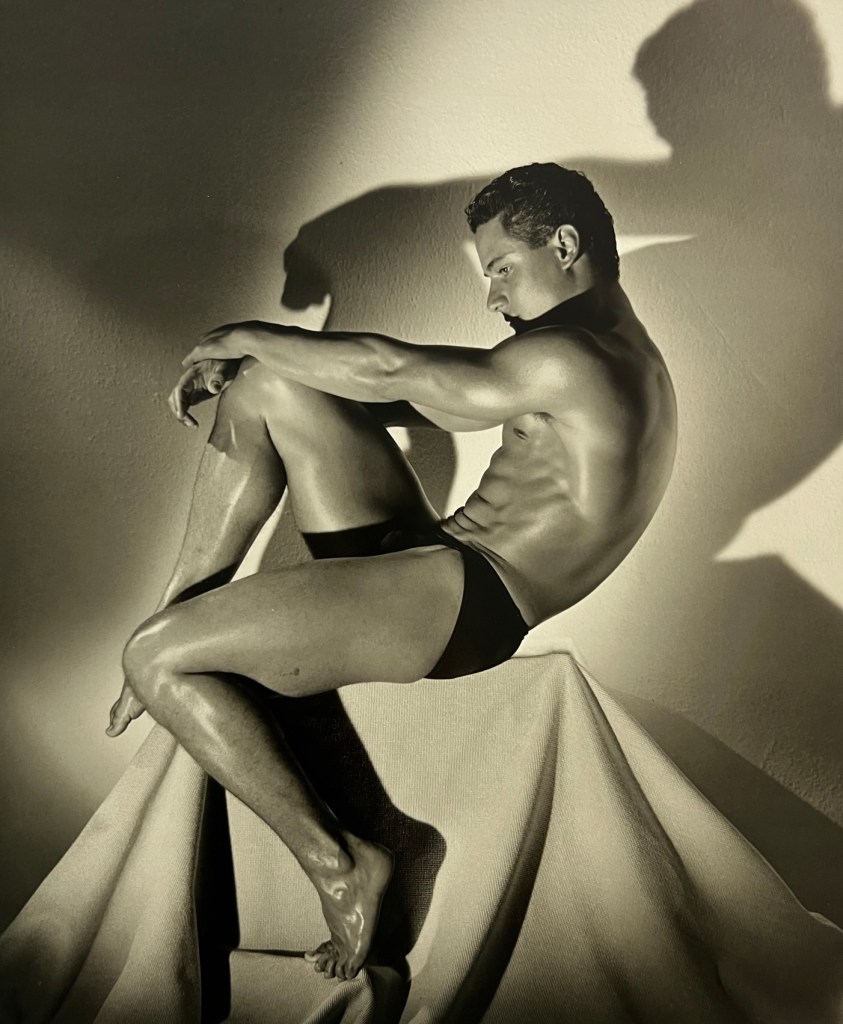
Herb Ritts’ photo of Olympian Greg Louganis

Though more common with female nudes, the crouching pose has become a staple in expressive male photography—knees drawn up, torso folded inward, arms wrapped across chest or thighs. It signals protection, introspection, or erotic containment. Contemporary artists like Omar Z. Robles or Ren Hang have used this pose to convey psychological intimacy, even fragility.

The Twisted Torso

Bernini’s David (1623)

Tension defines this pose—one limb pulled back, the torso twisted, spine coiled like a spring. It’s dynamic and dramatic, revealing musculature in full stretch and flex. In photographs, this pose dramatizes motion and often captures the male body mid-action—whether in dance, sport, or erotic tension. Think of dancer-turned-models in chiaroscuro-lit poses by photographers like Rick Day or Clive Barker.

The Averted Gaze
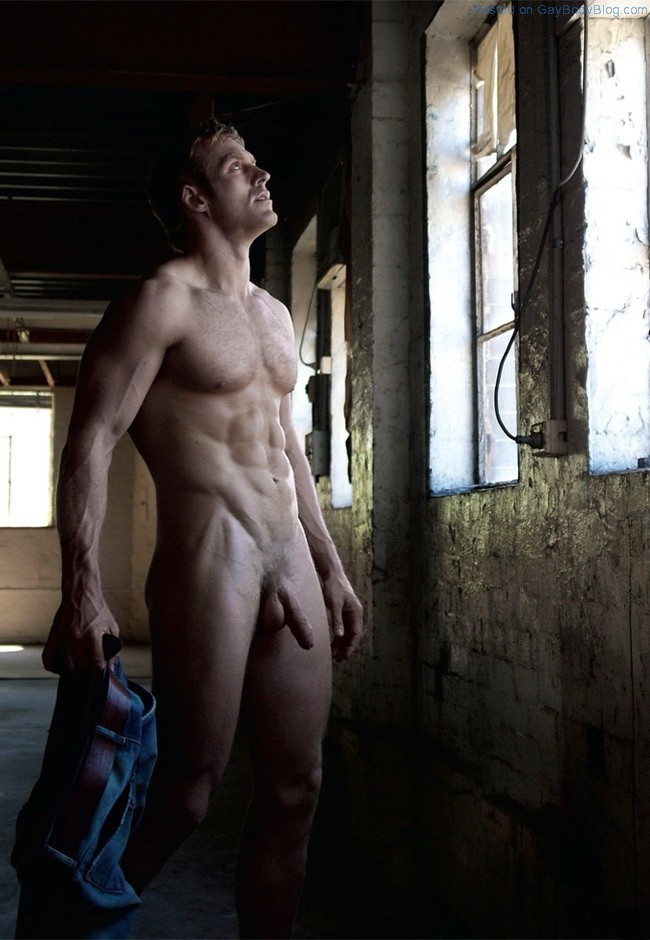
Untitled Photograph by Paul Freeman

This pose isn’t about the body so much as the gaze—or lack thereof. The male nude who looks away, whether shy, lost in thought, or caught in reverie, offers something emotionally elusive. In modern portraits, the averted gaze disarms the viewer: the nude isn’t performing for us, but existing despite us. It’s a favorite in modern queer portraiture, from artists like Duane Michals or Paul Freeman.

Arm Over Head — The Display of Strength and Vulnerability

Guido Reni’s Saint Sebastian

An arm raised behind the head lengthens the body, stretching the torso and exposing the armpit—an often-erotic gesture in male imagery. Saint Sebastian, often portrayed in this pose, became a queer icon through his sensual vulnerability. Today, this pose appears in both fitness photography and erotic art, especially where strength and submission intertwine.

Memento Mori — The Nude and Mortality
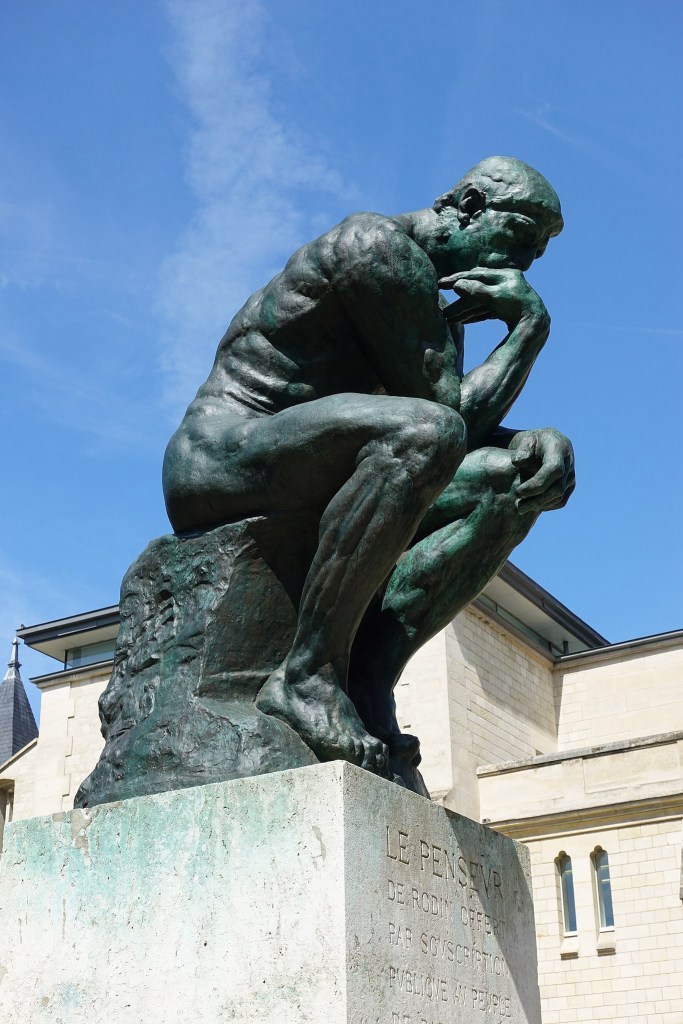
The Thinker by Rodin

This pose shows the male body entwined with symbols of death—a skull, a candle, a vacant stare. The man may be seated, leaning on one arm, lost in thought or grief. The erotic body meets existential dread. In contemporary queer art, this pose often reappears in AIDS-era photography—Peter Hujar and David Wojnarowicz come to mind—where the beauty of the body confronts its own impermanence.

The Mirror Pose

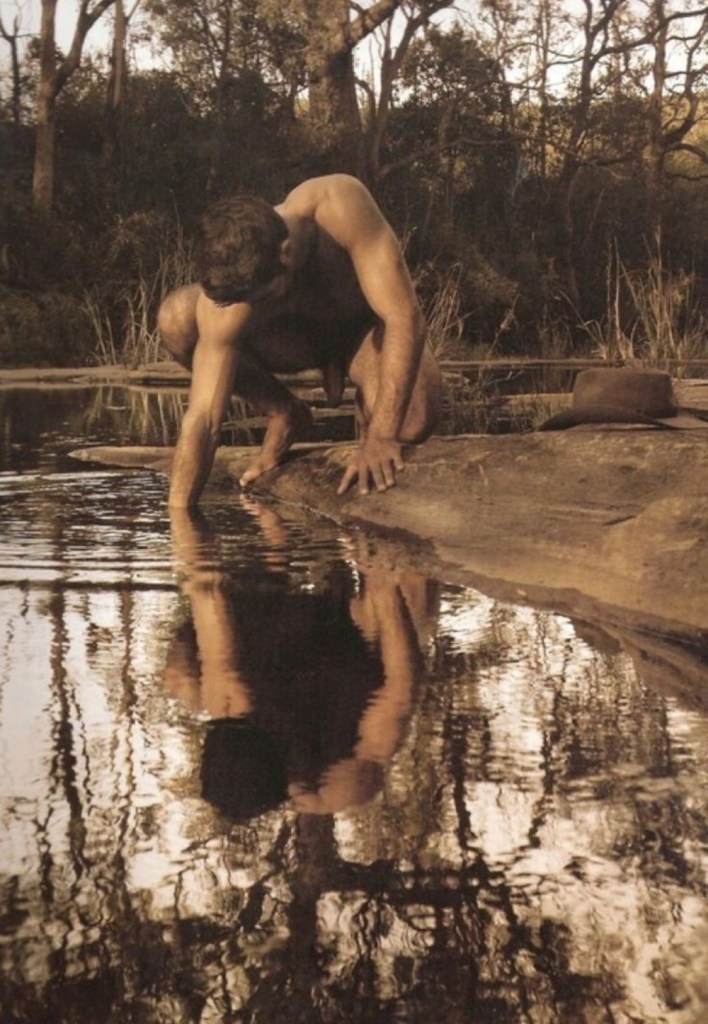
The male nude gazing at his reflection—either literally or metaphorically—carries a rich history of both vanity and self-awareness. In modern work, this pose has become a commentary on queer desire, identity, and self-recognition. Whether through mirrored images, doubled exposures, or paired models, the mirrored pose flirts with the erotic and the existential: Who do we see when we look at ourselves?
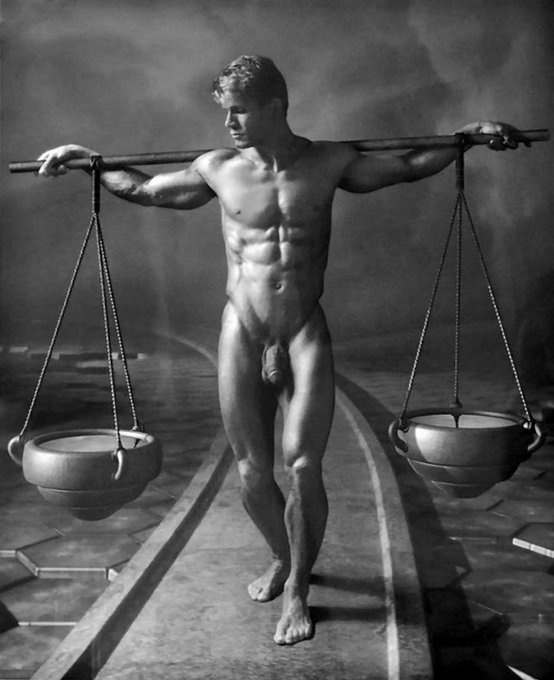
Nude Water Carrier by Mark Jenkins

These poses, repeated across millennia, aren’t just about aesthetics—they’re about how we’ve viewed the male body and the roles it plays: protector, object of desire, thinker, vessel of strength or sorrow. And in queer art especially, these poses become subversive. They reclaim what was once coded and hidden, turning vulnerability into power and eroticism into expression.

Whether sculpted in marble, captured in monochrome, or filtered through a digital lens, the male nude continues to speak a visual language of longing, beauty, and identity. It’s a language many of us have learned to read—and some of us are still learning to write with our own bodies.

The Art of the Gay Film: Where Does Porn End and Cinema Begin?

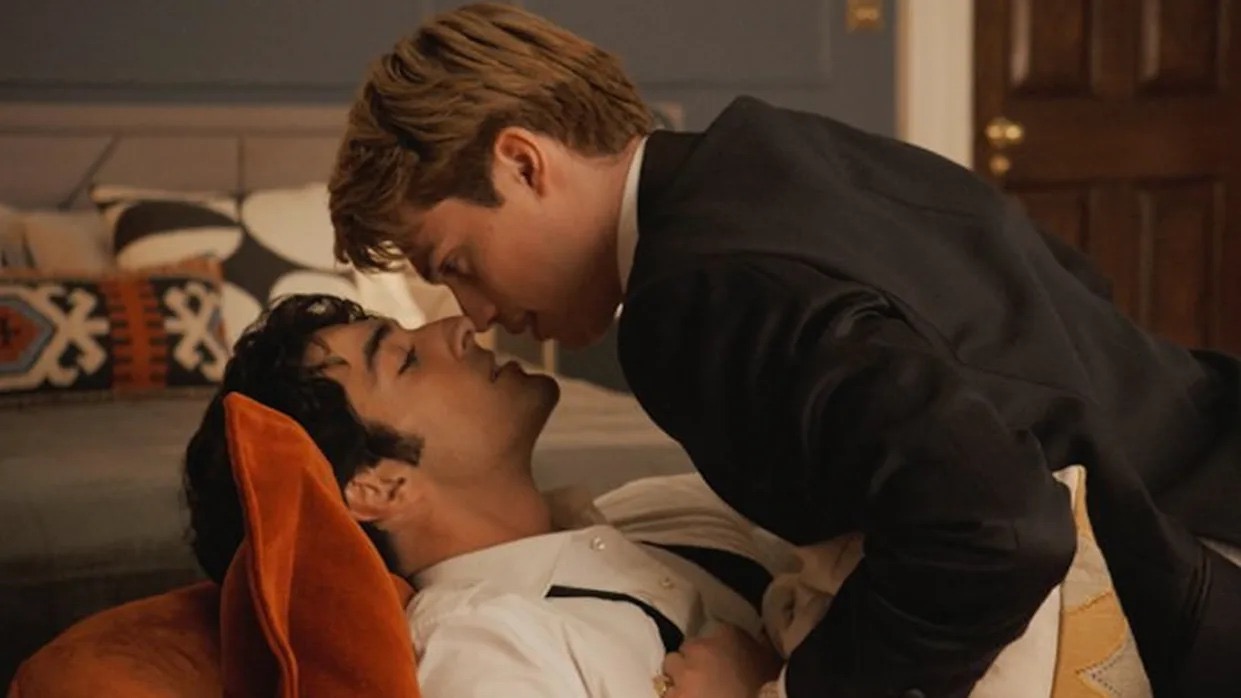
Red, White & Royal Blue

One of the oldest and most provocative questions in art history is what counts as art? That question becomes even more layered when we look at gay-themed films. Are they art? Are they pornography? Or something else entirely? 

Last week, in my post “Can Gay Porn Be Considered Art?”, I explored how even pornography can rise to the level of art when it’s created with intention, craft, and meaning. This week, I want to turn to films—particularly gay-themed ones—and ask: where do they fit on the spectrum between art and pornography? 

Let’s start at the beginning: Are films art? 

The answer from an art historical perspective is a resounding yes. Cinema, from its very birth, was hailed by some as the most modern and democratic art form—capable of bringing storytelling, image, sound, and emotion into a single, immersive experience. 

But when sex enters the frame, things get complicated—particularly for films with queer themes. 

Red, White & Royal Blue

Consider Red, White & Royal Blue, which generated considerable buzz in the gay community for its romantic and tender love scenes. The two leads engage in intercourse—though we see no frontal nudity or penetration, and most of the actual sexual act is in the facial expressions of the two main characters. The narrative focuses on their emotional and political stakes as much as their physical passion. 

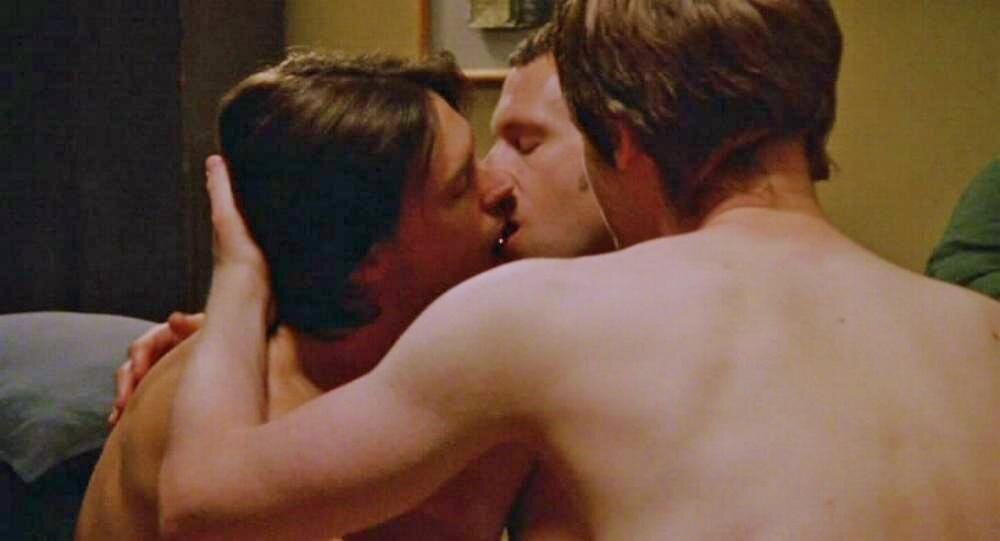
Shortbus

But compare that to Shortbus, the groundbreaking 2006 independent film featuring gay and straight characters exploring sexuality, intimacy, and loneliness. It famously includes unsimulated sex scenes—autofellatio, rimming, ejaculation, and more—woven into a story about connection in New York City. Despite its graphic imagery, many critics and audiences hailed Shortbus as an art film because the sexual content was in service to its humanistic and narrative vision. 

Minx

Then on the other end of the spectrum are campy, sex-forward comedies like the Eating Out series or Another Gay Movie, which parody and revel in gay hookup culture with winks, nudity, and humor. These films are explicitly about sex, but in a light, comic, self-aware way—not quite pornography, but certainly not subtle. In the same vein, we might put certain HBO shows (The White LotusEuphoria) or Minx (on HBO/Starz), which features an extraordinary amount of male frontal nudity but uses it to explore the 1970s porn industry with a feminist and comedic slant. 

So, where do we draw the line between art and pornography? 

It’s not always clear—and, as you pointed out, it may well be “in the eye of the beholder.” In general: 

  • Pornography tends to have a singular, utilitarian purpose: sexual arousal and entertainment. It doesn’t usually ask its audience to reflect, empathize, or wrestle with deeper meaning. However, even pornography can be considered art, as I wrote about in last week’s post, “Can Gay Porn Be Considered Art?”—and I think it can be. When crafted thoughtfully, with aesthetic intention and emotional resonance, even porn can rise to the level of art. 
  • Art, even when explicit, usually serves a broader purpose—telling a story, exploring vulnerability, interrogating social norms, or celebrating intimacy. 

That doesn’t mean art can’t also be arousing—just as Mapplethorpe’s photographs or Greek kouroi might still thrill us centuries later. The difference lies in intent and context. 

Many of these films (and TV series) deliberately blur the line. Shortbus was attacked by some as pornography precisely because it showed real sex acts, but defended as art because it was about loneliness, connection, and what it means to be human. Meanwhile, Red, White & Royal Blue was criticized by some for being too tame, choosing romantic convention over sexual candor—but it, too, is art, in the sense that it tells a story about love and identity.

Another Gay Movie

Even campy comedies like Another Gay Movie or series like The White Lotus are part of this conversation—using nudity and sexual humor partly to titillate, yes, but also to satirize and expose cultural hypocrisy. 

Personally, I tend to agree that much of what we call pornography is shallow and transactional, whereas even the most sexually explicit arthouse films still aspire to say something about the human experience. Then again, as I’ve also noted, some modern “art” (abstract or otherwise) can feel just as empty or pretentious to some of us as porn can. 

We as gay viewers—long denied honest representations of ourselves—have often sought out films that blurred the line between art and eroticism, because sometimes that’s where we feel most seen. Cinema remains, perhaps, the most widely consumed art form in the gay community—precisely because it can contain beauty, sex, tenderness, and critique all at once. 

What do you think? Have you seen a film (ShortbusMinxAnother Gay Movie?) that you felt crossed a line—or one that made you feel understood? Does the presence of graphic sex diminish a movie’s artistic value for you—or enhance its honesty? 

Let’s keep the conversation going in the comments. 


Can Gay Porn Be Considered Art?

For as long as the male nude has existed in art — from the Kouros statues of ancient Greece to the sketches of Michelangelo — the erotic potential of the male body has fascinated artists and viewers alike. But what happens when we turn our gaze to the realm of gay pornography? Can gay porn — films and photography explicitly created for sexual arousal — also be considered art?

It’s a provocative question, but a worthwhile one. In fact, the history of gay porn itself often parallels the history of queer art: pushing boundaries, challenging taboos, celebrating bodies, and telling truths about desire. 

The Beginnings: Porn as Forbidden Art

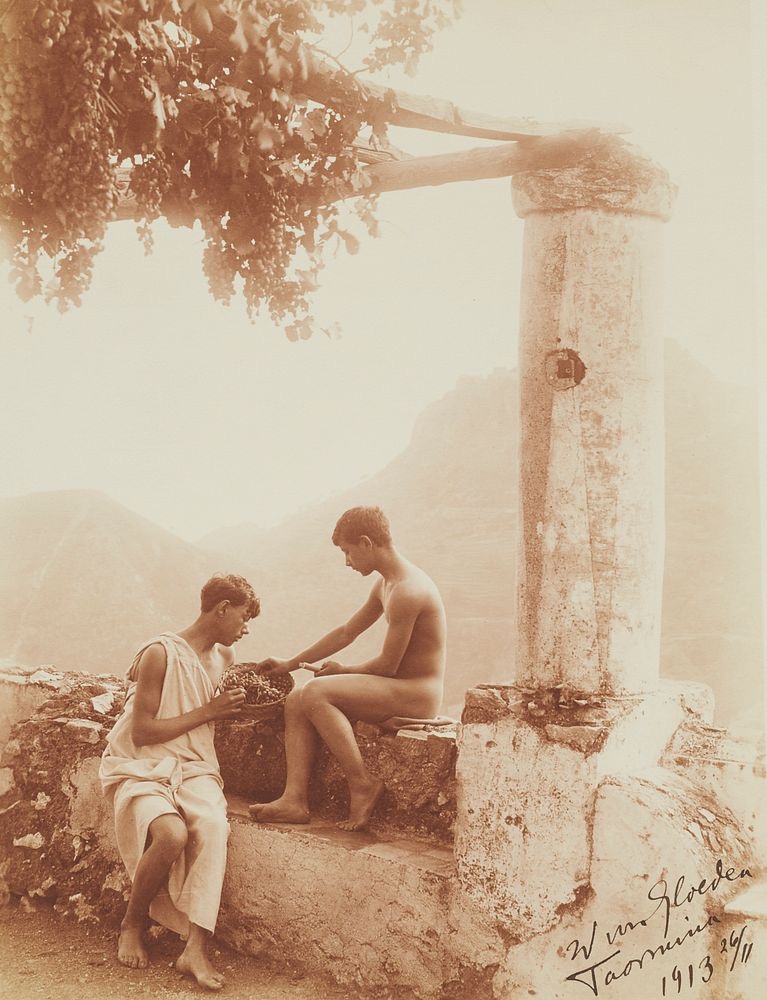
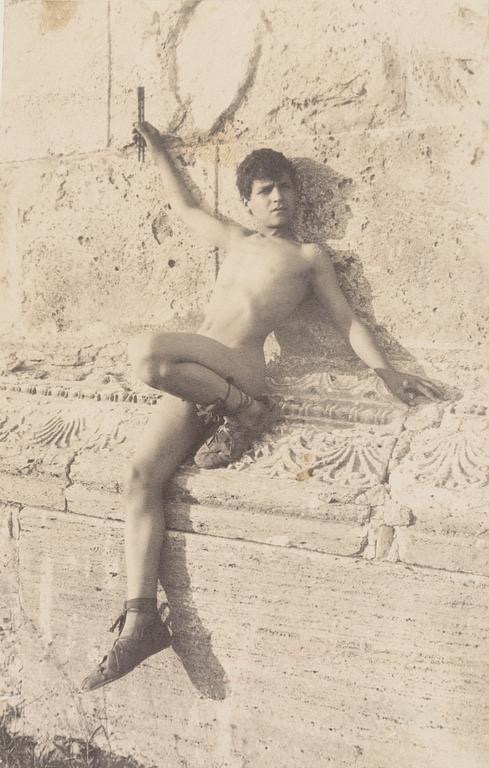
Long before moving pictures, erotic images circulated as drawings, engravings, and photographs. In the 19th century, so-called “French postcards” depicted nude men as athletic models, though sometimes posed in implicitly homoerotic ways. One of the earliest and most influential figures to straddle the line between art and pornography was Wilhelm von Gloeden, whose photographs of Sicilian boys, taken between the 1880s and 1920s, combined classical references, soft lighting, and unabashed sensuality. These images were sold as art but carried undeniable erotic charge.

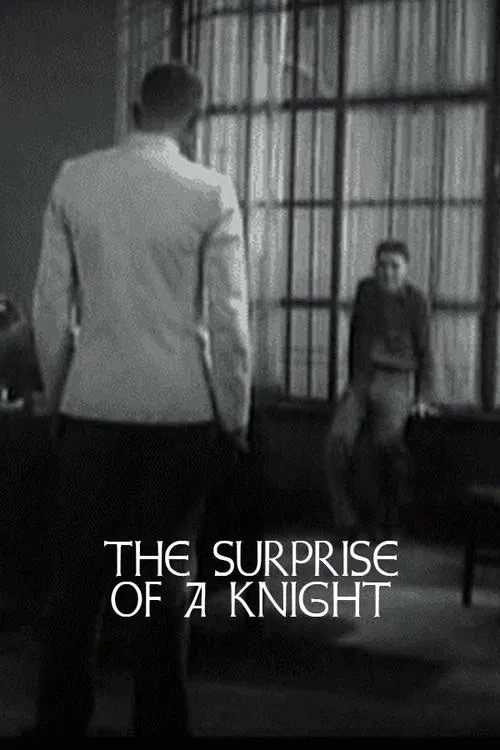
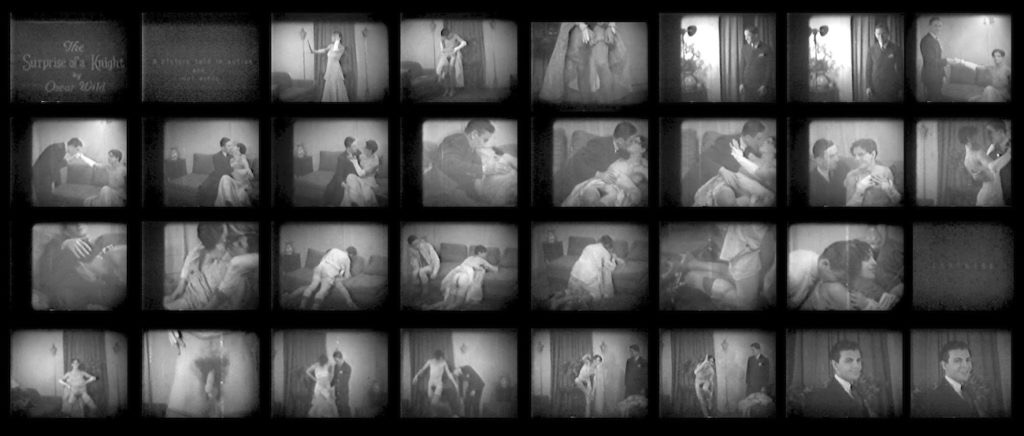
When film arrived, early pornography — called “stag films” — rarely included explicitly gay scenes. Still, there were clandestine reels from the 1920s–40s that showed male-male encounters. Though they were often anonymous and lacked narrative or polish, their very existence documented queer desire at a time when it was otherwise hidden. The Surprise of a Knight (1930), one of the earliest surviving gay stag films, is a fascinating precursor — a clandestine, playful short that captures queer desire in an era of strict censorship, showing how even in the shadows, erotic expression could hint at both art and resistance.

The Surprise of a Knight opens with an elegantly dressed “lady” preparing for a visit, who reveals a patch of pubic hair as an intertitle credits the screenplay to “Oscar Wild.” In the drawing room, the lady flirts and kisses her dapper “knight,” rebuffing his gropes before playfully slapping him and then performing oral sex. She then positions herself face-down on the sofa, and the knight simulates anal sex with her twice, both reaching climax. After he departs, the “lady” lifts her skirts to reveal he is actually a man, punctuated by an intertitle reading “Surprise.” The man dances nude, his penis visible, before the knight returns to help him undress completely; they dance together briefly, and in the final shot the man, now in business attire, winks at the camera before walking off.

The Classic Era: Porn as Provocation, Pleasure as Art

The so-called “Golden Age” of gay porn coincided with the sexual revolution of the late 1960s and 1970s. Explicit films were finally being made openly, screened in theaters, and even reviewed in mainstream publications. During this period, filmmakers experimented with narrative, cinematography, and symbolism — producing works that were undeniably pornographic but also clearly ambitious, aesthetically considered, and culturally significant. Some of these films are now preserved in archives and even screened in museums.

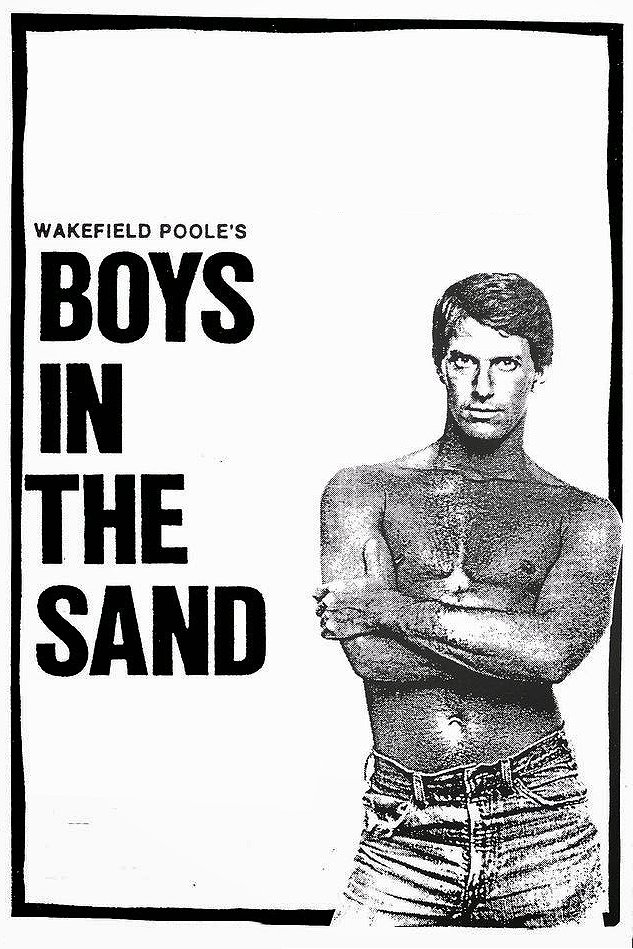
Perhaps the most famous of these was Boys in the Sand (1971), directed by Wakefield Poole, which portrayed erotic encounters on Fire Island in lush, painterly compositions. Poole’s film was groundbreaking for its beautiful cinematography and narrative flow — and it even premiered to a packed theater audience, signaling a new cultural visibility.

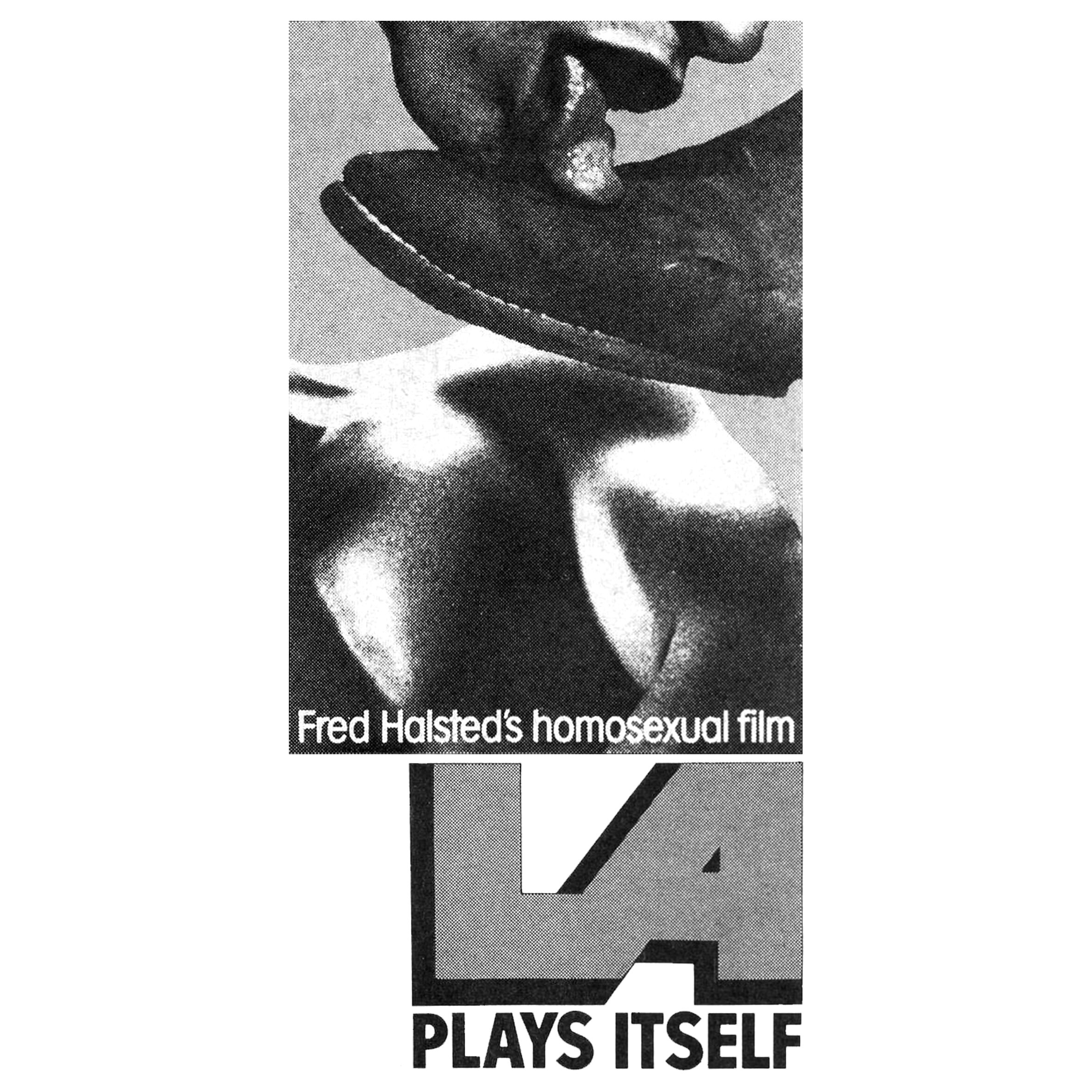
Around the same time, Fred Halsted’s LA Plays Itself (1972) took a radically different approach, presenting gay sex through a gritty, surrealist lens that reflected the urban experience of Los Angeles. In October 2023, New York’s IFC Center hosted a rare screening of Fred Halsted’s LA Plays Itself, shown on Friday, October 20 and Saturday, October 21. The IFC Center, a renowned independent art-house cinema in New York City, screening LA Plays Itself is significant because it affirms the film’s enduring status not just as underground pornography but as a provocative work of avant-garde queer art worthy of serious cultural recognition. This gritty, surreal classic of queer cinema was presented as part of a retrospective celebrating the film’s radical blend of explicit gay sexuality, avant-garde experimentation, and social critique — reminding audiences why it remains both controversial and artistically significant more than fifty years later.

From: Fred Halsted’s LA Plays Itself (1972)

Other notable films of this era, such as Sex Garage and Drive!, blended explicit sex with experimental art-film techniques, offering a kind of avant-garde pornography. And beyond film, the hypermasculine, leather-clad drawings of Tom of Finland profoundly influenced the aesthetic of this era — his work infused pornographic imagery with style and self-confidence. These films treated sex not just as a physical act but also as an expression of fantasy, identity, and even politics — often blending sensuality with beauty and humor.

The Condom Era: Risk, Responsibility, and Reinvention

With the arrival of HIV/AIDS in the early 1980s, the landscape of gay porn changed dramatically. Fear and loss reshaped queer sexuality, and the industry adopted condoms both as a visual norm and as an ethical statement. Yet filmmakers continued to create works that were erotic, imaginative, and even moving. While the films of this era often retained the narrative ambition of the classic period, the urgent subtext of survival and safer sex advocacy gave them new weight. Many films explicitly incorporated education or chose to eroticize condoms themselves, making them part of the fantasy rather than an intrusion on it.

One example is More of a Man (1986), which managed to portray explicit gay sex as affirming and healthy during a time of crisis. Later films such as Oversized Load (1992) and Flashpoint (1994) demonstrated that high production values and eroticism could coexist with a commitment to showing safer sex. Directors like Chi Chi LaRue injected humor, camp, and even tenderness into their films while insisting on condoms, making the condom itself part of the fantasy rather than an obstacle. These works helped sustain gay erotic culture during a devastating epidemic, offering viewers both pleasure and reassurance. These films demonstrated how erotic art could adapt to a changed world, preserving desire while honoring safety and responsibility.

The Post-Condom Era: Emotional Realism and Erotic Storytelling

With the introduction of PrEP (pre-exposure prophylaxis) and better treatments for HIV, the last decade has seen a return to condomless (or “bareback”) porn. Some see this as a fetishization of risk; others view it as reflecting new realities where undetectable equals untransmittable (U=U) and consent is better understood. The artistry of the current era often lies in its diversity: high-definition cinematography, thoughtful storytelling, and a new openness about race, body types, and kink.

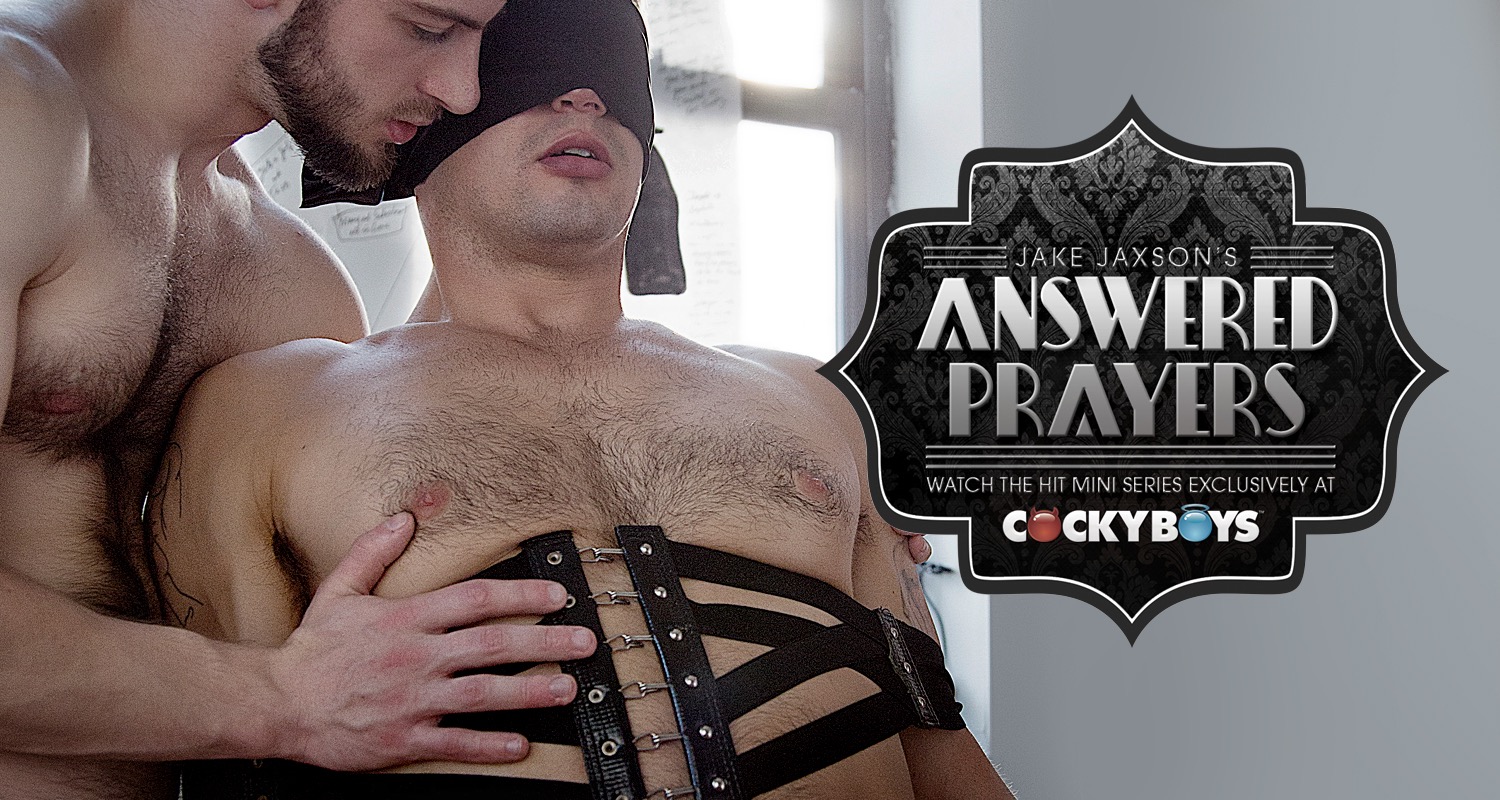
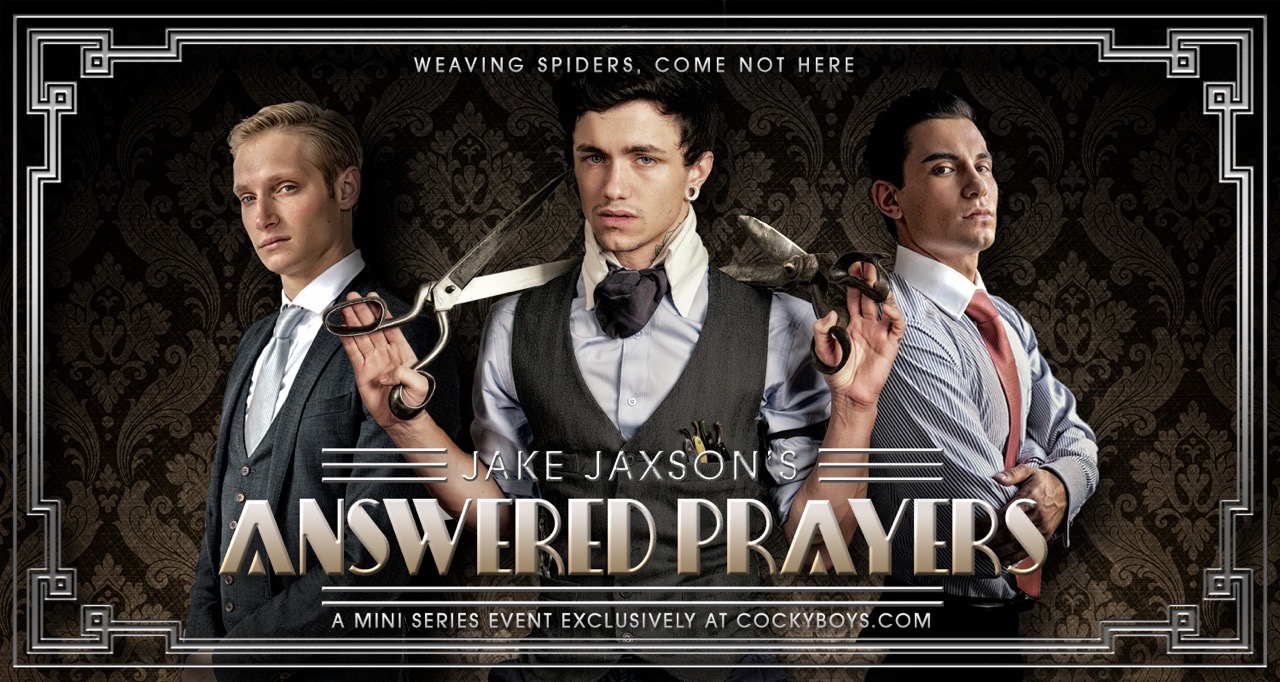
Studios like CockyBoys have embraced the idea of “art house porn” — their Answered Prayers series (2014–15) was highly conceptual, blending dreamlike imagery, emotional narratives, and striking cinematography with explicit sex. Meanwhile, queer filmmaker Bruce LaBruce has consistently created films that integrate hardcore gay sex into narrative art cinema, screened at film festivals and museums.

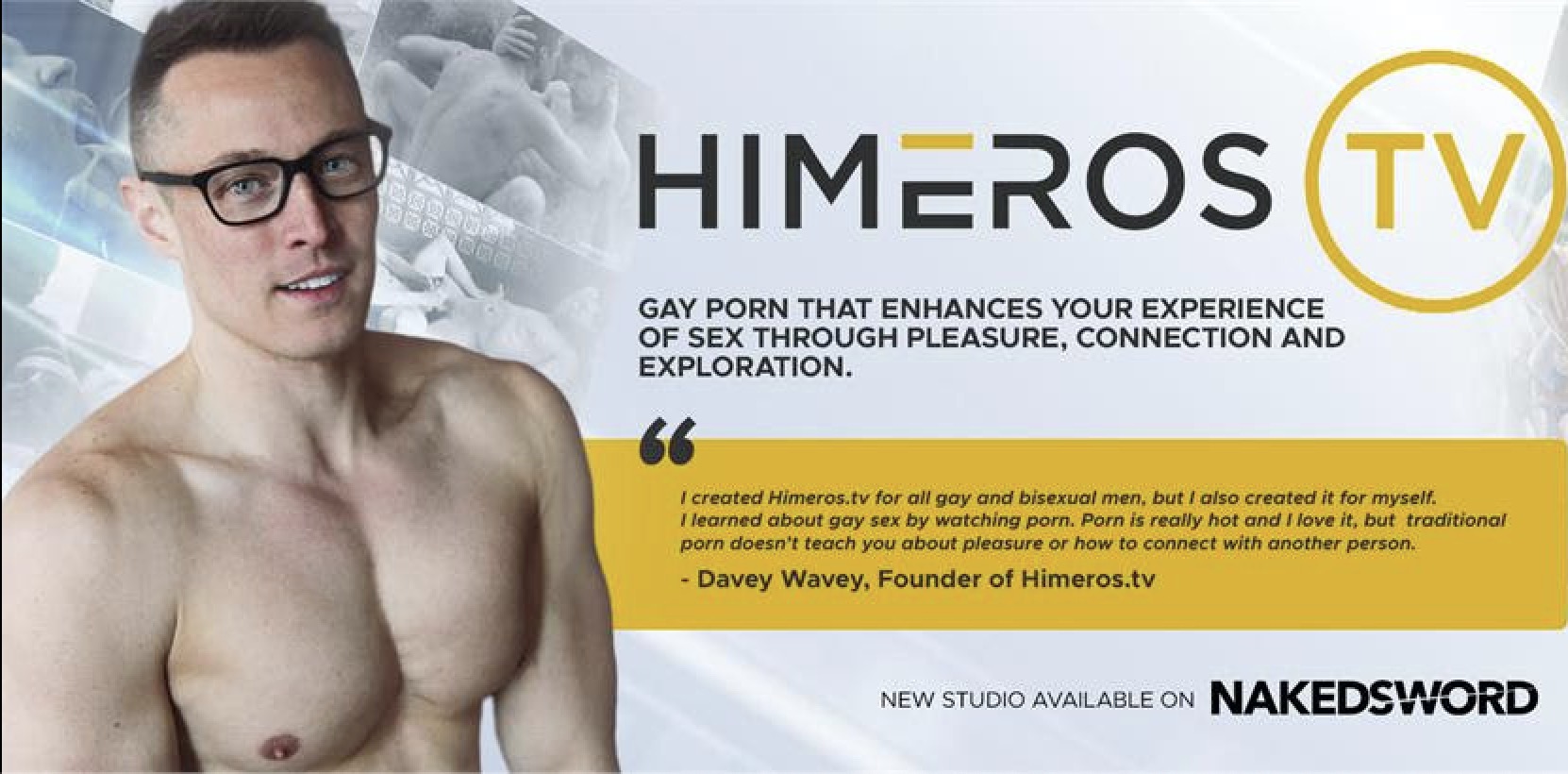
In addition, Davey Wavey’s Himeros project has taken the idea of porn-as-art even further, explicitly positioning itself at the intersection of eroticism, education, and body positivity. With its emphasis on advocacy and sensual exploration, Himeros aims to create porn that doesn’t just arouse but also affirms, teaching viewers to see their own bodies and desires as beautiful and worthy. And across the independent scene, more and more filmmakers are producing “post-porn” hybrids: installations, videos, and screenings in galleries that use pornographic elements to explore desire, identity, and politics.

What Makes Porn Art?

So, what distinguishes these works from “just porn”?

  • Intent: Many of these works aim not just to arouse but to say something — about desire, about queerness, about the human condition.
  • Aesthetic Vision: Careful cinematography, editing, sound design, and narrative ambition elevate the material.
  • Cultural Context: In eras when mainstream culture erased queer desire, these films asserted its legitimacy and beauty.
  • Emotional Resonance: Art moves us — and some of these films succeed in doing so even beyond the erotic charge.

Of course, not all gay porn is art — nor does it have to be. But these examples show that pornography can be artful, meaningful, and even beautiful. Whether you view it on a gallery wall, a festival screen, or your laptop at midnight, it is part of the long story of how queer people have imagined, celebrated, and preserved our desires.

What do you think? Where do you draw the line between porn and art? Or is there even a line at all? Share your thoughts in the comments.


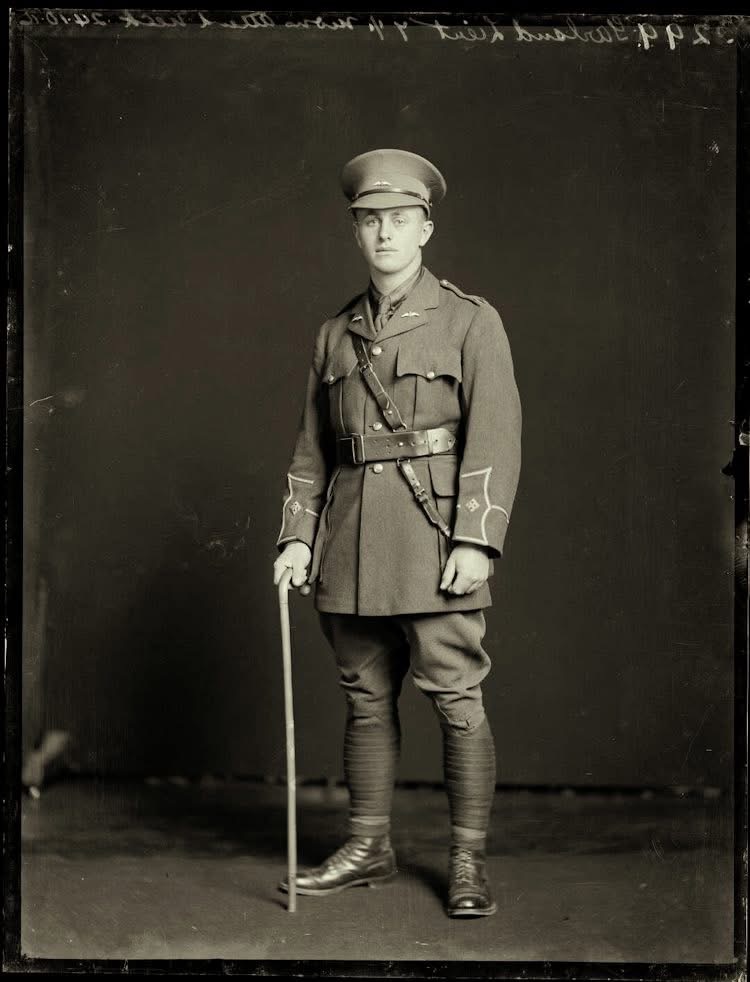
A Soldier Stripped Bare: The Nude Photographs of Lt. Edgar Henry Garland

Some of you may know that my original academic passion—and the reason I first went to graduate school—was to study military history, with a particular focus on the First World War. Ever since I took my first undergraduate course on WWI, I’ve been captivated by the conflict: the way it reshaped nations, upended empires, and left cultural and emotional reverberations we still feel more than a century later. I’ve long been drawn to the poetry of the war, as well as the deeply human stories of the individuals and communities who lived through it.

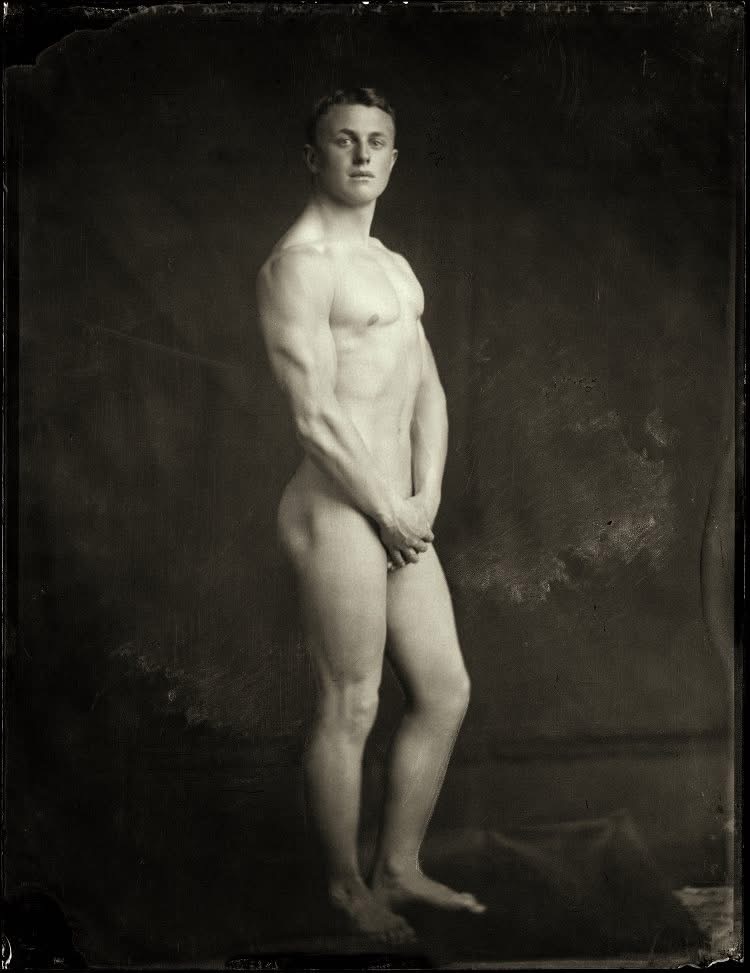
That’s why, when I came across a set of nude photographs taken of New Zealand soldier Lieutenant Edgar Henry Garland, I was immediately intrigued. The images are striking—not just for their artistic composition, but for the questions they raise about masculinity, memory, and identity during wartime. This week’s art history post centers on three rare and intimate photographs of a single soldier. There may have been others like them, but this particular case remains one of the most compelling and well-known examples of its kind.

Uncovering the Man Behind the Uniform: Art, Intimacy, and Queer Visibility in a WWI Portrait

In the archives of New Zealand’s photographic history lies a haunting and striking series of images: nude portraits of Lieutenant Edgar Henry Garland, a World War I soldier, posed with classical grace and remarkable vulnerability. Captured by the studio of S. P. Andrew Ltd., these images raise fascinating questions about art, masculinity, and queer subtext in the early 20th century.

At first glance, Garland might seem like any young officer from the Great War—handsome, lithe, a product of Edwardian values and imperial loyalty. But his story is far more remarkable.

Born in 1895, Edgar Henry Garland served with distinction in the New Zealand Expeditionary Force during World War I. He fought on the Western Front and was captured by German forces, becoming a prisoner of war. What set Garland apart was not just his courage in combat, but his extraordinary persistence in trying to escape captivity. He attempted to escape seven times from various POW camps—an astonishing feat that earned him admiration both during and after the war. His repeated escapes were acts of daring and defiance that turned him into a kind of folk hero in New Zealand military lore. By war’s end, he was among the most celebrated escapees in New Zealand’s wartime record.

And yet, tucked away behind this legacy of bravery is a quieter, more intimate chapter—one not written in medals or official commendations, but in a series of photographs that strip away the uniform and expose the man beneath.

These nude images were taken by S. P. Andrew Ltd., one of the most respected portrait studios in New Zealand. Founded by Samuel Paul Andrew, the Wellington-based studio was renowned for its official portraits of governors-general, judges, and prime ministers. It specialized in formal, large-format images meant to convey dignity, authority, and professionalism. That such a prestigious studio would also produce a set of male nudes—posed with artistry and elegance—speaks volumes about the complexity of photographic culture at the time.

So why were these photographs taken?

At one level, they reflect the influence of classical artistic ideals. In the late 19th and early 20th centuries, the nude male form was seen—at least within certain artistic circles—as a symbol of strength, youth, and aesthetic perfection. Garland’s poses recall ancient Greek statuary, suggesting a deliberate invocation of heroism and beauty. For a young man who had survived war and captivity, these images may have served as a personal monument—an assertion of vitality, resilience, and self-possession.

But there are other possibilities too.

The photographs may have been taken as private keepsakes, either for Garland himself or for someone close to him. Garland never married, and little is known about his private relationships. The possibility that these images were intended for a romantic or intimate partner—perhaps even a male lover—has been raised by queer historians who see in the photographs a coded form of homoerotic expression. The tenderness of the poses, the elegance of the lighting, and the sheer vulnerability on display all hint at a relationship between photographer and subject that goes beyond documentation.

Indeed, these photographs function within a long tradition of discreet queer representation. In an era when homosexuality was criminalized and forbidden by military and civil law, photography could serve as a silent language of desire. Studios like S. P. Andrew—though publicly respectable—may have discreetly permitted or even participated in the creation of such images for trusted clients. This wasn’t pornography; it was art. But it was art with layers of subtext—subtext that speaks volumes to those willing to see it.

Whether these photographs were meant as aesthetic studies, personal mementos, or secret love letters, they offer a rare and poignant glimpse into the inner life of a man whose public legacy is defined by heroism. In these images, we see not just the soldier who escaped seven times, but the human being who posed—naked, unguarded, and beautiful—for reasons we may never fully know.

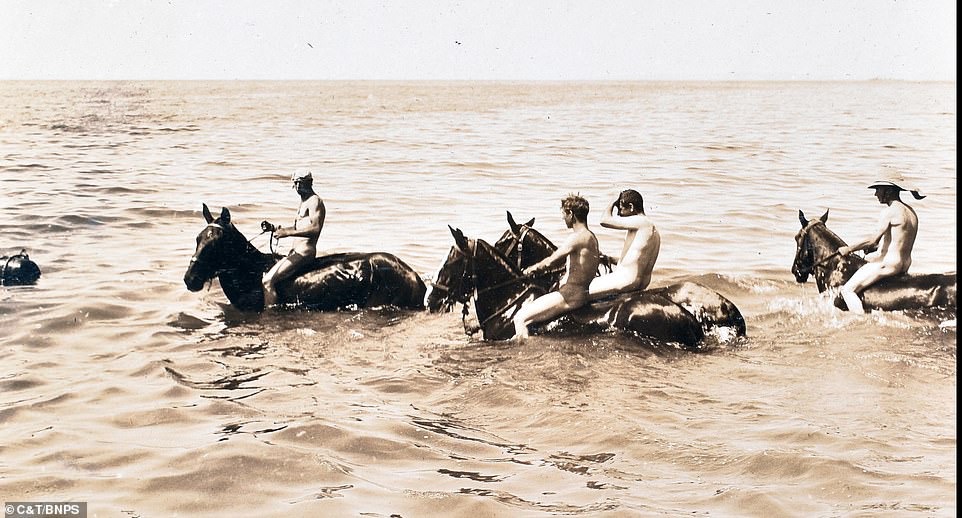
Taking a dip: Soldiers take a break from the heat with their horses in the sea. The men wash their steeds while completely naked as they enjoy a moment away from the battle

A Note on Queer Visibility in WWI Remembrance Culture

Photographs of nude soldiers—while rarely publicized—have existed across multiple conflicts, including World War I and World War II. Often taken in private or semi-artistic contexts, these images captured the male form not only as a symbol of strength and youth, but sometimes as an intimate keepsake, a personal act of vulnerability, or even a quiet expression of queer desire. Though such photographs were uncommon, they remind us that behind every uniform was a body, a story, and a complex humanity often left out of official histories.
Stories like Edgar Garland’s remind us how queer history often survives in the margins—in photographs, in letters, in quiet acts of defiance and longing. Mainstream remembrance of World War I tends to focus on duty, sacrifice, and masculine honor, but it rarely makes space for the hidden lives of queer soldiers. Yet they were there: loving, grieving, and serving alongside their comrades. For some, like Garland, a single photograph may be the closest we get to that truth.
As we commemorate the soldiers of the Great War, it is vital to recognize that their humanity was not confined to the battlefield. Some found intimacy in silence. Some left behind coded artifacts. And some, like Garland, posed for a camera and dared to be seen—fully, tenderly, and without shame.

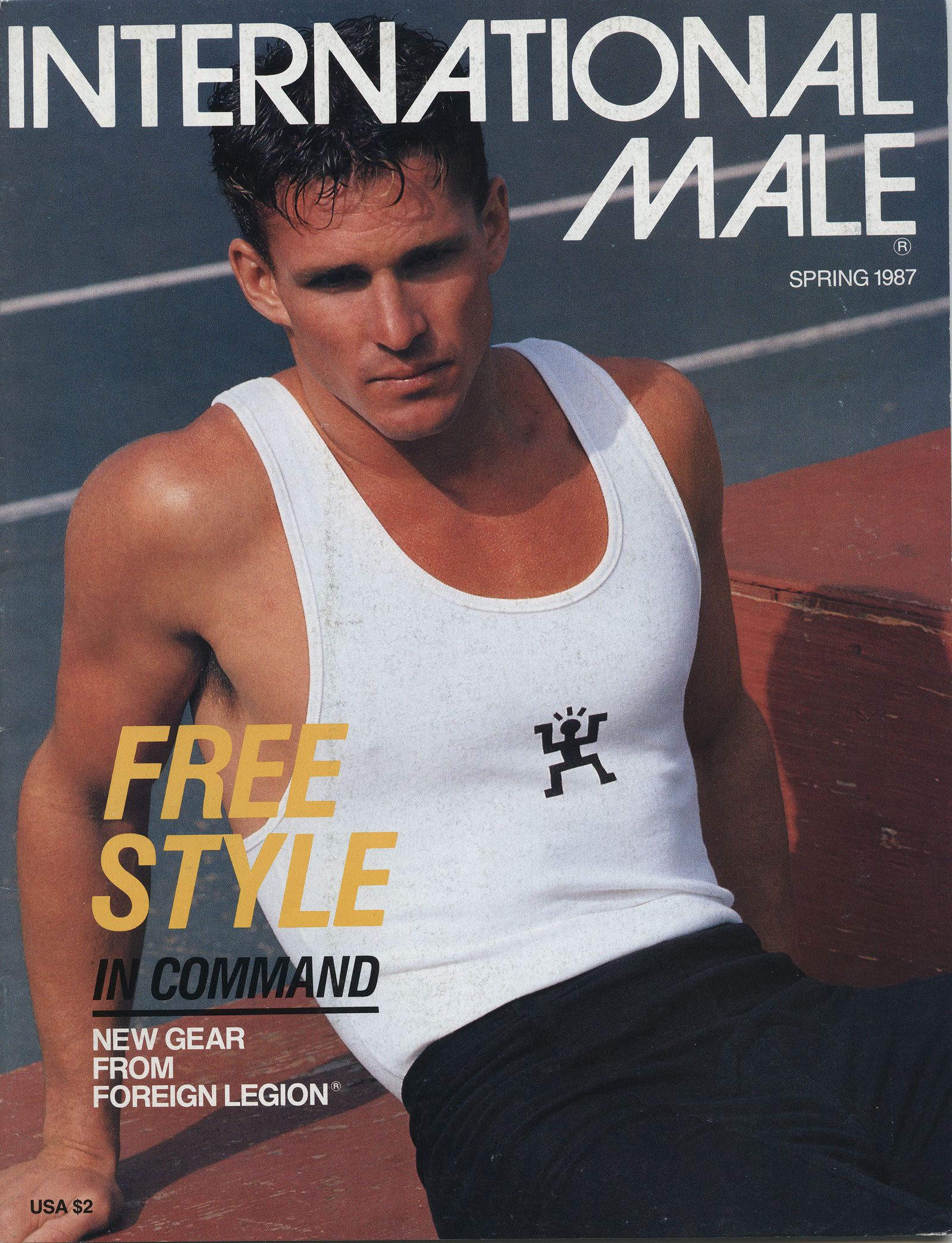
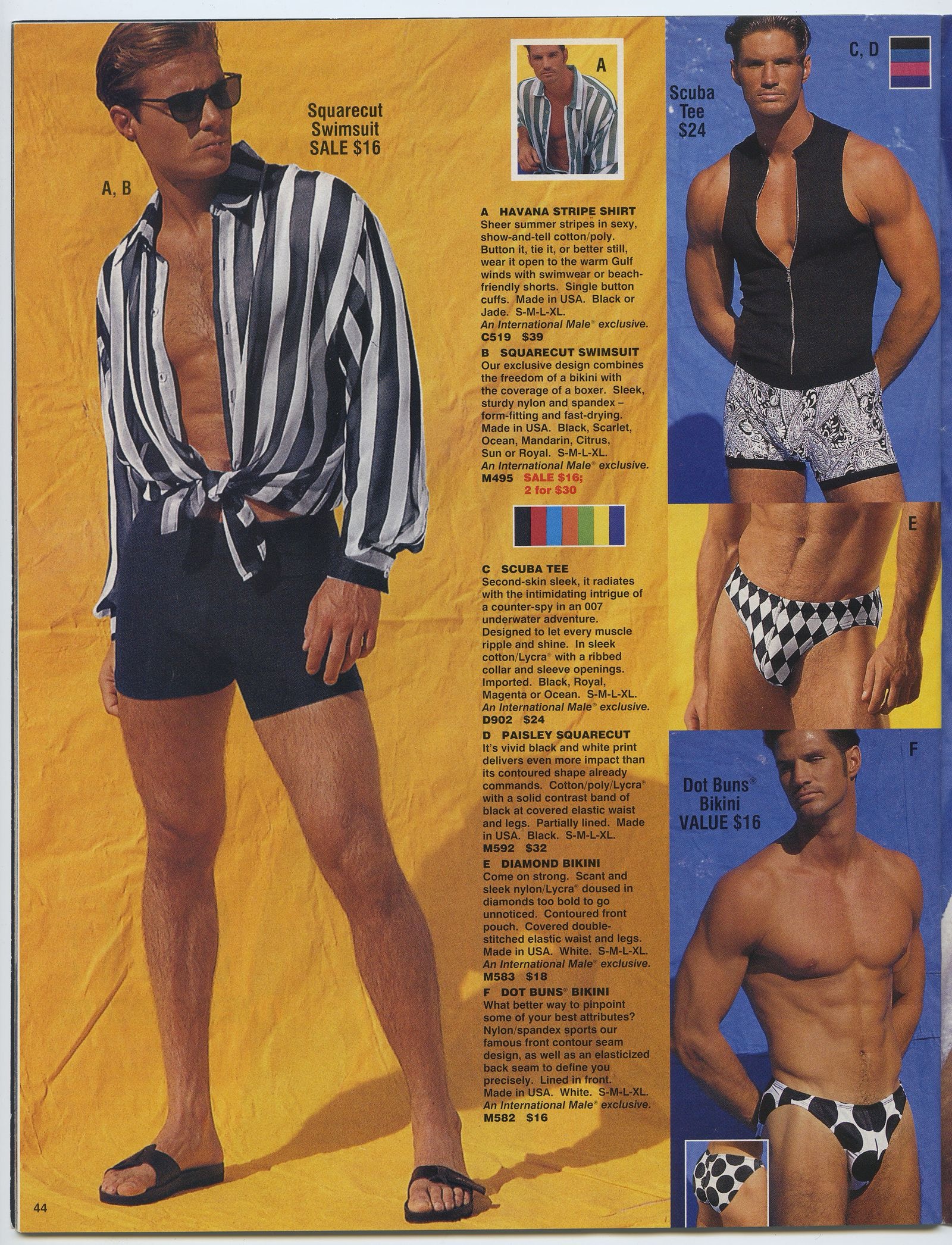
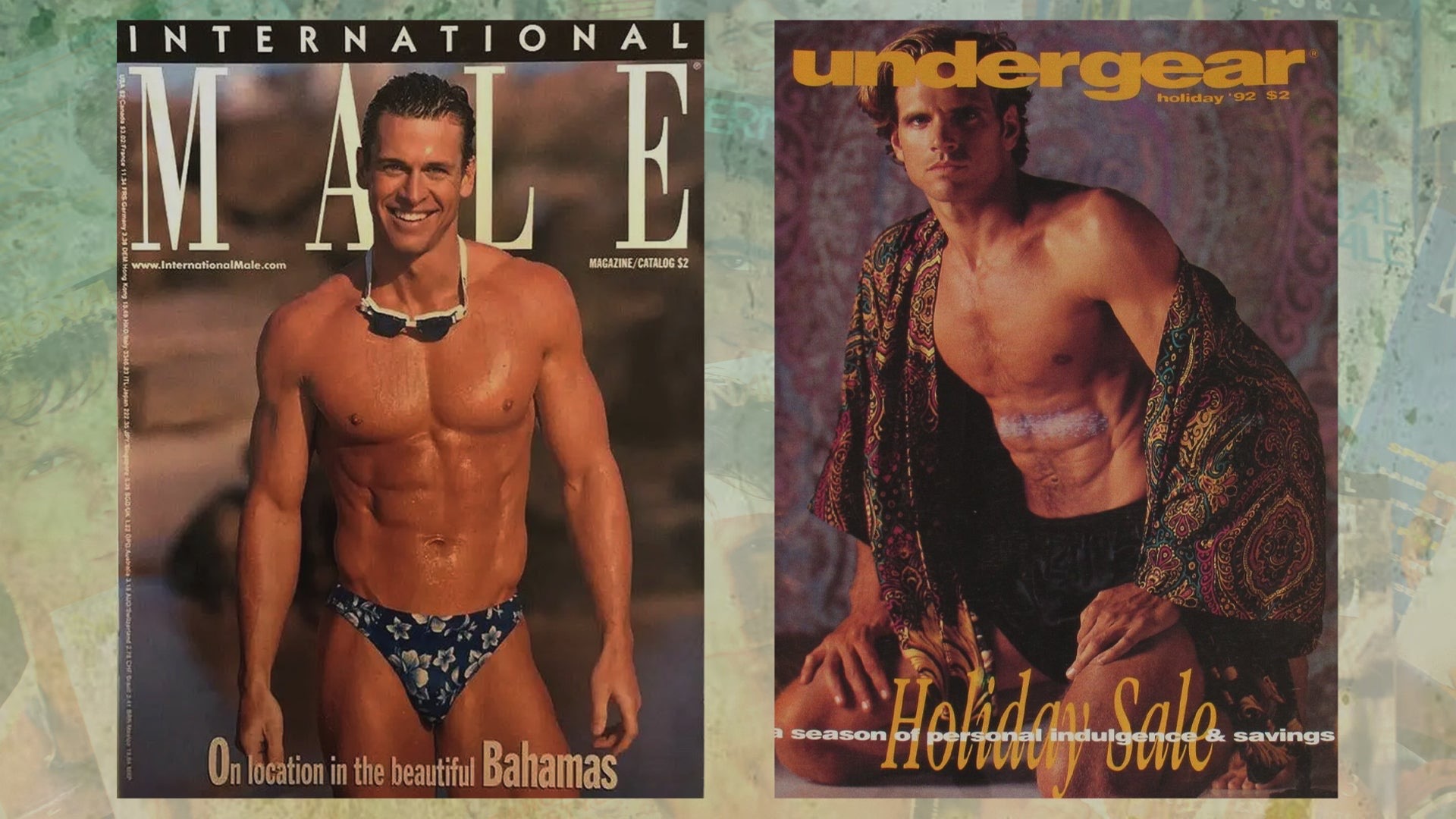
Male-Order Desire: The Bold Legacy of International Male

Long before Grindr profiles and Instagram thirst traps, gay men turned to other sources for affirmation, fantasy, and fashion. And for many, there was nothing quite like opening the mailbox to find the latest issue of International Male—a glossy, unapologetically flamboyant catalog filled with mesh shirts, tight pants, deep V-necks, and men whose smoldering stares made it very clear: this wasn’t just about buying clothes.

From its founding in the 1970s through its peak in the ’80s and ’90s, International Male became a low-key lifeline for gay men across America. And even if it never explicitly said the word “gay,” the message was clear: these clothes—and these bodies—were for you.

International Male was launched in 1974 by Gene Burkard, a San Diego-based entrepreneur with an eye for flamboyant fashion and emerging markets. His goal? To create a mail-order catalog for men who wanted more than just workwear and flannel. This was high-collared, disco-era glam for men who wanted to be seen—and desired.

Though never overtly labeled as gay, the catalog’s aesthetic left little doubt. Muscular male models posed in silky robes, sheer tank tops, and outrageously tight trousers, often in settings that felt more boudoir than boardroom. But because it was technically a fashion catalog, it flew under the radar. For closeted men in conservative towns, this was covert contraband—an acceptable, even respectable way to engage with queer desire.

At its peak in the 1980s and early ’90s, International Male had over 3 million customers. Its sister brand, Undergear, took things even further, focusing almost entirely on underwear and swimwear. Both catalogs were often tucked under beds, stuffed in gym bags, or secretly flipped through while pretending to look for a new blazer.

The magic of International Male was never really about the clothes. It was about fantasy. About possibility. About creating a world where men could be sexy, flamboyant, and free.

For gay men—especially those in the pre-Internet era—the catalog served as coded affirmation. It said, “You’re not alone.” It offered a vision of masculinity that didn’t have to be rugged or repressed. It could be styled, sensual, even sultry.

As queer studies scholar Shaun Cole writes in Don We Now Our Gay Apparel, catalogs like International Male offered not just fashion but “performances of masculinity” that pushed boundaries and created new scripts for how men could look and be seen.

Other Icons of Queer Print Culture

International Male wasn’t alone. There was a whole universe of catalogs, zines, and magazines that played pivotal roles in gay history:

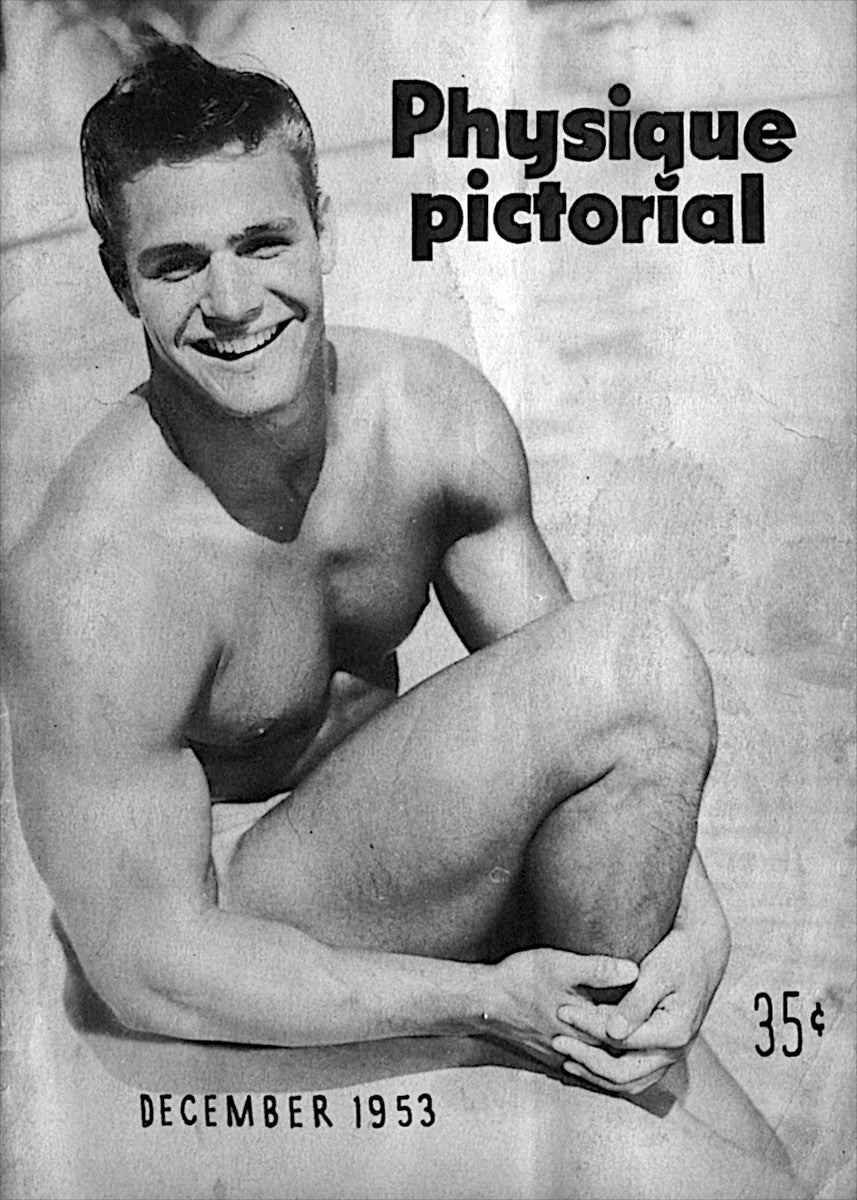
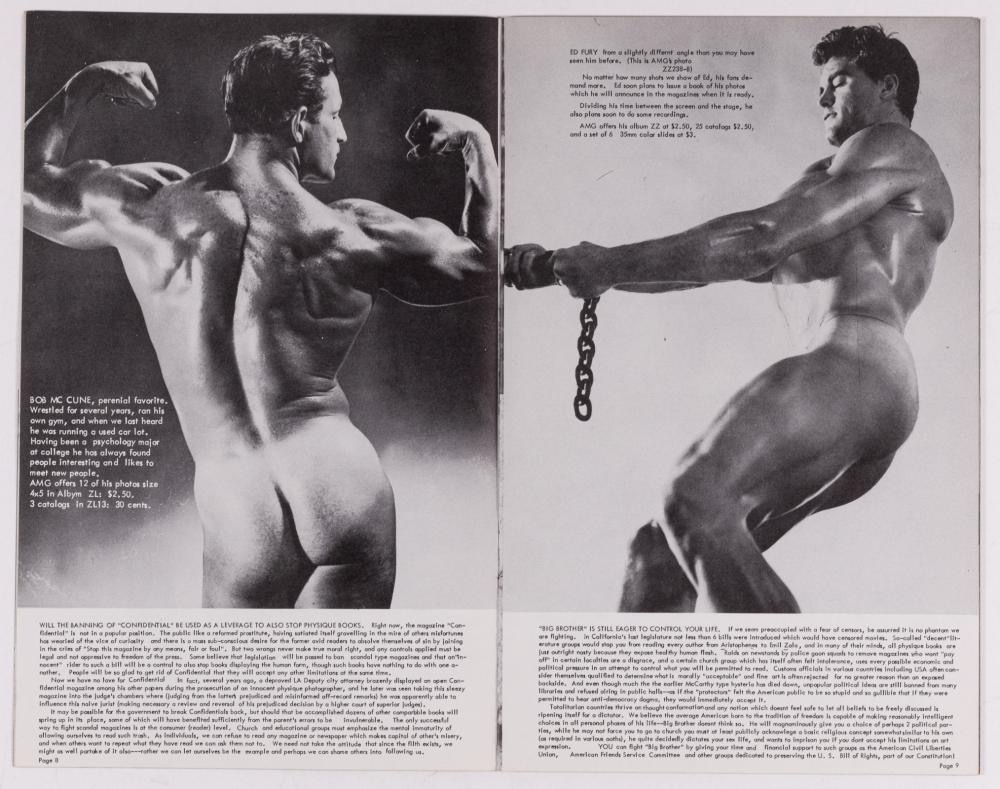
Physique Pictorial (1951–1990)

Launched by Bob Mizer, this “fitness” magazine was the first to feature nearly nude muscular men in a semi-legit format. It helped launch the careers of models like Joe Dallesandro and inspired generations of artists, including Tom of Finland.

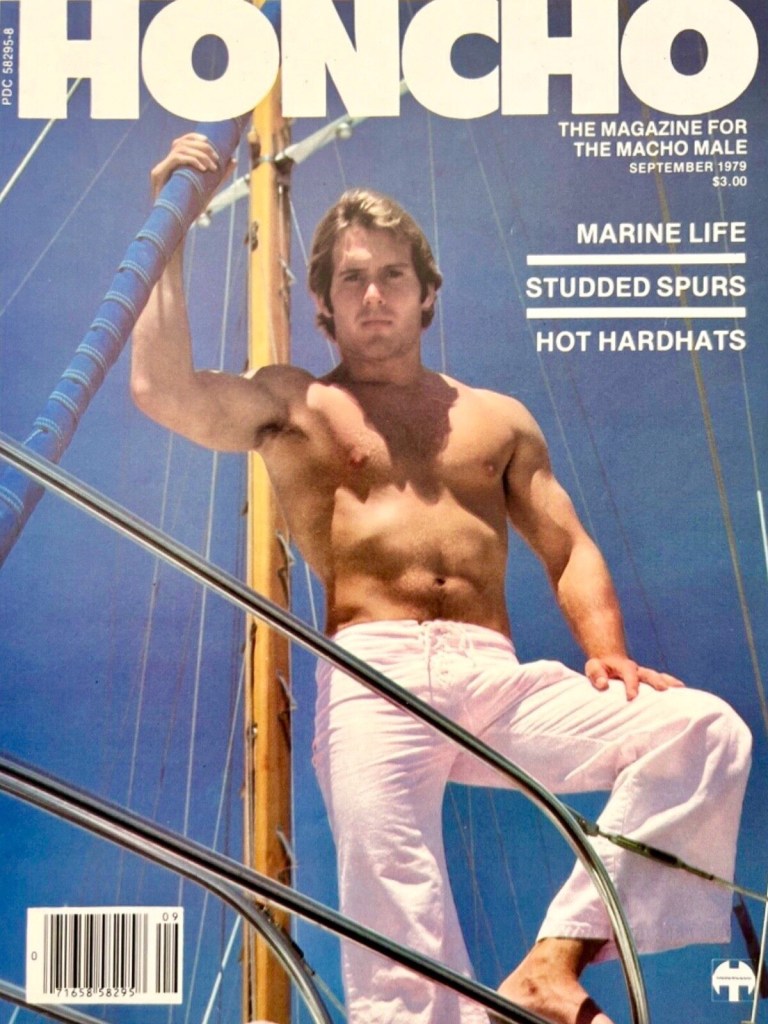
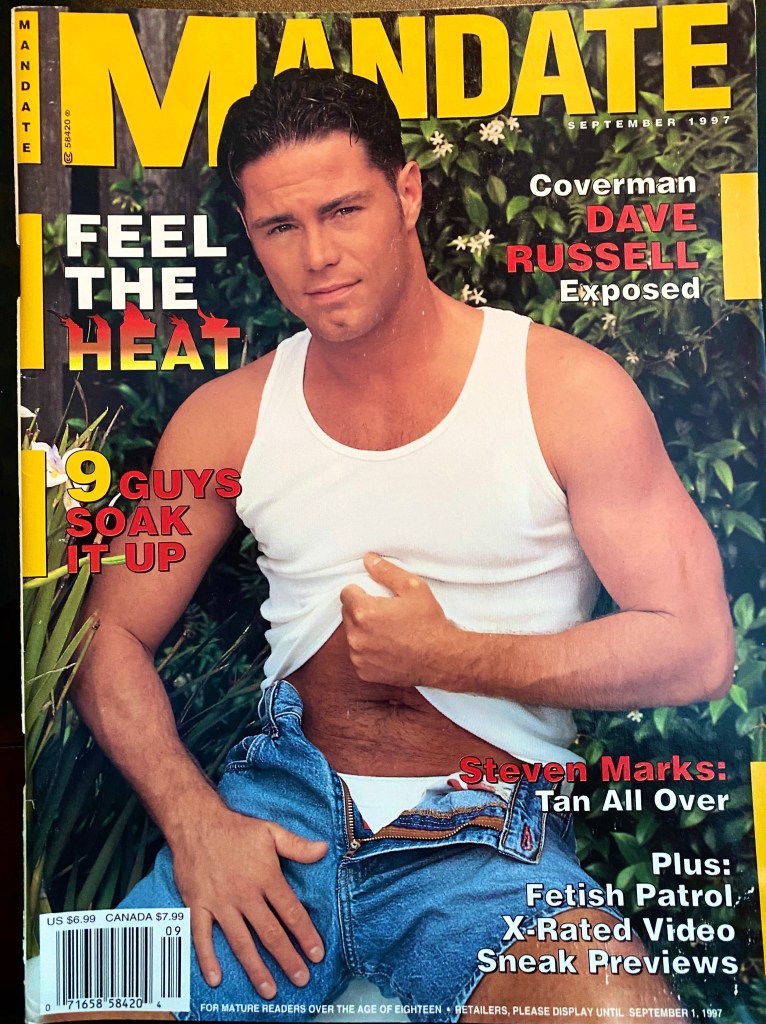
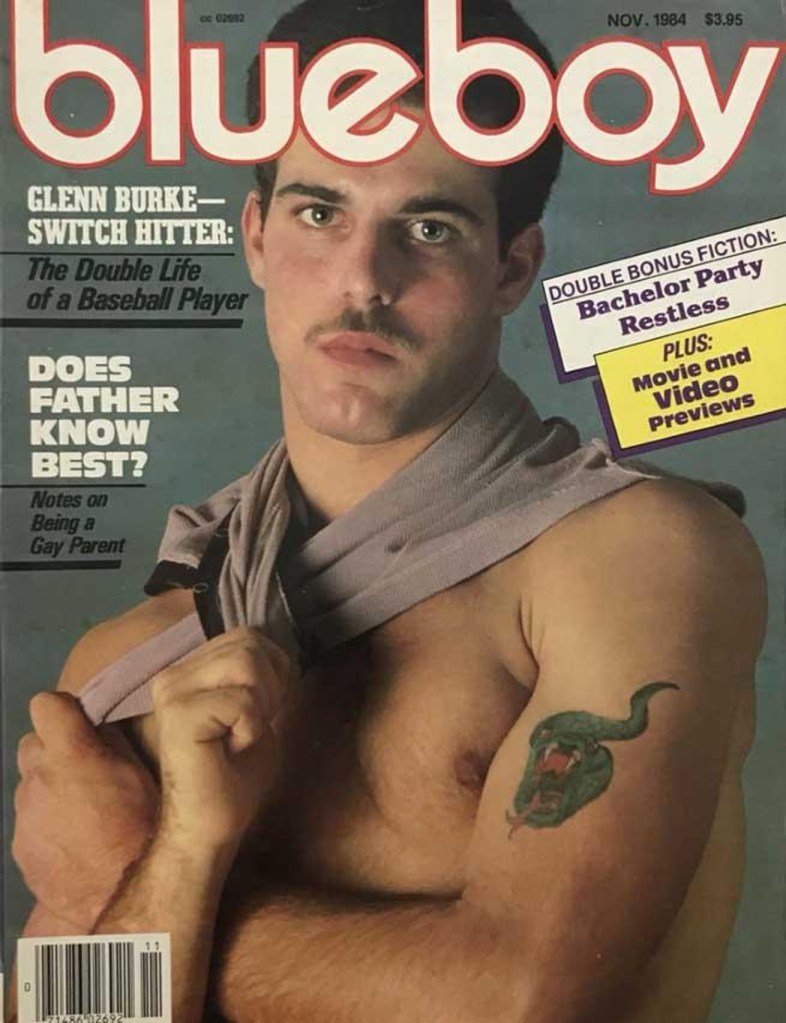
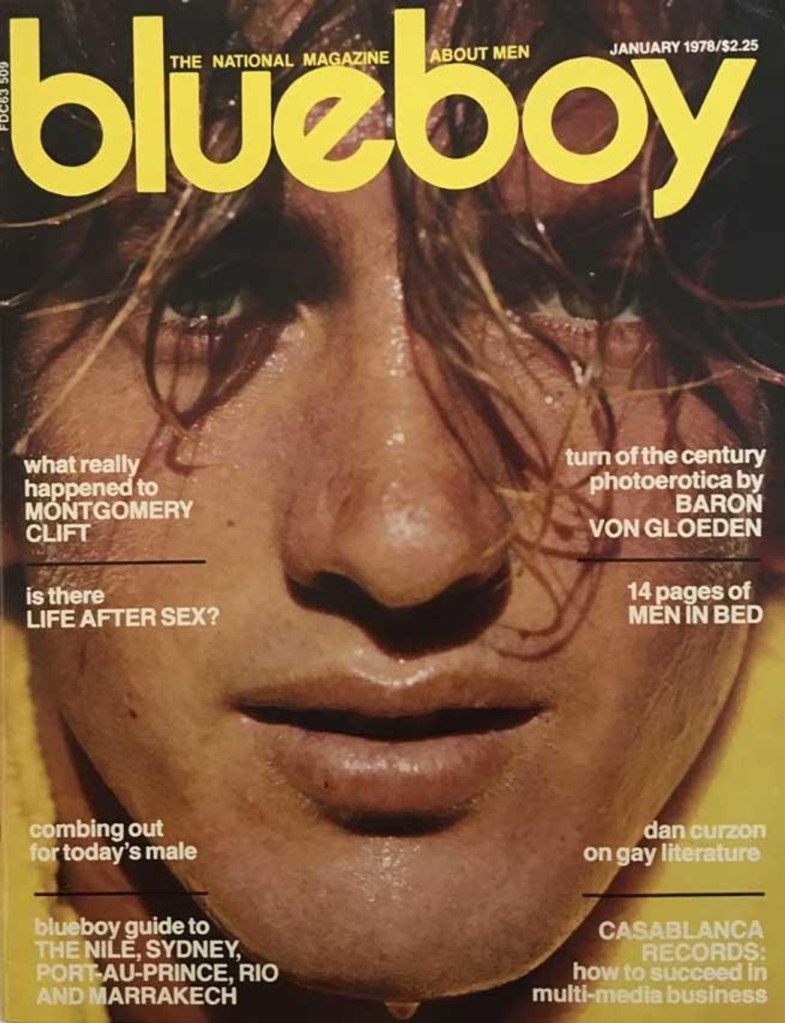
Honcho, Mandate, and Blueboy (1970s–1990s)

Glossy gay lifestyle and erotica magazines that blended porn, interviews, fashion, and personal ads. They gave gay men access to a world far larger and more glamorous than their own.

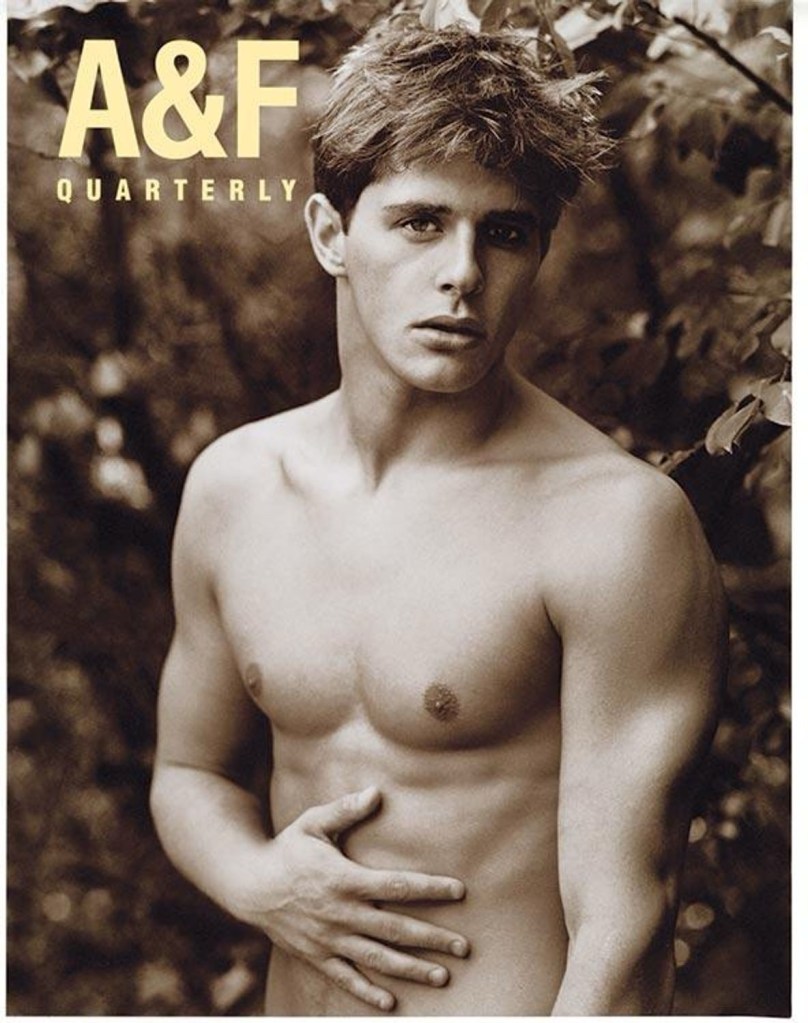
A&F Quarterly (1997–2003)

While technically a catalog for Abercrombie & Fitch, under Bruce Weber’s lens it became a bold, glossy celebration of homoerotic youth culture—shirtless boys in golden fields, bathed in natural light and coded desire.

Undergear

A spinoff of International Male, this catalog was even more explicitly erotic—offering thongs, jockstraps, sheer briefs, and loungewear photographed with far less subtlety.

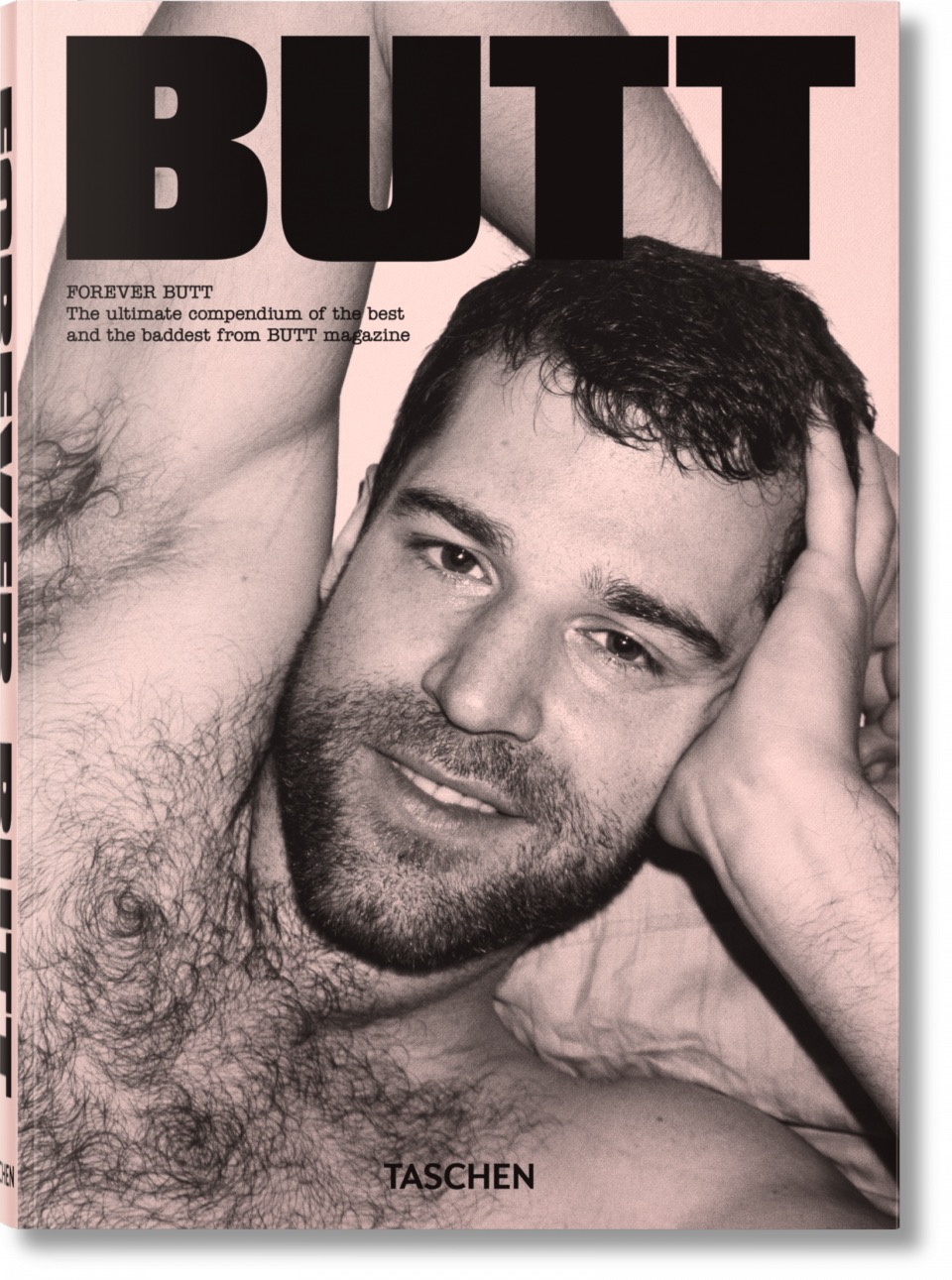
BUTT Magazine (2001–2016)

Launched in Amsterdam, BUTT was an indie, raw, and refreshingly honest publication that celebrated gay sex, intimacy, and everyday life. Pink pages, candid interviews, and gritty photography made it a cult favorite.

The Argument for Art

As with erotic photography and gay porn cinema, there’s a growing argument that catalogs like International Male should be remembered not just as pop culture oddities but as legitimate artifacts of queer history and visual art.

They reflect the shifting landscape of male identity. They archive our fantasies, our insecurities, our attempts to be beautiful in a world that once told us we didn’t belong.

Today, collectors preserve International Male catalogs as kitsch, camp, and cultural gold. Exhibitions of old issues have appeared in queer history museums, and documentaries (like All Man: The International Male Story, 2022) are reclaiming the catalog’s legacy as both fashion history and queer resistance.

For many gay men, flipping through International Male was a ritual—a private moment of longing and laughter. It was how you discovered new shirts and new dreams. How you imagined a body that might one day be yours—or in your bed.

And perhaps that’s the enduring power of such catalogs and magazines: they made desire visible. They turned clothing into code, fashion into fantasy, and mail-order into memory.

So, here’s to International Male—to its satin shirts, its sultry stares, its sneaky subversiveness. It was never just about the clothes. It was always about the possibility of being seen.

Further Reading and Viewing


Pride in Every Stroke: Gay Art Since 1970

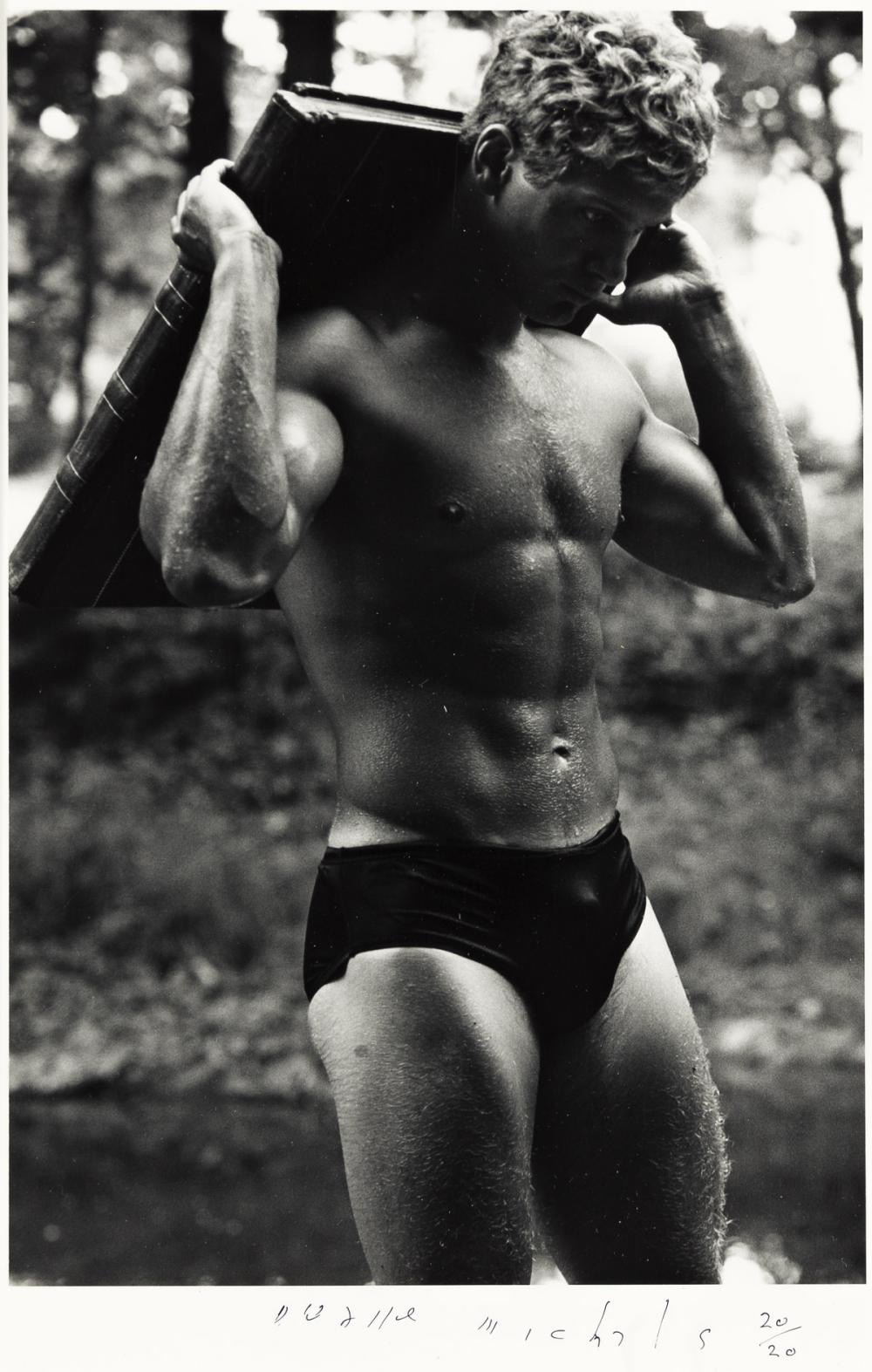
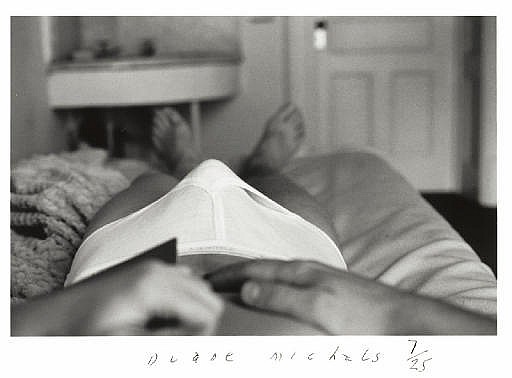
Duane Michals, Male figure holding book, date unknown.

When the first Pride parade marched through New York City in June 1970—commemorating the one-year anniversary of the Stonewall uprising—it marked not only a political turning point but also an artistic awakening. No longer confined to coded symbolism or covert expression, gay pride began to blaze through the art world in bold, unflinching forms. Over the next six decades, LGBTQ+ artists harnessed the power of visibility to challenge oppression, celebrate desire, mourn loss, and imagine futures beyond shame.

The 1970s: Visibility and Liberation

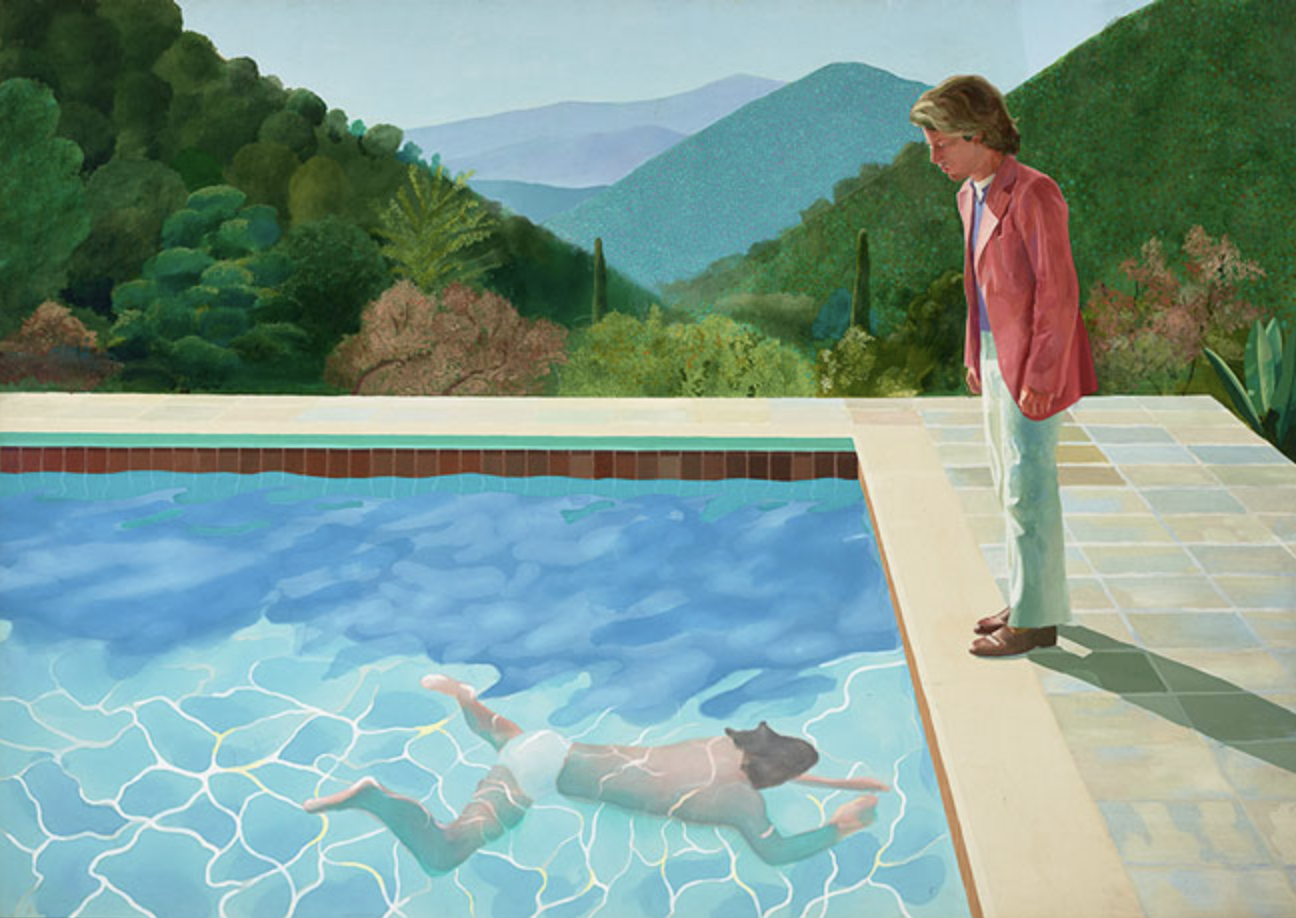
David Hockney, Portrait of an Artist (Pool with Two Figures), 1972.
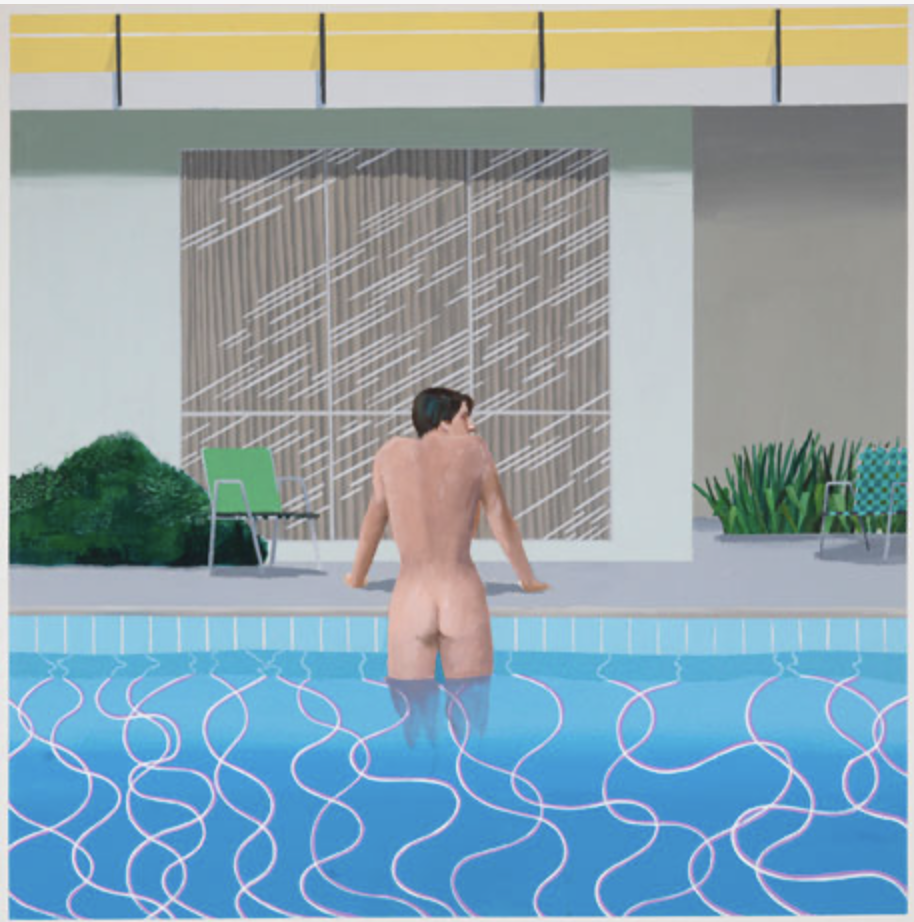
David Hockney, Peter Getting Out of Nick’s Pool, 1966.
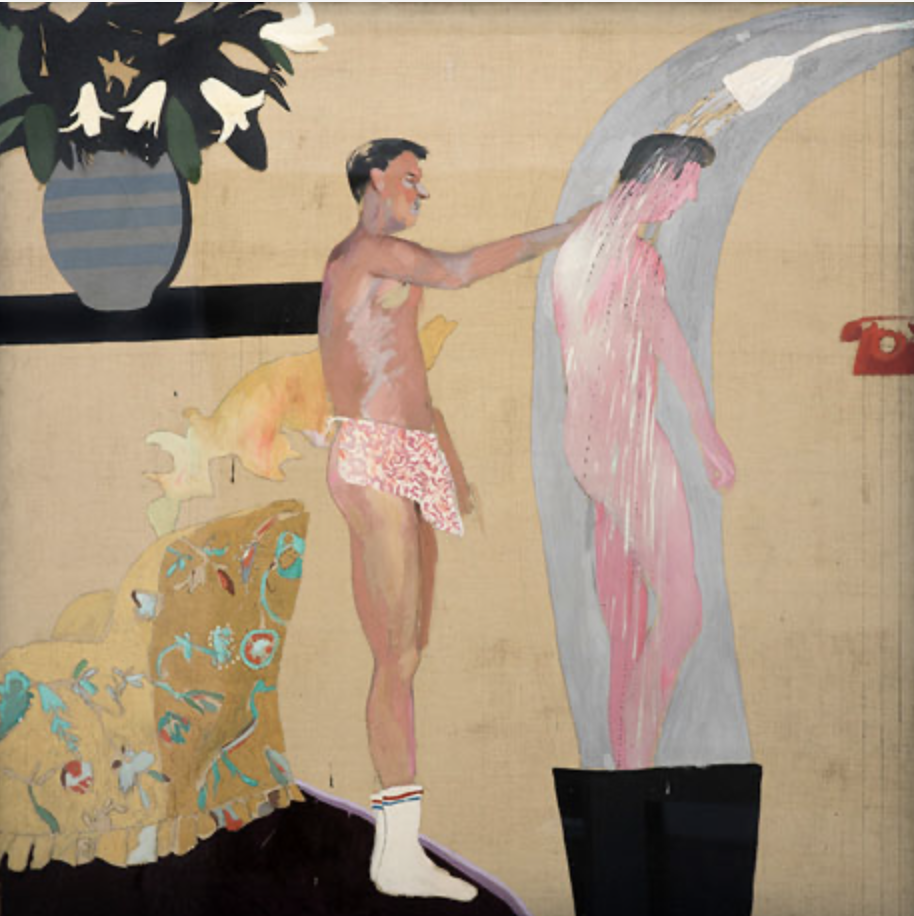
David Hockney, Domestic Scene, Los Angeles, 1963.
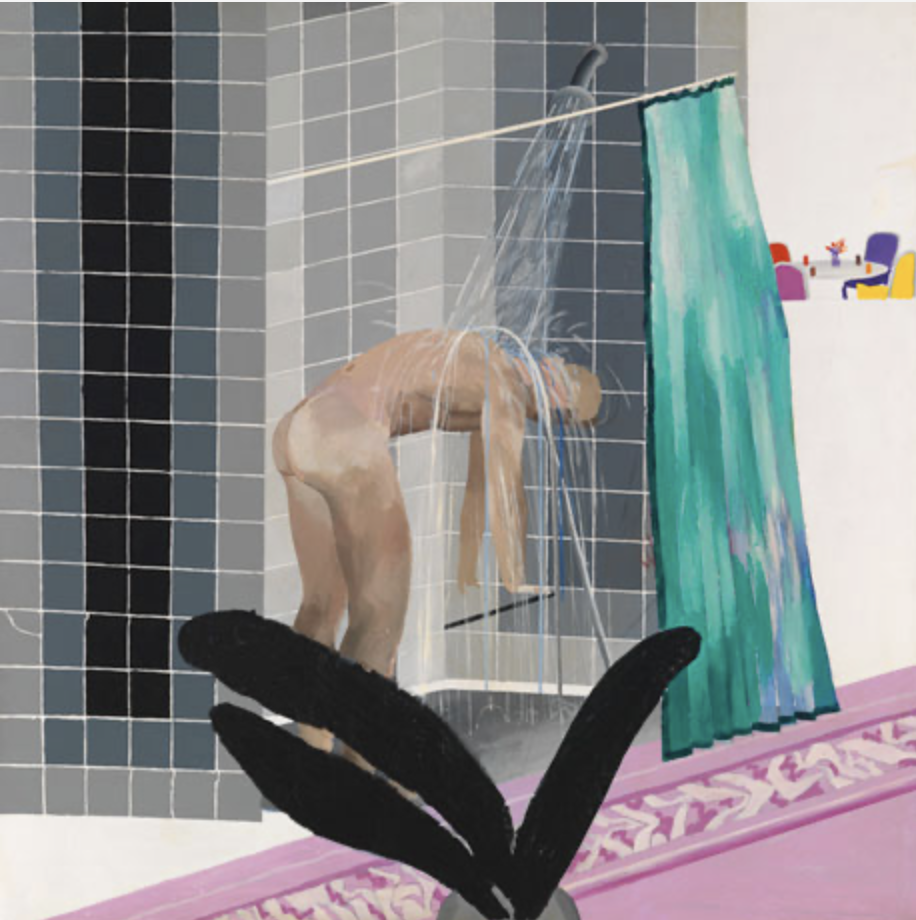
David Hockney, Man in Shower in Beverly Hills, 1964.
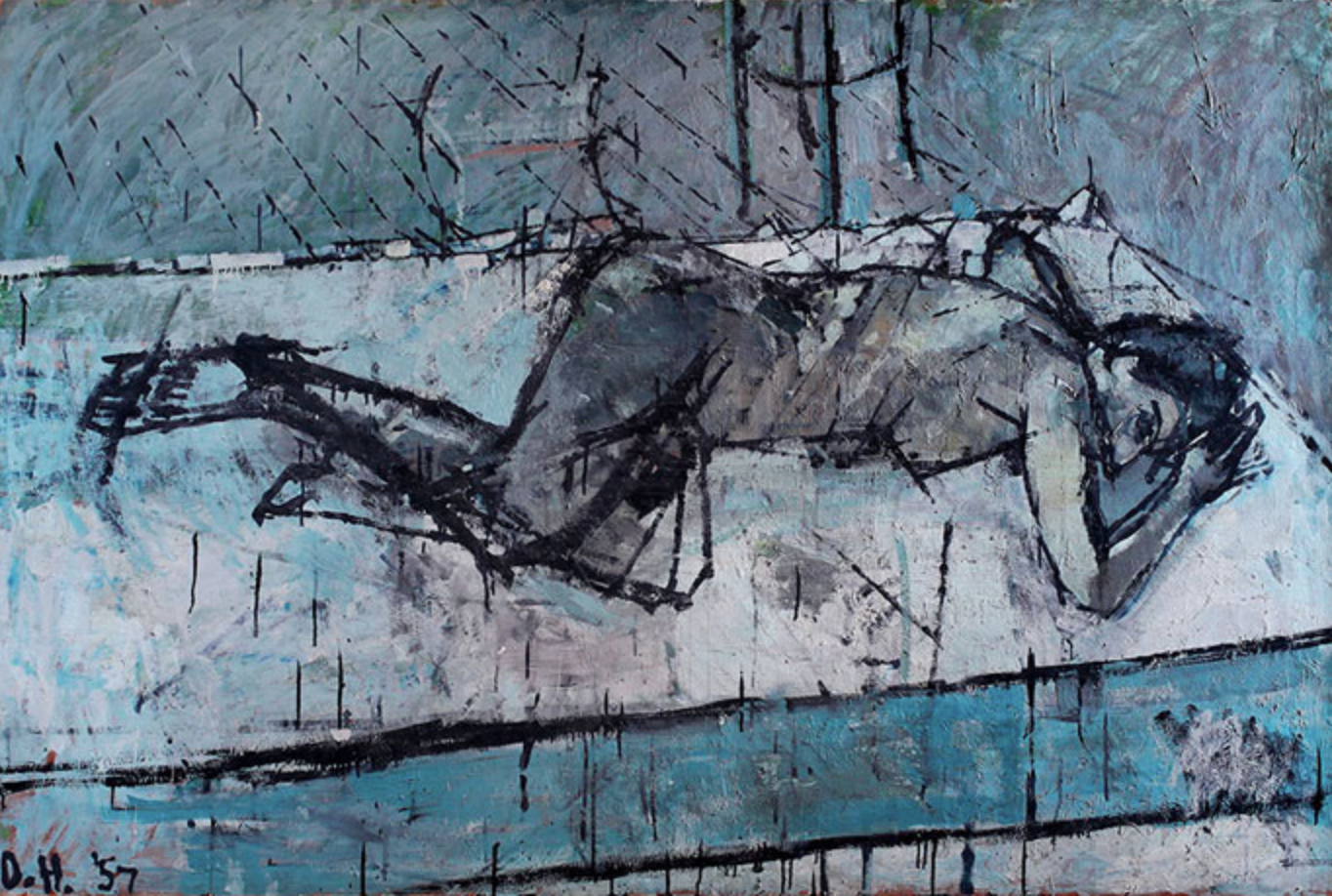
David Hockney, Nude, 1957.

Hockney is known for his vibrant use of color, innovative techniques, and significant contributions to the Pop Art movement. He infused his work with subtle but powerful depictions of gay male intimacy. His 1971 painting Portrait of an Artist (Pool with Two Figures) captured not just a sunlit pool but a relationship dynamic—gaze, distance, vulnerability. It remains one of the most iconic queer paintings of the 20th century. Educated at the Royal College of Art in London, Hockney became celebrated for his depictions of California life, especially his swimming pool series such as Peter Getting Out of Nick’s Pool (1966). His artistic practice spans painting, drawing, printmaking, photography, stage design, and digital art, including pioneering work with iPad drawing apps. Openly gay, Hockney’s works often explore themes of intimacy, domestic life, and sexuality, and his expansive career has solidified him as one of the most influential artists of the 20th and 21st centuries.

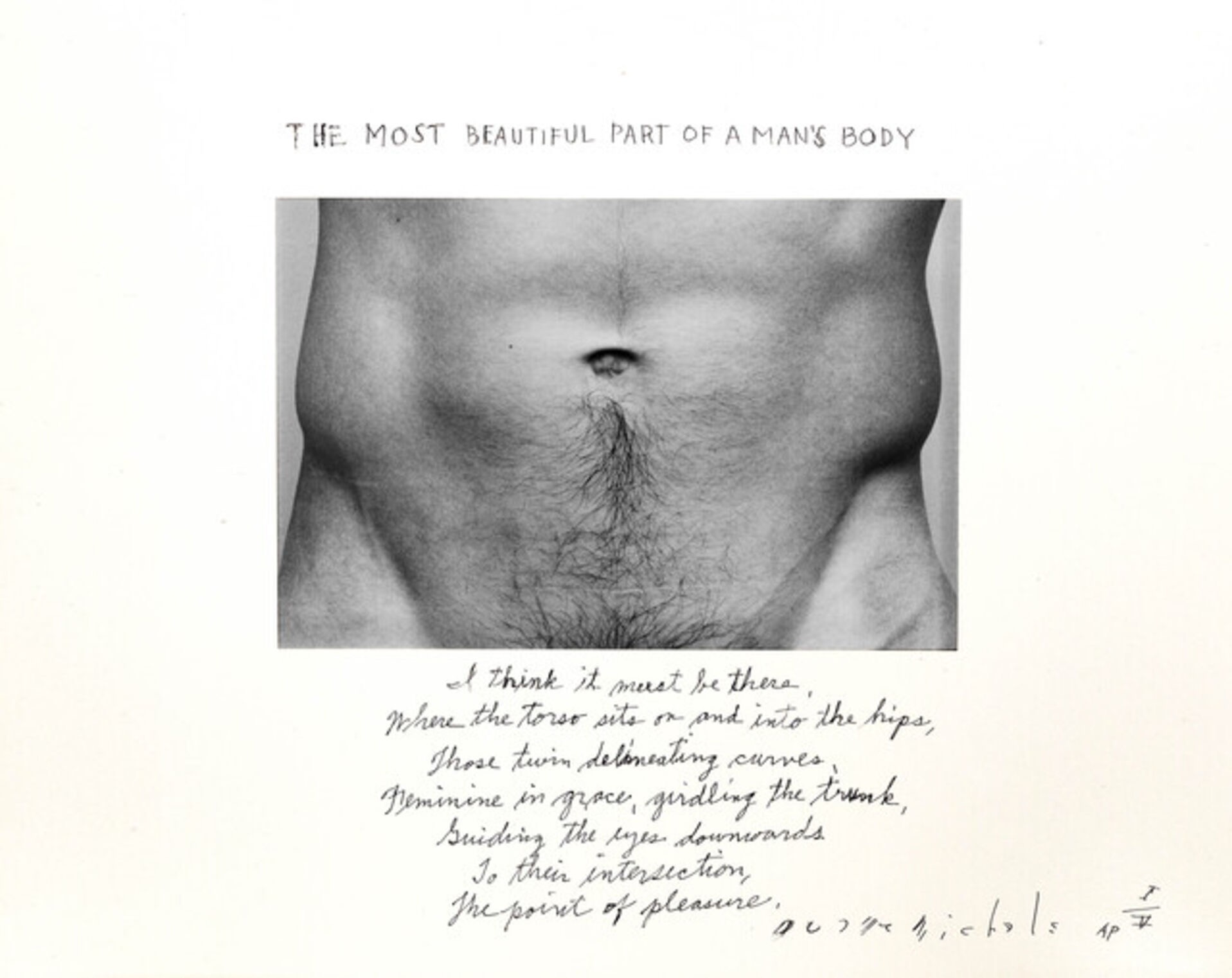
Duane Michals, The Most Beautiful Part of a Man’s Body, 1974.
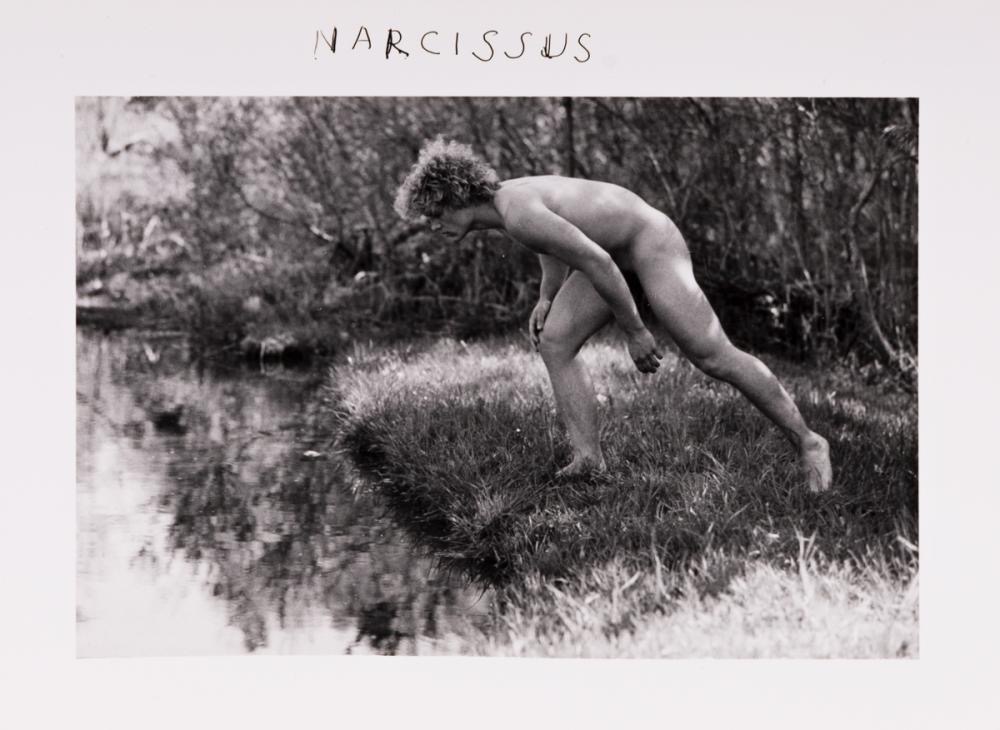
Duane Michals, Narcissus, 1985.
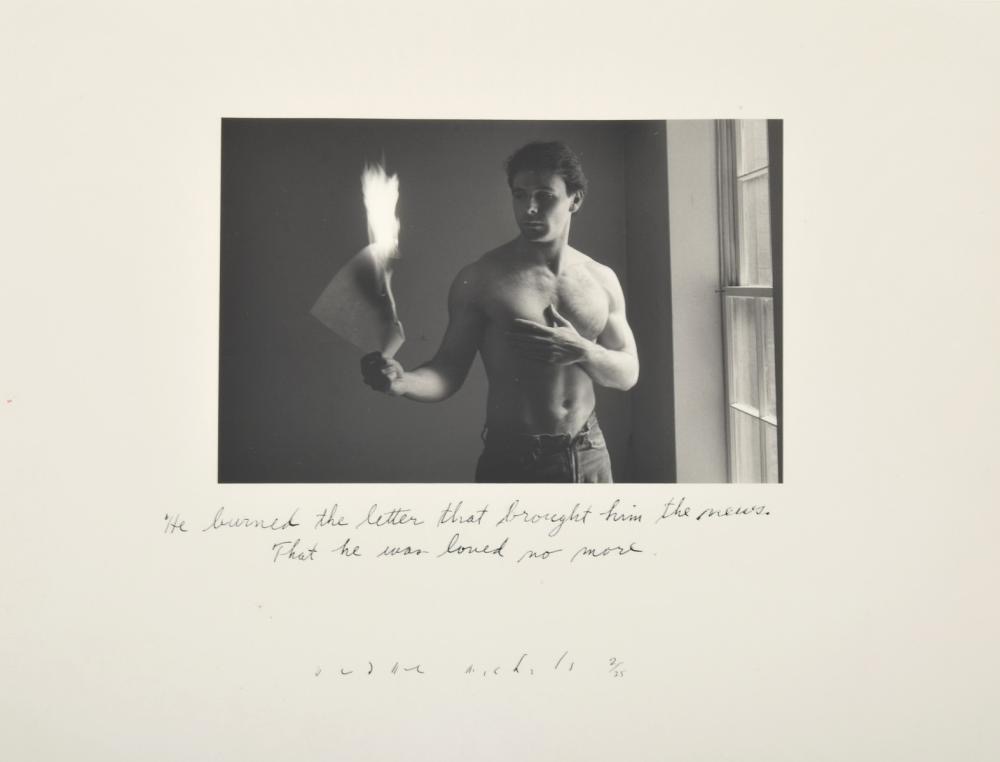
Duane Michals, He burned the letter that brought him the news that he was loved no more, date unknown.
Duane Michals, Moment of Perfection, c. 1980.
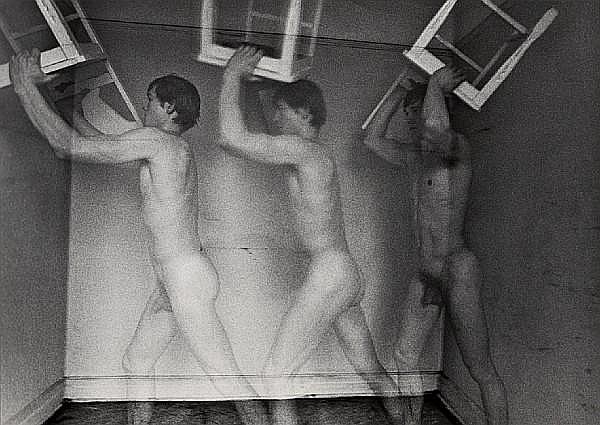
Duane Michals, Man Carrying a Chair, 1982.
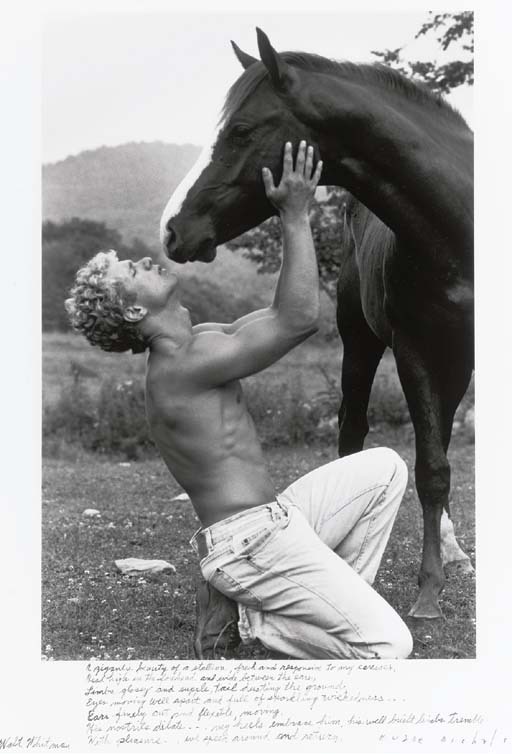
Duane Michals, A Gigantic Beauty of a Stallion, from The Series Salute To Walt Whitman, 1970.
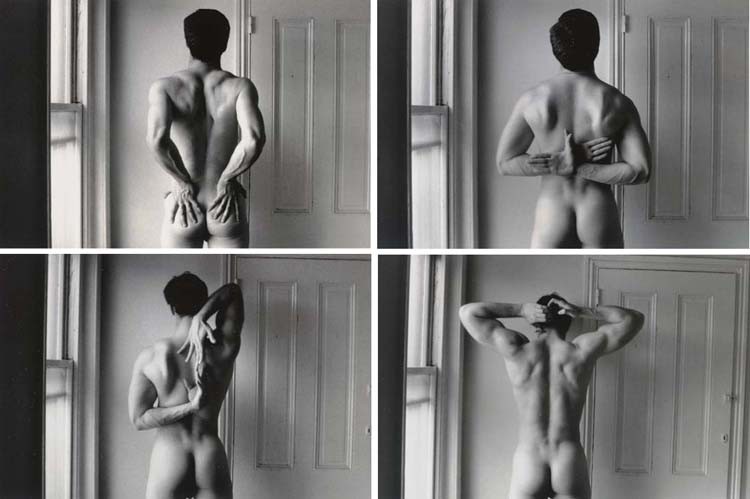
Duane Michals, Back Talk, 1970s.
Duane Michals, Take One and See Mt. Fujiyama, 1976.

Duane Michals (1932- ) is an influential American photographer renowned for his innovative use of photographic sequences and handwritten narratives that create intimate and poetic visual storytelling. Often blending dream-like imagery with deeply personal themes, Michals pushed beyond traditional documentary photography, favoring staged scenes to explore metaphysical questions, mortality, and human emotion. He used photographic sequences to tell poetic, often erotic, visual stories—like his haunting piece The Most Beautiful Part of a Man’s Body (1974), which explored vulnerability and sensuality through layered narrative. Michals’ pioneering approach profoundly impacted contemporary photography, emphasizing that imagery could embody not only what is seen, but also what is felt, imagined, or deeply desired.

The 1980s–90s: Art in the Shadow of AIDS

As the AIDS crisis devastated the LGBTQ+ community, artists responded with fury, grief, and resilience.

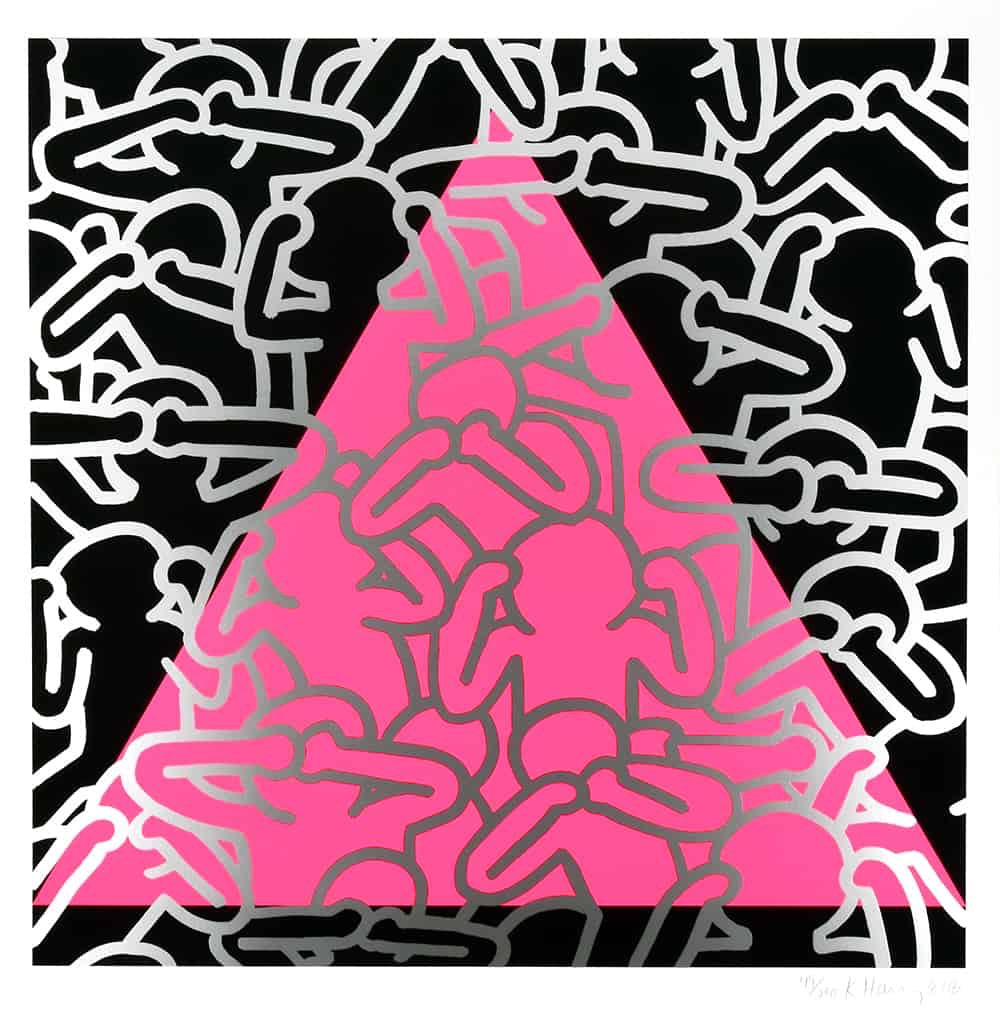
Keith Haring, Silence Equals Death, 1989.
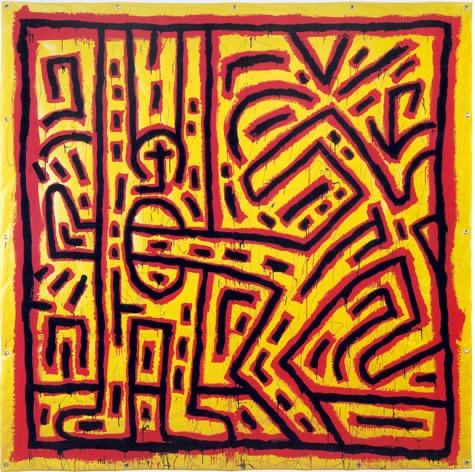
Keith Haring, Untitled, 1981.

Keith Haring (1958-1990) was a groundbreaking American artist whose bold, neon-outlined figures transformed urban spaces and gallery walls into vibrant canvases filled with queer joy and political urgency. Rising to prominence in the 1980s New York art scene, Haring used accessible imagery and public spaces—including subways and street murals—to communicate powerful messages on sexuality, AIDS awareness, and social justice. His iconic Silence = Death imagery became a rallying cry against apathy and inaction, galvanizing activism during the AIDS epidemic and amplifying voices within the LGBTQ+ community. Haring’s energetic style and activist spirit continue to resonate, ensuring his legacy as an artist who merged exuberant creativity with fearless advocacy.

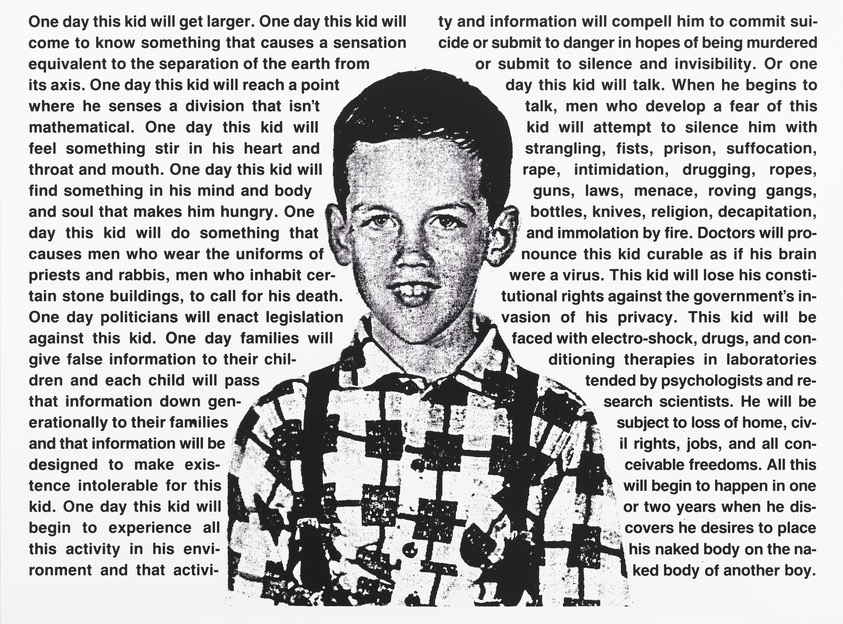
David Wojnarowicz, Untitled (One Day This Kid…), 1990.

David Wojnarowicz (1954-1992) was a fiercely confrontational American artist, writer, and activist whose work channeled the raw power of queer rage into searing critiques of homophobia, censorship, and government inaction during the AIDS crisis. Emerging from New York’s East Village art scene in the 1980s, Wojnarowicz worked across media—painting, photography, film, and text—to expose the violence and vulnerability of queer existence. His iconic piece Untitled (One day this kid…) (1990) juxtaposes a childhood photo of himself with a prophetic, damning text that lays bare the grim realities faced by queer youth in a hostile world. Unapologetically political and deeply personal, Wojnarowicz’s art remains a visceral reminder of both the pain and defiance at the heart of queer survival.

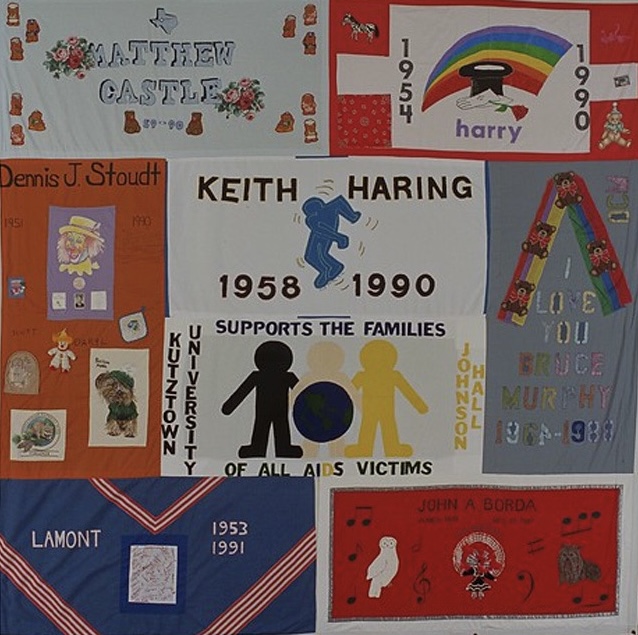
NAMES Project AIDS Memorial Quilt

The NAMES Project AIDS Memorial Quilt, begun in 1987, now contains over 50,000 panels. It is both a work of art and a massive, tangible act of remembrance and protest.

2000s–Present: Intersectionality and Expanding the Frame

In recent decades, Pride in art has become more expansive, intersectional, and experimental.

Zanele Muholi, a South African visual activist, documents Black LGBTQ+ life through dramatic portraiture. Their series Faces and Phases offers a powerful visual archive of queer resilience. Mickalene Thomas reclaims the Black female body in rhinestone-studded paintings and photographic tableaux. Her work unapologetically fuses queerness, glamour, and political assertion. See Le déjeuner sur l’herbe: Les Trois Femmes Noires (2010), a reimagining of Manet’s painting through a queer, Black feminist lens. Cassils, a transgender performance artist, uses their body in durational, often physically intense works. In Becoming an Image, they strike a clay block in darkness while a camera flash records the violence—a metaphor for queer visibility and embodiment. Juliana Huxtable, a Black trans artist, poet, and performer, combines Afrofuturism, photography, and digital media to challenge fixed identities. Her self-portraits—gender-fluid, mythic, fierce—embody queer futurity.

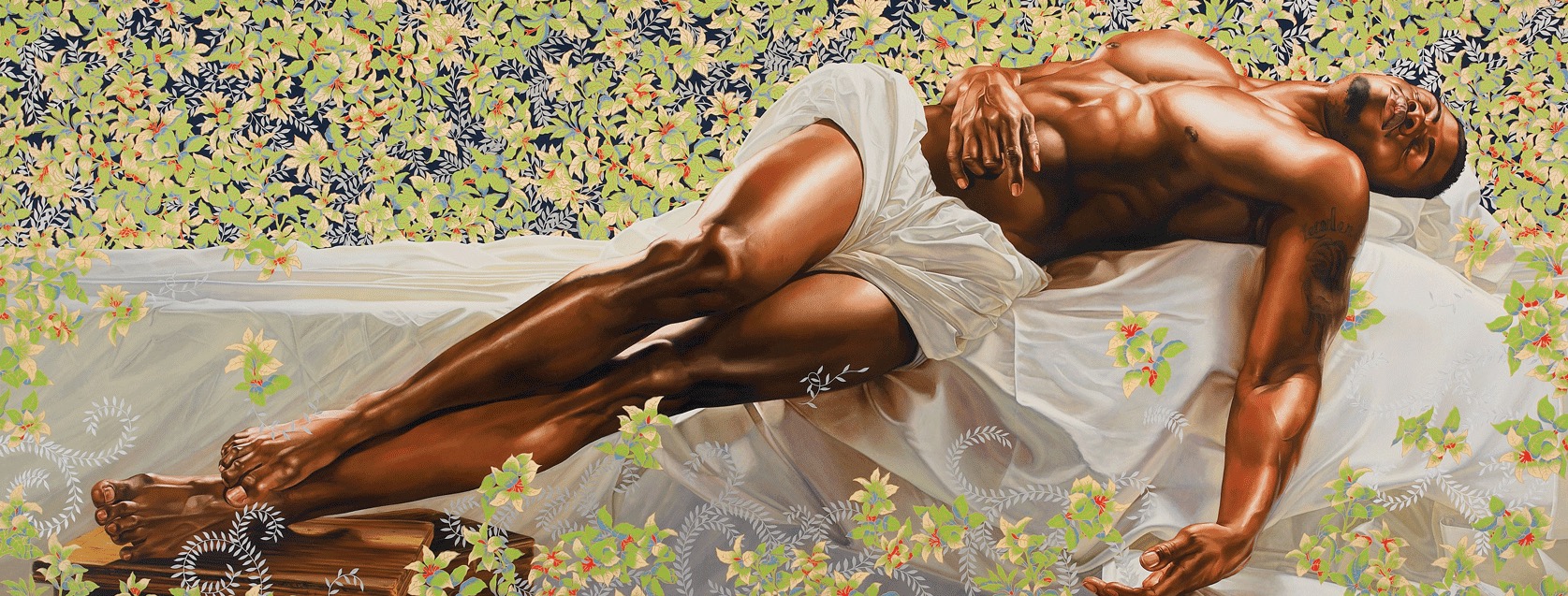
Kehinde Wiley, Sleep, 2008.

More Artists to Explore

  • Robert Mapplethorpe – his black-and-white male nudes remain some of the most iconic (and controversial) queer images in American photography.
  • Kehinde Wiley – while not exclusively queer-themed, his work often presents Black men in romantic or intimate poses, reclaiming both history and homoerotic aesthetic.
  • Hunter Reynolds – an AIDS activist and visual artist whose performance pieces and memorial works carry immense emotional and historical weight.
  • Gilbert Baker – not only an artist, but the designer of the rainbow flag itself, one of the most enduring symbols of queer pride.

Pride as Resistance and Renewal

From murals to fashion, fine art to graffiti, queer art since 1970 has told the story of a people who refused to be erased. Pride in art has been about more than beauty—it has been about survival, protest, celebration, and memory.

As Pride Month continues, remember that the movement is not only political—it is also creative. And in every painting, photograph, poem, and performance, LGBTQ+ artists have asked the world to see them not just as survivors—but as visionaries.


Before the Parades: Gay Pride in Art and Artistic Expression

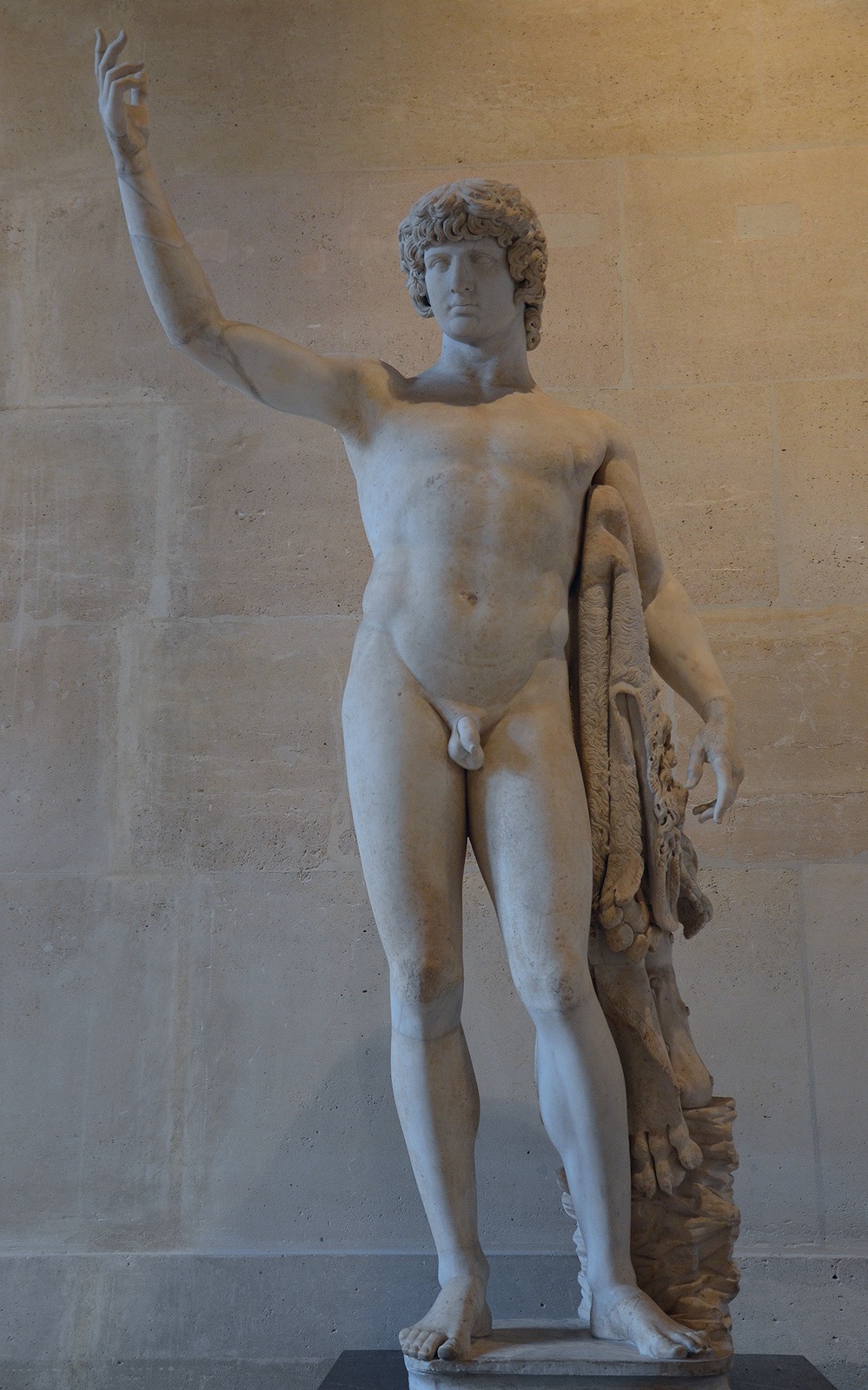
“Braschi Antinous”, also known (wrongly) as Albani Antinous, the statue is composed of an antique head of Antinous and an antique body of Hercules, 2nd century AD, (Louvre Museum)

While the concept of Gay Pride as we know it—public marches, rainbow flags, and open celebration of LGBTQ+ identity—is a relatively recent phenomenon, the spirit of gay pride has long found expression through art. For centuries, queer individuals used artistic media to celebrate same-sex desire, intimacy, and identity in ways that defied societal norms and preserved a sense of dignity and joy. Long before the world was ready for open affirmation, LGBTQ+ artists—and their allies—used beauty, symbolism, and coded language to proclaim their existence and their worth.

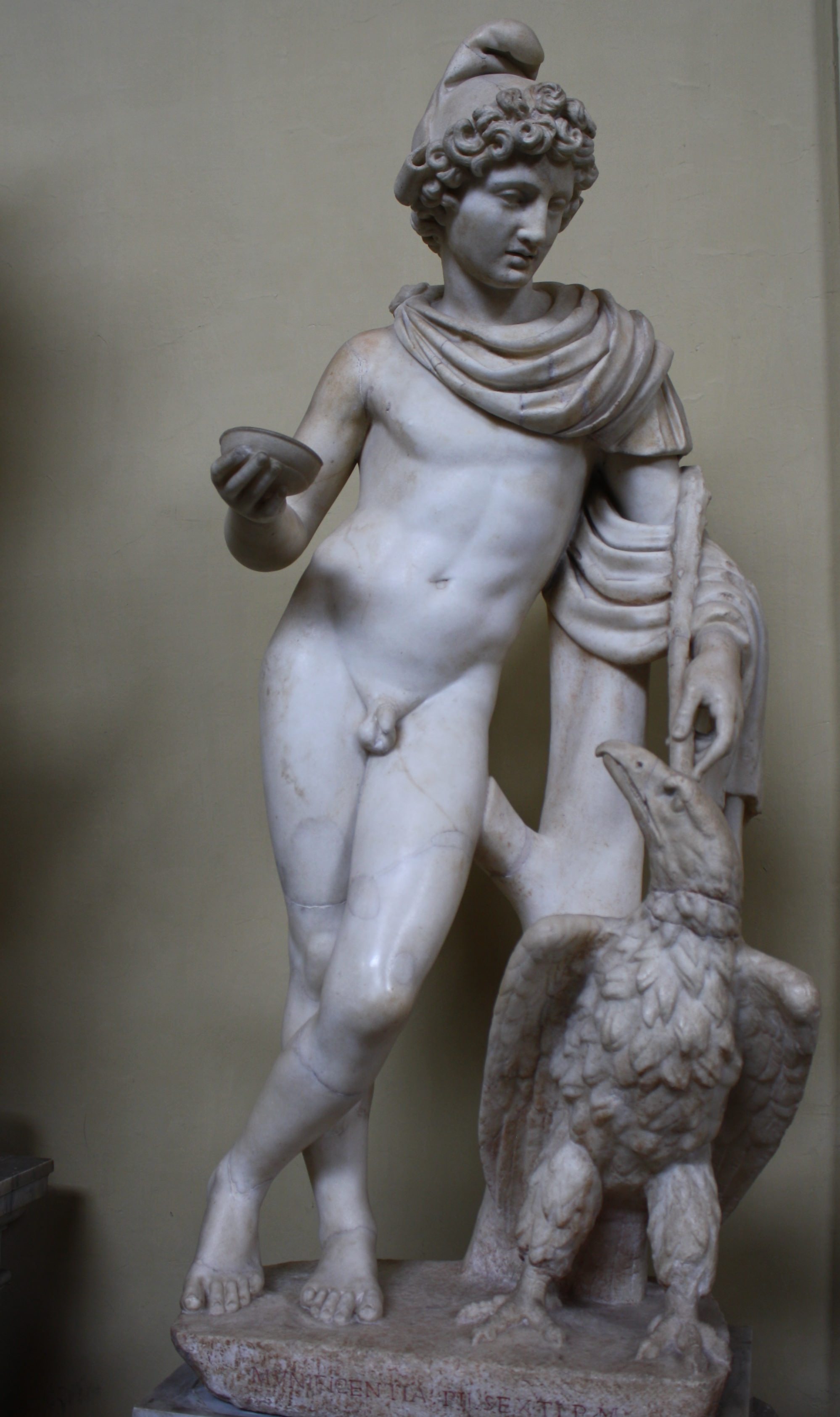
Ganymede, Rome, 2nd century CE. (Vatican Museums, Rome)

Art has always provided a refuge for queer expression, especially in eras and regions where same-sex love was criminalized or pathologized. From the sensual male nudes of classical antiquity to the romantic portraits of Renaissance companions, art offered what public discourse denied: a space to affirm beauty and love between men. The sculptures of ancient Greece and Rome—Apollo, Ganymede, Antinous—didn’t just celebrate form; they canonized homoerotic ideals in marble and bronze. Even when later societies sought to suppress these themes, artists returned to them time and again, as if retrieving a sacred truth buried beneath centuries of shame.

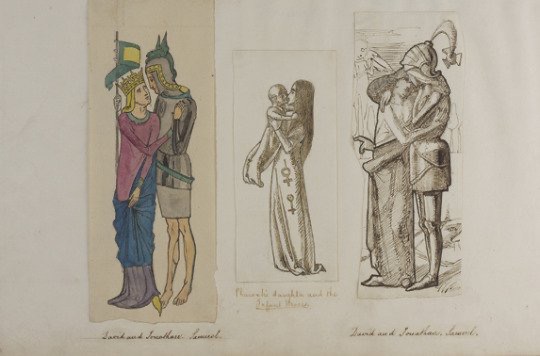
David and Jonathan. Samuel & Pharaohs Daughter and the Infant Moses from Simeon Solomon’s 1854 Sketchbook (Jewish Museum London)

During the 19th century, artists such as Simeon Solomon in Britain and Wilhelm von Gloeden in Italy dared to depict love between men with unmistakable tenderness and eroticism. Solomon’s watercolors of biblical figures—David and Jonathan, Ruth and Naomi—recast religious stories as queer allegories, while von Gloeden’s photographs of young men in Sicily, staged in classical poses, cloaked desire in the guise of nostalgia and antiquity. Their works were often persecuted, sometimes destroyed, but they endure today as testimonies of queer pride in the face of rejection.

Photograph titled “Pastoral Idyll,” Wilhelm von Gloeden, 1913 (Private Collection)

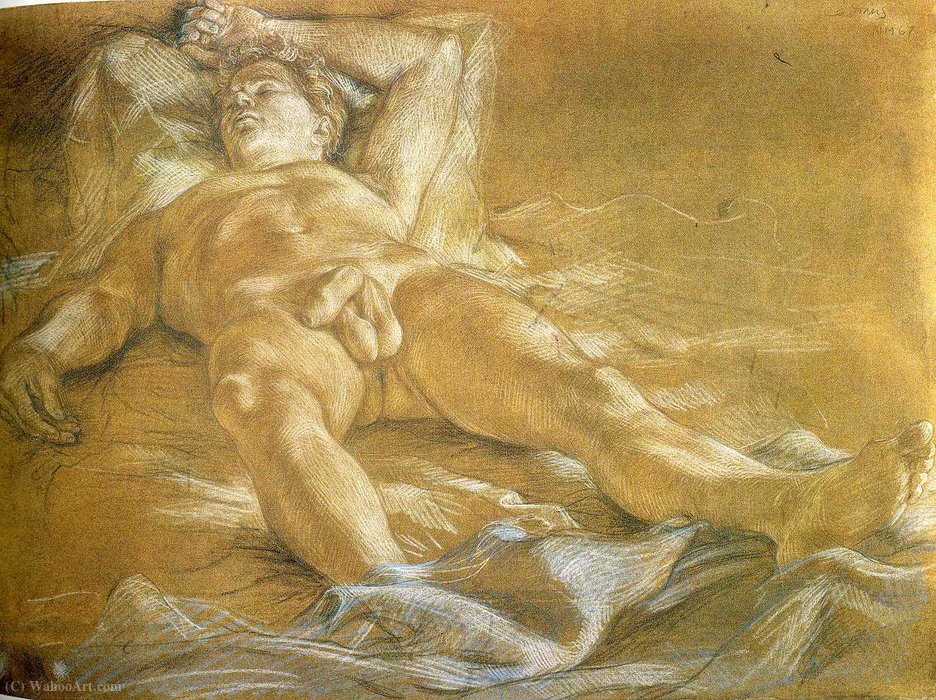
In the 20th century, as queer identity began to coalesce into more defined social and political movements, art took on a sharper edge. Artists like Keith Haring and David Wojnarowicz turned pride into protest. Their works channeled anger, loss, celebration, and eroticism in ways that were unapologetically queer—bold lines, graphic imagery, public installations, and furious calls to action during the AIDS crisis. At the same time, the poetry of Audre Lorde, the paintings of Paul Cadmus, and the photography of Robert Mapplethorpe revealed the many facets of queer life—from intimacy and sensuality to community and struggle.

“Untitled (565), Paul Cadmus, 1968, (Originally, the property of actor, cabaret singer, and Paul Cadmus’ muse and lover, Jon F. Anderson)

What unites these expressions across time is a fundamental belief: that same-sex love is beautiful, worthy of representation, and part of the human story. Whether through coded glances in Renaissance paintings or blazing neon activism in contemporary murals, gay pride has always found a way to speak. Even when silenced, it painted itself into the margins, waiting for a world that could see it clearly.

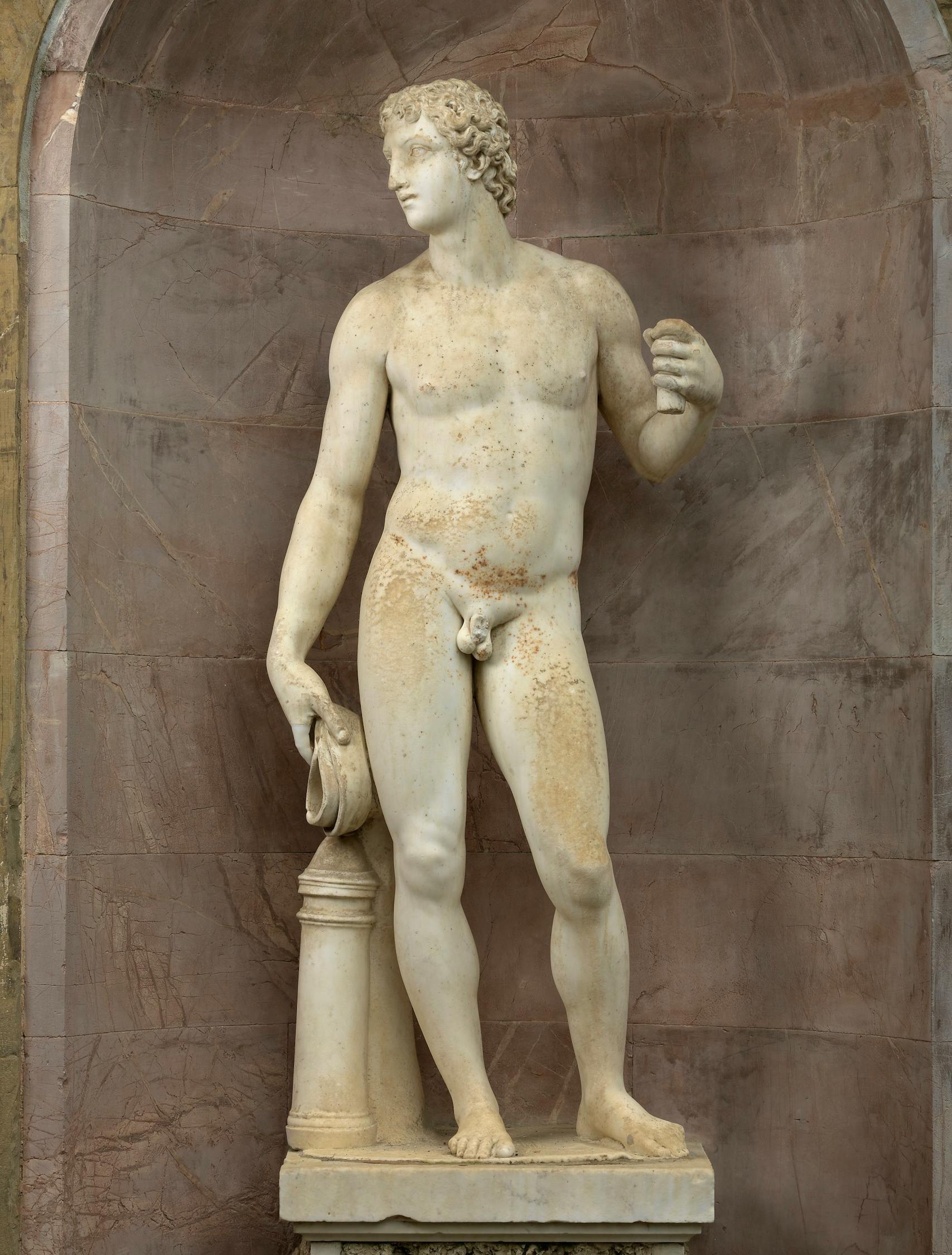
Apollo, Baccio Bandinelli, 1548 – 58, (Boboli Gardens)

Today, we celebrate openly. But let us also remember and honor those who celebrated in secret—those who, through brushstroke and verse, camera and chisel, gave voice to a pride they couldn’t proclaim aloud. They remind us that Pride is not only about visibility, but also about creation. And art, in all its forms, remains one of the truest expressions of queer existence and resilience.


Brawn, Leather, and Liberation

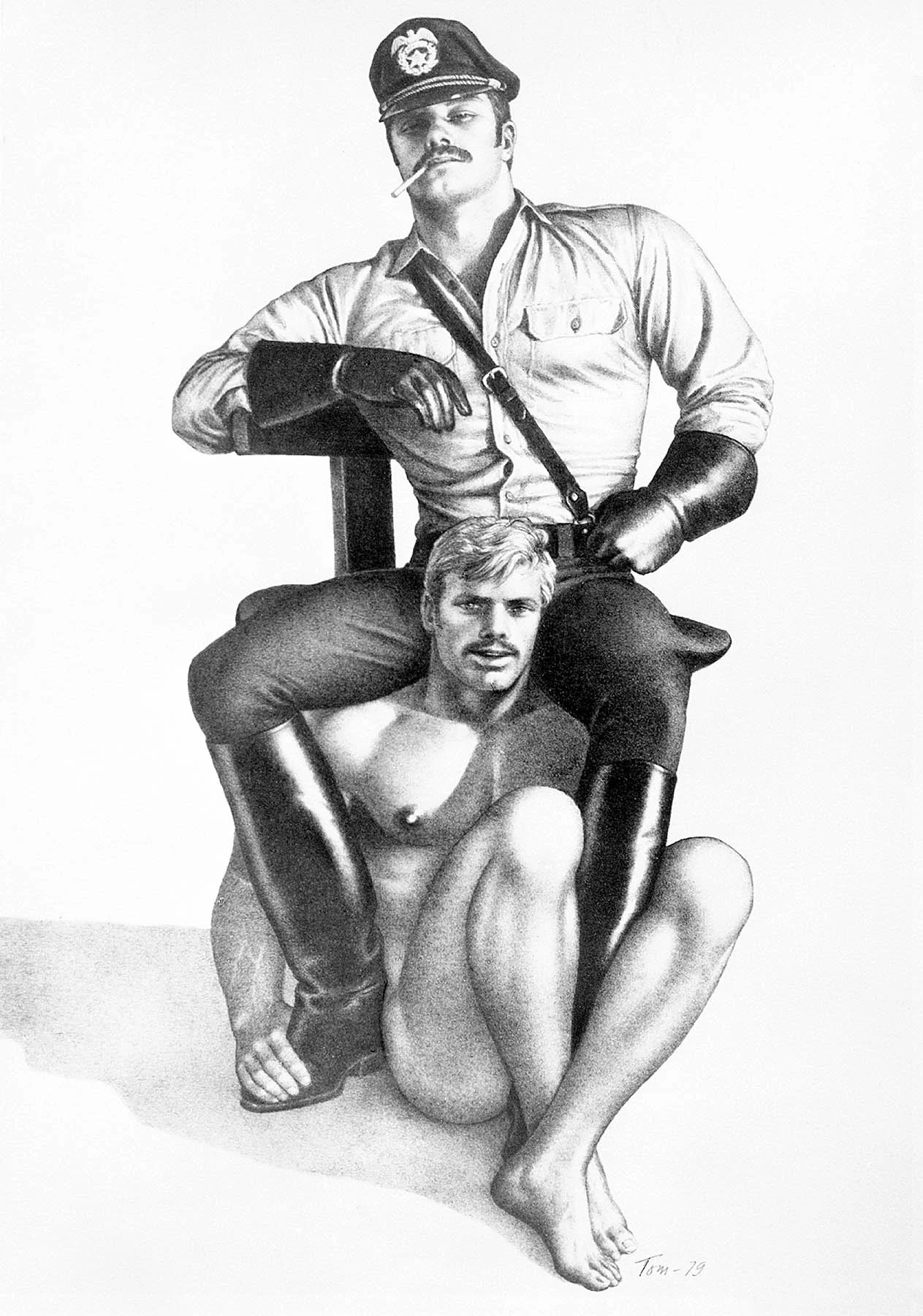
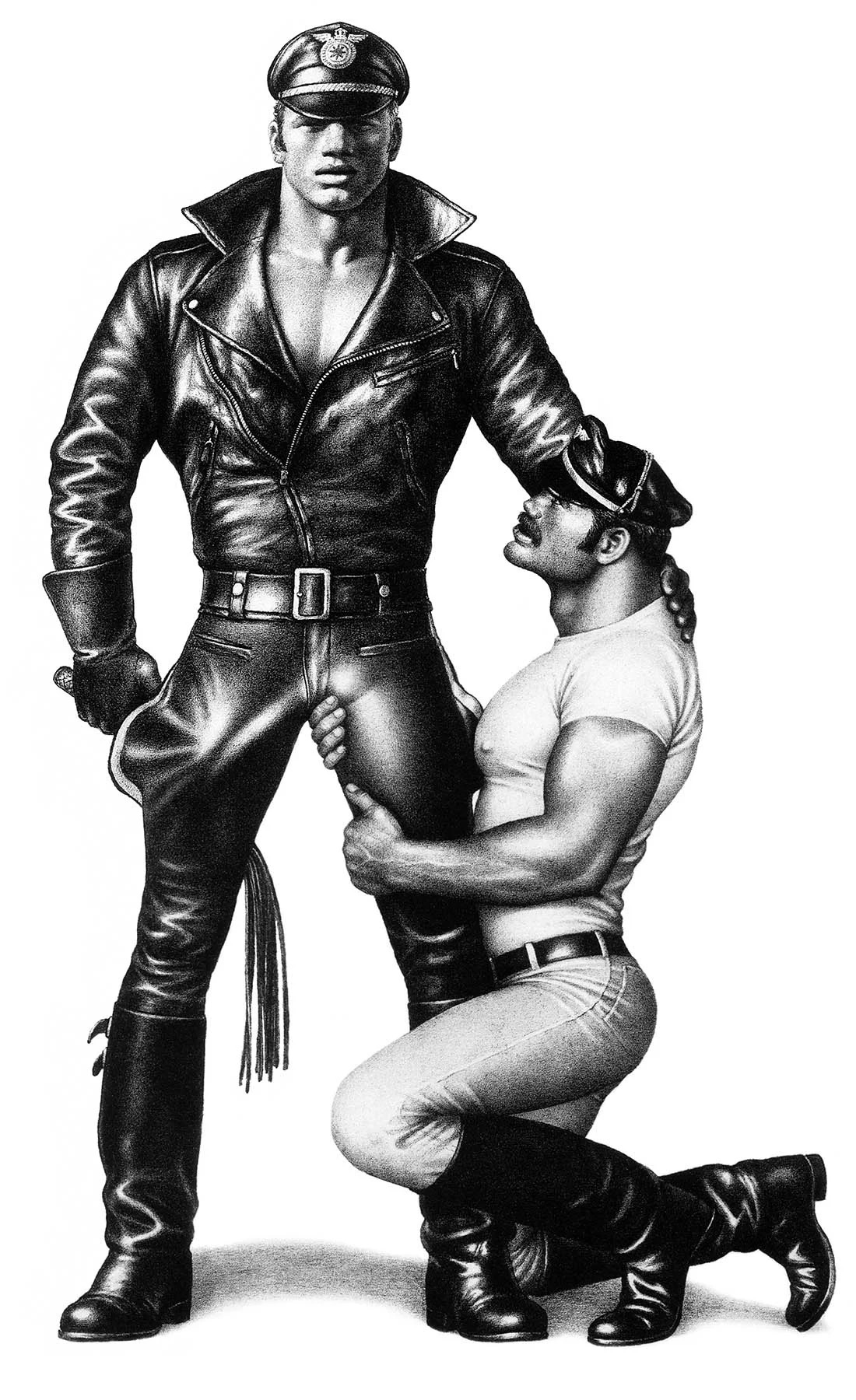
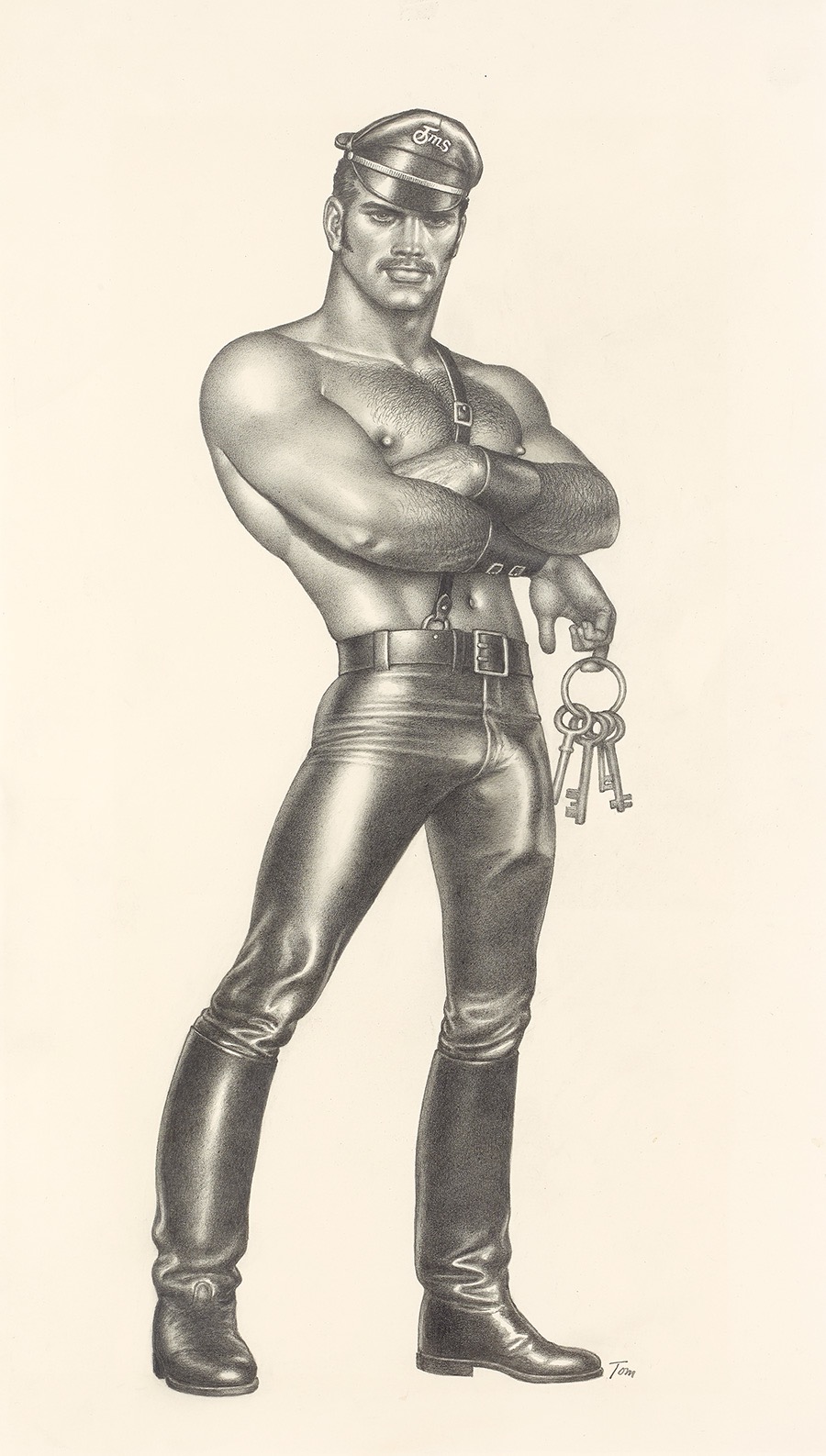
Untitled, by Tom of Finland

In the pantheon of queer visual culture, few images are as iconic—or as unapologetically homoerotic—as the bulging, leather-clad figures drawn by Tom of Finland. With their impossibly broad shoulders, exaggerated musculature, and conspicuous bulges, these hypermasculine men were more than just fantasy: they were acts of artistic rebellion, crafted at a time when queer desire had to be hidden in the shadows. But Tom of Finland (born Touko Laaksonen) was not alone in reshaping how gay masculinity was imagined and celebrated in visual art. He belonged to a wider aesthetic tradition that blurred the lines between eroticism, protest, and artistic expression.

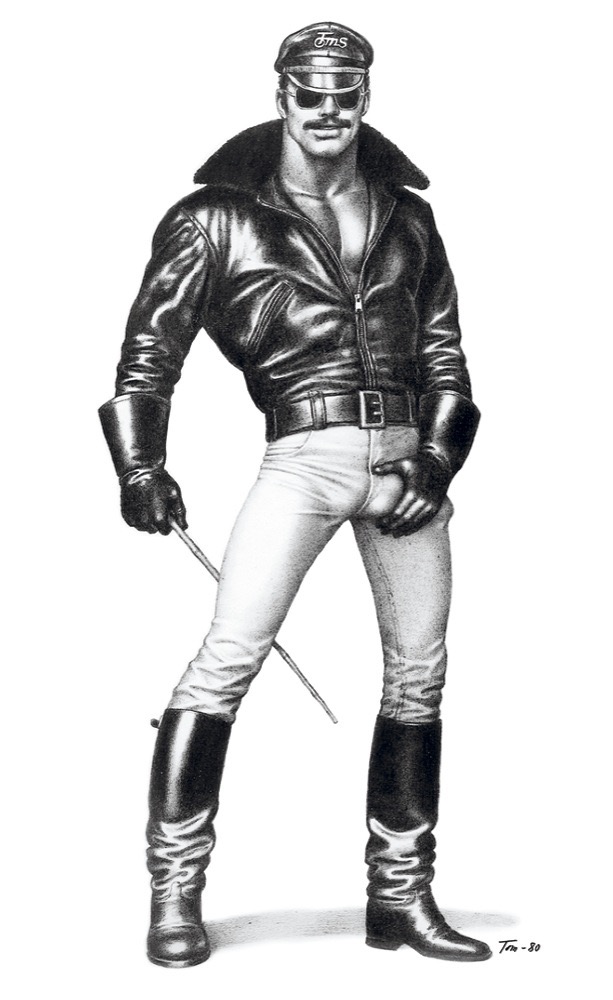
Untitled, by Tom of Finland

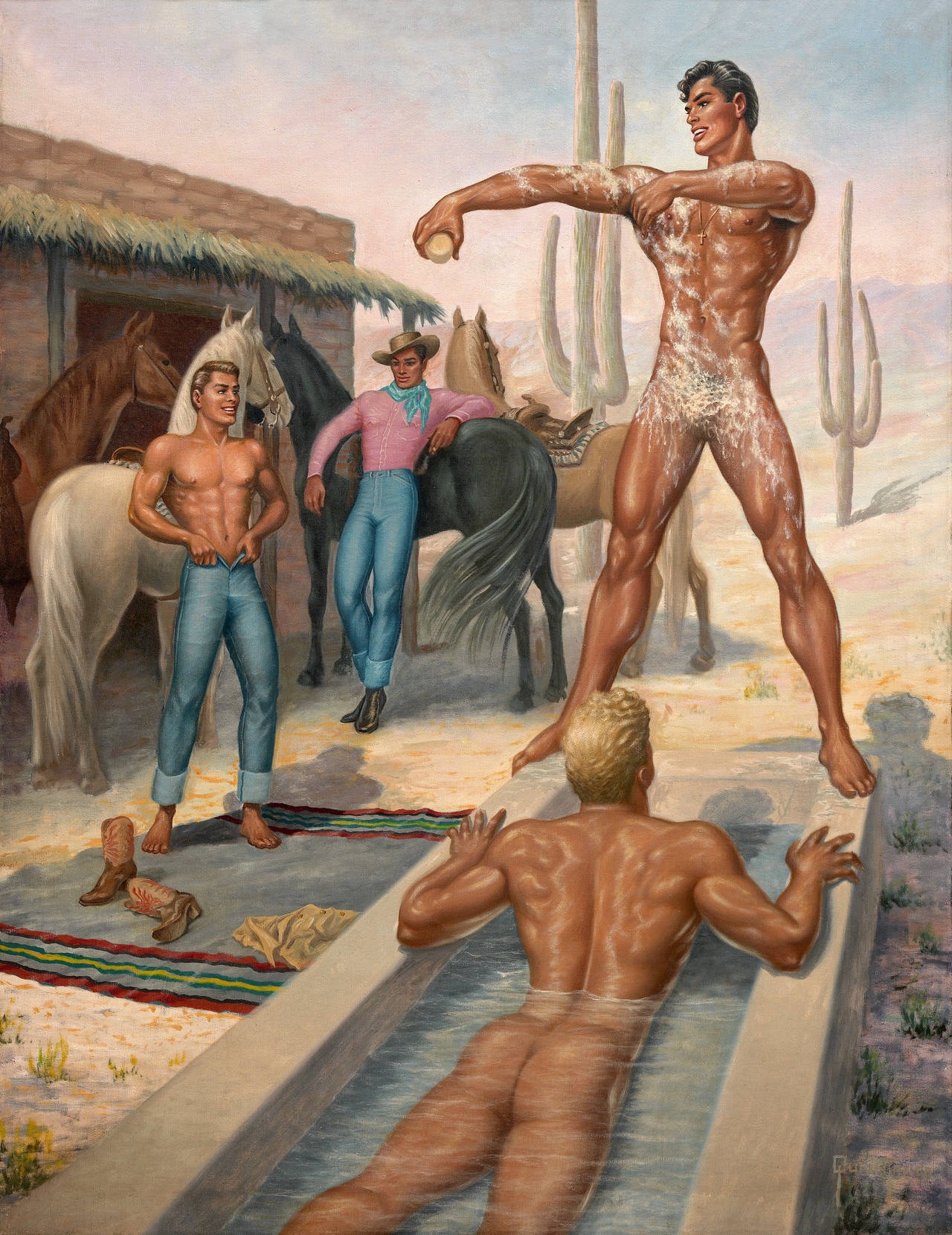
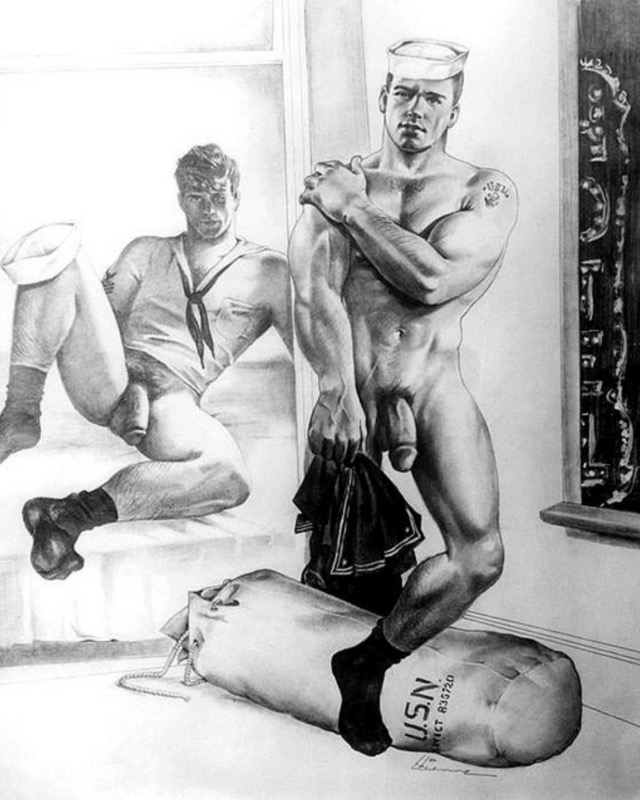
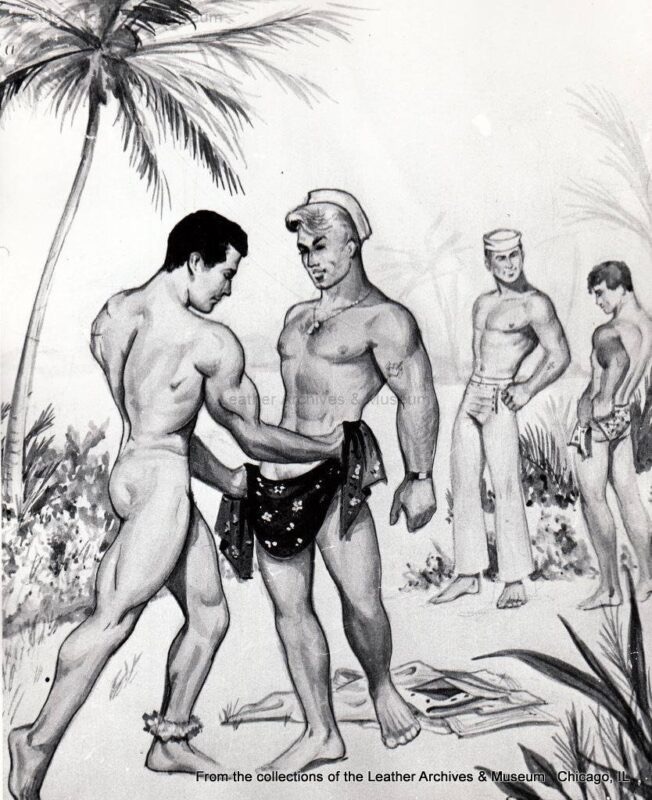
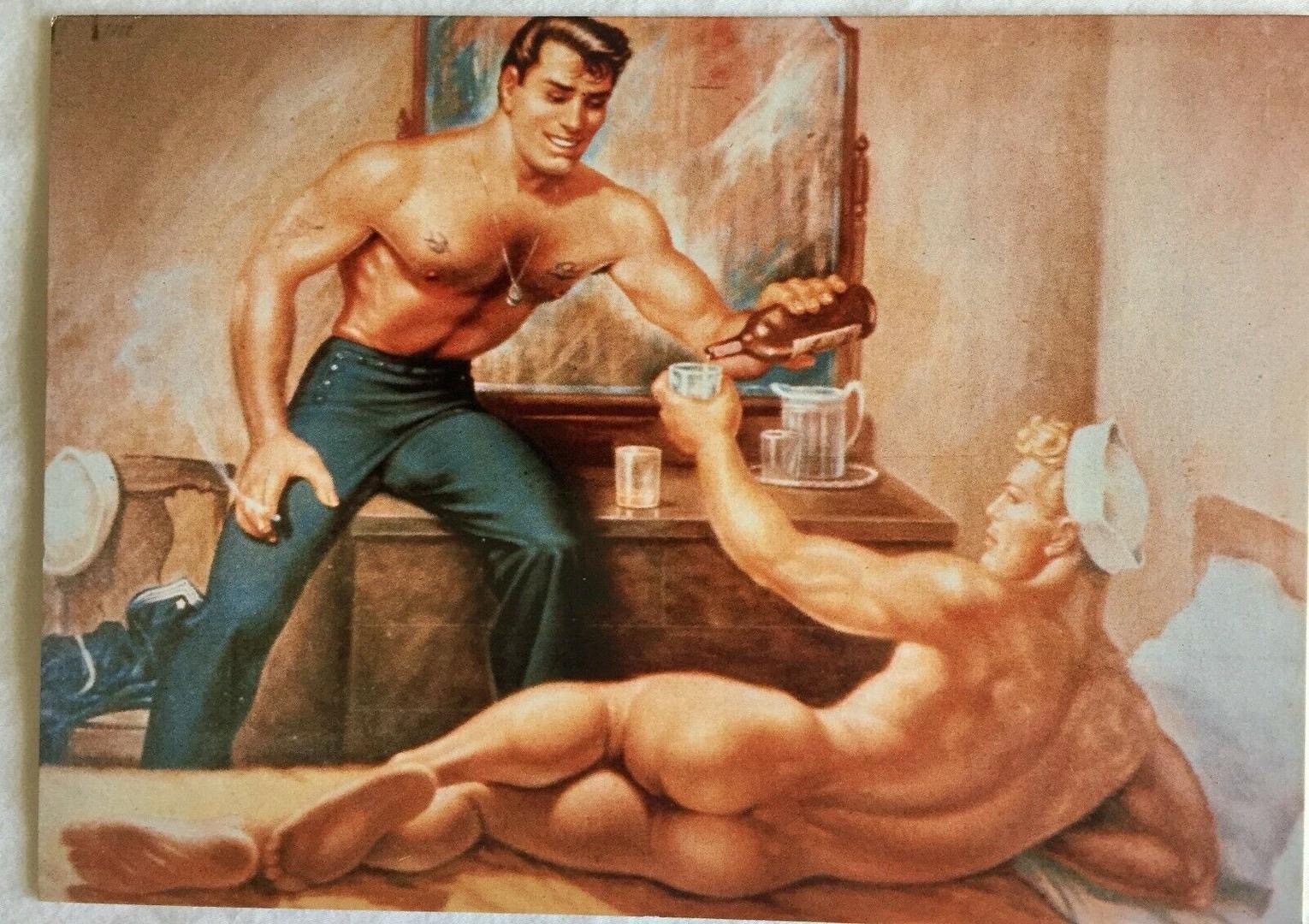
Tom of Finland began publishing his drawings in the 1950s, first in American beefcake magazines under pseudonyms before gaining cult status within underground gay circles. His men were not just naked—they were powerfully naked. Whether sailors, bikers, cowboys, or police officers, these figures projected confidence, dominance, and sexual agency. This was a deliberate rejection of earlier depictions of gay men in visual media, which often painted them as effeminate, sickly, or criminal.

Untitled, by Tom of Finland

Rather than conform to heteronormative expectations, Tom exaggerated the masculine archetype to subvert it. Muscles were drawn just shy of absurdity. Genitalia, while rarely fully exposed in early works due to censorship, were always implied to be monumental. Clothing—tight jeans, uniforms, leather—clung to bodies with sculptural precision. In this world, queerness was not weak or shameful, but fiercely virile.

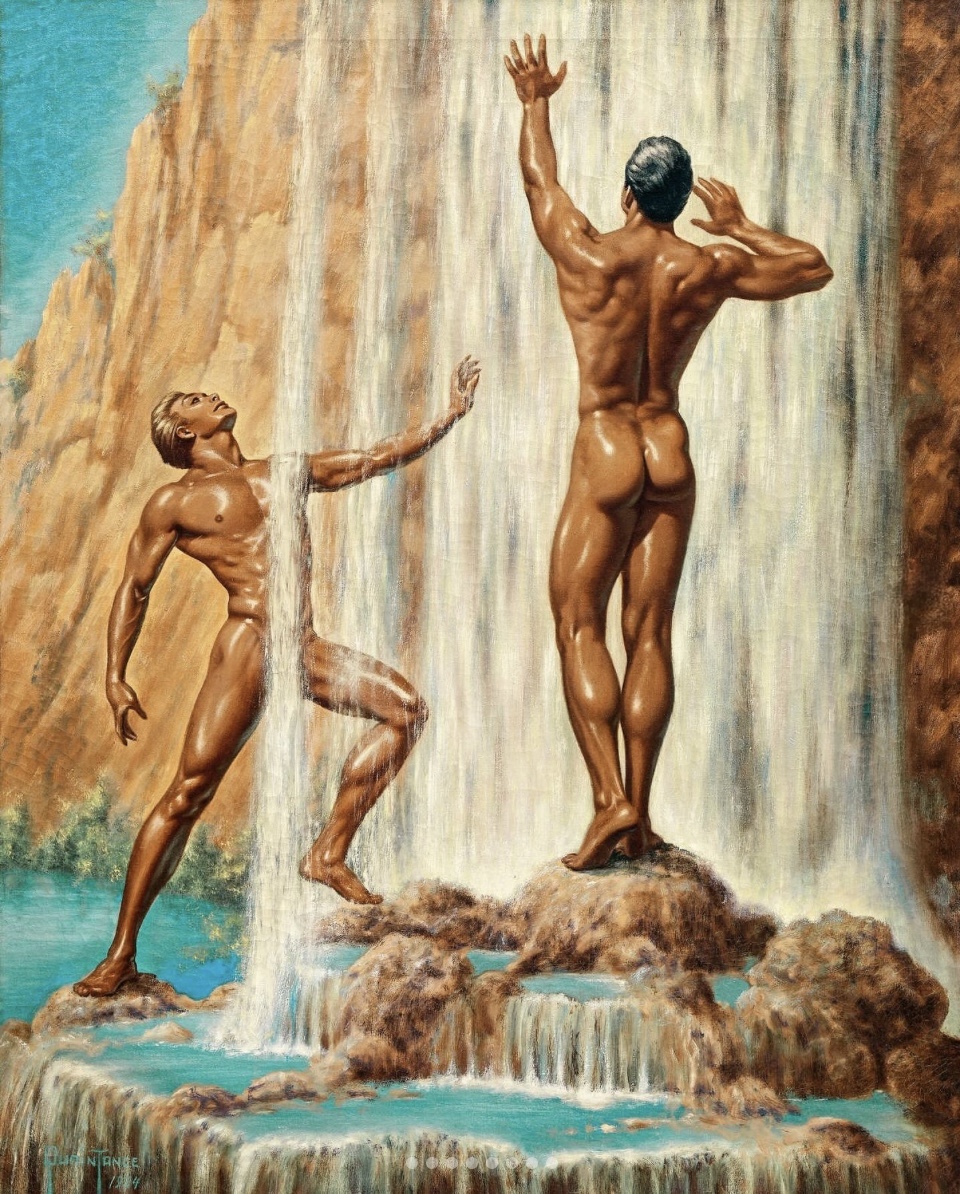
Rainbow Falls, by George Quaintance

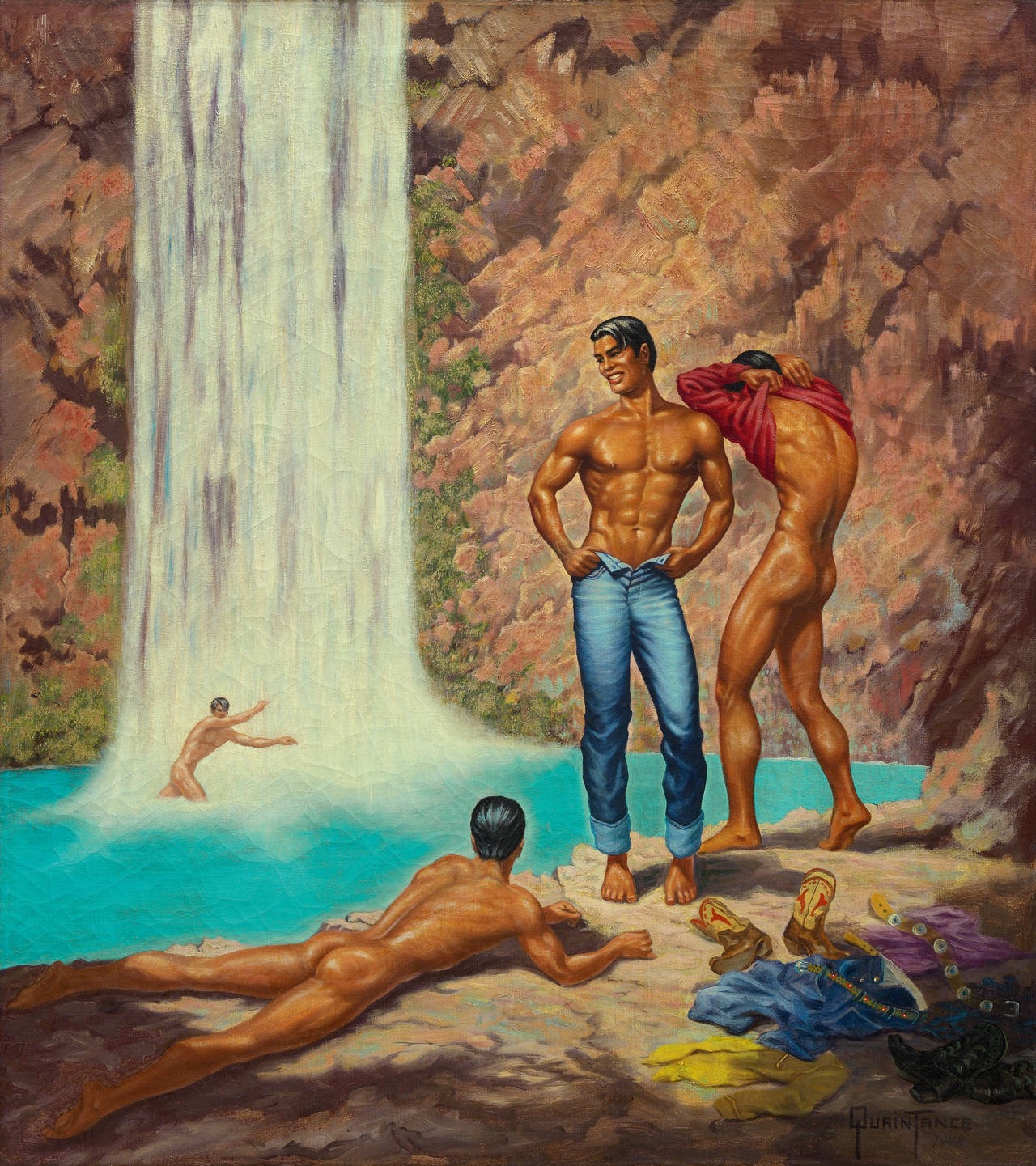
Tom of Finland was not the first to explore the muscular male form as an object of desire, though he certainly popularized it within queer culture. Earlier artists such as George Quaintance—whose idyllic, soft-lit scenes of sun-kissed ranch hands and swimmers in the 1940s and ’50s also blended classical idealism with homoerotic themes—helped lay the groundwork. Quaintance’s men were more polished and posed, evoking Greco-Roman statuary, but they shared with Tom a fascination with male beauty and strength.

Havasu Creek, George Quaintance
Morning in the Desert, George Quaintance

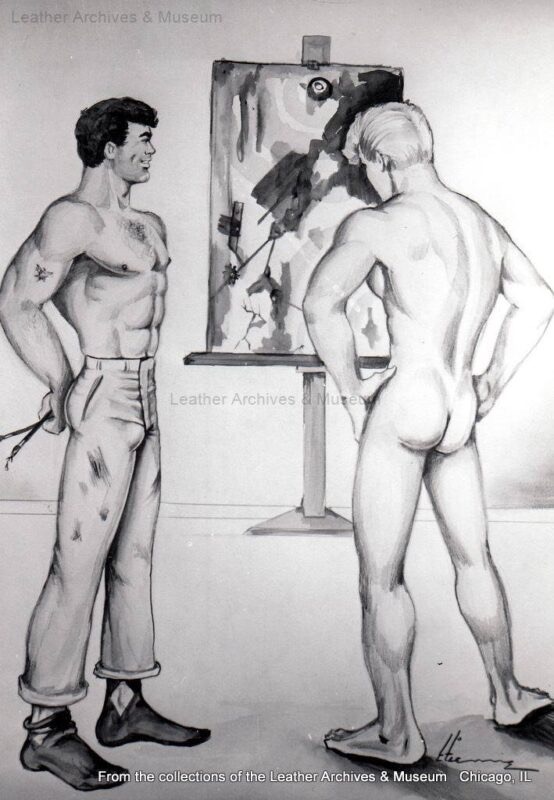
Others in this lineage include Etienne (Dom Orejudos), known for his bondage-tinged illustrations, and more contemporary artists like Robert Mapplethorpe, whose photographic studies of the male body in the 1970s and ’80s, gave fine art legitimacy to explicitly sexual gay imagery. These artists collectively expanded the visual vocabulary of masculinity—and queer masculinity in particular—by daring to eroticize it on its own terms.

Untitled, by Etienne (Dom Orejudos)

The hypermasculine male nude was, and still is, more than just visual titillation. For many gay men—especially those emerging from the post-WWII era through the gay liberation movement of the 1970s—these images were lifelines. In a world that demonized or erased queer identities, these artworks created an imaginative space of strength, desire, and belonging.

Dan S., 1980, by Robert Mapplethorpe

Tom of Finland’s drawings inspired a sense of pride at a time when few public role models existed. His men weren’t victims or martyrs—they were in control. They gazed back at the viewer with a smirk, not shame. Leather culture, which Tom helped popularize, became a defiant and communal expression of this ethos, evolving into an entire subculture with its own codes, rituals, and aesthetics.

Untitled, by Tom of Finland

Today, the hypermasculine aesthetic pioneered by Tom of Finland and his artistic descendants is both celebrated and interrogated. On one hand, his work has been embraced by museums and collectors, with the Tom of Finland Foundation preserving his legacy as both art and activism. On the other hand, critics have raised important questions about body ideals, race, and inclusivity within this visual tradition.

Shore Leave, George Quaintance

Nonetheless, Tom’s work endures because it dared to imagine a world where gay men could be powerful, erotic, and unashamed—all at once. For those who still find strength in the curvature of a flexed bicep, the gleam of a leather cap, or the tilt of a winking smile, these images remain potent reminders that desire can be both beautiful and bold.

____________________________________________________________

About the Artist: Tom of Finland (Touko Laaksonen, 1920–1991)
Born in Finland, Touko Laaksonen served in the Finnish Army during World War II before working as a graphic designer. His first drawing was published in Physique Pictorial in 1957. Over his lifetime, he created thousands of images that celebrated queer desire with explicit muscular masculinity. In 1984, he co-founded the Tom of Finland Foundation in Los Angeles to preserve and promote erotic art. His legacy continues to influence fashion, photography, and LGBTQ+ visual culture globally.

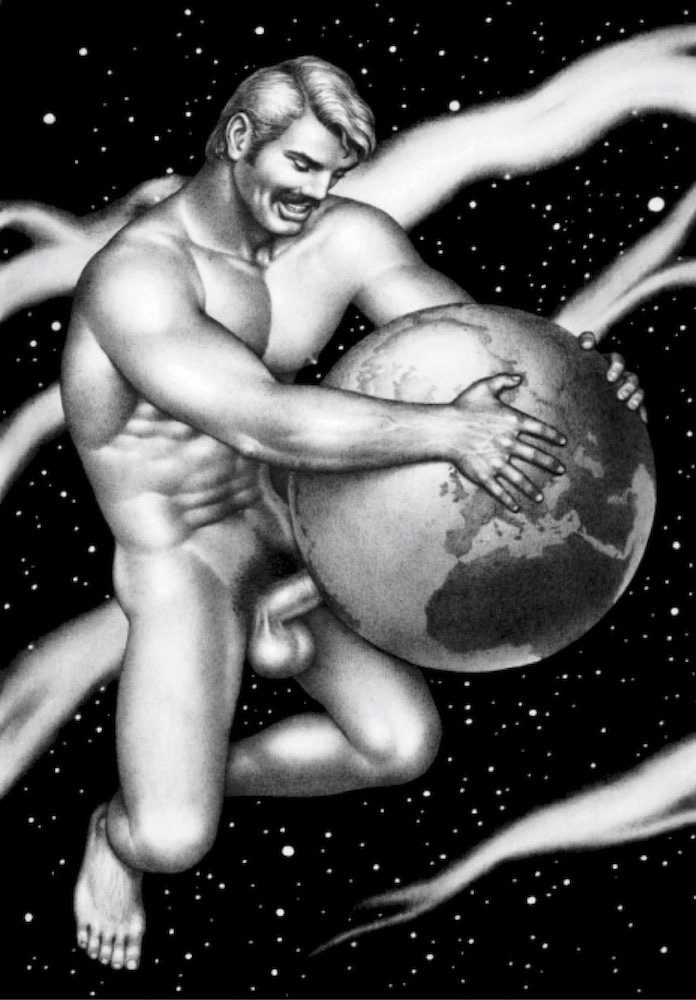
Untitled, by Tom of Finland

While this last one might be Untitled, I think the message is clear, “Fuck the World.” This image is not merely erotic; it is symbolic. The man doesn’t hide; he dominates the universe with sensual confidence. In a time when queer lives were marginalized and criminalized, Tom of Finland dared to draw a world where desire could orbit freely—where the weight of the world was no burden, but a thing to be held with love and strength. 


The Eternal Flesh of Divine Desire

From the polished marble of ancient statues to the shimmer of modern photography, Greco-Roman gods have been reimagined for centuries as icons of idealized, eroticized male beauty. In myth, their bodies held cosmic power; in art, their nudity has long served as a conduit for expressing desire, divinity, and the human longing for transcendence.

This post explores nude depictions of four major figures—Apollo, Adonis, Dionysus, and Ganymede—through a selection of artworks that span antiquity, the Renaissance, Neoclassicism, and into modern queer photography. These gods persist not merely as symbols of myth but as enduring archetypes of same-sex attraction and aesthetic longing.

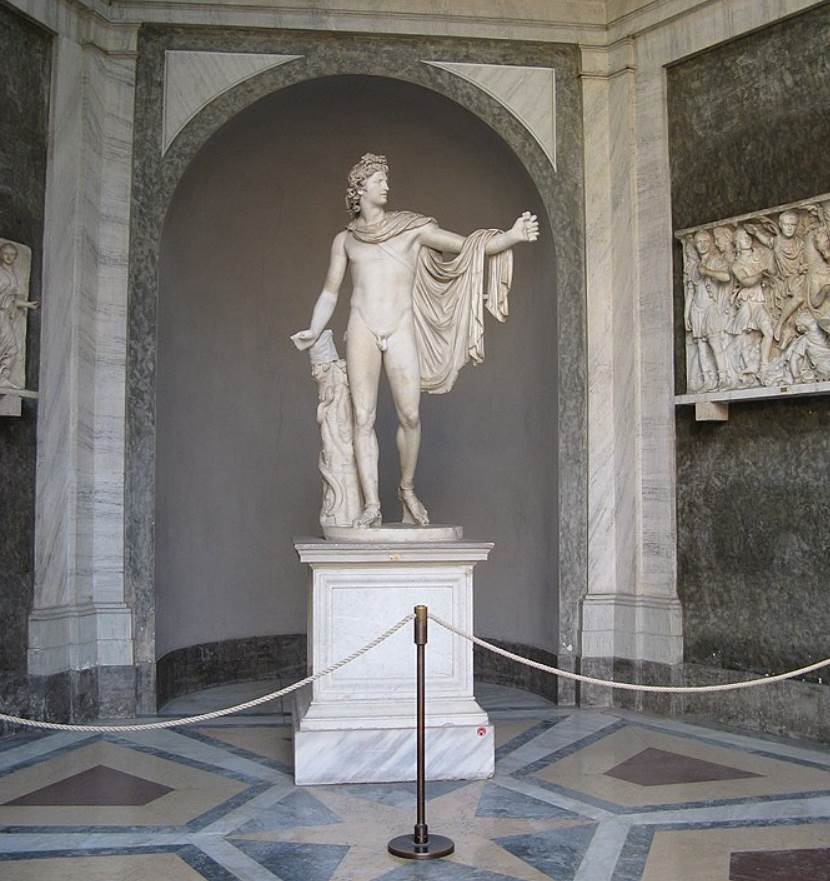
Few deities embody beauty like Apollo, the Greek god of light, music, and reason. His idealized, youthful body became the template for masculine perfection across Western art history.

The Apollo Belvedere [above], a Roman copy of a 4th-century BCE Greek bronze, exemplifies this ideal. Standing nude but for a cloak draped over one arm, Apollo’s form is serene, balanced, and timeless.

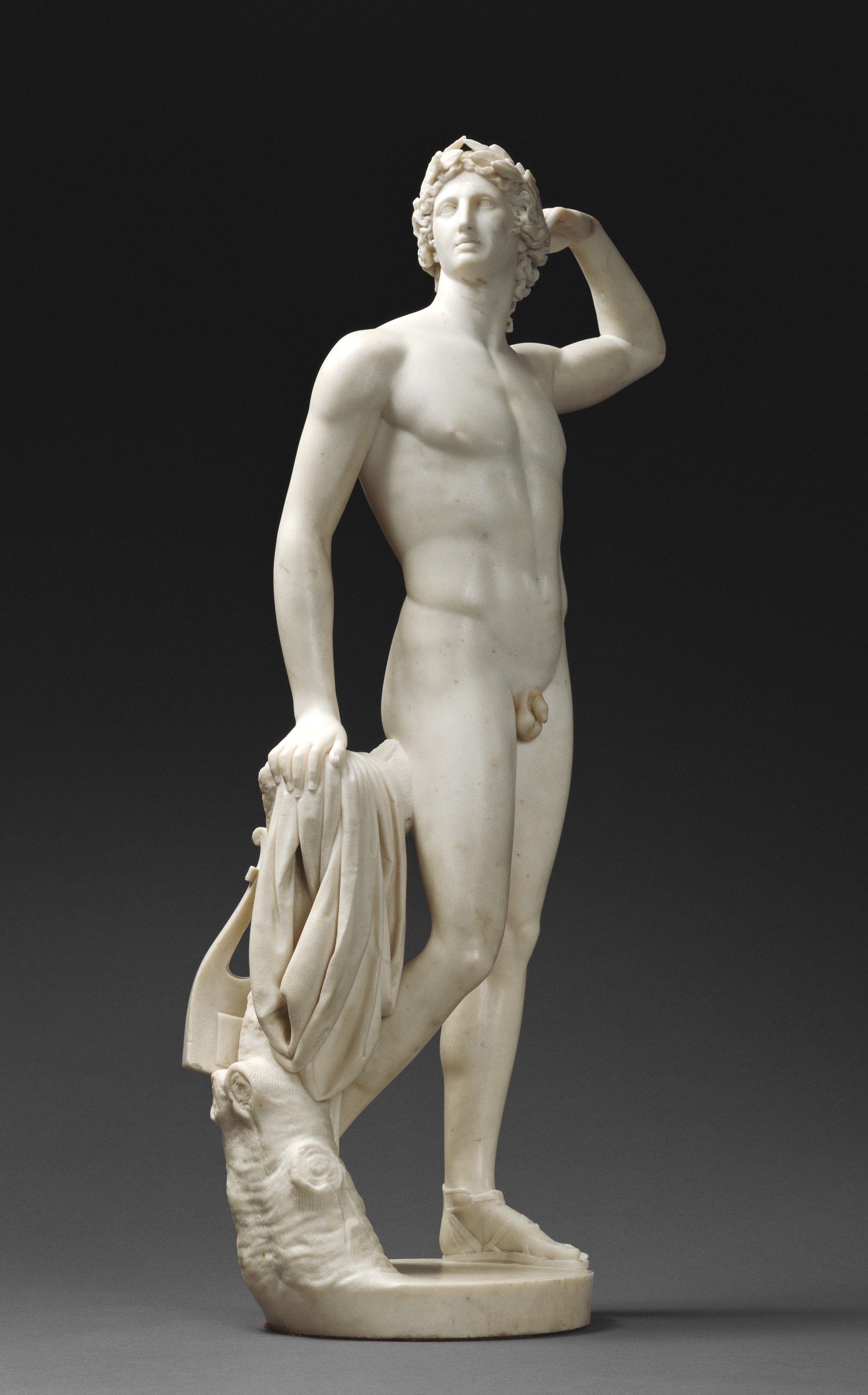
In the late 18th century, Neoclassical sculptor Antonio Canova reinterpreted this ideal in Apollo Crowning Himself [above](1781–1782), depicting the god nude, lifting a laurel wreath with quiet triumph. It is a vision of reason and beauty as divine harmony.

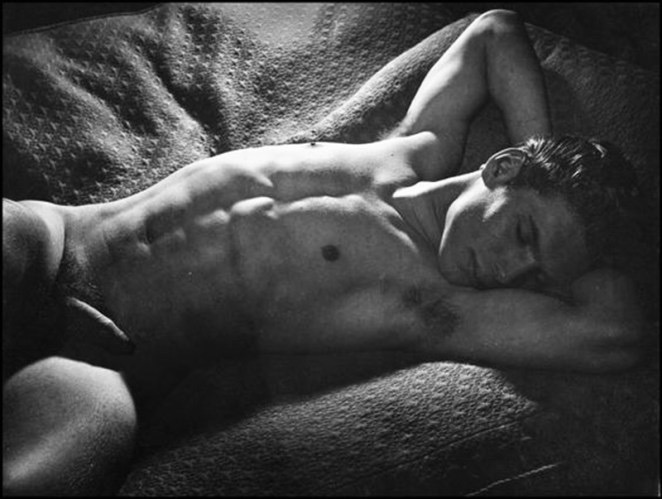
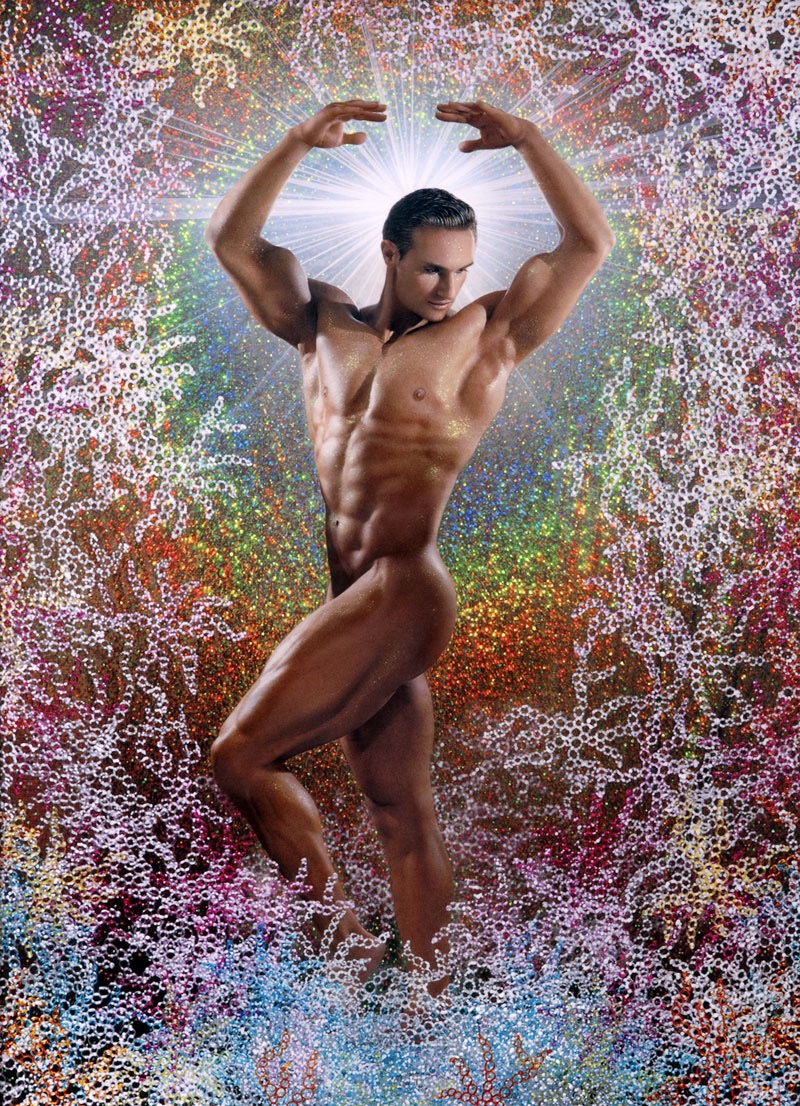
Modern artists have reclaimed Apollo with more intimate and erotic intentions. Photographer Herbert List’s Nap in the Afternoon [above] (1933) portrays a nude young man reclined in soft light, radiating not mythic grandeur but human vulnerability and quiet sensuality. Likewise, Pierre et Gilles’ Apolló [below](2005) transforms the god into a glowing nude queer icon, bathed in gold, sun rays, and self-aware kitsch—modeled by Jean-Christophe Blin with overt erotic charge.

Adonis, loved by both Aphrodite and Persephone, represents ephemeral beauty—the lover who dies young, whose body becomes memory and myth.

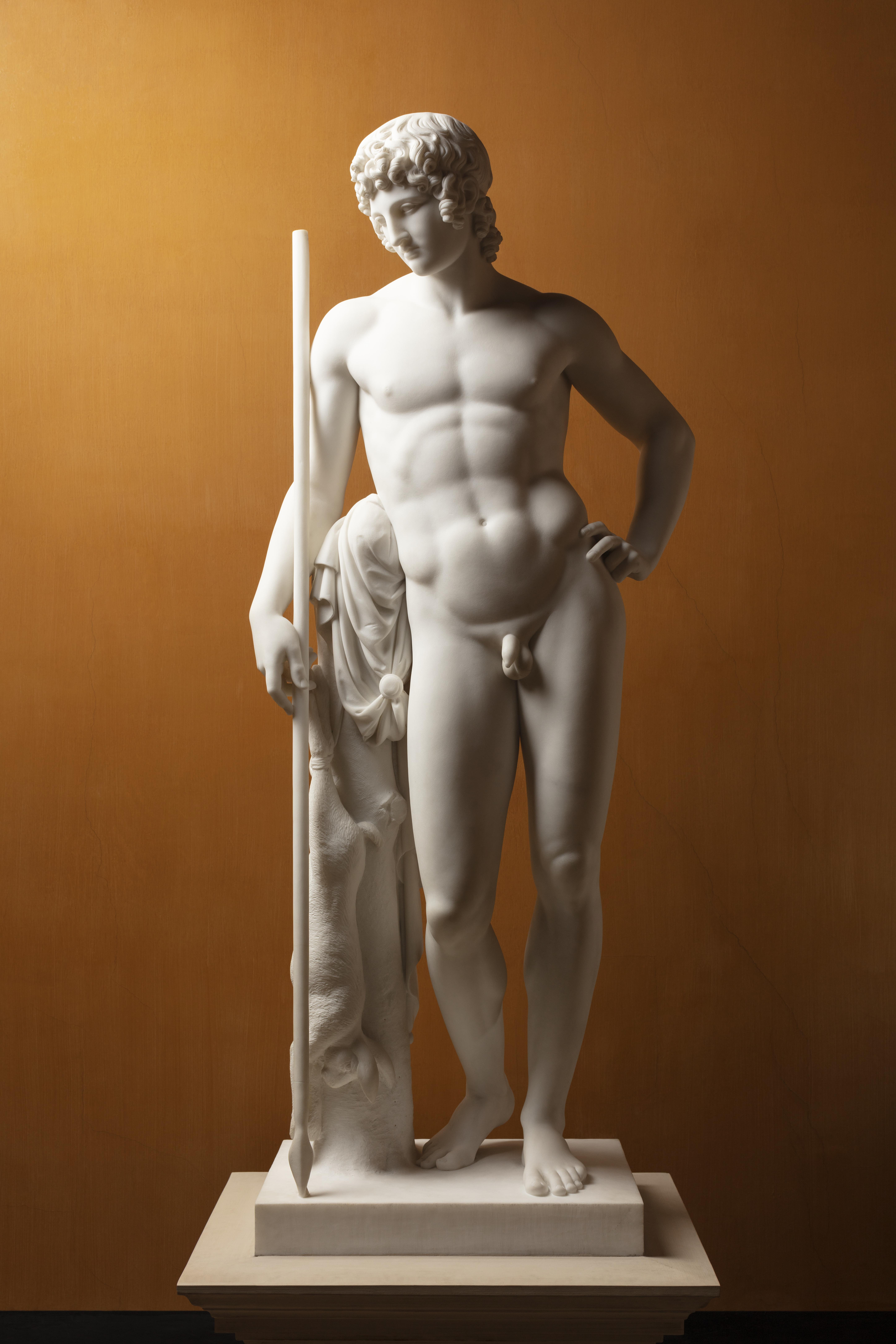
Bertel Thorvaldsen’s Adonis [above] (1808–1832) renders him fully nude and poised with graceful sorrow, a figure both heroic and tender. This tension becomes tragic in Peter Paul Rubens’s Venus Mourning Adonis [below] (1614), where Adonis lies partially nude in Venus’s embrace, his body mourned as much as it was desired.

In modernity, Adonis has been reborn as a name for fitness models, physique photography, and pornographic performers. Whether in glossy “Adonis Physique” [below] portfolios or by adult actors adopting the name, these contemporary “gods” continue the legacy of youthful male beauty displayed and consumed—reflecting society’s ongoing obsession with eroticized perfection.

While Apollo embodies clarity and Adonis, fragility, Dionysus represents something wilder—fluid gender, sensual abandon, and ecstatic freedom.

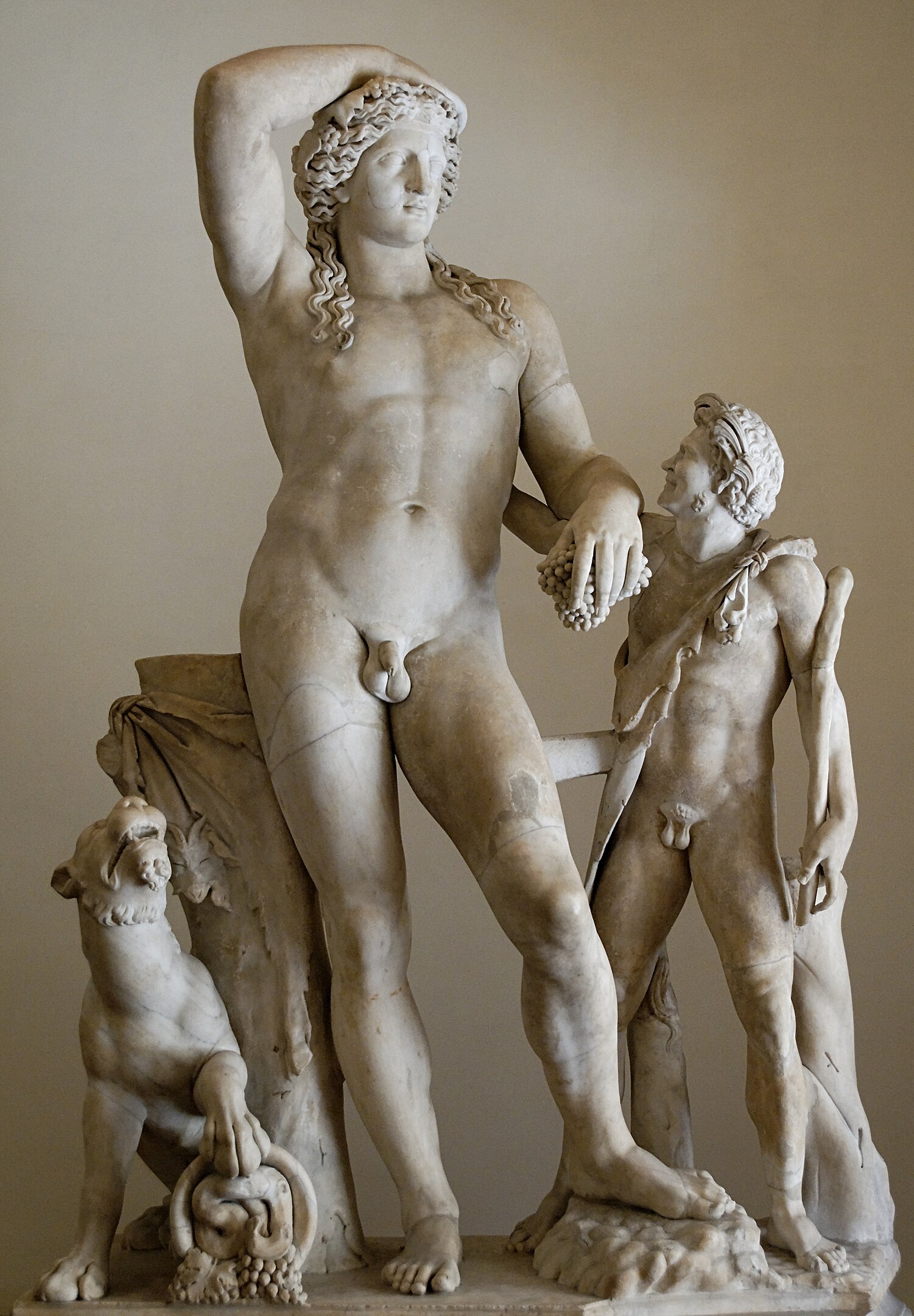
The Ludovisi Dionysus [above] (2nd century CE) captures this duality, showing the god nude and youthful, reclining beside a satyr. His form is less structured than Apollo’s, more languid—inviting the viewer into the pleasures of intoxication and eroticism.

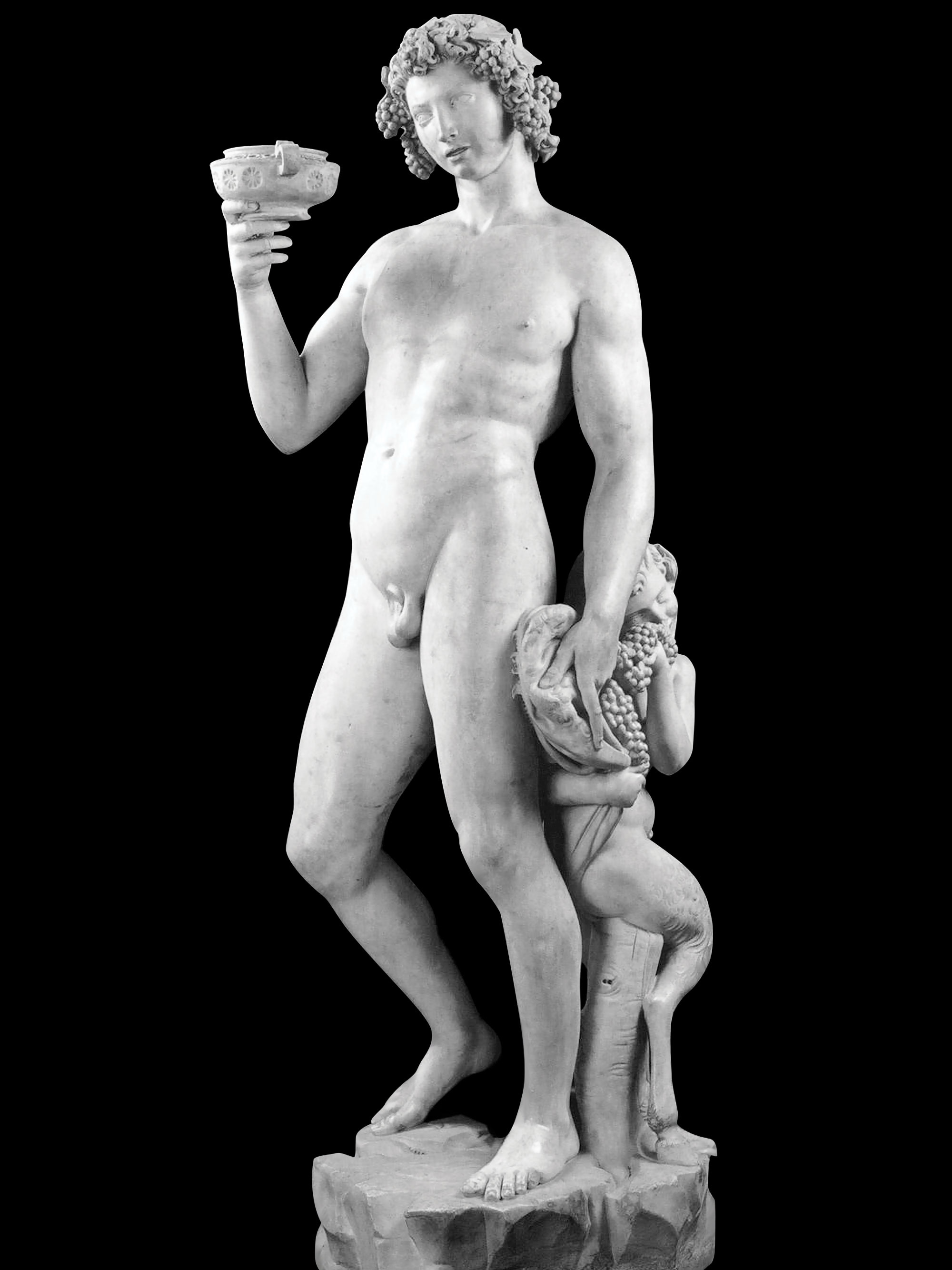
Michelangelo’s Bacchus [above] (1496–1497) expands this image with a staggering, fully nude god offering wine. His body is softly muscled, unsteady, and provocatively unguarded—a subtle challenge to Renaissance masculinity.

In modern queer art and performance, Dionysus is frequently reimagined as a nude figure of androgynous seduction—adorned with ivy, lounging among vessels and male companions. Whether in contemporary photography, drag, or performance art, he embodies liberation from gender, structure, and shame.

Ganymede, the beautiful Trojan prince abducted by Zeus, is mythology’s most overt celebration of male same-sex desire. Ancient Greek art embraced this narrative, often depicting Ganymede nude and pursued by Zeus in eagle form, as on red-figure vases from the 5th century BCE.

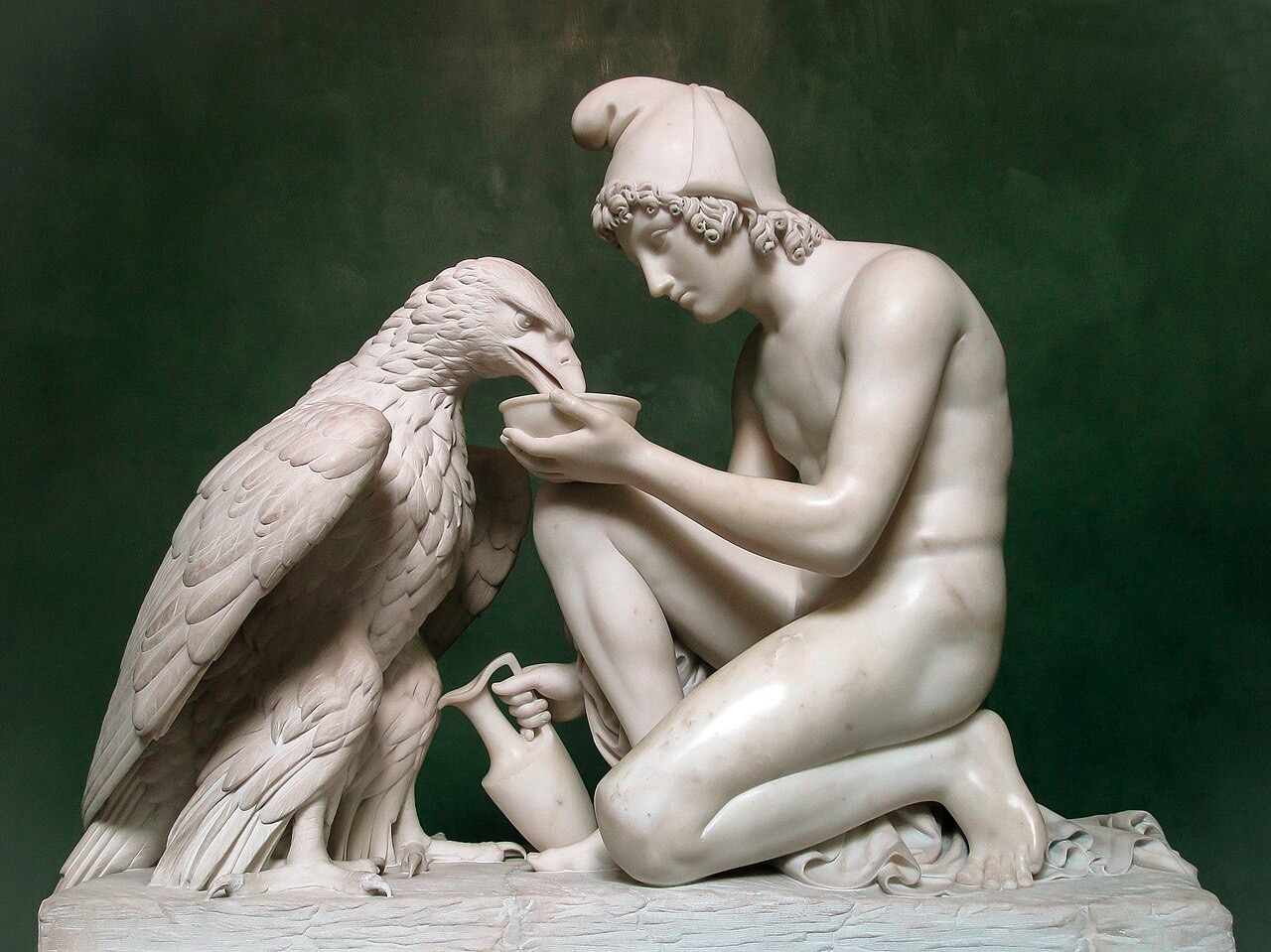
Neoclassicism softened the abduction in Bertel Thorvaldsen’s Ganymede and the Eagle [above] (1817). Here, Ganymede stands fully nude, offering a cup to Zeus with serenity and grace. His nudity is not scandalous but dignified, even sacred.

This narrative takes a more intimate turn in Wilhelm von Gloeden’s Ganymede-inspired photographs [above] , taken in Sicily between 1890 and 1910. His nude young models, posed with amphorae or gazing skyward, evoke myth while offering coded homoerotic imagery at a time when queer expression was criminalized. These photographs blend longing, artifice, and resistance—a queer reclamation of myth.

From ancient temples to modern studios, the nude forms of Apollo, Adonis, Dionysus, and Ganymede have served as vessels for beauty, longing, and erotic speculation. Their depictions reveal more than aesthetic ideals; they reflect how cultures across time have understood desire—particularly same-sex desire—not as taboo, but as divine.

These bodies, carved in marble, painted in oils, or captured in silver print, continue to remind us that queer love, and the beauty that awakens it, is older than shame and as enduring as myth.


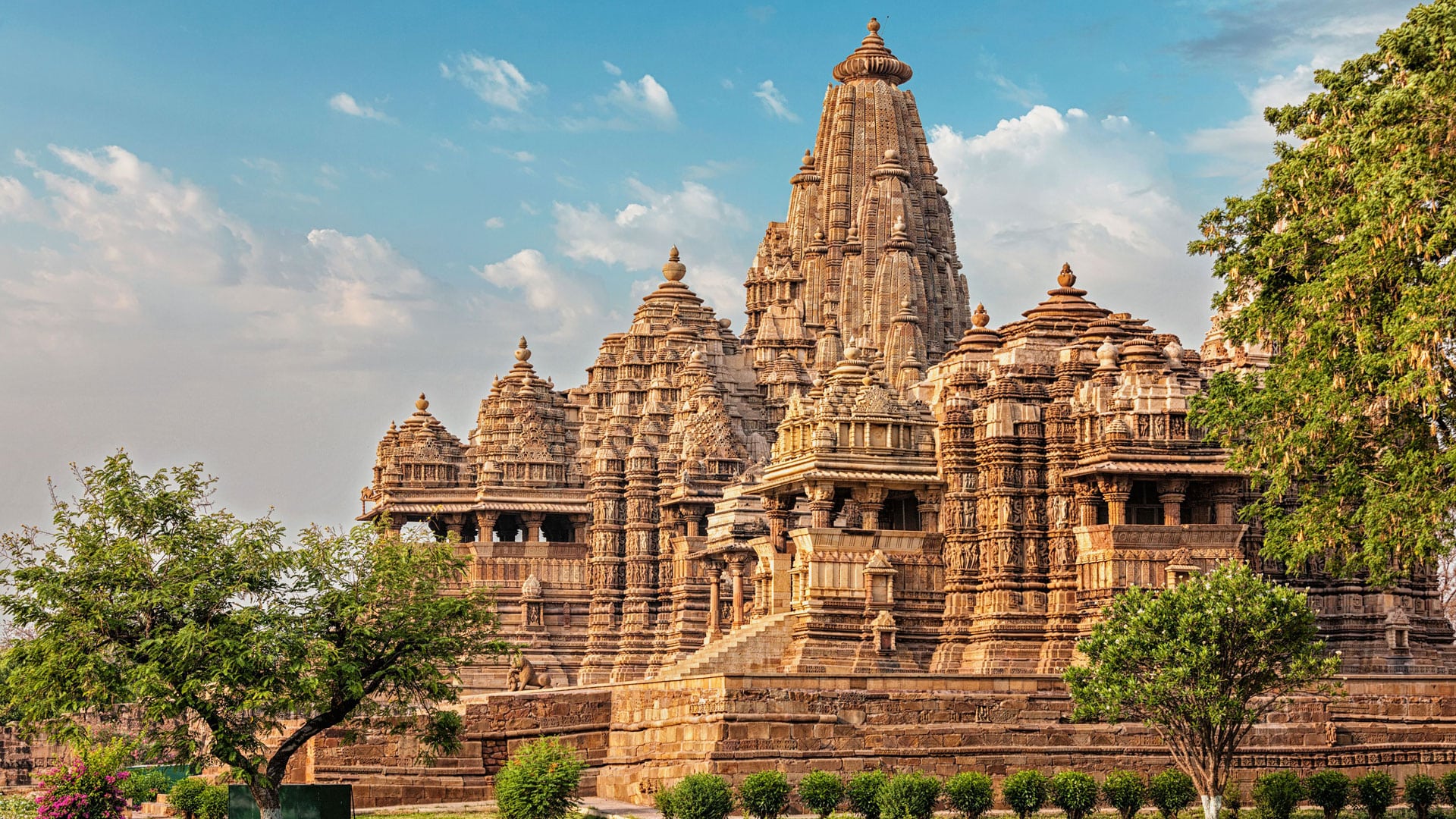
Khajuraho Temples

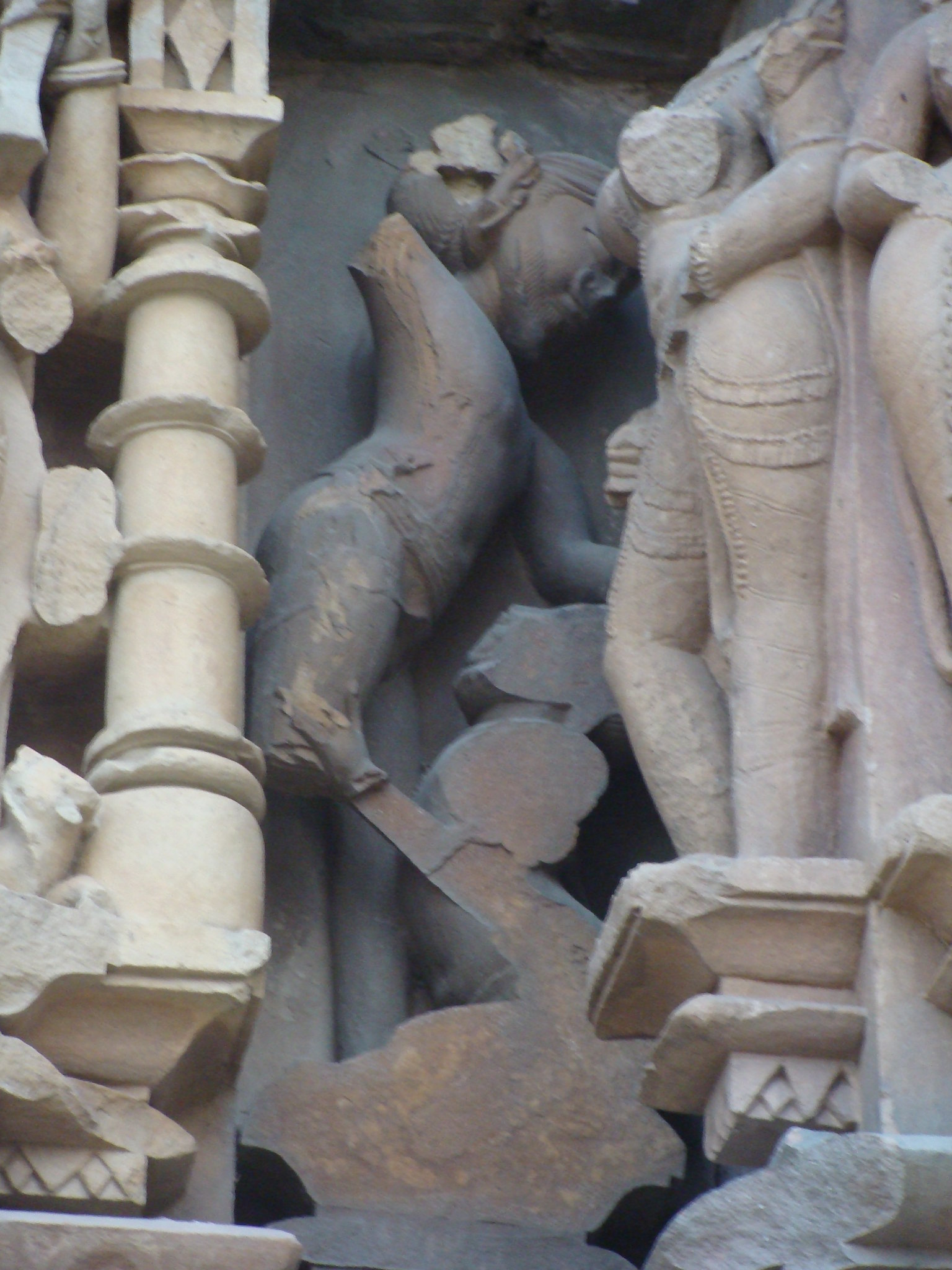
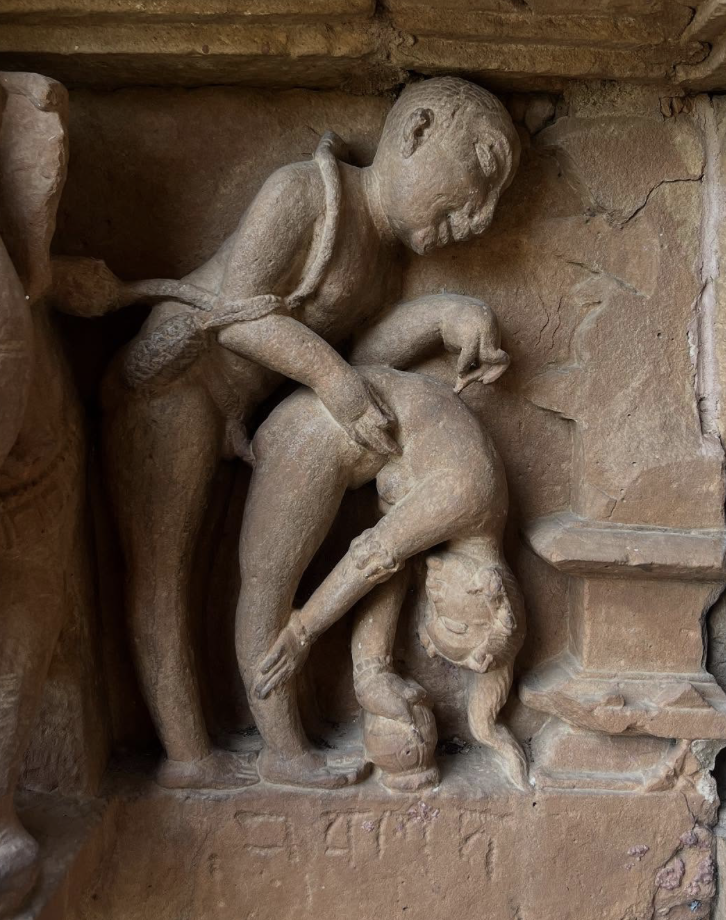
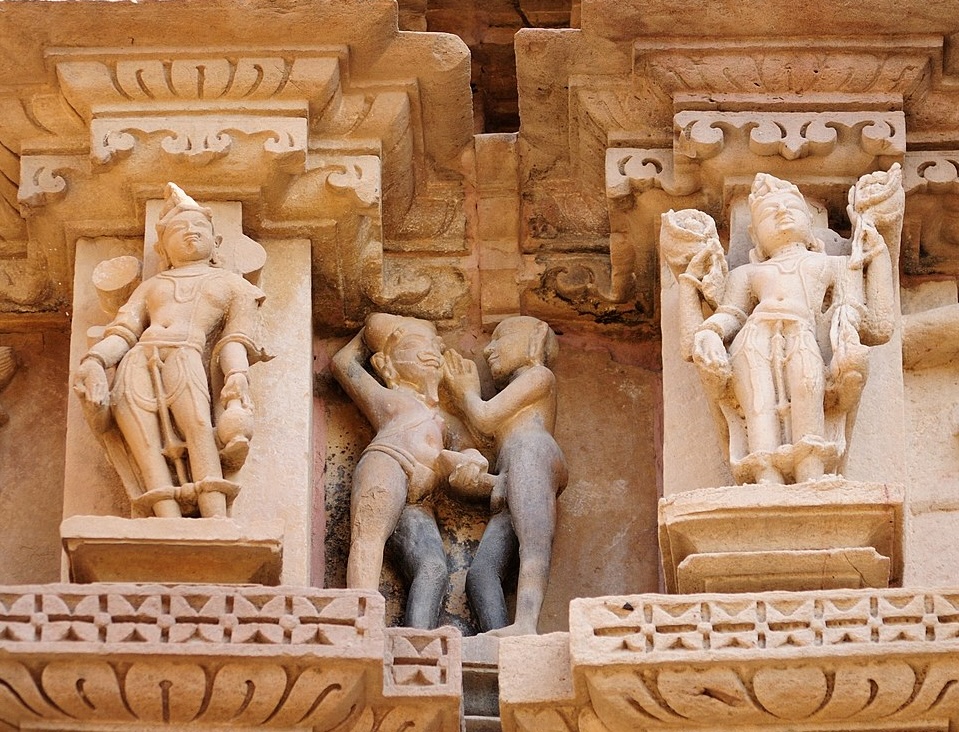
The temples of Khajuraho, a UNESCO World Heritage site located in Madhya Pradesh, India, are renowned for their intricate sculptures that celebrate the full spectrum of human life—spiritual, sensual, and mundane. Constructed between the 10th and 12th centuries CE under the rule of the Chandela dynasty, these temples have drawn global attention for their uninhibited erotic carvings. While most focus has traditionally been directed toward heterosexual imagery, the presence of male same-sex activity in the sculptural program offers a rare and illuminating glimpse into a pre-modern Indian worldview that acknowledged, depicted, and integrated diverse expressions of desire, including male-male eroticism, without censure.

Among the 85 temples originally built at Khajuraho, 22 remain today. Temples like the Kandariya Mahadeva, Lakshmana, and Vishvanatha house the majority of the erotic sculptures. These carvings are typically located on the outer walls and are interspersed among depictions of deities, mythical creatures, daily life, and celestial beings. In this context, the erotic is not marginal or profane—it is part of a holistic worldview that includes kama (desire) as one of the four essential goals of life, alongside dharma (duty), artha (prosperity), and moksha (liberation).

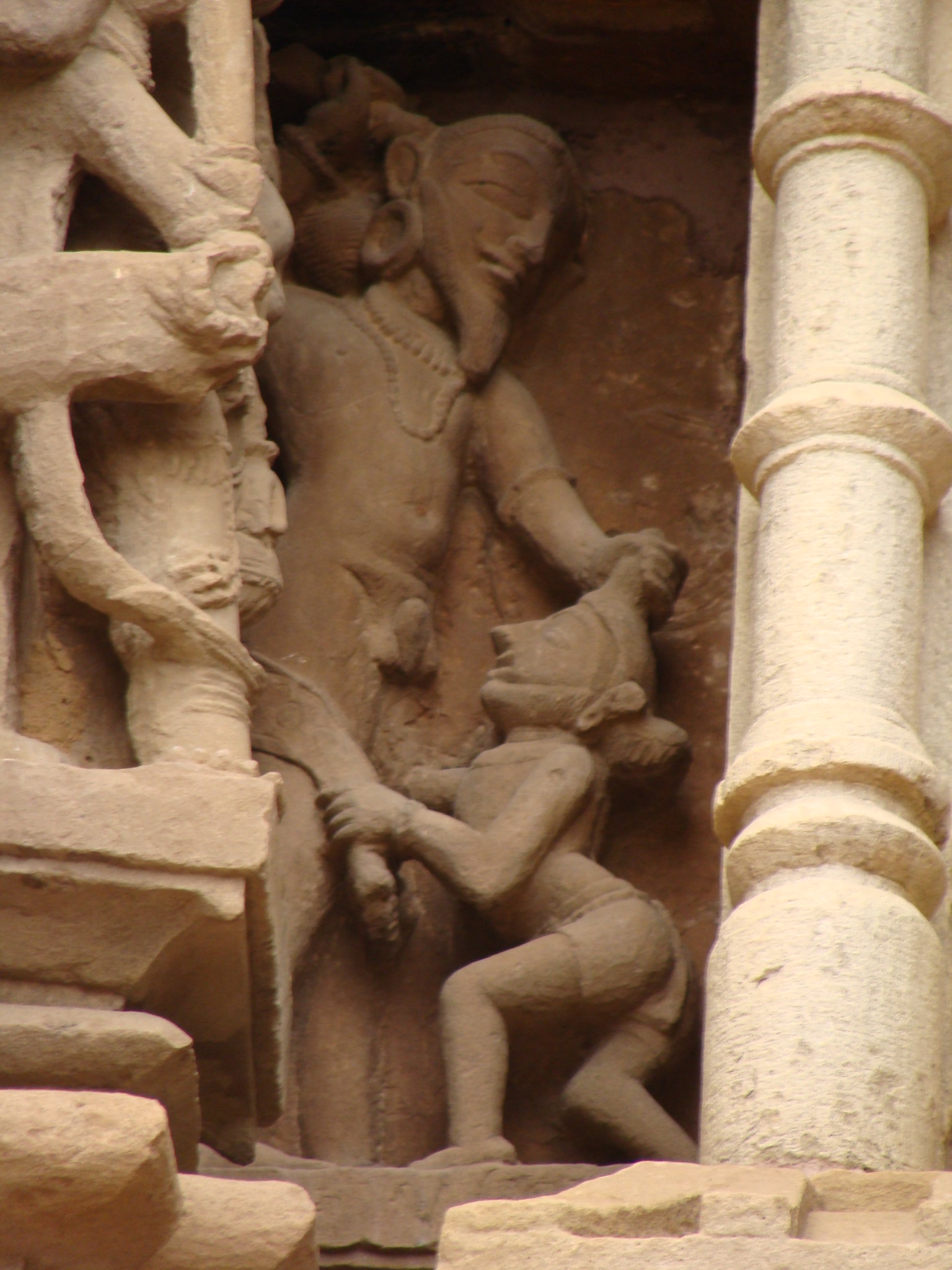
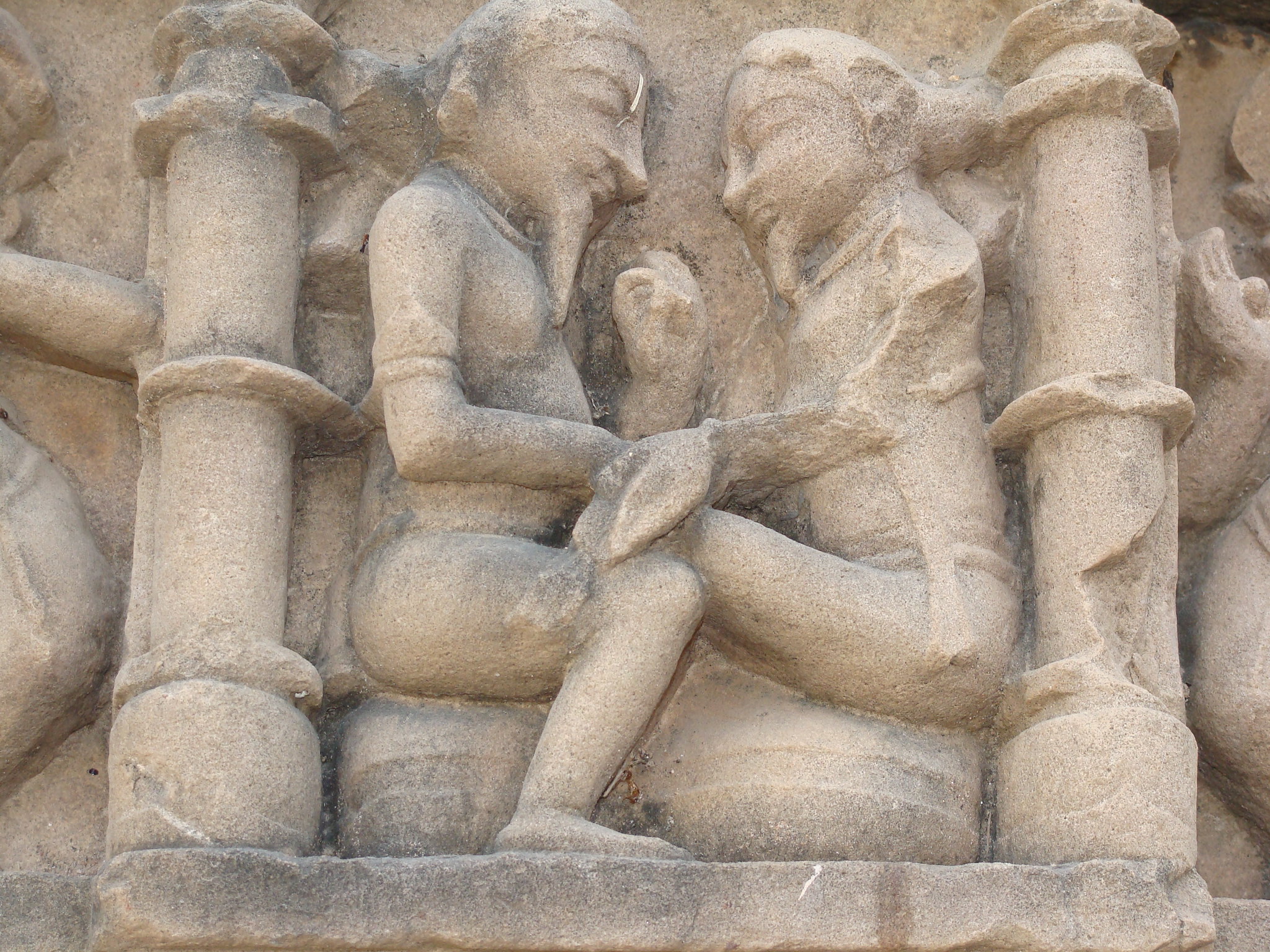
Within this framework, scenes of male same-sex activity appear—never as the dominant theme, but as a recognized and unashamed element of human and divine experience. One well-documented relief on the Kandariya Mahadeva Temple portrays three male figures: two engaged in what appears to be anal intercourse while the third supports or observes. The composition, carved with anatomical clarity and sensual expressiveness, is neither hidden nor diminutive. Instead, it is seamlessly integrated with other sexual depictions, suggesting that such interactions were not viewed as abnormal or unworthy of representation.

The Khajuraho sculptures are informed by Tantric philosophy, which celebrates the union of opposites—male and female, mortal and divine, physical and spiritual. Tantra does not moralize sexual behavior but instead sees it as a path to transcendence when practiced with awareness and ritual purpose. In such a framework, the body is not a source of shame but a vehicle for experiencing and accessing the sacred. This philosophical backdrop helps explain the inclusion of non-normative sexualities in the temple art.

Moreover, the historical Indian worldview, as evidenced in ancient texts like the Kama Sutra and the Natyashastra, acknowledged and codified categories for male-male desire. The Kama Sutra describes the behavior of the kliba—a term that included a variety of gender-nonconforming or homosexual individuals—and elaborates on oral sex between men without moral condemnation. The presence of male same-sex depictions at Khajuraho may be seen as a visual extension of these texts, reflecting their acceptance within elite court and religious circles.

The British colonial period marked a turning point in the interpretation of Indian art and sexuality. Victorian sensibilities, combined with Christian morality, led to a widespread suppression of India’s diverse sexual past. Erotic art was dismissed as “obscene” or “degenerate,” and the Khajuraho sculptures were either censored or misinterpreted. The presence of male same-sex acts, in particular, was downplayed or ignored in early archaeological reports, a silence that endured into much of the 20th century.

Only in recent decades have Indian and international scholars begun to reassess Khajuraho through lenses unclouded by colonial morality. Researchers such as Devdutt Pattanaik and Ruth Vanita have foregrounded these representations as evidence of a more fluid and inclusive premodern Indian culture. In doing so, they challenge modern narratives that frame homosexuality as a “Western import” or a postcolonial phenomenon.

The male same-sex depictions at the Khajuraho Temples serve as powerful reminders of a historical moment when erotic plurality was not stigmatized but sculpted in stone for the divine and the earthly to witness. These carvings do not merely reflect acts of physical pleasure—they symbolize a cultural acceptance of the full range of human desire. As India and the world continue to grapple with questions of sexual identity and historical memory, the Khajuraho temples stand as enduring monuments to a time when the sacred and the sensual, including love between men, coexisted without shame.In recognizing and reclaiming these images, we honor a forgotten legacy—one that whispers across time from temple walls that have seen centuries, reminding us that queerness is not an aberration in Indian history, but a thread woven into its very cultural fabric.