Category Archives: Art

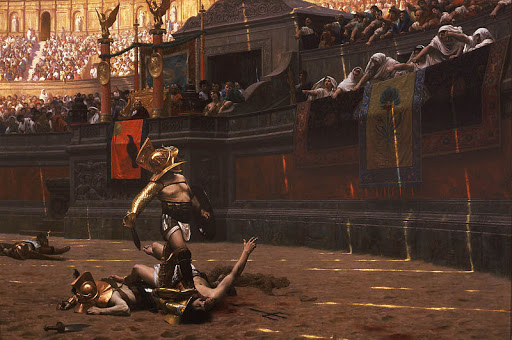
Moment of Zen: Thumbs Up

The Latin phrase pollice verso is used in the context of gladiatorial combat for a hand gesture used by Ancient Roman crowds to pass judgment on a defeated gladiator. However, the type of gesture described by the phrase pollice verso and its meaning is unclear in the historical and literary record.


In modern popular culture, it is assumed that “thumbs down” was the signal that a defeated gladiator should be condemned to death; “thumbs up”, that he should be spared, a view popularized by a widely reproduced painting by the 19th-century artist Jean-Léon Gérôme, whose Pollice Verso (usually known in English as “Thumbs Down”) depicts a triumphant gladiator looking up into the stands for the verdict of the crowd.

To see the painting by Jean-Léon Gérôme, click to see more below and go to the second part of the post.


F. Holland Day: 1864-1933

day-youthstoneThe extremely controversial F. Holland Day is all but forgotten today as his fin de siécle images of young nude men—like the one pictured here— were eclipsed by rivals such as Alfred Steigltiz and other moderns. An American, he was the first in the U.S.A. to advocate that photography should be considered a fine art.
Day spent much time among poor immigrant children in Boston, tutoring them in reading and mentoring them. One in particular, the 13-year-old Lebanese immigrant Kahlil Gibran, went on to fame as the author of The Prophet.
day (1)Fred Holland Day was a wealthy eccentric and philanthropist from Massachusetts. As partner in the publishing firm Copeland and Day, which he founded in 1884, Day indulged his passion for English literature, publishing exquisite small-edition, hand-bound volumes by the likes of Dante Gabriel Rossetti and Day’s friend Oscar Wilde. Although Copeland and Day published ninety-eight books and periodicals, the firm was never financially successful.
Day began to photograph in 1886; and he wrote extensively about photography’s position as a fine art and organized international photography exhibitions to further his claim. He asked: “And if it chance that [a] picture is beautiful, by what name shall we call it? Shall we say that it is not a work of art, because our vocabulary calls it a photograph?”
fhdnudeFrederick Holland Day’s photographs of the male body concentrated on mythological and religious subject matter. In these photographs he tried to reveal a transcendence of spirit through an aesthetic vision of androgynous physical perfection. He reveled in the sensuous hedonistic beauty of what he saw as the perfection of the youthful male body. In the photograph “St. Sebastian,” for example, the young male body is presented for our gaze in the combined ecstasy and agony of suffering. In his mythological photographs Holland Day used the idealism of Ancient Greece as the basis for his directed and staged images. These are not the bodies of muscular men but of youthful boys (ephebes) in their adolescence; they seem to have an ambiguous sexuality. F.-Holland-Day5The models genitalia are rarely shown and when they are, the penis is usually hidden in dark shadow, imbuing the photographs with a sexual mystery. The images are suffused with an erotic beauty of the male body never seen before, a photographic reflection of a seductive utopian beauty seen through the desiring eye of a homosexual photographer.
His style was Pictorialist, and he favored platinum prints, which are distinguished by their fine detail and ability to render a full range of soft tones. He lost interest in photography when a shortage of platinum during World War I made printing prohibitively expensive and eventually impossible. He died twenty years later, in relative obscurity.
Day


David Hockney’s "Illustrations for Fourteen Poems from C P Cavafy"

Two Young Men, 23 to 24 Years Old
Bild 047He’d been sitting in the café since ten-thirty
expecting him to turn up any minute.
Midnight went by, and he was still waiting for him.
It was now after one-thirty, and the café was almost deserted.
He’d grown tired of reading newspapers
mechanically. Of his three lonely shillings
only one was left: waiting that long,
he’d spent the others on coffees and brandy.
He’d smoked all his cigarettes.
So much waiting had worn him out. Because
alone like that for so many hours,
he’d also begun to have disturbing thoughts
about the immoral life he was living.

But when he saw his friend come in—
weariness, boredom, thoughts vanished at once.

His friend brought unexpected news.
He’d won sixty pounds playing cards.

Their good looks, their exquisite youthfulness,
the sensitive love they shared
were refreshed, livened, invigorated
by the sixty pounds from the card table.
Now all joy and vitality, feeling and charm,
they went—not to the homes of their respectable families
(where they were no longer wanted anyway)—
they went to a familiar and very special
house of debauchery, and they asked for a bedroom
and expensive drinks, and they drank again.

And when the expensive drinks were finished
and it was close to four in the morning,
happy, they gave themselves to love.


Following the Recipe of Ancient Greco-Syrian Magicians
Bild 051Said an aesthete: “What distillation from magic herbs
can I find—what distillation, following the recipe
of ancient Greco-Syrian magicians—
that will bring back to me for one day (if its power
doesn’t last longer) or even for a few hours,
my twenty-third year,
bring back to me my friend of twenty-two,
his beauty, his love.
What distillation, following the recipe
of ancient Greco-Syrian magicians, can be found
to bring back also—as part of this return of things past—
even the little room we shared.”


In an Old Book
Bild 052Forgotten between the leaves of an old book—
almost a hundred years old—
I found an unsigned watercolor.
It must have been the work of a powerful artist.
Its title: “Representation of Love.”
“…love of extreme sensualists” would have been more to the point.
Because it became clear as you looked at the work
(it was easy to see what the artist had in mind)
that the young man in the painting
was not designated for those
who love in ways that are more or less healthy,
inside the bounds of what is clearly permissible—
with his deep chestnut eyes,
the rare beauty of his face,
the beauty of anomalous charm,
with those ideal lips that bring
sensual delight to the body loved,
those ideal limbs shaped for beds
that common morality calls shameless.


In the Boring Village
DavidHockney_InTheDullVillage_LGIn the boring village where he works—
clerk in a textile shop, very young—
and where he’s waiting out the two or three months ahead,
another two or three months until business falls off
so he can leave for the city and plunge headlong
into its action, its entertainment;
in the boring village where he’s waiting out the time—
he goes to bed tonight full of sexual longing,
all his youth on fire with the body’s passion,
his lovely youth given over to a fine intensity.
And in his sleep pleasure comes to him;
in his sleep he sees and has the figure, the flesh he longed for…


Their Beginning
hockn_beginningTheir illicit pleasure has been fulfilled.
They get up and dress quickly, without a word.
They come out of the house separately, furtively;
and as they move along the street a bit unsettled,
it seems they sense that something about them betrays
what kind of bed they’ve just been lying on.
But what profit for the life of the artist:
tomorrow, the day after, or years later, he’ll give voice
to the strong lines that had their beginning here.


One Night
P1188The room was cheap and sordid,
hidden above the suspect taverna.
From the window you could see the alley,
dirty and narrow. From below
came the voices of workmen
playing cards, enjoying themselves.
And there on that common, humble bed
I had love’s body, had those intoxicating lips,
red and sensual,
red lips of such intoxication
that now as I write, after so many years,
in my lonely house, I’m drunk with passion again.


In Despair
P1189He lost him completely. And he now tries to find
his lips in the lips of each new lover,
he tries in the union with each new lover
to convince himself that it’s the same young man,
that it’s to him he gives himself.
He lost him completely, as though he never existed.
He wanted, his lover said, to save himself
from the tainted, unhealthy form of sexual pleasure,
the tainted, shameful form of sexual pleasure.
There was still time, he said, to save himself.
He lost him completely, as though he never existed.
Through fantasy, through hallucination,
he tries to find his lips in the lips of other young men,
he longs to feel his kind of love once more.


David Hockney has enjoyed international fame ever since the early 1960s. He began his artistic training in 1953 to 1957 at the Bradford College of Art and continued studying at the Royal College of Art in London from 1959 to 1962. He exhibited his first works in 1960 and participated in the exhibition of the ‘London Group 1960’ in 1960 and was also presented for the first time with the ‘Young Contemporaries’ at the R.B.A. Galleries in London. He was awarded the Royal College Drawing Prize in the year he graduated. Hockney began working on his first engraved cycle ‘A Rake’s Progress’ as early as in 1961 – it was published in 1963. Hockney traveled to New York, Berlin and Egypt after having finished his studies, in order to find ideas for his illustrations. His friend, Henry Geldzahler, the curator at the Metropolitan Museum of Art in New York, encouraged him to move to Los Angeles in 1964. Hockney was offered a teaching post at the University of Iowa in the summer of the same year. His first one-man exhibition in the USA was successfully opened in the same year at the Alan Gallery in New York. He had other teaching posts until 1967 at the University of Colorado in Boulder, in Los Angeles and in Berkeley.
Hockney came across the Greek poet Konstantinos Kavafis, also called Cafavy, as early as in his studies. He was fascinated by Cafavy’s clear and unpretentious way of writing about homosexuality. Thus the idea for a cycle of etchings was born, which was, however, not solely due to his fascination for the Greek poet, but also because of his basic desire to create literature etchings. The project was not put into practice before 1966, as the translation of the poems which was in existence then could not be used for legal reasons. This is why Hockney decided to entrust his friend Stephen Spender, an English poet, and his colleague Nikos Stangos with a new translation of the poems. The project was completed in just 6 months. In general, the works of the cycle were not intended to be exact illustrations of the poem, but rather visual interpretations of Cafy’s poetry.
Hockney accepted a post as a guest professor at the Kunsthochschule in Hamburg in 1969. His international fame increased with his invitations to exhibit at the documenta 4 and 6 in Kassel in 1968 and 1977. He made numerous stage stets for ballets and operas by Mozart, Strawinsky, Wagner and Strauss from the mid 1970s to the 1990s. In 1982 Hockney began making Polaroid collages in a Cubist manner. He also began making color-copy prints, abstract computer graphics and fax drawings at the end of the 1980s. Hockney is often associated with Pop-Art, but he refuses to accept this labeling of his art.
Sources:

I only used seven of the fourteen poems featured in Hockney’s work, but these were the seven I found most intriguing. Each of the above poems were translated by Edmund Keeley/Philip Sherrard.  In Hockey’s book, they were translated by Stephen Spender and Nikos Stangos.


Constantine Cavafy

Duane Michals-The Adventures of Constantine CavafyDuane Michals. “The Adventures of Constantine Cavafy”

Born 29 April 1863 – 29 April 1933

Background: Constantine P. Cavafy was born Konstantinos Petrou Kavafis (or Kabaphs) in Alexandria, Egypt, into a wealthy merchant family. Originally the family came from Constantinople, Turkey, where Cavafy lived from 1880 to 1885. After his father’s death in 1872 he was taken to Liverpool, England, for five years. Apart from the years in Istanbul (1882-85), he spent the rest of his life in Alexandria. “Whatever war-damage it’s suffered, / however much smaller it’s become, / it’s still a wonderful city,” Cavafy once wrote of his cosmopolitan home town – perhaps not without ironic attitude.

cavafy50Work: When the family’s prosperity declined, Cavafy worked 34 years intermittently as journalist, broker, and in the Irrigation Service, from which he retired in 1922.

Enjoying his family’s respectable position in the cosmopolitan society of Alexandria, Cavafy led an uneventful life of routine, which was interrupted only by short trips to Athens, France, England, and Italy. His first book was published when he was 41, and reissued five years later with additional seven poems. He published no further works during his lifetime.

As a writer Cavafy was perfectionist – he printed his poems by himself and delivered them only to close friends. The poems had sometimes handwritten corrections. Main themes in his works were homosexual love, art, and politics. He started writing poetry under the influence of late-Victorian and Decadent European models, but then abandoned his attempts to compose in foreign tongues.

Fourteen of Cavafy’s poems appeared in a pamphlet in 1904. The edition was enlarged in 1910. Several dozens appeared subsequent years in a number of privately printed booklets and broadsheets. These editions contained mostly the same poems, first arranged thematically, and then chronologically. Close to one third of his poems were never printed in any form while he lived. ‘One Night,’ written 1907, was one of the erotic poems Cavafy wrote during the years in Alexandria, and referred to a passing sexual encounter. It showed the poet’s devotion to a sensual pleasure, free and joyous.

And there on that common, humble bed,
I had love’s body, hand those intoxicating lips,
red and sensual, red lips of such intoxication
that now as I write, after so many years,
in my lonely house, I’m drunk with passion again.

In book form Cavafy’s poems were first published without dates before World War II and reprinted in 1949. PIIMATA (The Poems of Constantine P. Cavafy) appeared posthumously in 1935 in Alexandria. Cavafy died on April 29, 1933 in Alexandria. Nowadays the cafés that the poet frequented on the Rue Misalla (now Safiya Zaghlul) have been largely replaced by shops.

prt09973_david_hockney_signed_print_portrait_of_cavafy_in_alexandria_iCavafy composed rhymed as well as free verse, but never loose, unstructured, or irregular poems. He used iambic, eleven-syllable measures, including the popular fifteen-syllable verse of the demotic tradition. After giving up experiments with different literary models, Cavafy mixed the demotic and pure Greek called katharevousa, and used his wide knowledge of the history of East Roman and Byzantine empires as the basis of his themes.

Like in Oscar Wilde, aestheticism and skepticism marked Cavafy’s work. One of his central motifs was regret for old age: Past and present, East and West, Greek and ‘barbarian’ were fused into sophisticated commentaries on paganism, Christianity, and decadent modern world. Cavafy sketched a rich gallery of historical, semi-obscure, or fictitious characters, whom he used as personae acting, or being discussed, in the episodes of his poems. Often his style was dramatic, as in the famous ‘Waiting for the Barbarians.’ Among his confessional poems with homosexual theme is ‘The Bandaged Shoulder,’ much admired by Lawrence Durrell.

Friends & Relationships: His first love affair was with his cousin, George Psilliary, in 1882. he would often visit male brothels or the Café Al Salam where there were plenty of available young men – in particular a handsome young car mechanic called Toto. His only long-term lover was Alexander Singopoulos whom he made his heir and literary executor. Although he was upset when Alexander got married he later became fond of his wife Rika.
Cavafy held afternoons from 5 until 7 at his flat with metses and ouzo or whisky and he would observe quietly his friends and his handsome youths.
Cavafy lived in West London for three years from 1873 – 1876. He died on his seventieth birthday after a long fight against throat cancer. His last act was to place a dot into the center of a circle he had drawn. In Hidden Things he predicted:

Later, in a more perfect society, Someone else made just like me
Is certain to appear and act freely.

http://www.circa-club.com/gallery/gay_history_icons_constantine_cavafy.php


In Praise of Limestone

NCP25058843801In Praise of Limestone” is a poem written by W. H. Auden in Italy in May 1948. Central to his canon and one of Auden’s finest poems, it has been the subject of diverse scholarly interpretations. Auden’s limestone landscape has been interpreted as an allegory of Mediterranean civilization and of the human body. The poem, sui generis, is not easily classified. As a topographical poem, it describes a landscape and infuses it with meaning. It has been called the “first … postmodern pastoral”. In a letter, Auden wrote of limestone and the poem’s theme that “that rock creates the only human landscape.”

In December 1948, a few months after he had celebrated the maternal aspects of the flesh in “In Praise of Limestone,” Auden celebrated the male flesh in a less sacramental style. “Deciding that there ought to be one in the Auden corpus” — his choice of the noun is deliberate — “I am writing a purely pornographic poem, The Platonic Blow,” he told Kallman. He borrowed the nameless syncopated metre (“It was a Spring day, a day for a lay, when the air / Smelled like a locker-room”) invented by Charles Williams for the poems of his highly sacramental Taliessin through Logres, but the word “Platonic” in Auden’s title was an ironic spoof. The sexual act described by the poem in microscopic physiological detail is “Platonic” only in the popular sense that it is perfect of its kind — Auden asked friends to contribute their relevant ideas of perfection — and not in the sense that the bodies that perform the act are in any way transcended.


In Praise Of Limestone

Tuke,_Henry_Scott_(1858–1929)_-_1920_-_Youth_on_beachIf it form the one landscape that we, the inconstant ones,
Are consistently homesick for, this is chiefly
Because it dissolves in water. Mark these rounded slopes
With their surface fragrance of thyme and, beneath,
A secret system of caves and conduits; hear the springs
That spurt out everywhere with a chuckle,
Each filling a private pool for its fish and carving
Its own little ravine whose cliffs entertain
The butterfly and the lizard; examine this region
Of short distances and definite places:
What could be more like Mother or a fitter background
For her son, the flirtatious male who lounges
Against a rock in the sunlight, never doubting
That for all his faults he is loved; whose works are but
Extensions of his power to charm? From weathered outcrop
To hill-top temple, from appearing waters to
Conspicuous fountains, from a wild to a formal vineyard,
Are ingenious but short steps that a child’s wish
To receive more attention than his brothers, whether
By pleasing or teasing, can easily take.

Watch, then, the band of rivals as they climb up and down
Their steep stone gennels in twos and threes, at times
Arm in arm, but never, thank God, in step; or engaged
On the shady side of a square at midday in
Voluble discourse, knowing each other too well to think
There are any important secrets, unable
To conceive a god whose temper-tantrums are moral
And not to be pacified by a clever line
Tuke,_Henry_Scott_(1858–1929)_-_1921_-_Boys_bathing_on_rocksOr a good lay: for accustomed to a stone that responds,
They have never had to veil their faces in awe
Of a crater whose blazing fury could not be fixed;
Adjusted to the local needs of valleys
Where everything can be touched or reached by walking,
Their eyes have never looked into infinite space
Through the lattice-work of a nomad’s comb; born lucky,
Their legs have never encountered the fungi
And insects of the jungle, the monstrous forms and lives
With which we have nothing, we like to hope, in common.
So, when one of them goes to the bad, the way his mind works
Remains incomprehensible: to become a pimp
Or deal in fake jewellery or ruin a fine tenor voice
For effects that bring down the house, could happen to all
But the best and the worst of us…
That is why, I suppose,
The best and worst never stayed here long but sought
Immoderate soils where the beauty was not so external,
The light less public and the meaning of life
Something more than a mad camp. ‘Come!’ cried the granite wastes,
“How evasive is your humour, how accidental
Your kindest kiss, how permanent is death.” (Saints-to-be
Slipped away sighing.) “Come!” purred the clays and gravels,
“On our plains there is room for armies to drill; rivers
Wait to be tamed and slaves to construct you a tomb
In the grand manner: soft as the earth is mankind and both
Need to be altered.” (Intendant Caesars rose and
Left, slamming the door.) But the really reckless were fetched
By an older colder voice, the oceanic whisper:
“I am the solitude that asks and promises nothing;
That is how I shall set you free. There is no love;
Tuke_Henry_Scott_1858–1929_-_1914_ca_-_Two_boys_and_a_dogThere are only the various envies, all of them sad.”

They were right, my dear, all those voices were right
And still are; this land is not the sweet home that it looks,
Nor its peace the historical calm of a site
Where something was settled once and for all: A back ward
And dilapidated province, connected
To the big busy world by a tunnel, with a certain
Seedy appeal, is that all it is now? Not quite:
It has a worldy duty which in spite of itself
It does not neglect, but calls into question
All the Great Powers assume; it disturbs our rights. The poet,
Admired for his earnest habit of calling
The sun the sun, his mind Puzzle, is made uneasy
By these marble statues which so obviously doubt
His antimythological myth; and these gamins,
Pursuing the scientist down the tiled colonnade
With such lively offers, rebuke his concern for Nature’s
Remotest aspects: I, too, am reproached, for what
And how much you know. Not to lose time, not to get caught,
Not to be left behind, not, please! to resemble
The beasts who repeat themselves, or a thing like water
Or stone whose conduct can be predicted, these
Are our common prayer, whose greatest comfort is music
Which can be made anywhere, is invisible,
And does not smell. In so far as we have to look forward
SunBather_TukeTo death as a fact, no doubt we are right: But if
Sins can be forgiven, if bodies rise from the dead,
These modifications of matter into
Innocent athletes and gesticulating fountains,
Made solely for pleasure, make a further point:
The blessed will not care what angle they are regarded from,
Having nothing to hide. Dear, I know nothing of
Either, but when I try to imagine a faultless love
Or the life to come, what I hear is the murmur
Of underground streams, what I see is a limestone landscape.

W.H. Auden

The paintings are by Henry Scott Tuke.


Onanism by Mark Twain

Did Mark Twain, nom de plume for Samuel Langhorne Clemens (1835-1910), really say that 95% of men masturbate and the other 5% lie about it (or statistics to that effect)? In any event, at about 44 years of age, here’s what he said as speaker at a dinner held in 1879 at a Paris supper club. Fellow diners were, to say the least, surprised by what they heard. Enjoy!

Some Thoughts on the Science of Onanism
by Mark Twain

[One evening in Paris in 1879, The Stomach Club, a society of American writers and artists, gathered to drink well, to eat a good dinner and hear an address by Mark Twain. He was among friends and, according to the custom of the club, he delivered a humorous talk on a subject hardly ever mentioned in public in that day and age. After the meeting, he preserved the manuscript among his papers. It was finally printed in a pamphlet limited to 50 copies 64 years later.]

My gifted predecessor has warned you against the “social evil–adultery.” In his able paper he exhausted that subject; he left absolutely nothing more to be said on it. But I will continue his good work in the cause of morality by cautioning you against that species of recreation called self-abuse to which I perceive you are much addicted. All great writers on health and morals, both ancient and modern, have struggled with this stately subject; this shows its dignity and importance. Some of these writers have taken one side, some the other.
Homer, in the second book of the Iliad says with fine enthusiasm, “Give me masturbation or give me death.” Caesar, in his Commentaries, says, “To the lonely it is company; to the forsaken it is a friend; to the aged and to the impotent it is a benefactor. They that are penniless are yet rich, in that they still have this majestic diversion.” In another place this experienced observer has said, “There are times when I prefer it to sodomy.”
Robinson Crusoe says, “I cannot describe what I owe to this gentle art.” Queen Elizabeth said, “It is the bulwark of virginity.” Cetewayo, the Zulu hero, remarked, “A jerk in the hand is worth two in the bush.” The immortal Franklin has said, “Masturbation is the best policy.”
Michelangelo and all of the other old masters–“old masters,” I will remark, is an abbreviation, a contraction–have used similar language. Michelangelo said to Pope Julius II, “Self-negation is noble, self-culture beneficent, self-possession is manly, but to the truly great and inspiring soul they are poor and tame compared with self-abuse.” Mr. Brown, here, in one of his latest and most graceful poems, refers to it in an eloquent line which is destined to live to the end of time–“None knows it but to love it; none name it but to praise.”
Such are the utterances of the most illustrious of the masters of this renowned science, and apologists for it. The name of those who decry it and oppose it is legion; they have made strong arguments and uttered bitter speeches against it–but there is not room to repeat them here in much detail. Brigham Young, an expert of incontestable authority, said, “As compared with the other thing, it is the difference between the lightning bug and the lightning.” Solomon said, “There is nothing to recommend it but its cheapness.” Galen said, “It is shameful to degrade to such bestial uses that grand limb, that formidable member, which we votaries of Science dub the Major Maxillary*–when they dub it at all–which is seldom, It would be better to amputate the os frontis** than to put it to such use.”
The great statistician Smith, in his report to Parliament, says, “In my opinion, more children have been wasted in this way than any other.” It cannot be denied that the high antiquity of this art entitles it to our respect; but at the same time, I think its harmfulness demands our condemnation. Mr. Darwin was grieved to feel obliged to give up his theory that the monkey was the connecting link between man and the lower animals. I think he was too hasty. The monkey is the only animal, except man, that practices this science; hence, he is our brother; there is a bond of sympathy and relationship between us. Give this ingenuous animal an audience of the proper kind and he will straightway put aside his other affairs and take a whet; and you will see by his contortions and his ecstatic expression that he takes an intelligent and human interest in his performance.
The signs of excessive indulgence in this destructive pastime are easily detectable. They are these: a disposition to eat, to drink, to smoke, to meet together convivially, to laugh, to joke and tell indelicate stories–and mainly, a yearning to paint pictures. The results of the habit are: loss of memory, loss of virility, loss of cheerfulness and loss of progeny.
Of all the various kinds of sexual intercourse, this has the least to recommend it. As an amusement, it is too fleeting; as an occupation, it is too wearing; as a public exhibition, there is no money in it. It is unsuited to the drawing room, and in the most cultured society it has long been banished from the social board. It has at last, in our day of progress and improvement, been degraded to brotherhood with flatulence. Among the best bred, these two arts are now indulged in only private–though by consent of the whole company, when only males are present, it is still permissible, in good society, to remove the embargo on the fundamental sigh.
My illustrious predecessor has taught you that all forms of the “social evil” are bad. I would teach you that some of these forms are more to be avoided than others. So, in concluding, I say, “If you must gamble your lives sexually, don’t play a lone hand too much.” When you feel a revolutionary uprising in your system, get your Vendome Column down some other way–don’t jerk it down.***


Note: Formal title of his Presentation was “Some Thoughts on the Science of Onanism.” Not that it would matter to Twain (who was well ahead of his time on masturbation), most biblical scholars today see Onan’s alleged “sin” as a reference to his disobedience of God’s alleged order to procreate. Instead, Onan engaged in coitus interruptus—withdrawing his penis before ejaculating. Masturbation had nothing to do with it.

* in the area of the sinuses (as best I can tell)
** frontal bone—forehead
***Twain’s satiric reference is to a penis-like column (pictured above), originally put in place by Napoleon, which rises majestically in Paris like an obelisk or erect phallus in the Place Vendôme. Napoleon himself stands on the head of this vertical shaft in full glory.
 
From: http://artofmalemasturbation.tumblr.com/MarkTwain.


For a more explicit view of masturbation, please visit my other blog.


Happy Valentine’s Day

tumblr_ley3ymUlcs1qg66b4o1_400The history of Valentine’s Day — and its patron saint — is shrouded in mystery. But we do know that February has long been a month of romance. St. Valentine’s Day, as we know it today, contains vestiges of both Christian and ancient Roman tradition. So, who was Saint Valentine and how did he become associated with this ancient rite? Today, the Catholic Church recognizes at least three different saints named Valentine or Valentinus, all of whom were martyred.
One legend contends that Valentine was a priest who served during the third century in Rome. When Emperor Claudius II decided that single men made better soldiers than those with wives and families, he outlawed marriage for young men — his crop of potential soldiers. Valentine, realizing the injustice of the decree, defied Claudius and continued to perform marriages for young lovers in secret. When Valentine’s actions were discovered, Claudius ordered that he be put to death.


Other stories suggest that Valentine may have been killed for attempting to help Christians escape harsh Roman prisons where they were often beaten and tortured.
tumblr_lfzzqqIsTs1qbtfb6o1_500
According to one legend, Valentine actually sent the first “valentine” greeting himself. While in prison, it is believed that Valentine fell in love with a young girl — who may have been his jailor’s daughter — who visited him during his confinement. Before his death, it is alleged that he wrote her a letter, which he signed “From your Valentine,” an expression that is still in use today. Although the truth behind the Valentine legends is murky, the stories certainly emphasize his appeal as a sympathetic, heroic, and, most importantly, romantic figure. It’s no surprise that by the Middle Ages, Valentine was one of the most popular saints in England and France.


tumblr_lg5fplqKAd1qc75dro1_500While some believe that Valentine’s Day is celebrated in the middle of February to commemorate the anniversary of Valentine’s death or burial — which probably occurred around 270 A.D — others claim that the Christian church may have decided to celebrate Valentine’s feast day in the middle of February in an effort to “christianize” celebrations of the pagan Lupercalia festival. In ancient Rome, February was the official beginning of spring and was considered a time for purification. Houses were ritually cleansed by sweeping them out and then sprinkling salt and a type of wheat called spelt throughout their interiors. Lupercalia, which began at the ides of February, February 15, was a fertility festival dedicated to Faunus, the Roman god of agriculture, as well as to the Roman founders Romulus and Remus.


To begin the festival, members of the Luperci, an order of Roman priests, would gather at the sacred cave where the infants Romulus and Remus, the founders of Rome, were believed to have been cared for by a she-wolf or lupa. The priests would then sacrifice a goat, for fertility, and a dog, for purification.


1452The boys then sliced the goat’s hide into strips, dipped them in the sacrificial blood and took to the streets, gently slapping both women and fields of crops with the goathide strips. Far from being fearful, Roman women welcomed being touched with the hides because it was believed the strips would make them more fertile in the coming year. Later in the day, according to legend, all the young women in the city would place their names in a big urn. The city’s bachelors would then each choose a name out of the urn and become paired for the year with his chosen woman. These matches often ended in marriage. Pope Gelasius declared February 14 St. Valentine’s Day around 498 A.D. The Roman “lottery” system for romantic pairing was deemed un-Christian and outlawed. Later, during the Middle Ages, it was commonly believed in France and England that February 14 was the beginning of birds’ mating season, which added to the idea that the middle of February — Valentine’s Day — should be a day for romance. The oldest known valentine still in existence today was a poem written by Charles, Duke of Orleans to his wife while he was imprisoned in the Tower of London following his capture at the Battle of Agincourt. The greeting, which was written in 1415, is part of the manuscript collection of the British Library in London, England. Several years later, it is believed that King Henry V hired a writer named John Lydgate to compose a valentine note to Catherine of Valois.


ErosIn Great Britain, Valentine’s Day began to be popularly celebrated around the seventeenth century. By the middle of the eighteenth century, it was common for friends and lovers in all social classes to exchange small tokens of affection or handwritten notes. By the end of the century, printed cards began to replace written letters due to improvements in printing technology. Ready-made cards were an easy way for people to express their emotions in a time when direct expression of one’s feelings was discouraged. Cheaper postage rates also contributed to an increase in the popularity of sending Valentine’s Day greetings. Americans probably began exchanging hand-made valentines in the early 1700s. In the 1840s, Esther A. Howland began to sell the first mass-produced valentines in America.


According to the Greeting Card Association, an estimated one billion valentine cards are sent each year, making Valentine’s Day the second largest card-sending holiday of the year. (An estimated 2.6 billion cards are sent for Christmas.)


5bd2b7e1962d1c50eb7d67e66f9e_grandeApproximately 85 percent of all valentines are purchased by women. In addition to the United States, Valentine’s Day is celebrated in Canada, Mexico, the United Kingdom, France, and Australia.
Valentine greetings were popular as far back as the Middle Ages (written Valentine’s didn’t begin to appear until after 1400), and the oldest known Valentine card is on display at the British Museum. The first commercial Valentine’s Day greeting cards produced in the U.S. were created in the 1840s by Esther A. Howland. Howland, known as the Mother of the Valentine, made elaborate creations with real lace, ribbons and colorful pictures known as “scrap.”
From: http://www.history.com/topics/valentines-day.

ErosMeteyard

XOXO,
JoeBlow

Gian Gastone de’ Medici, Grand Duke of Tuscany

Last of the Medici – Brian Sewell

The House of Medici or de’ Medici was a political dynasty, banking family and later royal house that first began to gather prominence under Cosimo de’ Medici in the Republic of Florence during the late 14th century. 6a00d8341cc27e53ef01053617c20d970b-350wiThe family originated in the Mugello region of the Tuscan countryside, gradually rising until they were able to found the Medici Bank. The bank was the largest in Europe during the 15th century, seeing the Medici gain political power in Florence— though officially they remained simply citizens, rather than monarchs. The Medici produced four Popes of the Catholic Church and in 1531 the family became hereditary Dukes of Florence. In 1569, the duchy was elevated to a grand duchy after territorial expansion. They ruled the Grand Duchy of Tuscany from its inception until 1737, with the death of Gian Gastone de’ Medici. The grand duchy witnessed degrees of economic growth under the earlier grand dukes, but by the time of Cosimo III de’ Medici, Tuscany was fiscally bankrupt.

Their wealth and influence initially derived from the textile trade guided by the guild of the Arte della Lana. Like other signore families they dominated their city’s government. They were able to bring Florence under their family’s power, allowing for an environment where art and humanism could flourish. They fostered and inspired the birth of the Italian Renaissance along with other families of Italy, such as the Visconti and Sforza of Milan, the Este of Ferrara, and the Gonzaga of Mantua.

439px-Retrato_oficial_de_Gian_Gastone_Medici,_por_Ferdinand_RichterGian Gastone de’ Medici (Giovanni Battista Gastone; 24 May 1671 – 9 July 1737) was the seventh and last Medicean Grand Duke of Tuscany. He was the second son of Cosimo III de’ Medici, Grand Duke of Tuscany, and Marguerite Louise d’Orléans, Princess of France. His sister, Anna Maria Luisa de’ Medici, the Electress Palatine, married him to Anna Maria Franziska of Saxe-Lauenburg, a wealthy widow, in 1697. Unfortunately, Gian Gastone despised his new wife, and she, him. The union produced no offspring. As Grand Prince Ferdinando, Gian Gastone’s elder brother, predeceased Cosimo III, Gian Gastone succeeded his father as Grand Duke in 1723.

His reign was marked by the reversal of his predecessor’s ultra-reactionary policy; he abolished taxes for poorer people, repealed the anti-Semitic penal laws and discontinued public executions. The Medici were wanting in male heirs; his father, Cosimo III, wanted the Electress Palatine to succeed Gian Gastone. However, Spain, Great Britain, Austria and the Dutch Republic disregarded Cosimo’s plan and appointed Don Carlos of Spain—whose mother,Elisabeth Farnese, was a great-granddaughter of Margherita de’ Medici—Gian Gastone’s heir.  Don Carlos later transferred his claim to Francis III of Lorraine pursuant to a preliminary peace that was finalized in 1738. Francis duly succeeded at Gian Gastone’s demise, on 9 July 1737, ending almost 300 years of Medici rule over Florence. For the latter part of his reign, Gian Gastone chose to remain confined in his bed, tended by his entourage, the Ruspanti. (Italian for free-range, as in chicken or poultry, even back then they had the concept for twinks, young good looking men, or fresh chicken).


Yankee Doodle

imageYankee Doodle went to town
A-riding on a pony
Stuck a feather in his hat
And called it macaroni.


Yankee Doodle, keep it up
Yankee Doodle dandy
Mind the music and the step
And with the girls be handy.


Have you ever really listened to or considered the words to “Yankee Doodle?”  imageFor many years, I never understood the why he called himself “macaroni.”  What is a macaroni?  He obviously wasn’t talking about the pasta.  I had always known that “Yankee Doodle” first started out as a song that was making fun of the the colonists as country bumpkins (an awkward and unsophisticated person), because that was how the English regarded most colonials at that time.  The term macaroni actually has more connotations than the song lets on.  Macaroni is a fancy and overdressed (“dandy”) style of Italian clothing widely imitated in England at the time.  Young Englishmen who went on the Grand Tour of Europe to finish their studies (I will do a further post on the Grand Tour soon), spent much of their time in Italy.  They began to adopt Continental, and especially Italian, manners, fashions, and attitudes.


Those young men who returned form Italy with Italian fashion and ways were often made fun of for being effeminate.  imageBeing called a macaroni was not the same as the later terms of fops or dandy, which did not always, though mostly, had negative connotations.  Fop became a pejorative term for a foolish man over-concerned with his appearance and clothes in 17th century England.   A dandy (also known as a beau or gallant) is a man who places particular importance upon physical appearance, refined language, and leisurely hobbies, pursued with the appearance of nonchalance in a cult of Self. Historically, especially in late 18th- and early 19th-century Britain, a dandy, who was self-made, often strove to imitate an aristocratic lifestyle despite coming from a middle-class background.  In present day, we often called these types of men metrosexuals.  A heterosexual man who takes on gay fashion and care in their appearance.


A macaroni in mid-18th century England, was a fashionable fellow who dressed and even spoke in an outlandishly affected and epicene manner. The term pejoratively referred to a man who “exceeded the ordinary bounds of fashion” in terms of clothes, fastidious eating and gambling. Like a practitioner of macaronic verse, which mixed together English and Latin to comic effect, he mixed Continental affectations with his English nature, laying himself open to satire:


There is indeed a kind of animal, neither male nor female, a thing of the neuter gender, lately [1770] started up among us. It is called a macaroni. It talks without meaning, it smiles without pleasantry, it eats without appetite, it rides without exercise, it wenches without passion.


Young men who had been to Italy on the Grand Tour imageadopted the Italian word maccherone – a boorish fool in Italian – and said that anything that was fashionable or à la mode was ‘very maccaroni’. Horace Walpole wrote to a friend in 1764 of “the Macaroni Club, which is composed of all the traveled young men who wear long curls and spying-glasses.” The “club” was not a formal one: the expression was particularly used to characterize fops who dressed in high fashion with tall, powdered wigs with a chapeau bras on top that could only be removed on the point of a sword. The macaronis were precursor to the dandies, who far from their present connotation of effeminacy came as a more masculine reaction to the excesses of the macaroni.


In 1773, James Boswell was on tour in Scotland with the stout and serious-minded essayist and lexicographer Dr. Samuel Johnson, the least dandified of Londoners. Johnson was awkward in the saddle, and Boswell ribbed him: “You are a delicate Londoner; you are a maccaroni; you can’t ride.”


antiquity10More often the not, the term macaroni, fop, or dandy was considered synonymous with homosexual (though homosexual is not a term that comes into existence until the late 1800s and early 1900s).  Needless to say, it was certainly not compliment to say that he “Stuck a feather in his hat; And called it macaroni.”  So the next time you hear the song “Yankee Doodle”  I hope that you will have a different understanding of the song.


The Last Judgment

An Italian art historian claims some of the images depicted in Michelangelo’s “Last Judgment“—the fresco on the wall behind the altar of the Sistine Chapel—were inspired by acts the artist witnessed in homosexual bathhouses. Let’s take a closer look, shall we?

Elena Lazzarini, the author of a new book about the work, explains, “The virile male bodies are inspired by the physiology of laborers engaged in physical exertion, with taut muscles, strenuous exertion and pain etched into the expression on their faces.” (That is the most polite description of man-on-man intercourse we’ve ever heard.) Lazzarini goes on to say that Michelangelo drew inspiration from his fellow gays and the muscular prostitutes who regularly worked in the saunas.

The colossal work, which took the Renaissance master four years to paint and graces the Sistine Chapel in Vatican City, is a depiction of judgment day, with the virtuous being called to heaven and sinners being dragged into hell. The full work was scoured for the queerest images, and boy were some doozies found.

The Gayest Images from Michelangelo's Most Famous Painting
This pile of men headed to heaven is a virtual orgy. Check out the two hunks on the left in a deep embrace, the two blond twinks making out in the center, and the bearded daddies next to them who are about to make out. Yup, this sure looks like heaven.

The Gayest Images from Michelangelo's Most Famous Painting
Here are a bunch of naked guys walking somewhere together and checking out the hot stud just out of view. (It’s hunky Jesus in this case.) Where do you think they’re going? Probably to get more lube.

The Gayest Images from Michelangelo's Most Famous Painting
One guy on his back with his legs in the air is getting reamed with a giant pole by a line of gorgeous muscle studs. Nope, nothing gay happening here.

The Gayest Images from Michelangelo's Most Famous Painting
Speaking of pass-around party bottoms, here is a gentleman bending over in a receptive position with another man’s hand—well, we’ll leave that to your imagination. But the line of boys behind him sure have a good view.

The Gayest Images from Michelangelo's Most Famous Painting
Someone is being dragged to hell by his testicles. This doesn’t look so much like torture, but more like your average Saturday night at a leather bar.

The Gayest Images from Michelangelo's Most Famous Painting
A group of men blowing. Yup, that’s what this is. They’re also showing off some sort of book. We imagine they are the world’s last remaining copies of Honcho magazine. For bonus points, check out the dude who just scored himself a bottom in the lower right quadrant.

The Gayest Images from Michelangelo's Most Famous Painting
Those angels and demons are so mean. They’re obviously breaking up a three-way between these two naked guys and their robed friend. This must be hell, because group sex is definitely allowed in heaven.

image
And one more bonus image to use your imagination on.

The Last Judgment is a fresco by Michelangelo on the altar wall of the Sistine Chapel in Vatican City. It took four years to complete and was executed from 1537 to 1541. Michelangelo began working on it three decades after having finished the ceiling of the chapel.
 

image
The work is massive and spans the entire wall behind the altar of the Sistine Chapel. It is a depiction of the second coming of Christ and the apocalypse. The souls of humans rise and descend to their fates, as judged by Christ surrounded by his saints.

The Last Judgment was an object of a heavy dispute between Cardinal Carafa and Michelangelo: the artist was accused of immorality and intolerable obscenity, having depicted naked figures, with genitals in evidence, inside the most important church of Christianity, so a censorship campaign (known as the “Fig-Leaf Campaign”) was organized by Carafa and Monsignor Sernini (Mantua’s ambassador) to remove the frescoes. When the Pope’s own Master of Ceremonies, Biagio da Cesena, said “it was mostly disgraceful that in so sacred a place there should have been depicted all those nude figures, exposing themselves so shamefully,” and that it was no work for a papal chapel but rather “for the public baths and taverns,” Michelangelo worked Cesena’s face into the scene as Minos, judge of the underworld (far bottom-right corner of the painting) with Donkey ears {i.e.foolishness} while his nudity is covered by a coiled snake. It is said that when Cesena complained to the Pope, the pontiff joked that his jurisdiction did not extend to hell, so the portrait would have to remain.
The genitalia in the fresco were covered 24 years later (when the Council of Trent condemned nudity in religious art) by the artist Daniele da Volterra, whom history remembers by the derogatory nickname “Il Braghettone” (“the breeches-painter”). In the painting, Michelangelo does a self portrait depicting himself as St. Bartholomew after he had been flayed (skinned alive). This is reflective of the feelings of contempt Michelangelo had for being commissioned to paint “The Last Judgement”. The figure of St. Bartholomew depicts the satirist and erotic writer Pietro Aretino who had tried to extort a valuable drawing from Michelangelo. He holds the painter’s flayed skin as a symbol of attempted victimization.

Much of this post was borrowed from Gawker.com and was originally written by Brian Moylan.

After the jump you can see QueerClick.com’s very irreverent take on this masterpiece by Michelangelo.

cistinechapelcistinechapelacistinechapelabcistinechapelabccistinechapelabcdcistinechapelabcdecistinechapelabcdefcistinechapelabcdefg