Category Archives: Gay Icon

Si Mis Manos Pudieran Deshojar

Si Mis Manos Pudieran Deshojar by Federico García Lorca
— With English Translation

tumblr_lhlh2fp1Ua1qe5yzqo1_1280Yo pronuncio tu nombre
En las noches oscuras
Cuando vienen los astros
A beber en la luna
Y duermen los ramajes
De las frondas ocultas.
Y yo me siento hueco
De pasión y de música.
Loco reloj que canta
Muertas horas antiguas.

Yo pronuncio tu nombre,
En esta noche oscura,
Y tu nombre me suena
Más lejano que nunca.
Más lejano que todas las estrellas
Y más doliente que la mansa lluvia.

tumblr_lj1ejbORua1qdcsbjo1_400¿Te querré como entonces
Alguna vez? ¿Qué culpa
Tiene mi corazón?
Si la niebla se esfuma
¿Qué otra pasión me espera?
¿Será tranquila y pura?
¡¡Si mis dedos pudieran
Deshojar a la luna!!

————-

If My Hands Could Defoliate

I pronounce your name
on dark nights,
when the stars come
to drink on the moon
and sleep in tufts
of hidden fronds.
And I feel myself hollow
of passion and music.
Crazy clock that sings
dead ancient hours.

zzzzzzzzzSimonVroemena

I pronounce your name,
in this dark night,
and your name sounds
more distant than ever.
More distant that all stars
and more doleful than a calm rain.

Will I love you like then
ever again? What blame
has my heart?
When the mist dissipates,
what other passion may I expect?
Will it be calm and pure?
If only my fingers could
defoliate the moon!


Federico García Lorca

Many recognized his homosexuality from the start, but for decades Spain’s literary establishment, and even his own family, refused to acknowledge that the country’s best loved poet, Federico Garcia Lorca, was gay. His biographer, Ian Gibson, has conclusive evidence that Lorca’s poetic achievements sprang from his lifelong frustration at concealing his homosexuality.

lorcaIn Lorca y el mundo gay (Lorca and the Gay World), published in Spanish on Monday, Gibson describes how the poet’s works were censored to conceal his sexuality. It was not until the late 1980s that Lorca’s sexual identity became grudgingly acknowledged, in the face of denials and evasions. Gibson blames the decades of silence on a deep-seated Spanish homophobia. “Spain couldn’t accept that the greatest Spanish poet of all time was homosexual. Homophobia existed on both sides in the civil war and afterwards; it was a national problem. Now Spain permits same-sex marriage that taboo must be broken.”

Some academics who recognized the truth “suggested the poet’s homosexuality was alien to his poetic creativity”, Gibson writes of the man he’s studied for 40 years. Scholars colluded in the cover-up for fear of losing access to the poet’s archives, or antagonizing the family, he says. “All his poetry turns around frustrated love. His tormented characters who can’t live the life they want are precisely the metaphor for his sorrow. He was a genius who turned his suffering into art.”

After Lorca was assassinated by death squads in August 1936, at the start of Spain’s civil war, his brother Francisco and sister Isabel made every effort to expunge any trace of homosexuality from his life and work, Gibson claims.

A family spokeswoman, Laura Garcia Lorca, says they never talked of her uncle’s homosexuality when her father was alive. “We didn’t want his murder to be considered a sexual crime but to stress it was a political crime. It was difficult for my father to accept the homosexuality of his brother. However my Aunt Isabel [who died in 2002] spoke openly in her later years about homosexuality, and came to accept it as something natural. I imagine my father spoke of it among friends, but never publicly,” she said recently.

As late as 1987, a long introduction to a standard textbook of Lorca poems, The Poet in New York, contained not a word about his sexuality. But that US trip in 1929, which produced an explosion of anguished creativity, was the result of a failed love affair with the sculptor Emilio Aladrén, Gibson reveals. The beautiful sculptor abandoned the poet to marry an English woman, Elizabeth Dove, which plunged Lorca into a deep depression.

Poems written shortly before his death were finally published in the mid-1980s. But the title, Sonnets of a Dark Love (to read this sonnet, click “Read more” below), was softened to Love Sonnets, even though the verses clearly referred to a man: “You will never understand that I love you/ because you sleep in me and are asleep./I hide you, weeping, persecuted/ by a voice of penetrating steel.” The masculinity is clear in Spanish, in which nouns have gender.

Gibson says he went back to the beginning and re-read all of Lorca’s earliest poems for this latest book. “I discovered an anguished, tortured – gay – love … Those who deny his homosexuality must now shut up, or at least question their prejudices. It’s a relief after so many decades of obfuscation and silence, to reveal the truth.”

http://www.independent.co.uk/arts-entertainment/theatre-dance/news/lorca-was-censored-to-hide-his-sexuality-biographer-reveals-1644906.html

Sonnet of Dark Love

tumblr_lj6slwV4sg1qgucp7o1_400Oh secret voice and song of a dark love!
Oh lowing without lambs! Oh hidden wound!
Oh needle of bile, cankered camellia!
Oh storm without a sea, town without walls!
Oh nights of iron darkness that descend
on mountains of mourning, proud peaks of grief!
Oh hound in the heart, the heart’s forbidden cry,
song ripening in silence without end!
Fly from my throat, you voice of burning ice,
yet don’t abandon me here in the wild
where flesh and sky mate without bearing fruit.
Don’t haunt the heavy ivory of my skull–
take pity and strip off this strangling shroud,
I who am love, I who am nature’s child!


Tennessee Williams: Born March 26, 1911

463px-tennessee-williams-with-cake-nywtsOne hundred years ago today, Edwina and Cornelius Williams gave birth to Thomas Lanier Williams III in Columbus, Mississippi.  Tom Williams grew up to become the greatest American playwright of the 20th century and is known to us today as Tennessee Williams.  Williams is my personal favorite playwright.  His plays, A Streetcar Named Desire, Suddenly, Last Summer, Cat on a Hot Tin Roof, The Night of the Iguana, The Glass Menagerie, and his novel, The Roman Spring of Mrs. Stone have inspired countless productions, numerous movies, and a host of enjoyment for millions.  The richness of his stories, though set in a time before my birth, are timeless and never lose their appeal.

Tennessee was close to his sister Rose, who was a slim and beautiful woman with a host of mental illnesses from a young age, including schizophrenia, for which she was later institutionalized and spent most of her adult life in mental hospitals. After various unsuccessful attempts at therapy, her parents eventually allowed a prefrontal lobotomy in an effort to treat her. The operation, performed in 1943, in Washington, D.C., went badly, and Rose remained incapacitated for the rest of her life. Rose’s failed lobotomy was a hard blow to Tennessee, who never forgave his parents for allowing the operation. It may have been one of the factors that drove him to alcoholism.

20081023_080741_ae24menagerie_300Characters in his plays are often seen to be direct representations of his family members. Laura Wingfield in The Glass Menagerie is understood to be modeled on Rose. Some biographers say that the character of Blanche DuBois in A Streetcar Named Desire is based on her as well. The motif of lobotomy also arises in Suddenly Last Summer. Amanda Wingfield in The Glass Menagerie can easily be seen to represent his mother. Many of his characters are autobiographical, including Tom Wingfield in The Glass Menagerie and Sebastian in Suddenly Last Summer.

In his memoirs, the playwright claims he became sexually active as a teenager; his biographer Lyle Leverich maintained this actually occurred later, in his late 20s. His first sexual affair with a man was at Provincetown, Massachusetts with a dancer named Kip Kiernan. He carried a photo of Kip in his wallet for many years. Having struggled with his sexuality throughout his youth, he came out as a gay man in private. When Kip left him for a woman and marriage, Williams was devastated. Williams was outed as gay by Louis Kronenberger in Time magazine in the 1950s.

990528.garden.pbAfter the success of The Glass Menagerie, Thomas Lanier Williams, later known as Tennessee, spent time in Mexico in late 1945. “I feel I was born in Mexico in another life,” he wrote in a letter from Mexico City. Over the years, other writers—from Katherine Anne Porter to Williams’ mentor, Hart Crane— had expressed the same sentiment. But luck was with Williams as he crossed la frontera at Piedras Negras/Eagle Pass: He met Pancho Rodriguez, a young Mexican American. The tale of that meeting would later be embellished—with Williams’ car breaking down and a border guard’s son helping to rescue a manuscript that border guards had confiscated.  The rising 34-year-old playwright was immediately smitten with the 24-year-old Pancho—the border guard’s son—and invited him to New Orleans as his live-in muse. The rest, as they say, is history. But the chronicle of their relationship was forgotten and, to a large extent, whitewashed from Williams’ life story.

frank_merloHis physical and emotional relationship with his secretary, Frank Merlo, lasted from 1947 until Merlo’s death from cancer in 1961, and provided the stability during which Williams produced his most enduring works. Merlo was a balance to many of Williams’s depressions, especially the fear that like his sister, Rose, he would become insane. The death of his lover drove Williams into a deep decade-long depression.

Conflicted over his own sexuality, Tennessee Williams wrote directly about homosexuality only in his short stories, his poetry, and his late plays. Williams’s gayness was an open secret he neither publicly confirmed nor denied until the post-Stonewall era when gay critics took him to task for not coming out, which he did in a series of public utterances, his Memoirs (1975), self-portraits in some of the later plays, and the novel, Moise and the World of Reason (1975), all of which document, often pathetically, Williams’s sense of himself as a gay man.

tennessee_williams-by-lessignetsdotcomThere are several volumes of witty, confessional letters to friends Donald Windham and Maria St. Just and a raft of cynical, exploitative kiss-and-tell books by men who claimed to know Williams well in his later, declining years. However, anyone who had read his stories and poems, in which Williams could be more candid than he could be in works written for a Broadway audience, had ample evidence of his homosexuality.

Tennessee Williams’s work poses fascinating problems for the gay reader. At his best, Williams wrote some of the greatest American plays, but though homosexuals are sometimes mentioned, they are dead, closeted safely in the exposition but never appearing on stage.  In his post-Stonewall plays, in which openly homosexual characters appear, they serve only to dramatize Williams’s negative feelings about his own homosexuality. In the 1940s and 1950s, Williams presented in his finest stories poetic renderings of homosexual desire, but homoeroticism was always linked to death. Only in his lyric poetry does one find positive expression of homoerotic desire.

bhon5lThese contradictions are not presented to damn Williams for not having a contemporary gay sensibility but to say that his attitude toward his own homosexuality reflected the era in which he lived. In the late 1940s and early 1950s, the McCarthy era, during which Williams wrote his best work, homosexuality branded one a traitor as well as a “degenerate.”

Williams’s best work was an expression of his homosexuality combined with the intense neuroses that fueled his imagination and crippled his life. Gay critics have debated in recent years whether Williams’s work is marked by “internalized homophobia” (Clum) or whether he is a subversive artist whose work can be best interpreted through the lens of leftist French theorists like Roland Barthes and Michel Foucault (Savran).
David Bergman sees Williams’s characteristic linking of homosexuality and cannibalism as both religious (the homosexual as martyr) and Freudian (homosexuality as accommodation to and rebellion against the father figure), as well as part of a central American gay literary tradition that has its roots in the work of Herman Melville.

The diverse but complementary work of these critics can be read as necessary counters to the heteTennessee Williamsrosexist critics of the past who either ignored Williams’s homosexuality altogether or saw it as the root of his personal and artistic failings.
Williams died on February 25, 1983 at the age of 71. Reports at the time indicated he choked on an eyedrop bottle cap in his room at the Hotel Elysee in New York. The reports said he would routinely place the cap in his mouth, lean back, and place his eyedrops in each eye. The police report, however, suggested his use of drugs and alcohol contributed to his death. Prescription drugs, including barbiturates, were found in the room, and Williams’ gag response may have been diminished by the effects of drugs and alcohol.

Suggested Further Readings:

For a more intimate look at Williams, click “More” below.
pajama
Here’s a rare find. Original PAJAMA (Paul Cadmus, Jared French, Margaret French) vintage gelatin silver print by Jared French (1905-1987) from the collection of Paul Cadmus.

A rare image of a nude Tennessee Williams (lower right) and Donald Windham to (upper left) dated 1943.


F. Holland Day: 1864-1933

day-youthstoneThe extremely controversial F. Holland Day is all but forgotten today as his fin de siécle images of young nude men—like the one pictured here— were eclipsed by rivals such as Alfred Steigltiz and other moderns. An American, he was the first in the U.S.A. to advocate that photography should be considered a fine art.
Day spent much time among poor immigrant children in Boston, tutoring them in reading and mentoring them. One in particular, the 13-year-old Lebanese immigrant Kahlil Gibran, went on to fame as the author of The Prophet.
day (1)Fred Holland Day was a wealthy eccentric and philanthropist from Massachusetts. As partner in the publishing firm Copeland and Day, which he founded in 1884, Day indulged his passion for English literature, publishing exquisite small-edition, hand-bound volumes by the likes of Dante Gabriel Rossetti and Day’s friend Oscar Wilde. Although Copeland and Day published ninety-eight books and periodicals, the firm was never financially successful.
Day began to photograph in 1886; and he wrote extensively about photography’s position as a fine art and organized international photography exhibitions to further his claim. He asked: “And if it chance that [a] picture is beautiful, by what name shall we call it? Shall we say that it is not a work of art, because our vocabulary calls it a photograph?”
fhdnudeFrederick Holland Day’s photographs of the male body concentrated on mythological and religious subject matter. In these photographs he tried to reveal a transcendence of spirit through an aesthetic vision of androgynous physical perfection. He reveled in the sensuous hedonistic beauty of what he saw as the perfection of the youthful male body. In the photograph “St. Sebastian,” for example, the young male body is presented for our gaze in the combined ecstasy and agony of suffering. In his mythological photographs Holland Day used the idealism of Ancient Greece as the basis for his directed and staged images. These are not the bodies of muscular men but of youthful boys (ephebes) in their adolescence; they seem to have an ambiguous sexuality. F.-Holland-Day5The models genitalia are rarely shown and when they are, the penis is usually hidden in dark shadow, imbuing the photographs with a sexual mystery. The images are suffused with an erotic beauty of the male body never seen before, a photographic reflection of a seductive utopian beauty seen through the desiring eye of a homosexual photographer.
His style was Pictorialist, and he favored platinum prints, which are distinguished by their fine detail and ability to render a full range of soft tones. He lost interest in photography when a shortage of platinum during World War I made printing prohibitively expensive and eventually impossible. He died twenty years later, in relative obscurity.
Day


Goodbye, Elizabeth Taylor

alizElizabeth Taylor, the legendary actress famed for her beauty, her jet-set lifestyle, her charitable endeavors and her many marriages, died this morning. She was 79.

Taylor died “peacefully today in Cedars-Sinai Hospital in Los Angeles,” said a statement from her publicist. She was hospitalized six weeks ago with congestive heart failure, “a condition with which she had struggled for many years. Though she had recently suffered a number of complications, her condition had stabilized and it was hoped that she would be able to return home. Sadly, this was not to be.”

Taylor starred in Tennessee Williams’ classic, Cat on a Hot Tin Roof as Maggie the Cat in late February 1958. cat_on_a_hot_tin_roofNot only is Tennessee Williams one of my favorite playwrights, this is one of my favorite plays. When Taylor made the movie, she was straight from a trip around the world, she was happily married to Mike Todd and was the mother of three very small children under the age of 5. It looked as though she was going to retire from her contractual obligations at MGM Studio’s and work exclusively for Mike Todd. Life seemed perfect. Too perfect. Three weeks after production began, Mike Todd was tragically killed in a plane crash and Elizabeth Taylor’s world fell apart. His death caused such a tear in her life that it would take four years to mend. Elizabeth Taylor’s performance in Cat on a Hot Tin Roof is one of her finest. She garnered her second Academy Award nomination. She literally threw herself into her work as detraction from her tragedy. Her role boiled with subdued and expressed emotion.

Cat on a Hot Tin Roof was not the only Tennessee Williams play that Taylor made into a movie.  She also acted in Suddenly Last Summer.  Both plays deal with gay men and the trials and tribulations they dealt with during William’s lifetime.  l_53318_fde66d34Williams himself was gay and often, homosexuality was a subtest of his plays.  Paul Newman’s character in Cat on a Hot Tin Roof never recovered from the love he had for a boyhood friend, which frustrates Taylor’s character Maggie.  In Suddenly, Last Summer, Taylor played Catharine Holly, a young woman who seems to go insane after her cousin Sebastian dies on a trip to Europe under mysterious circumstances. Sebastian’s mother, Violet Venable, trying to cloud the truth about her son’s homosexuality and death, threatens to lobotomize Catharine for her incoherent utterances relating to Sebastian’s demise. Finally, under the influence of a truth serum, Catharine tells the gruesome story of Sebastian’s death by cannibalism at the hand of local boys whose sexual favors he sought, using Catharine as a device to attract the young men (as he had earlier used his mother). The clip below features Taylor and Montgomery Clift, who happened to be Taylor’s best gay friend and a marvelous actor.

After her acting career faded, she devoted herself to charity. In 1985, she organized a benefit dinner to raise money for her friend Rock Hudson, who was dying of AIDS. The project eventually led to the American Foundation for AIDS Research (amFAR); in 1991, she began the Elizabeth Taylor HIV/AIDS Foundation. “The Elizabeth Taylor AIDS Foundation” funds programs and organization that give direct care to the population of millions affected with HIV/AIDS,whether it is direct care or related/ associated services. So many people are now living longer with AIDS/HIV due to advances in viral medication technology, but the impact of living a life with AIDS is far reaching. AIDS affects all of us, in one way or another. Generations of young people are not conscious of the 1980’s. The face of AIDS has changed since the time when those who were ill were visibly stigmatized, akin to being lepers. Now, those with HIV/AIDS live life among the general population attempting to cope with the disease. Sometimes, silently. Emotionally, the impact is just the same as those first diagnosed. Fear. The only solution is to rid the world of this disease, therefore opening a technological highway aimed to ignite the remedy to so many other diseases as well.

elizabeth_taylor_gallery_40

logo_headerThe Elizabeth Taylor AIDS Foundation
c/o Derrick Lee 
 Reback Lee & Company, Inc. 
 12400 Wilshire Blvd #1275 
 Los Angeles,  CA. 90025


Oscar Wilde and Jefferson Davis

In continuing my look at Oscar Wilde for St. Patrick’s Day, I came across this very interesting.  As a southerner, It amazes me that Wilde and Davis met 1882. (My look at Cavefy will continue tomorrow).

Oscar Wilde
Playwright, wit, and gay icon

      meets

Jefferson Davis
Politician, traitor, and Confederate icon

tumblr_l5cpzhR0er1qcqz6qo1_1280

While on his tour of the United States in 1882, there was one man Wilde wanted to meet above all others. No, not Walt Whitman (although the two did meet—and share a kiss—at Whitman’s New Jersey home that January). It was Jefferson Davis, former president of the Confederacy. Wilde finally got his chance on June 27, 1882, when he blew through Beauvoir, Mississippi on his way to Montgomery, Alabama to deliver a lecture on “Decorative Art” at the local opera house. The seemingly mismatched pair actually found they had a lot in common. Wilde remarked on the similarities between the American South and his native Ireland: both had fought to attain self-rule and both had lost. He went on to declare that “The principles for which Jefferson Davis and the South went to war cannot suffer defeat.”

As for the ensuing lecture, that proved to be something of a letdown. “An immense assemblage of the morbidly curious will greet him,” declared the Selma Times in an article previewing the event. The Montgomery Advertiser was also eager to hear what the famous wit had to offer.  “No lady has heard of Mr. Wilde that is not anxious to see and hear him; and, ‘tis said, he ‘adores the fair sex.’” But the Irishman’s observations on aesthetics, delivered in such a strange and exotic accent, were wasted on the Southern audience. “The lecture was one of the peculiar nature that should be heard to be appreciated,” the Advertiser summed up afterwards, “and a synopsis or even a brief sketch will not be attempted.


Oscar Wilde’s Influence on Gay Identity

In honor of St. Patrick’s Day, I thought it would be appropriate to post this piece on the most famous Irish homosexual (it was Oscar Wilde or Graham Norton, I chose to be a bit more serious, LOL).  Happy St. Patrick’s Day!!!

After his 1895 trial for gross indecency, Oscar Wilde’s name became a byword for immorality. But in the 20th century, gay men embraced Wilde as an icon of gay history.

555314_com_ow1Oscar Wilde (1854-1900) was an Irish poet, playwright, critic, essayist, novelist, and the preeminent aesthete of the Victorian era, whose unparalleled genius for witty conversation and a well-turned aphorism elevated him to the height of English society in the 1880s and 1890s. But his 1895 trial for “gross indecencies” (homosexual acts), and his defense of love between men, made Wilde an inadvertent hero of the 20th century’s gay rights movement.

Wilde’s Impact on Victorian Social Propriety

Wilde studied with the critic Walter Pater at Oxford’s Magdalen College and adopted Pater’s appreciation of “Art for Art’s sake”—that is, to worship Beauty simply because it is beautiful. Some of Pater’s critics insinuated that Aestheticism was merely a euphemism for homosexuality.

oscar wilde sentenceWilde himself was the opposite of the stereotypically strapping, hale Victorian male: he wore his hair in long waves; the London World reported he favored a costume of “open-work embroidered shirt showing black silk lining, a large yellow silk handkerchief thrust in the breast of the coat, and a high stock [stocking] of the past ages,” and always wore an ostentatious flower (a lily, a green carnation) in his buttonhole.

Wilde’s only novel, The Picture of Dorian Gray (1891), told the fable of a young aesthete who embraces Youth and Beauty while his soul, embodied in a portrait of himself, reveals the depths of his moral decay. Nevertheless, young men in 1890s London knowingly imitated Wilde’s unique style of dress and comportment, perhaps recognizing Wilde’s coded homosexuality under a socially-acceptable veneer of aesthetic admiration.

Wilde’s Trials and Defense of Love Between Men

wildeIn 1891, Wilde had met and fallen in love with handsome Oxford student Lord Alfred Douglas (Bosie to his friends) to the unending chagrin of Bosie’s pugnacious father, the Marquess of Queensberry. In 1895 the Marquess accused Wilde of being a sodomite; Wilde sued him for libel and lost. Soon afterwards, the government charged Wilde with “gross indecencies.” Wilde was asked to define “the love that dare not speak its name,” a phrase from one of Bosie’s own poems:

“It is beautiful; it is fine; it is the noblest form of affection. It is intellectual and has existed repeatedly between an elder and a younger man when the elder has the intellect and the younger has all the joy and hope and glamour of life. That it should be so the world does not understand. The world mocks at it and sometimes puts one in the pillory for it.”

Victorian society, unfortunately, made a moral example of Wilde. He was convicted in May 1895 and sentenced to the maximum penalty of two years’ hard labor. Upon his conviction, producers erased his authorship from playbills, and his name connoted immorality, in particular the disgrace of homosexuality, for years after his death in 1900.

Gay men in the first few decades of the twentieth century, identifying with the symbol of homosexuality’s consequences, internalized the shame and self-loathing imposed on Wilde. In E.M. Forster’s novel Maurice, set in the Edwardian period, the title character seeks a cure for his homosexual feelings, admitting that he is “an unspeakable of the Oscar Wilde sort.”

Wilde’s Revival in Mid-to-Late Twentieth Century

As the infamy of his trial faded from memory, and as sexual mores relaxed after World War I, a more sympathetic light was cast on Wilde.

770093_com_owbWhen the gay rights movement erupted in the United States and Europe, LGBT people sought historical icons with which to identify. Wilde’s life seemed to encompass the extremes of being homosexual: possessing brilliance, wit, and beauty, but suffering shame, opprobrium, and fear in the name of love. Gays embraced this iconography in the 1960s and 1970s. As one example of Wilde’s reclamation, the Oscar Wilde Memorial Bookshop opened in New York’s Greenwich Village in 1967, one block from where the Stonewall rebellion would take place two years later. The bookstore closed on March 29, 2009.

Read more at Suite101: Oscar Wilde’s Influence on Gay Identity: Wilde’s Impact on 19th and 20th Century Gay Culture


Constantine Cavafy

Duane Michals-The Adventures of Constantine CavafyDuane Michals. “The Adventures of Constantine Cavafy”

Born 29 April 1863 – 29 April 1933

Background: Constantine P. Cavafy was born Konstantinos Petrou Kavafis (or Kabaphs) in Alexandria, Egypt, into a wealthy merchant family. Originally the family came from Constantinople, Turkey, where Cavafy lived from 1880 to 1885. After his father’s death in 1872 he was taken to Liverpool, England, for five years. Apart from the years in Istanbul (1882-85), he spent the rest of his life in Alexandria. “Whatever war-damage it’s suffered, / however much smaller it’s become, / it’s still a wonderful city,” Cavafy once wrote of his cosmopolitan home town – perhaps not without ironic attitude.

cavafy50Work: When the family’s prosperity declined, Cavafy worked 34 years intermittently as journalist, broker, and in the Irrigation Service, from which he retired in 1922.

Enjoying his family’s respectable position in the cosmopolitan society of Alexandria, Cavafy led an uneventful life of routine, which was interrupted only by short trips to Athens, France, England, and Italy. His first book was published when he was 41, and reissued five years later with additional seven poems. He published no further works during his lifetime.

As a writer Cavafy was perfectionist – he printed his poems by himself and delivered them only to close friends. The poems had sometimes handwritten corrections. Main themes in his works were homosexual love, art, and politics. He started writing poetry under the influence of late-Victorian and Decadent European models, but then abandoned his attempts to compose in foreign tongues.

Fourteen of Cavafy’s poems appeared in a pamphlet in 1904. The edition was enlarged in 1910. Several dozens appeared subsequent years in a number of privately printed booklets and broadsheets. These editions contained mostly the same poems, first arranged thematically, and then chronologically. Close to one third of his poems were never printed in any form while he lived. ‘One Night,’ written 1907, was one of the erotic poems Cavafy wrote during the years in Alexandria, and referred to a passing sexual encounter. It showed the poet’s devotion to a sensual pleasure, free and joyous.

And there on that common, humble bed,
I had love’s body, hand those intoxicating lips,
red and sensual, red lips of such intoxication
that now as I write, after so many years,
in my lonely house, I’m drunk with passion again.

In book form Cavafy’s poems were first published without dates before World War II and reprinted in 1949. PIIMATA (The Poems of Constantine P. Cavafy) appeared posthumously in 1935 in Alexandria. Cavafy died on April 29, 1933 in Alexandria. Nowadays the cafés that the poet frequented on the Rue Misalla (now Safiya Zaghlul) have been largely replaced by shops.

prt09973_david_hockney_signed_print_portrait_of_cavafy_in_alexandria_iCavafy composed rhymed as well as free verse, but never loose, unstructured, or irregular poems. He used iambic, eleven-syllable measures, including the popular fifteen-syllable verse of the demotic tradition. After giving up experiments with different literary models, Cavafy mixed the demotic and pure Greek called katharevousa, and used his wide knowledge of the history of East Roman and Byzantine empires as the basis of his themes.

Like in Oscar Wilde, aestheticism and skepticism marked Cavafy’s work. One of his central motifs was regret for old age: Past and present, East and West, Greek and ‘barbarian’ were fused into sophisticated commentaries on paganism, Christianity, and decadent modern world. Cavafy sketched a rich gallery of historical, semi-obscure, or fictitious characters, whom he used as personae acting, or being discussed, in the episodes of his poems. Often his style was dramatic, as in the famous ‘Waiting for the Barbarians.’ Among his confessional poems with homosexual theme is ‘The Bandaged Shoulder,’ much admired by Lawrence Durrell.

Friends & Relationships: His first love affair was with his cousin, George Psilliary, in 1882. he would often visit male brothels or the Café Al Salam where there were plenty of available young men – in particular a handsome young car mechanic called Toto. His only long-term lover was Alexander Singopoulos whom he made his heir and literary executor. Although he was upset when Alexander got married he later became fond of his wife Rika.
Cavafy held afternoons from 5 until 7 at his flat with metses and ouzo or whisky and he would observe quietly his friends and his handsome youths.
Cavafy lived in West London for three years from 1873 – 1876. He died on his seventieth birthday after a long fight against throat cancer. His last act was to place a dot into the center of a circle he had drawn. In Hidden Things he predicted:

Later, in a more perfect society, Someone else made just like me
Is certain to appear and act freely.

http://www.circa-club.com/gallery/gay_history_icons_constantine_cavafy.php


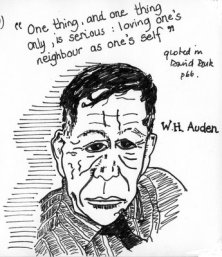
W.H. Auden

This week I am going to focus on W. H. Auden.  You probably know by now how much I love poetry, and Auden is a beautiful poet.  The poem that I will feature tomorrow on this blog is the main reason that I decided to devote a week to Auden and his poetry.

W. H. Auden, (1907-1973)

Described by Edward Mendelson as “the most inclusive poet of the twentieth century, its most technically skilled, and its most truthful,” Auden is the first major poet to incorporate modern psychological insights and paradigms as a natural element of his work and thought. The foremost religious poet of his age, the most variously learned, and the one most preoccupied with existentialism, Auden is also an important love poet.

Although particularly concerned with the relationship of Eros and Agape and characteristically practicing a “poetry of reticence,” Auden celebrates erotic love as a significant element in his geography of the heart.

Born into an upper middle-class professional family in York in 1907 and educated at Christ Church College, Oxford, from which he received his B.A. in 1928, Wystan Hugh Auden was the third son of a physician and a nurse, from whom he imbibed scientific, religious, and musical interests and a love of the Norse sagas. Following his graduation, he spent a year in Berlin, where he enjoyed the city’s homosexual demimonde and absorbed German culture. He returned to teach in public schools in Scotland and England from 1930 to 1935.

In 1938, he married Erika Mann, daughter of the German novelist Thomas Mann, in order to enable her to obtain a British visa and escape Nazi Germany; the marriage was not consummated. In January 1939, disillusioned with the left-wing politics they had embraced, Auden and his friend and frequent collaborator, Christopher Isherwood, emigrated to the United States.

Settling in New York City, Auden soon fell in love with a precocious eighteen-year-old from Brooklyn, Chester Kallman, with whom he maintained a relationship for the rest of his life, sharing apartments in New York and, later, summer residences in first Ischia and then Austria. Auden died in Vienna on September 29, 1973.

Auden dominated the British literary scene of the 1930s, quickly emerging as the leading voice of his generation. With the publication of The Orators (1932) and the enlarged edition of Poems (1933), Auden became, by his mid-twenties, firmly established as an important literary presence, the leader of the “Auden Gang” that included Isherwood, Stephen Spender, C. Day Lewis, and Louis MacNeice.

Auden’s early poetry breathed an air of revolutionary freshness. In language at once exotic and earthy, alternately banal and elegant, colloquial yet faintly archaic, Auden’s verse diagnosed psychic disturbances with an extraordinary resonance. Although most of his early poems have their origins in his personal anxieties, especially those related to his homosexuality and his search for psychic healing, they seemed to voice the fears and uncertainties of his entire generation.

Auden may have initially regarded his gayness as a psychic wound, but he came to see it as a liberating force. In the prose poem “Letter to a Wound” (1932), he writes,

Thanks to you, I have come to see a profound significance in relations I never dreamt of considering before, an old lady’s affection for a small dog, the Waterhouses and their retriever, the curious bond between Offal and Snig, the partners in the hardware shop on the front. Even the close-ups in the films no longer disgust nor amuse me. On the contrary, they sometimes make me cry; knowing you has made me understand.

Auden’s acceptance of his gayness thus leads him to new insight into the universal impulse to love and enlarges his understanding of all kinds of relationships. At the same time, however, Auden is acutely aware of the limitations of eroticism.

His earliest love poems complain of his lack of sexual success, but his poems from the later 1930s such as “May with its light behaving” lament an emotional isolation that accompanies physical intimacy. In the poem beginning “Easily, my dear, you move,” erotic love and feverish political activity are both depicted as expressions of vanity and the desire for power. Auden finally reaches the conclusion that Eros and Agape are interdependent.

Auden’s recognition of the interdependence of Eros and Agape is at the heart of perhaps the greatest love poem of the century, the grave and tender “Lullaby” ([“Lay your sleeping head”] 1937), which moves so nimbly and with such grace among abstractions evoked so subtly that it may well be regarded as the premiere example of the poet’s intellectual lyricism. The luminous moment of fulfillment that the poem celebrates is placed in a context of mutability and decay that poignantly underlines the fragility of a love endangered from within by guilt, promiscuity, and betrayal, and from without by the “pedantic boring cry” of homophobic “fashionable madmen.”

Auden’s marriage to Kallman was not to prove entirely happy (primarily due to Kallman’s promiscuity), but it provided the poet with loving companionship and helped seal the permanence of his self-exile. Auden’s first flush of passion for Kallman immediately inspired several poems of fulfilled erotic love, including “The Prophets,” “Like a Vocation,” “The Riddle,” “Law Like Love,” and “Heavy Date,” in which he tells his lover, “I have / Found myself in you.”

Kallman introduced Auden to opera, an interest that would shape the curve of his career. The partners collaborated on several original libretti, including one for Stravinsky’s The Rake’s Progress (1951), and on translating others.

Auden movingly celebrates his relationship with Kallman in “The Common Life” (1965), which tellingly declares that “every home should be a fortress.” Also among Auden’s late poems is “Glad,” a light but deeply felt account of his relationship with a male hustler, “for a decade now / My bed-visitor, / An unexpected blessing / In a lucky life.”

In “Since,” a poem probably inspired by his relationship with Kallman, Auden suddenly remembers an August noon thirty years ago and “You as then you were.” He juxtaposes the memory of his youthful love-making with an account of the failures of Eros and Agape in the world since then and finds sustenance in the memory: “round your image / there is no fog, and the Earth / can still astonish.”

In a remarkable conclusion that bravely faces the issue of aging with unsentimental wit, he concludes, “I at least can learn / to live with obesity / and a little fame.” A stunning achievement, “Since” validates the vision of Eros as a life-sustaining experience that can compensate at least in part even for the inevitable failures of Agape.

Auden’s homosexuality is also expressed throughout his canon in the camp wit that discerns defensive fun in serious fear, as in the limerick “The Aesthetic Point of View” (1960). Moreover, the humorous self-revelations of the “Shorts” (1960), the “Marginalia” (1969), or “Profile” (1969), as well as the bawdy verse–such as “A Day for a Lay”–circulated among friends, helped establish for Auden a persona that has been particularly influential on younger gay poets, such as James Merrill, Richard Howard, and Howard Moss. In Merrill’s series of adventures with the Ouija board, for example, Auden is a ghostly presence, the embodiment of a homosexual artistic sensibility.

An essay by Claude J. Summers

Summers, Claude J., “Auden, W. H., ” glbtq: An Encyclopedia of Gay, Lesbian, Bisexual, Transgender, and Queer Culture, 2002.  URL: http://www.glbtq.com/literature/auden_wh.html.


Bibliography

Callan, Edward. Auden: A Carnival of Intellect. New York: Oxford University Press, 1983.

Carpenter, Humphrey. W.H. Auden: A Biography. London: Allen & Unwin, 1981.

Farnin, Dorothy J. Auden in Love. New York: Simon & Schuster, 1984.

Mendelson, Edward. Early Auden. New York: Viking, 1981.

Spender, Stephen, ed. W.H. Auden: A Tribute. New York: Macmillan, 1975.

Summers, Claude J. “American Auden.” Columbia History of American Poetry. Jay Parini, ed. New York: Columbia University Press, 1993.

_____. “‘And the Earth Can Still Astonish’: W.H. Auden and the Landscape of Eros.” The Windless Orchard 32 (1978): 27-36.

Wright, George T. W.H. Auden. Rev. ed. Boston: Twayne Publishers, 1981.


Two Male College Students Break Guinness World Record, Raise GLBTQ Awareness

image

The Guinness Book of World Records may have a new entry.

Matty Daley and Bobby Canciello, both gay men, have apparently broken the record for the world’s longest kiss after locking lips for nearly 33 hours. The record was formerly held by Nicola Matovik and Kristina Reinhart, a German couple.

As they said on their website, “After years of fighting bigotry and discrimination, it’s time to put down our words and demonstrate otherwise. When there’s nothing left to say, say it with a kiss.”

While most college students spent their weekend with friends or catching up on homework, Daley and Canciello, both students at The College of New Jersey (TCNJ), stood kissing from Saturday morning to Sunday night. The kiss was streamed live on the Internet, with thousands of viewers watching. Neither Daley nor Canciello ate, slept, sat, or used the bathroom for the duration (and as per official Guinness rules, neither wore adult diapers or sanitary napkins).

Daley and Canciello stood for the entire kiss under a small tent set up in a central part of the TCNJ campus in full view of people passing by. An audience gathered for the “finale” Sunday night, after which Daley and Canciello took a bow.

Officials from Guinness World Records will now review the taped material to determine if the record has in fact been broken. The record would be published in the 2012 print edition of the book, because the 2011 version was just released this month. If entered into the Guinness Book of World Records, the best-selling book series under copyright of all time, Daley and Canciello will be the first same-sex pairing to hold the record for longest continuous kiss.


October Is GLBT History Month: Finally

Eleanor Roosevelt
First Lady
b.  October 11, 1884
d.  November 7, 1962
“No one can make you feel inferior without your consent.”
image Eleanor Roosevelt transformed the role of First Lady. She served as a diplomat and was a tireless champion of international human rights.
Roosevelt was born into a wealthy family in New York City. Both her parents died before she was 10; thereafter, she moved in with her grandmother in upstate New York. At the age of 15, she lived in England, where she learned to speak French and Italian fluently.
Soon after her return to New York, Roosevelt met her future husband, Franklin Delano Roosevelt, her father’s fifth cousin. Franklin was attending Columbia Law School. The couple married and had six children, five of whom survived infancy. Franklin took his first leap into politics, winning a seat in the New York State Senate. The family moved to Washington, D.C., when he was appointed Assistant Secretary of the Navy by President Wilson.
Life in the nation’s capital kindled Eleanor’s interests in policy making.  She joined the board of the League of Women Voters in 1924 and became involved in Democratic Party politics. In 1928, after her husband was elected governor of New York, she became actively engaged in domestic and international issues. She wrote a syndicated newspaper column titled “My Day.”
In 1933, Roosevelt became First Lady of the United States, a position she held for 12 years. While she assumed traditional duties, she did not allow them to compromise her ideals. In 1939, she announced in her column that she would resign her membership in the Daughters of the American Revolution, after the group refused to allow Marian Anderson, a black singer, to perform in Washington’s Constitution Hall. “The basic fact of segregation,” Roosevelt wrote, “is itself discriminatory.”
While First Lady, Roosevelt developed an intimate relationship with Lorena Hickock, a journalist who covered the White House. The relationship lasted for the rest of Roosevelt’s life.
Eleanor Roosevelt’s commitment to public service continued after her husband’s death in 1945. President Truman named her a delegate to the United Nations, where she was elected chairwoman of the Commission on Human Rights. In that position, she helped draft the influential Universal Declaration on Human Rights. 
Roosevelt was a member of the Board of Trustees of Brandeis University and delivered the school’s first commencement address. She also authored several children’s books. In her lifetime, she received many civic awards and honorary degrees.
Jalal al-Din Rumi
Sufi Mystic/Poet
b. September 30, 1207
d. December 17, 1273
“Only from the heart can you touch the sky.”
image Jalal al-Din Rumi was a poet, theologian and Sufi mystic. He founded the Order of the Whirling Dervishes, a branch of the Sufi tradition that practicies a gyrating dance ritual representing the revolving stages of life.
Rumi was born in the Persian province of Balkh, now part of Afghanistan. Rumi’s father was an author, a religious scholar and a leader in the Sufi movement—the mystical dimension of Islam.
When Rumi was 12, his father moved the family to escape the impending invasion of Mongol armies, eventually setting in Konya, Anatolia, the westernmost tip of Asia where Turkey is today.
In 1231, after his father died, Rumi began teaching, meditating and helping the poor. He amassed hundreds of disciples who attended his lectures and sermons.
Rumi was married and had one son. After his wife’s death, he remarried and fathered two more children. In 1244, Rumi met a man who changed his life. Shams of Tabriz was an older Sufi master who became Rumi’s spiritual mentor and constant companion. After Shams died, Rumi grieved for years. He began expressing his love and bereavement in poetry, music and dance.
Rumi had two other male companions, but none would replace his beloved Shams. One of Rumi’s major poetic works is named in honor of his master, “The Works of Shams of Tabriz.” Rumi’s best-known work is “Spiritual Couplets,” a six-volume poem often referred to as the greatest work of mystical poetry.
In “Rumi: The Book of Love Poems of Ecstasy and Longing” (2003), Rumi expresses his perception of true love. “Lovers don’t finally meet somewhere. They’re in each other all along.”
Rumi died surrounded by his family and disciples. His tomb is one of the most revered pilgrimage sites in Islam and is a spiritual center of Turkey.
David Sedaris
Writer/Humorist
b. December 26, 1956
“A good short story would take me out of myself and then stuff me back in, outsized, now, and uneasy with the fit.”
image David Sedaris is an award-winning best-selling author whose short stories depict, variously, the life of a young gay man in 20th century America, the experience of an American living abroad and the comedy of family life.
Sedaris, who was one of six children, was born in Binghamton, New York, and grew up in Raleigh, North Carolina. In 1983, he graduated from the School of the Art Institute of Chicago. He began writing and supported himself with odd jobs in Raleigh, in Chicago and eventually in New York. His big break came on National Public Radio, where he read his short stories.
Called the “preeminent humorist of his generation” by Entertainment Weekly, Sedaris is the author of numerous collections: “Barrel Fever” (1994), “Naked” (1997), “Holidays on Ice” (1997), “Me Talk Pretty One Day” (2000), “Dress Your Family in Corduroy and Denim” (2004) and “When You are Engulfed in Flames” (2008), which was number one on the New York Times best-seller list. He edited a 2005 collection of stories called “Children Playing Before a Statue of Hercules,” the proceeds from which benefit a nonprofit writing and tutorial center.
Sedaris is known for his distinctive style, combining elements of memoir, humor and the traditional short story. He is clear that his stories are embellished. “I’m a humorist,” he says. “I’m not a reporter.”
Sedaris is a frequent contributor to the award-winning “This American Life” public radio show. Along with his sister Amy, he is the author of numerous plays written under the name “The Talent Family.” He has been nominated for two Grammy Awards and was named Time magazine’s Humorist of the Year in 2001. In 2008, he delivered the commencement speech at Binghamton University and was awarded an honorary doctorate. 
Sedaris lives in London, Paris and Normandy with his longtime partner, Hugh Hamrick. 
Matthew Shepard
Hero      
b.  December 1, 1976
d.  October 12, 1998
“Every American child deserves the strongest protections from some of the country’s most horrifying crimes.” – Judy Shepard
image As a gay college student, Matthew Shepard was the victim of a deadly hate crime. His murder brought national and international attention to the need for GLBT-inclusive hate crimes legislation.
Shepard was born in Casper, Wyoming, to Judy and Dennis Shepard. He was the older of two sons. Matthew completed high school at The American School in Switzerland. In 1998, he enrolled at the University of Wyoming in Laramie. Soon afterward, he joined the campus gay alliance.
On October 6, 1998, two men—Aaron McKinney and Russell Henderson—lured Shepard from a downtown Laramie bar. After Shepard acknowledged that he was gay, McKinney and Henderson beat and tortured him, then tied him to a tree in a remote, rural area and left him for dead. Eighteen hours later, a biker, who thought he saw a scarecrow, found Shepard barely breathing.
Shepard was rushed to the hospital, but never regained consciousness. He died on October 12. Both of Shepard’s killers were convicted of felony murder and are serving two consecutive life sentences.
Despite the outcome of the trial, the men who took Shepard’s life were not charged with a hate crime. Wyoming has no hate crimes law, which protects victims of crimes motivated by bias against a protected class. Shepard’s high-profile murder case sparked protests, vigils and calls for federal hate crimes legislation for GLBT victims of violence.
Shortly after their son’s death, Judy and Dennis Shepard founded The Matthew Shepard Foundation to honor his memory and to “replace hate with understanding, compassion, and acceptance.” Judy Shepard became a GLBT activist and the most recognized voice in the fight for a federal hate crimes bill.
In 2009, more than a decade after Shepard’s murder, The Matthew Shepard and James Byrd Jr. Hate Crimes Prevention Act (HCPA) was signed into law. HCPA added sexual orientation and gender identity to the list of protected classes, giving the United States Department of Justice the power to investigate and prosecute bias-motivated violent crimes against GLBT victims.
Dozens of songs have been written and recorded to honor Matthew Shepard’s legacy.  Several films, television movies and plays about him have been produced, including “The Laramie Project” (2002) and “The Matthew Shepard Story” (2002).
Jóhanna Sigurðardóttir
Prime Minister of Iceland
b. October 4, 1942
“Egalitarian policies are the best way to unite and empower people.”
image Jóhanna Sigurðardóttir is the first female prime minister of Iceland and the world’s first openly GLBT national leader.
Sigurðardóttir was born in Reykjavik, where she received the equivalent of a high school diploma from the Commercial College of Iceland. Her first job was as a flight attendant for what is now Icelandair. After six years in that position, she became a union organizer with the airline—a move that served as her entree into Icelandic politics.
Sigurðardóttir was elected to Iceland’s Parliament in 1978. Viewed as a rising star, she was named minister of social affairs in 1987. In 1990, she ran for the top spot in her party, the Social Democrat Alliance. She narrowly lost that race, declaring, “My time will come,” which has become a common catchphrase in Iceland.
In January of 2009, following the collapse of the nation’s economy in the worldwide recession, Iceland’s president asked the Social Democrat Alliance to form a new government, which elevated Sigurðardóttir to the office of the prime minister. At the time of her appointment, she was the longest-serving member of Iceland’s Parliament.
Four months later, Sigurðardóttir’s party, along with its coalition partner, won a majority of seats in the Parliament, handing her a strong mandate to lead Iceland’s economic revitalization efforts and to work toward joining the European Union. While focusing on these important tasks, Sigurðardóttir has not forgotten the value of equity in politics. “A society that does not use the intellectual power of its female population fully is not a wise society,” she says.
Sigurðardóttir was married to a man prior to coming out. She and her ex-husband are the parents of two adult children. On June 11, 2010, by a vote of 49 to 0, Iceland’s Parliament approved same-sex marriage. On June 26, 2010, the first day that legislation became effective, Jóhanna Sigurðardóttir and Jónína Leósdóttir were married. 
Pyotr Ilyich Tchaikovsky
Composer 
b. May 7, 1840
d. November 6, 1893
“Music’s triumphant power lies in the fact that it reveals to us beauties we find in no other sphere.”
image Pyotr Ilyich Tchaikovsky is one of the most popular composers in history. His best-known works include the ballets “Swan Lake,” “The Sleeping Beauty,” and “The Nutcracker”;  the operas “The Queen of Spades” and “Eugene Onegin”; and the widely recognized Fantasy Overture “Romeo and Juliet” and “1812 Overture.”
Tchaikovsky was born in Votinsk, Russia, a small industrial town. His father was a mine inspector. His mother, who was of French and Russian heritage, strongly influenced his education and cultural upbringing.
At age 5, Tchaikovsky began piano lessons. His parents nurtured his musical talents, but had a different career path in mind for their son. In 1850, the family enrolled him at the Imperial School of Jurisprudence in St. Petersburg, where he prepared for a job in civil service.
After working in government for a few years, Tchaikovsky pursued his passion at the St. Petersburg Conservatory. After graduation, he taught music theory at the Moscow Conservatory and worked on new compositions. Tchaikovsky created concertos, symphonies, ballets, chamber music, and concert and theatrical pieces. His passionate, emotional compositions represented a departure from traditional Russian music, and his work became popular with Western audiences.
Despite his career success, Tchaikovsky’s personal life was filled with crises and bouts of depression. After receiving letters of admiration from a former student, Tchaikovsky married her. Historians speculate the marriage took place to dispel rumors that Tchaikovsky was gay. The marriage was a disaster and Tchaikovsky left his wife after nine days.
Tchaikovsky began an unconventional relationship with a wealthy widow, Nadezhda von Mek, who agreed to be his benefactor on one condition: they were never to meet face to face. The couple exchanged more than 1,000 letters, until von Mek abruptly ended their 13-year liaison.
The famed composer died suddenly at age 53. The cause of his death, believed by some to be suicide, remains a mystery.
Rufus Wainwright
Singer/Songwriter
b. July 22, 1973
“It’s important for famous people to be an example for gay teens.”
image Known for his unique style and daring artistic endeavors, Rufus Wainwright is one of the most accomplished singer/songwriters of his generation. He has produced six albums and is the recipient of two Juno Awards and five GLAAD Media Awards.
Wainwright’s musical talent was shaped by his folksinger parents, Kate McGarrigle and Loudon Wainwright III. He was born in Rhinebeck, New York, and holds dual United States and Canadian citizenship. After his parents divorced, he spent most of his youth with his mother in Montreal.
At age 14, Wainwright broke into the entertainment world with a song he composed and sang in the film “Tommy Tricker and the Stamp Traveller,” earning him a Juno Award nomination for “Most Promising Male Vocalist of the Year.” That same year, he was sexually assaulted by a man he met at a bar. Deeply disturbed by the attack, he remained celibate for seven years.
In 1998, following the release of his first album, Wainwright was named “Best New Artist” by Rolling Stone. He composes music for theater, dance and opera, and has contributed to numerous film soundtracks, including “Moulin Rouge” and “Brokeback Mountain.” Additionally, he has acted in “The Aviator” and “Heights,” among other films.
As a collaborator, Wainwright has worked on albums with music greats Rosanne Cash and Elton John. John hailed him as “the greatest songwriter on the planet.” His first opera, “Prima Donna,” premiered in 2009 at the Manchester International Festival and was the subject of a documentary film that premiered on Bravo! in 2010.
Despite fame and success, Wainwright struggled with crystal meth addiction, a habit he eventually recovered from in 2002. With two decades of performing under his belt, Wainwright assures his fans that he won’t be retiring any time soon: “I am a self-sustaining, vibrant, long-term artist, and I’m not going away!” 
Mel White
Minister/Activist
b. July 26, 1940
“I’m perfectly happy going on TV now and saying I’m a gay man. I’m happy and proud to say that.”

image Mel White is an ordained minister who left his career as an adviser to prominent Christian evangelists when he came out during the mid 1990’s. White has dedicated his life to gaining acceptance for GLBT Christians.
In 1962, White graduated from Warner Pacific College. He received a master’s degree in communications from the University of Portland and a Doctorate of Ministry from Fuller Theological Seminary in Pasadena, California, where he was also a professor.
Early in his career, White served as a speechwriter for evangelical leaders Jerry Falwell and Pat Robertson. He married a woman with whom he had one son. When he realized he was attracted to men, he tried to “cure” his homosexuality with therapy and exorcism.  Acknowledging that nothing could alter his sexual orientation, White attempted suicide.
White ultimately accepted his sexuality and amicably divorced his wife. In 1993, he publicly acknowledged that he was gay when he was named dean of the Dallas Cathedral of Hope of the Universal Fellowship at Metropolitan Community Churches. Two years later, he published “Stranger at the Gate,” a book that chronicles his struggles as a gay Christian.
In the early 1990’s, White shifted his focus to GLBT advocacy, both within and outside of the church. In 1996, White led a two-week fast on the steps of Congress as the Senate considered and ultimately passed the Defense of Marriage Act. He moved the fast to the White House, where he was arrested. “How can we stand by in silent acceptance while the president and the Congress sacrifice lesbian and gay Americans for some ‘greater political good’?” he asked.
In 1998, White and his partner of more than 25 years, Gary Nixon, founded Soulforce, an organization whose mission is to “seek freedom from religious and political oppression” for GLBT people. Its name comes from “satyagraha,” a term meaning “soul force” used by Gandhi in to describe his civil rights struggle.
White is the author of nearly 20 books, including “Religion Gone Bad: Hidden Dangers from the Christian Right” (2009). His story is featured in “Friends of God” (2007), a documentary film about evangelical Christians.
In 2008, White and Nixon were legally married in California. In 2009, White and his son, Mike, were a team on the 14th season of “The Amazing Race.”
Emanuel Xavier
Poet   
b. May 3, 1971  
“Being Latino and gay gives me much to write about. Anything that oppresses us as artists is always great fodder for art.”
image Emanuel Xavier is a poet, author and editor. He is one of the most significant openly gay Latino spoken word artists of his generation. 
Xavier was born in Brooklyn, New York, the child of an Ecuadorian mother and a Puerto Rican father who abandoned the family before his son was born. When Xavier was three, he was sexually abused by a family member. At 16, when Xavier came out to his mother, she threw him out of the house.
A homeless gay teen on the streets of New York, Xavier soon turned to sex and drugs for money. He became a hustler at the West Side Highway piers and sold drugs in gay clubs. After landing a job at a gay bookstore, A Different Light, Xavier began to write poetry and perform as a spoken word artist.
“Pier Queen” (1997), Xavier’s self-published poetry collection, established him in the New York underground arts scene. “Christ Like” (1999), Xavier’s novel, was the first coming of age story by a gay Nuyorican (Puerto Rican living in New York) and earned him a Lambda Literary Award nomination. Fellow author Jaime Manrique said, “Once in a generation, a new voice emerges that makes us see the world in a dazzling new light. Emanuel Xavier is that kind of writer.”
“Americano” (2002), another poetry collection and Xavier’s first official published work, advanced his prominence within the literary community of color. Xavier edited “Bullets & Butterflies: Queer Spoken Word Poetry” (2005), for which he received a second Lambda Literary Award nomination. 
In 2005, Xavier was the victim of a random attack by a group of young men. As a result of the beating, he lost all hearing in his right ear, but continued to write and perform.
Xavier reflects on the assault in his poem “Passage”:

Had they known I was gay they would have killed me
None of my poems about peace and unity
would have kept me whole

Also an activist, Xavier focuses his work on homeless gay youth. He has organized benefits for many organizations, including The New York Pier AIDS Education Coalition, Live Out Loud, and Sylvia’s Place, a shelter for homeless GLBTQ youth.
Xavier has appeared on HBO’s “Russell Simmons Presents Def Poetry” and “In the Life” on PBS. In 2010, his CD “Legendary—The Spoken Word Poetry of Emanuel Xavier” was released to critical acclaim.