“If there is ever to be peace, it won’t be authentic until each individual achieves peace within [them]self, expels all feelings of hatred for a race or group of people, or better, can dominate hatred and change it into something else, maybe even into love- or is that asking too much? It’s the only solution.”
– Etty Hillesum
I came across this post in my daily email from Queer Theology. I’ll be honest, I had never heard of Etty Hillesum, who was a diarist and Holocaust victim. There is probably a reason for that. Her diaries are not of a young girl like those of Anne Frank, but a woman who was open about her sexuality. In one of her writings she wrote, “I am accomplished in bed.” Hillesum journaled for two years and three months. In her first entry, she boasted of being, “just about seasoned enough I should think to be counted among the better lovers.” She was then sleeping with the man she was living with, Han Wegerif, a widower of 62. Soon, Etty would be sleeping with her therapist, Julius Spear. When it came to sexual freedom, Etty was a woman ahead of her time. But besides being a sexually free woman of the 1940s, who was Etty Hillesum?
Etty Hillesum was born on 15 January 1914 in Middelburg, Netherlands. After leaving school in 1932, she went to Amsterdam to study law. She also studied Slavic languages in both Amsterdam and Leiden. She greatly enjoyed student life moving several times within Amsterdam before settling down in an apartment on the Gabriël Metsustraat in 1937 which she shared with Wegerif. She lived in that apartment until her final departure for Westerbork (a Dutch camp that served as a staging ground for the deportation of Jews) in June 1943, and it was there in the Gabriël Metsustraat that she wrote her diaries.
At Westerbork, Etty was assigned to the registration of arrivals and acted as a social worker, psychologist, and spiritual counselor. The survivors of that period testified to her radiant personality and her great dedication. “One would like to be a balm poured on so many wounds.” She devoted herself to others and bore the daily brunt of the stress in the camp such as the deportation of a part of its population every weekend. She finally fell ill, but thanks to her status, was allowed to go back to Amsterdam to be treated. Despite such pressure, Etty nevertheless remained determined to write, and she kept up her journaling.
On June 5, 1943, when friends offered to help her hide, she chose instead to return to Westerbork and stay there to continue her work. She also had the opportunity to help her parents and her brother Misha who had been the victims of the great roundup of June 20-21, 1943. An unfortunate letter written by Etty’s mother to H.A. Rauter, the Commanding Officer of the police and the SS in the Netherlands, exasperated him and caused the entire Hillesum family to be deported. On September 7, 1943, they were sent to Auschwitz with 986 other Jews. According to the Red Cross, Etty was thought to have died there on November 30, 1943.
What survives her is a diary covering the last three years of her life. In Etty’s diary we discover her as she really was, day by day, and this presence which we perceive in her writing moves us much more than a biography written by someone else. A few letters also remain. They were published in 1982, and give us a deeply moving picture of Westerbork: “the home of Jewish suffering” stuck in the mud and barbed wire where Etty depicts men, women, children, old people who have nothing left except “the thin cover of their humanity.” The end of her diary written in Westerbork unfortunately disappeared with her at Auschwitz.
The quote above shows her feelings about humanity. With protests, divisive politics, and an emerging police state surrounding us every day, we need to take her words to heart. We can honor her legacy by expelling those feelings of hatred we may have and achieve peace. We can turn our negative feelings to love and create a better world. I think Etty makes a very good point. It is something we should strive for in our lives.
When I wrote last Friday’s post on homophobic language I said, “The words gay (used in a demeaning fashion), fag, sissy, fairy, queer, faggot can do psychological damage to a young person especially when used in a degrading way.” Roderick, a reader of this blog, and always such a sweet darling, asked, “Joe, interesting that you don’t even mention the term “queer.” Is it or is it not homophobic?” I pointed out that I had mentioned it; however, it was a brief comment. So, I thought perhaps I should do another post on derogatory gay euphemisms. They have been used in movies, by politicians, religious leaders, and everyday people. This is by no means an exhaustive list. Below are some terms I feel are important to address.
The first term is gay when used in a demeaning fashion. It is interesting how that word came to mean homosexual. It appears to have its origins around the 12th century in England derived from the Old French word ‘gai’, which in turn was probably derived from a Germanic word though that isn’t completely known. The word’s original meaning meant something “joyful”, “carefree”, “full of mirth”, or “bright and showy.” However, around the early part of the 17th century, the word began to be associated with immorality. Fast-forward to the 19th century, and the word referred to a woman who was a prostitute or a gay man who slept with a lot of women (ironically enough) often prostitutes.
However, in the 1920s and 1930s, the word’s meaning began to change. In its sexual definition, a gay man no longer meant a man who had sex with a lot of women, but now referred to men who had sex with other men. By 1955, the word officially acquired the added definition of homosexual male. The 1938 movie, Bringing Up Baby, was the first film to use the word gay to mean homosexual. In one scene, Cary Grant ends up having to wear a lady’s feathery robe. When another character asks why he is wearing that he responds with an ad-libbed line, “Because I just went gay.” At the time, mainstream audiences didn’t get the reference, so the line was popularly thought to have meant, “I just decided to be carefree.” Whether Grant meant gay as in homosexual or gay as in carefree is up for debate, but rumors about Grant’s sexuality have always been around especially when it pertained to his relationship with Randolph Scott.
Queer is a word particularly traumatic for me. I don’t like hearing it, and I don’t use it. Some people classify queer as a sexuality different from gay especially in the term genderqueer another word for non-binary. Merriam-Webster defines “queer” as a “sometimes disparaging & offensive” term for same-sex attraction. Some LGBTQ+ activists began to reclaim the word as a deliberately provocative and politically radical alternative to the more assimilationist branches of the LGBTQ+ community. Even with that usage, I still find it offensive because of personal experiences. As I said in Friday’s post, “When the gay community normalizes these words, they don’t know the traumatic affect it can have on someone younger.” When it comes to the word queer, I find it homophobic, and it causes a great deal of discomfort. However, others in the LGBTQ+ community don’t see it that way as long as it’s within the LGBTQ+ community or in academic usage such as queer studies. I guess it is up to which side of the fence you fall.
My daddy always told me not to be a sissy. I hate the word. I think we all know this, but it deserves repeating: sissy (derived from sister), also sissy baby, sissy boy, sissy man, sissy pants, etc., is a pejorative term for a boy or man who is not traditionally masculine and shows possible signs of fragility. Sissy implies a lack of courage, strength, athleticism, coordination, testosterone, male libido, and stoic calm all of which have traditionally been associated with masculinity and considered important to the male role in Western society. A man might also be considered a sissy for being interested in traditionally feminine hobbies or employment (e.g., fashion), displaying effeminate behavior (e.g., using hair products, displaying limp wrists), being unathletic, being homosexual. By the 1930s, the most damning insult was to be called a sissy; the word was widely used by American football coaches and sports writers to disparage rival teams, and to encourage ferocious player behavior. Good students were taunted as sissies, and clothing styles associated with higher social classes were demeaned as sissified.
Fairy denotes not only homosexuality but effeminacy. It has been used when speaking of gay men for over 100 years. One example of its use was from the Roaring Twenties. On a Friday night in February 1926, a crowd of some 1,500 packed the Renaissance Casino in New York City’s Harlem neighborhood for the 58th Masquerade and Civil ball of Hamilton Lodge. The New York Age reported nearly half of those attending appeared to be “men of the class generally known as ‘fairies,’ and many Bohemians from the Greenwich Village section who [….] in their gorgeous evening gowns, wigs, and powdered faces were hard to distinguish from many of the women.” For the most part, fairy has been stripped of its power by the Radical Faerie movement and new-era queers. On a side note, Faerie Camp Destiny, the Radical Faerie sanctuary in New England, began in the town where I currently live though it has since moved. (It is now in southern Vermont.) Radical Faeries have always been a special group in the gay hippie sanctuary of Vermont.
While growing up, I heard other phrases from my mother. She would describe gay men as having “sugar in their shorts,” that they were “light in the loafers,” or the ever-popular “queer as a $3 bill.” Because of my mother’s derisive use of these phrases, I particularly hate them. Though I don’t remember my mother using it, “limp-wristed” was another common phrase. Holding your hand up and flipping your wrist down so it looks limp has been a code I’ve known for most of my life to mean gay. Southerners have always enjoyed using colorful language to disparage people. Sodomite was well-known in the South during the 19th century. Though it is the place where LGBTQ+ people have the least rights and respect, a Williams Institute study looking at LGBTQ+ demographics across the United States found that the South had the largest LGBTQ+ population of all other regions in America. With an LGBTQ+ population of 3,868,000, the South surpassed every other region in its makeup of the 11,343,000 Americans—roughly 4.5 percent – that “identify as lesbian, gay, bisexual, or transgender.” Eventually, the South will have to wake up and start treating their own people better.
Before ‘’gay’’ became common and accepted parlance, the world had many other unofficial names for men who liked men. Some names were self-created by the gay community, and others were thrust, often cruelly, upon gay, bi, and queer men. Following are a few terms used in the past some of which are thankfully becoming obsolete while others are being reclaimed by the gay community. Mary is a mostly innocuous term from the middle 20th century used among gay and bi men. It was first mentioned in the early 1900s and has been reclaimed by the gay community. An example is Hamburger Mary’s Bar & Grille, a gay-themed and LGBT-friendly burger restaurant chain started in San Francisco in 1972. The eateries are often in gay neighborhoods and are intended to represent stereotypical gay culture through humorously named menu items, flamboyant décor with many of their locations hosting drag shows on weekends.
Nancy boy is based on a vaudeville term. The ‘nance,’ was a gay burlesque character from the 1930s who created laughs as he pranced about the stage creating campy scenes and sketches of gay life. The ‘nance’ character put on an outrageous show and was popular with audiences. In the late 1930s, New York Mayor Fiorello LaGuardia, fearful of how the lurid burlesque shows would make his city look in the upcoming World’s Fair of 1939, cracked down on burlesque houses. Part of LaGuardia’s anger was aimed at the ‘nance’ whom critics said created audiences of lusty gay men having sex in the dark balconies of the burlesque emporiums. It was an outrage, the Mayor said, and police began swooping down on burlesque shows closing many and forcing others to drop the ‘nance’ act or greatly curb it. The term has always been used to mock gay men and today is still used in a derogatory fashion.
Flowers have a long association with the LGBTQ community. The American “Pansy Craze” of almost 100 years ago cemented the use of that flower’s name as a slang term for gay men. During the Pansy Craze of 1930–1933, drag queens, known as “pansy performers”, experienced a surge in underground popularity especially in Los Angeles, New York, Chicago, and San Francisco. Oscar Wilde earlier turned the green carnation into a symbol for gay men in England by wearing one in his lapel. Violets were associated with Sappho herself, and the calamuswith Walt Whitman. A pre-Stonewall gay bar at the corner of Christopher Street and Gay Street was called The Flower Pot. While we don’t know whether “lavender” refers to the color or the herb, either way, the word seems to have been used in connection with gay men since the 1920s. It’s now used interchangeably with “rainbow” to mean “LGBTQ+” at events like Lavender Graduations, and the annual Lavender Law Conference of the LGBT Bar Association.
While we are on the subject of plants, a “fruit” is another euphemism for a gay man. I don’t think “fruit” has been reclaimed. It still gets under my skin. It’s a word used to laugh at us. When I first came out in graduate school, one of my professors walked up to me at a bar gathering of the History Department and drunkenly said, “Congratulations, I hear you are a fruit.” I was horrified. It was an inappropriate thing to say to a student. He was a very rude man from Canada, a historian of Latin America. Canadians don’t tend to be so rude at least I’ve never found them to be. However, it’s what I’d expect from a Latin America historian. Sorry if you are one, hopefully this doesn’t pertain to you, but I have always found them not to be the nicest of people. When it comes to historians, we all have our own quirks associated with our disciplines; medievalist are always a strange bunch of people, military historians tend to be rivet counters (obsessing on minutiae of their particular interest, especially military and technology history), oral historians tend to be the most liberal and social justice-minded. I could go on, but I will likely offend someone if I haven’t already. Besides, I’m off topic.
I know this list is only the tip of the iceberg. I stayed with American euphemisms and derogatory terms. I did not delve into words and phrases for the rest of the LGBTQ+ spectrum. Lesbians, bisexuals, transgender, non-binary, etc., have derogatory terms directed at them. I also didn’t discuss the more subtle and not so subtle terms used in politics for gay-baiting such as fussy, hysterical, San Francisco, wine drinker, lifestyle, etc. Then there is the rest of the world who have their own terms; the list goes on and on and on. While terms are being reclaimed by some in the LGBTQ+ community, I cannot stress this enough: many of them will continue to be hurtful to other members of the community. Childhood and family trauma live with a person their entire lives. It is forever. When you grow up hearing words and phrases used derogatorily and directed at yourself, it is almost impossible to reclaim them and use them for your own empowerment.
On July 4, 1965—four years before Stonewall—39 activists from D.C., New York, and Philadelphia marched on the place where the Declaration of Independence had been signed roughly two centuries earlier. They wanted to remind the nation that their rights of “life, liberty, and the pursuit of happiness” had been denied. Dressed in formal attire—the men in coats and ties, and many of the women in skirts and dresses—they carried signs that read Equal Treatment Before the Law and Homosexual Bill of Rights.
For the next four years, the organizer of that protest, Craig Rodwell, along with his comrades, Barbara Gittings and Kay Tobin Lahusen, marched in Philadelphia. Their demonstrations became known as “the Annual Reminders.” But in the summer of 1967, Rodwell also decided to do something that was, in its own quiet way, more radical than marching. He wanted to open a bookstore. Rodwell was the vice president of the Mattachine Society, a gay male political group. He wanted to make the Society more accessible to people, instead of just sitting in an office. He wanted the Society to set up a combination bookstore, counseling service, fund-raising headquarters, and office. When the Mattachine Society rejected Rodwell’s plans to open a bookstore, he resigned from the group and decided to do it alone.
The Stonewall protests two years later would draw broad attention to the struggle for gay liberation, but that struggle did not start in 1969. There were protests, and thriving gay communities, before that night in New York City—and Stonewall’s success was rooted in those earlier efforts. Activists like Rodwell understood the value of visibility; he was among the architects of New York’s gay-pride parade. But some were struggling not just for rights or liberation, but for something still more revolutionary. They were fighting for what they called “gay power,” the authority to define their own identity. Their efforts produced the intellectual revolution that lent the Stonewall protests their power, and which helped ensure that long after the protests were over, the changes they wrought would endure. The victories of Stonewall, then, had the unlikeliest of birthplaces: the Oscar Wilde Memorial Bookshop.
In 1967, there were no gay community centers, save San Francisco’s Society for Individual Rights, that offered cultural programming and recreational activities. There were no gay bookstores that included shelves of gay books. In fact, there was no such thing as serious gay nonfiction. Libraries had systematically cataloged homosexuality as a deviance or a disorder. There were the occasional novels—notably, The Well of Loneliness, published by Radclyffe Hall in the United Kingdom in 1928—but mostly there was pulp fiction and porn, and novels that had queer subtexts. In 1870, Bayard Taylor had published Joseph and His Friend: A Story in Pennsylvania, widely considered to be the first American gay novel. Joseph and His Friend was the story of a newly engaged young man who finds himself instead falling in love with another man. The book was not well received. Then there is Bertram Cope’s Year, a 1919 novel by Henry Blake Fuller, which is sometimes also called the first American gay novel, but it was never widely circulated, and the gay theme was never fully specified. Gay novels have always had a specific but not large audience. When I was in my late teens and early twenties, gay literature was very hard to find in bookstores. It was even worse in the decades before I was born.
Therefore, Rodwell wanted a bookstore that would provide LGBTQ people with intellectual engagement as well as books on homosexuality. He also wanted the store to offer psychological-counseling services because, in 1967, the American Psychiatric Association still listed homosexuality as a mental illness in its diagnostic and statistical manual. For many queer people in the 1960s, the search for books, which offered some clues about homosexuality, was how they navigated their way out of the closet. When I first wanted to find out what it meant to be gay and was trying to understand my sexuality, the internet wasn’t widely available, and books were the only place to turn. When I was in college, Books-A-Million and their mall store Bookland had few if any gay books. Luckily, Montgomery had a Barnes and Noble back then, and the store did have a small gay literature section. It was worse in the 1960s. Those who went looking for gay books typically came up empty-handed.
Rodwell boarded a bus and headed to Fire Island, a Long Island beach town that had become a gay hub, with the hope that he could earn enough money working as a bartender to open the store. Three months later, he arrived back in New York City. He found a storefront in the Village with a rent of $115 a month. He had to come up with the first month’s rent plus two month’s security. That amount came to $345, which was one third of what he’d earned tending bar. So, he paid the rent and security deposit and opened the first-ever gay bookstore in the world at 291 Mercer Street, between Waverly Place and East Eighth Street. In 1973, Rodwell moved the store to 15 Christopher Street. He kept the Mercer Street store open for several months, for “sentimental reasons,” but finally closed it in May 1974.
He wanted a name that would tell people what the shop was about, so he tried to thin of the most prominent person whose name I could use who is most readily identifiable as a homosexual by most people. Oscar Wilde seemed the most obvious at the time, so he called it the Oscar Wilde Memorial Bookshop.
Rodwell planned the official opening for a few months later, on November 24, 1967. His mother arrived from Chicago the day before and they stayed up all night setting up the store. His plan to offer counseling services never came to fruition, but the store itself proved unexpectedly radical. The few identifiably queer books that could then be found in libraries—by Hall or Wilde or any other queer writers—were scattered by differences in genre, nationality, and date of publication. As Rodwell and his mother placed books by queer authors on the same shelf, they redefined the meaning of homosexuality. It was no longer simply a deviance or a disorder. It was, instead, a coherent category—with shelves of books to prove it.
The bookshop was immediately popular within the gay community. The store was packed, especially on Saturday afternoons, when Rodwell served free coffee and pastries. News of the Oscar Wilde Memorial Bookshop traveled around the country, and around the world. Gay readers wrote to Rodwell, asking for book suggestions and praising him for making LGBTQ novels, newspapers, and pamphlets available. Young men wrote, asking for advice on how to come out. European tourists told their friends, who made it a point to visit the Oscar Wilde Bookshop on their trips to New York. American soldiers stationed in Vietnam ordered books and asked for magazine subscriptions to The New York Hymnal, a journal Rodwell founded and edited. A handful of Americans and Europeans wrote to Rodwell asking for help on how to establish their own stores, which led, for example, to the creation of Giovanni’s Room in Philadelphia. (The store title was taken from the title of James Baldwin’s 1956 homoerotic novel, which was the first gay book I ever bought and read.) The bookshop had not only become a major touchstone for New Yorkers but also symbolized the promise of gay liberation to many others throughout the world.
On June 28, 1969, Rodwell was walking home from a bridge game with a friend when he heard noise coming from the Stonewall Inn, a gay bar that had been owned by the Mafia and frequently raided by the police. At first, he ignored it, but then he noticed that a crowd had formed around the police wagon; people were resisting being handcuffed by the police. Rodwell climbed onto the steps of the highest stoop and yelled, “Gay power!” and “Christopher Street belongs to the queens!”
While Rodwell and others defined homosexuality on their own terms, refusing to allow those in positions of authority to be the sole authors of their identity, the revolution was not over. Discrimination continued. Decades of activism lay ahead. The Stonewall uprising amplified the work that Rodwell and others had been doing before 1969. And it was those networks of activists, and the intellectual revolution they set in motion—reclaiming and defining their own identity—that transformed Stonewall from an isolated event into a turning point in the struggle for gay liberation. The protests themselves eventually ended, but the books and articles these activists published endure, and continue to inspire new generations. The Oscar Wilde Bookshop closed on March 29, 2009 citing the Great Recession and challenges from online bookstores.
This post was adapted from an article in The Atlantic by Jim Downs, a history professor at Connecticut College.
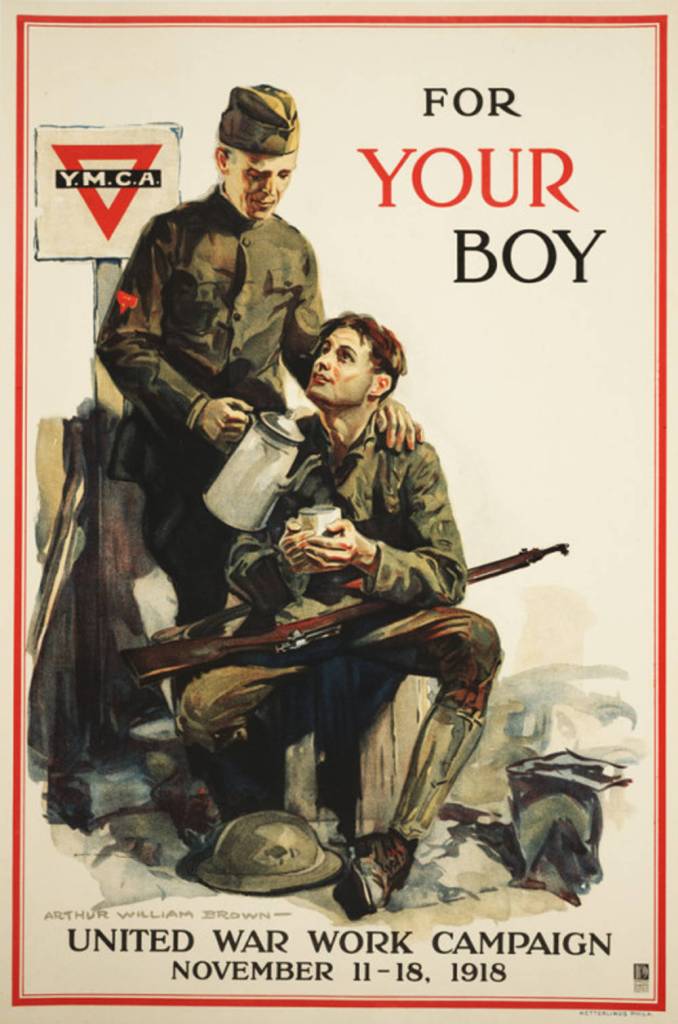
For the past month, I’ve been taking an online professional development course designed to teach museum educators, like myself, how to develop and write formal lesson plans for K-12 teachers. It’s been a pretty interesting class; our end project is to write a lesson plan for our museum. I chose to write about our vast collection of World War I propaganda posters. Most lesson plans are no more than 5-10 pages; mine currently is 36, and I still need to add in the curriculum standards for Vermont. While I did get a bit carried away, my teacher said the lesson plan did not contain anything that wasn’t needed. In fact, what takes up the most pages are the posters themselves as well as background information on the artists and posters. I also compiled a list of early propaganda techniques. Tweets and accusations of “fake news” may be everyday politics for Trump, but in April 1917, the U.S. government had to create an entire committee to influence media and shape popular opinion; and for the most part, they used propaganda for the good of the country.
When I look at the various propaganda techniques, I see correlations to the tactics of the current administration. The only difference is propaganda is usually based on at least some shred of evidence or a grain of truth. What that man in the White House says and disseminates has no grain of truth; it’s just lies. He doesn’t even attempt half-truths, and when he does tell the “truth” such as in his Tulsa speech when he said he ordered a slowdown in COVID-19 testing because it was revealing too many positive cases, the truth is worse than fiction.
For this assignment, I’ve been doing a lot of research on types of propaganda, and it’s easier to come up with ways Trump uses it than ways it was used in WWI. To give you some examples: Name Calling (Sleepy Joe), Transfer (I’m a very stable genius), Plain Folks (calling Neo- Nazi’s “very fine people”), Weak Inference (referring to Putin’s claim of not interfering in the 2016 election, “I believe he believes it”), Stereotyping (Kung-Flu), Guilt-by-Association (Liberal Media=Fake News), Bandwagon (“I’m a winner. I beat people. I’m ahead in the polls and there’s no end in sight.”), Faulty Analogy (“All Republicans must remember what they are witnessing here—a lynching. But we will WIN!”), Glittering Generalities (Make America Great Again), Virtue-by-Association (Trump’s claiming he’s a Christian), Patriotic Symbols (How he abhors protestors who kneel for the National Anthem), Testimonials (Trump’s new slogan “Transition to Greatness”), Distortion of Data (Do I even have to give examples of his more than 19,000 lies?), Emotional Appeal (the way he demonizes immigrants, protestors, Democrats, etc.). The list goes on and on and on ad nauseam.
It’s difficult to understand why people blindly follow Trump. It can’t be only about being pro-life. Which brings me to the main point of my post: I’ve been a bit down since Sunday night. I got into an argument with my mother about her support of Trump. She made me so upset, I ended the call by telling her, “Bye,” and hanging up the phone. I just could not take any more of her parroting Fox News drivel. I told her she had disappointed me by supporting a bully like a Trump, that I’d dealt with bullies all my life—which she knows—and I didn’t want one in the White House. I don’t want an amoral person as president who goes against everything I was raised to believe in. I was literally shaking when I got off the phone. What upsets me the most: she didn’t seem to care that I was upset.
I read an article in The Washington Post the other day that talked about how many public health officials were being harassed and threatened. People were publishing their emails, home addresses, and phone numbers so others could harass them from around the country. I thought of my mother who spent 25 years as a nurse at the county health department. If she were still working, she’d be one of the people enforcing rules to mitigate the spread of the virus. I wonder if my family—my mother specifically—could have faced the hatred and retribution of Trump supporters who care more about money and their “freedom” than they care about the safety of others. I wonder if she were still at the health department would she have felt differently about an administration that has downplayed the deadliness of this disease and politicized a public health crisis for their own political gain.
Mama was always a particularly good and caring nurse; I don’t understand what has happened to her. She wasn’t like this when I was growing up or at least, I never saw it so blatantly. I can’t help but take some of the blame for her change of heart. Since she found out I am gay, she has become more of a fundamental evangelical Christian and a diehard Republican who sees no good in anyone who doesn’t think like Fox News tells them to think. She has closed her mind to so much of the world, and I wonder if this is all because she has a gay son. She has never been able to accept my sexuality. As she becomes more and more in line with conservative Republican ideology, the less I want to talk to her. I am getting to the point where I no longer care what she thinks of me. I have held off finding someone to spend my life with because I knew she’d never accept him. Now, I fear I’ve wasted my life hoping for my mother’s love and acceptance when that hope can never be fully realized.
I do love my mother, and in some strange, twisted, and warp-minded way, I know she holds some love for me. But I don’t know if I can continue to live my life this way. I live 1,100 miles away from my parents. Perhaps it is time to become who I really am, and to quit holding back because of the fear of what my parents and family might think of me.
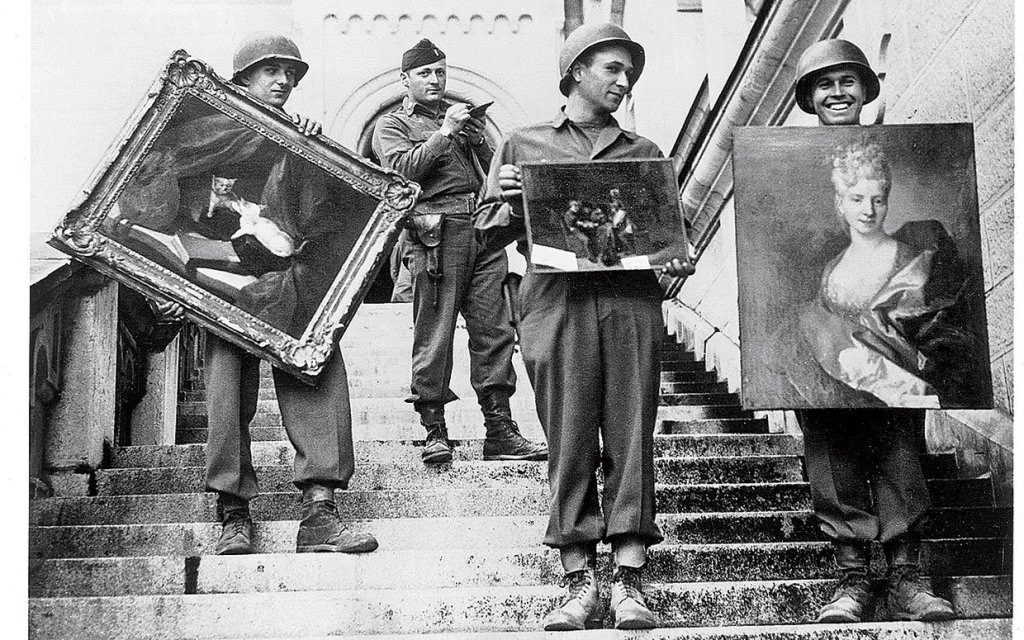
I’ve been listening to the book, The Monuments Men by Robert M. Edsel whenever I drive anywhere. On Thursday, I will be teaching a class on the history of the Monuments Men, and I wanted to know as much as possible about the subject. I hope it goes well as it will be the first class I’ve taught as a webinar. If you don’t know who the Monuments Men were, they were part of the Monuments, Fine Arts, and Archives (MFAA) program under the Civil Affairs and Military Government Sections of the Allied armies established in 1943 to help protect cultural property in war zones during and after World War II. The group of approximately 400 service members and civilians worked with military forces to safeguard historic and cultural monuments from war damage, and as the conflict came to a close, to find and return works of art and other items of cultural importance stolen by the Nazis or hidden for safekeeping.
Göring
One of the things that really struck me in this book is the description of the greed and opulence of the Nazis and their collaborators. Edsel points out that Hermann Göring, though being the main “collector” of art and items of cultural importance, was mediocre at best in his taste. He just wasn’t well-educated enough in art to know good art from bad art. Furthermore, it was more about the prestige of owning things that drove Göring not any artistic value. Göring, like many fascists, was garish: he owned dozens of uniforms each more grand than the last; he kept a pocket full of rubies at all times so he could jingle them like change; he had homes decorated with the most expensive things he could find most of which he confiscated illegally; and the list goes on. Göring was almost cartoonish in his appearance. It doesn’t seem real that someone could have such poor taste and at the same time feel his possessions and clothing were the height of taste. The same thing is also often said of the nouveau riche which has become a derogatory term for people who have recently acquired wealth, typically those perceived as ostentatious or lacking in good taste. The nouveau riche and the opulence of the fascists seem somewhat ridiculous to us these days, and they would be thought of as just that—ridiculous and cartoonish—if it had not been for the horrendous things they did with their power.
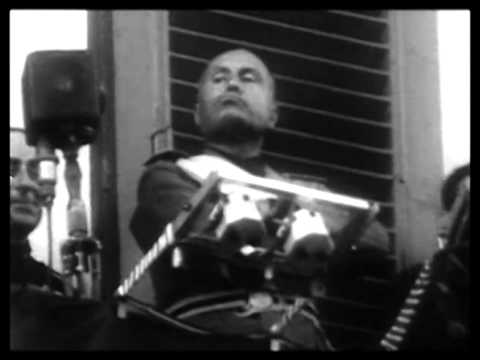
Benito Mussolini
The ridiculousness of the fascists goes beyond just their ostentatious possessions. There are their actions in public. Think of Benito Mussolini in full military regalia with his chest puffed out, arms crossed, and his chin up. Hitler studied oratory delivery, hand gestures, and body language to make his speeches more hypnotic and mesmerizing. Both overemphasized their gestures. Hitler took lessons with the hypnotic clairvoyant and magician, Erik Jan Hanussen, and learned speaking and mass psychology from him. Looking back at the 1920s and 1930s, history shows us the rise—and fall—of charismatic leaders and/or demagogues: Mussolini, Hitler, V.I. Lenin, Leon Trotsky, Ataturk, and Mao Tse-tung. Even good guys like Franklin D. Roosevelt, Winston Churchill, and Huey Long used their personal charisma to get where they wanted to be. The exception to these charismatic leaders was Spain’s fascist dictator Francisco Franco. Franco was one of the few dictators in modern times who was a professional soldier who fought for power to the very top. Hitler, Mussolini and Antonio Salazar (of Portugal) had to win over or neutralize the national armed forces to come out on top. Lenin, Trotsky, Stalin, Mao, and Ho Chi Minh were primarily civilians who politicized the military for their own strategic ends. These other men bent their followers to their own will; Franco became everything to everyone.
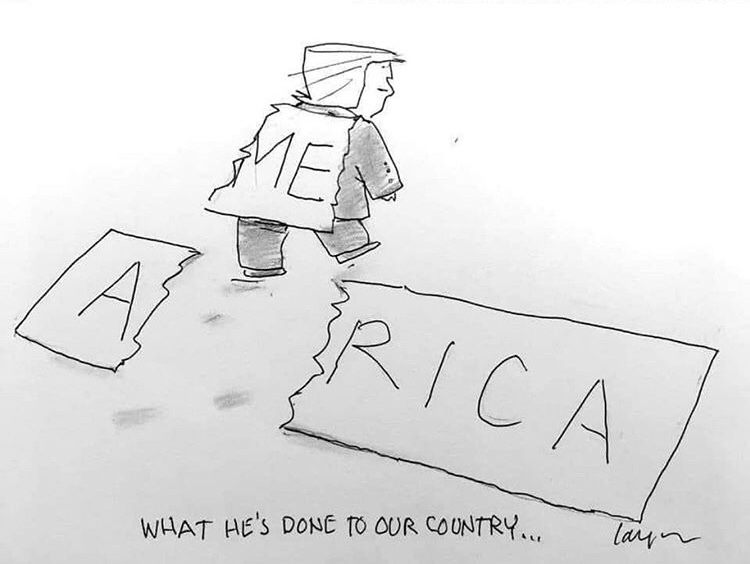
Looking at the dictators from the 20th century, I wonder if the historians in the 22nd century will look upon Donald Trump and think he was just a silly, horrible man with power. Will they see him as charismatic? Inhumane? Dangerous? Will they mock him for his garish and ostentatious lifestyle? Will they recognize his diminished intelligence? His disdain for intelligence? His lack of action on important issues? His disastrous actions to harm others (immigrants, LGBTQ+, women’s rights, the most vulnerable in American society, etc.)? I read an article by a historian the other day who said he believed Trump was not one of the worst presidents, but the worst president—even worse than James Buchanan whose actions, or lack thereof, led to the Civil War. Will Trump’s successors be able to undo his harm? If they do, will it make historians look at Trump differently? A friend of mine commented on Saturday that when the ludicrous things a politician—referring to Trump— says and does become common place, people forget it’s not normal; they begin to normalize that behavior.
Saturday, June 20th, was Trump’s first rally since the start of the worst of the pandemic when quarantines, social distancing, and the wearing of masks were implemented. Trump chose Tulsa where a race massacre took place on May 31st, and June 1st, 1921. During the riots, mobs of white residents attacked the black residents and businesses of Tulsa’s Greenwood District. One must wonder what Trump and his campaign were thinking when they chose a rally there amid widespread protests against racial discrimination and police brutality. (And remember, the rally was originally scheduled for June 19th, or Juneteenth.) I’m pretty sure I know why, and I think it was calculated, but I will leave that for you to decide.
Like Lenin, Mussolini, Hitler, and Mao, Trump thrives on the adoration of crowds. His followers are so fanatical, they are convinced they will be saved by God from the virus; that by supporting Trump, they are doing God’s work; and if Trump didn’t see the need to wear a mask, they don’t either. It may take days or weeks before we know the full extent of the outbreak that is likely to occur because of Trump’s rally. The questions are: How will Trump explain the outbreak caused by his rally? Will he just ignore any ill effects from the rally? Will his supporters ever come to the realization they put their life and the lives of loved ones in harm’s way in order to see a megalomaniac speak? The answers to all of these questions are probably predictable.
My greatest fear is that when Trump loses the election, he won’t accept it and won’t leave the White House. He’s already setting up the scene to call the election fraudulent with his cries against mail-in votes, etc. He will use every tactic he has to resist the inevitable. But one question remains, will he burn the country down in the process like a modern-day Nero burning Rome to keep himself in power? I’m afraid he will. Trump and the Republicans have done more to harm the sacred institutions of the American government than anyone else in American history. Just as he uses the charismatic tactics of fascists to advocate his position and power, he will try to use tactics of dictators to stay in office. All of this could end badly for Trump: Hitler shot himself; Mussolini was captured and publicly hanged; Göring took a cyanide capsule; Trotsky was assassinated. How will it end for Trump?
On May 27, 2020, after 11 a.m., a 38-year-old African American transgender man, Tony McDade, was fatally shot in the Tallahassee, Florida, by an officer of the Tallahassee Police Department. The circumstances surrounding McDade’s death are still murky. Tallahassee Police say McDade was a suspect in a fatal stabbing that occurred shortly before his death. They also claim he was armed with a handgun and he “made a move consistent with using the firearm against the officer.” An eyewitness report has contradicted statements by the Police Department that McDade was armed with a gun. But this barely made the news. Why?
McDade doesn’t check off the appropriate boxes for being a “real” victim. He was transgendered, and for some, that’s not the face of the Black Lives Matter Movement and Protests. McDade’s death came on the heels of the high-profile deaths of Breonna Taylor and George Floyd—who were killed in police encounters in Louisville and Minneapolis, respectively.
Florida has been an epicenter of anti-transgender violence over the past two years. Last year, the American Medical Association deemed a surge in the murder of transgender people an “epidemic.” The vast majority of victims are transgender women of color. Of the 52 reported murders of transgender or gender non-conforming people in the past two years, about 1 in 7 were in Florida.
I was going to talk about other civil rights moments when people who didn’t fit the bill of the perfect victim and were pushed aside or forgotten, but I decided to do a bit shorter of a post today. Did you know that five women refused to give up their seats to a white person and were arrested in 1955 before Rosa Parks became the face of the Montgomery Bus Boycott for doing the same thing? For one reason or another, the other women did not fit the profile that the Movement wanted. Several of these women did file the lawsuit Browder v. Gayle which eventually end bus segregation. Bayard Rustin, one of the organizers of the March on Washington, was eventually pushed out of the Civil Rights Movement for being gay. In many civil rights movements, those who didn’t fit into the perfect profile were ignored or pushed out. In the early gay rights movement, men who couldn’t pass as “straight” were not allowed to march with the Mattachine Society. The examples are really too numerous to mention all of them.
Never forget that Marsha P. Johnson, a black self-identified drag queen, was a leader of the Stonewall Riots. Many of the rioters in June 1969 were transgender, and we owe it to transgendered people of all races for the gains we have made in civil rights. Let’s not forget the “T” in LGBTQI+, because they are also our brothers and sisters. They deserve to be recognized as well. Just because a person doesn’t fit the perfect profile you want to see represent people that are treated unjustly, they were still treated unjustly, nonetheless.
As newly out actor Justice Smith recently said while protesting for Black Lives Matter:
“[Nicholas Ashe (his boyfriend)] and I protested today in New Orleans. We chanted ‘Black Trans Lives Matter’ ‘Black Queer Lives Matter’ ‘All Black Lives Matter’. As a black queer man, myself, I was disappointed to see certain people eager to say Black Lives Matter but hold their tongue when Trans/Queer was added. … I want to reiterate this sentiment: if your revolution does not include Black Queer voices, it is anti-black. If your revolution is okay with letting black trans people like #TonyMcDade slip through the cracks in order to solely liberate black cishet men, it is anti-black.”
While I know what it is like to be a gay man and have to hide who I am, I cannot begin to pretend that I know what life is like for a person of color. I know that the LGBTQI+ community and communities of color have faced similar struggles and fights for equal rights, it is far from being the same. Many of us can, and have, hidden our sexuality, but people of color can’t hide their skin color. African Americans need our support at this time. We are a nation in crisis, and we need to all come together to make it a better place. Especially since we have a president who as The New York Times reported: “Trump increasingly sounds like a cultural relic, detached from not just the left-leaning protesters in the streets but also the country’s political middle and even some Republican allies and his own military leaders.”
The mask is the COVID-19 pandemic’s defining symbol, and probably will be the defining symbol of 2020. In America, the medical mask used to be confined to operating rooms and hospital dramas. It is a public health device but also has revealed itself as a mask in several different perceptions. It has become a political symbol: an object signifying a person’s politics and their relationship to truth itself. A bare face is what registers as a choice.
To its supporters, mask-wearing is a visual expression of civic duty, an affirmation of scientific authority, and a show of respect. To its critics, it is a sign of weakness, emasculation, and deceit. Many Americans accept the medical benefits of masks, and for those who do not, their rhetoric corresponds with racist ideas about Asian cultures where wearing a mask in public has long been normalized.
Among the maskless ranks is R.R. Reno, the editor of the conservative religious journal, First Things, who tweeted, “Masks = enforced cowardice,” and Donald Trump, who said, “Somehow, I don’t see it for myself.” Brett Hume tweeted a picture of Biden wearing a mask on Memorial Day saying, “This might help explain why Trump doesn’t like to wear a mask in public. Biden today.” It was a childish thing to say. “This macho stuff,” Biden said after Trump retweeted a jab at the candidate’s own mask. “It’s cost people’s lives.” For people who refuse to wear masks, the implication is that people who choose to wear masks are not just protecting themselves — they are attacking the president and his supporters.
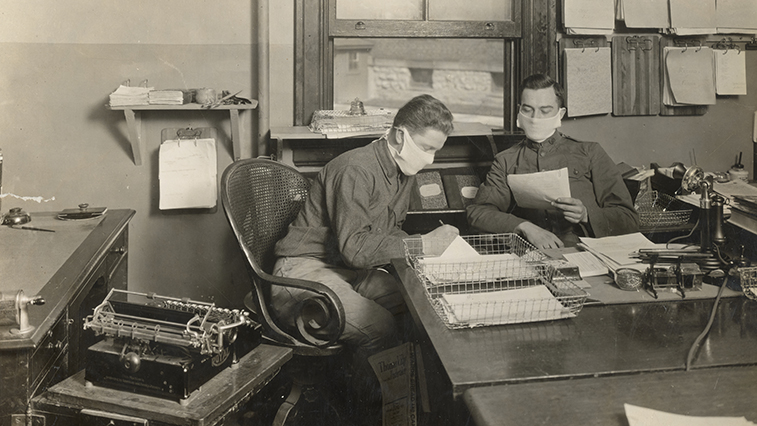
Ironically, in 1918, when the Spanish flu pandemic coincided with World War I, many Americans wore masks as a symbol of their patriotism, and their effort to curb the spread of the disease to protect soldiers who were about to enter the battlefield. San Francisco, along with other Western cities such as Seattle, Juneau, and Phoenix, passed laws requiring masks in public. Violators could be ticketed, fined, and imprisoned. Even so, protests against wearing masks were plentiful in 1918. San Francisco saw the creation of the anti-mask league, as well as protests and civil disobedience. People refused to wear masks in public or flaunted wearing them improperly. Some went to prison for not wearing them or refusing to pay fines. Within weeks, however, as the number of cases and deaths decreased, recommendations and even regulations to wear masks were relaxed and then eliminated. Because of this, cases spiked again around Thanksgiving, and another surge occurred into the New Year. These second and third waves were the deadliest. However, in many places, there was no appetite to enact another set of mandates. Removing those orders, and then trying to re-implement them a second time, proved to be exceedingly difficult. By then, the patriotic fervor that influenced compliance had waned.
Historians and scientists at the University of Michigan and the Centers for Disease Control and Prevention have studied the efforts of trying to contain the Spanish Flu of 1918. Comparative analysis of data from several American cities during the 1918-1919 influenza pandemic provide incontrovertible evidence of the effectiveness of the kind of restrictions we are living with today. Cities that imposed expansive closure orders early and maintained them for the duration of pandemic conditions suffered significantly lower death rates than those cities that did not. While protestors in 1918 fought against the hated mask, their act of gathering, which was entirely legal at the time, was helping to spread the disease.
Wearing masks is a collective declaration of a serious disease recognizing that behavior of an entire population must change. In this sense, the seeming omnipresence of masks in historical photographs from 1918 reinforces the message that preventing transmission is a community effort requiring substantial behavioral change. Wearing masks means accepting that community welfare supersedes individual preferences. It should not be a political issue. Instead, wearing a mask should follow the maxim that is found in many religions and cultures often known as the Golden Rule: treat others as you want to be treated.
One of the sanest voices in the government’s response to the pandemic, Dr. Anthony Fauci, has called for a cautious approach to reopening the US and implored Americans to wear face masks in public. Fauci said, “I want to protect myself and protect others, and also because I want to make it be a symbol for people to see that that’s the kind of thing you should be doing.” He went on to say that while wearing a mask is not “100% effective,” it is a valuable safeguard and shows “respect for another person.” His comments are at odds with Trump’s push to have America quickly return to normalcy.
Trump seems unwilling to fight the coronavirus rationally instead claiming it will disappear “like a miracle.” It’s as if taking the disease seriously is an indictment of his presidency. By dismissing the threat and banishing its visual cues, Trump also shields his own reputation and protects his personal vanity. While everyone who refuses to wear a mask might not be pro-Trump, they all have two things in common: selfishness and ignorance. These two traits seem to be glorified by part of the American public, and that is just not acceptable.
Some historians claim the most traumatic year in modern American history was 1968, but that 2020 is shaping up as the second worst with Trump having no bottom to how low he will go. With seven months left in 2020, the comparison of these two years provides little comfort, and several reasons for concern.
When I taught World or American History, I always said there were certain pivotal years: 1066, 1492, 1776, 1968, 1969, and others. I did not teach date memorization, but there are years and dates that need to be remembered. The year 1968 belongs on that list as an unbelievably anno horribilis while most of the other dates mark positive historical events. In the case of 1969, a lot of events just happened: Stonewall, the Moon Landing, Ted Kennedy and the Chappaquiddick incident, the Summer of Love, the Manson Murders, Woodstock, Hurricane Camille, the list goes on…
How could any year be worse than the current one in which more Americans are out of work than in the Great Depression, and more people are needlessly dying than in several of America’s wars combined? How could the domestic order seem more frayed and failing than it has in the past week with the filmed record of a white, Minneapolis police officer calmly killing a black man as other officers just as calmly looked on? This led naturally to protests which in turn led to looting and destruction. In many cities, police and troopers, kitted out as if for Baghdad circa 2003, widened the violence and hastened the decay with strong-arm tactics sure to generate new protests.
Most of the objects of police roundups have been civilians. But in a rapidly expanding list of cities—first Minneapolis, then Louisville, Seattle, Detroit, and elsewhere—reporters appeared to be singled out by police as targets. The arrest of CNN’s Omar Jimenez on live television was just one of many to come. Againin Minneapolis, Minnesota State Patrol members approached a group of a dozen reporters all bearing credentials and yelling to identify themselves as press, and “fired tear gas […] at point-blank range.” In Louisville, Kaitlin Rust, a reporter for an NBC affiliate, yelled on camera, “I’m getting shot!” as her cameraman, James Dobson, filmed an officer taking careful aim and firing a pepper-ball gun directly at them. In Detroit, the reporter JC Reindl, of the Free Press, was pepper-sprayed in the face even as he held up his press badge. The examples keep piling up.
One man can be blamed for these abuses of the press: Donald Trump. From the beginning of his presidency, he referred to the press as “the enemy of the people.” It’s a vile term with a dangerous history. During the French Revolution, December 1793, Robespierre stated, “The revolutionary government…owes nothing to the Enemies of the People but death.” During the Russian Revolution, Nazi Germany, Communist China, and many other times in history, the phrase has been used to place people beyond the pale. It is at its vilest and most dangerous when used by people in power while attacks are ongoing. Those are the exact circumstances under which Trump uses it. In his appalling 2017 inaugural address, he spoke about “American carnage.” Thus, he prophetically began his time in office by profaning the setting from which all his predecessors had invoked American potential and American hope. Under his auspices, we’ve seen a new kind of carnage; it’s all bad, and it’s all getting worse.
So how does it compare with the distant past of 1968? There is no objective comparison of suffering or confusion. Fear, loss, dislocation, and despair are real enough to people who encounter them no matter what happened to someone else at some other time.
In 1968, these terrible and/or shocking events occurred:
• On average, nearly 50 American servicemen died in combat in Vietnam every day—plus many more Vietnamese.
• Prague Spring began on January 5 and ended disastrously with the Warsaw Pact invasion of Czechoslovakia in August.
• Starting on January 31 – The Tet Offensive began as Vietnam celebrated the Tet Holiday, and dragged on until September causing Walter Cronkite to report that “the bloody experience of Vietnam is [likely] to end in a stalemate” and prompted President Johnson to proclaim, “If I’ve lost Cronkite, I’ve lost Middle America.”
• February 1 – A Viet Cong prisoner was executed on a Saigon street by a South Vietnamese National Police Chief. The event was photographed by Associated Press photographer, Eddie Adams; the photo made headlines around the world. It swayed U.S. public opinion against the war. If you’ve seen the photograph, you’ll never forget it.
• February 8 – Orangeburg Massacre in South Carolina wherethree college students were killed by highway patrolmen.
• March 16 – My Lai Massacre where a company of American soldiers brutally killed most of the people—men, women, children, infants—in the village of My Lai, South Vietnam.
• March 31 – Johnson announced he would not run for re-election as he uttered these two simple sentences:
[…] I do not believe that I should devote an hour or a day of my time to any personal partisan causes or to any duties other than the awesome duties of this office—the presidency of your country. Accordingly, I shall not seek, and I will not accept, the nomination of my party for another term as your president.
• April 4 – Martin Luther King Jr. is assassinated in Memphis, Tennessee causing riots to erupt in major American cities that lasted for several days afterward.
• June 5 – U.S. presidential candidate Robert F. Kennedy is assassinated in Los Angeles.
• July-September – The H3N2 influenza known colloquially as the Hong Kong flu garnered little interest at the time, but estimated number of deaths was one million worldwide,with about 100,000 in the United States. Most of the deaths were people 65 and older. It is similar to COVID-19.
• August 28 – 1968 Democratic National Convention in Chicago where police clash with anti-war protesters
• The “most intrusive ever” case of foreign interference in a U.S. election occurred although it was covered up at the time. {In brief: Richard Nixon’s campaign had back-channel connections with the South Vietnamese government andurged it to go slow in negotiations to end the war in hopes of better terms if they helped Nixon win.}
Try to approximate the surprise of Johnson’s announcement to end his presidential re-election bid. Imagine listening to a standard Trump rant-speech, and hearing something like Johnson’s words. Imagine, also, a leader like Johnson who had spent his entire life thinking about wielding power—and who decided, in the nation’s interest, to give it up.
In some ways, the comparison between 1968 and 2020 might make Americans feel better, or at least consoled, that things have been terrible before. But here are two implications that cut the other way.
First, everyone contending for power in American politics in 1968 was competent. They all had governing experience. And most of them—even, arguably, George Wallace who had been governor of Alabama and running as a segregationist—recognized that a leader’s duty was supposed to include representing the American public as a whole. Each of them had, as all powerful figures do, his vanities and excesses and blind spots, plus, of course, points of corruption. Wallace, in his flagrant and pugnacious way, and Nixon, with his smarm, preyed upon American prejudices and resentments. But all of them recognized what they were expected to say. For Johnson, this was obvious. For Humphrey, whose breakthrough in politics was as a young, firebrand, pro-civil-rights mayor of, yes, Minneapolis in the 1940s, this was the pain of being lumbered with defense of the Vietnam War visible every day.
Nixon’s breakthrough had been as a GOP dirty-tricks hit manduring the McCarthy Era. But—and this is the contrast with today—he had a broader range in his register. If you read his 1968 acceptance speech at the Republican convention, and contrast it with Donald Trump’s “I alone can fix it” monstrosity from the 2016 RNC convention, you will see the difference. Trump knows only how to talk about himself, and his critics. Nixon knew how to at least feign a bring us together message. For instance, after the police killing of George Floyd in Minneapolis, it was Trump himself who tweeted about “thugs” and “when the looting starts, the shooting starts.” Nixon would not say things so crudely while in the public eye; he was, however, known to be quite crude in private. In 1968, the political players at least seemed competent. There was no chance that the White House would end up in the hands of a clown.
Second, is a similarity between 1968 and the present. Nixon knew that the specter of disorder—especially disorderly conduct by Black Americans, face-to-face with police—was one of his strongest weapons. He said as much in his convention speech:
As we look at America, we see cities enveloped in smoke and flame. We hear sirens in the night … We see Americans hating each other; fighting each other; killing each other at home. And as we see and hear these things, millions of Americans cry out in anguish. Did we come all this way for this? Did American boys die in Normandy, and Korea, and in Valley Forge for this?
When people feel afraid, they want someone who claims to be strong. Law-and-order candidates rise when confidence in regular order ebbs. Richard Nixon had much more going for him in 1968 than Donald Trump does in 2020—most of all that Nixon, not being the incumbent, could campaign on everything that was wrong with the country; while Trump, as the incumbent, must defend his management and record which includes record unemployment and an economy in chaos. But protests and fear of disorder—especially fear of angry Black people in disorder—drew people to Nixon as the law-and-order candidate in 1968, and he clearly knew that.
Conversely, Donald Trump could not put that point as carefully as Nixon. But he must sense that backlash against disorder from people he has classified as the other and the enemy, is his main—indeed, his only—electoral hope. Trump promised in hisinaugural address that “American carnage stops right here, right now.” Now, he appears to be trying to make it worse.
Sometimes, life is boring,butthat’s ok. There is an English expression“May you live in interesting times,” which purports to be a translation of a traditional Chinese curse.Despite being so common in English as the “Chinese curse,“the saying is apocryphal, and no actual Chinese source has ever been produced. The most likely connection to Chinese culture may be deduced from analysis of the late-19th-century speeches ofthe British statesmanJoseph Chamberlain, probably erroneously transmitted and revised through his son Austen Chamberlain.
It seems to me that a quarantine during a world-wide pandemicis a bit of both. Being at home more than usual,isin fact often boring. There is only so much Netflix, Amazon Prime Video, and Star Trek reruns a person can watch.Yet, this pandemic can be considered interesting times. Itis most certainlyan event of historical proportions,and I suspect, among other things, this pandemic will cause Donald Trump to go down inhistory as the most self-centered, imbecilic, and ineffectualpresident in the history of the United States.
Sadly,James Buchanan, who was probably America’s first gay president, will continue to be the worstfor his ineptitude in preventing the Civil War, but DonaldTrump still hasat least eight more months in officeto beat Buchanan out of his spot.Trump will never make it to the list of best presidents, not even close, but he likes to be the“most”in everything, so he may just decide he wants to go down as the worst president.Fat chance he’d ever consider himself anything but the best, but he sure does seem to be working hard to be the worst.
I also don’t think any revisionist historian will look back and try to reassess Trump as being better than he was portrayedby contemporary historians, who mostly show their dismay whenassessing Trump’s presidency. He will not be like Herbert Hoover,whowas reviled and utterly defeated in his quest for re-election, yet inthe years since Hoover was president, historians have reassessed his tenure in office.What made Hoover so ineffectual during the Great Depression was that he lost the confidence of the people and could not gain it back.With a fewexceptions, Hoover did not want the federal government involved in relief efforts; however, many of his policieswere also tried by FDR.Rooseveltwas never able to bring the United States out of the Depressionwithout involving the country in World War II. It was the industrial-military complex created during the war effortand the fact that most of the unemployed men were drafted into the militarythat brought theend of the Great Depression. The war eliminated unemploymentand rebuilt the economy on a war footing.FDR was seen as a hero, while Hoover was seen as a failure until recently.
In my opinion, Trump has done nothing redeeming in his presidency, and I don’t believe he can turn it around before the election.Numerous investigations,animpeachment(that he was saved from conviction because the Republicans in the Senate refused to have a real impeachment trial),anadversarial relationship with the press, narcissism,thousands of lies,total disregard for the rule of law, etc. will go down in history. Yes, there will be some historians on the right whomighttry to defend him, but history is supposed to be unbiased. And, I believe history will judge him very harshly and with few if any redeeming qualities.He quite possibly is not only doing damage to his reputation but is also damaging the Republican Party as a whole.Republicans will have to reassess their moral standing andtake a long hard look atthe depthsthe party hasdragged down the Grand Old Party.Hopefully after the November election, it won’t be so grand anymore.
So yes, sitting at home can be boring, but no one can deny that we are living in historic and interesting times.By the way, the nearest related Chinese expressionto the “curse” quoted abovetranslates as“Better to be a dog in times of tranquility than a human in times of chaos.”For some of us, our homes are tranquil places, but humanity is definitely in chaos.
As a museum professional, I know how hard it is to reach our usual audience during these difficult times. Museums everywhere have been doing special exhibits, educational opportunities, and programs all virtually since we are unable to have people in the museum. I have been working on all three of these things since I have been working from home. It’s really the only thing I have to do. However, I wanted to bring your attention to a special online exhibit by the GLBT Historical Society in San Francisco. I keep up with their events because I’d love to work there or at another GLBT museum, but my specialty is military history, so I will probably always be at a military oriented museum, which is fine by me. I don’t plan to leave my current museum anytime soon.
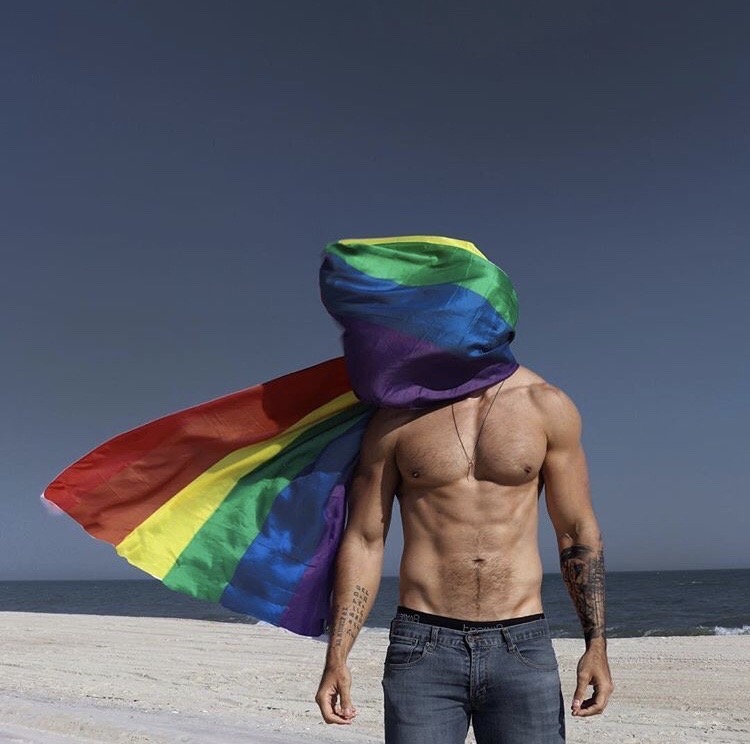
The GLBT Historical Society has unveiled an online version of its exhibition “Performance, Protest and Politics: The Art of Gilbert Baker,” which opened at the GLBT Historical Society Museum on November 1, 2019. The exhibition uses textiles, costumes, photographs and ephemera to paint a complex portrait of artist Gilbert Baker (1951–2017), who designed the iconic rainbow flag. The online exhibition opened on Monday, April 27 at glbthistory.org/gilbert-baker-exhibition.
First displayed at the 1978 San Francisco Gay Freedom Day Parade, the rainbow flag has transcended its humble, hand-sewn origins to become an internationally recognized symbol of the LGBTQ community. Yet the success of this design has in some ways overshadowed the larger story of its creator and his exceptional creative work. “Performance, Protest and Politics” examines how Baker blurred the lines between artist and activist, protester and performer, emphasizing his intuitive understanding of the ways art can serve as a powerful means to address political and social issues.
Over the course of four decades, Baker melded his artistic gifts with his devotion to justice, employing a range of media and approaches — including sewing, painting, design and performance — to advocate for positive social change. The exhibition has been co-curated by Jeremy Prince, who has curated and overseen numerous exhibitions at the GLBT Historical Society Museum; and Joanna Black, the archivist who oversaw the donation of the Gilbert Baker Collection to the GLBT Historical Society’s archives in 2017.
Referring to the many extravagant costumes on display, Prince notes that Baker employed drag “as a vehicle to critique injustice and express outrage. From Betsy Ross to Pink Jesus, from Lady Liberty to the uniform of a concentration-camp prisoner, Baker’s drag wardrobe and personas represent the intersection of patriotism, discrimination and social justice.” By exploring the less well known dimensions of Baker’s wide-ranging oeuvre, the exhibition places the rainbow flag back into the unexpected and evocative context of his exceptional life as an activist and artist. “We highlight some of the political flashpoints of Baker’s life and how his creative responses at those moments reveal a multilayered character — a man intent on being publicly seen and using his visibility as a declaration,” says Black. “Performance, Protest and Politics: The Art of Gilbert Baker” opens online Monday, April 27 and can be experienced at glbthistory.org/gilbert-baker-exhibition.
For more information, visit the GLBT Historical Society website at www.glbthistory.org.
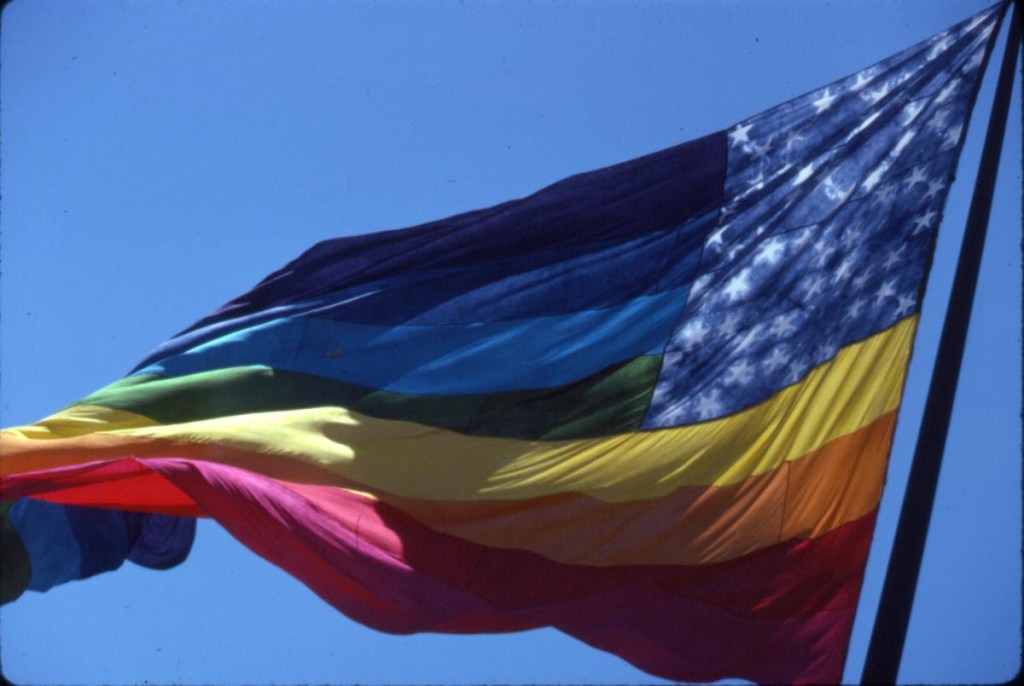
One of the original eight-color rainbow flags flying at United Nations Plaza during San Francisco Gay Freedom Day 1978; photograph by Crawford Barton, Crawford Barton Papers (1993-11), collection of the GLBT Historical Society.
About the Curators Joanna Black is the archivist at the William E. Colby Memorial Library at the Sierra Club’s National Headquarters in Oakland, California. She was director of archives and special collections at the GLBT Historical Society from 2016 to 2018. Black holds a B.A. in creative writing from San Francisco State University and a master’s in library and information science from the University of California, Los Angeles. Jeremy Prince is the Collections Specialist at the San Diego History Center in San Diego, California. He began volunteering at the newly opened GLBT Historical Society Museum in 2011. From 2014 to 2019, he served as the society’s director of exhibitions and museum operations. Prince holds an M.A. in early modern European history and museum studies from San Francisco State University.
About the Museum Open since January 2011, the GLBT Historical Society Museum is the first stand-alone museum of its kind in the United States. Its Main Gallery features a long-term exhibition on San Francisco LGBTQ history, “Queer Past Becomes Present.” Its Front Gallery and Community Gallery host changing exhibitions. The institution also sponsors forums, author talks and other programs. The museum is a project of the GLBT Historical Society, a public history center and archives that collects, preserves, exhibits and makes accessible to the public materials and knowledge to support and promote understanding of LGBTQ history, culture and arts in all their diversity. Founded in 1985, the society maintains one of the world’s largest collections of LGBTQ historical materials. For more information, visit the GLBT Historical Society website at www.glbthistory.org.















 Joe
Joe





 The Closet Professor