Category Archives: History
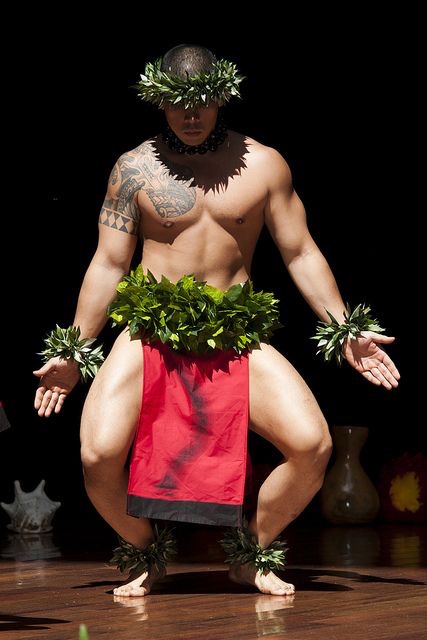
Aikane and Ancient Hawaiian Homosexuality
The Stonewall of the South That History Forgot

Independence Day

In Congress, July 4, 1776.
The unanimous Declaration of the thirteen united States of America, When in the Course of human events, it becomes necessary for one people to dissolve the political bands which have connected them with another, and to assume among the powers of the earth, the separate and equal station to which the Laws of Nature and of Nature’s God entitle them, a decent respect to the opinions of mankind requires that they should declare the causes which impel them to the separation.
We hold these truths to be self-evident, that all men are created equal, that they are endowed by their Creator with certain unalienable Rights, that among these are Life, Liberty and the pursuit of Happiness.–That to secure these rights, Governments are instituted among Men, deriving their just powers from the consent of the governed, –That whenever any Form of Government becomes destructive of these ends, it is the Right of the People to alter or to abolish it, and to institute new Government, laying its foundation on such principles and organizing its powers in such form, as to them shall seem most likely to effect their Safety and Happiness. Prudence, indeed, will dictate that Governments long established should not be changed for light and transient causes; and accordingly all experience hath shewn, that mankind are more disposed to suffer, while evils are sufferable, than to right themselves by abolishing the forms to which they are accustomed. But when a long train of abuses and usurpations, pursuing invariably the same Object evinces a design to reduce them under absolute Despotism, it is their right, it is their duty, to throw off such Government, and to provide new Guards for their future security.–Such has been the patient sufferance of these Colonies; and such is now the necessity which constrains them to alter their former Systems of Government. The history of the present King of Great Britain is a history of repeated injuries and usurpations, all having qin direct object the establishment of an absolute Tyranny over these States. To prove this, let Facts be submitted to a candid world.
He has refused his Assent to Laws, the most wholesome and necessary for the public good.
He has forbidden his Governors to pass Laws of immediate and pressing importance, unless suspended in their operation till his Assent should be obtained; and when so suspended, he has utterly neglected to attend to them.
He has refused to pass other Laws for the accommodation of large districts of people, unless those people would relinquish the right of Representation in the Legislature, a right inestimable to them and formidable to tyrants only.
He has called together legislative bodies at places unusual, uncomfortable, and distant from the depository of their public Records, for the sole purpose of fatiguing them into compliance with his measures.
He has dissolved Representative Houses repeatedly, for opposing with manly firmness his invasions on the rights of the people.
He has refused for a long time, after such dissolutions, to cause others to be elected; whereby the Legislative powers, incapable of Annihilation, have returned to the People at large for their exercise; the State remaining in the mean time exposed to all the dangers of invasion from without, and convulsions within.
He has endeavoured to prevent the population of these States; for that purpose obstructing the Laws for Naturalization of Foreigners; refusing to pass others to encourage their migrations hither, and raising the conditions of new Appropriations of Lands.
He has obstructed the Administration of Justice, by refusing his Assent to Laws for establishing Judiciary powers.
He has made Judges dependent on his Will alone, for the tenure of their offices, and the amount and payment of their salaries.
He has erected a multitude of New Offices, and sent hither swarms of Officers to harrass our people, and eat out their substance.
He has kept among us, in times of peace, Standing Armies without the Consent of our legislatures.
He has affected to render the Military independent of and superior to the Civil power.
He has combined with others to subject us to a jurisdiction foreign to our constitution, and unacknowledged by our laws; giving his Assent to their Acts of pretended Legislation:
For Quartering large bodies of armed troops among us:
For protecting them, by a mock Trial, from punishment for any Murders which they should commit on the Inhabitants of these States:
For cutting off our Trade with all parts of the world:
For imposing Taxes on us without our Consent:
For depriving us in many cases, of the benefits of Trial by Jury:
For transporting us beyond Seas to be tried for pretended offences
For abolishing the free System of English Laws in a neighbouring Province, establishing therein an Arbitrary government, and enlarging its Boundaries so as to render it at once an example and fit instrument for introducing the same absolute rule into these Colonies:
For taking away our Charters, abolishing our most valuable Laws, and altering fundamentally the Forms of our Governments:
For suspending our own Legislatures, and declaring themselves invested with power to legislate for us in all cases whatsoever.
He has abdicated Government here, by declaring us out of his Protection and waging War against us.
He has plundered our seas, ravaged our Coasts, burnt our towns, and destroyed the lives of our people.
He is at this time transporting large Armies of foreign Mercenaries to compleat the works of death, desolation and tyranny, already begun with circumstances of Cruelty & perfidy scarcely paralleled in the most barbarous ages, and totally unworthy the Head of a civilized nation.
He has constrained our fellow Citizens taken Captive on the high Seas to bear Arms against their Country, to become the executioners of their friends and Brethren, or to fall themselves by their Hands.
He has excited domestic insurrections amongst us, and has endeavoured to bring on the inhabitants of our frontiers, the merciless Indian Savages, whose known rule of warfare, is an undistinguished destruction of all ages, sexes and conditions.
In every stage of these Oppressions We have Petitioned for Redress in the most humble terms: Our repeated Petitions have been answered only by repeated injury. A Prince whose character is thus marked by every act which may define a Tyrant, is unfit to be the ruler of a free people.
Nor have We been wanting in attentions to our Brittish brethren. We have warned them from time to time of attempts by their legislature to extend an unwarrantable jurisdiction over us. We have reminded them of the circumstances of our emigration and settlement here. We have appealed to their native justice and magnanimity, and we have conjured them by the ties of our common kindred to disavow these usurpations, which, would inevitably interrupt our connections and correspondence. They too have been deaf to the voice of justice and of consanguinity. We must, therefore, acquiesce in the necessity, which denounces our Separation, and hold them, as we hold the rest of mankind, Enemies in War, in Peace Friends.
We, therefore, the Representatives of the United States of America, in General Congress, Assembled, appealing to the Supreme Judge of the world for the rectitude of our intentions, do, in the Name, and by Authority of the good People of these Colonies, solemnly publish and declare, That these United Colonies are, and of Right ought to be Free and Independent States; that they are Absolved from all Allegiance to the British Crown, and that all political connection between them and the State of Great Britain, is and ought to be totally dissolved; and that as Free and Independent States, they have full Power to levy War, conclude Peace, contract Alliances, establish Commerce, and to do all other Acts and Things which Independent States may of right do. And for the support of this Declaration, with a firm reliance on the protection of divine Providence, we mutually pledge to each other our Lives, our Fortunes and our sacred Honor.
The Declaration of Independence is arguably one of the most influential documents in American History. Other countries and organizations have adopted its tone and manner in their own documents and declarations. For example, France wrote its ‘Declaration of the Rights of Man’ and the Women’s Rights movement wrote its ‘Declaration of Sentiments’. However, the Declaration of Independence was actually not technically necessary in proclaiming independence from Great Britain.
A resolution of independence passed the Philadelphia Convention on July 2. This was all that was needed to break away from Britain. The colonists had been fighting Great Britain for 14 months while proclaiming their allegiance to the crown. Now they were breaking away. Obviously, they wanted to make clear exactly why they decided to take this action. Hence, they presented the world with the ‘Declaration of Independence’ drafted by thirty-three year old Thomas Jefferson.
The text of the Declaration has been compared to a ‘Lawyer’s Brief’. It presents a long list of grievances against King George III including such items as taxation without representation, maintaining a standing army in peacetime, dissolving houses of representatives, and hiring “large armies of foreign mercenaries.” The analogy is that Jefferson is an attorney presenting his case before the world court. Not everything that Jefferson wrote was exactly correct. However, it is important to remember that he was writing a persuasive essay, not a historical text. The formal break from Great Britain was complete with the adoption of this document on July 4, 1776.
Jefferson wrote the Declaration in a way that was meant to be read aloud. The first two paragraphs are some of the most powerful words ever written.
The West Coast LGBTQ activism that predated Stonewall

By Julia Wick
It’s simple and powerful to say that the gay rights movement began 50 years ago today, when the first brick was thrown in the early hours of June 28, 1969, outside the Stonewall Inn in Greenwich Village.
Movements are unruly, with ragged edges and a penchant for flaring and sputtering in many directions. But the weight of history has a way of condensing things. And the spin cycle of time will slough off the footnotes and find the linear narrative.
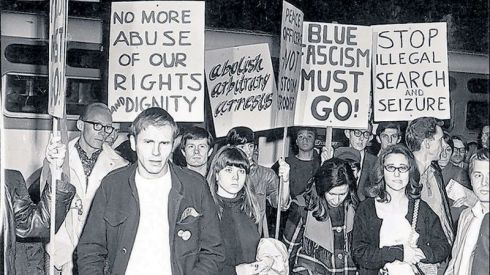
The three nights of rioting sparked by a routine police raid at a New York City gay bar and the even more routine police harassment of the gay community were unbelievably important and symbolic. But they also followed years of organizing and numerous previous eruptions against police harassment in community spaces. Much of that groundwork was laid in California, particularly in Los Angeles and San Francisco.
“The spark of Stonewall goes exponentially beyond what the actual events created,” Terry Beswick, the executive director of the GLBT Historical Society and museum in San Francisco, explained over the phone earlier this month. “At least in the popular culture, [Stonewall] swallowed up a lot of the very real and even more significant organizing that was happening for decades before that — and afterwards.”
In San Francisco, police raided a 1965 New Year’s costume ball organized by the newly formed Council on Religion and the Homosexual. Officers sought to photograph all the attendees and made two arrests. The event galvanized organizing in San Francisco’s gay community and helped draw broader attention to the police harassment gay people faced.
“That was really what most of the pre-Stonewall real spontaneous actions were about — police harassment of our gathering places,” Beswick said.
“In the 1960s and back into the ’50s, gay bars were our community centers,” Beswick said. “They were where we found each other. They were where we found fellowship and emotional support, as well as sex.”
In Beswick’s view, those bars were “like homes,” sometimes “even more so” than the places where their denizens actually lived. “For police to invade those spaces really fought against the notion of any kind of self-determination and safety for us,” he said.
Two and a half years before Stonewall, the Black Cat bar in Silver Lake was raided just after midnight on New Year’s Day 1967. Police beat patrons and arrested more than a dozen people. Several weeks later, hundreds peacefully gathered outside the bar in a protest — a demonstration that was considered a seminal turning point in the early gay rights movement.
[Go deeper: “Before Stonewall, the Queer Revolution Started Right Here in Los Angeles” by Jason McGahan in Los Angeles Magazine]
And nearly a decade before Black Cat, a group of transgender women, lesbians and gay men fought back against police harassment in what turned into a melee outside Cooper Do-nuts in downtown Los Angeles. That was May 1959, and it’s believed to have been the first LGBTQ uprising against police harassment.
“Stonewall, at least in the rear-view mirror, has become a place of demarcation for historians, where we can sort of measure our progress,” Beswick said.
“But it’s important for us to resurrect those stories around other events. It’s important for the pride of LGBT people in San Francisco to know that the New Year’s Day ball event happened and that Compton’s [Cafeteria riot] happened,” Beswick said, and he didn’t stop there. He listed off the names like a litany of early organizations and leaders and places that have been turned into symbols by virtue of what happened there.
“The same kind of stories can be told all around the country, in Philadelphia and D.C. and Chicago,” he said.
From Joe:
What marks the Stonewall Riots as most significant in the Gay Rights Movement is that it became a catalyst for more action. The next year was the first gay pride parade and there has been one ever since. Activists in California may have laid the groundwork for Stonewall, but Stonewall lit the fire that became the Gay Rights Movement and we can’t let that be slowed down. Pete Buttigieg did us proud in the debates last night. He’s my frontrunner candidate. He’s eloquent and always has an answer. I have yet to hear him give an answer to interviewers or moderators question that I did not agree with him 100 percent. He is obviously a brilliant man and one that we need as president. If Biden wins the nomination, as I suspect he will, he would be fortunate to have Pete as his vice-president.
Gay Rights Movement: Post Stonewall

Not all gays believed that the riots and “revolution” were a good thing. The older and more wealthy gay men who frequented Fire Island in the summer either ignored the riots or were embarrassed by then. They belonged to the beliefs of the Mattachine Society who believed in assimilation and accommodationist tactics. The Mattachines wanted gays to act like heterosexuals and thus blend into the greater society.[1] The differences between the accommodationists and the liberationist will be a trend in gay politics to this day.
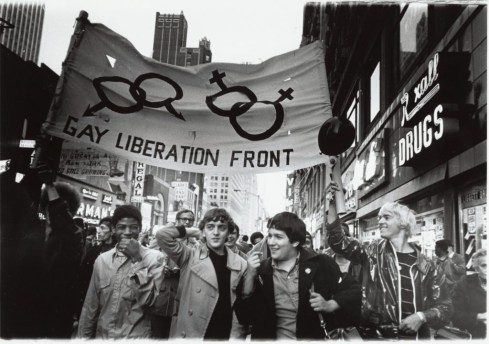
On the evening of July 4, 1969, the New York Mattachine Society called a meeting. The purpose of the gathering was to stop anymore riots and to get gays and lesbians to follow more closely their view of how the revolution should proceed, mainly for them to act like straight people and gain respect among normal society. Most of the gays in the room that night were tired of the Mattachine’s tactics. They wanted a new movement, one that challenged what normal was, one that was more militant, and one in which they did not have to change who they were. That night, the gays and lesbians at the Mattachine Society meeting formed the beginnings of the Gay Liberation Front.[2]
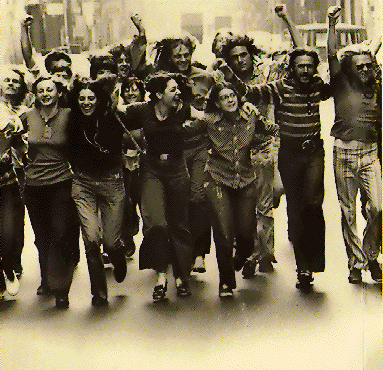
The Gay Liberation Front (GLF) never had the same organizational hierarchy that the Mattachine Society had. The GLF allowed for each chapter to move in its own direction and determine how best to achieve their overall goals in their local area. The GLF was also more visible than many people actually preferred to be, but for the GLF to succeed they had no choice but to use the “We’re here, we’re queer, get used to it” tactics.[3] The GLF had their share of splinter groups and unlikely alliances, such as with the Black Panthers.
The gay liberation movement also moved into more proper politics in the early 1990s. The AIDS epidemic took a great deal of the steam out of the movement that had continued to build during the seventies. In the early nineties, groups like the Human Rights Council, the largest gay and lesbian political action committee, the Gay and Lesbian Task Force, and the Lambda Legal Defense Fund tackled legislative and legal issues pertaining to gay and lesbian rights. Gays and lesbians even entered the political arena with a branch of the Democratic Party, the Stonewall Democrats, and with a branch of the Republican Party, the Log Cabin Republicans. The same old issues of whether gays should assimilate into society or make society accept them for who they are and at the same time have equal rights are still apparent in the splits that exist within the gay community.[4]
[1]Ibid., 206-207.
[2]Ibid., 211-212.
[3]James T. Sears, Rebels, Rubyfruit, and Rhinestones: Queering Space in the Stonewall South, (New Brunswick: Rutgers University Press, 2001), 60, 64.
[4]Benjamin H. Shepard, “The Queer/Gay Assimilationist: The Suits vs. the Sluts,” Monthly Review: An Independent Socialist Magazine 53:1 (May 2001): 49-63.
Further Reading:
“ 4 Policemen Hurt in ‘Village’ Raid,” The New York Times, 29 June 1969.
Duberman, Martin. 1994. Stonewall. New York: Plume.
“Hostile Crowd Dispersed Near Sheridan Square,” New York Times, 3 July 1969.
Meeker, Martin. 2001. “Behind the Mask of Respectability: Reconsidering the Mattachine Society and Male Homophile Practice, 1950s and 1960s.” Journal of the History of Sexuality. 1:78-116.
“Police Again Rout ‘Village’ Youths,” New York Times, 30 June 1969.
Sears,James T. 2001. Rebels, Rubyfruit, and Rhinestones: Queering Space in the Stonewall South. New Brunswick: Rutgers University Press.
Shepard, Benjamin H. 2001. “The Queer/Gay Assimilationist: The Suits vs. the Sluts.” Monthly Review: An Independent Socialist Magazine 53:1, 49-63.
Smith, Howard. “Full Moon Over the Stonewall,” The Village Voice, 3 July 1969.
Suran, Justin David. 2001. “Coming Out Against the War: Antimilitarism and the Politicization of Homosexuality in the Era of Vietnam.” American Quarterly 3: 452-488.
Truscott,Lucian, IV. “Gay Power Comes To Sheridan Square.” The Village Voice. 3 July 1969.
“Village Raid Stirs Melee.” New York Post. 28 June 1969.
Gay Rights Movement: Stonewall Riots

We reached Cooper Square, and as Ginsberg turned to head toward home, he waved and yelled, “Defend the fairies!” and bounce on across the square. He enjoyed the prospect of “gay power” and is probably working on a manifesto for the movement right now. Watch out. The liberation is under way![5]
Gay Rights Movement: The Anti-War Movement

In more modern times, the United States and most countries of the world criminalized homosexuality (sodomy) and therefore banned gay men and women from serving in the military. The Mattachine Society, founded in 1950, was one of the earliest homophile (gay rights) organizations in the United States, probably second only to Chicago’s short-lived Society for Human Rights (1924). Harry Hay and a group of Los Angeles male friends formed the group to protect and improve the rights of homosexuals. Because of concerns for secrecy and the founders’ leftist ideology, they adopted the cell organization of the Communist Party. In the anti-Communist atmosphere of the 1950s, the Society’s growing membership substituted a more traditional ameliorative civil rights leadership style and agenda for the group’s early Communist model. Then as branches formed in other cities, the Society splintered in regional groups by 1961.
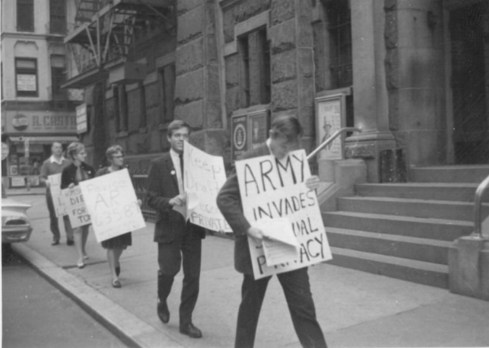
Youths rebelled against older homophile organization, which often refused to take a stance on the Vietnam War. Young gay men had to chose whether or not to reveal or conceal their homosexuality when they came before the draft board, because with the draft board being composed of local citizens, this could mean being outed to friends, neighbors or parents. The dilemma faced by gay youths polarized the gay liberation movement and gay youths joined in on the antiwar protests.[1] While older homophile organizations saw non-participation of homosexuals in the American military as detrimental to gay rights, youths of the antiwar stance saw it as a positive good. Suran contends that there are four major assertions by gay men in the antiwar movement. First, young homophiles saw military service as politically and morally counterproductive. Second, they declared war as a masculine affront to gay men. They cited the “effiminist” nature of homosexual men and refused to participate in macho role playing. Third, the young activists viewed imperialism as an extension of heterosexist ideology. Finally, they perceived homosexuality itself as antiwar antiestablishment, and anti-imperialist. With these four beliefs, young homophiles refused to embrace the older homophile tradition of assimilation in to “normal” society through military service.[2]
Though the Mattachine Society fell apart by the 1970s, one of their focuses was on protesting the US policy against gays serving in the military. They believed they could serve their country in any capacity, whether it be in government (gay men and women were not allowed to serve in government positions because their sexuality could be used as a basis for blackmail by communist spies) or in the military.
When more public gay rights groups formed after the 1969 Stonewall Riots, image gay men had moved away from support for military service. With the Vietnam War and the draft still very much a reality, gay rights groups turned their backs on the issue of military service because they did not want to be drafted. However, the government also turned their backs on the ban and forced many gay men who were drafted to serve, deciding that they needed the manpower more than they needed to uphold the ban on military service. In the United States today, sodomy is no longer illegal thanks to the Supreme Court decision, Lawrence v. Texas, and in 1973 the American Psychiatric Association removed homosexuality from its Diagnostic and Statistical Manual of Mental Disorders. Therefore there is no legal or medical reason that can be used to deny gay men and women the right to serve openly in the military.
image
[1]Justin David Suran, “Coming Out Against the War: Antimilitarism and the Politicization of Homosexuality in the Era of Vietnam,” American Quarterly 53, no. 3 (2001): 453.
[2]Ibid., 471-472.
Next: The Stonewall Riots
Gay Rights Movement: Mattachine Society

Most historians agree that the movement towards gay rights, at least, nominally began with the founding of the Mattachine Society in Los Angeles in 1950 as the first gay rights organization in history. Harry Hay founded the organization and gave it its name after the medieval group of court jesters who satirized the government and royalty by wearing masks to keep themselves anonymous. Mattachine went through two different phases in its development. Early leadership based the leadership of the organization on the cell structure of the Communist Party with a secret hierarchical structure and a very centralized leadership. The seven founding members of the Mattachine Society remained anonymous as the mysterious “fifth order” who ran the organization through their leadership. The organization had three primary goals: to unify homosexuals as a group and with the dominant heterosexual culture, to educate both homosexuals and heterosexuals on the subject of homosexuality, and to enter the realm of political action.[1]
Due to the insistence of the first Mattachine Society that homosexuals adapt to the homophobic society of the Cold War by adopting the social and cultural mores of heterosexuals, the organization began to lose influence and membership. By 1957, the organizations national headquarters moved from its base in Los Angeles to San Francisco where it remained until the national organization disbanded in 1961. With the end of the national organization and its insistence on conservative politics, the local chapters began to become more radical in their quest for gay liberation.[2] The Communist Party structure and tactics of the Mattachine Society ultimately hurt the organization more that it would help it. With the Red Scare during the Cold War, the politics of the movement had a difficult time getting any recognition. Besides its communist association, this early homophile organization was never that large of a political organization. The fear of being publicly discovered as a homosexual was worse than having freedoms during the 1950s, when coming out meant that you were considered mentally ill, a social deviant, often classified as a criminal, and were barred from holding civil service jobs.
In his examination of the radicalization of the gay liberation movement, historian Justin David Suran shifts the focus from the radicalization of local homophile organizations to the gay participation in the antiwar movement. Local homophile organizations were still working for homosexuals to be “normalized” by assimilating into imagethe heterosexual cultures, most by allowing gay men and women to serve discretely in the U.S. Armed Forces. With the ability to be deferred from the draft by being labeled homosexual, many young gay men saw the opportunity to stay out of the Vietnam War. As the war continued into the early seventies, the deferment for homosexuality would have to be proved by a doctor or an arrest report in order to receive the deferment because of the prevalence of heterosexual men posing as homosexuals to stay out of the military.[3]
[1]Martin Meeker, “Behind the Mask of Respectability: Reconsidering the Mattachine Society and Male Homophile Practice, 1950s and 1960s,” Journal of the History of Sexuality 10, no. 1 (2001): 83.
[2]Ibid., 79.
[3]Justin David Suran, “Coming Out Against the War: Antimilitarism and the Politicization of Homosexuality in the Era of Vietnam,” American Quarterly 53, no. 3 (2001): 458-463.
Next: The Anti-War Movement
Gay Rights Movement: The Beginning

This post begins a series printed several years ago on The Closet Professor about the history of the early gay rights movement. It’s still one of my favorite pieces and I wanted to reprint it since Friday will mark the 50th anniversary of the Stonewall Riots. Most if not all of you have heard of the Stonewall Riots, and though most people credit Stonewall with the beginning of gay rights, there were precursors to the movement. This series is based on a paper I once wrote about the gay rights movement but has been updated to some extent. I hope you enjoy it and find it informative.
The summer of 1969 showed the best and worst of America. In June, President Nixon announced Vietnamization as a way to get America out of the Vietnam War. Man stood on the moon for the first time on July 16 with the Apollo 11 landing. In August, Woodstock demonstrated to the world the epitome of the flower children’s culture and the height of the counter culture movement. While such events were celebrated in American culture, the summer of 1969 was also marked by a series of tragedies. Judy Garland died from an overdose of drugs. The Manson Family murdered actress Sharon Tate, her unborn child, and four others in Bel Air, California, in what has image become known as Helter Skelter. Mary Jo Kopechne died in a drunk driving accident with Ted Kennedy in Chapppaquiddick, Massachusetts. And 248 people perished in Mississippi when Hurricane Camille crashed into the Gulf Coast. The Civil Rights Movement was also going through a change. With the assassination of Martin Luther King, Jr. in Memphis in 1968, the end had come to the classic period of the Civil Rights Movement. The movement was becoming more radical and began to splinter off into more groups of people, including women and the gay and lesbian community.
With the Stonewall Riots, the modern gay and lesbian rights movement had its beginnings in Greenwich Village, New York, during the summer of 1969. The Stonewall Riots marked a change in the direction of the gay liberation movement that had been brewing since the end of World War II with the founding of the Mattachine Society in Los Angeles with chapters in New York, Philadelphia, and San Francisco. Gays and lesbians worked with the Civil Rights Movement, participated in the anti-war movement, and kept their sexuality in the background. But the “Friends of Dorothy” and “Daughters of Bilitis” were determined to no longer stay in the background and have homosexuality criminalized as it had been in the past. On the night of June 27, 1969, the gays and lesbians in the Stonewall Inn fought back after a police raid, and the modern gay liberation movement was born and would continue to grow as gay pride marches marked the subsequent anniversaries of the Stonewall Riots each year in New York during the month of June.
Although most historians of the gay liberation movement place the climax of the beginning of the modern movement on the Stonewall Riots, some west coast historians give the metropolitan centers of the movement as Los Angeles and San Francisco in the fifties with the founding of the Mattachine Society, the earliest homophile activist organization, and the antiwar movement in San Francisco during the sixties. Martin Meeker of the University of Southern California presented a re-evaluation of the Mattachine Society in his article “Behind the Mask of Respectability: Reconsidering the Mattachine Society and Male Homophile Practice 1950s and 1960s,” and Justin David Suran of the University of California, Berkeley examines the effects of the Vietnam War on the gay liberation movement in “Coming Out Against the War: Antimilitarism and the Politicization of Homosexuality in the Era of Vietnam.”
Next: The Mattachine Society
D-Day

I must return
I must go back to Normandy
to look out upon the sea,
Where once a great armada
carried troops, including me.
I must go back to Omaha
to walk along the shore,
and let my mind go back in time
to when there was a war.
When I go back I know I’ll mourn,
and shed some tears and feel the pain.
But I must go back and reminisce,
and think, and pray for those who there remain.
For they, too, were out upon that sea,
and then they died in Normandy.
Now from their graves above the shore,
they’ll keep their watch out on that sea, forever more.
I must go back to Normandy,
and, with them, once more,
look out upon that sea.
Sergeant Frank J. Wawrynovic landed on Omaha Brach on D-Day with C Company of the First Battalion, 115th Regiment, 29th Division. On June 17, he was wounded while scouting ahead of the American line in an orchard near the Norman city of St. Lô. He was evacuated, hospitalized for nearly two years, and discharged with a medical disability. After the war he returned to school and had a successful business career. Over the years he and his wife, Stella, gave very generous support to a variety of charities and non-profit organizations, including Normandy Allies. Many years after the war, his thoughts returned to that episode, leading him to write the poem shown above. He died in 2005, and his wife followed him in 2013.
D-Day occurred 73 years ago today and led to the liberation of Europe from Hitler’s Nazi regime.