Category Archives: History

Remember Pearl Harbor 

It began as an ordinary December day. People were gathered around the radio listening to a football game or planning holiday parties, not girding for battle. But on Dec. 7, 1941, when the first Associated Press report came over the radio at 2:22 p.m. Eastern Standard Time of a “bombing in Hawaii,” the news was electrifying. Seventy-five years later, every American living now who heard it then can still tell you exactly what he was doing when he learned of the Japanese attack on Pearl Harbor.

My grandmother would never forget that day seventy-five years ago. Her first child died of pneumonia on that day. She came home from the hospital to turn on the radio just as they were announcing the bombing of Pearl Harbor. Not only had she just lost her baby, but also, she realized that she would soon lose her husband to the war as well. My grandfather fought in WWII and luckily he safely returned, and they had two more children, my father and my aunt.

Pearl Harbor marked a watershed in the nation’s history and we knew it. What came after would be very different from what came before. It was the war that changed the world. “The Day of Infamy” thrust us into a conflict more than four years long that altered nearly every aspect of American life, large and small – from rationing gas and sugar to the harnessing of atomic power to the new role of women in the workplace. We united to defend our democracy. For more than 400,000, it would be the ultimate sacrifice.

That is why it is so important to remember the 75th anniversary of Pearl Harbor and all the 70th anniversaries of World War II events that follow. I will be commemorating the day by presenting a talk on the voices (oral histories) of Pearl Harbor. I hope my presentation goes well today.


Those Kinky Romans

When we think of Ancient Rome, we immediately think of excess. The kind of excess that means balls to the wall, non-stop drinking and orgy-fueled ridiculousness, leading to their eventual fall from grace. And in this excess was a shameless, extravagant community of homosexuals. Though there was no Latin word for ‘gay’ per se, men were getting down with each other in Ancient Rome like it was their damn job, often in ways that, by today’s standards, are highly disturbing. Here are a few of the more bizarre activities and habits that the boys got up to in their spare time:

1. Bestiality Role Play

Emperor Nero, who reigned from 54 to 68 AD, was a frisky guy. And by frisky, we mean psychotic pervert. The infamous fire of Rome that took place during his reign is often thought to be intentionally sparked to make way for his Golden Pleasure Palace, paid for with the taxes of Roman citizens. One of the gayest activities that took place in said palace was what he called ‘The Animal Game’. It began by tying and binding naked men to various posts set up around the room. Nero would then don himself in animal skins and be put in a cage. When released from the cage, he would wildly begin to ravage each of his victims however he chose. Whatever you say of the man, you can’t deny that he was imaginative.

2. Freaky Gay Marriages

Considering the great lengths to which the modern world has fought for gay marriage, it seems odd that it would have been a perfectly legal practice in the ancient world. But the practice of gay marriage was a bit more fetishized and falsified than the union we know today. Everyone’s favorite emperor Nero was a frequenter of this practice, as was the emperor Elagabalus. These two would proudly display their male lover du jour in a full, official ceremony, complete with bridal veil and a dowry. Nero even bent genders, participating in two ceremonies where he ‘played bride’. But this is all fine compared to the men he castrated to be his true ‘bride’.  

3. Tiberius’ ‘Tiddlers’ also known as ‘Minnows’

Swimming pools are a perfectly understandable breeding ground for the erotic. You’re having a good time, you’re half or completely naked, and usually with one or more persons feeling your carefree vibe. So who could blame Emperor Tiberius for being a prolific swimmer, especially when his empire had such decadent bathhouses and pools so readily available? However, Tiberius’ underwater excursions were accompanied by a league of helpers he referred to as his ‘tiddlers’. These tiddlers were young men (and often even younger boys) who were trained to swim beneath him and provide pleasure through light nibbling and coddling. In other words, actual humans were trained to act as sexual minnows in the emperor’s private pond. No word on how long these tiddlers had to hold their breath, but assume it was on the longer side.

4. Road-Side Sex Stops

Everybody has those urges that seem so desperate, they must be filled immediately – it’s a normal part of being a horny human. But for those in Ancient Rome with money and power to spare, these urges could be fed however they pleased. The most creative outlet was surely the road-side sex stops, set up along whichever street or riverbank the lucky member of aristocracy happened to pass through. These were quite literally tents that would be prepared ahead of the wealthy man’s journey where a male prostitute would lay in waiting to be ravaged before their lord would continue about his stroll. Think of it like a McDonald’s stop, but even more satisfying.

5. Learning by Pictures

Another innovation made handy by the randy Emperor Tiberius, entire rooms in his palaces were devoted to paintings depicting every sex act imaginable in vivid detail. These were not just for decor; Tiberius had these works created for learning purposes. He would reportedly bring in scores of his new male prostitutes to these chambers to learn the finite details of how to please an emperor; that way there could be no question about one’s duty in the bedroom. It was a practice rarely seen before in ancient times, yet oddly one that mirrors the way young gays today learn from their elders via pornography on screen. Guess Tiberius’ gross libido did some good. Many bathhouses had these depictions as well. Pompeii is known to have had many such depictions of sexual acts in their bathhouses.
From: https://dandydicks.com/blog-entry/a-brief-history-of-all-the-gay-shit-that-went-down-in-ancient-rome


Baron Friedrich Wilhelm von Steuben

Meet the gay man who actually won America her independence
By Mark Segal

To appreciate the contributions Baron Friedrich Wilhelm von Steuben (1730-94) made to the American Revolution, consider this: Before his arrival in Valley Forge in 1778, the colonies were on the path to defeat. Without his leadership, our modern America might still be the British Colonies.

The Sodomite Soldier

Before von Steuben arrived at Valley Forge, the Revolutionary Army was a loosely organized, rag-tag band of men with little military training or discipline. The military fumbled through the beginning of the war for independence lacking training and organization. Gen. George Washington and the Continental Congress knew that, without help from additional seasoned military experts, the colonies would clearly lose.

Since Washington himself was the best the colonies had, they looked to Europe for someone who could train the troops. To that end, Washington wrote the colonies’ representatives in Paris, among them Benjamin Franklin, to see what he could come up with. Franklin, a renowned inventor, was treated as a celebrity in the French court. This would be pivotal in achieving his two major objectives in France: winning financial support for the American Revolution and finding military leaders who could bring a semblance of order to the Revolutionary Army.

Franklin learned of a “brilliant Prussian” military genius, Lt. Gen. Baron Friedrich Wilhelm von Steuben, who had a string of successes across Germanic Europe. But there was one problem. He’d been asked to depart many of those states and countries because of his “affections for members of his own sex,” according to biographer Paul Lockhart’s The Drillmaster of Valley Forge.

This became urgent in 1777 when von Steuben literally escaped imprisonment in what is now Germany and traveled to Paris. There, Franklin was interviewing candidates to assist Washington back in the colonies when his fellow Colonial representative Silas Deane brought von Steuben to his residence for an interview in June.

During the process, Franklin discovered von Steuben’s reputation for having “affections” with males and the issue became pressing, as members of the French clergy demanded the French court, as in other countries, take action against this sodomite, whom they considered a pedophile. They had decided to make their effort a crusade and run him out of France.

Lockhart’s biography tells of von Steuben’s being summoned from Paris for Karlsruhe, at the court of the Margrave of Baden, for a military vacancy. But, Lockhart notes, “what he found waiting for him at Karlsruhe was not an officer’s commissioner but a rumor, a horrible, vicious rumor” that the Baron had “taken familiarities with young boys.”

Those allegations were fueled by von Steuben’s close ties to Prince Henry and Frederick the Great, also “widely rumored to be homosexual.”

Benjamin Franklin: Smuggler & Scandal Fixer

Von Steuben returned to Paris, and Franklin had a choice here — and he decided von Steuben’s expertise was more important to the colonies than his sexuality. While it can be debated how much a part Franklin played in the recruitment of von Steuben, one cannot doubt that one of the most informed people at the French court would know of the allegations against the baron. With that knowledge, and with von Steuben about to be jailed, Franklin, along with Deane, wrote what must be the nation’s first example of “Don’t Ask, Don’t Tell” as they mutually signed a recommendation letter to Gen. Washington that embellished von Steuben’s military expertise and titles and suggested he had been recommended by various princes and “other great personages.” Most surprisingly, it remarked that “his distinguished character and known abilities were attested to by two judges of military merit in this country.”

The judges of character that Franklin referred to were two of the four involved in the plot to bring von Steuben to America, along with Franklin and Deane, and personal friends of the baron: Pierre Beaumarchais, author of the “Figaro” plays and an arms dealer who supplied arms for the ship von Steuben eventually sailed on, and Claude Louis, Comte de Saint-Germain, the minister of war under Louis XVI.

What the letter didn’t mention was that he was about to be arrested and appear before judges in France.

Franklin, working with Deane, decided von Steuben’s “affections” were less important than what he, Washington and the colonies needed to win the war with England. Deane learned of von Steuben’s indiscretions — and that the French clergy was investigating — from a letter to the Prince of Hechingen, which read in part:

“It has come to me from different sources that M. de Steuben is accused of having taken familiarities with young boys, which the laws forbid and punish severely. I have even been informed that that is the reason why M. de Steuben was obliged to leave Hechingen and that the clergy of your country intend to prosecute him by law as soon as he may establish himself anywhere.”

The proof of Franklin and Deane’s knowledge lies in the letter to Washington recommending von Steuben and their quick action to secure the baron from France. So in September 1777, von Steuben boarded a 24-gun ship named Heureux — but, for this voyage, the ship’s name was changed to Le Flamand, and the baron’s name was entered onto the captain’s log as “Frank.” And he was on his way to the colonies.

Baron von Steuben Whips the Men Into Shape

Washington and Franklin’s trust in von Steuben was rewarded. He whipped the rag-tag army of the colonies into a professional fighting force, able to take on the most powerful superpower of the time, England. Some of his accomplishments include instituting a “model company” for training, establishing sanitary standards and organization for the camp and training soldiers in drills and tactics such as bayonet fighting and musket loading. According to the New York Public Library, (“The Papers of Von Steuben”) these were his achievements:

  • February 1778: Arrives at Valley Forge to serve under Washington, having informed Congress of his desire for paid service after an initial volunteer trial period, with which request Washington concurs.
  • March 1778: Begins tenure as inspector general, drilling troops according to established European military precepts.
  • 1778-79: Writes “Regulations for the Order and Discipline of the Troops of the United States,” which becomes a fundamental guide for the Continental Army and remains in active use through the War of 1812, was published in over 70 editions.
  • 1780-81: Senior military officer in charge of troop and supply mobilization in Virginia.
  • 1781: Replaced by Marquis de Lafayette as commander in Virginia.
  • 1781-83: Continues to serve as Washington’s inspector general, and is active in improving discipline and streamlining administration in the Army.
  • Spring 1783: Assists in formulating plans for the post-war American military.

Washington rewarded von Steuben with a house at Valley Forge, which he shared with his aide-de-camps Capt. William North and Gen. Benjamin Walker. Walker lived with him through the remainder of his life, and von Steuben, who neither married nor denied any of the allegations of homosexuality, left his estate to North and Walker. There wasn’t much else to claim, as the baron was in debt at the time of his death, according to both Kapp and Lockhart. His last will and testament has been described as a love letter to Walker and has been purported to describe their “extraordinarily intense emotional relationship,” yet that line was not in the Kapp biography of 1859.
Both North and Walker are featured in the statue of von Steuben in Lafayette Park across from the White House.

John Adams’ Son’s ‘Unsavory’ Relationship with the Baron

Von Steuben and with whom he slept was long a matter of discussion — from Prussia to France to the United States. Yet he never publicly denied it. The closest he came was to ask Washington to speak on behalf of his morals in a letter to Congress so he could get his pension. And why did he ask Washington?

Since his arrival in Philadelphia to assist the Revolution, von Steuben had financial issues caused by a Continental Congress that often didn’t keep its funding promises, a challenge compounded by his own personality: Von Steuben at times could be cold and aloof, which was problematic when diplomacy was needed with an important member of Congress. He also had a tendency to live and spend extravagantly, especially on his uniforms, which were often emblazoned with epaulettes and medals of his own design.

Adding to that were the constant rumors about his sexuality, which by 1790, reached one of the revolution’s first families, the Adamses of Massachusetts.

Charles, the son of John and Abigail Adams — the second president and first lady of the new union — was what today would be called the black sheep of the family. Early on, Abigail considered him “not at peace within himself.” His biggest problem was alcoholism but, as revealed in letters among the various members of the family, the Adamses had other concerns.

As John Ferling wrote in the biography John Adams: A Life, “There are references to [Charles’] alleged proclivity for consorting with men whom his parents regarded as unsavory.” One of these men was von Steuben, who, as Ferling writes, many at the time considered homosexual.

Charles had become infatuated with and adored Von Steuben. It is clear from the family letters that the Adamses were concerned about a relationship between Charles and the baron. Von Steuben’s sexuality was an open secret, one that he himself never challenged, other than to ask Washington to defend his moral character.

The Nation’s First Underwear Party

The baron is a puzzle. At first, I really didn’t like him: The man himself was pompous, cold and theatrical, and his uniforms and title were stage props for an officer who didn’t even speak English when he got to Valley Forge. But I respected him for what he did to help Washington’s rag-tag army to defeat the British, eventually leading to the creation of our country. His knowledge created the first sense of military discipline in the colonies. My appreciation for him came from his most recent biographer, Lockhart, whose book The Drillmaster of Valley Forge offers a complete look at von Steuben’s work.

There is one story in the book that could be considered rather scandalous in today’s terms: Von Steuben most likely threw the first underwear party in the United States military, at his house in Valley Forge.

As Lockhart writes, “The Baron hosted a party exclusively for their lower-ranking friends. He insisted, though, that ‘none should be admitted that had on a whole pair of breeches,’ making light of the shortages that affected the junior officers as they did the enlisted men.”

Apart from this humorous anecdote, it’s hard to question von Steuben’s importance — especially as Washington’s last official act as commander-in-chief of the Continental Army was to write a letter to the baron.

George Washington Says Goodbye

Sent from Annapolis and dated Dec. 23, 1783, Washington wrote:

My dear Baron: Altho’ I have taken frequent opportunities, both in public and private, of acknowledging your great zeal, attention and abilities in performing the duties of your office; yet I wish to make use of this last moment of my public life, to signifie [sic] in the strongest terms my entire approbation of your conduct, and to express my sense of the obligations the public is under to you, for your faithful and meritorious services.

“I beg you will be convinced, my dear sir, that I should rejoice if it could ever be in my power to serve you more essentially than by expressions of regard and affection; but in the meantime, I am persuaded you will not be displeased with this farewell token of my sincere friendship and esteem for you.

“This is the last letter I shall ever write while I continue in the service of my country; the hour of my resignation is fixed at 12 this day, after which I shall become a private citizen on the banks of the Potomack, where I shall be glad to embrace you, and to testify the great esteem and consideration with which I am, etc.”

The nation that von Steuben helped found has memorialized him with numerous statues, including those at Lafayette Square near the White House and at Valley Forge and Utica, N.Y. (where he is buried) and German Americans celebrate his birthday each year on Sept. 17, hosting parades in New York City, Philadelphia and Chicago.

It was von Steuben, a gay man, who played a giant role in not only the creation of our military, but the idea of military academies, a standing Army and even veterans organizations.

If George Washington was the father of the nation, then von Steuben, a gay man, was the father of the United States military.

This article was originally published on Bilerico in 2013. This version has been abridged.


It’s a Small (Ancient) World After All…

'David'_by_Michelangelo_JBU0001-1.JPG

On Sunday, BosGuy wrote the following blog piece:

An article with a similar title was sent to me by a reader and friend of this blog and it made me laugh so I thought I’d share it with you for some light reading.

According to art historian Ellen Oredsson, the reason virtually every ancient statue you’ll ever see has a rather small penis is because of cultural perceptions and biases of the time. Apparently, big penises were associated with specific negative characteristics: foolishness, lust and ugliness. By contrast the ideal man was meant to be rational, intellectual and authoritative and a small penis allowed a man to remain coolly logical.

Who can say if this is true or not but the brief and colorful article (they use a bit more direct language) can be read in its entirety here.

Here is a story from history to back up Oredsson’s theory. While Marc Antony was away with Cleopatra in Egypt, Octavian and his enemies in Rome began to slander him.  One of the forms of slander was that Marc Antony was well hung. While that would not be slander in today’s world, it was slander in the ancient world. In the ancient world this meant that he was lead by his penis. Because it was so large he could not control his sexual appetite and thus had Cleopatra, who was known to have affairs with men to gain power, i.e. Julius Caesar. In Aristophanes The Clouds, he describes the perfect man:

If you follow my recommendations,
and keep them ever in mind,
you will always have a rippling chest, radiant skin,
broad shoulders, a wee tongue,
a grand rump and a petite dick.
But if you adopt current practices,
you’ll start by having
a puny chest, pasty skin,
narrow shoulders, a grand tongue,
a wee rump and a lengthy edict.


Short-Arm Inspection 


I’m not for sure if this is what’s going on in the picture above, but I think it’s a good guess. They are definitely checking something.

From Wikipedia:

The term “short-arm inspection” is a military euphemism referring to the routine medical inspection of male soldiers’ penises (“short arms”) for signs of sexually-transmitted diseases and other medical problems.

The precise origin of the term is uncertain; however, American and Australian troops are known to have used the term during the First World War.


The Hanky Code

Adult male with back tattoo reading believer.

The Hanky Code is a traditional form of signaling to others what your sexual preferences and interests are. Gay men used this code to communicate with each other in the noisy and distracting environment of gay bars. Although not as widely used these days, it is still a worthwhile resource and is, among those who know, a great conversation starter. Hankies can also be worn around the wrist, ankle, or leg (at the thigh, above the knee), or around the neck with the tie going either right or left. Other objects such as keys, key chains, watch fobs, or even handcuffs can also be used to let people know if you’re a “top” or “bottom.” If worn in the back on the center belt loop, it translates as “versatile.”

The wearing of various colored bandanas around the neck was common in the mid- and late-nineteenth century among cowboys, steam railroad engineers, and miners in the Western United States. It is thought that the wearing of bandanas by gay men originated in San Francisco after the Gold Rush, when, because of a shortage of women, men dancing with each other in square dances developed a code wherein the man wearing the blue bandana took the male part in the square dance, and the man wearing the red bandana took the female part (these bandanas were usually worn around the arm or hanging from the belt or in the back pocket of one’s jeans). It is thought that the modern hanky code started in New York City when a Village Voice journalist is credited with the birth of the modern hanky code in 1970, jokingly suggesting that instead of wearing keys to indicate whether someone was a top or a bottom, it would be more effective to announce a particular sexual desire by wearing different colored hankies in their back pockets. There were only a few colors suggested—red, navy, light blue, green and black—because that was all that Levi’s produced at the time.
Today, wearing color-coded handkerchiefs (bandanas) is the manner in which communication of desires and fetishes is achieved. Wearing a handkerchief on the left side of the body typically indicates one is a “top” (one considered active in the practice of the fetish indicated by the color of the handkerchief), while wearing it on the right side of the body would indicate one is a “bottom” (one considered passive in the practice of the fetish indicated by the color of the handkerchief). This left-right reality is taken from the earlier practice of tops wearing their keys on the left belt loop and bottoms on the right to indicate being a member of the leather subculture. Bandanas might be worn in the front or back pocket, tied around the neck (with the knot positioned on either the left or right side); around the ankle (when wearing boots or when undressed); or on other parts of the body.

image


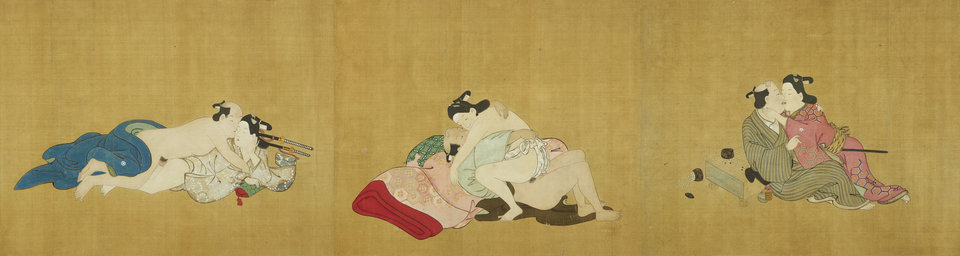
Homosexuality in Japan’s Edo Period

image
Japan’s Edo period, stretching from the 17th to 19th century, was characterized by economic growth and a rigid social order, both of which worked together to bolster a before unrealized interest in art, culture, entertainment and, yes, sex.

While most marriages at the time were arranged — and between a man and a woman — sex between two men was not at all uncommon, though often kept out of public view. For the most part, such erotic encounters were allocated to three spheres: red-light style pleasure districts, kabuki theater, and shunga, or erotic art.

Artistic representations of erotic encounters between two men, known as nanshoku, are harder to find in the annals of shunga prints than images of sexually skilled octopi. However, a wildly rare shunga handscroll by artist Miyagawa Choshun, which has been shielded from public view since the 1970s, depicting man-on-man loving, has been recently rediscovered by Bonhams auction house.

“In the strictly regulated society of Edo period Japan, it was not unusual for people to yearn for circumstances and opportunities not afforded them by birth,” Bonhams’ Director of Japanese Art Jeff Olson said in a press statement. “For most, costly visits to the pleasure quarters were out of reach, so illustrated erotica was the next best thing.”

While most shunga prints frame the genitals front and center, nanshoku works focus more on the tender romance of the relationship. Think of them as the soft-core alternative to hardcore porn. The pairings normally consist of an older man and a younger partner, dressed in an ornate kimono and traditional woman’s hairstyle. Artistic depictions often muse on the luxurious details of the young lover’s garments and appearance.

Choshun’s striking handscrolls are at once minimalist in their color-blocked elegance and grandiose in their detailed renderings of kimonos and tricky-looking sexual positions. The lovers are rendered in a gold-tinted, floating world, swallowed up by the fantasy of their own desires.

This article is from the Huffington Post, though slightly edited. To see more of these depictions of Japanese gay erotica (though I’ll be honest, they don’t look too gay to me), you can feast your eyes on these delightfully rare, 17th-century Japanese gay erotica at http://www.huffingtonpost.com/entry/feast-your-eyes-on-these-rare-17th-century-handscrolls-of-japanese-gay-erotica_us_56ec35bfe4b03a640a6a53d5


Sughaim Sine

IMG_3867.JPG

Ancient Celtic culture is typically lauded for such things as storytelling, mysticism and warrior fierceness. Mistakenly, however it’s not been broadly known for its eroticism. Something we know to be a historical oversight at the least.

It wasn’t always like this. In ancient times, the Celts were widely renowned as much for their erotic energy and prowess, multiple love affairs/sexual liaisons and androphilic activities, as for their warlike habits. It is known that male warriors were often part of ‘sodalities’ or groups of “special friends”. They engaged freely and openly in same-sex relationships and participated in a variety of acts for pleasure and bonding. Ancient Greeks such as Aristotle and Strabo mention Celtic homosexuality as one of the few good things about what they considered a barbarian culture. Diodorus Siculus chronicled his impressions writing —

They are accustomed to sleep on the ground on animal skins and roll around with male bed-mates on both sides. Heedless of their own dignity, they abandon without qualm the bloom of their bodies to others. And the most incredible thing is that they do not think this is shameful. But when they proposition someone, they consider it dishonorable if he does not accept the offer!…

A particularly succulent example of this fluidity is perhaps exemplified in the adjunctive early Irish practice of homosocial nipple-sucking or what today can be called “sughaim sine”. This typically male act stood for many things in the pagan culture of the times. In one aspect, it was used as a way to pledge loyalty, devotion and submission for a king. Among common men, it was an expression of friendship, greeting, reconciliation, affection, fealty, protection and not surprisingly, as some sources suggest, sexual stimulation and pleasure.

While Ireland was still a pagan culture, Christianity was taking hold in Europe and North Africa. Christian philosophy increasingly taught that all sexual ways were physically harmful and that sexual abstention was the wisest course. But the tradition of “special friends” and the importance of love, physicality, affection and sexual expression did not die out. It was an essential part of the culture. An old Celtic saying holds, “A person without a soul friend is like a body without a head.”

Though Irish monasteries in the Dark Ages between the years of 600 and 1200 CE tried to control the sexuality of both the clerics and the converted, the privileges and benefits of soul friendship could not be destroyed. The delectable habit of men sucking on each other’s nipples to affirm friendship (particularly after a quarrel) seemed indelible and was slow to change.

There are a number of references or implications regarding the practice but detailed information is spare. The most notable account is in an oft omitted passage of St. Patrick’s ‘Confessions’ wherein he says —-

On the day I arrived the ship weighed anchor, I explained that I had the wherewithal to sail with them. And that day, furthermore, I refused for fear of God, to suck their nipples. (A Pagan custom of friendship) Nevertheless I hoped that some of them would come to faith in Jesus Christ (for they were heathen). This displeased the captain who answered sharply, with anger “Your wish to travel with us is quite futile”. And when I heard this, I left them in order to return to the shelter in which I had lodged, beginning to pray as I went. Before the prayer was finished, I heard one of them, who shouted out to me “Come quickly these men are calling you”. I returned to them immediately and they began to explain to me: “Come, we will accept you in good faith. Bind yourself to us in whatever way you wish” Because of this I was received among them and we set sail straight away…

Patrick was citing the prevalence of pagan practices and in doing so he was making the obvious point that the Ireland in which he had been a slave was largely un-Christianized. Since he does not explain the significance of the incident, its meaning is taken to have been evident to the readers of his day. This suggests therefore that the custom was widely accepted and well-known among Celts. By declining to participate, Patrick denies pagan practice and in turn gives us an idea of how deliciously unrestrained the Celtic/Pagan world may have been.

Archaeological bog discoveries in Ireland have corroborated the “sughaim sine” practice in another of its aspects. The subjects of ancient Irish king’s ritually and routinely demonstrated their submission by sucking on their ruler’s nipples – some believe perhaps in a nursing, group or perhaps erotically intended way. It is theorized that there may have been royal reception days when the king exposed his nipples for his “court” in order to facilitate sucking for a large group. In a potentially more macabre element, there appears to have been power games in the nipple hierarchy. Cutting off a royal descendant’s nipples made him ineligible for kingship. Not as subtle as poison, but undeniable evidence of his unsuitability for a kingly role. No nips, game over.

Perhaps the King’s nipples were most important when celebrating fertility compacts, in the festivals where the King was wedded to the Earth (Goddess). His kingly role required him to keep nature and society in equilibrium. A little nipple sucking would surely increase his self-esteem, stimulate him thereby enhancing his virility and help him on his way to essential potency. But if he failed to keep everything fertile he could be dispatched. Such is believed to possibly have been the case of the bog men.

IMG_3866.JPGThe practice is also referenced mythologically within the tale of King Fergus mac Leite. Lore says that the King, after returning to his own land, falls asleep on the coast near the sea. Small people appear who carry the king without his sword into the water. It might be inferred that they want to abduct him to their own ‘land’ under water. This ‘foreign’ invasion threatens the king and thereby the land. When his bare feet become wet and cold, however, he awakens in time and grabs three of them. In order to save themselves they offer a pact, which is introduced by a ritualistic exchange of words and is sealed by the mutual, prolonged sucking of nipples. Thanks to this agreement, the king receives a charm with which he can survive under water – a kind of ‘passport’ to travel in the ‘foreign’ lands under the waves and is forever nipple-bonded to the small men.

Finally, the nipple motif even reappears later after the Christian era is in full swing showing again the importance of “sugere mammillas” within the culture. There is reference of holy men suckling neophytes relatively late in Irish hagiography. This seems significant in a metaphorical sense as a spiritual act of imparting the perceived grace and teaching of Christ through the symbolic acts of nursing and bonding. This information relates to the role of saints of both genders. However, it is notable in that the nipplage of male saints is cited equally in their place as nurturers of the early Irish church meaning that the “nursing” of male breasts was acceptable. This suggests the continuance of the tradition, albeit in a post-pagan, Christianized and sanitized configuration.


Friend of Dorothy

IMG_3622

The Wizard of Oz has been a iconic movie for gay men since it was released. Judy Garland starred in the film and connections between Garland and LGBT people include the slang term Friend of Dorothy. In gay slang, a “Friend of Dorothy” (occasionally abbreviated FOD) is a term for a gay man.The phrase dates back to at least World War II, when homosexual acts were illegal in the United States. Stating that, or asking if, someone was a “friend of Dorothy” was a euphemism used for discussing sexual orientation without others knowing its meaning. A similar term “friend of Mrs. King” (i.e. Queen) was used in England, mostly in the first half of the 20th century.

Conventional wisdom is that Garland’s death and funeral, in June 1969, helped inspire the Stonewall riots, the flashpoint of the modern Gay Liberation movement. However, some observers of the riots contend that most of those involved “were not the type to moon over Judy Garland records or attend her concerts at Carnegie Hall. They were more preoccupied with where they were going to sleep and where their next meal would come from.” There was certainly an awareness and appreciation of Garland among Stonewall Inn patrons. Because the bar had no liquor license, it was passed off as a bottle club and patrons were required to sign in. Many used pseudonyms and “Judy Garland” was among the most popular. Regardless of the truth of the matter, the Garland/Stonewall connection has persisted and has been fictionalized in Stonewall, Nigel Finch’s feature film about the events leading up to the riots. Lead character Bostonia is shown watching Garland’s funeral on television and mourning, and later refusing to silence a jukebox playing a Garland song during a police raid, declaring “Judy stays.”

Time magazine would summarize decades later:

The uprising was inspirited by a potent cocktail of pent-up rage (raids of gay bars were brutal and routine), overwrought emotions (hours earlier, thousands had wept at the funeral of Judy Garland) and drugs. As a 17-year-old cross-dresser was being led into the paddy wagon and got a shove from a cop, she fought back. [She] hit the cop and was so stoned, she didn’t know what she was doing—or didn’t care.

Garland’s daughter Lorna Luft points to the connection with pride, saying that her mother was a “huge, huge advocate of human rights” and that Garland would have found the rioting appropriate.

The phrase “Friend of Dorothy” likely derives from Garland’s portrayal of Dorothy Gale in The Wizard of Oz and became a code phrase gay people used to identify each other. Dorothy’s journey from Kansas to Oz mirrored many gay men’s desires to escape the black-and-white limitations of small town life…for big, colorful cities filled with quirky, gender-bending characters who would welcome them.

Another possible origin is that the term is derived from Road To Oz (1909), a sequel to the original Wonderful Wizard of Oz. The book introduces readers to Polychrome who, upon meeting Dorothy’s traveling companions, exclaims “You have some queer friends, Dorothy” and she replies “The queerness doesn’t matter, so long as they’re friends.” More commonly it is stated that “Friend of Dorothy” refers to the film The Wizard of Oz because Judy Garland, who starred as the main character Dorothy, is a gay icon.

In the film, Dorothy immediately accepts those who are different, including the Cowardly Lion. The Lion identifies himself through song as a “sissy” and exhibits stereotypically “gay” (or at least effeminate) mannerisms. The Lion offers a coded example of Garland meeting and accepting a gay man without question. In the film, Dorothy is accepting of those who are different. For example the “gentle lion” living a lie, “I’m afraid there’s no denyin’, I’m just a dandy lion.” Dandy has long been slang for an effeminate man or one preoccupied with fashion, such as Yankee Doodle Dandy, who “stuck a feather in his hat and called it macaroni.” A macaroni was a man who returned from the Grand tour with overaffected Italian mannerisms often portrayed as effeminate and wearing makeup.

IMG_3737I find this little fact hilarious, though it is also quite tragic in terms of understanding the American military attitudes and understanding of gay men.  In the early 1980s, the Naval Investigative Service was investigating homosexuality in the Chicago area. Agents discovered that gay men sometimes referred to themselves as “friends of Dorothy.” Unaware of the historical meaning of the term, the NIS believed that a woman named Dorothy was at the center of a massive ring of homosexual military personnel. The NIS launched an enormous hunt for Dorothy, hoping to find her and convince her to reveal the names of gay service members. Of course, they never found Dorothy.


Starting in the late 1980s, on several cruise lines, gay and lesbian passengers began approaching ship staff, asking them to publicize gatherings in the daily cruise activity list. As the cruise lines were hesitant to announce such things so blatantly in their daily publications, they would list the gathering as a “Meeting of the Friends of Dorothy”. The use of this phrase likely comes from the cruise directors who were also familiar with and using the “Friends of Bill W.” phrase in their programs to tell members of Alcoholics Anonymous that there were support group meetings on the trip. Such meetings have expanded in popularity and frequency over the years. Now, many cruise lines will have multiple “FOD” events, sometimes as many as one each night.

Another connection is the rainbow flag, symbol of the LGBT communities which may have been inspired, in part, by Garland’s song “Over the Rainbow.” Garland’s performance of this song has been described as “the sound of the closet,” speaking to gay men whose image “they presented in their own public lives was often at odds with a truer sense of self that mainstream society would not condone.”


Leap Year

b9aa64792db427ba41bad060e30571e0.jpg

10 fun facts about leap year and leap day

Feb. 29, 2016

Our year just got one day longer. Today, Feb. 29 is leap day, the day inserted into the calendar every four years to keep our calendar operating smoothly. This extra day makes the year 366 days long, instead of 365 days like regular years. Curious about why we have one extra day stuck to the end of February every four years? Here are 10 fun facts about leap years and leap days. This information was found on Timeanddate.com, Mother Nature Network and the Old Farmer’s Almanac.

  1. Why add a leap day?: Leap days are needed to keep our calendar in alignment with the Earth’s revolutions around the Sun. It takes the Earth approximately 365.242189 days – or 365 days, 5 hours, 48 minutes, and 45 seconds – to circle once around the Sun. This called a tropical year. Without an extra day on February 29 nearly every four years, we would lose almost six hours every year. After only 100 years, our calendar would be off by approximately 24 days.
  2. Hail Caesar: Julius Caesar introduced the first leap year around 46 B.C., but his Julian calendar had only one rule: Any year evenly divisible by four would be a leap year. That created too many leap years, but the math wasn’t tweaked until Pope Gregory XIII introduced his Gregorian calendar more than 1,500 years later. There’s a leap year every year that is divisible by four, except for years that are both divisible by 100 and not divisible by 400. The year 2000 was a leap year, but the years 1700, 1800 and 1900 were not. The added rule about centuries (versus just every four years) was an additional fix to make up for the fact that an extra day every four years is too much of a correction, according to ScienceWorld.
  3. Leap months in other countries: A whole leap month is added to the Chinese calendar every three years. The leap month’s place in the Chinese calendar varies from year to year, and 2015 was a leap year in the Chinese calendar. A leap year in the Ethiopian calendar occurs when an extra day is added to the last month of the year every four years.
  4. Leap year traditions: It’s acceptable for a woman to propose to a man on Feb. 29. The custom has been attributed to St. Bridget, who is said to have complained to St. Patrick about women having to wait for men to propose marriage. Patrick supposedly gave women one day to propose.
  5. Leap year babies: People born on leap day are often called “leaplings” or “leapers.” Most of them celebrate their birthday on Feb. 28 or March 1 on non-leap years.
  6. Leap year capital: The twin cities of Anthony, Texas, and Anthony, New Mexico, are the self-proclaimed Leap Year Capital of the World. They hold a four-day leap year festival each leap year that includes a huge birthday party for all leap year babies.
  7. Famous leapers: If you were born on leap day, you share a birthday with composer Gioacchino Rossini, motivational speaker Tony Robbins, jazz musician Jimmy Dorsey, actors Dennis Farina and Antonio Sabato Jr., and rapper/actor Ja Rule.
  8. There’s a leap year club: The Honor Society of Leap Year Babies is a club for people born on Feb. 29. More than 10,000 people worldwide are members.
  9. And a leap year movie: Amy Adams and Matthew Goode starred in the 2010 romcom “Leap Year.” It’s about a woman who travels to to Ireland to ask her boyfriend to accept her wedding proposal on leap day, when tradition says that men cannot refuse a woman’s marriage proposal.
  10. Leap years in history: During leap years, George Armstrong Custer fought the Battle of the Little Bighorn (1876), the Titanic sank (1912), Benjamin Franklin proved that lightning is electricity (1752) and and gold was discovered in California (1848).