Category Archives: History

恭禧發財 (Gong Hey Fat Choy) Happy New Year!

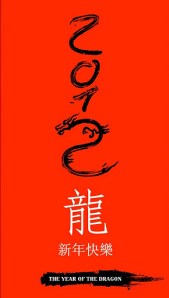
Chinese New Year 2012 began today, Monday, Jan. 23, 2012, and will usher in the Year of the Dragon. Celebrations have been held for the two weeks leading up to Jan. 23 as revelers from Hong Kong to San Francisco geared up for the most important holiday in the Chinese cultural tradition. However, the event has become a multicultural affair, celebrated many nationalities.  The Chinese New Year lasts for 15 days, thus I have decided that it is the perfect time to publish a series of posts about homosexuality and Asia from historical and contemporary perspectives.

The Chinese New Year is symbolized by a new animal zodiac, determined by a 12-year cycle. Last year was the Year of the Rabbit. But 2012 welcomes a more commanding beast — the Dragon.

Who is the Dragon?

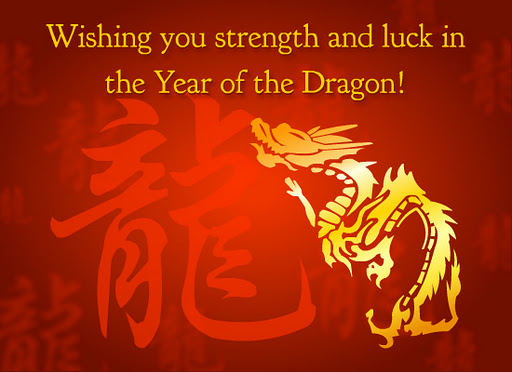
The Dragon is anything but a formidable foe in Chinese culture. Unlike the demon that gets slayed in Western literature, the Dragon is a symbol of good fortune and intense power in Eastern culture. In Chinese tradition, the Dragon is regarded as a divine beast.

According to Sung dynasty manuscripts, the Dragon is described as having the “head of an ox or donkey, eyes of a shrimp, horns of a deer, body of a serpent covered with fish scales, and a feet of a phoenix,” and it usually clutches a pearl, meant to symbolize its supernatural powers.

The Year of the Dragon is one of the most revered years of the Chinese New Year calendar, and those born under the sign are regarded as innovative, passionate people who are colorful, confident and fearless.

The Manila Bulletin cites that the Dragon is sometimes called a “karmic sign.” The Dragon is larger than life and its appearance means that big things are to come. The Year of the Dragon is a flowing river, not a stagnant lake, so things happen quickly earlier in the year. The Dragon marks progression, perseverance and auspiciousness. It may also bring about unpredictable events.

Elements

The five Chinese elements are Wood, Fire, Earth, Metal and Water. The Dragon is made of Earth, Water and Wood. The Chinese New Year 2012 will primarily be a water year. This could mean riches and abundance or it could mean natural disaster.

Hong Kong astrologer Alion Yeo said the world should prepare for storms and floods. “Expect to see a lot of flooding in areas like Thailand and Southeast China,” he said. “Indonesia, Pakistan, India and places in China like Sichuan, Yunnan and Guizhou are particularly disaster-prone. They are likely to experience frequent earthquakes.”

Earth elements prosper from Water. So if an individual has a strong Earth-related sign, then he or she will have the opportunity to make money in 2012. This year can also be prosperous for those with Metal and Wood-related signs. However, Wood signs must mind their words and actions as an unsavory reputation looms this year.

Water is not a good omen for Fire signs, as Fire fears water. Fire signs must be mindful of their personal safety, conservation efforts and exhibiting patience in 2012. However, female Fire signs could see blossoming social relationships in the Year of the Dragon, including romantic ones.

Gong Xi Fa Cai: wishing you to be prosperous in the coming year.

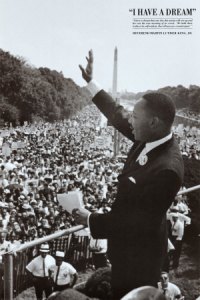
I Have a Dream

I am happy to join with you today in what will go down in history as the greatest demonstration for freedom in the history of our nation.

Five score years ago, a great American, in whose symbolic shadow we stand today, signed the Emancipation Proclamation. This momentous decree came as a great beacon light of hope to millions of Negro slaves who had been seared in the flames of withering injustice. It came as a joyous daybreak to end the long night of their captivity.

But one hundred years later, the Negro still is not free. One hundred years later, the life of the Negro is still sadly crippled by the manacles of segregation and the chains of discrimination. One hundred years later, the Negro lives on a lonely island of poverty in the midst of a vast ocean of material prosperity. One hundred years later, the Negro is still languished in the corners of American society and finds himself an exile in his own land. And so we’ve come here today to dramatize a shameful condition.

In a sense we’ve come to our nation’s capital to cash a check. When the architects of our republic wrote the magnificent words of the Constitution and the Declaration of Independence, they were signing a promissory note to which every American was to fall heir. This note was a promise that all men, yes, black men as well as white men, would be guaranteed the “unalienable Rights” of “Life, Liberty and the pursuit of Happiness.” It is obvious today that America has defaulted on this promissory note, insofar as her citizens of color are concerned. Instead of honoring this sacred obligation, America has given the Negro people a bad check, a check which has come back marked “insufficient funds.”

But we refuse to believe that the bank of justice is bankrupt. We refuse to believe that there are insufficient funds in the great vaults of opportunity of this nation. And so, we’ve come to cash this check, a check that will give us upon demand the riches of freedom and the security of justice.

We have also come to this hallowed spot to remind America of the fierce urgency of Now. This is no time to engage in the luxury of cooling off or to take the tranquilizing drug of gradualism. Now is the time to make real the promises of democracy. Now is the time to rise from the dark and desolate valley of segregation to the sunlit path of racial justice. Now is the time to lift our nation from the quicksands of racial injustice to the solid rock of brotherhood. Now is the time to make justice a reality for all of God’s children.

It would be fatal for the nation to overlook the urgency of the moment. This sweltering summer of the Negro’s legitimate discontent will not pass until there is an invigorating autumn of freedom and equality. Nineteen sixty-three is not an end, but a beginning. And those who hope that the Negro needed to blow off steam and will now be content will have a rude awakening if the nation returns to business as usual. And there will be neither rest nor tranquility in America until the Negro is granted his citizenship rights. The whirlwinds of revolt will continue to shake the foundations of our nation until the bright day of justice emerges.

But there is something that I must say to my people, who stand on the warm threshold which leads into the palace of justice: In the process of gaining our rightful place, we must not be guilty of wrongful deeds. Let us not seek to satisfy our thirst for freedom by drinking from the cup of bitterness and hatred. We must forever conduct our struggle on the high plane of dignity and discipline. We must not allow our creative protest to degenerate into physical violence. Again and again, we must rise to the majestic heights of meeting physical force with soul force.

The marvelous new militancy which has engulfed the Negro community must not lead us to a distrust of all white people, for many of our white brothers, as evidenced by their presence here today, have come to realize that their destiny is tied up with our destiny. And they have come to realize that their freedom is inextricably bound to our freedom.

We cannot walk alone.

And as we walk, we must make the pledge that we shall always march ahead.

We cannot turn back.

There are those who are asking the devotees of civil rights, “When will you be satisfied?” We can never be satisfied as long as the Negro is the victim of the unspeakable horrors of police brutality. We can never be satisfied as long as our bodies, heavy with the fatigue of travel, cannot gain lodging in the motels of the highways and the hotels of the cities. We cannot be satisfied as long as the negro’s basic mobility is from a smaller ghetto to a larger one. We can never be satisfied as long as our children are stripped of their self-hood and robbed of their dignity by signs stating: “For Whites Only.” We cannot be satisfied as long as a Negro in Mississippi cannot vote and a Negro in New York believes he has nothing for which to vote. No, no, we are not satisfied, and we will not be satisfied until “justice rolls down like waters, and righteousness like a mighty stream.”

I am not unmindful that some of you have come here out of great trials and tribulations. Some of you have come fresh from narrow jail cells. And some of you have come from areas where your quest — quest for freedom left you battered by the storms of persecution and staggered by the winds of police brutality. You have been the veterans of creative suffering. Continue to work with the faith that unearned suffering is redemptive. Go back to Mississippi, go back to Alabama, go back to South Carolina, go back to Georgia, go back to Louisiana, go back to the slums and ghettos of our northern cities, knowing that somehow this situation can and will be changed.

Let us not wallow in the valley of despair, I say to you today, my friends.

And so even though we face the difficulties of today and tomorrow, I still have a dream. It is a dream deeply rooted in the American dream.

I have a dream that one day this nation will rise up and live out the true meaning of its creed: “We hold these truths to be self-evident, that all men are created equal.”

I have a dream that one day on the red hills of Georgia, the sons of former slaves and the sons of former slave owners will be able to sit down together at the table of brotherhood.

I have a dream that one day even the state of Mississippi, a state sweltering with the heat of injustice, sweltering with the heat of oppression, will be transformed into an oasis of freedom and justice.

I have a dream that my four little children will one day live in a nation where they will not be judged by the color of their skin but by the content of their character.

I have a dream today!

I have a dream that one day, down in Alabama, with its vicious racists, with its governor having his lips dripping with the words of “interposition” and “nullification” — one day right there in Alabama little black boys and black girls will be able to join hands with little white boys and white girls as sisters and brothers.

I have a dream today!

I have a dream that one day every valley shall be exalted, and every hill and mountain shall be made low, the rough places will be made plain, and the crooked places will be made straight; “and the glory of the Lord shall be revealed and all flesh shall see it together.”

This is our hope, and this is the faith that I go back to the South with.

With this faith, we will be able to hew out of the mountain of despair a stone of hope. With this faith, we will be able to transform the jangling discords of our nation into a beautiful symphony of brotherhood. With this faith, we will be able to work together, to pray together, to struggle together, to go to jail together, to stand up for freedom together, knowing that we will be free one day.

And this will be the day — this will be the day when all of God’s children will be able to sing with new meaning:

My country ’tis of thee, sweet land of liberty, of thee I sing.

Land where my fathers died, land of the Pilgrim’s pride,

From every mountainside, let freedom ring!

And if America is to be a great nation, this must become true

And so let freedom ring from the prodigious hilltops of New Hampshire.

Let freedom ring from the mighty mountains of New York.
Let freedom ring from the heightening Alleghenies of Pennsylvania.
Let freedom ring from the snow-capped Rockies of Colorado.
Let freedom ring from the curvaceous slopes of California.

But not only that:

Let freedom ring from Stone Mountain of Georgia.
Let freedom ring from Lookout Mountain of Tennessee.
Let freedom ring from every hill and molehill of Mississippi.
From every mountainside, let freedom ring.

And when this happens, when we allow freedom ring, when we let it ring from every village and every hamlet, from every state and every city, we will be able to speed up that day when all of God’s children, black men and white men, Jews and Gentiles, Protestants and Catholics, will be able to join hands and sing in the words of the old Negro spiritual:

Free at last! Free at last!

Thank God Almighty, we are free at last!

There is little doubt that this is one, if not the, most famous Civil Rights speech in history. On this day that we celebrate the birth of Martin Luther King, Jr., how would King have treated the struggle for GLBT rights?  King would now be an 83 year old man if he were still alive, and no doubt would still be a revered civil rights leader.  It is well documented that during his lifetime, he was uncomfortable with homosexuality, but we will never know if he would have changed his mind on this issue.
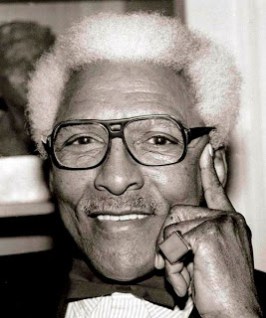
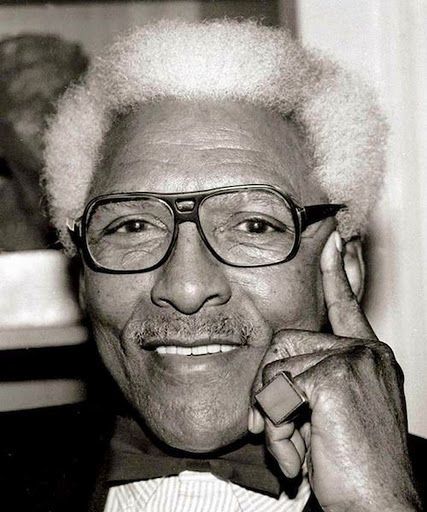
Bayard Rustin

Master strategist Bayard Rustin was Martin Luther King Jr.’s organizer for the 1963 March on Washington, but because he was gay, he has been hidden from history. In 1956, Bayard Rustin was hidden in the trunk of a car and snuck out of Montgomery during the Montgomery Bus Boycott because it was feared that having an openly-gay man as an advisor would discredit the efforts of Dr. Martin Luther King and the other leaders of the African-American Civil Rights Movement.

In 1937, at the age of 25, Bayard Rustin started training at the American Friends Service Committee. By 1963 he was perhaps one of the most important figures in African-American and GLBT history. Rustin fought social and politician causes behind the scenes and thus his name is rarely spoken. Yet few would imagine it was he, an openly gay man, that Dr. Martin Luther King, Jr. tapped to organize the Montgomery Bus Boycott and the 1963 March on Washington. Neither King nor Rustin did what they did for the glory. They saw an injustice in the country and the World and dedicated every ounce of themselves to making it right–one person at a time.

In ‎1983, Congressman Walter Fauntroy, one the organizers of a Washington March marking the 20th anniversary of the iconic March on Washington for Jobs and Freedom, (where Martin Luther King, Jr. delivered his historic “I Have a Dream” speech,) attempted to prevent representatives from gay and lesbian rights groups from speaking, thereby insulting the memory of the openly-gay Bayard Rustin, the architect of the original 1963 civil rights march.

King’s late wife, Coretta Scott King, was a supporter of GLBT rights but was strongly criticized by some African-American pastors. She called her critics “misinformed” and said that Martin Luther King’s message to the world was one of equality and inclusion.  In 2003, she invited the National Gay and Lesbian Task Force to take part in observances of the 40th anniversary of the March on Washington. It was the first time that an GLBT rights group had been invited to a major event of the African American community.

As you take time away from work or school to commemorate the great achievements of Dr. King, think about how you can make a difference. The state of our world can be overwhelming and each of us within it may seem insignificant, but King and Rustin were only single people who used their individual strengths for a common cause.

What is your dream?

The Rainbow

The Rainbow

My heart leaps up when I behold
   A Rainbow in the sky:
So was it when my life began;
So is it now I am a man;
So be it when I shall grow old,
   Or let me die!
The Child is father of the man;
And I wish my days to be
Bound each to each by natural piety.

William Wordsworth

My Heart Leaps Up, also known as The Rainbow, is a poem by the British Romantic Poet William Wordsworth. Noted for its simplicity of structure and language, it describes the joy that he feels when he sees a rainbow and notes that he has felt this way since his childhood. He concludes the poem by noting how his childhood has shaped his current views and stating that “the child is father of the man.”

Wordsworth wrote “My Heart Leaps Up” on the night of March 26, 1802. Earlier that day, he wad written “To The Cuckoo”. He was in Dove Cottage, Grasmere with his wife, Mary. After he wrote it he often thought about altering it, but decided to leave it as it was originally written. It was published as part of Poems in Two Volumes in 1807.

The day after he wrote “My Heart Leaps Up” Wordsworth began to write his larger and better known Ode: Intimations of Immortality. The last three lines from “My Heart Leaps Up” are used as an epigraph to Intimations of Immortality. Some scholars have noted that “My Heart Leaps Up” indicates Wordsworth’s state of mind while writing the larger poem and provide clues to its interpretation.

Some commentators have speculated that Wordsworth felt such joy because the rainbow indicates the constancy of his connection to nature throughout his life. Others have said that it celebrates “the continuity in Wordsworth’s consciousness of self.” Many commentators also draw parallels to the rainbow of Noah and the covenant that it symbolized. Wordsworth’s use of the phrase “bound each to each” in the poem also implies the presence of a covenant. Some commentators have drawn further parallels with the story of Noah. Harold Bloom has suggested that Wordsworth casts the rainbow as a symbol of the survival of his poetic gift, just as the rainbow symbolised to Noah the survival of mankind. Bloom suggests that Wordsworth’s poetic gift relied on his ability to recall the memories of his joy as a child.

William Wordsworth

On April 7, 1770, William Wordsworth was born in Cockermouth, Cumbria, England. Wordsworth’s mother died when he was eight–this experience shapes much of his later work. Wordsworth attended Hawkshead Grammar School, where his love of poetry was firmly established and, it is believed, he made his first attempts at verse. While he was at Hawkshead, Wordsworth’s father died leaving him and his four siblings orphans. After Hawkshead, Wordsworth studied at St. John’s College in Cambridge and before his final semester, he set out on a walking tour of Europe, an experience that influenced both his poetry and his political sensibilities. While touring Europe, Wordsworth came into contact with the French Revolution. This experience as well as a subsequent period living in France, brought about Wordsworth’s interest and sympathy for the life, troubles and speech of the “common man”. These issues proved to be of the utmost importance to Wordsworth’s work. Wordsworth’s earliest poetry was published in 1793 in the collections An Evening Walk and Descriptive Sketches. While living in France, Wordsworth conceived a daughter, Caroline, out of wedlock; he left France, however, before she was born. In 1802, he returned to France with his sister on a four-week visit to meet Caroline. Later that year, he married Mary Hutchinson, a childhood friend, and they had five children together. In 1812, while living in Grasmere, they grieved the loss of two of their children, Catherine and John, who both died that year.

Equally important in the poetic life of Wordsworth was his 1795 meeting with the poet, Samuel Taylor Coleridge. It was with Coleridge that Wordsworth published the famous Lyrical Ballads in 1798. While the poems themselves are some of the most influential in Western literature, it is the preface to the second edition that remains one of the most important testaments to a poet’s views on both his craft and his place in the world. In the preface Wordsworth writes on the need for “common speech” within poems and argues against the hierarchy of the period which valued epic poetry above the lyric.

Wordsworth’s most famous work, The Prelude (1850), is considered by many to be the crowning achievement of English romanticism. The poem, revised numerous times, chronicles the spiritual life of the poet and marks the birth of a new genre of poetry. Although Wordsworth worked on The Prelude throughout his life, the poem was published posthumously. Wordsworth spent his final years settled at Rydal Mount in England, travelling and continuing his outdoor excursions. Devastated by the death of his daughter Dora in 1847, Wordsworth seemingly lost his will to compose poems. William Wordsworth died at Rydal Mount on April 23, 1850, leaving his wife Mary to publish The Prelude three months later.


Rainbow Flag

We see it all the time, but do we ever think about its origins or what it means.

The Rainbow flag or Pride flag of the LGBT community is a symbol of LGBT pride and LGBT social movements in use since the 1970s. The colors reflect the diversity of the LGBT community, and the flag is often used as a symbol of gay pride in LGBT rights marches. It originated in the United States, but is now used worldwide. Designed by San Francisco artist Gilbert Baker in 1978, the design has undergone several revisions.

Sewn by thirty volunteers, the original gay-pride flag flew in the San Francisco Gay Freedom Day Parade on June 25, 1978. It has been suggested that Baker was inspired by Judy Garland’s singing “Over The Rainbow.” The flag consisted of eight stripes; Baker assigned specific meaning to each of the colors as follows:

  • hot pink: sexuality
  • red: life
  • orange: healing
  • yellow: sunlight
  • green: nature
  • turquoise: magic/art
  • indigo: serenity/harmony
  • violet: spirit

After the assassination of openly gay San Francisco City Supervisor Harvey Milk, demand for the rainbow flag greatly increased. To meet demand, the Paramount Flag Company began selling a version of the flag using stock rainbow fabric consisting of seven stripes of red, orange, yellow, green, turquoise, blue, and violet. As Baker ramped up production of his version of the flag, he too dropped the hot pink stripe because of the unavailability of hot-pink fabric. Also, San Francisco-based Paramount Flag Co. began selling a surplus stock of Rainbow Girls flags from its Polk Street retail store.

As of 2008, the most common variant consists of six stripes, with the colors red, orange, yellow, green, blue, and violet. The flag is commonly flown horizontally, with the red stripe on top, as the colors would appear in a natural rainbow.

SOURCES


Silent Night

Thank you for all of your responses to my post “I’d Like to Hear Your Opinion on This.”  I still tend to think that a Christmas play is by its nature not secular, but the particular play that was being put on is called “The Reindeer Rebellion” and is supposed to be a secular production involving Santa’s reindeer going on strike. It happened to include the song “Silent Night.”  An update to the story is that after consulting with their attorney, the school system decided to allow the students to perform the traditional Christmas carol.  I had found this interesting because it was in Alabama, which is my home state.  I also have a particular love for the song “Silent Night,” and I would like to tell you why and how to me, the song embodies the Christmas Spirit.

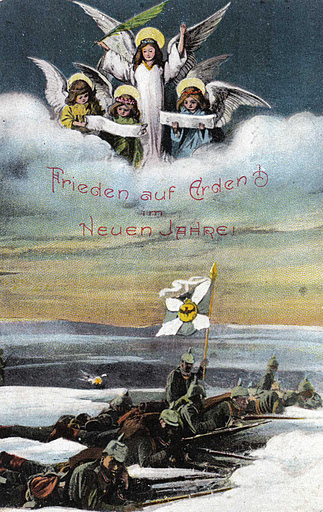
During World War I, on and around Christmas Day 1914, the sounds of rifles firing and shells exploding faded in a number of places along the Western Front in favor of holiday celebrations in the trenches and gestures of goodwill between enemies. On December 7, 1914, Pope Benedict XV suggested a temporary hiatus of the war for the celebration of Christmas. Though Germany readily agreed, the other powers refused.

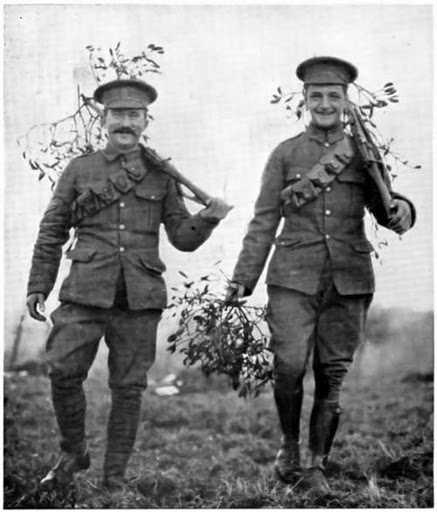
Even without a cessation of war for Christmas, family and friends of the soldiers wanted to make their loved ones’ Christmas special. They sent packages filled with letters, warm clothing, food, cigarettes, and medications. Yet what especially made Christmas at the front seem like Christmas were the troves of small Christmas trees.

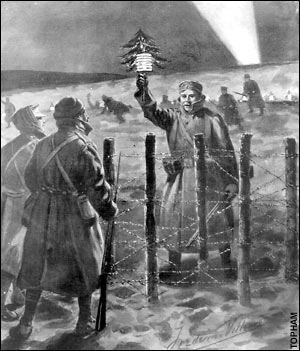
On Christmas Eve, many German soldiers put up Christmas trees, decorated with candles, on the parapets of their trenches. Hundreds of Christmas trees lighted the German trenches and although British soldiers could see the lights, it took them a few minutes to figure out what they were from. Could this be a trick? British soldiers were ordered not to fire but to watch them closely. Instead of trickery, the British soldiers heard many of the Germans celebrating.  They heard songs that were very familiar being sung in the other trenches:

Stille Nacht, heilige Nacht,
Alles schläft; einsam wacht
Nur das traute hochheilige Paar.
Holder Knabe im lockigen Haar,
Schlaf in himmlischer Ruh!

The British responded with the song in their own language:

Silent night, holy night
All is calm all is bright
‘Round yon virgin Mother and Child
Holy infant so tender and mild
Sleep in heavenly peace

Starting on Christmas Eve, many German and British troops sang Christmas carols to each other across the lines, and at certain points the Allied soldiers even heard brass bands joining the Germans in their joyous singing.

At the first light of dawn on Christmas Day, some German soldiers emerged from their trenches and approached the Allied lines across no-man’s-land, calling out “Merry Christmas” in their enemies’ native tongues. At first, the Allied soldiers feared it was a trick, but seeing the Germans unarmed they climbed out of their trenches and shook hands with the enemy soldiers. The men exchanged presents of cigarettes and plum puddings and sang carols and songs. There was even a documented case of soldiers from opposing sides playing a good-natured game of soccer.

Some soldiers used this short-lived ceasefire for a more somber task: the retrieval of the bodies of fellow combatants who had fallen within the no-man’s land between the lines.

The so-called Christmas Truce of 1914 came only five months after the outbreak of war in Europe and was one of the last examples of the outdated notion of chivalry between enemies in warfare. It was never repeated—future attempts at holiday ceasefires were quashed by officers’ threats of disciplinary action—but it served as heartening proof, however brief, that beneath the brutal clash of weapons, the soldiers’ essential humanity endured.

During World War I, the soldiers on the Western Front did not expect to celebrate on the battlefield, but even a world war could not destory the Christmas spirit.

The First World War is one of my favorite topics of study. It is so important for much of the history of the twentieth century, even though it is often overlooked. We, the GLBT community, also owe a great deal to the Great War. The First World War traumatised millions of men and challenged hegemonic conceptions of masculinity. In the post-war era, battles raged between competing socio-political groups over masculinity and the war experience. The homosexual movement posed one of the most significant challenges to pre-war gender norms. The war galvanised homosexuals to challenge social and cultural perceptions of gays as degenerate ‘enemies of the nation’. The movement was fragmented by rivalries and theoretical differences, but the memory of the war served as a central reference point for defining homosexual identity, masculinity and political rights in the Weimar Republic. The First World War was a turning point for Germany’s homosexual movement, as the war provided a central ideal – comradeship – that became a cornerstone for defining homosexual identity and justifying emancipation. An intensely militarised rhetoric permeated the language of gay rights organisations in the 1920s and, despite the differences among those organisations, the war gave homosexuals similar visions of a spiritually and politically liberated gay man who could use his training at the front to fight legal oppression and cultural prejudice.


Compton’s Cafeteria Riot

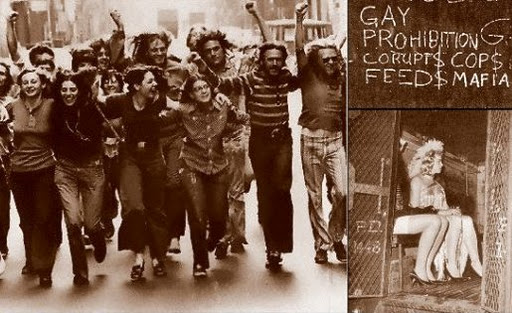
The Compton’s Cafeteria Riot occurred in August 1966 in the Tenderloin district of San Francisco. This incident was the first recorded transgender riot in United States history, preceding the more famous 1969 Stonewall Riots in New York City by three years.

Compton’s Cafeteria was one of a chain of cafeterias, owned by Gene Compton, in San Francisco from the 1940s to the 1970s. The Compton’s at 101 Taylor Street in the Tenderloin was one of the few places where transgender people could congregate publicly in the city, because they were unwelcome in gay bars at that time. Because cross-dressing was illegal, police could use the presence of transgender people in a bar as a pretext for making a raid and closing the bar down.

Many of the militant hustlers and street queens involved in the riot were members of Vanguard, the first known gay youth organization in the United States, which had been organized earlier that year with the help of radical ministers working with Glide Memorial Church, a center for progressive social activism in the Tenderloin for many years. A lesbian group of street people was also formed called the Street Orphans.

On the first night of the riot, the management of Compton’s called the police when some transgender customers became raucous. When a police officer accustomed to manhandling the Compton’s clientele attempted to arrest one of the transwomen, she threw her coffee in his face. At that point the riot began, dishes and furniture were thrown, and the restaurant’s plate-glass windows were smashed. Police called for reinforcements as the fighting spilled into the street, where a police car had all its windows broken out and a sidewalk newsstand was burned down.

The next night, more transgender people, hustlers, Tenderloin street people, and other members of the LGBT community joined in a picket of the cafeteria, which would not allow transgender people back in. The demonstration ended with the newly installed plate-glass windows being smashed again.

In the aftermath of the riot at Compton’s, a network of transgender social, psychological, and medical support services was established, which culminated in 1968 with the creation of the National Transsexual Counseling Unit, the first such peer-run support and advocacy organization in the world.

Gay History Project


The Gay History Project

John Clevesy and Damien Barnes

I am going to brag for just a minute.  A very dear friend of mine gave me an iPad for my birthday and Christmas.  (Thank you, because I know you are reading this. I have thanked you numerous times for this very generous gift, but it needs repeating so you know how wonderful you are.)  The iPad is absolutely wonderful, and I love it.  One of the apps that I have downloaded is the Gay History Project.
The Gay History Project is the first and only iPhone/iPad app to be solely based on providing LGBT history to its users. It is a global interactive project started in 2009 by John Clevesy in an attempt to spread awareness about LGBT historical figures and events. It also features personal stories by Clevesy and any contributors who wish to share their experiences. Users can also contribute new articles about events as they occur to keep the project constantly growing.
In 2009, John Clevesy (born February 27, 1986 in Lawrence, Massachusetts) received the news that his husband Damien Barnes (born December 24, 1984 in Bristol, United Kingdom) would not be allowed to apply for a green card because of the Defense of Marriage Act (DOMA). Because this Act proclaims that one state does not have to recognize marriages performed in other states, the federal government does not recognize the Clevesy-Barnes union (which took place in Boston, MA, in 2008), nullifying Clevesy as a sponsor for his husband.

http://www.gayrightssite.com

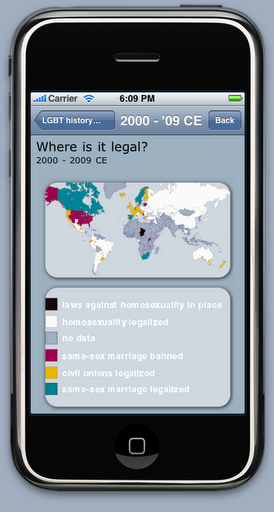
Shocked to learn this, Clevesy decided to do something about it. As a student in graphic design at Northeastern University, in Boston, MA, Clevesy decided to focus his senior design project on spreading awareness about gay rights. Having some ties with media already as a photographer in association with Spectrum Literary Art Magazine and featured on websites such as Creative Photography Tips & Videos, he was familiar with mass media. He created an interactive application which features his story along with gay history spanning over four-thousand years of information and color-coded maps displaying where and when different territories from around the world began to create and void laws regarding homosexuals. Clevesy’s project was met with great reception from peers and professors and displayed in Northeastern’s 360 Gallery to be viewed by the public. It has since been published on GayRightsSite.com.
John Clevesy, however, was still not satisfied with the final outcome. Due to time constrictions of the class he was forced to omit a lot of information. He decided it was necessary to create a book which could hold much more information. As of June 2009, this book is still in production but can be preordered on the website.
Realizing that a book has a definite beginning and end, and because he wanted to reach more people, John Clevesy decided to take all of the information that is to be included in his book and create an iPhone App. The application entitled “Gay History Project” shares John’s story along with the articles from his senior project, over a hundred more write-ups, and a section for users to share their stories and news events as they occur around the world from their mobile devise, allowing the Gay History Project to grow as the information grows unendingly. This final outcome of Clevesy’s design project was released on the Apple iTunes App Store on June 23, 2009.
As of June 2009, the Gay History Project features over 150 built-in articles about LGBT events and people from around the world. The articles span over four-thousand years of history and are ordered chronologically. They are divided into nine categories: Ancient Times, The Roman Empire, England & America (1000CE – 1800CE), Life in the 1800s, The early 1900s, Social Revolution (1960-1979CE), The eighties, The nineties, and A new millennium. Clevesy’s personal story is also featured in a separate section entitled “Forward.” Each section contains articles relating to the time-period in which the user has selected along with an article that lists additional events that occurred during that timeframe. The sections relating to periods after the 1700s also include color-coded maps which display information about laws regarding homosexuals in various territories around the world.

The final section of the Gay History Project is an area in which users can write to inform others about new stories as they occur. This allows the Gay History Project to continue growing indefinitely through time. Because of the iPhone’s portability, news can be posted from anywhere the user has service even as the event is taking place. Users of the Gay History Project are, therefore, kept up to date on news regarding gay, lesbian, bisexual, and transgender people. By allowing the content to continually build and grow, this section allowed Clevesy to achieve the unending expansion of the Gay History Project.
In addition to news about people and events, this last section also includes other areas for users to write in. A person can ask questions to be answered by other users regarding anything informational that they could not find elsewhere. There is also an area for anyone to tell others their own personal stories in order to receive support with their own personal struggles or triumphs.


Remember Pearl Harbor

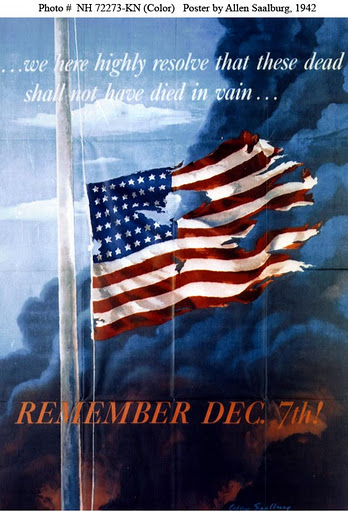
It began as an ordinary December day. People were gathered around the radio listening to a football game or planning holiday parties, not girding for battle. But on Dec. 7, 1941, when the first Associated Press report came over the radio at 2:22 p.m. Eastern Standard Time of a “bombing in Hawaii,” the news was electrifying. Seventy years later, every American living now who heard it then can still tell you exactly what he was doing when he learned of the Japanese attack on Pearl Harbor.

My grandmother will never forget that day seventy years ago. Her first child died of pneumonia on that day. She came home from the hospital to turn on the radio just as they were announcing the bombing of Pearl Harbor. Not only had she just lost her baby, but also, she realized that she would soon lose her husband to the war as well. My grandfather fought in WWII and luckily he safely returned, and they had two more children, my father and my aunt.

Pearl Harbor marked a watershed in the nation’s history and we knew it. What came after would be very different from what came before. It was the war that changed the world. “The Day of Infamy” thrust us into a conflict more than four years long that altered nearly every aspect of American life, large and small – from rationing gas and sugar to the harnessing of atomic power to the new role of women in the workplace. We united to defend our democracy. For more than 400,000, it would be the ultimate sacrifice.

That is why it is so important to remember the 70th anniversary of Pearl Harbor and all the 70th anniversaries of World War II events that follow.


Friends of Dorothy

image

image The Wizard of Oz had its first premiere screening August 12, 1939 and has been a beloved classic since that day. This movie has been a iconic movie for gay men since it was released. Other connections between Garland and LGBT people include the slang term friend of Dorothy, which likely derives from Garland’s portrayal of Dorothy Gale in The Wizard of Oz and became a code phrase gay people used to identify each other. Dorothy’s journey from Kansas to Oz “mirrored many gay men’s desires to escape the black-and-white limitations of small town life…for big, colorful cities filled with quirky, gender-bending characters who would welcome them.” In the film, Dorothy immediately accepts those who are different, including the Cowardly Lion. The Lion identifies himself through song as a “sissy” and exhibits stereotypically “gay” (or at least effeminate) mannerisms. The Lion offers a coded example of Garland meeting and accepting a gay man without question.In the film, Dorothy is accepting of those who are different. For example the “gentle lion” living a lie, “I’m afraid there’s no denyin’, I’m just a dandy lion.”

image

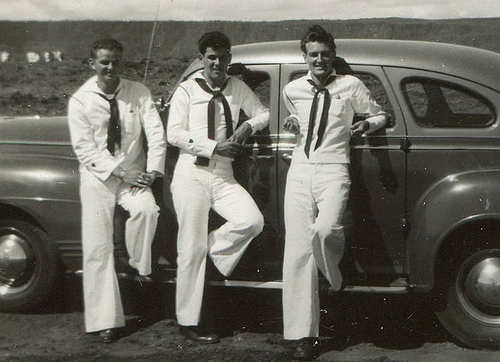
image I find this little fact hilarious, though it is also quite tragic in terms of understanding the American military attitudes and understanding of gay men.  In the early 1980s, the Naval Investigative Service was investigating homosexuality in the Chicago area. Agents discovered that gay men sometimes referred to themselves as “friends of Dorothy.” Unaware of the historical meaning of the term, the NIS believed that a woman named Dorothy was at the center of a massive ring of homosexual military personnel. The NIS launched an enormous hunt for Dorothy, hoping to find her and convince her to reveal the names of gay servicemembers.

Conventional wisdom is that Garland’s death and funeral, in June 1969, helped inspire the Stonewall riots, the flashpoint of the modern Gay Liberation movement. However, some observers of the riots contend that most of those involved “were not the type to moon over Judy Garland records or attend her concerts at Carnegie Hall. They were more preoccupied with where they were going to sleep and where their next meal would come from.” There was certainly an awareness and appreciation of Garland among Stonewall Inn patrons. Because the bar had no liquor license, it was passed off as a bottle club and patrons were required to sign in. Many used pseudonyms and “Judy Garland” was among the most popular. Regardless of the truth of the matter, the Garland/Stonewall connection has persisted and has been fictionalized in Stonewall, Nigel Finch’s feature film about the events leading up to the riots. Lead character Bostonia is shown watching Garland’s funeral on television and mourning, and later refusing to silence a jukebox playing a Garland song during a police raid, declaring “Judy stays.”

Time magazine would summarize decades later:

The uprising was inspirited by a potent cocktail of pent-up rage (raids of gay bars were brutal and routine), overwrought emotions (hours earlier, thousands had wept at the funeral of Judy Garland) and drugs. As a 17-year-old cross-dresser was being led into the paddy wagon and got a shove from a cop, she fought back. [She] hit the cop and was so stoned, she didn’t know what she was doing—or didn’t care.

Garland’s daughter Lorna Luft points to the connection with pride, saying that her mother was a “huge, huge advocate of human rights” and that Garland would have found the rioting appropriate.

Another connection is the rainbow flag, symbol of the LGBT communities which may have been inspired, in part, by Garland’s song “Over the Rainbow.” Garland’s performance of this song has been described as “the sound of the closet,” speaking to gay men whose image “they presented in their own public lives was often at odds with a truer sense of self that mainstream society would not condone.”

image


The American Gay Rights Movement: A Timeline To Be Thankful For

This timeline provides information about the gay rights movement in the United States from 1924 to the present: including the Stonewall riots; the contributions of Harvey Milk; the “Don’t Ask, Don’t Tell” policy; the first civil unions; the legalization of same-sex marriage in Massachusetts, Connecticut, New York; and more.


1924 
The Society for Human Rights in Chicago becomes the country’s earliest known gay rights organization.
1948
Alfred Kinsey publishes Sexual Behavior in the Human Male, revealing to the public that homosexuality is far more widespread than was commonly believed.
1951
The Mattachine Society, the first national gay rights organization, is formed by Harry Hay, considered by many to be the founder of the gay rights movement.
1956
The Daughters of Bilitis, a pioneering national lesbian organization, is founded.
1962
Illinois becomes the first state in the U.S. to decriminalize homosexual acts between consenting adults in private.
1969
The Stonewall riots transform the gay rights movement from one limited to a small number of activists into a widespread protest for equal rights and acceptance. Patrons of a gay bar in New York’s Greenwich Village, the Stonewall Inn, fight back during a police raid on June 27, sparking three days of riots.
1973
The American Psychiatric Association removes homosexuality from its official list of mental disorders.
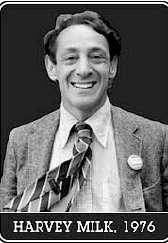
Harvey Milk runs for city supervisor in San Francisco. He runs on a socially liberal platform and opposes government involvement in personal sexual matters. Milk comes in 10th out of 32 candidates, earning 16,900 votes, winning the Castro District and other liberal neighborhoods. He receives a lot of media attention for his passionate speeches, brave political stance, and media skills.
1976
San Francisco Mayor George Moscone appoints Harvey Milk to the Board of Permit Appeals, making Milk the first openly gay city commissioner in the United States. Milk decides to run for the California State Assembly and Moscone is forced to fire him from the Board of Permit Appeals after just five weeks. Milk loses the State Assembly race by fewer than 4,000 votes. Believing the Alice B. Toklas LGBT Democratic Club will never support him politically, Milk co-founds the San Francisco Gay Democratic Club after his election loss.
1978
On January 8, Harvey Milk makes national news when he is sworn in as a member of the San Francisco Board of Supervisors. Running against 16 other candidates, he wins the election by 30 percent. Milk begins his term by sponsoring a civil rights bill that outlaws sexual orientation discrimination. Only one supervisor votes against it and Mayor Moscone signs it into law.
John Briggs drops out of the California governor’s race, but receives support for Proposition 6, also known as the Briggs Initiative, a proposal to fire any teacher or school employee who publicly supports gay rights. Harvey Milk campaigns against the bill and attends every event hosted by Briggs. In the summer, attendance greatly increases at Gay Pride marches in San Francisco and Los Angeles, partly in response to Briggs. President Jimmy Carter, former Governor Ronald Reagan, and Governor Jerry Brown speak out against the proposition. On November 7, voters reject the proposition by more than a million votes.
1982
Wisconsin becomes the first state to outlaw discrimination on the basis of sexual orientation.
1993
The “Don’t Ask, Don’t Tell” policy is instituted for the U.S. military, permitting gays to serve in the military but banning homosexual activity. President Clinton’s original intention to revoke the prohibition against gays in the military was met with stiff opposition; this compromise, which has led to the discharge of thousands of men and women in the armed forces, was the result.
1996
In Romer v. Evans, the Supreme Court strikes down Colorado’s Amendment 2, which denied gays and lesbians protections against discrimination, calling them “special rights.” According to Justice Anthony Kennedy, “We find nothing special in the protections Amendment 2 withholds. These protections . . . constitute ordinary civil life in a free society.”
2000
Vermont becomes the first state in the country to legally recognize civil unions between gay or lesbian couples. The law states that these “couples would be entitled to the same benefits, privileges, and responsibilities as spouses.” It stops short of referring to same-sex unions as marriage, which the state defines as heterosexual.
2003
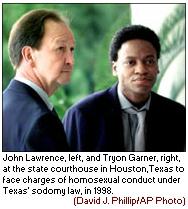
The U.S. Supreme Court rules in Lawrence v. Texas that sodomy laws in the U.S. are unconstitutional. Justice Anthony Kennedy wrote, “Liberty presumes an autonomy of self that includes freedom of thought, belief, expression, and certain intimate conduct.”
 
In November, the Massachusetts Supreme Judicial Court ruled that barring gays and lesbians from marrying violates the state constitution. The Massachusetts Chief Justice concluded that to “deny the protections, benefits, and obligations conferred by civil marriage” to gay couples was unconstitutional because it denied “the dignity and equality of all individuals” and made them “second-class citizens.” Strong opposition followed the ruling.
2004
On May 17, same-sex marriages become legal in Massachusetts.
2005
Civil unions become legal in Connecticut in October.
2006
Civil unions become legal in New Jersey in December.
2007
In November, the House of Representatives approves a bill ensuring equal rights in the workplace for gay men, lesbians, and bisexuals.
2008
In February, a New York State appeals court unanimously votes that valid same-sex marriages performed in other states must be recognized by employers in New York, granting same-sex couples the same rights as other couples.
In February, the state of Oregon passes a law that allows same-sex couples to register as domestic partners allowing them some spousal rights of married couples.
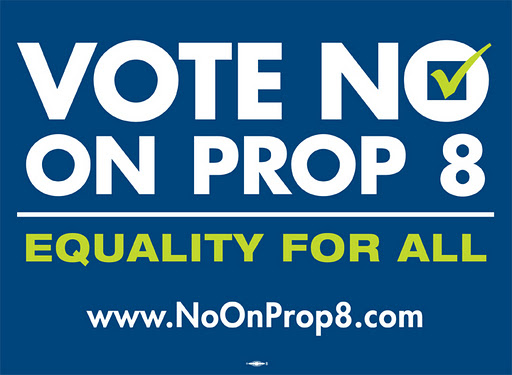
On May 15, the California Supreme Court rules that same-sex couples have a constitutional right to marry. By November 3rd, more than 18,000 same-sex couples have married. On November 4, California voters approved a ban on same-sex marriage called Proposition 8. The attorney general of California, Jerry Brown, asked the state’s Supreme Court to review the constitutionality of Proposition 8. The ban throws into question the validity of the more than 18,000 marriages already performed, but Attorney General Brown reiterated in a news release that he believed the same-sex marriages performed in California before November 4 should remain valid, and the California Supreme Court, which upheld the ban in May 2009, agreed, allowing those couples married under the old law to remain that way.
On October 10, the Supreme Court of Connecticut rules that same-sex couples have the right to marry. This makes Connecticut the second state, after Massachusetts, to legalize civil marriage for same-sex couples. The court rules that the state cannot deny gay and lesbian couples the freedom to marry under Connecticut’s constitution, and that the state’s civil union law does not provide same-sex couples with the same rights as heterosexual couples.
On November 12, same-sex marriages begin to be officially performed in Connecticut.
2009
On April 3, the Iowa Supreme Court unanimously rejects the state law banning same-sex marriage. Twenty-one days later, county recorders are required to issue marriage licenses to same-sex couples.
On April 7, the Vermont Legislature votes to override Gov. Jim Douglas’s veto of a bill allowing gays and lesbians to marry, legalizing same-sex marriage. It is the first state to legalize gay marriage through the legislature; the courts of the other states in which the marriage is legal—Massachusetts, Connecticut, and Iowa—gave approval.
On June 3, New Hampshire governor John Lynch signs legislation allowing same-sex marriage. The law stipulates that religious organizations and their employees will not be required to participate in the ceremonies. New Hampshire is the sixth state in the nation to allow same-sex marriage.
On June 17, President Obama signs a referendum allowing the same-sex partners of federal employees to receive benefits. They will not be allowed full health coverage, however. This is Obama’s first major initiative in his campaign promise to improve gay rights.
On August 12, President Obama posthumously awards Harvey Milk the Presidential Medal of Freedom.
2010
March 3, Congress approves a law signed in December 2009 that legalizes same-sex marriage in the District of Columbia.
August 4, Chief U.S. District Judge Vaughn Walker ruled that Proposition 8, the 2008 referendum that banned same-sex marriage in California, violates the 14th Amendment’s equal protection clause. “Proposition 8 singles out gays and lesbians and legitimates their unequal treatment,” Vaughn wrote in his opinion. “Proposition 8 perpetuates the stereotype that gays and lesbians are incapable of forming long-term loving relationships and that gays and lesbians are not good parents.”
December 18, the U.S. Senate voted 65 to 31 in favor of repealing Don’t Ask, Don’t Tell, the Clinton-era military policy that forbids openly gay men and women from serving in the military. Eight Republicans sided with the Democrats to strike down the ban. The ban will not be lifted officially until President Obama, Defense Secretary Robert Gates, and Admiral Mike Mullen, the chairman of the Joint Chiefs of Staff, agree that the military is ready to enact the change and that it won’t affect military readiness. On Dec. 18, President Obama officially repealed the “Don’t Ask, Don’t Tell” military policy.
2011
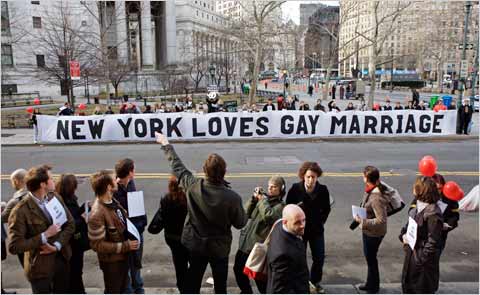
June 24, New York passes a law to allow same-sex marriage. New York is now the largest state that allows gay and lesbian couples to marry. The vote comes on the eve of the city’s annual Gay Pride Parade and gives new momentum to the national gay-rights movement. The marriage bill is approved with a 33 to 29 vote. Cheering supporters greet Gov. Andrew Cuomo as he arrives on the Senate floor to sign the measure at 11:55pm, just moments after the vote. After making same-sax marriage one of his top priorities, Cuomo emerges as a true champion of gay rights.


Read more: The American Gay Rights Movement: A Timeline — Infoplease.com http://www.infoplease.com/ipa/A0761909.html#ixzz1ePbgH9Js