Category Archives: History

St. Sebastian in Art

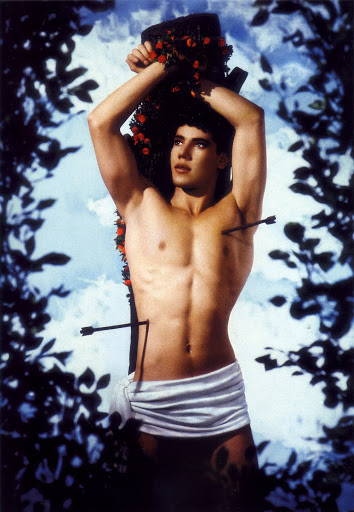
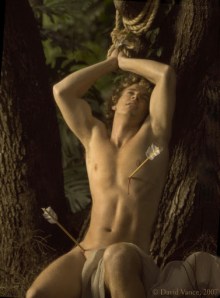
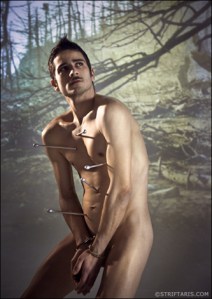
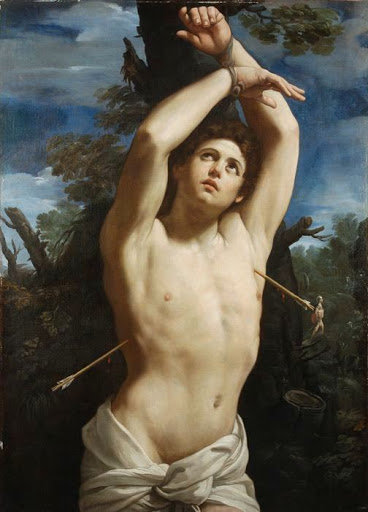
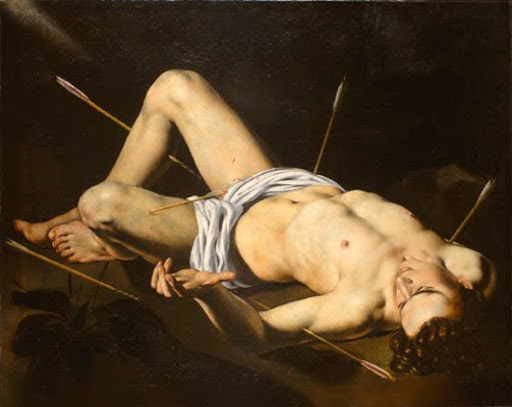
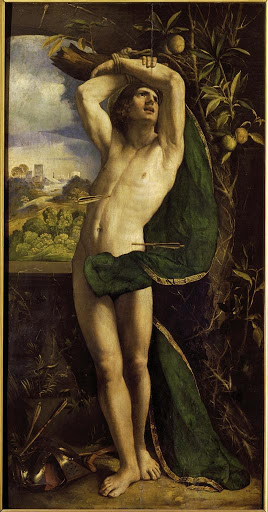
To continue our look at St. Sebastian, I wanted to look at his depiction in art. Can a Christian saint be a gay icon? Apparently he can. Sebastian was a Christian martyr who died during the persecutions of the Roman Emperor Diocletian in 288. According to legend, he was born in Gaul (present-day France) and went to Rome to serve in the army. When officials learned that he was a Christian seeking converts, they ordered his execution by archers. Left for dead, he was nursed back to health by a Christian widow. He presented himself before the emperor, who condemned him to death by beating. His body was thrown into a sewer but was afterward found and buried. In Renaissance art he was often depicted as a handsome youth pierced by arrows.

The earliest representation of Sebastian is a mosaic in the Basilica of Sant’Apollinare Nuovo (Ravenna, Italy) dated between 527 and 565. The right lateral wall of the basilica contains large mosaics representing a procession of 26 martyrs, led by Saint Martin and including Sebastian. The martyrs are represented in Byzantine style, lacking any individuality, and have all identical expressions.

Another early representation is in a mosaic in the Church of San Pietro in Vincoli (Rome, Italy), probably made in the year 682. It shows a grown, bearded man in court dress but contains no trace of an arrow. The archers and arrows begin to appear by 1000, and ever since have been far more commonly shown than the actual moment of his death by clubbing, so that there is a popular misperception that this is how he died.
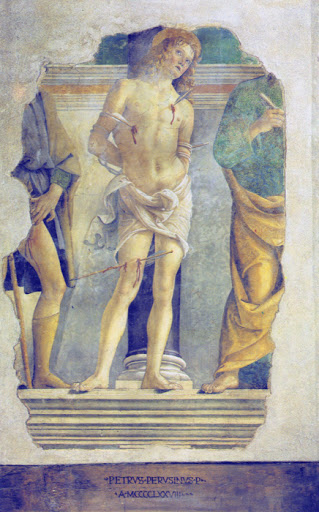
As protector of potential plague victims (a connection popularized by the Golden Legend) and soldiers, Sebastian naturally occupied a very important place in the popular medieval mind, and hence was among the most frequently depicted of all saints by Late Gothic and Renaissance artists, in the period after the Black Death. The opportunity to show a semi-nude male, often in a contorted pose, also made Sebastian a favourite subject. His shooting with arrows was the subject of the largest engraving by the Master of the Playing Cards in the 1430s, when there were few other current subjects with male nudes other than Christ. Sebastian appears in many other prints and paintings, although this was also due to his popularity with the faithful. Among many others, Botticelli, Perugino, Titian, Pollaiuolo, Giovanni Bellini, Guido Reni (who painted the subject seven times), Mantegna (three times), Hans Memling, Gerrit van Honthorst, Luca Signorelli, El Greco, Honoré Daumier, John Singer Sargent and Louise Bourgeois all painted Saint Sebastians.

The saint is ordinarily depicted as a handsome youth pierced by arrows. There were predella scenes, when required, often of his arrest, confrontation with the Emperor, and final beheading. The illustration in the infobox is the Saint Sebastian of Il Sodoma, at the Pitti Palace, Florence.

A mainly 17th-century subject, though found in predella scenes as early as the 15th century, was St Sebastian tended by St Irene, painted by Georges de La Tour, Trophime Bigot (four times), Jusepe de Ribera, Hendrick ter Brugghen and others. This may have been a deliberate attempt by the Church to get away from the single nude subject, which is already recorded in Vasari as sometimes arousing inappropriate thoughts among female churchgoers. The Baroque artists usually treated it as a nocturnal chiaroscuro scene, illuminated by a single candle, torch or lantern, in the style fashionable in the first half of the 17th century.
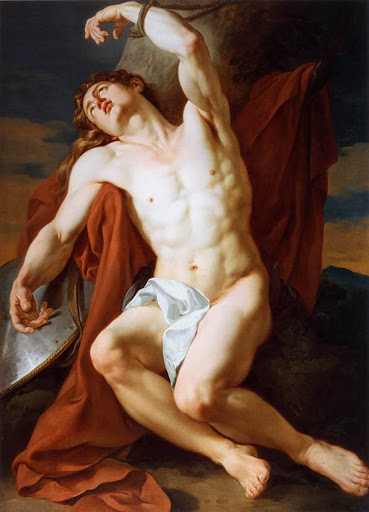
There exist several cycles depicting the life of Saint Sebastian. Among them, the frescos in the “Basilica di San Sebastiano” of Acireale (Italy) with paintings by Pietro Paolo Vasta.

Egon Schiele, an Austrian Expressionist artist, painted a self-portrait as Saint Sebastian in 1915. During Salvador Dalí’s “Lorca (Federico García Lorca) Period”, he painted Sebastian several times, most notably in his “Neo-Cubist Academy”. For reasons unknown, the left vein of Sebastian is always exposed.

In 1911, the Italian playwright Gabriele d’Annunzio in conjunction with Claude Debussy produced a mystery play on the subject. The American composer Gian Carlo Menotti composed a ballet score for a Ballets Russes production which was first given in 1944.

In his novella Death in Venice, Thomas Mann hails the “Sebastian-Figure” as the supreme emblem of Apollonian beauty, that is, the artistry of differentiated forms, beauty as measured by discipline, proportion, and luminous distinctions. This allusion to Saint Sebastian’s suffering, associated with the writerly professionalism of the novella’s protagonist, Gustav Aschenbach, provides a model for the “heroism born of weakness”, which characterizes poise amidst agonizing torment and plain acceptance of one’s fate as, beyond mere patience and passivity, a stylized achievement and artistic triumph.
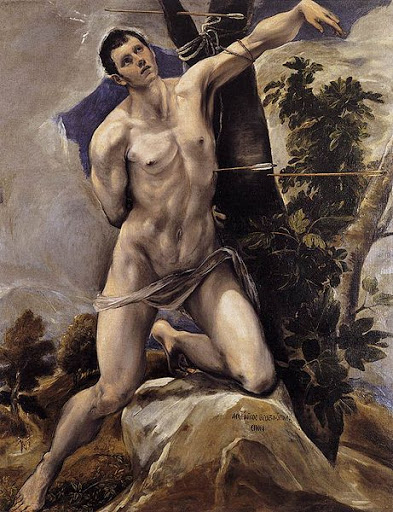
In 1976, the British director Derek Jarman made a film, Sebastiane, which caused controversy in its treatment of the martyr as a homosexual icon. However, as several critics have noted, this has been a subtext of the imagery since the Renaissance.

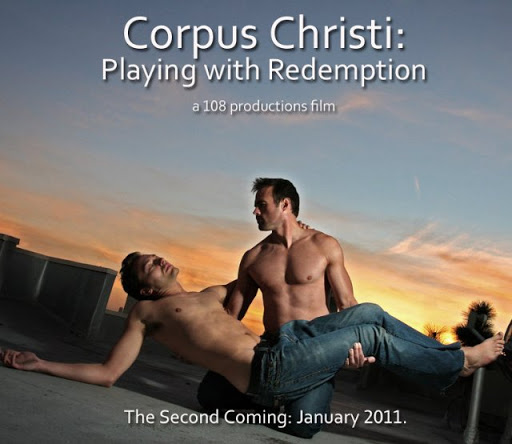
Renaissance artists had access to history that we currently do not. There was obviously some reason why they chose to depict him as a beautiful young man. Since Sebastian was a Gaul, it could have been influenced by the beauty of The Dying Gaul, one of my all time favorite statues. The warrior is depicted as a beautiful man, but there is obviously love and lust for his beauty that the sculptor saw. It is also likely that Renaissance artists may have known some historical gossip about Sebastian, or the loving relationships that existed between the early brothers and sisters in Christ. Who knows why they depicted him as a beautiful young man, but they have left behind a question for history and the beauty of man.  Since many of the Renaissance artists were homosexuals, St. Sebastian allowed them to depict a beautiful naked (or nearly naked) young man, very similar to those young models they often used.

dyinggaul


The Missing Text of the Gospel of St. Mark

More recently, but in a somewhat similar vein to Kirkup’s poem, the American playwright, Terrence McNally had the 1998 scheduled run of his new play, Corpus Christi, cancelled by the prestigious Manhattan Theatre Club in New York, following threats to kill the staff, burn down the theatre, and “exterminate” McNally. The reason for these threats was that McNally’s play told the story of a young gay man called Joshua and his sexual adventures with his 12 disciples. The Catholic League for Religious and Civil Rights in New York vowed to “wage a war” against any attempt to stage the play. While top playwrights, such as Tony Kushner, Edward Albee and Athol Fugard, urged the theatre to reverse its cancellation, accusing them of “capitulation to right-wing extremists and religious zealots”.

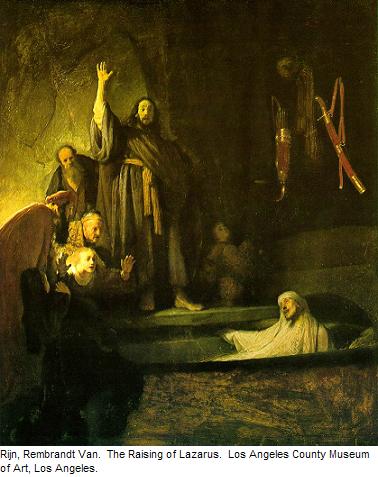
The homosexual associations being made with Jesus are not simply the work of gay artists seeking to appropriate conventional religious themes for the sake of blasphemy or controversy, but may actually be based in fact. In 1958, Professor Morton Smith of Columbia University uncovered a letter at the Mar Saba monastery, which mentioned a suppressed extract from the gospel of Mark. The letter was between Bishop Clement of Alexandria (one of the founding fathers of the early church), and a correspondent called Theodore, who wrote complaining about the Carpocratians, a Gnostic sect. The Carpocratians were using a passage from Mark’s gospel to justify their beliefs and practices, which were not shared by Clement and Theodore. In his reply to Theodore, Clement congratulated him on his opposition to the Carpocratians, and then wrote a dissertation on the passage in question, quoting the passage in its entirety. What is remarkable is that this passage does not appear in the canonical New Testament today, but was obviously current at the time. It is from Mark chapter 10 (between verses 34 and 35), and tells the story of the raising of Lazarus:

And the youth, looking upon him (Jesus), loved him and beseeched that he might remain with him. And going out of the tomb, they went into the house of the youth, for he was rich. And after six days, Jesus instructed him and, at evening, the youth came to him wearing a linen cloth over his naked body. And he remained with him that night, for Jesus taught him the mystery of the Kingdom of God.

The expurgated text seems to suggest that the raising of Lazarus, rather than being a literal raising from the dead, was the kind of mystery school initiation that was common throughout the ancient world; something that the biblical scholar Barbara Thiering has emphasised in her recent work. What is also clear, and may have been obvious to the Carpocratians also, is that there seems to have been a homosexual element to the ritual, with the half-naked youth who loved Jesus being shown the mystery of the Kingdom of God during the final night of his instruction. If these inferences can be so readily made from the passage in Mark, it is somewhat understandable that the founding fathers of the Church would feel no guilt over removing it from the canon in order to preserve the image of Jesus that was in concordance with their particular ideas.

Source: Torture By Roses, “Sebastian~Salome” (pdf).


The Love That Dares To Speak Its Name

“The Love that Dares to Speak its Name” is a controversial poem by James Kirkup.  In fact, some might find the poem to be quite offensive, but after reading it and researching about it, I found it fascinating, even if it is blasphemous.  Maybe intellectual curiosity sometimes kills the cat, but I decided to write about it anyway.  It is written from the viewpoint of a Roman centurion who is graphically described having sex with Jesus after his crucifixion, and also claims that Jesus had had sex with numerous disciples, guards, and even Pontius Pilate.  If the poem was not about Jesus Christ and the centurion, Longinus, I would truly consider the poem beautiful and erotic in an odd necrophilia sort of way that is also quite disturbing.  Maybe it is either way, or maybe I have been reading too much Edgar Allen Poe in the high school English class that I am currently teaching.

The poem was at the centre of the Whitehouse v. Lemon trial for blasphemous libel, where the editor of Gay News—which first published in the poem in 1976—was convicted and given a suspended prison sentence.  In later years, Britain’s Royal Crown Prosecution Service attempted to charge the Lesbian and Gay Christian Movement with a similar charge of blasphemous libel after a complaint by religious conservatives over a hypertext link on their web site to text of “The Love that Dares to Speak its Name” by James Kirkup.

The Love That Dares To Speak Its Name
By James Kirkup

As they took him from the cross
I, the centurion, took him in my arms-
the tough lean body
of a man no longer young,
beardless, breathless,
but well hung.


He was still warm.
While they prepared the tomb
I kept guard over him.
His mother and the Magdalen
had gone to fetch clean linen
to shroud his nakedness.


I was alone with him.
For the last time
I kissed his mouth. My tongue
found his, bitter with death.
I licked his wound-
the blood was harsh
For the last time
I laid my lips around the tip
of that great cock, the instrument
of our salvation, our eternal joy.
The shaft, still throbbed, anointed
with death’s final ejaculation


I knew he’d had it off with other men-
with Herod’s guards, with Pontius Pilate,
With John the Baptist, with Paul of Tarsus
with foxy Judas, a great kisser, with
the rest of the Twelve, together and apart.
He loved all men, body, soul and spirit. – even me.


So now I took off my uniform, and, naked,
lay together with him in his desolation,
caressing every shadow of his cooling flesh,
hugging him and trying to warm him back to life.
Slowly the fire in his thighs went out,
while I grew hotter with unearthly love.


It was the only way I knew to speak our love’s proud name,
to tell him of my long devotion, my desire, my dread-
something we had never talked about. My spear, wet with blood,
his dear, broken body all open wounds,
and in each wound his side, his back,
his mouth – I came and came and came


as if each coming was my last.
And then the miracle possessed us.
I felt him enter into me, and fiercely spend
his spirit’s finbal seed within my hole, my soul,
pulse upon pulse, unto the ends of the earth-
he crucified me with him into kingdom come.


-This is the passionate and blissful crucifixion
same-sex lovers suffer, patiently and gladly.
They inflict these loving injuries of joy and grace
one upon the other, till they dies of lust and pain
within the horny paradise of one another’s limbs,
with one voice cry to heaven in a last divine release.


Then lie long together, peacefully entwined, with hope
of resurrection, as we did, on that green hill far away.
But before we rose again, they came and took him from me.
They knew not what we had done, but felt
no shame or anger. Rather they were glad for us,
and blessed us, as would he, who loved all men.


And after three long, lonely days, like years,
in which I roamed the gardens of my grief
seeking for him, my one friend who had gone from me,
he rose from sleep, at dawn, and showed himself to me before
all others. And took me to him with
the love that now forever dares to speak its name.

Further Reading:


St. Sebastian: The Patron Saint of Homosexuals

Saint Sebastian by Guido Reni (c. 1616)

There is hardly anything unusual or particularly compelling about a gay icon who is young, beautiful, white, shirtless, and baby-faced. But what if this same boyish icon had emerged from a key historical antagonist of same-sex desire: the teachings of Christianity?

The case of Saint Sebastian, who was martyred in 287, animates several complex questions about the evolution of a gay idol, not the least of which is his so-called appropriation from the hallowed pages of Church history and martyrology to the visual, literary, and filmic works of numerous gay artists.

Although he has had various embodiments throughout history–plague saint in the Middle Ages, shimmering youth of Apollonian beauty throughout the Renaissance, “decadent” androgyne in the late nineteenth century–Sebastian has long been known as the homosexual’s saint.

Precisely when and how this role evolved may be related to details of St. Sebastian’s life, the earliest reference to which can be found in the Martyrology of 354 A.D., which refers to him as a young nobleman from either Milan or Narbonne, whose official capacity was commander of a company of archers of the imperial bodyguard.

According to the Church’s official Acta Sanctorum, Sebastian, serving under the emperors Diocletian and Maximian, came to the rescue of Christian soldiers, Marcellinus and Mark, and thereby confessed his own Christianity. Diocletian insisted that Sebastian be shot to death by his fellow archers; these orders were followed, and Sebastian was left for dead.

What is often neglected in later accounts is that Sebastian survived this initial attack after having been nursed by a “pious woman,” St Irene of Rome. Diocletian was required to order a second execution, and this time Sebastian was beaten to death by soldiers in the Hippodrome.

School of Nicolas Regnier, Saint Sebastian, 17th century

These details–based on accounts written centuries after Sebastian’s death and therefore largely apocryphal–may have helped form Sebastian’s subsequent reputation as a homosexual martyr since his story constitutes a kind of “coming out” tale followed by his survival of an execution that may be read symbolically as a penetration.

Renaissance representations of Saint Sebastian–mostly paintings of a tender, loin-clothed youth writhing in the ecstasy of the arrows that pierce him–are perhaps ground zero for his appointment as the patron saint of gay sensuality.

And for seemingly obvious reasons. Sebastian’s supple, near-naked body; the wink-wink symbolism of the penetrating arrows; his thrown-back head expressing a mixture of pleasure and pain; and his inviting gaze all readily contribute to his homoerotic appeal. But Sebastian’s entry into gay cultures in the first place most certainly involves his origins as an emblem of Christian godliness and martyrdom.

Same-sex desire is often, on many levels, about the crossing of lines, the overturning of sacred norms, the pleasure of the forbidden. Both the story of Sebastian and his subsequent role in modern gay cultures epitomize this subversive impulse: Sebastian revels in the pleasure of his own martyrdom as gay men revel in gazing upon an off-limits emblem of Christian holiness. By all accounts, Sebastian is a very good “bad object choice.”

Possibly his role as a plague saint may have generated associations between Sebastian and what, in a nineteenth-century medical context, was represented as a disease, homosexuality.

The question of whether Sebastian himself was gay is largely moot. While some historical records suggest a notable affection between the saint and his male superiors, after almost two thousand years Sebastian’s sexuality is not only greatly speculative, but also rather inconsequential.

However, while it is doubtful that a buried homosexual existence could justify his current camp popularity, it seems equally doubtful that his homoerotic associations can be explained away as the superficial afterthoughts, revisions, or cross-readings of a willful contemporary gay purview.

Saint Sebastian is not just represented in the visual arts during the Renaissance, but also in the written arts as well. In Shakespeare’s Twelfth Night (1600), for example, the character of Sebastian, saved from a shipwreck by Antonio, is the intense focus of Antonio’s love: “And to his image, which methought did promise / Most venerable worth, did I devotion.”

Mosaic of St. Sebastian, ca. 682 in San Pietro in Vincoli

Sebastian has been reinvented numerous times in history, from the middle-aged man in the mosaic at the Church of San Pietro in Vincoli, not far from San Sebastiano Fuori le Mura, where the martyr’s punctured remains have lain since the year 287 AD. Here, in a niche to the left, is the seventh-century mosaic of a middle-aged man, bearded and in Byzantine court dress. Perhaps Sebastian’s oddest reinvention came in Thomas Mann’s Nobel Prize acceptance speech. “Grace in suffering – that is the heroism symbolised by St Sebastian,” said Mann; then, warming to his theme, he added: “The image may be bold, but I am tempted to claim this heroism for the German mind and German art.” The date was 1929. A decade later, German gays such as Mann were being rounded up and tortured in the Nazi concentration camps.

All of which is to say that the secret of Sebastian’s success may lie in his ability to be all things to all men. Along with the famous arrows, the symbol of his martyrdom is the rope that binds his hands; yet the shape-shifting Sebastian just won’t be tied down. The novelist and political activist Susan Sontag pointed out that his face never registers the agonies of his body, that his beauty and his pain are eternally divorced from each other. This made him proof against plague in 1348, and, in these ungodly times, it still does.

Sources:


Lest We Forget

On the morning of September 11, 2001, nineteen terrorists from the Islamist extremist group, al Qaeda, hijacked four commercial airplanes, deliberately crashing two of the planes into the upper floors of the North and South Towers of the World Trade Center complex and a third plane into the Pentagon in Arlington, VA. The Twin Towers ultimately collapsed because of the damage sustained from the impacts and the resulting fires. After learning about the other attacks, passengers on the fourth hijacked plane, Flight 93, fought back, and the plane was crashed into an empty field in western Pennsylvania about 20 minutes by air from Washington, DC.
The attacks killed nearly 3,000 people from 93 nations. 2,753 people were killed in New York,  184 people were killed at the Pentagon, and 40 people were killed on Flight 93.


Ode of Remembrance
With proud thanksgiving, a mother for her children,
England mourns for her dead across the sea.
Flesh of her flesh they were, spirit of her spirit,
Fallen in the cause of the free.
Solemn the drums thrill: Death august and royal,
Sings sorrow up into immortal spheres.
There is music in the midst of desolation,
And a glory that shines upon her tears.
They went with songs to the battle, they were young.
Straight of limb, true of eyes, steady and aglow.
They were staunch to the end against odds uncounted,
They fell with their faces to the foe.
They shall not grow old, as we that are left grow old:
Age shall not weary them, nor the years condemn.
At the going down of the sun and in the morning,
We will remember them.
Lest We Forget

They mingle not with their laughing comrades again;
They sit no more at familiar tables at home;
They have no lot in our labour of the daytime;
They sleep beyond England’s foam.
But where our desires are and our hopes profound,
Felt as a well-spring that is hidden from sight,
To the innermost heart of their own land they are known,
As the stars are known to the night.

As the stars will be bright when we are dust,
Moving in marches upon the heavenly plain;
As the stars that are starry in the time of our darkness,
To the end, to the end, they remain.
Lest We Forget

English poet Laurence Binyon, overwhelmed by the carnage and loss of life by British and Allied forces in World War 1, penned one of the most moving tributes the world has known to those who died in war.

Originally titled For the Fallen, the ode first appeared in The Times of London on September 21, 1914. It has now become known in Australia and Canada as the Ode of Remembrance.  I think that on the 10th anniversary of 9/11 it is a fitting memorial.  After the verse in bold is recited in memory of those who died, it is followed by the response, “Lest we forget” as I have added it above.


History of Gay Pornography, Part II

Sexual Revolution and Gay Pornography
MANual Enterprises Publication

During the 1960s, a series of United States Supreme Court rulings created a more liberalized legal environment that allowed the commercialization of pornography. MANual Enterprises v. Day, 370 U.S. 478 (1962) was the first decision by the United States Supreme Court which held that magazines consisting largely of photographs of nude or near-nude male models are not obscene within the meaning of 18 U.S.C. § 1461. It was the first case in which the Court engaged in plenary review of a Post Office Department order holding obscene matter “nonmailable.” The case is notable for its ruling that photographs of nude men are not obscene, an implication which opened up the U.S. Postal Service to nude male pornographic magazines, especially those catering to gay men.

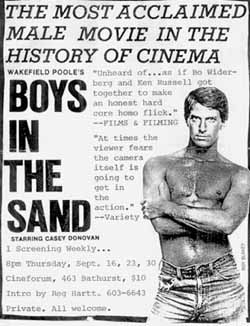
Wakefield Poole’s Boys in the Sand, starring Casey Donovan, can be considered one of the first gay pornography feature films, along with the works of filmmakers such as Pat Rocco and the Park Theatre, Los Angeles, California, circa 1970. Boys in the Sand opened in a theater in New York City in December 1971 and played to a packed house with record breaking box office receipts, preceding Deep Throat, the first commercial straight pornography film in America, which opened in June 1972. This success launched gay pornographic film as a popular phenomenon.

The production of gay pornography films expanded during the 1970s. A few studios released films for the growing number of gay adult movie theatres, where men could also have sexual encounters. Often, the films reflected the sexual liberation that gay men were experiencing at the time, depicting the numerous public spaces where men engaged in sex: bathhouses, sex clubs, beaches, etc.

Peter Berlin’s 1973 film Nights in Black Leather was the first major pornographic film designed to appeal to the gay leather subculture and drew some mainstream gays into this culture.

The 1960s and 1970s also saw the rise of gay publishing with After Dark and Michael’s Thing. During this time many more magazines were founded, including In Touch and Blueboy. Playgirl, ostensibly produced for women, was purchased and enjoyed by gay men and feature full frontal nudity (the posing straps and fig leaves were removed).

The 1980s were a period of transition for gay pornography film. The proliferation of VCRs made pornography videos easily accessible, and, as their prices fell, the market for home videos aimed at adult viewers became more and more lucrative. By the mid-1980s, the standard was to release pornography movies directly on video, which meant the wide disappearance of pornography theaters. Furthermore, video recording being more affordable, a multitude of producers entered the market, making low-budget pornography videos.

This shift from watching pornography as a public activity to doing so in private was also influenced by the discovery of HIV and the subsequent AIDS crisis. Public spaces for sex, such as theatres, became less attended when in the early 1980s it became a much riskier behavior. Masturbatory activities in the privacy of the home became a safe sex practice in the midst of this health crisis.

Gay movies of the 1970s had contained some exploration of novel ways to represent the sexual act. In the 1980s, by contrast, all movies seemed to be made under an unwritten set of rules and conventions. Most scenes would start with a few lines of dialogue, have performers engage in foreplay (fellatio), followed by anal penetration, and ending with a visual climax close-up of ejaculating penises, called a “money shot” or cum shot. Video technology allowed the recording of longer scenes than did the costly film stock. Scenes were often composed of extended footage of the same act filmed from different shots using multiple cameras. The quality of the picture and sound were often very poor.

Major directors such as Matt Sterling, Eric Peterson, John Travis, and William Higgins set the standard for the models of the decade. The performers they cast were especially young, usually appearing to be around the ages of 22 or 23. Their bodies were slender and hairless, of the “swimmer’s build” type, which contrasted with the older, bigger, and hairier man of the 1970s’ gay pornography. Performer roles also evolved into the tight divisions of “tops” and “bottoms”. The “top” in anal sex is the penetrating partner, who would typically have a more muscular body and the larger penis. The “bottom”, or receiver of anal sex, would often be smaller and sometimes more effeminate. The stars of the decade were almost always tops, while the bottoms were interchangeable (with the exception of Joey Stefano, a popular star, who was more of a “bottom”.)

Joey Stefano (bottom left)

This strict division between “tops” and “bottoms” may have reflected a preference by some of the popular directors of the decade to hire heterosexual men for their movies. Heterosexual men who perform gay sex for monetary reasons (commonly labeled “gay-for-pay”) are considered a rare commodity in the gay sex trade, but the biggest producers of the decade could afford them. Many critics attributed the conventionalization of gay pornography of the 80s to this trend.

The gay pornography industry diversified steadily during the 1990s.  In 1989, director Kristen Bjorn started a pornographic business which was considered as setting a standard for gay pornography producers. He was a professional photographer, and the images in his videos were considered to be of high-quality. As a former porn star himself, he directed his models with care, which helped improved the actors’ believability. Other directors had to improve their technical quality to keep up with demands from their audiences.

Another significant change during this decade was the explosion of the niche market.  Many videos began to be produced for viewers with specific tastes (i.e. for amateur pornography, Military (Men in Uniform) pornography, transsexual performers, bondage fetishes, performers belonging to specific ethnic groups, etc.), and this led to a diversification of the people involved in pornography production and consumption.
The gay pornography industry grew substantially in popularity during the 1990s, evolving into a complex and interactive subculture. Professional directors (such as Chi Chi LaRue and John Rutherford), technicians or deck operators during the U-matic phase of video technology, and performers started to engage in pornography as a career, their work sustained by emerging pornographic media and influential critics, such as Mikey Skee.

In the 21st century, gay pornography has become a highly profitable enterprise, ranging from the “straight-guy” pornography of Active Duty and Sean Cody, to the ‘twinks’ of Bel Ami. Many niche genres and online delivery sites cater to various and changing interests. For instance much of Van Darkholme’s work contains bondage and particularly shibari, the Japanese art of bondage and knot-tying, a specialty within BDSM cultures.

On the other hand, Lucas Kazan Productions successfully adapted literary classics: Decameron: Two Naughty Tales is based on two novels by Boccaccio, The Innkeeper on Goldoni’s La Locandiera. Lucas Kazan also found inspiration in 19th and 20th century operas, combining gay porn and melodrama: The School for Lovers, 2007 GayVN Award Winner for Best Foreign Picture, is in fact inspired by Mozart’s Così fan tutte.

Some controversy currently exists regarding studios that produce bareback (sex without condoms) videos. Mainstream companies, such as Falcon Entertainment, Hot House Entertainment, Channel 1 Releasing, Lucas Entertainment, Raging Stallion, Lucas Kazan Productions and Titan Media and LGBT health advocates assert that condomless videos promote unsafe sex and contribute to the HIV/AIDS pandemic, both in the pornography industry and in the gay community as a whole. The controversy dates back to the first few years of the HIV crisis, when nearly all gay pornography production companies voluntarily required their models to wear condoms for anal sex.

Chi Chi LaRue

The premise of industry figures, notably Chi Chi LaRue, is that gay pornography serves as a leading forum for teaching safer sex skills and modeling healthy sexual behaviors. At least one bareback studio agrees that porn should promote healthy sexual behaviors, but disagrees on the definition of “healthy” in this context: speaking about the AIDS crisis, Treasure Island Media owner and founder Paul Morris has expressed his belief that, “To a great extent, the current gay mindset surrounding HIV is a result of a generation of men living with PTSD and not getting the support and help they need now that the war is over.  As a pornographer, all I can do in response is to produce work that features men who are openly positive (or negative) and happily living their lives honestly and fully.”


History of Gay Porn, Part I

Many gay men, and nearly all of the ones that I know personally, love gay porn.  Gay men and their attitudes toward pornography tend not to be as stigmatized as it is with heterosexual men and women, though there are plenty of them who enjoy pornography as well.  Pornography as a whole does not have the stigma that it once did, at least not with the majority of the population; in fact, in some ways, it is becoming somewhat more mainstream.  I’ve noticed even with my students, they are willing to admit that they like porn and are much more likely today to admit that they masturbate than my generation had been.  I think that my generation was the beginning of that change, but as a whole, the attitudes toward sex are becoming more liberal.  I think that part of that is the fact that many people dismiss the AIDS crisis as being something of the past, when it most certainly is not, no matter who well the drug cocktails are working.  All that being said, I thought that I would write a post about the history of gay pornography.

I haven’t done a really salacious post in a while, and 2011 is the 40th anniversary of Falcon Studios. Founded in 1971 by Chuck Holmes, the company is one of the most recognizable brand names in gay pornography. The estate of Chuck Holmes, who died of AIDS complications in September 2000, gave $1 million for the completion of the San Francisco Lesbian Gay Bisexual Transgender Community Center, the largest individual donation ever to any gay community group in San Francisco.

The Swimming Hole (1884–85) by the American artist Thomas Eakins (1844–1916) is regarded as a masterpiece of American painting, and has been called “the most finely designed of all his outdoor pictures”. The painting has been “widely cited as a prime example of homoeroticism in American art”. Eakins himself appears in the water at bottom right – “in signature position, so to speak.” According to Jonathan Weinberg, The Swimming Hole marked the beginning of homoerotic imagery in American art.

Homoeroticism has been present in photography and film since their invention. During much of that time, any kind of sexual depiction had to remain underground because of obscenity laws. In particular, gay material might constitute evidence of an illegal act under sodomy laws in many jurisdictions. This is no longer the case in the United States since such laws were ruled unconstitutional by the Supreme Court in 2003 in Lawrence v. Texas.

However, hardcore pornographic motion pictures (“stag films,” as they were called prior to their legalization in 1970) were produced relatively early in the history of film. The first known pornographic film of any kind appears to have been made in Europe in 1908. The earliest known film to depict hardcore gay (and bisexual) sex was the French film Le Menage Moderne Du Madame Butterfly, produced and released in 1920. Most historians consider the first American stag film to be A Free Ride, produced and released in 1915. But in the United States, hardcore gay sexual intercourse did not make it onto film until 1929’s The Surprise of a Knight.  The Surprise of a Knight‘s plot was relatively simple:

The film opens with an elegantly attired “woman” with short hair as she finishes dressing for a visitor. As the “lady” completes her boudoir, she lifts her skirts to reveal a thick patch of pubic hair. At this point, an intertitle reveals that the screenwriter is “Oscar Wild” (clearly a pseudonym).
The “lady” goes into the drawing room and offers her well-attired gentleman caller (her “knight”) a drink. He refuses it, and she drinks the cocktail. They talk briefly, and then engage in passionate kissing. Whenever the gentleman caller puts his hands on the “lady’s” breasts or genitals, “she” pushes his hand away. Finally, she slaps him coyly. The “lady” then apologizes for her aggressiveness by fellating her partner.

The “lady” then lies face-down on the sofa with her buttocks in the air. It is revealed that she has no underwear on. The gentleman caller then penetrates the “lady” anally (although no penetration is actually shown). After a minute or so, the gentleman withdraws and sits back on the sofa. The “lady” gyrates her buttocks in the air. This induces him to mount her anally again. Both individuals reach orgasm, and the gentleman caller walks off-camera.
The “lady” stands and raises her skirts to reveal that “she” is really a he. The film’s second and final intertitle announces “Surprise.” His penis is exposed. The man in drag then dances about briefly, making sure that his penis bobs up and down in the air. The gentleman caller re-enters the camera’s view, and helps the other man remove his skirt and most of his other clothing. The gentleman caller (now completely clothed again) dances briefly with the nude young man. After a jump cut, the “lady”—now dressed completely in business attire—walks back on screen, winks at the audience, and walks off screen.

The Surprise of a Knight ushered in a brief period of homosexual hardcore pornography in the stag film era. About a year later, in A Stiff Game, an African American male would engage in fellatio on a Caucasian man without the need for drag. The appearance of gay sexual contact on film would soon end, however, and not reappear until the advent of legal gay hardcore pornography after 1970.

It has been noted that the lead character (the “lady”) is in costume, yet costumes are the antithesis of the hardcore pornographic film (in which nudity and the display of genitalia and penetration during intercourse are key). “The costume spectacle either steals the show…” as film historian Thomas Waugh put it, “…or becomes a grotesque distraction…” The revelation of the “lady’s” penis is not real surprise, Waugh concludes, as audiences knew what sort of film they were getting (e.g., homosexual porn).

The use of drag in The Surprise of a Knight also distances the audience from the performers on screen, Waugh argues. The main character of the film is a drag queen, and yet nearly all the audience members could say that they were not drag queens. Waugh see the film not depicting gay men on screen, but reaffirming heteronormativity and negative stereotypes of gay men and gay sex. John Robert Burger writes that it is unclear from the film whether the visitor knows of the drag queen’s gender before the encounter, and that hiding the gender of the drag queen makes it “faux homosexuality”. Burger also writes that The Surprise of a Knight is an exception to the norm of stag films, in which the receptive parter in same-sex anal sex is typically perceived to be victimised or punished.

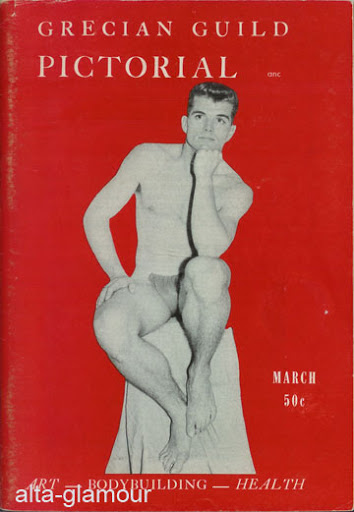
Legal restrictions meant that early hardcore gay pornography was underground and that commercially available gay pornography primarily consisted of pictures of individual men either fully naked or wearing a g-string. Pornography in the 1940s and 1950s focused on athletic men or bodybuilders in statuesque poses. They were generally young, muscular, and with little or no visible body hair. Those pictures were sold in physique magazines, also known as beefcake magazines, allowing the reader to pass as a fitness enthusiast.

The Athletic Model Guild (AMG) founded by photographer Bob Mizer in 1945 in Los Angeles, California, was arguably the first studio to commercially produce material specifically for gay men and published the first magazine known as Physique Pictorial in 1951. Tom of Finland drawings are featured in many issues. Mizer produced about a million images, and thousands of films and videos before he died on May 12, 1992. During the late 1960s and early 1970s, the advent of 16mm film cameras enabled these photographers to produce underground movies of gay sex and/or male masturbation. Sales of these products were either by mail-order or through more discreet channels. Some of the early gay pornographers would travel around the country selling their photographs and films out of their hotel rooms, with advertising only through word of mouth and magazine ads.

The 1960s were also a period where many underground art film makers integrated suggestive or overtly gay content in their work. Kenneth Anger’s Scorpio Rising (1963), Andy Warhol’s Blow Job (1964) and My Hustler (1965), or Paul Morrissey’s Flesh (1968) are examples of experimental films that are known to have influenced further gay pornographic films with their formal qualities and narratives. Tyler Gajewski is a noted actor and model of the period who appeared in Warhol’s and Morrissey’s films, as well as in Mizer’s work at the AMG. Also of note is Joe Dallesandro, who acted in hardcore gay pornographic films in his early 20s, posed nude for Francesco Scavullo, Bruce of L.A. and Bob Mizer, and later acted for Warhol in films such as Flesh. Dallesandro was well-known to the public. In 1969 Time magazine called him one of the most beautiful people of the 1960s, and he graced the cover of Rolling Stone magazine in April 1971. Dallesandro even appeared on the cover of The Smiths’ eponymous debut album, The Smiths.


The History of Southern Decadence

image Since it was founded in 1781, New Orleans has marched to the beat of its own drum.  For two centuries, those in control of the Louisiana state government have tried in vain to impose their prejudices on a city that is French, Spanish, Creole, African, Catholic, pagan and very gay (in both senses of the word).  If nothing else, New Orleans knows how to throw a party, from the world-famous Mardi Gras to other, more specialized celebrations.
One of these celebrations began quite inauspiciously in August of 1972, by a group of friends living in a ramshackle cottage house at 2110 Barracks Street in the Treme section of New Orleans, just outside of the French Quarter. image It was in desperate need of repair, and the rent was $100 per month.  At any given time the residents numbered anywhere from six to ten, and it was still sometimes difficult to come up with the rent.
The large bathroom became a natural gathering place in the house.  It had no shower, only a clawfoot tub, but it also had a sofa.  With from six to ten residents, and one bathtub, everyone became close friends.  While one soaked in the tub, another would recline on the couch and read A Streetcar Named Desire aloud. The Tennessee Williams play inspired the residents to fondly name the house “Belle Reve” in honor of Blanche DuBois’ Mississippi plantation.
image And so it was, on a sultry August afternoon in 1972, that this band of friends decided to plan an amusement.  According to author James T. Spears, writing in Rebels, Rubyfruit and Rhinestones: Queering Space in the Stonewall South, this “motley crew of outcasts” began Southern Decadence as a going away party for a friend named Michael Evers, and to shut up a new “Belle Reve” tenant (from New York) who kept complaining about the New Orleans heat.  As a riff on the “Belle Reve” theme, the group named the event a “Southern Decadence Party: Come As Your Favorite Southern Decadent,” requiring all participants to dress in costume as their favorite “decadent Southern” character.    According to Spears, “The party began late that Sunday afternoon, with the expectation that the next day (Labor Day) would allow for recovery. Forty or fifty people drank, smoked, and carried on near the big fig tree … even though Maureen (the New Yorker) still complained about the heat.”
The following year the group decided to throw another Southern Decadence Party.  image They met at Matassa’s bar in the French Quarter to show off their costumes, then they walked back to “Belle Reve.”  This first “parade” included only about 15 people impersonating such “decadent Southern” icons as Belle Watling, Mary Ann Mobley, Tallulah Bankhead, Helen Keller, and New Orleans’ own Ruthie the Duck Lady.  This impromptu parade through the French Quarter and along Esplanade Avenue laid the groundwork for future events, and  the group decided to repeat the party again the following year.
In 1974, the Southern Decadence visionaries named Frederick Wright as the first Grand Marshal, hoping to provide at least a modicum of order.  For the next six years, the format of the celebration changed little.  The founding group continued to appoint each year’s Grand Marshal by consensus.  Some were gay, some were not. But all were members of the founding group.
image By 1981, most of the original organizers had moved on with their lives.  Many felt that the event had become so big that it was no longer the intimate party they had started nine years earlier.  Of the original group, only Grand Marshal V Robert King was actively participating.  He, along with some of his friends that hung out at the Golden Lantern bar, thought it was worth continuing and they took over the festivities.  It was at this point that Southern Decadence became primarily a gay event.  Other protocol changes made in 1981 included moving the starting point of the annual parade from Matassa’s to the Golden Lantern bar, and allowing Grand Marshals to personally name their own successors.  Both of these traditions continue today. And in 1987, the Grand Marshal began to make a proclamation of the official theme, color and song.
image Because the 2005 celebration was cancelled due to Hurricane Katrina, Southern Decadence 2005 Grand Marshals Lisa Beaumann and Regina Adams reigned for both 2005 and 2006, making the very first time in Southern Decadence history that grand marshals
ruled for two years.  And keeping with the unpredictability of Decadence, the Grand Marshals from 2008 reigned once again in 2009.
The rest, as they say, is history.  What began as a little costume party is now a world-famous gay celebration.  In the 39th year, it has mushroomed from a small gathering of friends to a Labor Day weekend tradition, attracting over 100,000 participants, predominantly gay and lesbian, and generating almost $100 million in tourist revenue.  This annual economic impact ranks it among the city’s top five most significant tourist events.  The mayor has even welcomed the event with an Official Proclamation.
Southern Decadence Grand Marshals XXXIII Lisa Beaumann and Regina AdamsDescribed by one reporter as “a happening of haberdashery fit for an LSD Alice in Wonderland,” Southern Decadence 2010 will be as outrageous as ever and live up to its reputation as New Orleans’ largest gay street fair.  It all begins in earnest six weeks before Labor Day.  However, the real party starts on the Wednesday before Labor Day, and the events are non-stop. It picks up steam daily as it nears Sunday’s big street parade, which rivals New Orleans’ gay Mardi Gras in scope, with the party lasting well into the day on Monday.
image If you’ve never been to Southern Decadence, and sadly I haven’t, here are some tips to know before you go. What follows are some thoughts gathered from locals that will help you get the most out of your experience.
Pass by the NO/AIDS Task Force’s information tables located on the St. Ann Street sidewalk in front of Hit Parade Gift and Clothing, at the corner of Bourbon and St. Ann Streets.  You’ll find lots of community information and details of the weekend’s events.  The literature racks inside of Hit Parade are another great source for all of the Southern Decadence information that you will need.
During Southern Decadence, some streets of the French Quarter do not allow parking – look for, and heed, no parking signs. Plan on doing a lot of walking. Comfortable shoes are a must. Always walk where it is well lit and there are a lot of people. New Orleans is a city of neighborhoods. imageLike all large cities, the Big Easy does have some trouble spots. Always walk with others, never alone if possible. Don’t wander about the city. In New Orleans the neighborhoods can change, literally, when you cross a street. Always carry a map. If you’re drinking, don’t go stumbling about the French Quarter. Locals know that the people who encounter trouble are usually the ones who have been drinking.
And a bit of urban common sense is in order. When you walk the streets, don’t bring your wallet. Take the cash you need and possibly a credit card, along with some sort of identification, and put them in a pocket that no one can slip their hand into. Don’t wear expensive jewelry. Basically, don’t take anything with you that you would have a hard time replacing if it were lost.
If your car is impounded, it will cost you over $100 plus whatever else the city decides to tack on. Your car can be retrieved from the City Auto Pound, located in a dangerous area of the city, 400 N. Claiborne Ave., (504.565.7236). This will spoil a good time. Cabs are not difficult to get during Southern Decadence. If you are going to take a cab, try UNITED CABS: 504.522.9771 or 504.524.9606. Write these numbers down and put them in your wallet. This cab company can be trusted. United Cabs has a sound reputation with the New Orleans gay community.
imagePeople are allowed to drink on the streets in New Orleans —  that large 24-oz Southern Decadence cup that you’ll see people walking with and drinking from likely contains several shots of alcohol!  However, if your drink isn’t already in a plastic cup, please ask for one before leaving your favorite watering hole. Glass and cans are not allowed on the streets for safety reasons.
Most bars in New Orleans are open twenty-four hours a day. Pace yourself. Most important, it’s easy to get caught up in all the excitement and forget to eat. If you want to make it through the weekend, solid food is a necessity. Of course, New Orleans is world famous for its food and indulging is part of a complete New Orleans experience.
Clean bathrooms can be difficult to find during Southern Decadence. Most businesses close their facilities to everyone but paying customers. If your hotel is far from the action, take care of the more important business before you hit the streets. If you need to, plan on buying lunch or dinner and using the restaurant’s bathroom before you pay the check!
image The French Quarter is an historic neighborhood. Please respect it. No matter how “bad” you have to go, do not urinate in the streets or on door steps or through iron gates. This is a good way to end up in central lock-up, and people who are arrested sit in jail until the courts re-open after Labor Day. It will cost you about $200. And it’s not polite. Listen to your body. Get in line before you really have to go. By the time you’re crossing your legs, you might be at the front of the line.
During Southern Decadence weekend, you’re guaranteed to get an eyeful of great costumes and fabulous bodies. Officially, public nudity is not allowed and there are obscenity laws on the books. Better judgment should be the rule of the day.
Southern Decadence is a BIG non-stop party. People drink and are having a good time. It’s easy to forget that there is a real world out there. Free condoms are available from the NO/AIDS Task Force station located near the Bourbon Pub / Parade. Don’t allow the party to overwhelm your better judgment. We want you to come again. Have fun and play safe!


Fauns and Satyrs

The satyrs were woodland spirits, often depicted in arts with head and upper body of man, horns and pointy ears, and goat legs. They were also depicted with large erect phallus (penis).

They were often seen accompanying Dionysus, the god of wine and ecstasy. They were shown in drunken revelry and orgy, dancing with Dionysus’ female followers, the maenads.
Pan, the god of shepherd was a satyr, so was probably Silenus or Seilenus. Silenus was one of the loyal followers of Dionysus, who brought up the wine god.

Satyrs were usually represented as being very hairy and having the tails and ears of a horse and often the horns and legs of a goat. An important part of Dionysus’ entourage, they were lustful, fertile creatures, always merrily drinking and dancing.

In Greek mythology, satyrs (in Greek, Σάτυροι — Sátyroi) are a troop of male companions of Pan and Dionysus— “satyresses” were a late invention of poets— that roamed the woods and mountains. In mythology they are often associated with male sex drive and vase-painters often portrayed them with uncontrollable erections.

The Fauns and Satyrs were he-creatures, like men, with the hind-legs of goats, short horns on their foreheads, and long pointed ears. But there was a difference between the Fauns and Satyrs. The Fauns were handsome, gentle, innocent, and rather foolish. The Satyrs were hideous, clumsy, hairy monsters, with flat faces, little eyes, and huge mouths, great gluttons, often drunk, and sometimes mischievous: most of them were dull and stupid, but many of them had plenty of sense and knowledge. The Fauns and Satyrs lived among the woods and hills like the Dryads and Oreads.

The king of all these Nymphs, Fauns, and Satyrs was a god named Pan, who was himself a very hideous satyr. He had nothing to do with the gods of Olympus, but lived on the earth, chiefly in a part of Greece called Arcādia. “Pan” is the Greek for “all”—you remember the same word in the name of “Pan-dora.” He was called “Pan” because he was the god of “all” nature—all the hills and mountains, all the woods and forests, all the fields, rivers, and streams.

Anonymous poem: A Faun meets a Taormina shepherd

In the most remote areas of Taormina’s wilderness,
Young shepherds met fauns and satyrs, Pan and Dionysos,
Hidding behind a rock, vanishing in a flash, a flash of light.

Most of the time they were mere illusions, a reflection of the sun,
A mirage in Taormina’s wilderness, at the peak of the hot wave,
Or just a noise of a rock falling down from a cliff… 

But Pasqualino met a faun, a real faun, sitting on a rock,
Far away from the usual paths of Taormina’s young shepherds,
So far that he was in the middle of nowhere… 

“Are you a god or just an illusion ?”, asked Pasqualino.
“Did I love you a long time ago, I am sure I know you”,
Answered the faun with his Dionysiac horns… 

“Cute shepherd of Taormina, please, play a melody for me,
A melody from your reed flute, perhaps I will sing one for you,
A song of love, of the love of gods for Taormina’s shepherds… 

Please, have a seat on this rock, beside me, let us sing and dream,
Hope and remember, love and be loved, let me tell you the legend of fauns,
Please tell me the story of your life, where you are from, what you dream about…” 

And Pasqualino played the most beautiful of the tunes the boys of Taormina know,
A music wide as an horizon, deep as eyes, sensitive as a caressing hand,
A music of longing and sorrow, of dream and hope, of loneliness and communion. 

Wilhelm von Gloeden’s camera obscura was able to catch the magic of this encounter,
The encounter of a Faun and of a young shepherd from Taormina,
At the turn of a century, at the threshold of two worlds, reality and imagination. 

While looking at this photograph, forever I can listen to this forgotten melody,
To the melody of Fauns meeting young shepherds in the most remote wilderness,
Of Fauns falling in love with them, and crossing the invisible border, 

The border between gods and humans, between dream and reality,
Between hope and memory,
So far, so deep, at this crossroads where a lover meet his loved one.

Anonymous poet, around 1907, Von Gloeden Archive, 1907, call number 1907/Anon/12 (Rêves Siciliens)


The Homoerotic Poetry of Catullus

Catullus 

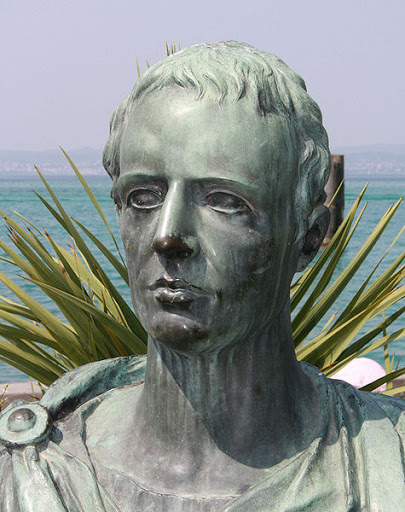
Gaius Valerius Catullus (ca. 84 BC – ca. 54 BC) was a Roman poet of the 1st century BC.His surviving works are still read widely, and continue to influence poetry and other forms of art. Catullus invented the “angry love poem.” He was imitated by Tibullus, Propertius, Horace and Ovid, as well as Ben Jonson and Robert Herrick in English. Most of Catullus’ poems are short. In a few concise lines he expresses love, friendship or bitterness. Most of his poems are heterosexual, but a good number of them are devoted to boys and are “particularly lusty.”

50. Yesterday: to Licinius Calvus 1

Yesterday, Calvus, idle day
we played with my writing tablets,
harmonising in being delightful:
scribbling verses, each of us
playing with metres, this and that,
reciting together, through laughter and wine.
And I left there fired with your charm,
Calvus, and with your wit,
so that, restless, I couldn’t enjoy food,
or close my eyes quietly in sleep,
but tossed the whole bed about wildly
in passion, longing to see the light,
so I might speak to you, and be with you.
But afterwards I lay there wearied
with effort, half-dead in the bed,
I made this poem for you, pleasantly,
from which you might gather my pain.
Now beware of being rash, don’t reject
my prayers I beg, my darling,
lest Nemesis demand your punishment. She’s
a powerful goddess. Beware of annoying her.

99. Stolen Kisses: to Iuventius 2

I stole a sweet kiss while you played, sweet Iuventius,
one sweeter than sweetest ambrosia.
Not taken indeed with impunity: for more than an hour
I remember, I hung at the top of the gallows,
while I was justifying myself to you, yet with my tears
I couldn’t lessen your anger a tiny morsel.
No sooner was it done, than, your lips rinsed
with plenty of water, you banished it with your fingers,
so nothing contracted from my lips might remain,
as though it were the foul spit of a tainted whore.
More, you handed me unhappily to vicious love
who’s not failed to torment me in every way,
so that sweet kiss, altered for me from ambrosia,
was more bitter than bitter hellebore then.
Since you lay down such punishments for unhappy love,
now, after this, I’ll never steal kisses again.

1 Gaius Licinius Calvus, orator, poet, friend of Catullus and colleague of Cicero. Ovid mentions him alongside Catullus and Tibullus.


2 An unidentified friend of Catullus.