Category Archives: History

Gays and the Old West

Last night, the topic of my c.ass was the settling of the American West.  I always enjoy punching up my lectures with something interesting and though many people find the Wild West fascinating, most of what they find fascinating is mere cowboy mythology.  Lecturing about the invention of barbed-wire and the massacres of Native Americans can get a little tedious (not to diminish the importance of either topic, but…).  The fact is, you can only talk about Chinese prostitution just so much to make it interesting.  Though I am a nineteenth century US historian, I have never found the history of the Wild West that exciting.  So after my lecture tonight, which did go surprisingly well for a topic I am not that interested in, I decided to do a little research into the homosexual past of the Wild West, which is certainly something that can make the topic more interesting.

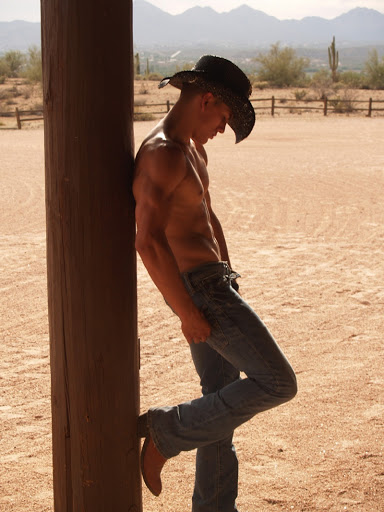
Say the words “gay cowboy” and chances are the conversation will turn to “Brokeback Mountain,” the 2005 film starring Heath Ledger and Jake Gyllenhaal, and based on the Annie Proulx short story.  The Oscar-winning drama, which is set in the 1960s to ’80s, highlighted a long-submerged facet of frontier culture. But  homosexuals and transgender individuals had a more interesting history in the American West is much older than the movie might lead you to think. It is, in fact, almost as old as the West itself.

The Autry National Center is the first major American museum to recognize the contributions of the lesbian, gay, bisexual, and transgender (LGBT) community to the American West and has created the Out West series. The museum presents a series of programs featuring Western scholars, authors, artists, politicians, musicians, and friends of Western LGBTs in discussions and gallery talks at the Autry.

“With Hidden Histories, the Autry National Center weaves the lesbian, gay, bisexual and transgender community into the rich tapestry of the American West,” said GLAAD President Jarrett Barrios. “It is so important for Americans to hear stories that reflect the diversity of the LGBT community and our presence throughout our nation’s great history. GLAAD is proud to endorse Out West.”

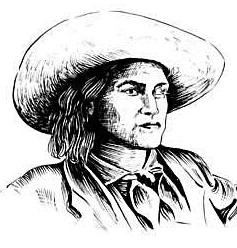
It seems that LGBT community has a long history in the West. Take for instance the tale of One-Eyed Charlie, who was a stagecoach driver known for his hard drinking and itchy trigger finger. Charlie worked for the California Stage Co., where he earned his reputation as one of the best drivers in the wild West. He traveled between Oregon and California and, the story goes, got his nickname when he lost an eye while attempting to shoe a horse.

But Charlie kept a secret that was revealed only after his death in 1879. When his body was being prepared, a coroner discovered that One-Eyed Charlie was actually a woman.  It turns out that Charlie, nee Charlotte Darkey Parkhurst, had passed much of her adult life as a man. The discovery of her true gender became a local sensation. And her story still fascinates U.S. historians, some of whom believe that she was the first woman to have voted in a presidential election, long before the ratification of the 19th Amendment in 1920.

As far back as 1882, the Texas Livestock Journal wrote that “if the inner history of friendship among the rough and perhaps untutored cowboys could be written, it would be quite as unselfish and romantic as that of Damon and Pythias.”  In Greek mythology, Damon offered to be taken hostage by the despot Dionysius I so that his condemned friend, Pythias, could make a final visit home. When Pythias returned to be executed, Dionysius was so impressed by their trust that he spared both their lives.

“There have been gay cowboys for as long as there have been gay people,” says Brian Helander, a 51-year-old nurse from Arizona and president of the International Gay Rodeo Association. “It’s always been a part of the western frontier lifestyle that wasn’t talked about. It was just there.”

Jim Wilke, the cowboy historian, agrees. “Many circumstances contributed to personal closeness on the ranch and trail,” he wrote in a 1997 article. “Cowboys commonly bedded in pairs, sharing bedrolls with their ‘bunkie’.”

Wilke also points to the tradition of the all-male stag dance, where cowboys could be found entertaining themselves with polkas, waltzes and quicksteps. He says homosexual acts between young, unmarried cowboys were euphemistically known as “mutual solace” in the 19th century.

In a 1948 study of rural homosexuality by Alfred Kinsey, the controversial zoologist, it was noted that “there is a fair amount of sexual contact among the older males in western rural areas.”  His report added: “It is a type of homosexuality that was probably common among pioneers and outdoor men. Today it is found among ranchmen, cattlemen, prospectors, lumbermen and farming groups in general. These are men who … live on realities and on a minimum of theory. Such a background breeds the attitude that sex is sex, irrespective of the nature of the partner.”

He also noted that these homosexual acts rarely interfered with heterosexual relationships and that the cowboys themselves were often deeply homophobic and “quite without the argot, physical manifestations and other affectations often found in urban groups.”

Although anti-sodomy laws were common in the Wild West, they were selectively enforced. In 1896 a man from El Paso called Marcelo Alviar was charged with sodomy and his bond was set at $500, the same as it would have been for murder. And in 1901 an Idaho detective hid in the ceiling above a public lavatory in an attempt to catch homosexuals in the act. Alas, the bowler hats worn by the offenders made identification impossible.

Samples of California Sodomy Laws:

1801–Though carried out under Spanish law, the last known U.S. death sentence for sodomy occurs in California. Eighteen-year-old Jose Antonio Rosas is shot by a firing squad. 

1850–California’s first criminal code is enacted, and includes a ban on sodomy. The law begins with the preface, “The People of the State of California, represented in Senate and Assembly, do enact as follows:”. However, the law was enacted in April when California still was a territory. It did not become a state until September, and it is unclear if this made the original law invalid.

Below is an unnamed poem written in Texas in the 1880s and recorded by Charlie Siringo, a cowboy in the 1870s.

My lover is a cowboy
He’s kind, he’s brave, he’s true
He rides the Spanish pony
and throws the lasso, too
And when he comes to see me
And our vows we have redeemed
He puts his arms around me
And then begins to sing:
Oh, I am a jolly cowboy,
From Texas now I hail,
Give me my saddle and pony
And I’m ready for the trail.
I love the rolling prairie
Where we are free from care and strife,
And behind a herd of long-horns,
I will journey all my life.

Sources:

A ‘howdy pardner’ could be more than just hello
Gay Cowboys? Sure, Pardner.
Gays in the wild wild west.
‘Out West’ at the Autry examines the history of homosexuals and transgender people in the Old West


Les regrets de Joachim du Bellay

Les regrets de Joachim du Bellay

Sonnet CV (Originally French)

De voir mignon du Roy un courtisan honneste,
Voir un pauvre cadet l’ordre au col soustenir,
Un petit compagnon aux estat parvenir,
Ce n’est chose (Morel) digne d’en faire feste.


Mais voir un estaffier, un enfant, une beste.
In forfant, un poltron Cardinal devenir,
Et pour avoir bien sceu un singe entretenir
Un Ganymide avoir le rouge sur la teste:


S’estre veu par les mains d’un soldat Espagnol
Bien hault sur un eschelle avoir la corde au col
Celuy, que par le nom de Sainct-Père lon nomme:


Un bélistre en trois jours aux princes s’égaller,
Et puis le voir de là en trois jours dévaller:
Ces miracles (Morel) ne se font point qu’à Rome.

The Regrets of Joachim du Bellay

Sonnet 105 (English Translation)

Seeing King’s darling as an honest courtier,
Watch a poor junior order to support to the collar,
A little companion to achieve status,
This is something, my dear Morel, worthy of making a feast.

Yet seeing a footman, a child, a beast,
A rascal, a coward made a Cardinal
For having taken care of a monkey well,
A Ganymede wearing the red hat on his head

Is to be seen through the hands of a Spanish soldier
Although a high ladder to have the rope to the neck
The one, by the name of the Holy Father’s common names:

A scoundrel in three days for the princes are equal,
And then view there over three days to unwrap:
These are miracles, my dear Morel, that take place in Rome alone.

I searched the internet to the best of my ability to find an English translation of this poem and never found more than a few lines translated.  So with my limited ability at translating French and the use of Google Translate with some further help from various French-English Dictionaries, the English Translation above is my best attempt at a translation, though I am afraid I am not poetic enough to translate it in the style of a Petrarchan Sonnet in which it was originally written.  If anyone knows of a better English translation, please let me know.

Du Bellay

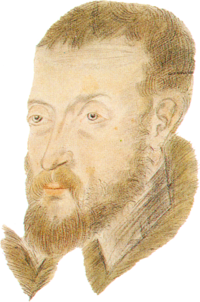
With that caveat at the beginning you may be wondering why I even posted this poem today.  For me, the answer is quite interesting.  The poem was written by the poet Joachim du Bellay, who lived in Rome while in the retinue of his relative Cardinal Jean du Bellay.  This sonnet is one of the two sonnets in his series Les regrets (1558) which expressed his scandalized opinion of Julius III during what became known as The Innocenzo Scandal.

The Innocenzo Scandal

Julius III

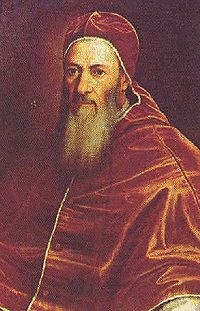
Pope Julius III (1550-1555) was born in Rome, September 10, 1487 as Giovanni Maria Ciocchi del Monte, he took the name Julius and studied law at Perugia and Siena. After taking holy orders, he became chamberlain to Pope Julius II.  Although an outstanding canonists, his careless homosexuality, especially as he got older, created a scandal for the papacy. In his sixties, he picked up a 14-year-old boy on the streets of Parma. The boy, ironically named Innocenzo was described as being stunningly beautiful, and Julius was so enraptured with him that he forced his brother to adopt Innocenzo.

In February of 1550 Cardinal Del Monte was elected pope as Julius III, and immediately made the 17 year old Innocenzo a Cardinal. Attempts to give the boy an education which could have prepared him for ecclesiastic office had already proven useless – “a few social graces, a few bits of knowledge, perhaps about the glories of the Classical world, and Innocenzo’s formal education was over.” Nevertheless, Julius issued a Papal Bull declaring Innocenzo legitimate – a necessary move given that persons of illegitimate birth were not eligible for membership of the College of Cardinals – and named him Cardinal Nephew, effectively in charge of all papal correspondence. But the role of secretary to the papacy proved manifestly beyond Innocenzo’s abilities, and so, in order to find a way for his favourite to retain the appearance of power without having any real responsibility, Julius upgraded a hitherto minor position, that of secretary intimus, which, as Cardinal Secretary of State, was eventually to become the highest of Vatican offices. Innocenzo, although relieved of all real duties, continued to be showered with benefices and high offices, much to the disgust of his fellow cardinals. As Cardinal he was given the titular church of San Callisto, in 1562.

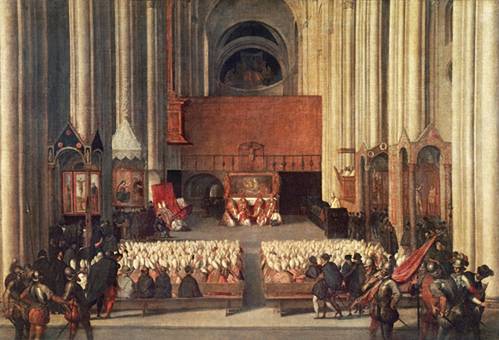
Council of Trent

Cardinals who were more sensitive to the need to reform the mores of the Church in order to combat the Protestant Reformation protested in vain against Innocenzo’s elevation. Rumors also circulated around European courts. Gossip called the boy Julius’s “Ganymede.” The relationship became a staple of anti-papal polemics for over a century: it was said that Julius, awaiting Innocenzo’s arrival in Rome to receive his cardinal’s hat, showed the impatience of a lover awaiting a mistress, and that he boasted of the boy’s prowess. The Venetian ambassador, Matteo Dandolo, wrote that Cardinal Del Monte “was a little scoundrel”, and that the Pope “took him [Innocenzo] into his bedroom and into his own bed as if he were his own son or grandson”. Onofrio Panvinio wrote that Julius was “excessively given to intemperance in a life of luxuriousness and to his libido,” and, more explicitly characterized him as “puerorum amoribus implicitus” (‘entangled in love for boys’). One more mocking rumor made the rounds in Rome, saying that Innocenzo had been made a cardinal as a reward for his being the keeper of the pope’s monkey.

Remember that this scandal took place in one of the most tumultuous periods of the Roman Catholic Church. It occurred in the midst of the Wars of Religion that resulted from the Protestant Reformation.  As a Cardinal, Julius III, had served as the first president of the Council of Trent, which was the core movement in the Catholic Counter-Reformation.


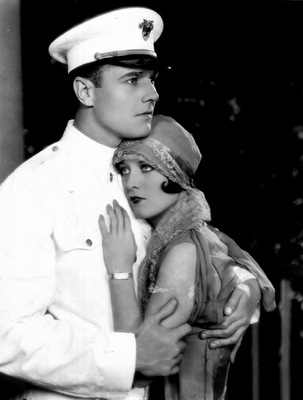
William (Billy) Haines

William Haines was born in Virginia in 1900 and in 1914, opened a nightclub in Hopewell, Virginia. Destined for entertainment and high style, he arrives in Hollywood in 1922 after winning a talent contest. He appeared in over twenty films as a leading man to Hollywood’s most famous stars including Joan Crawford, Marion Davies and Constance Bennett. He was a star of the silent era until the 1930s, when Haines’ career was cut short by MGM Studios due to his refusal to deny his homosexuality. Haines never returned to film and instead started a successful interior design business with his life partner and supported by friends in Hollywood.

Haines redefined the way movie stars lived. He lived large and played the role of a successful movie star to the max with the encouragement of his partner, Jimmie Shields. He defined style and his passion for grand automobiles was no exception.

When Haines ran away from home at 14 with his first boyfriend, the fun was only just starting. Next stop: Greenwich Village, New York, where he worked as a model and lived with Cary Grant. A talent scout landed him a contract in Hollywood where he became a top box office draw in silent films. In 1926 he met Jimmie Shields who became his life-long partner.

Then in 1933 he was arrested for being caught with a sailor in the Y.M.C.A.. MGM studio head Louis B. Mayer gave Haines an ultimatum: break up with Jimmie Shields, or get out.

Haines got out. Shields took his lover’s Y.M.C.A. scandal a lot easier than Mayer did. In fact, Haines and Shields had a legendarily open relationship, often sharing tricks and cruising Los Angeles’ Pershing Square together. Joan Crawford described them as “The happiest married couple in Hollywood.”

The young men went on to become some of the most influential designers and antique dealers for the glitterati of Hollywood and Beverly Hills. His BFF was Joan Crawford, and his influence over her look, career, and even her behavior is inestimable— she was one of his greatest creations. His design studio continues to this day and his furniture designs are in constant reissue.

Their lives were disrupted in 1936 when members of the Ku Klux Klan dragged the two men from their home and beat them, because a neighbor had accused the two of propositioning his son. Crawford, along with other stars such as Claudette Colbert, George Burns, Gracie Allen, Kay Francis, and Charles Boyer urged the men to report this to the police. Marion Davies asked her lover William Randolph Hearst to use his influence to ensure the neighbors were prosecuted to the full extent of the law, but ultimately Haines and Shields chose not to report the incident.

The couple finally settled into the Hollywood community in Brentwood, and their business prospered until their retirement in the early 1970s, except for a brief interruption when Haines served in World War II. Their long list of clients included Betsy Bloomingdale, Ronald and Nancy Reagan when Reagan was governor of California, and Walter and Leonore Annenberg with their 240-acre estate “Sunnylands.”

Haines never returned to film. Gloria Swanson, another lifelong friend, extended him a personal invitation to appear with her in the film Sunset Boulevard (1950), but he declined.  Haines and Shields remained together for the rest of their lives. Joan Crawford described them as “the happiest married couple in Hollywood.”

Haines died from lung cancer in Santa Monica, California at the age of 73, a week short of his 74th birthday, which was on the new year of 1974. Soon afterward, Shields, who suffered from what many believe to be Alzheimer’s Disease, put on Haines’ pajamas, took an overdose of pills, and crawled into their bed to die. They were interred side by side in Woodlawn Memorial Cemetery.

William Haines Designs remains in operation, with main offices in West Hollywood and showrooms in New York, Denver and Dallas. Haines’s life story is told in the 1998 biography Wisecracker: The Life and Times of William Haines, Hollywood’s First Openly Gay Star by William J. Mann, and his designs are the subject of Peter Schifando and Haines associate Jean H. Mathison’s 2005 book Class Act: William Haines Legendary Hollywood Decorator. World of Wonder produced Out of the Closet, Off the Screen: The Life of William Haines, which aired on HBO in 2001.

Sources:


On His Queerness

On His Queerness

When I was young and wanted to see the sights,
They told me: ‘Cast an eye over the Roman Camp
If you care to.
But plan to spend most of your day at the Aquarium –
Because, after all, the Aquarium –
Well, I mean to say, the Aquarium –
Till you’ve seen the Aquarium you ain’t seen nothing.’

So I cast my eye over
The Roman Camp –
And that old Roman Camp,
That old, old Roman Camp
Got me
Interested.

So that now, near closing-time,
I find that I still know nothing –
And am still not even sorry that I know nothing –
About fish.

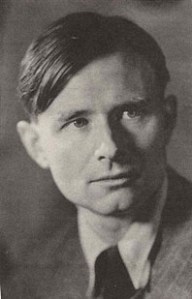
— Christopher Isherwood

For a biography of Christopher Isherwood, click on “Read More” below.

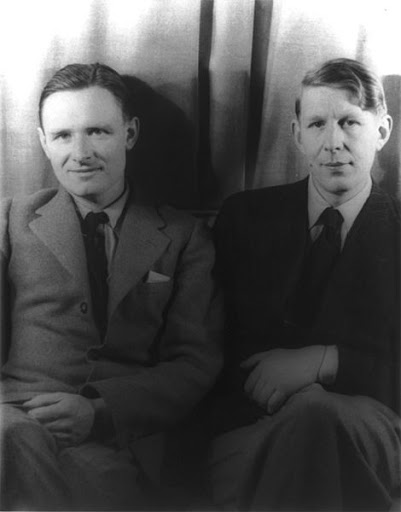
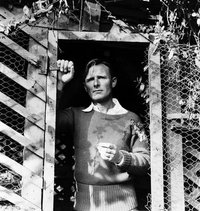
Christopher Isherwood (1904-1986) was a British-born American writer who worked in many genres, including fiction, drama, film, travel, and autobiography. He was especially esteemed for his stories about Berlin in the early 1930s.


The son of a career military officer, Christopher Isherwood was born in High Lane, Cheshire, England, on August 26, 1904. He attended the Repton School from 1919 to 1922 and Cambridge University from 1924 to 1925. His university year was significant because it was at Cambridge that he met Wystan Hugh Auden, with whom he later collaborated on several literary projects, and because it was there that he became a practicing homosexual, an orientation which played an important role in his personal and artistic life.

Leaving the university without a degree, Isherwood worked for a year as the secretary to French violinist Andre Mangeot and as a private tutor in London. In his spare hours he worked on his first novel, which was published as All the Conspirators in 1928.

Scenes of a Crumbling Germany

In 1929 he went to Germany to visit Auden, who was living there, and was attracted to life in the crumbling Weimar Republic, and particularly to the sexual freedom that existed. As he so succinctly put it in his 1976 book Christopher and His Kind 1929-1939, “Berlin meant Boys.” He was not long in establishing a liaison with Berthold “Bubi” Szczesny, a bisexual ex-boxer, which lasted until Szczesny was forced to leave the country. Among the young men he met subsequently was one from the working class section of Berlin; he took a room with this boy’s family for a time and so became familiar with day-to-day living among the urban proletariat.

At first his stay in Germany was financed through an allowance provided by his only wealthy relative, his uncle Henry Isherwood. His uncle was also homosexual and seemed happy to assist his nephew in the quest for companions. Eventually, however, Uncle Henry stopped his remittances, and Isherwood paid his way by tutoring in English; in this way he met Berliners from the upper classes.

All this provided background for his most successful work, The Last of Mr. Norris (1935), Sally Bowles (1937), and Goodbye to Berlin (1939), all collected under the title The Berlin Stories in 1945. In these novellas and short stories he presented an in-depth portrait of life in Germany’s capital as the republican center collapsed, the Communists tried desperately to stem the rightist tide, and the Nazis came to power.

He began in “A Berlin Diary (Autumn 1930)” with an almost offhand observation about Fráulein Hippi, a student whom the narrator is tutoring in English: “Like everyone else in Berlin, she refers continually to the political situation, but only briefly, with a conventional melancholy…. It is quite unreal to her.” In “Sally Bowles,” he mentioned the closing of two major banks and noted: “One alarmist headline stood out boldly, barred with blood-red ink: ‘Everything Collapses’.”

In “The Nowaks,” about a working class family, he described their neighborhood in this way: “The entrance to the Wassertorstrasse was … a bit of old Berlin, daubed with hammers and sickles and Nazi crosses and plastered with tattered bills….” The political pressures are seen increasing in “The Landauers,” about a well-to-do Jewish family: “One night in October 1930, about a month after the Elections, there was a big row on the Leipzigerstrasse. Gangs of Nazi toughs turned out to demonstrate against the Jews. They … smashed the windows of all the Jewish shops.” Finally, in “A Berlin Diary (Winter 1932-33),” the narrator observes: “Schleicher has resigned. Hitler has formed a cabinet…. Nobody thinks it can last until the spring.”

The Berlin stories were picked up by playwright John van Druten, who was struck by a sentence in “A Berlin Diary (Autumn 1930)”: “I am a camera, with its shutter open, quite passive, recording not thinking.” He wrote the play I Am a Camera, centering on Sally Bowles, of whom Alan Wilde wrote: “Sally’s charm is her naíveté, … her total capacity for self-deception and self-contradiction, … her ability to accommodate herself to each new situation….” I Am a Camera in turn became the musical Cabaret (1967), with book by Joe Masteroff and lyrics by Fred Ebb, which was produced both on stage and in film.

Isherwood of course became fluent in German and got acquainted, as did Auden, with the expressionist drama of such important figures as Ernst Toller, Georg Kaiser, and Bertolt Brecht. This led the two British artists to collaborate on three expressionist plays: The Dog Beneath the Skin (1935), The Ascent of F6 (1937), and A Melodrama in Three Acts: On the Frontier (1938), of which the first two are generally considered the more successful.

Move to the United States

Isherwood and Auden travelled to China in 1938 and in 1939 worked together on Journey to a War. In that same year, the year World War II began, both came to America, a move which made them anathema to many Britons. Indeed, even three years later in Put Out More Flags novelist Evelyn Waugh, christening them Parsnip and Pimpernell, commented, “What I don’t see is how these two can claim to be contemporary if they run away from the biggest event in contemporary history.”

During World War II Isherwood wrote scripts for Metro-Goldwyn-Mayer, Warner Brothers, and 20th Century Fox film studios; worked for a year in a refugee center in Haverford, Pennsylvania; and became a resident student of the Vedanta Society of Southern California and co-editor of the group’s magazine Vedanta and the West.

He became increasingly involved in the Vedantist religion, editing the volumes Vedanta for the Western World in 1945 and Vedanta for Modern Man in 1951 and writing An Approach to Vedanta in 1963, Ramakrishna and His Disciples in 1965, and Essentials of Vedanta in 1969. He explained its basic tenets in the 1963 work as follows: “We have two selves – an apparent, outer self and an invisible, inner self. The apparent self claims to be an individual and as such, other than all other individuals…. The real self is unchanging and immortal.”

Isherwood did not confine himself solely to religious writings, however. He authored such novels as Prater Violet (1945), The World in the Evening (1954), A Single Man (1964), and A Meeting by the River (1967), which he dramatized in 1972. He also wrote the travel book The Condor and the Cows (1949), autobiographical volumes, and the collection of stories, articles, and poems titled Exhumations (1966). Additionally, he taught at Los Angeles State University, the University of California at Santa Barbara, and the University of California at Los Angeles and wrote film scripts.

Isherwood’s status in modern literature was best summarized by G. K. Hall: “Christopher Isherwood has always been a problem for the critics. An obviously talented writer, he has refused to exploit his artistry for either commercial success or literary status…. Isherwood was adjudged a ‘promising writer’ – a designation that he has not been able to outrun even to this day. It is still a clicheé of Isherwood criticism to say that he never fulfilled his early promise….In any case, five decades of Isherwood criticism present a history of sharply divided opinion.”

Isherwood, who became an American citizen in 1946, lived and worked in southern California until his death from cancer January 4, 1986.

Further Reading

Much personal information is in his autobiographical Christopher and His Kind (1976). In G. K. Hall’s Christopher Isherwood: A Reference Guide (1979) the reader will find a comprehensive listing of all works by and about the subject.

Additional Sources

Finney, Brian, Christopher Isherwood: A Critical Biography, New York: Oxford University Press, 1979.

Fryer, Jonathan, Isherwood, Garden City, N.Y.: Doubleday, 1978, 1977.

Fryer, Jonathan, Isherwood: A Biography of Christopher Isherwood, London: New English Library, 1977.

Isherwood, Christopher, Christopher and His Kind, 1929-1939, London: Eyre Methuen, 1977; New York: Farrar, Straus Giroux, 1976.

Isherwood, Christopher, My Guru and His Disciple, New York, N.Y.: Penguin Books, 1981.

King, Francis Henry, Christopher Isherwood, Harlow Eng.: Published for the British Council by Longman Group, 1976.

Lehmann, John, Christopher Isherwood: A Personal Memoir, New York: H. Holt, 1988, 1987.

Read more: http://www.answers.com/topic/christopher-isherwood#ixzz1V3BQq8vY


Harvard’s Secret Court of 1920

May 27, 1920 is the day when the dean of Harvard College convened a secret court in 1920 to question students about the suicide of sophomore Cyril Wilcox.

The questions weren’t about Cyril’s death. They focused on a letter that connected Cyril to a gay scene at Harvard. Dean Greenough said the discovery was “unspeakably gross” and that it “tainted” the college. He took quick action. All students found to be gay would be expelled.

Eugene Cummings had studied five years to become a dentist. The senior wouldn’t graduate. A note was added to Eugene’s file: “Proved guilty, but took ether upon receiving news. Died on morning of June 11, 1920.”

Back then, students like Cyril and Eugene were silenced by shame. Today they speak proudly.

How open are we?

In America we have Glee on TV, gays in the military and same-sex marriage in six states — but not the other 44. In some 30 states, workers can be fired just for being gay. Gays don’t have full rights in most countries. Even the oppressed oppress gays. The deaths of Cyril and Eugene in 1920 were repeated in 2010. There was a rash of gay teenage suicides across America last fall.

Kids internalize the intolerant speech that still runs deep in our politics, religion and culture. Growing up, all I heard about gays was how bad they are — by ministers, politicians, in jokes on television and at school. I believed what I was told.

Back in 1920, a mother spoke out when her gay son was expelled from Harvard: “You could have done much good,” she wrote to the dean, “had you perhaps had a little less sense of justice and a little more of the spirit of Jesus in your heart.”

That Harvard mom of 1920 represents the true religious traditions of love and compassion. She also represents the true Harvard tradition.

Speech, then openness

Next year, a dedicated faculty member will provide support for LGBT (lesbian, gay, bisexual and transgender) students for the first time in school history. After injustice, a rainbow. Just a side note: The Harvard Gay and Lesbian Caucus is composed of more than 5,000 gay, lesbian, bisexual and transgender Harvard and Radcliffe alumni/ae, faculty, staff and students. HGLC was formed in 1984 to pressure Harvard University to include sexual orientation in its non-discrimination policy.

Speech is what has moved Harvard toward openness — not just for gays, but all the people who weren’t welcome on campus at one time. Today’s diverse graduates will export their values of tolerance to the world, negotiating solutions for the many injustices that still exist. Imagine the power of their education.

This post was adapted from a May 20, 2011 article in USA Today by Joel P. Engardio who graduated last May with a Master of Public Administration degree from the Harvard Kennedy School of Government.


So Close, and Yet So Far Away

School starts back today (pray for me, LOL), so I didn’t have a lot of time last night to write a post. A friend of mine sent me this article, and I found it an interesting and delightful read.  I hope that you do as well. (Thanks, FOC.)


The contorted history of autofellatio.

By Jesse Bering

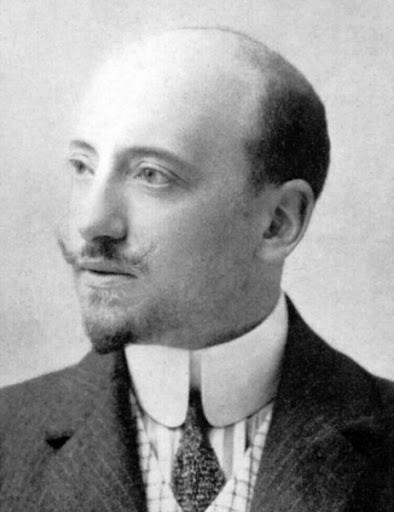
Italian poet Gabriele d’Annunzio

Long before I knew very much about anything regarding sex, I did what many young males do, which of course is to place an empty paper-towel roll over my penis and suck hopefully upon the cardboard end. Okay, perhaps not everyone does this; I was a little confused about the suction principle. And now I’m a bit embarrassed by the story, although it’s been a full year since the event and I’m much better informed on the subject of fellatio today. Oh, settle down, I’m only joking.

Well, kind of. I did actually attempt this feat, but I was 12 or 13 at the time, which, to give you a clearer sense of my unimpressive carnal knowledge at that age, is also around the time that I submitted to my older sister with great confidence that a “blow job” involves using one’s lips to blow a cool breeze upon another’s anus.

So to avoid similar confusion, let us define our terms clearly. Autofellatio, the subject at hand—or rather, not at hand at all—is the act of taking one’s genitals in one’s mouth to derive sexual pleasure. Terminology is important here, because at least one team of psychiatrists writing on this subject distinguishes between autofellatio and “self-irrumatio.” In nonsolo sex, fellatio sees most of the action in the sucking party while irrumatio has more of a thrusting element to it, wherein the other person’s mouth serves as a passive penile receptacle. (Hence the colorful and rather aggressive-sounding slang for irrumatio—”face-f*cking,” “skull-f*cking,” and so on.)

In any event, my paper-towel-roll act was simply a “Plan B” at that puerile age, a futile way to circumvent the obvious anatomical limitations to oral self-gratification. And by all accounts, I wasn’t alone in hatching Plan B. Alfred Kinsey and his colleagues reported in Sexual Behavior in the Human Male, in fact, that, “[a] considerable portion of the population does record attempts at self-fellation, at least in early adolescence.” Sadly, given our species’ pesky ribcage and hesitant spine, Kinsey estimated that only two or three of every 1,000 males are able to achieve this feat. There’s the story of the Italian decadent poet, Gabriele d’Annunzio, who is said to have had a bone removed to facilitate the act, or that old Saturday Night Live skit in which Will Ferrell enrolls in a Yoga class only to become flexible enough to fellate his own organ. But truth is often stranger than fiction. In 1975, the psychiatrist Frances Millican and her colleagues described the real case of a “very disturbed” patient who learned Yoga precisely for this reason.

Now, you may think that being one of the ultrabendable 0.25 percent of the population is all fun and games. (We’ve all heard those quips about never having to leave the house.) But think again. There’s a long and unfortunate history of pathologizing this behavior; psychiatrists have described its practitioners as being sexually maladjusted, stuck in an infantile state of suckling dependency, or even motivated by repressed homosexual desires. Take the case described by psychiatrists Jesse Cavenar, Jean Spalding, and Nancy Butts, who wrote in 1977 of a lonely, 22-year-old serviceman who’d been fellating himself since the age of 12. He was driven mad, “by the fact that he could physically incorporate only the glans, and wanted to be able to incorporate more.” Honestly, it must have been so—oh, what’s the word I’m looking for … it’s right on the tip of my tongue—frustrating, for this poor soldier. This is the ultimate cock tease, its being so close yet so far away.

Since the days of Freud, psychoanalysts have gone to town on the subject of autofellatio. In a 1971 article by psychiatrist Frank Orland, we see the typical jargon-filled language used in dissecting the “symbolic” bases of autofellatio, which is conceptualized as a virtual “ring of narcissism”:

… autofellation represents a recreation of the early infantile state in which the intrapsychic representatives of external objects are separated from the self-object, with a coexisting parasitic symbiosis with the external object. Through the autofellatio phenomenon, the ego re-establishes the necessary mastery over the external object representative as a defence against object loss and to restore the parasitic fusion with the nipple-breast.

That, ladies and gentlemen, is unadulterated psychobabble—and I tell you this as a psychologist. Sometimes, people are motivated to lick their own genitals because it just feels good. Of course, there are always going to be those, such as the dubious Yoga master, who take it a bit too far and for whom autofellatio contributes to mental illness. The foregoing soldier, who couldn’t take it far enough, got so frustrated by his semifulfilled fantasy that, when he masturbated the old-fashioned way, he could achieve climax only by imagining himself fellating himself.

The very first published psychiatric case of autofellatio, appearing in the American Journal of Psychiatry way back in 1938, was also one of the most outrageous and pathological. The patient was a 33-year-old store clerk who, prior to being referred to Yale psychiatrists Eugen Kahn and Ernest Lion, had just completed a 60-day jail sentence for sexual assault. “Among his perverse practices,” explain the authors, “were pedophilia, cunnilinguism, homosexual acts (fellatio, sodomy and mutual masturbation), exhibitionism, transvestism, fetishism, algolagnia, voyeurism and peeping.” But never mind all those vanilla paraphilias. The man’s psychiatrists were especially intrigued by his more unusual habit. He seems a devious wee character, this patient of theirs. The authors describe him as being somewhat effeminate in posture, gait and mannerisms; he stood only 5 feet 2 inches tall—”somewhat thin and with wide hips,” they wrote, with “a female pattern of distribution of his pubic hair” and “his gag reflex is very sluggish.”

The patient was the third-oldest of eight children and grew up in a strict, religious family, which the physicians felt he rebelled against by egregiously breaching their high moral standards. In recounting to the psychiatrists the origins of his interest in autofellatio, the troubled clerk recalled being invited at the age of 14 by a “cripple boy” to engage in oral sex with him. The patient, being shy, had refused this offer, but the thought of it simmered and, lacking the courage to approach anyone else, he took matters upon himself: “He kept trying night after night, managing to bend his back more and more until he finally succeeded in August, 1923.” (The 89th anniversary of this event is coming up, in case you want to mark it on your calendar.) It turns out he liked it—so much, in fact, that even amidst the long litany of perversions he enjoyed, self-irrumatio instantly became his favorite autoerotic act.

In an odd Pavlov’s dog sort of way, the authors even describe how the man’s sexual arousal had since then been accompanied by a “constricting feeling in the throat.” That must be a terribly annoying feeling, I’d imagine, and apparently also one not easily resolved. “He has attempted to secure substitute gratification,” say the authors, “by smoking, or by stimulating his pharynx with a banana, vaginal douche or a broom handle. These have yielded various degrees of satisfaction.” And he did apparently get over his adolescent shyness and lack of confidence, too—he particularly enjoyed fellating himself in front of a shocked audience.

Since this initial case report by Kahn and Lion, a handful of others have trickled in over the years, with subsequent investigators attempting to find a set of common personality denominators in those who prefer autofellatio over other forms of sex. In a 1954 article in Psychoanalytic Review, for instance, William Guy and Michael Finn saw a theme beginning to emerge. “In all of the clinical descriptions,” observe these authors, “one finds repeatedly such phrases as sensitive, shy, timid, effeminate, and passive.” This is code for “queer,” I believe, and in fact other writers have more expressly noted the often-suppressed homosexual desires in these autofellators.

In fact, judging by the scant literature, one of the big psychoanalytic questions yet to be resolved satisfactorily seems to be the extent to which engaging in autofellatio—or perhaps simply the desire to do so—signals a latent erotic attraction to the same sex. I suspect, however, that the overrepresentation of gay men in the antiquated case reports is simply a reflection of the cultural ethos of those times. The most recent psychiatric investigations on autofellatio date to the late 1970s (around the time that Freud’s particular grip on psychiatry lost its tenuous hold), and the earlier ones to the 1930s, so as a rule the men described therein faced baseless moralistic proscriptions against homosexuality. This meant other men’s penises were very hard to come by. So it’s not terribly surprising that those too frightened to perform fellatio on another man would develop severe neuroses after indulging in their own penises.

A 1946 article from the American Journal of Psychiatry exemplifies this phenomenon. The case involves a 36-year-old, highly intelligent, personable, but virginal staff sergeant (not to be confused with the military man we met earlier) with closeted homosexual desires. According to the official record, he’d first performed autofellatio at age 13, but he became so frightened by this “impulse” that he resisted ever doing so again—that is, until a month prior to arriving at the psychiatric ward of the hospital. After giving himself head in private, the sergeant became intensely paranoid that the other soldiers somehow knew of his autofellatio, and that every little snigger, whisper, or averted glance concerned this transgression. He suffered a nervous breakdown on hearing the word “cocksucker” floating about so casually and playfully in the military barracks, convinced it was meant just for him.

It’s a rather sad ending for him, too, because despite his responding well to the doctors’ reassurance that he was being overly paranoid, the sergeant was discharged for being “no longer adaptable within the military service.” The therapists assigned to the case, Major Morris Kessler and Captain George Poucher, reached a rather strange conclusion, one that I have a hunch you might disagree with: “Sexual self-sufficiency,” they write, “either by masturbation or autofellatio, is tantamount to having an affinity for one’s own sex.” In other words, if you were a fan of manual masturbation in 1946, my heterosexual male friends, you’d have been branded a secret homosexual pervert who likes penises so much that he gives himself hand jobs. This would have made autofellatio a devil of a case under the Clinton-era “Don’t Ask, Don’t Tell” ban on gays in the military had it arisen then. And, seriously, good riddance to those ignorant days of yore. To each his own—quite literally in the case of autofellatio.

I know, I know, I didn’t even get a chance to talk about autocunningulism in females. Given the even more serious anatomical hurdles in lacking a protruding reproductive device, such behavior in women may not even be possible. I confess I don’t know; and there’s no mention of it in the scientific literature. The closest female comparison to autofellatio I stumbled upon is the case of women who suckle from their own breasts, for sexual or other purposes. One therapist writes of an especially self-sufficient female patient who had a habit of doing this. When he asked her why, she merely replied, “I’m hungry.” But that’s another article for another day.

Jesse Bering teaches at Wells College and is the author of The Belief Instinct. He is a frequent contributor to Slate and writes the “Bering in Mind” column for scientificamerican.com. His next book will be on the curiously scandalous science of human sexuality. Follow him on Twitter @JesseBering or try adding him on Facebook.

Article URL: http://www.slate.com/id/2300733/


Native American Transvestites

Juan Pardo travelled from South Carolina up to North Carolina and then west as far as what is nowadays Johnson City and Knoxville, Tennessee.

This journey has been chronicled by the ethnohistorian Charles Hudson.  One of the more curious incidents recorded in Charles Hudson’s The Juan Pardo Expeditions: Exploration of the Carolinas and Tennessee, 1566-1568 (Smithsonian Institution Press, 1990) is an ethnographic observation of the local Indians:

“…in Cauchi they saw an Indian man who was dressed as a woman and walking in the company of women. When Pardo asked Cauchi Orata for an explanation he said that the man was his “brother,” but because he was not a man for war or for doing the things that men do, he went about as a woman and did a woman’s tasks…”

The illustration in the book, reproduced above, is Plate XXIII from the famous set of engravings by Jacques Le Moyne: “Timucuan male transvestites carrying packbaskets of food. Females are shown loading the packbaskets… Photo courtesy of the Smithsonian Institution.”

Source: “The transvestites of 16th century America” TYWKIWDBI (“Tai-Wiki-Widbee”)


For “A brief history of the Timucua people of Northern Florida” click Read More below.

A brief history of the Timucua people of Northern Florida
By Haines Brown

Florida offers archaeological evidence of some of the earliest settlements in North America. In particular, spectacular finds from Florida sink holes may date from the end of the Wisconson glaciation in about 10,000 B.C. However, by historical times, much of Florida was occupied by Taino-speaking peoples from the Caribbean, who, like all Arawak speakers, came originally from Amazonia. Among the better known of these Taino peoples of Florida are the Tekesta, associated with the Maimi Circle, the state-level Calusa society based on a fishing economy in Southern Florida, and the Timucua tribe of Northern Florida.

Apparently the Timucuan language is a Caribbean kreol that derives from the Arawak language group of Amazonia as spoken by the Warao, but it was influenced by North American languages through trade and cultural exchanges. In this respect the Timucuan language resembles other Taino languages, but it seems to have emerged at a somewhat earlier point in Caribbean Arawak linguistic history. The separation of Taino and Carib languages had occurred even earlier.

The Timucua from northern Florida participated in a broad Southeastern American culture sphere, but preserved distinctive traits reflecting their Caribbean origin. By the 17th century, their population was greatly reduced, and with the influx of new peoples from the North such as the Creek and the impact of European colonizers, not much of that original culture survives among the Timucuan people today. For example, we know of only a small number of Timucuan words. Peoples of Taino descent, such as the Timucua, are trying to recover as much of their cultural heritage as they can and gain the tribal recognition necessary to win some control over their circumstances. Solidarity among Taino-speaking people everywhere, from South America to the Caribbean and North America, is a means to achive official recognition for Taino tribes.

The amount of surviving evidence and the extent to which survivers are able to perpetuate their traditions vary considerably from one Taino tribe to another. In the case of the Timucua, that evidence to a large extent derives from records of conquest by European whites, but from it we at least gain some idea of Timucuan society. In it there was the marked sexual distinction typical of Southeastern American culture. It gave rise to a sexual division of labor and affected many aspects of daily life. For example, in their dress, men wore a woven fiber breechcloth, sashes, and deerskin moccasins for travel. Timucuan women instead wore skirts of Spanish moss. In cold weather, both women and men put on feather or skin matchcoats, although worn differently. In warm weather, young boys and girls generally wore nothing.

Although gender was sharply distinguished, one’s choice of gender was not dictated by sex. For example, the social demands on men were so great that some chose instead to be transvestites and accept responsibilities associated with the female role, to care for the household, to carry burdens and cultivate the fields. Likewise, some women would adopt a man’s role, fight in war and sit on the governing council. This was common enough, apparently, that Taino people expressed surprise at the complete absence of women in Spanish councils.

Because of deepening social contraditions associated with their own social development and with European contact, Timucua lineages segmented into a large number of clan settlements consisting of people considered to be inlaws. If a young couple within a settlement wished to marry, to avoid incest their clan would segment so that the two parties came to represent different clans and therefore became marriageable. Social segmentation led to a large number of small lineages and clans, which greatly weakened the Timucua. To achieve the solidarity needed for defense against the white invaders, lineages would consolidate into larger lineages by means of exogenous marriage bonds.

It is thought that a settlement usually consisted of a small number of round timber houses with palm thatched roofs arranged in a semi-circle around a central plaza equiped with a large post for the traditional Timucua games. In larger settlements there would be an artificial mound for a temple and another for the chief’s residence. Timucua settlements seem to have been generally quite small.

Early every morning the council in a settlement would meet to discuss the affairs of the chiefdom, smoke, and sometimes carry out the games. Important council meetings opened with a “White Drink” ceremony (the drink was actually black in color) that helped purify the men (and women posing as men) so that they would find it easier to interact. Women adopting a male gender would serve on the council, but young boys and women who chose a female gender were excluded. This White Drink was made from a local variety of holly, and so was related to the maté drink of Central and South America (perhaps brought by Arawak-speakers from Amazonia). Its main constituent was caffeine, and it was drunk hot like coffee to focus thought and enhance intellectual powers. A pipe would be lit and smoke blown in the four cardinal directions by one person after another according to their status.

While for many Taino peoples ceremonial games imply a contest among ball teams to resolve a judicial dispute, the Timucua adopted instead a variation of the North American game of chunkey. This involved using beautifully fashioned concave disks of stone about 45 centimeters in diameter. When rolled, the stone takes an irregular path, and each player throws a long pole toward the point they think the stone will eventually stop. The object is to throw just before you think the stone will fall over. In Creek Indian culture, the players had to throw the long pole before the disk passed a certain line, meaning that the players had to judge where the disk would fall over before it began to slow down.

In the community there would be wise men who functioned as priests as well as shamans able to mediate supernatural powers to serve the needs of the community. For example, the Timucuan shaman, through a trance was able to prophesy, diagnose a disease, locate stolen objects, and foretell the weather.

Archaeological evidence suggests a quite mature agricultural economy among the Apalachee and Timucua of northern Florida based on Indian corn, beans, pumpkins and vegetables. In fact, de Soto’s four-year expedition through “La Florida” could not have taken place without the appropriation of enormous amounts of food from local populations. The American farmers first cleared the land by burning the brush, prepared the soil with hoes, and then women planted seeds with dibble sticks (coa). Apparently, two crops were planted annually, and there was field rotation. Guards stood in wooden watchtowers (barbacoa) to protect the crops from birds and foraging animals.

Besides beans, corn and squash, the people of Florida also cultivated the Zamia root for grinding into bread flour. They also apparently cultivated the tobacco needed for religious ceremonies (the halucinogenic “sot weed”). Cultigens were probably brought into Florida from the North to supplement or displace the traditional Taino dependence on marine resources in the South. The harvest was dried and stored in stone warehouses to protect it from spoilage and insects.

Hunted were alligators (by thrusting a long pole down their throats), sea cows and occasional nearby whales. Meat was cooked on a wooden rack over a fire, also called a barbacoa, from which derives the English word “barbecue.” Although the Taino generally relied on a marine economy, unlike the Calusa, who managed to support a state-level society on a fishing industry, it seems that Timucuan culture constrained fishing and hunting so that Florida’s west coast economic potentials were never fully exploited by the Timucua. Later on, due to a dependency on British trade, much of Florida’s deer population was destroyed for the deerskin needed to exchange for tools, cloth, and ammunition.

Spanish pillagers penetrated Florida early in the sixteenth century in search of precious metal and slaves. One of them, the sinister Pánfilo de Narváez, landed in 1528 in order to conquer the Timucua, but he did not find the precious metal he expected and also apparently food supplies were inadequate. So, from Tampa Bay, he marched north along the coast to enter Apalachee territory. Although they, too, lacked gold, he appropriated sufficient grain from them to keep his band alive. However, facing the stiff resistence of the Apalachee, he had to abandon any idea of a permanent settlement, and his band continued on into what is now Texas and eventually reached New Spain (Mexico). Of the 260 who started out, only three survived. Unfortunately their account is sketchy, but they spoke of an arid and poor land (perhaps the result of the ravages of the desease broght by the Europeans spreading through Eastern Woodland trade routes. This abandonment of traditional settlements continued well into the next century and opened the way for immigration from the North by other Native Americans who eventualy prevailed in Florida and came to be known as the Seminoles.

Nevertheless, the Timucua economy must have remained highly productive for some time. In 1539, Hernando de Soto, who had been appointed Governor of Cuba and La Florida, landed with 622 men in Tampa Bay in a search for wealth and opportunities for colonization. He found the Americans living in a small town of timber houses with thatched roofs. The chief’s house was near the beach on a high defensive mound, and opposite to it was a temple surmounted by a wooden bird with gilded eyes. Not finding any significant wealth in the area of Tampa Bay, de Soto attacked the surrounding region in order to rob, kill and enslave. People often abandoned their settlements at his approach. Like de Narváez before him, de Soto eventually marched north in the search for greater amounts of food and wealth.

De Soto eventually reached the large settlement of Cofachiqui (in modern Georgia), led by a female chieftain who greeted him in a shaded canoe. To avoid disastor, she ordered that all available white and yellow metal be given to de Soto. This meant copper and the mica sheets which artisans fashioned into ornaments. However, her efforts were in vain. Because there were no local pearls, de Soto’s men looted the burial ground to seize 158 kg of the freshwater pearls that were buried there and proceeded to scalp and kill everyone they could (scalping was practiced in early Europe by the Alemani and Franks as a way to destroy a person’s charisma).

The Timucua were not as warlike as the Apalachee to the North or the Calusa state of Arawak speakers to the South, although they were certainly capable warriors. They preferred to find ways to avoid overt conflict. For example, they would place the head of an enemy on a post outside public buildings or hang his limbs from trees to warn off possible enemies. Older male captives tended to fare poorly, but women and children were adopted and came to lead normal lives. Sacrificial killing was apparently also practiced.

Several kilometers from Cofachiqui lay Talomeco, an even larger settlement. Here too, the chief’s house and the temple were placed on artificial mounds. The temple was 12 meters wide and 30 meters long, and had a steep roof of reeds and split cane with sea-shell decoration. The Spaniards looted the temple and found wooden statues decorated with pearls, and there were great stores of deerskin, dyed cloth and copper ceremonial weapons of superb workmanship.

De Soto gave up on Florida because of its lack of gold, because the local population had been decimated by disease, but most importantly because the Apalachee were quite effective in their own military defense (they were excellent fort builders and constantly harassed his troop). His negative reports discouraged further depredations against the chiefdoms in Florida until the mid-17th century.

Perhaps because the Spanish were unable to establish viable settlements in the Southeast, French Hugeuenots from 1564 tried their own hand at it. However, they had no better success. The Timucua people resisted conquest as effectively as they had resisted being culturally colonized by Franciscan Friars. One Frenchman, Le Moyne de Morgues, made sketches of the Timucuans which have been of enormous interest to ethnographers, and I have included reproductions of some etchings based on them here. The Huguenots tried to convert the Timucuans to Christianity, but only got back for their trouble the habit of tobacco smoking. Perhaps this threat to Timucuan culture helped persuaded the Timucuans to join in the Spanish attack of the Huguenots at Fort Caroline. The Spanish killed everyone there who did not swear they were Catholic.

Whether the Spanish Franciscan missions had any significant impact is debated, but clearly the penetration of British trade was important. Northern Indians were given guns by the British traders in Charleston in order to launch slave raids, particularly against the Florida missions because mission Indians had lost any ability to defend theselves.

With the collapse of the French mission system, the British were eventually able to take over in 1763. Because they were more successful in establishing a permanent presence than either the Spanish or French, there began a period of greater outside cultural influences upon the Timucua. One reason for the British success was their commercial aggressiveness. They brought in cheap manufactured goods such as utensils and tools, rum and guns; they backed up their trade advantage with Indian mercenaries; and they also had greater self-sufficiency by reason of their larger numbers. In exchange for manufactures, the British took back the deer skins, which Americans had long accumulated as prestige goods, and slaves. This trade made the Timucua dependent on the British for tools, cloth and ammunition, and complete subjection became only a matter of time.

By the eighteenth century, the Americans of Florida were entirely dependent on the white European colonizers, and often this was because they lost their land to an encroaching slave economy.

Today there survive people in Florida of Timucuan heritage who would like to unite on that basis, even though they have lost much of their language and culture. However, it should be noted that this loss does not actually prevent tribal reconstitution, but only makes it more challenging. The historical fact is that the social construction of tribes is only constrained by considerations of common origin, shared genes, and cultural survival. Without at least some objective constraints, a tribe will never emerge, but on the other hand a tribe does not reduce to them.

Source: Taino Timucua Tribal Web Page


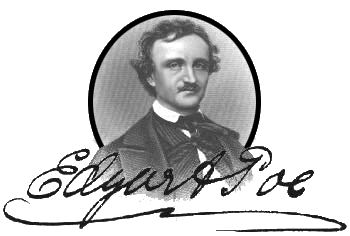
Dreams by Edgar Allan Poe

Dreams

Oh! that my young life were a lasting dream! 

My spirit not awakening, till the beam
Of an Eternity should bring the morrow.
Yes! tho’ that long dream were of hopeless sorrow,
‘Twere better than the cold reality
Of waking life, to him whose heart must be,
And hath been still, upon the lovely earth,
A chaos of deep passion, from his birth.
But should it be- that dream eternally
Continuing- as dreams have been to me
In my young boyhood- should it thus be given,
‘Twere folly still to hope for higher Heaven.
For I have revell’d, when the sun was bright
I’ the summer sky, in dreams of living light
And loveliness,- have left my very heart
In climes of my imagining, apart
From mine own home, with beings that have been
Of mine own thought- what more could I have seen?
‘Twas once- and only once- and the wild hour
From my remembrance shall not pass- some power
Or spell had bound me- ’twas the chilly wind
Came o’er me in the night, and left behind
Its image on my spirit- or the moon
Shone on my slumbers in her lofty noon
Too coldly- or the stars- howe’er it was
That dream was as that night-wind- let it pass.

I have been happy, tho’ in a dream.
I have been happy- and I love the theme:
Dreams! in their vivid coloring of life,
As in that fleeting, shadowy, misty strife
Of semblance with reality, which brings
To the delirious eye, more lovely things
Of Paradise and Love- and all our own!
Than young Hope in his sunniest hour hath known.

-Edgar Allan Poe


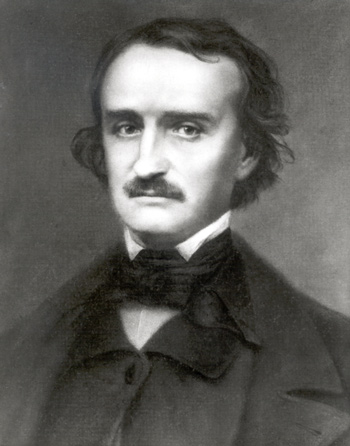
Poe was quite an interesting man, and for a full biography of the poet, click on “Read More” below.  However, I do want to share one the most famous legends surrounding the man.  Poe began attending West Point in 1830, and he quickly realized that he was not cut out for officer material and hated the military.  So he set out to get himself kicked out.  The legend says that Poe was a notorious prankster, and since West Point cadet regulations stated that cadets were to show up for drill wearing belt and gloves, Poe did just that.  He reported for drill wearing belts for his cartridges, his gloves, a smile and nothing else. The reality is probably much less colorful.  Tired of West Point by the beginning of 1831, Poe’s plan to get out was to neglect his duties. In January he was tried at a court-martial for having missed drills, parades, classes and church. However, I like the notorious naked legend better.


Who is Edgar Allan Poe?

The name Poe brings to mind images of murderers and madmen, premature burials, and mysterious women who return from the dead. His works have been in print since 1827 and include such literary classics as “The Tell-Tale Heart,” “The Raven,” and “The Fall of the House of Usher.” This versatile writer’s oeuvre includes short stories, poetry, a novel, a textbook, a book of scientific theory, and hundreds of essays and book reviews. He is widely acknowledged as the inventor of the modern detective story and an innovator in the science fiction genre, but he made his living as America’s first great literary critic and theoretician. Poe’s reputation today rests primarily on his tales of terror as well as on his haunting lyric poetry.

Just as the bizarre characters in Poe’s stories have captured the public imagination so too has Poe himself. He is seen as a morbid, mysterious figure lurking in the shadows of moonlit cemeteries or crumbling castles. This is the Poe of legend. But much of what we know about Poe is wrong, the product of a biography written by one of his enemies in an attempt to defame the author’s name.

The real Poe was born to traveling actors in Boston on January 19, 1809. Edgar was the second of three children. His other brother William Henry Leonard Poe would also become a poet before his early death, and Poe’s sister Rosalie Poe would grow up to teach penmanship at a Richmond girls’ school. Within three years of Poe’s birth both of his parents had died, and he was taken in by the wealthy tobacco merchant John Allan and his wife Frances Valentine Allan in Richmond, Virginia while Poe’s siblings went to live with other families. Mr. Allan would rear Poe to be a businessman and a Virginia gentleman, but Poe had dreams of being a writer in emulation of his childhood hero the British poet Lord Byron. Early poetic verses found written in a young Poe’s handwriting on the backs of Allan’s ledger sheets reveal how little interest Poe had in the tobacco business. By the age of thirteen, Poe had compiled enough poetry to publish a book, but his headmaster advised Allan against allowing this.

In 1826 Poe left Richmond to attend the University of Virginia, where he excelled in his classes while accumulating considerable debt. The miserly Allan had sent Poe to college with less than a third of the money he needed, and Poe soon took up gambling to raise money to pay his expenses. By the end of his first term Poe was so desperately poor that he burned his furniture to keep warm.

Humiliated by his poverty and furious with Allan for not providing enough funds in the first place, Poe returned to Richmond and visited the home of his fiancée Elmira Royster, only to discover that she had become engaged to another man in Poe’s absence. The heartbroken Poe’s last few months in the Allan mansion were punctuated with increasing hostility towards Allan until Poe finally stormed out of the home in a quixotic quest to become a great poet and to find adventure. He accomplished the first objective by publishing his first book Tamerlane when he was only eighteen, and to achieve the second goal he enlisted in the United States Army. Two years later he heard that Frances Allan, the only mother he had ever known, was dying of tuberculosis and wanted to see him before she died. By the time Poe returned to Richmond she had already been buried. Poe and Allan briefly reconciled, and Allan helped Poe gain an appointment to the United States Military Academy at West Point.

Before going to West Point, Poe published another volume of poetry. While there, Poe was offended to hear that Allan had remarried without telling him or even inviting him to the ceremony. Poe wrote to Allan detailing all the wrongs Allan had committed against him and threatened to get himself expelled from the academy. After only eight months at West Point Poe was thrown out, but he soon published yet another book.
Broke and alone, Poe turned to Baltimore, his late father’s home, and called upon relatives in the city. One of Poe’s cousins robbed him in the night, but another relative, Poe’s aunt Maria Clemm, became a new mother to him and welcomed him into her home. Clemm’s daughter Virginia first acted as a courier to carry letters to Poe’s lady loves but soon became the object of his desire.

While Poe was in Baltimore, Allan died, leaving Poe out of his will, which did, however, provide for an illegitimate child Allan had never seen. By then Poe was living in poverty but had started publishing his short stories, one of which won a contest sponsored by the Saturday Visiter. The connections Poe established through the contest allowed him to publish more stories and to eventually gain an editorial position at the Southern Literary Messenger in Richmond. It was at this magazine that Poe finally found his life’s work as a magazine writer.

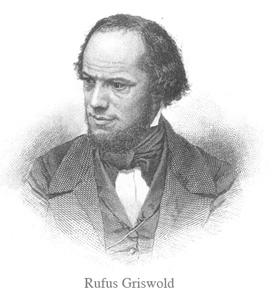
Within a year Poe helped make the Messenger the most popular magazine in the south with his sensational stories as well as with his scathing book reviews. Poe soon developed a reputation as a fearless critic who not only attacked an author’s work but also insulted the author and the northern literary establishment. Poe targeted some of the most famous writers in the country. One of his victims was the anthologist and editor Rufus Griswold.

At the age of twenty-seven, Poe brought Maria and Virginia Clemm to Richmond and married his Virginia, who was not yet fourteen. The marriage proved a happy one, and the family is said to have enjoyed singing together at night. Virginia expressed her devotion to her husband in a Valentine poem now in the collection of the Enoch Pratt Free Library, and Poe celebrated the joys of married life in his poem “Eulalie.”

Dissatisfied with his low pay and lack of editorial control at theMessenger, Poe moved to New York City. In the wake of the financial crisis known as the “Panic of 1837,” Poe struggled to find magazine work and wrote his only novel, The Narrative of Arthur Gordon Pym.

After a year in New York, Poe moved to Philadelphia in 1838 and wrote for a number of different magazines. He served as editor of Burton’s and then Graham’s magazines while continuing to sell articles to Alexander’s Weekly Messengerand other journals. In spite of his growing fame, Poe was still barely able to make a living. For the publication of his first book of short stories, Tales of the Grotesque and Arabesque, he was only paid with twenty-five free copies of his book. He would soon become a champion for the cause of higher wages for writers as well as for an international copyright law. To change the face of the magazine industry, he proposed starting his own journal, but he failed to find the necessary funding.

In the face of poverty Poe was still able to find solace at home with his wife and mother-in-law, but tragedy struck in 1842 when Poe’s wife contracted tuberculosis, the disease that had already claimed Poe’s mother, brother, and foster mother.

Always in search of better opportunities, Poe moved to New York again in 1844 and introduced himself to the city by perpetrating a hoax. His “news story” of a balloon trip across the ocean caused a sensation, and the public rushed to read everything about it—until Poe revealed that he had fooled them all.

The January 1845 publication of “The Raven” made Poe a household name. He was now famous enough to draw large crowds to his lectures, and he was beginning to demand better pay for his work. He published two books that year, and briefly lived his dream of running his own magazine when he bought out the owners of the Broadway Journal. The failure of the venture, his wife’s deteriorating health, and rumors spreading about Poe’s relationship with a married woman, drove him out of the city in 1846. At this time he moved to a tiny cottage in the country. It was there, in the winter of 1847 that Virginia died at the age of twenty-four. Poe was devastated, and was unable to write for months. His critics assumed he would soon be dead. They were right. Poe only lived another two years and spent much of that time traveling from one city to the next giving lectures and finding backers for his latest proposed magazine project to be called The Stylus.

While on lecture tour in Lowell, Massachusetts, Poe met and befriended Nancy Richmond. His idealized and platonic love of her inspired some of his greatest poetry, including “For Annie.” Since she remained married and unattainable, Poe attempted to marry the poetess Sarah Helen Whitman in Providence, but the engagement lasted only about one month. In Richmond he found his first fiancée Elmira Royster Shelton was now a widow, so began to court her again. Before he left Richmond on a trip to Philadelphia he considered himself engaged to her, and her letters from the time imply that she felt the same way. On the way to Philadelphia, Poe stopped in Baltimore and disappeared for five days.

He was found in the bar room of a public house that was being used as a polling place for an election. The magazine editor Joseph Snodgrass sent Poe to Washington College Hospital, where Poe spent the last days of his life far from home and surrounded by strangers. Neither Poe’s mother-in-law nor his fiancée knew what had become of him until they read about it in the newspapers. Poe died on October 7, 1849 at the age of forty. The exact cause of Poe’s death remains a mystery.

Days after Poe’s death, his literary rival Rufus Griswold wrote a libelous obituary of the author in a misguided attempt at revenge for some of the offensive things Poe had said and written about him. Griswold followed the obituary with a memoir in which he portrayed Poe as a drunken, womanizing madman with no morals and no friends. Griswold’s attacks were meant to cause the public to dismiss Poe and his works, but the biography had exactly the opposite effect and instead drove the sales of Poe’s books higher than they had ever been during the author’s lifetime. Griswold’s distorted image of Poe created the Poe legend that lives to this day while Griswold is only remembered (if at all) as Poe’s first biographer.

Source: http://www.poemuseum.org/life.php


If Sometimes in the Haunts of Men

If Sometimes in the Haunts of Men

If sometimes in the haunts of men 
    Thine image from my breast may fade,
The lonely hour presents again
    The semblance of thy gentle shade:
And now that sad and silent hour
    Thus much of thee can still restore,
And sorrow unobserved may pour
    The plaint she dare not speak before.

Oh, pardon that in crowds awhile
    I waste one thought I owe to thee,
And self-condemn’d, appear to smile,
    Unfaithful to thy memory:
Nor deem that memory less dear,
    That then I seem not to repine;
I would not fools should overhear
    One sigh that should be wholly thine.

If not the goblet pass unquaff’d,
    It is not drain’d to banish care;
The cup must hold a deadlier draught,
    That brings a Lethe for despair.
And could Oblivion set my soul
    From all her troubled visions free,
I’d dash to earth the sweetest bowl
    That drown’d a single thought of thee.
6a00d8341cc27e53ef01157144f88f970c-600wi
For wert thou vanish’d from my mind,
    Where could my vacant bosom turn?
And who could then remain behind
    To honour thine abandon’d Urn?
No, no–it is my sorrow’s pride
    That last dear duty to fulfil:
Though all the world forget beside,
    ‘Tis meet that I remember still.

Thomas Eakins - ArcadiaFor well I know, that such had been
    Thy gentle care for him, who now
Unmourn’d shall quit this mortal scene,
    Where none regarded him, but thou:
And, oh! I feel in that was given
    A blessing never meant for me;
Thou wert too like a dream of Heaven
    For earthly Love to merit thee.
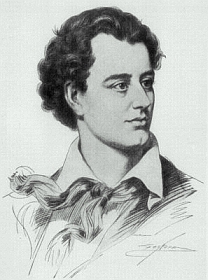
                                                                               -Lord Byron (1812)


George Gordon Noel Byron, 6th Baron Byron, was born 22 January 1788 in London and died 19 April 1824 in Missolonghi, Greece.  He was among the most famous of the English ‘Romantic’ poets; his contemporaries included Percy Shelley and John Keats.  He was also a satirist whose poetry and personality captured the imagination of Europe.  His major works include Childe Harold’s Pilgrimage (1812-18) and Don Juan (1819-24).  He died of fever and exposure while engaged in the Greek struggle for independence.

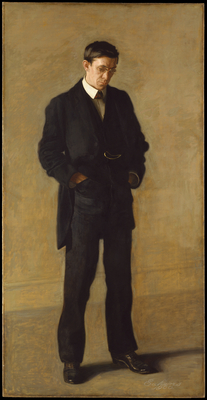
The images accompanying the poem above are by Thomas Eakins.  To read more about Eakins, click “More” below.


Thomas Eakins

“I never knew of but one artist, and this is Tom Eakins, who could resist the temptation to see what they think ought to be rather than what is.” – Walt Whitman

610_eakins_about
Thomas Eakins


When Thomas Eakins died in 1916, he left behind a body of work unprecedented in American art for its depth, strength, perception, character, and commitment to realism. Yet during his life, Eakins sold less than thirty paintings. Rejected by the public and the art establishment of his day, it was only after his death that a new generation of scholars and critics recognized Eakins as one of America’s greatest painters.

Born in 1844, Thomas Eakins lived most of his life in his home city of Philadelphia. After graduating high school he attended the Pennsylvania Academy of Fine Arts. He simultaneously took anatomy courses at Jefferson Medical College, in the hopes of creating more realistic pictures and gaining further insight into the human figure. In 1866 he left Philadelphia for Paris and later Spain, where he studied art and found the works of painters Diego Velásquez and Jusepe de Ribera. Along with Rembrant, these painters would be his greatest influences. A year later he returned to Philadelphia, never to go abroad again.

Throughout the 1870s Eakins painted the interior and exterior life of everyday America. He was concerned with the functioning of the physical world, as well as the inner lives of the people he painted. His paintings were both realistic and expressive. His attention to light, landscape, and the human form made Eakins stand far above his contemporaries. Among the most famous paintings of the time are his group portraits made at medical schools. Striking in their honesty and strict attention paid to the details of the human body, they shocked many in and out of the art world.
In the 1880s, Eakins’ interest in realism brought him in contact with the photographer Edward Muybridge. The two collaborated on photographing the movement of animals and humans. Though few painters took it seriously, Eakins believed the new photographic technology was a tool to better represent the physical world. Throughout much of the 1880s, Eakins brought these interests to students at the Pennsylvania Academy, encouraging them to study anatomy and work from live nude models. In 1886 his insistence on the use of nude models saw a great deal of criticism. Frustrated with the criticism, he eventually resigned.
Though he continued to teach at a number of different colleges, it wasn’t until long after his death that Eakins’ innovations in art education were recognized and adopted throughout the country. By the 1890s he had moved from his earlier outdoor works like “Max Schmitt in a Single Scull,” (1871), a perfectly rendered quiet picture of a rower on the Schuylkill River, to portraiture. In the many portraits completed over the last thirty years of his life, Eakins retained his passionate adherence to realist representation. Unlike most other portrait painters of the time, Eakins had little concern for flattering his subjects , and instead demanded from himself the most precise objective images. The results were thorough and telling portraits that seemed to carry with them the souls of their subjects.

During the final years of his life, Eakins began to receive a bit of the recognition he deserved. On June 25, 1916 he died in the Philadelphia home in which he was born. Against social demands for propriety and respectability, Eakins refused to compromise and painted his subjects as they really were, and not as they wished to be seen. His paintings reflected the passing of time, the awareness of mortality, and the nobility of everyday life. His courageous persistence in advocating his personal vision changed the nature of art education and provided future generations with a deeper view of the time in which he lived.


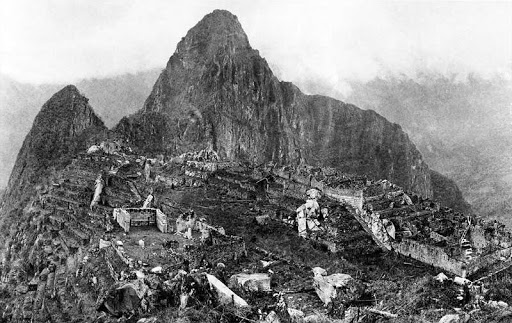
Machu Picchu

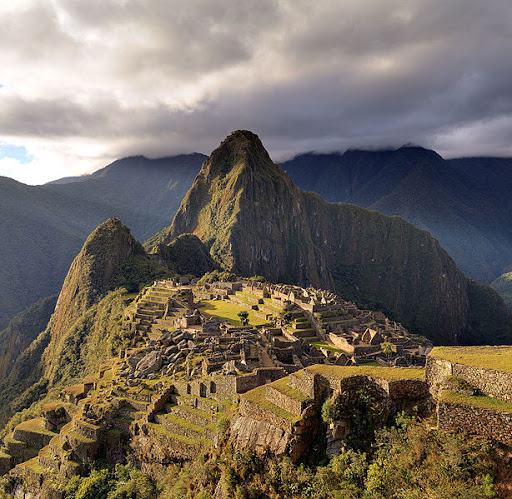
On July 24, 1911, that’s right 100 years ago today, Machu Picchu was found by an American historian, and this weekend many are celebrating the centennial of the “discovery” of the cloud city high in the Andes — one of the most remarkable archeological sites on the planet.

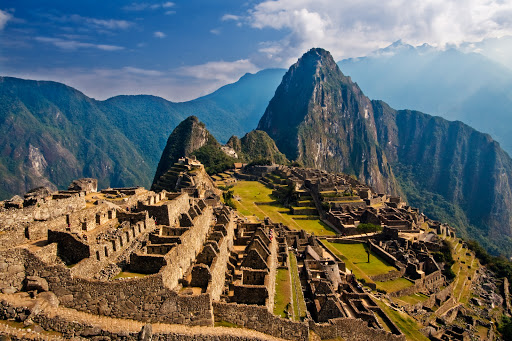
Now, of course, Peruvians say that the city was not discovered a century ago today, because they never lost it. But Americans give credit to Hiram Bingham III, who climbed the Andes and saw the remarkable city, surrounded by holy mountains and filled with houses, terraces and temples that with all our modern skills and machines would be impossible to build today.

Machu Picchu is a pre-Columbian 15th-century Inca site located 7,970 feet above sea level. It is situated on a mountain ridge above the Urubamba Valley in Peru, which is 50 miles northwest of Cusco and through which the Urubamba River flows. Most archaeologists believe that Machu Picchu was built as an estate for the Inca emperor Pachacuti (1438–1472). Often referred to as the “Lost City of the Incas”, it is perhaps the most familiar icon of the Inca World.

The Incas started building the “estate” around AD 1400, but abandoned it as an official site for the Inca rulers a century later at the time of the Spanish Conquest. Although known locally, it was unknown to the outside world before being brought to international attention in 1911 by the American historian Hiram Bingham. Since then, Machu Picchu has become an important tourist attraction. Most of the outlying buildings have been reconstructed in order to give tourists a better idea of what the structures originally looked like. By 1976, thirty percent of Machu Picchu had been restored. The restoration work continues to this day.

Since the site was never known to the Spanish during their conquest, it is highly significant as a relatively intact cultural site. Machu Picchu was declared a Peruvian Historical Sanctuary in 1981 and a UNESCO World Heritage Site in 1983. In 2007, Machu Picchu was voted one of the New Seven Wonders of the World in a worldwide Internet poll.

Machu Picchu was built in the classical Inca style, with polished dry-stone walls. Its three primary buildings are the Intihuatana, the Temple of the Sun, and the Room of the Three Windows. These are located in what is known by archaeologists as the Sacred District of Machu Picchu. In September 2007, Peru and Yale University almost reached an agreement regarding the return of artifacts which Yale has held since Hiram Bingham removed them from Machu Picchu in the early 20th century. In November 2010, a Yale University representative agreed to return the artifacts to a Peruvian university.

And if you want a fun read that centers around this wonderfully historic site (one which I hope to visit one day), you should check out William Maltese’s Beyond Machu.  From the first chapter, Beyond Machu is jam-packed with mystery, adventure and intrigue. Dan Green, travel photographer and investigative reporter extraordinaire, has a chance meeting with the mysterious and sexy Sloane Hendriks that results in Dan leaving his comfortable world and being thrust into an unexpectedly dangerous trip to the ancient Incan city of Machu Picchu. Sloane is a man with a dark past, which could be fatal, but Dan believes Sloane is the ticket to a newspaper story that will expose hidden ruins, illicit archeological finds, and long-lost treasure – if they can stay alive long enough to find it.

Sloane and Dan are captivating characters whose connection to one another only increases as the tension mounts. From the heights of Machu Picchu to the dangers of the South American rain forest, the reader is taken on a chaotic journey that can lead only to death–or riches beyond anyone’s wildest dreams. It’s Indiana Jones meets Allan Quatermain with enough man/man romance to make your toes tingle.