Category Archives: History

The Last Judgment

An Italian art historian claims some of the images depicted in Michelangelo’s “Last Judgment“—the fresco on the wall behind the altar of the Sistine Chapel—were inspired by acts the artist witnessed in homosexual bathhouses. Let’s take a closer look, shall we?

Elena Lazzarini, the author of a new book about the work, explains, “The virile male bodies are inspired by the physiology of laborers engaged in physical exertion, with taut muscles, strenuous exertion and pain etched into the expression on their faces.” (That is the most polite description of man-on-man intercourse we’ve ever heard.) Lazzarini goes on to say that Michelangelo drew inspiration from his fellow gays and the muscular prostitutes who regularly worked in the saunas.

The colossal work, which took the Renaissance master four years to paint and graces the Sistine Chapel in Vatican City, is a depiction of judgment day, with the virtuous being called to heaven and sinners being dragged into hell. The full work was scoured for the queerest images, and boy were some doozies found.

The Gayest Images from Michelangelo's Most Famous Painting
This pile of men headed to heaven is a virtual orgy. Check out the two hunks on the left in a deep embrace, the two blond twinks making out in the center, and the bearded daddies next to them who are about to make out. Yup, this sure looks like heaven.

The Gayest Images from Michelangelo's Most Famous Painting
Here are a bunch of naked guys walking somewhere together and checking out the hot stud just out of view. (It’s hunky Jesus in this case.) Where do you think they’re going? Probably to get more lube.

The Gayest Images from Michelangelo's Most Famous Painting
One guy on his back with his legs in the air is getting reamed with a giant pole by a line of gorgeous muscle studs. Nope, nothing gay happening here.

The Gayest Images from Michelangelo's Most Famous Painting
Speaking of pass-around party bottoms, here is a gentleman bending over in a receptive position with another man’s hand—well, we’ll leave that to your imagination. But the line of boys behind him sure have a good view.

The Gayest Images from Michelangelo's Most Famous Painting
Someone is being dragged to hell by his testicles. This doesn’t look so much like torture, but more like your average Saturday night at a leather bar.

The Gayest Images from Michelangelo's Most Famous Painting
A group of men blowing. Yup, that’s what this is. They’re also showing off some sort of book. We imagine they are the world’s last remaining copies of Honcho magazine. For bonus points, check out the dude who just scored himself a bottom in the lower right quadrant.

The Gayest Images from Michelangelo's Most Famous Painting
Those angels and demons are so mean. They’re obviously breaking up a three-way between these two naked guys and their robed friend. This must be hell, because group sex is definitely allowed in heaven.

image
And one more bonus image to use your imagination on.

The Last Judgment is a fresco by Michelangelo on the altar wall of the Sistine Chapel in Vatican City. It took four years to complete and was executed from 1537 to 1541. Michelangelo began working on it three decades after having finished the ceiling of the chapel.
 

image
The work is massive and spans the entire wall behind the altar of the Sistine Chapel. It is a depiction of the second coming of Christ and the apocalypse. The souls of humans rise and descend to their fates, as judged by Christ surrounded by his saints.

The Last Judgment was an object of a heavy dispute between Cardinal Carafa and Michelangelo: the artist was accused of immorality and intolerable obscenity, having depicted naked figures, with genitals in evidence, inside the most important church of Christianity, so a censorship campaign (known as the “Fig-Leaf Campaign”) was organized by Carafa and Monsignor Sernini (Mantua’s ambassador) to remove the frescoes. When the Pope’s own Master of Ceremonies, Biagio da Cesena, said “it was mostly disgraceful that in so sacred a place there should have been depicted all those nude figures, exposing themselves so shamefully,” and that it was no work for a papal chapel but rather “for the public baths and taverns,” Michelangelo worked Cesena’s face into the scene as Minos, judge of the underworld (far bottom-right corner of the painting) with Donkey ears {i.e.foolishness} while his nudity is covered by a coiled snake. It is said that when Cesena complained to the Pope, the pontiff joked that his jurisdiction did not extend to hell, so the portrait would have to remain.
The genitalia in the fresco were covered 24 years later (when the Council of Trent condemned nudity in religious art) by the artist Daniele da Volterra, whom history remembers by the derogatory nickname “Il Braghettone” (“the breeches-painter”). In the painting, Michelangelo does a self portrait depicting himself as St. Bartholomew after he had been flayed (skinned alive). This is reflective of the feelings of contempt Michelangelo had for being commissioned to paint “The Last Judgement”. The figure of St. Bartholomew depicts the satirist and erotic writer Pietro Aretino who had tried to extort a valuable drawing from Michelangelo. He holds the painter’s flayed skin as a symbol of attempted victimization.

Much of this post was borrowed from Gawker.com and was originally written by Brian Moylan.

After the jump you can see QueerClick.com’s very irreverent take on this masterpiece by Michelangelo.

cistinechapelcistinechapelacistinechapelabcistinechapelabccistinechapelabcdcistinechapelabcdecistinechapelabcdefcistinechapelabcdefg

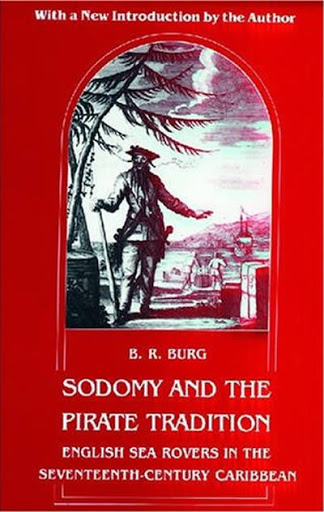
Sodomy and the Pirate Tradition: English Sea Rovers in the Seventeenth Century Caribbean

Pirates are among the most heavily romanticized and fabled characters in history. From Bluebeard to Captain Hook, they have been the subject of countless movies, books, children’s tales, even a world-famous amusement park ride.

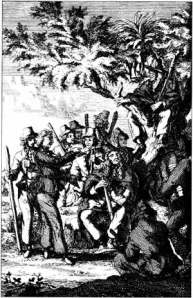
In Sodomy and the Pirate Tradition, historian B. R. Burg investigates the social and sexual world of these sea rovers, a tightly bound brotherhood of men engaged in almost constant warfare. What, he asks, did these men, often on the high seas for years at a time, do for sexual fulfillment? Buccaneer sexuality differed widely from that of other all- male institutions such as prisons, for it existed not within a regimented structure of rule, regulations, and oppressive supervision, but instead operated in a society in which widespread toleration of homosexuality was the norm and conditions encouraged its practice.
In his new introduction, Burg discusses the initial response to the book when it was published in 1983 and how our perspectives on all-male societies have since changed.

You have to love a book that begins, “The England that produced three generations of sodomitical pirates was a land far different from modern Britain or America.” Burg, a professor of history at Arizona State University, wrote Sodomy and the Pirate Tradition in 1983 and updated it in 1995 (it’s now in paperback). It describes how most if not all of the pirates and buccaneers who sailed the Caribbean from 1650 to 1700 had sex with each other. Homosexual behavior was rarely condemned in the West Indies or Great Britain during that century, when most of the pirates were growing up. By the early 1800s, the party was over and sailors were being executed for the crime of loving another man — or at least having sex with him. The first chapters trace the history of the perception of homosexuality in modern English society. For the most part it was tolerated if kept discreet. Sex was sex. Even in the American colonies, sexual crimes were condemned severely in the law but not in practice. Fornication and adultery were usually punished with whippings or fines, even in settlements that had been founded by families. The only person executed for sodomy in the colonies during the middle 17th century was a guy in conservative New Haven who admitted to having sex with two men, encouraging boys to masturbate and, most horrifically, being an agnostic.

Usually when people cried “sodomy” there were other motivations, such as revenge. Live-and-let-live set the stage in England. During the time there were many beggars and vagabonds roaming the countryside in groups of two to six men. Women weren’t accessible (you had to have a job and money to land a wife), so over time homosexual behavior became more frequent among disenfranchised males. Some of them may have been gay; others heterosexual but without a choice of female partners. Eventually the men would end up in a coastal city. There they might be conscripted into the Royal Navy or hired to work on merchant ships. In either case, the journeys would last years at a time, and the Navy wasn’t about to give shore leave to vagrants who might desert in some foreign land. So you’re at sea for four years — hey, things happen. If you’re on a merchant ship sailing anywhere from South America north to Bermuda, you risked being jumped by pirates. Disillusioned, maybe you join them. Like everyone on your ship and back home, the pirates were buggering each other.

Burg contrasts the pirate lifestyle with homosexual acts you find among prison inmates and notes many differences. In prison, men see their homosexuality as temporary — it’s more about power, a way of saying “I’m in charge.” Among the pirates, it more closely expressed their sexualities. Burg documents how many pirates, if they came upon a ship with women aboard, wouldn’t touch them. Not that women weren’t raped by pirates, but usually they were native or black women who were seen as “inferior.” European women had never been approachable when the pirates were coming of age, and they weren’t now either (in one case, a woman was simply tossed overboard with the rest of the loot the pirates didn’t want). The lesson Burg draws from his research is that “aside from the production of children, homosexuals alone can fulfill satisfactorily all human needs, wants and desires, all the while supporting and sustaining a human community remarkable by the very fact that it is unremarkable…. The male engaging in homosexual activity aboard a pirate ship in the West Indies three centuries past was simply an ordinary member of his community, completely socialized and acculturated.” Except for that killing and looting part, sure.


Remember Pearl Harbor

December 7, 1941

image

Pearl Harbor Day marks the anniversary of the Japanese raid on Pearl Harbor in 1941, bringing the United States into World War II and widening the European war to the Pacific.
The bombing, which began at 7:55 a.m. Hawaiian time on a Sunday morning, lasted little more than an hour but devastated the American military base on the island of Oahu in the Hawaiian Islands. Nearly all the ships of the U.S. Pacific Fleet were anchored there side by side, and most were damaged or destroyed; half the bombers at the army’s Hickam Field were destroyed. The battleship USS Arizona sank, and 1,177 sailors and Marines went down with the ship, which became their tomb. In all, the attack claimed more than 3,000 casualties—2,403 killed and 1,178 wounded.

image

On the following day, President Franklin D. Roosevelt addressed a solemn Congress to ask for a declaration of war. His opening unforgettable words: “Yesterday, December 7, 1941—a date which will live in infamy—the United States of America was suddenly and deliberately attacked by naval and air forces of the Empire of Japan.” War was declared immediately with only one opposing vote, that by Rep. Jeannette Rankin of Montana.

In the months that followed, the slogan “Remember Pearl Harbor” swept America, and radio stations repeatedly played the song of the same name with these lyrics:

Let’s remember Pearl Harbor, as we go to meet the foe,
Let’s remember Pearl Harbor, as we did the Alamo.
We will always remember, how they died for liberty,
Let’s remember Pearl Harbor, and go on to victory.

Many states proclaim a Pearl Harbor Remembrance Day, and each year, services are held on December 7 at the Arizona Memorial in Pearl Harbor. The marble memorial, built over the sunken USS Arizona and dedicated in 1962, was designed by architect Albert Preis, a resident of Honolulu who was an Austrian citizen in 1941 and was interned as an enemy alien.
In 1991, on the 50th anniversary of the attack, commemorations were held over several days in Hawaii.

image

The observances began on Dec. 4, designated as Hawaii Remembrance Day. Ceremonies recalled the death of civilians in downtown Pearl Harbor. One of them was Nancy Masako Arakaki, a nine-year-old Japanese-American girl killed when anti-aircraft shells fell on her Japanese-language school.

image

Pearl Harbor

On Dec. 5, Survivors Day, families of those present in Pearl Harbor in 1941 attended ceremonies at the Arizona Memorial. Franklin Van Valkenburgh, the commanding officer of the USS Arizona, was among those remembered; he posthumously won the Medal of Honor for his heroism aboard ship.

image

From Here to Eternity

Dec. 6 was a Day of Reflection, intended to focus on the gains since the war rather than on the losses of the day.

012010 (5)sdfa

On Pearl Harbor Day itself, former President George Bush, who received the Distinguished Flying Cross for heroism as a Navy pilot in the Pacific during World War II, spoke at ceremonies beginning at 7:55 a.m. at the Arizona Memorial. Other dignitaries were all Americans; no foreign representatives were invited, out of political prudence. Other events included a parade, a flyover by jet fighters, an outdoor concert by the Honolulu Symphony presenting the premiere of Pearl Harbor Overture: Time of Remembrance by John Duffy, and a wreath-laying service at the National Memorial Cemetery of the Pacific in the Punchbowl overlooking Honolulu. And finally, at sunset on Pearl Harbor Day, survivors and their families gathered at the Arizona Visitors Center for a final service to honor those who died aboard the battleship in 1941.


Calamus

The “Calamus” poems are a cluster of poems in Leaves of Grass by Walt Whitman. These poems celebrate and promote “the manly love of comrades”. Many critics believe that these poems are Whitman’s clearest expressions in print of his ideas about homosexual love.

Arcadia

This cluster of poems contains a number of images and motifs that are repeated throughout. The most important is probably the Calamus root itself. Acorus calamus or Sweet Flag is a marsh-growing plant similar to a cat-tail. Whitman continues through this one of the central images of Leaves of Grass–Calamus is treated as a larger example of the grass that he writes of elsewhere. Some scholars have pointed out as reasons for Whitman’s choice the phallic shape of what Whitman calls, “pink-tinged roots” of Calamus, its mythological association with failed male same-sex love and with writing (see Kalamos), and the allegedly mind-altering effects of the root. The root was chiefly chewed at the time as a breath-freshener and to relieve stomach complaints.

Swimming

We two boys together clinging,
One the other never leaving,
Up and down the roads going, North and South excursions making,
Power enjoying, elbows stretching, fingers clutching,
Arm’d and fearless, eating, drinking, sleeping, loving.
No law less than ourselves owning, sailing, soldiering, thieving,
      threatening,
Misers, menials, priests alarming, air breathing, water drinking, on
      the turf or the sea-beach dancing,
Cities wrenching, ease scorning, statutes mocking, feebleness chasing,
Fulfilling our foray.

The-Wrestlers

The images in this post are paintings by Thomas Eakins.  Thomas Cowperthwait Eakins (July 25, 1844 – June 25, 1916) was a realist painter, photographer, sculptor, and fine arts educator. He is widely acknowledged to be one of the most important artists in American art history.

For the length of his professional career, from the early 1870s until his health began to fail some forty years later, Eakins worked exactingly from life, choosing as his subject the people of his hometown of Philadelphia. He painted several hundred portraits, usually of friends, family members, or prominent people in the arts, sciences, medicine, and clergy. Taken en masse, the portraits offer an overview of the intellectual life of Philadelphia in the late 19th and early 20th centuries; individually, they are incisive depictions of thinking persons. As well, Eakins produced a number of large paintings which brought the portrait out of the drawing room and into the offices, streets, parks, rivers, arenas, and surgical amphitheaters of his city. These active outdoor venues allowed him to paint the subject which most inspired him: the nude or lightly clad figure in motion. In the process he could model the forms of the body in full sunlight, and create images of deep space utilizing his studies in perspective.


Gay Pilgrims

PLYMOUTH – In the summer of 1637, two working men at the English colony at Plymouth faced the possibility of execution, convicted of what the law books said was a grave moral crime.

gaypilgrimsGay Pilgrims would have never looked this happy.

John Alexander and Thomas Roberts had been caught in a homosexual relationship.

Court records from their case, and from a handful of others, are the only keyhole through which researchers at the Plimoth Plantation museum can peek backward through time to imagine the lives of the colony’s gays and lesbians.

On this date in 1637, John Alexander and Thomas Roberts were changed with and convicted of “lude behavior and unclean carriage one with another, by often spending their seed one upon another, which was proved both by witness and their own confession; the said Alexander found to have been formerly notoriously guilty that way, and seeking to allure others thereunto.”

John Alexander was sentenced to a severe whipping, then to be burned in the shoulder with a hot iron, and then to be permanently banished from the Colony.

Roberts was sentenced to a severe whipping, but was not banished. He was prohibited from ever owning any land within the Plymouth Colony “except he manifest better desert.” He was returned to his master and forbidden to hold any lands in the future.

Sodomy, usually homosexuality, was considered a capital offence but rarely punished as such. These punishments, while harsh, still lacked the full force of the law.

At the Out at Plimoth Plantation event, the living museum of Colonial and Native American history presents special programs on gay history of the 17th and 18th centuries in early American culture.

“Plimoth Plantation as a museum has always been a place that has tried to recover every life,’’ said Richard Pickering, the museum’s deputy director. Pickering quoted the poet and author Paul Monette, who wrote that most of gay history “lies in shallow bachelors’ graves.’’

“We’re telling the audience that we’re going to talk about all those uncles and all those aunts who have fallen off the family tree,’’ said Pickering. “Their stories may be lost, so let’s contemplate those lost lives.’’ Though the historical record is sparse, “we can get a sense of what the options of the past were,’’ and provide some sense of history to a modern gay community “that really doesn’t have a strong sense of its past much before 1960.’’

Back in the 1600s, homosexuality was thought to be a behavior that could be learned due to a lack of “proper’’ examples of traditional relationships, said Pickering. Being gay or lesbian at the time was not a sexual identity as we think of it today. Gays and lesbians “did not have the opportunity to pursue the kind of lives and identities that modern social structures allow,’’ he said.

Yet the prosecution of Alexander and Roberts for homosexual conduct reveals layers of complexities in Colonial life, despite the scant court records. Though the maximum penalty was death, neither man was executed.

Alexander, who was perceived as the seducer and therefore was considered more responsible, was branded with a hot iron and banished from the colony, said Pickering.

Roberts was allowed to stay, though the court forbade him from owning land or participating in the political process, Pickering said.

“At first glance you would think that 17th-century New Englanders would be very harsh,’’ said Pickering. But both men were spared execution, and in time Roberts was allowed to own land and to vote. “Even though there are statutes, in the enactment of the law they are much more gentle.’’ It may have been that the colony needed every pair of hands and couldn’t afford to lose both workers, or that in a tiny community of a few hundred, the judges would have known the defendants personally and were reluctant to send neighbors to their deaths.

Plimoth Plantation began researching the gay history of the colony about 10 years ago, in preparation for bringing its replica of the Pilgrim ship Mayflower to gay-friendly Provincetown.

The role players at Plimoth Plantation wear period costumes and never come out of character while they’re on the job. In a recent interview, for example, Pickering had to leave the “village’’ for a private room to speak as a modern man. In that spirit of authenticity, the museum researched gay Colonial history to educate its staff in case one of the role players got a question about same-sex relationships while in Provincetown.

The museum last year presented that research to visitors at its first Out at Plimoth Plantation, a conscious effort to reach out to the gay community. “For a while the museum just assumed it was known that everyone was welcome here,’’ said spokeswoman Jennifer Monac. “History is everybody’s story. We realize we need to make it relevant for everybody.

“We wanted to create a day where same-sex couples could attend like any other family and not have to worry if they hold hands or show affection,’’ she said.

The museum’s website is www.plimoth.org.


Homosexual Poetry from the Three Kingdoms and Six Dynasties Period

image The complexity of homosexual relationships inevitably led to the creation of poetic works immortalizing conflicting sentiments. Ruan Ji (210- 263CE), lover of Xi Kang, was one of the most famous poets to apply his brush to a homosexual theme. This work, one of several dealing with homosexuality from the “Jade Terrace” collection of love poetry, beautifully illustrates the stock imagery on which men of his time could draw in conceptualizing and describing love for another man.

In days of old there were many blossom boys —
An Ling and Long Yang.
Young peach and plum blossoms,
Dazzling with glorious brightness.
Joyful as nine springtimes;
Pliant as if bowed by autumn frost.

Roving glances gave rise to beautiful seductions;
Speech and laughter expelled fragrance.
Hand in hand they shared love’s rapture,
Sharing coverlets and bedclothes.

Couples of birds in flight,
Paired wings soaring.
Cinnabar and green pigments record a vow:
“I’ll never forget you for all eternity. ”


‘Mama Wu’ unlikely hero for homosexuals in China

Wu Youjian, right, chats with another parent of gay child at a recent event at Shanghai Pride, a month-long celebration of gay culture in China's largest city.

Wu Youjian, right, chats with another parent of gay child at a recent event at Shanghai Pride, a month-long celebration of gay culture in China’s largest city.
STORY HIGHLIGHTS

  • ‘Mama Wu’ has earned fame by publicly defending her homosexual son
  • Homosexuals face deep cultural prejudices and pressure to marry
  • About 30 percent of Chinese homosexuals have attempted suicide
  • Although not illegal, homosexual venues regularly shut down in China

Beijing, China (CNN) — When Wu Youjian’s teenage son told her on a spring night in 1999 that he was gay, Wu did something rarely heard of in China.
“I told him, there’s nothing wrong with liking boys and it’s no big deal,” said the 63-year-old retired magazine editor.
Five years later, when her son discussed his sexuality on local television in the southern metropolis of Guangzhou, Wu made another groundbreaking decision. She became what state media calls the first Chinese parent to go on television in support of her gay child.
Zheng Yuantao, 30, knows how lucky he is to have such a mother.
“Many of my gay friends are afraid of going home during holidays, because their parents would ask about girlfriends and press them to get married,” he said.
“I grew up in a very open-minded family,” he added. “I didn’t have too much of a struggle about my sexuality.”
Wu now devotes her time and energy to speaking up for gay acceptance by family and society. Her small frame belies her big role in China’s gay community, where she is affectionately called “Mama Wu.”
She taught herself to use a computer three years ago and now writes a blog that has clocked more than 2.2 million hits. She also tweets frequently, has launched a hotline and founded the country’s first PFLAG – Parents, Families and Friends of Lesbians and Gays – group in her hometown.

“I just followed my instinct and my love for my son,” Wu said.
For other Chinese parents in her situation, however, instinct usually means a deep sense of shame. Many refuse to face the reality and some sever ties with their gay children. Others scheme to break up their children’s relationships. Some may insist on psychiatric treatments, while others may threaten to commit suicide if their children don’t change.
‘Mama Wu’ inspires other Chinese parents of gay children
“In China, we consider carrying on the family line of paramount importance, but we don’t value the happiness of individuals,” said Li Yinhe, a sociologist with the Chinese Academy of Social Sciences.
Societal pressure cooker
Suicide is high among Chinese homosexuals, Li said, with some surveys saying as many as 30 percent of gay youth attempt to take their lives. That trend mirrors the United States, where a spate of suicides by gay adolescents in recent months has shaken the nation.
Most gay men in China still succumb to social pressure and marry women. It once meant heterosexual marriages, often with children, Li said. Now, gay community activists say a small but growing number of young gay men in big cities are tying the knot with lesbians to both placate families and maintain their lifestyles.
Li conducted China’s first comprehensive surveys on gay men. She published her findings in a 1992 book, which Wu credited for shaping her views on homosexuality.
While society at large has loosened up on homosexuality, Li said, family pressure on gay people remains strong because of deep-rooted Confucian ideas and the government’s one-child policy – making Wu’s words and actions all the more powerful.
“No one would listen to an outsider, but she is not – she is a mother whose only son is gay,” Li said. “Others would wonder, if she can handle it so well, why can’t I.”
It’s not all accolades for Wu, however. Vitriolic attacks often dog her online. On a popular video-sharing site, under a clip paying tribute to her achievements, a recent comment accused her of “leading our youth to a place filthier than a brothel” and “hastening the moral death of our already-sick society.”
Wu brushes such verbal assaults aside. Her son, often a target himself along with Wu, understands why.
“It’s not about how many people she can change,” Zheng said. “The important thing is that she is out there helping real people every day.”
Gay venues shut down
Homosexuality is not illegal in China, and in 2001 it was also removed from the country’s list of officially recognized mental disorders. But it remains largely a taboo topic on state-run media.

China mom becomes advocate for gay son
No one would listen to an outsider, but she is not – she is a mother whose only son is gay –Li Yinhe, Chinese Academy of Social Sciences
RELATED TOPICS

Police sometimes shut down gay venues when high profile events are held. Gay rights advocates reported raids on gay clubs, saunas and cruising spots ahead of the Summer Olympics and the annual parliament sessions in Beijing in the past.
Officials have also pulled the plug – often at the last minute – on gay-themed events, including the country’s first gay pageant last January.
Li, the sociologist who also serves as a government adviser, has tried to cement gay rights in Chinese law. She submitted proposals to legalize same-sex marriage in 2003, 2005 and 2006. None have succeeded so far – and she admits her goal probably won’t be realized anytime soon.
“Gays are minorities in society,” she said. “People just don’t think this issue is important enough, compared to national priorities like economic development.”
Wu stresses the social and non-political nature of her activities, highlighting official approval and state media reports in her speeches. Her group also joins the effort in HIV/AIDS prevention, a gay-related cause promoted by the government.
She has picked up pace in spreading the message of acceptance, giving lectures and hosting seminars across the nation.
At a recent PFLAG gathering in Beijing, Wu, sporting a rainbow scarf and speaking in a calm but firm tone, addressed a packed hotel conference room of about 100 people, with her son and his boyfriend in attendance.
Her voice cracked, however, when she mentioned how parental intransigence drove a married young gay man, who had sought her help, to take his life.
“We have to give them hope,” Wu said, quoting iconic gay American politician Harvey Milk.
Wu says she constantly reminds other parents about one basic fact.
“It doesn’t matter if our children are gay or straight – just like it doesn’t matter if they are left-handed or right-handed,” she said. “They are always our children.”
Thousands of blog posts and phone calls later, Wu has compiled her stories in a new book – titled “Love Is the Most Beautiful Rainbow” – and vows to continue her effort.
“I have only one child, but so many call me Mama,” she said.
 
This article was originally written and published by Steven Jiang, CNN on November 16, 2010 1:36 p.m. EST


Veterans Day

image

John McCrae: In Flanders Fields (1915)


image Canadian poet John McCrae was a medical officer in both the Boer War and World War I. A year into the latter war he published in Punch magazine, on December 8, 1915, the sole work by which he would be remembered. This poem commemorates the deaths of thousands of young men who died in Flanders during the grueling battles there. It created a great sensation, and was used widely as a recruiting tool, inspiring other young men to join the Army. Legend has it that he was inspired by seeing the blood-red poppies blooming in the fields where many friends had died. In 1918 McCrae died at the age of 46, in the way most men died during that war, not from a bullet or bomb, but from disease: pneumonia, in his case.


In Flanders fields the poppies blow
Between the crosses, row on rowimage
That mark our place; and in the sky
The larks, still bravely singing, fly


Scarce heard amid the guns below.
We are the Dead. Short days ago
We lived, felt dawn, saw sunset glow,
Loved and were loved, and now we lie
In Flanders fields.


Take up our quarrel with the foe:
To you from failing hands we throw
The torch; be yours to hold it high.
If ye break faith with us who die
We shall not sleep, though poppies grow
In Flanders fields.


Veterans Day is an annual United States holiday honoring military veterans. A federal holiday, it is observed on November 11. It is also celebrated as Armistice Day or Remembrance Day in other parts of the world, falling on November 11, the anniversary of the signing of the Armistice that ended World War I. (Major hostilities of World War I were formally ended at the 11th hour of the 11th day of the 11th month of 1918 with the German signing of the Armistice.)

WWI-military-13123
Especially, please remember all of the gay and lesbian service men and women who have served and too often died in silence about their sexuality, yet served their country with as much élan as any other soldier.  Hopefully soon, GLBT members of the military can serve openly and we can celebrate their service to the fullest extent of their deserved equality.  We need to rid America of DADT.

photo_35549740
Happy Veterans Day!
image

The Flapper

“Hip flasks of hooch, jazz, speakeasies, bobbed hair, ‘the lost generation.’ The Twenties are endlessly fascinating. It was the first truly modern decade and, for better or worse, it created the model for society that all the world follows today.” (from Kevin Rayburn, “Two Views of the 1920s.”)

image The Jazz Age and the Flapper was the western world’s response to the horrors of World War I. Today is Veteran’s Day (there will be a special post coming up later about Veteran’s Day).  Veteran’s Day began originally as Armistice Day, a day to celebrate the end of hostilities during the Great War, 1914-1918.

So what, beside the thought of hot soldiers in uniform, does the Veteran’s Day have to do with a gay blog?  First of all, as a result of the war, came the Jazz Age, and with the Jazz Age came the Flapper.  “Flapper” in the 1920s was a term applied to a “new breed” of young Western women who wore short skirts, bobbed their hair, listened to jazz, and flaunted their disdain for what was then considered acceptable behavior. Flappers were seen as brash for wearing excessive makeup, drinking, treating sex in a casual manner, smoking, driving automobiles and otherwise flouting social and sexual norms.

image Flappers did not truly emerge until 1926.  Flapper fashion embraced all things and styles modern.  A fashionable flapper had short sleek hair, a shorter than average shapeless shift dress, a chest as flat as a board, wore make up and applied it in public, smoked with a long cigarette holder, exposed her limbs and epitomized the spirit of a reckless rebel who danced the nights away in the Jazz Age.  The French called the flapper fashion style the ‘garçonne’. ‘Garçonne’ in French, by the way, means boy. More on that later.

When the Great War was over, the survivors went home and the world tried to return to normalcy. Unfortunately, settling down in peacetime proved more difficult than expected. During the war, the boys had fought against both the enemy and death in far away lands; the girls had bought into the patriotic fervor and aggressively entered the workforce. During the war, both the boys and the girls of this generation had broken out of society’s structure; they found it very difficult to return.

They found themselves expected to settle down into the humdrum routine of American life as if nothing had happened, to accept the moral dicta of elders who seemed to them still to be living in a Pollyanna land of rosy ideals which the war had killed for them. They couldn’t do it, and they very disrespectfully said so (Frederick Lewis Allen, Only Yesterday: An Informal History of the Nineteen-Twenties (New York: Harper & Brothers Publishers, 1931).

image Women were just as anxious as the men to avoid returning to society’s rules and roles after the war. In the age of the Gibson Girl, young women did not date, they waited until a proper young man formally paid her interest with suitable intentions (i.e. marriage). However, nearly a whole generation of young men had died in the war, leaving nearly a whole generation of young women without possible suitors. Young women decided that they were not willing to waste away their young lives waiting idly for spinsterhood; they were going to enjoy life. The “Younger Generation” was breaking away from the old set of values.

The term “flapper” first appeared in Great Britain after World War I. It was there used to describe young girls, still somewhat awkward in movement who had not yet entered womanhood. In the June 1922 edition of the Atlantic Monthly, G. Stanley Hall described looking in a dictionary to discover what the evasive term “flapper” meant:

[T]he dictionary set me right by defining the word as a fledgling, yet in the nest, and vainly attempting to fly while its wings have only pinfeathers; and I recognized that the genius of ‘slanguage’ had made the squab the symbol of budding girlhood.

Authors such as F. Scott Fitzgerald and artists such as John Held Jr. first used the term to the U.S., half reflecting and half creating the image and style of the flapper. Fitzgerald described the ideal flapper as “lovely, expensive, and about nineteen.”

The Flappers’ image consisted of drastic – to some, shocking – changes in women’s clothing and hair. Nearly every article of clothing was trimmed down and lightened in order to make movement easier.

It is said that girls “parked” their corsets when they were to go dancing. The new, energetic dances of the Jazz Age, required women to be able to move freely, something the “ironsides” didn’t allow. Replacing the pantaloons and corsets were underwear called “step-ins.”

Abds-100301 The outer clothing of flappers is even still extremely identifiable. This look, called “garconne” (“little boy”), was instigated by Coco Chanel. To look more like a boy, women tightly wound their chest with strips of cloth in order to flatten it. The waists of flapper clothes were dropped to the hipline. She wore stockings – made of rayon (“artificial silk”) starting in 1923 – which the flapper often wore rolled over a garter belt. Flappers worked hard to look more boyish.  The men they were trying to attract during the 1920s were men who had spent years alongside other men in the trenches of the First World War. These men were more comfortable with other men, so women chose to be more like men than the womanly figure of proper society.

Too bad more gay men could not legally be out and proud during the Roaring Twenties, we can look a lot more like hot young men than a bunch of flat-chested women who called themselves Flappers.


October Is GLBT History Month: Finally

Eleanor Roosevelt
First Lady
b.  October 11, 1884
d.  November 7, 1962
“No one can make you feel inferior without your consent.”
image Eleanor Roosevelt transformed the role of First Lady. She served as a diplomat and was a tireless champion of international human rights.
Roosevelt was born into a wealthy family in New York City. Both her parents died before she was 10; thereafter, she moved in with her grandmother in upstate New York. At the age of 15, she lived in England, where she learned to speak French and Italian fluently.
Soon after her return to New York, Roosevelt met her future husband, Franklin Delano Roosevelt, her father’s fifth cousin. Franklin was attending Columbia Law School. The couple married and had six children, five of whom survived infancy. Franklin took his first leap into politics, winning a seat in the New York State Senate. The family moved to Washington, D.C., when he was appointed Assistant Secretary of the Navy by President Wilson.
Life in the nation’s capital kindled Eleanor’s interests in policy making.  She joined the board of the League of Women Voters in 1924 and became involved in Democratic Party politics. In 1928, after her husband was elected governor of New York, she became actively engaged in domestic and international issues. She wrote a syndicated newspaper column titled “My Day.”
In 1933, Roosevelt became First Lady of the United States, a position she held for 12 years. While she assumed traditional duties, she did not allow them to compromise her ideals. In 1939, she announced in her column that she would resign her membership in the Daughters of the American Revolution, after the group refused to allow Marian Anderson, a black singer, to perform in Washington’s Constitution Hall. “The basic fact of segregation,” Roosevelt wrote, “is itself discriminatory.”
While First Lady, Roosevelt developed an intimate relationship with Lorena Hickock, a journalist who covered the White House. The relationship lasted for the rest of Roosevelt’s life.
Eleanor Roosevelt’s commitment to public service continued after her husband’s death in 1945. President Truman named her a delegate to the United Nations, where she was elected chairwoman of the Commission on Human Rights. In that position, she helped draft the influential Universal Declaration on Human Rights. 
Roosevelt was a member of the Board of Trustees of Brandeis University and delivered the school’s first commencement address. She also authored several children’s books. In her lifetime, she received many civic awards and honorary degrees.
Jalal al-Din Rumi
Sufi Mystic/Poet
b. September 30, 1207
d. December 17, 1273
“Only from the heart can you touch the sky.”
image Jalal al-Din Rumi was a poet, theologian and Sufi mystic. He founded the Order of the Whirling Dervishes, a branch of the Sufi tradition that practicies a gyrating dance ritual representing the revolving stages of life.
Rumi was born in the Persian province of Balkh, now part of Afghanistan. Rumi’s father was an author, a religious scholar and a leader in the Sufi movement—the mystical dimension of Islam.
When Rumi was 12, his father moved the family to escape the impending invasion of Mongol armies, eventually setting in Konya, Anatolia, the westernmost tip of Asia where Turkey is today.
In 1231, after his father died, Rumi began teaching, meditating and helping the poor. He amassed hundreds of disciples who attended his lectures and sermons.
Rumi was married and had one son. After his wife’s death, he remarried and fathered two more children. In 1244, Rumi met a man who changed his life. Shams of Tabriz was an older Sufi master who became Rumi’s spiritual mentor and constant companion. After Shams died, Rumi grieved for years. He began expressing his love and bereavement in poetry, music and dance.
Rumi had two other male companions, but none would replace his beloved Shams. One of Rumi’s major poetic works is named in honor of his master, “The Works of Shams of Tabriz.” Rumi’s best-known work is “Spiritual Couplets,” a six-volume poem often referred to as the greatest work of mystical poetry.
In “Rumi: The Book of Love Poems of Ecstasy and Longing” (2003), Rumi expresses his perception of true love. “Lovers don’t finally meet somewhere. They’re in each other all along.”
Rumi died surrounded by his family and disciples. His tomb is one of the most revered pilgrimage sites in Islam and is a spiritual center of Turkey.
David Sedaris
Writer/Humorist
b. December 26, 1956
“A good short story would take me out of myself and then stuff me back in, outsized, now, and uneasy with the fit.”
image David Sedaris is an award-winning best-selling author whose short stories depict, variously, the life of a young gay man in 20th century America, the experience of an American living abroad and the comedy of family life.
Sedaris, who was one of six children, was born in Binghamton, New York, and grew up in Raleigh, North Carolina. In 1983, he graduated from the School of the Art Institute of Chicago. He began writing and supported himself with odd jobs in Raleigh, in Chicago and eventually in New York. His big break came on National Public Radio, where he read his short stories.
Called the “preeminent humorist of his generation” by Entertainment Weekly, Sedaris is the author of numerous collections: “Barrel Fever” (1994), “Naked” (1997), “Holidays on Ice” (1997), “Me Talk Pretty One Day” (2000), “Dress Your Family in Corduroy and Denim” (2004) and “When You are Engulfed in Flames” (2008), which was number one on the New York Times best-seller list. He edited a 2005 collection of stories called “Children Playing Before a Statue of Hercules,” the proceeds from which benefit a nonprofit writing and tutorial center.
Sedaris is known for his distinctive style, combining elements of memoir, humor and the traditional short story. He is clear that his stories are embellished. “I’m a humorist,” he says. “I’m not a reporter.”
Sedaris is a frequent contributor to the award-winning “This American Life” public radio show. Along with his sister Amy, he is the author of numerous plays written under the name “The Talent Family.” He has been nominated for two Grammy Awards and was named Time magazine’s Humorist of the Year in 2001. In 2008, he delivered the commencement speech at Binghamton University and was awarded an honorary doctorate. 
Sedaris lives in London, Paris and Normandy with his longtime partner, Hugh Hamrick. 
Matthew Shepard
Hero      
b.  December 1, 1976
d.  October 12, 1998
“Every American child deserves the strongest protections from some of the country’s most horrifying crimes.” – Judy Shepard
image As a gay college student, Matthew Shepard was the victim of a deadly hate crime. His murder brought national and international attention to the need for GLBT-inclusive hate crimes legislation.
Shepard was born in Casper, Wyoming, to Judy and Dennis Shepard. He was the older of two sons. Matthew completed high school at The American School in Switzerland. In 1998, he enrolled at the University of Wyoming in Laramie. Soon afterward, he joined the campus gay alliance.
On October 6, 1998, two men—Aaron McKinney and Russell Henderson—lured Shepard from a downtown Laramie bar. After Shepard acknowledged that he was gay, McKinney and Henderson beat and tortured him, then tied him to a tree in a remote, rural area and left him for dead. Eighteen hours later, a biker, who thought he saw a scarecrow, found Shepard barely breathing.
Shepard was rushed to the hospital, but never regained consciousness. He died on October 12. Both of Shepard’s killers were convicted of felony murder and are serving two consecutive life sentences.
Despite the outcome of the trial, the men who took Shepard’s life were not charged with a hate crime. Wyoming has no hate crimes law, which protects victims of crimes motivated by bias against a protected class. Shepard’s high-profile murder case sparked protests, vigils and calls for federal hate crimes legislation for GLBT victims of violence.
Shortly after their son’s death, Judy and Dennis Shepard founded The Matthew Shepard Foundation to honor his memory and to “replace hate with understanding, compassion, and acceptance.” Judy Shepard became a GLBT activist and the most recognized voice in the fight for a federal hate crimes bill.
In 2009, more than a decade after Shepard’s murder, The Matthew Shepard and James Byrd Jr. Hate Crimes Prevention Act (HCPA) was signed into law. HCPA added sexual orientation and gender identity to the list of protected classes, giving the United States Department of Justice the power to investigate and prosecute bias-motivated violent crimes against GLBT victims.
Dozens of songs have been written and recorded to honor Matthew Shepard’s legacy.  Several films, television movies and plays about him have been produced, including “The Laramie Project” (2002) and “The Matthew Shepard Story” (2002).
Jóhanna Sigurðardóttir
Prime Minister of Iceland
b. October 4, 1942
“Egalitarian policies are the best way to unite and empower people.”
image Jóhanna Sigurðardóttir is the first female prime minister of Iceland and the world’s first openly GLBT national leader.
Sigurðardóttir was born in Reykjavik, where she received the equivalent of a high school diploma from the Commercial College of Iceland. Her first job was as a flight attendant for what is now Icelandair. After six years in that position, she became a union organizer with the airline—a move that served as her entree into Icelandic politics.
Sigurðardóttir was elected to Iceland’s Parliament in 1978. Viewed as a rising star, she was named minister of social affairs in 1987. In 1990, she ran for the top spot in her party, the Social Democrat Alliance. She narrowly lost that race, declaring, “My time will come,” which has become a common catchphrase in Iceland.
In January of 2009, following the collapse of the nation’s economy in the worldwide recession, Iceland’s president asked the Social Democrat Alliance to form a new government, which elevated Sigurðardóttir to the office of the prime minister. At the time of her appointment, she was the longest-serving member of Iceland’s Parliament.
Four months later, Sigurðardóttir’s party, along with its coalition partner, won a majority of seats in the Parliament, handing her a strong mandate to lead Iceland’s economic revitalization efforts and to work toward joining the European Union. While focusing on these important tasks, Sigurðardóttir has not forgotten the value of equity in politics. “A society that does not use the intellectual power of its female population fully is not a wise society,” she says.
Sigurðardóttir was married to a man prior to coming out. She and her ex-husband are the parents of two adult children. On June 11, 2010, by a vote of 49 to 0, Iceland’s Parliament approved same-sex marriage. On June 26, 2010, the first day that legislation became effective, Jóhanna Sigurðardóttir and Jónína Leósdóttir were married. 
Pyotr Ilyich Tchaikovsky
Composer 
b. May 7, 1840
d. November 6, 1893
“Music’s triumphant power lies in the fact that it reveals to us beauties we find in no other sphere.”
image Pyotr Ilyich Tchaikovsky is one of the most popular composers in history. His best-known works include the ballets “Swan Lake,” “The Sleeping Beauty,” and “The Nutcracker”;  the operas “The Queen of Spades” and “Eugene Onegin”; and the widely recognized Fantasy Overture “Romeo and Juliet” and “1812 Overture.”
Tchaikovsky was born in Votinsk, Russia, a small industrial town. His father was a mine inspector. His mother, who was of French and Russian heritage, strongly influenced his education and cultural upbringing.
At age 5, Tchaikovsky began piano lessons. His parents nurtured his musical talents, but had a different career path in mind for their son. In 1850, the family enrolled him at the Imperial School of Jurisprudence in St. Petersburg, where he prepared for a job in civil service.
After working in government for a few years, Tchaikovsky pursued his passion at the St. Petersburg Conservatory. After graduation, he taught music theory at the Moscow Conservatory and worked on new compositions. Tchaikovsky created concertos, symphonies, ballets, chamber music, and concert and theatrical pieces. His passionate, emotional compositions represented a departure from traditional Russian music, and his work became popular with Western audiences.
Despite his career success, Tchaikovsky’s personal life was filled with crises and bouts of depression. After receiving letters of admiration from a former student, Tchaikovsky married her. Historians speculate the marriage took place to dispel rumors that Tchaikovsky was gay. The marriage was a disaster and Tchaikovsky left his wife after nine days.
Tchaikovsky began an unconventional relationship with a wealthy widow, Nadezhda von Mek, who agreed to be his benefactor on one condition: they were never to meet face to face. The couple exchanged more than 1,000 letters, until von Mek abruptly ended their 13-year liaison.
The famed composer died suddenly at age 53. The cause of his death, believed by some to be suicide, remains a mystery.
Rufus Wainwright
Singer/Songwriter
b. July 22, 1973
“It’s important for famous people to be an example for gay teens.”
image Known for his unique style and daring artistic endeavors, Rufus Wainwright is one of the most accomplished singer/songwriters of his generation. He has produced six albums and is the recipient of two Juno Awards and five GLAAD Media Awards.
Wainwright’s musical talent was shaped by his folksinger parents, Kate McGarrigle and Loudon Wainwright III. He was born in Rhinebeck, New York, and holds dual United States and Canadian citizenship. After his parents divorced, he spent most of his youth with his mother in Montreal.
At age 14, Wainwright broke into the entertainment world with a song he composed and sang in the film “Tommy Tricker and the Stamp Traveller,” earning him a Juno Award nomination for “Most Promising Male Vocalist of the Year.” That same year, he was sexually assaulted by a man he met at a bar. Deeply disturbed by the attack, he remained celibate for seven years.
In 1998, following the release of his first album, Wainwright was named “Best New Artist” by Rolling Stone. He composes music for theater, dance and opera, and has contributed to numerous film soundtracks, including “Moulin Rouge” and “Brokeback Mountain.” Additionally, he has acted in “The Aviator” and “Heights,” among other films.
As a collaborator, Wainwright has worked on albums with music greats Rosanne Cash and Elton John. John hailed him as “the greatest songwriter on the planet.” His first opera, “Prima Donna,” premiered in 2009 at the Manchester International Festival and was the subject of a documentary film that premiered on Bravo! in 2010.
Despite fame and success, Wainwright struggled with crystal meth addiction, a habit he eventually recovered from in 2002. With two decades of performing under his belt, Wainwright assures his fans that he won’t be retiring any time soon: “I am a self-sustaining, vibrant, long-term artist, and I’m not going away!” 
Mel White
Minister/Activist
b. July 26, 1940
“I’m perfectly happy going on TV now and saying I’m a gay man. I’m happy and proud to say that.”
image Mel White is an ordained minister who left his career as an adviser to prominent Christian evangelists when he came out during the mid 1990’s. White has dedicated his life to gaining acceptance for GLBT Christians.
In 1962, White graduated from Warner Pacific College. He received a master’s degree in communications from the University of Portland and a Doctorate of Ministry from Fuller Theological Seminary in Pasadena, California, where he was also a professor.
Early in his career, White served as a speechwriter for evangelical leaders Jerry Falwell and Pat Robertson. He married a woman with whom he had one son. When he realized he was attracted to men, he tried to “cure” his homosexuality with therapy and exorcism.  Acknowledging that nothing could alter his sexual orientation, White attempted suicide.
White ultimately accepted his sexuality and amicably divorced his wife. In 1993, he publicly acknowledged that he was gay when he was named dean of the Dallas Cathedral of Hope of the Universal Fellowship at Metropolitan Community Churches. Two years later, he published “Stranger at the Gate,” a book that chronicles his struggles as a gay Christian.
In the early 1990’s, White shifted his focus to GLBT advocacy, both within and outside of the church. In 1996, White led a two-week fast on the steps of Congress as the Senate considered and ultimately passed the Defense of Marriage Act. He moved the fast to the White House, where he was arrested. “How can we stand by in silent acceptance while the president and the Congress sacrifice lesbian and gay Americans for some ‘greater political good’?” he asked.
In 1998, White and his partner of more than 25 years, Gary Nixon, founded Soulforce, an organization whose mission is to “seek freedom from religious and political oppression” for GLBT people. Its name comes from “satyagraha,” a term meaning “soul force” used by Gandhi in to describe his civil rights struggle.
White is the author of nearly 20 books, including “Religion Gone Bad: Hidden Dangers from the Christian Right” (2009). His story is featured in “Friends of God” (2007), a documentary film about evangelical Christians.
In 2008, White and Nixon were legally married in California. In 2009, White and his son, Mike, were a team on the 14th season of “The Amazing Race.”
Emanuel Xavier
Poet   
b. May 3, 1971  
“Being Latino and gay gives me much to write about. Anything that oppresses us as artists is always great fodder for art.”
image Emanuel Xavier is a poet, author and editor. He is one of the most significant openly gay Latino spoken word artists of his generation. 
Xavier was born in Brooklyn, New York, the child of an Ecuadorian mother and a Puerto Rican father who abandoned the family before his son was born. When Xavier was three, he was sexually abused by a family member. At 16, when Xavier came out to his mother, she threw him out of the house.
A homeless gay teen on the streets of New York, Xavier soon turned to sex and drugs for money. He became a hustler at the West Side Highway piers and sold drugs in gay clubs. After landing a job at a gay bookstore, A Different Light, Xavier began to write poetry and perform as a spoken word artist.
“Pier Queen” (1997), Xavier’s self-published poetry collection, established him in the New York underground arts scene. “Christ Like” (1999), Xavier’s novel, was the first coming of age story by a gay Nuyorican (Puerto Rican living in New York) and earned him a Lambda Literary Award nomination. Fellow author Jaime Manrique said, “Once in a generation, a new voice emerges that makes us see the world in a dazzling new light. Emanuel Xavier is that kind of writer.”
“Americano” (2002), another poetry collection and Xavier’s first official published work, advanced his prominence within the literary community of color. Xavier edited “Bullets & Butterflies: Queer Spoken Word Poetry” (2005), for which he received a second Lambda Literary Award nomination. 
In 2005, Xavier was the victim of a random attack by a group of young men. As a result of the beating, he lost all hearing in his right ear, but continued to write and perform.
Xavier reflects on the assault in his poem “Passage”:

Had they known I was gay they would have killed me
None of my poems about peace and unity
would have kept me whole

Also an activist, Xavier focuses his work on homeless gay youth. He has organized benefits for many organizations, including The New York Pier AIDS Education Coalition, Live Out Loud, and Sylvia’s Place, a shelter for homeless GLBTQ youth.
Xavier has appeared on HBO’s “Russell Simmons Presents Def Poetry” and “In the Life” on PBS. In 2010, his CD “Legendary—The Spoken Word Poetry of Emanuel Xavier” was released to critical acclaim.