
Category Archives: History

A History of Gay Sex

What sorts of things did gay men get up to in the past, and how much did these differ from what we get up to today? Does gay sex have a history, or do the forms of pleasure remain the same across centuries? Have some tastes declined, and new tastes arisen?

Some things, like cruising and cottaging, have been popular for centuries. Public latrines and baths or “stews” were good pick-up spots in the late Middle Ages. Dutch gay men in the early 18th century coined the word “kruisen”, and their favourite cruising grounds were the quays along the waterfront. In Amsterdam in the 1760s many sodomites were arrested in the public toilets built next to the city’s numerous bridges; favourite toilets were given nicknames, such as The Old Lady and The Long Lady. In 18th-century London, gay men were regularly arrested in the Lincoln’s Inn bog house, on the east side of New Square, Lincoln’s Inn Fields. The Savoy bog house was used so regularly by gay men that members of the Society for the Reformation of Manners often posted themselves outside and could be sure of making an arrest there. And in the Temple bog house in 1707 a hole had been deliberately cut in the partition wall between two stalls – making it the first recorded glory hole.

In 18th-century England, what gay men called “picking up trade” was common in the covered arcades of the Royal Exchange and Covent Garden, where they competed with Women of Pleasure. In 1718 a watchman caught sight of two people shagging while leaning against the rails of Covent Garden Church, not an unusual sight, but when he realised they were both men he started calling them filthy sodomites. One of these men, whose breeches were down around his ankles, replied “Sirrah! what’s that to you, can’t I make use of my own Body? I have done nothing but what I will do again.”

Public parks and open fields were popular resorts for gay sex. The path that ran across the middle of Moorfields, the large fields just north of the City walls, was called the “Sodomites’ Walk”. The basic pick-up technique was to stand up against a wall and pretend to be making water, and to wait until someone expressed some interest. The best area for male prostitution was Bird Cage Alley in St James’s Park. There, Guardsmen regularly offered themselves for sex and then blackmailed their tricks. A soldier named James Brown and his brother claimed that they had picked up and then blackmailed five hundred gentlemen in Bird Cage Alley in the late 1750s. Another soldier, John Mitchell, who bragged that his penis was nine inches long, said, “When I wanted Money, I took a Walk in the Park, and got 4 or 5 Guineas a-Night of Gentlemen, because they would not be expos’d.”
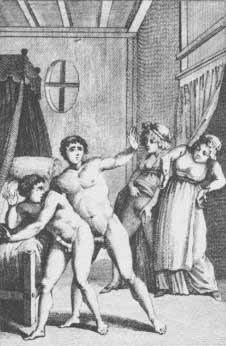
Contrary to the view that gays in the past took strictly “active” or “passive” roles, eighteenth-century trials (our best source for details about sex) show that most gay men took turn and turn about, and enjoyed reciprocal sex. A single sexual encounter often covered a broad range of activity. An illustration of this is the case of two men who were prosecuted in 1772 for buggering one another in the toilet of the Red Lion pub in Moorfields. Robert Crook, a 19-year-old man who was sharing a drink with Charles Gibson, said: “I went into the yard to make water, he came into the yard while I was making water, took hold of my yard, and began to work it with his hand; he said ‘It was a very good one, and he liked it very well’; he then asked me to go down to the vault [i.e. the bog-house] with him, which I did. There he said ‘Did not you know Dick that lived in this house? He had a fine tool, almost as big as my wrist, you are just such a lad as he was, let’s see if your’s is as big as his.’ Then he worked my yard till he made it spend in his hand. Then he pushed me back upon the vault, and worked me in the same manner on the seat of the vault till I did it in his hand; after that he kissed me very heartily; then he unbuttoned his own breeches, put my hand to his private parts, and kept tickling me about ten minutes; he kissed it and rubbed it, then he said ‘Now it will do’; he then turned round, and put his naked breech into my lap, and put his hand behind him, laid hold of my yard, and pushed it into his backside, twice or three times, I am not sure which.” After they were finished, Gibson wanted to change positions and bugger Crook. Crook claimed he was drunk and had been forced to take part in sex. But others had seen them kissing in the pub, and it transpired that this was not the only time both men had been to the vault together.

In this incident Gibson kissed Crook’s “yard”. But there are only half a dozen references to sucking between men in 18th-century English trials. In the Dutch Republic it was also rare, and considered a special treat. In 1730 a wealthy patrician was prosecuted for sucking his servants; one of the things he liked to do was spit their semen into a glass of wine and drink it. In 1765 a pedler was tried in Amsterdam for sucking a friend. He claimed he had learned the practice from a physician, who on one occasion said “Oh boy, I swallowed it.”

Cock-sucking is mentioned, usually as an insult, in Ancient Classical literature, but the practice nearly disappeared between then and modern times. In late medieval Florence, it is mentioned in 12 per cent of the legal records concerning sex between men. In German lands in the 1530s there are cases of men approaching other men in public latrines and offering to “suck out the nature” from them. There are allusions to oral sex in Richard Barnfield’s poem The Affectionate Shepherd, Containing the Complaint of Daphnis for the love of Ganymede, which was published in 1594, e.g.:

If it be sinne to loue a louely Lad:
Oh then sinne I, for whom my soule is sad.
                              . . . . . .
O would to God (so I might have my fee)
My lips were honey, and thy mouth a Bee.
Then shouldst thou sucke my sweete and my faire flower
That now is ripe, and full of honey-berries.

“Fee” is a common Elizabethan pun for sexual intercourse. Elsewhere in the poem Barnfield hopes his beloved will “suck my Coyne” (“coin” is a common Elizabethan metaphor for semen), and he also uses puns such as “stones” (meaning testicles) and “purses” (meaning scrotum). However, although Barnfield’s homoeroticism is clear, and was recognized by his contemporaries, it has to be acknowledged that any claim that he deals with fellatio depends upon our interpretation of metaphors and puns. Less metaphorical descriptions of oral sex feature in some late 18th-century French erotica, especially by the Marquis de Sade, and there are prints illustrating it. But in real life, hardly anyone in the 17th or 18th centuries, male or female, prostitute or otherwise, gay or straight, ever engaged in oral sex.

Some historians of sexuality argue that oral sex between men and women wasn’t common until the early twentieth century. For example, it wasn’t treated favourably in marriage manuals until the late 1920s. For gay men, the taste for oral sex has grown over the years. In Havelock Ellis’s book Sexual Inversion, published in 1897, nine of the gay men in his case studies preferred anal sex, compared to only three who preferred oral sex. In America, in the late nineteenth century some laws for the first time specifically prohibited oral sex between men, which might indicate that it was a newly popular practice. Herman Melville in his novel Redburn, published in 1849, refers obliquely to oral sex between sailors. It seems possible that oral sex became popular among gay men first in America and was then imported into Europe. Gay Swedish men working on the liners sailing between Gothenburg and New York in the 1930s reported that they got lots of oral sex in New York, while the main sex act in Gothenburg was mutual masturbation. The slang terms “blow” and “blow job” originated in 1930s America. Even in the 1960s and 1970s, it was generally believed that oral sex was more common between American men, while anal sex was more common between British men, and these national preferences are reflected in the pornography of the time.

The changing taste for oral sex is one area where there is a sharp break between the past and the present. Some historians argue that in the past oral sex was disagreeable to people becasue their personal hygiene left something to be desired. That argument isn’t entirely convincing. For one thing, people did in fact wash themselves using a hand basin and water jug even though they didn’t take baths or showers (and they did go to saunas and “stews” or public baths every so often, where lots of non-oral sex was enjoyed). For another, dental hygiene wasn’t too great either — most people had rotten teeth and stinking breath — but that didn’t prevent them from enjoying a good long kiss now and then.

There is probably a strong taboo concerning semen, which gay men overcame earlier than straight men and women. Though semen has no procreative value in sex between men, it nevertheless has a magical value. In some cultures, notably Melanesia, the ingestion of semen features in “coming-of-age” initiation rituals, whereby masculinity is transferred to young men. The two Victorian pioneers of gay liberation, Edward Carpenter and John Addington Symonds, felt that their personal experience confirmed this. Symonds wrote to Carpenter in December 1892: “I have no doubt myself that the absorption of semen implies a real modification of the physique of the person who absorbs it, & that the most beneficent results, as regards health and nervous energy, accrue from the sexual relations between men.”

Volcanic jets of the liquid erupt in gay pornography, as in the Victorian pornographic novel Teleny (1893), which was probably written by a group of men under the direction of Oscar Wilde: “my breath came thickly; I panted, I sighed, I groaned. The thick burning fluid was spouted out slowly and at long intervals. As I rubbed myself against him, he underwent all the sensations I was feeling; for I was hardly drained of the last drop before I was likewise bathed in his own seething sperm.” A lot of “rubbing” takes place in this novel, as well as sodomy. The most common forms of sex between men during Victorian times seem to have been mutual tossing off or between-thigh fucking. Oscar Wilde didn’t much care for anal intercourse, but preferred to have one of his “panthers” or rough trade sit in his lap while he “played” with him. Then Wilde would mount his partner face-to-face to enjoy “spending on his belly”. But sexual tastes vary according to temperament as well as historical period. For example, Oscar Wilde’s lover Lord Alfred Douglas preferred to bugger young schoolboys, while Wilde preferred “rough” older lads. Neither Wilde nor Douglas would seek sex with an obviously effeminate “pouf”.

Times have changed. Some marked changes in gay sexuality have occurred especially since the 1950s and 1960s. Fisting, for example, has no historical precedent — although impalement features in some early gay fantasies. In Teleny, a man who is not satisfied by a dildo bleeds to death after a large glass vase inserted into his anus breaks. Surveys of diaries, news reports, and the gay media have established that fisting was invented in the summer of 1971, in the “backroom” of a gay bar in New York City. The practice quickly spread to the backroom bars of San Francisco, and was exported thence to Japan and Europe. The pent-up libido that was released in the Swinging Sixties has blossomed in a garden of special interests, notably fetishistic sex games ranging from mild bondage and discipline to the extremes of sadomasochism.

To see how things have changed, we can compare the original 1881 edition of The Sins of the Cities of the Plain: Or, The Recollections of a Mary-Anne, with an edition published in 1992 by Badboy Books, New York. This Victorian gay pornography is the genuine (albeit semi-fictionalised) autobiography of a male prostitute, or “Mary-Ann”, named John Saul, aka Dublin Jack, and it probably contain an accurate account of what gay men did in the 1870s. Saul was game for anything, and his memoirs contain plenty of descriptions of between-thigh rubbing, “bottom-fucking” (often by sitting in someone’s lap), rimming preparatory to buggering, fingering ditto, cock-sucking and sixty-nining. But the 1992 “reprint” added several totally new scenes catering for the modern S/M market. In a long episode not in the original, a wicked voluptuary seizes a large candle from a table laid for a banquet and drips molten wax over Jack’s flesh, before stuffing him like a turkey with the said candle. Another important change is that the 1881 original had several heterosexual sex scenes, while the 1992 “reprint” changed the gender pronouns in these scenes, thus making the book exclusively homosexual throughout.

Such alterations suggest that over the course of a century there has been a historical shift in gay self-identity, and a more masculine gay self-image. Alternatively, the changes in the two versions of may simply represent the fact that the modern market for pornography has become much more rigidly segregated between gay and straight than it was a century ago. Nevertheless, in this novel and in other sources we see that the “Mary-Anns” or gay prostitutes in Victorian times often dressed up as women, or at least wore make-up and presented an effeminate appearance. The most famous in real life were Ernest Boulton and Frederick William Park, aka Lady Stella and Miss Fanny. When they were arrested in the Burlington Arcade in 1869 Boulton was wearing a cherry-coloured silk evening dress, trimmed with white lace, and Park was wearing a green satin dress trimmed with black lace. In the 1920s male prostitutes often wore make-up and, like Quentin Crisp, presented an “effeminate” appearance. Today, although male prostitutes often wear distinctive “costumes”, they generally present a macho appearance, echoing the “physique” magazines since the 1950s, when photographers such as Bob Mizer had their models pose as bikers and leathermen, construction workers and sailors of the rougher sort. The “effeminate” model of sexually available young men or “lady-boys” is still common, however, in places such as Thailand and other countries frequented by sexual tourists, and prostitution is the main form of employment of the self-castrated hijras of India. Even in the West, transsexuals form a large percentage of prostitutes, and “chicks with dicks” are an intriguing sub-section on gay porn sites on the web.

However, some things never change. Trial records for all periods turn up cases of men who lived together in “sodomitical sin” that included intimacy and tenderness. Several men investigated by the Paris police in the 1740s claimed that they sought “a relationship which might last”. According to one police report, two men had lived and slept together intimately for two years: “It was even almost always necessary for Duquesnel to have his arm extended along the headboard, under Dumaine’s head. Without that Dumaine could not rest.”


Copyright © 2005, 2006 Rictor Norton.


CITATION: Rictor Norton, “A History of Gay Sex”, Gay History and Literature, 24 November 2006 <http://rictornorton.co.uk/gaysex.htm&gt;


History of Male Contraception

The majority of us as gay men use condoms to protect us against STDs and HIV.  So I thought a little history of the condom would be quite interesting.  I hope that you find this as interesting as I do.

For men, who were, historically, freer to partake in sexual activity than women, the primary reason for using birth control was to avoid disease and illegitimate children, and, to a lesser extent, to reduced the economic burden of having too many children.

The “Natural” Way

Some social rules regarding birth control relied on the abstinence or control of the male. For instance, some indigenous Australian communities forbade men to have sex with their wives for several months after the birth of a child. In many areas in early Europe, royalty and men of standing (e.g., among 10th-century Ottonian Saxons) would have sex with their wives only for procreation, usually resulting in a rapid succession of births, after which they would spare their wives from having too many children by turning to prostitutes for recreation. Also in early Europe, men often turned to prostitutes to limit the number of children in the family, so as to prevent the family fortune from being split among too many heirs.

800px-Condom_with_manual_from_1813

Aristotle (384–322 BCE) wrote that homosexual relations in Crete were an officially condoned population control method. The Mohave of New Mexico considered anal intercourse to be a favor to women, since it would not result in pregnancy. In Jewish traditions, the law of niddah separated a husband and wife during menstruation to prevent conception during this time, for hygienic and health reasons.

Hopeful, but unreliable, natural methods of birth control included coitus reservatus (withholding ejaculation) and coitus interruptus (ejaculating outside the vagina). Coitus interruptus was common during the time of Mohammed, and Islam endorsed the practice, unless the woman disagreed. Meanwhile, the Book of Genesis tells of the fate of Onan, who practiced coitus interruptus with his dead brother’s wife to prevent her from becoming pregnant: he was put to death for “spilling his seed on the ground.”

Condoms

Historians believe that ancient Egyptian men wore fabric condoms, mainly for protection from disease, as long ago as 1000 BCE. The Romans used condoms made of animal intestine. In the 1500s, Fallopius, an Italian, invented a linen sheath to be worn to prevent the transmission of syphilis – later in the century the cloth was soaked in a chemical solution that was considered to be a spermicide. image By the 1700s, most condoms were made out of animal intestines – they were expensive, but could be washed and reused. (Often they came with a silk ribbon with which to tie them on.) King Charles II used animal-skin condoms to prevent having illegitimate heirs or contracting diseases. Of course, Charles II is not a testimony to the efficacy of animal-skin condoms: he had at least 13 illegitimate children.

In 1844, vulcanized rubber condoms hit the markets. Men generally wore them to avoid catching diseases such as gonorrhea and syphilis. As a result, for years afterward, condoms became associated with prostitution and disease.

The first condom advertisement appeared in 1861 in The New York Times – the product was “Dr. Power’s French Preventatives.” Laws were passed in the US 12 years later making it illegal to advertise contraceptives and allowing the postal service to confiscate condoms sold through the mail. A similar law was passed in 1882 in Canada, making it illegal to sell or advertise birth control, unless it was “for the public good.”

The first latex condom was invented in the 1880s, but they were not widely used until the 1930s. During World War I, the American troops were not allowed to use condoms, as many Americans believed that “loose” sexual behavior deserved the effects of disease. But by World War II, US troops were encouraged to use condoms. A training film urged, “Don’t forget – put it on before you put it in.”

Timeline for the History of Condoms

1000 BC

The use of condoms has been traced back several thousand years. It is believed that around 1000 BC the ancient Egyptians used a linen sheath for protection against disease.

100 – 200 AD

The earliest evidence of condom use in Europe comes from scenes in cave paintings at Combarelles in France.  There is also some evidence that some form of condom was used in imperial Rome.

1500s

The syphilis epidemic that spread across Europe gave rise to the first published account of the condom. Gabrielle Fallopius described a sheath of linen he claimed to have invented to protect men against syphilis.Having been found useful for prevention of infection, it was only later that the usefulness of the condom for the prevention of pregnancy was recognized.

Later in the 1500s, one of the first improvements to the condom was made, when the linen cloth sheaths were sometimes soaked in a chemical solution and then allowed to dry prior to use. These were the first spermicides on condoms.

1700s

old condom

The first published use of the world ‘condum’ was in a 1706 poem.It has also been suggested that Condom was a doctor in the time of Charles II. It is believed that he invented the device to help the king to prevent the birth of more illegitimate children.

Even the most famous lover of all, Casanova, was using the condom as a birth control as well as against infection.

Condoms made out of animal intestines began to be available. However, they were quite expensive and the unfortunate result was that they were often reused. This type of condom was described at the time as “an armor against pleasure, and a cobweb against infection”.

In the second half of the 1700’s, a trade in handmade condoms thrived in London and some shops where producing handbills and advertisements of condoms.

1800s

old condom

The use of condoms was affected by technological, economic and social development in Europe and the US in the 1800s.

Condom manufacturing was revolutionized by the discovery of rubber vulcanization by Goodyear (founder of the tire company) and Hancock. This meant that is was possible to mass produce rubber goods including condoms quickly and cheaply. Vulcanization is a process, which turns the rubber into a strong elastic material.

In 1861,the first advertisement for condoms was published in an American newspaper when The New York Times printed an ad. for ‘Dr. Power’s French Preventatives.’

In 1873, the Comstock Law was passed. Named after Anthony Comstock, the Comstock Law made illegal the advertising of any sort of birth control, and it also allowed the postal service to confiscate condoms sold through the mail.

1900s

condom

Until the 1920s, most condoms were manufactured by hand-dipping from rubber cement. These kinds of condoms aged quickly and the quality was doubtful.

In 1919, Frederick Killian initiated hand-dipping from natural rubber latex in Ohio. The latex condoms had the advantage of ageing less quickly and being thinner and odorless. These new type of condoms enjoyed a great expansion of sales. By the mid-1930s, the fifteen largest makers in the U.S. were producing 1.5 million condoms a day.

In 1957, the very first lubricated condom was launched in the UK by Durex.

From the early 1960s, the use of condoms as a contraceptive device declined as the pill, the coil and sterilization became more popular.

The use of the condom increased strikingly in many countries following the recognition of HIV and AIDS in the 1980’s. Condoms also became available in pubs, bars, grocery stores and supermarkets.

The female condom has been available in Europe since 1992 and it was approved in 1993 by the US Food and Drug Administration (FDA).

In 1994, the world’s first polyurethane condom for men was launched in the US.

The 1990s also saw the introduction of colored and flavored condoms.

Present day

In more recent years, improved technology has enabled the thickness of the condom to decrease. Also, condom manufacturers have recognized that one size of condom does not fit all. You can now find condoms that are different shapes, widths and lengths.


A Midsummer Night’s Dream

image
Puck’s soliloquy from the last lines of A Midsummer Night’s Dream, a comedy by William Shakespeare, is one of my favorite lines from any of Shakespeare’s plays.

If we shadows have offended,
Think but this, and all is mended,
imageThat you have but slumber’d here
While these visions did appear.
And this weak and idle theme,
No more yielding but a dream,
Gentles, do not reprehend:
if you pardon, we will mend:
And, as I am an honest Puck,
If we have unearned luck
Now to ‘scape the serpent’s tongue,
We will make amends ere long;
Else the Puck a liar call;
So, good night unto you all.
Give me your hands, if we be friends,
And Robin shall restore amends.

image In his essay “Preposterous Pleasures, Queer Theories and A Midsummer Night’s Dream“, Douglas E. Green explores possible interpretations of alternative sexuality that he finds within the text of the play, in juxtaposition to the proscribed social mores of the culture at the time the play was written. He writes that his essay “does not (seek to) rewrite A Midsummer Night’s Dream as a gay play but rather explores some of its ‘homoerotic significations’ … moments of ‘queer’ disruption and eruption in this Shakespearean comedy”. Green states that he does not consider Shakspeare to have been a “sexual radical”, but that the play represented a “topsy-turvy world” or “temporary holiday”image that mediates or negotiates the “discontents of civilization”, which while resolved neatly in the story’s conclusion, do not resolve so neatly in real life. Green writes that the “sodomitical elements”, “homoeroticism”, “lesbianism”, and even “compulsory heterosexuality” in the story must be considered in the context of the “culture of early modern England” as a commentary on the “aesthetic rigidities of comic form and political ideologies of the prevailing order”. Aspects of ambiguous sexuality and gender conflict in the story are also addressed in essays by Shirley Garner and William W.E. Slights (see citations below).

Garner, Shirley Nelson. “Jack Shall Have Jill;/ Nought Shall Go Ill“. A Midsummer Night’s Dream Critical Essays. Ed. Dorothea Kehler. New York: Garland Publishing Inc., 1998. 127–144
Slights, William W. E. “The Changeling in A Dream”. Studies in English Literature, 1500–1900. Rice University Press, 1998. 259–272.

If you love a good gay movie, musicals, cute guys, and/or Shakespeare, here is a suggestion for you. Indie movies are definitely not for everyone. In other words, specific movies tend to appeal to specific groups. Were the World Mine will obviously appeal to a gay audience, but also to people who are into Shakespeare, as it is fun and often ridiculous – just like the Bard’s play.

What Is It About?

image Were the World Mine was based on a short film entitled Fairies. The movie’s protagonist is Timothy (played by Tanner Cohen), a gay outcast at a prep school in a small town somewhere in America. He loves to daydream, and his daydreams always feature musical sequences and beautiful scenery. The object of his daydreams is Jonathan (played by Nathaniel David Becker), the star jock of the school. It is not long before Timothy gets involved into a school drama project, starts exploring Shakespeare and finds a recipe for the magical love potion in A Midsummer Night’s Dream – which allows him to turn the entire town gay.
Read more at Suite101: Were the World Mine Movie Review: An Indie Retelling of Shakespeare’s A Midsummer Night’s Dream.
Cupid’s Love Spell from A Midsummer Night’s Dream
OBERON

That very time I saw, but thou couldst not,
Flying between the cold moon and the earth,
Cupid all arm’d: a certain aim he took
At a fair vestal throned by the west,
And loosed his love-shaft smartly from his bow,
image As it should pierce a hundred thousand hearts;
But I might see young Cupid’s fiery shaft
Quench’d in the chaste beams of the watery moon,
And the imperial votaress passed on,
In maiden meditation, fancy-free.
Yet mark’d I where the bolt of Cupid fell:
It fell upon a little western flower,
Before milk-white, now purple with love’s wound,
And maidens call it love-in-idleness.
Fetch me that flower; the herb I shew’d thee once:
The juice of it on sleeping eye-lids laid
Will make or man or woman madly dote
Upon the next live creature that it sees.
Fetch me this herb; and be thou here again
Ere the leviathan can swim a league.

PUCK

I’ll put a girdle round about the earth
In forty minutes.

OBERON

Having once this juice,
I’ll watch Titania when she is asleep,
image And drop the liquor of it in her eyes.
The next thing then she waking looks upon,
Be it on lion, bear, or wolf, or bull,
On meddling monkey, or on busy ape,
She shall pursue it with the soul of love:
And ere I take this charm from off her sight,
As I can take it with another herb,
I’ll make her render up her page to me.
But who comes here? I am invisible;
And I will overhear their conference.

If you could have potion that could turn someone you have a crush on or are in love with gay, would you use it? Seriously, now. I am not talking about just on a whim. You would be changing this person’s life. Would you do it to satisfy your own happiness, even though it might not satisfy their own?


Stefan George

Stefan George

Stefan George (1868-1933)

The German poet Stefan George was born in 1868 in the village of Büdesheim near Bingen, a small but ancient town on the Rhine. In 1873 his family moved to Bingen, where his father, who had first been an inn-keeper, became a successful wine-merchant. From 1882 to 1888 George attended the grammar school in Darmstadt. During the following two years, his first journeys abroad led him to London, Italy and most notably to Paris, were he met the poets of the French symbolism, above all Stéphane Mallarmé, who became the model for the beginning of George’s literary career. The literary situation in Germany at the time was dominated on the one hand by a shallow classicism, on the other hand by a gross naturalism, both of which were equally repelling to George. Mallarmé’s programme of pure poetry’ without any social relevance, his conviction that the Orphic interpretation of the earth is the only task of the poet’ and that everything that is sacred and wants to stay sacred veils itself into mysteries’, was like a revelation and quite appealing to the young George. From 1889 on he was registered for three terms at the University of Berlin, but attended only a few lectures. By the time of the publication of his first volume of poems in 1890 he had already assumed the life style that he was to keep up until his end. Never living in a home of his own – not because he could not have afforded it, as he had inherited a sufficient fortune from his parents, but because of the way he saw himself – he would stay as a guest of his friends and admirers in Berlin, Munich, Heidelberg, Basel, or else traveled abroad, mostly in Italy and in Paris. He avoided all publicity, and his books were only privately published. Moreover, he underlined the esoteric character of his writings by certain orthographic peculiarities and a special ornamental typography.

George’s subsequently famous Kreis (Circle) of like-minded friends was beginning to rally about the same time. Still it consisted mostly of fellows of about his own age treated as equals, as distinguished from the later situation, when George was the august master venerated by much younger disciples.

Hugo von HofmannsthalThough, to all appearances, George was of an almost exclusively homoerotic inclination, there is no indication that he ever went beyond the Platonic concept of spiritual guidance and aesthetic contemplation – to which he adhered doubtless partly out of mere social convention, but also for artistic discipline. Nevertheless, sometimes the strong emotions George displayed in his relationships to young men could be disturbing to them, as it is documented in the case of Hugo von Hofmannsthal. George was himself only 23 when he met the still younger but precocious Austrian poet, who was 17 then. It is not really clear what happened, but evidently their relations were troubled, though they kept up a correspondence for some years. Also another friendship of George that had been initially more successful ended in dissonance, when the Friedrich GundolfGermanist Friedrich Gundolf whom George had mentored as a teenager, and who had become his most ardent apostle, as a man in his late thirties insisted on marrying despite George’s disapproval.
What proved to be George’s most passionate, most ill-fated and poetically most fruitful love affair began in 1902, when he approached a boy in a street of Munich: Max Kronberger, a 14-year-old grammar-school student, felt flattered when a man he had noted before asked his permission to sketch his ‘interesting’ head. On the next day George succeeded in taking a photograph of the boy, but it seems that thereupon George’s courage failed him, as he did not try to meet the boy again for almost a year. At the time of their next accidental meeting in the street, Kronberger found out that George was a poet and, since his respectable parents agreed, they saw each other regularly from then on, in a relationship not always free from tension. However, Kronberger died of an acute disease on the day after his sixteenth birthday. What followed was a poetical glorification which was sometimes compared to the literary monument erected by Dante for Beatrice, but resembles rather the deification bestowed by Hadrian on Antinous, in a somewhat different way owing to the difference of times and circumstances, of course.

Your eyes were dim with distant dreams, you tended
No more with care the holy fief and knew
in every space the breath of living ended –
Now lift your head for joy has come to you.

The cold and dragging year that was your share,
A vernal tide of dawning wonders bore,
With blooming hand, with shimmers in his hair
A god appeared and stepped within your door.

Unite in gladness, now no longer darkened
and blushing for an age whose gold is flown:
The calling of a god you too have hearkened,
It was a god whose mouth has kissed your own.

You also were elect – no longer mourn
For all your days in unfulfilment sheathed…
Praise to your city where a god was born!
Praise to your age in which a god has breathed!

This forced gesture and overdone interpretation twisted everything George wrote looking back on his love for Maximin. His spontaneous feelings for an adolescent are better expressed in the verses that he, again in love, in 1905 addressed to the 14-year-old Hugo Zernik:

My child came home
The sea-wind tangled in his hair,
His gait still rocks
With conquered fears and young desires for quest.

The salty spray
Still tans and burns the bloom upon his cheek:
Fruit swiftly ripe
In savage scent and flame of alien suns.

His eyes are grave
With secrets now, that I shall never learn,
And faintly veiled,Since from a spring he came into our frost.

So wide the bud
That almost shyly I withdrew my gaze,
And I abstained
From lips that had already chosen lips.

My arm enclasps
One who unmoved by me, grew up and bloomed
To other worlds –
My own and yet, how very far from me!

George not only turned Maximin into a myth, but also used him as figurehead for his new aims, as expressed in his most ambitious poetry, contained in the volume Der Siebente Ring, (The Seventh Ring) of 1907. Now George’s programme was no longer art for art’s sake, but a political vision formed in opposition to a time and society he considered vile and decayed, a spiritually void world of mean commercial utilitarianism and brutal power-politics garnished with decorative phrases.

George, who had been opposed to the reality of the Prussian-dominated German Empire, as contrasted with his idea of Germany, was not carried away by the storm of enthusiasm at the outbreak of the First World War in 1914, and felt rather confirmed by the defeat of 1918. In the turmoil of the post-war years, George became the lodestar of the most idealistic part of the young generation, as represented by Klaus MannKlaus Mann (born in 1906), who remembered later that “my admiration for him was boundless. I saw him as the leader and prophet, the Caesarean priestly figure as he presented himself. Amidst a rotten and barbarous civilization, he embodied human and artistic dignity, uniting discipline and passion, grace and majesty. Each of his gestures was of an exemplary, programmatic character. He stylized his own biography like a myth: his romance, the boy Maximin, was the core of a philosophy that was a revelation to the circle of disciples. — The reunification of morals and beauty seemed to have been realized in the mystery of Maximin. Here I found the reconciliation of Hellenic and Christian ethos. Stefan George’s ordering mind had – or so did I believe – solved the fundamental conflict that Heinrich Heine analyses with intuition and perspicacity, that reigns as tragic leitmotiv over the works of Friedrich Nietzsche. — My youth venerated in Stefan George the Templar whose mission and deed is described in his poem. When the black wave of nihilism was threatening to devour our culture, he arrived, the militant seer and inspired knight.”
At the surface, there were doubtless some similarities between George’s Maximinprogram of a hierarchic reformation based upon a new aristocracy of mind and spirit, and the ideologies of the fascist movements as they were beginning to flourish in several European countries during the nineteen-twenties. Though to him, for his attitude and sentiments, it was impossible to identify his cause with the Nazism that was to take over Germany, the ambiguity became clear in 1933, when some of his followers embraced the upheaval wholeheartedly, while others, like his oldest companion, the Jewish poet Karl Wolfskehl, were forced to emigrate. George himself, who was already fatally ill, declined all honors by which the new rulers tried to gain his support, and, silent but demonstrative, left Germany to end his life elsewhere. He died on the 4th of December 1933, in Locarno, Ticino, Switzerland.

Editorial Board, World History of Male Love, “Famous Homosexuals”, Stefan George, 2000 <http://www.gay-art-history.org/gay-history/gay-literature/famous-homosexuals/stefan-george-gay/stefan-george-gay.html>


“Let them hate me, so long as they fear me.”

image The quote that is the title of this post is from the 1979 film Caligula.  One of the most infamous films ever made.  Tonight for the first time, I watched it.  And as much as I love porn, even I was shocked—shocked, I tell you.  This film chronicles the rise and fall of the notorious Roman Emperor Caligula, showing the violent methods that he employs to gain the throne, and the subsequent insanity of his reign – he gives his horse political office and humiliates and executes anyone who even slightly displeases him. He also sleeps with his sister, organizes elaborate orgies and embarks on a fruitless invasion of England before meeting an appropriate end. There are various versions of the film, ranging from the heavily- truncated 90-minute version to the legendary 160-minute hardcore version which leaves nothing to the imagination (though the hardcore scenes were inserted later and do not involve the main cast members).
imageCaligula is a 1979 film directed by Tinto Brass, with additional scenes filmed by Giancarlo Lui and Penthouse founder Bob Guccione. The film concerns the rise and fall of Roman Emperor Gaius Caesar Germanicus, better known as Caligula. Caligula was written by Gore Vidal and co-financed by Penthouse magazine, and produced by Guccione and Franco Rossellini. It stars Malcolm McDowell as the Emperor. Caligula was the first major motion picture to feature eminent film actors (John Gielgud, Peter O’Toole, Malcolm McDowell, Helen Mirren) in a film with explicit sex scenes.
image With the cast of John Gielgud, Peter O’Toole, Malcolm McDowell, Helen Mirren, you have to wonder how these actors made a film that was panned by critics; Roger Ebert gave it zero stars, describing it as “sickening, utterly worthless, shameful trash.” Perhaps the most scathing comment to ever appear in one of Ebert’s reviews is attributed to a third party: “‘This movie’, said the lady in front of me at the drinking fountain, ‘is the worst piece of shit I have ever seen.'” This was one of the few films Ebert ever walked out of; “two hours into its 170 [sic] minute length.” Reviewer Leonard Maltin said the film was little more than “chutzpah and six minutes of not-bad hardcore footage.” Newsweek magazine called Caligula “a two-and-one-half-hour cavalcade of depravity that seems to have been photographed through a tub of Vaseline.”
image Basically, what was done was that the actors in the movie only saw the script for what later became the heavily- truncated 90-minute version.  The rest of the movie was shot by Penthouse founder Bob Guccione.  Guccione essentially made a porn film of orgies, full frontal and graphic nudity, and S&M  bondage scents.  He then spliced those into the movie without the actors knowing it.  The movie contained a lot of nudity before the graphically sexual scenes, but none of the penetrative sex.  You can certainly tell the difference when Caligula (Malcolm McDowell) is taking Livia’s virginity and then fists her husband, which appears to be quite fake, versus the penetrative vaginal and oral sex scenes in the orgy of the Roman Senator’s wives.  None of the main characters appear in the hardcore sex scenes though they can be heard in the background trying to put some continuity to the spliced up movie.
If you like seventies straight porn, a fan of huge thick cocks (and don’t mind seeing naked women), or are bisexual and enjoy straight porn, watch this movie.  The historical accuracy is pretty pitiful, but then what else could you expect from Gore Vidal writing the script.  Overall, I found it a very interesting movie, I just had no idea that is was so, so graphic.
Case in point, all of these pictures are from the movie.
By the way, some people say that this is the worst film of all time.  I say that sometimes a bad movie is fun to watch.  This one is perverse, but still interesting (maybe, fun).

Trailer for a remake Gore Vidal’s Caligula (2005)

This is a short film (parody) based on the 1979 film of the same name. The film is stylized with the actors wearing modernized robes and Roman jewelry and females playing male characters and vice-versa. starring : Helen Mirren, Karen Black, Milla Jovovich, Benicio Del Toro, Adriana Asti,Glenn Shadix, Michelle Phillips, Gerard Butler

Oscar Wilde

  • Born: 16 October 1854
  • Birthplace: Dublin, Ireland
  • Died: 30 November 1900
  • Best Known As: The author of The Importance of Being Earnest

Name at birth: Oscar Fingal O’Flahertie Wills Wilde

image Oscar Wilde was an 19th century Irish writer whose works include the play The Importance of Being Earnest and the novel The Picture of Dorian Gray. He is also one of the Victorian era’s most famous dandies, a wit whose good-humored disdain for convention became less favored after he was jailed for homosexuality. Wilde grew up in a prosperous family and distinguished himself at Dublin’s Trinity College and London’s Oxford. He published his first volume of poems in 1881 and found work in England as a critic and lecturer, but it was his socializing (and self-promotion) that made him famous, even before the 1890 publication of The Picture of Dorian Gray. In 1895, at the height of his popularity, his relationship with the young poet Lord Alfred Douglas was declared inappropriately intimate by imageDouglas’s father, the Marquess of Queensberry.  Wilde sued for libel, but the tables were turned when it became clear there was enough evidence to charge Wilde with “gross indecency” for his homosexual relationships. He was convicted and spent two years in jail, after which he went into self-imposed exile in France, bankrupt and in ill health. His other works include the comedies Lady Windermere’s Fan (1892), A Woman of No Importance (1893) and An Ideal Husband (1895), several collections of children’s stories and the French drama Salomé (1896).

The phrase “the Love that dare not speak its name” comes from a poem by Lord Alfred Douglas, and when questioned about its meaning in open court, Wilde gave an impassioned speech on the value of male love (See the quote below the video). One of Wilde’s most famous quotes: “There is only one thing in life worse than being talked about, and that is not being talked about.”


Oscar Wilde “The Ballad of Reading Gaol” Poem Animation
Uploaded by Poetrylad. – Arts and animation videos.

On being cross-examined at his trial
Mr. C. F. Gill (cross-examining): What is “the love that dares not speak its name?”
Wilde: “The love that dares not speak its name” in this century is such a great affection of an elder for a younger man as there was between David and Jonathan, such as Plato made the very basis of his philosophy, and such as you find in the sonnets of Michelangelo and Shakespeare. It is that deep spiritual affection that is as pure as it is perfect. It dictates and pervades great works of art, like those of Shakespeare and Michelangelo, and those two letters of mine, such as they are. It is in this century misunderstood, so much misunderstood that it may be described as “The love that dares not speak its name,” and on that account of it I am placed where I am now. It is beautiful, it is fine, it is the noblest form of affection. There is nothing unnatural about it. It is intellectual, and it repeatedly exists between an older and a younger man, when the older man has intellect, and the younger man has all the joy, hope and glamour of life before him. That it should be so, the world does not understand. The world mocks at it, and sometimes puts one in the pillory for it.


Walt Whitman

image Walt Whitman was a 19th century writer whose life’s work, Leaves of Grass, made him one of the first American poets to gain international attention. Whitman spent most of his young life in Brooklyn, where he worked as a printer and newspaper journalist through the 1850s. The first edition of Leaves of Grass was privately printed in 1855 and consisted of 12 untitled poems, one of which was to later become famous as “Song of Myself.” His literary style was experimental, a free-verse avalanche in celebration of nature and self that has since been described as the first expression of a distinctly American voice. Although Leaves of Grass did not sell well at first, it became popular in literary circles in Europe and, later, the United States, and Whitman published a total of eight editions during his lifetime. During the Civil War Whitman moved to Washington, D.C., where he served as a civil servant and volunteer nurse. There he published the poetry collections Drum Taps and Sequel to Drum Taps (1865-66), the latter containing his famous elegies for Abraham Lincoln, “Where Lilacs Last in the Dooryard Bloom’d” and “O Captain! My Captain!” In 1873 he was paralyzed after a stroke and moved to Camden, New Jersey. By the time of his death he was an international literary celebrity, and he is considered one of the most influential poets in American literature.

When I heard at the Close of the Day
(No. 11, from ‘Calamus’)
par50 When I heard at the close of the day how I had
been praised in the Capitol, still it was not
a happy night for me that followed,
And else when I caroused nor when my favorite plans were
accomplished was I really happy,
But the day when I arose at dawn from the perfect
health, electric, inhaling sweet breath
When I saw the full moon in the west grow pale andTBoBA_140
disappear in the morning light,
When I wandered alone over the beach, and undressing, bathed,
laughing with the waters, and saw the sun rise,
And when I thought how my friend, my lover, was on
his way coming, then O I was happy,
Each breath tasted sweeter and all that day my food
nourished me more and the beautiful day passed well,
And the next came with equal joy and with the next,TBoBA_144
at evening, came my friend,
And that night while all was still I heard the waters roll
slowly continually up the shores,
I heard the hissing rustle of the liquid and sands, as directed
to me, whispering to congratulate me,
For the friend I love lay sleeping by my side,
In the stillness his face was inclined toward me, while the
moon’s clear beams shone
And his arm lay lightly over my breast and that night I was happy.

image Whitman’s sexuality is sometimes disputed, although often assumed to be bisexual based on his poetry. The concept of heterosexual and homosexual personalities was invented in 1868, and it was not widely promoted until Whitman was an old man. Whitman’s poetry depicts love and sexuality in a more earthy, individualistic way common in American culture before the ‘medicalisation’ of sexuality in the late 1800s. Though Leaves of Grass was often labeled pornographic or obscene, only one critic remarked on its author’s presumed sexual activity: in a November 1855 review, Rufus Wilmot Griswold suggested Whitman was guilty of ‘that horrible sin not to be mentioned among Christians’. Whitman had intense friendships with many men throughout his life.
Some biographers have claimed that he may not have actually engaged in sexual relationships with men, while others cite letters, journal entries and other sources which they claim as proof of the sexual nature of some of his relationships.
image Biographer David S. Reynolds described a man named Peter Doyle as being the most likely candidate for the love of Whitman’s life. Doyle was a bus conductor whom he met around 1866. They were inseparable for several years. Interviewed in 1895, Doyle said: ‘We were familiar at once — I put my hand on his knee — we understood. He did not get out at the end of the trip — in fact went all the way back with me.’
image A more direct second-hand account comes from Oscar Wilde. Wilde met Whitman in America in 1882, and wrote to the homosexual rights activist George Cecil Ives that there was ‘no doubt’ about the great American poet’s sexual orientation — ‘I have the kiss of Walt Whitman still on my lips,’ he boasted. The only explicit description of Whitman’s sexual activities is second hand. In 1924 Edward Carpenter, then an old man, described an erotic encounter he had had in his youth with Whitman to Gavin Arthur, who recorded it in detail in his journal. Late in his life, when Whitman was asked outright if his series of Calamus poems were homosexual, he chose not to respond.
image There is also some evidence that Whitman may have had sexual relationships with women. He had a romantic friendship with a New York actress named Ellen Grey in the spring of 1862, but it is not known whether or not it was also sexual. He still had a photo of her decades later when he moved to Camden and referred to her as ‘an old sweetheart of mine’. In a letter dated August 21, 1890 he claimed, ‘I have had six children – two are dead’. This claim has never been corroborated. Toward the end of his life, he often told stories of previous girlfriends and sweethearts and denied an allegation from the New York Herald that he had ‘never had a love affair’.
In any case, Whitman is one of the first truly working-class poets and an iconic figure in gay literature.


Love Potion #…Nah, I’m Not Eating That

image
“The Roman Emperor Vitellius gave a feast in honor of Minerva at which the piéce de résistance called for the brains of a thousand peacocks and the tongues of a thousand flamingos.”

image Throughout history man has searched the earth for ways of enhancing sexual desire, looking for substances which would act as aphrodisiacs, a word derived from the Greek goddess of love Aphrodite. This quest for sexual stimulants has encompassed a startling variety of substances, some with good reason but many on the basis of entirely unfounded ideas. One good example of a well known but false sex enhancer is the long sought after rhinoceros horn, which is powdered and consumed in alcohol. Equally unfounded is the consumption of other animal products such as various parts of the tiger and the bear and drinks containing such delicacies as crushed frog bones or snake droppings.
image Aphrodisiac recipes have been cooked up throughout the world for millennia. In Europe, up to the eighteenth century, many recipes were based on the theories of the Roman physician Galen, who wrote that foods worked as aphrodisiacs if they were “warm and moist” and also “windy,” meaning they produced flatulence. Spices, mainly pepper, were important in aphrodisiac recipes. And because they were reckoned to have these qualities, carrots, asparagus, anise, mustard, nettles, and sweet peas were commonly considered aphrodisiacs.
An aphrodisiac, as we use the term today, is something that inspires lust. It usually isn’t meant to cure impotence or infertility, problems that are now handled by separate fields of medicine. But until recently there was little distinction between sexual desire and function. Any lack of lust, potency, or fertility would have a common cure in an aphrodisiac. Galen thought that a “wind” — or as one 16th-century writer put it, an “insensible pollution” — inflated the penis to cause an erection, so anything that made you gassy would also make you erect.
image Galen’s theories were not the only basis for concocting aphrodisiacs. Mandrake root was eaten as an aphrodisiac and as a cure for female infertility because the forked root was supposed to resemble a woman’s thighs. This was based on an arcane philosophy called the “doctrine of signatures.”In simple terms, the “Doctrine of Signatures” is the idea that God has marked everything He created with a sign (signature).  This doctrine states that herbs that resemble various parts of the body can be used to treat ailments of that part of the body. Oysters may have come to be known as an aphrodisiac only by their resemblance to female genitals. However, because of the high amount of zinc in raw oysters, it actually worked to produce more semen and healthier sperm.  Few old medical texts listed oysters as an aphrodisiac, although literary allusions to that use are plentiful.
image Parts of the skink, a kind of lizard, were thought to be an aphrodisiac for centuries. It’s hard to say why exactly, but three different ancient authors make the claim. Potatoes, both sweet and white, were once known as an aphrodisiac in Europe, probably because they were a rare delicacy when they were first transplanted from the Americas. Potatoes are also related to night shade, which was known as a poison in Europe, but the Incas who first cultivated and domesticated potatoes as a food source, bred out the inherent poisons.
image Some aphrodisiacs came out of mythology. Aphrodite, the Greek goddess of love (from whose name, of course, “aphrodisiac” is derived) was supposed to have held sparrows sacred. We think rabbits are promiscuous animals, hence the Playboy bunny and certain lewd sayings, but the ancient Greeks thought sparrows were especially lustful. Because of the association with Aphrodite, Europeans were inclined to eat sparrows, particularly their brains, as aphrodisiacs.
St. Thomas Aquinas, a 13th-century friar, also wrote a bit on aphrodisiacs. Like Galen, he thought aphrodisiac foods had to produce “vital spirit” and provide good nutrition. image So meat, considered the heartiest food, was an aphrodisiac. Drinking wine produced the “vital spirit.” The association between food and eroticism is primal, but some foods have more aphrodisiacal qualities than others. Biblical heroines, ancient Egyptians, and Homeric sorceresses all swore by the root and fruit of the mandrake plant. The grape figured prominently in the sensual rites of Greek Dionysian cults, and well-trained geishas have been known to peel plump grapes for their pampered customers. Fermented, of course, grape juice yields wine, renowned for loosening inhibitions and enhancing attraction (though as Shakespeare’s porter wryly notes in Macbeth, alcohol “provokes the desire, but it takes away the performance”). image Honey sweetens the nectar-like philters prescribed in the Kama Sutra to promote sexual vigor, and the modern “honeymoon” harks back to the old custom for newlyweds to drink honeyed mead in their first month of marriage. Grains like rice and wheat have long been associated with fertility if not with love, and Avena sativa (green oats), an ingredient in many over-the-counter sexual stimulants, may explain why young people are advised to “sow their wild oats.” Numerous herbs and spices—basil, mint, cinnamon, cardamom, fenugreek, ginger, pepper, saffron, and vanilla, to name a few—appear in ancient and medieval recipes for love potions, as well as in lists of foodstuffs forbidden in convents because of their aphrodisiac properties.
image Among other delicacies banned by the Church in centuries past were black beans, avocados, and chocolate, presumably all threats to chastity. And truffles—both earthy black and ethereal white—caused religious consternation in the days of the Arab empire. One story has it that the muhtasib of Seville tried to prohibit their sale anywhere near a mosque, for fear they would corrupt the morals of good Muslims. For those who held debauchery in higher esteem, the list of favored aphrodisiacs was bound only by the imagination. The herb valerian, noted for its stimulant properties at lower doses, was long a brothel favorite, and yu-jo, professional women of pleasure in feudal Japan, supplemented their charms with the aphrodisiacal powers of eels, lotus root, and charred newts.
image Another foodstuff much favored by Casanova was chocolate, although the first person associated with chocolate as an alleged aphrodisiac was the Aztec ruler Montezuma, who is said to have drank 50 cups of hot chocolate a day in order to fully service his harem of 600 women. Such was the reputation of chocolate at that time, that the Aztecs and also the Mayans celebrated the harvest of the cocoa bean with festivals of orgies. However, this was far from being the earliest use of a vegetable substance for sexual purposes, as various plants were being extensively used in China thousands of years before that. image  The earliest known beneficiary was Huang Ti, the Yellow Emperor, who lived around 2600 BC. He was provided with a potion made from 22 herbal ingredients mixed with wine and it apparently bestowed him with an amazing sexual stamina. Empowered with this potent concoction of herbs he was able to enjoy the sexual favors of 1200 women and achieve a legendary status as the greatest of all lovers.
Coffee is another old one, and it’s still sometimes considered an aphrodisiac. “Every time you have an excitation, you have an effect of disinhibition,” says Paola Sandroni, MD, a neurologist at the Mayo Clinic. She reviewed the scientific evidence that exists on many supposed aphrodisiacs, and published her findings in the journal Clinical Autonomic Research.
image But to call coffee or anything that contains caffeine an aphrodisiac would be misleading. “I think the effect is much more general,” she says. In the same way, cocaine and amphetamines may seem to be aphrodisiacs because they stimulate the central nervous system, but they have no specific effects on sexual desire.
Sandroni also looked at studies on ambergris, which comes from the guts of whales and is used in perfumes. Some consider ambergris an aphrodisiac and there is evidence to support this notion. In animal studies, it increased levels of testosterone in the blood, which is essential to the male sex drive, and is thought to play a part in women’s libido as well.
Next to oysters, the most well known aphrodisiac is the fabled “Spanish fly.” image It’s not just a legend. Such a thing does exist. Its active ingredient is the chemical cantharidin, which is found in blister beetles. Cantharidin irritates genital membranes, and so it is believed to be arousing. It’s also deadly, causing kidney malfunction or gastrointestinal hemorrhages in people who ingest too much. A quick Internet search is all it takes to find some for sale. Sandroni says she was “horrified” to see how easy it is to buy.
Then there’s the “herbal Viagra” pitched in spam emails. This is yohimbe bark. Some claim, falsely, that arginine, an amino acid in yohimbe, can restore erectile function and act as an aphrodisiac. “The only saving grace there is that arginine in large quantity is not harmful,” says Cynthia Finley, a dietician at Johns Hopkins University.
The Roman poet Ovid wrote in The Art of Love, after giving a litany of aphrodisiacs,

Prescribe no more my muse, nor medicines give

Beauty and youth need no provocative.

Similarly, Finley says she thinks the only true aphrodisiac is good health achieved by a balanced diet — which isn’t all that different from what St. Thomas Aquinas said 800 years ago.


Abraham Lincoln, Gay???

LINCOLN nude final(1)
If you want just my opinion on this controversial issue, this would be a very short post, because I don’t think he was gay.  However, there is a lot of controversy over this issue, and I thought I would give a closer look for you guys.  I know I mostly have discussed Ancient History on The Closet Professor, but since modern history is much closer to my field of study, I thought it was time to show you that I know more than just sex in the ancient world.
So what brought about this discussion of more modern history?  Well, I recently came across this review of a play in the New York Times:

91 (2)Plot Description for Abraham Lincoln’s Big, Gay Dance Party

A fourth-grade Christmas pageant in Abraham Lincoln’s rural Illinois hometown sets off a firestorm of controversy when it calls into question Abraham Lincoln’s sexuality. Each of the play’s three acts lets the audience see the story through a different character’s viewpoint — and at each performance the audience decides in which order the acts are performed, creating a Rubik’s-like theatrical event. Finally, a truly democratic theatergoing experience! What could be more American than that? 
The sexuality of Abraham Lincoln is a subject that is laced with many discrepancies and historical flaws.  GayLincoln The notion that Lincoln was a homosexual also portrays nearly perfectly two of my major pet peeves with historians.  First, much of the argument is taken out of its historical context, and second, the authors who expound on this notion have no historical objectivity.  I will explain these two pet peeves of mine as I relate the supposed homosexuality of Abraham Lincoln.  Mostly, I will explain what is wrong with the theories of Lincoln’s homosexuality.  If you are not familiar with the arguments concerning Lincoln’s homosexuality, please read the suggested readings below first.  I am including them before my argument because as I was writing this, I realized that it was quite long already, and I decided to let the actual discussion of Lincoln’s homosexuality to be in these articles, while most of this post will be mainly a refutation of The Intimate World of Abraham Lincoln by C. A. Tripp.
gay Suggested Readings:
6a00d8341c730253ef00e54f3297c08833-640wi In The Intimate World of Abraham Lincoln, C. A. Tripp contends that Lincoln had erotic attractions and attachments to men throughout his life, from his youth to his presidency. He further argues that Lincoln’s relationships with women were either invented by biographers (his love of Ann Rutledge) or were desolate botches (his courtship of Mary Owens and his marriage to Mary Todd). Tripp is not the first to argue that Lincoln was homosexual — earlier writers have parsed his friendship with Joshua Speed, the young store owner he lived with after moving to Springfield, Ill. — but he assembles a mass of evidence and tries to make sense of it.
image  Tripp died in May 2003, after finishing the manuscript of this book, which means he never had a chance to fix its flaws. Tripp alternates shrewd guesses and modest judgments with bluster and fantasy. He drags in references to Alfred Kinsey (with whom he once worked) to give his arguments a (spurious) scientific sheen. And he has an ax to grind. Not only did he work with Kinsey, but Tripp was a well-known gay activist and psychologist.  By the way, psychologists who write psycho-history are often the worst type of historians.  They have very little understanding of the craft and they use their knowledge of psychology to interpret historical data.  The same goes for most journalists, who do not have the same standards as historians when it comes to citing their sources. Psychologists who write history too often apply Freudian and Jungian psychology to people who had never had any knowledge of this type of psychoanalyzing. 
In the after math of the Franco-Prussian War in Europe (1870-71), Carl von Clauswitz wrote the military strategy book On War.  Military historians after the publication of On War are able to compare Clauswitz theories to modern warfare because it influenced modern generals and military strategists.  Likewise, the psychological theories of Freud and Jung and the perverted misunderstanding of Einstein’s Theory of Relativity (“everything is relative,” not just E = mc2, as Einstein meant it) greatly influenced 20th century writers, who used this knowledge to form their characters and plot devises. I mention these two instances of influencing theories because Tripp uses modern homosexual behavior to explain Lincoln relationships with men.  He takes the notion out of its historical context. 
image  Intimacy between men was much more common and less sexually laced in the 19th century than it was in the later part of the 20th century.  In 19th century America men commonly slept with other men. For example, when lawyers and judges traveled “the circuit” with Lincoln, the lawyers often slept “two in a bed and eight in a room.”  William H. Herndon recalled, “I have slept with 20 men in the same room.”  A tabulation of historical sources shows that Lincoln slept with at least 11 boys and men during his youth and adulthood. There are no known instances in which Lincoln tried to suppress knowledge or discussion of such arrangements, and in some conversations, raised the subject himself. Tripp, who was not aware of this large number of Lincoln’s male co-sleepers, discusses only three of them at length: Joshua Speed, William Greene, and Charles Derickson.

image

Joshua Speed

abrahamlincoln5-500Tripp and other gay activists have an agenda to prove Lincoln’s homosexuality.  He is seen as the father of the Republican Party, an American political party known for its many anti-gay members and platforms.  Their objectivity is shot to hell because they are not attempting to give their readers an intimate look at the private life of Abraham Lincoln, but to discredit the Republican Party.  For me, this takes away much of the credibility of advocates of Lincoln’s homosexuality.  I am no fan of the Republican Party.  I largely find the modern Republican Party to be defined by what it hates and not what it is for; however, the same could be said for the Democratic Party.  American politics is a divisive politics of hate.  If someone writing history is blinded by that hate, they cannot see the error of their historical argument.  They apply modern interpretations to situations that do not warrant modernity.  Yes, the Civil War in America, the mid-19th century was a turning point in the history of America.  It is a period of transitioning from the early republic to the modern era.  Yet, this transition was not even complete by 1877 when Reconstruction ended.  Therefore, modern interpretations of events are null and void.
I love nothing more than a great historical figure to be homosexual.  We have some great ones and some evil ones.  However, I find it very hard to believe that Lincoln was homosexual.  You are more than welcome to disagree with me if you like (that is, if anyone is actually reading this).  Please leave your comments in the comment section or email me directly.


The Later Emperors

Commodus
Commodus (Lucius Aelius Aurelius Commodus), 161-192, Roman emperor (180-192), son and successor of Marcus Aurelius. imageMarcus Aurelius is seen as one of the wisest and greatest of the Roman Emperors, however, his record is sometimes tainted by that of his deviant son. In 180, reversing his father’s foreign policy, he concluded peace with the German and the Sarmatian tribes and returned to his licentious pleasures in Rome. There he vaunted his strength in gladiatorial combats and decreed that he should be worshiped as Hercules Romanus. He changed his own name to Marcus Commodus Antoninus and wanted to rename the city of Rome after himself. Many plots to assassinate him failed, but eventually, on the order of his advisers, he was strangled by a wrestler. Pertinax succeeded him.
Commodus had a number of male lovers. He is said to have a harem of 300 girls and the same number of boys and to put on great orgies. In 2000’s Academy Award-winner for Best Picture, Gladiator, Commodus serves as the main antagonist of the film. He is depicted as cowardly, greedy and ruthless. He is played by Joaquin Phoenix.
Elagabalus
Heliogabalus or Elagabalus, c.205-222, Roman emperor (218-22). He was a priest of the local sun god, Elagabalus, at Emesa and was named Varius Avitus Bassianus. imageHe was a cousin of Caracalla; according to the claims (almost certainly false) of his ambitious mother and grandmother, he was the son of Caracalla. He was chosen by the troops in Syria as emperor in opposition to Macrinus, who had killed and succeeded Caracalla. When Macrinus was defeated and killed at Antioch, Heliogabalus became emperor as Marcus Aurelius Antoninus. His reign was a tragic farce. He imported the cult of which he was priest, and Rome was shocked and disgusted by the indecency of the rites as well as by the private life of the emperor, who gave high offices to an actor, a charioteer, and a barber. His grandmother, Julia Maesa, induced him to adopt his young cousin, Alexander Severus, but Heliogabalus later tried to have the boy killed. Heliogabalus and his mother were murdered in an uprising of the Praetorian Guard. Alexander Severus succeeded.
image But for sheer shock value, none can compare with Elagabalus, who believes himself to be a living god. Elagabalus is remarkable not only for being only 14 years old when he becomes absolute ruler of the Roman empire but also for his sexual activities while holding that office… shocking in the eyes of respectable Roman society is his ‘marriage’ to a slave named Hierocles. Elagabalus likes nothing better than to dress as a woman and go around with his ‘husband’, who is even encouraged to beat the emperor as if he is his real wife. Sometimes Elagabalus plays out scenes in which Hierocles finds him with another man and punishes him for his ‘infidelity’.
Philip the Arab
image Philip or Philip the Arabian (Marcus Julius Philippus), 204?-249, Roman emperor (244-49). He served under Gordian III against the Persians, instigated the assassination of the emperor, and concluded a peace with Persia. The millennium of Rome was celebrated by him with the splendor of secular games in the Circus Maximus. Philip sent Decius to the Danube to quell a mutiny, but when the troops hailed Decius as emperor, he marched at their head upon Italy. Philip met them near Verona and was slain. Philip the Arabian was also known for his fondness for young men.


