Category Archives: History

Drawn to Form: The Academic Nude and the Art School Mode

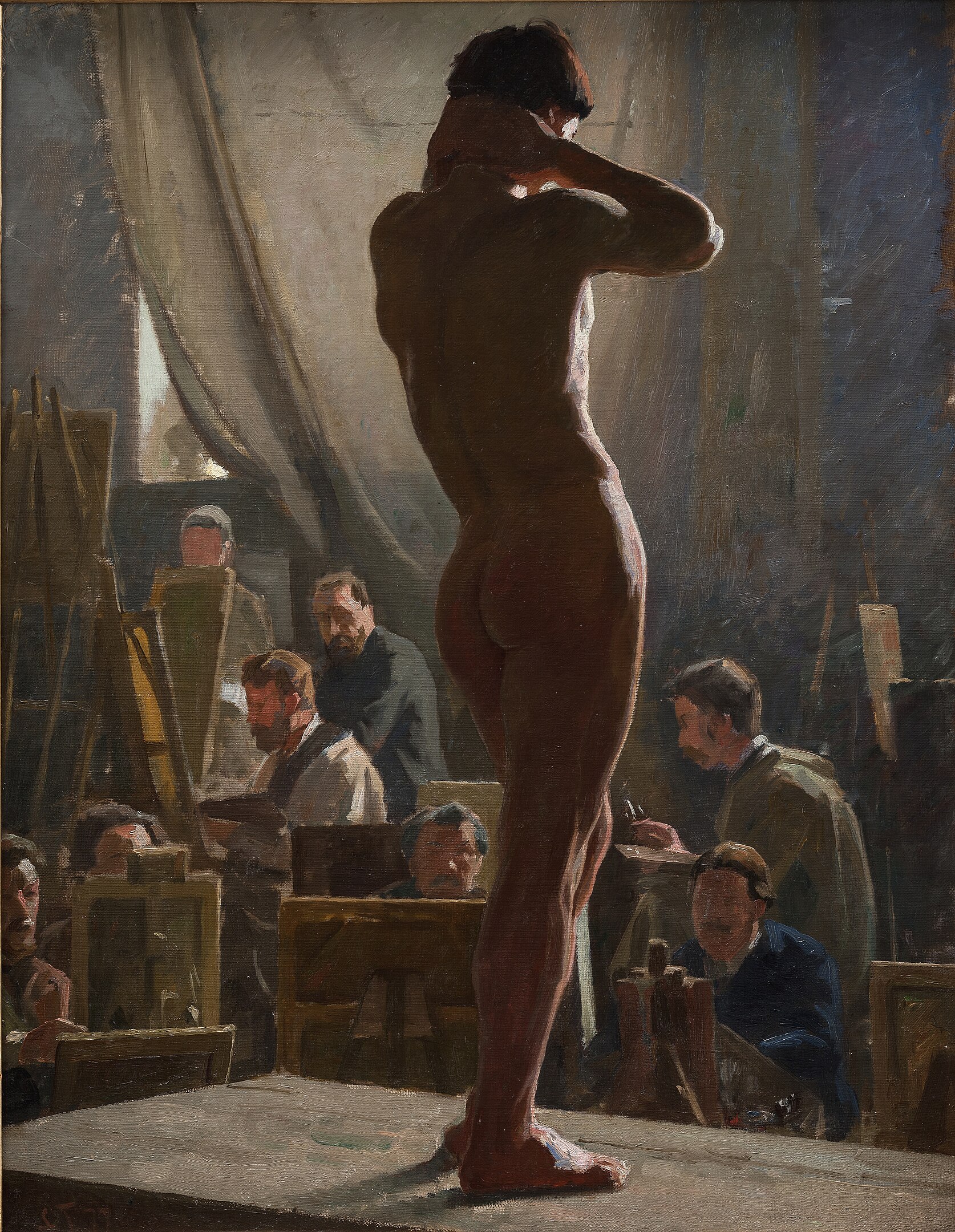
Male Nude in the Studio of Bonnat, Laurits Tuxen (1877)

Long before museums and galleries became the homes of the male nude, it lived in the studios. In the ateliers of the École des Beaux-Arts in Paris, the Royal Academy in London, and the Pennsylvania Academy of the Fine Arts in the United States, generations of students learned the ideal proportions of the human form not through imagination—but by closely observing the naked man before them.

Paul Delaroche’s Study of a Male Nude (c. 1835)

The academic nude wasn’t just a subject of study; it was a rite of passage. Drawing the male model became a disciplined practice that shaped not only artists’ technical skill, but also Western ideals of masculinity, beauty, and form. In the 19th century, the École des Beaux-Arts institutionalized the male nude as the pinnacle of artistic study. The male figure, more than the female, was thought to embody harmony and proportion, a living reference to both ancient sculpture and Renaissance anatomical studies. The famed “Concours de Torse,” or Torso Competition, showcased how aspiring painters honed their craft on the male body, rendering each muscle with academic precision. A striking example is Paul Delaroche’s Study of a Male Nude (c. 1835), a dramatically lit figure standing in a contrapposto pose, his flesh rendered with the same reverence one might apply to a marble Apollo. Here, individuality fades; the model becomes a type, a vessel for timeless ideals.
Study of a Male Nude Seen from Behind, William Etty (c. 1830s)

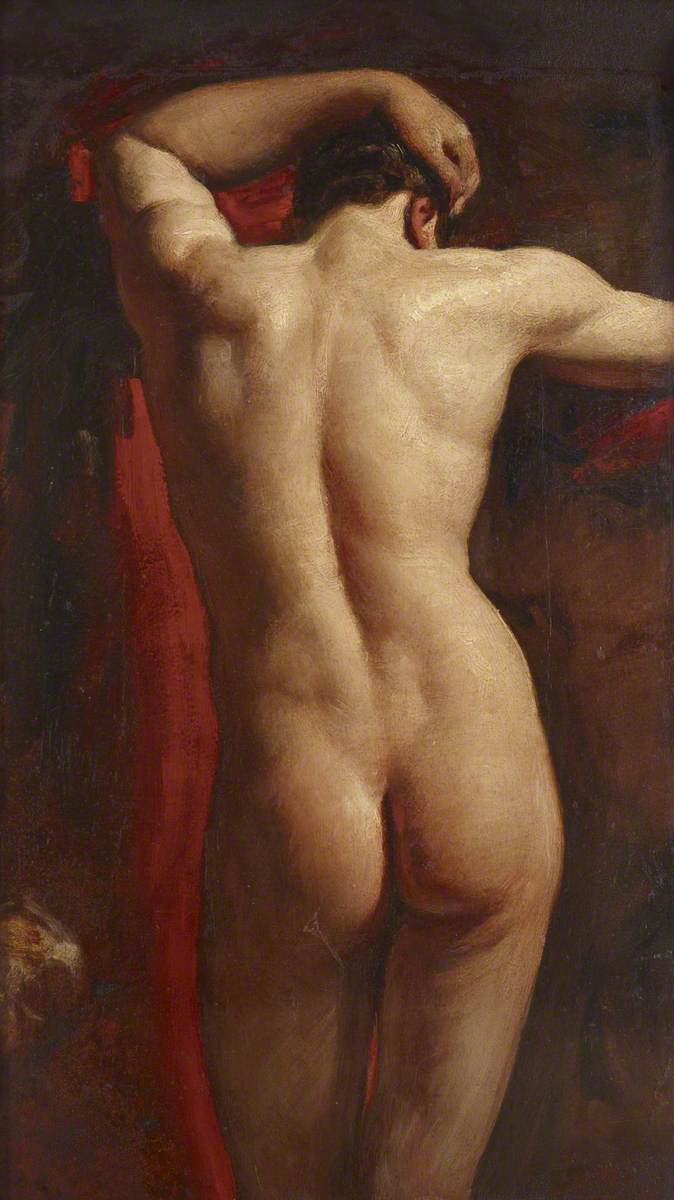
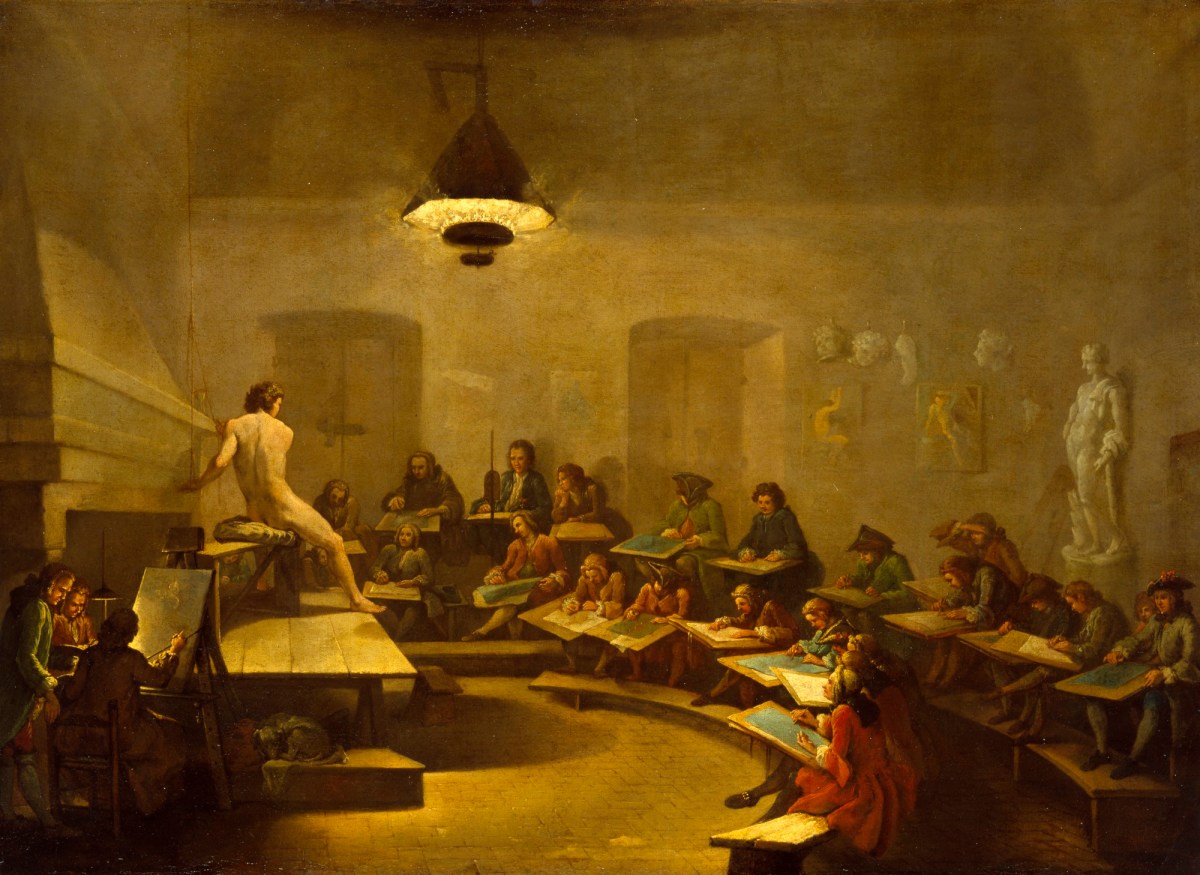
In London, the Royal Academy Schools upheld similar values. Students began by copying antique plaster casts, gradually earning the right to work in the Life Room, where a live male model stood nude on a platform under harsh light and stricter silence. These models often came from the working classes, their anonymity preserved even as their bodies were meticulously recorded in sketch after sketch. William Etty, a British painter committed to the nude in an often prudish art culture, created countless studies that quietly smuggled eroticism into the academic process. His Study of a Male Nude Seen from Behind (c. 1830s), now housed at Tate Britain, transforms a backlit model into an object of lyrical sensuality, every curve of the body rendered with lingering attention.
Bill Duckett Nude, Thomas Eakins (ca. 1889)

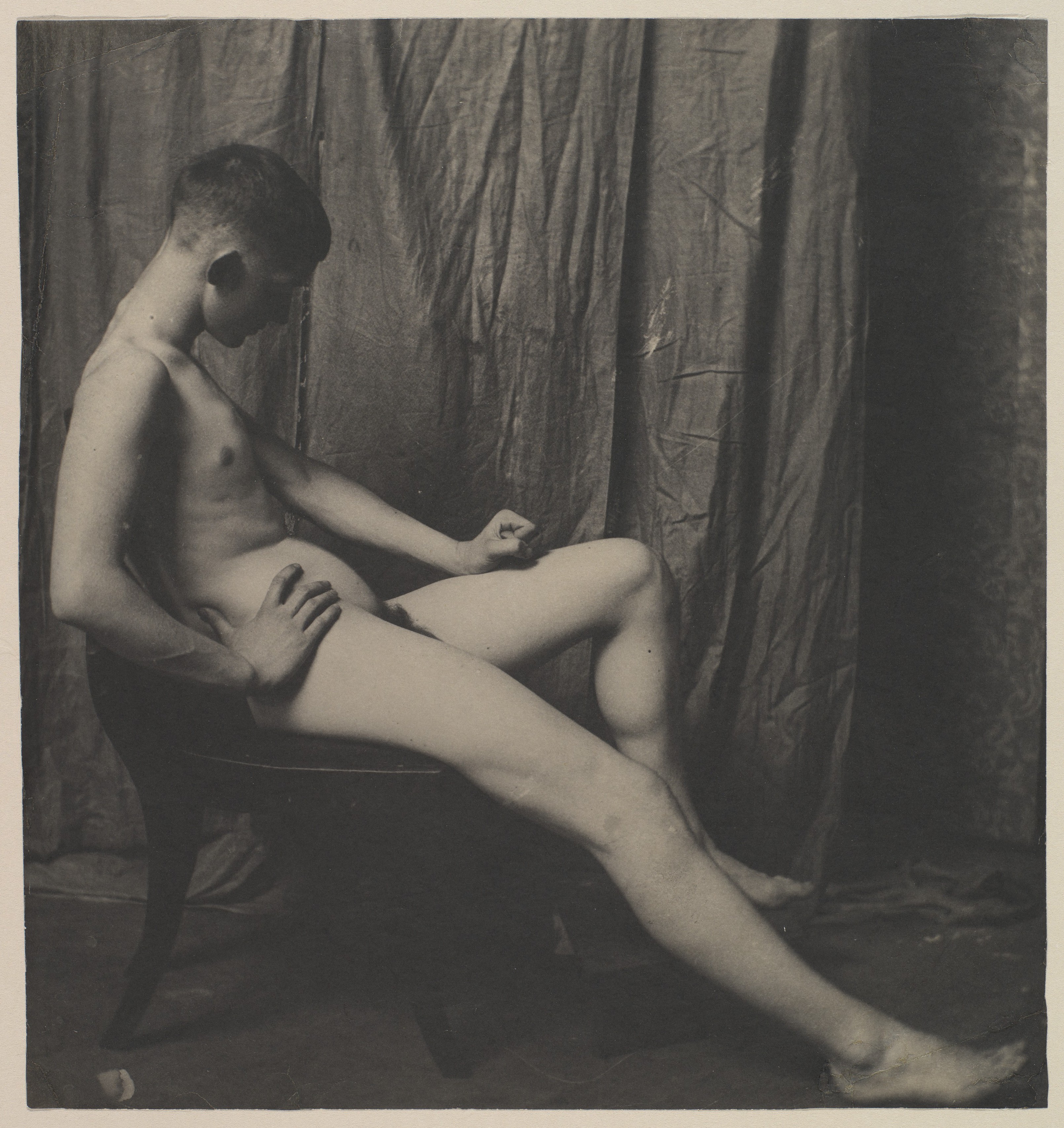
In the United States, Thomas Eakins redefined the academic nude—and ignited controversy. At the Pennsylvania Academy of the Fine Arts, Eakins encouraged both male and female students to observe fully nude male models, a practice that pushed the limits of American Victorian propriety. He sometimes posed nude himself, blurring the boundaries between instructor, artist, and subject. One of his oil sketches of which no photo exists, The Male Nude (c. 1885), strips away allegory or idealism entirely. A model sits awkwardly, raw and unguarded. There is no attempt to mythologize or elevate, only to observe. The tension in Eakins’s work lies in this realism—an almost clinical intimacy that reveals more than anatomy.
Young Male Nude Seated by the Sea, Jean-Hippolyte Flandrin  (1836)

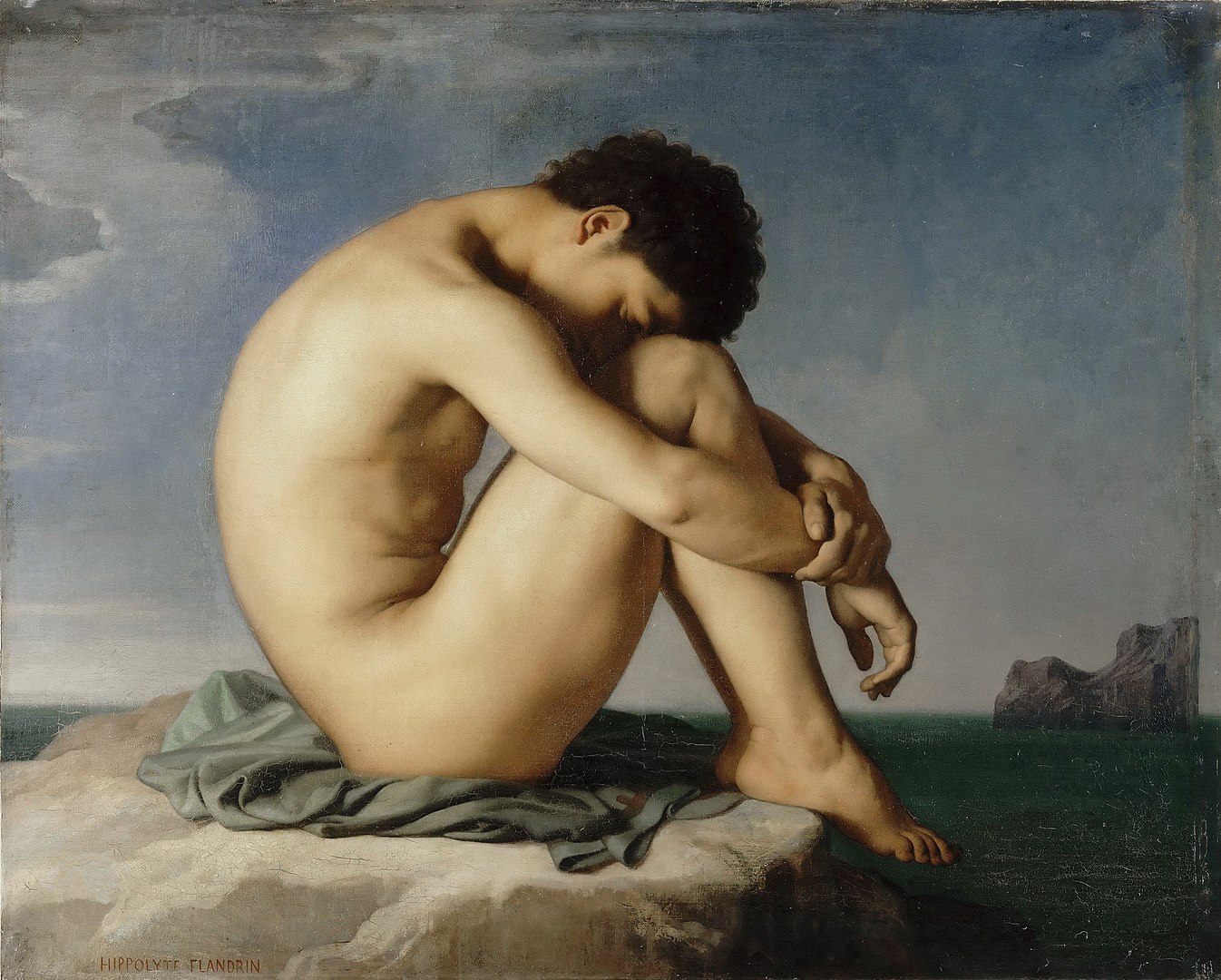
Though most academic studies of the nude remained in the studio, some evolved into finished works for public exhibition. These retained the formal lessons of the academy while cloaking the nude in mythological or historical justification. Jean-Hippolyte Flandrin’s Young Male Nude Seated by the Sea (1836) exemplifies this genre. A solitary youth, nude and introspective, sits beside an imagined shore. The painting, while formally academic, gestures toward emotional vulnerability and latent desire. It is not just an ideal—it is a reverie. Often described as “the most beautiful boy in French painting,” the figure suggests a coded eroticism beneath its classical restraint.
A Life Class, Unidentified artist and Formerly attributed to William Hogarth (c. early 19th century

The art school nude was shaped not just by technique, but by a complex social structure. The model—often unnamed—was a laborer in a rarefied world. In the archives of the École des Beaux-Arts or the Musée Rodin, one finds charcoal drawings of men reclining, lunging, or simply standing, their bodies lit and studied as if they were statues. An anonymous drawing from around 1890 captures a reclining male nude in dramatic foreshortening—an image at once clinical and intimate. These men were employed for their endurance, strength, and presence. Though rarely memorialized, their bodies shaped generations of artists’ understanding of the human form.

The academic nude may appear orderly or formulaic, but beneath its surface lies a subtle history of aesthetic pleasure, regulation, and coded longing. In the Life Room, artists were taught not only how to render the male body, but how to look at it—intently, repeatedly, and within the sanctioned space of artistic discipline. Today, those once-forgotten studies are being reconsidered—not just as technical exercises, but as visual records of how masculinity was taught, observed, and quietly desired.

Framing the Male Nude

Guglielmo Plüschow, “Untitled” (Date Unknown)

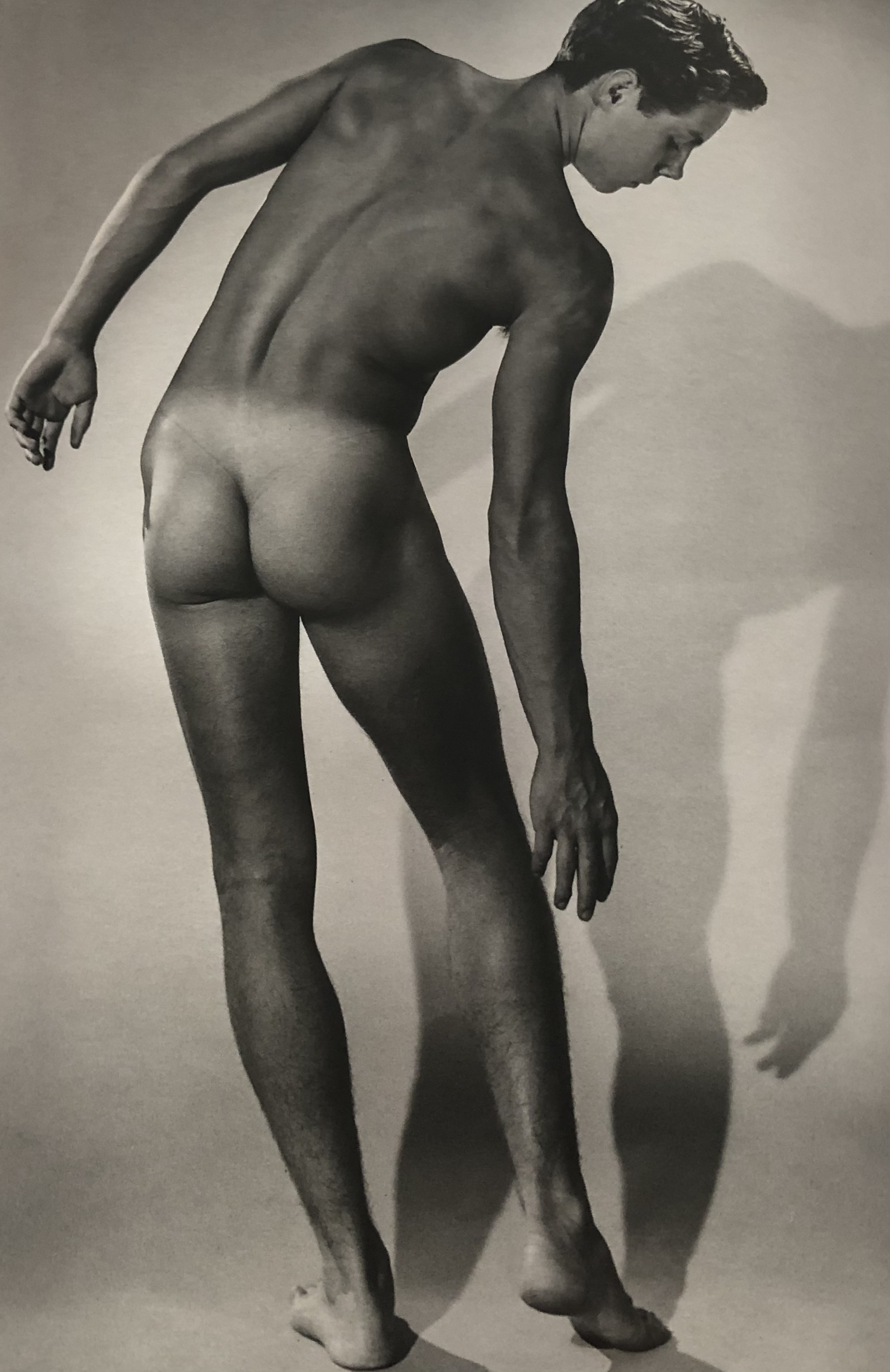
The photography of the male nude occupies a rich and multifaceted space in visual history. From its emergence in the 19th century to its entwinement with queer identity and sexual liberation in the 20th, the male nude has been variously categorized as artistic, erotic, art-erotic, or pornographic. These categories—though often overlapping—are shaped by aesthetic choices, social context, and the photographer’s intent. While definitions remain fluid, understanding their distinctions helps trace the evolution of male imagery, censorship, and desire across time.

Guglielmo Plüschow, “Male Nude Seated on Leopard Skin” ( c. 1890s–1900s)

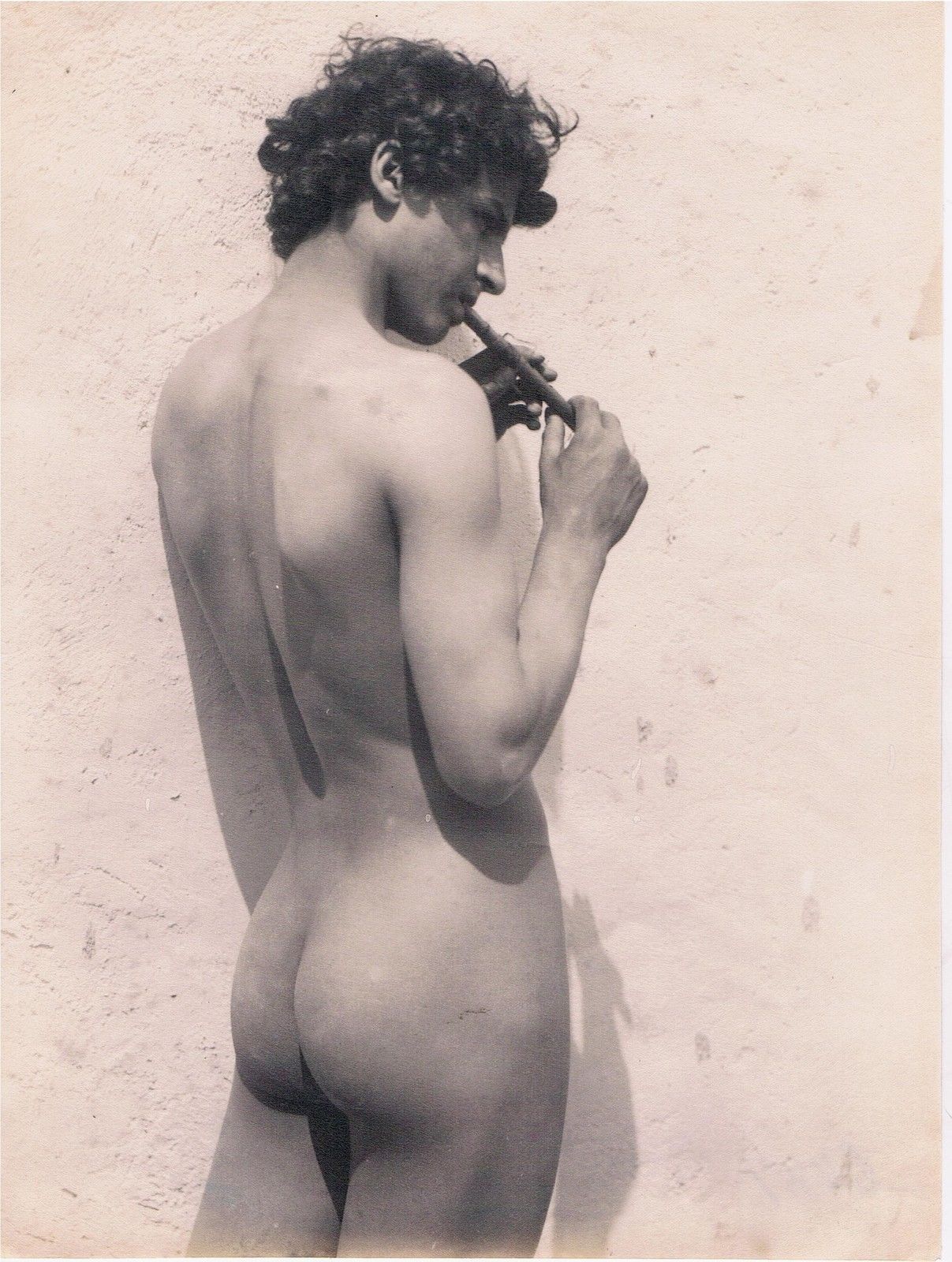
Artistic male nudes are rooted in classical ideals of beauty, proportion, and human form. These works typically present the male body as a timeless object of contemplation rather than sexual desire. Photographers such as Wilhelm von Gloeden and Guglielmo Plüschow, working in late 19th-century Italy, produced pastoral, sepia-toned images of nude youths posed against ancient ruins or natural landscapes. The subjects, often draped in togas or standing in contrapposto, evoke Hellenistic sculpture. The aesthetic was elevated, not erotic framed as reference for artists or scholars.

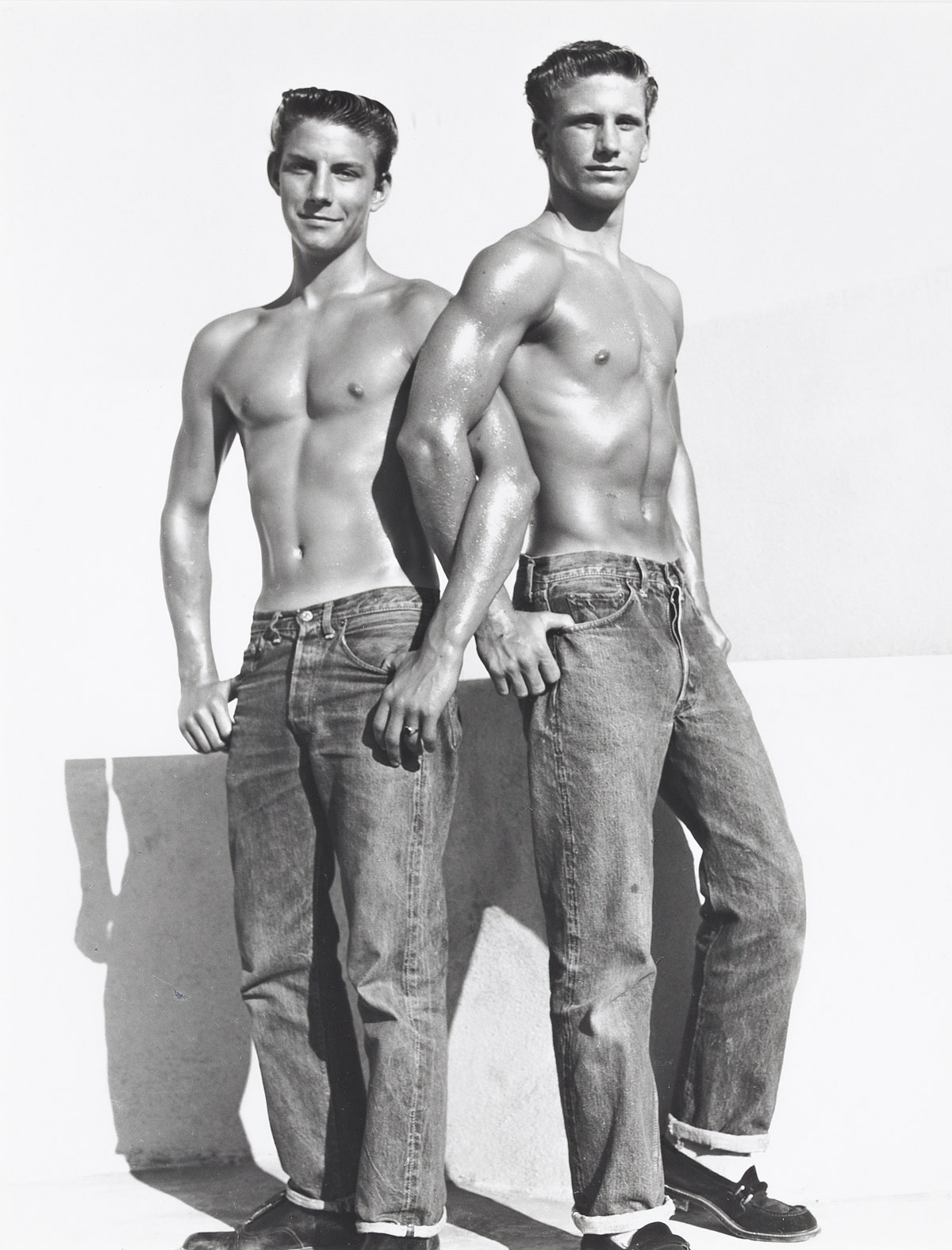
Erotic male nudes, by contrast, are designed to evoke desire. While still avoiding explicit content, they emphasize sensuality and allure. Studios like the Athletic Model Guild, founded by Bob Mizer in 1945, epitomize this genre. Mizer’s models were often young, muscular, and photographed in minimal attire—usually posing straps. Though presented as ‘model studies’ or athletic reference images, they were unmistakably charged with homoerotic appeal. A classic example is AMG model Jim Grant in 1949, his body carefully composed for aesthetic and erotic impact.

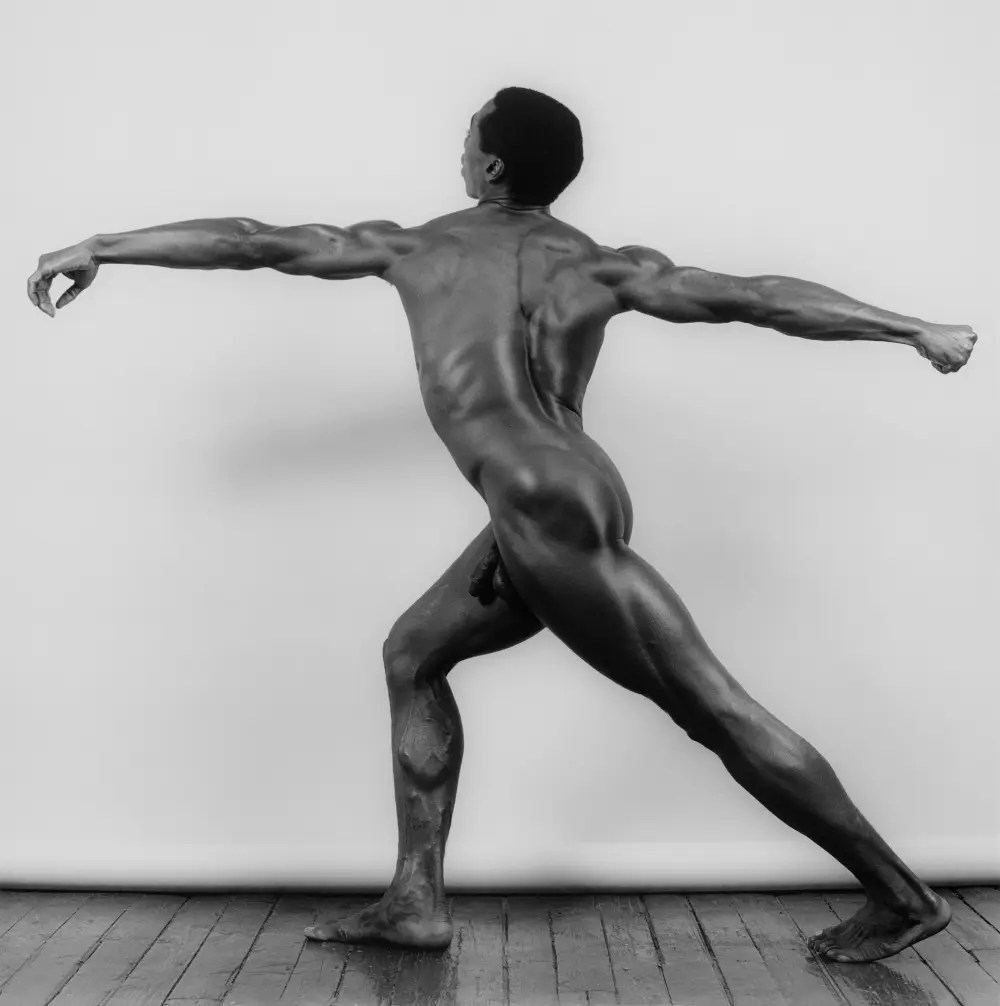
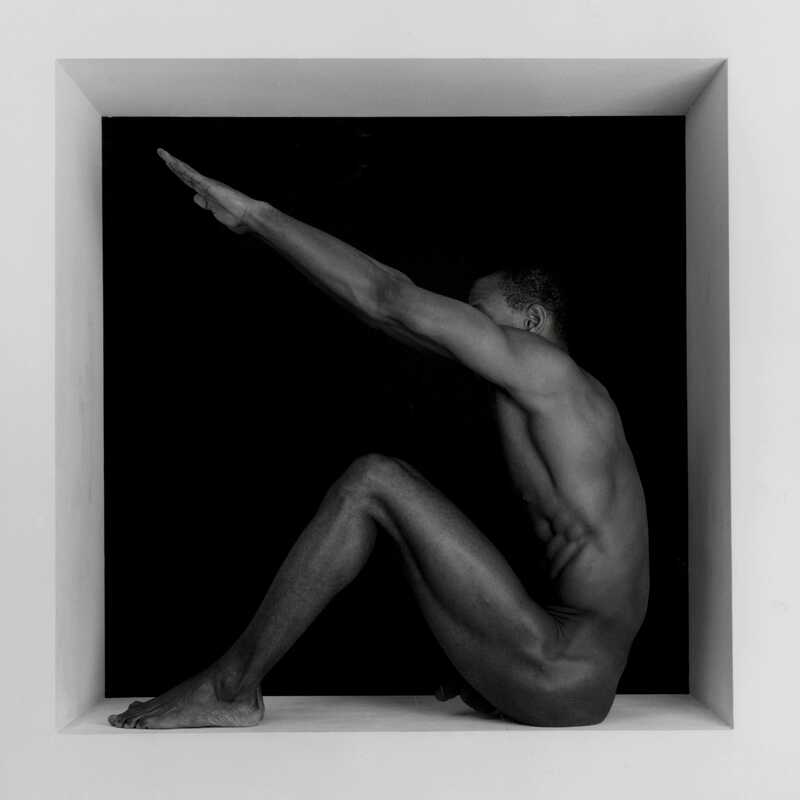
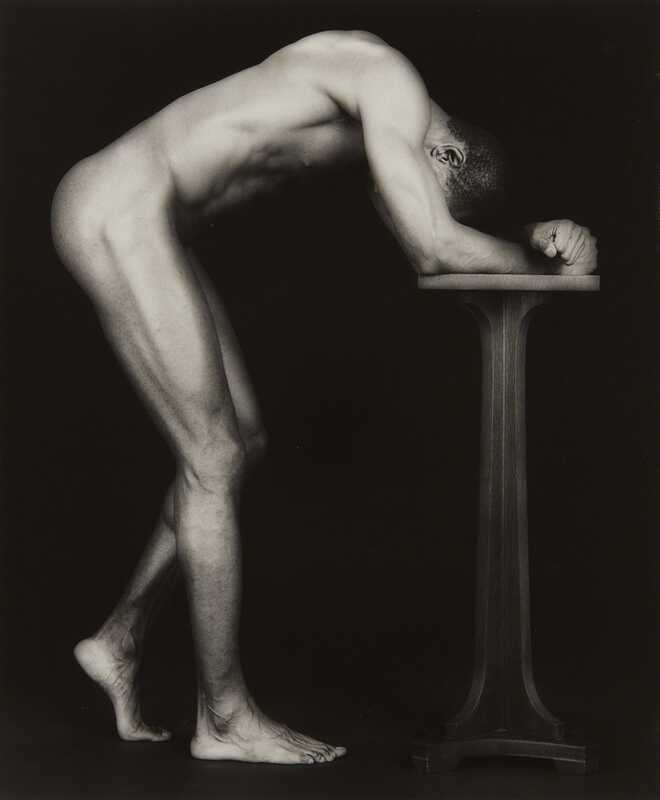
Between these poles lies the hybrid category of art-erotic nudes—images that deliberately blend aesthetic ambition with erotic suggestion. Photographer Robert Mapplethorpe redefined this space in the 1970s and ’80s. His studio portraits of Black male nudes, leather-clad figures, and homoerotic still lifes challenged museum conventions while embracing overt sensuality. His 1986 photograph of bodybuilder Thomas—posed like a neoclassical statue but fully exposed—is both starkly erotic and compositionally exquisite. Earlier precedents include F. Holland Day’s portrait of Nicola Giancola as St. Sebastian, which straddle martyrdom and homoerotic reverence.

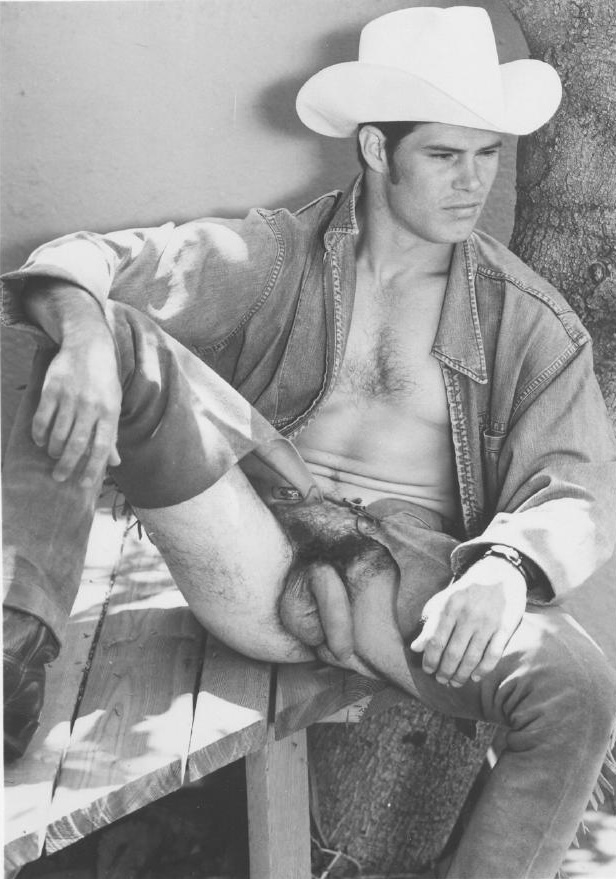
COLT Studios, “Buddy Houston” (c.1979)

Still photo pornography occupies the far end of the spectrum, with imagery created explicitly for sexual arousal. With the loosening of obscenity laws in the 1960s and 1970s, studios like COLT, Falcon, and Target began publishing full-frontal male photography, often themed around working-class or hypermasculine fantasies. A 1970s COLT photo set of model Buddy Houston, fully nude and posed as a cowboy, exemplifies this genre. Here, the goal is no longer suggestion or metaphor, but direct sexual gratification—often accompanied by narratives or visual cues designed to stimulate.

F. Holland Day, “Saint Sebastian” (1906)

These categories—artistic, erotic, art-erotic, and pornographic—are best understood as points along a continuum rather than rigid definitions. A single image might be interpreted differently depending on the viewer, setting, or historical moment. In 1964 United States Supreme Court Justice Potter Stewart described his threshold test for obscenity in Jacobellis v. Ohio by saying:

I shall not today attempt further to define the kinds of material I understand to be embraced within that shorthand description [“hard-core pornography”], and perhaps I could never succeed in intelligibly doing so. But I know it when I see it, and the motion picture involved in this case is not that.

In gallery spaces, an image may be framed as art; in private, it may serve a different function altogether. For LGBTQ+ audiences, especially during eras of repression, these images carried layered meanings: as mirrors of desire, acts of defiance, and moments of recognition. Their legacy continues to shape how we view the male body, beauty, and freedom.


Florence: A Haven for Gay Artists

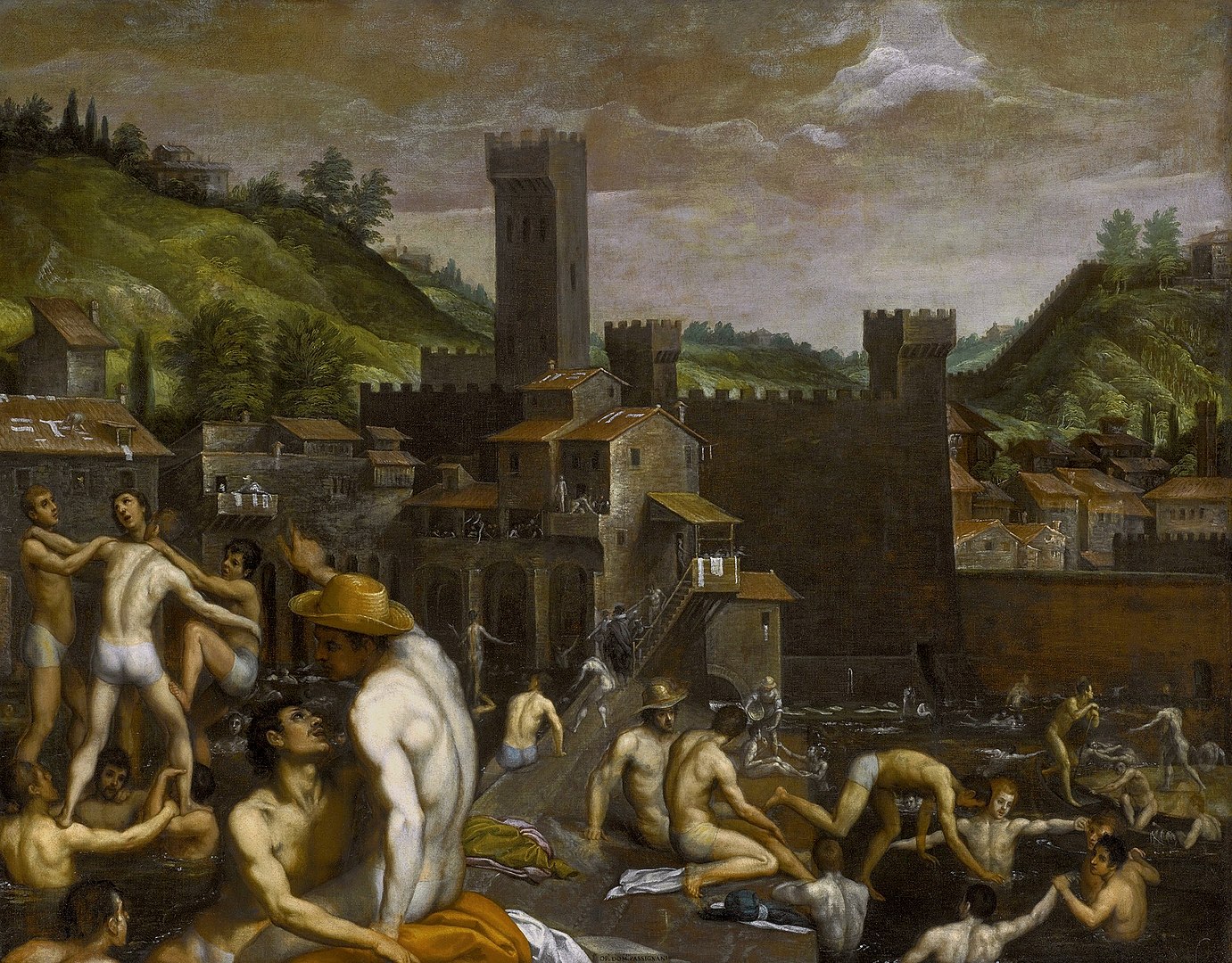
Passignano’s Bagnanti a San Niccolò (The Bathers at San Niccolò) c.1600

Throughout its long and culturally rich history, Florence, Italy has been a singular beacon for artistic innovation, intellectual inquiry, and—though often unspoken—a degree of sexual tolerance that fostered the flourishing of queer artistic expression. While not free of repression or societal prejudice, Florence’s nuanced approach to male same-sex desire, especially during the Renaissance, provided a relatively permissive environment in which gay artists, writers, and patrons could explore themes of male beauty and homoeroticism with a boldness rarely seen elsewhere in Europe. This openness left a profound imprint on Western art, particularly in the celebration of the idealized male nude.

Florence’s complex relationship with homosexuality begins with its legal records. In the late Middle Ages and early Renaissance, Florentine officials did periodically prosecute acts of sodomy; however, these charges were often handled by a special court called the Ufficiali di Notte (Officers of the Night), which, rather than enforcing severe punishment, often issued small fines or encouraged discretion. Historians such as Michael Rocke have detailed how this legal system—while certainly functioning to monitor sexuality—also allowed a surprising degree of leeway. Rocke’s influential study, Forbidden Friendships: Homosexuality and Male Culture in Renaissance Florence, documents how widespread male same-sex relations were, particularly among youths, apprentices, and even within elite circles.

This complex system of tacit tolerance allowed many artists and patrons to pursue relationships and artistic themes centered on male beauty without immediate fear of extreme censure. The Church’s looming influence often required a veil of classical or mythological allegory, but Florentine artists mastered this strategy, embedding homoerotic ideals within celebrated and culturally accepted artworks.

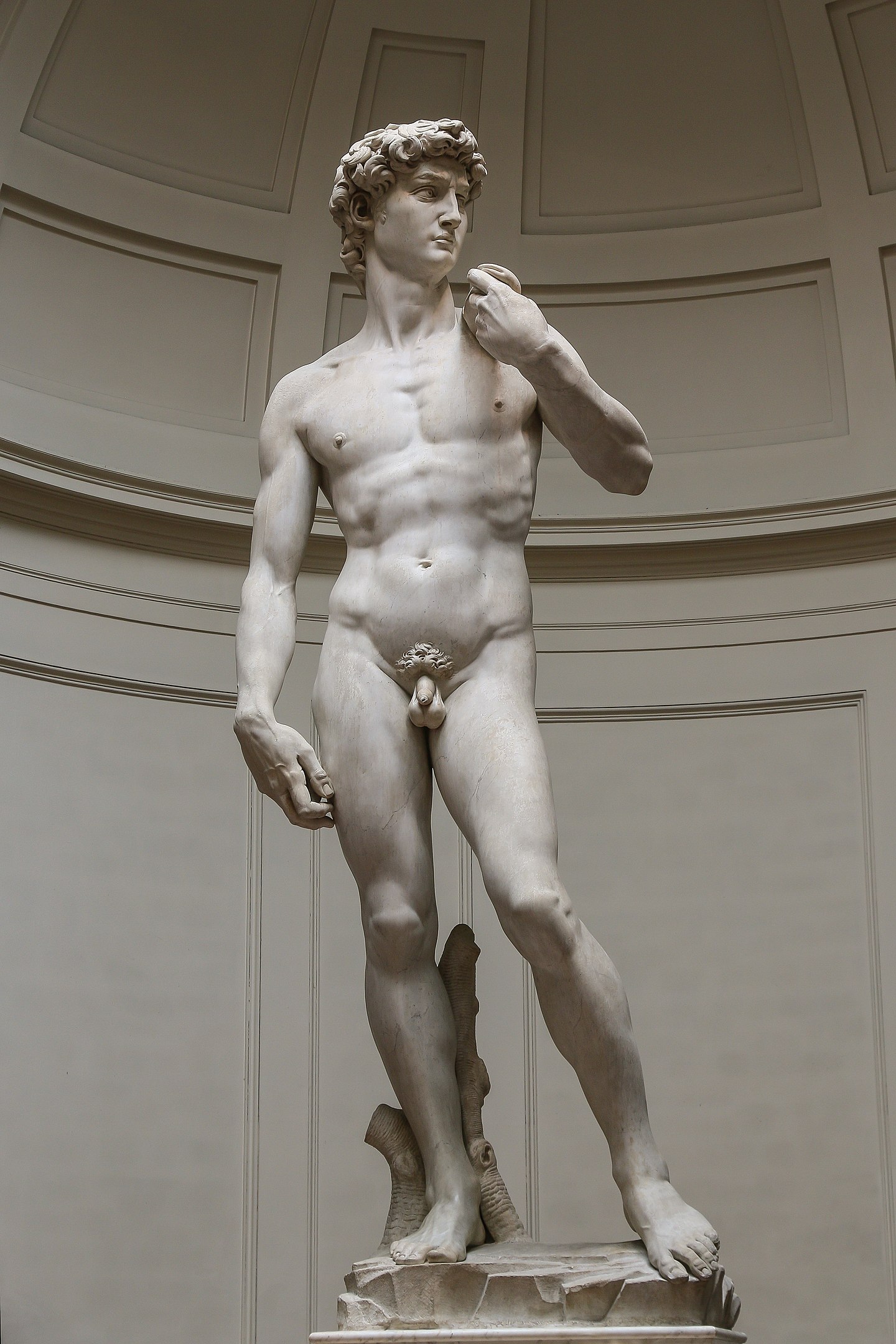
The Renaissance’s rediscovery of Greco-Roman ideals—particularly in Florence—led to a renewed emphasis on the idealized human form. Nowhere was this more apparent than in the explosion of male nude imagery, often clothed in mythological or biblical themes but clearly intended as a vehicle for the admiration of masculine beauty.Michelangelo Buonarroti, one of Florence’s most revered sons, was perhaps the most prominent example of this convergence of artistic genius and homoerotic expression. Deeply religious yet emotionally and artistically drawn to male beauty, Michelangelo left behind a vast body of work—both visual and poetic—that expresses intense admiration for the male form. His David (1501–1504), sculpted from a single block of marble, stands as the quintessential expression of the ideal male nude. While ostensibly a biblical hero, the sculpture’s nudity, grace, and sensuality are undeniably rooted in classical aestheticism and personal admiration. 

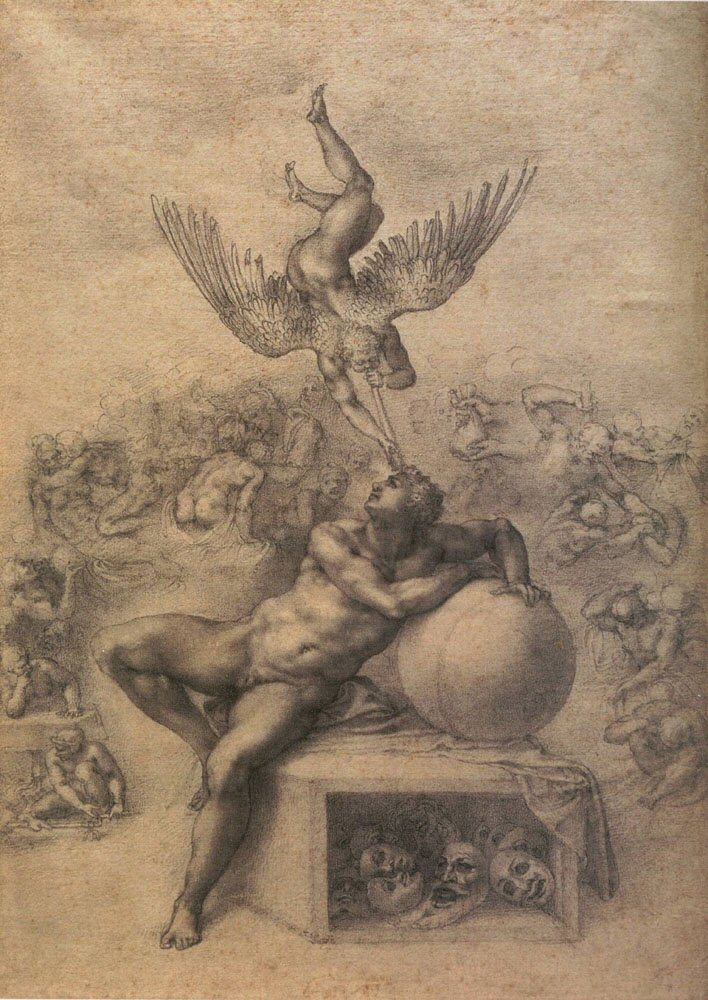
Michelangelo’s Il Sogno (The Dream)

Michelangelo’s love poems to young men like Tommaso dei Cavalieri further reveal the emotional landscape from which these artistic works emerged. Deil Cavalieri also appeared in Michelangelo’s art, such as in his 1533 drawing Il Sogno(The Dream). While the drawing is not directly linked to de’ Cavalieri, its similarity with the others has suggested to some scholars that it was connected to them. Unlike other works, the iconography does not derive from Greek mythology, and its subject is interpreted as related to beauty.
Michelangelo’s Dusk and Dawn on the Tomb of Duke Lorenzo

In the Medici Chapel (1520s–1530s), Michelangelo again uses male nude figures as symbolic forms in his allegorical representations of Dawn, Dusk, Night, and Day—emphasizing not only the muscular male body but also the melancholic introspection often associated with unattainable longing.

Da Vinci’s A Nude Man seen from the Front, c1480

Leonardo da Vinci, though more cautious than Michelangelo, also exemplifies this phenomenon. Arrested as a young man for accusations of sodomy (which were ultimately dropped), Leonardo lived most of his life with male companions and frequently drew male nudes, many of which contain sensual, almost tender depictions of the male body. His anatomical studies, such as those housed in the Royal Collection at Windsor, reflect an obsessive and intimate familiarity with male physicality, often surpassing the scientific purpose of the sketches.

Donatello, David (back view), c. 1440

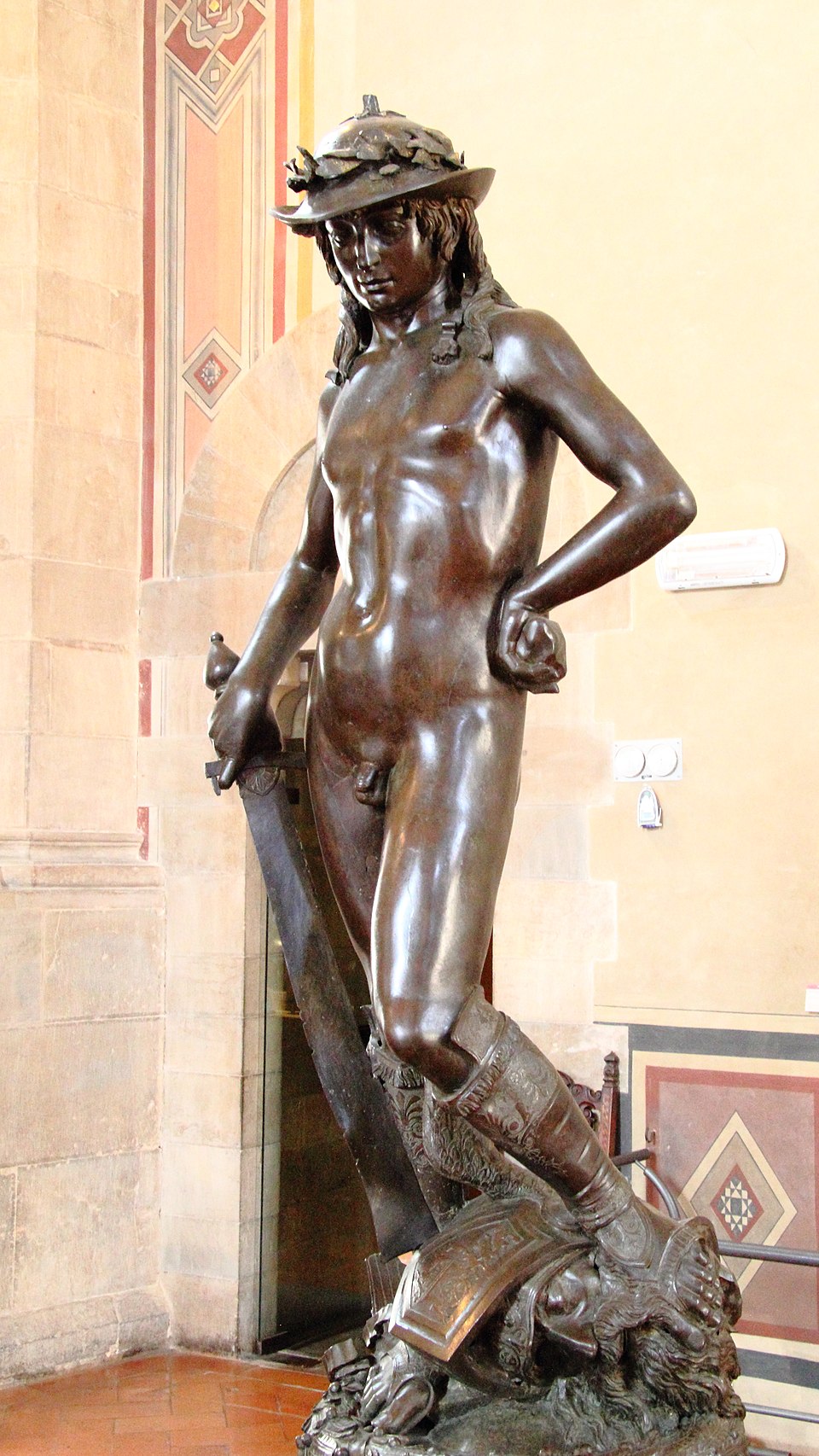
The relative tolerance of same-sex love, coupled with the city’s humanist and aesthetic philosophies, gave rise to a cultural milieu where queer-coded art could flourish under classical and religious guises. This climate, while not openly affirming, allowed for an extraordinary level of subtextual and symbolic freedom. Artists such as Donatello, whose bronze David (c. 1440s) predates Michelangelo’s and features a more androgynous, sensual portrayal, added to the lexicon of homoerotic art in Florence. The languid pose, feather-brushed thigh, and soft musculature of Donatello’s David have been widely read by scholars as a coded celebration of male eroticism.

In literature, figures like Marsilio Ficino, a Neoplatonist philosopher under Medici patronage, exalted same-sex spiritual love as part of divine beauty. Ficino’s translations of Plato’s Symposium and other works gave philosophical legitimacy to love between men, which would become a foundational element of Renaissance humanism.

This artistic tradition continued to echo well beyond the Renaissance. In the 19th and early 20th centuries, Florence attracted numerous queer expatriates and artists who found inspiration and refuge in the city’s tolerant atmosphere and classical aesthetic. Figures such as Edward Perry Warren, John Addington Symonds, and even E.M. Forster spent time in Florence, drawn by its legacy of beauty, art, and the sensual freedom subtly encoded in its cultural DNA. 

Leighton’s The Sluggard, 1885

One of the most compelling and explicitly queer figures connected to 19th-century Florence is not Italian, but Frederick Leighton (1830–1896), the British painter and sculptor who was part of the expatriate art community in Italy. Leighton traveled extensively throughout Italy and maintained a strong relationship with Florence, where he studied and engaged with the classical tradition. Though he spent much of his later life in London, Florence was instrumental in shaping his early artistic ideals.Florence’s nuanced and historically shifting tolerance toward homosexuality enabled one of the most robust and beautiful traditions of male nudity in Western art. Through sculpture, painting, poetry, and philosophy, gay artists and patrons were able to explore male beauty not merely as a classical ideal but as a deeply personal, emotional, and sometimes spiritual pursuit. Florence stands as a historical haven—not without contradiction or repression, but with a legacy of quiet dignity and artistic boldness that continues to inspire to this day.


Rebirth in Marble and Paint: The Renaissance Celebration of the Male Nude

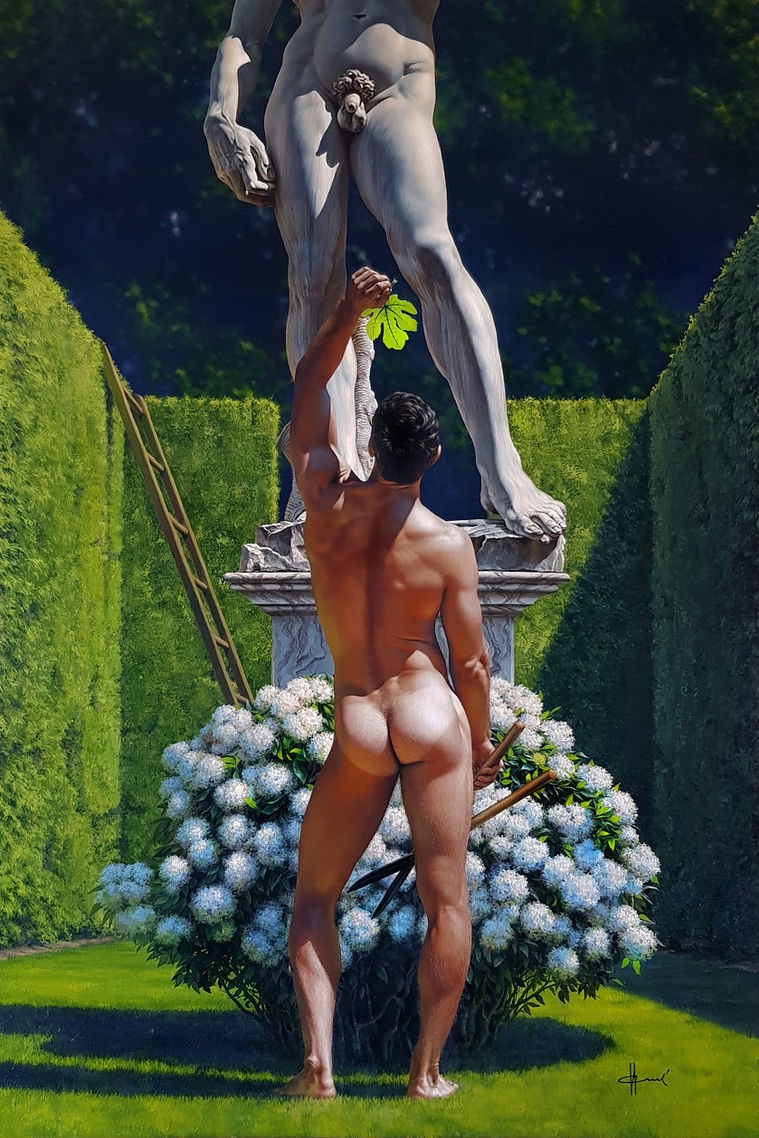
Leaf of Sanctimony by Igor Sychev

The Renaissance was a period of extraordinary artistic innovation, deeply rooted in the revival of classical antiquity. One of the most striking aspects of this artistic rebirth was the depiction of the male nude, which emerged as a central subject in painting and sculpture. Inspired by the idealized human form of ancient Greek and Roman art, Renaissance artists sought to depict the male body with a renewed emphasis on anatomical precision, movement, and harmony. Through their works, they celebrated the human body not only as a physical entity but as a symbol of intellectual and moral excellence.  

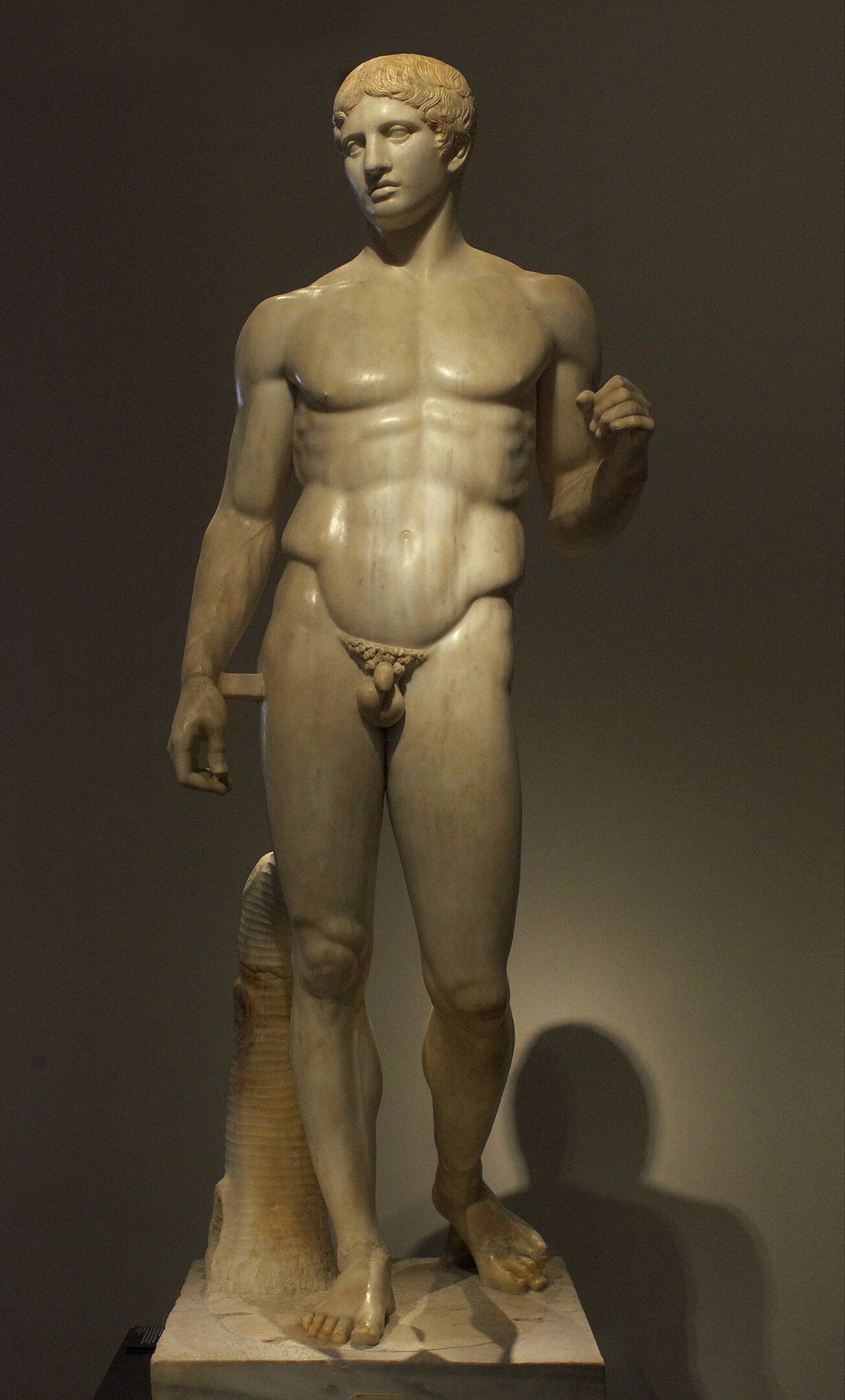
The Renaissance aesthetic for the male nude was heavily influenced by the rediscovery of Greco-Roman sculptures, such as the Doryphoros of Polykleitos and the Laocoön and His Sons. These works provided artists with a model for idealized proportions, muscularity, and contrapposto—a stance in which the body’s weight is shifted onto one leg, creating a dynamic yet balanced composition. Renaissance humanism further reinforced this fascination with the body, as artists and scholars viewed the human form as a reflection of divine beauty and the perfection of nature. 

Donatello’s David (c. 1440-1460)

One of the earliest and most significant Renaissance depictions of the male nude is Donatello’s David, a bronze sculpture that stands as a departure from medieval artistic conventions. Unlike earlier depictions of David, which were typically clothed and rigid, Donatello’s David is an entirely nude, youthful figure standing in a relaxed contrapposto stance. His slender yet graceful form recalls ancient Greek statuary, while the sensuality of his pose and delicate features introduce a new level of naturalism. This was one of the first freestanding male nudes since antiquity, marking a return to the classical ideal of the human body as a subject worthy of artistic exploration.  

Michelangelo’s David (1501-1504)

If Donatello’s David embodied grace and youthful beauty, Michelangelo’s David elevated the male nude to an expression of power and intellect. Created from a single block of marble, this towering figure stands over 17 feet tall, emphasizing strength and heroic idealism. Michelangelo’s meticulous study of anatomy is evident in David’s muscular definition, veins, and tense posture, reflecting both physical perfection and psychological depth. The influence of classical antiquity is clear, yet Michelangelo imbues his David with a distinctly Renaissance sense of individualism and self-awareness. Unlike Donatello’s contemplative David, Michelangelo’s version captures the moment before action, his furrowed brow and focused gaze conveying the tension of impending battle.  

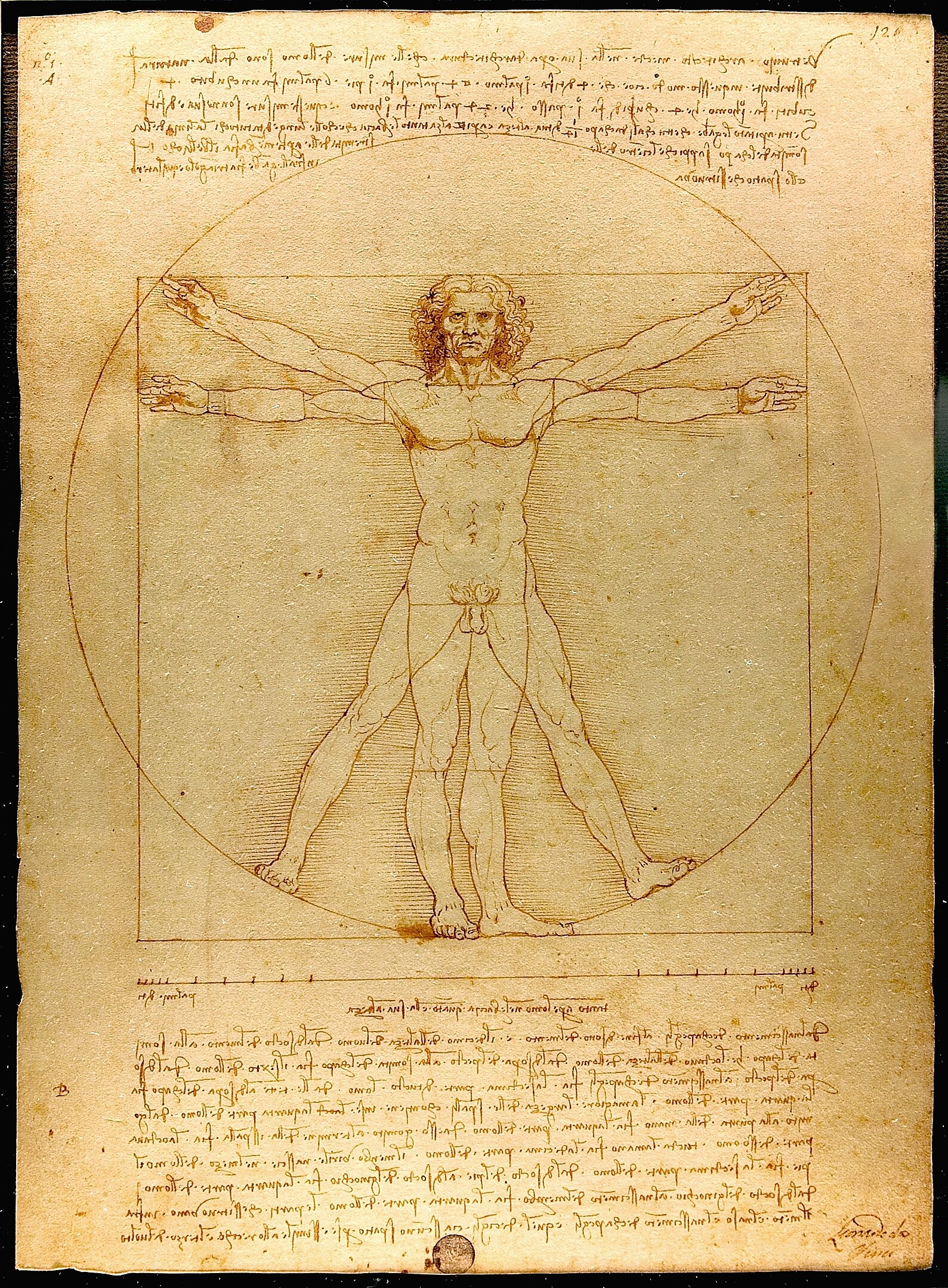
Leonardo da Vinci’s Vitruvian Man (c. 1490)

Though not a finished artwork, Leonardo da Vinci’s Vitruvian Man remains one of the most iconic representations of the Renaissance fascination with the male nude. Based on the writings of the ancient Roman architect Vitruvius, Leonardo’s drawing explores the mathematical proportions of the human body, inscribing a nude male figure within both a square and a circle. This image is not only an anatomical study but a philosophical statement on the harmony between man and the universe. Leonardo, like many Renaissance artists, saw the male body as a manifestation of divine order, bridging art, science, and humanism.  

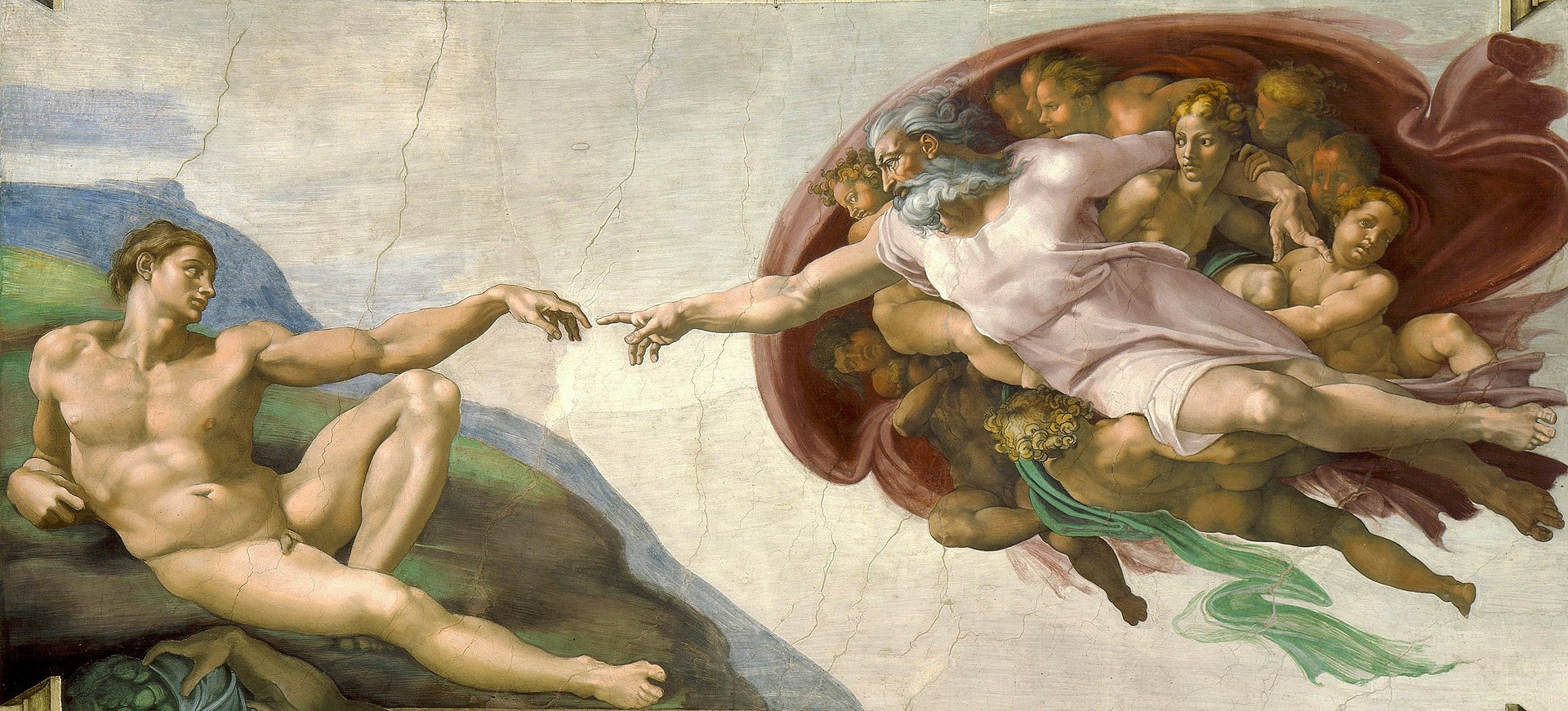
Michelangelo’s The Creation of Adam (1511-1512)

Another of Michelangelo’s masterful depictions of the male nude is found in The Creation of Adam, a fresco on the Sistine Chapel ceiling. Here, the muscular, reclining figure of Adam reaches out toward God in a moment of divine animation. Adam’s body, sculpted with the precision of an ancient Greek athlete, exudes both physical perfection and vulnerability, symbolizing humanity’s potential and dependence on divine grace. The composition and exaggerated gestures heighten the drama of the scene, making it one of the most celebrated images of the Renaissance.  

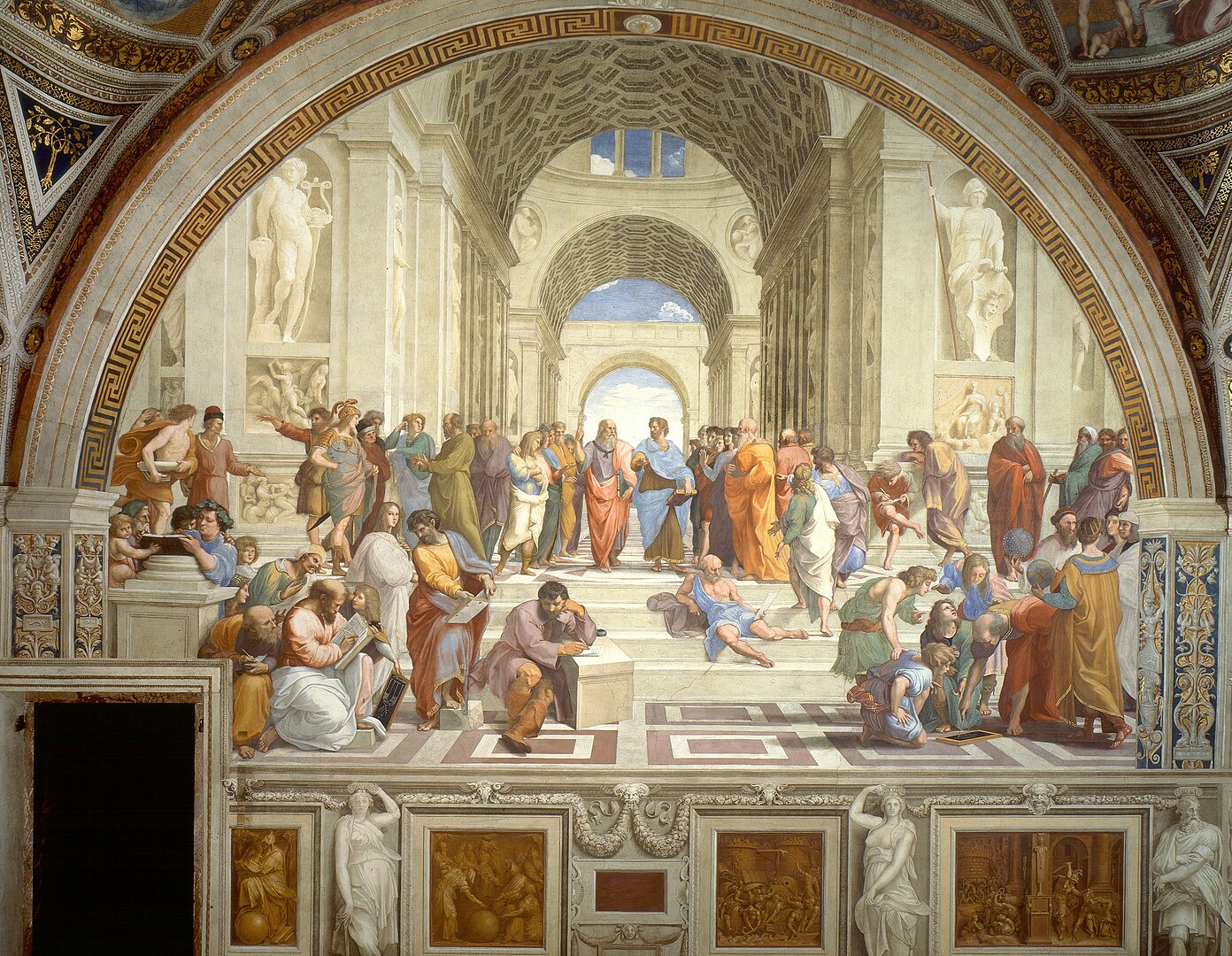
Raphael’s The School of Athens (1509-1511)

While Raphael is best known for his refined, idealized figures, The School of Athens includes several striking male nudes that showcase his mastery of anatomy and composition. The figures reclining in the foreground, likely inspired by classical sculptures, demonstrate the Renaissance artist’s ability to capture the beauty of the human form while integrating it into a grand intellectual scene. Unlike Michelangelo’s muscular intensity, Raphael’s figures possess a softer elegance, reflecting the harmonious balance that defined his artistic style.  

The Renaissance aesthetic for the male nude in art was a testament to the period’s renewed admiration for classical ideals, humanism, and scientific inquiry. Whether through the sensual grace of Donatello’s David, the heroic grandeur of Michelangelo’s sculptures, or the intellectual rigor of Leonardo’s anatomical studies, Renaissance artists transformed the male nude into an enduring symbol of beauty, strength, and the limitless potential of mankind. Their works not only revived ancient artistic traditions but also laid the foundation for future generations of artists who would continue to explore and celebrate the human form. 

Bathers: Depictions of Victorian Male Nudity

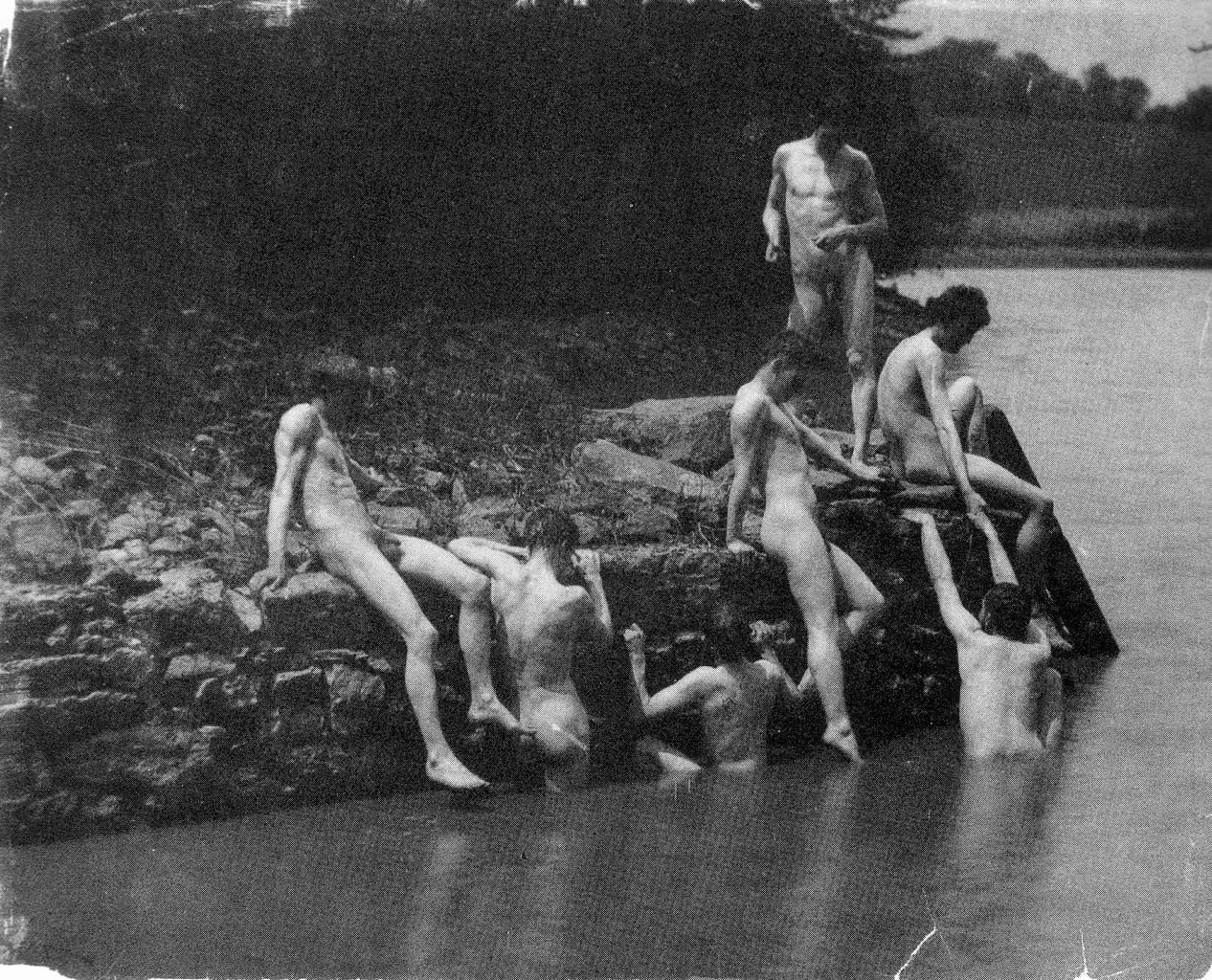
Thomas Eakins’ students swimming naked in Dove Lake, c. 1883–84

Four paintings—The Swimming Hole (1885) by Thomas Eakins, The Bathers (1898–1905) by Paul Cézanne, The Bathing Group (1914) by Henry Scott Tuke, and The Bathers (1885) by John Singer Sargent—each depict figures in or near water, a subject with deep art historical roots. They each depict the one of the few exceptions to the generally prudish Victorian attitude to nudity: swimming naked was widely accepted, and for males was seen as normal, even in public spaces. The other notable exceptions are depictions of nudes in classical, mythological, and allegorical art.

I have been looking at many 19th century artists, particularly American artists, for a class I am teaching, and one thing I have noticed that is remarkably different from Renaissance art is the lack of male nudes. In the Renaissance, some of the most famous pieces of art are of male nudes; Michelangelo’s and Donatello’s depictions of David come to mind. Yet, in 19th century America, few of the art produced are of nude men. However, female nudity abounds. The great American sculptor Hiram Powers’s The Greek Slave (1843) is of a young nearly naked woman in chains. The only depiction I know of Powers that was of a male nude is The Fisher Boy (1857). Both sculptures are of examples of classical and allegorical works.

The Greek Slave (1843) and The Fisher Boy (1857) by Hiram Powers

The four paintings by Eakins, Cézanne, Tuke, and Sargent are exceptions to the lack of male nudity. However, each approaches the theme of male nudity with distinct stylistic and thematic differences. The theme of male bathers has long been a subject in Western art, and like nearly all male nude artwork, the bathers often carry homoerotic undertones. The role of homoeroticism varies depending on the artist’s personal life, stylistic choices, and the cultural context in which they worked. Most of the known gay or bisexual men throughout history were artists. There are a few exceptions, and with nearly all of these historical figures, their sexuality has become a source of great debate. The sexuality of Eakins and Sargent are hotly contested in the art world. The sexuality of Cézanne has questioned for his personal detachment from women, lifelong male friendships, and repeated depictions of male figures in communal settings have led to some speculative interpretations. However, Tuke’s sexuality is not really debated. During the 1880s, Tuke met Oscar Wilde and other prominent poets and writers such as John Addington Symonds, most of whom were Uranian, an archaic term for homosexual men. Tuke’s art is sometimes referred to as Uranian art.

The Swimming Hole by Thomas Eakins

Eakins’ The Swimming Hole is a realist depiction of young men bathing in a natural setting. The composition is carefully structured, with figures arranged dynamically, demonstrating Eakins’ deep understanding of anatomy. He used photography as a reference, contributing to the work’s precision. The painting celebrates the male form, and some scholars suggest a homoerotic subtext, particularly given Eakins’ personal interest in male camaraderie and physicality. Eakins was deeply interested in the male nude, often using his students and friends as models in his photographic and painted studies. The Swimming Hole is notable for its emphasis on the beauty of the male form, with figures depicted in relaxed, intimate, and naturalistic poses. Eakins’ career was marked by controversy, particularly his insistence on using nude male models in his teaching, especially when women were present in class, which ultimately led to his dismissal from the Pennsylvania Academy of the Fine Arts. While Eakins’ sexuality remains debated, his work suggests an intense fascination with the male body that aligns with homoerotic artistic traditions.

The Bathers by Paul Cézanne

Cézanne’s The Bathers presents a more abstracted and structural approach to the human form.. Cézanne’s approach to the male nude was more detached and formal, reducing figures to geometric forms and emphasizing composition over sensuality. He merges the men with the surrounding landscape. His brushwork and color palette are highly expressive, prioritizing form over detail. This painting is part of a series of bathers that played a crucial role in the development of modern art, influencing Cubism and abstraction. Rather than focusing on individuality, Cézanne treats the figures as part of a broader compositional harmony. While his Bathers paintings lack the overt homoeroticism seen in Eakins or Tuke, some scholars have suggested that Cézanne’s awkwardness around women and preference for male companionship may be reflected in his repeated depictions of groups of men in idealized, classical settings. His work was admired by later artists interested in queering traditional artistic forms, though it remains more intellectual than sensual.

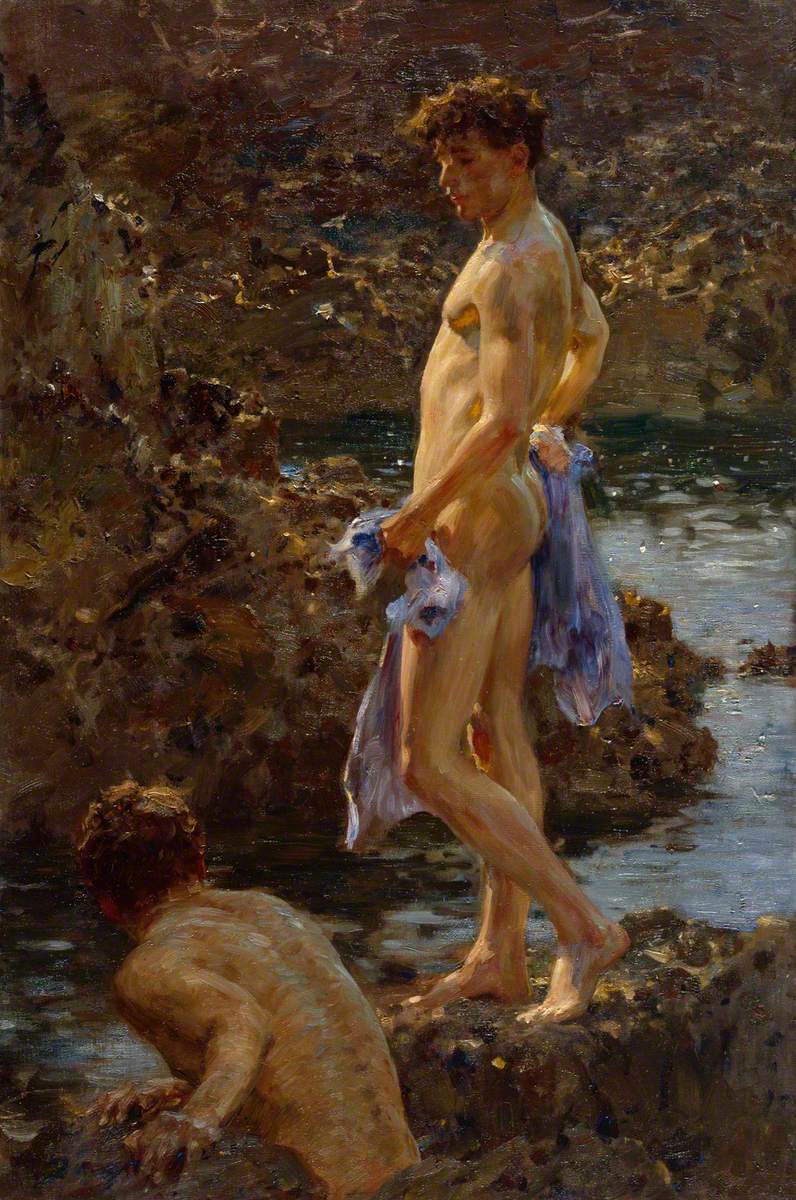
A Bathing Group by Tuke, Henry Scott Tuke

Tuke’s The Bathing Group shares thematic similarities with Eakins’ Swimming Hole, as it portrays young men bathing in a sunlit outdoor setting. However, Tuke’s work has a softer, impressionistic style with warm, glowing light that romanticizes the scene. His focus on adolescent male figures, combined with his use of color and light, creates an atmosphere of nostalgia and idealized youth. The painting reflects Tuke’s broader oeuvre, which often explored themes of male beauty and companionship in idyllic coastal settings. Tuke’s work is the most overtly homoerotic among the four painters. He frequently painted young, athletic men in idyllic seaside settings, often nude or minimally clothed, with a warm, romanticized glow. Unlike Eakins, whose realism could be read as clinical, Tuke’s impressionistic style and soft, golden lighting emphasize youth and sensuality. Tuke was known to have had close relationships with young men, and while his exact sexual orientation remains ambiguous, his work clearly celebrates male beauty in a way that aligns with homoerotic traditions in art.

The Bathers by John Singer Sargent

Sargent’s The Bathers is more atmospheric and impressionistic than the others. It captures figures relaxing by the water, with loose brushwork and an emphasis on light and movement. Unlike Eakins’ rigorous realism or Cézanne’s abstraction, Sargent’s fluid style suggests spontaneity, capturing a fleeting moment rather than a structured composition. His interest in light and fabric is evident, as the painting conveys a sense of leisure and elegance characteristic of Sargent’s work. Sargent, like Tuke, has long been the subject of speculation regarding his sexuality. His portraits of both men and women often exude sensuality, and his friendships with men such as the poet and aesthete Vernon Lee suggest an affinity for male beauty. In The Bathers, Sargent takes a more impressionistic and fleeting approach to the subject, capturing a moment of leisure rather than lingering on the erotic possibilities of the male nude. However, his interest in male figures and fluid, suggestive brushwork align with the aesthetic codes often used to signal homoerotic desire. Sargent’s art is best known for his beautiful depictions of women in their finest clothing, and the majority of Sargent’s depictions of nude men were not discovered until after his death.

Each of these paintings offers a unique interpretation of the bathing scene and their homoerotic subtext reflect the respective artists’ styles, concerns, personal inclinations, and broader artistic movements. Eakins’ and Tuke’s paintings are more naturalistic, while Cézanne’s and, to some extent, Sargent’s approach abstraction or impressionism. Eakins prioritizes anatomical precision, while Cézanne breaks forms into geometric masses. Tuke and Sargent take a softer, more atmospheric approach. Eakins presents the male nude in a studied, naturalistic, and academic way, but his fascination with the subject led to controversy for potentially suggesting homoerotic undertones. Tuke romanticizes youth, while Cézanne constructs a timeless, almost mythological world, and Sargent captures a fleeting, elegant moment. Cézanne abstracts the figures, distancing them from direct sensuality but engaging with ideas of male camaraderie. Tuke openly romanticizes and celebrates youthful male beauty in a manner that strongly suggests queer desire. Sargent is more ambiguous, capturing fleeting moments of male interaction with a sensuous yet reserved touch. While only Tuke’s work seems directly intended to be read as homoerotic, all four artists contribute to a visual tradition in which the male nude serves as both a formal study and a space for exploring desire, intimacy, and beauty.


The Aesthetics of the Male Nude in Ancient Art

The male nude was a central subject in the art of many ancient civilizations, particularly in Greece and Rome, but also in Egypt and Mesopotamia. These representations were not just artistic choices but carried deep cultural, religious, and philosophical meanings. The aesthetic of the male nude in the ancient world often emphasized idealized forms, physical perfection, and heroic attributes, reflecting societal values and beliefs about masculinity, virtue, and even divine favor.

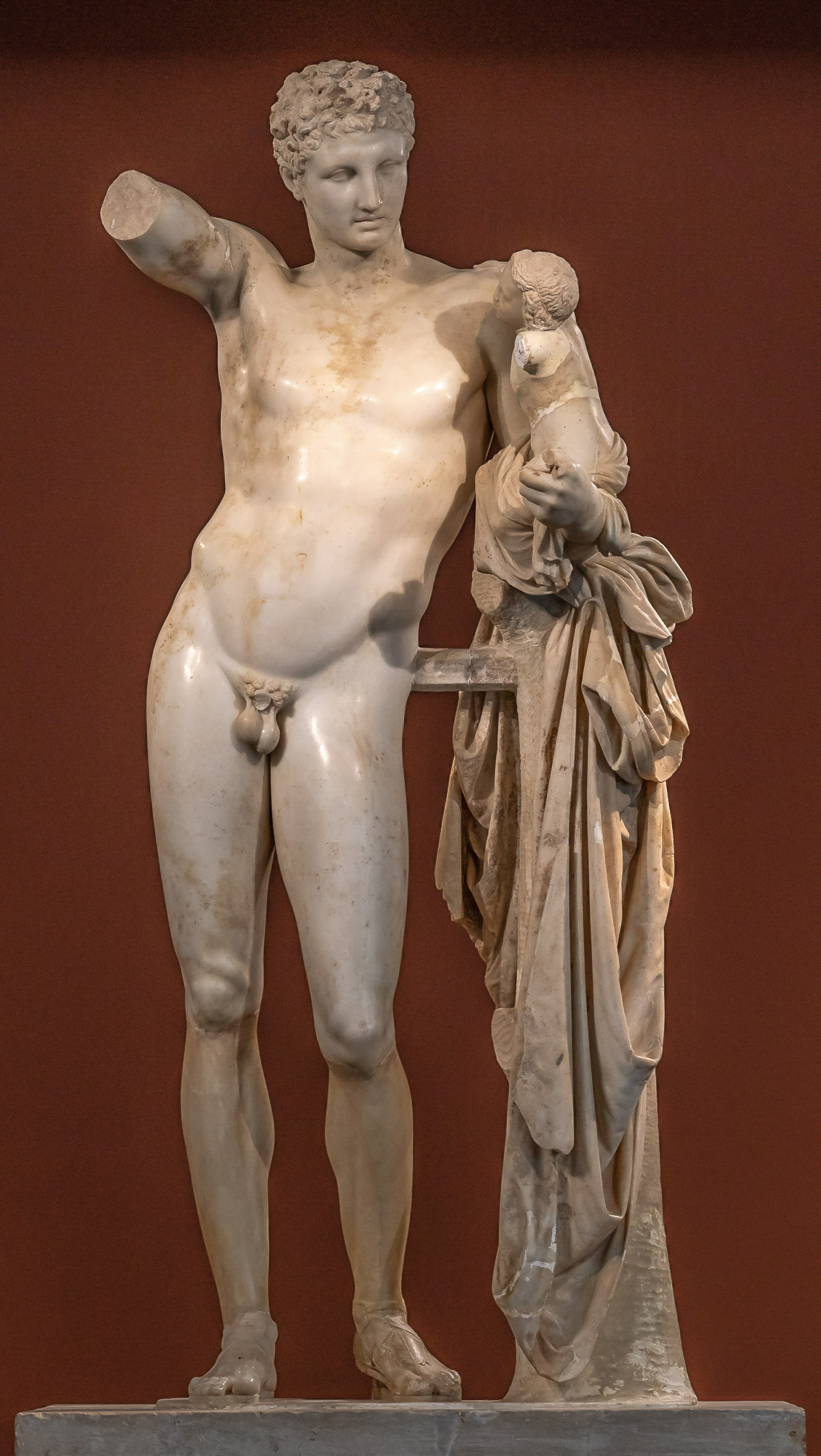
In ancient Greek art, the male nude was idealized in sculpture, particularly in works such as Polykleitos’ Doryphoros and Praxiteles’ Hermes and the Infant Dionysus. The Greek kouros statues (early archaic depictions of young men) emphasized youthful beauty, symmetry, and a balance between realism and idealization. Nudity in Greek art was associated with athleticism, heroism, and even moral virtue, reflecting the Greek belief that the male form was the pinnacle of divine beauty. Greek vase paintings often depicted nude male athletes, warriors, and gods, reinforcing the connection between physical excellence and noble character. The gymnasium (a place where young men trained nude) was both an athletic and intellectual center, reinforcing the idea that physical and intellectual excellence were intertwined. 

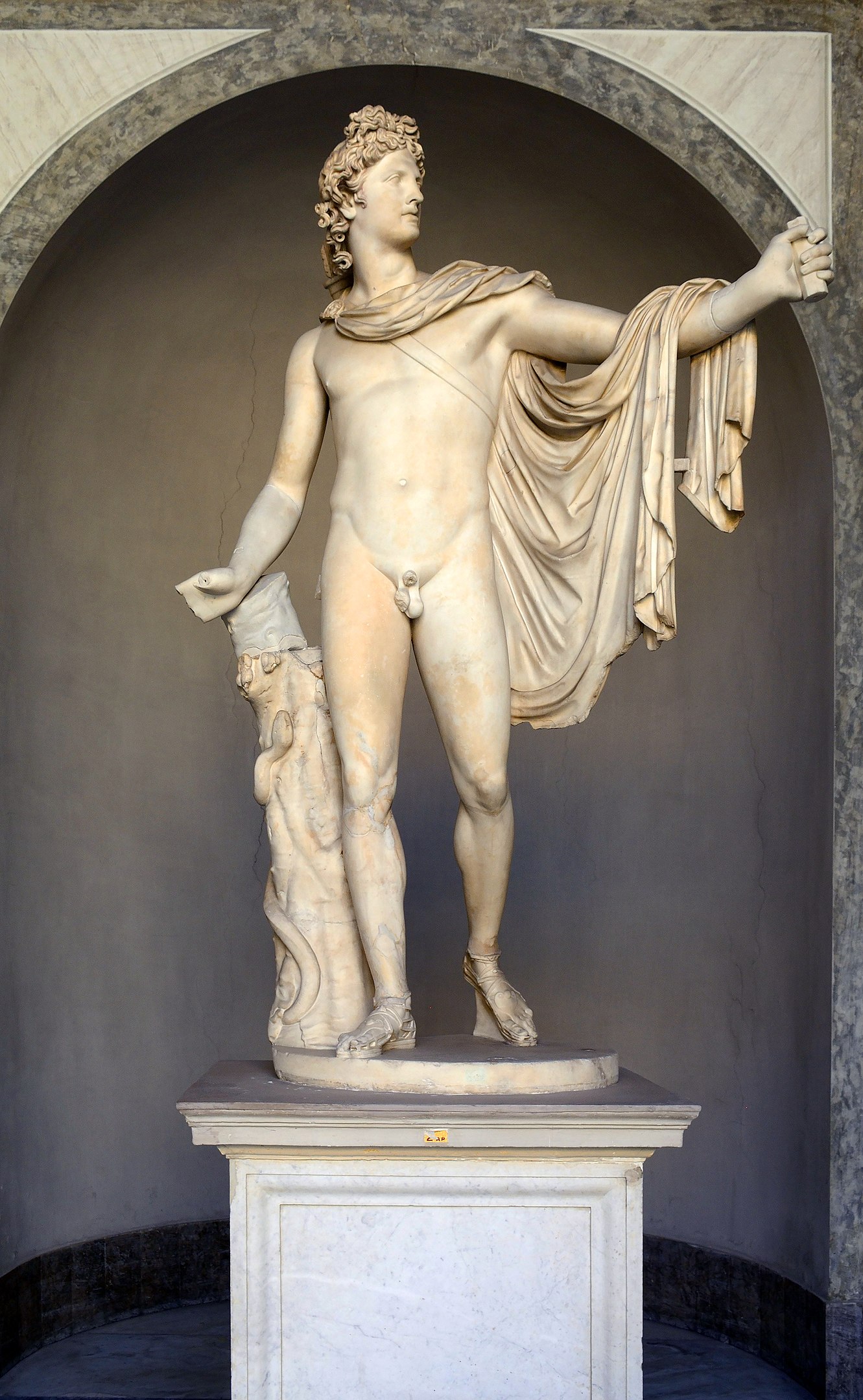
The second century Roman copy of the Apollo Belvedere is one of, if not the, most celebrated marble sculpture of a nude male from classical antiquity. From the mid-18th century, it was considered the greatest ancient sculpture by ardent neoclassicists, and for centuries it epitomized the ideals of aesthetic perfection for Europeans and westernized parts of the world. The Apollo became one of the world’s most celebrated art works when in 1755 it was championed by the German art historian and archaeologist Johann Joachim Winckelmann as the best example of the perfection of the Greek aesthetic ideal. Its “noble simplicity and quiet grandeur,” as he described it, became one of the leading lights of neoclassicism and an icon of the Enlightenment. Goethe, Schiller, and Byron, all endorsed it. The Apollo was one of the artworks brought to Paris by Napoleon after his 1796 Italian Campaign. From 1798 it formed part of the collection of the Louvre during the First Empire, but after 1815 was returned to the Vatican where it has remained ever since.

The frequent depiction of the male nude in ancient art reveal how cultures conceptualized beauty, masculinity, and relationships between men. In ancient Greece, for example, the admiration of the male form was closely tied to pederasty, a socially accepted relationship between an older man (erastes) and a younger man (eromenos). This relationship was often educational and mentorship-based but could also have an erotic component. Greek vase paintings sometimes depicted these relationships explicitly, showing affection between men, including courtship rituals like gift-giving or intimate gestures. In Rome, male-male relationships existed, but Roman masculinity was defined differently than in Greece. A freeborn Roman man (citizen) could engage in relationships with other men, but societal norms dictated that he should take the dominant role; being the passive partner was seen as unmanly. Roman frescoes and sculptures sometimes depicted homoerotic themes, especially in private or mythological contexts, such as scenes involving the god Ganymede, who was abducted by Zeus.

While not often, Greek and Roman art would feature homoerotic relationships. One of the most compelling pieces of ancient Roman art that directly addresses same-sex desire is the Warren Cup, a silver drinking vessel from the 1st century CE. The Warren Cup, named after its modern owner Edward Perry Warren, is a luxurious Roman silver cup featuring explicit homoerotic scenes. The two sides of the cup depict male-male sexual encounters between older and younger men, rendered in a detailed and naturalistic style. The craftsmanship suggests that it was an elite object, likely used in private banquets (symposia) where discussions of philosophy, poetry, and sexuality took place. The scenes on the cup align with what we know of Roman and Greek attitudes toward male-male relationships. The figures are shown engaging in acts that emphasize the older man as the active partner and the younger as the passive partner, reflecting Roman norms around masculinity and dominance in sexual relationships. The setting, with draped beds and carefully arranged compositions, suggests that such relationships were not only known but also accepted in elite social circles. The cup’s artistic style is distinctly Greco-Roman, with a focus on idealized musculature and classical composition. The use of silver, a valuable material, indicates that it belonged to a wealthy individual who may have collected art reflecting personal tastes or cultural ideals around eroticism.

Continue reading

Art and the Naked Man

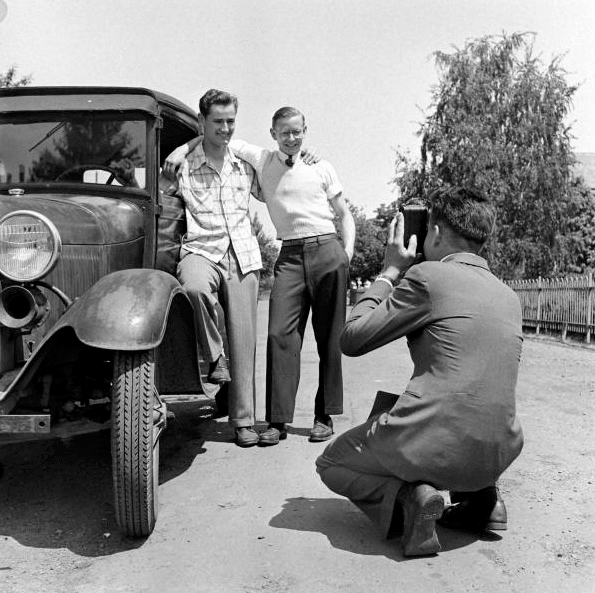
I post a lot of nude photography of men. I have always preferred images that look less professional or posed and I keep away from selfies, except in the pics of guys with cameras that I post on Tuesdays. Occasionally, I receive criticism for posting male nudes while at the same time talking about my faith each Sunday. I think the male body should be celebrated, and some of my readers come to see the photos I will post. If that means they also read my devotionals on Sundays, then it spreads the message I try to convey. That being said, I thought I’d start a weekly series on the male nude in art throughout the history. I doubt I will go in chronological order, but more of an introduction today focusing on the photography of male nudes.

Photography has been a crucial medium in LGBTQ+ art, providing a powerful way to explore identity, desire, and resistance. Male nude photography, in particular, has played a significant role in shaping the visual language of queer art, challenging societal norms, and creating spaces for LGBTQ+ expression. From the early coded works of the 19th century to the bold imagery of contemporary artists, male nude photography has been a key site of queer visibility and activism.

Art has been part of the appreciation of the male body throughout history. The male nude has been a central subject in the history of art, serving as a symbol of idealized beauty, power, and the human condition. In ancient Greece and Rome, male nude sculptures celebrated physical perfection and heroism, embodying philosophical ideals of harmony and virtue. During the Renaissance, artists like Michelangelo and Leonardo da Vinci revived classical traditions, using the male form to explore anatomy, movement, and divine inspiration. While religious and mythological themes often justified depictions of male nudity, these works also reflected shifting cultural attitudes toward masculinity, physicality, and artistic mastery.

In later centuries, the male nude became more controversial, especially in Western art, where shifting moral standards led to greater censorship. While female nudes remained common, male nudity was often restricted to academic studies or hidden in private collections. In the 19th and 20th centuries, artists like Édouard Manet, Egon Schiele, and later, queer photographers such as George Platt Lynes and Robert Mapplethorpe, used the male nude to challenge societal norms, explore eroticism, and assert LGBTQ+ visibility. Today, the male nude continues to be a powerful subject, reflecting changing perspectives on gender, identity, and artistic freedom.


Let Us Not Forget

Only be careful, and watch yourselves closely so that you do not forget the things your eyes have seen or let them fade from your heart as long as you live. Teach them to your children and to their children after them.

— Deuteronomy 4:9

Throughout Scripture, we are reminded of the importance of honoring those who came before us—our ancestors, mentors, and spiritual forebears. Their struggles, sacrifices, and faithfulness shape who we are today. For the LGBTQ+ community, this truth carries deep meaning. We stand on the shoulders of those who fought for dignity, justice, and inclusion—those who lived their truth despite discrimination, those who marched for equality, and those who created spaces of love and belonging. We honor them not just in memory, but in action—by continuing the work they started and ensuring that future generations inherit a world of greater love and acceptance. 

Many LGBTQ+ individuals have suffered and died due to systemic injustice, oppression, and neglect. The AIDS crisis took the lives of countless people while governments and religious institutions turned their backs. Sodomy laws criminalized love and sent people to prison simply for being who they were. Many were cast out of their families and churches, denied healthcare, and left to die in isolation. In Matthew 5:4, Jesus tells us, “Blessed are those who mourn, for they will be comforted.” We must remember them—not as victims, but as beloved children of God, as warriors of love, as sacred souls who deserved so much more than what the world gave them. Their lives mattered, and their memory calls us to action.  

The LGBTQ+ rights we have today exist because of those who risked everything to fight for them. The activists who protested government inaction during the AIDS crisis, the individuals who defied sodomy laws, the countless people who lived openly in times of deep persecution—all of them paved the way for the progress we see today. Psalm 145:4 says, “One generation commends your works to another; they tell of your mighty acts.” Honoring them means carrying their torch forward. It means fighting against modern forms of discrimination, advocating for better healthcare, and ensuring that queer and trans youth grow up in a world where they are loved, safe, and valued. 

This week, the National Park Service made significant changes to the Stonewall National Monument’s website, removing references to transgender and queer individuals. The updated site now mentions only “LGB” communities, omitting the “T” and “Q” from the LGBTQ+ acronym. This action aligns with an executive order from our disgraceful current president, which mandates a strict binary definition of sex as male or female. The Stonewall National Monument commemorates the 1969 Stonewall Uprising, a pivotal event in LGBTQ+ history, significantly led by transgender women of color. The recent alterations have sparked widespread criticism, stating that erasing transgender history dishonors the community’s contributions to the LGBTQ+ rights movement and ignores the essential role transgender activists played in the fight for LGBTQ+ rights. 

Psalm 112:6 states, “The righteous will be remembered forever.” True honor is not just remembering—it’s living in a way that reflects the love, justice, and truth of those who paved the way. For LGBTQ+ Christians, this means embracing who God created us to be, showing love to others, and working to make our faith communities more inclusive. It also means demanding justice. The AIDS crisis taught us that silence equals death. Sodomy laws taught us that unjust policies must be challenged. Our faith teaches us that love must be louder than hate, and justice must be pursued with unshakable faith.  

We need to give thanks for those who have come before us—the LGBTQ+ pioneers, the activists, and the everyday heroes who fought for justice and dignity. We must remember those who were taken too soon by AIDS, by state violence, by unjust laws, and by a world that refused to see their worth. We should honor their legacy by living boldly, loving fully, and advocating for those who still face discrimination. Deuteronomy 4:7–9 says, “Only be careful, and watch yourselves closely so that you do not forget the things your eyes have seen or let them fade from your heart as long as you live. Teach them to your children and to their children after them.” Let us not forget.


Two Hours

Jokes about porn dialogue and acting ability are not in short supply, but every once in a while, there are some golden lines, even if the lines delivery is terrible. Gay porn dialogue has gotten better in recently and some even have a “plot.” Yeah, I know, it’s hard to believe l, right? Through the years, there have been a few porn movies with a definite plot. Top Secret (2000) starring Corey Summers in two roles had a pretty decent plot, but if there is a plot in most porn movies, it’s barely there. Ok, I’m getting off track.

Vintage gay porn dialogue can be intentionally quite humorous at times. Of course, most of the time it is not intentional. I recently watched My Best Buddy (1988), which was most definitely short on plot. Basically, it is about two “best buddies” traveling separately across the country to spend the summer with one of the guy’s brother. The final scene is with Chris Williams (pictured above) and the aforementioned brother (I don’t know this actor’s name) they are going to stay with. So here’s the setup for the movie’s final scene:

Chris arrives first and the brother is not home. He’s let in by the apartment manager, who, of course, propositions him, but Chris says he just wants to take a shower to get the travel grime off him and take a nap. Cut to Chris getting undressed down to his white briefs and flopping down on the bed.

As he’s dozing off, the brother comes home, and Chris pretends to be asleep. The brother remarks that his brother’s friend “sure has grown up.” Then, creepily, begins to run his hand over the butt of the sleeping friend before pulling down the guy’s briefs and beginning to rim him. During all of this, Chris is awake but feigning sleep. 

Chris finally decides to wake up, and utters one of my favorite lines I’ve ever heard in porn, “I don’t know who you are, but you have about two hours to stop doing that.” I’m pretty sure you can figure out yourself what happens next. The movie ends with Chris and the brother naked post coitus in bed discussing plans for dinner when the other brother arrives. The two guys jump under the covers as the brother walks into the room and looks shocked that his brother and best buddy are naked in bed together. Then, fade to black.

The only thing about vintage gay porn that you have to suspend belief about is that so many of these guy’s died during the AIDS epidemic. Sadly, Chris Williams was one of those young men and died in 1992.


Ugh! Work

I wish I could stay home this morning, but I have a few things I need to be at the museum to do. If I had my work computer here, I’d call in sick. I left at lunch yesterday because I had a migraine. This morning, it’s not much better, in fact it’s not better at all. I may only go in for a partial day. I need my work computer to do much of what I need to do today.  I have a school group coming today, but my boss could handle that. However, I need my computer for the rest of what’s on my agenda. I have some emails to answer; I need to prepare for my classes next week; and I need my computer to be able to work from home tomorrow. I could do all that at home on my personal laptop, but it only has Microsoft Word, not the rest of the Office Suite. I could access it through the online Microsoft 365, but I hate using Office through my browser. It always feels clumsy to me. Anyway, I’ll go in today for whatever length I need to, then, I’ll work from home tomorrow.

Here’s your Isabella pic of the week:

I’d rather be doing this today: laying on my couch with Isabella on my hip. I wish she’d lay in my lap or down my chest and stomach, which she’ll do on rare occasions, but her preference is my hip with me laying on my side. Sometimes, this is how I fall asleep at night, with her on my hip.