Drawn while on the Great Plains, among the Sac and Fox Indians, the sketch depicts a ceremonial dance to celebrate the two-spirit person.
Gay Native Americans call themselves Two-Spirits and have historically been considered a third sex, though they did not suffer castration, which was not common in the Americas. Two-Spirit People is an English term that emerged in 1990, out of the third annual inter-tribal Native American/First Nations gay and lesbian conference, in Winnipeg, to describe Native Americans who fulfill one of many mixed gender roles found traditionally among many Native Americans and Canadian First Nations indigenous groups. The mixed gender roles encompassed by the term historically included wearing the clothing and performing the work associated with both men and women.
A direct translation of the Ojibwe term, Niizh manidoowag, “two-spirited” or “two-spirit” is usually used to indicate a person whose body simultaneously houses a masculine spirit and a feminine spirit. The term can also be used more abstractly, to indicate presence of two contrasting human spirits (such as Warrior and Clan Mother) or two contrasting animal spirits (which, depending on the culture, might be Eagle and Coyote); however, these uses, while descriptive of some aboriginal cultural practices and beliefs, depart somewhat from the 1990 purposes of promoting the term.
Prior to western contact, many American Native tribes had third-gender roles. These include “Berdaches” (a derogatory French term for genetic males who assumed a feminine role) and “Passing women” (genetic females who took on a masculine role). The term Berdache in not a Native American word; rather it was a European definition covering a range of third-gender people in different tribes. Not all Native American tribes had Transgender people.
These individuals are often viewed as having two spirits occupying one body. Their dress is usually a mixture of traditionally male and traditionally female articles. They have distinct gender and social roles in their tribes.
Two-spirited individuals perform specific social functions in their communities. In some tribes male-bodied two-spirits held active roles such as: healers or medicine persons, gravediggers, undertakers, handling and burying of the deceased, conduct mourning and sexual rites, conveyers of oral traditions and songs, nurses during war expeditions, foretold the future, conferred lucky names on children or adults, wove, made pottery, made beadwork and quillwork, arranged marriages, made feather regalia for dances, special skills in games of chance, led scalp-dances, and fulfilled special functions in connection with the setting up of the central post for the Sun Dance.
In some tribes female-bodied two-spirits typically took on roles such as: chief, council, trader, hunter, trapper, fisher, warrior, raider, guides, peace missions, vision quests, prophets, and medicine persons.
Two-spirit people, specifically male-bodied (biologically male, gender female), could go to war and have access to male activities such as sweat lodges. However, they also took on female roles such as cooking and other domestic responsibilities. It is obvious from the list above that Two-Spirits carried out many of the most important tasks of the tribes.
For more information about Two-Spirits, please visit TWO SPIRIT: GBLT INDIAN NATION. It is a very interesting article.
Category Archives: History
Two-Spirit, The American Third Sex
The Sex Lives of Eunuchs
Throughout history, there has existed basically three types of eunuchs: those where were castrated before puberty, those who were castrated after puberty, and those who had their penis and testicles removed during the castration. Those in the first group, who castrated during puberty, never developed mature sexual organs because they did not go through puberty. With the lack of mature male hormones, i.e. testosterone, their voices never changed, they had more feminine features, often gained weight very easily and lacked muscle tone, and they were totally impotent.
The second group, those who were castrated after puberty, went through puberty and though many took on feminine traits, it was easier for them to gain muscle mass, and they had the ability to get an erection. However, because of the lack of testicles, they could not produce sperm and therefore could not reproduce. They did however, have the ability to ejaculate, though instead of the creamy white ejaculate most men produce, it would mostly be a clear viscous liquid composed of the parts of their semen not produced by the testicles. The third group lacked a penis and testicles and therefore were obviously not able to get an erection. They bodies could remain masculine, if the procedure occurred after puberty, but since it was a highly dangerous procedure during the years before modern surgery, it was often performed on young men.
In the Ottoman Empire (modern day Turkey, the Middle East, Northeast Africa, and the Balkans), African slaves who were bought for the purpose of guarding the harem were often taken into the desert on their journey from sub-Saharan Africa to the Sultan’s palace and the procedure was performed there. They young Africans’ penis and testicles were sheared off by a sharp blade, then a hot blade would cauterize the wound, and their bodies were buried in the hot sand up to their necks so that the bleeding could be staunched and the healing could begin. Many did not survive this horrific and barbaric procedure. If they did, they would be taken back to Istanbul as slaves to guard the women of the harem. Africans were not the only eunuchs of the Ottoman Empire.
The conquered Christian communities of the Balkans in Eastern Europe were forced to pay a tax to the Ottoman Empire. Devşirme or devshirme (Serbian: Данак у крви and Bulgarian: Кръвен данък – tribute in blood) was the practice by which the Ottoman Empire conscripted boys from Christian families, who were taken from their families by force, converted to Islam, trained and enrolled in one of the four imperial institutions: the Palace, the Scribes, the Religious and the Military. The devşirme system humiliated non-Muslim societies controlled by the Ottomans and was resisted. Those who joined the military became part of the Janissary, an elite military corps that protected the Sultan. The other young men who would serve in the palace, as scribes, were castrated. These young men, generally, only had their testicles removed and according to how old they were and whether they had been through puberty, determined if they were impotent or not.
Being castrated did not end a eunuchs sex life. The first and last of eunuchs, those castrated before puberty and those who had their sexual organs completely removed, could not perform an active role in sexual relations; however, they could and often did take on the passive role. Eunuchs in history have often held high positions in society because they are seen as trustworthy since the lack of testosterone removes a great deal of aggressive tendencies. They could and did use their sexual abilities to gain favor in royal courts and the jealousies around their power could be used for or against them. Those who had fully functioning penises (i.e. they could get erections) could dominate others and gain favor with women, because they could provide a safe sexual partner without the risk of pregnancy. The downside is that most if not all eunuchs were slaves and just as African-American slaves were subject to the sexual whims of their masters, so were eunuchs in the ancient world.
There will be more posted about the sex lives of eunuchs and the Ottoman Empire later. I am also working on a few posts about Egyptian eunuchs and those in the Far East. There were some fascinating figures who were eunuchs, one Chinese eunuch may have even reached America decades before Christopher Columbus.
Forever Florence
This article, “Forever Florence,” is by Felice Picano and is from from the Fall 2004 issue of The Out Traveler. It is one of my favorite writings about Florence. I wanted to share it with you and I hope that you enjoy it.
My first night in Florence, I was walking home late from dinner to my pensione in the mostly residential Santa Croce (central west) side of town. Fog had begun to creep up from the Arno river. I don’t know what I was thinking, perhaps how quiet the town was at 11 p.m. or how I should take a look the next day into the huge library, the Biblioteca Nazionale, I’d just passed. When I turned I faced a long double row of buildings, identical in the misted-over streetlight, all the shops closed for the night. There was a succession of arched doorways, and in the first doorway I walked by were two young men kissing. Not just kissing, they were necking passionately, hands all over each other, inside each other’s clothing, oblivious of me, of anyone or anything but their mutual passion.
I began smiling then, and as far as Florence is concerned I’ve never stopped smiling. One of the most beautiful and best-maintained cities in Europe, from the beginning Firenze, literally “the flowery one,” has been thoroughly sexy, thoroughly gay, and thoroughly welcoming. There, even my high school Italian was tolerated, if at times politely corrected. Unlike in Rome, where I lived almost a year. When I spoke Italian there, they called me Professorino–little professor–interrupting before I was through to tell me the dialect word I should have used.
Unlike so many others, I never fell in love while in Florence, alas, but on a later visit I made a friend, a book clerk working at the well-known Feltrinelli bookstore, and it was Flavio who expostulated the much-used “Ah, certo!” (“of course”) to the anecdote of my first night in town. He explained, “The great Michelangelo lived directly across the street. His spirit haunts la citta, you know, and drives men to seduce other men.”
A myth, right? The next day I checked the spot, and indeed it was located on Via Buonarroti, and there was Casa Buonarroti, a museum to the artist that I’d never noticed.
It was at the end of that same visit that I found myself chided one night by my dinner companions for never having seen their famous Duomo. Obediently, the next rainy afternoon I dragged myself to the spectacular cathedral in the center of the city. In truth, I’d had my fill of Italian churches. So I took in the view from atop the dome, which was admittedly pretty cool, and I was back downstairs, exiting, when a young cleric passed by with candle-lighting equipment in his hands–and a considerable tenting effect at crotch level.
I never found out whether he was a postulant, priest, deacon, dean, or what, but, hypnotized by the sight, I followed him through the main body of the church, past a nave, and into a dim chapel, where he’d found an isolated spot near a large pillar and was just standing there, waiting. Waiting for me, it turned out. No sooner had I joined him than he began kissing me.
Fanciulli was a word the young cleric used for boyfriends when we chatted later. And that’s the very word that comes up time and time again in Michael Rocke’s study of homosexuality in Florence, Forbidden Friendships, a book that confirms, if any confirmation was needed, just how gay Florence has been historically–or at least from the time of record-keeping about such matters, the 15th century on.
Naturally, while in Florence I’d heard the stories of famous artists of the Renaissance. How young Leonardo da Vinci, the most
beautiful youth in the city, had aristocratic men fighting over him but was eventually spirited away by Francis I, king of France – now, that’s a sugar daddy! – and didn’t return until he’d grown a beard. Or how Donatello, who, like Leonardo, never married and kept a studio full of apprentices, sculpted his statue of David, the first fully free-modeled statue since classical times. Only when it was shown did others get the joke literally behind the masterpiece. Goliath may have been defeated–his head cut off, and young David standing atop it–but from the rear view the slain Philistine’s helmet feather erectly rises along the boy’s legs, poking at his naked butt. It is as though Donatello is saying, “The boy’s so beautiful, even the dead can get it up for him.”
We think of Botticelli in the context of his Venus and other lovely women, but he never married either, and he also kept apprentices in style. The story goes that he was utterly taken with one lad and was so proud of his beauty that he painted him naked, sleeping, taken from life, in a piece titled Venus and Mars, where, let’s
recall, Venus is fully clothed. The gesture was intended to show his friends and enemies the young man’s ineffable beauty. But the boy, although willing, turned out to be faithless, so Botticelli painted him again, this time as the North Wind in his famous Primavera saying, in effect, that the boy blew hot and cold and also–impugning his masculinity–that he blew, period.
On another trip to the city I began hanging out in a café in the Piazza Santa Trinita, between the bridge of the same name and the chic shopping street Via de Tornabuoni. Seeing me writing all the time, one waiter, Titone, began calling me “the poet.” He told me he’d grown up around the corner and that another poet, Lord Byron, had lived nearby, after he’d fled England. Byron’s vengeful wife, tired of his infidelities with both men and women, accused him of sleeping with his own sister. So Byron was forced into exile. Fancy exile, I found out, since he stayed with the unmarried William Beckford, a British millionaire and author of the justly forgotten Gothic novel Vathek. According to Titone, Byron satisfied Beckford and all of his live-in boys. “Ha un cazzo grande!” the waiter assured me. When I asked how he knew Byron’s size, Titone began limping away, crowing, “The clubfoot! God compensates!”
A stone’s throw from my preferred café is where the Old Market had been located for centuries, and also the ancient Street of the Furriers, which, according to Rocke’s book, were two conspicuous stomping grounds of artisans and working-class 15th-century queers looking for sex. The aristos meanwhile favored the Boboli Gardens, meeting lower-class youths behind the Pitti Palace, and later at night, when the river mists rose from the Arno, outdoor sex was freely available in the corners and doorways of shops along the venerable Ponte Vecchio (Old Bridge), then filled with grocers, butchers, and carpenters, now a tony leather and jewelry mart by day that’s still cruisy at night.
Florence was so devastated by plague in 1348–the population ebbed to 40,000–that everyone was encouraged to make babies. The city fathers founded an Office of the Night to police the widespread homosexuality the city had become known for all over Europe–in Renaissance Germany the word for gay was Florenzer. In the 70-year history of the office, over 3,000 men were convicted of same-sex sodomy, and thousands more confessed to gain amnesty; as many as 17,000–one out of every two men in Florence–were accused. Gay and straight, married and single, the accused came from all ages, classes, areas of the city-state, and walks of life (although, like today, the clothing trade was best represented). “The links between homosexual activity and broader male social relations were so dense and so intertwined,” writes Rocke, “that there was no truly autonomous distinctive sodomitical subculture, much less one based on a modern sense” of being gay. In late-medieval and Renaissance Florence, Rocke concludes, “there was only a single sexual culture with a predominantly homoerotic character.”
Despite fines, exile, and corporal punishment, the Office of the Night failed in its task and was disbanded after a brief surge of intense gay repression by the followers of the Dominican reformer Savonarola. After he was burned at the stake, his supporters lost credit and the city magistrates decided more or less to sweep the “problem” of widespread homosexuality under the rug.
The pervasive, mostly man-boy homoeroticism that defined Florence for centuries persists to this day. Over lattes and glasses of wine, across counters at the flower-filled outdoor produce markets, in any clothing, book, or butcher store, male clerks, bartenders, and waiters will flirt shamelessly with young men, openly calling them bello and uaglio (beautiful lad and sweet boy, respectively). Who knows how much is traditional banter, how much mere bluff? Living in Rome, I was always invited by Florentine flirters to move to their city and repeatedly told that the SPQR found on ancient Roman shields and obelisks stood for Sono Porci, Quelle Romani, which translates as “Those Romans are pigs.” With my looks, in Tuscany, the Florentine men flattered me, I’d be assured of love eternally.
Even the stylish young lesbian couple I met in the lobby of the English-language theater showing Kim Novak as Moll Flanders–said within minutes of our meeting that they had the perfect man for me. Molto gentile, they insisted, handsome, and from one of the Four Hundred families. Fool that I was, looking for love and not a meal ticket, I never showed for the appointment.
Since 1795 homosexuality has been decriminalized in Florence. The age of consent for sex is 14, with male hustlers legal at 18. Italian homosexuals, almost 5 million of whom are eligible voters, according to Arcigay, Italy’s largest and oldest gay association, have not thrown their considerable weight behind any particular political party or coalition. In a Roman Catholic nation with an openly homophobic pope issuing antigay decrees, the political situation is still not as open or loose as in much of Northern Europe. Enrico Oliari, who heads Gay Lib, a center-right gay association with about 400 members, rejects the clichÈ that the left is pro-gay and the right is homophobic. He claims that Italy’s gay voters have yet to be mobilized by anyone. Although in 2003 the Italian legislature had bills presented on same-sex marriage, the right of gays to adopt children, and banning discrimination on the basis of sexual orientation, none became law. Only the bill annulling a decree that barred gays from giving blood made it through the parliament.
Where can you find romance in Florence? Besides the usual places, museums (don’t miss the Uffizi Gallery–formerly Medici government offices, explaining the name), trattorias, palaces, and theaters are all good bets. Gay locals swear by the annual Maggio Musicale Fiorentino, the distinguished May opera and concert festival that brings performers and audiences from all over Europe. Many think the off-season is better than when tourists flood the well-known piazzas. And lately gay Florentines have come to prefer living in what used to be older, more rustic villages and byways: new suburbs above the city, toward the town of Fiesole–another worthwhile day trip. I say aim for the spring and summer, when every hillside around the everlasting city of Florence is a patchwork of brilliant colors thanks to the name-giving flowers.
The original article can be found by clicking on the following link.
Another interesting look at Florence, Italy, can be found in David Leavitt’s Florence, A Delicates Case. It is a truly fascinating little book.
Just a side note, the pictures of men in this post are of three very hot Italian actors: Gabriel Garko, Luca Argentero, and Raoul Bova. Some of you may recognize Raoul Bova from the movie “Under the Tuscan Sun.”

M
Caravaggio was sometimes known as M. His painting are sometimes darker in style than many of the Renaissance artists. He doesn’t have the lightness of the Tuscan painters, nor does he have the blues of Titian. However, of all the Renaissance painters, he seems to me to have the most realism. His paintings look more like photographs than paintings, giving them a realist quality that many of the great Renaissance artists lacked.
Michelangelo Merisi da Caravaggio, known simply as Caravaggio, was an Italian artist at the turn of the 17th century whose influence rivals that of Michelangelo when it comes to Western art. But while Michelangelo was known for a devotion to the
idealized form of body and Christian spirit, Caravaggio was known for his ability to realistically capture moments of human emotion, often in violent depictions of Christianity’s sacred stories. Caravaggio apprenticed in Milan, and in the early 1590s made his way to Rome. He made a splash in Rome, first with collectors and other artists, then with commissions from the Vatican, including The Calling of Saint Matthew and The Martyrdom of Saint Matthew. By all accounts Caravaggio was a belligerent cuss, and his brief career as a famous artist is marked by episodes of violent behavior and trouble with the law. After killing a man in Rome in 1606 he was on the lam, finding haven in Naples, Malta and Sicily, where his extraordinary talent and
society connections bailed him out of one scrape after another. Along the way, he mastered chiaroscuro, the technique of bringing contrasted light images from shadowy backgrounds, and pioneered the modern tradition of Realism — “painting what you see” — using techniques that remain a mystery. Caravaggio also painted his subjects live, directly onto the canvas, without the use of carefully planned drawings, unlike the masters of his era. Caravaggio was popular — and notorious — during his lifetime, but his reputation in the history books suffered until the 20th century, when modern critics agreed that he’d changed the face of Western art and influenced greats such as Rubens, Rembrandt and Vermeer.
Since the 1970s art scholars and gender studies scholars have debated the homoeroticism of Caravaggio’s art, but there is very little evidence from his own time regarding his sexuality. A <img title="SOURCE CREDIT –
‘BFI STILLS POSTERS & DESIGNS’
Reproduction of this image requires the appropriate copyright clearence. In making this image available, the BFI confers no licence to use or copy the image. All copyright clearence is the responsibility of the user.
In consideration for making this image available, the user hereby agrees to indemnify the BFI against any claim or liability arising from the use of this image.
The information service of the BFI National Library may be able to carry out copyright ownership research on your behalf. Fax +44 020 7436 0165 for details of services and costs.” style=”border-top-width: 0px; display: inline; border-left-width: 0px; border-bottom-width: 0px; margin-left: 0px; margin-right: 0px; border-right-width: 0px” height=”244″ alt=”SOURCE CREDIT –
‘BFI STILLS POSTERS & DESIGNS’
Reproduction of this image requires the appropriate copyright clearence. In making this image available, the BFI confers no licence to use or copy the image. All copyright clearence is the responsibility of the user.
In consideration for making this image available, the user hereby agrees to indemnify the BFI against any claim or liability arising from the use of this image.
The information service of the BFI National Library may be able to carry out copyright ownership research on your behalf. Fax +44 020 7436 0165 for details of services and costs.” src=”http://lh3.ggpht.com/_6trla2rXMnY/TDu3kqlRCVI/AAAAAAAALCo/duqXCfvOA5M/caravaggio.photo01_thumb2.jpg?imgmax=800″ width=”165″ align=”left” border=”0″> connection with a certain Lena is mentioned in a 1605 court document (the complainant Pasqualone is speaking): “I didn’t see who wounded me, but I never had disputes with anybody but the said Michelangelo (i.e., Caravaggio). A few nights ago he and I had words on the Corso on account of a girl called Lena who is to be found in Piazza Navona, past the palace of Mr. Sertorio Teofilo. She is Michelangelo’s girl. Please, excuse me quickly, that I may dress my wounds.” The biographer Passeri, however, writing about the incident some seventy years later, implies that although Lena was Caravaggio’s friend and model there was no sexual relationship between them, and that Caravaggio was, on the contrary, taking revenge on Pasqualone for impugning his behavior with her.
The sole other piece of evidence comes from the libel trial brought against Caravaggio by Baglione in 1603. Baglione
accused Caravaggio and his friends of writing and distributing scurrilous doggerel attacking him; the pamphlets, according to Baglione’s friend and witness Mao Salini, had been distributed by a certain Giovanni Battista, a bardassa, or boy prostitute, shared by Caravaggio and his friend Onorio Longhi. Caravaggio denied knowing any young boy of that name, and the allegation was not followed up.
In the absence of conclusive documentary evidence modern art scholars have turned to the evidence of the paintings. Caravaggio never married and had no known children, and Howard Hibbard notes the absence of erotic female figures from the artist’s oeuvre: “In his entire career he did not paint a single female nude.” On the other hand, the cabinet-pieces from the Del Monte period are replete with “full-lipped, languorous boys … who seem to solicit the onlooker with their offers of fruit, wine, flowers – and themselves.”
Bastille Day
On this date in 1789, citizens of Paris rioted; they took over the Bastille prison, released the seven prisoners inside, and destroyed the fortress. Bastille Day (known in France as La Fête Nationale) has been celebrated on the event’s anniversary ever since, with feasting, parades and fireworks. It was the second of two pivotal events that started the French Revolution. The first one had taken place three weeks earlier, on June 20, 1789, when all but one of the 577 members of France’s Third Estate of the Estates-General — locked out of their meeting hall by Louis XVI’s soldiers — convened on a nearby tennis court. There they signed a declaration renaming their body the National Assembly and vowing to continue to meet until a constitution was written. This declaration became known as the Tennis Court Oath.
Claude Monet, Rue Montorgueil, Paris, Festival of 30 June 1878.
Of Course, you know that I can’t celebrate a holiday without some hot men, so here they are:
Viva La France
Did He Sculpt the Perfect Man?
Several years ago, a friend of mine took a trip to Italy. This was before I first went to Italy myself. When she came back she brought me a souvenir. It was a small statue of Michelangelo’s David. She said that she wanted to bring me back the perfect man. She thought there was no better gift for me, and I have to agree. David is perfection in beauty. ![]()
So for today’s post I wanted to feature two of my favorite Renaissance artists. Both of whom are believed to have been gay. The first is Michelangelo (the other is Michelangelo also, but a different one).
Michelangelo was born March 6, 1475, in Caprese, Republic of Florence and died Feb. 18, 1564, in Rome, Papal States. He was an Italian sculptor, painter, architect, and poet. He served a brief apprenticeship with Domenico Ghirlandaio in Florence before beginning the first of several sculptures for Lorenzo de’Medici. After Lorenzo’s death in 1492, he left for Bologna and then for Rome. There his Bacchus (1496 – 97) established his fame and led to a commission for the Pietà (now in St. Peter’s Basilica), the masterpiece of his early years, in which he demonstrated his unique ability to extract two distinct figures from one marble block. His David (1501 – 04), commissioned for the cathedral of Florence, is still considered the prime example of the Renaissance ideal of perfect humanity. On the side, he produced several Madonnas for private patrons and his only universally accepted easel painting, The Holy Family (known as
the Doni Tondo). Attracted to ambitious sculptural projects, which he did not always complete, he reluctantly agreed to paint the ceiling of the Sistine Chapel (1508 – 12). The first scenes, depicting the story of Noah, are relatively stable and on a small scale, but his confidence grew as he proceeded, and the later scenes evince boldness and complexity. His figures for the tombs in Florence’s Medici Chapel (1519 – 33), which he designed, are among his most accomplished creations. He devoted his last 30 years largely to the Last Judgment fresco in the Sistine Chapel, to writing poetry (he left more than 300 sonnets and madrigals), and to architecture. He was commissioned to complete St. Peter’s Basilica, begun in 1506 and little advanced since 1514. Though it was not quite finished at Michelangelo’s death, its exterior owes more to him than to any other architect. He is regarded today as among the most exalted of artists.
Fundamental to Michelangelo’s art is his love of male beauty, which attracted him both aesthetically and emotionally. In part, this was an expression of the Renaissance idealization of masculinity. But in Michelangelo’s art there is clearly a sensual response to this aesthetic.
The sculptor’s expressions of love have been characterized as
both Neoplatonic and openly homoerotic; recent scholarship seeks an interpretation which respects both readings, yet is wary of drawing absolute conclusions. One example of the conundrum is Cecchino dei Bracci, whose death, only a year after their meeting in 1543, inspired the writing of forty eight funeral epigrams, which by some accounts allude to a relationship that was not only romantic but physical as well:
La carne terra, e qui l’ossa mia, prive
de’ lor begli occhi, e del leggiadro aspetto
fan fede a quel ch’i’ fu grazia nel letto,
che abbracciava, e’ n che l’anima vive.The flesh now earth, and here my bones,
Bereft of handsome eyes, and jaunty air,
Still loyal are to him I joyed in bed,
Whom I embraced, in whom my soul now lives.
The greatest written expression of his love was given to Tommaso dei Cavalieri (c. 1509–1587), who was 23 years old when Michelangelo met him in 1532, at the age of 57. Cavalieri was open to the older man’s affection: I swear to return your love. Never have I loved a man more than I love you, never have I wished for a friendship more than I wish for yours. Cavalieri remained devoted to Michelangelo until his death.
The sonnets are the first large sequence of poems in any modern tongue addressed by one man to another, predating Shakespeare’s sonnets to his young friend by fifty years.
I feel as lit by fire a cold countenance
That burns me from afar and keeps itself ice-chill;
A strength I feel two shapely arms to fill
Which without motion moves every balance.
(Michael Sullivan, translation)
The Renaissance Man
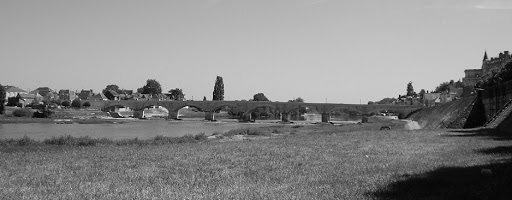
In my post explaining the picture behind the title of my blog, I mentioned that the bridge is in Amboise, France. The Chapel at Amboise Chateau is the final resting place of the quintessential Renaissance man.
What’s a Renaissance man? The term
Renaissance man refers to someone who is knowledgeable and accomplished in a wide variety of subjects, in both the arts and sciences. One of history’s greatest examples of a Renaissance man is Leonardo da Vinci, who was born on this date in 1452. Best known as the painter of the Mona Lisa, Leonardo was also a sculptor, a draftsman, an engineer, a scientist, an inventor and an architect. He was equally at home in the studies of human anatomy and military engineering, and was as fascinated by firearms and cannon as he was by the flow of water, the way plants grow and how birds fly. Testament to his skills was the title he received from the French king Francis I: first painter, architect and mechanic to the king.
- Born: 15 April 1452
- Birthplace: Vinci, Italy
- Died: 2 May 1519 (natural causes)
- Best Known As: Painter of the Mona Lisa
Leonardo da Vinci is best remembered as the painter of the Mona Lisa (1503-
1506) and The Last Supper (1495). But he’s almost equally famous for his astonishing multiplicity of talents: he dabbled in architecture, sculpture, engineering, geology, hydraulics and the military arts, all with success, and in his spare time doodled parachutes and flying machines that resembled inventions of the 19th and 20th centuries. He made detailed drawings of human anatomy which are still highly regarded today. Leonardo also was quirky enough to write notebook entries in mirror (backwards) script, a trick which kept many of his observations from being widely known until decades after his death.
Was Leonardo da Vinci Gay? The late Renaissance painter, poet, designer, architect and inventor, Leonardo da Vinci (1452-1519) is famous for his paintings of the Vitruvius Man, The Last Supper and Mona Lisa, to name just a few masterpieces. Through his art, Leonardo da Vinci depicted the complexities and perfection of the human form and was often thought to represent a melding of both humanity and divinity through mathematics, science, music, paint and poetry.
Speculation over Leonardo da Vinci’s sexuality began when he was 24 years old after his arrest on charges of sodomy, a serious crime in 15th century Florence. No witnesses appeared to support allegations da Vinci had sexual relations with a seventeen-year-old male model, thus the charges were dropped.
Although allegations of Leonardo da Vinci’s homosexuality were never substantiated, rumors continued to circulate among those who analyzed his depiction of young boys in his paintings, his portrayal of an effeminate John in The Last Supper, and the fact that he had several young male protégés and no wife and kids.
![]()
After the hearings, Leonardo kept his personal
life extremely private. At the time, unfavorable rumors or negative public attention was detrimental to the career of an artist, such as da Vinci, who was dependant upon the support of patrons and the Church.
Today, we are left with mere speculation as to the same-gender-loving feelings Leonardo da Vinci may have expressed in his personal life and his art. Regardless of his sexuality, Leonardo da Vinci should be (and is) remembered as the most influential Renaissance artists in our history.
We all know that the most talented men and artists in the world have generally been gay. So why shouldn’t we believe that the greatest Renaissance man in history was gay. He was one of the greatest architects, artists, engineers in history, and well ahead of his time. Sounds like a gay genius to me.
Since I have already written some blogs about the Renaissance on (Cocks, Asses, & More), I will continue to post those over the next several days. After we have revived Europe from the Dark Ages of the Medieval Period, (Renaissance means Rebirth) we will return and study what the Renaissance Europeans studied—the Classics of the Ancient World.
My Title Picture
Amboise is a town in north central France, in Touraine, on the Loire River (the river in the picture). It is a wine and wool market, and its manufactures include sporting goods, pharmaceuticals, and film and radio equipment. The town is chiefly famous, however, for its Gothic château, a royal residence from the reign of Charles VIII (who was born and died there) to that of Francis II. Leonardo da Vinci, who probably worked on it, is said to be buried in its chapel. Amboise was the scene (1560) of a Huguenot plot against the Guise family. Other old structures in the town include St. Denis Church (12th, 15th, 16th, and 17th cent.), St. Florentine Church (15th cent.), the town hall (16th cent.; restored), and the Clos-Lucé (15th cent.), where Francis I spent part of his youth and where da Vinci lived while in France and where he died.
Below is a picture of Château Amboise.
The Ancient Olympics: A History Lesson
When I took my first history class in college, I did a research project on the Ancient Olympics. I had always been fascinated with the thought of athletes competing in the nude, but I also was in by the Summer Olympics that year, which were being held in Atlanta. My family and I actually went to the Olympics that year since it was close by and had a great time. I was thinking today about doing another history post and I was thinking about all the conversation we have been having about circumcision, and the idea of the Ancient Olympics came to me.
One of the things I learned during that research project on the Ancient Olympics is that men were not allowed to compete if they were
circumcised, which meant that during that time Greek Jews were not allowed to compete in the Ancient Olympics. I also learned that in order to protect their penis during wrestling matches and other contact sports, the men would tie a string around the tip of their foreskin enclosing their glans, thus keeping them safe. The kynodesme was tied tightly around the part of the foreskin that extended beyond the glans. The kynodesme could then either be attached to a waist band to expose the scrotum, or tied to the base of the penis so that the penis appeared to curl upwards.
The ancient Olympics were rather different from the modern Games. There were fewer events, and only free men who spoke Greek could compete, instead of athletes from any country. Also, the games were always held at Olympia instead of moving around to different sites every time.
There are numerous myths about how the Olympics began. One myth says that the guardians of the infant god Zeus held the first footrace, or that Zeus himself started the Games to celebrate his victory over his father Cronus for control of the world. Another tradition states that after the Greek hero Pelops won a chariot race against King Oenomaus to marry Oenomaus’s daughter Hippodamia, he established the Games.
Athletic games also were an important part of many religious festivals from early on in ancient Greek culture. In the Iliad, the famous warrior Achilles holds games as part of the funeral services for his best friend Patroclus. The events in them include a chariot race, a footrace, a discus match, boxing and wrestling.
The footrace was the sole event for the first 13 Olympiads. Over time, the Greeks added longer footraces, and separate events. The pentathlon and wrestling events were the first new sports to be added, in the 18th Olympiad.
Click on any of the event names to see a description of a particular sport:
The victorious olive branch. The Ancient Olympic Games didn’t have any medals or prizes. Winners of the competitions won olive wreaths, branches, as well as woolen ribbons. The victors returned home as heroes – and got showered with gifts by their fellow citizens.
Here are two videos the History Channel did about the Ancient Olympics. Too bad, they have them wearing modesty pouches.
By the way, for those interested, here is an explanation of women’s role in the Ancient Olympics:
Married women were banned at the Ancient Olympics on the penalty of death. The laws dictated that any adult married woman caught entering the Olympic grounds would be hurled to her death from a cliff! Maidens, however, could watch (probably to encourage gettin’ it on later). But this didn’t mean that the women were left out: they had their own games, which took place during Heraea, a festival worshipping the goddess Hera. The sport? Running – on a track that is 1/6th shorter than the length of a man’s track on the account that a woman’s stride is 1/6th shorter than that of a man’s! The female victors at the Heraea Games actually got better prizes: in addition to olive wreaths, they also got meat from an ox slaughtered for the patron deity on behalf of all participants! Overall, young girls in Ancient Greece weren’t encouraged to be athletes – with a notable exception of Spartan girls. The Spartans believed that athletic women would breed strong warriors, so they trained girls alongside boys in sports. In Sparta, girls also competed in the nude or wearing skimpy outfits, and boys were allowed to watch.
Another side note, Spartan marriage rituals are quite fascinating, if any one is interested I will do a straight post about Spartan sexuality and the marriage rituals. It will have some about gay sex, these were the Spartans after all.
Ancient Mentorships (With a Little Sex Occasionally Thrown In)

It has been suggested that I do another one of my history posts this time on the ancient practice of pederasty. Before you NAMBLA folks get too excited, this is not a post about Man/Boy love, and it is not a post about pedophilia. It is about pederasty and what I think is the modern equivalent.
Pederasty (or Greek Paederasteia) is the relationship between an adult male and a boy, generally one between the ages of twelve and seventeen, in which the older partner is the mentor to the younger man. Pederasty is a relationship between an older man and an adolescent boy outside his immediate family. The word pederasty derives from Greek (paiderastia) “love of children” or “love of boys”, a compound derived from παῖς (pais) “child, boy” and ἐραστής (erastēs) “lover”.
Historically, pederasty has existed as a variety of customs and practices within different cultures. The status of pederasty has changed over the course of history, at times considered an ideal and at other times a crime.
In the history of Europe, its most structured cultural manifestation was Athenian pederasty, and became most prominent in the 6th century BC. Greek pederasty’s various forms were the subject of philosophic debates in which the carnal type was unfavorably compared with erotic yet spiritual and moderate forms.
Anthropologist Geoffrey Gorer distinguishes pederasty from pedophilia, which he defined as a separate fourth type that he described as “grossly pathological in all societies of which we have record.” According to Gorer, the main characteristic of homosexual pederasty is the age difference (either of generation or age-group) between the partners. In his study of native cultures, pederasty appears typically as a passing stage in which the adolescent is the beloved of an older male, who may act as a mentor. He remains as such until he reaches a certain developmental threshold, after which he in turn takes on an adolescent beloved of his own.
Ancient history
Among historical figures, some were recorded as having relations with others of their own sex — exclusively or together with opposite-sex relations — while others were recorded as only having relations with the opposite sex. However, there are instances of same-sex love and sexuality within almost all ancient civilizations. Additionally, Transgender and third sex peoples have been recorded in almost all cultures across human history.
Ancient Greece and Rome
The earliest documents concerning same-sex pederastic relationships come from Ancient Greece. Such relationships did not replace marriage between man and woman, but occurred before and beside it. A mature man would usually not have a mature male mate (exceptions aside, such as Alexander the Great) but he would be the erastes (lover) to a young eromenos (loved one). The ideal held that both partners would be inspired by love symbolized by Eros, the erastes unselfishly providing education, guidance, and appropriate gifts to his eromenos, who became his devoted pupil and assistant, while the sexuality remained short of penetrative acts. The hoped for result was the mutual improvement of both erastes and eromenos, each doing his best to excel in order to be worthy of the other.
Many historians believe that early pederast relationships were not sexual. In fact, these relationships are much like an internship. The older man, who was generally a better classed or more powerful citizen than the young man’s family, taught the young man how to be a man and how to join in politics or trade. There is little doubt that the relationship was sometimes sexual, but most historians now think that is rare.
I will give two famous examples of both a sexual relationship and that of a non-sexual relationship.

The first relationship is that of Emperor Hadrian, a grecophile and the third of the so-called Five Good Emperors. Hadrian believed in the concept of pederasty and had a relationship with a young man named Antinous. Antinous was born to a Greek family in Bithynion-Claudiopolis, in the Roman province of Bithynia in what is now north-west Turkey. One version is that Antinous joined the entourage of the Emperor when Hadrian passed through Bithynia in about 124, and soon became his beloved companion who accompanied him on his many journeys through the empire. Another version has it that Hadrian had the empire searched for the most beautiful youth, and chose Antinous. Although some have suggested the two might have had a romantic relationship, it is uncertain if this was true. In October 130, according to Hadrian, Antinous was drowned in the Nile. It is not known whether his death was the result of accident, suicide, murder, or religious sacrifice. At Antinous’s death the emperor decreed his deification, and the 2nd century Christian writer Tatian mentions a belief that his likeness was placed over the face of the Moon, though this may be exaggerated due to his anti-pagan polemical style.
The second great example, and one that was probably not a sexual relationship, is that of St. Paul (Saul of Tarsus) and St. Timothy. The New Testament describes the relationship between the older Paul and the younger Timothy as a mentor/mentored relationship. Since Paul was a Roman citizen and a Greek Jew, he would have been very familiar with the idea of pederasty. It is my belief that the relationship between Paul and Timothy was a pederastic relationship, however, since Paul became so pious and self-denying (or you might even say ascetic) he probably did not engage in any sexual conduct once his conversion occurred.
What is the modern day equivalent to pederasty?
So above was the history lesson, now here is how I think pederasty translates to today. In recent weeks, I have been trading emails between some older bloggers. Now you younger bloggers out there may consider me one of the older bloggers, I am 32, but I think of myself as what is probably middle-aged in blog years. There seems to be three age groups: they young twenty-something bloggers, us middle-agers (LOL) in our thirties and forties, and the older guys in their fifties and sixties. I think all three groups can learn a lot from the others. Sometime, it’s just nostalgia for me with the younger guys, and it’s a learning experience with the older guys.
Anyway, with some of the older guys I have been talking with, I have definitely learned a lot. I have always found I learn a lot from older people. Don’t count them out, you younger guys! For younger guys they often don’t understand the difficulties older guys had. Especially, when coming out could been either losing your job or being put in jail for sodomy. They often got married and tried to live a so-called hetero-normal life. It often didn’t work out. When I was growing up, it was still not acceptable to be gay. It often was perceived as a death sentence, because I was a kid during the height of the AIDS crisis in the eighties and early nineties. I had a cousin and his partner who died of AIDS and his family never acknowledge that he was gay nor that he died of AIDS. However, it was not a huge secret, at least behind closed doors. This cousin went to one of the only doctors in the state who specialized in AIDS patients and then a year or two after he died his partner died the same way. Yet, still it wasn’t talked about.
I think the three generational gaps are because of this. The older guys lived in a time when you had to be in the closet. The middle guys lived and remembered the horror of the AIDS crisis, the great unknown that it was back then. The younger guys grew up in the age of Will & Grace, when being gay was much more accepted and continues to be more accepted each day. There are still parts of this country where incidents like Matthew Shepard’s death can and does still occur.
Older men have a lot they can teach us younger men. They can teach us about history. They can teach us about being responsible sexually. They can teach us about the mistakes they made. They can teach us how to be better lovers (they often do tend to have more experience). They can teach us about being better gay men. They can teach us about the struggles gay men have gone through. And they can teach us that, though we may be in different stages in our lives, we are not alone. There aren’t a lot of pics to this post, mainly because I don’t think it needs to distract away from the message, and there just aren’t that many Daddy/Boy (adult bois) pictures out there that aren’t bondage pics.
Thanks for reading, and if you go to the end of the post, congrats, LOL.
I will have a post in a little while about my first sexual experience with another man, who was an older man.