Today is the anniversary of D-Day when British, Canadian and US soldiers – 160,000 of them – landed on the beaches of Normandy in treacherous weather, initiating the Western Allied effort to liberate mainland Europe from Nazi Germany. While D-Day is not a specific LGBT-related event, there were undoubtedly many hundreds of young gay soldiers killed on those beaches. 160,000 landed, 9,000 killed or wounded. Today we remember them with gratitude.
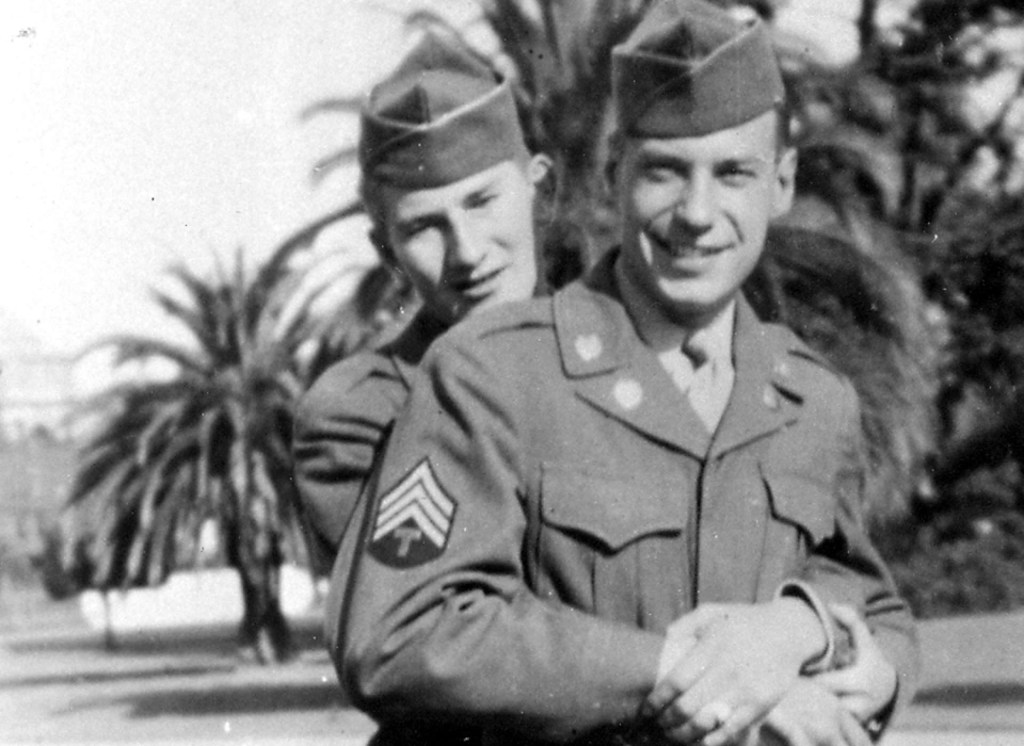
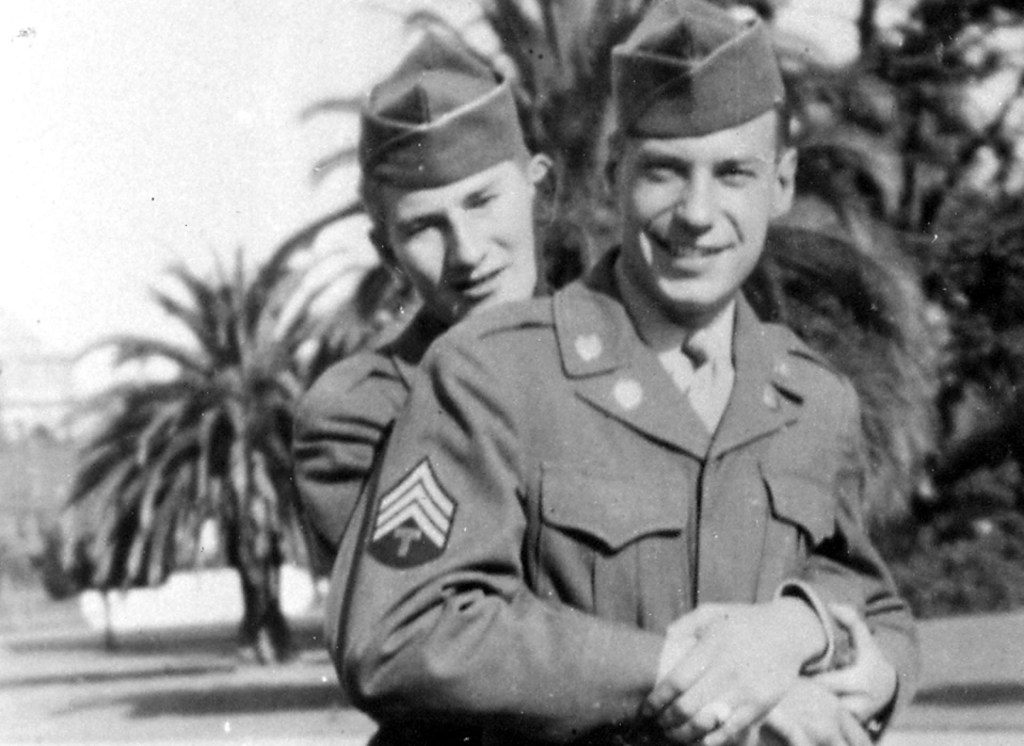
June is Pride Month and festivals and parades are happening across the world in celebration of LGBTQ+ Pride. But Pride didn’t start as a parade, it started as a protest with the Stonewall Riots in 1969 and many historians believe that the roots of these LGBT activists can be found in the World War II experiences of gays men and lesbians in the American military.
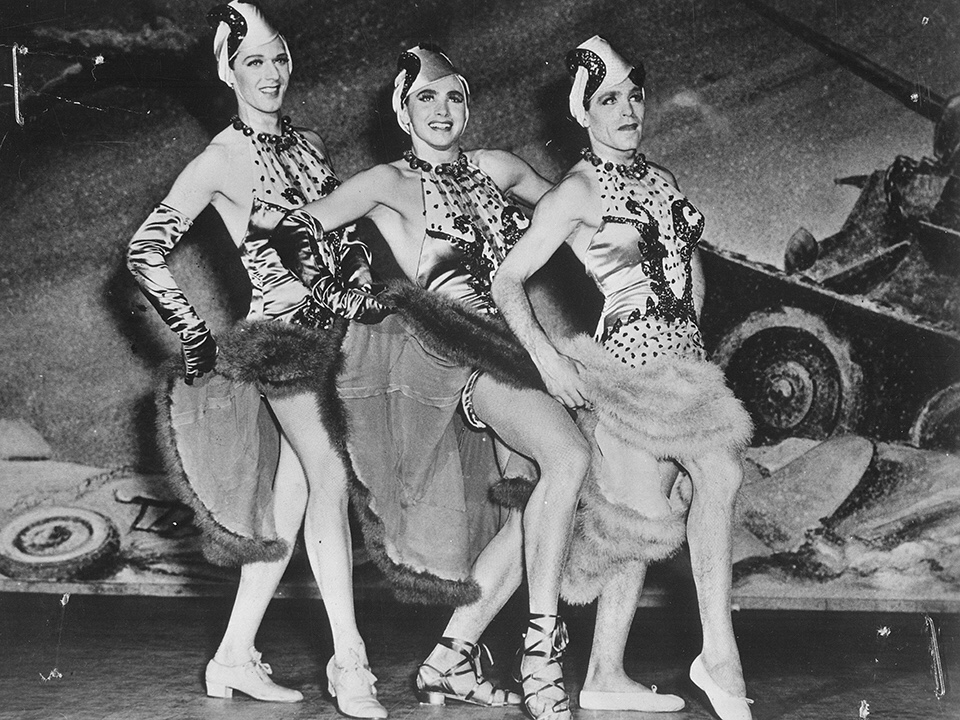
Despite the threat of persecution, gay and lesbian service members thrived during World War II. As with most young soldiers, many had never left their homes before and the war provided them an opportunity to find community, camaraderie, and, in some cases, first loves. These new friendships gave gay and lesbian GIs refuge from the hostility that surrounded them and allowed for a distinct sub-culture to develop within the military. Service members on every warfront enjoyed drag show entertainment; an entire gay lexicon was developed from the writings of Dorothy Parker; and eventually an underground queer newspaper emerged. The “Myrtle Beach Bitch” or “Myrtle Beach Belle” covertly shared news and stories between bases and units.
Gay male culture flourished in many ways in the military during the Second World War. Homosocial environments and the intimacy caused by life in combat made many in the military practice “don’t ask don’t tell” before it was even the official military stance. Drag shows were quite popular during the war, like “G.I. Carmen,” an all-GI musical stage show produced by the 253rdInfantry Regiment, 63rdDivision of the U.S. Army as a morale booster for Allied troops. There were also queer social networks of gay men.
Thousands of gay, lesbian, and bisexual men and women served in the armed forces during World War II. The massive manpower needed during the war created an ambiguous place for gay men and lesbians in military service. And gay men and women, like most groups of Americans, wanted to serve their country. You can read more about LGBTQ+ service members in Allan Bérubé’s book Coming Out Under Fire: The History of Gay Men and Women in World War II.
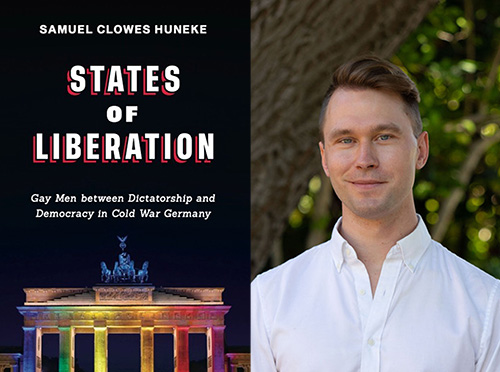
If anyone is interested, the International Spy Museum is hosting a virtual talk by Samuel Clowes Huneke, author of States of Liberation: Gay Men between Dictatorship and Democracy in Cold War Germany. He will focus on how both Eastern and Western intelligence agencies sought to recruit gay men because they believed that they were naturally more conspiratorial and would thus make better agents. Huneke explores previously untapped German archives to capture this surprising story of espionage and emancipation with its colorful cast of Cold War characters.
Samuel Clowes Huneke is a historian of modern Europe, with a focus on the social and political history of twentieth-century Germany. He is broadly interested in how everyday life intersects with and shapes the relationships between citizens and states. His research foci include the history of gender and sexuality, legal history, and the history of dictatorship and democracy. Dr. Huneke received a B.A. summa cum laude in German and Mathematics from Amherst College, an M.Sc. with Distinction in Applicable Mathematics from the London School of Economics, and a Ph.D. in History from Stanford University.
I will be attending, and it looks/sounds very interesting. (It doesn’t hurt that he’s rather handsome.)
For many of us, Memorial Day weekend is about cookouts, sales, watching fireworks, fellowshipping with family and friends. However, this weekend is supposed to be about honoring those who made the ultimate sacrifice. They gave their lives serving in one of the branches of the U.S. Armed Forces. As a military historian and working at a military college, I am very much aware of the sacrifices made every day by military personnel. Historically, LGBTQ+ soldiers have sacrificed even more. For most of the history of the U.S. military, LGBTQ+ soldiers had to be closeted because being “out” wasn’t acceptable. Being outed could have cost them their military career. Many LGBTQ+ soldiers kept their mouths shut and their business to themselves to protect themselves from harm and protect the nation.
In 1982, the U.S. military enacted a policy explicitly banning gay men and lesbians from their ranks. Before that, however, same-sex relations were criminalized and cause for discharge. And in the early 1940s, it was classified as a mental illness, disqualifying gay men and lesbians from service. In 1993, the “don’t ask, don’t tell” policy (DADT) went into effect, allowing closeted LGBTQ+ soldiers to serve in the military. Under the policy, service members would not be asked about their sexual orientation but would be discharged for disclosing it.
Many LGBTQ+ soldiers were outed as gay or lesbian by fellow soldiers and not allowed to serve. Some soldiers were killed by their fellow comrades while on active duty. If you saw the 2003 film Soldier’s Girl, you are aware of U.S. Army infantry soldier PFC Barry Winchell who was murdered on July 6, 1999, by a fellow soldier for dating a transgender woman, Calpernia Addams. The murder became a point of reference in the ongoing DADT debate. Eighteen years after DADT was enacted, Congress repealed the policy, allowing openly gay, lesbian, and bisexual people to serve in the military.
Another barrier was lifted in 2013 when spousal and family benefits were extended to same-sex married partners in the military. After ending temporarily in 2016, the ban on transgender individuals was again rescinded in 2021, allowing transgender individuals to enlist and serve in the armed forces. It’s been a long journey, but LGBTQ+ soldiers have always been part of the American military. In an era before gay marriage or open pride, military men fell in love, formed passionate friendships, and had same-sex encounters. Due to social and official discrimination, most of the stories of these LGBTQ+ soldiers have gone untold. One famous example was Baron Friedrich von Steuben, a Prussian military man hired by George Washington to whip the Continental Army into shape during the darkest days of the Revolutionary War. He was known for his bravery and the discipline and grit he brought to the American troops. Historians also believe he was gay—and served as an openly gay man in the military when sex between men was punished as a crime.
So, if you have never considered the LGBTQ+ service members who lost their lives to serve a country that didn’t respect them, you should. We shouldn’t take our freedom for granted. It comes with a price tag, and we all need to remember this. As we celebrate another Memorial Day weekend, please note this isn’t just another time to party. Today is a day set aside to remember those who have sacrificed their lives so that we may live and be free, fight against discrimination, and love who we want. These brave, unsung heroes sacrificed the truth of themselves. Let us never forget them.
Be safe, be conscious, be proud, and remember our fallen LGBTQ+ service members who died in times when being “out” wasn’t allowed. Thankfully, things seemed to have changed drastically in the U.S. military. LGBTQ+ service members are able to serve openly and without harassment. While acceptance of LGBTQ+ service members is a relatively new development in the military’s long history, the Department of Defense is committed to maintaining a strong force that reflects the nation’s diversity.
A major news story broke Monday night. It is not something I would usually talk about on my blog, but the seriousness of the issue is frightening to me for many reasons. The online news media site, Politico, obtained what it calls a draft of a majority opinion written by Justice Samuel Alito that would strike down Roe v. Wade. For those of you who may not be in the United States or may not know what the 1973 Supreme Court case is about, Roe v. Wadewas a landmark decision of the U.S. Supreme Court in which the Court ruled that the Constitution of the United States protects a pregnant woman’s liberty to choose to have an abortion without excessive government restriction. What Politico released is only a draft. The final opinion has not been released, and votes and language can change before opinions are formally released. The opinion in this case is not expected to be published until late June. However, Republicans have been pushing to pack the Court with conservative justices who want to overturn Roe v. Wade for many years, and they finally succeeded under the twice-impeached, previous loser president.
Prior to the Senate confirmation of the very conservative and young Amy Coney Barrett to the Supreme Court, Chief Justice John Roberts had served as a swing vote and attempted to balance the Court between liberal and conservative justices. If this draft is accurate, Roberts voted against overturning Roe v. Wade. Overturning it would be unprecedented (as far as I am aware) in that it would be the first Supreme Court case to overturn a major precedent that granted rights. Most, if not all, overturned decisions have been done so to correct cases where the Supreme Court took away rights, such as Brown v. Board of Education (1954). Brownended racial segregation in schools and overturned Plessy v. Ferguson (1896) in which the Court had ruled that racial segregation laws did not violate the U.S. Constitution if the facilities for each race were equal in quality, a doctrine that came to be known as “separate but equal.” Other examples exist, but this is by far the most famous. However, with some recent decisions by the Supreme Court, Brown v. Board of Education is slowly being chipped away. The same is happening regarding the constitutionality of key provisions of the Voting Rights Act of 1965. But I am going down a rabbit hole. The fact is, the Supreme Court for the past seven decades has expanded rights of individuals not taken them away. This is beginning to change under the new make-up of the Court. Overturning Roe v. Wade may be the most dramatic of what may become a series of setbacks for civil rights.
I am not going to debate the rights and wrongs of abortions, but I am going to give a little history lesson on abortions for those who think that abortions have always been illegal in America. (Here, I am speaking of the Americas, including colonial times, not just the United States.) In colonial America, abortion was dealt with in a manner according to English common law. Abortion was typically only frowned upon if anyone even thought of it at all. If abortion was penalized, it occurred after “quickening,”—when a woman felt fetal movement—because it suggested that the fetus had manifested into its separate being. Quickening could vary from woman to woman, and sometimes went as late as four months. And, it was only penalized when it was typically seen as a cover-up for improper sexual relations. Also, abortions were much more common than believed and usually performed by midwives, not doctors. (Midwives were always much safer than doctors for pregnant women.)
States did not begin to draft abortion legislation until the first half of the 19th century; by 1880, every state had an abortion statute. These abortion statutes were not passed because of a belief that the fetus was a living being. Children were not seen as fully humans until they reached adulthood. Most of these early abortion statutes were designed to protect women from medical quacks far from the established centers of American medicine—Philadelphia, New York, and Boston, for example. These early statutes (for the most part) punished only the provider of the abortion, not the woman, and either did not apply to physicians or did not apply if the abortion was necessary to preserve the life of the woman.
Not until late 19th century did Americans—writers, journalists, preachers, and physicians—began to describe abortion with moral absolutism that had never existed before. In the late 19th century, targeting abortions and abortion providers—like midwives and “irregulars”—occurred within the context of the professionalization of the medical field. Doctors attempted to legitimize themselves as professional medical men, and they did so at others’ expense largely because women knew having your baby delivered by a midwife was much safer. (Midwives sterilized their hands and equipment, whereas male doctors, and nearly all doctors were male, did not believe in sterilization and did not understand germ theory.) In claiming that pregnancy and childbirth were not natural events, where women and midwives could maintain authority, they argued that pregnancy and childbirth were medical conditions requiring physician intervention.
Abortions were dangerous in the early 20th century, but by the 1920s and 1930s, sterilization of equipment, specialization, and, later, antibiotics, all worked together to decrease mortality. But the laws and the changed view of the morality of abortions had made getting an abortion from anyone, even doctors, illegal. By the 1970s, illegal back-alley abortions were again very dangerous affairs, so when the case of Roe v. Wade came before the courts in 1973, some states were already moving toward allowing abortions so they could be legally and safely obtained.
That was a lot to read, and I hope you are still with me. I mention all this because of a flaw in Justice Samuel Alito’s draft opinion overturning Roe v. Wade. The conservative justice attached to his draft a 31-page appendix listing laws passed to criminalize abortion during that period. Alito claims “an unbroken tradition of prohibiting abortion on pain of criminal punishment…from the earliest days of the common law until 1973.” This is just not true. It is not until the 19th century, 300 years after the first English settlement establishing common law in the Americas, that abortions started to become illegal, and only then to protect a women’s health. Abortions are much safer now, which makes citing those laws illegitimate.
What worries me is if the Supreme Court begins overturning precedents that established rights for certain groups of people, especially those despised by Republicans, what is going to be next? Alito’s draft misleadingly argues that rights protected by the Constitution but not explicitly mentioned in it—so-called unenumerated rights—must be strongly rooted in U.S. history and tradition. That form of analysis seems at odds with several of the Court’s recent decisions, including many of its rulings backing gay rights. Liberal justices seem likely to take issue with Alito’s assertion in the draft opinion that overturning Roe would not jeopardize other rights the courts have grounded in privacy such as the right to contraception, to engage in private consensual sexual activity, and to marry someone of the same sex.
Alito explicitly denies that the Court will overturn any other precedents when he says in the opinion, “We emphasize that our decision concerns the constitutional right to abortion and no other right. Nothing in this opinion should be understood to cast doubt on precedents that do not concern abortion.” However, how can we believe him? Conservatives in the United States have increasingly made lying a part of their everyday life. Just look at the claims of voter fraud in the 2020 election. The only voter fraud that has been found was committed by Republicans and did not change the outcome of the election to re-elect their twice-impeached loser candidate. They also have consistently denied there was an insurrection at the Capitol on January 6, 2021, aimed at stopping the certification of Joe Biden’s presidency. Therefore, I cannot feel safe that Obergefell v. Hodges which granted the right for same-sex couples to marry or Lawrence v. Texas which struck down sodomy laws in the U.S. are not next on the Supreme Court’s chopping block.
I fear with a conservative majority on the Supreme Court and the fascist leanings of the current Republican Party which remains loyal to a lying, idiotic, twice-impeached, orange menace, we are looking at even darker days in the future of the United States and the world. Conservative backlash is not limited to the United States. Authoritarianism is on the rise, and it is not being kept in check by democratic institutions. I encourage all Americans, and people who read this blog in other parts of the world, to back liberal candidates who believe in fundamental human rights and decency. If the Democratic majority in Congress is lost, we are looking at a minimum of two years of intense gridlock; if Republicans win in 2024, we are looking at a wholesale rollback on human rights. Democrats not only need to retain a majority in Congress, but need to gain a filibuster-proof majority in the Senate. We must fight, and we must vote for candidates who will protect our rights. If we don’t, we are surely doomed to lose many of our civil rights as U.S. citizens. Backlash against LGBTQ+ rights are already infiltrating even liberal and LGBTQ+-friendly states like Vermont. In the last few weeks, a trans woman was murdered in a hate crime in Vermont, someone vandalized the offices of the Pride Center of Vermont, and a pride flag was stolen from a flagpole at Northern Vermont University in Lyndon, Vermont. Since I moved to Vermont, I have rarely faced any type of hate or discrimination, but hate is on the rise everywhere.
With all of this said, I must admit, I also find it disturbing that this draft opinion was leaked to the press. I’m glad it was, but I still find it disturbing. The Supreme Court remains one of Washington’s most secretive institutions, priding itself on protecting the confidentiality of its internal deliberations. It is one of the hallmarks of the Supreme Court which allows for deliberation of cases before the Court to happen without intense media scrutiny. Ruth Bader Ginsburg was fond of saying, “At the Supreme Court, those who know don’t talk, and those who talk don’t know.”
And a final word that I couldn’t have said better myself to anyone who wants to make one of the stupid, hateful, and misleading arguments made by Republicans:
Back in graduate school, I took a seminar on Latin American History. My research project for that class was sexuality in colonial Latin America. It has a fascinating history. I remember that I read,Beyond Carnival: Male Homosexuality in Twentieth-Century Brazil which I found infinitely fascinating. So, when I saw that Dr. Cervini’s Queer History 101 this week was about “Sexuality and the Colonization of the Americas,” I was eager to read it and share it with you.
From Dr. Eric Cervini’s Queer History 101
Even in 2022, we are still seeing an alarming rate of LGBTQ+ content being unjustly censored. In China, an episode of Friends was edited so Ross’s ex-wife wouldn’t be gay. In Hungary, a recent law has banned queer content in schools or kids’ television. And right here in the U.S., dozens of state legislatures have attacked teachers’ ability to teach queer and trans history. But how far back does this phenomenon of censoring queerness go?
Zeb Tortorici, an Associate Professor of Spanish and Portuguese Languages and Literatures at NYU, understands the reality and nuances of this suppression more than most. Tortorici’s body of research focuses on the origins, archiving, and censorship of the queer “obscene” in New Spain, which included Mexico and Central America.
“I was directed toward the obscene,” Tortorici told me, “through my first book, Sins Against Nature: Sex and Archives in Colonial New Spain, which is about the archiving of sodomy.” It was during this research of colonial, same-sex criminal case records that Tortorici noticed the repeat occurrence of the Spanish word obsceno, or obscene. But it struck him as odd. “The word ‘obscene’ in the cases that I looked at,” explained Tortorici, “was particularly grafted upon desires that were less legible than something like sodomy.” So what were these “less legible” offenses?
First, Tortorici pointed me to the 1776 case of Manuel de Arroyo from Pachuca, Mexico. “Arroyo asserted that consuming human semen from another man is not a sin,” he told me. “The assertion of this heretical thought is what Inquisitors referred to as ‘obscene.’” Curiously, the act of oral sex wasn’t the obscene offense, but holding the belief was obscene.
Tortorici also cited a second example, the 1803 case of Juana Aguilar from Guatemala. “They were a so-called hermafrodita, or a hermaphrodite. Their body is described as ‘obscene’ in some records, including medical reports published in the colonial Guatemalan Gazette.” Again, the alleged act of Aguilar being a hermaphrodite wasn’t necessarily obscene, but the description of their body was obscene.
“Obscenity is produced in conjunction with other forms of alterity,” explained Totorici. “It’s not simply something that refers to explicit sexuality or sexual desire in the wrong place or in the public sphere.” For Arroyo and Aguilar, moralistic and cultural opinions were “grafted” onto them in a means that further marginalized them as individuals. The Inquisition’s concept of the “obscene” wasn’t solely about being queer; it was a commentary on diversity and how difference itself was anathema to colonial culture. Thus, being different became criminal.
“Sodomy itself was policed in colonial Spanish, Portuguese American, and Spanish Pacific landscapes,” noted Tortorici, “but women and men were judged and denounced very differently for the crime.” Regardless of the type of court–criminal, secular, ecclesiastical, or inquisitorial–colonial Spanish America, despite an effort to standardize punishments for sodomy, allowed gender biases to influence legal consequences. And, in Tortorici’s research, the proof is in how records were kept.
“I spent from 2003 to 2018 in the archives looking for as many cases dealing with the sins against nature as I could, and I was struck by the fact that almost no cases of female sodomy appeared.” Indeed, Tortorici found only one unambiguous criminal case from 1732: it was about Josepha de Garfias, a woman from Mexico City who was punished for the crime of sodomy. But as far as details goes, that’s it!
“All we have is a one-paragraph summary of Josepha’s criminal case, which basically says that she was convicted of the crime of sodomy with other women,” said Tortorici. Apart from that, all evidence was burned and no record of punishment was kept. A leniency toward a female, same-sex crime all but proves, as Tortorici puts it, “the topic of sodomy was not the the axis of the case itself.”
So, as Tortorici asked me, “What is queer? And what does it mean to think about queerness centuries before the term was ever invented?” As Tortorici suggested, “Maybe what makes something queer is in the ways that it is trying to rupture or challenge identitarian claims and politics.” Queer history, in other words, may be much more expansive than you’d think!
For more of Tortorici’s fascinating work, check out:
Dr. Eric Cervini is an award-winning historian of LGBTQ+ politics. His first book, The Deviant’s War: The Homosexual vs. the United States of America (a fascinating read), was a New York Times bestseller and a finalist for the Pulitzer Prize. It also won the Publishing Triangle’s Randy Shilts Award for Gay Nonfiction, the NYT Editors’ Choice, and the “Best Read of 2020” at the Queerties.
Cervini graduated summa cum laude from Harvard College and was a Gates Scholar at the University of Cambridge, where he received his PhD. As an authority on 1960s gay activism, Cervini serves on the Board of Advisors of the Mattachine Society of Washington, D.C., a nonprofit dedicated to the preservation of gay American history. His award-winning digital exhibitions have been featured in Harvard’s Rudenstine Gallery, and he has presented his research to audiences across America and the United Kingdom.
He lives in Los Angeles with his drag queen boyfriend and their dog, Moo Bear.
Here’s a bonus picture of Dr. Cervini, just because…
I think more people would enjoy history if their professors looked like Dr. Cervini. I have such a crush on this man.
When I came out in graduate school, I remember a professor came up to me and said, “Congratulations, I hear you’re a fruit.” I was horrified, and it was incredibly inappropriate. I do not think he meant it as a derogatory comment, but I was still offended. It’s a bit ironic, because this professor was Canadian, and he abhorred being called a Canuck. I’m not sure if Canuck was or is seen as offensive by Canadians, but he certainly was sensitive about it. Why he wasn’t sensitive about a slur like “fruit” I’ll never know. He was a bit of an insensitive jerk, and we did not miss him when he failed to file for an extension of his green card and was sent back to Canada to straighten it out. He never did come back.
Much like the words queen and queer, “fruit” is a slur that has been hurled against gay men for decades. Over time, gay men have begun to reclaim the “fruit” in the same way that “queen” and “queer” have become an innocuous part of our lexicon, and today use it as a term of endearment rather than a derogatory comment on one’s effeminacy and attraction towards other men. This goes to the question of how did “fruit” become a slur for a gay man? What does “fruity” mean for the LGBTQ+ community? What does it mean to be “fruity?” And where did this comparison come from in the first place? Interestingly, the term may have originated from the gay community itself.
Language experts believe that the insult “fruit” has roots in the British cant, or secret language, Polari as a slang word. The slang was born out of the West and East Ends of London in the 19th century (but could date back as far as the 16th century) and was used by social outcasts and outsiders. Polari (from Italian parlare ‘to talk’) was used by some actors, circus and fairground showmen, professional wrestlers, merchant navy sailors, criminals, sex workers, and the gay subculture. This group also included costermongers, street vendors who sold fruit and vegetables in British towns. Costermongers were looked down upon for their brash behavior, love of gambling, and unusual slang. Like many secret languages, Polari emerged as a way for these outsiders to “protect their identities or actions.” Pretty soon, Britain’s gay community adopted this code, transforming it into a “vehicle for campery, bitchiness, filthy jokes, and innuendo.” The word “fruit” was just one of many slang words gay men would throw at each other to poke fun at their effeminacy. The evolution of this slang was perhaps not unlike that of the American gay lingo that can be traced back to the drag and ballroom culture of the 1980s, where “reading” was, as RuPaul says, fundamental.
But why fruit? The common assumption goes that, like women, fruits are soft and tender. Mayukh Sen, a writer who began writing about food “by accident” when he began working at the blog Food52. His first piece to get significant attention was about fruitcake, titled “How—and Why—Did Fruitcake Become a Slur?”. He wrote that, “As someone who’s queer and Bengal, I grew up eating fruitcake and really treasuring it. I sit in between these two meanings of the word and explored that whole idea in detail, where I metabolized all of that personal writing very early on in my food writing career.” As Sen explains, “A fruit, susceptible to the whims of nature, tends to grow tender and soft. For a man to embody these very traits, a sensitivity to the elements that is typically coded female, goes against the imaginings of masculinity our culture worships.”
Sen goes on to say that, when the slur made its way to the US in the 20th century, it became tied to fruitcake – the sticky and much-maligned treat. The phrase “nutty as a fruitcake” was reserved for people who had lost their marbles, had gone off their rocker, or, simply put, were crazy. At the time, homosexuality was considered deviant – a mental illness to be corrected through lobotomies, electroshock treatment, and chemical castration. Thus, fruits became fruitcakes, and the psychiatric institutions where these horrific procedures occurred were called “fruitcake factories.” Over time, the words “fruit” and “fruitcake” became less of an inside joke in the gay community and more of a weapon that straight people could use to remind gay people of their otherness. For some older gay men who lived through this era, the term “fruit” is as hurtful and offensive as the term “faggot.” Perhaps even worse.
Can we reclaim a slur such as “fruit” like many have for “queer” and “queen?” According to linguistics professor Sally McConnell Ginet, sometimes distance is essential to reclaiming a slur. The young activists in the 1980s who shouted “we’re here, we’re queer” in AIDS rallies were distant enough from the word that, perhaps, they barely had any experiences with it. The same goes for the word “fruity” today. Navigating the world as a gay person is leaps and bounds different than it was all those decades ago. And while homophobia and transphobia most definitely still exist around the world – and even in our own backyards – there are people, places, and moments that serve as solid reminders that LGBTQ+ people do deserve and have a place in this world.
So, when someone calls you “fruity,” what does it mean? It’s like most things, all about context. If they’re a friend, then perhaps it’s a light jab, perhaps a celebration of gayness, perhaps a little bit of both. If they’re not an ally, then it’s a word that they think should hurt you, but at the end of the day, all it does is say, “you’re sensitive, you’re effeminate.” And really, what’s so wrong with that? We should embrace who we are, not what others expect us to be, which is a lesson it took me a long time to realize and one that I sometimes still struggle with.
“Luck is when an opportunity comes along and you’ve prepared for it.”
—Saint Patrick
St. Patrick, originally named Maewyn Succat, was a fifth-century Romano-British Christian missionary and bishop in Ireland. Known as the “Apostle of Ireland”, he is the primary patron saint of that country. Each year on This day, Irish and Catholics everywhere celebrate the Feast of Saint Patrick who died on March 17, 461.
Saint Patrick’s Day is a time for grand celebration in many parts of the world, with green beer and shamrocks sprouting in the most unlikely places. So what do you do, if you want to join in the fun, but cannot find a trace of green blood in your ancestry, no matter how far back you go? Good old St Patrick is one of a surprising number of queer saints and martyrs in Christian history, giving gays, Irish or not, an excuse to enjoy his day.
In his book on Irish gay history, Terrible Queer Creatures, Brian Lacey presents some evidence that Patrick may have had a long term intimate relationship with a man:
St. Patrick himself may have had a relationship tinged with homoeroticism. Tirechan, a late seventh century cleric who wrote about St. Patrick, tells the story of a man Patrick visited and converted to Christianity, who had a son to whom Patrick took a strong liking.
Tirechan wrote that “he gave him the name Benignus, because he took Patrick’s feet between his hands and would not sleep with his father and mother, but wept unless he would be allowed to sleep with Patrick.” Patrick baptized the boy and made him his close lifelong companion, so much so that Benignus succeeded Patrick as bishop of Armagh.
This is a rather tenuous basis for a claim that Patrick was gay, but there is more from his youth. He was originally brought to Ireland as a Roman slave. In Ancient Roman society, slaves, male and female, were freely used for sexual purposes. Later, young Maewyn Succat escaped, but returned to undertake the evangelizing of Ireland that he’s famed for. To pay his way back, there is a claim that he worked as a prostitute.
This is still short of really hard evidence – but hagiography, the writing of the lives of saints, is not history. The most famous popular belief about St Patrick, that he chased the snakes out of Ireland, is certainly not true (there never were any), but that doesn’t deter anybody from repeating it, regardless. When it comes to the life of saints, definitive proof is not a criteria for a saints life story.
Irrespective of our view on the historic Patrick, there’s a deeper, serious reason for thinking about him. For too long, Christianity has been badly abused as a weapon against sexual minorities, but there are undoubtedly a large number of people in church history that in today’s terminology, would be considered LGBTQ+, but who nevertheless achieved high office in the Church, as bishops, abbesses, and popes, or honored as Christian saints and martyrs. There are bishops who wrote frankly erotic poetry and love letters addressed to each other, bishops who secured appointments to vacant sees for their boyfriends, and popes who slept with men, or commissioned homoerotic paintings from the great Renaissance artists. There are even the forerunners of our modern trans men – biological females, who lived as males in men-only monasteries.
Secular historians have gone a long way in uncovering our hidden history. We are blessed by God with our sexuality. We are His creation, and to quote St, Patrick, “Hence I cannot be silent, and indeed I ought not to be, about the many blessings and the great grace which the Lord has designed to bestow upon me.”Doing the same for our place in church history can make a small contribution to countering religious bullying. Just consider: the next time you hear offensive remarks from a homophobic Irish neighbor or colleague, just point out to him: St Paddy was queer.
I will leave you with one final quote from St. Patrick:
“May good luck be with you wherever you go. And your blessings outnumber the shamrocks that grow.”
—Saint Patrick
This modified article was originally written by Terence Weldon, a UK based gay Catholic activist He writes on general matters of faith and sexuality, and was first published on Bilerico in 2012.
“Gentlemen with Golf Clubs,” 1909, by J.C. Leyendecker
Joseph Christian Leyendecker’s life, career, and love is captured in a new film, Coded: The Hidden Love of J.C. Leyendecker, which I watched the other day on Paramount+. The documentary shows Leyendecker’s enduring influence on American culture and LGBTQ+ representation in advertising, as well as the relationship with his partner, Charles Beach, the muse for Leyendecker’s “Arrow Collar Man.”
Arrow Short Collars, American Advertisement, 1914, by J.C. Leyendecker
The use of men as sexy symbols in advertising would not have existed without the influence of Leyendecker’s art. The German-American artist received training in Paris under the French Art Nouveau movement and imported some of this “Modern Style” to United States. His ad illustrations, which leaned into sexualizing his handsome male subjects, made brands like Arrow shirts fly off the shelves while also defining the image of the early 20th-century American man. Many of his illustrations featured intimate gazes between two gentlemen. Often, if there were two gentlemen and a lady, the two men would be focused on each other and not the woman.
“The Oarsman,” 1916, (Left) and “Man on the Bag,” 1912, (Right) by J. C. Leyendecker
Additionally, Leyendecker painted over 400 magazine covers in his career — over 300 alone for The Saturday Evening Post — essentially creating the design template still in use today. His stock took a plunge along with Wall Street following the Great Depression, when shrinking wallets also meant a return to social conservatism. The public turned away from Leyendecker’s eroticized male forms toward Norman Rockwell, a more traditional illustrator who was mentored by Leyendecker.
Advertisement for Cluett Dress Shirts, 1911, by J.C. Leyendecker
The image below of an Ivory Soap advertisement from 1900 is one of his early pieces before he met Charles Beach; however, it is a great example of the coded messages in many of his works. Can you spot the “code” in this image? Once you see it, you’ll probably never not see it.
“Ivory Soap It Floats,” Ivory Magazine, 1900, by J.C. Leyendecker
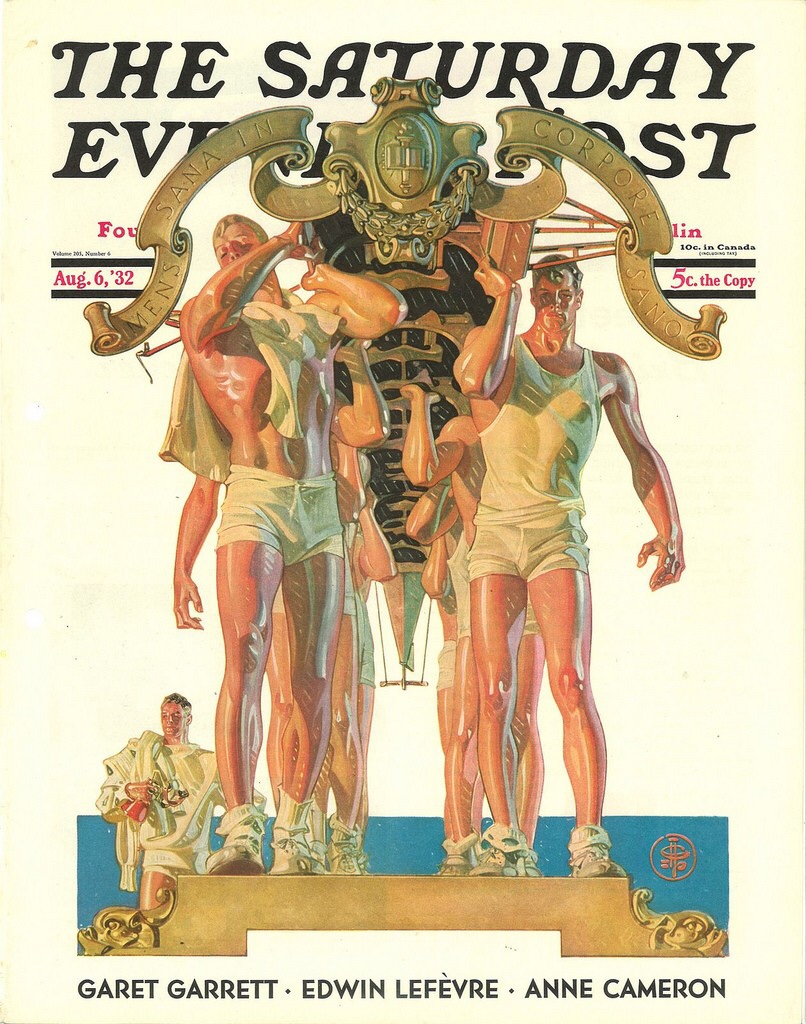
In honor of the (Winter) Olympics beginning this week, I’ll end with this 1932 edition of The Saturday Evening Post. Strangely, the conservative, anti-New Deal, and middle class family orientated publication had what is (to most modern eyes at least) a sexualized ‘gay’ image of the U.S. Olympic Eight on its cover, painted by Leyendecker. This was not the only time that Leyendecker put semi-naked men on a pedestal as you’ve seen in some of his other illustrations.
Every good gift and every perfect gift is from above, and comes down from the Father of lights, with whom there is no variation or shadow of turning.
—James 1:17
Many of us received gifts yesterday for Christmas, but our greatest gift came from above. Isaiah 9:6 predicted that gift, “For unto us a child is born, unto us a son is given: and the government shall be upon his shoulder: and his name shall be called Wonderful, Counsellor, The mighty God, The everlasting Father, The Prince of Peace.” God sent Jesus to this earth to offer us salvation and to save us from the sins of this world. He taught a message of faith, love, hope, and charity.
Gift giving at Christmas is a Christian tradition that is widely practiced around the world. However, the practice is not something that is exclusive to Christianity, as several other religions mark the end of the year with a similar custom, such as the Jewish festival of lights Hanukkah or the Hindu celebration of Pancha Ganapati in honor of Lord Ganesha.
In many parts of the Christian world, January 6 is celebrated as Three Kings Day, also known as Epiphany. In Spain and Latin America, Three Kings Day is the day when children receive gifts, not Christmas Day. For many other Christian cultures, the gifts given at Christmas are also symbolic of the tributes made to the baby Jesus by the Three Wise Men, or Magi, after his birth during the story of the Nativity. Matthew 2:1-12 describes the Magi, who tradition gives the names as Melchior, Caspar, and Balthazar, journeying to the location of Jesus’s birth by following a star, and upon their arrival, presenting him with gifts of gold, frankincense, and myrrh.
However, the tradition of gift giving extended long before the founding of Christianity, with roots in the festivals of the ancient Romans—in particular the festival of Saturnalia, where thanks were given to the bounty provided by the agricultural god Saturn. The festivities took place from the 17th to the 23rd of December, and were celebrated with a sacrifice and a public banquet, followed by private gift-giving, continued partying, and a wild atmosphere where social standings were done away with. During this feast, slaves would be considered the equal of their masters and free speech was embraced.
The day that gifts were exchanged in Ancient Rome was known as Sigillaria and took place on the December 19th. As gifts of value were in contradiction to the spirit of the season, the Romans exchanged more modest items, such as candles, seasonal figurines, and ‘gag gifts’, which were designed to amuse or terrify the other guests. Etiquette dictated that the lowlier the gift, the stronger the bond of friendship it was said to represent. Some bosses often gave a gratuity known as a ‘sigillarcium’ to their clients or employees in order to help them purchase their gifts.
Unlike many of the more cultish festivals held in the Roman Empire, Saturnalia was widely celebrated throughout all of the territories of Rome at the end of the calendar year. As it was a much-loved festival thanks to its carefree atmosphere, generous gift-giving, and lavish entertainments, people were less inclined to give up its popular traditions. This made it a lot harder to deal with when the religious status quo changed in the Empire.
The conversion of Emperor Constantine to Christianity in AD 312 signaled the beginning of the end of pagan celebrations in the Empire, but early religious leaders couldn’t simply ban the popular Saturnalia, as there would be a backlash. There is a theory that they used many of the traits of the festival when establishing Christmas, a rival feast that would take Saturnalia’s place, but commemorate a Christian occasion: the birth of Jesus. The exchange of gifts was probably one of the traditions carried over from the old to the new.
The old pagan custom of gift-giving was rationalized into Christianity by attaching strong associations with the gifts of the Magi to Jesus, and was also likely influenced by the life of Nikolaos of Myra, a 4th century saint who was famed for his fondness of giving people gifts. When he was venerated as a saint, he became more widely known as Saint Nicholas, which is recognizable as the origin of the name Santa Claus.
Our greatest Christmas gift though, no matter the tradition’s origins, is the message Jesus brought with his teachings. He gave us the gift of salvation. To honor His birth, which was probably not in late December, we need to remember His message all year long. As James 1:17 reminds us, “Every good gift and every perfect gift is from above.” Jesus offered us a message of faith, love, hope, and charity, and the best way we can honor is birth is to spears that message. If we live our life in a way that honors the teachings of Jesus, not the teachings of man, we can live by example and show that the world can be a better place. If we honor Jesus’ teachings of love, hope, and charity, then we will have faith in the goodness of this world. It is the greatest gift we can give. Love is chief among those gifts, and love is always free. Give the gift of love today.
When I was growing up, we always had our family’s Christmas on December 23rd. We had other family obligations on Christmas Eve and Christmas Day, so my mother always put out the fine china and silverware and made a really nice dinner that we ate by candlelight on the twenty-third. It was just my parents, my sister, and myself. We would exchange gifts with each other, and my sister and I knew that Santa Claus would bring the bulk of our gifts after we went to sleep on Christmas Eve. One of our traditions was that before dinner my sister or I read aloud Luke 2:1-20 (ironically, I always hear these verses in Linus’s voice from “A Charlie Brown Christmas”). We then ate our meal and after we finished , we opened presents. After we finished with presents, my dad usually went and watched TV, and my mother took a book from our bookshelves that contained Christmas traditions. She read us “A Visit from St. Nicholas” and then she always read us the letters that have become known as “Yes, VIRGINIA, there is a Santa Claus.”
In 1897, eight-year-old Virginia O’Hanlon wrote a letter to the editor of the New York Sun, and the quick response was printed as an unsigned editorial on September 21, 1897. The response was written by veteran newsman Francis Pharcellus Church and has since become history’s most reprinted newspaper editorial. It has appeared in part or whole in dozens of languages in books, movies, and other editorials, and on posters and stamps. As I read the letter today, it makes me think that what Church said about people in 1897 is still true today.
DEAR EDITOR: I am 8 years old.Some of my little friends say there is no Santa Claus.Papa says, ‘If you see it in THE SUN it’s so.’Please tell me the truth; is there a Santa Claus? VIRGINIA O’HANLON.115 WEST NINETY-FIFTH STREET.
VIRGINIA, your little friends are wrong. They have been affected by the skepticism of a skeptical age. They do not believe except they see. They think that nothing can be which is not comprehensible by their little minds. All minds, Virginia, whether they be men’s or children’s, are little. In this great universe of ours man is a mere insect, an ant, in his intellect, as compared with the boundless world about him, as measured by the intelligence capable of grasping the whole of truth and knowledge.
Yes, VIRGINIA, there is a Santa Claus. He exists as certainly as love and generosity and devotion exist, and you know that they abound and give to your life its highest beauty and joy. Alas! how dreary would be the world if there were no Santa Claus. It would be as dreary as if there were no VIRGINIAS. There would be no childlike faith then, no poetry, no romance to make tolerable this existence. We should have no enjoyment, except in sense and sight. The eternal light with which childhood fills the world would be extinguished.
Not believe in Santa Claus! You might as well not believe in fairies! You might get your papa to hire men to watch in all the chimneys on Christmas Eve to catch Santa Claus, but even if they did not see Santa Claus coming down, what would that prove? Nobody sees Santa Claus, but that is no sign that there is no Santa Claus. The most real things in the world are those that neither children nor men can see. Did you ever see fairies dancing on the lawn? Of course not, but that’s no proof that they are not there. Nobody can conceive or imagine all the wonders there are unseen and unseeable in the world.
You may tear apart the baby’s rattle and see what makes the noise inside, but there is a veil covering the unseen world which not the strongest man, nor even the united strength of all the strongest men that ever lived, could tear apart. Only faith, fancy, poetry, love, romance, can push aside that curtain and view and picture the supernal beauty and glory beyond. Is it all real? Ah, VIRGINIA, in all this world there is nothing else real and abiding.
No Santa Claus! Thank God! he lives, and he lives forever. A thousand years from now, Virginia, nay, ten times ten thousand years from now, he will continue to make glad the heart of childhood.
As an adult, this letter hits very differently than it did when I was a child. I think the childlike belief I once had of Santa Claus’s existence imprinted on me a desire for open mindedness and curiosity. I may not believe in Santa Claus anymore, but I still believe in the essence of this letter. Maybe I still have a childlike belief in faith, fancy, poetry, love, and romance. I still hope that one day I will find love and romance, but even if I don’t, I still know it exists. Love, like Santa Claus, will continue to make glad our hearts, not only during the Christmas season, but all year long.
Tomorrow is Christmas Eve, and I hope all of you remember to have faith in humanity’s goodness. Yes, there are those with no good intentions, but I believe that most of us are good at heart. So, have a very Merry Christmas!
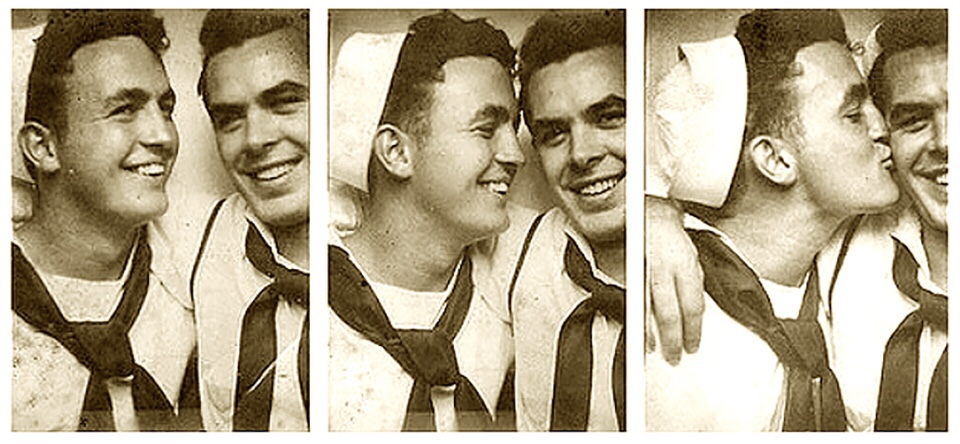
Two unknown American sailors in a photo booth. Image courtesy of Friends of the National WWII Memorial.
The Fateful Day By Fremont “Cap” Sawade
‘Twas the day before that fateful day, December Sixth I think they say. When leave trucks passed Pearl Harbor clear The service men perched in the rear. No thought gave they, of things to come. For them, that day, all work was done. In waters quiet of Pearl Harbor Bay, The ships serene, at anchor lay.
Nor did we give the slightest thought Of treacherous deeds by the yellow lot. Those men whose very acts of treason, Are done with neither rhyme nor reason. For if we knew what was in store We ne’re would leave that day before. For fun and drink to forget the war Of Britain, Europe, and Singapore.
For all of us there was no fear This time of peace and Christmas cheer. Forget the axiom, might is right, Guardians of Peace, were we that night. We passed the sailors in cabs galore, Those men in white who came ashore. But some will ne’re be seen again, In care-free fun, those sailor men.
The Sabbath Day dawned bright and clear, A brand of fire ore the lofty spear, Of Diamond Head, Hawaii’s own. A picture itself that can’t be shown, Unless observed with naked eye, That makes one look, and stop, and sigh. What more could lowly humans ask To start upon their daily task.
The men asleep in barracks late, Knew no war, that morn at eight. The planes on fields, their motors cold, Like sheep asleep among the fold. The ships at anchor with turbines stilled, Their crews below in hammocks filled. And faint, as tho it were a dream, A sound steels on upon this scene.
A drone of many red tipped things, The Rising Sun upon their wings. Those who saw would not believe, And those that heard could not conceive. A single shocking, thundering roar, Followed by another and many more. To rob the sleep from weary eyes, Or close forever those that died.
A hot machine gun’s chattering rattle, Mowed men down like herds of cattle. A bomb destroys an air plane hangar, The planes within will fly no more. Bombs explode upon a ship, Blasting men into the deep, To sink without the slightest thought Of what brought on this hell they caught.
What seems like years, the horrible remains, Blasting men and ships and planes. And just as quick as they had come, Away they went, their foul deeds done. To leave the burning wreckage here, The scorching hulks of dead ships there. And blasted forms of dying men, Alive in hell, to die again.
At night the skies were all but clear, The rosy glow of a white hot bier, Showed on clouds the havoc wrought, And greedy flames the men still fought. But from the ruins arose this cry, That night from those who did not die, “Beware Japan we’ll take eleven, For every death of December Seven.”
And from that day there has arisen, A cry for vengeance, in storms they’re driven. This fateful day among the ages, Shall stand out red in Hist’rys pages. Those men whom homefolk held so dear, Will be avenged, have no fear. And if their lives they gave in vain, Pray, I too, may not remain.
About the Poet and the Poem
Fremont “Cap” Sawade, who passed away at age 94 in 2016, wrote this the poem right after Pearl Harbor. Sawade was assigned to an Army anti-aircraft regiment in Honolulu on liberty, having breakfast the morning of the attack on Pearl Harbor eighty years ago today. Loud explosions sent him racing to his base in a cab. He could see the Japanese planes flying low, dropping bombs, and strafing battleships with machine gun fire. Back at Camp Malakole, Sawade ducked for cover when the Japanese Zeros strafed it. The attack caught the Americans completely off guard. Sawade said his unit didn’t even have ammunition for their big guns.
Two days later, with the wreckage of the Pacific Fleet still smoking, he sat at a desk at Hickam Field and started writing a poem. He’d never written one before. He hasn’t written one since. But over the next week, this one flowed out of him. He called it “The Fateful Day.” It captures how idyllic life was, before the attack. How lucky the service members felt to wake up every day with a view of Diamond Head. The poem captures their surprise, and then their anger at the Japanese, including a slur that was common then, offensive now. It captures the horror — “A hot machine gun’s chattering rattle/Mowed men down like herds of cattle” — and the raw thirst for vengeance.
He came home from the war to his native San Diego, worked a variety of jobs, including 10 years as a building inspector for the city of El Cajon. He got married, raised a family, and lived in Rancho Bernardo with his wife, Gloria. Over the years, he showed the poem to a few friends. He shared it a time or two in military newsletters. But the truth is he never thought it was anything special. However, today, nearly 80 years after he wrote it, it serves as a primary source for the thoughts of the men who lived through the attack on Pearl Harbor that fateful Sunday morning.










 Joe
Joe



 The Closet Professor