Category Archives: Inspiration

Apple CEO Tim Cook Come Out

IMG_9179.JPG

Last Monday, Apple CEO and Alabama native Tim Cook was inducted along with seven others into the Alabama Academy of Honor. Cook took the opportunity to challenge Alabama to do better with LGBT equality. He said that Alabama was too slow to guarantee the rights of minorities during the civil rights era, and now it’s too slow to ensure the rights of people based on sexual orientation and gender identity.

Speaking at the Capitol in the chamber where the state voted to secede from the Union in 1861, Cook said Alabama and the nation “have a long way to go” before realizing Dr. Martin Luther King Jr.’s dream of equality. Alabama was “too slow” to guarantee rights in the 1960s, Cook said, and “still too slow on equality for the LGBT community. Under the law, citizens of Alabama can still be fired based on their sexual orientation” Cook went further and stated that “We can’t change the past, but we can learn from it and we can create a different future.”

On Thursday October 30, 2014, Cook published the following message in BusinessWeek:

Throughout my professional life, I’ve tried to maintain a basic level of privacy. I come from humble roots, and I don’t seek to draw attention to myself. Apple is already one of the most closely watched companies in the world, and I like keeping the focus on our products and the incredible things our customers achieve with them.

At the same time, I believe deeply in the words of Dr. Martin Luther King, who said: “Life’s most persistent and urgent question is, ‘What are you doing for others?’ ” I often challenge myself with that question, and I’ve come to realize that my desire for personal privacy has been holding me back from doing something more important. That’s what has led me to today.

For years, I’ve been open with many people about my sexual orientation. Plenty of colleagues at Apple know I’m gay, and it doesn’t seem to make a difference in the way they treat me. Of course, I’ve had the good fortune to work at a company that loves creativity and innovation and knows it can only flourish when you embrace people’s differences. Not everyone is so lucky.

While I have never denied my sexuality, I haven’t publicly acknowledged it either, until now. So let me be clear: I’m proud to be gay, and I consider being gay among the greatest gifts God has given me.

Being gay has given me a deeper understanding of what it means to be in the minority and provided a window into the challenges that people in other minority groups deal with every day. It’s made me more empathetic, which has led to a richer life. It’s been tough and uncomfortable at times, but it has given me the confidence to be myself, to follow my own path, and to rise above adversity and bigotry. It’s also given me the skin of a rhinoceros, which comes in handy when you’re the CEO of Apple.

The world has changed so much since I was a kid. America is moving toward marriage equality, and the public figures who have bravely come out have helped change perceptions and made our culture more tolerant. Still, there are laws on the books in a majority of states that allow employers to fire people based solely on their sexual orientation. There are many places where landlords can evict tenants for being gay, or where we can be barred from visiting sick partners and sharing in their legacies. Countless people, particularly kids, face fear and abuse every day because of their sexual orientation.

I don’t consider myself an activist, but I realize how much I’ve benefited from the sacrifice of others. So if hearing that the CEO of Apple is gay can help someone struggling to come to terms with who he or she is, or bring comfort to anyone who feels alone, or inspire people to insist on their equality, then it’s worth the trade-off with my own privacy.

I’ll admit that this wasn’t an easy choice. Privacy remains important to me, and I’d like to hold on to a small amount of it. I’ve made Apple my life’s work, and I will continue to spend virtually all of my waking time focused on being the best CEO I can be. That’s what our employees deserve—and our customers, developers, shareholders, and supplier partners deserve it, too. Part of social progress is understanding that a person is not defined only by one’s sexuality, race, or gender. I’m an engineer, an uncle, a nature lover, a fitness nut, a son of the South, a sports fanatic, and many other things. I hope that people will respect my desire to focus on the things I’m best suited for and the work that brings me joy.

The company I am so fortunate to lead has long advocated for human rights and equality for all. We’ve taken a strong stand in support of a workplace equality bill before Congress, just as we stood for marriage equality in our home state of California. And we spoke up in Arizona when that state’s legislature passed a discriminatory bill targeting the gay community. We’ll continue to fight for our values, and I believe that any CEO of this incredible company, regardless of race, gender, or sexual orientation, would do the same. And I will personally continue to advocate for equality for all people until my toes point up.

When I arrive in my office each morning, I’m greeted by framed photos of Dr. King and Robert F. Kennedy. I don’t pretend that writing this puts me in their league. All it does is allow me to look at those pictures and know that I’m doing my part, however small, to help others. We pave the sunlit path toward justice together, brick by brick. This is my brick.

The Apple CEO’s announcement on Thursday that he is gay and wants to help further civil rights found strong support in some quarters, but his advocacy met less enthusiasm among some people in Alabama, where he was born and raised.

In socially conservative Alabama, where gay marriage remains illegal and workers can lawfully be fired on the basis of their sexual orientation, some said they wish the Apple executive had kept his sexual orientation private. However, I am very glad he came forward. In a world where money and power speaks, the advantages that Apple can provide makes Cook a very powerful spokesman for the LGBT community.

As mentioned earlier, when inducted on Monday into the Alabama Academy of Honor, Cook made comments critical of the state’s progress on rights for gays and minorities. Alabama Governor Robert Bentley, a Republican and opponent of same-sex marriage, said afterward that he objected to connections Cook drew in his induction speech between the civil rights movement and gay rights, the Anniston Star newspaper reported. “I don’t connect those two, and in fact I don’t think the African-American community connects those two either,” Bentley said, according to the newspaper. I have always connected equality for one with equality for all, and I can only hope that Bentley loses the governor’s race in tomorrow’s election, though it is highly doubtful since the Alabama Democratic Party placed a weak candidate in the race. Bentley’s opponent is actually a “former” Republican.

Birmingham-based state Representative Patricia Todd, a Democrat who is Alabama’s sole openly gay lawmaker, said she drew strength from Cook’s announcement, made in an article he wrote in Bloomberg Businessweek. Todd said the prospects for a bill she plans to reintroduce next year to legalize gay marriage will be strengthened by Cook’s example. “I’m tickled to death,” Todd said. “He is saying what we’ve been saying all along. Equality is good for business.”



Don’t Sneak

20140629-222318-80598391.jpg

Yesterday in my Sunday post, I discussed the two types of pride: the sinful selfish pride and the pride we should take in ourselves and be stronger people. LGBT can find meaning in pride. We start to feel able to freely and openly celebrate who we are. We need to stop hating and fearing ourselves, because those who live secret lives of pain are not able to fully celebrate their identity. I also used the following quote:

Maybe our journey in life isn’t so much about becoming anything. Maybe it’s about unbecoming everything that isn’t really you so you can become who you were meant to be in the first place.

It symbolizes that we should take pride in our true selves and not hide or “sneak.” StoryCorps, an NPR segment, marked the anniversary of a pivotal moment for gay rights, the 1969 Stonewall riots. Forty-five years ago, on June 27, gay protesters clashed with police in New York. Now, StoryCorps launched an initiative to preserve the stories of LGBT people called “OutLoud.” Below is one of those stories, and it’s a perfect example of why we should celebrate ourselves.

In the 1950s in rural Washington, a teenage boy learned an important lesson about self-acceptance. Patrick Haggerty, now 70, didn’t know he was gay at the time, but says his father knew what direction he was headed.

The conversation started because as a teenager Haggerty decided to perform in a school assembly. On their way there, he started covering his face with glitter — to his brother’s horror. Haggerty says his brother dropped him off at school and then called their father.

“Dad, I think you better get up there,” his brother said. “This is not going to look good.”

Their father did come. Charles Edward Haggerty, a dairy farmer, showed up at the school in dirty farming jeans and boots. When Haggerty saw his dad in the halls, he hid.

“It wasn’t because of what I was wearing,” Haggerty says. “It was because of what he was wearing.”

After the assembly, in the car ride home, Haggerty’s father called him out on his attempt to hide.

“My father says to me, ‘I was walking down the hall this morning, and I saw a kid that looked a lot like you ducking around the hall to avoid his dad. But I know it wasn’t you, ’cause you would never do that to your dad,’ ” Haggerty recalls.

Haggerty squirmed in his seat and finally exclaimed, “Well, Dad, did you have to wear your cow-crap jeans to my assembly?”

“Look, everybody knows I’m a dairy farmer,” his father replied. “This is who I am. Now, how ’bout you? When you’re an adult, who are you gonna go out with at night?”

Then, he gave his son some advice:

“Now, I’m gonna tell you something today, and you might not know what to think of it now, but you’re gonna remember when you’re a full-grown man: Don’t sneak. Because if you sneak, like you did today, it means you think you’re doing the wrong thing. And if you run around spending your whole life thinking that you’re doing the wrong thing, then you’ll ruin your immortal soul.”

“And out of all the things a father in 1959 could have told his gay son, my father tells me to be proud of myself and not sneak,” Haggerty says.

“He knew where I was headed. And he knew that making me feel bad about it in any way was the wrong thing to do,” he adds. “I had the patron saint of dads for sissies, and no, I didn’t know at the time, but I know it now.”

If more people could understand what Charles Edward Haggerty did over sixty years ago, then we’d have a lot less teenage suicide, we’d have a lot less depression in LGBT people, acceptance would be a given, and there would it longer be the need for the closet.


Alone

20140616-211032-76232436.jpg

Alone
Maya Angelou, 1928 – 2014

Lying, thinking
Last night
How to find my soul a home
Where water is not thirsty
And bread loaf is not stone
I came up with one thing
And I don’t believe I’m wrong
That nobody,
But nobody
Can make it out here alone.

Alone, all alone
Nobody, but nobody
Can make it out here alone.

There are some millionaires
With money they can’t use
Their wives run round like banshees
Their children sing the blues
They’ve got expensive doctors
To cure their hearts of stone.
But nobody
No, nobody
Can make it out here alone.

Alone, all alone
Nobody, but nobody
Can make it out here alone.

Now if you listen closely
I’ll tell you what I know
Storm clouds are gathering
The wind is gonna blow
The race of man is suffering
And I can hear the moan,
‘Cause nobody,
But nobody
Can make it out here alone.

Alone, all alone
Nobody, but nobody
Can make it out here alone.

“Alone” starts off with our speaker doing some serious soul-searching. She’s feeling pretty isolated, but she thinks she just might have come up with an answer to her problems: people need community in order to get by. I think this is very important for many minority groups, but is currently especially needed for the LGBT people in the South. As I was discussing with a friend the other day about the HRC’s Project One America Campaign. My friend said that the most important thing that Alabama LGBT needed was a sense of community. We currently don’t have much of a community besides in larger cities. Alabama still has a largely rural population, which often feels alone because they need that sense of community,

In “Alone,” Angelou says that money won’t buy you happiness. Even the very, very rich get lonely. So, don’t try to make more money. Make friends instead. Something I’m attempting do more of. The speaker of the poem fashions herself into something like a prophet, warning the “race of man” that things aren’t about to get any easier anytime soon. The solution is to realize that no one can make it on their own. We need each other.

When poet, memoirist, screenwriter, film director, jazz singer, dancer, professor, and civil rights activist Maya Angelou died in May at the age of 86, I reflected on what an icon America had lost. Maya Angelou helped people feel like they were possible of living great, meaningful lives.

She became, for so many, a symbol of resilience — the capacity to persist in the face of hardship and adversity — and beyond that a symbol of boundless creativity. She didn’t just survive the significant trauma of her early life; she made something magnificent of that life. Here are a few quotes a dear friend sent me from Maya Angelou, and I asked him to tell me what those quotes mean to him.

I’ve learned that people will forget what you said, people will forget what you did, but people will never forget how you made them feel.“– Maya Angelou

This is my friend’s favorite quote from Maya Angelou. As he thought back on his life and the trials he’s gone through, He said he remember people who have been there for him. You may not remember what they said or did to comfort you, reassure you or build you back up, but we will never forget how they made us feel loved, needed and worth their time. For my friend (and for most of us), these people are our real friends, our real family. We love them more than they will ever know.

You may not control all the events that happen to you, but you can decide not to be reduced by them.“– Maya Angelou

This is a very wise and powerful statement made by Angelou and one that has been very difficult for my friend and many of us to achieve. We all take a beating by events in our lives, those experiences knock us down, stomp on our hearts and tear at our souls. We can choose to be conquered by those unfortunate life occurrences or we can overcome them, learn from them and then go help others.

Try to be a rainbow in someone else’s cloud.“– Maya Angelou

This is so simple and yet we don’t often put it into action. We get so wrapped up in our own problems, our own desires, and our own silly day-to-day meaningless activities that we forget to be there for other people. I’ve found that when I help others or reach out to a friend in need or take time with someone to let them know we care and that they are important, we are able to forget our problems, our pain and our worries. It’s all about the “Golden Rule” a dear friend once told me. Treat others how you’d hope they would treat you. It’s in a small way following the example of Jesus Christ.

You can see in others what they don’t see in themselves and what the world doesn’t see in them. We all have that possibility, that potential and that promise of seeing beyond the seeming.” — Maya Angelou

Angelou wrote for her own creative satisfaction, but she was driven by the desire to encourage and inspire people beyond their limitations, whether they were self-imposed, determined by society, or handed down through history. The point of endeavor was, as she wrote, “to be a rainbow in someone else’s cloud.” She sought to be that rainbow for anyone who could read or hear her work. I try to so the same through The Closet Professor, as we should each attempt to in our lives.


What Would You Do?

20140525-080955.jpg

What good is it, my brothers, if someone says he has faith but does not have works? Can that faith save him? If a brother or sister is poorly clothed and lacking in daily food, and one of you says to them, “Go in peace, be warmed and filled,” without giving them the things needed for the body, what good is that? So also faith by itself, if it does not have works, is dead.
James 2:14-17

Many of us have stories about old couches — particularly ones we had in college, or shortly after. But not many stories are like the one three roommates in New Paltz, N.Y., can now tell.

After the trio realized their beat-up couch was stuffed with more than $40,000, they decided to return the money to its rightful owner.

It all started when roommates Reese Werkhoven, Cally Guasti and Lara Russo realized that the lumps in their couch’s pillows were actually envelopes stuffed with money. Just two months earlier, they’d bought the couch for $20 at a Salvation Army store.

“It had these bubble wrap envelopes, just like two or three of them,” Werkhoven tells CBS New York. “We ripped them out and [I] was just like freaking out, like an inch and a half of $100 bills.”

Or, as he told SUNY, New Paltz student-run blog The Little Rebellion, “I almost peed.”

They kept finding more envelopes in the couch, pulling money out of it like an upholstered ATM.

Werkhoven added, “The most money I’d ever found in a couch was like 50 cents. Honestly, I’d be ecstatic to find just $5 in a couch.”

The discovery was like a dream for the three friends, all of whom are either in college or recent graduates.

As they counted the money, they talked about what they might do with it; Werkhoven says he wanted to buy his mom a new car. But then they spotted a name among the envelopes, and realized they were faced with an ethical puzzle.

“We had a lot of moral discussions about the money,” Russo tells Little Rebellion. “We all agreed that we had to bring the money back to whoever it belonged to … it’s their money — we didn’t earn it. However, there were a lot of gray areas we had to consider.”

They asked their parents for advice; don’t spend the money, they were told. A phone number led them to the family that had donated the couch — and to answers about why it was full of money.

The roommates drove to the woman’s house in what The Little Rebellion calls “a rustic home in a rough neighborhood.”

“I think the part of this whole experience that cleared away my prior thoughts and worries was when I saw the woman’s daughter and granddaughter greet us at the door,” Werkhoven tells the blog. “I could just tell right away that these were nice people.”

It turned out that the money was socked away out of the woman’s late husband’s concerns that he wouldn’t always be there for his wife (she has chosen to remain anonymous). It represented decades of savings, including wages from the woman’s job as a florist.

For years, she also slept on the couch. But recent back problems led her daughter and son-in-law to replace it with a bed, meaning that the couch had to go.

“This was her life savings and she actually said something really beautiful, like ‘This is my husband looking down on me and this was supposed to happen,’ ” Guasti tells CBS NY.

After they returned the money to the woman, Guasti, Russo and Werkhoven received $1,000 as a reward.

What would you do if you found $40,000 in a Salvation Army couch? I honestly think that I’d do the same as these roommates did, because they found the name of the person to whom it belonged. If I had no idea of who it belonged to and no way of finding out, I would have given part of the money to the Salvation Army and done something good with the rest if it.

In addition, Reese Werkhoven looks pretty sexy in the picture above, this story makes him all the sexier to me.


Americans Say Yes To Gay Athletes … Until They Kiss

20140515-230638.jpg

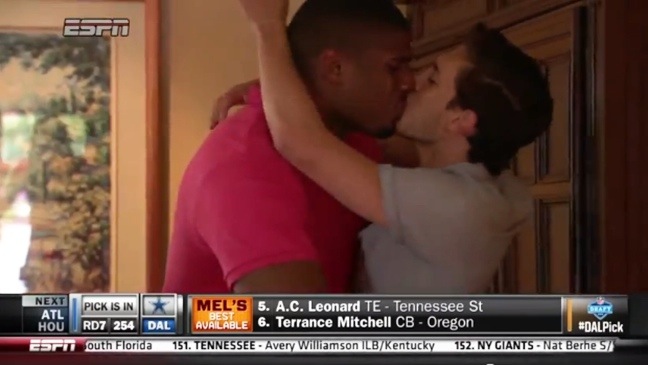
Americans say they’re ready for openly gay players, according to a HuffPost/YouGov poll conducted after Michael Sam became the first openly gay player to be drafted by an NFL team. But the survey also found lingering discomfort with gay athletes publicly celebrating in a way that straight athletes routinely do.

According to the new poll, 60 percent of Americans said they would approve of their favorite sports team signing an openly gay player, while 20 percent said they would disapprove. Among NFL fans in particular, 65 percent said they would approve and 21 percent said they would disapprove.

The year has seen breakthroughs in two major American sports leagues, with Sam being drafted by the St. Louis Rams last Saturday and Jason Collins becoming the first openly gay NBA player when he signed with the Brooklyn Nets in February.

But although most Americans approve of gay players in theory, many are less comfortable with the reality. Male athletes kissing their wives or girlfriends is routine territory for networks covering victory and other sporting celebrations, but coverage of Sam’s kissing his boyfriend after he was drafted has generated controversy. Forty-seven percent in the new poll said it was “inappropriate” for networks to show the kiss, while only 36 percent said it was “appropriate.” Seventeen percent said they weren’t sure.

The survey likewise found a major generational divide. Americans under age 30 had no problem with coverage of the kiss, by a 55 percent to 29 percent margin. Those between ages 30 and 44 were evenly divided: 40 percent said it was appropriate; 39 percent said it was inappropriate. And a majority of older Americans said it was inappropriate, including 52 percent of those between ages 45 and 64, and 69 percent of those 65 and older.

The kiss between Sam and his boyfriend may have been particularly heartfelt because they had to wait for it: He was the 249th pick in the seventh round of the draft. But those who said they follow the sport were more likely than not to say that Sam got a fair shake. Thirty-four percent of NFL fans said he was drafted at about the right time based on talent alone. Nineteen percent said he was drafted later than he should have been. Only 9 percent said he was drafted earlier than he should have been, while 38 percent said they didn’t know enough to judge.

However, the SEC is one of the, if not the best, conferences in college football. Since the SEC began giving the Defensive Player of the Year Award in 2003, all winners but Chad Lavalais (the first SEC Defensive Player of the Year and also two years older than most NFL draftees), DeMeco Ryans (a second round draft pick), and Michael Sam (a seventh round draft pick) have all been first round draft picks, including Sam’s co-Defensive Player of the Year for the SEC C. J. Mosley. Sam should have been a first round draft pick, yet he was one of the last players drafted, and it’s not because he got a “fair shake” but because he was gay.

New York Giants quarterback Eli Manning sounded off on Michael Sam’s headline-making news as part of an interview with HuffPost Live this week. As to how his Giants teammates would’ve reacted if Sam had been drafted by that team, Manning said, “We have a great locker room, and I think the most important thing … you’re drafted a football player. That’s all we care about in the locker room.”

Noting that “what you do outside in your personal life is up to you,” Manning added, “I was excited for [Sam]. This is a gentleman who’s been through a lot … I’m wishing Michael all the best in having a successful career.”

Way to go, Eli, you always show more class than your brother Peyton. I think the Rams will be lucky to have Sam as a player as any team would be and should have realized. They certainly need some good players at the Rams.


The Key To Success

20140319-211550.jpg

20140319-211600.jpg


Birmingham’s Good Samaritan

20140130-000940.jpg

It’s no secret that Chick-fil-A was founded by a family that considers itself Christian, and yet that same family continues to contribute to hate groups who wish to destroy equality in America. They claim that they run their business on biblical values, but their version of biblical values are not the values of a loving God. However, with the winter storm that swept through the South this week, one Chick-fil-A franchise owner is an example of true biblical values. What happened in Birmingham Tuesday evening was an example of how true biblical values are played out.

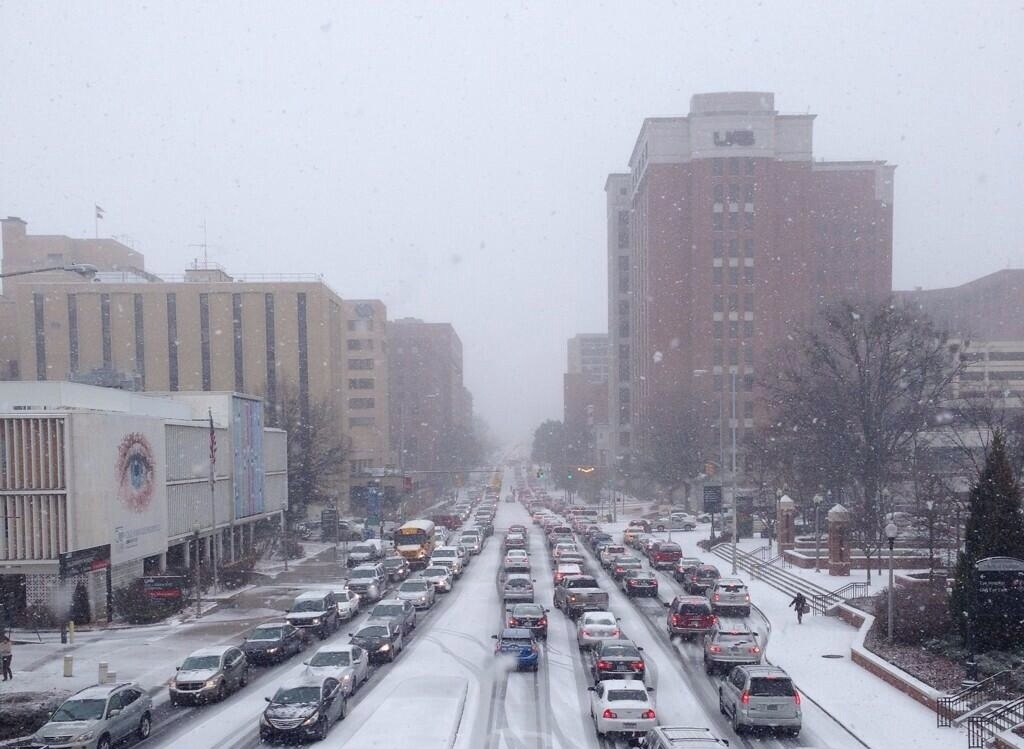
A snowstorm in the South is about as rare as it gets. Folks around Birmingham, Alabama, weren’t all that worried though. The storm was only supposed to dust the city – not even enough powder for a Southern snowman. Every prediction of the storm was that any major winter precipitation would be mostly contained to south of Montgomery in a northeastern arch that would stretch from Louisiana to Virginia. South Alabama was expected to get the brunt of the storms. North Alabama would be spared, but was likely to get some snow flurries.

So when the first snowflakes began to fall, no one paid all that much attention. But then, the flakes kept falling. Before too long people in the Birmingham Metro area realized it was much more than a dusting. By that point, it was too late for anyone to do anything.

Icy interstates and highways soon became clogged with cars and trucks. Thousands of motorists soon found themselves stranded with nowhere to go – including many stuck on Highway 280. (As a side note, a similar situation occurred in Atlanta, but Atlanta had been predicted to get heavy amounts of winter precipitation. Birmingham had not.)

But a good number of those stranded motorists were able to find shelter in the storm thanks to the kindness and generosity of some Chick-fil-A restaurant employees and the restaurant’s owner, Mark Meadows. Once the snow started accumulating, Meadows closed the restaurant and sent his staff home. But a few hours later, many of them returned – unable to get to their homes.

“Our store is about a mile and a half from the interstate and it took me two hours to get there,” manager Audrey Pitt said. “It was a parking lot as far as I could see.”

So Audrey left her car on the side of the interstate and joined a flock of bundled up drivers trudging through the snow.

“At one point there were more people walking than driving,” she said.

Some of the drivers had been stuck in their cars for nearly seven hours without any food or water. So the staff of the Chick-fil-A decided to lend a helping hand.

“We cooked several hundred sandwiches and stood out on both sides of 280 and handed out the sandwiches to anyone we could get to – as long as we had food to give out.”

The staffers braved the falling snow and ice, slipping and sliding, as they offered hot juicy chicken breasts tucked between two buttered buns. And Chick-fil-A refused to take a single penny for their sandwiches. The meal was a gift – no strings attached.

“They were very excited and extremely thankful,” she said. “People were thankful to get something to put in their stomachs.”

“We just wanted to be able to help,” Audrey said. “[Tuesday] was such a hopeless situation. We wanted to do something to make people feel a little bit better. We were here. We had food and there were people outside who needed food. So it just made sense to do something for them.”

But Chick-fil-A’s generosity didn’t stop there.

“We opened up our dining room to anyone who wanted to sleep on a bench or a booth,” Audrey said. And this morning, the weary staff members fired up their ovens and began preparing chicken biscuits. The only thing that is closed – is Chick-fil-A’s cash register.

“We’re not open for business,” she said. ‘We’re just feeding people who are hungry.”

I’d say the Chick-fil-A team blessed a lot of people in Birmingham – but that’s not how Audrey sees it. “It’s a blessing to us to be able to help people,” she said. “It really is.”

I think this is a wonderful story of generosity. “For I was hungry and you gave me something to eat,” Jesus said in the Gospel of Matthew. “I was thirsty and you gave me something to drink, I was a stranger and you invited me in.” The owner of this Chick-fil-A franchise obviously knows the meaning of the teachings of Jesus. Maybe one day the CEO of Chick-fil-A, Dan Cathy, will learn what the true meaning of Christianity is. I have to say though, that until Cathy quits donating to anti-LGBT organizations, I still won’t be going to a Chick-fil-A restaurant and giving them any of my money.

I am glad though that there are people like Mark Meadows who understand the true nature of Christian charity. May God bless him.

And while we are speaking of people getting stranded in the Birmingham area, some teachers and school administrators have my complete sympathies. Throughout Jefferson County (Birmingham is in Jefferson County), some parents were unable to get to their children to pick them up from school and teachers and administrators stayed with the students, some overnight, so that the children would be safe, warm, and well-fed. Being stuck in a car for hours on the road is one thing, but I can’t imagine the nightmare of being stuck at school with my students overnight. It may sound horrible of me to say that, but if you knew my students, you’d no doubt feel the same way.

Thankfully, Alabama should begin to thaw out tomorrow afternoon. Today will be another snow day for us. The good news is that with the governor declaring a state of emergency, we will not be required to make up the missed days. I could not have made it to school tomorrow anyway. My driveway is still frozen over as is the road in front of my house. I keep praying that no one hits those patches of ice and has a wreck. I can understand carefully getting out on the roads if you have a major emergency, but it is quite stupid to get out and joyride and sightsee.


Words To Live By

image


In their own words: Why students, educators support LGBT youth and #SpiritDay

Spirit Day, this October 17th, is about uniting in solidarity with LGBT youth everywhere by standing against bullying. A few of the students and educators participating this year are making their voices heard, explaining why it’s important to support the youngest members of the LGBT community through grassroots initiatives.

GLSEN has found that of the many students who reported not having supportive staff members at their school, more than three-fourths of them feel unsafe in their school. GLSEN further reported that in the past year, 81.9% of LGBT students were verbally harassed because of their sexual orientation and 63.9% were verbally harassed because of their gender expression. GLAAD recently brought you the stories of the tragic results of bullying for teen girls in Florida and Nevada.

High schools, colleges, and graduate schools throughout the country have signed on as Spirit Day partners. A few of them have spoken with GLAAD about their interests in going purple and raising awareness about anti-LGBT bullying.

DOLMSU_0.pngJennifer Carruth, a student at Mississippi State University, is a member of her school’s Safe Zone Advisory Board and president of the LGBTQ and Ally Service Sorority Delta Omega Lambda. Speaking to the importance of ending anti-LGBT bullying, she told GLAAD, “There are so many tragic endings that can be prevented if allies would raise their voices and protest bullying, educate others on LGBTQ issues, and advocate for LGBTQ youth… No one should have to live a life of fear and isolation because they are afraid to be who they are. Everyone deserves the right to shine, enjoy life, and be their true self.”

Spirit Day is an opportunity for a diverse range of communities to come together in their support for LGBT youth. Stonehill College, a Massachusetts school rooted in Catholicism, is one such example.

stonehill%20edited_0.pngMary Charlotte Buck, Student Government Associations’ Executive Board Vice President and an ally to the LGBT community, played an integral role in partnering Stonehill with GLAAD for Spirit Day. Mary Charlotte, who has an extensive background in working with teenagers, sees an important link between her school’s traditions and allying with the LGBT community. She said, “I think respecting, honoring, and loving the inherent dignity of all people is one of the most important aspects of our Catholic Identity, and I’m psyched we’ve chosen to recognize such a great day and cause! I’m proud to say we’ll be joining the schools supporting this day.” Faith based organizations from a variety of religions and denominations are going purple this year.

i%20am%20an%20educator%20edited.pngFaculty and students at Connecticut College, which recently ranked as one of the top 25 LGBT-friendly schools in the country, are going purple this year, too. Carol Akai is an Assistant Professor with the school’s Human Development department who specializes in children’s developmental psychology. She provided GLAAD with her professional opinion on supporting LGBT youth.

“One of the most compelling aspects of human development is our enormous capacity for change,” said Professor Akai. “As a society, we are at the beginning of what I hope is a paradigm shift toward the insistence of just treatment for individuals with LGBTQ identities under every circumstance.”

Spirit Day is about creating a safe and supportive environment in which all kids, teens, and young adults are given the opportunity to flourish. Educating people on the daily struggles of our community’s vulnerable members is the key to ultimately strengthening our at-risk members as well as the cause at large.

Spirit Day initially launched four years ago when Brittany McMillan, then a high school student in Canada, took to Tumblr to promote remembrance of the young lives lost as a result of bullying. Now, Spirit Day has grown into an international movement and is a testament to young people’s transformative powers as agents of change.

Professor Akai added, “As today’s college students become scholars, I hope they will combine their academic knowledge with their generational influence to affect widespread change that replaces intolerance and ignorance with kindness and complex understanding.”

There’s still time for you and your school to get into the spirit by:

  • Turning your Facebook, Twitter and other profile photos purple atwww.glaad.org/spiritday and spreading the word by using hashtag #SpiritDay
  • Wearing purple on October 17th and encouraging classmates or coworkers to do the same
  • Uploading photos of you wearing purple to Facebook, Twitter, Instagram and Tumblr using hashtag #SpiritDay and Spirit Day graphics
  • Downloading the Spirit Day App
  • Educating your friends and family about bullying and the LGBT community
  • Getting your school, GSA, organization, etc. to become a Spirit Day partner

Time is running out to go purple on Spirit Day as a participant and partner, and to join the Facebook event! Sign up today and spread the word.


The Importance of Individualism

20131010-214820.jpg

I have been reading up on summaries and analyses of Emerson’s “Self-Reliance.” I put off the reading and discussion of the essay until we return to school on Tuesday. I knew that if I started yesterday, I’d be interrupted for the holiday weekend, so I put it off. It also allowed me to study up on Emerson more. I’m trying to make it as interesting and thought provoking as I can so that we can have a good discussion, which means I need to make it as simple as possible for this particular group of students, who can be a bit lazy at times. Though you, my dear readers, may not be as enamored with Emerson and Transcendentalism as I am, I hope you will stick with reading this post as I get around to explaining why I think that a reading of Emerson today, of all days, is especially important.

As I was reading commentaries on Emerson, I came across the article “The Foul Reign of ‘Self-Reliance’,” in which Benjamin Anastas exposes what he considers to be the havoc wreaked by Ralph Waldo Emerson’s seminal essay on generations of Americans. Anastas asks us to consider: Did the great Ralph Waldo Emerson get it wrong? Have we? Have we turned self-reliance into self-centeredness? And while I tend to think he goes a bit overboard in laying virtually all American self-centeredness at Emerson’s feet, his ultimate point about his interpretation of self-reliance being an unassailable (and dangerous) moral and spiritual principle these days is one that is at least worth taking a closer look at. And we certainly wouldn’t advocate for a return to the dehumanizing, piety of the Puritanism to which Emerson was responding.

Early in the heart of the 19th Century, young America was in trouble. A brutal economic bust. Banks collapsing all over. Confidence was wavering. And here came the brilliant transcendentalist philosopher Ralph Waldo Emerson, like a blazing star. Trust yourselves, he said. Look inside. Speak what you think in hard words. Above all, embrace self-reliance. And boy did that go deep. It’s American bedrock. Maybe too deep, which is what Anasta says in his article. It’s become self-centeredness. Polarizing rigidity. In an interview with Tom Ashbrook. Of NPR’s “On Point,” Anasta states that he wrote “The Foul Reign of ‘Self-Reliance’” in an Emersonian style of purposeful antagonism. I personally think that he was a bit too antagonistic, and that “Self-Reliance” spoke to him in a totally different way then it did to me.

Anastas read “Self-Reliance” and sees a call for each person to be concerned with their own self and not be concerned with others. At least, he claims this is how Americans interpreted it and has in turn become the American pursuit of self-interest and self-centeredness.

However, I believe that Emerson’s true point is not to advocate selfish people, but to advocate non-conformity. Emerson wanted people to rely on their inner self. That inner self which is guided by a rational God. No two people are identical. We were created that way on purpose. If all we do is follow others, then there is no free will. We simply conform to the pack mentality. Does this mean that we should be selfish? No it doesn’t. Emerson believes that our true inner voice is not selfish. If we rely on our inner moral code then we work for the betterment of all mankind.

If we were to blindly follow and conform, then no LGBT person would ever come out of the closet. Today is National Coming Out Day. It is a day for us to celebrate who we truly are. National Coming Out Day is observed annually to celebrate coming out and to raise awareness of the LGBT community and civil rights movement. The holiday is observed in a wide variety of ways: from rallies and parades to information tables in public spaces. Participants often wear pride symbols such as pink triangles and rainbow flags. Whereas, I may not go around telling people, especially those who have no need to know, that I am gay, I have become more comfortable in my own skin. If people want to assume I am gay or assume that I am straight, then that is their prerogative. However, the one major thing that Emerson has taught me is to be who I am. Being who we are has been a bit of a theme this week for this blog, and I thank Emerson for that reminder.