Category Archives: Miscellaneous

The Blahs

Since I had the day off today, I had planned on blogging this morning when I got up, but when I woke up, I still had a bit of the blahs.  We probably all have them at some point, so I decided to take the day for myself.  So I remained lazy all day today.  Sorry for not posting my usual post, but I hope that you all will forgive me.  The good thing is, I am currently feeling better.  I think that maybe I have actually caught up on my sleep deficit, and the blahness that I was feeling yesterday is not so blah anymore.  I hope that you all have had a wonderful day today, I know that I have had some wonderful sleep.


Not Up to Snuff

You may have thought my most recent posts have been a little lackluster, and truthfully, the last few days, I have, as my late grandfather would have said, not been feeling up to snuff.  It could be the recent weather being warm, then rainy, warmer, then rainy again, and now growing colder.  Whatever it is, I have just had no energy the last few days, have had a headache, and just generally feeling blah.  I get  a four day weekend this weekend, so hopefully, I will recuperate and get back to my normal self.  Until then, I thought I would give you the meaning of my granddaddy’s old saying “not up to snuff.”

“Up to snuff,” meaning “satisfactory” or “measuring up to the required standard” turns out to be quite an interesting phrase. First of all, “snuff” all by itself is an intriguing word, or should I say “words,” because there are really two different “snuffs.” The older “snuff,” of unknown origin and dating back to the 14th century, meant the burnt part of a candle wick. As a verb, this “snuff” meant “to extinguish a candle” and it is from this sense that we get our modern metaphor of “snuffing” someone’s hopes (or, in slang, actually expunging the person). 

The other kind of “snuff,” meaning powdered tobacco inhaled through the nostrils, came along a bit later, in the 1680’s. The root of this “snuff” was probably the verb “to snuff,” meaning to draw up into the nose (think back to your last “snuffling” head cold), and it apparently began as an abbreviation of the Dutch word “snuiftabak,” or snuffing tobacco. “Taking snuff” was a popular habit in Europe for hundreds of years, so its not surprising that it showed up in a metaphor for “satisfactory” or “usual.” What remains a little unclear about “up to snuff” is whether the phrase refers to a level of acceptable quality of snuff itself, or to the wide-awake and perky attitude of someone who has just taken snuff.

The phrase, “up to snuff,” likely dates from Britain where it is recorded in 1811 with the meaning “knowing; not easily deceived”. In America in 1831 its meaning had changed to “up to standard”. The British meaning arose from the notion of being old or experienced enough to take snuff, and the American form was an expansion of that meaning.


Contemplation


Happy New Year!!!

Auld Lang Syne
by Robert Burns
Should auld acquaintance be forgot,
     And never brought to mind?
Should auld acquaintance be forgot,
     And auld lang syne!
     For auld lang syne, my dear,
     For auld lang syne.
     We’ll tak a cup o’ kindness yet,
     For auld lang syne.
And surely ye’ll be your pint stowp!
     And surely I’ll be mine!
And we’ll tak a cup o’ kindness yet,
     For auld lang syne.
     For auld lang syne, my dear,
     For auld lang syne.
     We’ll tak a cup o’ kindness yet,
     For auld lang syne.
We twa hae run about the braes,
     And pou’d the gowans fine;
But we’ve wander’d mony a weary fit,
     Sin’ auld lang syne.
     For auld lang syne, my dear,
     For auld lang syne.
     We’ll tak a cup o’ kindness yet,
     For auld lang syne.
We twa hae paidl’d in the burn,
     Frae morning sun till dine;
But seas between us braid hae roar’d
     Sin’ auld lang syne.
     For auld lang syne, my dear,
     For auld lang syne.
     We’ll tak a cup o’ kindness yet,
     For auld lang syne.
And there’s a hand, my trusty fere!
     And gie’s a hand o’ thine!
And we’ll tak a right gude-willie waught,
     For auld lang syne.
     For auld lang syne, my dear,
     For auld lang syne.
     We’ll tak a cup o’ kindness yet,

     For auld lang syne.

Eighteenth-century Scottish poet Robert Burns may well be most famous not for a poem he wrote, exactly, but for a poem he wrote down. According to Burns Country, a comprehensive website devoted to the poet, Burns, in a letter to an acquaintance, wrote, “There is an old song and tune which has often thrilled through my soul. You know I am an enthusiast in old Scotch songs. I shall give you the verses on the other sheet… Light be the turf on the breast of the heaven-inspired poet who composed this glorious fragment! There is more of the fire of native genius in it than in half a dozen of modern English Bacchanalians.”

That song was a version that Burns fashioned of “Auld Lang Syne,” which annually rings in the New Year at parties across the world, though most often sung out of tune and with improvised lyrics, as it has been described as “the song that nobody knows.” Though the history of the authorship of the poem is labyrinthine and disputed, Burns is generally credited with penning at least two original stanzas to the version that is most familiar to revelers of the New Year. Here are the first two stanzas as Burns recorded them:

Should auld acquaintance be forgot,
And never brought to mind?
Should auld acquaintance be forgot,
And auld lang syne!

Chorus.-For auld lang syne, my dear,
For auld lang syne.
We’ll tak a cup o’ kindness yet,
For auld lang syne.

Undoubtedly, some rousing version of the Scottish song echoed through the New Year’s night near whereThomas Hardy wrote his haunting goodbye to the ninteenth century, “The Darkling Thrush.” Dated December 30, 1900, which signaled the end of the century in Hardy’s view, the poem intones a much more somber sense of the end of one time and beginning of another. Consider the last lines of the opening stanza, which set a grim scene:

The tangled bine-stems scored the sky
Like strings of broken lyres,
And all mankind that haunted nigh
Had sought their household fires.

But century’s end, for Hardy, was possibly an arbitrary marking, too, and there was hope to be found, in the form of the sudden song issued from a thrush’s voice, a “full-hearted evensong / Of joy illimited.”
For centuries, it has been the charge of Britain’s Poet Laureate to write a poem to ring in the New Year. Laureate Nahum Tate established this practice, having written eight New Year odes between 1693 and 1708. And the phrase “ring out the old, ring in the new” first comes from another laureate’s pen, Lord Alfred Tennyson, from his most well-known poem, “In Memoriam”:

Ring out the old, ring in the new,
Ring, happy bells, across the snow:
The year is going, let him go;
Ring out the false, ring in the true.

Finally, Kobayashi Issa, a great practitioner of the haiku form, approached the new year with a sense of humility and reverence:

New Year’s Day–
everything is in blossom!
I feel about average.


Twin Boys, One Transgender, Become Brother and Sister

Twin Boys, One Transgender, Become Brother and Sister
By SUSAN DONALDSON JAMES (ABCNews.com)

Identical 14-year-old twins, Nicole and Jonas Maines, started out life as Wyatt and Jonas. Nicole is transgender.

As early as age 4, Wyatt Maines asked his mother, “When do I get to be a girl?” And he told his father he hated his penis.

Wyatt always liked girl’s clothes and movies, while his twin brother Jonas played with traditional boy toys.

Born identical twins, the siblings share the same DNA, but their gender identification took divergent paths. Now, at age 14, they are brother and sister, as Wyatt’s transition to Nicole is well under way.

Nicole is 5-feet, 1-inch tall and 100 pounds; her twin brother is 5-feet, 6-inches and weighs 115 pounds — and they are best friends.

Their story — marked by tearful emotions, bullying at their first school and eventually a lawsuit and a move to a different town — was chronicled in the Boston Globe.

Their parents, Wayne and Kelly Maines, said they brought their transgender daughter into the spotlight in the hopes that their story might shed light on the struggle of others.

“We sat down with our kids at the breakfast table when they were 9 and talked about fear, hate, evil and freedom of speech before sending them to school,” their father, Wayne Maines, 52, wrote in an email to ABCNews.com.

“I was very angry and sad to have to talk to our small children in this manner,” he said. “We also told them to keep their heads-up, be proud and take care of each other and their friends. I am very proud of them both because they have not forgotten that lesson and they continue to help others whenever it is safe to do so.”

Maines, who is director of safety and environmental management at the University of Maine in Orono, said his “biggest concern” was the safety of his son and daughter after the Globe ran its front-page story.

A hunter and a political conservative, Maines told the newspaper that he at first had trouble calling Nicole by the name she adopted in fourth grade: “I was grieving,” he said. “I was losing a son.”

But Nicole said, “The thought of being a boy makes me cringe.”

“It is important for people to understand some of the challenges we and other families are dealing with at home, at work and in our communities,” Maines wrote, declining to do a full interview.

“We need to watch for a little while to see how this recent step out in the world impacts their safety and ability to function normally at their new school,” he said.

He has warned his daughter since she began speaking out before advocacy groups and even at the Maine State House, to watch her back.

A report by the National Center for Transgender Equality and the National Gay and Lesbian Task Force paints a bleak picture of life as a transgender person in the United States. The 2011 survey, “Injustice at Every Turn,” found that discrimination is pervasive in “nearly every system and institution.”

Transgender youth, in particular, are at disproportionate risk for depression, suicide, substance abuse, HIV and sexually transmitted diseases, according to the Family Acceptance Project at San Francisco State University.

And unlike in the Maines twins, many children do not get the vital support of their own parents and end up homeless.

ABC’s “20/20” recently profiled homeless teens, including 13-year-old June, of Portland, Ore., who is transgender. She faced bullying from her brothers and said she feels like an outsider in her own home.

“They don’t meet the family’s expectation of how a boy or girl should behave,” said Family Acceptance Project Director Caitlin Ryan, a clinical social worker. “They see them as disobedient or disrespectful or willful. To punish a child or force them to wear clothes that feel wrong for them and make them feel humiliated damages their self-worth.”

Ryan said there is a “dearth of information” for parents on how to deal with a child who is gender nonconformist.

While Nicole has been sure about her gender since she was a toddler, her parents faced enormous confusion, wondering if their son had a feminine side, was gay or, as it turns out, was a female trapped in a male body, according to the Globe.

Even their pediatrician wouldn’t address the issue with them.

She excelled in middle school, serving as vice-president in the fifth grade, but one day a bully called her “faggot” and told his guardian that Nicole was using the boys’ room. The school required her to use the staff bathroom, then assigned an adult to follow her daily routine so she wouldn’t be further bullied. Jonas was teased as well.

The Maineses got the backing of the Maine Human Rights Commission, which agreed that Nicole had been discriminated against, according to the Globe. They joined the family in a lawsuit against the Orono School District, which is now pending.

The Boston legal organization Gay and Lesbian Advocates and Defenders (GLAD) is representing the family, which says the stigma got so bad after they took legal action that they had to move to a more diverse and open-minded town in southern Maine.

“It’s the first time they’ve gone to school since this story has come out and the family is understandably cautious of the kinds of reactions they might get based on past experiences,” GLAD spokeswoman Carisa Cunningham told ABCNews.com.

But Nicole has been sure from the start: “I’ve always known I was a girl,” she told the Globe. “I think what I am aiming for is to undergo surgery to get a physical female body that matches up to my image of myself.”

Her mother, Kelly Maines, who is 50 and works in law enforcement, went online to learn more and came across the Gender Management Service at Children’s Hospital in Boston, founded in 2007 by endocrinologist Dr. Normal Spack and urologist Dr. David Diamond, the first of its kind in the Western hemisphere.

The clinic serves children with disorders of sexual development and physical deformities, as well as those with gender identity issues with a team of geneticists, urologists, endocrinologists and mental health specialists.

At about 12, Nicole was given puberty blockers to stop the development of secondary sexual characteristics like male body hair, which can later make sex reassignment surgery more painful and expensive.

Later in adolescence, she will begin estrogen treatment and continue on testosterone suppressers until she is 18 — old enough for surgery.

After the testes are surgically removed, there will be no need for the hormone blockers. But the entire procedure will render Nicole infertile, which is why she continues counseling to help her make a final decision.

The majority of all children who express the belief that they are the wrong gender, will enter puberty and go on to identify with their biological gender, according to Spack.

“Of all little kids who are gender variant, 20 percent will stick with it,” he said. “Over 80 percent will accept looking like Jonas and would push talk about cutting off [their penis.]”

That is why doctors wait for children like Nicole to show the first sign of puberty before giving them blockers and the treatments are reversible.

But giving a prepubescent child hormones of the opposite sex has permanent effects like halting their development, closing up growth plates. Using puberty blockers “buys us time, so they can extend the diagnostic phase,” Spack said.

Spack said GeMS has sent a half dozen children all the way to sex change surgery from male to female. Using estrogen in combination with testosterone blockers allows them to develop curves and grow “normal” size breasts without implants.

Surgery is also sophisticated. “They have learned to use tissue to form the vagina and some surgery is so incredible even gynecologists have been a bit fooled.”

Sensation tissue can also be preserved so male to female patients can experience orgasm. Even fertility may one day be resolved, he said.

“Nicole has a hopeful future,” said Spack. “The field is growing faster than I am getting old. Who knows about the future of reproductive endocrinology.”

The fact that Nicole and her brother are identical twins gives scientists a window into the causes of transgenderism. Though Nicole is the first in this clinic, twins like the Maines ones are not unknown.

“Obviously everything isn’t DNA,” said Spack. “Parents tell you identical twins are different. But what this means in terms of transgenderism altogether, we are in a primitive state of understanding this.”

Several neurological studies from Europe show brain differences in transgender people, suggesting they may be “wired” differently. Spack said that he has noticed that about 10 percent of his patients display “something in the autistic spectrum, very mild, like Asperger’s [syndrome].”

As for Nicole, Spack said her strong voice helped the family support her and eventually seek help. She has even been able to attend a summer camp for transgender children — Camp Arunu’ Tiq.

“She needed to push the envelope,” said Spack, who now only consults on her case every few months. “I have this phenomenal image of her. I saw Nicole and other kids who had seemed reticent in my office playing the piano and doing dance numbers, just like at any other camp.”

Spack, who once yearned to deliver babies, said he gets a special thrill working with transgender children like Nicole.

“It’s sort of like being a midwife to a person who has the courage to give birth to themselves,” he said.



Tradition #3: Merry Christmas

Deck the halls with boughs of holly,
Fa la la la la, la la la la.
Tis the season to be jolly,
Fa la la la la, la la la la.

Don we now our gay apparel,
Fa la la, la la la, la la la.
Troll the ancient Yule tide carol,
Fa la la la la, la la la la.

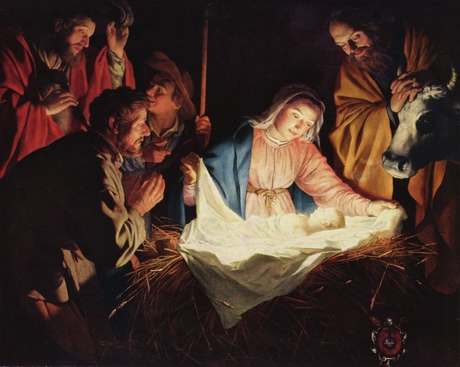
I hope that you all have a very Merry Christmas (or a Happy Hanukkah for some of you).  I will be attending church this morning and then helping my mother get ready for Christmas Dinner. The holidays are a wonderful time, though they can be quite stressful.  When the times get stressful, I just remember the true meaning of Christmas.  Though the story of Christ’s birth is in both the Gospels of Matthew and Luke, I have always loved Luke’s version best.  It has long been a tradition in our family to read Luke Chapter 2 together as a family.

Happy Holidays, Everyone!


Luke Chapter 2: 1-25

And it came to pass in those days, that there went out a decree from Caesar Augustus, that all the world should be taxed.
([And] this taxing was first made when Cyrenius was governor of Syria.)
And all went to be taxed, every one into his own city.
And Joseph also went up from Galilee, out of the city of Nazareth, into Judaea, unto the city of David, which is called Bethlehem; (because he was of the house and lineage of David:)
To be taxed with Mary his espoused wife, being great with child.
And so it was, that, while they were there, the days were accomplished that she should be delivered.
And she brought forth her firstborn son, and wrapped him in swaddling clothes, and laid him in a manger; because there was no room for them in the inn.
And there were in the same country shepherds abiding in the field, keeping watch over their flock by night.
And, lo, the angel of the Lord came upon them, and the glory of the Lord shone round about them: and they were sore afraid.
And the angel said unto them, Fear not: for, behold, I bring you good tidings of great joy, which shall be to all people.
For unto you is born this day in the city of David a Saviour, which is Christ the Lord.
And this [shall be] a sign unto you; Ye shall find the babe wrapped in swaddling clothes, lying in a manger.
And suddenly there was with the angel a multitude of the heavenly host praising God, and saying,
Glory to God in the highest, and on earth peace, good will toward men.
And it came to pass, as the angels were gone away from them into heaven, the shepherds said one to another, Let us now go even unto Bethlehem, and see this thing which is come to pass, which the Lord hath made known unto us.
And they came with haste, and found Mary, and Joseph, and the babe lying in a manger.
And when they had seen [it], they made known abroad the saying which was told them concerning this child.
And all they that heard [it] wondered at those things which were told them by the shepherds.
But Mary kept all these things, and pondered [them] in her heart.
And the shepherds returned, glorifying and praising God for all the things that they had heard and seen, as it was told unto them.
And when eight days were accomplished for the circumcising of the child, his name was called JESUS, which was so named of the angel before he was conceived in the womb.
And when the days of her purification according to the law of Moses were accomplished, they brought him to Jerusalem, to present [him] to the Lord;
(As it is written in the law of the Lord, Every male that openeth the womb shall be called holy to the Lord;)
And to offer a sacrifice according to that which is said in the law of the Lord, A pair of turtledoves, or two young pigeons.
And, behold, there was a man in Jerusalem, whose name [was] Simeon; and the same man [was] just and devout, waiting for the consolation of Israel: and the Holy Ghost was upon him.

Tradition #2: Christmas Eve

I have to admit, that Christmas Eve in my household growing up was never an especially fun time.  We did not go to to church on Christmas Eve or Christmas Day (unless Sunday fell on one of these days) because as members of the church of Christ, it is not considered a religious holiday, since there is no mention of an actual date for Christmas in the New Testament.  We rarely even sang Christmas songs; the only exceptions being when I used to lead the singing.  The only thing that signified Christmas in our church was the poinsettias that were placed in the church.

The reason for Christmas Even not being especially fun was because we had to go to my maternal grandparent’s house for Christmas Eve, and then as soon as we opened gifts we had to go to my paternal grandmother’s family Christmas party.  My father was always ill-tempered because we would always arrive late to the second party and he blamed it all on my mother.  This made for a really uncomfortable ride between the two parties.  My father hates being late, and sees another Christmas party as not a good excuse.  My father could be a real jackass at times, and every Christmas Eve we had to hear him bitch and complain.  Then as soon as we got home from the second party, it was off to bed, so that “Santa Claus” could come. I always hated trying to fall asleep on Christmas Eve.  Even on a good night, I have never been one to simply lay my head down and go to sleep, and with the anticipation of Christmas morning, Christmas Eve night was never an easy night to go to sleep, but I always did, and never once heard my parents (yes, contrary to yesterday’s post, I knew it was them) putting the presents under the tree.

However, there was one thing that I loved about Christmas Eve. It was the night that Santa Claus would be coming to visit.  I have always loved Clement C. Moore’s A Visit from St. Nicholas, and so I wanted to share it with you for my Christmas Eve post.


A Visit from St. Nicholas
by Clement Clark Moore

‘Twas the night before Christmas, when all through the house
Not a creature was stirring, not even a mouse;
The stockings were hung by the chimney with care,
In hopes that St. Nicholas soon would be there;
The children were nestled all snug in their beds,
While visions of sugar-plums danced in their heads;
And mamma in her ’kerchief, and I in my cap,
Had just settled our brains for a long winter’s nap,
When out on the lawn there arose such a clatter,
I sprang from the bed to see what was the matter.
Away to the window I flew like a flash,
Tore open the shutters and threw up the sash.
The moon on the breast of the new-fallen snow
Gave the lustre of mid-day to objects below,
When, what to my wondering eyes should appear,
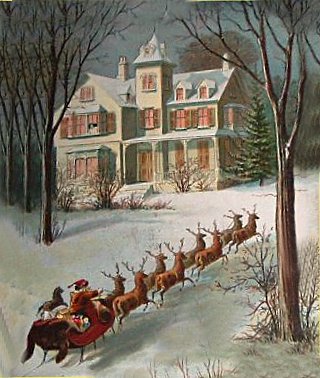
But a miniature sleigh, and eight tiny reindeer,
With a little old driver, so lively and quick,
I knew in a moment it must be St. Nick.
More rapid than eagles his coursers they came,
And he whistled, and shouted, and called them by name;

“Now, Dasher! now, Dancer! now, Prancer and Vixen!
On, Comet! on, Cupid! on, Donder and Blitzen!
To the top of the porch! to the top of the wall!
Now dash away! dash away! dash away all!”
As dry leaves that before the wild hurricane fly,
When they meet with an obstacle, mount to the sky;
So up to the house-top the coursers they flew,
With the sleigh full of Toys, and St. Nicholas too.
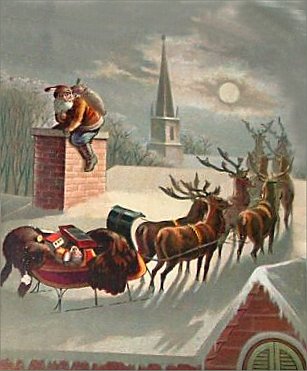
And then, in a twinkling, I heard on the roof
The prancing and pawing of each little hoof.
As I drew in my head, and was turning around,
Down the chimney St. Nicholas came with a bound.
He was dressed all in fur, from his head to his foot,
And his clothes were all tarnished with ashes and soot;
A bundle of Toys he had flung on his back,
And he looked like a pedler just opening his pack.
His eyes—how they twinkled! his dimples how merry!
His cheeks were like roses, his nose like a cherry!
His droll little mouth was drawn up like a bow
And the beard of his chin was as white as the snow;
The stump of a pipe he held tight in his teeth,

And the smoke it encircled his head like a wreath;
He had a broad face and a little round belly,
That shook when he laughed, like a bowlful of jelly.
He was chubby and plump, a right jolly old elf,
And I laughed when I saw him, in spite of myself;
A wink of his eye and a twist of his head,
Soon gave me to know I had nothing to dread;
He spoke not a word, but went straight to his work,
And filled all the stockings; then turned with a jerk,
And laying his finger aside of his nose,
And giving a nod, up the chimney he rose;
He sprang to his sleigh, to his team gave a whistle,
And away they all flew like the down of a thistle,
But I heard him exclaim, ere he drove out of sight,
“Happy Christmas to all, and to all a good-night.”

By the way, did you know that A Visit from St. Nicholas was not the only poem that Moore wrote about Santa Claus.  He wrote another one, that I had never read until recently called Old Santeclaus.  I hope that you enjoy it as well.

Old Santeclaus
by Clement Clark Moore

Old Santeclaus with much delight
His reindeer drives this frosty night,
O’er chimney-tops, and tracks of snow,
To bring his yearly gifts to you.


The steady friend of virtuous youth,
The friend of duty, and of truth,
Each Christmas eve he joys to come
Where love and peace have made their home.


Through many houses he has been,
And various beds and stockings seen;
Some, white as snow, and neatly mended,
Others, that seemed for pigs intended.


Where e’er I found good girls or boys,
That hated quarrels, strife and noise,
I left an apple, or a tart,
Or wooden gun, or painted cart.


To some I gave a pretty doll,
To some a peg-top, or a ball;
No crackers, cannons, squibs, or rockets,
To blow their eyes up, or their pockets.


No drums to stun their Mother’s ear,
Nor swords to make their sisters fear;
But pretty books to store their mind
With knowledge of each various kind.


But where I found the children naughty,
In manners rude, in temper haughty,
Thankless to parents, liars, swearers,
Boxers, or cheats, or base tale-bearers,


I left a long, black, birchen rod,
Such as the dread command of God
Directs a Parent’s hand to use

When virtue’s path his sons refuse.


Tradition #1: Santa Claus

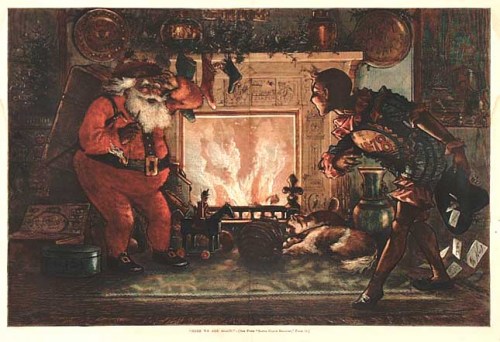
A Santa that I can believe in.

As a kid, you invariably get to the age when other kids no longer believe in Santa Claus, and you go and ask your parents if he is real.  I remember doing this when I was about 7 or 8 years old and my mother pulling down a book of Christmas Traditions and reading to my sister and me the story of Virginia O’Hanlon.  To this day, I still love this story, and it was one of our Christmas traditions for my mom to read it to us when we were kids.  It is more about the spirit of Christmas instead of “Is there a Santa Claus?”, but it is beautifully written and my favorite editorial of all-time.  We always have to keep in mind that we should not be “affected by the skepticism of a skeptical age.”  Over a hundred years later, Mr. Church’s words still ring true.


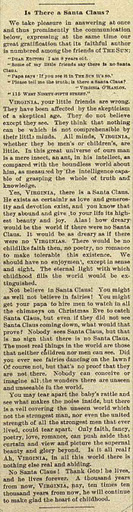
Eight-year-old Virginia O’Hanlon wrote a letter to the editor of New York’s Sun, and the quick response was printed as an unsigned editorial Sept. 21, 1897. The work of veteran newsman Francis Pharcellus Church has since become history’s most reprinted newspaper editorial, appearing in part or whole in dozens of languages in books, movies, and other editorials, and on posters and stamps.

“DEAR EDITOR: I am 8 years old.
“Some of my little friends say there is no Santa Claus.
“Papa says, ‘If you see it in THE SUN it’s so.’
“Please tell me the truth; is there a Santa Claus?

“VIRGINIA O’HANLON.

“115 WEST NINETY-FIFTH STREET.”

VIRGINIA, your little friends are wrong. They have been affected by the skepticism of a skeptical age. They do not believe except [what] they see. They think that nothing can be which is not comprehensible by their little minds. All minds, Virginia, whether they be men’s or children’s, are little. In this great universe of ours man is a mere insect, an ant, in his intellect, as compared with the boundless world about him, as measured by the intelligence capable of grasping the whole of truth and knowledge.

Yes, VIRGINIA, there is a Santa Claus. He exists as certainly as love and generosity and devotion exist, and you know that they abound and give to your life its highest beauty and joy. Alas! how dreary would be the world if there were no Santa Claus. It would be as dreary as if there were no VIRGINIAS. There would be no childlike faith then, no poetry, no romance to make tolerable this existence. We should have no enjoyment, except in sense and sight. The eternal light with which childhood fills the world would be extinguished.

Not believe in Santa Claus! You might as well not believe in fairies! You might get your papa to hire men to watch in all the chimneys on Christmas Eve to catch Santa Claus, but even if they did not see Santa Claus coming down, what would that prove? Nobody sees Santa Claus, but that is no sign that there is no Santa Claus. The most real things in the world are those that neither children nor men can see. Did you ever see fairies dancing on the lawn? Of course not, but that’s no proof that they are not there. Nobody can conceive or imagine all the wonders there are unseen and unseeable in the world.

You may tear apart the baby’s rattle and see what makes the noise inside, but there is a veil covering the unseen world which not the strongest man, nor even the united strength of all the strongest men that ever lived, could tear apart. Only faith, fancy, poetry, love, romance, can push aside that curtain and view and picture the supernal beauty and glory beyond. Is it all real? Ah, VIRGINIA, in all this world there is nothing else real and abiding.

Francis Pharcellus Church

No Santa Claus! Thank God! he lives, and he lives forever. A thousand years from now, Virginia, nay, ten times ten thousand years from now, he will continue to make glad the heart of childhood.

NOTE:  First of all, if you read this blog you most certainly believe in faeries.  As gay men, we’ve been called faeries for many years. And many times I have seen ” fairies dancing on the lawn” or at least in bars. And if anyone takes offense to my little endnote, well then shame on you.  If we can’t laugh at ourselves, then who the hell can we laugh at.


Family Christmas Traditions

Christmas with the immediate family (Mom, Dad, my sister, and I) in my house was a very special occasion.  Until my sister got married, it always took place on December 23, because we had two family Christmas gatherings on Christmas Eve and Christmas morning was for Santa Claus and breakfast with my grandparents.  Christmas Day was always a day when the family just spent together.  We probably all have certain family holiday traditions.  Over the next three days, I want to tell you about my family’s traditions.  The posts for the 23rd, 24th, and 25th are all about things that my mother read to us as children, generally on the 23rd or the night before.

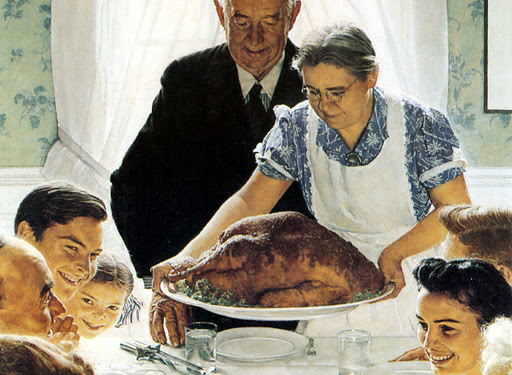
Our dinner on the 23rd was always a special meal.  My mother used her fine china, crystal, and silverware only once a year, and this was the night.  My mother prepared the meal, which began with shrimp cocktails and salads, then we usually had Cornish game hens, various vegetables, and real yeast rolls.  Dessert was usually a homemade cheesecake.  While my mother prepared the meal, my sister and I were to set the table.  She would get out the Auburn Extension Cookbook which had the diagram above for setting the table, and my sister and I had to have it just perfect.  We always had the meal by candlelight, and when we were finished, we then were able to sit in the living room, which was next to the dining room, and open presents (These were the presents that Santa was not going to bring us; Santa always brought the big stuff).

Since my sister has been married, we have move this tradition to Christmas Night, which seems more appropriate anyway.  So what family traditions do you cherish the memories of?


Your Mental Health: Surviving the Holidays

Your mental health: Surviving the holidays
by Eric Albert, Brandon Browne, Jonathan Mohr
PGN-The Philadelphia Gay News

The holidays can be a stressful time for LGBTQ people and their families, but there are several strategies you can use to help reduce stress and create a happy holiday this year.

Traveling home

Before heading home for the holidays, make a decision about being “out” to each family member. If you are bringing a partner, discuss in advance how you will talk about your relationship and show affection with one another (and plan your sleeping arrangements in advance!). Have alternate plans if the situation becomes difficult at home. If you’re traveling, find out about local LGBT resources. And if you plan to “come out,” have support available, including PFLAG materials and the number of a local PFLAG chapter.

Don’t assume you know how somebody will react to news of your sexual orientation or gender identity — you may be surprised. Realize that your family’s reaction to you may not be because you are LGBTQ; the hectic holiday pace may simply be taking its toll on family members. Remember that “coming out” is a continuous process. Don’t wait for your family’s attitude to change to have a special holiday. Remember that it took you time to come to terms with who you are; now it is your family’s turn. Let your family’s judgments be theirs to work on, as long as they are kind to you. If you are transgender, be gentle with your family’s pronoun “slips.” Let them know you know how difficult it is.

During your visit focus on common interests and reassure family members you are still the same person they’ve always known. If you are partnered, be sensitive to his or her needs as well as your own. Be wary of the possible desire to shock your family — and at the same time, remember that you don’t need your family’s approval. It may help to connect with someone else who is LGBTQ — by phone or in person — who understands what you are going through.

If it’s too difficult to be with your family, create your own holiday gathering with friends and loved ones.

Holiday blues

While we like to think of this season as a time of joy, festive parties, warm family gatherings and optimistic hopes for the new year, sometimes our idealized expectations are not met and we end up feeling anxious, let down, disillusioned, alienated and/or stretched to emotional limits.

— Keep your expectations for the holiday season manageable.

— Remember the holiday season does not supercede reasons for feeling sad or lonely.

— Limit predictable sources of stress: shopping, decorating, traffic, your Aunt Nancy, etc.

— Don’t fall prey to commercial hype.

— Spend time with supportive and caring people.

— Attend holiday community events.

— Engage in volunteer activity.

— Don’t abandon healthful habits.

— Make time to get physical exercise.

Staying sober over the holidays

For some in recovery, the holiday season is a particularly trying time. Financial pressures, family stress and the dramatic increase in social gatherings can tempt even the most resolute individuals. Though everyone has specific strategies that enable them to pursue lifelong sobriety, the following are a few common-sense tips that can help you remain alcohol-free throughout the holiday season:

— Plan for success. Knowing you might be tempted, it’s a good idea to plan ahead, and limit the likelihood that you’ll encounter situations that strain your commitment to sobriety. For example, inviting a dependable friend or a member of your 12-step group to accompany you to a gathering where you know alcohol will be present can provide you with the support you need to stay sober. Consider inviting a dependable friend or a member of your 12-step group to join you at a gathering where you know alcohol will be served, for some added support. You may want to schedule an extra session or two with your therapist or plan to attend more 12-step meetings than you normally do. Also, make sure that you continue to eat healthy and exercise regularly.

— Identify your triggers. If your family members traditionally follow Thanksgiving dinner with a football game and a few beers, consider making alternate post-dinner plans, or enlisting your family’s assistance to get you through those potentially tempting hours. If the stress and arguments that accompany your family’s get-togethers threaten to push you back toward the bottle, you may have to make the difficult — but ultimately healthy — decision to skip these events, or limit your attendance to an hour or two until you have a firmer grip on your sobriety. Don’t put your health at risk by exposing yourself unnecessarily or without proper preparation.

— Create new traditions. If you’ve always welcomed the New Year with a quiet evening at home, highlighted by a champagne toast at midnight, substitute sparkling grape juice and keep everything else the same. But if you’re used to celebrating at a local bar or nightclub, it would probably be wise to find another way to mark the year’s passing, such as hosting an alcohol-free party, attending a concert or some other event that won’t include or revolve around drinking. A great tradition to start this season is writing a letter to at least one person who has touched your life in a particularly meaningful way during the previous year. In addition to giving this person the gift of knowing they have made a positive difference in your life, writing a letter like this will strengthen your connection with an important source of support and remind you how far you have progressed in your recovery.

— Ask for help. When you were mired in the depths of addiction, you may have felt you were alone in your misery. But as you began to walk the path of recovery, you found there were many others who understood what you were going through, and were more than willing to lend whatever support they could to help you regain control over your life. During the holiday season, make an extra effort to connect with the members of your support network.

— Reach out to others. There will likely never be a shortage of people in need of some assistance. People who will be experiencing their first sober holidays, underprivileged youth, hospital patients and residents of homeless shelters are just a few of the many folks who could benefit from your volunteer time, your advice or simply your company. Volunteering to serve others is a fantastic way to take your mind off your own worries and problems, to give back to the community and to remind yourself how rewarding life can be every day that you resist the urge to drink or to use.

In general it’s important to remember that life brings changes: as individual lives change, as families evolve and grow, traditions often need to adapt to the new configurations. Don’t set yourself up for disappointment by comparing this year’s holiday season with the nostalgia of past holidays. Each holiday season is different and can be enjoyed in its own way.

Eric Albert, Brandon Browne and Jonathan Mohr are peer-engagement specialists at Mazzoni Center, the region’s only LGBT-specific health center. For a detailed holiday survival guide and a list of community holiday activities, visit www.mazzonicenter.org and click “resources.” Thanks to Anita Gooding, Jennifer Greenman and Kira Manser for contributions to the article, and to Hugh McBride for providing source material.

Read more: PGN-The Philadelphia Gay News. Phila gay news. philly news – Your mental health Surviving the holidays