
Category Archives: News

Google Reverses Blogger’s Censorship Policy


Last Monday, Google sent an email to Blogger users who had blogs with adult content saying that there would be a change in policy on March 23, effectively banning any adult content blogs. Last Thursday,  I wrote about Blogger’s new censorship policy.  Now, Google has reversed that decision, allowing people running adult blogs to continue.

On Friday, a rep from the Blogger team posted to the support page:

This week, we announced a change to Blogger’s porn policy. We’ve had a ton of feedback, in particular about the introduction of a retroactive change (some people have had accounts for 10+ years), but also about the negative impact on individuals who post sexually explicit content to express their identities. Blog owners should continue to mark any blogs containing sexually explicit content as “adult” so that they can be placed behind an ‘adult content’ warning page.

This message was also given to bloggers who had written into the Blogger support page seeking help with what to do with their accounts. A rep for Google confirmed the change in policy to BuzzFeed News.

I thought the ban was a terrible idea — it meant that people who had devoted huge amounts of time, labor, and love into their blogs would have that taken away (adult blogs wouldn’t have been technically deleted, they’d be turned “private,” which means they’d be invisible to readers). While porn spam on Blogger may be an issue, there are myriad other types of blogs that contain adult content. Their now reversed policy was vague and left many bloggers with a lot of questions.

An early employee of Blogger, Jason Shellen, told BuzzFeed News earlier this week that he thought the new policy may have been a result of Google’s shifting priorities. The original Blogger team had staunchly believed in it as a platform for free expression, and he was disappointed to hear about the change. Ironically, former Blogger founder Ev Williams, who went on later to found Twitter and then Medium, posted on Monday about new changes on Medium that would make the platform even more blogging-friendly for users and readers.

Turning all adult blogs private would have been a devastating blow for the fabric of the internet. What was likely meant to be an anti-spam measure would’ve taken away not only people’s beloved works of art and communities of readership, but also would’ve deleted incomprehensible amounts of internet history. Google is a big company with deep pockets, and to remove who knows how many (hundreds of thousands? millions?) of the works that its users had been making for more than a decade just because of some pesky spam seemed like a massive overreaction.

I’m glad that Google listened and did the right thing by reversing this decision. I hope that whatever weird interdepartmental power struggle that led to the bad idea in the first place won’t be revisited.

Owning Blogger means being the steward of millions of people’s deepest creative thoughts and feelings and art. As that steward, Google has an ethical responsibility preserve that for the internet. This is a happy day for the internet.

Blogger and Censorship

2015/02/img_0487.jpg

Note: This is a back-up/mirror blog for my original Closet Professor Blog at closetprofessor.blogspot.com.

Google has announced a new adult content policy for Blogger. Starting March 23, 2015, bloggers won’t be able to publicly share images and videos that are sexually explicit or show graphic nudity on Blogger. Google says that they will “still allow nudity if the content offers a substantial public benefit. For example, in artistic, educational, documentary, or scientific contexts.” Bloggers says that if an existing blog doesn’t have any sexually explicit or graphic nude images or video on it, that you won’t notice any changes.

If an existing blog does have sexually explicit or graphic nude images or video, the blog will be made private after March 23, 2015. Blogger says that no content will be deleted, but private content can only be seen by the owner or administrators of the blog and the people who the owner has shared the blog with.

Several years ago when Blogger began to shut down many gay blogs, I decided to remove anything I deemed overtly sexually explicit or contained graphic nude images or videos from my blog. At the same time, I also removed the adult content warning. However, I do still post some nudity on my blog, but mostly only male behinds. I never post an exposed penis, nor an erect penis.

I have several issues with Blogger’s explanation of the new policy because it is too vague and ambiguous. There needs to be a specific policy to explain what Google/Blogger will determine as what will be deemed not to “offer substantial public benefit.” Who will determine what is substantial? The answer most likely is that it will be either google workers or some computerized search technique they will use. I’ve had a few problems with Blogger in the past with their AdSense revenue sharing program. It never produced much money, but a little here and there always hoped. However, AdSense, even though I conformed to their policy, decided that my blog was in violation of their policy. Though I emailed them numerous times, I was never given an explanation. I’m afraid they will do the same with their new policy.

Some of the blogs I read daily, do contain sexual content. Steve’s “All Natural and More” is one of my favorite blogs. I follow it and check it out each day. I love the pictures that Steve shares, but I also love the newsworthy items that he shares on his blog. Since I am a follower of Steve’s blog, will I lose access to this blog if it is deemed “pornographic” or will I have to ask for permission to follow his blog or other blogs that are made private that I follow? Will blogs that are converted to private still appear on my Dashboard? These are just some of the many questions that Blogger should be answering, but is remaining silent about.

It is simple censorship. A blog (a truncation of the expression weblog) is a discussion or informational site published on the World Wide Web and consisting of discrete entries (“posts”) typically displayed in reverse chronological order (the most recent post appears first). Many blogs provide commentary on a particular subject; others function as more personal online diaries; others function more as online brand advertising of a particular individual or company. A typical blog combines text, images, and links to other blogs, Web pages, and other media related to its topic, sometimes those topics are sexual in nature. The ability of readers to leave comments in an interactive format is an important part of a blog. I’ve met many great people through blogging.

What upsets me is that a blog is an extension of your personality. Often bloggers are anonymous so that they can freely express a part of their personality that they may not be able to express to the public world around them. This is especially true of closeted gay bloggers. By censoring us, of what Google/Blogger may or may not deem to offer substantial public benefit, they are taking away a large part of what blogging is about. I do not believe that my blog is in violation of their new policy, but if one day they deem it to be in violation, please remember my dear readers that I have a mirror blog at closetprofessor.wordpress.com.

UPDATE:

Writing for Google’s Blogger Team, Social Product Support Manager Jessica Pelegio said that users whose blogs were consistent with Blogger’s existing policies (including the labeling of adult content) would not need to make any changes.

“We’ve had a ton of feedback,” Pelegio said, “in particular about the introduction of a retroactive change (some people have had accounts for 10+ years), but also about the negative impact on individuals who post sexually explicit content to express their identities. So rather than implement this change, we’ve decided to step up enforcement around our existing policy prohibiting commercial porn.”

Rally for Marriage

2015/02/img_0418.png

I never listen to the radio in the mornings. I used to listen to NPR every morning on the way to school, but occasionally they get on a story and they are as bad as all the other news sources and just go on and on ad nauseam. So, I usually listen to an audiobook to and from school. But this morning, I was having trouble with the phone syncing to the radio and it kept playing the actual radio station, which happened to have “The Rick and Bubba Show” on the station. I used to listen to Rick and Bubba fifteen years ago back when it was largely a comedy show and they still played music, but since then they have gone so far to the Christian Right politically and religiously that I can’t even begin to listen to it.

The less than two minutes I accidentally heard the show, it was like listening to a racing lunatic on the radio. Rick Burgess has such a blind hatred of President Obama and all things liberal that he sounds like a religious fanatic, which he is. This morning he was ranting about how Obama decries any criticism of Islam while chastising anyone in support of Christianity. It was a load of shit. Rick would say the same thing about me. I hate when other people are ignorant and dismissive of a religion just because it is different from theirs and they don’t understand it. I probably didn’t hear more than 20 seconds of the show and in that time, he raged against Obama’s “hatred” of Christianity and got on the topic of same-sex marriage in Alabama.

Rick Burgess happens to be a fanatical supporter of Alabama’s Chief Clown Roy Moore. Burgess last week sent out a message on Twitter stating that Alabama probate judges claiming to be Christians should make a stand and refuse to sign same sex marriage license. Then, in a follow-up statement to AL.com, Burgess urged judges to follow the example of King in fighting unjust segregationist laws.

“If you are a Christian and a probate judge do you condone a version of marriage that goes against God even though it’s the current law of the land? Martin Luther King Jr. in his letter from a Birmingham jail covered this when explaining to fellow pastors why he would continue to break “unjust” laws.”

This coming from a man who we all know doesn’t hate Obama because he’s “not a Christian” but because Obama is part African-American. All southern (and most national) conservatives don’t hate Obama solely because he is a Democrat but at least 75 percent of their hatred is because he’s “black.” It pisses me off that someone like Rick Burgess will hate a man because he’s black and then turn around and used Dr. King as an example for judges to hold themselves to a “Christian” standard.

Honestly, I can’t understand why anyone would listen to the dribble that comes from the mouths of Rick and Bubba. Not only will I not find myself accidentally listening to them again, but I will never tune to that radio station again.

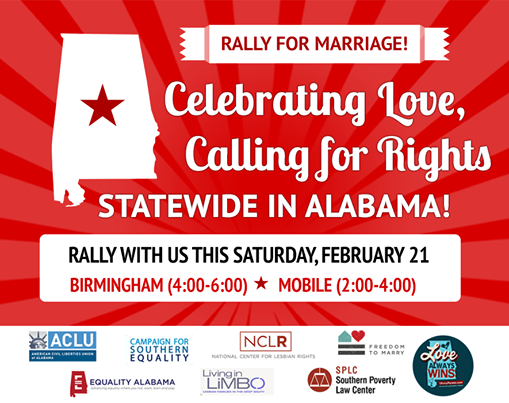
By the way, I’d also love to be attending the Rally for Marriage in either Birmingham or Mobile tomorrow. I wish they were holding one in Montgomery, but maybe I will head to one of the rallies. If you are around Birmingham or Mobile, I encourage you to go. Show your support for the Alabama probate judges who are doing the right thing and for the right for gay people to marry and have some equality in Alabama.


Gay marriage comes to Alabama over chief judge’s objections

IMG_0399

MONTGOMERY, Ala. (AP) – Alabama’s chief justice built his career on defiance: In 2003, Roy Moore was removed from the bench for defying a federal court order to remove a boulder-size Ten Commandments monument from the state courthouse.

On Monday, as Alabama became the 37th state where gays can legally wed, Moore took a defiant stand again, employing the kind of states’ rights language used during the Civil War and again during the civil rights movement.

He argued that a federal judge’s Jan. 23 ruling striking down the Bible Belt state’s gay-marriage ban was an illegal intrusion on Alabama’s sovereignty. And he demanded the state’s probate judges not issue any marriage licenses to same-sex couples.

“It’s my duty to speak up when I see the jurisdiction of our courts being intruded by unlawful federal authority,” the 67-year-old Republican chief justice of Alabama’s Supreme Court said in an interview Monday.

His stand did not succeed in stopping gay couples from tying the knot. And it brought forth another round of criticism of Moore at a time when the movie “Selma” has reminded many Americans of Alabama’s segregationist defiance of the federal government in the 1960s.

Richard Cohen, president of the Southern Poverty Law Center, a major civil rights organization, branded Moore the “Ayatollah of Alabama.”

Moore’s office in the Alabama judicial building is down the street from the Alabama Capitol, where in 1963 Gov. George Wallace promised “segregation now, segregation tomorrow, segregation forever” and vowed to fight what he portrayed as the tyranny of the federal government.

“Moore is using the religion issue to further his political career, just as Wallace used the race issue to further his,” Cohen said.

The Southern Poverty Law Center filed a judicial complaint against Moore accusing him of trying to incite chaos at the probate courts.

On Monday, some counties refused to issue same-sex marriage licenses or shut down their licensing operations altogether, citing confusion about what they should do. But at least seven of Alabama’s 67 counties issued gay marriage licenses, and same-sex couples were wed at courthouses in such places as Birmingham and Montgomery.

In Birmingham, the Jefferson County Probate Office said it had dispensed more than 250 licenses to same-sex couples by midday, with people still arriving. Only three opposite-sex couples had received licenses.

Some of the gay couples who had been lined up for hours exited courthouses to applause, delighted by the opportunity to exchange vows.

“I figured that we would be that last ones – I mean, they would drag Alabama kicking and screaming to equality,” said Laura Bush, who married Dee Bush in a park outside the courthouse in Birmingham.

Alabama Gov. Robert Bentley, a Republican and a Southern Baptist, said he believes strongly that marriage is between one man and one woman. But he said the issue should be “worked out through the proper legal channels” and not through defiance of the law.

Bentley noted that Alabama is about to be in the spotlight again with the 50th anniversary of the Voting Rights Act of 1965, which was passed after civil rights marchers were attacked and beaten in Selma, Alabama.

“I don’t want Alabama to be seen as it was 50 years when a federal law was defied. I’m not going to do that,” Bentley said. “I’m trying to move this state forward.”

After the Ten Commandments dispute made a national figure out Moore, he ran unsuccessfully for governor in 2006 and 2010. In 2012, he returned to the high court when he got elected chief justice. There has been speculation he might make a third run for governor.

He has been one of the state’s most outspoken critics of gay marriage and homosexuality. Moore called homosexuality an “inherent evil” in a 2002 ruling in a child custody case. On the campaign trail in 2012, he said that same-sex marriage would bring about the “ultimate destruction” of the country.

Late last month, U.S. District Judge Callie Granade ruled that the state marriage ban was unconstitutional and – in a later clarifying order – said probate judges have a legal duty under the U.S. Constitution to issue the licenses. On Monday morning, the U.S. Supreme Court refused to block the start of gay marriages in Alabama.

Moore bristled at the comparison to Wallace and disputed the notion that same-sex marriage is a civil rights issue.

“This is not about the right of people to be recognized with race or creed or color. This is about same-sex marriage. It is not the same subject,” he said.

“Eighty-one percent of the voters adopted the Alabama Sanctity of Marriage Amendment in the Alabama Constitution. I think they want leaders that will stand up against an unlawful intrusion of their sovereignty, and that’s what we’re seeing.


Historical Question

2015/02/img_0120.jpg

Many of my readers often assume that my major field of study is literature, because I post a poem every Tuesday and I write book reviews on a semi-regular basis. However first and foremost, I am a historian. All of my degrees are in history, but my doctoral studies were based on cultural history which included art, architecture, and literature. Whenever, I am studying something, I study it through a historical eye. Historical analysis is my modus operendi.

In recent weeks, I have been contemplating the anticipation/apprehension of the impending Supreme Court decision on same-sex marriage. A U.S. district court judge has ruled that Alabama’s same-sex marriage bans are unconstitutional, but placed a fourteen day stay on her decision to allow time for the Alabama Attorney General Luther Strange to attempt to extend the stay until the Supreme Court makes a decision. The 11th Circuit refused to extend the stay, and AG Strange is now attempting to get the Supreme Court to extend the stay pending their decision. If the Supreme Court follows its own precedent, it will allow the stay to be lifted on February 9, 2015, as planned.

The Court has allowed lower courts’ rulings to stand, bringing marriage equality to state after state, now with 36 in total. It would be quite chaotic if the Supreme Court didn’t strike down marriage bans now. And the court will be seen as having been exceedingly reckless. That doesn’t seem like something Justice Kennedy wants as his legacy on gay rights, having crafted it very carefully for several decades. He’ll go all the way, and the liberals will go with him.

It seems to be a foregone conclusion that the Supreme Court will rule in favor of same-sex marriage, but the question is still being asked as to how far the ruling will go. If Roberts decides to vote with Kennedy and the four liberals, he would then control the decision, because as Chief Justice, he could assign it to himself or any of the other justices. He could keep it away from Kennedy. If he votes for marriage equality, he would keep the decision for himself, and he would try to write it as narrowly as possible. In the past, Chief Justices have switched to the majority so that they can narrow the scope of the opinion.

As I look at the speculation concerning what the Supreme Court will do when it decides same-sex marriage in this term, I began to wonder: has their been similar situations in which this much speculation has been covered in the media on other issues? For most of its history, the U.S. Supreme Court has been seen as the lesser branch of government, as dominance has always passed between Congress and the President. Last night I did a fair amount of research to see if I could find any pre-decision media coverage of major Supreme Court cases. In history, we study the significance of a decision and occasionally (but not always) the story that led to the case being heard before the Supreme Court.

The question I have though is how much is the general public aware of cases going before the Supreme Court. Have Americans been aware enough before a decision is made to weigh in on the speculation? For instance, did most southerners know that Brown v. Board of Education would be decided in 1954? Were they aware enough to think about the consequences? As a student of history in the South, I have studied a great deal about the Civil Rights Movement, but I cannot remeber reading about reactions to school desegregation until after Brown was decided. Thinking of cases in my lifetime, I cannot think of a single instance other than Windsor v. United States in which this much speculation has occurred in a Supreme Court case before the decision was made.

No doubt there are legal scholars who speculate on Supreme Court rulings for a living, and I know there are reporters who cover the Supreme Court and thus speculation is part of their job. However, has Americans themselves been thrown into the speculation game. Maybe much of it has to do with the controversy drummed up by political figures wanting to get air time on television, or the abundance of 24 hour news networks, but it seems to me like this is one of the few times that America is actually waiting to see what the Supreme Court will do.

Legal history is not my forte, so it is entirely possible that there are numerous cases that caused controversy and speculation before the court ever issued an opinion. And maybe I’m just interested in this issue and therefore I’m paying more attention to media coverage. If I had the time, I could begin searching through newspapers looking for mentions of the Supreme Court’s terms, but unless someone wants to give me a huge grant to conduct that research, I don’t have the time or the energy to search through 225 years of newspapers.

So since my curiosity is up, I am going to ask my readers this question. Have you ever known there to me so much media coverage and speculation over an issue that has come before the Supreme Court?


Breaking News

IMG_0391

Appeals court denies AL request to stay same-sex marriage case

ATLANTA (WSFA) – The 11th Circuit Court of Appeals in Atlanta is issuing a decision that denies Alabama Attorney General Luther Strange’s request to issue a stay pending appeal of the state’s ban on same-sex marriage.

Alabama’s laws that banned gay marriage were struck down by federal judge Callie Granade on Jan. 23, but the judge issued a temporary stay to allow the State time to seek an appeal from the 11th Circuit.

Judge Granade’s stay is set to expire on Feb. 9 after which time Alabama probate judges will be required to start issuing marriage licenses to same-sex couples. The Plaintiffs have asked the judge to lift her stay. U.S. District Judge Callie Granade’s said in her ruling Tuesday the stay will remain in place until that date unless the U.S. Supreme Court issues a stay or makes a ruling.

The U.S. Supreme Court is expected to rule on the issue of same-sex marriage in June.

Continue checking back for additional updates and reaction.


Sixth Circuit Upholds Marriage Ban

IMG_9203.JPG

As expected the 6th Circuit Court of Appeals reversed lower federal court rulings legalizing gay marriage in Michigan, Ohio, Tennessee and Kentucky on Thursday.

Judge Jeffrey S. Sutton, who wrote the 6th Circuit Court of Appeals’ majority opinion, said the court does not have “a sweeping grant of authority” that allows it to determine “whether gay marriage is a good idea” for the residents of those states. This is in contrast to how other U.S. circuit courts that have interpreted the ruling in United States v. Windsor, which declared Section 3 of the DOMA unconstitutional under the Due Process Clause of the Fifth Amendment.

Sutton questioned, “Is this a matter that the National Constitution commits to resolution by the federal courts or leaves to the less expedient, but usually reliable, work of the state democratic processes?”

The AP reports on the ruling:

It followed more than 20 court victories for supporters of same-sex marriage since the U.S. Supreme Court struck down part of the federal Defense of Marriage Act last year. A federal judge in Louisiana recently upheld that state’s ban, but four U.S. appeals courts ruled against state bans.

The issue appears likely to return to the Supreme Court so the nation’s highest court can settle whether states can ban gay marriage or that gay and lesbian couples have a fundamental right to marry under the U.S. Constitution. Thirty-two states recently asked the Supreme Court to settle the issue once and for all.

Sutton did acknowledge that the legalization of gay marriage is an issue that’s not going away. In this, Sutron is correct. The Supreme Court will almost certainly be forced to take up the case of gay marriage now that there is a conflict in the lower courts. With all previous circuit courts agreeing on the unconstitutionality of gay marriage bans, the Supreme Court had no reason to take on the issue. However, now that the Sixth Circuit’s ruling differs, there is a reason for the Supreme Court to take on the issue. “From the vantage point of 2014, it would now seem, the question is not whether American law will allow gay couples to marry; it is when and how that will happen,” the opinion said.

Senior Judge Martha Craig Daughtrey, writi the dissent, chastised her colleague for writing “what would make an engrossing TED Talk or, possibly, an introductory lecture in Political Philosophy,” arguing that “the majority sets up a false premise—that the question before us is ‘who should decide?’—and leads us through a largely irrelevant discourse on democracy and federalism.”

“If we in the judiciary do not have the authority, and indeed the responsibility, to right fundamental wrongs left excused by a majority of the electorate, our whole intricate, constitutional system of checks and balances, as well as the oaths to which we swore, prove to be nothing but shams,” Daughtrey wrote.

Sutton and the Sixth Circuit are merely delaying the inevitable. Of course, they may have also taken it as a sign from the Republican victories in the midterm election that Senators like Ted Cruz will likely try to pass a Defense of Marriage Amendment to answer the “question” once and for all. It would be one of the greatest travesties in American history if they do because it will be the first amendment designed to discriminate against a group of Americans instead of expanding freedoms.

Adapted from: http://www.huffingtonpost.com/2014/11/06/gay-marriage-bans_n_6117196.html


Apple CEO Tim Cook Come Out

IMG_9179.JPG

Last Monday, Apple CEO and Alabama native Tim Cook was inducted along with seven others into the Alabama Academy of Honor. Cook took the opportunity to challenge Alabama to do better with LGBT equality. He said that Alabama was too slow to guarantee the rights of minorities during the civil rights era, and now it’s too slow to ensure the rights of people based on sexual orientation and gender identity.

Speaking at the Capitol in the chamber where the state voted to secede from the Union in 1861, Cook said Alabama and the nation “have a long way to go” before realizing Dr. Martin Luther King Jr.’s dream of equality. Alabama was “too slow” to guarantee rights in the 1960s, Cook said, and “still too slow on equality for the LGBT community. Under the law, citizens of Alabama can still be fired based on their sexual orientation” Cook went further and stated that “We can’t change the past, but we can learn from it and we can create a different future.”

On Thursday October 30, 2014, Cook published the following message in BusinessWeek:

Throughout my professional life, I’ve tried to maintain a basic level of privacy. I come from humble roots, and I don’t seek to draw attention to myself. Apple is already one of the most closely watched companies in the world, and I like keeping the focus on our products and the incredible things our customers achieve with them.

At the same time, I believe deeply in the words of Dr. Martin Luther King, who said: “Life’s most persistent and urgent question is, ‘What are you doing for others?’ ” I often challenge myself with that question, and I’ve come to realize that my desire for personal privacy has been holding me back from doing something more important. That’s what has led me to today.

For years, I’ve been open with many people about my sexual orientation. Plenty of colleagues at Apple know I’m gay, and it doesn’t seem to make a difference in the way they treat me. Of course, I’ve had the good fortune to work at a company that loves creativity and innovation and knows it can only flourish when you embrace people’s differences. Not everyone is so lucky.

While I have never denied my sexuality, I haven’t publicly acknowledged it either, until now. So let me be clear: I’m proud to be gay, and I consider being gay among the greatest gifts God has given me.

Being gay has given me a deeper understanding of what it means to be in the minority and provided a window into the challenges that people in other minority groups deal with every day. It’s made me more empathetic, which has led to a richer life. It’s been tough and uncomfortable at times, but it has given me the confidence to be myself, to follow my own path, and to rise above adversity and bigotry. It’s also given me the skin of a rhinoceros, which comes in handy when you’re the CEO of Apple.

The world has changed so much since I was a kid. America is moving toward marriage equality, and the public figures who have bravely come out have helped change perceptions and made our culture more tolerant. Still, there are laws on the books in a majority of states that allow employers to fire people based solely on their sexual orientation. There are many places where landlords can evict tenants for being gay, or where we can be barred from visiting sick partners and sharing in their legacies. Countless people, particularly kids, face fear and abuse every day because of their sexual orientation.

I don’t consider myself an activist, but I realize how much I’ve benefited from the sacrifice of others. So if hearing that the CEO of Apple is gay can help someone struggling to come to terms with who he or she is, or bring comfort to anyone who feels alone, or inspire people to insist on their equality, then it’s worth the trade-off with my own privacy.

I’ll admit that this wasn’t an easy choice. Privacy remains important to me, and I’d like to hold on to a small amount of it. I’ve made Apple my life’s work, and I will continue to spend virtually all of my waking time focused on being the best CEO I can be. That’s what our employees deserve—and our customers, developers, shareholders, and supplier partners deserve it, too. Part of social progress is understanding that a person is not defined only by one’s sexuality, race, or gender. I’m an engineer, an uncle, a nature lover, a fitness nut, a son of the South, a sports fanatic, and many other things. I hope that people will respect my desire to focus on the things I’m best suited for and the work that brings me joy.

The company I am so fortunate to lead has long advocated for human rights and equality for all. We’ve taken a strong stand in support of a workplace equality bill before Congress, just as we stood for marriage equality in our home state of California. And we spoke up in Arizona when that state’s legislature passed a discriminatory bill targeting the gay community. We’ll continue to fight for our values, and I believe that any CEO of this incredible company, regardless of race, gender, or sexual orientation, would do the same. And I will personally continue to advocate for equality for all people until my toes point up.

When I arrive in my office each morning, I’m greeted by framed photos of Dr. King and Robert F. Kennedy. I don’t pretend that writing this puts me in their league. All it does is allow me to look at those pictures and know that I’m doing my part, however small, to help others. We pave the sunlit path toward justice together, brick by brick. This is my brick.

The Apple CEO’s announcement on Thursday that he is gay and wants to help further civil rights found strong support in some quarters, but his advocacy met less enthusiasm among some people in Alabama, where he was born and raised.

In socially conservative Alabama, where gay marriage remains illegal and workers can lawfully be fired on the basis of their sexual orientation, some said they wish the Apple executive had kept his sexual orientation private. However, I am very glad he came forward. In a world where money and power speaks, the advantages that Apple can provide makes Cook a very powerful spokesman for the LGBT community.

As mentioned earlier, when inducted on Monday into the Alabama Academy of Honor, Cook made comments critical of the state’s progress on rights for gays and minorities. Alabama Governor Robert Bentley, a Republican and opponent of same-sex marriage, said afterward that he objected to connections Cook drew in his induction speech between the civil rights movement and gay rights, the Anniston Star newspaper reported. “I don’t connect those two, and in fact I don’t think the African-American community connects those two either,” Bentley said, according to the newspaper. I have always connected equality for one with equality for all, and I can only hope that Bentley loses the governor’s race in tomorrow’s election, though it is highly doubtful since the Alabama Democratic Party placed a weak candidate in the race. Bentley’s opponent is actually a “former” Republican.

Birmingham-based state Representative Patricia Todd, a Democrat who is Alabama’s sole openly gay lawmaker, said she drew strength from Cook’s announcement, made in an article he wrote in Bloomberg Businessweek. Todd said the prospects for a bill she plans to reintroduce next year to legalize gay marriage will be strengthened by Cook’s example. “I’m tickled to death,” Todd said. “He is saying what we’ve been saying all along. Equality is good for business.”


Arin and Katie’s Stories

IMG_9114.JPG

Katie Rain Hill and Arin Andrews received international attention last year because of the unique nature of their relationship at the time: They are both transgender and dated while supporting each other through their transitions. A little over a year ago, I wrote a post about Arin and Katie and their amazing story. I was touched to see that they have each published a memoir: Rethinking Normal by Katie and Some Assembly Required by Arin. Huffington Post said that the “books are beautifully written and incredibly personal, with neither of them shying away from sexual content, which may be seen as somewhat controversial due to our society’s fascination with transitioning, trans bodies and the way trans people have sex.”

“I wanted to be the most authentic way I could explain it without getting too sexual because my grandma is going to read it, my aunt is going to read it, my little cousins are,” Andrews told The Huffington Post. “So I wanted to find a way to explain it that was still able to share my story without sexualizing it a lot and I think I found that way. It was just really important to share that because there’s issues that go into that with the trans community… it’s a very complex thing.”

Hill noted, “I thought, No one else is talking about it, so why not me? … Someone has to step up to the plate and address these things because these are questions everyone has… We might as well be straight up and honest with these people.” She added, “I know it’s going to help people because I have so many people who say to me, “Oh wow! That’s what it’s like.”

I have to admit, when I think of transitioning transgendered people and sexual reassignment surgery, I have wondered how it all works. I doubt anyone can honestly say that they haven’t thought about it. That being said, I always wanted to know more about each of their journeys. I will be buying tune books and reading them, and you can be sure that I will let you know in a few weeks what I thought of them.

Though Arin and Katie are no longer a couple, they do remain good friends. Each have gone their separate ways with college and since they were not seeing much of each other they decided to remain friends but no longer date. Also, Katie has undergone full reassignment surgery, whereas, Arin is continuing to hope to have the bottom half of the surgery done sometime in the future. I hope both of them the best can’t wait to read their memoirs.


Will They, Or Won’t They?

IMG_8896.JPG

The nine justices of the U.S. Supreme Court met behind closed doors on Monday to consider whether they should take up the hotly contested question of whether states can ban gay marriage.

The court has seven cases pending before it concerning bans in five states: Virginia, Utah, Oklahoma, Wisconsin and Indiana. If the court agrees to take one or more of the cases it has the chance to rule when, if ever, gay men and women in the 31 states that now bar them from marrying could get marriage licenses.

An announcement on whether the court will hear the same-sex marriage dispute could come later this week. But given the weight of the controversy and that the justices only in recent weeks received the petitions, an announcement could come at a later point. The court officially reconvenes next Monday for its new term, which runs until the end of June.

The justices are due to discuss the cases as they weigh hundreds of petitions that have piled up during the court’s summer recess. The discussion is private. The court takes a case if four or more of the nine justices vote to hear it.

Gay marriage is legal in 19 of the 50 U.S. states. Judges in 16 other states have issued pro-gay marriage rulings, most of which have struck down bans. The bans have remained intact while litigation continues.

Supporters of gay marriage say the bans violate the U.S. Constitution’s guarantee of equal treatment under the law.

State officials defending the bans counter that the Constitution does not dictate how states should define marriage and that there is no deeply rooted legal tradition that supports a right to gay marriage.

Although all seven cases raise the key question of whether states can ban gay marriage, they are all slightly different. If the court does decide to consider the issue, it could take one case or several.

The court could also decide to take no action on the cases at this stage. If the court were to decline to take them, appeals court rulings that struck down the bans would go into effect and other bans in certain states would likely fall as a result, but there would be no national ruling.

Across the country, a wave of court rulings favored arguments for gay marriage, prompted by the Supreme Court’s 2013 decision in U.S. v. Windsor. In that case, the justices struck down a key part of a law called the Defense of Marriage Act that restricted the definition of marriage to heterosexual couples for the purposes of federal benefits.

If the Supreme Court agrees to hear at least one of the pending cases, oral arguments would be heard early next year and a ruling would come by the end of June. Additional lawsuits testing other state bans are also in the pipeline.

From
Supreme Court Meets To Consider Taking Gay Marriage Cases. By Lawrence Hurley
http://m.huffpost.com/us/entry/5900122?ir=Gay%20Voices