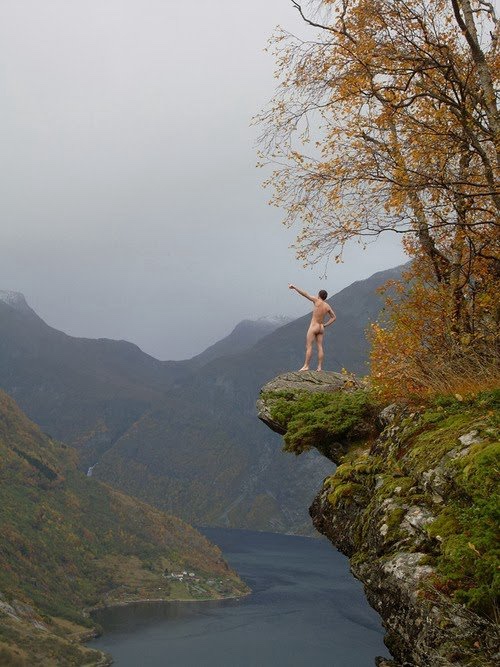
He went to Paris looking for answers To questions that bothered him so He was impressive, young and aggressive Saving the world on his own But the warm Summer breezes The French wines and cheeses Put his ambition at bay And Summers and Winters Scattered like splinters And four or five years slipped away
Then he went to England, played the piano And married an actress named Kim They had a fine life, she was a good wife And bore him a young son named Jim And all of the answers and all of the questions He locked in his attic one day ‘Cause he liked the quiet clean country living And twenty more years slipped away
Well the war took his baby, the bombs killed his lady And left him with only one eye His body was battered, his world was shattered And all he could do was just cry While the tears were falling, he was recalling The answers he never found So he hopped on a freighter, skidded the ocean And left England without a sound
Now he lives in the islands, fishes the pilin’s And drinks his green label each day He’s writing his memoirs and losing his hearing But he don’t care what most people say Through 86 years of perpetual motion If he likes you he’ll smile then he’ll say Jimmy, some of it’s magic, some of it’s tragic But I had a good life all the way
And he went to Paris looking for answers To questions that bother him so
Jimmy Buffett is probably best known for his tropical rock music, which often portrays a lifestyle described as “island escapism.” With his Coral Reefer Band, he is best known for songs like the hit “Margaritaville” and its namesake restaurants and for a sense of humor and irony exhibited in songs like “Cheeseburger In Paradise” and “Why Don’t We Get Drunk” (which originally had the words “and screw” added to the end but was dropped from the title by a lot of online retailers and websites). With this last weekend being Labor Day weekend, I can’t fail to mention “Come Monday.” But what often escapes the notice of so many is that this guy really is an accomplished, and often very serious, songwriter with hundreds of original titles to his credit. His songwriting gift showed up early in pieces like the much-lauded 1973 story song “He Went To Paris.” Though people know many of his other songs, many Jimmy Buffett fans (or Parrotheads, as they call themselves) might tell you that “He Went To Paris” is their favorite song. (My personal favorites are “Stars Fell on Alabama” and “Pencil Thin Mustache.”)
From his album A White Sport Coat And A Pink Crustacean, Buffett wrote the third-person narrative “He Went To Paris” about a Spanish Civil War veteran and one-armed pianist he’d met named Eddie Balchowsky. Released as the album’s final single, it didn’t chart, but in recent years, it has become well known, especially since Bob Dylan named it as one of his favorites and Buffett began to perform it live. With an unusual construction, the song opens and closes with the lines, “He went to Paris/Looking for answers/To questions that bothered him so.” In between those lines are four long verses that chronicle a life of 86 years that saw war, music, tragedy, and world travels, with the subject finally, gratefully and graciously, telling the singer, “Jimmy, some of it’s magic, some of it’s tragic/But I had a good life all of the way.”
Buffett once explained the song’s origins, “The song was actually about a guy I met in Chicago, and he was the cleanup guy at a club called the Quiet Knight [where several prominent singer/songwriter careers were launched]. He had one arm. And so he started telling me stories about his days fighting in the Spanish Civil War, and when he got wounded, he came back to Paris for his treatment. The song is more reflective of stories that Eddie told me. All they did was accentuate the history in the books that I was familiar with from Hemingway and Fitzgerald. That song was written actually in Chicago of all places, and it was written based on the stories of Eddie. At that point I don’t believe I’d ever been to Paris. You put all that stuff together and mix it like a gumbo.”
Buffett was born on December 25, 1946, in Pascagoula, Mississippi, and spent part of his childhood in Mobile and Fairhope, Alabama. After graduating from McGill Institute for Boys, a Catholic high school in Mobile, in 1964, Buffett enrolled at Auburn University and began playing the guitar after seeing a fraternity brother playing surrounded by a group of girls. Buffett left Auburn after a year due to his grades and continued his college years at Pearl River Community College and the University of Southern Mississippi in Hattiesburg, Mississippi, where he received a bachelor’s degree in history in 1969. After graduating in 1969, Buffett moved to New Orleans, often held street performances for tourists on Decatur Street, and played for drunken crowds in the former Bayou Room nightclub on Bourbon Street. I’m pretty sure I’ve read that Auburn granted him a degree after he became famous, even though he flunked out of the university.
Aside from his career in music, Buffett was also a bestselling author and was involved in two restaurant chains named after two of his best-known songs; he owned Jimmy Buffett’s Margaritaville restaurant chain and co-developed the now defunct Cheeseburger in Paradise restaurant chain. Buffett was one of the world’s richest musicians, with a net worth of $1 billion in 2023. Buffett was involved in many charity efforts. In 1981, Buffett and former Florida governor Bob Graham founded the Save the Manatee Club. In 1989, legislation in Florida introduced the “Save the Manatee” license plate, featuring an image of a West Indian manatee, and earmarked funding for the Save the Manatee Club. Buffett was also a longtime supporter of and major donor to the Gulf Specimen Marine Laboratory. He has organized several benefit concerts for hurricane relief and for the 2010 BP oil spill that devastated marine life in the Gulf of Mexico. Buffett was also a lifelong Democratic and hosted fundraisers for Democratic politicians, including several for Hillary Clinton in 2016.
After entering hospice care just five days prior, Buffett passed away peacefully in his sleep on September 1, 2023, at his home in Sag Harbor, New York, at the age of 76 from skin cancer (diagnosed in 2019) that had turned into lymphoma. I think it can safely be said that Jimmy himself would say of his life, “Some of it’s magic, some of it’s tragic, but I had a good life all the way.” I hope God and Jimmy are having margaritas together and enjoying cheeseburgers in paradise.
Here is a live version from earlier this year (2/9/23):
I tried to find live recordings of the songs I provided links for throughout the post.
turns out there are more planets than stars more places to land than to be burned
I have always been in love with last chances especially now that they really do seem like last chances
the trill of it all upending what’s left of my head after we explode
are you ready to ascend in the morning I will take you on the wing
About This Poem
“An imago is, for many winged insects, the final form of its metamorphosis. The plural of imago is imagines, and this time in the insect’s life is called the imaginal stage. The insect at this point has reached sexual maturity and has also earned its wings.” —D. A. Powell
About The Poet
D. A. Powell was born in Albany, Georgia, on May 16, 1963. He attended Sonoma State University, where he received his bachelor’s degree in 1991 and his master’s in 1993. He received his MFA degree from the Iowa Writers’ Workshop in 1996.
Powell is the author of the trilogy of books Cocktails (Graywolf Press, 2004), which was nominated for the National Book Critics Circle Award, Lunch (Wesleyan University Press, 2000), and Tea (Wesleyan University Press, 1998). His poetry collection Chronic(Graywolf Press, 2009) received the Kingsley Tufts Award and was nominated for a National Book Critics Circle Award. His most recent books are Repast: Tea, Lunch, Cocktails (Graywolf Press, 2014) and Useless Landscape, or a Guide for Boys: Poems(Graywolf Press, 2012).
Powell’s subjects range from movies, art, and other trappings of contemporary culture to the AIDS pandemic. Powell’s work often returns to AIDS; his first three collections have been called a trilogy about the disease. As Carl Phillips wrote in his judge’s note for Boston Review’s Annual Poetry Award for Powell’s work, “No fear, here, of heritage nor of music nor, refreshingly, of authority. Mr. Powell recognizes in the contemporary the latest manifestations of a much older tradition: namely, what it is to be human.”
Powell has received a Paul Engle Fellowship from the James Michener Center, a grant from the National Endowment for the Arts, and the Lyric Poetry Award from the Poetry Society of America, among other awards.
Powell has taught at Columbia University, the University of Iowa, Sonoma State University, and San Francisco State University and served as the Briggs-Copeland Lecturer in Poetry at Harvard University. He currently teaches at the University of San Francisco.
At the touch of you, As if you were an archer with your swift hand at the bow, The arrows of delight shot through my body.
You were spring, And I the edge of a cliff, And a shining waterfall rushed over me.
About the Poet
“At the Touch of You” is presented in two tercets of irregular free verse with a theme of romantic love. The imagery in the first stanza is evocative of Greek mythology. The second stanza uses the image of a waterfall to create a beautiful metaphor. What drew me into this poem was the first line: “At the touch of you.” Most poems begin with mentioning the sight of the poet’s lover and describe their outer appearance, but Bynner instead felt his rush of emotions not when he saw his love, but when his lover touched him.
I feel like he is describing how it feels when his lover’s makes love to him. Without much doubt, this poem is very erotic. He touches him and as he enters him, his “arrow of delight” shoots through his body setting him off an erotic journey as his lover’s touch travels across his body setting him on an erotic edge of that cliff that brings him just to the edge of orgasm before that orgasm comes and rushes over him like a “shining waterfall.” That is quite an orgasm that is as powerful as a waterfall engulfing his body.
About the Poet
Witter Bynner was born in Brooklyn, New York in 1881. He graduated from Harvard University in 1902. After college, he worked as a newspaper reporter and, later, as the assistant editor of McClure’s magazine.
Bynner published his first poetry collection, An Ode to Harvard (Small, Maynard, & Co.), in 1907. He was also the author of New Poems (Alfred A. Knopf, 1960); Take Away the Darkness (Alfred A. Knopf, 1947); The Beloved Stranger (Alfred A. Knopf, 1919); Tiger (M. Kennerley, 1913); and several other poetry collections.
Bynner was also known for his works in translation, including The Way of Life According to Laotzu: An American Version (John Day Co., 1944), and a literary biography, Journey with Genius: Recollections and Reflections Concerning the D. H. Lawrences (J. Day Co, 1951).
In 1916, Bynner and Arthur David Ficke published Spectra: A Book of Poetic Experiments, under the pseudonyms Emanuel Morgan and Anne Krish. The book included poems and a manifesto on “spectrism,” a parody of Imagism. In 1918, Bynner admitted that the book was a hoax.
In 1922, Bynner settled in Santa Fe, New Mexico with his partner, Robert Hunt. He died there on June 1, 1968.
If You Must Hide Yourself From Love By Christopher Salerno
It is important to face the rear of the train as it leaves the republic. Not that all
departing is yearning. First love is a factory. We sleep in a bed that had once
been a tree. Nothing is forgot. Yet facts, over time, lose their charm,
warned a dying Plato. You have to isolate the lies you love. Are we any less
photorealistic? I spot in someone’s Face- book sonogram a tiny dictum
full of syllogisms. One says: all kisses come down to a hole in the skull,
toothpaste and gin; therefore your eyes are bull, your mouth is a goal.
About the Poem
“Love hurts, warned The Everly Brothers. Especially when we let passion trump reason. After all, as Plato suggests, there are any number of available ‘beds in nature’ to make one’s lovelife more complicated. As humans we struggle with the difference between physical, emotional, and intellectual love. Sometimes we simply need to bail out of the whole enterprise, and sometimes, after a great pain, we may need to censor it from our lives. To see sentimentality for what it is. Only then do we come back (to love) even stronger.”—Christopher Salerno
About the Poet
Christopher Salerno was born on June 13, 1975, in Somerville, New Jersey. He received an MA from East Carolina University and an MFA from Bennington College.
Salerno is the author of Sun & Urn (University of Georgia Press, 2017), winner of the Georgia Poetry Prize; ATM (Georgetown Review Press, 2014), winner of the Georgetown Review Poetry Prize; Minimum Heroic (Mississippi Review Press, 2010), winner of the Mississippi Review Poetry Prize; and Whirligig (Spuyten Duyvil, 2006).
In the judge’s citation for the Georgetown Review Poetry Prize, D. A. Powell writes, “Salerno rifles through our empty wallets to show how much we’re missing. These poems are mystical transactions of body and soul, as dark as Faust and as illuminating.”
Salerno has also received a fellowship from the New Jersey State Council on the Arts. He currently serves as an editor at Saturnalia Books and teaches at William Paterson University. He lives in Caldwell, New Jersey.
On the walk back from the therapist to the office you rub your chest and say
It’ll be all right, my gurgush There’s a clusterfuck waiting at work, things that really aren’t personal
but slice you up anyway You’ll be all right, my malai ka doona It’ll all get done, my chhunmunita
You think of your mother whose love birthed all these names How often she hurt you
and it dawns on you, like a flash of lightning on an airplane: love is a bagad billa
At the pantry, you feed yourself a boxed lunch of baingan and channa and remember how she once
stood at the door, hours after she locked you up in a room a plate of aloo parathas in her hand
and a look that said you were ok now, the anger under your relief You swallow the last morsel, feeling it graze your heart. Back at work, hungry again.
About the Poet
Mrigaa Sethi is an Indian poet and writer who was born in New Delhi. They were raised in Bangkok and currently living in Singapore. Their poems have appeared in The Seneca Review, ep;phany and other literary magazines, and been anthologized in Call and Response 2 and EXHALE: an Anthology of Queer Singapore Voices. She is also a storyteller and has performed at Other Tongues: A Festival of Minority Voices, What’s Your Story Slam, the Singapore Night Festival and StoryFest.
They are also a journalist and writer/editor who covers lifestyle, business, and social issues across the Asia-Pacific region. Their freelance journalism has appeared in Quartz, the Wall Street Journal and CNN Travel, and she has produced jargon-free business content for clients such as Prudential, TM ONE, NinjaVan, and other start-ups. Outside of work, Their creative projects engage digital audiences across different mediums. Over the pandemic, she hosted a podcast series for the Singapore Writers Festival, ran a poetry-themed video series, and helped lead an online theatre festival for queer women in Singapore. Their newest passion project is growing Their LinkedIn network of thought leaders and followers, around topics such as creativity, diversity and inclusion, and content marketing.
Mrigaa’s mother is Bonny Sethi, a fashion designer whose one-woman studio in Bangkok – June Fifth by Bonny – specializes in bespoke Indian bridal wear. Mrigaa is quite the opposite of their mother. In an article for the Singapore women’s magazine Her World, she explains:
As a toddler, I would lie on the floor and shriek with displeasure when she put me in dresses and stockings. During my tween years, I would mope around at parties in the high-waisted skirts and floral blouses she picked out for me. I loathed the culottes the girls had to wear at my Catholic middle school – my mother refused to buy me the trouser option – and hid inside a sweaty oversized jacket.
As a teenager, I became more willful, insisting on wearing my father’s roomy flannel shirts and leather belts. Every dressy occasion – office parties, Diwali dos, wedding receptions – became a fashion battleground for my mother and me.
The tension wasn’t just about clothes. And as I grew older, my gender and sexuality became harder to deny. Fashion anguish aside, I had unrequited crushes on female classmates and teachers that my mother knew about but was unprepared to handle.
There was no word in Hindi for what I was. There wasn’t anyone like me in Bangkok’s conservative Indian community, where their child’s eventual heterosexual wedding was the dream twinkling in every parent’s eye.
After high school, she moved to the US. In both fashion and romance, she found the freedom she wanted but wasn’t able to find the right fit. Mrigaa found it hard to reconcile their sexuality with their Indian identity. She felt she could be queer or Indian, but never at the same time. Things seemed to come to a head when she moved back to Bangkok from the US seven years later and faced the choice of going back in the closet or being openly gay in the city where their parents’ Indian community resided. Their mother’s bridal business had taken off and become very well-known and was concerned that living with my partner would lead to gossip.
The integration of being queer and Indian took many years, but things changed for the better when their mother stopped negotiating on toned-down Indian women’s outfits for them and started designing clothes that made me feel good: more masculine sherwanis, Aligarh trousers, fitted Nehru collar jackets in rich prints with silk pocket squares. Eventually, it seemed like the cosmos sent their mother a gift. Mrigaa met their current partner whom they say is “beautiful, both inside and out.” On every visit to Bangkok, their mother showered their partner with all the dresses, jewelry, and handbags a fashionista mother could give a daughter.
About the Poem
Sometimes you read a poem and you immediately identify with it in some way. You may not understand the whole poem, but there is just something about it that speaks to you. “Names for Hunger” by Mrigaa Sethi did that for me. Mrigaa is lesbian and Indian, while I am white, s gay man from the southern United States. Being members of the LGBTQ+ though is not they only thing we have in common. Our relationships with our mothers are complex, and we are constantly trying to work through that complexity.
Speaking about this poem, Mrigaa Sethi said, “I lived in Singapore during the pandemic, and for a time my temporary office happened to be across the street from my therapist’s. After one particularly impactful session, I came back to my office and reheated my lunch of homemade Indian leftovers. They used to cause me great shame when I was a little immigrant kid, but in adulthood bring me great joy. This poem resulted from the collision of my ‘work self’ with some other selves that had lingered after therapy.”
Before I give my thoughts on the poem, I thought I’d try to give definitions for some of the words in this poem that were unfamiliar to me and will possibly be unfamiliar to you. I could not find a direct reference to the first three, but the last three were easy enough to find. If you are familiar with any of these words (some mean something very different in language other than Hindi), please let me know.
Gargush was the most difficult for me to understand. The word gargush is Hebrew for a traditional Yemenite Jewish headdress. I do not believe this is what the poet was referencing. I think it is more likely a Hinglish (a mixture of the English and Hindi) word for gorgeous, though I could not find this in my searches for the word’s meaning.
malai ka doona: Malaika is a Hindu girl’s name meaning “angel.” Doona is a type of quilt or duvet, but it also seems to mean “doubly.” By best guess is malai ka doona means a double angel, or maybe a very sweet and caring person. I could not find any actual equivalent in Hindi, so this is my best guess.
I assume that chhunmunita is the diminutive of Chhunmun, a girl’s name meaning “Cute.” Thus, chhunmunita would mean “little cutie” or something to that affect. Again, I could not actually find a meaning for chhunmunita. Chunmun is also a clothing store in India, which might mean there is a connection to Mrigaa Sethi’s mother.
Bagad billa an imaginary animal invoked to frighten children. Also, the name Bagadbilla is of Hindi origin and means “A cat which pretends to be a tiger.”
Baingan and channa is a flavorful vegan eggplant (baingan) and chickpea (channa) curry.
Aloo paratha is a paratha (flat bread dish) stuffed with potato filling that is traditionally eaten for breakfast.
The poet hears their mother’s voice in their head as they cross the street from their therapist to their temporary office. They know that “there’s a clusterfuck waiting at work.” As a queer Indian, the poet speaks of how often their mother hurt them and that love can be a terrifying monster (bagad billa) that pretends to be something that it is not but disguises itself as something that should be beautiful. As the poet eats their lunch, they realize that their mother did love them but found it hard to express that love through understanding. Eventually, the mother does accept the poet, and they go back to work still feeling hungry for the love that they had felt they lacked growing up.
I can understand the frustration of wanting to be accepted by your mother who believes that what she does, even though it hurts you, is done in love. My own mother lived in denial about my sexuality for years, and she still often hurts me with how she deals with it and the little nasty comments she sometimes makes. Yet, she wraps all of that in what she believes is love, when it is more hurtful than love ever should be. For some, like Mrigaa Sethi, acceptance eventually comes, but for others like me, I doubt it ever will. So, we press on, get back to work, and live our lives the best we can.
We hurry on, nor passing note By Digby Mackworth Dolben
We hurry on, nor passing note The rounded hedges white with May; For golden clouds before us float To lead our dazzled sight astray. We say, ‘they shall indeed be sweet ‘The summer days that are to be’— The ages murmur at our feet The everlasting mystery.
We seek for Love to make our own, But clasp him not for all our care Of outspread arms; we gain alone The flicker of his yellow hair Caught now and then through glancing vine, How rare, how fair, we dare not tell; We know those sunny locks entwine With ruddy-fruited asphodel.
A little life, a little love, Young men rejoicing in their youth, A doubtful twilight from above, A glimpse of Beauty and of Truth,— And then, no doubt, spring-loveliness Expressed in hawthorns white and red, The sprouting of the meadow grass, But churchyard weeds about our head.
About the Poet
During the 19th century the gay British poet Digby Mackworth Dolben was little known. He owes his poetic reputation to his cousin, Robert Bridges, Poet Laureate of the United Kingdom from 1913 to 1930, who edited a partial edition of his verse, Poems, in 1911. Bridges guaranteed Dolben’s reputation with Three Friends: Memoirs of Digby Mackworth Dolben, Richard Watson Dixon, Henry Bradley (1932), as well as the careful editing of his poetry. Bridges said that the poems Dolben left behind were equal to “anything that was ever written by any English poet at his age.” Hopkins’ infatuation for Dolben and Dolben’s tragic death feature in Simon Edge’s 2017 novel The Hopkins Conundrum.
Digby Mackworth Dolben
Dolben was born February 8, 1848, in Guernsey and brought up at Finedon Hall in Northamptonshire. He was educated at Cheam School and Eton College. At Eton, his distant cousin Bridges was his senior and took him under his wing. Dolben caused considerable scandal at school by his exhibitionist behavior. He chronicled his romantic attachment to another pupil a year older than he was, Martin Le Marchant Gosselin, by writing love poetry. He also defied his strict Protestant upbringing by joining group of studetns of the Oxford Movement, a movement of high church members of the Church of England which began in the 1830s and eventually developed into Anglo-Catholicism. He then claimed allegiance to the Order of St Benedict, affecting a monk’s habit. He was considering a conversion to Roman Catholicism. On June 28, 1867, Dolben drowned in the River Welland when bathing with the ten-year-old son of his tutor, Rev. C. E. Prichard, Rector of South Luffenham in Rutland. Dolben was then aged 19 and preparing to go up to Oxford.
According to Simon Edge, the English poet and Jesuit priest Gerard Manley Hopkins was “so captivated by a brief meeting [with Dolben] that he spent the rest of his life mourning him.” In a letter to Bridges after Dolben’s death, Hopkins said “there can very seldom have happened the loss of so much beauty (in body and mind and life) and of the promise of still more as there has been in his case.” Hopkins also asked Bridges whether Dolben’s family had considered publishing his poems. Fortunately, the independently wealthy Bridges later published books of poems by both Dolben and Hopkins, or their poetry might have been lost to the world forever. Dolben’s poems were published in a single volume by Bridges in 1911; the Oxford Dictionary of National Biography says that his work stands “among the best of the poetry of the Oxford Movement.” Dolben’s death, it adds, “was the end of a life of exceptional poetic promise.”
In his biography of Dolben, Bridges identifies Dolben’s ardent affection for another of his Eton classmates, a particularly attractive (if in Bridges’s estimation somewhat vacuous) member of their high church circle. Bridges calls this an “idolization”, but infatuation is a better term; the poems are plainly homoerotic. While editing the book Bridges refused the suggestion put forth by mutual friends that he rewrite Dolben’s poems to read as though they had been written for a girl: but he did agree to suppress the identity of Gosselin, the seemingly oblivious young man who had so enamored Dolben. Gosselin, the British Minister to Lisbon and a knight, had himself died a few years before Bridges began his memoir. (His widow requested the suppression after denying access to his diary.) Bridges does not ignore Dolben’s sexuality. However, he is never direct, and his discussion of his sexuality is hesitant, extremely guarded without any direct or conclusive statement.
i lie around wondering what, if anything i should post on the internet about the government trying to legislate me out of existence i decided to say nothing too tired today birds make noise outside while my back aches from stress and bad sleep and worse dreams it’s autumn and the light comes in different this house inside looks different i haven’t breathed okay in a while maybe a few years can’t remember wish i could fall back asleep while staying aware of things that way i can guide the dream can make the light do its normal thing can inhale fully without walls compressing the air away can fly up above this city its modest downtown shrinking down to model size the people dotting around saying isn’t it just awful and what can we say to make it feel less awful and i’m there in the air singing nothing nothing nothing
About the Poem
I had found a different poem by Joshua Jennifer Espinoza called “It Is Important To Be Something” and while I was looking up information about her, I came across this poem on her Tumblr site. While a lot of “NOTHING” is about being trans, but when I read:
i lie around wondering what, if anything i should post on the internet about the government trying
I decided to use this poem instead. I had spent about an hour or so trying to come up with a poem to use today, and I was “wondering / what, if anything / i should post.” This happens to me more than I’d like to admit. My life is not exactly exciting, and sometimes, I am just not up to babbling on about things other people probably have no interest in. I like talking about politics, but a lot of people don’t like political discussions. I like talking about Star Trek, but again, not all people like to listen to things about Star Trek that I find interesting. There are numerous other topics as well: a recipe I found, books I’ve read, a restaurant I went to or want to go to, important news items, etc. And while I do sometimes write about these things, sometimes I don’t write about them because I am lazy.
I found “NOTHING” to be an interesting poem from beginning to end, especially the final lines:
and what can we say to make it feel less awful and i’m there in the air singing nothing nothing nothing
About the Poet
Joshua Jennifer Espinoza is a trans woman poet and the author of I Don’t Want to Be Understood (Alice James Books, 2024), There Should Be Flowers (Civil Coping Mechanisms, 2016), and i’m alive / it hurts / i love it (Boost House, 2014). Espinoza’s work covers topics like mental illness, coming out as a transgender woman, as well as universal themes like love, grief, anger, and beauty. She is a Visiting Professor of English at Occidental College in Los Angeles, California.
All yesterday it poured, and all night long I could not sleep; the rain unceasing beat Upon the shingled roof like a weird song, Upon the grass like running children’s feet. And down the mountains by the dark cloud kissed, Like a strange shape in filmy veiling dressed, Slid slowly, silently, the wraith-like mist, And nestled soft against the earth’s wet breast. But lo, there was a miracle at dawn! The still air stirred at touch of the faint breeze, The sun a sheet of gold bequeathed the lawn, The songsters twittered in the rustling trees. And all things were transfigured in the day, But me whom radiant beauty could not move; For you, more wonderful, were far away, And I was blind with hunger for your love.
If you have seen the news, you probably know that there has been a lot of flooding in Northern New York and Vermont. In most of the towns around me, there has been some flooding as the local rivers have overrun their banks. Thankfully, I live on high ground, so I am not in any danger, though what the roads will look like on my way to work this morning is anyone’s guess. I will watch the morning news hoping I will hear more about road conditions.
I picked the above poem because the rain began Sunday afternoon and is supposed to continue through the early hours of this morning. Hopefully, it will have stopped by the time I leave for work. It poured all day yesterday.
About the Poet
Claude McKay, who was born in Jamaica in 1889, wrote about social and political concerns from his perspective as a Black man in the United States, as well as a variety of subjects ranging from his Jamaican homeland to romantic love.
Listen, my children, and you shall hear Of the midnight ride of Paul Revere, On the eighteenth of April, in Seventy-Five: Hardly a man is now alive Who remembers that famous day and year.
He said to his friend, “If the British march By land or sea from the town to-night, Hang a lantern aloft in the belfry-arch Of the North-Church-tower, as a signal-light,— One if by land, and two if by sea; And I on the opposite shore will be, Ready to ride and spread the alarm Through every Middlesex village and farm, For the country-folk to be up and to arm.”
Then he said “Good night!” and with muffled oar Silently rowed to the Charlestown shore, Just as the moon rose over the bay, Where swinging wide at her moorings lay The Somerset, British man-of-war: A phantom ship, with each mast and spar Across the moon, like a prison-bar, And a huge black hulk, that was magnified By its own reflection in the tide.
Meanwhile, his friend, through alley and street Wanders and watches with eager ears, Till in the silence around him he hears The muster of men at the barrack door, The sound of arms, and the tramp of feet, And the measured tread of the grenadiers Marching down to their boats on the shore.
Then he climbed to the tower of the church, Up the wooden stairs, with stealthy tread, To the belfry-chamber overhead, And startled the pigeons from their perch On the sombre rafters, that round him made Masses and moving shapes of shade,— By the trembling ladder, steep and tall, To the highest window in the wall, Where he paused to listen and look down A moment on the roofs of the town, And the moonlight flowing over all.
Beneath, in the churchyard, lay the dead, In their night-encampment on the hill, Wrapped in silence so deep and still That he could hear, like a sentinel’s tread, The watchful night-wind, as it went Creeping along from tent to tent, And seeming to whisper, “All is well!” A moment only he feels the spell Of the place and the hour, and the secret dread Of the lonely belfry and the dead; For suddenly all his thoughts are bent On a shadowy something far away, Where the river widens to meet the bay,— A line of black, that bends and floats On the rising tide, like a bridge of boats.
Meanwhile, impatient to mount and ride, Booted and spurred, with a heavy stride, On the opposite shore walked Paul Revere. Now he patted his horse’s side, Now gazed on the landscape far and near, Then impetuous stamped the earth, And turned and tightened his saddle-girth; But mostly he watched with eager search The belfry-tower of the old North Church, As it rose above the graves on the hill, Lonely and spectral and sombre and still. And lo! as he looks, on the belfry’s height, A glimmer, and then a gleam of light! He springs to the saddle, the bridle he turns, But lingers and gazes, till full on his sight A second lamp in the belfry burns!
A hurry of hoofs in a village-street, A shape in the moonlight, a bulk in the dark, And beneath from the pebbles, in passing, a spark Struck out by a steed that flies fearless and fleet: That was all! And yet, through the gloom and the light, The fate of a nation was riding that night; And the spark struck out by that steed, in his flight, Kindled the land into flame with its heat.
He has left the village and mounted the steep, And beneath him, tranquil and broad and deep, Is the Mystic, meeting the ocean tides; And under the alders, that skirt its edge, Now soft on the sand, now loud on the ledge, Is heard the tramp of his steed as he rides.
It was twelve by the village clock When he crossed the bridge into Medford town. He heard the crowing of the cock, And the barking of the farmer’s dog, And felt the damp of the river-fog, That rises when the sun goes down.
It was one by the village clock, When he galloped into Lexington. He saw the gilded weathercock Swim in the moonlight as he passed, And the meeting-house windows, blank and bare, Gaze at him with a spectral glare, As if they already stood aghast At the bloody work they would look upon.
It was two by the village clock, When he came to the bridge in Concord town. He heard the bleating of the flock, And the twitter of birds among the trees, And felt the breath of the morning breeze Blowing over the meadows brown. And one was safe and asleep in his bed Who at the bridge would be first to fall, Who that day would be lying dead, Pierced by a British musket-ball.
You know the rest. In the books you have read, How the British Regulars fired and fled,— How the farmers gave them ball for ball, From behind each fence and farmyard-wall, Chasing the red-coats down the lane, Then crossing the fields to emerge again Under the trees at the turn of the road, And only pausing to fire and load.
So through the night rode Paul Revere; And so through the night went his cry of alarm To every Middlesex village and farm,— A cry of defiance, and not of fear, A voice in the darkness, a knock at the door, And a word that shall echo forevermore! For, borne on the night-wind of the Past, Through all our history, to the last, In the hour of darkness and peril and need, The people will waken and listen to hear The hurrying hoof-beats of that steed, And the midnight message of Paul Revere.
About the Poem
“Paul Revere’s Ride” commemorates the actions of American patriot Paul Revere on April 18, 1775, although with significant inaccuracies. It was first published in the January 1861 issue of The Atlantic Monthly. It was later retitled “The Landlord’s Tale” in Longfellow’s 1863 collection Tales of a Wayside Inn.
The poem is spoken by the landlord of the Wayside Inn and tells a partly fictionalized story of Paul Revere. In the poem, Revere tells a friend to prepare signal lanterns in the Old North Church (North End, Boston) to inform him whether the British will attack by land or sea. He would await the signal across the river in Charlestown and be ready to spread the alarm throughout Middlesex County, Massachusetts. The unnamed friend climbs up the steeple and soon sets up two signal lanterns, informing Revere that the British are coming by sea. Revere rides his horse through Medford, Lexington, and Concord to warn the patriots.
Longfellow’s poem is credited with creating the national legend of Paul Revere, a previously little-known Massachusetts silversmith. Upon Revere’s death in 1818, for example, his obituary did not mention his midnight ride but instead focused on his business sense and his many friends. The fame that Longfellow brought to Revere, however, did not materialize until after the Civil War amidst the Colonial Revival Movement of the 1870s. In 1875, for example, the Old North Church mentioned in the poem began an annual custom called the “lantern ceremony” recreating the action of the poem. Three years later, the Church added a plaque noting it as the site of “the signal lanterns of Paul Revere.” Revere’s elevated historical importance also led to unsubstantiated rumors that he made a set of false teeth for George Washington. Revere’s legendary status continued for decades and, in part due to Longfellow’s poem, authentic silverware made by Revere commanded high prices. Wall Street tycoon J. P. Morgan, for example, offered $100,000 for a punch bowl Revere made.
In 1774 and 1775, the Boston Committee of Correspondence and the Massachusetts Committee of Safety employed Paul Revere as an express rider to carry news, messages, and copies of important documents as far away as New York and Philadelphia.
On the evening of April 18, 1775, Dr. Joseph Warren summoned Paul Revere and gave him the task of riding to Lexington, Massachusetts, with the news that British soldiers stationed in Boston were about to march into the countryside northwest of the town. According to Warren, these troops planned to arrest Samuel Adams and John Hancock, two leaders of the Sons of Liberty, who were staying at a house in Lexington. It was thought they would then continue on to the town of Concord, to capture or destroy military stores — gunpowder, ammunition, and several cannon — that had been stockpiled there. In fact, the British troops had no orders to arrest anyone — Dr. Warren’s intelligence on this point was faulty- but they were very much on a major mission out of Boston. Revere contacted an unidentified friend (probably Robert Newman, the sexton of Christ Church in Boston’s North End) and instructed him to hold two lit lanterns in the tower of Christ Church (now called the Old North Church) as a signal to fellow Sons of Liberty across the Charles River in case Revere was unable to leave town.
The two lanterns were a predetermined signal stating that the British troops planned to row “by sea” across the Charles River to Cambridge, rather than march “by land” out Boston Neck.
Revere then stopped by his own house to pick up his boots and overcoat and proceeded the short distance to Boston’s North End waterfront. There two friends rowed him across the river to Charlestown. Slipping past the British warship HMS Somerset in the darkness, Revere landed safely. After informing Colonel Conant and other local Sons of Liberty about recent events in Boston and verifying that they had seen his signals in the North Church tower, Revere borrowed a horse from John Larkin, a Charlestown merchant, and a patriot sympathizer. While there, a member of the Committee of Safety named Richard Devens warned Revere that there were a number of British officers in the area who might try to intercept him.
At about eleven o’clock Revere set off on horseback. After narrowly avoiding capture just outside of Charlestown, Revere changed his planned route and rode through Medford, where he alarmed Isaac Hall, the captain of the local militia, of the British movements. He then alarmed almost all the houses from Medford, through Menotomy (today’s Arlington) — carefully avoiding the Royall Mansion whose property he rode through (Isaac Royall was a well-known Loyalist) — and arrived in Lexington sometime after midnight.
In Lexington, as he approached the house where Adams and Hancock were staying, Sergeant Monroe, acting as a guard outside the house, requested that he not make so much noise. “Noise!” cried Revere, “You’ll have noise enough before long. The regulars are coming out!” According to tradition, John Hancock, who was still awake, heard Revere’s voice and said “Come in, Revere! We’re not afraid of you”. He entered the house and delivered his message.
About half past twelve, William Dawes, who had traveled the longer land route out of Boston Neck, arrived in Lexington carrying the same message as Revere. After both men “refreshed themselves” (i.e., had something to eat and drink), they decided to continue on to Concord, Massachusetts to verify that the military stores were properly dispersed and hidden away. A short distance outside of Lexington, they were overtaken by Dr. Samuel Prescott, who they determined was a fellow “high Son of Liberty.” A short time later, a British patrol intercepted all three men. Prescott and Dawes escaped; Revere was held for some time, questioned, and let go. Before he was released, however, his horse was confiscated to replace the tired mount of a British sergeant. Left alone on the road, Revere returned to Lexington on foot in time to witness the latter part of the battle on Lexington Green.
This story comes from several accounts written by Paul Revere after his Midnight Ride. To see one of them in his own handwriting, with a transcription, visit “Revere’s Own Words.”
About the Poet
Henry Wadsworth Longfellow was born in Portland, Maine—then still part of Massachusetts—on February 27, 1807, the second son in a family of eight children. His mother, Zilpah Wadsworth, was the daughter of a Revolutionary War hero. His father, Stephen Longfellow, was a prominent Portland lawyer and later a member of Congress.
After graduating from Bowdoin College, Longfellow studied modern languages in Europe for three years, then returned to Bowdoin to teach them. In 1831, he married Mary Storer Potter of Portland, a former classmate, and soon published his first book, a description of his travels called Outre Mer (“Overseas”). But, in November 1835, during a second trip to Europe, Longfellow’s life was shaken when his wife died during a miscarriage. The young teacher spent a grief-stricken year in Germany and Switzerland.
Longfellow took a position at Harvard in 1836. Three years later, at the age of thirty-two, he published his first collection of poems, Voices of the Night, followed in 1841 by Ballads and Other Poems. Many of these poems (“A Psalm of Life,” for example) showed people triumphing over adversity, and in a struggling young nation that theme was inspiring. Both books were very popular, but Longfellow’s growing duties as a professor left him little time to write more. In addition, Frances Appleton, a young woman from Boston, had refused his proposal of marriage.
Frances finally accepted Longfellow’s proposal the following spring, ushering in the happiest eighteen years of Longfellow’s life. The couple had six children, five of whom lived to adulthood, and the marriage gave him new confidence. In 1847, he published Evangeline, a book-length poem about what would now be called “ethnic cleansing.” The poem takes place as the British drive the French from Nova Scotia, and two lovers are parted, only to find each other years later when the man is about to die.
In 1854, Longfellow decided to quit teaching to devote all his time to poetry. He published Hiawatha, a long poem about Native American life, and The Courtship of Miles Standish and Other Poems. Both books were immensely successful, but Longfellow was now preoccupied with national events. With the country moving toward civil war, he wrote “Paul Revere’s Ride,” a call for courage in the coming conflict.
A few months after the war began in 1861, Frances Longfellow was sealing an envelope with wax when her dress caught fire. Despite her husband’s desperate attempts to save her, she died the next day. Profoundly saddened, Longfellow published nothing for the next two years. He found comfort in his family and in reading Dante’s Divine Comedy. (Later, he produced its first American translation, which led to American universities realizing the importance of modern languages, like Italian. Previously, the majority of colleges and universities in the United States only taught Latin, Greek, and Hebrew.) Tales of a Wayside Inn, largely written before his wife’s death, was published in 1863.
When the Civil War ended in 1865, the poet was fifty-eight. His most important work was finished, but his fame kept growing. In London alone, twenty-four different companies were publishing his work. His poems were popular throughout the English-speaking world, and they were widely translated, making him the most famous American of his day. His admirers included Abraham Lincoln, Charles Dickens, and Charles Baudelaire.
From 1866 to 1880, Longfellow published seven more books of poetry, and his seventy-fifth birthday in 1882 was celebrated across the country. But his health was failing, and he died the following month, on March 24. When Walt Whitman heard of the poet’s death, he wrote that, while Longfellow’s work “brings nothing offensive or new, does not deal hard blows,” he was the sort of bard most needed in a materialistic age: “He comes as the poet of melancholy, courtesy, deference—poet of all sympathetic gentleness—and universal poet of women and young people. I should have to think long if I were ask’d to name the man who has done more and in more valuable directions, for America.”
When the moon was high I waited, Pale with evening’s tints it shone; When its gold came slow, belated, Still I kept my watch alone
When it sank, a golden wonder, From my window still I bent, Though the clouds hung thick with thunder Where our hilltop roadway went.
By the cypress tops I’ve counted Every golden star that passed; Weary hours they’ve shone and mounted, Each more tender than the last.
All my pillows hot with turning, All my weary maids asleep; Every star in heaven was burning For the tryst you did not keep.
Now the clouds have hushed their warning, Paleness creeps upon the sea; One star more, and then the morning— Share, oh, share that star with me!
Never fear that I shall chide thee For the wasted stars of night, So thine arms will come and hide me From the dawn’s unwelcome light.
Though the moon a heav’n had given us, Every star a crown and throne, Till the morn apart had driven us— Let the last star be our own.
Ah! the cypress tops are sighing With the wind that brings the day; There my last pale treasure dying Ebbs in jeweled light away;
Ebbs like water bright, untasted; Black the cypress, bright the sea; Heav’n’s whole treasury lies wasted And the dawn burns over me.
* He showed up with a seal and Pleiades
About this Poem
“The Star Dial” appeared in McClure’s, vol. 30, no. 2 (December 1907). In “‘The Thing Not Named’: Willa Cather as a Lesbian Writer,” published in Signs, vol. 9, no. 4, (Summer 1984), Sharon O’Brien, adjunct faculty in creative writing at Dickinson College, argues that “[i]n Sappho, [Willa Cather] found a poet who celebrated the delights and agonies of love between women. Cather read Sappho during her college years and in 1907 wrote ‘The Star Dial,’ a poem revealing her identification with this literary and sexual foremother as she assumes Sappho’s voice [. . .]. Evidently Sappho’s poetry formed a bond between Cather and Louise [Pound], for Cather refers to her verse in one of [their] letters; understandably the two young women were drawn to this poet of ‘love and maidens’ where they found their own experience of romantic love mirrored.” Expanding on O’Brien’s argument in his book Sappho: ]fragments (Punctum Books, 2018), Jonathan Goldberg, former Arts and Sciences Distinguished Professor Emeritus of English at Emory University, writes, “Fragment 168B [in Eva-Maria Voigt’s edition of Sappho’s poetry] lies behind the poem: ‘Moon has set / and Pleiades: middle / night, the hour goes by, / alone I lie.’ In Cather’s poem, her speaker waits for a lover who never appears as a dawn arises that would, in any case, have necessitated their separation. Theirs is a secret love; although no gender is explicit, the fourth stanza of Cather’s light-drenched nocturne is particularly sapphic [. . .]. She burns to the end of the poem.”
About this Poet
Willa Cather was born in Virginia on December 7, 1873. Her family moved to Nebraska in 1883, ultimately settling in the town of Red Cloud, where the National Willa Cather Center is located today. She attended the University of Nebraska–Lincoln.
Cather moved to Pittsburgh in 1896 to pursue a career in journalism and work for the women’s magazine Home Monthly. After a few years, she took a break to teach high school English and focus on her creative writing. In 1903, she published her first book, April Twilights (The Gorham Press), a collection of poems, and began writing and publishing short stories. In 1906, she moved to New York City to take an editorial position at McClure’s Magazine, where she worked until 1911, then left to focus again on her creative writing.
Cather is the author of twenty books and best known for her works of fiction, including Death Comes for the Archbishop (Alfred A. Knopf, 1927); One of Ours (Alfred A. Knopf, 1922), which won the Pulitzer Prize; My Antonia (Houghton Mifflin, 1918); and O, Pioneers! (Houghton Mifflin, 1913).Cather was awarded a gold medal in fiction by the National Institute of Arts and Letters in 1944. She died in New York City on April 24, 1947, and is memorialized at the American Poets’ Corner at the Cathedral Church of St. John the Divine.