The way a crow Shook down on me The dust of snow From a hemlock tree
Has given my heart A change of mood And saved some part Of a day I had rued.
“Dust of Snow” is a short poem by Robert Frost, published in the Pulitzer Prize-winning volume New Hampshire (1923). The poem’s speaker, possibly the poet himself, is initially unhappy. But a sprinkling of snow, dislodged by a crow in the tree above the speaker, brings an element of surprise that partly “save[s]” the speaker’s bad day. The poem thus shows how nature can lift people’s mood, if only temporarily.
Hark to the gondolier singing, Dreamily, dreamily singing, Ever guiding our languid gondola Out on the fair lagoon.
Lo, how the pigeons are winging, Airily, airily winging, Blending coos in our idle revery Out on the fair lagoon.
Now is the gondolier calling, Warningly, warningly calling; Hark—the answer—from turning shadowy, Where the dark waters wind.
Now we emerge in a glory, Radiant, radiant glory; Campanile and dome rise magical Out of the Grand Canal.
Every wall has a story, Passionate, passionate story,— O’er the song of the gondolier hovering, Out on the Grand Canal.
Gardens above us are leaning, Drowsily, drowsily leaning; Never water and sky so heavenly, Sung by a gondolier.
Ever and aye in our dreaming, Far-away, far-away dreaming, We’ll remember this golden Italy, Sung by a gondolier.
About 15 years ago, I was doing research in Italy for my dissertation. I was able to spend a month traveling Italy (Rome, Florence, and Venice), and it was a trip I will never forget for many reasons. It was the first time I had ever traveled on my own. I remember the beauty and food of Rome and the amazing Vatican City with St. Peter’s Basilica and the Vatican Museums. I wondered through the Cimitero Acattolico (Non-Catholic Cemetery) of Rome, often referred to as the Cimitero dei protestanti (Protestant Cemetery) looking at the famous graves of Americans who had traveled to Italy in the nineteenth century.
In Florence, I remember the festive atmosphere of the Piazza della Repubblica, the gold merchants on the Ponte Vecchio, the splendor of the Duomo, and the wonders of the storied museums such as the Uffizi Gallery with Sandro Botticelli’s Primavera and The Birth of Venus and the Accademia with Michelangelo’s David. I walked the streets where American artists had walked more than a century before. I visited the English Cemetery and made friends with the strange but infinitely interesting custodian of the cemetery, the medieval scholar Julia Bolton Holloway, formerly a nun of the Anglican order Community of the Holy Family and scholar of Elizabeth Barrett Browning, who is buried in the cemetery.
Then I went to Venice, which was cold and damp, and I caught a terrible cold. The city, however, is magical. The canals and the grand palazzos that line it are breathtaking. The gaudy but fascinating Basilica di San Marco and the pink and seemingly austere Doge’s Palace with the Scala d’Oro, the Golden Staircase, and the Ponte dei Sospiri, the Bridge of Sighs. I remember taking a vaporetto to the Lido with a group of nuns sitting in front of me laughing and seeming to have the greatest time as they were sprayed by the waters of the Lagoon while we bounced over the waves.
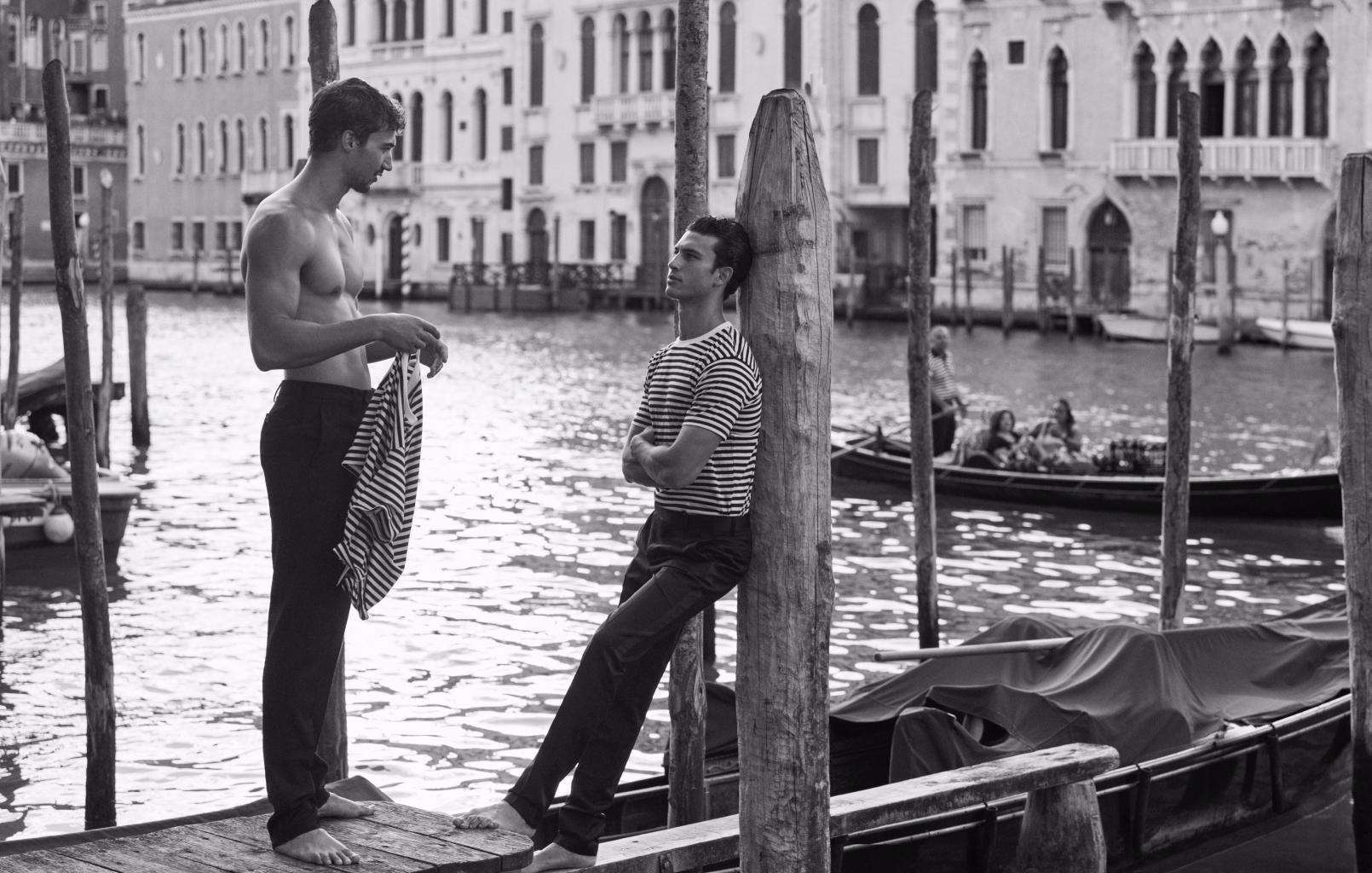
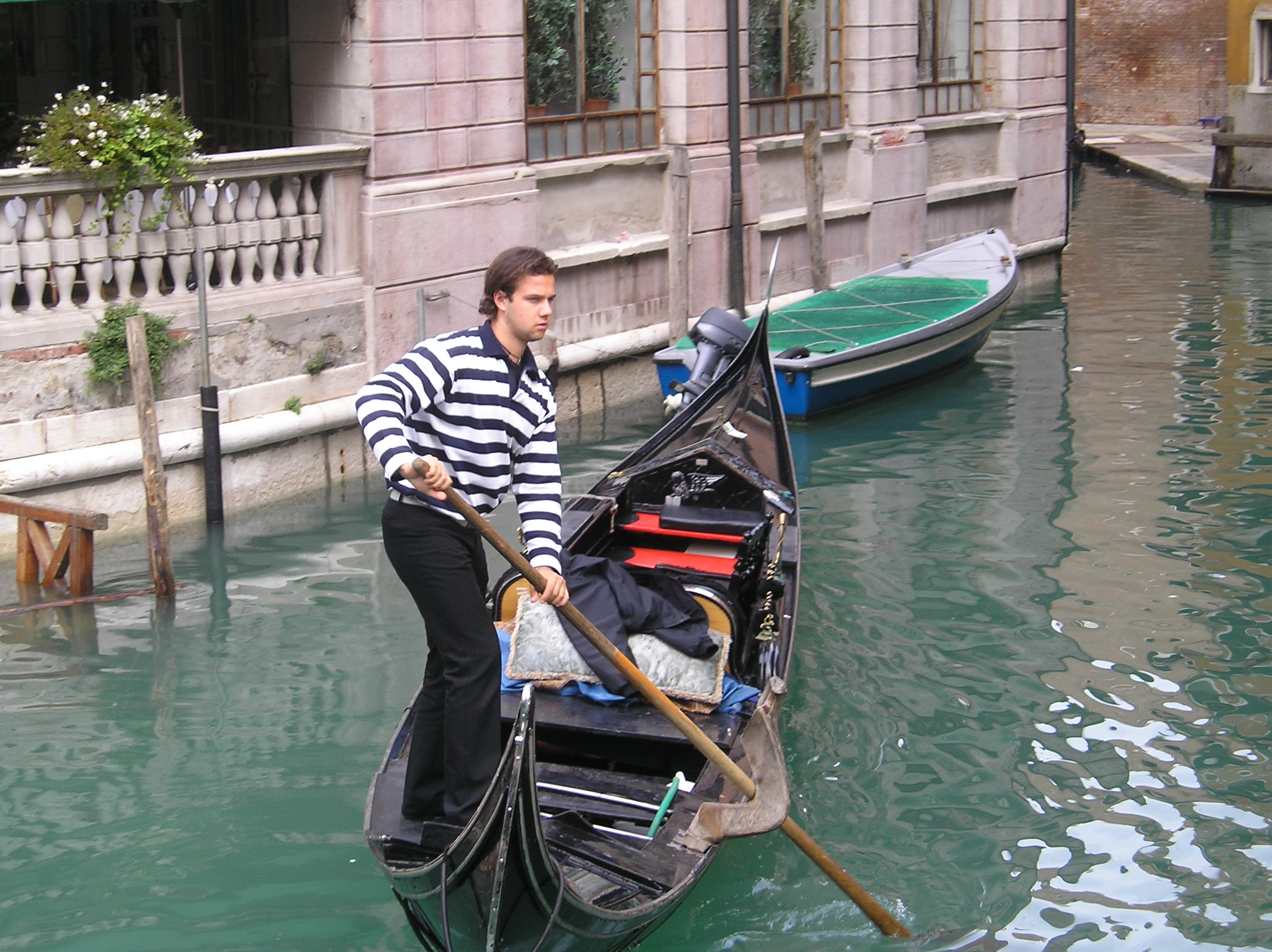
These were all great memories, but what will always warm my heart is the thought of seeing the gondolieri in their blue or red striped tops, red neckerchiefs, wide-brimmed straw hats, and dark pants. In movies you often see an older man guiding the gondolas down the canal as lovers cuddle in the traditional, flat-bottomed rowing boat holding their rowing oar to guide the gondola down the canals. I did not see many old men as gondolieri, but mostly beautiful young men like those in the picture above or the one below who I became enamored with and had to take his picture.
About the Poet
Ruby Archer (Ruby Archer Doud or Ruby Archer Gray) was born in Kansas City, Missouri on January 28, 1873, and died in Los Angeles on January 23, 1961. She was an American poet, educated at Kansas City High School and by private tutors. She was married to Dr. Frank Newland Doud on March 27, 1910, and later to Benjamin Franklin Gray. She contributed poems, translations from French and German dramas and lyrics, and prose articles on art, architecture, music, Biblical literature, philosophy, etc. to papers and magazines.
If we shadows have offended, Think but this, and all is mended, That you have but slumber’d here While these visions did appear. And this weak and idle theme, No more yielding but a dream, Gentles, do not reprehend: if you pardon, we will mend: And, as I am an honest Puck, If we have unearned luck Now to ‘scape the serpent’s tongue, We will make amends ere long; Else the Puck a liar call; So, good night unto you all. Give me your hands, if we be friends, And Robin shall restore amends.
The mischievous Puck ends A Midsummer Night’s Dream with these lines. It is one of my favorite passages from Shakespeare.
Let’s talk about gay sex baby Let’s crow about its beauty daily Place away your shades of shame And trace in me a sacred flame Lend me your lips, boy And of your muscled hips I will speak and enjoy Give me the words Of your body’s supple burn And into silver zodiacs I will write the codes My desire in you has cracked Of naked bodies and buttocks And cocks and jockstraps My tongue between your shoulderblades Tattoos them with my name That I will dare to speak And dare to speak again Down into the dip of your back My mouth will murmur rapt Then I let my whispers lick First one gluteus muscle Before on to its perfect brother Hear my hands On your flesh slap And the parting of your pretty ass To reveal your winking, pink anus In the hush of my first kiss The sensation’s racing Instantaneous Spiralling up your spinal cord Exploding into your loosened brain Uttered as a gasp and a word That was there from the beginning:
“Fuck”
And I say, “yes…”
I’m not talking about gay sex To shock or cause stress I’m talking about it Because no one else is Our gay comedians Are asexual chameleons No sex, please We’re gay and on TV
And I’ve heard my straight mates say: “I don’t mind it happening As long as I don’t hear about it” Well here, now, it’s happening And it’s hard and it’s fast and it’s racing A gasp and a whimper The sound of flesh whacking flesh Of my penis inside him It’s sweat dripping from one man to another A soaring, writhing ecstasy of kissing It’s in your face It’s in your head It’s in the space Where angels fear to tread
Because my sex is part of my identity My sex makes me and shapes me And I’m not going to stop it and lock it And shut it up Not for you and not for me My sex is laced with shame My sex is the wrong sex My sex was illegal My sex instils fear It’s parks after dark And it’s public toilets And it’s AIDS Like David Stuart said: “When your parents think of sex They see your sister married You and your boyfriend It’s shit on dicks” My sex is a sin without name And try telling this To the two 20-year-old boys I interviewed last week Who both have HIV Because they’re not told About gay sex in schools And they’re not told About transmission And the condom, they are told, Is there to stop pregnancy
But lastly my sex is my gift To be shared safely With rising sensation Of move and thrust and kiss My sex lives in excited eyes It whispers between fingertips My sex is in his smile It’s in his pleasure And what we share together My sex speaks now and always will Of the word we all call love
Patrick Cash is a queer journalist and creative writer based in London, prominently known for hosting two LGBTQ-friendly open mic nights: the poetry and performance night, “Spoken Word London,” the gay men’s well-being forum, “Let’s Talk About Gay Sex & Drugs,” and the theatrical showcase event Dark Fabrics Cabaret. He writes on various subjects, including much arts/culture, and works as Assistant Editor for QX Magazine. Find him on Twitter @paddycash.
Cash’s main focus when writing poetry is emotional truth. He believes we are sometimes smothered by falsity in the modern world, from social media performance to creepy algorithm-led advertising, and good art cuts through that superficiality. If you achieve authenticity of feeling in your poem, then that truth will resonate deeply with your audiences, whatever your surface differences of sexuality, gender, or race.
Cash believes it is important for queer poets to be heard to engender understanding of the queer experience. He said that if you’ve grown up straight, male and privileged, then queerness may seem like a very alien—even threatening—concept to you. Yet all humans understand what it is to feel different, and innate concepts like shame and hope. Queer poets not only empower queer people, but use their words as conduits for empathy.
When asked about the future of queer poetry, Cash said, “Greater visibility, more mixed queer/straight readerships and more mainstream literary recognition. In some ways, I feel the age we’re living in of LGBTQ rights and queer literature is partially comparable to the Harlem Renaissance bringing black literature to mainstream America in the ’20s. Queer poetry deepens our understanding of multifaceted humanity.”
Sable clouds by tempest driven, Snowflakes whirling in the gales, Hark—it sounds like grim wolves howling, Hark—now like a child it wails! Creeping through the rustling straw thatch, Rattling on the mortared walls, Like some weary wanderer knocking— On the lowly pane it falls.
Fearsome darkness fills the kitchen, Drear and lonely our retreat, Speak a word and break the silence, Dearest little Mother, sweet! Has the moaning of the tempest Closed thine eyelids wearily? Has the spinning wheel’s soft whirring Hummed a cradle song to thee?
Sweetheart of my youthful Springtime, Thou true-souled companion dear— Let us drink! Away with sadness! Wine will fill our hearts with cheer. Sing the song how free and careless Birds live in a distant land— Sing the song of maids at morning Meeting by the brook’s clear strand!
Sable clouds by tempest driven, Snowflakes whirling in the gales, Hark—it sounds like grim wolves howling, Hark—now like a child it wails! Sweetheart of my youthful Springtime, Thou true-souled companion dear, Let us drink! Away with sadness! Wine will fill our hearts with cheer!
————-
ЗИМНИЙ ВЕЧЕР
Буря мглою небо кроет, Вихри снежные крутя: То, как зверь, она завоет, То заплачет, как дитя, То по кровле обветшалой Вдруг соломой зашумит, То, как путник запоздалый, К нам в окошко застучит.
Наша ветхая лачужка И печальна и темна.— Что же ты, моя старушка, Приумолкла у окна? Или бури завываньем Ты, мой друг, утомлена, Или дремлешь под жужжаньем Своего веретена?
Выпьем, добрая подружка Бедной юности моей, Выпьем с горя; где же кружка? Сердцу будет веселей. Спой мне песню, как синица Тихо за морем жила; Спой мне песню, как девица За водой поутру шла.
Буря мглою небо кроет, Вихри снежные крутя: То, как зверь, она завоет, То заплачет, как дитя. Выпьем, добрая подружка Бедной юности моей, Выпьем с горя; где же кружка? Сердцу будет веселей.
About the Poet
Alexander Sergeyevich Pushkin (Александр Сергеевич Пушкин) was born on June 6 [O.S. May26] 1799 and died on February 10 [O.S. January 29] 1837) was a Russian poet, playwright, and novelist of the Romantic era. He is considered by many to be the greatest Russian poet and the founder of modern Russian literature.
Pushkin was born into the Russian nobility in Moscow. His father, Sergey Lvovich Pushkin, belonged to an old noble family. His maternal great-grandfather was Major-General Abram Petrovich Gannibal, a nobleman of African origin who was kidnapped from his homeland and raised in the Emperor’s court household as his godson.
He published his first poem at the age of 15, and was widely recognized by the literary establishment by the time of his graduation from the Tsarskoye Selo Lyceum. Upon graduation from the Lycée, Pushkin recited his controversial poem “Ode to Liberty”, one of several that led to his exile by Emperor Alexander I. While under the strict surveillance of the Emperor’s political police and unable to publish, Pushkin wrote his most famous play, Boris Godunov. His novel in verse, Eugene Onegin, was serialized between 1825 and 1832. Pushkin was fatally wounded in a duel with his wife’s alleged lover and her sister’s husband, Georges-Charles de Heeckeren d’Anthès, also known as Dantes-Gekkern, a French officer serving with the Chevalier Guard Regiment.
Sitting under the mistletoe (Pale-green, fairy mistletoe), One last candle burning low, All the sleepy dancers gone, Just one candle burning on, Shadows lurking everywhere: Some one came, and kissed me there.
Tired I was; my head would go Nodding under the mistletoe (Pale-green, fairy mistletoe), No footsteps came, no voice, but only, Just as I sat there, sleepy, lonely, Stooped in the still and shadowy air Lips unseen—and kissed me there.
About the Poet
Walter de la Mare was born on April 25, 1873, in London. He is the author of numerous books, including The Listeners (Constable & Company, 1912) and The Veil and Other Poems (Constable & Company, 1921).
Walter de la Mare is considered one of modern literature’s chief exemplars of the romantic imagination. His complete works form a sustained treatment of romantic themes: dreams, death, rare states of mind and emotion, fantasy worlds of childhood, and the pursuit of the transcendent.
Near Clapham village, where fields began, Saint Edward met a beggar man. It was Christmas morning, the church bells tolled, The old man trembled for the fierce cold.
Saint Edward cried, “It is monstrous sin A beggar to lie in rags so thin! An old gray-beard and the frost so keen: I shall give him my fur-lined gaberdine.”
He stripped off his gaberdine of scarlet And wrapped it round the aged varlet, Who clutched at the folds with a muttered curse, Quaking and chattering seven times worse.
Said Edward, “Sir, it would seem you freeze Most bitter at your extremities. Here are gloves and shoes and stockings also, That warm upon your way you may go.”
The man took stocking and shoe and glove, Blaspheming Christ our Saviour’s love, Yet seemed to find but little relief, Shaking and shivering like a leaf.
Said the saint again, “I have no great riches, Yet take this tunic, take these breeches, My shirt and my vest, take everything, And give due thanks to Jesus the King.”
The saint stood naked upon the snow Long miles from where he was lodged at Bowe, Praying, “O God! my faith, it grows faint! This would try the temper of any saint.
“Make clean my heart, Almighty, I pray, And drive these sinful thoughts away. Make clean my heart if it be Thy will, This damned old rascal’s shivering still!”
He stooped, he touched the beggar man’s shoulder; He asked him did the frost nip colder? “Frost!” said the beggar, “no, stupid lad! ’Tis the palsy makes me shiver so bad.”
About the Poem
The Saint Edward referred to in this poem is Edward the Confessor (c. 1003 – 5 January 1066), one of the last Anglo-Saxon English kings. As king, Edward developed a reputation for living a simple, pious lifestyle and being generous with the poor. Some reports indicate that he longed for a monastic life and took a vow of celibacy, as he and his wife never had children. He was associated with legends including a story from towards the end of his life. Edward was riding by a church in Essex and an old man asked for alms. As the king had no money to give, he drew a large ring off his finger and gave this to the beggar. A few years later two pilgrims were travelling in the Holy Land and became stranded. They were helped by an old man, and when he knew they came from England, he told them he was St John the Evangelist and asked them to return the ring to Edward telling him that in six months he would join him in heaven. The story is one of fourteen scenes from the king’s life – real and legendary – carved on a mid-15th-century stone screen in Westminster Abbey. Also shown are his birth, his coronation, Christ appearing to Edward at Mass, and the dedication of a church, assumed to be the Abbey.
While Edward spent much of his life in exile in France, particularly Normandy, Edward’s love for the region of his childhood can be seen in one of his greatest architectural achievements, the building of Westminster Abbey. The story goes that Edward vowed that if he should return safely from exile in Normandy to his kingdom, he would make a pilgrimage to St Peter’s, Rome. But once on the throne he found it impossible to leave his subjects, and the Pope released him from his vow on condition that he should found or restore a monastery to St Peter. This led to the building of a new church in the Norman style to replace the Saxon church at Westminster.
The king’s piety had greatly endeared him to his people, and he came to be regarded as a saint long before he was officially canonized as Saint and Confessor by Pope Alexander III in 1161. His nickname reflects the traditional image of him as unworldly and pious. Edward’s reputation for piety and charity was widespread, and he was viewed with great veneration, even being considered a patron saint of England. In 1139, the prior of Westminster Abbey traveled to Rome to ask the pope to canonize Edward, but the appeal was rejected amid political disputes. Edward was buried in Westminster Abbey, which was completed shortly before his death. His body remains there today, although the abbey is now an Anglican church.
About the Poet
On July 24, 1895, Robert Graves was born in Wimbledon, near London. His father, Alfred Perceval Graves, was a Gaelic scholar and minor Irish poet. His mother, Amalie von Ranke Graves, was a relation of Leopold von Ranke, one of the founding fathers of modern historical studies. One of ten children, Robert was greatly influenced by his mother’s puritanical beliefs and his father’s love of Celtic poetry and myth. As a young man, he was more interested in boxing and mountain climbing than studying, although poetry later sustained him through a turbulent adolescence. Graves received his early education at a series of six preparatory schools, including King’s College School in Wimbledon, Penrallt in Wales, Hillbrow School in Rugby, Rokeby School in Kingston upon Thames and Copthorne in Sussex, from which last in 1909 he won a scholarship to Charterhouse.
Robert Graves was bisexual, having intense romantic relationships with both men and women, though the word he coined for it was “pseudo-homosexual.” Graves was raised to be “prudishly innocent, as my mother had planned I should be.” His mother, Amy, forbade speaking about sex, save in a “gruesome” context, and all skin “must be covered.” At his days in Penrallt, he had “innocent crushes” on boys; one in particular was a boy named Ronny, who “climbed trees, killed pigeons with a catapult and broke all the school rules while never seeming to get caught.” At Charterhouse, an all-boys school, it was common for boys to develop “amorous but seldom erotic” relationships, which the headmaster mostly ignored. Graves described boxing with a friend, Raymond Rodakowski, as having a “a lot of sex feeling.” And although Graves admitted to loving Raymond, he would dismiss it as “more comradely than amorous.” In his fourth year at Charterhouse, Graves met “Dick” (George “Peter” Harcourt Johnstone) with whom he would develop “an even stronger relationship.” Johnstone was an object of adoration in Graves’s early poems.
In 1913 Graves won a scholarship to continue his studies at St. John’s College, Oxford, but in August 1914 he enlisted as a junior officer in the Royal Welch Fusiliers. He fought in the Battle of Loos and was injured in the Somme offensive in 1916. While convalescing, he published his first collection of poetry, Over the Brazier. By 1917, though still an active serviceman, Graves had published three volumes. In 1918, he spent a year in the trenches, where he was again severely wounded.
During the war, Johnstone remained a “solace” to Graves. Despite Graves’s own “pure and innocent” view of Johnstone, Graves’s cousin Gerald wrote in a letter that Johnstone was: “not at all the innocent fellow I took him for, but as bad as anyone could be”. Johnstone remained a subject for Graves’s poems despite this. Communication between them ended when Johnstone’s mother found their letters and forbade further contact with Graves. Johnstone would later be arrested for attempting to seduce a Canadian soldier, which removed Graves’s denial about Johnstone’s infidelity, causing Graves to collapse.
In January 1918, at the age of twenty-two, he married eighteen-year-old Nancy Nicholson, with whom he was to have four children. Traumatized by the war, he went to Oxford with his wife and took a position at St. John’s College. Graves’s early volumes of poetry, like those of his contemporaries, deal with natural beauty and bucolic pleasures, and with the consequences of the First World War. Over the Brazier and Fairies and Fusiliers earned Graves his reputation as an accomplished war poet. After meeting the American poet and theorist Laura Riding in 1926, Graves’s poetry underwent a significant transformation.
In 1927, Graves and his first wife separated permanently, and in 1929 he published Goodbye to All That, an autobiography that announced his psychological accommodation with the residual horror of his war experiences. Shortly afterward, he departed to Majorca with Laura Riding. In addition to completing many books of verse while in Majorca, Graves also wrote several volumes of criticism, some in collaboration with Riding. During that period, he evolved his theory of poetry as spiritually cathartic to both the poet and the reader. Although Graves claimed that he wrote novels only to earn money, it was through these that he attained status as a major writer in 1934, with the publication of the historical novel I, Claudius, and its sequel, Claudius the God and His Wife Messalina. (During the 1970’s, the BBC adapted the novels into an internationally popular television series.)
At the onset of the Spanish Civil War in 1936, Graves and Riding fled Majorca, eventually settling in America. In 1939, Laura Riding left Graves for the writer Schuyler Jackson; one year later Graves began a relationship with Beryl Hodge that was to last until his death.
After World War II, Graves returned to Majorca, where he lived with Hodge and continued to write. By the 1950s, Graves had won an enormous international reputation as a poet, novelist, literary scholar, and translator. In 1962, W. H. Auden went as far as to assert that Graves was England’s “greatest living poet.” From 1961 to 1966, Graves returned to England to serve as a professor of poetry at Oxford. In the 1970s his productivity fell off; and the last decade of his life was lost in silence and senility. Robert Graves died in Majorca in 1985, at the age of ninety.
[I’m happiest now when most away] By Emily Brontë – 1818-1848
I’m happiest now when most away I can tear my soul from its mould of clay, On a windy night when the moon is bright, And my eye can wander through worlds of light.
When I am not, and none beside, Nor earth, nor sea, nor cloudless sky, But only spirit wandering wide Through infinite immensity.
About the Poem
“I’m Happiest When Most Away” by novelist Emily Brontë is short and meaningful. The speaker in this poem enjoys taking time alone to disengage from the world and contemplate life. The poem can be interpreted in many ways– one of which is that peaceful, quiet contemplation can have a positive impact on one’s life. Readers can infer that the speaker’s life wouldn’t be worth living without this time for contemplation.
About the Poet
Emily Jane Brontë, born on July 30, 1818, in Thornton, England, was a novelist and poet from the Romantic era. She is the author of the novel Wuthering Heights (Thomas Cautley Newby, 1847), today regarded as a classic of English literature. She died on December 19, 1848.











 Joe
Joe




 The Closet Professor