Category Archives: Poetry

In Summer Twilight

In Summer Twilight
By Joshua Henry Jones, Jr.

Just a dash of lambent carmine
  Shading into sky of gold;
Just a twitter of a song-bird
  the wings its head enfold;
Just a rustling sigh of parting
  From the moon-kissed hill to breeze;
And a cheerful gentle, nodding
  Adieu waving from the trees;
Just a friendly sunbeam’s flutter
  Wishing all a night’s repose,
Ere the stars swing back the curtain
  Bringing twilight’s dewy close.

About the Poet

Joshua Henry Jones, Jr. was born in Orangeburg, South Carolina. He published both prose and poetry, including Poems of the Four Seas (The Cornhill Company, 1921); The Heart of the World (Stratford Co., 1919); and By Sanction of Law (McGrath Publishing Company, 1924). Jones died on December 14, 1955, in Boston.


in & out of jean shorts (the reel catches)

in & out of jean shorts (the reel catches)
By Chris Campanioni

Picture a flower dreaming
of its own future
folded inward, enclosed within its seed
& its surroundings
my nascent
homosexuality is that
I love every body even

as if it were my own
which is to say
I love every body as if
I were myself
tasked with becoming both
object & the offer
of adoration begged

by it Is it
wrong to think
If I weren’t sitting
on a bench overlooking the Vieux Port
not considering each vessel
approaching the Canebiére but
where each one has been only

recently this would read
otherwise or not at all
which is to say I am indebted to so many
forms & what can
only be gifted by our
swift encounters I bow before
velocity & haphazard excess, the latent succulence

contained or carried by
words, a generous
invitation to plunge or plummet
or to be the hole itself
out of which something always
something blossoms (count the number
of times naugahyde appears in the text)

(count the number of times hypnotic & ass mingle
in my mind) Reading Puig from memory
I can place myself
back
at the beach &
every time or so it seems
I wish for sex out

in the open, to have
some strange body
glide over mine, to collide
as if to butterfly
underwater required not one
but two sets of salty
chests & jutting

calves (last
night’s intermittent dream
where my penis appears
in public, veering in & out
of jean shorts almost violently)
& Puig’s wish (how could I
forget this?) to grow up & not

to become movie star
but movie, which means
assemblage, network, motoric
scrapbook, the discontinuity of the act
of filming—set pieces
rushing across the set & the set
itself but also the future

of the subjects within the frame—
not just the act of filming but its unknowable
points of view, simultaneous & multiple
months or only moments later & always
to return & to beg reception
draped in dark or the privacy
of some well-lit home, alone

or in the company of people
one has only ever seen in passing
reimagined through this allowance
for difference, which is my own
inability to say where Puig’s wish
comes from (other
than Puig himself, speaking

as if he were still a child, unless
Puig, at 43 or 44 or more, awaited a life
of substitution & self-adaptation
unless Puig, ever exuberant
is still awaiting to be, the way in place
of source or reference I find only my own origin: my
meticulous way of copying out

everything that comes even everything
that evades me)—is it me
is it Puig is there any difference?
The opposite of authorship
is feverish attribution, my tendency
to assume all thoughts
I have belong to everyone

& doesn’t
a changeover
imply the endeavor to move
by rapidly opening
& shutting one’s eyes? The real catches
only if I deny myself
its recognition

From: Catapult Magazine

Chris Campanioni was born in New York City in 1985 and grew up in a very nineties New Jersey. The son of exiles from Cuba and Poland, Chris is a writer, multimedia artist, and instructor. His debut novel, Going Down, was selected as Best First Book at the International Latino Book Awards in 2014. His poem “Transport (after ‘When Ecstasy is Inconvenient’)” received the Zócalo Public Square Poetry Prize in 2015, and a selection from his cross-genre Death of Art was awarded a Pushcart Prize in 2016. Earlier, he was awarded the 2013 Academy of American Poets College Prize. He is the recipient of numerous fellowships, including a 2019 CHCI-Mellon Global Humanities Institute fellowship to join the Transnational Joint Research Center for Migration, Logistics, and Cultural Intervention; in 2021, he became a member of the Institute for Research on the African Diaspora in the Americas and the Caribbean, where he continues to broach the multiple, intersecting, and extant repercussions of the Cold War. From 2016 until 2022 he edited PANK and PANK Books, launching PANK’s Folio series in 2019 and its translation imprint, Transmission, in 2021. 

His essays, poetry, and fiction have been translated into Spanish and Portuguese, appearing in BOMB, Diacritics, Life Writing, Catapult, Social Text, Los Angeles Review of Books, American Poetry Review, Fence, Ambit, Nat. Brut, Kenyon Review, Denver Quarterly, Gulf Coast, Tupelo Press Quarterly, Journal of Cinema and Media Studies, Hayden’s Ferry Review, Journal of Comparative Literature and Aesthetics, 3:AM Magazine, DIAGRAM, Poetry International {this list is long … & I’m still loading}, M/C: Media & Culture, Prelude, RHINO, Gorse, and several other journals, anthologies, and edited volumes, including Revisiting the Elegy in the Black Lives Matter Era (Routledge, 2019), Manticore: Hybrid Writing from Hybrid Identities (Sundress, 2019), Open House: Conversations with Writers About Community (Tupelo Press, 2023) Migration, Dislocation and Movement on Screen(Berghahn Books, 2023), and Transmedia Selves: Identity and Persona Creation in the Age of Mobile and Multiplatform Media(Routledge, 2023). His translations have been published in Beginnings of the Prose Poem: All Over The Place (Commonwealth Books, 2021), his multimedia work has been exhibited at the New York Academy of Art, and the film adaptation of his poem This body’s long (& I’m still loading) was in the official selection at the Canadian International Film Festival.

Chris’s research on queer migration, surveillance, and the personal text has been presented internationally and he has served as a visiting author and writer in residence at universities and MFA programs across the United States. Outside the academy, he has performed at public symposiums including TED Talks, the Transatlantic Poetry Series, and the &Now Festival of Innovative Writing.  From 2016-2022 he served as a MAGNET Mentor at the Graduate Center of the City University of New York, with the primary goal of getting more students of color into graduate programs in the humanities. He has taught Latinx literature, creative writing, media studies, and journalism at Pace University and Baruch College, where he’s been awarded the Diana Colbert Prize for Innovative Teaching, the Presidential Excellence Award for Distinguished Teaching, and the Department of English Excellence in Teaching Award. Today he is a Visiting Lecturer in the English department at Baruch College.

A Few Notes:

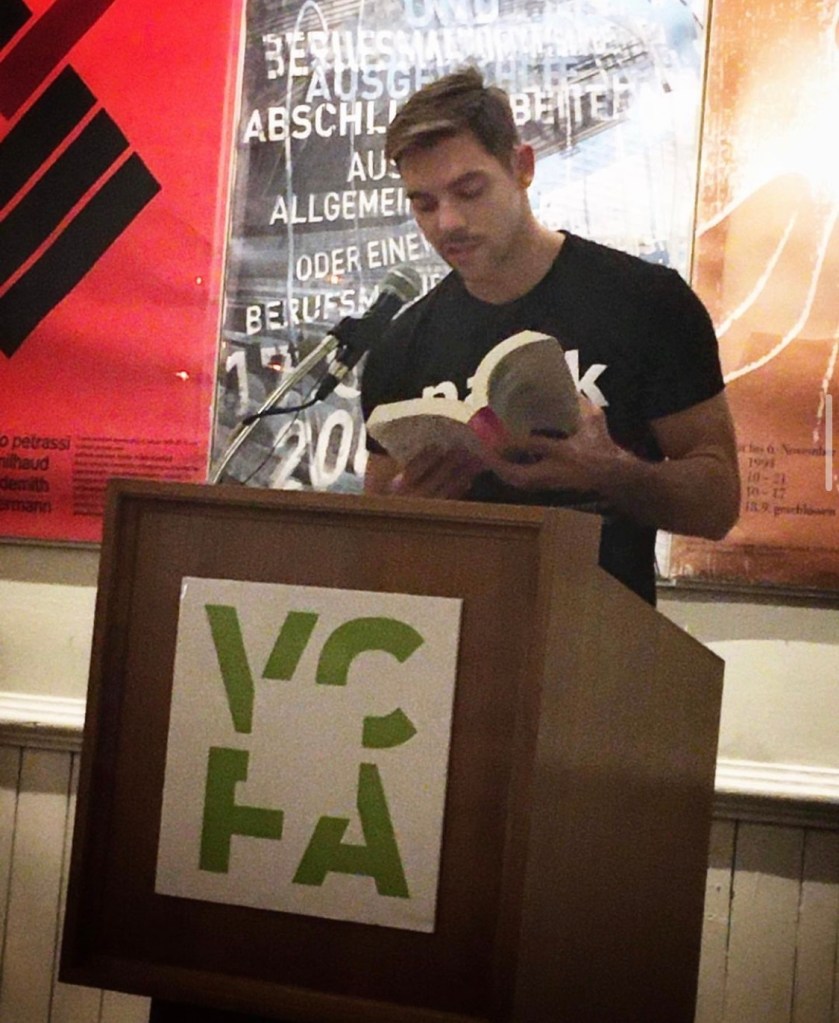
Some of you may recognize Chris from his modeling. He was a model for C-IN2, and he has done other modeling as well. However, he is also a prolific writer and intellectual.

Also, and this may show my ignorance, but I had to look up who “Puig” was that he mentions in the poem above. Manuel Puig was an Argentine author. Among his best-known novels are La traición de Rita Hayworth (Betrayed by Rita Hayworth, 1968), Boquitas pintadas (Heartbreak Tango, 1969), and El beso de la mujer araña (Kiss of the Spider Woman, 1976) which was adapted into the film released in 1985, directed by the Argentine-Brazilian director Héctor Babenco; and a Broadway musical in 1993.

Also, I had to include the second picture of Chris because it is of him speaking at the Vermont College of Fine Arts, which recently announced it would no longer be holding classes/residency in Vermont anymore. I am familiar with VCFA for several reasons, not least because for a brief while, I dated a guy who was attending VCFA, but it never really went anywhere.


Poems by Edward Carpenter

Summer Heat

Summer Heat
by Edward Carpenter

Sun burning down on back and loins, penetrating the skin, bathing their flanks in sweat,
Where they lie naked on the warm ground, and the ferns arch over them,
Out in the woods, and the sweet scent of fir-needles
Blends with the fragrant nearness of their bodies;

In-armed together, murmuring, talking,
Drunk with wine of Eros’ lips,
Hourlong, while the great wind rushes in the branches,
And the blue above lies deep beyond the fern-fronds and fir-tips;

Till, with the midday sun, fierce scorching, smiting,
Up from their woodland lair they leap, and smite,
And strike with wands, and wrestle, and bruise each other,
In savage play and amorous despite.

Love’s Vision

Love’s Vision
by Edward Carpenter

At night in each other’s arms,
Content, overjoyed, resting deep deep down in the darkness,
Lo! the heavens opened and He appeared–
Whom no mortal eye may see,
Whom no eye clouded with Care,
Whom none who seeks after this or that, whom none who has not escaped from self.

There–in the region of Equality, in the world of Freedom no longer limited,
Standing as a lofty peak in heaven above the clouds,
From below hidden, yet to all who pass into that region most clearly visible–
He the Eternal appeared.

To a Stranger

To a Stranger
by Edward Carpenter

O faithful eyes, day after day as I see and know
you—unswerving faithful and beautiful—going about
your ordinary work unnoticed,
I have noticed—I do not forget you.
I know the truth the tenderness the courage, I know
the longings hidden quiet there.
Go right on. Have good faith yet—keep that your
unseen treasure untainted.
Many shall bless you. To many yet, though no word
be spoken, your face shall shine as a lamp.
It shall be remembered, and that which you have
desired—in silence—shall come abundantly to you.

Through the Long Night

Through the Long Night
by Edward Carpenter

You, proud curve-lipped youth, with brown sensitive face,
Why, suddenly, as you sat there on the grass, did you
turn full upon me those twin black eyes of yours,
With gaze so absorbing so intense, I a strong man
trembled and was faint?
Why in a moment between me and you in the full
summer afternoon did Love sweep-leading after it in procession across the lawn and the flowers and under the waving
trees huge dusky shadows of Death and the other world?

I know not.
Solemn and dewy-passionate, yet burning clear and sted-fast at the last,
Through the long night those eyes of yours, dear,
remain to me—
And I remain gazing into them.

You, proud curve-lipped youth, with brown sensitive face,
Why, suddenly, as you sat there on the grass, did you turn full upon me those twin black eyes of yours,
With gaze so absorbing so intense, I a strong man trembled and was faint?
Why in a moment between me and you in the full summer afternoon did Love sweep—leading after it in procession across the lawn and the flowers and under the waving trees huge dusky shadows of Death and the other world?
I know not.
Solemn and dewy-passionate, yet burning clear and steadfast at the last,
Through the long night those eyes of yours, dear, remain to me—
And I remain gazing into them.

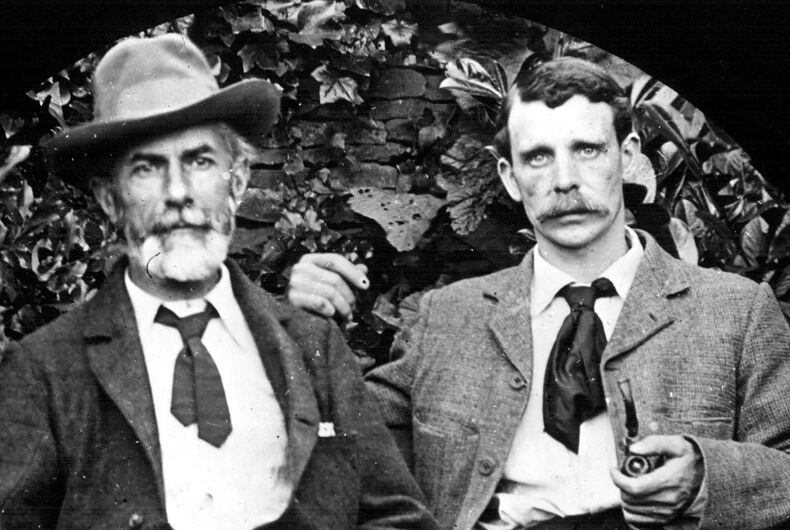
Edward Carpenter & his lover George Merrill circa 1900

About the Poet

The Mount Cemetery of Guildford, an English town about 32 miles southwest of London, contains the graves of two gay lovers: Edward Carpenter, a man called the “gay godfather of the British left” and his longtime partner George Merrill. While this may not seem too surprising these days, and you may not recognize them by name, both men bucked the homophobia of the late 18th and early 19th centuries by living together in an out gay relationship, providing romantic inspiration for two books written by well-known gay authors in the process. Their final resting place has recently been designated as an LGBTQ historic site by Historic England, an organization that helps people care for, enjoy and celebrate England’s spectacular historic environment.

Born in 1844, Edward Carpenter knew he was gay from an early age. In his diary, he wrote, “At the age of eight or nine, and long before distinct sexual feelings declared themselves, I felt a friendly attraction toward my own sex, and this developed after the age of puberty into a passionate sense of love.” He studied at the prestigious Trinity Hall college at the University of Cambridge. There, he developed romantic feelings toward his friend Edward Anthony Beck, who also served as Trinity Hall’s master. Beck eventually ended their friendship, leaving Carpenter heartbroken.

Carpenter said the work of gay American poet Walt Whitman caused “a profound change” in him, as Whitman urged people to find divinity in nature and within themselves rather than in religious society. Though Carpenter served in the Anglican ministry until age 30, he gradually grew dissatisfied with church and university life. He left both to begin publicly lecturing on astronomy, historic Greek women, and music. When he moved to the town of Sheffield at age 31, he encountered many manual workers. Historians note that his poetry around this time expressed attraction to these workers, to “the grimy and oil-besmeared figure of a stoker” and “the thick-thighed hot coarse-fleshed young bricklayer with a strap around his waist.”

As such, it’s hardly surprising that at age 47, he met and fell in love with George Merrill, a working-class man who (unlike Carpenter) grew up in the slums and had no formal education. The couple met on a train after Carpenter returned from travels in India. Merrill worked numerous blue-collar jobs at a newspaper office, a hotel, and an ironworks. Seven years after meeting, the two men moved in together into Carpenter’s small farm home in Millthorpe, Derbyshire.

There, Merrill officially served as Carpenter’s servant, cooking, cleaning, and decorating their home in fresh flowers. Carpenter liked Merrill’s baritone voice and enjoyment in singing comical songs. Carpenter once wrote of him, “George in fact was accepted and one may say beloved by both my manual worker friends and my more aristocratic friends.” Their living openly as a gay couple was especially notable considering that, at the time, the United Kingdom had laws punishing “buggery” with prison time. Oscar Wilde was convicted and sent to prison for homosexuality in 1895 and shunned by society — countless other men had their lives ruined under similar offenses.

But despite this, Carpenter openly defended same-sex relationships in his 1895 book Homogenic Love, his 1896 work Love’s Coming of Age, and 1908 creation The Intermediate Sex, calling same-sex couples “not only natural but “inevitable.” The books generated controversy, even leading one of Carpenter’s neighbors to report him to the Derbyshire Police. The police pledged to keep a “discreet watch” on him and his activities.

Carpenter became friends with Whitman and other influential writers like Indian writer Rabindranath Tagore and the English authors D.H. Lawrence and E.M. Forester. Carpenter’s relationship with Merrill reportedly inspired the gay romance in Forster’s posthumously published novel Maurice and the straight romance in Lawrence’s Lady Chatterley’s Lover, both of which involved people in romantic relationships with men from lower social classes. Beyond the couple’s notoriety, Carpenter himself is also celebrated for being a socialist whose early works opposed environmental pollution, cruelty to animals, worker exploitation, and other positions which have since become mainstays of different social justice movements.

Merrill died in 1928. In May of the same year, Carpenter had a paralytic stroke. After 13 months, Carpenter too died. The men’s gravestone reads, “Do not think too much of the dead husk of your friend, or mourn too much over it, but send your thoughts out towards the real soul or self which has escaped-to reach it. For so, surely you will cast a light of gladness upon his onward journey, and contribute your part towards the building of that kingdom of love which links our earth to heaven.”


Cape Cod

Cape Cod
By George Santayana – 1863-1952

The low sandy beach and the thin scrub pine,
The wide reach of bay and the long sky line,—
    O, I am far from home!

The salt, salt smell of the thick sea air,
And the smooth round stones that the ebbtides wear,—
    When will the good ship come?

The wretched stumps all charred and burned,
And the deep soft rut where the cartwheel turned,—
    Why is the world so old?

The lapping wave, and the broad gray sky
Where the cawing crows and the slow gulls fly,—
    Where are the dead untold?

The thin, slant willows by the flooded bog,
The huge stranded hulk and the floating log,—
    Sorrow with life began!

And among the dark pines, and along the flat shore,
O the wind, and the wind, for evermore!
    What will become of man?

About This Poem

“Cape Cod” first appeared in Santayana’s Sonnets and Other Verses (Stone & Kimball, 1894). As Santayana recounts in Persons and Places: The Middle Span (Charles Scribner’s Sons, 1945), the poem originated in a fishing trip with friends to Cape Cod, during which he “never held a rod in [his] hand, and never meant to.” He explains, “I wrote some lines on Cape Cod, of which the poet William Vaughn Moody said that there for once I had been inspired. But that inspiration came only by the way, as on returning we skirted a beach in the gathering twilight. Cape Cod in general has the most cheerful associations in my mind.” The scholar Newton Phelps Stallknecht later wrote about the poem in George Santayana (University of Minnesota Press, 1971) that “language, rhythm, and imagery yield fully to the sense of forlorn exile that is throughout. The scene becomes a haunting symbol of loneliness, an end of the world, whose beauty lives in its very desolation.”

About This Poet

George Santayana was a philosopher, critic, essayist, novelist, and poet. born Jorge Agustín Nicolás Ruiz de Santayana y Borrás on December 16, 1863, in Madrid, was a philosopher, critic, poet, and novelist. He was the author of many books, including The Sense of Beauty: Being the Outlines of Aesthetic Theory (Charles Scribner’s Sons, 1896) and Three Philosophical Poets: Lucretius, Dante And Goethe (Harvard University, 1910).

He received his PhD from Harvard, where he taught Conrad Aiken, T. S. Eliot, Robert Frost, and Wallace Stevens. In 1912, Santayana moved to Europe and never returned to the United States. He died on September 26, 1952.


The Migraine

The Migraine: An Original Poem About Migraine
by Kathleen Dempsey

Vertiginous,
Equilibrium off,
Exhausted.
Comparable to a drug-induced haze,
I have fifteen minutes to prepare for HELL.
Nauseated, I retreat to bed,
In the fetal position, I hold my head.
It pounds, like a sledgehammer against steel,
As waves of fireless burning flow through my being.
I’m hot, I’m cold, I’m a broken thermometer.
I can’t eat, I can’t drink.
It won’t stay down.
Waves of sickness clutch my stomach,
It will not settle without a pharmaceutical.
An invisible knife punctures my head,
Entering the base of my skull with perfect precision.
I cry ——
But only on the inside. Begging, pleading to an unseen force,
I whimper, as my head is in an ephemeral vice,
MAKE IT STOP!
I wonder —is this punishment?
for some mortal sin in a past life…
Or is it a trial, of how much I can endure.
I take another pill.
It subsides a little.
Enough to function,
But not for long.
Not long enough for commitment,
Not long enough to make money.
I have survived the first pang of days.
But like a long-lost bad memory,
It will return with a vengeance.
Each time trying to break my spirit.
But it will not because I persevere.
Savouring the in-between times,
When I can create,
I can travel, I can live.
And forget the shadow of my agony,
If for just a time.

Yesterday, I had a terrible migraine. It started Sunday night, and I slept fitfully through the night, waking up to the pain several times. Yesterday, I had to call in sick. There was no way I could handle going to work: the bright lights, the noise, the heat (it was 92 here yesterday). I have mostly been doing good since the new treatment, but a major storm front came through Vermont. It’s the pressure changes before the storm hits that begin the migraine attack. Sometimes, they subside when the rain actually begins, but that did not happen yesterday. I went to bed in pain last night.

The poem above was written by Kathleen Dempsey of Toronto on January 4, 2018. She has suffered from migraines since she was 24 and has suffered from chronic migraines for the last three decades. I have suffered with them for more than four decades. (I’ve had them all my life, and I will turn 45 this November.)

I knew I suffered from migraines, but until I began going to the Headache Clinic at Dartmouth, no doctor ever really took them seriously. During my first visit, they diagnosed me with chronic migraines and began trying to find the correct treatment for me. For Dempsey, it took a few visits to the hospital before she was officially diagnosed. Like me, she has tried just about everything to manage her migraines. Some of her attempts to relieve her migraines included opioids, preventative medications, holistic treatments, a decade of triptan use, and even the silly suggestions on social media, like sitting in the bathtub with frozen peas on my head! I have tried many of the same things.

Sadly, like me, she has not been able to get more than temporary relief and has had to give her migraines more control over her adult life than she would like to. I learned a long time ago to persevere. I push and push until I can’t any longer. The pain becomes all-encompassing. Like many with chronic migraines, Dempsey was unable to work for many years. Despite this, she says she’s a fairly happy person with a life full of hobbies, family, and friends. As her poem shows, living with migraines can sometimes be depressing.

She comforts herself by knowing that when the attack is happening, it will only be short-lived, and then she will feel okay. She hopes that one day her migraine attacks will stop. I never know how long my migraines will last. Sometimes, it’s hours; other times, it’s days. Eventually, I get some relief.

Dempsey copes with her pain through creativity. She creates through poetry, photography, painting, drawing, and jewelry design. She has said that writing poetry about her migraines helps her show others the impact they have on her life and that they are not just another headache. Like Dempsey, I have learned we should never wait to do the things we enjoy, and we should spend as much time with the people that we love as we are able to. Like Dempsey, I try to incorporate this philosophy into my life, spending as much energy as I can creating through writing this blog, having fun, doing a job I love, and traveling when I can. I try to do as much as I can when I can. I make a point to learn something new every day and to know my limitations. For Dempsey, the purpose of life is to have fun and help others, making memories as she goes along — and that is exactly what she does when she is migraine-free. I try to do the same.


The More Loving One

The More Loving One
By W. H. Auden – 1907-1973

Looking up at the stars, I know quite well
That, for all they care, I can go to hell,
But on earth indifference is the least
We have to dread from man or beast.

How should we like it were stars to burn
With a passion for us we could not return?
If equal affection cannot be,
Let the more loving one be me.

Admirer as I think I am
Of stars that do not give a damn,
I cannot, now I see them, say
I missed one terribly all day.

Were all stars to disappear or die,
I should learn to look at an empty sky
And feel its total dark sublime,
Though this might take me a little time.

About the Poem

“The More Loving One” is one of W. H. Auden’s most popular post-1930s poems. At once a celebration of unrequited love and a metaphysical poem about the difficulty of finding “love” and meaning in a secular age, it is a straightforward poem that, like much of Auden’s poetry, conceals more complex interpretations beneath the surface. 

In the first stanza, the poet begins by remarking upon the indifference of the stars: when he looks up at them, he knows they don’t care about what happens to him. However, the poem is not a self-pitying verse. Auden stoically reflects that of all the things man is primed to be wary of in “man or beast,” indifference is the least one to be feared. 

Auden thinks about the stars’ indifference towards him in the second stanza. He wonders if things were different, and the stars were “burning” not purely out of an act of nuclear fission but because they harbored a passion for us, a love we could not reciprocate. At the end of this second stanza, Auden declares that when it comes to the stars, he is glad to be “the more loving one” out of the two.

In the third stanza, Auden tells us that, although he likes to think of himself as the stars’ “admirer,” he doesn’t miss them during the day when they’re not visible in the sky. Auden is saying that technically he is “the more loving one” because he admires the beauty of the stars in the night sky, but that’s as far as it goes.

In the final stanza, Auden says that if all the stars in the sky disappeared and died, he would get used to looking up at an empty night sky and eventually embrace the total darkness without stars to brighten it up. While it might take him some time, he’d adapt.

Auden constantly reins in this poem. The first half of the first stanza sets us up for a poem lamenting the indifference of nature towards us, only to conclude that indifference is actually fine; the first half of the poem leads us to believe that Auden loves the stars and that we are in for a celebratory poem admiring their beauty, before the second half checks this impulse and the poet heartily reassures us that he could cope without them. When summarized in this way, it seems that the poem is almost too simple: he’s an admirer of the stars, which don’t care whether he lives or dies, but actually, he doesn’t even care that much about the stars. However, there’s more to the poem than you might think at first reading.

“The More Loving One” should be analyzed in light of the decline of faith in the western world and the growing secularism of the twentieth century. The “stars” in Auden’s poem should be read with astrology as well as astronomy in mind: the stars may be mere balls of gas light-years away in the universe, but for centuries man made them the center of a whole belief system, believing that human fate could be read or divined within the patterns of the stars. As the famous quotation from Julius Caesar says, “The fault, dear Brutus, lies not in our stars / But in ourselves.” 

In other words, it’s significant that of all natural phenomena, Auden looks up at the heavens and decides that there is no “heaven” as man conceived of it. The stars are just balls of gas, and there is no godly guiding hand. What should we make of this knowledge? As it consistently is throughout his work, Auden’s answer is love: we should admire the stars all the same, even though they don’t care about us. But at the same time, we should resist the romantic. “The More Loving One” is not a song of praise for the beauty of the stars but instead a level-headed response to the crisis of disenchantment in a post-religious age. Once, man collectively believed the stars or the heavens cared about what happened to him. Auden is saying that the world has lost its belief in the stars.

As individuals, we can respond by believing that the universe has a purpose for us; or we can respond by saying it doesn’t and ask what the point of anything is. Or we can meet the universe’s indifference to us head-on and take pride in the fact that we, as products of nature, have been instilled with the ability to care, to feel awe in the face of nature’s beauty, and to love.

About W. H. Auden

Wystan Hugh Auden (1907-73) was born in York, England, and was educated at the University of Oxford. He described how the poetic outlook when he was born was “Tennysonian,” but by the time he went to Oxford as a student in 1925, T. S. Eliot’s The Waste Land had altered the English poetic landscape away from Tennyson and towards what we now call “modernism.”

W. H. Auden was admired for his unsurpassed technical virtuosity and ability to write poems in nearly every imaginable verse form; his incorporation of popular culture, current events, and vernacular speech in his work; and also for the vast range of his intellect, which drew easily from an extraordinary variety of literary art forms, social and political theories, and scientific and technical information.

Surprisingly given his later, better-known work, Auden’s early poetry flirted with the obscurity of modernism: in 1932, his long work The Orators (a mixture of verse and prose poetry with an incomprehensible plot) was published by Faber and Faber, then under the watchful eye of none other than T. S. Eliot. Auden later distanced himself from this experimental false start, describing The Orators as the kind of work produced by someone who would later either become a fascist or go mad.

Auden thankfully did neither, embracing instead a more traditional set of poetic forms (he wrote a whole sequence of sonnets about the Sino-Japanese War of the late 1930s) and a more direct way of writing that rejected modernism’s love of obscure allusion. This does not mean that Auden’s work is always straightforward in its meaning, and arguably his most famous poem, “Funeral Blues,” is often “misread” as a sincere elegy when it was intended to be a send-up or parody of public obituaries.

In early 1939, not long before the outbreak of the Second World War, Auden left Britain for the United States, much to the annoyance of his fellow left-wing writers. They saw such a move as a desertion of Auden’s political duty as the most prominent English poet of the decade. In America, where he lived for much of the rest of his life with his long-time partner Chester Kallman, Auden collaborated with composers on a range of musicals and continued to write poetry, but 90 percent of his best work belongs to the 1930s, the decade with which is most associated. He died in 1973 in Austria, where he had a holiday home.


Shakespearean Sonnets

Shall I compare thee to a summer’s day? (Sonnet 18)
By William Shakespeare – 1564-1616

Shall I compare thee to a summer’s day?
Thou art more lovely and more temperate.
Rough winds do shake the darling buds of May,
And summer’s lease hath all too short a date.
Sometime too hot the eye of heaven shines,
And often is his gold complexion dimmed;
And every fair from fair sometime declines,
By chance, or nature’s changing course, untrimmed;
But thy eternal summer shall not fade,
Nor lose possession of that fair thou ow’st,
Nor shall death brag thou wand’rest in his shade,
When in eternal lines to Time thou grow’st.
  So long as men can breathe, or eyes can see,
  So long lives this, and this gives life to thee.

I usually post this poem every summer. It’s my favorite of Shakespeare’s sonnets. Sonnets are one of my favorite forms of poetry. I used to love teaching sonnets back when I taught British literature. I’ve always loved the intricacy of various forms of poetry. Sonnets may be my a favorite, but I also love villanelles. A sonnet is a fourteen-line poem written in iambic pentameter, employing one of several rhyme schemes (Italian/Petrarchan, English/Shakespearean, Spenserian, Miltonic, and a few others), and adhering to a tightly structured thematic organization. In contrast, a villanelle, also known as villanesque, is a nineteen-line poetic form consisting of five tercets followed by a quatrain, but I’m not going to bore you with the intricacies of a villanelle. For me, the two masters of the sonnet form were Shakespeare and Elizabeth Barrett Browning, whose Sonnets from the Portuguese includes “How do I love thee?” (Sonnet 43).

Back to the poem above, Shakespeare’s Sonnet 18 is arguably his most famous, and it is absolutely beautiful. I love the final lines:

So long as men can breathe, or eyes can see,
  So long lives this, and this gives life to thee.

But did you know that Shakespeare also wrote a sonnet in contrast to Sonnet 18? It is known as “My mistress’ eyes are nothing like the sun” (Sonnet 130). Instead of celebrating his mistress’s beauty, Shakespeare Sonnet 130 mocks the conventions of the showy and flowery courtly sonnets in its realistic portrayal of his mistress. In the three quatrains, he describes how homely and ordinary his mistress is, but in the final couplet, the speaker proclaims his love for his mistress by declaring that he makes no false comparisons, the implication being that other poets do precisely that (and what Shakespeare did in Sonnet 18).. Shakespeare’s Sonnet 130 aims to do the opposite, by indicating that his mistress is the ideal object of his affections because of her genuine qualities, and that she is more worthy of his love than the paramours of other poets who are more fanciful. As much as I like Sonnet 18, I also love Sonnet 130. It seems to say, “She might not be pretty or perfect, but he loves her more deeply because his love for her transcends everything else.”

It’s not what’s on the outside, but what’s on the inside. We all know those beautiful people who are perfection on the outside, but ugly on the inside. They may be nice to look at, but they certainly aren’t nice to be around. Then, there are the truly beautiful people. There are the rare ones who are both beautiful on the outside and the inside, but it’s the beauty on the inside that really matters.

My mistress’ eyes are nothing like the sun (Sonnet 130)
By William Shakespeare – 1564-1616

My mistress’ eyes are nothing like the sun;
Coral is far more red than her lips’ red;
If snow be white, why then her breasts are dun;
If hairs be wires, black wires grow on her head.
I have seen roses damasked, red and white,
But no such roses see I in her cheeks;
And in some perfumes is there more delight
Than in the breath that from my mistress reeks.
I love to hear her speak, yet well I know
That music hath a far more pleasing sound;
I grant I never saw a goddess go;
My mistress when she walks treads on the ground.
  And yet, by heaven, I think my love as rare
  As any she belied with false compare.


A Summer Night

A Summer Night
By Elizabeth Drew Stoddard

I feel the breath of the summer night,
    Aromatic fire:
The trees, the vines, the flowers are astir
    With tender desire.

The white moths flutter about the lamp,
    Enamoured with light;
And a thousand creates softly sing
    A song to the night!

But I am alone, and how can I sing
    Praises to thee?
Come, Night! unveil the beautiful soul
    That waiteth for me.

About the Poet
Elizabeth Drew Stoddard was born in Mattapoisett, Massachusetts, in 1823. She published both prose and poetry during her lifetime, including Poems (Houghton, Mifflin and Company, 1895). She died in 1902.


Inscription for the Ceiling of a Bedroom

Inscription for the Ceiling of a Bedroom
By Dorothy Parker – 1893-1967

DAILY dawns another day;
I must up, to make my way.
Though I dress and drink and eat,
Move my fingers and my feet,
Learn a little, here and there,
Weep and laugh and sweat and swear,
Hear a song, or watch a stage,
Leave some words upon a page,
Claim a foe, or hail a friend––
Bed awaits me at the end.

Though I go in pride and strength,
I’ll come back to bed at length.
Though I walk in blinded woe,
Back to bed I’m bound to go.
High my heart, or bowed my head,
All my days but lead to bed.
Up, and out, and on; and then
Ever back to bed again,
Summer, Winter, Spring, and Fall––
I’m a fool to rise at all!

For twelve years now, I have left “some words upon a page” in the form of The Closet Professor. Nearly every day for the past twelve years I have published a post on this site. Mostly, they have been my ramblings about history, poetry, politics, and religion. Sometimes, I, “weep and laugh and sweat and swear,” but I have always tried to be as candid about my life and career as I could be. I’ve written about growing up gay, religious, and closeted in the South. I have written about my health, especially my journey with chronic migraines. Several years ago, I started to add a second post each day, my “Pic of the Day.” I come across so many great pictures on the internet, and some of them I think would make a great addition to a post. Others, I have no idea how I’d ever use it with a post, but I know I like the picture and want to be able to share it. So, it becomes my “Pic of the Day.”

The Closet Professor blog has been a fantastic journey that isn’t over yet. Occasionally, I “claim a foe” which what I write about, but more often than not, I “hail a friend.” I have met some wonderful friends along the way, some merely virtually and others in person. Some, old and new, are still friends, others I’ve lost touch with, and a few have passed away. My readers mean the world to me, and I love when one of you reaches out to me. I read each comment you make, and though I don’t always respond, I read them all. This blog has allowed me to “go in pride and strength” through this life, and I think it has made me a better person.

While each night “bed awaits me at the end,” it is usually just before I go to bed that I write my post for tomorrow. I wanted to celebrate my twelfth anniversary. Since I almost always post a poem on Tuesdays and my anniversary fell on a Tuesday this year, I looked for what I thought might be an appropriate poem. I love Dorothy Parker’s wit, and when I read this poem, I really didn’t think any other poem would be as perfect as this poem is for the anniversary of a blog. 

Blogs didn’t exist in Parker’s lifetime, but I imagine if she’d lived during this time, she would have had a very popular blog with fantastic and scathing commentary on the world. I will never be the wordsmith that Dorothy Parker was, but I do hope you will continue to enjoy my ramblings for maybe another twelve years (or maybe longer). We shall see. When I started this blog, I never imagined that I’d still be writing it twelve years later. 

Thanks for being on this journey with me.

About the Poet

On August 22, 1893, Dorothy Parker was born to J. Henry and Elizabeth Rothschild, at their summer home in West End, New Jersey. She grew up on Manhattan’s Upper West Side. In 1914, Dorothy sold her first poem to Vanity Fair. At age twenty-two, she took an editorial job at Vogue. She continued to write poems for newspapers and magazines, and in 1917 she joined Vanity Fair, taking over for P.G. Wodehouse as drama critic.

In 1919, Parker became a founding member of the Algonquin Round Table, an informal gathering of writers who lunched at the Algonquin Hotel in Midtown Manhattan. The “Vicious Circle” included Robert Benchley, Harpo Marx, George S. Kaufman, and Edna Ferber, and was known for its scathing wit and intellectual commentary. In 1922, Parker published her first short story, “Such a Pretty Little Picture,” for Smart Set. When the New Yorker debuted in 1925, Parker was listed on the editorial board. Over the years, she contributed poetry, fiction, and book reviews as the “Constant Reader.” 

Parker’s first collection of poetry, Enough Rope (Boni & Liveright), was published in 1926 and was a bestseller. Her two subsequent collections were Sunset Gun (Boni & Liveright, 1928) and Death and Taxes (The Stratford Press, 1931). She published a work of collected fiction, Laments for the Living (The Viking Press), in 1930. 

During the 1920s, Parker traveled to Europe several times. She befriended Ernest Hemingway, F. Scott Fitzgerald, socialites Gerald and Sara Murphy, and contributed articles to the New Yorker and Life. While her work was successful, and she was well-regarded for her wit and conversational abilities, she suffered from depression and alcoholism. 

Parker was inducted into the American Academy of Arts and Letters in 1959 and was a visiting professor at California State College in Los Angeles in 1963. That same year, her husband, actor-writer Alan Campbell, died of an overdose. On June 6, 1967, Parker was found dead of a heart attack in a New York City hotel at age seventy-three. A firm believer in civil rights, she bequeathed her literary estate to Dr. Martin Luther King, Jr. Upon his assassination the following year, the estate was turned over to the NAACP. 


Two Poems for a Rainy Tuesday in July

Summer Rain
By Amy Lowell – 1874-1925

All night our room was outer-walled with rain.
Drops fell and flattened on the tin roof,
And rang like little disks of metal.
Ping!—Ping!—and there was not a pin-point of silence between
    them.
The rain rattled and clashed,
And the slats of the shutters danced and glittered.
But to me the darkness was red-gold and crocus-colored
With your brightness,
And the words you whispered to me
Sprang up and flamed—orange torches against the rain.
Torches against the wall of cool, silver rain!

Summer Morn in New Hampshire
By Claude McKay – 1889-1948

All yesterday it poured, and all night long
    I could not sleep; the rain unceasing beat
Upon the shingled roof like a weird song,
    Upon the grass like running children’s feet.
And down the mountains by the dark cloud kissed,
    Like a strange shape in filmy veiling dressed,
Slid slowly, silently, the wraith-like mist,
    And nestled soft against the earth’s wet breast.
But lo, there was a miracle at dawn!
    The still air stirred at touch of the faint breeze,
The sun a sheet of gold bequeathed the lawn,
    The songsters twittered in the rustling trees.
And all things were transfigured in the day,
    But me whom radiant beauty could not move;
For you, more wonderful, were far away,
    And I was blind with hunger for your love.

The Poets:

Born in 1874, Amy Lowell was deeply interested in and influenced by the Imagist movement and she received the Pulitzer Prize for her collection What’s O’Clock.

Claude McKay, who was born in Jamaica in 1889, wrote about social and political concerns from his perspective as a black man in the United States, as well as a variety of subjects ranging from his Jamaican homeland to romantic love.