From Heaven I fall, though from earth I begin. No lady alive can show such a skin. I’m bright as an angel, and light as a feather, But heavy and dark, when you squeeze me together. Though candor and truth in my aspect I bear, Yet many poor creatures I help to insnare. Though so much of Heaven appears in my make, The foulest impressions I easily take. My parent and I produce one another, The mother the daughter, the daughter the mother.
This is a poem/riddle by the satirist Jonathan Swift. I’m going to take a page from BosGuy’s Friday Brain Teaser, and so, I’m not going to post the title of this poem until later this afternoon. I’d like to see if you can figure out the title. BosGuy waits to approve the guesses in the comments until later, I’ve changed my comments, only for today, so that you can comment your answer. After the Pic of the Day posts, I will approve all of the comments for the riddle answers. Any other comments to other posts will be approved as soon as I see them. Don’t cheat and look up the poem. Instead, give it a real shot to see if you can guess the answer to the riddle.
Jonathan Swift was born in Dublin, Ireland, on November 20, 1667, and spent his adult life alternately living in Ireland and England. A satirist known for his sharp wit and unforgiving criticism of politics, religion, and society, Swift is best known for his satirical novel Gulliver’s Travels (1726). Though best known for his prose, Swift also wrote a number of poems in his lifetime, most of which were also humorous in tone and written under pseudonyms. Swift died in Dublin on October 19, 1745.
By the way, I think Swift would have had a field day with our previous defeated, loser, and twice-impeached president. Can you imagine? I’m sure it would have been good, at least for those who did not like the former president.
I can only give you back what you imagine. I am a soulless man. When I take you into my mouth, it is not my mouth. It is an unlit pit, an aperture opened just enough in the pinhole camera to capture the shade.
I have caused you to rise up to me, and I have watched as you rose and waned. Our times together have been innumerable. Still, like a Capistrano swallow, you come back. You understand: I understand you. Understand each jiggle and tug. Your pudgy, mercurial wad.
I am simply a hand inexhaustible as yours could never be. You’re nevertheless prepared to shoot. If I could I’d finish you. Be more than just your rag.
About the Poem and the Poet
I featured W. H. Auden’s “The Platonic Blow” a few weeks ago about a blowjob. Though much longer, D. A. Powell’s “The Fluffer Talks to Eternity” deals with the same sexual act, though I am not sure that in this poem it is not metaphorical. I once saw an independent film called The Fluffer about a film buff with a crush on a porn star who is straight, for whom he would end up working as a fluffer in gay porn. Just in case you don’t know, a fluffer is a person employed to keep a porn performer’s penis erect on the set. “The Fluffer Talks to Eternity” was published in Poetry in February 2010 along with his poem “Pupil.”
Born in Albany, Georgia, D. A. Powell earned an MA at Sonoma State University and an MFA at the Iowa Writers’ Workshop. His first three collections of poetry, Tea, (1998), Lunch (2000), and Cocktails (2004), are considered by some to be a trilogy on the AIDS epidemic. Lunch was a finalist for the National Poetry Series, and Cocktails was a finalist for the National Book Critics Circle Award for poetry. His next two books were Chronic (2009), which won the Kingsley Tufts Poetry Award and was a finalist for the National Book Critics Circle Award;and Useless Landscape, or A Guide for Boys (2012) won the National Book Critics Circle Award for poetry.
Powell is known for his syntactically inventive, longer eight- or ten-beat lines in poems that are often untitled. As a teacher at Sonoma State, he noticed that most of his students’ poems were written to fit the demands of the page. His experiments with his students in writing on unexpected surfaces (such as candlesticks or rolls of toilet paper) led to his own breakthrough in “subverting the page”: he turned a legal pad sideways and wrote the first poem for Tea. Powell explains that “by pulling the line longer, stretching it into a longer breath, I was giving a little bit more life to some people who had very short lives.”
Powell has also taught at Harvard University, Columbia University, and the University of San Francisco. He has been awarded the Lyric Poetry Award from the Poetry Society of America, a grant from the National Endowment for the Arts, and a Paul Engle Fellowship from the James Michener Foundation. His poems have been featured in the Norton anthology American Hybrid (2009) and Best American Poetry (2008).
D.A. Powell is openly gay, and often explores his sexuality and the body through his poetry. This exploration of the body is noted with some sadness if anyone knows anything about Powell himself. Powell is HIV positive, which is part of the reason why his first three books have been called “The AIDS Trilogy” because of their exploration of the cultural and individual impact of the disease. Too many critics and writers focus just on Powell’s identity as a gay man with AIDS. They spend so much time on that aspect of his life, and they miss the man’s soul seen through his poetry. Powell’s humor is one of the greatest appeals of his work. Despite the moments where Powell is lifting the small details of existence up for reflection, he takes the reader to another place, such as he does in “The Fluffer Talks of Eternity.”
The poem is a monologue of a man who “fluffs” men before a porn shoot. Powell is working in a voice spoken from a sensitivity of life, of its absurdity, or its all tiniest beauties. He is able to conjure sensations and imaginations that real poetry should do. Poetry sometimes should just shock us out of our comfort so that we can then reassess our reality and determine what it actually is. That is often the beauty of poetry.
This being human is a guest house. Every morning a new arrival.
A joy, a depression, a meanness, some momentary awareness comes as an unexpected visitor.
Welcome and entertain them all! Even if they’re a crowd of sorrows, who violently sweep your house empty of its furniture, still, treat each guest honorably. He may be clearing you out for some new delight.
The dark thought, the shame, the malice, meet them at the door laughing, and invite them in.
Be grateful for whoever comes, because each has been sent as a guide from beyond.
Taken from SELECTED POEMS by Rumi, Translated by Coleman Barks (Penguin Classics, 2004).
Cory Muscara is a former monk and bestselling author of Stop Missing Your Life. He has taught Mindful Leadership at Columbia University, is an instructor of Positive Psychology at the University of Pennsylvania, and for the last ten years has offered mindfulness workshops and retreats around the world. Muscara is the host of the top ranked podcast, Practicing Human, host of the mindfulness app and platform, Mindfulness.com, and author of the bestselling book, Stop Missing Your Life: How to Be Deeply Present in an Un-Present World.
I saw him read this poem on Instagram and his soothing voice seemed to make this poem mean so much more. I think it’s a wonderful poem to start off the new year. His comments after the video are also a great analysis of the poem.
Mowlānā Jalāloddin Balkhi, known in Persia as Jalāl ad-Dīn Muhammad Balkhī and in the West as Rumi, was born on September 30, 1207 C. E. in Balkh Province, Afghanistan, on the eastern edge of the Persian Empire. Rumi descended from a long line of Islamic jurists, theologians, and mystics, including his father, who was known by followers of Rumi as “Sultan of the Scholars.” When Rumi was still a young man, his father led their family more than 2,000 miles west to avoid the invasion of Genghis Khan’s armies. They settled in present-day Turkey, where Rumi lived and wrote most of his life.
As a teenager, Rumi was recognized as a great spirit by the poet and teacher Fariduddin Attar, who gave him a copy of his own Ilahinama (The Book of God). When his father died in 1231, Rumi became head of the madrasah, or spiritual learning community.
Rumi’s oldest son, Sultan Velad, managed to save 147 of Rumi’s intimate letters, which provide insights about the poet and how he lived. Rumi often involved himself in the lives of his community members, solving disputes and facilitating loans between nobles and students. The letters are described as having lines of poetry scattered throughout.
In 1244, Rumi met Shams Tabriz, who had taken a vow of poverty. Their meeting is considered a central event in Rumi’s life, and Rumi believed his real poetry began when he met Shams. They were close friends for about four years. Over the course of that time, Shams was repeatedly driven away by Rumi’s jealous disciples, including one of Rumi’s sons, Ala al-Din. In December of 1248, Shams again disappeared; it is believed that he was either driven away or killed. Rumi left the madrasah in search of his friend, traveling to Damascus and elsewhere. Eventually, Rumi made peace with his loss, returning to his home.
Rumi’s mourning for the loss of his friend led to the outpouring of more than 40,000 lyric verses, including odes, eulogies, quatrains, and other styles of Eastern-Islamic poetry. The resulting collection, Divan-e Shams-e Tabrizi or The Works of Shams Tabriz, is considered one of Rumi’s masterpieces and one of the greatest works of Persian literature.
In his introduction to his translation of Rumi’s The Shams, Coleman Barks has written: “Rumi is one of the great souls, and one of the great spiritual teachers. He shows us our glory. He wants us to be more alive, to wake up… He wants us to see our beauty, in the mirror and in each other.”
For the last twelve years of his life, beginning in 1262, Rumi dictated a single, six-volume poem to his scribe, Husam Chelebi. The resulting masterwork, the Masnavi-ye Ma’navi (Spiritual Verses), consists of sixty-four thousand lines, and is considered Rumi’s most personal work of spiritual teaching. Rumi described the Masnavias “the roots of the roots of the roots of the (Islamic) Religion,” and the text has come to be regarded by some Sufis as the Persian-language Koran.
In his introduction to an English edition of Spiritual Verses, translator Alan Williams wrote: “Rumi is both a poet and a mystic, but he is a teacher first, trying to communicate what he knows to his audience. Like all good teachers, he trusts that ultimately, when the means to go any further fail him and his voice falls silent, his students will have learnt to understand on their own.”
Rumi fell ill and died on December 17, 1273 C. E., in Konya, Turkey. His remains were interred adjacent to his father’s, and the Yeşil Türbe (Green Tomb) was erected above their final resting place. Now the Mevlâna museum, the site includes a mosque, dance hall, and dervish living quarters. Thousands of visitors, of all faiths, visit his tomb each month, honoring the poet of legendary spiritual understanding.
My glass is filled, my pipe is lit, My den is all a cosy glow; And snug before the fire I sit, And wait to feel the old year go. I dedicate to solemn thought Amid my too-unthinking days, This sober moment, sadly fraught With much of blame, with little praise.
Old Year! upon the Stage of Time You stand to bow your last adieu; A moment, and the prompter’s chime Will ring the curtain down on you. Your mien is sad, your step is slow; You falter as a Sage in pain; Yet turn, Old Year, before you go, And face your audience again.
That sphinx-like face, remote, austere, Let us all read, whate’er the cost: O Maiden! why that bitter tear? Is it for dear one you have lost? Is it for fond illusion gone? For trusted lover proved untrue? O sweet girl-face, so sad, so wan What hath the Old Year meant to you?
And you, O neighbour on my right So sleek, so prosperously clad! What see you in that aged wight That makes your smile so gay and glad? What opportunity unmissed? What golden gain, what pride of place? What splendid hope? O Optimist! What read you in that withered face?
And You, deep shrinking in the gloom, What find you in that filmy gaze? What menace of a tragic doom? What dark, condemning yesterdays? What urge to crime, what evil done? What cold, confronting shape of fear? O haggard, haunted, hidden One What see you in the dying year?
And so from face to face I flit, The countless eyes that stare and stare; Some are with approbation lit, And some are shadowed with despair. Some show a smile and some a frown; Some joy and hope, some pain and woe: Enough! Oh, ring the curtain down! Old weary year! it’s time to go.
My pipe is out, my glass is dry; My fire is almost ashes too; But once again, before you go, And I prepare to meet the New: Old Year! a parting word that’s true, For we’ve been comrades, you and I — I thank God for each day of you; There! bless you now! Old Year, good-bye!
About the Poem
“The Passing of the Year” by Robert Service is a beautiful and thoughtful poem about the passing of the year and the beginning of the new. At this critical juncture, the poet, sitting comfortably, talks with the old year. There isn’t much from the poet’s side as it’s much about others with whom the poet converses. They don’t talk with the poet but show how they are, either happy with the passing of the year or sad. However, without remarking much about the poet’s personal affairs the poet bids thanks to the old year at last. Such a poem like this is always rewarding to that person who sits alone and visualizes the year in a recap.
About the Poet
Robert William Service, the renowned poet of the Yukon, was born in Lancashire, England, on January 16, 1874. In 1883 he moved with his family north to Glasgow, Scotland. He attended several of Scotland’s finest schools, where he developed a deep interest in books and poetry, along with a sharp wit and a way with words.
Service’s innate curiosity and fondness for adventure stories inspired an urge to travel—to go off to sea and to see the world. Although his parents discouraged this adolescent ambition, his desire wasn’t extinguished (and would one day be fulfilled). Service bided his time with assorted jobs—one at a shipping office that soon closed down, then another following his father’s footsteps in a position at a suburban branch of the Commercial Bank of Scotland. Working under light supervision, Service managed to pass the day with reading material he’d snuck in: Robert Browning, Lord Alfred Tennyson, and John Keats. Service developed into an excellent student of poetry, and attended the University of Glasgow to study English Literature. He was quickly identified as one of the brightest in his class, though he also proved to be a bit audacious. After a year, the young poet left the university.
Soon his interests realigned with his aims for adventure. His reading turned to Rudyard Kipling and Robert Louis Stevenson, and their stories of world explorers in search of fortune and, more important, their own identity. In 1895, at the age of twenty-one, with a significant amount of savings, Robert announced his dream of going to Western Canada to become a cowboy. He soon set sail for Montreal with only his suitcase and a letter of reference from the bank in tow. Upon arrival, Service took a train across Canada to Vancouver Island, where he lived for many years and gathered much of the material for what became his most celebrated poems. Many of his experiences working on cowboy ranches, and the colorful personalities he met during his travels around the West, eventually found their place in his work.
Numerous publications followed, including Songs of a Sourdough, published in 1907, which won wide acclaim. His forty-five verse collections accumulated over one thousand poems, the most famous of which include “The Cremation of Sam McGee,” “The Shooting of Dan McGrew,” and “The Men That Don’t Fit In.” To add to his poetic output, Service wrote two autobiographies, Ploughman of the Moon (1945) and Harper of Heaven (1948), as well as six novels. His poem about Dan McGrew and several of his novels were adapted to film. The poet himself managed even to garner an acting credit, appearing briefly opposite Marlene Dietrich in the 1942 movie The Spoilers.
Service served as an ambulance driver during World War I, after which he published Rhymes of a Red Cross Man (Barse & Hopkins, 1916), a collection of mostly war poems. He later married a French woman, Germaine Bougeoin, and the two lived in Europe, mainly in the south of France, until the poet’s death in 1958. By then, his prolific and prosperous career in poetry had earned him the distinction—as stated in an obituary in the Pittsburgh Sun-Telegraph—as “the people’s poet.”
He died in Lancieux, France, on September 11, 1958.
A Visit from St. Nicholas By Clement Clarke Moore – 1779-1863
‘Twas the night before Christmas, when all through the house Not a creature was stirring, not even a mouse; The stockings were hung by the chimney with care, In hopes that St. Nicholas soon would be there; The children were nestled all snug in their beds, While visions of sugar-plums danced in their heads; And mamma in her ’kerchief, and I in my cap, Had just settled our brains for a long winter’s nap, When out on the lawn there arose such a clatter, I sprang from the bed to see what was the matter. Away to the window I flew like a flash, Tore open the shutters and threw up the sash. The moon on the breast of the new-fallen snow Gave the lustre of mid-day to objects below, When, what to my wondering eyes should appear, But a miniature sleigh, and eight tiny reindeer, With a little old driver, so lively and quick, I knew in a moment it must be St. Nick. More rapid than eagles his coursers they came, And he whistled, and shouted, and called them by name; “Now, Dasher! now, Dancer! now, Prancer and Vixen! On, Comet! on, Cupid! on, Donder and Blitzen! To the top of the porch! to the top of the wall! Now dash away! dash away! dash away all!” As dry leaves that before the wild hurricane fly, When they meet with an obstacle, mount to the sky; So up to the house-top the coursers they flew, With the sleigh full of Toys, and St. Nicholas too. And then, in a twinkling, I heard on the roof The prancing and pawing of each little hoof. As I drew in my head, and was turning around, Down the chimney St. Nicholas came with a bound. He was dressed all in fur, from his head to his foot, And his clothes were all tarnished with ashes and soot; A bundle of Toys he had flung on his back, And he looked like a pedler just opening his pack. His eyes—how they twinkled! his dimples how merry! His cheeks were like roses, his nose like a cherry! His droll little mouth was drawn up like a bow And the beard of his chin was as white as the snow; The stump of a pipe he held tight in his teeth, And the smoke it encircled his head like a wreath; He had a broad face and a little round belly, That shook when he laughed, like a bowlful of jelly. He was chubby and plump, a right jolly old elf, And I laughed when I saw him, in spite of myself; A wink of his eye and a twist of his head, Soon gave me to know I had nothing to dread; He spoke not a word, but went straight to his work, And filled all the stockings; then turned with a jerk, And laying his finger aside of his nose, And giving a nod, up the chimney he rose; He sprang to his sleigh, to his team gave a whistle, And away they all flew like the down of a thistle, But I heard him exclaim, ere he drove out of sight, “Happy Christmas to all, and to all a good-night.”
About This Poem
I know very few poems by heart, but I can say this one all the way through from memory. It was always a favorite of mine during my childhood. My mother used to read it to us when I was young, so it always brings back fond memories of a happy childhood, back when life was innocent and simple.
On December 23, 1823, a poem called “A Visit from Saint Nicholas” was published anonymously in the Sentinel, the local newspaper of Troy, New York. This piece offered a different take on Santa Claus, a figure who was, until that time, traditionally depicted as a thinner, less jolly, horse-riding disciplinarian, a combination of mythologies about the British Father Christmas, the Dutch Sinterklaas, and the fourth-century bishop Saint Nicholas of Myra.
The poem in the newspaper painted a different picture: it gave Santa eight reindeer, and even named them; it described a Santa who could magically sneak in and out of homes via chimneys; and it created the venerated, cheerful, chubby icon that is everpresent in holiday cards, movies, television shows, and malls everywhere. The poem, of course, is now known as “‘Twas the Night Before Christmas,” after its famous first line. Thirteen years after it was published, Clement Clark Moore took credit for its authorship, though his claim to the poem is now in question. Many believe the poem was actually penned by New York writer Henry Livingston.
About the Poet
Clement Clarke Moore was born on July 15, 1779, in New York City. He received a BA from Columbia College in 1798 and an MA in 1801. Moore was the author of Poems (Barlett & Welford, 1844), which included the poem “A Visit from St. Nicholas.” Moore also published several academic works, including A Compendious Lexicon of the Hebrew Language(Collins & Perkins, 1809). He taught at the General Theological Seminary in New York City from 1821 to 1850. He died on July 10, 1863, in Newport, Rhode Island.
Oh! Christmas wreath upon the wall, Within thine ivied space I see the years beyond recall, Amid thy leaves I trace The shadows of a happy past, When all the world was bright, And love its magic splendour cast O’er morn and noon and night.
Oh! Christmas wreath upon the wall, ’Neath memory’s tender spell A wondrous charm doth o’er thee fall, And round thy beauty dwell. Thine ivy hath the satiny sheen Of tresses I’ve caressed, Thy holly’s crimson gleam I’ve seen On lips I oft have pressed.
Oh! Christmas wreath upon the wall, A mist steals o’er my sight. Dear hallow’d wreath, these tears are all The pledge I now can plight To those loved ones whose spirit eyes Shine down the flight of time; Around God’s throne their voices rise To swell the Christmas Chime!
The Comptess Anna de Brémont was born Anna Dunphy in 1864. A journalist, memoirist, fiction writer, and poet, she authored two poetry collections: Sonnets and Love Poems (J. J. Little, 1892) and Love Poems (Argus Printing Co., 1889). She died in 1922.
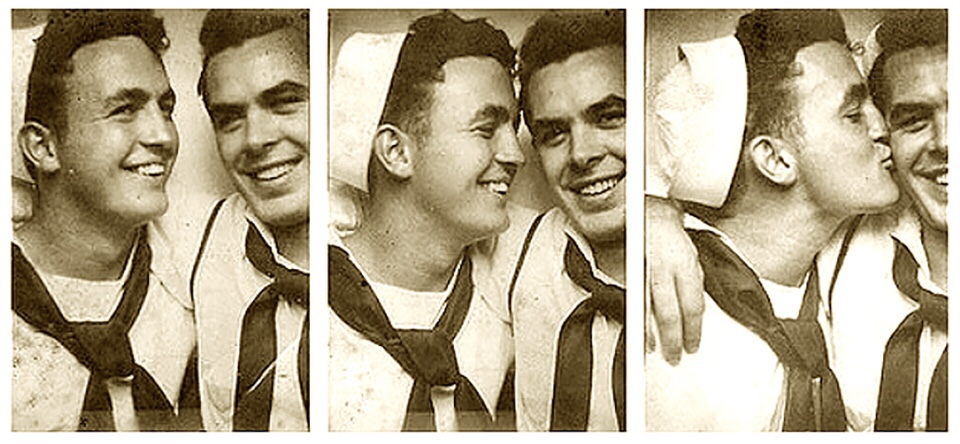
Two unknown American sailors in a photo booth. Image courtesy of Friends of the National WWII Memorial.
The Fateful Day By Fremont “Cap” Sawade
‘Twas the day before that fateful day, December Sixth I think they say. When leave trucks passed Pearl Harbor clear The service men perched in the rear. No thought gave they, of things to come. For them, that day, all work was done. In waters quiet of Pearl Harbor Bay, The ships serene, at anchor lay.
Nor did we give the slightest thought Of treacherous deeds by the yellow lot. Those men whose very acts of treason, Are done with neither rhyme nor reason. For if we knew what was in store We ne’re would leave that day before. For fun and drink to forget the war Of Britain, Europe, and Singapore.
For all of us there was no fear This time of peace and Christmas cheer. Forget the axiom, might is right, Guardians of Peace, were we that night. We passed the sailors in cabs galore, Those men in white who came ashore. But some will ne’re be seen again, In care-free fun, those sailor men.
The Sabbath Day dawned bright and clear, A brand of fire ore the lofty spear, Of Diamond Head, Hawaii’s own. A picture itself that can’t be shown, Unless observed with naked eye, That makes one look, and stop, and sigh. What more could lowly humans ask To start upon their daily task.
The men asleep in barracks late, Knew no war, that morn at eight. The planes on fields, their motors cold, Like sheep asleep among the fold. The ships at anchor with turbines stilled, Their crews below in hammocks filled. And faint, as tho it were a dream, A sound steels on upon this scene.
A drone of many red tipped things, The Rising Sun upon their wings. Those who saw would not believe, And those that heard could not conceive. A single shocking, thundering roar, Followed by another and many more. To rob the sleep from weary eyes, Or close forever those that died.
A hot machine gun’s chattering rattle, Mowed men down like herds of cattle. A bomb destroys an air plane hangar, The planes within will fly no more. Bombs explode upon a ship, Blasting men into the deep, To sink without the slightest thought Of what brought on this hell they caught.
What seems like years, the horrible remains, Blasting men and ships and planes. And just as quick as they had come, Away they went, their foul deeds done. To leave the burning wreckage here, The scorching hulks of dead ships there. And blasted forms of dying men, Alive in hell, to die again.
At night the skies were all but clear, The rosy glow of a white hot bier, Showed on clouds the havoc wrought, And greedy flames the men still fought. But from the ruins arose this cry, That night from those who did not die, “Beware Japan we’ll take eleven, For every death of December Seven.”
And from that day there has arisen, A cry for vengeance, in storms they’re driven. This fateful day among the ages, Shall stand out red in Hist’rys pages. Those men whom homefolk held so dear, Will be avenged, have no fear. And if their lives they gave in vain, Pray, I too, may not remain.
About the Poet and the Poem
Fremont “Cap” Sawade, who passed away at age 94 in 2016, wrote this the poem right after Pearl Harbor. Sawade was assigned to an Army anti-aircraft regiment in Honolulu on liberty, having breakfast the morning of the attack on Pearl Harbor eighty years ago today. Loud explosions sent him racing to his base in a cab. He could see the Japanese planes flying low, dropping bombs, and strafing battleships with machine gun fire. Back at Camp Malakole, Sawade ducked for cover when the Japanese Zeros strafed it. The attack caught the Americans completely off guard. Sawade said his unit didn’t even have ammunition for their big guns.
Two days later, with the wreckage of the Pacific Fleet still smoking, he sat at a desk at Hickam Field and started writing a poem. He’d never written one before. He hasn’t written one since. But over the next week, this one flowed out of him. He called it “The Fateful Day.” It captures how idyllic life was, before the attack. How lucky the service members felt to wake up every day with a view of Diamond Head. The poem captures their surprise, and then their anger at the Japanese, including a slur that was common then, offensive now. It captures the horror — “A hot machine gun’s chattering rattle/Mowed men down like herds of cattle” — and the raw thirst for vengeance.
He came home from the war to his native San Diego, worked a variety of jobs, including 10 years as a building inspector for the city of El Cajon. He got married, raised a family, and lived in Rancho Bernardo with his wife, Gloria. Over the years, he showed the poem to a few friends. He shared it a time or two in military newsletters. But the truth is he never thought it was anything special. However, today, nearly 80 years after he wrote it, it serves as a primary source for the thoughts of the men who lived through the attack on Pearl Harbor that fateful Sunday morning.
My heart is like a singing bird Whose nest is in a water’d shoot; My heart is like an apple-tree Whose boughs are bent with thick-set fruit; My heart is like a rainbow shell That paddles in a halcyon sea; My heart is gladder than all these, Because my love is come to me.
Raise me a daïs of silk and down; Hang it with vair and purple dyes; Carve it in doves and pomegranates, And peacocks with a hundred eyes; Work it in gold and silver grapes, In leaves and silver fleurs-de-lys; Because the birthday of my life Is come, my love is come to me.
Today is my 44th birthday. I took today off work, so I doubt I’ll be spending it with anyone. I am going to Burlington to have lunch with a friend of mine, and I might even take myself to dinner tonight and enjoy a lovely meal. Other than that, it’s really just another day. My mother will probably call, and my sister and her two kids will call to wish me happy birthday. That’s about it. Today’s poem is dedicated to it being my birthday.
About the Poem
Love poetry is a common theme in English literature, but there are a few truly great poems about being in love (and being happy). “A Birthday” is an example of a poem which celebrates being in love using colorful and majestic imagery. It is written by one of the Victorian era’s greatest poets. The poet is not celebrating her own birthday but celebrating the birthday of her lover.
Let us be thankful—not only because Since last our universal thanks were told We have grown greater in the world’s applause, And fortune’s newer smiles surpass the old—
But thankful for all things that come as alms From out the open hand of Providence:— The winter clouds and storms—the summer calms— The sleepless dread—the drowse of indolence.
Let us be thankful—thankful for the prayers Whose gracious answers were long, long delayed, That they might fall upon us unawares, And bless us, as in greater need we prayed.
Let us be thankful for the loyal hand That love held out in welcome to our own, When love and only love could understand The need of touches we had never known.
Let us be thankful for the longing eyes That gave their secret to us as they wept, Yet in return found, with a sweet surprise, Love’s touch upon their lids, and, smiling, slept.
And let us, too, be thankful that the tears Of sorrow have not all been drained away, That through them still, for all the coming years, We may look on the dead face of To-day.
About the Poet
James Whitcomb Riley was born in Greenfield, Indiana, on October 7, 1849. He left school at age sixteen and served in a variety of different jobs, including as a sign painter and with a traveling wagon show. He was the author of several books of poetry, including Home-Folks (Bowen-Merrill, 1900), The Flying Islands of the Night (Bowen-Merrill, 1892), and Pipes o’ Pan at Zekesbury (Bobbs-Merrill, 1888). He also served on the staff of two local newspapers, the Anderson Democrat and, later, the Indianapolis Journal. Riley was known as “the poet of the common people” for his frequent use of his local Indiana dialect in his work. He died in Indianapolis, Indiana, on July 22, 1916.
Before we get to the poem, I wanted to update you on the job search outcome. My boss did take my suggestion and hire the candidate I had advocated for during the process. Now onto the poem.
Homosexuality By Frank O’Hara
So we are taking off our masks, are we, and keeping our mouths shut? as if we’d been pierced by a glance!
The song of an old cow is not more full of judgment than the vapors which escape one’s soul when one is sick;
so I pull the shadows around me like a puff and crinkle my eyes as if at the most exquisite moment
of a very long opera, and then we are off! without reproach and without hope that our delicate feet
will touch the earth again, let alone “very soon.” It is the law of my own voice I shall investigate.
I start like ice, my finger to my ear, my ear to my heart, that proud cur at the garbage can
in the rain. It’s wonderful to admire oneself with complete candor, tallying up the merits of each
of the latrines. 14th Street is drunken and credulous, 53 rd tries to tremble but is too at rest. The good
love a park and the inept a railway station, and there are the divine ones who drag themselves up
and down the lengthening shadow of an Abyssinian head in the dust, trailing their long elegant heels of hot air
crying to confuse the brave “It’s a summer day, and I want to be wanted more than anything else in the world.”
About the Poet
On March 27, 1926, Frank (Francis Russell) O’Hara was born in Maryland. He grew up in Massachusetts, and later studied piano at the New England Conservatory in Boston from 1941 to 1944. O’Hara then served in the South Pacific and Japan as a sonarman on the destroyer USS Nicholas during World War II.
Following the war, O’Hara studied at Harvard College, where he majored in music and worked on compositions and was deeply influenced by contemporary music, his first love, as well as visual art. He also wrote poetry at that time. While at Harvard, O’Hara met John Ashbery and soon began publishing poems in the Harvard Advocate. Despite his love for music, O’Hara changed his major and left Harvard in 1950 with a degree in English. He then attended graduate school at the University of Michigan, Ann Arbor, and received his MA in 1951. That autumn, O’Hara moved into an apartment in New York. He was soon employed at the front desk of the Museum of Modern Art and continued to write seriously.
O’Hara’s early work was considered both provocative and provoking. In 1952, his first volume of poetry, A City Winter, and Other Poems, attracted favorable attention; his essays on painting and sculpture and his reviews for ArtNews were considered brilliant. O’Hara became one of the most distinguished members of the New York School of poets, which also included Ashbery. O’Hara’s association with painters Larry Rivers, Jackson Pollock, and Jasper Johns, also leaders of the New York School, became a source of inspiration for his highly original poetry. He attempted to produce with words the effects these artists had created on canvas. In certain instances, he collaborated with the painters to make “poem-paintings,” paintings with word texts.
O’Hara’s most original volumes of verse, Meditations in an Emergency (1956) and Lunch Poems (1964), are impromptu lyrics, a jumble of witty talk, journalistic parodies, and surrealist imagery.
O’Hara continued working at the Museum of Modern Art throughout his life, curating exhibitions and writing introductions and catalogs for exhibits and tours. On July 25, 1966, while vacationing on Fire Island, Frank O’Hara was killed in a sand buggy accident. He was forty years old.













 Joe
Joe





 The Closet Professor