Category Archives: Poetry

Between the Dragon and the Phoenix

Between the Dragon and the Phoenix
By C. Dale Young – 1969-

Fire in the heart, fire in the sky, the sun just
a smallish smudge resting on the horizon
out beyond the reef that breaks the waves,

fiery sun that waits for no one. I was little more
than a child when my father explained
that the mongrel is stronger than the thoroughbred,

that I was splendidly blended, genetically engineered
for survival. I somehow forgot this, misplaced this,
time eroding my memory as it erodes everything.

But go ask someone else to write a poem about Time.
Out over the bay, the sun is rising, and I am running
out of time. Each and every year, on my birthday,

I wake to watch the sunrise. I am superstitious.
And today, as in years past, it is not my father
but my father’s father who comes to shout at me:

Whether you like it or not, you are a child of fire. You
descend from the Dragon, descend from the Phoenix.
Your blood is older than England, older than Castille.

Year after year, he says the same thing, this old man
dead long before I was born. So, I wake each year
on the day of my birth to watch the fire enter the sky

while being chastised by my dead grandfather.
Despite being a creature of fire, I stay near the water.
Why even try to avoid what can extinguish me?

There are times I can feel the fire flickering inside my frame.
The gulls are quarreling, the palm trees shimmering—
the world keeps spinning on its axis. Some say I have

nine lives. Others think me a machine. Neither is true.
The truth is rarely so conventional. Fire in my heart, fire
in my veins, I write this down for you and watch

as it goes up in flames. There are no paragraphs
wide enough to contain this fire, no stanzas
durable enough to house it. Blood of the Dragon,

blood of the Phoenix, I turn my head slowly
toward the East. I bow and call for another year.
I stand there and demand one more year.


About This Poem

“Can the dead visit you? Can a grandfather who died before you were even born come to you? Every year on my birthday, I get up to watch the sunrise. And every year, I feel quite clearly my father’s father is there with me.”—C. Dale Young


Why I Chose This Poem

I chose this poem because I was looking at poems for LGBTQ+ Pride Month on the Academy of American Poets website, and the title of this poem, “Between the Dragon and the Phoenix,” caught my eye. I have a tattoo on my left arm of a dragon and a phoenix. The tattoo is very meaningful for me because it represents a friend of mine who died last year. He had been a friend of mine from about the time I started blogging. He had helped me through some difficult times, and I will forever be grateful for his friendship. In the last few years of his life, he had suffered some major health problems, and he was not able to recover from them.

He lived in Hawaii but was of Chinese descent. We rarely exchanged Christmas gifts, but we always sent each other something for Chinese New Year and for birthdays. One year, I sent him a drawing of a dragon and phoenix in the classic Yin and Yang position. I had an artist friend of mine draw it and I had it framed and sent to him. When his mother saw it, she became very excited as it was nearly the exact same design as had been on her wedding dress many years earlier. Because he cherished that piece of art and displayed it prominently in his house, I had a similar design tattooed on my arm to always remind me of him and his generosity.

Like in the grandfather in “Between the Dragon and the Phoenix,” I feel that my friend is with me always.

My Tattoo


About The Poet

C. Dale Young was born in 1969 and grew up in the Caribbean and South Florida. He received a Bachelor of Science in molecular biology and English at Boston College in 1991 and went on to earn an MFA in English and creative writing and a doctoral degree in medicine, both from the University of Florida.

Young is the author of five poetry collections: Prometeo, (Four Way Books, 2021); The Affliction: A Novel in Stories (Four Way Books, 2018); The Halo (Four Way Books, 2016); Torn (Four Way Books, 2011); The Second Person (Four Way Books, 2007); The Day Underneath the Day (Northwestern University Press, 2001).

In his review of Torn, Mark Doty writes, “C. Dale Young’s poems employ sly forms of repetition, touching back to phrases we’ve already encountered as if to guide us along the poem’s winding way. How important—and how fierce—these directions turn out to be as his poems push into their deepest territory: the burden of expectation and guilt, the fiercely pressurized experience that an education in the ‘healing arts’ becomes. … [Young] brings all his strength to bear on the necessary work of art, which is also a means of tending and of stitching, a craft that by its very artfulness implies the possibility of hope.”

Young’s honors include the Grolier Prize and the Tennessee Williams Scholarship in Poetry from the Sewanee Writers’ Conference, as well as fellowships from the Bread Loaf Writers’ Conference, the National Endowment for the Arts, the Guggenheim Foundation, and the Rockefeller Foundation. The former poetry editor of the New England Review (1995–2014), Young currently practices medicine full-time and teaches in the Warren Wilson College MFA Program for Writers. He lives in San Francisco.

🏳️‍🌈 LGBT POETS FOR PRIDE MONTH 🏳️‍🌈


LGBTQ+ Poetry Classics

Love the Light-Giver
By Michelangelo Buonarroti (1475-1564)

To Tommaso De’ Cavalieri

Veggio co’ bei vostri occhi.

With your fair eyes a charming light I see,
 For which my own blind eyes would peer in vain;
 Stayed by your feet, the burden I sustain
 Which my lame feet find all too strong for me;
Wingless upon your pinions forth I fly;
 Heavenward your spirit stirreth me to strain;
 E’en as you will, I blush and blanch again,
 Freeze in the sun, burn ‘neath a frosty sky.
Your will includes and is the lord of mine;
 Life to my thoughts within your heart is given;
 My words begin to breathe upon your breath:
Like to the moon am I, that cannot shine
 Alone; for lo! our eyes see nought in heaven
 Save what the living sun illumineth.


Love Returned
By Bayard Taylor (1825-1878)

He was a boy when first we met;
 His eyes were mixed of dew and fire,
And on his candid brow was set
 The sweetness of a chaste desire:
But in his veins the pulses beat
 Of passion, waiting for its wing,
As ardent veins of summer heat
 Throb through the innocence of spring.

As manhood came, his stature grew,
 And fiercer burned his restless eyes,
Until I trembled, as he drew
 From wedded hearts their young disguise.
Like wind-fed flame his ardor rose,
 And brought, like flame, a stormy rain:
In tumult, sweeter than repose,
 He tossed the souls of joy and pain.

So many years of absence change!
 I knew him not when he returned:
His step was slow, his brow was strange,
 His quiet eye no longer burned.
When at my heart I heard his knock,
 No voice within his right confessed:
I could not venture to unlock
 Its chambers to an alien guest.

Then, at the threshold, spent and worn
 With fruitless travel, down he lay:
And I beheld the gleams of morn
 On his reviving beauty play.
I knelt, and kissed his holy lips,
 I washed his feet with pious care;
And from my life the long eclipse
 Drew off; and left his sunshine there.

He burns no more with youthful fire;
 He melts no more in foolish tears;
Serene and sweet, his eyes inspire
 The steady faith of balanced years.
His folded wings no longer thrill,
 But in some peaceful flight of prayer:
He nestles in my heart so still,
 I scarcely feel his presence there.

O Love, that stern probation o’er,
 Thy calmer blessing is secure!
Thy beauteous feet shall stray no more,
 Thy peace and patience shall endure!
The lightest wind deflowers the rose,
 The rainbow with the sun departs,
But thou art centred in repose,
 And rooted in my heart of hearts!


A Shropshire Lad, XXXVI
By A. E. Housman (1859-1936)

White in the moon the long road lies,
 The moon stands blank above;
White in the moon the long road lies
 That leads me from my love.

Still hangs the hedge without a gust,
 Still, still the shadows stay:
My feet upon the moonlit dust
 Pursue the ceaseless way.

The world is round, so travellers tell,
 And straight though reach the track,
Trudge on, trudge on, ’twill all be well,
 The way will guide one back.

But ere the circle homeward hies
 Far, far must it remove:
White in the moon the long road lies
 That leads me from my love.


Undressing You
By Witter Bynner (1881-1968)

Fiercely I remove from you
All the little vestiges—
Garments that confine you,
Things that touch the flesh,
The wool and the silk
And the linen that entwine you,
Tear them all away from you,
Bare you from the mesh.
And now I have you as you are,
Nothing to encumber you—
But now I see, caressing you,
Colder hands than mine.
They take away your flesh and bone,
And, utterly undressing you,
They tear you from your beauty
And they leave no sign.


The More Loving One
By W. H. Auden (1907-1973)

Looking up at the stars, I know quite well
That, for all they care, I can go to hell,
But on earth indifference is the least
We have to dread from man or beast.

How should we like it were stars to burn
With a passion for us we could not return?
If equal affection cannot be,
Let the more loving one be me.

Admirer as I think I am
Of stars that do not give a damn,
I cannot, now I see them, say
I missed one terribly all day.

Were all stars to disappear or die,
I should learn to look at an empty sky
And feel its total dark sublime,
Though this might take me a little time.


And for the “L” in LGBTQ+:

[In my eyes he matches the gods]
By Sappho (c. 630-c. 570 BCE)

In my eyes he matches the gods, that man who
sits there facing you–any man whatever–
listening from closeby to the sweetness of your
  voice as you talk, the

sweetness of your laughter: yes, that–I swear it–
sets the heart to shaking inside my breast, since
once I look at you for a moment, I can’t
  speak any longer,

but my tongue breaks down, and then all at once a
subtle fire races inside my skin, my
eyes can’t see a thing and a whirring whistle
  thrums at my hearing,

cold sweat covers me and a trembling takes
ahold of me all over: I’m greener than the
grass is and appear to myself to be little
  short of dying.

But all must be endured, since even a poor


About the Poets

Michelangelo di Lodovico Buonarroti Simoni, known simply as Michelangelo, was an Italian sculptor, painter, architect and poet of the High Renaissance born in the Republic of Florence.

Bayard Taylor was an American poet, literary critic, translator, travel author, and diplomat. Though he wanted to be known most as a poet, Taylor was mostly recognized as a travel writer during his lifetime. Modern critics have generally accepted him as technically skilled in verse, but lacking imagination and, ultimately, consider his work as a conventional example of 19th-century sentimentalism.

Alfred Edward Housman, usually known as A. E. Housman, was an English classical scholar and poet. His cycle of poems, A Shropshire Lad, wistfully evoke the dooms and disappointments of youth in the English countryside.

Harold Witter Bynner, also known by the pen name Emanuel Morgan, was an American poet and translator. He was known for his long residence in Santa Fe, New Mexico, and association with other literary figures there.

Wystan Hugh Auden, usually known as W.H. Auden, was an Anglo-American poet. Auden’s poetry was noted for its stylistic and technical achievement, its engagement with politics, morals, love, and religion, and its variety in tone, form, and content. 

Sappho was an Ancient Greek poet from the island of Lesbos. Sappho is known for her lyric poetry, written to be sung while accompanied by a lyre. In ancient times, Sappho was widely regarded as one of the greatest lyric poets and was given names such as the “Tenth Muse” and “The Poetess”. Most of Sappho’s poetry is now lost, and what is extant has mostly survived in fragmentary form.

🏳️‍🌈 LGBT POETS FOR PRIDE MONTH 🏳️‍🌈


Poems by Joseph O. Legaspi

Whom You Love
By Joseph O. Legaspi

  ”Tell me whom you love, and I’ll tell you who you are.” – Creole Proverb

The man whose throat blossoms with spicy chocolates
Tempers my ways of flurrying
Is my inner recesses surfacing
Paints the bedroom blue because he wants to carry me to the skies
Pear eater in the orchard
Possesses Whitmanesque urge & urgency
Boo Bear, the room turns orchestral
Crooked grin of ice cream persuasion
When I speak he bursts into seeds & religion
Poetry housed in a harmonica
Line dances with his awkward flair
Rare steaks, onion rings, Maker’s on the rocks
Once-a-boy pilfering grenadine
Nebraska, Nebraska, Nebraska
Wicked at the door of happiness
At a longed-for distance remains sharply crystalline
Fragments, but by day’s end assembled into joint narrative
Does not make me who I am, entirely
Heart like a fig, sliced
Peonies in a clear round vase, singing
A wisp, a gasp, sonorous stutter
Tuning fork deep in my belly, which is also a bell
Evening where there is no church but fire
Sparks, particles, chrysalis into memory
Moth, pod of enormous pleasure, fluttering about on a train
He knows I don’t need saving & rescues me anyhow
Our often-misunderstood kind of love is dangerous
Darling, fill my cup; the bird has come to roost

[ a subway ride ]
By Joseph O. Legaspi

His artfully unkempt strawberry blonde head sports outsized headphones. Like a contemporary bust. Behold the innocence of the freckles, ripe pout of cherry lips. As if the mere sight of the world hurts him, he squints greenly and applies saline drops. You dream him crying over you. For the duration of a subway ride you fall blindly in love. Until he exits. Or you exit, returning home to the one you truly love to ravish him.

V-Neck T-Shirt Sonnet
By Joseph O. Legaspi

I love a white v-neck t-shirt
on you: two cotton strips racing
to a point they both arrived at: there
vigor barely contained, flaming hair,
collarless, fenced-in skin that shines.
Cool drop of hem, soft & lived-in,
so unlike my father, to bed you go,
flushed with fur in a rabbit’s burrow
or nest for a flightless bird, brooding.
Let me be that endangered species,
huddled in the vessel of the inverted
triangle: gaped mouth of a great white
fish on the verge of striking, poised
to devour & feed on skin, on all.

Vows (for a gay wedding)
By Joseph O. Legaspi

What was unforeseen is now a bird orbiting this field.

What wasn’t a possibility is present in our arms.

It shall be and it begins with you.

Our often-misunderstood kind of love deems dangerous.
How it frightens and confounds and enrages.
How strange, unfamiliar.

Our love carries all those and the contrary.
It is most incandescent.

So, I vow to be brave.
Clear a path through jungles of shame and doubt and fear.
I’m done with silence. I proclaim.

It shall be and it sings from within.

Truly we are enraptured
With Whitmanesque urge and urgency.

I vow to love in all seasons.
When you’re summer, I’m watermelon balled up in a sky-blue bowl.
When I’m autumn, you’re foliage ablaze in New England.
When in winter, I am the tender scarf of warm mercies.
When in spring, you are the bourgeoning buds.

I vow to love you in all places.
High plains, prairies, hills and lowlands.
In our dream-laden bed,
Cradled in the nest
Of your neck.
Deep in the plum.

It shall be and it flows with you.

We’ll leap over the waters and barbaric rooftops.

You embrace my resilient metropolis.
I adore your nourishing wilderness.

I vow to love you in primal ways.
I vow to love you in infinite forms.

In our separateness and composites.
To dust and stars and the ever after.

Intrepid travelers, lovers, and family
We have arrived.

Look. The bird has come home to roost.

About the Poet

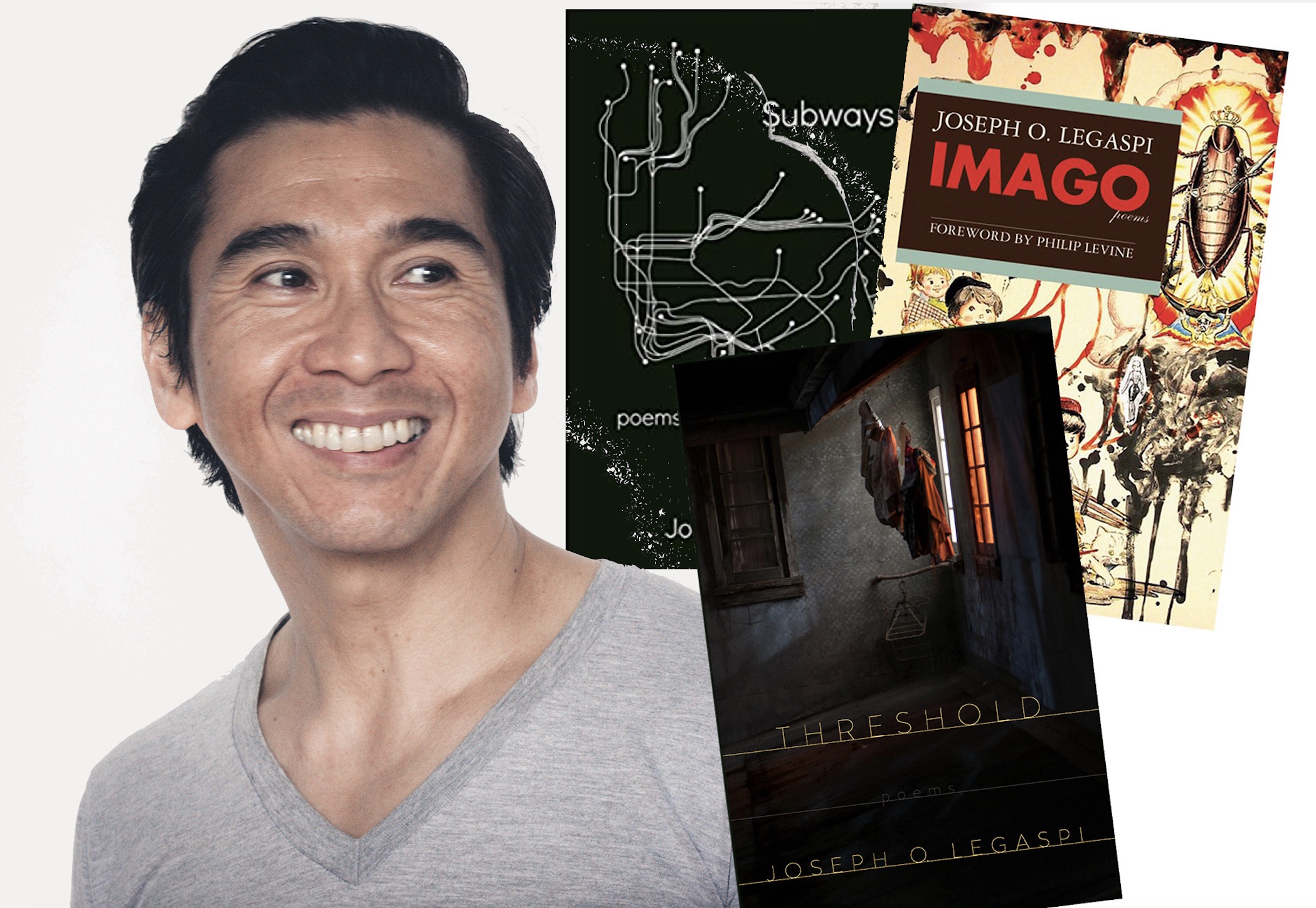
Joseph O. Legaspi was born in the Philippines, where he lived before immigrating to Los Angeles with his family at age twelve. He received a BA from Loyola Marymount University and an MFA from New York University’s Creative Writing Program. Legaspi is the author of the collection Subway (CreateSpace, 2013), Threshold (CavanKerry Press, 2017), and Imago (CavanKerry Press, 2007), winner of a Global Filipino Literary Award. He is the recipient of two poetry fellowships from the New York Foundation for the Arts, and in 2004 he cofounded Kundiman, a nonprofit organization serving Asian American poetry. He works at Columbia University, teaches at New York University and Fordham University, and lives with his husband in Queens, New York.


🏳️‍🌈 LGBT POETS FOR PRIDE MONTH 🏳️‍🌈


i love you to the moon &

i love you to the moon &
by Chen Chen

not back, let’s not come back, let’s go by the speed of
queer zest & stay up
there & get ourselves a little
moon cottage (so pretty), then start a moon garden

with lots of moon veggies (so healthy), i mean
i was already moonlighting
as an online moonologist
most weekends, so this is the immensely

logical next step, are you
packing your bags yet, don’t forget your
sailor moon jean jacket, let’s wear
our sailor moon jean jackets while twirling in that lighter,

queerer moon gravity, let’s love each other
(so good) on the moon, let’s love
the moon
on the moon

About the Poem

“I love the moon. I love love. And I’m always thinking about these idiomatic expressions which become cliched over time, but when you really think about them, they’re mysterious—enigmatic expressions. I wanted to give back to this piece of language some of its giddy mystery. To say ‘I love you’ is at once everyday and extraordinary, like the glorious fact of the moon.”—Chen Chen

About the Poet

Chen Chen’s second book of poetry, Your Emergency Contact Has Experienced an Emergency, is forthcoming from BOA Editions in Sept. 2022. His debut, When I Grow Up I Want to Be a List of Further Possibilities (BOA Editions, 2017), was longlisted for the National Book Award and won the Thom Gunn Award for Gay Poetry, among other honors. Upon receiving the Thom Gunn Award, he said, “”I am honored and astounded to receive this award for a book that I wrote really because I needed it—poems that refuse to separate sexuality and race, that are political and restless and just, a whole lot of gaysian feelings. I did not anticipate such a beautiful response from readers and it’s the greatest gift, seeing how LGBTQ readers in particular have responded. To be recognized specifically by an award named after one of the most visionary gay poets—I am deeply moved.”

Chen is also the author of four chapbooks and the forthcoming book of essays, In Cahoots with the Rabbit God (Noemi Press, 2023). His work appears/is forthcoming in many publications, including Poem-a-Day and three editions of The Best American Poetry (2015, 2019, & 2021). He has received a Pushcart Prize and fellowships from Kundiman and the National Endowment for the Arts. He teaches at Brandeis University as the Jacob Ziskind Poet-in-Residence and serves on the poetry faculty for the low-residency MFA programs at New England College and Stonecoast. With a brilliant team, he edits the journal, Underblong.

Chen Chen was born in Xiamen, China, and grew up in Massachusetts. He lives in Waltham, MA with his partner, Jeff Gilbert and their pug, Mr. Rupert Giles.

🏳️‍🌈 LGBT POETS FOR PRIDE MONTH 🏳️‍🌈


Clair de lune

Clair de lune (English “Moonlight”)
By Paul Verlaine

Votre âme est un paysage choisi
Que vont charmant masques et bergamasques
Jouant du luth et dansant et quasi
Tristes sous leurs déguisements fantasques.

Tout en chantant sur le mode mineur
L’amour vainqueur et la vie opportune
Ils n’ont pas l’air de croire à leur bonheur
Et leur chanson se mêle au clair de lune,

Au calme clair de lune triste et beau,
Qui fait rêver les oiseaux dans les arbres
Et sangloter d’extase les jets d’eau,
Les grands jets d’eau sveltes parmi les marbres.

 _________________

(English Translation)

Your soul is a chosen landscape
Where charming masquerades and dancers are promenading,
Playing the lute and dancing, and almost
Sad beneath their fantastic disguises.

While singing in a minor key
Of victorious love, and the pleasant life
They seem not to believe in their own happiness
And their song blends with the light of the moon,

With the sad and beautiful light of the moon,
Which sets the birds in the trees dreaming,
And makes the fountains sob with ecstasy,
The slender water streams among the marble statues.

 _________________

“Clair de lune” (English “Moonlight”) is a poem written by French poet Paul Verlaine in 1869. It is the inspiration for the third and most famous movement of Claude Debussy’s 1890 Suite bergamasque. Debussy also made two settings of the poem for voice and piano accompaniment. The poem has also been set to music by Gabriel Fauré, Louis Vierne and Josef Szulc.

Paul-Marie Verlaine (30 March 1844 – 8 January 1896) was a French poet associated with the Symbolist movement and the Decadent movement. He is considered one of the greatest representatives of the fin de siècle (“end of century”) in international and French poetry.

Paul Verlaine was born in a town called Metz in northeastern France in 1844. He received his formal education from what is now the Lycee Condorcet and originally found a job in France’s civil service, despite the fact that he had been writing poetry from an early age; he published his first poem before his twentieth birthday.

Poet Charles Marie Rene Leconte de Lisle, who led the Parnassian movement, heavily influenced Verlaine in the beginning. The Parnassian movement was a style of poetry which utilized emotional detachment and a strict adherence to form. Verlaine was also influenced by the many people he socialized with, most of whom made up the intellectual and artistic elite of the day.

His first book of poetry, Poemes saturniens, was published in 1866. Four years later, Verlaine’s life underwent massive changes; he got married to Mathilde Maute de Fleurville and joined the French equivalent of the National Guard, though he later became a supporter of the Paris Commune, a group of anarchists and Marxists that took control of Paris from March to May. When a large number of Commune members (called Communards) were killed and imprisoned after the fall of their government, Verlaine escaped to Pas-de-Calais, returning in 1871.

In 1872, Verlaine began his first homosexual affair, though he had probably had homosexual experiences before then. He received a letter from the younger poet Arthur Rimbaud, and Verlaine’s reply was, “Come, dear great soul. We await you; we desire you.” Though Verlaine’s wife was pregnant at the time, Rimbaud came to stay with the older poet and his seventeen-year-old wife. Later that year, Verlaine and Rimbaud lived together in London, having abandoned Mathilde. Both poets frequently drank absinthe and used hashish, living in poverty and making a living by teaching and getting an allowance from Verlaine’s mother. The relationship grew very strained, and Verlaine shot his lover in the wrist during an alcoholic furor just days after the pair had split and subsequently reunited in Brussels.

Rimbaud originally refused to press charges, but Verlaine’s increasingly violent and odd behavior forced the younger man to seek protection. A judge sentenced Verlaine to two years in prison following testimony from Mathilde. Not even a last-second change of heart from Rimbaud could save Verlaine; the Symbolist poet spent two years in prison in the Belgian city of Mons. While there, Verlaine converted to Roman Catholicism, which spurred him to write further poems. Rimbaud mocked Verlaine’s conversion to Catholicism. Verlaine also managed to release another collection of poems while imprisoned, Romances sans paroles. Upon his release, Verlaine worked as a teacher in various cities in England. He returned once more to France to teach and fell in love with one of his students, Lucien Letinois. When Letinois died of typhus in the 1880’s, Verlaine was devastated and spiraled into drug and alcohol abuse.

Verlaine spent the rest of his days drinking absinthe in Parisian cafes and using drugs, though by this time the public’s love of his work allowed him to draw an income. His peers even voted to bestow the title “France’s Prince of Poets” upon Verlaine in 1894. two years later, Verlaine died from drugs and alcohol on 8 January 1896. He was 51. He was buried in the Cimetière des Batignolles.

Verlaine’s poetry was admired and recognized as ground-breaking and served as a source of inspiration to composers. Gabriel Fauré composed many mélodies, such as the song cycles Cinq mélodies “de Venise” and La bonne chanson, which were settings of Verlaine’s poems. As mentioned above, Claude Debussy set to music Clair de lune and six of the Fêtes galantes poems, forming part of the mélodie collection known as the Recueil Vasnier; he also made another setting ofClair de lune, and the poem inspired his Suite bergamasque. Reynaldo Hahn set several of Verlaine’s poems as did the Belgian-British composer Poldowski.Verlaine’s work was characterized by lurid content and common themes including sex, urban life, and fatality. He often used repeated sounds to evoke certain moods and emotions. Verlaine’s poem “Chanson d’Automne” was used during World War II by the BBC to signal to the French resistance that Operation Overlord was to begin. The 1995 film Total Eclipse was based on Verlaine’s relationship with Rimbaud; David Thewlis and Leonardo DiCaprio played Verlaine and Rimbaud, respectively.

This video of Clair de Lune contains moonlight paintings by the Victorian painter John Atkinson Grimshaw. In this recording, Stanley Black conducts his arrangement of Clair de Lune with the London Symphony. 


The Mountain

The Mountain
By Laura Ding-Edwards

If the mountain seems too big today
then climb a hill instead
if the morning brings you sadness
it’s okay to stay in bed

If the day ahead weighs heavy
and your plans, feel like a curse
there’s no shame in rearranging
don’t make yourself feel worse

If a shower stings like needles
and a bath feels like you’ll drown
if you haven’t washed your hair for days
don’t throw away your crown

A day is not a lifetime
a rest is not defeat
don’t think of it as failure
just a quiet kind retreat

It’s okay to take a moment
from an anxious, fractured mind
the world will not stop turning
while you get realigned

The mountain will still be there
when you want to try again
you climb it in your own time
just love yourself til then

About the Author

Laura Ding-Edwards is an artist and writer from Herefordshire, UK. She started her business, Rainbird Roots, in 2016 and quickly went from painting as a hobby to full-time artist, commissioning pet portraits, unique wildlife artwork & typography pieces. The Rainbird Roots brand name comes from her mother’s beautiful maiden name of “Rainbird”. You can see Laura’s artwork by visiting RainbirdRoots.com. Her first poem, “The Mountain,” was written in a car back in January 2019 and details her experiences of living with anxiety. It rapidly gained momentum on social media, having had millions of views and shares across the world. From this, more poems were written and eventually The Mountain book was born. 

Ding-Edwards’ book The Mountain tackles mental health, relationships, bullying, body image, hate, love, and everything in between. In her first collection of poetry and prose, she focusses on the importance of being human, in its rawest, purest forms. The book doesn’t have the answers to our most intricate complexities, but it does reassure you that you are only human, after all.


A Slow Death

A Slow Death
By Martha Medeiros

You start dying slowly
if you do not travel,
if you do not read,
If you do not listen to the sounds of life,
If you do not appreciate yourself.

You start dying slowly
When you kill your self-esteem,
When you do not let others help you.

You start dying slowly
If you become a slave of your habits, walking everyday on the same paths…
If you do not change your routine,
If you do not wear different colours,
If you do not speak to those you don’t know.

You start dying slowly
If you avoid to feel passion, and their turbulent emotions;
Those which make your eyes glisten,
And your heart beat fast.

You start dying slowly
If you do not change your life when you are not satisfied with your job, or with your love,
If you do not risk what is safe for the uncertain,
If you do not go after a dream,
If you do not allow yourself,
At least once in your lifetime,
To run away from sensible advice.

My friend Susan sent me this poem. It is called “A Slow Death” (“A Morte Devagar” 2000) and has been erroneously attributed to Pablo Neruda for some time on the Internet. A similar poem, “Muere Lentamente” (Dying Slowly), has also been mistakenly attributed to Pablo Neruda. The Pablo Neruda Foundation has confirmed that the Chilean poet never wrote it.

“Muere Lentamente” and “A Morte Devagar” are the works of Brazilian writer Martha Medeiros, author of numerous books and reporter for the Porto Alegre newspaper Zero Hora. Tired of people believing that Neruda wrote the poems, she got in touch with the Neruda Foundation to establish her own authorship, giving as evidence how largely the verses coincide with her work in Portuguese “A Morte Devagar” (To Death Slowly), published in the year 2000 on All Souls Day eve.

Born in Porto Alegre in 1961, Medeiros graduated from the Pontifical Catholic University of Rio Grande do Sul (PUCRS) in Porto Alegre in 1982 and became a journalist for the newspaper Zero Hora of Porto Alegre and O Globo of Rio de Janeiro. She moved for nine months in Chile, and she began to write poems. Coming back to Porto Alegre, she began writing as a journalist also continuing her literary way.

Medeiros has no idea how “Muere Lentamente” and “A Morte Devagar” began circulating on the Internet, although she’s said it does not surprise her since many of her verses are on the Web “as if they were by other authors. Unfortunately, nothing can be done about it,” she said. The 47-year-old Brazilian poet and novelist deeply admires Neruda and says she is a fan of his poems but prefers that “everybody’s work be recognized.” She loses no sleep over such matters, however, and said that she has “enough of a sense of humor to laugh at all this.”

There is sadness in “A Slow Death,” but it is thought-provoking and really lovely. 


By the way, I have an essay in a book coming out in publication today. One of the historical organizations I belong to has their triennial conference starting today, andthe book launch is part of the conference. I’ve never had anything published in a book before, so this is very exciting to me.


May

May
By Helen Hunt Jackson

O Month when they who love must love and wed!
Were one to go to worlds where May is naught,
And seek to tell the memories he had brought
From earth of thee, what were most fitly said?
I know not if the rosy showers shed
From apple-boughs, or if the soft green wrought
In fields, or if the robin’s call be fraught
The most with thy delight. Perhaps they read
Thee best who in the ancient time did say
Thou wert the sacred month unto the old:
No blossom blooms upon thy brightest day
  So subtly sweet as memories which unfold
  In aged hearts which in thy sunshine lie,
  To sun themselves once more before they die.

Helen Hunt Jackson was born in Amherst, Massachusetts, in 1830. She was a classmate of Emily Dickinson, also from Amherst; the two corresponded for the rest of their lives, but few of their letters have survived. She published five collections of poetry during her lifetime and was posthumously inducted into the Colorado Women’s Hall of Fame in 1985, one hundred years after her death.

Helen Hunt Jackson (pen name, H.H.; born Helen Maria Fiske; October 15, 1830 – August 12, 1885) was an American poet and writer who became an activist on behalf of improved treatment of Native Americans by the United States government. She described the adverse effects of government actions in her history A Century of Dishonor (1881). Her novel Ramona (1884) dramatized the federal government’s mistreatment of Native Americans in Southern California after the Mexican–American War and attracted considerable attention to her cause. Commercially popular, it was estimated to have been reprinted 300 times and most readers liked its romantic and picturesque qualities rather than its political content. The novel was so popular that it attracted many tourists to Southern California who wanted to see places from the book.


Fisherman

Fisherman
By Kurt Brown

A man spends his whole life fishing in himself
for something grand. It’s like some lost lunker, big enough
to break all records. But he’s only heard rumors, myths,
vague promises of wonder. He’s only felt the shadow
of something enormous darken his life. Or has he?
Maybe it’s the shadow of other fish, greater than his,
the shadow of other men’s souls passing over him.
Each day he grabs his gear and makes his way
to the ocean. At least he’s sure of that: or is he? Is it the ocean
or the little puddle of his tears? Is this his dinghy
or the frayed boards of his ego, scoured by storm?
He shoves off, feeling the land fall away under his boots.
Soon he’s drifting under clouds, wind whispering blandishments
in his ears. It could be today: the water heaves
and settles like a chest. . . He’s not far out.
It’s all so pleasant, so comforting–the sunlight,
the waves. He’ll go back soon, thinking: “Maybe tonight.”
Night with its concealments, its shadow masking all other shadows.
Night with its privacies, its alluringly distant stars.


Winter to Spring

Winter to Spring
By Irvin W. Underhill

Did not I remember that my hair is grey
  With only a fringe of it left,
I’d follow your footsteps from wee break of day
  Till night was of moon-light bereft.

Your eyes wondrous fountains of joy and of youth
  Remind me of days long since flown,
My sweetheart, I led to the altar of truth,
  But then the gay spring was my own.

Now winter has come with its snow and its wind
  And made me as bare as its trees,
Oh, yes, I still love, but it’s only in mind,
  For I’m fast growing weak at the knees.

Your voice is as sweet as the song of a bird,
  Your manners are those of the fawn,
I dream of you, darling,—oh, pardon, that word,
  From twilight to breaking of dawn.

Your name in this missive you’ll search for in vain,
  Nor mine at the finis, I’ll fling,
For winter must suffer the bliss and the pain
In secret for loving the spring.

Here in Vermont, we are not quite out of winter yet. We are expecting 3-6 inches of snow tomorrow and possibly more snow on Thursday. Spring is coming though.

The Poet
Irvin W. Underhill was born in Port Clinton, Pennsylvania, on May 1, 1868. He is the author of Daddy’s Love and Other Poems (A.M.E. Book Concern, 1916).