O Month when they who love must love and wed! Were one to go to worlds where May is naught, And seek to tell the memories he had brought From earth of thee, what were most fitly said? I know not if the rosy showers shed From apple-boughs, or if the soft green wrought In fields, or if the robin’s call be fraught The most with thy delight. Perhaps they read Thee best who in the ancient time did say Thou wert the sacred month unto the old: No blossom blooms upon thy brightest day So subtly sweet as memories which unfold In aged hearts which in thy sunshine lie, To sun themselves once more before they die.
Helen Hunt Jackson was born in Amherst, Massachusetts, in 1830. She was a classmate of Emily Dickinson, also from Amherst; the two corresponded for the rest of their lives, but few of their letters have survived. She published five collections of poetry during her lifetime and was posthumously inducted into the Colorado Women’s Hall of Fame in 1985, one hundred years after her death.
Helen Hunt Jackson (pen name, H.H.; born Helen Maria Fiske; October 15, 1830 – August 12, 1885) was an American poet and writer who became an activist on behalf of improved treatment of Native Americans by the United States government. She described the adverse effects of government actions in her history A Century of Dishonor (1881). Her novel Ramona (1884) dramatized the federal government’s mistreatment of Native Americans in Southern California after the Mexican–American War and attracted considerable attention to her cause. Commercially popular, it was estimated to have been reprinted 300 times and most readers liked its romantic and picturesque qualities rather than its political content. The novel was so popular that it attracted many tourists to Southern California who wanted to see places from the book.
A man spends his whole life fishing in himself for something grand. It’s like some lost lunker, big enough to break all records. But he’s only heard rumors, myths, vague promises of wonder. He’s only felt the shadow of something enormous darken his life. Or has he? Maybe it’s the shadow of other fish, greater than his, the shadow of other men’s souls passing over him. Each day he grabs his gear and makes his way to the ocean. At least he’s sure of that: or is he? Is it the ocean or the little puddle of his tears? Is this his dinghy or the frayed boards of his ego, scoured by storm? He shoves off, feeling the land fall away under his boots. Soon he’s drifting under clouds, wind whispering blandishments in his ears. It could be today: the water heaves and settles like a chest. . . He’s not far out. It’s all so pleasant, so comforting–the sunlight, the waves. He’ll go back soon, thinking: “Maybe tonight.” Night with its concealments, its shadow masking all other shadows. Night with its privacies, its alluringly distant stars.
Did not I remember that my hair is grey
With only a fringe of it left,
I’d follow your footsteps from wee break of day
Till night was of moon-light bereft.
Your eyes wondrous fountains of joy and of youth
Remind me of days long since flown,
My sweetheart, I led to the altar of truth,
But then the gay spring was my own.
Now winter has come with its snow and its wind
And made me as bare as its trees,
Oh, yes, I still love, but it’s only in mind,
For I’m fast growing weak at the knees.
Your voice is as sweet as the song of a bird,
Your manners are those of the fawn,
I dream of you, darling,—oh, pardon, that word,
From twilight to breaking of dawn.
Your name in this missive you’ll search for in vain,
Nor mine at the finis, I’ll fling,
For winter must suffer the bliss and the pain
In secret for loving the spring.
Here in Vermont, we are not quite out of winter yet. We are expecting 3-6 inches of snow tomorrow and possibly more snow on Thursday. Spring is coming though.
The Poet Irvin W. Underhill was born in Port Clinton, Pennsylvania, on May 1, 1868. He is the author of Daddy’s Love and Other Poems (A.M.E. Book Concern, 1916).
Needless to say I support the forsythia’s war against the dull colored houses, the beagle deciphering the infinitely complicated universe at the bottom of a fence post. I should be gussying up my resume, I should be dusting off my protestant work ethic, not walking around the neighborhood loving the peonies and the lilac bushes, not heading up Shamrock and spotting Lucia coming down the train tracks. Lucia who just sold her first story and whose rent is going up, too, Lucia who says she’s moving to South America to save money, Lucia, cute twenty-something I wish wasn’t walking down train tracks alone. I tell her about my niece teaching in China, about the waiter who built a tiny house in Hawaii, how he saved up, how he had to call the house a garage to get a building permit. Someone’s practicing the trumpet, someone’s frying bacon and once again the wisteria across the street is trying to take over the nation. Which could use a nice invasion, old growth trees and sea turtles, every kind of bird marching on Washington. If I had something in my refrigerator, if my house didn’t look like the woman who lives there forgot to water the plants, I’d invite Lucia home, enjoy another hour of not thinking about not having a job, about not having a mother to move back in with. I could pick Lucia’s brain about our circadian rhythms, about this space between sunrise and sunset, ask if she’s ever managed to get inside it, the air, the sky ethereal as all get out—so close and no ladder in sight.
About This Poem “I wrote this poem while realizing how quickly my time in graduate school had sped by, and with it, much of the bravado I’d felt back when I was first quitting my job and leaving behind everything to be a poet. As scary as things got—and things got pretty scary—taking that leap saved my life.”—Valencia Robin
About the Poet Valencia Robin is the recipient of a 2021 National Endowment of the Arts Fellowship. Her first collection of poems, Ridiculous Light (Persea Books, 2019), won Persea Books’ Lexi Rudnitsky First Book Prize. She is a co-director of the University of Virginia Young Writers Workshop.
From you have I been absent in the spring (Sonnet 98) By William Shakespeare
From you have I been absent in the spring, When proud-pied April, dressed in all his trim, Hath put a spirit of youth in everything, That heavy Saturn laughed and leaped with him, Yet nor the lays of birds, nor the sweet smell Of different flowers in odor and in hue, Could make me any summer’s story tell, Or from their proud lap pluck them where they grew. Nor did I wonder at the lily’s white, Nor praise the deep vermilion in the rose; They were but sweet, but figures of delight, Drawn after you, you pattern of all those. Yet seemed it winter still, and, you away, As with your shadow I with these did play.
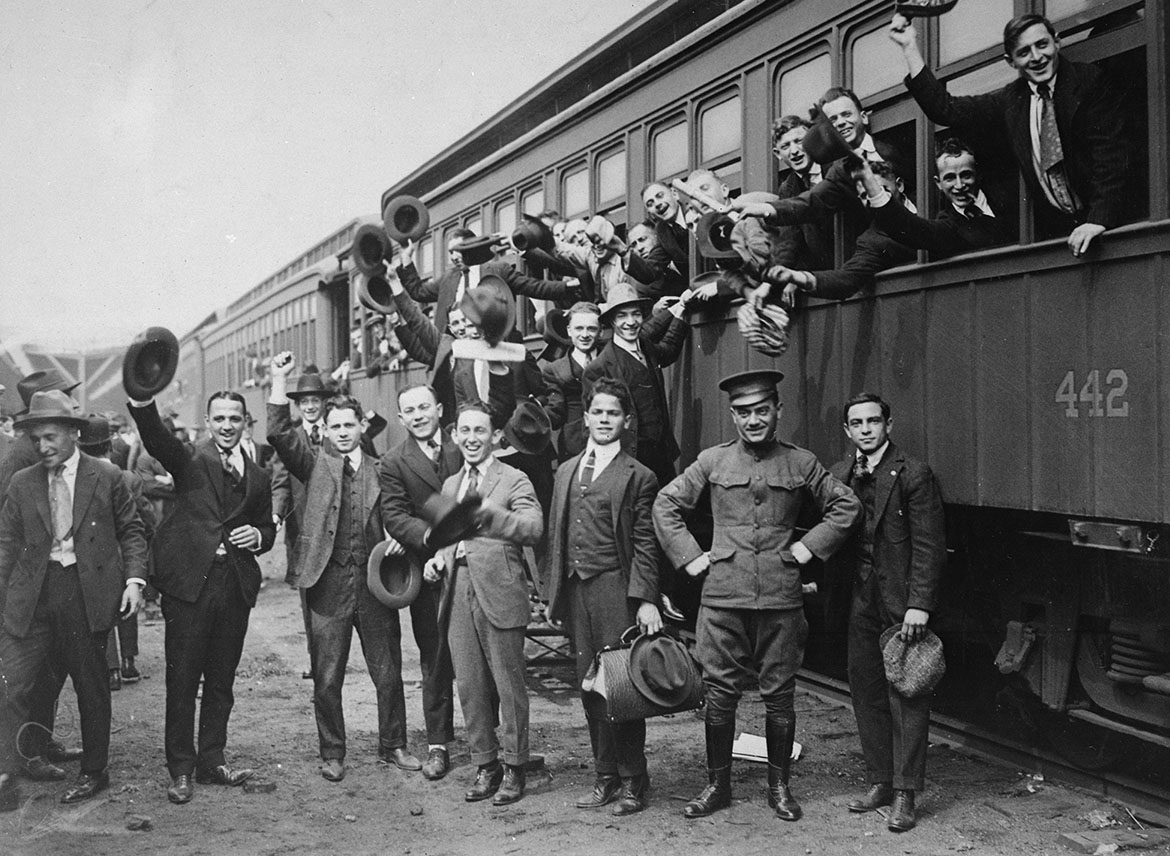
Down the close, darkening lanes they sang their way To the siding-shed, And lined the train with faces grimly gay.
Their breasts were stuck all white with wreath and spray As men’s are, dead.
Dull porters watched them, and a casual tramp Stood staring hard, Sorry to miss them from the upland camp. Then, unmoved, signals nodded, and a lamp Winked to the guard.
So secretly, like wrongs hushed-up, they went. They were not ours: We never heard to which front these were sent.
Nor there if they yet mock what women meant Who gave them flowers.
Shall they return to beatings of great bells In wild trainloads? A few, a few, too few for drums and yells, May creep back, silent, to still village wells Up half-known roads.
___________________
“The Send-off” describes a group of new soldiers departing for the trenches of the Great War by train, ‘The Send-Off’ was not one of Wilfred Owen’s poems that I was familiar with until I came across it yesterday. Wilfred Owen is most often remembered as one of the more passionate and eloquent voices of the First World War poets. Most of the poems for which he is now famous were written in a period of intense creativity between 1917 and 1918. The poem I am most familiar with is “Dulce et Decorum Est,” which he wrote at Craiglockhart hospital near Edinburgh where he had been sent to recover from neurasthenia, better known as shellshock. While at the hospital, he would meet the poet and novelist, Siegfried Sassoon, who had a major impact upon his life and work and played a crucial role in publishing Owen’s poetry following Owen’s untimely death in 1918, aged 25. Only five of Owen’s poems were published in his lifetime. Owen wrote a number of his most famous poems at Craiglockhart.
“The Send-off” was written at Ripon, where there was a huge army camp. The poem describes a group of soldiers leaving for the Western Front by train. They had just come from a sending-off ceremony—cheering crowds, bells, drums, flowers given by strangers—and they were being packed into trains for an unknown destination. Note the effect of the early use of an oxymoron: the men are said to be “grimly gay.” They sang as they marched gayly from the upland camp to the siding shed, but the use of “grimly” suggests that they know enough about what lies ahead of them to feel somber and anxious.
The poem suggests that they may have been given flowers to celebrate the bravery of their commitment to the cause, but Owen emphatically compares the “wreath and spray” to flowers for the “dead.” Traditionally flowers have a double significance – colorful flowers for a celebration, white flowers for mourning. So, the women who stuck flowers on their breasts thought they were expressing support but were actually garlanding them for the slaughter of the Western Front. One of the things which make “The Send-Off” a masterful piece of poetry is the way in which Owen suggests the cracks already showing beneath the supposedly joyous and celebratory event of a group of soldiers being cheered on as they depart their homes and head for the Western Front.
“The Send-Off” correctly predicts that those soldiers who are lucky enough to return home alive will find their hometowns and villages to be very different (“half-known”) from the ones they left: there will be no crowds of girls to greet them and cheer them as there was to see them off, and no great celebration of their heroism. And many who returned would never be the same again, mentally scarred by shellshock, post-traumatic stress disorder, and the horrors witnessed. During and after the First World War, many people could not bear to watch a train moving away because this reminded them of a last meeting. His work is full of compassion and outrage and technically highly skillful. Perhaps more than any other poet of the First World War he was able to show the reality and horror of war.
Sadly, Owen was killed in action on November 4, 1918, during the crossing of the Sambre–Oise Canal, exactly one week (almost to the hour) before the signing of the Armistice which ended the war and was promoted to the rank of Lieutenant the day after his death. His mother received the telegram informing her of his death on Armistice Day, as the church bells in Shrewsbury were ringing out in celebration. Owen is buried at Ors Communal Cemetery, Ors, in northern France. The inscription on his gravestone, chosen by his mother Susan, is based on a quote from his poetry: “SHALL LIFE RENEW THESE BODIES? OF A TRUTH ALL DEATH WILL HE ANNUL” W.O.
Oh, give us pleasure in the flowers to-day; And give us not to think so far away As the uncertain harvest; keep us here All simply in the springing of the year.
Oh, give us pleasure in the orchard white, Like nothing else by day, like ghosts by night; And make us happy in the happy bees, The swarm dilating round the perfect trees.
And make us happy in the darting bird That suddenly above the bees is heard, The meteor that thrusts in with needle bill, And off a blossom in mid air stands still.
For this is love and nothing else is love, The which it is reserved for God above To sanctify to what far ends He will, But which it only needs that we fulfil.
Robert Frost’s “A Prayer in Spring” is a prayer in poetic form giving thanks and gratitude to God for the blessing of spring. The poem shows how spring is an expression of God’s love. The poet reminds us to give a prayer of thanks for receiving the happiness and pleasure that we experience in springtime because we are given spring as a gift from God. We should remember the present beauty and indulgence of spring and not think of the unpredictability of the future because the future is God’s secret.
The overall theme of “A Prayer in Spring” is an expression of God’s love. Frost wants us to trust in God completely even during spring or times of change. God brings us the beauty of spring, and He has given us everything to reach Him and to ask for His guidance. Frost offers an uncomplicated prayer to God in this poem, focusing on love and gratitude that is traditionally on display during the season of Thanksgiving. As the poet prays to God, he is also inviting his audience to become as delighted in “the springing of the year” as they do in the later harvest which happens in autumn—two seasons away from spring.
The wind was a care-free soul That broke the chains of earth, And strode for a moment across the land With the wild halloo of his mirth. He little cared that he ripped up trees, That houses fell at his hand, That his step broke calm on the breast of seas, That his feet stirred clouds of sand.
But when he had had his little joke, Had shouted and laughed and sung, When the trees were scarred, their branches broke, And their foliage aching hung, He crept to his cave with a stealthy tread, With rain-filled eyes and low-bowed head.
Gwendolyn Bennett, a teacher, artist, and writer, was born in Giddings, Texas in 1902. She never published her collected work, but her poems, short stories, and nonfiction columns appeared in literary journals, among them Opportunity, Fire!! and Palms. Bennett was connected to the Harlem Renaissance and a dedicated supporter of African American writers and artists through support groups, community centers, and schools. She died in Reading, Pennsylvania in 1981.
Dear March – Come in – (1320) By Emily Dickinson – 1830-1886
Dear March – Come in – How glad I am – I hoped for you before – Put down your Hat – You must have walked – How out of Breath you are – Dear March, how are you, and the Rest – Did you leave Nature well – Oh March, Come right upstairs with me – I have so much to tell –
I got your Letter, and the Birds – The Maples never knew that you were coming – I declare – how Red their Faces grew – But March, forgive me – And all those Hills you left for me to Hue – There was no Purple suitable – You took it all with you –
Who knocks? That April – Lock the Door – I will not be pursued – He stayed away a Year to call When I am occupied – But trifles look so trivial As soon as you have come
That blame is just as dear as Praise And Praise as mere as Blame –
____________________
About this Poem
“Dear March, Come In” is Emily Dickinson’s eloquent greeting to the season of Spring during the month of March. By personifying the season, Dickinson reminds us that we have anticipated spring each day of the long and infinite winter we have just experienced. She reminds the reader that Spring is on its way and will likely be out of breath when it arrives.
The beginning of spring means the blossoming of life anew. Dickinson describes the renewed life that comes with spring. Dickinson for many years lived as a recluse withdrawing from the society. Like her Transcendentalists contemporaries, she shows us that she does not need to leave her seclusion to understand the meaning and the elements of life. Through her garden, Dickinson realized her need to stay in contact with nature. The poem discusses her feeling of welcoming nature in her front doors. However, like life nature can arrive without any signs or warnings, and it can disappear just as easily.
At the end of the poem, Dickinson describes how she does not want April to arrive. Although she never give the reason of having such feelings, we can infer that she does not want to lose the contact between herself and the beginning of life. Sooner or later, May will arrive and after a few months, winter will creep back up and the nature of the world will return to the dreariness and cold of the winter months. Time marches on, but Dickinson doesn’t want the renewal of March to end.
The weather is rude today, too full of good color and cheer, and makes me want to be out of here, out of the interior time pandemic time trauma has made me. I would sing as the canary passes gently thru the break of my vision; I would listen as the cat’s ear stings patiently at its Lord; I would gorge deeply on my own fruit’s womb; I would entomb blind joy in its spell: et benedictus fructus ventris tui, Iesus. Iesus is us, and he isn’t, anymore than Byzantine raised halos and bronze disease is us, and they are—though most I enjoy these hiccups come also witty with the breast, with the breath, in the idea disease, ease, and that we might just be metal too close together that will infect each other, brother, brother, sister, sister, sister, brother, comma, comma, trans—with revision then, reglistening, which is love, becaused.
About the Poem
“Still early in the pandemic, around May 2020, I had a phone conversation with my friend, Sanchita Balachandran, associate director at John Hopkins Archaeological Museum, who taught me about ‘bronze disease,’ a term borne out of a belief earlier conservators had that certain corrosion products in bronze were the result of ‘a communicable biological contagion spread from object to object’ kept ‘too close together.’ It’s an idea, now disproved, that still struck me, knowing that for the conservator corrosion is enemy, but what if the corrosion was love?” —Rickey Laurentiis
Rickey Laurentiis (b. 1989, February 7) was raised in New Orleans, Louisiana, to love the dark. Their writing has been supported by several foundations and fellowships. In 2016, they traveled to Palestine as an invited reader for the Palestine Festival of Literature. Laurentiis received an MFA in Writing from Washington University in St Louis, where they were a Chancellor’s Graduate Fellow, and a Bachelor’s in Liberal Arts from Sarah Lawrence College, where they read literature and queer theory.
They are the trans author of Boy with Thorn, winner of the Cave Canem Poetry Prize and the Levis Reading Prize, and a finalist for the Kate Tufts Discovery Award, the Thom Gunn Award for Gay Poetry and a Lambda Literary Award. Boy with Thorn was also named one of the top ten debuts of 2015 by Poets & Writers Magazine and a top 16 best poetry book by Buzzfeed, among other distinctions.











 Joe
Joe





 The Closet Professor