Let’s say nothing big and bull-like, nothing too attractive, nothing chandeliering from septum to lobe. Just a simple, little stud nothing more.
Is it normal to get a nose ring at 30?
Normal is defined not by what it is, but what surrounds it. Meaning it could literally be anything, and is nothing.
Is it normal to get a nose ring at 30?
No, it’s not.
Am I just afraid of death?
Yes, probably.
Is there nothing more normal than fearing death?
It is very natural to fear death.
Should I get a nose ring?
It would look very cute on you
November is National Native American Heritage Month. It’s a time to recognize the many sacrifices, contributions, and achievements of Native American people, as well as celebrate their rich and vibrant cultures. In 1990, President George H.W. Bush approved a joint resolution designating November as “National American Indian Heritage Month.” Although the name eventually changed, it started an annual tradition upheld in communities across the United States.
The US holds in trust 56.2 million acres of land for various Native American tribes and individuals, according to the US Department of Indian Affairs. There are approximately 326 reservations. These reservations are not tourist attractions. Many are the remnants of native tribes’ lands, while others were created by the federal government for Native Americans who were forcibly removed from their lands. They are homes for tribes and communities; it’s where many live, work, and raise their families.
The Thanksgiving story of pilgrims and Native Americans sharing a friendly meal will be reenacted and celebrated across the country on November 26, and Friday, November 27 is Native American Heritage Day. However, many Native Americans actually consider Thanksgiving a “Day of Mourning,” pointing out the story overlooks how the introduction of European settlers spelled tragedy for indigenous communities. For this reason, some Native American groups and their allies are calling on Americans to “decolonize” their Thanksgiving celebrations. Some ways of doing this include putting away Native American decorations and tropes, introducing native dishes to the dinner table, and engaging in conversations about Native American history with dinner guests.
I usually post a poem about Thanksgiving, but this year, I thought I would honor Native Americans by posting a poem by a gay Native American. The poem above is by Tommy “Teebs” Pico. Many of Pico’s poems are centered on a character called Teebs, a queer Native American poet born on a reservation who left his home for school, much like the author himself. “I wasn’t raised in a world that necessarily uplifts queer indigenous perspectives,” Pico said. “So in order to get people to pay attention, I knew that I was going to have to be very loud and very funny or sharp or something.”
He is the author of many books published in the last few years, all of which are sort of a mix between poetry, novel-in-verse, and very slutty Tumblr posts. He is an indigenous American poet from the Kumeyaay Nation. The Kumeyaay, also known as Tipai-Ipai, are a tribe of Indigenous peoples of the Americas who live at the northern border of Baja California in Mexico and the southern border of California. Pico grew up on the Viejas reservation located in San Diego County, California, where he got his start writing comics at age 5, and as a teenager created zines and wrote poetry. Pico originally left the Viejas Indian reservation to study pre-med at Sarah Lawrence, hoping to return to the reservation to address some of the health problems he grew up surrounded by. Instead, he spent his twenties pioneering the artist collective Birdsong, making zines, publishing his poetry on Tumblr, and honing his performance skills through “exposure therapy.”
His poems are irreverent queer anthems, and in 2018, he received the $50,000 Whiting Award prize (just one of many things his work has won) for a book-length poem that contained content about Grindr, rimjobs, and Beyoncé. As you can tell from the excerpt from his second book of poems, Nature Poem, he has an interesting style. Nature Poem was the winner of a 2018 American Book Award and a finalist for the 2018 Lambda Literary Award. As you might have guessed, as an Indigenous American, his relationship with Thanksgiving is not too sweet. In 2015, Pico wrote an essay/poem for Literary Hub titled, “How to Pass the Time on a Holiday Commemorating the Destruction of Your Ancestors,” which is definitely worth reading.
November’s days are thirty: November’s earth is dirty, Those thirty days, from first to last; And the prettiest thing on ground are the paths With morning and evening hobnails dinted, With foot and wing-tip overprinted Or separately charactered, Of little beast and little bird. The fields are mashed by sheep, the roads Make the worst going, the best the woods Where dead leaves upward and downward scatter. Few care for the mixture of earth and water, Twig, leaf, flint, thorn, Straw, feather, all that men scorn, Pounded up and sodden by flood, Condemned as mud.
But of all the months when earth is greener Not one has clean skies that are cleaner. Clean and clear and sweet and cold, They shine above the earth so old, While the after-tempest cloud Sails over in silence though winds are loud, Till the full moon in the east Looks at the planet in the west And earth is silent as it is black, Yet not unhappy for its lack. Up from the dirty earth men stare: One imagines a refuge there Above the mud, in the pure bright Of the cloudless heavenly light: Another loves earth and November more dearly Because without them, he sees clearly, The sky would be nothing more to his eye Than he, in any case, is to the sky; He loves even the mud whose dyes Renounce all brightness to the skies.
About the Poet:
If the war goes on I believe I shall find myself a sort of Englishman, though neither poet or soldier’
– Letter to Walter de la Mare, 30th August 1914
Philip Edward Thomas (3 March 1878 – 9 April 1917) was a British poet, essayist, and novelist. Scholars consider him a war poet, although few of his poems deal directly with his war experiences. His career in poetry only came after he had already been a successful writer and literary critic. In 1915, he enlisted in the British Army to fight in the First World War and was killed in action shortly after arriving in France.
Thomas thought that poetry was the highest form of literature and regularly reviewed it, but he only became a poet himself at the end of 1914 when living at Steep, East Hampshire. He initially published his poetry under the name Edward Eastaway to disguise his identity due to his fame as a critic. Robert Frost, who was living in England at the time, encouraged Thomas (then more famous as a critic) to write poetry, and their friendship was so close that the two planned to reside side by side in the United States. Frost’s most famous poem, “The Road Not Taken,” was inspired by walks with Thomas and Thomas’s indecisiveness about which route to take.
Thomas enlisted in the Artists Rifles in July 1915, despite being a 37-year-old married man who could have avoided enlisting. He was unintentionally influenced in this decision by his friend Frost, who had returned to the U.S. but sent Thomas an advance copy of “The Road Not Taken.” Frost intended the poem as a gentle mocking of Thomas’ indecision, particularly the indecision that Thomas had shown on their many walks together; however, most audiences took the poem more seriously than Frost intended. Thomas similarly took it seriously and personally. The poem allowed Thomas to be decisive and enlist.
Thomas was promoted to corporal, and in November 1916 was commissioned into the Royal Garrison Artillery as a second lieutenant. He was killed in action soon after arriving in France at Arras on Easter Monday, 9 April 1917. To spare the feelings of his widow, Helen, she was told the fiction of a “bloodless death,” i.e., that Thomas was killed by the concussive blast wave of one of the last shells fired as he stood to light his pipe and that there was no mark on his body. However, a letter from his commanding officer Franklin Lushington written in 1936 (and discovered many years later in an American archive), states that in reality, the cause of Thomas’s death was being “shot clean through the chest.” W. H. Davies, the Welsh poet and Thomas’s close friend, was devastated by his death and immortalized him in a poem, “Killed in Action (Edward Thomas).”
Killed in Action (Edward Thomas) By W. H. Davies
Happy the man whose home is still In Nature’s green and peaceful ways; To wake and hear the birds so loud, That scream for joy to see the sun Is shouldering past a sullen cloud.
And we have known those days, when we Would wait to hear the cuckoo first; When you and I, with thoughtful mind, Would help a bird to hide her nest, For fear of other hands less kind.
But thou, my friend, art lying dead: War, with its hell-born childishness, Has claimed thy life, with many more: The man that loved this England well, And never left it once before.
Thomas is buried in Agny military cemetery on the outskirts of Arras. He did not live to see Poems (1917), a collection of his poetry published under his pseudonym, Edward Eastaway. In just under two years, he had written over 140 poems. On 11 November 1985, Thomas was among 16 Great War poets commemorated on a slate stone unveiled in Westminster Abbey’s Poet’s Corner. The inscription, written by fellow poet Wilfred Owen, reads: “My subject is War, and the pity of War. The Poetry is in the pity.”
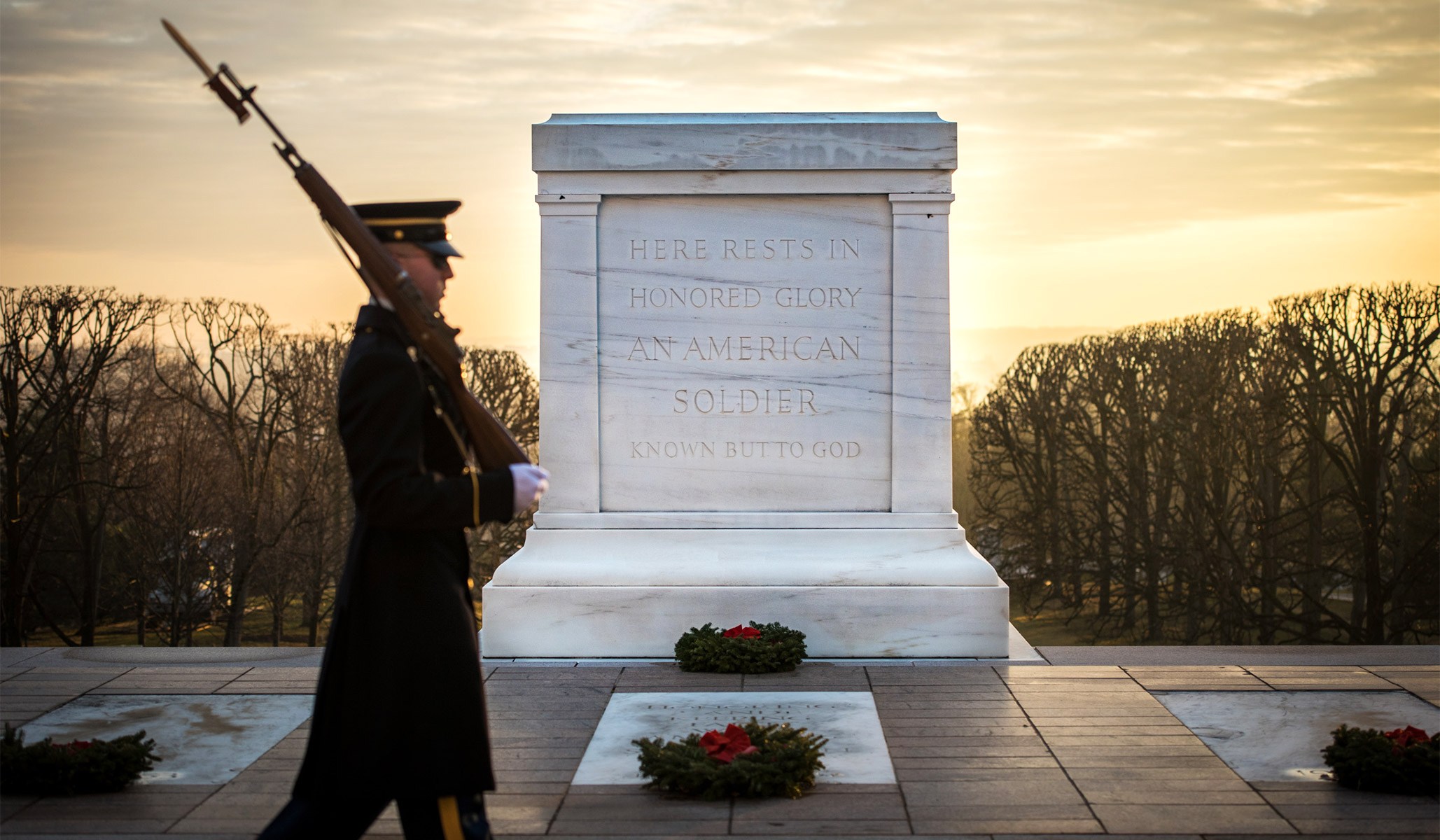
Sergeant Aaron Lopez-Stoner, assigned to the Third U.S. Infantry Regiment (The Old Guard), conducts his last walk at the Tomb of the Unknown Soldier at Arlington National Cemetery, January 15, 2017. (Staff Sergeant Terrance D. Rhodes/US Army)
The Unknown Soldier By Melvin B. Tolson
I was a minuteman at Concord Bridge, I was a frigate-gunner on Lake Erie, I was a mortarman at Stony Ridge, I fought at San Juan Hill and Château Thierry, I braved Corregidor and the Arctic Sea: The index finger brings democracy.
These States bred freedom in and in my bone— Old as the new testament of Plymouth Bay. When the Founding Fathers laid the Cornerstone And rued the thirteen clocks that would not say The hour on the hour, I nerved myself with them Under the noose in the hand of the tyrant’s whim.
I’ve seen the alien ships of destiny Plow the sea mountains between the hemispheres. I’ve seen the Gulf Stream of our history Littered with derelicts of corsair careers. I’ve heard the watchman cry, “The bars! The bars!” When midnight held the funeral of stars.
I saw horizontal States grow vertical, From Plymouth Harbor to the Golden Gate, Till wedged against skyscapes empyreal Their glories elbowed the decrees of fate. These States bred freedom in and in my bone: I hymn their virtues and their sins atone.
The tares and wheat grow in the self-same field, The rose and thorn companion on the bush, The gold and gravel cuddle in the yield, The oil and grit and dirt together gush. The Gordian knot to be or not to be Snares not the free.
My faith props the tomorrows, for I know The roots of liberty, tough-fibered, feed On the blood of tyrants and martyrs; the judas blow Tortures the branches till they twist and bleed; And yet no Caesar, vitamined on loot, Can liberty uproot!
I am the Unknown Soldier: I open doors To the Rights of Man, letters incarnadine. These shrines of freedom are mine as well as yours; These ashes of freemen yours as well as mine. My troubled ghost shall haunt These States, nor cease Till the global war becomes a global peace.
__________________________
World War I—known at the time as “The Great War”—officially ended when the Treaty of Versailles was signed on June 28, 1919, in the Palace of Versailles outside the town of Versailles, France. However, fighting ceased seven months earlier when an armistice, or temporary cessation of hostilities, between the Allied nations and Germany went into effect on the eleventh hour of the eleventh day of the eleventh month. For that reason, November 11, 1918, is generally regarded as the end of “the war to end all wars.”
Veterans Day, which is tomorrow, originated as “Armistice Day” on Nov. 11, 1919, the first anniversary of the end of World War I. Congress passed a resolution in 1926 for an annual observance, and Nov. 11 became a national holiday beginning in 1938. Veterans Day pays tribute to all American veterans—living or dead—but especially gives thanks to living veterans who served their country honorably during war or peacetime.
__________________________
The Tomb of the Unknown Soldier
The Tomb of the Unknown Soldier is a monument dedicated to deceased U.S. service members whose remains have not been identified. It is located in Arlington National Cemetery in Virginia, United States. The World War I “Unknown” is a recipient of the Medal of Honor, the Victoria Cross, and several other foreign nations’ highest service awards. The U.S. Unknowns who were interred are also recipients of the Medal of Honor, presented by U.S. presidents who presided over their funerals. The monument has no officially designated name.
Dozens of countries have a Tomb of the Unknown Soldier. These tombs are a monument dedicated to the services of unknown soldiers interred at the monument and to the common memories of all soldiers killed in war. These tombs can be found in many nations and are usually high-profile national monuments. Throughout history, many soldiers have died in war with their remains being unidentified. Following World War I, a movement arose to commemorate these soldiers with a single tomb, containing the body of one such unidentified soldier.
Many of these Tombs of the Unknown are usually guarded by honorary sentinels at all times. At the Tomb of the Unknown Soldier in Arlington National Cemetery, the tomb guards are soldiers of the United States Army. It is considered one of the highest honors to serve as a Sentinel at the Tomb of the Unknowns. Fewer than 20 percent of all volunteers are accepted for training and of those only a fraction pass training to become full-fledged Tomb Guards. The soldier “walking the mat” does not wear rank insignia, so as not to outrank the Unknowns, whatever their ranks may have been. Non-commissioned officers (usually the Relief Commander and Assistant Relief Commanders), do wear insignia of their rank when changing the guard only. They have a separate uniform (without rank) that is worn when they actually guard the Unknowns or are “posted.” The duties of the sentinels are not purely ceremonial. The sentinels will confront people who cross the barriers at the tomb or whom they perceive to be disrespectful or excessively loud.
__________________________
About the Poet
Melvin B. Tolson (February 6, 1898 – August 29, 1966) was an American poet, educator, columnist, and politician. As a poet, he was influenced both by Modernism and the language and experiences of African Americans, and he was deeply influenced by his study of the Harlem Renaissance. Known for his complex, visionary poetry, Melvin B. Tolson was one of America’s leading Black poets.
Tolson was born in 1898 in Moberly, Missouri. He earned a bachelor’s degree from Lincoln University in Chester County, Pennsylvania in 1924 and a master’s degree in English and comparative literature from Columbia University in 1940. In 1947, Liberia appointed him as poet laureate. He is the author of numerous works, including the poetry collections Harlem Gallery: Book One, The Curator (1965), Libretto for the Republic of Liberia(1953), and Rendezvous with America (1944), and the plays Black Boy (1963) and Black No More (1952).
Tolson had a vibrant teaching career. In Marshall, Texas, he taught English and speech at Wiley College, where he led an award-winning debate team. From 1947 to 1965, he was a professor of English, speech, and drama at Langston University, a historically black college in Langston, Oklahoma.
Let America Be America Again By Langston Hughes – 1902-1967
Let America be America again. Let it be the dream it used to be. Let it be the pioneer on the plain Seeking a home where he himself is free.
(America never was America to me.)
Let America be the dream the dreamers dreamed— Let it be that great strong land of love Where never kings connive nor tyrants scheme That any man be crushed by one above.
(It never was America to me.)
O, let my land be a land where Liberty Is crowned with no false patriotic wreath, But opportunity is real, and life is free, Equality is in the air we breathe.
(There’s never been equality for me, Nor freedom in this “homeland of the free.”)
Say, who are you that mumbles in the dark? And who are you that draws your veil across the stars?
I am the poor white, fooled and pushed apart, I am the Negro bearing slavery’s scars. I am the red man driven from the land, I am the immigrant clutching the hope I seek— And finding only the same old stupid plan Of dog eat dog, of mighty crush the weak.
I am the young man, full of strength and hope, Tangled in that ancient endless chain Of profit, power, gain, of grab the land! Of grab the gold! Of grab the ways of satisfying need! Of work the men! Of take the pay! Of owning everything for one’s own greed!
I am the farmer, bondsman to the soil. I am the worker sold to the machine. I am the Negro, servant to you all. I am the people, humble, hungry, mean— Hungry yet today despite the dream. Beaten yet today—O, Pioneers! I am the man who never got ahead, The poorest worker bartered through the years.
Yet I’m the one who dreamt our basic dream In the Old World while still a serf of kings, Who dreamt a dream so strong, so brave, so true, That even yet its mighty daring sings In every brick and stone, in every furrow turned That’s made America the land it has become. O, I’m the man who sailed those early seas In search of what I meant to be my home— For I’m the one who left dark Ireland’s shore, And Poland’s plain, and England’s grassy lea, And torn from Black Africa’s strand I came To build a “homeland of the free.”
The free?
Who said the free? Not me? Surely not me? The millions on relief today? The millions shot down when we strike? The millions who have nothing for our pay? For all the dreams we’ve dreamed And all the songs we’ve sung And all the hopes we’ve held And all the flags we’ve hung, The millions who have nothing for our pay— Except the dream that’s almost dead today.
O, let America be America again— The land that never has been yet— And yet must be—the land where every man is free. The land that’s mine—the poor man’s, Indian’s, Negro’s, ME— Who made America, Whose sweat and blood, whose faith and pain, Whose hand at the foundry, whose plow in the rain, Must bring back our mighty dream again.
Sure, call me any ugly name you choose— The steel of freedom does not stain. From those who live like leeches on the people’s lives, We must take back our land again, America!
O, yes, I say it plain, America never was America to me, And yet I swear this oath— America will be!
Out of the rack and ruin of our gangster death, The rape and rot of graft, and stealth, and lies, We, the people, must redeem The land, the mines, the plants, the rivers. The mountains and the endless plain— All, all the stretch of these great green states— And make America again!
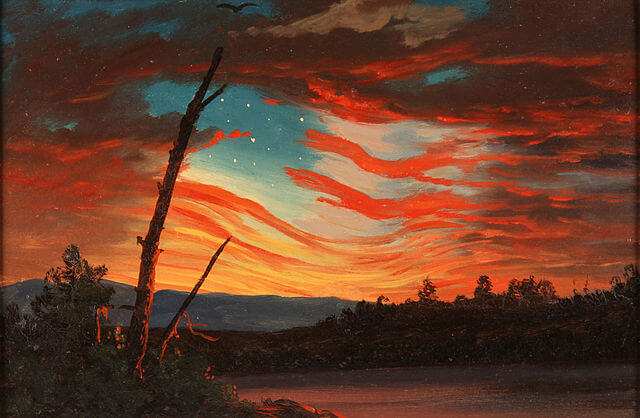
Frederic Edwin Church, Our Banner in the Sky, 1860
“Let America Be America Again” is a poem written in 1935 by American poet Langston Hughes. It was originally published in the July 1936 issue of Esquire Magazine. The poem was republished in the 1937 issue of Kansas Magazine. It was revised and included in a small collection of Langston Hughes poems entitled A New Song, published by the International Workers Order in 1938.
The poem speaks of the American dream that never existed for lower-class Americans and the freedom and equality that every immigrant hoped for but never received. In his poem, Hughes represents not only African Americans but also other economically disadvantaged and minority groups. Besides criticizing America’s inequalities, the poem conveys a sense of hope that the American Dream is soon to come. While Hughes does not address the LGBTQ+ as one of the minority groups, sexuality was likely on his mind when he wrote the poem. Some academics and biographers believe that Hughes was homosexual and included homosexual codes in many of his poems, as did Walt Whitman, who, Hughes said, influenced his poetry. Hughes’s story “Blessed Assurance” deals with a father’s anger over his son’s effeminacy and “queerness.” The biographer Robert Aldrich argues that to retain the respect and support of black churches and organizations and avoid exacerbating his precarious financial situation, Hughes remained closeted. There has been some controversy, but most of it centers on whether Hughes was homosexual or asexual. Few believe that he was heterosexual or had any interest in women.
Hughes wrote “Let America Be America Again” while riding a train from New York to his mother’s home in Ohio. He was depressed because of recent reviews of his first Broadway play and his mother’s breast cancer diagnosis. Despite being a leader of the Harlem Renaissance in the 1920s, he struggled for acceptance as a poet, battling persistent racism, and barely making a living. Selling a poem or a story every few months, he referred to himself as a “literary sharecropper.” Fate, he said, “never intended for me to have a full pocket of anything but manuscripts.”
Hughes finished the poem in a night but did not regard it as one of his best. The poem would be revised numerous times. It did not appear in his early anthologies and was only revived in the 1990s, first in a public reading by Supreme Court justice Thurgood Marshall, later as a title for museum shows. Following Donald Trump’s election, the poem started trending on social media. In the aftermath of the death of George Floyd and others in police custody, the poem has found new urgency. Perhaps it was the word again that first drew people’s attention. Decades before Trump used the slogan “Make America Great Again” in his 2016 campaign, Hughes published this poem titled “Let America Be America Again.” Hughes’s first poem, “The Negro Speaks of Rivers,” published in 1921, addressed the Black experience in America: “My soul has grown deep like the rivers.” In 1926, he published his first book of poems, The Weary Blues. Influenced by poets such as Walt Whitman, Carl Sandburg, and Paul Laurence Dunbar, Hughes embraced free verse. His collection included the poem “I, Too,” which opens “I, too, sing America,” and closes “I, too, am America.” The poems are a coda for Whitman’s poem “I hear America singing.”
“Let America Be America Again” begins “Let America be America again / Let it be the dream it used to be,” then continues, “Let America be the dream the dreamers dreamed.” It’s a dream of freedom, equality, opportunity, and liberty—the ideals that form the bedrock of the nation. Yet a parenthetic voice adds, “(America never was America to me).” If you’ve read much of Hughes’s work, it is clear that the parenthetic voice is the victim of the long history of racial segregation and oppression. The poem anticipates this assumption, and a new voice asks, “Say, who are you that mumbles in the dark? ” What follows is a list of everyday Americans: “the poor white,” “the Negro,” “the red man,” “the immigrant,” “the farmer,” “the worker.” All are carrying hope for a better future, and all have fallen victim to “the same old stupid plan / Of dog eat dog, of mighty crush the weak.” America is not America to any of them.
The poem laments the conditions of the Depression, with millions unemployed and on relief, and asks what happened to America, the purported “homeland of the free,” where so many have nothing left now “except the dream that’s almost dead today.” Almost dead, yet unvanquished.
For Hughes, the United States was an unrealized, perhaps unrealizable ideal. It was a land that “never has been yet— / And yet must be,” a dreamland unlike any other country. But the nation’s failure time and again to live up to its aspirations is a profound part of the story. Whatever its struggles, the United States has always identified itself by its dreams. Dreams inspired by abstractions like democracy, justice, and rights. Dreams animated by those seeking freedom and equality. Dreams stirred by those making a new home in America and pursuing a better life. Hughes believed in those dreams, and his poem ends not with despair but with an urgent plea:
We, the people, must redeem The land, the mines, the plants, the rivers. The mountains and the endless plain— All, all the stretch of these great green states— And make America again!
Hughes would continue to think about America, asking, “What happens to a dream deferred?” in a 1951 poem titled “Harlem.” Martin Luther King Jr. had also been contemplating dreams, long before his “I Have a Dream” speech at the Lincoln Memorial. King and Hughes were friends: in 1956, King recited a Hughes poem, “Mother to Son,” from the pulpit. King publicly kept his distance because of the poet’s suspected Communist, just as King eventually distanced himself from his advisor and friend Bayard Rustin because of Rustin’s homosexuality. Even though publicly distanced from Hughes, King must have appreciated the closing of “Let America Be America Again,” where the people are summoned to redeem the land. In a sermon first delivered in 1954, he declared that “instead of making history, we are made by history.” The line is easily misunderstood. King was not offering an argument for why history matters; instead, he was decrying passivity and insisting on empowerment. It was a call to action. King was telling his congregation that the time for waiting on dreams was over—the time for making dreams come true had begun.
Today, we have the chance to put the United States back on track to letting “America be America again,” at least the dream of what America could become but has yet never been. We can elect Joe Biden and other Democrats to help heal the soul of this nation and try to fulfill the true American dream of democracy, justice, and rights. For too long, conservatives in the United States have held back the ideals of democracy that are found in the words of our Founding Fathers as laid out in the Preamble of the Constitution:
We the People of the United States, in Order to form a more perfect Union, establish Justice, insure domestic Tranquility, provide for the common defence, promote the general Welfare, and secure the Blessings of Liberty to ourselves and our Posterity, do ordain and establish this Constitution for the United States of America.
Under Donald Trump, the idea of a perfect Union has been weakened as he has worked to divide this country along the lines of race, sexuality, health, age, and economic status. He has destroyed the domestic tranquility of the United States as his rhetoric and lack of action have led to protests over racial inequalities, women’s rights, and the health and safety of all Americans. He has worked with our enemies to weaken our status on the world stage and has distanced this country from our allies. He has failed to respond to the COVID-19 pandemic in a way that promotes the general welfare of this country. He has mocked science and medical professionals, those who wear masks, and those who promote social distancing to curb the spread of the virus, and he has hocked quack endorsed and crackpot cures for his own financial gain. He is destroying our posterity by allowing a failing economy, civil unrest, and a raging pandemic to fester. His ineptitude and inexperience with leadership will doom this country if he is reelected.
“These are the times that try men’s souls.” The opening line of Thomas Paine’s Revolutionary War pamphlet series, “The American Crisis,” resonates with Americans as much today as it did during the bleak winter of 1776. We, like our patriot ancestors, are locked in a struggle each side believes it must win to preserve the freedom and human dignity that are the natural rights of every American. Our souls are bowed under the pressure of the conflict, but each side remains resolute, even as we feel our nation’s bonds weaken under the strain. Everyone eagerly desires victory on Tuesday, and fear what might befall them if they are defeated. In his appendix to “Common Sense,” Thomas Paine wrote something that became one of Ronald Reagan’s favorite quotes: “We have it in our power to begin the world over again.” Taken literally, the sentiment would end in bloodshed and revolution. But that’s not how Reagan read it; he viewed Paine’s idea as an expression of optimism about the American spirit. So long as Americans remained true to their political heritage (at least in rhetoric), the natural equality of each and every human being, Reagan believed every generation of Americans would always rise to meet their “rendezvous with destiny.” Sadly, Reagan did not rise to meet America’s destiny (he set us on this path to Trumpism), but I believe Joe Biden can and will.
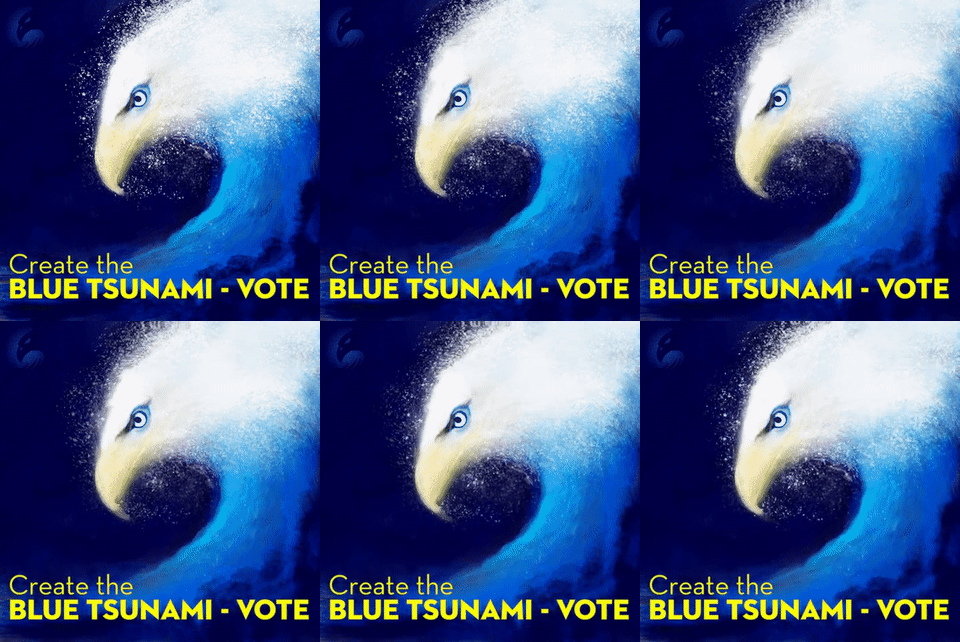
We must elect Joe Biden and Democrats down the ticket to salvage the dreams of the United States. The Supreme Court has often been the force of social change and equality but is now in danger with a majority of conservative justices who care more about what their interpretation of the original intent of the Constitution is over the idea of a living Constitution that can better the American dream. Biden can help reverse that with reforms to the judiciary and possibly the addition of more justices to the Supreme Court. We need Democrats to take control and right the wrongs of the Republicans and the Trump administration. We need to bring dignity and legitimacy back to the executive, legislative, and judicial branches of government. If you have not already voted, please vote today and vote for Democrats. Let this be a BLUE WAVE the likes of which this country has never before seen.
A ghost, though invisible, still is like a place your sight can knock on, echoing; but here within this thick black pelt, your strongest gaze will be absorbed and utterly disappear:
just as a raving madman, when nothing else can ease him, charges into his dark night howling, pounds on the padded wall, and feels the rage being taken in and pacified.
She seems to hide all looks that have ever fallen into her, so that, like an audience, she can look them over, menacing and sullen, and curl to sleep with them. But all at once
as if awakened, she turns her face to yours; and with a shock, you see yourself, tiny, inside the golden amber of her eyeballs suspended, like a prehistoric fly.
Schwarze Katze By Rainer Maria Rilke
The original German
Ein Gespenst ist noch wie eine Stelle, dran dein Blick mit einem Klange stößt; aber da, an diesem schwarzen Felle wird dein stärkstes Schauen aufgelöst:
wie ein Tobender, wenn er in vollster Raserei ins Schwarze stampft, jählings am benehmenden Gepolster einer Zelle aufhört und verdampft.
Alle Blicke, die sie jemals trafen, scheint sie also an sich zu verhehlen, um darüber drohend und verdrossen zuzuschauern und damit zu schlafen. Doch auf einmal kehrt sie, wie geweckt, ihr Gesicht und mitten in das deine: und da triffst du deinen Blick im geelen Amber ihrer runden Augensteine unerwartet wieder: eingeschlossen wie ein ausgestorbenes Insekt.
“Black Cat” was originally published in Rilke’s 1923 collection Duino Elegies. Rilke began writing this collection in 1912, but it remained unfinished for a decade before being completed and published.
I would like to watch you sleeping, which may not happen. I would like to watch you, sleeping. I would like to sleep with you, to enter your sleep as its smooth dark wave slides over my head
and walk with you through that lucent wavering forest of bluegreen leaves with its watery sun & three moons towards the cave where you must descend, towards your worst fear
I would like to give you the silver branch, the small white flower, the one word that will protect you from the grief at the center of your dream, from the grief at the center. I would like to follow you up the long stairway again & become the boat that would row you back carefully, a flame in two cupped hands to where your body lies beside me, and you enter it as easily as breathing in
I would like to be the air that inhabits you for a moment only. I would like to be that unnoticed & that necessary.
The poem is for my usual Tuesday poetry post, but if you’d like to read why I chose it and a political commentary on the dangers of the new Supreme Court Justice, read on.
With the Senate confirmation of Judge Handmaid to the Supreme Court last night, I thought I’d post a poem by the author of The Handmaid’s Tale, Canadian author Margaret Atwood. To be fair, the religious extremist group People of Praise to which Amy Coney Barrett belongs were the first to call its female advisers “hands” and “handmaids.” Their use of the term predated Margaret Atwood’s The Handmaid’s Tale. They no longer use the term. It also appears that the group was not Atwood’s direct inspiration. Still, it looks like we are in for a dystopian future of our own with the court dominated by conservatives who want to take away all the freedoms gained by women and the LGBTQ+ community in the past 50 years.
Her silence on the most basic issues of republican self-rule tells us to be ready for the worst. In her confirmation hearings, she wouldn’t say if voter intimidation is illegal, even though it plainly is. She wouldn’t say if a president has the power to postpone an election, even though he doesn’t. She wouldn’t even say that a president should commit himself to a peaceful transfer of power, telling Sen. Cory Booker (D-N.J.) that “to the extent that this is a political controversy right now, as a judge I want to stay out of it.” What exactly is controversial in a democratic republic about the peaceful transfer of power? It’s hard to escape the conclusion that she was nodding to the president who nominated her. He said he wanted a friendly judge on the court to deal with electoral matters, and he continues to signal that one of the most sacred concepts of a free republic is inoperative when it comes to himself. Rushing to confirm such a nominee just in time to rule on any election controversies (from which she refused to commit to recusing herself) should be troubling enough. But it is all the worse for being part of a tangle of excesses by the Republican Party and the conservative movement. Keep in mind that in Bush v. Gore, Chief Justice John Roberts Jr., Justice Brett Kavanaugh, and Barrett were all Bush lawyers in that fight.
Margaret Atwood’s dystopian Gilead of The Handmaid’s Tale centers on a hierarchical system of red-clad handmaids and blue-draped wives. The handmaids are stripped of rights and forced to bear children for wealthy infertile couples. Though the wives also face patriarchal rules forbidding them from activities like reading, they enjoy significantly more autonomy than handmaids. The wives don’t merely uphold the brutal heterosexist regime; they were instrumental in its creation. Throughout Hulu’s adaptation, wife Serena, played by Yvonne Strahovski, is shown like a fictional Phyllis Schlafly, proselytizing regressive policies in flashbacks. And like The Handmaid’s Tale’s wives, Amy Coney Barrett is working to build a more unjust society for oppressed communities, despite being a woman herself.
Barrett’s confirmation will turn the clock back on human rights, but similarly to the wives in The Handmaid’s Tale, Barrett will not face the full consequences of her judicial decisions. Conservative white women have upheld and continue to support patriarchal white supremacy and punitive capitalism at the direct expense of others. Barrett’s false feminist promise of the possibility to have it all—a large family and successful career—is not a reality for many working-class women, but rather “an example to young women across America of what they can do if they have enough money.” The impact of America’s policies on Black women, women of color, low-income women, indigenous women, immigrant women, and queer and trans folks already reflect conditions similar to those in The Handmaid’s Tale.
Though Barrett skirted questions about how she would rule on abortion during Senate hearings, it is clear she seeks to erode abortion rights. Trump vowed to appoint so-called pro-life judges. Barrett’s past writings indicate she will be one. On the 7th Circuit Court of Appeals, Barrett supported judicial opinions to require parental notification for abortions without exception and mandate the cremation of fetal remains.
Many pregnant women already face undue burdens when seeking abortion care. The Hyde Amendment prevents federal Medicaid funds from paying for abortions. This racist and classist policy disproportionately affects Black and Latinx patients, who are more likely to be enrolled in Medicaid. Rural patients also face barriers to care: 89 percent of U.S. counties do not have an abortion clinic. Many pregnant women seeking abortions must travel across state lines to receive care, racking up travel bills, and risking jobs when they have to take multiple days off. As Barrett has said she would do, these communities would be disproportionally harmed by further restricting access to care, even if Roe v. Wade holds.
Barrett’s likely rulings on abortion aren’t the only decisions she would hand down without personal consequence. Barrett sparked controversy during the Senate hearings after using the term “sexual preference” in response to Senator Dianne Feinstein’s question about Obergefell v. Hodges. Her use of this outdated term that implies sexuality is a choice caused concern among LGBTQ+ rights organizations. This problem is even more acute in light of the statement Justices Clarence Thomas and Samuel Alito penned earlier this month, indicating their desire to overturn Obergefell. While Barrett later clarified that she hadn’t meant “any offense” by her use of the term, her apparent lack of knowledge of its implication does not bode well in a nation that already undervalues and harms LGBTQ+ people, especially Black trans women.
In 175 election-related cases this year, it found that Republican appointees interpreted the law in ways that impeded access to the ballot 80 percent of the time, compared with 37 percent for Democratic appointees. The best case for the enlargement of the Supreme Court is likely to be made by the court’s conservative judicial activists themselves. It would be good for democracy if they showed some restraint. But everything about this struggle so far tells us that restraint is no longer a word in their vocabulary and that prudence is not a virtue they honor anymore.
That’s the thing about her jurisprudence—it is not aimed at making life better for systemically marginalized people. And this is precisely the problem the handmaid comparison ignores. Barrett is the oppressor, not the oppressed. She would make handmaids out of others.
Autumn Song By Paul Verlaine – 1844-1896 Translated by Arthur Symons
When a sighing begins In the violins Of the autumn-song, My heart is drowned In the slow sound Languorous and long
Pale as with pain, Breath fails me when The hours toll deep. My thoughts recover The days that are over, And I weep.
And I go Where the winds know, Broken and brief, To and fro, As the winds blow A dead leaf.
Chanson d’automne By Paul Verlaine – 1844-1896
Les saglots longs Des violons De l’automne Blessent mon coeur D’une langueur Monotone.
Tout suffocant Et blême, quand Sonne l’heure, Je me souviens Des jours anciens Et je pleure;
Et je m’en vais Au vent mauvais Qui m’emporte Deçà, delà, Pareil à la Feuille morte.
About the Poem:
“Chanson d’automne” (“Autumn Song”) is a poem by Paul Verlaine (1844–1896), one of the best known in the French language. It is included in Verlaine’s first collection, Poèmes saturniens, published in 1866 (see 1866 in poetry). The poem forms part of the “Paysages tristes” (“Sad landscapes”) section of the collection.
In World War II lines from the poem were used to send messages from Special Operations Executive (SOE) to the French Resistance about the timing of the forthcoming Invasion of Normandy. In preparation for Operation Overlord, the BBC’s Radio Londres had signaled to the French Resistance with the opening lines of “Chanson d’Automne” were to indicate the start of D-Day operations under the command of the Special Operations Executive. The first three lines of the poem, “Les sanglots longs / des violons / de l’automne” (“Long sobs of autumn violins”), would mean that Operation Overlord was to start within two weeks. These lines were broadcast on June 1, 1944. The next set of lines, “Blessent mon coeur / d’une langueur / monotone” (“wound my heart with a monotonous languor”), meant that it would start within 48 hours and that the resistance should begin sabotage operations, especially on the French railroad system; these lines were broadcast on June 5 at 23:15.
In 1940, Charles Trenet made changes to the words of the poem in order to change it into a song. There has been speculation that it was the popularity of his version that led to the use of the poem by SOE.
Turning and turning in the widening gyre The falcon cannot hear the falconer; Things fall apart; the centre cannot hold; Mere anarchy is loosed upon the world, The blood-dimmed tide is loosed, and everywhere The ceremony of innocence is drowned; The best lack all conviction, while the worst Are full of passionate intensity.
Surely some revelation is at hand; Surely the Second Coming is at hand. The Second Coming! Hardly are those words out When a vast image out of Spiritus Mundi Troubles my sight: somewhere in sands of the desert A shape with lion body and the head of a man, A gaze blank and pitiless as the sun, Is moving its slow thighs, while all about it Reel shadows of the indignant desert birds. The darkness drops again; but now I know That twenty centuries of stony sleep Were vexed to nightmare by a rocking cradle, And what rough beast, its hour come round at last, Slouches towards Bethlehem to be born?
“The Second Coming” is a poem written by Irish poet W. B. Yeats in 1919, first printed in The Dial in November 1920, and afterwards included in his 1921 collection of verses Michael Robartes and the Dancer. The poem uses Christian imagery regarding the Apocalypse and Second Coming to allegorically describe the atmosphere of post-war Europe. It is considered a major work of modernist poetry and has been reprinted in several collections, including The Norton Anthology of Modern Poetry.
The poem was written in 1919 in the aftermath of the First World War and the beginning of the Irish War of Independence that followed the Easter Rising, at a time before the British Government decided to send into Ireland the Black and Tans (constables recruited into the Royal Irish Constabulary as reinforcements during the Irish War of Independence to Ireland). The poem is also connected to the 1918–1919 flu pandemic. In the weeks preceding Yeats’s writing of the poem, his pregnant wife Georgie Hyde-Lees caught the virus and was very close to death. The highest death rates of the pandemic were among pregnant women—in some areas, they had up to a 70 percent death rate. While his wife was convalescing, he wrote “The Second Coming.”
“The Second Coming” has become perhaps the most plundered poem in the English language. At 164 words, it is short and memorable enough to be famous as a whole, but it has also been disassembled into its various phrases by books, albums, movies, TV shows, comic books, computer games, political speeches, and newspaper editorials. If you don’t know the poem, you will certainly recognize some of the phrases contained within. While many of Yeats’s poems have contributed unforgettable lines to cultural imagination (“no country for old men”; “the foul rag and bone shop of the heart”), “The Second Coming” consists of almost nothing but such lines. Someone reading it for the first time in 2020 might resemble the apocryphal theatergoer who complained that Hamlet was nothing but a bunch of quotations strung together. Whether or not it is Yeats’s greatest poem, it is by far his most useful. As Auden wrote in “In Memory of WB Yeats” (1939), “The words of a dead man / Are modified in the guts of the living.”
A 2016 analysis by research company Factiva showed that lines from the poem were quoted more often in the first seven months of 2016 than in any of the preceding 30 years. In the context of increased terrorist violence (particularly in France), political turmoil in the Western world after the Brexit referendum in the United Kingdom, and the election of Donald Trump as the US President shortly thereafter, commentators repeatedly invoked its lines: “Things fall apart; the centre cannot hold.” The post-2016 turn to Yeats is no surprise, because the image of the centre not holding has long made the poem a touchstone for frightened moderates. Shortly before running for president in 1968, Robert F Kennedy warned: “Indeed, we seem to fulfil the vision of Yeats.”
As the world is wrenched out of joint by the coronavirus pandemic, many people are turning to poetry for wisdom and consolation, but “The Second Coming” fulfils a different role, as it has done in crisis after crisis, from the Vietnam war to 9/11 to the election of Donald Trump: an opportunity to confront chaos and dread, rather than to escape it. Fintan O’Toole has proposed the “Yeats Test”: “The more quotable Yeats seems to commentators and politicians, the worse things are.”
It would be unwise to claim that “The Second Coming” is more relevant than ever because that has been said so many times before. If it feels especially compelling now, perhaps it is because we have become painfully accustomed to the idea that progress is fragile, and it is all too easy to fall back. In an age of shocking reversals, Yeats’s theory of historical cycles – “day & night, night & day for ever,” as he once put it—rings true. The only consolation the poem offers is the knowledge that, for one reason or another, every generation has felt the same apocalyptic shudder that Yeats did 100 years ago. That’s why it is a poem for 1919 and 1939 and 1968 and 1979 and 2001 and 2016 and today and tomorrow. Things fall apart, over and over again, yet the beast never quite reaches Bethlehem.
From childhood’s hour I have not been As others were-I have not seen As others saw-I could not bring My passions from a common spring- From the same source I have not taken My sorrow-I could not awaken My heart to joy at the same tone- And all I lov’d-I lov’d alone- Then-in my childhood-in the dawn Of a most stormy life-was drawn From ev’ry depth of good and ill The mystery which binds me still- From the torrent, or the fountain- From the red cliff of the mountain- From the sun that ’round me roll’d In its autumn tint of gold- From the lightning in the sky As it pass’d me flying by- From the thunder, and the storm- And the cloud that took the form (When the rest of Heaven was blue) Of a demon in my view-
Born during the early 19th century, Edgar Allen Poe’s characteristic mood swings were probably symptoms of Poe suffering from bipolar depression which may have led to his alcoholism and other self-destructive behaviors. Poe exhibited many of the symptoms of a man who suffered from mental illness. Trauma can cause mood disorders, and Poe was orphaned at a young age. He was also believed to be an alcoholic, likely the cause of his untimely death at the age of 40. When his beloved foster mother died in 1829, he wrote perhaps one of his most famous poems about depression, “Alone.” The poem illustrates loneliness associated with depression that leaves many feeling disconnected from others.
Each year, millions of Americans face the reality of living with a mental health condition. However, mental illness affects everyone directly or indirectly through family, friends or coworkers. Despite mental illnesses’ reach and prevalence, stigma and misunderstanding are also, unfortunately, widespread. That is why each year, the first week of October (October 4-10 in 2020) has been set aside for raising awareness of mental illness. Each year, mental health professionals focus on educating the public, fighting stigma, and providing support. While mental health conditions are important to discuss year-round, highlighting them during Mental Illness Awareness Week provides a dedicated time for mental health advocates across the country to come together as one unified voice. Since 1990, when Congress officially established the first full week of October as Mental Illness Awareness Week, advocates have worked together to sponsor activities, large or small, to educate the public about mental illness.
Below are only a few of the reasons why it’s important to take part in promoting awareness for Mental Illness Awareness Week. Please use these facts and others to encourage discussions about mental health.
1 in 5 U.S. adults experience mental illness each year
1 in 25 U.S. adults experience serious mental illness each year
1 in 6 U.S. youth aged 6-17 experience a mental health disorder each year
Mental illness affects:
37% of LGBTQ+ adults
27% Mixed/Multiracial adults
22% of American Indian or Alaska Native
20% of White adults
17% of Latinx adults
16% of Black adults
15% of Asian adults
Annual prevalence among U.S. adults, by condition:
Anxiety Disorders: 19.1% (estimated 48 million people)
Major Depressive Episode: 7.2% (17.7 million people)
Posttraumatic Stress Disorder: 3.6% (estimated 9 million people)
Bipolar Disorder: 2.8% (estimated 7 million people)
Borderline Personality Disorder: 1.4% (estimated 3.5 million people)
Obsessive Compulsive Disorder: 1.2% (estimated 3 million people)
Schizophrenia: <1% (estimated 1.5 million people)
Remember, people with mental illness need your support, not your pity. Talking to friends and family about mental health problems can be an opportunity to provide information, support, and guidance. People with mental health problems deserve respect, compassion, and empathy.
For most of my life I’ve walked around blind Never watching the news Kept an open mind
One day I was informed “You sound like a liberal” I felt rather scorned The subject was literal
I took a step back And replied, “okay” I love the blacks And respect the gays
Perhaps the left wing Has a vacant seat But what shall I bring I refuse kissing feet
So very unworthy To judge another When my hands are dirty Dear sister, brother
But I’ve come to see Accusations weren’t true You don’t know me As I don’t know you
Not defined by race Class or career We all deserve grace Redneck or queer
I’m tired of the hate And our pride being burned The art of debate Is yet to be learned
There will be a lot of debate over the next several weeks. Tonight begins the first in a series of presidential debates. They’re always unpredictable. There will also be debates over the Supreme Court nomination hearings. The politics in America will get nastier and nastier as we draw closer to the election, and I don’t expect it will end with election night. We have a hard fight ahead of us on all fronts. In the debate tonight and the ones in the future, I hope Biden crushes Trump, but I’d be stupid not to worry a little about the debates. If you think you know what will happen in the coming presidential debates, think again. Even the best debaters have stumbled during debates in the national spotlight.
The first Kennedy-Nixon debate in 1960, when the two candidates squared off in the first televised presidential debate, is a good example. Most commentators expected Richard Nixon to win the debate handily. Not only did he have eight years of experience as vice president, but he also had a reputation as a skilled debater. But when the camera came on and began to broadcast, Nixon came across as pale and weak. John F. Kennedy appeared cool, tanned, and in command. Nixon, unlike Kennedy, seemed nervous and declined to wear makeup. While Nixon fared better in the second and third debates, and on October 21, when the candidates met to discuss foreign affairs in their fourth and final debate, Nixon’s one-point polling edge before the first debate turned into a three-point lead for Kennedy after the debate. JFK went on to win the election by a hair.
In 2000, observers expected Vice President Al Gore, a capable debater, to wipe the floor with Texas Governor George W. Bush, who was not then and is still not known for his eloquence. But that’s not what happened. In their first debate, Gore sighed, huffed and puffed, and left a poor impression. It was an impression that was lampooned on Saturday Night Live, and it stuck with him throughout the race. His pre-debate lead was wiped out. After all three debates, it was Bush who emerged the winner of the election, but not without controversy (see Gore v. Bush).
Debates, however, are lost, not won. That was apparent in 1976 when President Ford intimated that Eastern Europe was not under Soviet domination. It was a big blunder that played into the negative stereotype of Ford as dimwitted. Jimmy Carter didn’t win that debate, Gerald Ford lost it — and with it the election. Self-inflicted injuries are the worst kind. Americans like debates. They offer voters a chance to see candidates side-by-side. They motivate supporters and serve as tiebreakers for undecided voters. Debates can make voters more comfortable with candidates and lessen doubts. The smartest debaters use them to identify with the nation’s political temperament.
Debates have big audiences with enormous media buildups. They work best for candidates who use them to clarify the choice that voters are about to make. They offer valuable opportunities to sharpen messages and sort out issues that have become jumbled in the fog of campaign warfare. That’s why the question Reagan posed at the end of his debate with Carter—“Are you better off than you were four years ago?”—was so effective. It’s a question everyone needs to consider in this election. There are many unknowns when going into a debate, and one thing is for certain, Trump is full of surprises. He will lie about anything and say anything to get a positive reaction from his base, which they will believe because he has them believing anything they disagree with is fake news. However, in debates, surprise can kill––putting the target, and sometimes the aggressor, at risk.
As the underdog in the polls, Trump has less to lose. He needs to change the dynamics of the race. He will likely position himself as the only defense against a takeover by the radical left and portray Biden as a left-wing zealot, which Biden is decidedly not. Viewers will be watching this debate to see what happens. For supporters of Trump, it will be an opportunity to reinforce cult-like devotion; for his opponents, it will be an opportunity to reinforce deepening revulsion. For the percentage of the electorate that is undecided or not happy with either candidate, it could be an opportunity for them to actually make a choice.
There is little doubt that Trump will be nasty in his remarks and try to bully Biden. Biden needs to stand firm. Trump’s usual dirty political tactics could open himself up for tough counterattacks, especially if Biden goes after Trump on the coronavirus and healthcare and emphasizes the Trump administration’s uncaring and reckless policies. Biden will need to hammer Trump on his and the Republican strategy of ramming a conservative judge through the Supreme Court confirmation process before they lose the election. Biden needs to focus on the hypocrisy of the Republicans. The revelations about Trump not paying taxes for a decade will surely be a topic that is discussed, and Biden has a chance to show the American people that Trump is a liar, a cheater, and a fraud.
Anything goes in this election. And in the debate tonight, anything can happen. The stakes couldn’t be higher. Trump has a lot to answer for, and if Biden stays calm, hits back hard and effectively, and doesn’t falter or stumble, Biden will most likely come out on top in this debate. There is a lot of opportunities to make Trump look small, weak, and petulant. There is little that Trump can claim the higher ground on, and therefore, he will hit below the belt and show his lousy temperament, which will not sway his cult followers who love that about him, but it could sway the undecided against him if Biden plays his cards right. Biden needs to remember what Michelle Obama always says, “When they go low, we go high.” There is no doubt that Trump will go low, but Biden needs to stay above that and come across as a strong defender of democracy.






 Joe
Joe





 The Closet Professor