
Y.M.C.A.
The Village People
Young man, there’s no need to feel down.
I said, young man, pick yourself off the ground.
I said, young man, ’cause you’re in a new town
There’s no need to be unhappy.
Young man, there’s a place you can go.
I said, young man, when you’re short on your dough.
You can stay there, and I’m sure you will find
Many ways to have a good time.
It’s fun to stay at the Y.M.C.A.
It’s fun to stay at the Y.M.C.A.
They have everything for you men to enjoy,
You can hang out with all the boys…
It’s fun to stay at the Y.M.C.A.
It’s fun to stay at the Y.M.C.A.
You can get yourself clean, you can have a good meal,
You can do whatever you feel…
Young man, are you listening to me?
I said, young man, what do you want to be?
I said, young man, you can make real your dreams.
But you got to know this one thing!
No man does it all by himself.
I said, young man, put your pride on the shelf,
And just go there, to the Y.M.C.A.
I’m sure they can help you today.
It’s fun to stay at the Y.M.C.A.
It’s fun to stay at the Y.M.C.A.
They have everything for you men to enjoy,
You can hang out with all the boys…
It’s fun to stay at the Y.M.C.A.
It’s fun to stay at the Y.M.C.A.
You can get yourself clean, you can have a good meal,
You can do whatever you feel…
Young man, I was once in your shoes.
I said, I was down and out with the blues.
I felt no man cared if I were alive.
I felt the whole world was so jive…
That’s when someone came up to me,
And said, young man, take a walk up the street.
There’s a place there called the Y.M.C.A.
They can start you back on your way.
It’s fun to stay at the Y.M.C.A.
It’s fun to stay at the Y.M.C.A.
They have everything for you men to enjoy,
You can hang out with all the boys…
Y.M.C.A…you’ll find it at the Y.M.C.A.
Young man, young man, there’s no need to feel down.
Young man, young man, get yourself off the ground.
Y.M.C.A…you’ll find it at the Y.M.C.A.
Young man, young man, there’s no need to feel down.
Young man, young man, get yourself off the ground.
Y.M.C.A…just go to the Y.M.C.A.
Young man, young man, are you listening to me?
Young man, young man, what do you wanna be?
Y.M.C.A.” (An Oral History)
America’s favorite ballpark sing-along is actually (gasp!) a disco anthem about gay sex. Or is it? On the 30th anniversary of the Village People smash, we get the full story from the folks who know best: the cowboy, the construction worker…
Jeff Pearlman // May 27, 2008
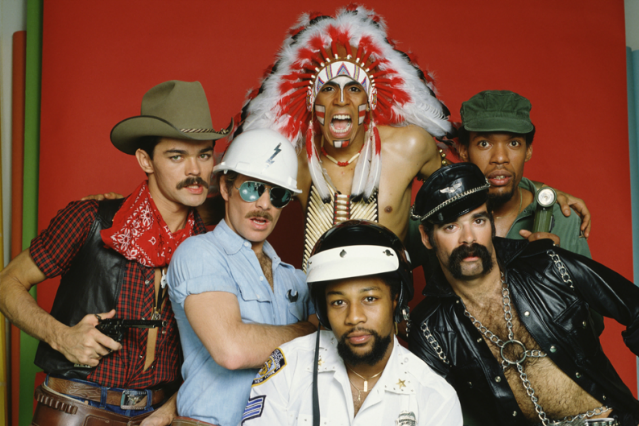
Henri Belolo (music producer, from a 2000 interview with disco-disco.com): [In 1975] I was talking to the gay community about what they liked, what they wanted to listen to musically, and what was their dream, their fantasy. One day [producer Jacques Morali and I] were walking in the streets of New York. I remember clearly it was down in the Village, and we saw an Indian walking down the street and heard the bells on his feet. We followed him into a bar.He was a bartender — he was serving and also dancing on the bar. And while we were watching him dancing and sipping our beer, we saw a cowboy watching him dance. And Jacques and I suddenly had the same idea. We said, “My God, look at those characters. “So we started to fantasize about what were the characters of America.The mix, you know, of the American man…And we named it the Village People.
The pair placed an ad that called for MACHO TYPES WITH MUSTACHE, eventually filling the roles of cowboy, cop, construction worker, soldier, leather-clad biker, and Indian. David Hodo, a 28-year-old struggling singer and actor, responded immediately.
David Hodo:I had just finished a musical about the Grand Ole Opry, and I had a mustache. It was Christmastime, and I needed money. They wanted a cowboy, and I had just finished a western — perfect. But when they said they wanted me to be the construction worker, that was my dad’s dream come true. I’m handy, but I’ve never built anything of consequence.
Victor Willis, who had starred in one of the original productions of The Wiz, would be the lead singer, a cop. A toll collector named Glenn Hughes was the leatherman. Alex Briley originally dressed as a sailor (but switched to a Navy ensign’s uniform when performing the group’s 1979’s hit “In the Navy”). Dancer Felipe Rose, born to a Lakota Sioux father, was, naturally, the Indian. Randy Jones, a singer raised on a North Carolina farm, became the cowboy.
Morali had sold hit-churning label Casablanca (home to Donna Summer and Kiss) on the concept of this boy band even before the roles were cast. The group’s first album, 1977’s Village People, featured the disco hit “San Francisco (You’ve Got Me). “The title track of the following year’s Macho Man debuted (and peaked) at No. 25 on the charts but later became a gay touchstone.
Randy Jones: Something just clicked with us. We had that spark. Victor was a terrific singer: He had the style of Teddy Pendergrass. He was married to Phylicia Rashad. But we didn’t start as a gay group, and not everyone in the group was gay — that’s an incorrect notion. So much of our music was played in black, Latin, and gay underground clubs; that’s’ where the first Village People album found its initial audience.
Hodo: It was 1977, and we were leaving a photography session on 23rd Street. Jacques Morali saw the big pink YMCA on 23rd and asked, “What is this YMCA, anyway? “And after laughing at his accent, we told him the Y was a place where you could go when you first came to New York when you didn’t have any money — you can stay there for very little. And of course, someone joked, “Yeah, but don’t bend over in the showers. “And Jacques, bless his heart, said, “I will write a song about this!”
Jones: David’s a little off. Yeah, Jacques came up with the idea. But what happened is that when I moved to New York in 1975, I joined the McBurney YMCA on 23rd Street. I took Jacques there three or four times in 1977, and he loved it. He was fascinated by a place where a person could work out with weights, play basketball, swim, take classes, and get a room. Plus, with Jacques being gay, I had a lot of friends I worked out with who were in the adult-film industry, and he was impressed by meeting people he had seen in the videos and magazines. Those visits with me planted a seed in him, and that’s how he got the idea for “Y.M.C.A.” — by literally going to the YMCA.
Hodo: We had finished our [third] album, Cruisin’, and we needed one more song as a filler. Jacques wrote “Y.M.C.A.” in about 20 minutes — the melody, the chorus, the outline. Then he gave it to Victor Willis and said, “Fill in the rest.” I was a bit skeptical about some of our hits, but the minute I heard “Y.M.C.A.,” I knew we had something special. Because it sounded like a commercial. And everyone likes commercials.
Jones: It was not intended as a gay anthem. Do you have the lyrics in front of you? There’s nothing gay about them. I think Victor wrote the words, but it’s all a big fucking mystery. The guy who really deserves the credit is Horace Ott, who arranged the horns and strings. Jacques had the ideas, but Horace transformed them into songs.
Horace Ott: What I loved about “Y.M.C.A.” was, to be honest, everything. Great beat, great voice with Victor, great timing in the midst of the disco boom. Now, was it a gay song? I don’t know. It certainly appealed to a lot of people who embraced that lifestyle.
Hodo: “Y.M.C.A.” certainly has a gay origin. That’s what Jacques was thinking when he wrote it, because our first album [1977’s Village People] was possibly the gayest album ever. I mean, look at us. We were a gay group. So was the song written to celebrate gay men at the YMCA? Yes. Absolutely. And gay people love it.
Leah Pouw (media relations manager, Young Men’s Christian Association): We at the YMCA celebrate the song. It’s a positive statement about the YMCA and what we offer to people all around the world.
The song’s undeniable, jinglelike hook made it a natural candidate for a single; it debuted on the Billboard Hot 100 chart on November 11, 1978, and peaked 13 weeks later at No. 2. On January 6, 1979, the Village People appeared on Dick Clark’s American Bandstand, TV’s biggest pop-music showcase.
Jones: We were flying up from South America for the show, and we worked on the choreography on the airplane — handclaps, turning, marching in place…stuff like that. Well, the audience at this particular taping was a bunch of kids bused in from a cheerleader camp. The first time we got to the chorus, we were clapping our hands above our heads. And the kids thought it looked like we were making a Y. So they automatically did the letters. We saw this and started doing letters with them. It was purely audience-generated, which is probably why it’s still so popular. And that’s great for me, because it keeps the checks coming in every six months.
Hodo: When I saw the movements, I thought, “Wow, that is so stupid.” Then everyone in America started doing it, and I thought, “Wow, that is so brilliant.” It took on a life of its own. The next thing we know, Hideki Saijo has the No. 1 hit in Japan with his ver- sion of “Y.M.C.A.” And we hit No. 2 [in the U.S.]. That’s how it always works. Saijo claimed to have invented the dance, so as soon as we got to Japan, we straightened him out.
“Y.M.C.A.” spent 26 weeks on Billboard’s top 100 (during which time the actual YMCA threatened to sue the band before dropping the lawsuit), but due largely to egos and personality clashes, the Village People quickly crumbled. Willis left the band in 1979, just before they were to start work on the feature film Can’t Stop the Music. He was replaced by Ray Simpson, one of the group’s backup singers and the brother of Ashford & Simpson’s Valerie Simpson. The movie (starring Steve Guttenberg as “Jack Morell” and ex-Olympian Bruce Jenner) bombed, as did the soundtrack album.
Three more studio albums came and went with barely a whimper; Willis returned briefly to contribute to 1982’s Fox on the Box. He also recorded an unreleased solo album and struggled with substance abuse. By the end of ’85, the Village People — who eventually sold a reported 65 million albums — gave up.
Jones: I left for the first time in ’81, when the group went in a different direction. But I kept getting royalties. Then I was the only one doing any kind of performing. [When the group broke up], Glenn was working in a camera store, David was a bartender, Alex was working in an office, Felipe was a secretary. It was sad — these were talented men who were once atop the world and deserved a chance to continue their craft.
The Village People regrouped in 1987, but not to record new material. They were proudly and officially a nostalgia act, available for weddings, bar mitzvahs, and corporate events.
Hodo: Bar mitzvahs used to be our bread and butter, everywhere from the Pierre Hotel to backyards. But we haven’t played one in five or six years, because now the parents grew up in the ’80s, not the ’70s. REO Speedwagon does bar mitzvahs instead of us.
Roger Bennett (coauthor, Bar Mitzvah Disco): “Y.M.C.A.” is the single most important song to hit the Jewish religion since “Hava Nagila.” And paradoxically, not one of the Village People is Jewish. But they did play a critical function, providing a slew of new role models for Jewish youth. We were under such pressure to become bankers, accountants, and lawyers. They opened our eyes to other career possibilities: a cop, a builder, a flamboyant Indian…
In February 1996, five years after Morali’s death from AIDS, a onetime aspiring priest from Tampa, Florida, the son-in-law of Yankees owner George Steinbrenner, changed everything.
Joseph Malloy (former general partner, New York Yankees): It was the opening of Legends Field, our spring-training stadium in Tampa, and a couple of the grounds crew guys approached me with the idea of bringing a little excitement to the exhibition games. In the middle of the fifth inning, when they dragged the infield, the guys wanted to do the arm motions to “Y.M.C.A.” I hadn’t heard the song for a long, long time, but the crowd absolutely loved it. I thought, “Hmmm, this might work in New York.”
On April 9, 1996, the Yankees opened at home against the Kansas City Royals. With a driving snowstorm battering players and fans alike, five Yankee Stadium groundskeepers began their customary walk to clean the infield in the middle of the fifth inning. Then, from the speakers, a familiar horn riff and disco beat kicked in.
Juan Gonzalez (from his New York Daily News column, October 29, 1996): They began to dance, strut, and gyrate around second base while they dragged the field. The capacity crowd roared with approving laughter. We all cheered and applauded, and for a moment we all felt a little warmer inside. It was baseball poking fun at itself, reminding us all that this huge, multibillion-dollar, cutthroat business is, after all, about people having a good time.
Molloy: I remember looking at [Yankees] Wade Boggs and Derek Jeter and seeing them swaying to the music. When those grounds crew guys dropped their rakes and performed, you had to watch. From the owner’s box, I would do the Y-M-C-A motions with the crowd. I should have trademarked it.
Michael Musto (columnist, The Village Voice): “Y.M.C.A.” is one of many cultural phenomena that started as a gay in-joke and eventually became stripped of its winkiness and subsumed by the mainstream. Back in the ’70s, the masses did those crazy hand gestures along with the song, truly thinking it was an upbeat number about how nice the Y is, but at least the sophisticated crowd was plugged into the real meaning. The Studio 54 set knew full well the Village People were a campy assortment of gay stereotypes nodding to the gays with coded sexual allusions and macho posturing.
Molloy: “Y.M.C.A.” is about homosexuality? I had no idea until this very moment. Wow! Well, it’s a great song that makes people feel good. That’s what’s important.
Not long after Yankee Stadium made “Y.M.C.A.” a fifth-inning staple (which is still being done 12 seasons later), other teams took notice. Also in ’96, the Oakland Coliseum was undergoing a $200 million renovation. As an A’s batter stood at the plate, trying to concentrate while, say, Randy Johnson unleashed a 97-mph inside fastball, the noise from bulldozers and jackhammers filled the air.
David Rinetti (vice president of stadium operations, Oakland A’s): We wanted to do something cool to make the most of a terrible time. So we dressed two guys up as construction workers and sent them out to the construction site. Then we’d have two of our security guards go out there and pretend to tell them to stop making so much noise. Everyone [in the crowd] believed it — then “Y.M.C.A.” would come on and the four of them would break out into dance. One of our security guards was a guy named Icebox who played in the local roller-derby league. He was a huge man, and when he danced…
Robert “Icebox” Smith (Oakland Coliseum security guard): I tore that place up. The A’s weren’t so hot that year, but we brought that house down every single night. It was magical. We were on ESPN for weeks. It was a gay song?
Fans ate it up — some even came dressed as the characters. Teams would host Village People Nights, capped off by postgame concerts — often by the Village People themselves.
Dr. Costas Karageorghis (sports psychologist, London’s Brunel University): When you think of using music to engage a crowd and increase cohesion, “Y.M.C.A.” is the perfect track. It turns a group of individuals into a unit, just like the wave, simply because of a common action. I haven’t heard it played at rugby, though — probably too butch.
Kyle Smith (director of stadium operations, Brevard County Manatees): There are a handful of songs that just make you get up and dance. At our ballpark, “Y.M.C.A.” has to be considered one of them. “Y.M.C.A.” is a gaysong? Honestly, I had no clue.
Cameron Harris (Wally the Warthog mascot, Winston-Salem Warthogs): I’m the only mascot I know who does the whole Y-M-C-A hand gesture thing while standing on his head. As soon as the first beats come out of the speakers, everyone in the stands is asking, “Where’s Wally? Where’s that wild Wally?” Not sure what you mean about it being a gay song…. I know the Y is a healthy place to exercise.
Musto: All these years later, the gay subtext is gone, and it’s a rah-rah crowd-pleaser for the baseball stadium crowd. It happens. A rallying song for the oppressed turns into a middle-of-the-road spirit-lifter, mainly because the straights like to steal things from the gays, take away all the scary edge, and make it their own.
Tim Wiles (director of research, Baseball Hall of Fame): The song is not alone in coming way out of left field. [Ramones’ “Blitzkrieg Bop”] is played in a lot of ball parks, and someone said to me once, “If Joey Ramone knew this was being played at games, he’d roll over in his grave.”
Brian Johnson (former major-league catcher): I’m not sure you can have a game without playing “Y.M.C.A.” The funny thing is, every ballplayer I know has heard the song a thousand times, but how many of them know it has to do with gay men at the Y? One percent, maybe? But that’s baseball players — not the most informed when it comes to music.
Brandon McCarthy (pitcher, Texas Rangers): I have no idea how “Y.M.C.A.” got popular or how it has remained so. If I had earplugs, I’d put them in every time that song came on.
J.P. Howell (pitcher, Tampa Bay Rays): I hate “Y.M.C.A.” I’ve been over it since I first heard it.
Jones: We made a mark in pop music but an even deeper impression in pop culture. People remember Donna Summer, Kiss, the Bee Gees, but they didn’t have the same impact on pop culture that the Village People did.
Belolo (from disco-disco.com): In life, you discover that an invention is not always one man or two men; it’s a combination of people putting their love together. “Y.M.C.A.” became a standard that will stay forever.
Hodo: The real genius of “Y.M.C.A.” is that it can be taken any way you want. We were once on a television show in England, and the hostess said, “Now, this is a gay song, isn’t it?” And I said, “No, actually it’s a Christian song — the Young Men’s Christian Association. “I mean, honey, isn’t it obvious?









 Joe
Joe





 The Closet Professor