Category Archives: Poetry

Cheerfulness Taught by Reason


Cheerfulness Taught by Reason
By Elizabeth Barrett Browning

I think we are too ready with complaint
In this fair world of God’s. Had we no hope
Indeed beyond the zenith and the slope
Of yon gray blank of sky, we might be faint
To muse upon eternity’s constraint
Round our aspirant souls. But since the scope
Must widen early, is it well to droop,
For a few days consumed in loss and taint?
O pusillanimous Heart, be comforted,—
And, like a cheerful traveller, take the road—
Singing beside the hedge. What if the bread
Be bitter in thine inn, and thou unshod
To meet the flints?—At least it may be said,
“Because the way is short, I thank thee, God!”

About This Poem

“Cheerfulness Taught by Reason” was published in Browning’s book A Drama of Exile: and other poems (H. G. Langley, 1845). It is true, we are often all too ready to complain, but God is on our side. God provides us with hope and happiness, it is only without Him that we could truly complain. If there was no God, we would have right to become weak and feel like our aspirations are constrained by an empty eternity, but because there is much more in life beyond that where there is God, we shouldn’t complain when we have a few bad days. Our cowardly hearts should be comforted and we should move on happily. Even if we come across some bad times, at least this life God has given us is short and afterwards we can have paradise for eternity. To put that more succinctly, on this journey to happiness, we must be prepared to run into bumps in the road, but know in the end it will get better. Even if in the end you feel as if the journey has taught you nothing, you must be thankful that the journey was short.

This poem was, in my opinion, a perfect companion to my post yesterday. My road has been bumpy and the journey has been arduous, but I persevered and kept God by my side, and I am much happier because of it.


October

  
October
By Helen Hunt Jackson

Bending above the spicy woods which blaze,
Arch skies so blue they flash, and hold the sun
Immeasurably far; the waters run
Too slow, so freighted are the river-ways
With gold of elms and birches from the maze
Of forests. Chestnuts, clicking one by one,
Escape from satin burs; her fringes done,
The gentian spreads them out in sunny days,
And, like late revelers at dawn, the chance
Of one sweet, mad, last hour, all things assail,
And conquering, flush and spin; while, to enhance
The spell, by sunset door, wrapped in a veil
Of red and purple mists, the summer, pale,
Steals back alone for one more song and dance.

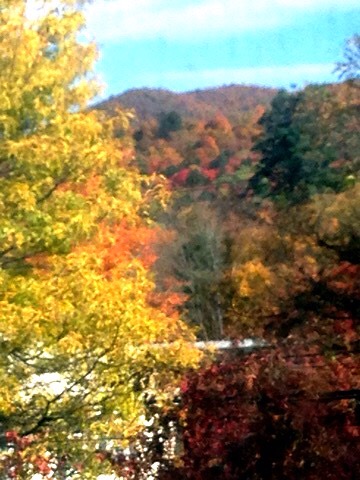
The picture above is not of the best quality because it was taken by me with my phone through my kitchen window. (My phone is my only internet right now.) This really is the view from my kitchen. The view from my balcony is just as beautiful. I feel like I moved into a postcard.
PS Our friend JiEL was able to enhance to enhance the picture above to give it some truer color. The window pains had muted the colors a bit.


Beginning

image


Beginning
by Warren Hanson

This is the Beginning…
This is where it all will start,
on the Wings of some new Spirit with the Beat of some new Heart.

Every morning brings a Promise,
Every day has Gifts to give,
But Today…right now…This Minute….
is when I begin to Live.
And the air that I am breathing is the breeze of what could be,
as I stand here looking out on all the things that could be Me.
And the road that goes before me, leading somewhere out of sight,
is a brand new Opportunity for me to get it Right.
This is the Beginning. This is
Once Upon a Time….
There are dragons to be vanquished! There are castle walls to climb!
But this story isn’t written yet.
I’m only at page One.
The Adventure that’s awaiting me has only just Begun.
There are Mysteries and Treasurers.
There are daring deeds to do!
And if I speak the secret word, then all my Wishes will come true.
That Magic Word has powers that can make the heavens spin.
But it really is not Secret that the password is……”Begin!”
Oh the possibilities is this Beginning I have made!
I am Ready!…. but reluctant.
I am Excited!…. but afraid.

Afraid that starting something New leaves something Old behind.
Afraid that what I seek is something I may Never find.
Or, if I Find it, that it won’t be what I want at all.
That what I’ve left Behind is what I needed after all.

Beginning can be bittersweet, and hard to comprehend.
It can mean that some sweet, precious part of life is at an End.
And the Heart can feel so Hollow when it has to say Good-bye
that the thought of starting Over is too Hard to even try.

But when I reach the End, when all my days are nearly through,
I will Not want to look back on all the things I Didn’t do.
Nor regret the Joys and Passions of the me that Might have been,
if only I had found the simple Courage to Begin.
So…….This is the Beginning….
My Beginning……..My Rebirth.
I Awaken to the Wonder of what I am Really worth.
It is a Springtime for the Spirit, and it’s Giving me a Choice.
So I choose to Use this season as a reason to Rejoice!

I lift my voice in Sweet thanksgiving, singing Loud….and not alone.
A host of Harmonies accompanies my song of the unknown.
Loving Friends and willing Strangers, with their voices joining in,
create a chorus of Encouragement that begs me to Begin.

And the end?…..
It’s out there, Somewhere, farther than the heart can see.
And the Power that will take me there is Here, inside of me.
Though there is no way I can know how many trials I’ll endure,
nor the Joys that I may find,
there is One thing I know for sure…..

This is the Beginning…….

Warren Hanson is a gifted writer of books for children and adults alike. It’s amazing how closely it aligns with what I am feeling today. I’m putting the final touches on packing, loading my car, and telling people goodbye. I’m heading north tomorrow morning. As the poem says, “I am Ready!…. but reluctant. I am Excited!…. but afraid.” It’s so true that “Beginning can be bittersweet, and hard to comprehend.” It can be a bit overwhelming at times. This is a new adventure and a new job far away from home. I don’t know what the future will hold, but I look forward to getting settled and getting to work. This is the Beginning…….


When We Two Parted

image

When We Two Parted
George Gordon Byron, 1788 – 1824

When we two parted
In silence and tears,
Half broken-hearted
To sever for years,
Pale grew thy cheek and cold,
Colder thy kiss;
Truly that hour foretold
Sorrow to this.

The dew of the morning
Sunk chill on my brow–
It felt like the warning
Of what I feel now.
Thy vows are all broken,
And light is thy fame;
I hear thy name spoken,
And share in its shame.

They name thee before me,
A knell to mine ear;
A shudder comes o’er me–
Why wert thou so dear?
They know not I knew thee,
Who knew thee too well–
Long, long shall I rue thee,
Too deeply to tell.

In secret we met–
In silence I grieve,
That thy heart could forget,
Thy spirit deceive.
If I should meet thee
After long years,
How should I greet thee?–
With silence and tears.


Ut Pictura, Poesis

image
Self-Portrait at 36 w/ David
By Ellen Hagan

Barnegat Light, New Jersey—April 4, 2015

Because looking at myself w/ out you beside me is unnatural
& though the light is all wrong—your camera slung & up

the light feels right to me, warm & soft, your chest pressed
towards my back, both our heads angling towards the dock,

boat slips on the bay—all the scallops secure in the sea still,
their bone-less bodies soft. & our own getting softer each day.

Sometimes the mirror makes our features fun-house style
& we’re way more old age than the teen age we most times feel,

or the slight of shutter promises supple & smooth, where edge
& ravine & straight up wrinkle have arrived & settled in

like vulnerable house guests we don’t have the heart to kick out.
How comfortable they’ve become all over our fine faces

& my neck—how they’ve become familiar w/ our privacy. How
we’ve begun to cradle them. Stitch & loom. In the photograph

there we are—chins tilted towards one another, mouths closed

& turned up. A type of satisfaction dead in this middle we’re both in.

 
Self-Portrait on the Street of an Unnamed Foreign City
By Jennifer Grotz

The lettering on the shop window in which
you catch a glimpse of yourself is in Polish.

Behind you a man quickly walks by, nearly shouting
into his cell phone. Then a woman

at a dreamier pace, carrying a just-bought bouquet
upside-down. All on a street where pickpockets abound

along with the ubiquitous smell of something baking.
It is delicious to be anonymous on a foreign city street.

Who knew this could be a life, having languages
instead of relationships, struggling even then,

finding out what it means to be a woman
by watching the faces of men passing by.

I went to distant cities, it almost didn’t matter
which, so primed was I to be reverent.

All of them have the beautiful bridge
crossing a grey, near-sighted river,

one that massages the eyes, focuses
the swooping birds that skim the water’s surface.

The usual things I didn’t pine for earlier
because I didn’t know I wouldn’t have them.

I spent so much time alone, when I actually turned lonely
it was vertigo.

Myself estranged is how I understood the world.
My ignorance had saved me, my vices fueled me,

and then I turned forty. I who love to look and look
couldn’t see what others did.

Now I think about currencies, linguistic equivalents, how lopsided they
are, while
my reflection blurs in the shop windows.

Wanting to be as far away as possible exactly as much as still with you.
Shamelessly entering a Starbucks (free wifi) to write this.

 
About These Poem:

When writing about “Self-Portrait on the Street of an Unnamed Foreign City,” Jennifer Grotz said, “Ut pictura, poesis: as with painting, so with poetry, the saying goes, and perhaps this is why from time to time poets, like painters, use the exercise of the self-portrait to practice seeing. If either the poet or the painter is lucky, sight leads to insight. In this unabashedly autobiographical poem, I use a shop window on a busy street, not a mirror, to view myself, and though my poem aims for truthful precision, I think it renders what, I’m convinced more and more, poems are meant to achieve, that is: registering what it feels like to pass through time.” I agree that poems are meant to evoke feelings; it’s the main thing that draws me to poetry. A hundred people can read the same poem, and each would probably have a different meaning. We tend to focus on what the “experts,” that is those literature professors and literary critics tell us what a poem is about, but a good poem as in any art form, it speaks differently to each person.

In another self-portraits through poetry, Ellen Hagan presents a very different picture. In her comments on “Self-Portrait at 36 w/ David,” she says, “There is something both jarring and seductive about the aging process—a thrill to be gathering years and moments and history (and hopefully wisdom), but too a railing against the media’s constant perception of youth and how to hang onto it. Writing has forever been a balm against all that keeps me awake at night. I look forward to writing the poems that will surely harness all the years to come.” My grandmother used to always say that you are only as old as you feel. In a way, this poem shows how the author sees herself as a woman who is young at heart, even if she looks older than she feels.

These are two very different portraits and two very different poems in content, though they have some grammatical similarities. Yet both are self portraits and tell how the poet sees herself.


The Stripling

image

The Stripling
Dante Micheaux

1 Samuel 17:56

The field soldiers remember the triumph,
a lithe boy’s naal on the head of giant,
before the king rode through the ranks
to inquire about his parentage or the prince
had him bathed, his hair scented with sweet herbs.

After the crowds dwindled, because neither
one’s cunning nor the adulation of the victorious
are nourishment, and the battle, having made him
hungry, alone and in silence, the boy
slowly ate the brain of the giant.

A stripling, to tell the truth, the boy grew—
mad with the taste—savored the giant brain
and learned its ways, became a giant,
begat giants, who craved and ate all
the people in the land, except their own.


About This Poem

“‘The Stripling’ is the marriage of a thematic obsession with beautiful boys (in this case, the youthful, ruddy and handsome David) and history’s tendency to perpetually recast the underdog and the favorite in its oldest stories.”
Dante Micheaux

Dante Micheaux is the author of Amorous Shepherd (Sheep Meadow Press, 2010). He is completing a study on literary influence and sexuality. He lives in London.


The Song of the Chattahoochee

image

The Song Of The Chattahoochee
Sidney Lanier, 1842 – 1881

Out of the hills of Habersham,
Down the valleys of Hall,
I hurry amain to reach the plain,
Run the rapid and leap the fall,
Split at the rock and together again,
Accept my bed, or narrow or wide,
And flee from folly on every side
With a lover’s pain to attain the plain
Far from the hills of Habersham,
Far from the valleys of Hall.

All down the hills of Habersham,
All through the valleys of Hall,
The rushes cried ‘Abide, abide,’
The willful waterweeds held me thrall,
The laving laurel turned my tide,
The ferns and the fondling grass said ‘Stay,’
The dewberry dipped for to work delay,
And the little reeds sighed ‘Abide, abide,
Here in the hills of Habersham,
Here in the valleys of Hall.’

High o’er the hills of Habersham,
Veiling the valleys of Hall,
The hickory told me manifold
Fair tales of shade, the poplar tall
Wrought me her shadowy self to hold,
The chestnut, the oak, the walnut, the pine,
Overleaning, with flickering meaning and sign,
Said, ‘Pass not, so cold, these manifold
Deep shades of the hills of Habersham,
These glades in the valleys of Hall.’

And oft in the hills of Habersham,
And oft in the valleys of Hall,
The white quartz shone, and the smooth brook-stone
Did bar me of passage with friendly brawl,
And many a luminous jewel lone
— Crystals clear or a-cloud with mist,
Ruby, garnet and amethyst —
Made lures with the lights of streaming stone
In the clefts of the hills of Habersham,
In the beds of the valleys of Hall.

But oh, not the hills of Habersham,
And oh, not the valleys of Hall
Avail: I am fain for to water the plain.
Downward the voices of Duty call —
Downward, to toil and be mixed with the main,
The dry fields burn, and the mills are to turn,
And a myriad flowers mortally yearn,
And the lordly main from beyond the plain
Calls o’er the hills of Habersham,
Calls through the valleys of Hall.

Sidney Lanier composed “Song of the Chattahoochee” in November 1877 for a small paper in West Point, Georgia; nonetheless, at the time he considered it the best poem he had ever written, and critics have generally agreed that it is one of his finer efforts. Originally from Macon, Georgia, Lanier travelled much in Georgia, Maryland, Florida, and North Carolina for employment and for his health. He fought for the Confederacy in the Civil War and was eventually captured by Union troops. He spent the rest of the war in prison, where he relieved his own sufferings and those of his fellow prisoners with melodious tunes on the flute he had taught himself to play when he was younger. But unfortunately, he contracted tuberculosis, and he spent the rest of his life trying unsuccessfully to restore himself to good health. These circumstances—travel, flute-playing, military discipline, and a keen awareness of his own mortality—may account for the major elements of his poetry: nature, music, moral duty, and religion. Lanier was able to see much of the South’s natural beauty, and he found much religious and spiritual significance in it. As a poet, he is regarded as a minor writer in American literature whose prime contribution was to lyrical or musical poetry in the tradition of the American poet Edgar Allan Poe and the English poet Alfred Tennyson. “Song of the Chattahoochee” is primarily a musical poem whose words flow very much like the river that is its speaker. The river’s aim is to do its duty, answering the call of God.

The Chattahoochee River rises in what used to be Habersham County, Georgia. The county, originally comprised much of Northeast Georgia, was cut up dramatically in the latter half of the 19th century and the first years of the 20th Century. The “valley of Halls,” which refers to where the Chattahoochee flows through Hall County, Georgia, became Lake Sydney Lanier in 1953 with the damming of the Chattahoochee River.

I have always loved this poem, but it also always brings to mind the Alan Jackson song “Chattahoochee .”  Every time I think of the Chattahoochee River, I think of this lady I used to work with, who always turned red when this song came on.  It only took the opening stanza:

Way down yonder on the Chattahoochee
It gets hotter than a hoochie coochie
We laid rubber on the Georgia asphalt
We got a little crazy but we never got caught

You’re probably wondering why would that cause her to get embarrassed.  With her daughter, she had always used “coochie” as her word for a woman’s lady parts (Southern women just won’t call it what it is.  I know one that refers to it as a squirrel.). So when this song first came on, her daughter was very confused by the line “It gets hotter than a hoochie coochie.”  Most people seem to think that “hoochie coochie” refers to a hoochie, or sexually provocative woman, and a coochie, just what my old coworker had told her daughter.  In fact, this is not what it means at all.  It means a sexually provocative belly dance that originated at a Philadelphia Exhibition in 1876. And while some may think that Jackson was referring to the former and not the latter, I’ll give him the benefit of the doubt and say that he used “hoochie coochie” because it was a phrase he had heard before and it rhymed nicely with Chattahoochee. It still makes me laugh though.


Mending Walls

image

Mending Wall
by Robert Frost

Something there is that doesn’t love a wall,
That sends the frozen-ground-swell under it,
And spills the upper boulders in the sun;
And makes gaps even two can pass abreast.
The work of hunters is another thing:
I have come after them and made repair
Where they have left not one stone on a stone,
But they would have the rabbit out of hiding,
To please the yelping dogs. The gaps I mean,
No one has seen them made or heard them made,
But at spring mending-time we find them there.
I let my neighbor know beyond the hill;
And on a day we meet to walk the line
And set the wall between us once again.
We keep the wall between us as we go.
To each the boulders that have fallen to each.
And some are loaves and some so nearly balls
We have to use a spell to make them balance:
‘Stay where you are until our backs are turned!’
We wear our fingers rough with handling them.
Oh, just another kind of outdoor game,
One on a side. It comes to little more:
There where it is we do not need the wall:
He is all pine and I am apple orchard.
My apple trees will never get across
And eat the cones under his pines, I tell him.
He only says, ‘Good fences make good neighbors.’
Spring is the mischief in me, and I wonder
If I could put a notion in his head:
‘Why do they make good neighbors? Isn’t it
Where there are cows? But here there are no cows.
Before I built a wall I’d ask to know
What I was walling in or walling out,
And to whom I was like to give offense.
Something there is that doesn’t love a wall,
That wants it down.’ I could say ‘Elves’ to him,
But it’s not elves exactly, and I’d rather
He said it for himself. I see him there
Bringing a stone grasped firmly by the top
In each hand, like an old-stone savage armed.
He moves in darkness as it seems to me,
Not of woods only and the shade of trees.
He will not go behind his father’s saying,
And he likes having thought of it so well
He says again, ‘Good fences make good neighbors.’
The image at the heart of “Mending Wall” is arresting: two men meeting on terms of civility and neighborliness to build a barrier between them. They do so out of tradition, out of habit. The poem seems to meditate conventionally on three grand themes: barrier-building (segregation, in the broadest sense of the word), the doomed nature of this enterprise, and our persistence in this activity regardless. But, as we so often see when we look closely at Frost’s best poems, what begins in folksy straightforwardness ends in complex ambiguity. The speaker would have us believe that there are two types of people: those who stubbornly insist on building superfluous walls (with clichés as their justification) and those who would dispense with this practice—wall-builders and wall-breakers. But are these impulses so easily separable? And what does the poem really say about the necessity of boundaries?

Frost’s poem is often listed as one of the great friendship poems, and I believe it speaks wonderfully of some of the intricacies of friendships. I have wonderful friends close to home and some who live far away from me and are part of my camaraderie of cyber friends. My friends closer to home are those I went to school with, work with, or met through family or acquaintances. All of my blog friends, who by the way mean as much to me as my friends who live nearby, live in far away places (with one or two exceptions). I think though that with all friendships we build walls. Just as the speaker in “Mending Wall” asks why we need the wall, I too ask why we need the walls. I don’t know that I have an answer for that, but I think I might have an idea. I know there are certain things in real life that I don’t share with my friends. Different friends I will reveal different things to. It’s not that I’m lying to them, at least I don’t see it that way, but it is because different friends share different parts of my life. Most of my friends know that I a gay, but not all of them. Why don’t I tell them? I really don’t know, but part of it is that the subject never came up. They may or may not know or may think they do know, but it really doesn’t matter to me. It is really not my defining characteristic, so why should it matter.

Yet, I am very honest about myself within the context of my blog. A lot of that has to do with the anonymity of writing a blog. Some people know me personally who read my blog. I am very honest and open with those people. I trust them to be open and honest with me and many of them are. Some have become my greatest friends, and they know who I am talking about. I love them dearly, and I hope they know it. Others I’m just getting to know. I feel as if I can often be more honest with them, but are their still walls involved? Of course there are, usually that wall is the great distance between us, but I still endeavor to be completely honest with them. Some may get to know me and not like my honesty or some other aspect about me. When that happens, I rarely know what it is, even though I wish I did know. If I knew what I said or did I might could mend things. Then again, I might just have a fundamental flaw that they see that I don’t, but I would lie, to fix it if possible. Sometimes, I just want to know what changed so suddenly in the friendship, but that wall is there and my southern upbringing taught me that it is rude to be impolite. The walls are around us, and I know that we don’t need them, just as the speaker in this poem states. Yet, you still have to wonder, do “Good fences make good neighbors”?

Hell, I think I got off the subject here, yet I chose this poem to speak about friendships. I do love the poems of Robert Frost. “Mending Wall” is one of my favorites. I can’t wait until we get to Frost’s poetry in the American Literature class that I teach. I have always enjoyed teaching the poets.

I want to add one more poem to end this post. It is also from a favorite poet of mine and it speaks for itself.

Dear Friends
by Edwin Arlington Robinson

Dear friends, reproach me not for what I do,
Nor counsel me, nor pity me; nor say
That I am wearing half my life away
For bubble-work that only fools pursue.
And if my bubbles be too small for you,
Blow bigger then your own: the games we play
To fill the frittered minutes of a day,
Good glasses are to read the spirit through.

And whoso reads may get him some shrewd skill;
And some unprofitable scorn resign,
To praise the very thing that he deplores;
So, friends (dear friends), remember, if you will,
The shame I win for singing is all mine,
The gold I miss for dreaming is all yours.


Opportunity

image

Opportunity
By Helen Hunt Jackson

I do not know if, climbing some steep hill,
Through fragrant wooded pass, this glimpse I bought,
Or whether in some mid-day I was caught
To upper air, where visions of God’s will
In pictures to our quickened sense fulfill
His word. But this I saw.
A path I sought
Through wall of rock. No human fingers wrought
The golden gates which opened sudden, still,
And wide. My fear was hushed by my delight.
Surpassing fair the lands; my path lay plain;
Alas, so spell-bound, feasting on the sight,
I paused, that I but reached the threshold bright,
When, swinging swift, the golden gates again
Were rocky wall, by which I wept in vain.

I used this poem “Opportunity,” because I have a tremendous opportunity that presented itself yesterday. I got a call for an interview on Thursday. Because this place is so far away, they are initially doing telephone interviews. I mentioned this job before because I was excited when I applied for it. So often, when you come across a job announcement, you meet the minimum requirements but not all of the “preferred qualifications.” This job, however, I not only meet their minimum qualifications but also their preferred qualifications. I’m not familiar with the software this place is using, but I will be before Thursday. Besides, I’ve yet to find a computer program that I cannot master. I’m just going to spend today and tomorrow refreshing myself on some of the specifics of the job and the history that I will be expected to know.

This would be a wonderful opportunity and a place where I can be myself again, and not just the person my family expects me to be. Please pray for me. Pray this goes well, and pray that if this is what God wants for me, then it will happen.


A Poetic Lesson: The Villanelle

image

The House on the Hill
By Edwin Arlington Robinson

They are all gone away,
The House is shut and still,
There is nothing more to say.

Through broken walls and gray
The winds blow bleak and shrill:
They are all gone away.

Nor is there one to-day
To speak them good or ill:
There is nothing more to say.

Why is it then we stray
Around the sunken sill?
They are all gone away,

And our poor fancy-play
For them is wasted skill:
There is nothing more to say.

There is ruin and decay
In the House on the Hill:
They are all gone away,
There is nothing more to say.

 
Edwin Arlington Robinson is one of my favorite American poets (see this post from several years ago). One of the things I will truly miss about teaching at my former job is having the opportunity to teach American literature. Sometimes, I wish I had gotten a master’s in American literature or literary history. If I had unlimited resources, I’d get a degree in American lit, American Art history, museum studies and probably one in religious studies, but that’s neither here nor there.

Now for the lesson on this poem. It is a poetic form of fixed verse known as the villanelle. A villanelle (also known as villanesque) is a nineteen-line poetic form consisting of five tercets (three line stanzas) followed by a quatrain (a four line stanza). There are two refrains and two repeating rhymes, with the first and third line of the first tercet repeated alternately until the last stanza, which includes both repeated lines. The word derives from Latin, then Italian, and is related to the initial subject of the form being the pastoral.

The rhyme-and-refrain pattern of the villanelle can be schematized as A1bA2 abA1 abA2 abA1 abA2 abA1A2 where letters (“a” and “b”) indicate the two rhyme sounds, upper case indicates a refrain (“A”), and numerals (1 and 2) indicate Refrain 1 and Refrain 2. The pattern is shown as an example in the poem “Do not go gentle into that good night” by Dylan Thomas, which is the poem most often used as an example of a villanelle:

Do not go gentle into that good night,
Old age should burn and rave at close of day;
Rage, rage against the dying of the light.

Though wise men at their end know dark is right,
Because their words had forked no lightning they
Do not go gentle into that good night.

Good men, the last wave by, crying how bright
Their frail deeds might have danced in a green bay,
Rage, rage against the dying of the light.

Wild men who caught and sang the sun in flight,
And learn, too late, they grieved it on its way,
Do not go gentle into that good night.

Grave men, near death, who see with blinding sight
Blind eyes could blaze like meteors and be gay,
Rage, rage against the dying of the light.

And you, my father, there on the sad height,
Curse, bless, me now with your fierce tears, I pray.
Do not go gentle into that good night.
Rage, rage against the dying of the light.

Refrain 1 (A1)
Line 2 (b)
Refrain 2 (A2)

Line 4 (a)
Line 5 (b)
Refrain 1 (A1)

Line 7 (a)
Line 8 (b)
Refrain 2 (A2)

Line 10 (a)
Line 11 (b)
Refrain 1 (A1)

Line 13 (a)
Line 14 (b)
Refrain 2 (A2)

Line 16 (a)
Line 17 (b)
Refrain 1 (A1)
Refrain 2 (A2)

Unlike many fixed verse poetic forms, the villanelle has no established meter, although most 19th-century villanelles have used trimeter or tetrameter and most 20th-century villanelles have used pentameter. Slight alteration of the refrain line is permissible.

The form started as a simple ballad-like song with no fixed form; this fixed quality would only come much later, from the poem “Villanelle (J’ay perdu ma Tourterelle)” (1606) by Jean Passerat. From this point, its evolution into the “fixed form” used in the present day is debated. Despite its French origins, the majority of villanelles have been written in English, a trend which began in the late nineteenth century. The villanelle has been noted as a form that frequently treats the subject of obsessions, and one which appeals to outsiders; its defining feature of repetition prevents it from having a conventional tone.

In the villanelle’s repetition of lines, the form is often used, and properly used, to deal with one or another degree of obsession, such as in Sylvia Plath’s “Mad Girl’s Love Song” amongst other examples. Repetition allows the possibility for the form to evoke, through the relationship between the repeated lines, a feeling of dislocation and is what some have termed a paradigm for schizophrenia. This repetition of lines has been considered to prevent villanelles from possessing a conventional tone and that instead they are closer in form to a song or lyric poetry. Stephen Fry says that the villanelle “is a form that seems to appeal to outsiders, or those who might have cause to consider themselves as such”, having a “playful artifice” which suits “rueful, ironic reiteration of pain or fatalism.” In spite of this, the villanelle has also often been used for light verse, as for instance Louis Untermeyer’s “Lugubrious Villanelle of Platitudes” or the song by They Might Be Giants called “Hate the Villanelle.”

On the relationship between form and content, Anne Ridler noted in an introduction to her own poem “Villanelle for the Middle of the Way” a point made by T. S. Eliot, that “to use very strict form is a help, because you concentrate on the technical difficulties of mastering the form, and allow the content of the poem a more unconscious and freer release,” which sounds so very Post Modern. In an introduction to his own take on the form entitled “Missing Dates,” William Empson suggested that while the villanelle is a “very rigid form,” W. H. Auden—in his long poem “The Sea and the Mirror”—had nonetheless “made it sound absolutely natural like the innocent girl talking.”

As an English teacher colleague once told me, fixed verse poems are fascinating because you have to have a true talent to make a poem not only conform to fixed verse rules, but to at at the same time create a poem that has meaning. Eliot might have believed free verse allowed for the unconscious to take over as the poet concentrates on form, but a poet who truly uses fixed verse must be able to master the language and the art.  Of the fixed verse forms, I think maybe the villanelle might be the easiest only because it does not follow a specific meter, which is a lesson for another week.