Category Archives: Poetry

Of Love: A Sonnet

image

Of Love: A Sonnet
Robert Herrick, 1591 – 1674

How love came in I do not know,
Whether by the eye, or ear, or no;
Or whether with the soul it came
(At first) infused with the same;
Whether in part ’tis here or there,
Or, like the soul, whole everywhere,
This troubles me: but I as well
As any other this can tell:
That when from hence she does depart
The outlet then is from the heart.

Though beautiful, I want to see if any of you can figure out what is wrong with this poem. I would say that I’d give a prize to the person who figured it out, but I have no idea what kind of prize I could give. If you had taken my class in English Literature, you’d know instantly what the problem with this poem is. Any guesses?


Summer Rain

image

Summer Rain
By Amy Lowell, 1874 – 1925

All night our room was outer-walled with rain.
Drops fell and flattened on the tin roof,
And rang like little disks of metal.
Ping!—Ping!—and there was not a pin-point of silence between
them.
The rain rattled and clashed,
And the slats of the shutters danced and glittered.
But to me the darkness was red-gold and crocus-colored
With your brightness,
And the words you whispered to me
Sprang up and flamed—orange torches against the rain.
Torches against the wall of cool, silver rain

P.S. My headache is better, just a residual shadow headache that usually follows the really bad one. The one last night had come and gone throughout the day. The thing with cluster headaches is that if you can stay busy and be up and around, they aren’t as noticeable but when you stop, they hit you like a ton of bricks, which is what happened last night when I laid down to go to bed and wrote my post for today. I’m really glad that I have good medicine that actually works.


Are You Going to Stay?

image

Are You Going to Stay?

Thomas Meyer

What was it I was going to say?
Slipped away probably because
it needn’t be said. At that edge

almost not knowing but second
guessing the gain, loss, or effect
of an otherwise hesitant remark.

Slant of light on a brass box. The way
a passing thought knots the heart.
There’s nothing, nothing to say.

About This Poem

“Why not take a reflective, little lyric moment, a sort of ‘negative capability’ sigh, and ignite it with a title (question) that demands a yes or no, not a maybe. The result struck me as oddly erotic.”
Thomas Meyer

Thomas Meyer is the author of Essay Stanzas (Song Cave, 2014). He lives in the mountains of western North Carolina.


Still I Rise

image

Still I Rise

Maya Angelou
, 1928 – 2014

You may write me down in history
With your bitter, twisted lies,
You may trod me in the very dirt
But still, like dust, I’ll rise.

Does my sassiness upset you?
Why are you beset with gloom?
‘Cause I walk like I’ve got oil wells
Pumping in my living room.

Just like moons and like suns,
With the certainty of tides,
Just like hopes springing high,
Still I’ll rise.

Did you want to see me broken?
Bowed head and lowered eyes?
Shoulders falling down like teardrops,
Weakened by my soulful cries?

Does my haughtiness offend you?
Don’t you take it awful hard
‘Cause I laugh like I’ve got gold mines
Diggin’ in my own backyard.

You may shoot me with your words,
You may cut me with your eyes,
You may kill me with your hatefulness,
But still, like air, I’ll rise.

Does my sexiness upset you?
Does it come as a surprise
That I dance like I’ve got diamonds
At the meeting of my thighs?

Out of the huts of history’s shame
I rise
Up from a past that’s rooted in pain
I rise
I’m a black ocean, leaping and wide,
Welling and swelling I bear in the tide.

Leaving behind nights of terror and fear
I rise
Into a daybreak that’s wondrously clear
I rise
Bringing the gifts that my ancestors gave,
I am the dream and the hope of the slave.
I rise
I rise
I rise.

From And Still I Rise by Maya Angelou.

“Still I Rise” was Angelou’s favorite poem. In the poem, she refers to the indomitable spirit of Black people, using repetition and the categorization of injustices against them. It is a theme many of is can relate too, especially the LGBT community. When we are down, we must rise again, because if we don’t then our foes win. She quoted it during interviews and often included it in her public readings. Despite adversity and racism, Angelou expresses her faith that one will overcome and triumph. Scholar Lyman B. Hagen compares “Still I Rise” with spirituals that express hope. As she does in “Phenomenal Woman” and throughout her poetry and autobiographies, Angelou speaks not only for herself, but for her entire gender and race, but what makes her an enduring poet is the universality of what she wrote. Reviewer Ellen Lippmann calls “Still I Rise” a “proud, even defiant statement of behalf of all Black people”. Angelou, during an interview in 1997, stated that she used the poem to help sustain her during hard times, and that many people, both Black and white, used it in the same way. I know that I do.
Some days, it’s difficult to even get out of bed and face the world, but I will persevere and carry on my life. People have remarked that I have taken being unemployed remarkably well, it’s not that I’m taking it well, I’m just good at hiding it, but I keep in mind what many have told me and what has become my mantra, “When God closes one door, he opens another.” I’ve grown fond of another way of saying this too, “Sometimes, good things fall apart so better things can fall together.” May be that’s what’s happening in my life right now. Things seem like they are falling apart, but in reality, better things are coming together. The lyricist and novelist Paulo Coelho said, “Close some doors. Not because of pride, incapacity, or arrogance, but simply because they no longer lead somewhere.” I know that my previous teaching job was leading nowhere, and it was time for a change. I just praying that I come out the other side of this better off than before, because “Still I Rise.”


First Love


First Love

 By Jennifer Franklin

The boy beside me
is not you but he
is familiar in all

the important ways.
I pass through life
finding you over

and over again—
oppress you
with love. And every

surrogate?
Afflicted by my
kindness, they leave

me with my music.
I loved you before
I ever loved you.


About This Poem

“This poem was written on a napkin in Brandy’s Piano Bar in New York’s upper east side. Brandy’s is a remnant of old(er) New York where a solo featured pianist and a handful of bartenders take turns playing 80s ballads, Bob Dylan, and standards. We arrived, close to last call on a bitterly cold February night, after a new friend and I filled in on my brother’s Wednesday night trivia team at the Banshee Pub nearby. Just before close, two patrons asked if they could usurp the piano and mic for a three-song set. They were brilliant. Their set happened to be the nostalgia of my childhood jukebox, presented as spontaneous and ironic, but nonetheless sincere and therefore sad.”
Jennifer Franklin
 

Jennifer Franklin is the author of Looming (Elixir Press, 2015). She teaches at The Hudson Valley Writers Center and lives in New York City.


Poems of Lies and Deception

image

Against Lying
By Isaac Watts

O ’tis a lovely thing for youth
To early walk in wisdom’s way;
To fear a lie, to speak the truth,
That we may trust to all they say!

But liars we can never trust,
Even when they say what is true.

And he who does one fault at first
And lies to hide it, makes it two.
Have we not known, nor heard, nor read
How God does hate deceit and wrong?
How Ananias was struck dead,
Caught with a lie upon his tongue?

So did his wife Sapphira die,
When she came in, and grew so bold
As to confirm that wicked lie,
Which just before her husband told.
The Lord delights in them that speak
The words of truth; but every liar
Must have his portion in the lake
That burns with brimstone and with fire.

Sowing Seeds of Deception
By Raymond A. Foss

Into the soil of our doubts
sowing seeds of deception
in patterns of behavior
in the shifting sands of numbers
moving beneath our feet

Changing the truths, facts
something which should be immutable
new information coming
beyond the last hour

Interpretations written, conveyed
seeking different understanding
nothings known generally
the public unawares

Raising concerns within us
a history of doubt growing
whether there is thought in these
or if innocence prevails
some frustrations almost palpable

When I was looking for a poem for today, I could not choose between the head two. They both fit what I was feeling since church on Sunday. Before I discuss these two poems, I want to say that although I strongly disapprove and disagree with what my preacher said on Sunday about homosexuality, I believe that he is a product of the ignorance that exist in so many Christians. I do not believe that the Bible can be taken completely literally, nor do I believe that you should only believe what others tell you to believe. I think that we must read and study the words and context of the Bible. When taken out of context, the Bible is largely meaningless because you are able to twist the words to what you want them to say. This is one of the cores of historical research: you cannot go into a topic with rigid preconceived beliefs, you must be able to adapt to the direction your research takes you and you must remain objective.

Isaac Watts (1674-1748) was an English pastor, preacher, poet, and hymn writer. Wrote about 600 hymns including his most famous, Joy to the World. Considered the founder of English hymnody, the singing and composition of hymns. “Against Lying” speaks of the innocence of children but that with one lie or deceit, then it is hard to ever trust again. He alludes to the story of Ananias and his wife Sapphira. It is just a small story, tucked away in the Book of Acts, familiar to many Christians. The couple sold a piece of property and agreed together to keep some of the money for themselves while giving the rest to the Church. Although the passage in Acts 5:1-11 does not explicitly say so, Ananias apparently pretended to be giving it all. For as soon as he laid the money at the apostles’ feet, Peter reproached him for lying to the Holy Spirit and keeping back some of the money, and Ananias fell down dead. Sapphira, arriving later, was questioned by Peter as to the amount of the sale. She, too, apparently lied, for Peter reproached her for agreeing to “put the Spirit of the Lord to the test,” and she fell down dead as well. Then the story concludes with the statement, “Great fear came upon the whole church, and upon all who heard of these things.” The poem then ends with God delighting in those who speak the truth but casting those who lie will be cast into the lake of fire and brimstone, i.e. Hell.

Raymond A. Foss was born in 1960 in Westfield, Massachusetts, and the oldest of five children. After moving to Claremont, NH at 16, he attended the University of New Hampshire, earning a Bachelor of Arts in Political Science in 1982 and a Master of Public Administration in 1984. He graduated from Franklin Pierce Law Center in 2004. He started writing poetry while serving on the Barrington, NH School Board in 2000. In “Sowing Seeds of Deception,” Foss speaks of the characteristics of deception. He says that changing the truth, changing facts “which should be immutable,” using interpretations that are false, and by not trying to correct mistakes, then you are deceitful and cannot be trusted. When there is an “innocence” in the deception, meaning that the person did not know better, but have not tried to gain the knowledge to know better, then it cause frustrations. Ignorance may make it a bit more palatable, but I do not feel that it is an excuse, especially when you profess to be an expert on the subject.

I guess that what I’m trying to say is that even though I do not agree with my preacher’s perspective, he is a product of evangelical Christianity. They are hard to change and they like hardline interpretations of the Bible, because it makes it easier to understand. However, most evangelical Christians consider themselves Protestant, which means that they rejected being told what to think and believe by the Catholic Church. There was only one interpretation and all others were destroyed through various crusades, so it is the nature of Protestants to question the hardline beliefs of the Bible. Mainline Protestants have done this but evangelical Protestants have forgotten this. It’s difficult to put the Churches of Christ into these two categories though they are usually considered evangelicals because of their rigid stances on biblical issues, but whereas most other Christians would classify them as Protestant, the Churches of Christ declare that they are restorationist not Protestants, (six of one, half dozen of another if you ask me).

I am going to leave you guys with a quote from a recent op-ed piece in the Jackson, Mississippi’s Clarion-Ledger written by Rob Hill, a former Methodist minister and current director of HRC Mississippi (if you are interested in the whole op-ed use this link: http://www.clarionledger.com/story/opinion/columnists/2015/05/30/hill-methodist-church-law-ends-ministry/28227759/). I believe this fits perfectly into the message that I am trying to get across today:

This isn’t an attack on the church I love, but a response to the erroneous and dangerous biblical interpretation that has met almost every positive social change in American history. It was the Bible many used to justify slavery, to deny women the right to vote, to prop up segregation and deny the most basic of civil rights to African Americans and other racial minorities. And it’s the Bible that many church leaders and many politicians continue to reference in an attempt to perpetuate discrimination against LGBT people in this country and around the world.

Tomorrow’s post will be about what my preacher said Sunday and why I believe it is wrong. I know I usually keep religious posts to Sundays, but this is an important issue that I am trying to work through in my own head and writing about it helps. Also, I love reading your comments and advice.



Sonnets 16 and 17 by Richard Barnfield


Sonnet 16
By Richard Barnfield

Long have I long’d to see my love again,
    Still have I wished, but never could obtain it;
    Rather than all the world (if I might gain it)
Would I desire my love’s sweet precious gain.
Yet in my soul I see him every day,
    See him, and see his still stern countenance,
    But (ah) what is of long continuance,
Where majesty and beauty bears the sway?
Sometimes, when I imagine that I see him,
    (As love is full of foolish fantasies)
    Weening to kiss his lips, as my love’s fees,
I feel but air: nothing but air to bee him.
    Thus with Ixion*, kiss I clouds in vain:
    Thus with Ixion, feel I endless pain.

Sonnet 17

By Richard Barnfield


Cherry-lipped Adonis in his snowy shape,
    Might not compare with his pure ivory white,
    On whose faire front a poet’s pen may write,
Whose roseate red excels the crimson grape,
His love-enticing delicate soft limbs,
    Are rarely framed to entrap poor gazing eyes:
    His cheeks, the lily and carnation dyes,
With lovely tincture which Apollo’s dims.
His lips ripe strawberries in nectar wet,
    His mouth a Hive, his tongue a honeycomb,
    Where Muses (like bees) make their mansion.
His teeth pure pearl in blushing coral set.
    Oh how can such a body sin-procuring,
    Be slow to love, and quick to hate, enduring? 

BIOGRAPHY

Richard Barnfield was born in Staffordshire, England. In his youth, Barnfield was deeply influenced by Virgil’s work and the 1591 publication of Sir Philip Sidney’s Astrophel and Stella, which popularized the sonnet sequence. Best known for his poem “As it fell upon a day,” Barnfield is the only Elizabethan male poet apart from Shakespeare—whom he admired—to address love poems to a man.

Little is known about Barnfield’s life and career, but it is thought that his maternal aunt raised him and his sister after his mother died during childbirth. In 1592 he graduated from Brasenose College, Oxford. At the age of 21 he published his first two books, The Affectionate Shepherd (1594) and Cynthia (1595), both addressed to “Ganymede.” Originally published anonymously, The Affectionate Shepherd expands upon Virgil’s second eclogue, and its homoerotic themes made Barnfield’s poems controversial for his time.
*  Ixion, in Greek legend, son either of the god Ares or of Phlegyas, king of the Lapiths in Thessaly. He murdered his father-in-law and could find no one to purify him until Zeus did so and admitted him as a guest to Olympus. Ixion abused his pardon by trying to seduce Zeus’s wife, Hera. Zeus substituted for her a cloud, by which Ixion became the father of Centaurus, who fathered the Centaurs by the mares of Mount Pelion. Zeus, to punish him, bound him on a fiery wheel, which rolled unceasingly through the air or, according to the more common tradition, in the underworld.


Queer


Queer
by Frank Bidart 

Lie to yourself about this and you will
forever lie about everything.

Everybody already knows everything
so you can
lie to them. That’s what they want.

But lie to yourself, what you will

lose is yourself. Then you
turn into them.

                 *

For each gay kid whose adolescence

was America in the forties or fifties
the primary, the crucial

scenario

forever is coming out—
or not. Or not. Or not. Or not. Or not.

                 *

Involuted velleities of self-erasure.

                 *

Quickly after my parents
died, I came out. Foundational narrative

designed to confer existence.

If I had managed to come out to my
mother, she would have blamed not

me, but herself.

The door through which you were shoved out
into the light

was self-loathing and terror.

                 *

Thank you, terror!

You learned early that adults’ genteel
fantasies about human life

were not, for you, life. You think sex

is a knife
driven into you to teach you that.

Frank Bidart

Frank Bidart was born in Bakersfield, California, in 1939 and educated at the University of California at Riverside and at Harvard University, where he was a student and friend of Robert Lowell and Elizabeth Bishop.

His first volume of poetry, Golden State (1973), was selected by poet Richard Howard for the Braziller Poetry series, but it wasn’t until the publication of The Sacrifice (1983) that Bidart’s poetry began to attract a wider readership. Bidart’s early books are collected in In the Western Night: Collected Poems 1965-90 (1990).

His recent volumes include Star Dust (Farrar, Straus and Giroux, 2005), Music Like Dirt (2002), and Desire (1997), which was nominated for a Pulitzer Prize, and was a finalist for both the National Book Award and the National Book Critic’s Circle Award. He is also the co-editor of Robert Lowell’s Collected Poems (2003).

About his work, the former U.S. Poet Laureate Louise Glück has said, “More fiercely, more obsessively, more profoundly than any poet sinceBerryman (whom he in no way resembles) Bidart explores individual guilt, the insoluble dilemma.” And about his career as a poet, she said, “Since the publication, in 1973, of Golden State, Frank Bidart has patiently amassed as profound and original a body of work as any now being written in this country.”

His honors include the Wallace Stevens Award, the Lila Wallace-Reader’s Digest Foundation Writer’s Award, the Morton Dauwen Zabel Award given by the American Academy of Arts and Letters, the Shelley Award of the Poetry Society of America, and The Paris Review’s first Bernard F. Conners Prize for “The War of Vaslav Nijinsky” in 1981. In 2007, he received the Bollingen Prize in American Poetry.

Bidart was elected a Chancellor of the Academy of American Poets in 2003. He lives in Cambridge, Massachusetts, where he has taught at Wellesley College since 1972.


Deep Lane [June 23rd, evening of the first fireflies]


Deep Lane [June 23rd, evening of the first fireflies]
By Mark Doty

June 23rd, evening of the first fireflies,
we’re walking in the cemetery down the road,
and I look up from my distracted study of whatever,

an unfocused gaze somewhere a few feet in front of my shoes,

and see that Ned has run on ahead
with the champagne plume of his tail held especially high,
his head erect,

which is often a sign that he has something he believes he is not allowed to have,

and in the gathering twilight (what is it that is gathered,
who is doing the harvesting?) I can make out that the long horizontal
between his lovely jaws is one of the four stakes planted on the slope

to indicate where the backhoe will dig a new grave.

Of course my impulse is to run after him, to replace the marker,
out of respect for the rule that we won’t desecrate the tombs,
or at least for those who knew the woman
whose name inks a placard in the rectangle claimed by the four poles

of vanishing—three poles now—and how it’s within their recollection,
their gathering, she’ll live. Evening of memory. Sparklamps in the grass.
I stand and watch him go in his wild figure eights,
I say, You run, darling, you tear up that hill.

Mark Doty’s Fire to Fire: New and Selected Poems, won the National Book Award for Poetry in 2008. His eight books of poems include School of the Arts, Source, and My Alexandria. He has also published four volumes of nonfiction prose: Still Life with Oysters and Lemon, Heaven’s Coast, Firebird and Dog Years, which was a New York Times bestseller in 2007. The Art of Description, a handbook for writers, appeared in 2011.

Doty’s poems have appeared in many magazines including The Atlantic Monthly, The London Review of Books, Ploughshares, Poetry, and The New Yorker. Widely anthologized, his poems appear in The Norton Anthology of Contemporary American Poetry and many other collections. 

Doty’s work has been honored by the National Book Critics Circle Award, the Los Angeles Times Book Prize, a Whiting Writers Award, two Lambda Literary Awards and the PEN/Martha Albrand Award for First Nonfiction. He is the only American poet to have received the T.S. Eliot Prize in the U.K., and has received fellowships from the Guggenheim, Ingram Merrill and Lila Wallace/Readers Digest Foundations, and from the National Endowment for the Arts.

Doty lives in New York City and on the east end of Long Island. He is Professor/Writer in Residence at Rutgers University in New Brunswick, New Jersey.

Two new books are forthcoming, both from W.W. Norton: What Is the Grass, a prose meditation on Walt Whitman and the ecstatic, and Deep Lane, a new volume of poems. 

Doty is one of the foremost LGBT poets alive today.


Langston Blue


Langston Blue

By Jericho Brown

 “O Blood of the River of songs,
O songs of the River of Blood,”
       Let me lie down. Let my words

Lie sound in the mouths of men
Repeating invocations pure
       And perfect as a moan

That mounts in the mouth of Bessie Smith.
Blues for the angels kicked out
       Of heaven. Blues for the angels

Who miss them still. Blues
For my people and what water
       They know. O weary drinkers

Drinking from the bloody river,
Why go to heaven with Harlem
       So close? Why sing of rivers

With fathers of our own to miss?
I remember mine and taste a stain
       Like blood coursing the body

Of a man chased by a mob. I write
His running, his sweat: here,
       He climbs a poplar for the sky,

But it is only sky. The river?
Follow me. You’ll see. We tried
       To fly and learned we couldn’t

Swim. Dear singing river full
Of my blood, are we as loud under
       Water? Is it blood that binds

Brothers? Or is it the Mississippi
Running through the fattest vein
       Of America? When I say home,

I mean I wanted to write some
Lines. I wanted to hear the blues,
       But here I am swimming in the river

Again. What flows through the fat
Veins of a drowned body? What
       America can a body call

Home? When I say Congo, I mean
Blood. When I say Nile, I mean blood.
       When I say Euphrates, I mean,

If only you knew what blood
We have in common. So much,
       In Louisiana, they call a man like me

Red. And red was too dark
For my daddy. And my daddy was
       Too dark for America. He ran

Like a man from my mother
And me. And my mother’s sobs
       Are the songs of Bessie Smith

Who wears more feathers than
Death. O the death my people refuse
       To die. When I was 18, I wrote down

The river though I couldn’t win
A race, climbed a tree that winter, then
       Fell, flat on my wet, red face. Line

After line, I read all the time,
But “there was nothing I could do
       About race.”

In Terrance Hayes’ “A Small Novel” (one of the under-discussed poems from Wind in a Box) Hayes writes: “On its blank last page I write the poem // ‘The Blue Langston’ which begins: ‘O Blood of the River songs, O song of the River of Blood,’ / and ends: ‘There was nothing I could do about Race.’”

After reading the poem, Brown said that he guesses that he got a little frustrated by the fact that the book had all these exciting personas, like “The Blue Baraka” and “The Blue Seuss,” yet it only gives us the beginning and ending of what would be “The Blue Langston.”

Brown wanted that poem to exist in full because of his love for Langston Hughes. Hughes is a figure so many people refer to as “Langston,” not because we ever knew him and not because we mean any disrespect by using his first name. We say, “Langston,” and each of us thinks, “my Langston.”

Jericho Brown said there’s a diversity of viewpoints and experiences among black poets that defies any single narrative. But there are cultural influences, like Missouri-born Langston Hughes’ use of the rhythms of jazz and blues in his poetry, he said.

“Being black affords you the opportunity to see things that others might not be able to see, to give you experiences that others may not have,” Brown said.

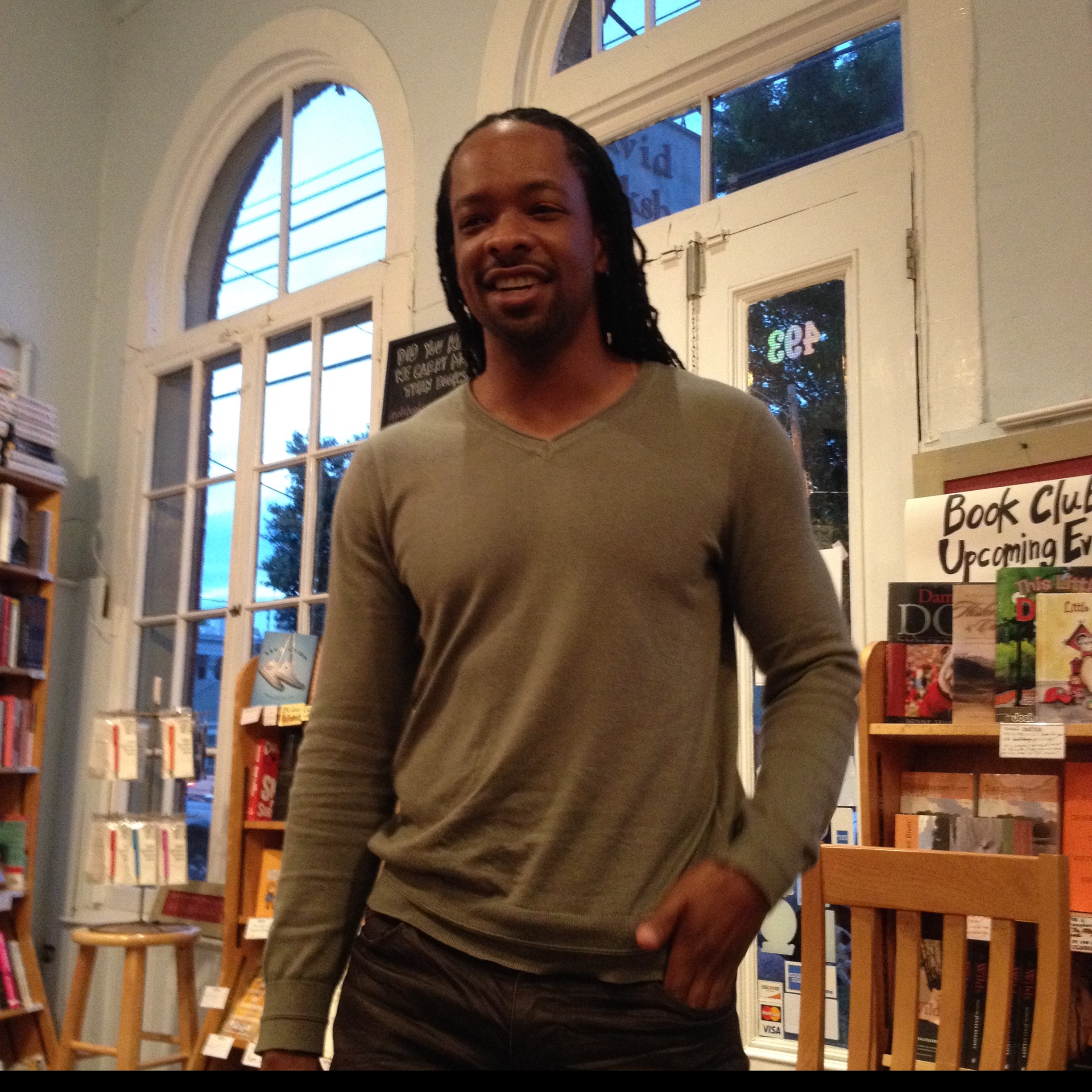
Jericho Brown grew up in Shreveport, Louisiana, and worked as a speechwriter for the mayor of New Orleans before earning his PhD in literature and creative writing from the University of Houston. He also holds an MFA in creative writing from the University of New Orleans and graduated with a BA from Dillard University in 1998.

He was a teaching fellow in the English department at the University of Houston from 2002-2007, a visiting professor at San Diego State University’s MFA program in spring 2009, and an assistant professor of English at the University of San Diego. He has also taught at numerous conferences and workshops, including the Iowa Summer Writing Festival at the University of Iowa. He is currently an assistant professor of English and creative writing at Emory University in Atlanta, Georgia.

Since June is LGBT Pride month, Jericho Brown is the first of three LGBT poets that I will be featuring on Tuesdays for the rest of the month.