Category Archives: Poetry

Deep Lane [June 23rd, evening of the first fireflies]


Deep Lane [June 23rd, evening of the first fireflies]
By Mark Doty

June 23rd, evening of the first fireflies,
we’re walking in the cemetery down the road,
and I look up from my distracted study of whatever,

an unfocused gaze somewhere a few feet in front of my shoes,

and see that Ned has run on ahead
with the champagne plume of his tail held especially high,
his head erect,

which is often a sign that he has something he believes he is not allowed to have,

and in the gathering twilight (what is it that is gathered,
who is doing the harvesting?) I can make out that the long horizontal
between his lovely jaws is one of the four stakes planted on the slope

to indicate where the backhoe will dig a new grave.

Of course my impulse is to run after him, to replace the marker,
out of respect for the rule that we won’t desecrate the tombs,
or at least for those who knew the woman
whose name inks a placard in the rectangle claimed by the four poles

of vanishing—three poles now—and how it’s within their recollection,
their gathering, she’ll live. Evening of memory. Sparklamps in the grass.
I stand and watch him go in his wild figure eights,
I say, You run, darling, you tear up that hill.

Mark Doty’s Fire to Fire: New and Selected Poems, won the National Book Award for Poetry in 2008. His eight books of poems include School of the Arts, Source, and My Alexandria. He has also published four volumes of nonfiction prose: Still Life with Oysters and Lemon, Heaven’s Coast, Firebird and Dog Years, which was a New York Times bestseller in 2007. The Art of Description, a handbook for writers, appeared in 2011.

Doty’s poems have appeared in many magazines including The Atlantic Monthly, The London Review of Books, Ploughshares, Poetry, and The New Yorker. Widely anthologized, his poems appear in The Norton Anthology of Contemporary American Poetry and many other collections. 

Doty’s work has been honored by the National Book Critics Circle Award, the Los Angeles Times Book Prize, a Whiting Writers Award, two Lambda Literary Awards and the PEN/Martha Albrand Award for First Nonfiction. He is the only American poet to have received the T.S. Eliot Prize in the U.K., and has received fellowships from the Guggenheim, Ingram Merrill and Lila Wallace/Readers Digest Foundations, and from the National Endowment for the Arts.

Doty lives in New York City and on the east end of Long Island. He is Professor/Writer in Residence at Rutgers University in New Brunswick, New Jersey.

Two new books are forthcoming, both from W.W. Norton: What Is the Grass, a prose meditation on Walt Whitman and the ecstatic, and Deep Lane, a new volume of poems. 

Doty is one of the foremost LGBT poets alive today.


Langston Blue


Langston Blue

By Jericho Brown

 “O Blood of the River of songs,
O songs of the River of Blood,”
       Let me lie down. Let my words

Lie sound in the mouths of men
Repeating invocations pure
       And perfect as a moan

That mounts in the mouth of Bessie Smith.
Blues for the angels kicked out
       Of heaven. Blues for the angels

Who miss them still. Blues
For my people and what water
       They know. O weary drinkers

Drinking from the bloody river,
Why go to heaven with Harlem
       So close? Why sing of rivers

With fathers of our own to miss?
I remember mine and taste a stain
       Like blood coursing the body

Of a man chased by a mob. I write
His running, his sweat: here,
       He climbs a poplar for the sky,

But it is only sky. The river?
Follow me. You’ll see. We tried
       To fly and learned we couldn’t

Swim. Dear singing river full
Of my blood, are we as loud under
       Water? Is it blood that binds

Brothers? Or is it the Mississippi
Running through the fattest vein
       Of America? When I say home,

I mean I wanted to write some
Lines. I wanted to hear the blues,
       But here I am swimming in the river

Again. What flows through the fat
Veins of a drowned body? What
       America can a body call

Home? When I say Congo, I mean
Blood. When I say Nile, I mean blood.
       When I say Euphrates, I mean,

If only you knew what blood
We have in common. So much,
       In Louisiana, they call a man like me

Red. And red was too dark
For my daddy. And my daddy was
       Too dark for America. He ran

Like a man from my mother
And me. And my mother’s sobs
       Are the songs of Bessie Smith

Who wears more feathers than
Death. O the death my people refuse
       To die. When I was 18, I wrote down

The river though I couldn’t win
A race, climbed a tree that winter, then
       Fell, flat on my wet, red face. Line

After line, I read all the time,
But “there was nothing I could do
       About race.”

In Terrance Hayes’ “A Small Novel” (one of the under-discussed poems from Wind in a Box) Hayes writes: “On its blank last page I write the poem // ‘The Blue Langston’ which begins: ‘O Blood of the River songs, O song of the River of Blood,’ / and ends: ‘There was nothing I could do about Race.’”

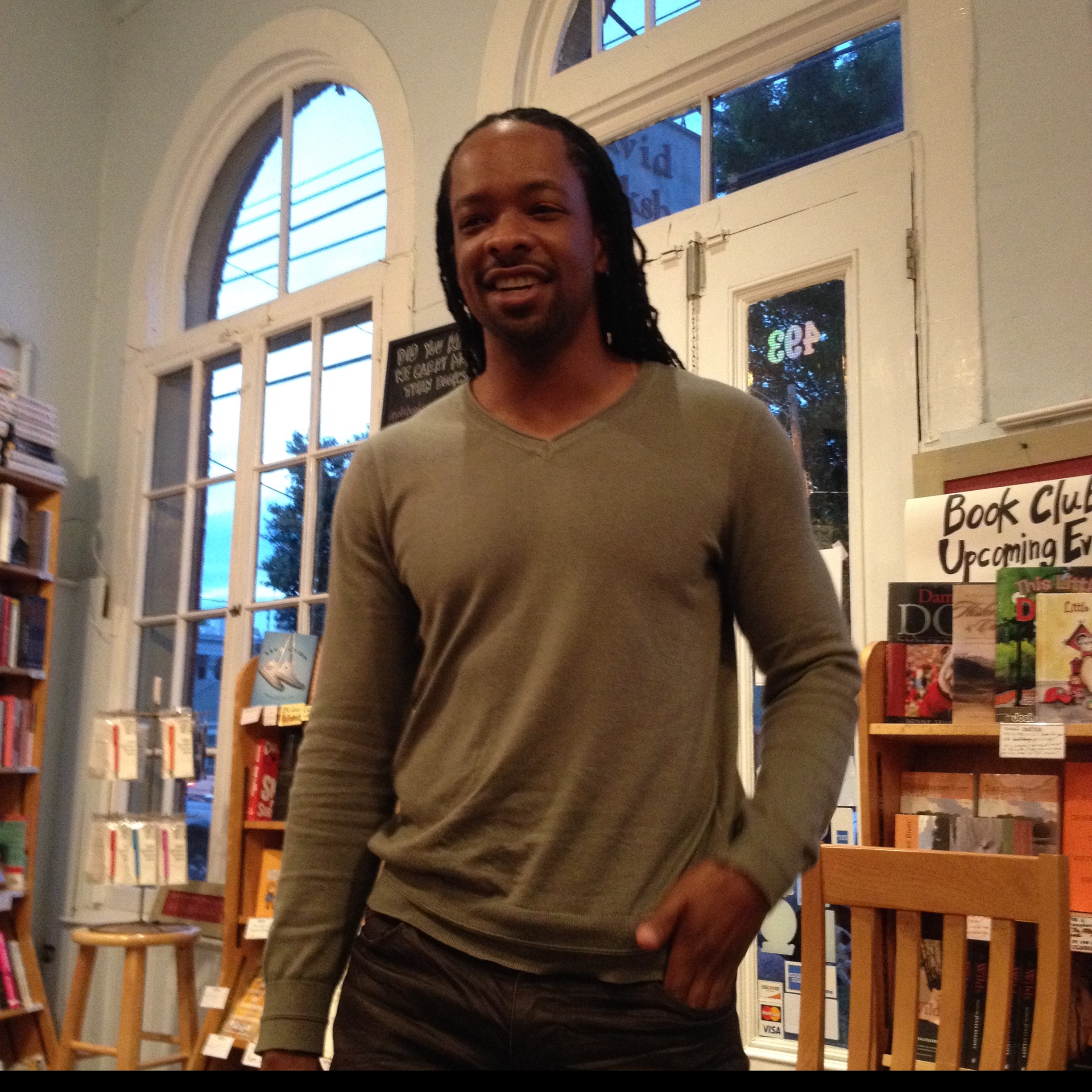
After reading the poem, Brown said that he guesses that he got a little frustrated by the fact that the book had all these exciting personas, like “The Blue Baraka” and “The Blue Seuss,” yet it only gives us the beginning and ending of what would be “The Blue Langston.”

Brown wanted that poem to exist in full because of his love for Langston Hughes. Hughes is a figure so many people refer to as “Langston,” not because we ever knew him and not because we mean any disrespect by using his first name. We say, “Langston,” and each of us thinks, “my Langston.”

Jericho Brown said there’s a diversity of viewpoints and experiences among black poets that defies any single narrative. But there are cultural influences, like Missouri-born Langston Hughes’ use of the rhythms of jazz and blues in his poetry, he said.

“Being black affords you the opportunity to see things that others might not be able to see, to give you experiences that others may not have,” Brown said.

Jericho Brown grew up in Shreveport, Louisiana, and worked as a speechwriter for the mayor of New Orleans before earning his PhD in literature and creative writing from the University of Houston. He also holds an MFA in creative writing from the University of New Orleans and graduated with a BA from Dillard University in 1998.

He was a teaching fellow in the English department at the University of Houston from 2002-2007, a visiting professor at San Diego State University’s MFA program in spring 2009, and an assistant professor of English at the University of San Diego. He has also taught at numerous conferences and workshops, including the Iowa Summer Writing Festival at the University of Iowa. He is currently an assistant professor of English and creative writing at Emory University in Atlanta, Georgia.

Since June is LGBT Pride month, Jericho Brown is the first of three LGBT poets that I will be featuring on Tuesdays for the rest of the month.


Satchmo

  
                                     Satchmo
                           By Melvin B. Tolson
 

                     King Oliver of New Orleans
         has kicked the bucket, but he left behind
              old Satchmo with his red-hot horn
                to syncopate the heart and mind.
                  The honky-tonks in Storyville
       have turned to ashes, have turned to dust,
                 but old Satchmo is still around
         like Uncle Sam’s IN GOD WE TRUST.

               Where, oh, where is Bessie Smith,
       with her heart as big as the blues of truth?
           Where, oh, where is Mister Jelly Roll,
           with his Cadillac and diamond tooth?
              Where, oh, where is Papa Handy
  With his blue notes a-dragging from bar to bar?
       Where, oh where is bulletproof Leadbelly
          with his tall tales and 12-string guitar?

                                Old Hip Cats,
              when you sang and played the blues
                    the night Satchmo was born,
       did you know hypodermic needles in Rome
         couldn’t hoodoo him away from his horn?
          Wyatt Earp’s legend, John Henry’s, too,
              is a dare and a bet to old Satchmo
  when his groovy blues put headlines in the news
            from the Gold Coast to cold Moscow.

                                 Old Satchmo’s
    gravelly voice and tapping foot and crazy notes
                             set my soul on fire.
                                   If I climbed
           the seventy-seven steps of the Seventh
  Heaven, Satchmo’s high C would carry me higher!
         Are you hip to this, Harlem? Are you hip?
              On Judgment Day, Gabriel will say
                       after he blows his horn:
   “I’d be the greatest trumpeter in the Universe
          if old Satchmo had never been born!”

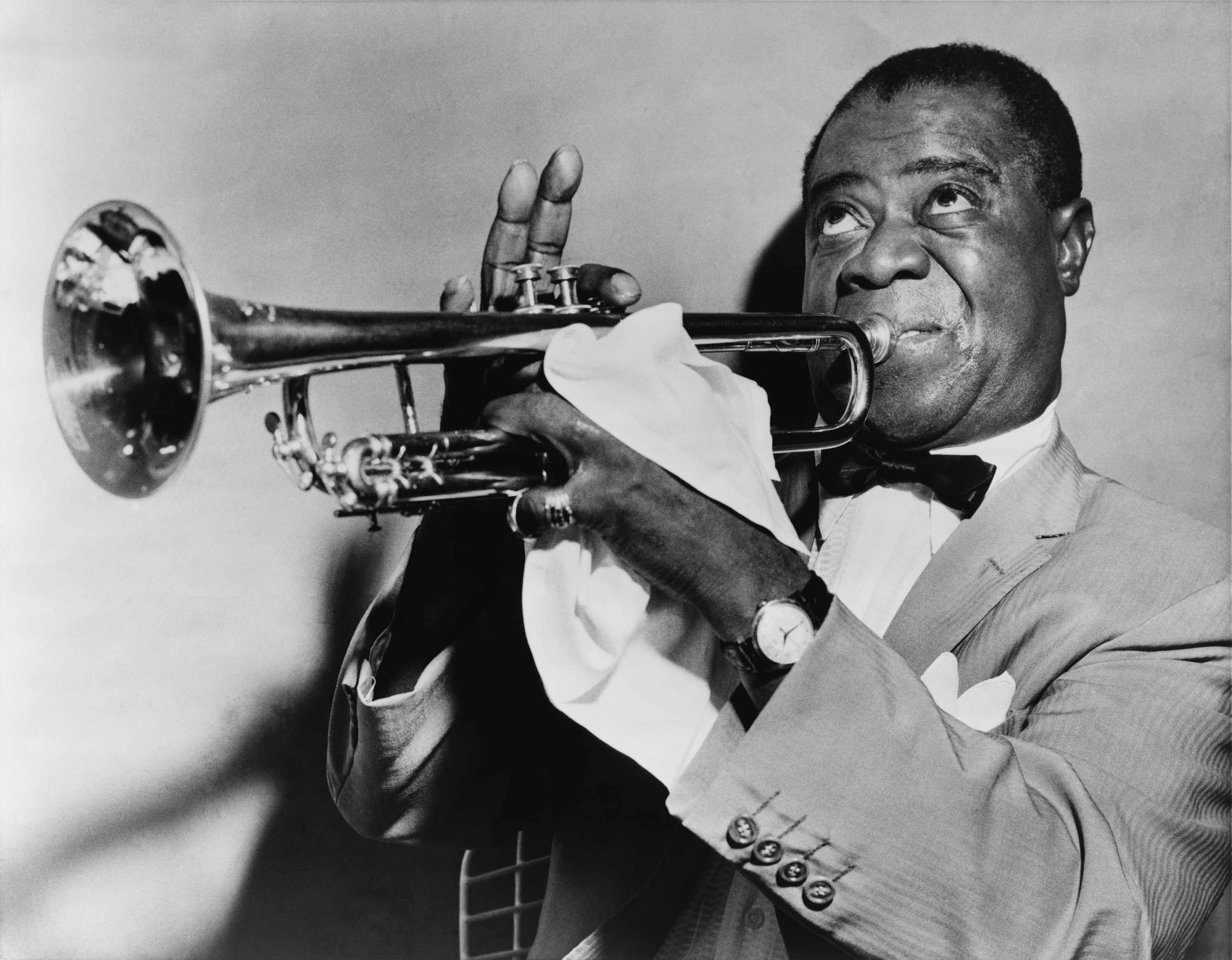
If  you are not familiar with the name Satchmo, it was the nickname for Louis Armstrong.  Louis had many nicknames as a child, all of which referred to the size of his mouth: “Gatemouth,” “Dippermouth,” and “Satchelmouth.” During a visit to Great Britain, Louis was met by Percy Brooks, the editor of Melody Maker magazine, who greeted him by saying, “Hello, Satchmo!” (He inadvertently contracted “Satchelmouth” into “Satchmo.”) Louis loved the new name and adopted it for his own. It provides the title to Louis’s second autobiography, is inscribed on at least two of Louis’s trumpets, and is on Louis’s stationery. 
Armstrong has always been a New Orleans legend and the airport is named Louis Armstrong International Airport.  Since I am heading there with my boyfriend today, I thought this made an appropriate poem.

P.S. I have a job interview this morning before we leave.  Hopefully, it will go well.  It’s not an ideal job, but it would be something until I find something better.


Doors opening, closing on us


Doors opening, closing on us
By Marge Piercy

Maybe there is more of the magical
in the idea of a door than in the door
itself. It’s always a matter of going
through into something else. But

while some doors lead to cathedrals
arching up overhead like stormy skies
and some to sumptuous auditoriums
and some to caves of nuclear monsters

most just yield a bathroom or a closet.
Still, the image of a door is liminal,
passing from one place into another
one state to the other, boundaries

and promises and threats. Inside
to outside, light into dark, dark into
light, cold into warm, known into
strange, safe into terror, wind

into stillness, silence into noise
or music. We slice our life into
segments by rituals, each a door
to a presumed new phase. We see

ourselves progressing from room
to room perhaps dragging our toys
along until the last door opens
and we pass at last into was.

About This Poem

“The poem actually started when I was thinking about the use of gates in the Yom Kippur service. I was thinking that doors are more concrete somehow as an image of going from one state or another, one era, one phase of one’s life to another—because you can’t see beyond a door when it’s shut. There can always be a surprise on the other side.”
—Marge Piercy

Marge Piercy is the author of Made in Detroit (Knopf, 2015). She lives on Cape Cod, Massachusetts with her husband, Ira Wood.


Theories of Time and Space


Theories of Time and Space
By Natasha Trethewey

You can get there from here, though
there’s no going home.

Everywhere you go will be somewhere
you’ve never been. Try this:

head south on Mississippi 49, one—
by—one mile markers ticking off

another minute of your life. Follow this
to its natural conclusion—dead end

at the coast, the pier at Gulfport where
riggings of shrimp boats are loose stitches

in a sky threatening rain. Cross over
the man-made beach, 26 miles of sand

dumped on a mangrove swamp—buried
terrain of the past. Bring only

what you must carry—tome of memory
its random blank pages. On the dock

where you board the boat for Ship Island,
someone will take your picture:

the photograph—who you were—
will be waiting when you return

I’ve never been further north on U.S. Highway 49 than Jackson, Mississippi, but I have driven the stretch from Jackson to its beginning in Gulfport, Mississippi, too many times to count.  North of Jackson at the junction of US 49 and U.S. Route 61, was where blues singer Robert Johnson is said to have sold his soul to the Devil.  But it is Gulfport that I am more familiar with because it used to be a short drive down to the beach when I wanted to get away from the stresses of graduate school. I’ve walked those man-made beaches and taken the boat out to Ship Island to see Fort Massachusetts.  If you are ever in Gulfport, or on the Mississippi Gulf Coast for that matter, you’ll probably be there for the casinos, but you really should go out to Ship Island and take a picnic lunch, explore the fort, and lounge on the beach on the south side of the island.  

The first time I went to Ship Island, I remember standing on top of Fort Massachusetts and feeling history come alive.  Having the only deep-water harbor between Mobile Bay and the Mississippi River, the island served as a vital anchorage for ships bearing explorers, colonists, sailors, soldiers, defenders and invaders. The French, Spanish, British, Confederate and Union flags have all flown over Ship Island.  French explorer Pierre Le Moyne d’Iberville charted Ship Island on 10 February 1699, which he used as a base of operations in discovering the mouth of the Mississippi River. The island served as a point of immigration to French colonies in the New World.

In the War of 1812, Admiral Sir Alexander Cochrane anchored between Ship Island and Cat Island with a fleet of fifty British warships and 7,500 soldiers in preparations for the Battle of New Orleans and the island was used as a launching point for British forces.  I remember standing on top of Fort Massachusetts and it was almost like I could see the fifty British warships as they prepared to attack New Orleans nearly 200 years before.  It was one of those magical moments historians sometimes have.  We are standing in a historical place and suddenly we are transported back to a significant moment.  The present world disappears and the world of the past emerges before your eyes.

“Everywhere you go will be somewhere you’ve never been.”  So if you ever find yourself in Jackson, Mississippi, try heading down U.S Highway 49 through Hattiesburg and past the beautiful campus of the University of Southern Mississippi down to the Mississippi Gulf Coast, hop on the boat out to Ship Island and let another world take you over. 


Field in Spring

 
Field in Spring

By Susan Stewart

Your eye moving 

left to right across

the plowed lines

looking to touch down

on the first

shoots coming up 

like a frieze

from the dark where

pale roots

and wood-lice gorge

on mold.

Red haze atop

the far trees.

A two dot, then

a ten dot

ladybug. Within

the wind, a per-

pendicular breeze.

Hold a mirror,

horizontal,

to the rain. Now

the blurred repetition

of ruled lines, the faint

green, quickening,

the doubled tears.

Wake up.

The wind is not for seeing,

neither is the first

song, soon half- 

way gone,

and the figures,

the figures are not waiting.

To see what is

in motion you must move.


About This Poem

“This poem is from a series of studies of the same field in sequential seasons. Is there anyone in the northern hemisphere who isn’t trying, in these days, to read the signs of spring?”— Susan Stewart 

Susan Stewart is the author of numerous books of poems, including Red Rover (University of Chicago Press, 2008). She is a professor of English at Princeton University. 


Good Ole Boys Like Me


 Good Ole Boys Like Me
Lyrics by Bob McDill
Performed by Don Williams

When I was a kid Uncle Remus he put me to bed
With a picture of Stonewall Jackson above my head
Then Daddy came in to kiss his little man
With gin on his breath and a Bible in his hand
He talked about honor and things I should know
Then he’d stagger a little as he went out the door

Chorus:

I can still hear the soft southern winds in the live oak trees
And those Williams boys they still mean a lot to me
Hank and Tennessee
I guess we’re all gonna be what we’re gonna be
So what do you do with good ole boys like me

When I was in school I ran with a kid down the street
But I watched him burn himself up on Bourbon and speed
But I was smarter than most and I could choose
Learned to talk like the man on the six o’clock news
When I was eighteen Lord I hit the road
But it really doesn’t matter how far I go

YestNothing makes a sound in the night like the wind does
But you ain’t afraid if you’re washed in the blood like I was
The smell of cape jasmine thru the window screen
John R and the Wolfman kept me company
By the light of the radio by my bed
With Thomas Wolfe whispering in my head

When I was in school I ran with a kid down the street
But I watched him burn himself up on Bourbon and speed
But I was smarter than most and I could choose
Learned to talk like the man on the six o’clock news
When I was eighteen Lord I hit the road
But it really doesn’t matter how far I go

Yesterday, Michael mentioned in his comment “On another topic entirely, I was thinking of the Don Williams song from 1980, “Good Ole Boys Like Me” and you came to mind. Are you familiar with it? If not, check it out on Youtube.”  I’m terrible with putting names to songs, so I took Michael’s advice and looked up “Good Ole Boys Like Me” on YouTube.  After listening to the song, it was familiar to me, and I can understand why it would remind Michael of me.  One thing about don Williams is that nearly every song of his reminds me of someone.

Much of it does describe me, but there are a few differences.  Stonewall Jackson did not hang above my head instead it was the painting of a local lake.  Daddy’s breath never smelled like gin (he hates gin), but it did often smell of beer.  It wasn’t the smell of cape jasmine that wafted in the windows, but the sweet smell of honeysuckle.  I remember Wolfman Jack (his heyday, though, was a bit before my time), but what I fell asleep listening to was Oldies 98, and it seems like every night as I was going to bed I heard Elton John singing “Crocodile Rock.”  Oldies 98 played that song all the time.  My best friend growing up didn’t burn herself out on bourbon and speed, but she did on men and sex.  As soon as I was eighteen though, I left for college and for fourteen years, I was free, but now I’m back home in Alabama, so it didn’t matter how far I went.

 The chorus though is the best past and the most like me:

I can still hear the soft southern winds in the live oak trees
And those Williams boys they still mean a lot to me
Hank and Tennessee
I guess we’re all gonna be what we’re gonna be
So what do you do with good ole boys like me

With the exception of “soft southern winds in the live oak trees,” because here we had pecan trees and pines, the chorus could have been written about me.  Hank Williams grew up not far away and was a good friend of my grandmama who used to be his favorite dance partner.  I’ve always loved Tennessee Williams, whose plays always seemed to speak to me in a special way.  As much as I tried not to be gay growing up, “we’re all gonna be what we’re gonna be,” and in my case that would be gay.  “So what do you do with good ole boys like me?”  Well, you need to get to know us and when you do, I think you’ll love us.

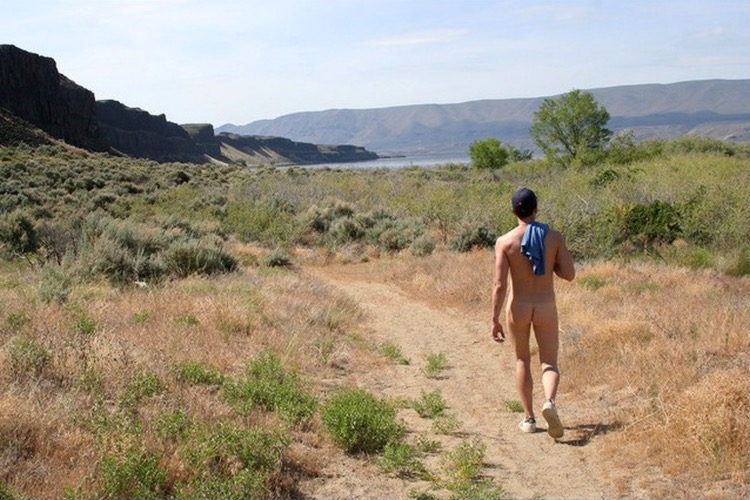
And here’s an extra “good ole boy” just for fun and eye candy.  The preppy boys at the top of the post are more like me, but the one below is what we all dream of when we dream of “good ole boys.”


The Long Road


The Long Road
By Matthew Foley

I see you there, standing by the crossroads,
studying the signs and reading the stars,
seeking the direction of a life that is yet to be…
wondering which way, O which way, should my feet point today?

Listen for a moment,
for these feet have felt the dirt of many a wrong path,
these boots have trod many a reckless misstep to be sure,
and those cracked and beaten roads ahead,
where all passion has gone out of the earth,
I too have wasted many a day walking those weary miles.

But for everyday I lived my passion, those days I do not regret.
Everyday I spoke boldly the truth of my soul,
that day I hold like a precious pearl in my memory.

On those days,
I lived like a wave, roaring with the rolling life of the sea,
begging no forgiveness for my right to breathe.

On those days,
I lived like a star, hiding not my fires in a universe gone dark,
for my soul was a candle that did not flicker or fade.

On those days,
I lived as a world, complete, and ushering all life into one,
as one as the different rivers of the world are but one rolling water,
as the separate nations of the earth are but one soil
sprouting but one family of life.

Take the long road, O wanderer, the long road of your passion.
Walk this one earth and breathe this one air,
and serve this one family of life with your fires of your passion.
Take the long, open road and walk it every day of your life.
Take the long road, O wanderer, the long road of your passion.

Matthew Foley is an English & Creative Writing teacher at the Charleston Charter School for Math & Science. When he’s not trying to make 7th graders fall in love with books & poetry, you can find Matt on Wednesdays hosting the Open Mic Poetry Night at The 827 art gallery in Avondale. Matt was also a recent feature poet at East Bay Meeting House’s Monday Night Poetry & Music series.  Find Matt on Facebook.


Hard Times by Brandon Haynes


Hard Times
By Brandon Haynes

Growing up in hard times 
i’m always stuck with a struggle
Every since i can remember
i’ve been getting in trouble
If it wasn’t skipping school
or running from them boys in blue
then i was beating up the dudes
that i sold the dope too
Thats not a lifestyle that i choose to go through.
Trying to make money on the streets
while other hustlers compete
they wanna run us off the block
but theres no way we will retreat
but thats just everyday street life
now pass the peace pipe
So i can just blaze
while i pray for better days
& try to think of clever ways
that i can make the chedder stay
This life is just not right
i’m in debt
& i cant stop smoking on these damn cigarettes
whats happened in the past has got me livin with regrets
but everybody has hard times so try not stress
Lord, i must confess im doing my best to proceed
but the devil will possess
& he’s flexing on me
hes got me stuck
stuck between a rock and hard place
so i’m slanging this cocaine
so i can come up like scareface
& it makes my heart ache
that i stay stuck in this dark space
harsh days got me feeling like its time to part ways

I saw an article yesterday on Steve’s “All Natural & More” blog talking about casual gay prostitution.  The article was originally in Fusion’s online magazine.  In the article, Taryn Hillin writes about “The rise of the part-time gay prostitute.”  The article inspired me to look for a poem about hustlers, and I found the one above, “Hard Times” by Brandon Haynes, which seemed to fit well with this article. (I left the punctuation and capitalization just as it was, as much as it pained me to want to edit it.)  The article itself can be found at http://fusion.net/story/107376/part-time-male-gay-sex-work/ or by clicking the link above to Steve’s blog.  Here are a few excerpts from the article:

Over the past few years, more gay men have begun to sell sex on the side like it’s no big deal—and for these men, it’s not. The rise, according to researchers, can be traced to the explosion of social networking sites combined with a less-than-stable job market—along with increasingly permissive cultural views toward casual sex. 

“Previously, men had to go to an outdoor venue, work for an agency, or advertise in the back pages of magazines and phone books to sell sex, now they can do it right from their phone,” said Kevin Walby, a professor of criminal justice at the University of Winnipeg and author of Touching Encounters: Sex, Work, and Male-for-Male Internet Escorting.

*****

While casual sex workers’ primary motivation is earning extra cash, many also see the work as having larger value. They see it as a form of care work, akin to being a therapist or masseuse. 

“The way that these guys approach what they do is not strictly commercial. They do feel like they’re helping people,” Walby told Fusion. “Whether it’s psychological or physical, they talk about their work like occupational therapy or nursing.” 

Several men we spoke with said much of the work involves touching, hugging, and baths. Most of the clients don’t have time for a relationship, don’t have a lot of options in the love department for physical reasons (weight, age, disability), or simply haven’t come out yet—making open intimacy difficult for them. 

With this in mind, Walby said society’s perception of sex work as shameful is dated. “It’s bizarre that we don’t include anything sexual in approaches to care or therapy,” he said—“that we divorce sexual touching from the notion of healing and caring.” 

Numerous studies have indeed shown the health benefits of intimacy and cuddling. For men who are unable to get it in their “real lives” and not bothered by the transactional nature of the encounter, paying a couple hundred dollars for sex or intimate behavior can help fill a painful void. 

*****

Men’s sex work does, of course, come with risks, but it tends to be safer than women’s sex work. “The risk profile for women and transgender workers is more complicated,” said Walby. For example, it’s pretty standard that female escorts will visit clients with bodyguards—active female prostitutes are 18 times more likely to be murdered than the general population. 

Walby, who has also researched female sex workers, said that while many women feel empowered by their work, they also tend to be more afraid of potential repercussions. “In my research the women were definitely more worried about violence and more worried about stigmatization—if word got out, they seemed to feel it would be more damaging for their lives than the men did.” 

*****

While these casual sex workers aren’t shouting about their work from the rooftops, the men we spoke with said they aren’t burdened by feelings of worry, guilt, or shame. True, they aren’t telling their mothers (too personal) or bosses (for fear of discrimination or other repercussions), but they’re open about the work with close friends. 


If—


          If—

By Rudyard Kipling


If you can keep your head when all about you
  Are losing theirs and blaming it on you,
If you can trust yourself when all men doubt you,
  But make allowance for their doubting too;
If you can wait and not be tired by waiting,
  Or being lied about, don’t deal in lies,
Or being hated, don’t give way to hating,
  And yet don’t look too good, nor talk too wise:

If you can dream—and not make dreams your master;
  If you can think—and not make thoughts your aim;
If you can meet with Triumph and Disaster
  And treat those two impostors just the same;
If you can bear to hear the truth you’ve spoken
  Twisted by knaves to make a trap for fools,
Or watch the things you gave your life to, broken,
  And stoop and build ’em up with worn-out tools:

If you can make one heap of all your winnings
  And risk it on one turn of pitch-and-toss,
And lose, and start again at your beginnings
  And never breathe a word about your loss;
If you can force your heart and nerve and sinew
  To serve your turn long after they are gone,
And so hold on when there is nothing in you
  Except the Will which says to them: “Hold on!”

If you can talk with crowds and keep your virtue,
  Or walk with Kings—nor lose the common touch,
If neither foes nor loving friends can hurt you,
  If all men count with you, but none too much;
If you can fill the unforgiving minute
  With sixty seconds’ worth of distance run,
Yours is the Earth and everything that’s in it,

  And—which is more—you’ll be a Man, my son.

Rudyard Kipling may be best known for The Jungle Book, but I have always enjoyed his poetry. Kipling’s ‘If’ is a discourse on the virtues of model leadership and exemplary manhood. The poem celebrates stoicism, fortitude and righteousness as the hallmark of manliness. Through a series of paradoxes, Kipling tells his son how the middle path – a golden mean in everything will serve as the secret key to this world and everything in it.

The poem exhorts the reader to be patient, honest, and forthright, especially when faced with opposition and temptation to act in a less virtuous manner. He may have to face criticism, opposition, lies, and hatred. When others blame him, he must neither lose heart nor retaliate the same way. He must remain confident and believe in himself; yet he must do his best to see the grounds for others doubting him. In all things he must hold on to his strength of character, morals, and to his values, yet he must not look too good or wise.

Stoic detachment to success and failure alike is the keynote of the poem. An ideal man cannot be deceived into thinking either triumph or disaster final. Sometimes he may even have to risk the fruits of a lifetime’s toil, lose everything and start anew when nothing but sheer will power remains. Still he must hold on.

When it comes to people, he must be able to walk with kings and talk with crowds and not “lose the common touch” even when remaining noble of character. All men should be given their due; yet none too much. He should remain upright so that he won’t be swayed or hurt by friends or foes.

Praise of a strong work ethic is echoed throughout the poem, as is a warning against idleness. The poem also places higher value on the ability to act than on the ability to dream and philosophize.

Throughout the poem, Kipling illustrates ideal behaviour and virtue through the use of paradox: righteousness without smugness; detachment while practicing determination; and noble life blended with commonality. The employment of these contradictory extremes throughout the poem serves to illustrate a central theme of striving for an idealized “golden mean” in all facets of life.