Category Archives: Poetry

A Gift

IMG_3924.JPG

A Gift
By Amy Lowell

See! I give myself to you, Beloved!
My words are little jars
For you to take and put upon a shelf.
Their shapes are quaint and beautiful,
And they have many pleasant colours and lusters
To recommend them.
Also the scent from them fills the room
With sweetness of flowers and crushed grasses.

When I shall have given you the last one,
You will have the whole of me,
But I shall be dead.

About This Poem
“A Gift” was originally published in Lowell’s second collection of poems, Sword Blades and Poppy Seeds (The Macmillan Company, 1914).

About This Poet
Amy Lowell was born in Brookline, Massachusetts, in 1874. Among her honors is the Pulitzer Prize in poetry. Lowell died in Brookline in May of 1925.


Can’t Help Falling In Love

IMG_8083.JPG

“Can’t Help Falling In Love”
written by Hugo Peretti, Luigi Creatore and George David Weiss

Wise men say only fools rush in
but I can’t help falling in love with you
Shall I stay
would it be a sin
If I can’t help falling in love with you

Like a river flows surely to the sea
Darling so it goes
some things are meant to be
take my hand, take my whole life too
for I can’t help falling in love with you

Like a river flows surely to the sea
Darling so it goes
some things are meant to be
take my hand, take my whole life too
for I can’t help falling in love with you

I can’t help falling in love with this song. It is such a beautiful love song, which basically says that we can’t choose who we love. Even if it’s a sin to fall in love and stay, you have no choice but to love the person you fall for. Some things really are meant to be. One day I hope to find that love that is meant to be. I’ve fallen in love, without a doubt there are two men that I am in love with, but in each case (and I will always love them, no matter what), there was something that got in the way, and it was not meant to be. Someday, though it will be meant to be. I refuse to give up hope.


Love Returned

20140818-232021-84021824.jpg

Love Returned
Bayard Taylor

He was a boy when first we met;
His eyes were mixed of dew and fire,
And on his candid brow was set
The sweetness of a chaste desire:
But in his veins the pulses beat
Of passion, waiting for its wing,
As ardent veins of summer heat
Throb through the innocence of spring.

As manhood came, his stature grew,
And fiercer burned his restless eyes,
Until I trembled, as he drew
From wedded hearts their young disguise.
Like wind-fed flame his ardor rose,
And brought, like flame, a stormy rain:
In tumult, sweeter than repose,
He tossed the souls of joy and pain.

So many years of absence change!
I knew him not when he returned:
His step was slow, his brow was strange,
His quiet eye no longer burned.
When at my heart I heard his knock,
No voice within his right confessed:
I could not venture to unlock
Its chambers to an alien guest.

Then, at the threshold, spent and worn
With fruitless travel, down he lay:
And I beheld the gleams of morn
On his reviving beauty play.
I knelt, and kissed his holy lips,
I washed his feet with pious care;
And from my life the long eclipse
Drew off; and left his sunshine there.

He burns no more with youthful fire;
He melts no more in foolish tears;
Serene and sweet, his eyes inspire
The steady faith of balanced years.
His folded wings no longer thrill,
But in some peaceful flight of prayer:
He nestles in my heart so still,
I scarcely feel his presence there.

O Love, that stern probation o’er,
Thy calmer blessing is secure!
Thy beauteous feet shall stray no more,
Thy peace and patience shall endure!
The lightest wind deflowers the rose,
The rainbow with the sun departs,
But thou art centred in repose,
And rooted in my heart of hearts!


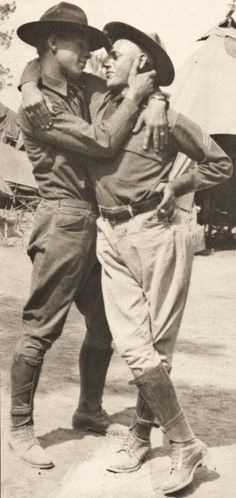
American Boys, Hello!

20140811-233426-84866405.jpg

American Boys, Hello!
Ella Wheeler Wilcox

Oh! we love all the French, and we speak in French
As along through France we go.
But the moments to us that are keen and sweet
Are the ones when our khaki boys we meet,
Stalwart and handsome and trim and neat;
And we call to them—“Boys, hello!”
“Hello, American boys,
Luck to you, and life’s best joys!
American boys, hello!”

We couldn’t do that if we were at home—
It never would do, you know!
For there you must wait till you’re told who’s who,
And to meet in the way that nice folks do.
Though you knew his name, and your name he knew—
You never would say “Hello, hello, American boy!”
But here it’s just a joy,
As we pass along in the stranger throng,
To call out, “Boys, hello!”

For each is a brother away from home;
And this we are sure is so,
There’s a lonesome spot in his heart somewhere,
And we want him to feel there are friends
right there

In this foreign land, and so we dare
To call out “Boys, hello!”
“Hello, American boys,
Luck to you, and life’s best joys!
American boys, hello!”

About This Poem

Ella Wheeler Wilcox wrote “American Boys, Hello!” while visiting France during the latter stages of World War I as entertainment for the American soldiers stationed there.

Ella Wheeler Wilcox was born in Johnstown, Wisconsin, in 1850. She wrote numerous collections of poetry, including Poems of Reflection (1905). She died in Connecticut in 1919.


When Summer’s End Is Nighing

20140804-214411-78251845.jpg

XXXIX (from Last Poems)
By AE Housman

When summer’s end is nighing
  And skies at evening cloud,
I muse on change and fortune
  And all the feats I vowed
  When I was young and proud.

The weathercock at sunset
  Would lose the slanted ray,
And I would climb the beacon
  That looked to Wales away
  And saw the last of day.

From hill and cloud and heaven
  The hues of evening died;
Night welled through lane and hollow
  And hushed the countryside,
  But I had youth and pride.

And I with earth and nightfall
  In converse high would stand,
Late, till the west was ashen
  And darkness hard at hand,
  And the eye lost the land.

The year might age, and cloudy
  The lessening day might close,
But air of other summers
  Breathed from beyond the snows,
  And I had hope of those.

They came and were and are not
  And come no more anew;
And all the years and seasons
  That ever can ensue
  Must now be worse and few.

So here’s an end of roaming
  On eves when autumn nighs:
The ear too fondly listens
  For summer’s parting sighs,
  And then the heart replies.

I chose this week’s poem because this is the last week of my summer before school starts back. The poem beginning “When summer’s end is nighing” is numbered but untitled, like all the others in the 1922 collection, Last Poems, Housman compiled and published this collection specifically so it could be read by Moses Jackson, one of Houseman’s college roommates and the object of his life-long, probably unrequited love, who, by this time, lay terminally ill in Canada. Jackson was heterosexual and did not reciprocate Housman’s feelings. Housman obtained a first in classical Moderations in 1879, but his dedication to textual analysis, particularly with Propertius, led him to neglect ancient history and philosophy, which formed part of the Greats curriculum. Accordingly, he failed to obtain a degree. Some scholars attribute Housman’s unexpected failure in his final exams directly to his rejection by Jackson. Most biographers suggest that there are more obvious reasons. Housman was indifferent to philosophy, overconfident in his preternatural gifts, felt contempt for inexact learning, and enjoyed idling away his time with Jackson. He may also have been distracted by news of his father’s desperate illness. The failure left him with a deep sense of humiliation, and a determination to vindicate his genius.

Housman is a poet who often seems to be on the verge of saying the conventional poetic thing, and then, in a flash, turns it in a new direction. It may simply be the matter of an unexpected phrase or even a single word. A less original poet would have chosen “nearing” rather than “nighing” for the first-line end-verb. This is not a choice decided by the need for a rhyme, because the “a” line in the poem never rhymes. “Nighing” is a curious archaism: it’s not even a particularly melodious word, but perhaps the fact that it rhymes with another present participle that the poem resists, “sighing”, underlies its haunting effect. Finally, the verb reappears in a different tense. This time, “nighs” meets with its natural word-mate, “sighs”. It’s one small example of an enormous technical skill in the shaping and integration of individual units and whole poem. But this skill is un-showy. It serves something that, for Housman, was all-important to a poem: its emotion.

While concerned with the melancholy closure of ageing, the poem conveys in parenthesis the limitlessness of adolescent aspiration. The narrative slows luxuriantly in stanza five, and pauses on the easy confidence of “the air of other summers”. But then, all at once, it accelerates. Those awaited summers have arrived, and evaporated, remaining somehow unlived: “They came, and went, and are not …” At this point it’s absolutely clear that Housman is not writing in the comfortable afterglow of nostalgia. He is writing about a dark absence of fulfilment, now irredeemably faced in the light of “the only end of age” – to quote a poet who learned much from him, and seems to have been temperamentally similar, Philip Larkin.

Housman was a great classical scholar, and his intimacy with Latin, in particular, dictates the shape of his poetry. He makes our cumbersome language seem graceful, flexible and swift. His enduring popular reputation over the years is partly because of his ability to express emotions of a certain universally appealing kind (The Shropshire Lad has been in print continuously since 1896) but also testifies to a remarkable style, both epigrammatic and musical, which produces lyric poems that are simple to remember – and simply memorable.


We Like To Party

20140728-224559-81959315.jpg

We Like To Party

I’ve got somethin’ to tell ya,
I’ve got news for you,
Gonna put some wheels in motion,
Get ready cause we’re comin’ through.
Hey now Hey now Hear what I say now
Happiness is just around the corner
Hey now Hey now Hear what I say now
We’ll be there for you

The Venga bus is comin’ & everybody’s jumpin’,
New York through San Francisco,
An Interstate free disco,
The wheels of steel are turnin’ and traffic lights are burnin’,
So if you like to party,
Get on and move your body

We like to party
We like we like to party
We like to party
We like we like to party

Hey now hey now hear what I say now
Happiness is just around the corner
Hey now hey now hear what I say now
We’ll be there for you

The Venga bus is comin’ & everybody’s jumpin’,
New York through San Francisco,
An Interstate free disco,
The wheels of steel are turnin’ and traffic lights are burnin’,
So if you like to party,
Get on and move your body

Mr. Six is an advertising character, first featured in a 2004–05 advertising campaign by the theme park chain Six Flags. Appearing as a bald, decrepit, wrinkled old man wearing a tuxedo and thick-framed glasses, he is usually shown stepping off a bus and inviting stressed and over-worked people to Six Flags by performing a frenetic dance to the Vengaboys song “We Like to Party”.

The first airing introduced Mr. Six as an apparently elderly, slow-moving man dressed in his trademark tuxedo and large glasses, pulling up in front of a house in a retro-style bus. The occupants of the house are sitting around the front yard apparently very bored. Mr. Six slowly shuffles off the bus, then suddenly comes to life and performs a high-energy dance routine as “We Like to Party” begins playing, and invites the bored family to Six Flags. The dance he performs borrows moves from the Melbourne Shuffle, Jumpstyle, and Techtonik. Subsequent ads showed different variations of Mr. Six dancing and inviting people to Six Flags. The role was, initially, non-speaking.
By the way, Matthew Wilkening of AOL Radio ranked the song at number 45 on the list of the 100 Worst Songs Ever while telling the listener, “If you live within a few hundred miles of a Six Flags adventure park, you’ve heard this 4,000 times.”

I thought this song’s lyrics, essentially poetry, would be pretty appropriate considering that I will be spending the day at Six Flags.

And I will add one last thing, for those of you with young children, nieces, nephews, or grandchildren, Jellystone Park is a fun place for them. There was gem and fossil mining, mini golf, horseshoes, a sandbox, a pool, numerous playgrounds, an arcade, and a menagerie of animals: alligators, iguanas, monitors, boa constrictors, macaws, peacocks, tortoises, a bunny, and a pig named Daisy. There are numerous Jellystone Parks around the U.S. and Canada.


When We Two Parted

20140721-235925-86365625.jpg

When We Two Parted
By George Gordon Byron

When we two parted
In silence and tears,
Half broken-hearted
To sever for years,
Pale grew thy cheek and cold,
Colder thy kiss;
Truly that hour foretold
Sorrow to this.

The dew of the morning
Sunk chill on my brow–
It felt like the warning
Of what I feel now.
Thy vows are all broken,
And light is thy fame;
I hear thy name spoken,
And share in its shame.

They name thee before me,
A knell to mine ear;
A shudder comes o’er me–
Why wert thou so dear?
They know not I knew thee,
Who knew thee too well–
Long, long shall I rue thee,
Too deeply to tell.

In secret we met–
In silence I grieve,
That thy heart could forget,
Thy spirit deceive.
If I should meet thee
After long years,
How should I greet thee?–
With silence and tears.

In a letter to a friend in 1809, Byron wrote (probably facetiously) that he was going to Turkey to do research for a treatise “Sodomy simplified or Paederasty proved to be praiseworthy from ancient authors and modern practice”. Like all jokes, this must have had an edge of truth to be funny.

At Cambridge, Byron had fallen deeply in love with a choirboy, John Edelston. Byron wrote several poems that scholars believe were written to and about John, calling him “Thyrza”. One of the Thyrza poems, written after John had died, indicates in the words: “The pressure of the thrilling hand, the kiss, so guiltless and refined, that Love each warmer wish forbore”, that their physical contact had been restricted to hand-holding and kissing. He later referred to it as a passion “violent though pure”. Even much later in life, after the “Thyrza” poems had become very famous and popular, Byron refused to say who they were addressed to and changed the pronouns from masculine to feminine to conceal that this doomed but lifelong passion was for a man.

After two years of being Byron’s “almost constant associate since October 1805”, John had to move away from Cambridge to London and Byron wrote to a woman friend, Elizabeth Pigot, about his heartbreak, saying that he was planning to live with his “protégé” after he had completed his studies, which would “put Lady E. Butler & Miss Ponsonby to the Blush, Pylades & Orestes out of countenance, & want nothing but a Catastrophe like Nisus and Euryalus, to give Johnathon & David the ‘go by’ “. These are all same-sex passionate relationships.

However, some time later John wrote a very courteous and formal letter to Byron asking for his help in getting a job. They had never met again.

While Byron was on his travels in Turkey, Albania, and Greece he wrote to Matthews frequently about his sexual conquests of boys using a coded term based on Latin “plen. et optabil. –Coit.” (Frequent and desired intercourse). He reported that he was amusing himself with “a Sopha to tumble upon” with a Greek boy called Eustathius who had “ambrosial curls hanging down his amiable back”.

It has been argued (with very little evidence)that while in the East, Byron was a lover of Ali Pasha or his son, Veli Pasha, rulers of Albania and the Peloponessus. They were very friendly and hospitable to Byron and Veli Pasha did give him a beautiful white horse.

Byron’s relationships with friends of both sexes seem to have been shadowed by jealousy and possessiveness. John Cam Hobhouse considered himself to be Byron’s “best friend” and in many ways was, travelling with him, assisting him legally and financially and finally burying him. There is no trace of sexuality between them.

Byron and Shelley became very close friends in the summer of 1816 in Switzerland. They sailed around Lake Leman together visiting the locations of a romantic novel written by Rousseau called “La Nouvelle Heloise”. One afternoon they exchanged roses. This was rhapsodically memorialized by Shelley in his journal where he referred to Byron, anonymously, as “my companion”.

While he was visiting Byron in Venice several years later, Shelley was shocked by Byron’s ostentatiously erotic lifestyle and remarked in a letter to a friend in England that some of his street pick-ups had “lost the gait and physiognomy of men”. This has been interpreted to mean they were cross-dressers. Shelley was also outraged that Byron bargained with parents for the services of their daughters.

The last poems Byron wrote were found among his papers after his sudden death. They indicated that he had fallen painfully and guiltily in love with a fifteen year old Greek boy named Loukas Chalandritsanos. Byron gave him money, fancy uniforms and the command of a regiment. As far as is known there was no physical contact between them.

Byron is known to have had sex with at least 300 women.

So the verdict is bisexual, although such distinctions were not explicit at the time. I think “hyper-sexual” covers it.

I’m heading back to Alabama and I guess back in the closet for a while. It’s been a good vacation, but it’s time to go back and face reality.



We Two Boys Together Clinging

20140715-000556-356949.jpg

“We Two Boys Together Clinging”
By Walt Whitman

WE two boys together clinging,
One the other never leaving,
Up and down the roads going, North and South excursions making,
Power enjoying, elbows stretching, fingers clutching,
Arm’d and fearless, eating, drinking, sleeping, loving.
No law less than ourselves owning, sailing, soldiering, thieving, threatening,
Misers, menials, priests alarming, air breathing, water drinking, on the turf or the sea-beach dancing,
Cities wrenching, ease scorning, statutes mocking, feebleness chasing,
Fulfilling our foray.

Walt Whitman’s poem “We Two Boys Together Clinging” is often identified as a poem of homosexual love, a label breeched from its title and the history of its author. Other scholars insist the poem represents a unique concept of the brotherhood of two young men, forged by the experiences of war. In either interpretation, the poem paints a portrait of masculinity through its setting of soldiering during the Civil War (1861–1865). Whitman’s poetry, including “We Two Boys Together Clinging”, was written before the “unspoken love” of homosexuality had a name to be spoken of. The context of the poem recalls the camaraderie of men through the challenges and ruggedness of this American war. Enveloping the romance of soldiering, the lines of the poem easily echo the ancient wars of the Romans as much as modern and contemporary wars through which notions of pride, glory, and masculinity are still associated. Whitman’s portrayal of this intense companionship developed from “excursions making” and “sailing, soldiering, thieving, threatening …” often leaves the reader with notions of survival, learned (or inherited) skill, manipulating the enemy, strength of body and intelligence, and the pursuit of adventure—all aspects society traditionally perceive as masculine.

In “We Two Boys Together Clinging,” a duo of young boys goes parading through various towns of the North and the South, taking part in numerous loud and obnoxious activities such as drinking, thieving, and enjoying public power; all the time, the boys never left each other’s side. According to Charles M. Oliver in his Critical Companion to Walt Whitman, with the last line, the speaker reveals that the two boys are homosexual and that they have been marauding places for food and to see the shocked faces of the people when they recognize their homosexuality.

Normally, Whitman would write about the “self” or the “everyman,” but it’s unlikely that either of these are strongly involved in “We Two Boys Together Clinging.” The story itself is not really self-enhancing because the speaker does not refer to anything that sets up a sense of fulfillment. The boys merely travel from location to location, scrounging for food and laughs, but they do not lead full lives. In fact, their lives are hallow and lacking, and they should be, at least, trying to build a solid relationship with each other to base their adventures less on necessity and more on friendship. The “everyman,” however, is slightly prevalent in the people the boys visit, like the priests, because religion was a large basis for the lives of the common citizen.


The Indications

20140707-234804-85684379.jpg

The Indications [excerpt]
Walt Whitman, 1819 – 1892

The words of the true poems give you more than poems,
They give you to form for yourself, poems, religions, politics,
war, peace, behavior, histories, essays, romances, and everything else,
They balance ranks, colors, races, creeds, and the sexes,
They do not seek beauty—they are sought,
Forever touching them, or close upon them, follows beauty, longing,
fain, love-sick.

They prepare for death—yet are they not the finish, but rather the outset,
They bring none to his or her terminus, or to be content and full;
Whom they take, they take into space, to behold the birth of stars,
to learn one of the meanings,
To launch off with absolute faith—to sweep through the ceaseless rings,
and never be quiet again.

To be honest there is not a whole lot I want to add for explanation or comment to this poem. This poem is what poetry means to me. I hope it speaks to you in the same way. I dearly love poetry and the above “indications” are why I love it so.


Garnishes by Micah Mora

20140701-003041-1841014.jpg

Garnishes
By Micah Mora

Most peculiar –
The air is warm today
Shadowing my outsides
And blanketing my soul
Bare to the eye
My insecurity finds me
Binds me
Steals my breaths
As I count to ten
And see there’s more to me hiding
Blow me fresh
And wisp away the delicacies
Running fingertips on mountain hills
And garnish each single strand
Most prolific in memory
Till at last
Like air
Thus wind
So befitting
Set me free

Micah Mora is a model, dancer, and above all an artists. The picture above and below are of him, such a beautiful young man and a tremendous gay artist. I happened across this poem on his Twitter (@MicahMora) and wanted to share it because I found it quite beautiful.

Free verse poetry can sometimes be difficult to comprehend, but I think the beauty of this piece speaks for itself. I think we all have insecurities, and in a way, this is what I’ve talked about the last two days. We have to “count to ten” and let go of those insecurities and be proud of who we are and continue on so the wind can set us free.

20140701-003142-1902531.jpg

“I have a belief that romanticism is what keeps our hearts young and our minds free to wonder.” – Micah Mora