Category Archives: Poetry

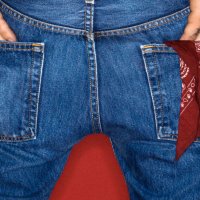
Love in the Morning

20140623-215214-78734384.jpg

Love in the Morning
By Annie Finch

Morning’s a new bird
stirring against me
out of a quiet nest,
coming to flight—

quick-changing,
slow-nodding,
breath-filling body,

life-holding,
waiting,
clean as clear water,

warmth-given,
fire-driven
kindling companion,

mystery and mountain,
dark-rooted,
earth-anchored.

About This Poem

“‘Love in the Morning’ was written in a spirit of sensual gratitude. The poem unites the four elements to celebrate male sexuality.”
—Annie Finch

Annie Finch is the author of Spells: New and Selected Poems (Wesleyan University Press, 2013). She teaches online in the Poetcraft Circles and lives in Portland, Maine.


Alone

20140616-211032-76232436.jpg

Alone
Maya Angelou, 1928 – 2014

Lying, thinking
Last night
How to find my soul a home
Where water is not thirsty
And bread loaf is not stone
I came up with one thing
And I don’t believe I’m wrong
That nobody,
But nobody
Can make it out here alone.

Alone, all alone
Nobody, but nobody
Can make it out here alone.

There are some millionaires
With money they can’t use
Their wives run round like banshees
Their children sing the blues
They’ve got expensive doctors
To cure their hearts of stone.
But nobody
No, nobody
Can make it out here alone.

Alone, all alone
Nobody, but nobody
Can make it out here alone.

Now if you listen closely
I’ll tell you what I know
Storm clouds are gathering
The wind is gonna blow
The race of man is suffering
And I can hear the moan,
‘Cause nobody,
But nobody
Can make it out here alone.

Alone, all alone
Nobody, but nobody
Can make it out here alone.

“Alone” starts off with our speaker doing some serious soul-searching. She’s feeling pretty isolated, but she thinks she just might have come up with an answer to her problems: people need community in order to get by. I think this is very important for many minority groups, but is currently especially needed for the LGBT people in the South. As I was discussing with a friend the other day about the HRC’s Project One America Campaign. My friend said that the most important thing that Alabama LGBT needed was a sense of community. We currently don’t have much of a community besides in larger cities. Alabama still has a largely rural population, which often feels alone because they need that sense of community,

In “Alone,” Angelou says that money won’t buy you happiness. Even the very, very rich get lonely. So, don’t try to make more money. Make friends instead. Something I’m attempting do more of. The speaker of the poem fashions herself into something like a prophet, warning the “race of man” that things aren’t about to get any easier anytime soon. The solution is to realize that no one can make it on their own. We need each other.

When poet, memoirist, screenwriter, film director, jazz singer, dancer, professor, and civil rights activist Maya Angelou died in May at the age of 86, I reflected on what an icon America had lost. Maya Angelou helped people feel like they were possible of living great, meaningful lives.

She became, for so many, a symbol of resilience — the capacity to persist in the face of hardship and adversity — and beyond that a symbol of boundless creativity. She didn’t just survive the significant trauma of her early life; she made something magnificent of that life. Here are a few quotes a dear friend sent me from Maya Angelou, and I asked him to tell me what those quotes mean to him.

I’ve learned that people will forget what you said, people will forget what you did, but people will never forget how you made them feel.“– Maya Angelou

This is my friend’s favorite quote from Maya Angelou. As he thought back on his life and the trials he’s gone through, He said he remember people who have been there for him. You may not remember what they said or did to comfort you, reassure you or build you back up, but we will never forget how they made us feel loved, needed and worth their time. For my friend (and for most of us), these people are our real friends, our real family. We love them more than they will ever know.

You may not control all the events that happen to you, but you can decide not to be reduced by them.“– Maya Angelou

This is a very wise and powerful statement made by Angelou and one that has been very difficult for my friend and many of us to achieve. We all take a beating by events in our lives, those experiences knock us down, stomp on our hearts and tear at our souls. We can choose to be conquered by those unfortunate life occurrences or we can overcome them, learn from them and then go help others.

Try to be a rainbow in someone else’s cloud.“– Maya Angelou

This is so simple and yet we don’t often put it into action. We get so wrapped up in our own problems, our own desires, and our own silly day-to-day meaningless activities that we forget to be there for other people. I’ve found that when I help others or reach out to a friend in need or take time with someone to let them know we care and that they are important, we are able to forget our problems, our pain and our worries. It’s all about the “Golden Rule” a dear friend once told me. Treat others how you’d hope they would treat you. It’s in a small way following the example of Jesus Christ.

You can see in others what they don’t see in themselves and what the world doesn’t see in them. We all have that possibility, that potential and that promise of seeing beyond the seeming.” — Maya Angelou

Angelou wrote for her own creative satisfaction, but she was driven by the desire to encourage and inspire people beyond their limitations, whether they were self-imposed, determined by society, or handed down through history. The point of endeavor was, as she wrote, “to be a rainbow in someone else’s cloud.” She sought to be that rainbow for anyone who could read or hear her work. I try to so the same through The Closet Professor, as we should each attempt to in our lives.



Antique

20140610-020236-7356688.jpg

Antique
Arthur Rimbaud, 1854 – 1891

Graceful son of Pan! Around your forehead crowned
with small flowers and berries, your eyes, precious
spheres, are moving. Spotted with brownish wine lees,
your cheeks grow hollow. Your fangs are gleaming.
Your chest is like a lyre, jingling sounds circulate between your
blond arms. Your heart beats in that belly where the double
sex sleeps. Walk at night, gently moving that thigh,
that second thigh and that left leg.


Verge

20140603-014208-6128631.jpg

Verge
By Mark Doty

A month at least before the bloom
and already five bare-limbed cherries
by the highway ringed in a haze
of incipient fire
—middle of the afternoon,
a faint pink-bronze glow. Some things
wear their becoming:
the night we walked,
nearly strangers, from a fevered party
to the corner where you’d left your motorcycle,
afraid some rough wind might knock it to the curb,
you stood on the other side
of the upright machine, other side
of what would be us, and tilted your head
toward me over the wet leather seat
while you strapped your helmet on,
engineer boots firm on the black pavement.

Did we guess we’d taken the party’s fire with us,
somewhere behind us that dim apartment
cooling around its core like a stone?
Can you know, when you’re not even a bud
but a possibility poised at some brink?

Of course we couldn’t see ourselves,
though love’s the template and rehearsal
of all being, something coming to happen
where nothing was…
But just now
I thought of a troubled corona of new color,
visible echo, and wondered if anyone
driving in the departing gust and spatter
on Seventh Avenue might have seen
the cloud breathed out around us
as if we were a pair
of—could it be?—soon-to-flower trees.

About This Poem

“Often we don’t seem to know when something new—maybe something major—is beginning. ‘Falling in love’ is, in truth, a recognition of something that’s already happened; when you know you’re in love, you’ve already arrived there. But can you ever tell when you’re just on the brink of something exhilarating, disruptive, lovely?”
—Mark Doty

I think Doty hits the nail on the head. You never know when you are on the brink of something, whether it is exhilarating, disruptive, or lovely. Sometimes it takes time to realize where a relationship is going; sometimes you might know from the beginning; and other times the journey can be incredibly confusing.

About Mark Doty

Author of several volumes of poetry and two major memoirs, Mark Doty, winner of the National Book Award for poetry, is one of the most celebrated American poets to emerge from the 1980s and 1990s. Doty helped bring the AIDS narrative and the experiences of gay men to a wider audience through emotionally resonant stories, a richly stylized poetic voice, and poems characterized by brilliant language and a polished surface. His work universalizes themes of loss, mortality, and renewal.

Doty writes poems of sumptuous detail and imagery while at the same time embracing emotionally raw subjects such as mortality and loss. His poems also explore art, beauty, and beauty’s surface, as well as the flaw, the wound, and the limit.

Doty is among the most prominent gay poets of his generation, and he has earned distinction as an AIDS memoirist. He has also managed to transcend the category “gay poet” and to find a wide audience and commercial success. As Robert Martin suggests, if Doty’s work endures, it will be in part “because he has understood the need both to record the suffering of AIDS and the desire for human gestures to transcend all loss and to write in a form at once delicate and powerful.”


Travelin’ Thru

20140111-092322.jpg

Travelin’ Thru
Lyrics by Dolly Parton

Well I can’t tell you where I’m going, I’m not sure of where I’ve been
But I know I must keep travelin’ till my road comes to an end
I’m out here on my journey, trying to make the most of it
I’m a puzzle, I must figure out where all my pieces fit

Like a poor wayfaring stranger that they speak about in song
I’m just a weary pilgrim trying to find what feels like home
Where that is no one can tell me, am I doomed to ever roam
I’m just travelin’, travelin’, travelin’, I’m just travelin’ on

Questions I have many, answers but a few
But we’re here to learn, the spirit burns, to know the greater truth
We’ve all been crucified and they nailed Jesus to the tree
And when I’m born again, you’re gonna see a change in me

God made me for a reason and nothing is in vain
Redemption comes in many shapes with many kinds of pain
Oh sweet Jesus if you’re listening, keep me ever close to you
As I’m stumblin’, tumblin’, wonderin’, as I’m travelin’ thru

I’m just travelin’, travelin’, travelin’, I’m just travelin’ thru

Oh sometimes the road is rugged, and it’s hard to travel on
But holdin’ to each other, we don’t have to walk alone
When everything is broken, we can mend it if we try
We can make a world of difference, if we want to we can fly

Goodbye little children, goodnight you handsome men
Farewell to all you ladies and to all who knew me when
And I hope I’ll see you down the road, you meant more than I knew
As I was travelin’, travelin’, travelin’, travelin’, travelin’ thru

I’m just travelin’, travelin’, travelin’, I’m just travelin’
Drifting like a floating boat and roaming like the wind
Oh give me some direction lord, let me lean on you
As I’m travelin’, travelin’, travelin’, thru

I’m just travelin’, travelin’, travelin’, I’m just travelin’ thru

Like the poor wayfaring stranger that they speak about in song
I’m just a weary pilgrim trying to find my own way home
Oh sweet Jesus if you’re out there, keep me ever close to you
As I’m travelin’, travelin’, travelin’, as I’m travelin’ thru


Sheathed

20140519-192809-70089301.jpg

“Sheathed”
By Sabrina Miller

Sometimes I forget to breathe.
What will not reach my voice
Shimmers with fury in my eyes.
I open the dusty cupboards
Holding thoughts upon their shelves.
Inward. Incessantly inward.
The fulcrum of confession
Keeps the ingredients in place.
I dare not move them.
It is but illusion.
I start again.

The roots of this emotion
Dig deeper and deeper,
Pooling in chasms of liquid;
Just because I want it.
Just because I let it.
It reaches the very core of me.
I confront the frustration
Of what I cannot speak
As reason imprisons my words.
Not yet…

It takes me by the trembling hand
Teaching me to understand.
It validates the prior view
Before I could conceive of you.
Depth synchronized.
Veiled and shaded,
Over anticipated,
It snapped in loaded tension.
The resplendent flight
Of this will, this light,
Builds a bridge across the fracture.

You crawl upon the chambered web,
Closer – quieter – closer.
What awaits the center?
The silvery fibers;
Distortions of age;
A poet’s cognitions
On an intimate page?
Pointing at my picket fence
While your fortress casts its shadow
Across the untouched valleys.
Inward, deeper still,
I forge my way across the hill.
In constant quest;
My truths – undressed,
Returning silence to its sheathe.
And sometimes I forget to breathe.

About the Poet
Love is the essence of pure thought.
There is nowhere that this thought is not.

Sabrina Miller is a dreamer and a poet navigating the creative waters of inspiration. She grew up in a small, conservative community in Oklahoma, just beyond several gypsum plateaus and miles of desert sand. Miller began writing poetry when she was 11 and never stopped. Words formulated a stream of consciousness that acted as a mental and emotional schematic to help her sort out and understand her experiences. Braving snakes, aggressive dogs, religion, homophobia, isolation and renegade tumbleweeds, she decided to make a major life change. Miller relocated to the Catskills to answer the call of creativity. With a deep sense of appreciation for the therapeutic and consciousness-raising qualities of art, she hopes to help others by documenting her experiences through words and imagery. She has been working with a group called Inspire Art (created by musician, Sarah Fimm) for a few years and am currently expanding poetry into video projects.

You can find more of Sabrina Miller’s poetry at her Tumblr blog, Sparkled Poetics.


In Paths Untrodden

20140512-224537.jpg

Calamus [In Paths Untrodden]
Walt Whitman, 1819 – 1892

In paths untrodden,
In the growth by margins of pond-waters,
Escaped from the life that exhibits itself,
From all the standards hitherto publish’d, from the
pleasures, profits, conformities,
Which too long I was offering to feed my soul,
Clear to me now standards not yet publish’d, clear to me
that my soul,
That the soul of the man I speak for rejoices in comrades,
Here by myself away from the clank of the world,
Tallying and talk’d to here by tongues aromatic,
No longer abash’d, (for in this secluded spot I can respond
as I would not dare elsewhere,)
Strong upon me the life that does not exhibit itself, yet
contains all the rest,
Resolv’d to sing no songs to-day but those of manly
attachment,
Projecting them along that substantial life,
Bequeathing hence types of athletic love,
Afternoon this delicious Ninth-month in my forty-first
year,
I proceed for all who are or have been young men,
To tell the secret of my nights and days,
To celebrate the need of comrades.

20140512-224616.jpg
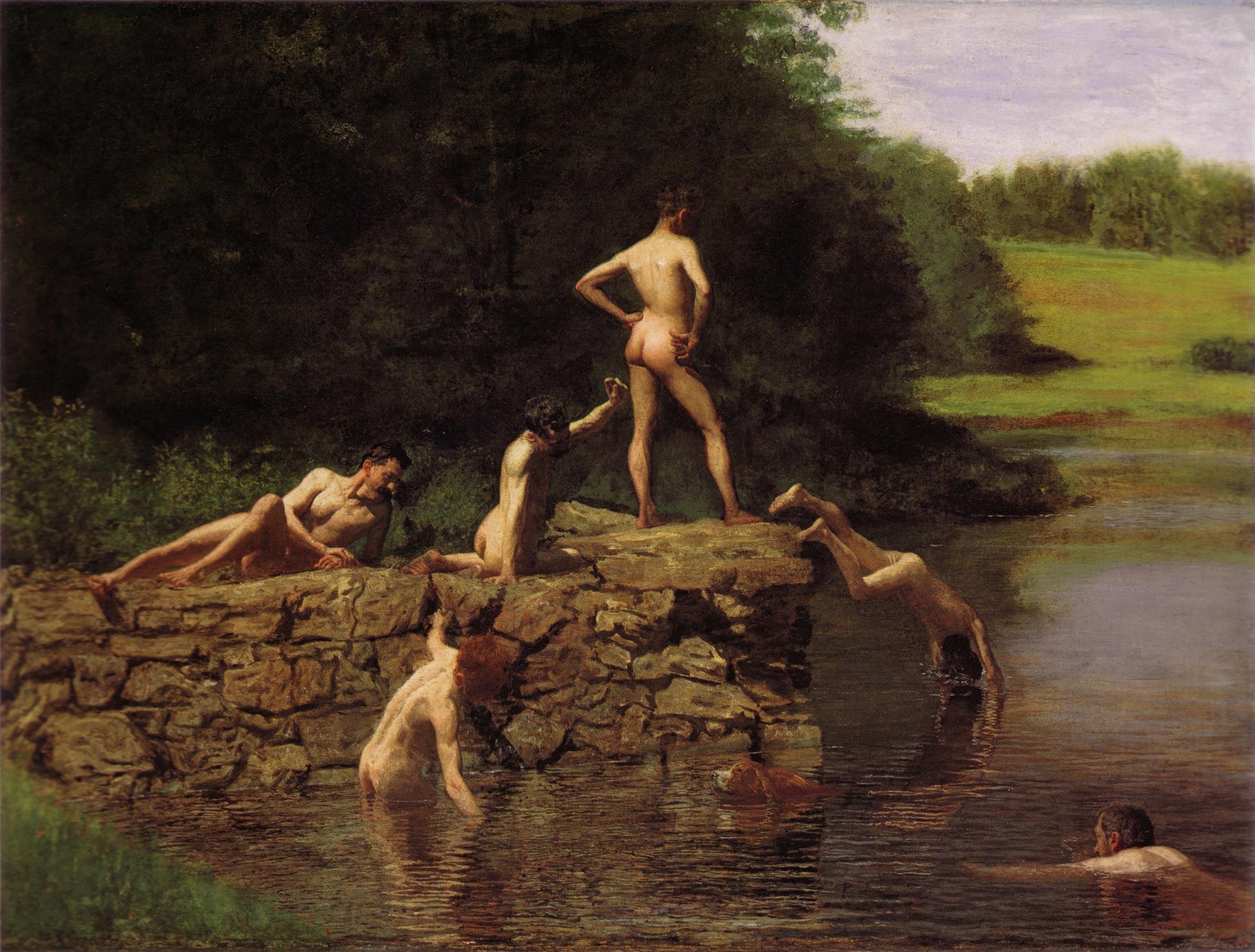
Thomas Eakins’ The Swimming Hole

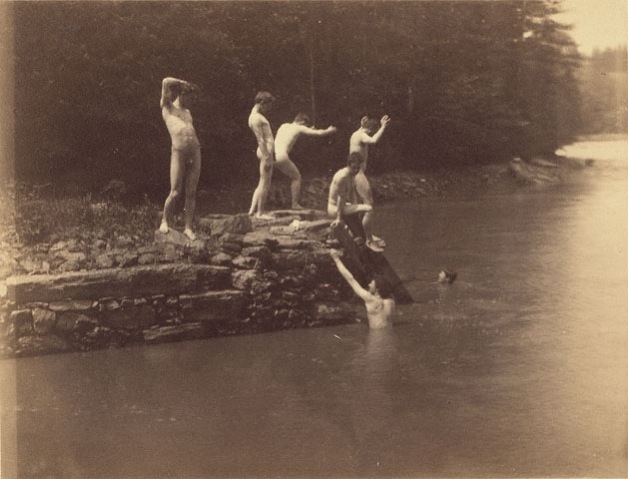
Thomas Eakins made several on-site oil sketches and photographic studies before painting The Swimming Hole. It is unknown whether the photographs were taken before the oil sketches were produced or vice versa (or, indeed, whether they were created on the same day).

By the early 1880s, Eakins was using photography to explore sequential movement and as a reference for painting. Some time in 1883 or 1884, he photographed his students engaged in outdoor activities. Four photographs of his students swimming naked in Dove Lake have survived (one is at the top of this post), and bear a clear relationship to The Swimming Hole. The swimmers are seen in the same spot and from the same vantage point, although their positions are entirely different from those in the painting. None of the photographs closely matches the poses depicted in the painting; this was unusual for Eakins, who typically adhered closely to his photographic studies. “The divergence between these sets of images may hint at lost or destroyed pictures, or it may tell us that the photographs came first, before Eakins’ mental image had crystallized, and before the execution of his first oil sketch.” The poses in the photographs are more spontaneous, while those of the painting are deliberately composed with a classical “severity”. Although no photographic studies have survived that would suggest a more direct connection between the photographs and the painting, recent scholarship has proposed that marks incised onto the canvas and later covered by paint indicate that Eakins made use of light-projected photographs


Need You Now

20140505-201324.jpg

Picture perfect memories scattered all around the floor.
Reaching for the phone ’cause I can’t fight it anymore.

And I wonder if I ever cross your mind?
For me it happens all the time.

It’s a quarter after one, I’m all alone and I need you now.
Said I wouldn’t call but I’ve lost all control and I need you now.
And I don’t know how I can do without.
I just need you now.

Another shot of whiskey, can’t stop looking at the door.
Wishing you’d come sweeping in the way you did before.

And I wonder if I ever cross your mind?
For me it happens all the time.

It’s a quarter after one, I’m a little drunk and I need you now.
Said I wouldn’t call but I’ve lost all control and I need you now.
And I don’t know how I can do without.
I just need you now.

Oh, whoa
Guess I’d rather hurt than feel nothing at all.

It’s a quarter after one, I’m all alone and I need you now.
And I said I wouldn’t call but I’m a little drunk and I need you now.
And I don’t know how I can do without.
I just need you now
I just need you now.
Oh, baby, I need you now.

As y’all know from my Friday and Saturday post, I went to a Lady Antebellum concert on Saturday night. It was the best concert I have ever been to. Love and a Theft opened up and sang a few songs, but quite honestly were mostly forgettable. Next on stage was Scotty McCreery who was energetic and a lot of fun to watch. Scotty’s deep voice just makes me want to melt. Finally Lady A came on stage. It was worth the wait.

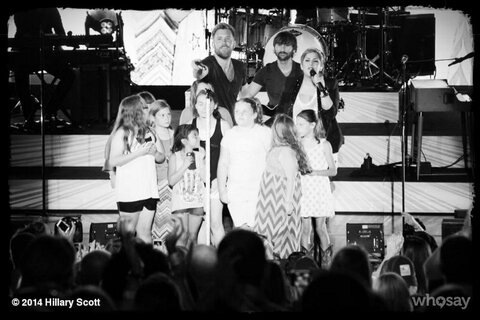
Lady A was wonderful. They sang a few songs then as they got ready to sing “American Honey” they brought up some young girls on the stage to sing with them, including One precious little girl with Down’s syndrome. They sang the song with the girls and took a few selfies. It was one of the cutest, sweetest things I’ve ever seem. The picture above was tweeted by Hillary Scott after the show. Then amazingly after a few more songs they walked out into the crowd to a little stage about 100 ft. away and sang a few songs. The seats we had were great. They ended the night with the song above as an encore song.

The lyrics to “Need You Now” describe placing a call to someone in the middle of the night due to being lonely and longing for companionship. Hillary Scott commented on the song, saying that “All three of us know what it’s like to get to that point where you feel lonely enough that you make a late night phone call that you very well could regret the next day.” Charles Kelley told The Boot that the band’s record executives initially had concerns regarding using the lyrics “I’m a little drunk“, but convinced the executives to leave the content in the song. It think that line adds a bit of authenticity to it. We’ve probably all had some point when we were awake late at night, unable to sleep, maybe we’ve been drinking a little, and you have that overwhelming need for that special someone.

There were also cutie a few hot guys at the concert, so there was plenty of eye candy. Though I didn’t hook-up or get any phone numbers, I did have a great time and whether I was sexy looking or not, I felt sexy and confident. I need to find more places to wear my boots.

The concert was the perfect end to what was a wonderful day. Lady A puts on a great concert. If you get the chance to see Lady Antebellum’s Downtown Tour, go see it. It’s totally worth it.


Follow Your Arrow

20140428-204258.jpg

“Follow Your Arrow”
Kacey Musgraves

If you save yourself for marriage
You’re a bore
If you don’t save yourself for marriage
You’re a horr…ible person
If you won’t have a drink
Then you’re a prude
But they’ll call you a drunk
As soon as you down the first one

If you can’t lose the weight
Then you’re just fat
But if you lose too much
Then you’re on crack
You’re damned if you do
And you’re damned if you don’t
So you might as well just do
Whatever you want
So

Make lots of noise
Kiss lots of boys
Or kiss lots of girls
If that’s something you’re into
When the straight and narrow
Gets a little too straight
Roll up a joint, or don’t
Just follow your arrow
Wherever it points, yeah
Follow your arrow
Wherever it points

If you don’t go to church
You’ll go to hell
If you’re the first one
On the front row
You’re self-righteous
Son of a-
Can’t win for losing
You’ll just disappoint ’em
Just ’cause you can’t beat ’em
Don’t mean you should join ’em

So make lots of noise
Kiss lots of boys
Or kiss lots of girls
If that’s something you’re into
When the straight and narrow
Gets a little too straight
Roll up a joint, or don’t
Just follow your arrow
Wherever it points, yeah
Follow your arrow
Wherever it points

Say what you think
Love who you love
‘Cause you just get
So many trips ’round the sun
Yeah, you only
Only live once

So make lots of noise
Kiss lots of boys
Or kiss lots of girls
If that’s what you’re into
When the straight and narrow
Gets a little too straight
Roll up a joint, I would
And follow your arrow
Wherever it points, yeah
Follow your arrow
Wherever it points

Sometimes a song really resonates with me, and as I think music should be, it is also beautiful poetry. I came across this song as a free download from my Starbucks app. One listen, and I was hooked. After listening to “Follow Your Arrow” from Musgraves’ Same Trailer Different Park!, the Nashville-based singer-songwriter’s first album for Mercury Records, it’s clear that this is a girl who has something to say. A true language artist, Kacey nimbly spins webs of words to create the quirky puns, shrewd metaphors, and steely ironies that fill the record. She is also the recipient of the 2013 CMA New Artist of the Year award, the 2014 Grammy for Best Country Album and Best Countey Song for “Merry Go ‘Round,” and the 2014 ACM Album of the Year.

On “Follow Your Arrow,” she points out the hypocrisies that society imposes on even the most conservative among us (If you save yourself for marriage you’re a bore/If you don’t save yourself for marriage you’re a horr…ible person) which she balances with a chorus that preaches throwing caution and propriety to the wind: (Make lots of noise/Kiss lots of boys/Or kiss lots of girls if that’s something your into/When the straight and narrow gets a little too straight/Roll up a joint/Or don’t/Follow your arrow wherever it points.) Her message is clear: Be yourself and be happy.

Musgraves’ first two singles, “Merry Go ‘Round” and “Blowin’ Smoke,” struck a chord with country fans because of Musgraves’ outspoken lyrics. Her third single, “Follow Your Arrow,” was released to radio this week and turns the real talk up to ten. In it she discusses a few controversial topics, including one mainstream country rarely — if ever — tackles: homosexuality. “Kiss lots of boys/Or kiss lots of girls if that’s something you’re into,” she sings.

“Well I hope it gets attention because I think it’s definitely time for those issues to be accepted in country music — I mean it’s 2013,” she said. “Regardless of your political beliefs, everybody should be able to love who they want to love and live how they want to live. We’re all driven by the same emotions; we all want to be loved and want to feel the same things. So, hopefully people will put aside their personal, political agenda and just agree with that fact.”

I am particularly excited because I am going to see Kacey Misgrave in concert on Saturday. She will be opening along with Kip Moore for Lady Antebellum. Besides being a fan of Musgrave and being very excited to see her, I am also excited to see Lady Antebellum, because Charles Kelley is one of the sexiest men in country music.

20140428-204406.jpg


From “I Sing the Body Electric” by Walt Whitman

20140421-221700.jpg

I knew a man, a common farmer, the father of five sons,
And in them the fathers of sons, and in them the fathers of sons.

This man was a wonderful vigor, calmness, beauty of person,
The shape of his head, the pale yellow and white of his hair and
beard, the immeasurable meaning of his black eyes, the richness
and breadth of his manners,
These I used to go and visit him to see, he was wise also,
He was six feet tall, he was over eighty years old, his sons were
massive, clean, bearded, tan-faced, handsome,
They and his daughters loved him, all who saw him loved him,
They did not love him by allowance, they loved him with personal
love,
He drank water only, the blood show’d like scarlet through the
clear-brown skin of his face,
He was a frequent gunner and fisher, he sail’d his boat himself, he
had a fine one presented to him by a ship-joiner, he had
fowling-pieces presented to him by men that loved him,
When he went with his five sons and many grand-sons to hunt or fish,
you would pick him out as the most beautiful and vigorous of
the gang,
You would wish long and long to be with him, you would wish to sit
by him in the boat that you and he might touch each other.