Category Archives: Poetry

Follow Your Arrow

20140428-204258.jpg

“Follow Your Arrow”
Kacey Musgraves

If you save yourself for marriage
You’re a bore
If you don’t save yourself for marriage
You’re a horr…ible person
If you won’t have a drink
Then you’re a prude
But they’ll call you a drunk
As soon as you down the first one

If you can’t lose the weight
Then you’re just fat
But if you lose too much
Then you’re on crack
You’re damned if you do
And you’re damned if you don’t
So you might as well just do
Whatever you want
So

Make lots of noise
Kiss lots of boys
Or kiss lots of girls
If that’s something you’re into
When the straight and narrow
Gets a little too straight
Roll up a joint, or don’t
Just follow your arrow
Wherever it points, yeah
Follow your arrow
Wherever it points

If you don’t go to church
You’ll go to hell
If you’re the first one
On the front row
You’re self-righteous
Son of a-
Can’t win for losing
You’ll just disappoint ’em
Just ’cause you can’t beat ’em
Don’t mean you should join ’em

So make lots of noise
Kiss lots of boys
Or kiss lots of girls
If that’s something you’re into
When the straight and narrow
Gets a little too straight
Roll up a joint, or don’t
Just follow your arrow
Wherever it points, yeah
Follow your arrow
Wherever it points

Say what you think
Love who you love
‘Cause you just get
So many trips ’round the sun
Yeah, you only
Only live once

So make lots of noise
Kiss lots of boys
Or kiss lots of girls
If that’s what you’re into
When the straight and narrow
Gets a little too straight
Roll up a joint, I would
And follow your arrow
Wherever it points, yeah
Follow your arrow
Wherever it points

Sometimes a song really resonates with me, and as I think music should be, it is also beautiful poetry. I came across this song as a free download from my Starbucks app. One listen, and I was hooked. After listening to “Follow Your Arrow” from Musgraves’ Same Trailer Different Park!, the Nashville-based singer-songwriter’s first album for Mercury Records, it’s clear that this is a girl who has something to say. A true language artist, Kacey nimbly spins webs of words to create the quirky puns, shrewd metaphors, and steely ironies that fill the record. She is also the recipient of the 2013 CMA New Artist of the Year award, the 2014 Grammy for Best Country Album and Best Countey Song for “Merry Go ‘Round,” and the 2014 ACM Album of the Year.

On “Follow Your Arrow,” she points out the hypocrisies that society imposes on even the most conservative among us (If you save yourself for marriage you’re a bore/If you don’t save yourself for marriage you’re a horr…ible person) which she balances with a chorus that preaches throwing caution and propriety to the wind: (Make lots of noise/Kiss lots of boys/Or kiss lots of girls if that’s something your into/When the straight and narrow gets a little too straight/Roll up a joint/Or don’t/Follow your arrow wherever it points.) Her message is clear: Be yourself and be happy.

Musgraves’ first two singles, “Merry Go ‘Round” and “Blowin’ Smoke,” struck a chord with country fans because of Musgraves’ outspoken lyrics. Her third single, “Follow Your Arrow,” was released to radio this week and turns the real talk up to ten. In it she discusses a few controversial topics, including one mainstream country rarely — if ever — tackles: homosexuality. “Kiss lots of boys/Or kiss lots of girls if that’s something you’re into,” she sings.

“Well I hope it gets attention because I think it’s definitely time for those issues to be accepted in country music — I mean it’s 2013,” she said. “Regardless of your political beliefs, everybody should be able to love who they want to love and live how they want to live. We’re all driven by the same emotions; we all want to be loved and want to feel the same things. So, hopefully people will put aside their personal, political agenda and just agree with that fact.”

I am particularly excited because I am going to see Kacey Misgrave in concert on Saturday. She will be opening along with Kip Moore for Lady Antebellum. Besides being a fan of Musgrave and being very excited to see her, I am also excited to see Lady Antebellum, because Charles Kelley is one of the sexiest men in country music.


20140428-204406.jpg


From “I Sing the Body Electric” by Walt Whitman

20140421-221700.jpg

I knew a man, a common farmer, the father of five sons,
And in them the fathers of sons, and in them the fathers of sons.

This man was a wonderful vigor, calmness, beauty of person,
The shape of his head, the pale yellow and white of his hair and
beard, the immeasurable meaning of his black eyes, the richness
and breadth of his manners,
These I used to go and visit him to see, he was wise also,
He was six feet tall, he was over eighty years old, his sons were
massive, clean, bearded, tan-faced, handsome,
They and his daughters loved him, all who saw him loved him,
They did not love him by allowance, they loved him with personal
love,
He drank water only, the blood show’d like scarlet through the
clear-brown skin of his face,
He was a frequent gunner and fisher, he sail’d his boat himself, he
had a fine one presented to him by a ship-joiner, he had
fowling-pieces presented to him by men that loved him,
When he went with his five sons and many grand-sons to hunt or fish,
you would pick him out as the most beautiful and vigorous of
the gang,
You would wish long and long to be with him, you would wish to sit
by him in the boat that you and he might touch each other.


Hope Springs Eternal

20140414-211525.jpg

III.
Heav’n from all creatures hides the book of fate,
All but the page prescrib’d, their present state:
From brutes what men, from men what spirits know:
Or who could suffer being here below?
The lamb thy riot dooms to bleed today,
Had he thy reason, would he skip and play?
Pleas’d to the last, he crops the flow’ry food,
And licks the hand just rais’d to shed his blood.
Oh blindness to the future! kindly giv’n,
That each may fill the circle mark’d by Heav’n:
Who sees with equal eye, as God of all,
A hero perish, or a sparrow fall,
Atoms or systems into ruin hurl’d,
And now a bubble burst, and now a world.

Hope humbly then; with trembling pinions soar;
Wait the great teacher Death; and God adore!
What future bliss, he gives not thee to know,
But gives that hope to be thy blessing now.
Hope springs eternal in the human breast:
Man never is, but always to be blest:
The soul, uneasy and confin’d from home,
Rests and expatiates in a life to come.

Lo! the poor Indian, whose untutor’d mind
Sees God in clouds, or hears him in the wind;
His soul, proud science never taught to stray
Far as the solar walk, or milky way;
Yet simple nature to his hope has giv’n,
Behind the cloud-topt hill, an humbler heav’n;
Some safer world in depth of woods embrac’d,
Some happier island in the wat’ry waste,
Where slaves once more their native land behold,
No fiends torment, no Christians thirst for gold.
To be, contents his natural desire,
He asks no angel’s wing, no seraph’s fire;
But thinks, admitted to that equal sky,
His faithful dog shall bear him company.

The above poem is merely a section of a much longer poem, “An Essay on Man” by Alexander Pope. Line 19 is probably the most famous and oft quoted piece of Pope’s writing, “Hope springs eternal in the human breast.”

The phrase “Hope springs eternal” is what drew me to this poem. I think it is a great illustration of the sheer tenacity of the human spirit. It tells us that it is human nature to always find fresh cause for optimism. Yes, there are those who are always pessimistic, or often pessimistic, but for those who choose optimism there are many more opportunities. As long as you have faith that you will persevere and and hope for a better tomorrow, hope will spring eternal. Pope’s “Hope springs eternal in the human breast” does not just encompass one single individual but instead is a concise treatise on the human condition.

The essence of hope itself is that wonderful blessing/curse that truly makes human beings the most intelligent and emotional creature that we are. Its existence provides us with the very basis of living. What does our existence amount to without the hope for a better tomorrow or expectation of things to come?

Hope is a wonderful thing. Each morning we are filled with hope for the day. But then also at the end of the day, hope can be a devastating thing. For example, you spent all day hoping that your beloved would phone as he promised you but as you lay your head on your pillow, you are left with the emptiness of an unrealized hope. However, we merely need to renew our hope for the next day and the day after. We should never lose hope.

I was speaking to a friend last night of the hope of finding a man in my life. I refuse to give up on that hope. I believe that someday it will happen. It is that hope/expectations that truly differentiates humans from the animal world around us. For what is a life without hope?

About the Poem
The Essay on Man is a philosophical poem, written, characteristically, in heroic couplets, and published between 1732 and 1734. Pope intended it as the centerpiece of a proposed system of ethics to be put forth in poetic form: it is in fact a fragment of a larger work which Pope planned but did not live to complete. It is an attempt to justify, as Milton had attempted to vindicate, the ways of God to Man, and a warning that man himself is not, as, in his pride, he seems to believe, the center of all things. Though not explicitly Christian, the Essay makes the implicit assumption that man is fallen and unregenerate, and that he must seek his own salvation.

The “Essay” consists of four epistles, addressed to Lord Bolingbroke, and derived, to some extent, from some of Bolingbroke’s own fragmentary philosophical writings, as well as from ideas expressed by the deistic third Earl of Shaftsbury. Pope sets out to demonstrate that no matter how imperfect, complex, inscrutable, and disturbingly full of evil the Universe may appear to be, it does function in a rational fashion, according to natural laws; and is, in fact, considered as a whole, a perfect work of God. It appears imperfect to us only because our perceptions are limited by our feeble moral and intellectual capacity.

Epistle I, which the above poem is from, concerns itself with the nature of man and with his place in the universe; Epistle II, with man as an individual; Epistle III, with man in relation to human society, to the political and social hierarchies; and Epistle IV, with man’s pursuit of happiness in this world. Considered as a whole, the Essay on Man is an affirmative poem of faith: life seems chaotic and patternless to man when he is in the midst of it, but is in fact a coherent portion of a divinely ordered plan. In Pope’s world God exists, and he is beneficent: his universe is an ordered place. The limited intellect of man can perceive only a tiny portion of this order, and can experience only partial truths, and hence must rely on hope, which leads to faith. Man must be cognizant of his rather insignificant position in the grand scheme of things: those things which he covets most — riches, power, fame — prove to be worthless in the greater context of which he is only dimly aware. In his place, it is man’s duty to strive to be good, even if he is doomed, because of his inherent frailty, to fail in his attempt.


Birches

20140407-214223.jpg

Birches
by Robert Frost

When I see birches bend to left and right
Across the lines of straighter darker trees,
I like to think some boy’s been swinging them.
But swinging doesn’t bend them down to stay
As ice-storms do. Often you must have seen them
Loaded with ice a sunny winter morning
After a rain. They click upon themselves
As the breeze rises, and turn many-colored
As the stir cracks and crazes their enamel.
Soon the sun’s warmth makes them shed crystal shells
Shattering and avalanching on the snow-crust—
Such heaps of broken glass to sweep away
You’d think the inner dome of heaven had fallen.
They are dragged to the withered bracken by the load,
And they seem not to break; though once they are bowed
So low for long, they never right themselves:
You may see their trunks arching in the woods
Years afterwards, trailing their leaves on the ground
Like girls on hands and knees that throw their hair
Before them over their heads to dry in the sun.
But I was going to say when Truth broke in
With all her matter-of-fact about the ice-storm
I should prefer to have some boy bend them
As he went out and in to fetch the cows—
Some boy too far from town to learn baseball,
Whose only play was what he found himself,
Summer or winter, and could play alone.
One by one he subdued his father’s trees
By riding them down over and over again
Until he took the stiffness out of them,
And not one but hung limp, not one was left
For him to conquer. He learned all there was
To learn about not launching out too soon
And so not carrying the tree away
Clear to the ground. He always kept his poise
To the top branches, climbing carefully
With the same pains you use to fill a cup
Up to the brim, and even above the brim.
Then he flung outward, feet first, with a swish,
Kicking his way down through the air to the ground.
So was I once myself a swinger of birches.
And so I dream of going back to be.
It’s when I’m weary of considerations,
And life is too much like a pathless wood
Where your face burns and tickles with the cobwebs
Broken across it, and one eye is weeping
From a twig’s having lashed across it open.
I’d like to get away from earth awhile
And then come back to it and begin over.
May no fate willfully misunderstand me
And half grant what I wish and snatch me away
Not to return. Earth’s the right place for love:
I don’t know where it’s likely to go better.
I’d like to go by climbing a birch tree,
And climb black branches up a snow-white trunk
Toward heaven, till the tree could bear no more,
But dipped its top and set me down again.
That would be good both going and coming back.
One could do worse than be a swinger of birches.

Source: The Poetry of Robert Frost (1969)

“Birches” is a poem by American poet Robert Frost. It was collected in Frost’s third collection of poetry Mountain Interval that was published in 1916. Consisting of 59 lines, it is one of Robert Frost’s most anthologized poems. The poem “Birches”, along with other poems that deal with rural landscape and wildlife, shows Frost as a nature poet.

Frost’s writing of this poem was inspired by another similar poem “Swinging on a Birch-tree” by American poet Lucy Larcom and his own experience of swinging birch trees at his childhood. Frost once told “it was almost sacrilegious climbing a birch tree till it bent, till it gave and swooped to the ground, but that’s what boys did in those days”.Written in 1913-1914, “Birches” first appeared in Atlantic Monthly in the August issue of 1915, and was later collected in Frost’s third book Mountain Interval (1916).

When the speaker (the poet himself) sees the birches being bent to left and right sides in contrast to straight trees, he likes to think that some boys have been swinging them. He then realizes that it is not the boys, rather the ice storms that bend the birches. In winter morning, birches become covered with snow which displays multiple colors in sunlight. The growing sunlight causes the snow to fall on the ground.

When the Truth again strikes the speaker, he still prefers his imagination of the boys swinging and bending the birches. In his imagination, the boy plays with the birches. The speaker says he also was a swinger of birches when he was a boy, and wishes to be so now. When he becomes weary of this world, and life becomes confused, he likes to go toward heaven by climbing a birch tree and then come back again because earth is the right place for love.

Written in conversational language, the poem constantly moves between imagination and fact, from reverie to reflection. In the opening, the speaker employs an explanation for how the birch trees were bent. He is pleased to think that some boys were swinging them when he is suddenly reminded that it is actually the ice-storm that bends the trees. Thus, the poem makes some shift of thought in its description. An abrupt shift occurs when the speaker yearns to leave this earth because of its confusion and make a heaven-ward journey. But the speaker does not want to die by leaving earth forever. He wants to come back to this earth, because to the speaker, the earth is, though not perfect, a better place for going on. The speaker is not one who is ready to wait for the promise of afterlife. The love expressed here is for life. This shows Frost’s agnostic side where heaven is a fragile concept to him. This becomes clear when he says the inner dome of heaven had fallen.

The poem centers on various themes of balance, youth, spirituality, and natural world. The poem deals with the issue of how to reconcile between impulse and carefulness, between spontaneity and structure. This act of balancing remains a crucial theme in Frost’s thought, and frost’s typical suggestion to this is to execute things in a way that requires control and skill – be it a question of climbing and swinging a Birch tree or an act of writing or any other issue of real-life. Youth also comes as a theme in this poem as the speaker imagines some boy despite coming across one.

FYI: If you’re wondering what the picture above has to do with the poem “Birches” by Robert Frost, it’s actually a play on words, because the model’s name is Cam Birch.


Multiple Man

20140331-231519.jpg

Multiple Man: Guest-starring me & you
by Gary Jackson

Every night I sleep on alternate

sides of the bed, as if to duplicate
sleeping with you. If

I’m fast enough, I’m the warmth
of my own body beside me, reach

out and touch myself. Breach
the blue of my bones, breathe in my own ear.

You left me. Lying here,
I left you to be with me.

Someone asks if your body
was worth trading for mine.

My sin was always pride.
Did you want a man that sleeps

with himself to keep
the bed warm? I need you like the earth

needed the flood after dearth.

About This Poem
“That first night you’re back to sleeping alone again, expecting another body beside you, and the physical absence is so jarring that you think what if I could become the body I miss? Multiple Man could do it, but I can’t. And of course he’s a mutant superhero, because I can’t help myself.” — Gary Jackson

About Gary Jackson
Gary Jackson is the author of Missing You, Metropolis (Graywolf Press, 2010). He teaches at Central New Mexico Community College and Murray State University, and lives in Albuquerque, New Mexico.


A Regret

20140325-001702.jpg

A Regret
by David Trinidad

Kurt, early
twenties. Met
him after
an AA
meeting in
Silverlake
(November,
eighty-five).
I remem-
ber standing
with him up-
stairs, in the
clubhouse, how
I checked his
body out.
But not who
approached whom.
Or what we
talked about
before we
leaned against
my car and
kissed, under
that tarnished
L.A. moon.
Drove to my
place and un-
dressed him in
the dark. He
was smaller
than me. I
couldn’t keep
my hands off
his ass. Next
morning, smoked
till he woke,
took him back.
He thanked me
sweetly. I
couldn’t have
said what I
wanted, though
must have known.
Drove home and
put him in
a poem
(“November”)
I was at
the end of.

Later that
day it rained
(I know from
the poem).

David Trinidad was born in Los Angeles, was raised in the San Fernando Valley, and moved to New York City in 1988. Much of his work investigates the cultural landscapes of America’s great metropolises, as well as the culture at large. His poems are often filled with references to television, movies, and music, while also being populated by very real people and problems. The autobiographical impulse in poets such as Anne Sexton, Frank O’Hara, Sylvia Plath, and James Schuyler can also be seen in Trinidad’s work, as can masterful threads of both elegy and celebration.

Trinidad is known for his use of popular culture in his poems. The poet James Schuyler wrote, “Trinidad turns the paste jewels of pop art into the real thing.” His work is also associated with the innovative formalism of the New York School. Alice Notley has written, “There is an unwavering light in all of Trinidad’s work that turns individual words into objects, new facts.” About The Late Show (2007), the New York Times Book Review wrote that Trinidad’s “most impressive gift is an ability to dignify the dross of American life, to honor both the shrink-wrapped sentiment of the cultural artifacts he writes about and his own much more complicated emotional response to them.”

Trinidad has also edited an anthology of collaborative poetry, the selected poems of Tim Dlugos and of Ann Stanford, and the journal Court Green, published out of Columbia College, where he teaches. He has also taught at Princeton, The New School, Rutgers, and Columbia.


The Passionate Freudian to His Love

20140317-205431.jpg

The Passionate Freudian to His Love
by Dorothy Parker

Only name the day, and we’ll fly away
In the face of old traditions,
To a sheltered spot, by the world forgot,
Where we’ll park our inhibitions.
Come and gaze in eyes where the lovelight lies
As it psychoanalyzes,
And when once you glean what your fantasies mean
Life will hold no more surprises.
When you’ve told your love what you’re thinking of
Things will be much more informal;
Through a sunlit land we’ll go hand-in-hand,
Drifting gently back to normal.

While the pale moon gleams, we will dream sweet dreams,
And I’ll win your admiration,
For it’s only fair to admit I’m there
With a mean interpretation.
In the sunrise glow we will whisper low
Of the scenes our dreams have painted,
And when you’re advised what they symbolized
We’ll begin to feel acquainted.
So we’ll gaily float in a slumber boat
Where subconscious waves dash wildly;
In the stars’ soft light, we will say good-night—
And “good-night!” will put it mildly.

Our desires shall be from repressions free—
As it’s only right to treat them.
To your ego’s whims I will sing sweet hymns,
And ad libido repeat them.
With your hand in mine, idly we’ll recline
Amid bowers of neuroses,
While the sun seeks rest in the great red west
We will sit and match psychoses.
So come dwell a while on that distant isle
In the brilliant tropic weather;
Where a Freud in need is a Freud indeed,
We’ll always be Jung together.

On August 22, 1893, Dorothy Parker was born to J. Henry and Elizabeth Rothschild, at their summer home in West End, New Jersey. Growing up on Manhattan’s Upper West Side, her childhood was an unhappy one. Both her mother and step-mother died when she was young; her uncle, Martin Rothschild, went down on the Titanic in 1912; and her father died the following year. Young Dorothy attended a Catholic grammar school, then a finishing school in Morristown, NJ. Her formal education abruptly ended when she was 14.

In 1914, Dorothy sold her first poem to Vanity Fair. At age 22, she took an editorial job at Vogue. She continued to write poems for newspapers and magazines, and in 1917 she joined Vanity Fair, taking over for P.G. Wodehouse as drama critic. That same year she married a stockbroker, Edwin P. Parker. But the marriage was tempestuous, and the couple divorced in 1928.

In 1919, Parker became a founding member of the Algonquin Round Table, an informal gathering of writers who lunched at the Algonquin Hotel. The “Vicious Circle” included Robert Benchley, Harpo Marx, George S Kaufman, and Edna Ferber, and was known for its scathing wit and intellectual commentary. In 1922, Parker published her first short story, “Such a Pretty Little Picture,” for Smart Set.

When the New Yorker debuted in 1925, Parker was listed on the editorial board. Over the years, she contributed poetry, fiction and book reviews as the “Constant Reader.”

Parker’s first collection of poetry, Enough Rope, was published in 1926, and was a bestseller. Her two subsequent collections were Sunset Gun in 1928 and Death and Taxes in 1931. Her collected fiction came out in 1930 as Laments for the Living.

During the 1920s, Parker traveled to Europe several times. She befriended Ernest Hemingway, F. Scott Fitzgerald, socialites Gerald and Sarah Murphy, and contributed articles to the New Yorker and Life. Dorothy Parker’s biting wit made her a legend, but it also masked her lonely struggle with depression and alcoholism and attempted suicide.

In 1929, she won the O. Henry Award for her autobiographical short story “Big Blonde.” She produced short fiction in the early 1930s, and also began writing drama reviews for the New Yorker. In 1934, Parker married actor-writer Alan Campbell in New Mexico; the couple relocated to Los Angeles and became a highly paid screenwriting team. They labored for MGM and Paramount on mostly forgettable features, the highlight being an Academy Award nomination for A Star Is Born in 1937. They divorced in 1947, and remarried in 1950.

Parker, who became a socialist in 1927 when she became involved in the Sacco and Vanzetti trial, was called before the House on Un-American Activities in 1955. She pleaded the Fifth Amendment.

Parker was inducted into the American Academy of Arts and Letters in 1959 and was a visiting professor at California State College in Los Angeles in 1963. That same year, her husband died of an overdose. On June 6, 1967, Parker was found dead of a heart attack in a New York City hotel at age 73. A firm believer in civil rights, she bequeathed her literary estate to Dr. Martin Luther King, Jr. Upon his assassination some months later, the estate was turned over to the NAACP.

Her wit was legendary, especially her one liners. Here is one of my favorites:

I require only three things of a man. He must be handsome, ruthless and stupid.


Libido

20140310-232209.jpg

Libido
Rupert Brooke

How should I know? The enormous wheels of will
Drove me cold-eyed on tired and sleepless feet.
Night was void arms and you a phantom still,
And day your far light swaying down the street.
As never fool for love, I starved for you;
My throat was dry and my eyes hot to see.
Your mouth so lying was most heaven in view,
And your remembered smell most agony.

Love wakens love! I felt your hot wrist shiver
And suddenly the mad victory I planned
Flashed real, in your burning bending head…
My conqueror’s blood was cool as a deep river
In shadow; and my heart beneath your hand
Quieter than a dead man on a bed.

Rupert Brooke was a poet who died far too young. His most famous work, the sonnet sequence 1914 and Other Poems, appeared in 1915. Later that year, after taking part in the Antwerp Expedition, he died of blood poisoning from a mosquito bite while en route to Gallipoli with the Navy. He was buried on the island of Skyros in the Aegean Sea.

Following his death at age 28, Brooke, who was already famous, became a symbol in England of the tragic loss of talented youth during the war. He was born in England in 1887, combined literary talent with legendary good looks, entered Cambridge in 1913, wrote a few dozen exquisite poems, joined the Royal Navy to go off to the Great War in 1914 and died in the Aegean seven months later. The artist/soldier is a kind of hero that has not been present in cultures on either side of the Atlantic in decades, but World War I vaunted and cut down many. Brooke, Wilfred Owen, Isaac Rosenberg, Alan Seeger: all dead, all in their prime.

While an undergraduate he attracted the amorous attentions of both men and women, but it was not until 1909, at the age of twenty-two, that he had his first sexual encounter. It was with a man. He described his seduction of Denham Russell-Smith (a former fellow student at Rugby) in some detail. (“My right hand got hold of the left half of his bottom, clutched it, and pressed his body into me. The smell of sweat began to be noticeable. At length we took to rolling to and fro over each other, in the excitement.”)

James Strachey, brother of Lytton Strachey of the Bloomsbury Group, fell deeply in love with Brooke, and while the poet did not return the intensity of feeling, he did hold Strachey in high regard. Strachey is probably Brooke’s most famous admirer. The two men exchanged correspondence for the last decade of Brooke’s life.

And though Brooke remains famous primarily for his war poems, he wrote a number of love poems as well. The sonnet above, “Libido,” is his most elegant; its theme is a burning bed–inspired midnight visit to a sleeping paramour. There is little more beautiful than the image of a milky Adonis leaving his tangled sheets to slip into his lover’s bedroom and wake him with a kiss, until we recall Brooke’s fate, and know that only the embracing arms of war awaited him on his final night. The passion of the poem does, however, show how passionate Brooke was as does his above description of his passionate evening with Russell-Smith.


Mardi Gras Madness

Mardi Gras Madness
By Mary Beth Magee

“T’row me som’pin, mistah!” yells the crowd along the curb,
And the riders throw them something as if they could be heard.
The roar of human masses drowns out single voice or thought.
Only beads, doubloons and trinkets can appease the crowd’s onslaught.
As purple, green and golden hues shade everything in sight,
The distant roar of motorcycles nearing sounds so right.
Horses step in rhythm, cadence clopping as they pass.
At a float’s approach the crowds surge toward the street, en masse.
Last fling before the austere days of Lent, we celebrate
With parties, food and bright parades to make the grayness wait.
A pretty string of beads to keep, a blazoned cup to hold,
A treasured doubloon to collect become Mardi Gras gold.
At midnight, Carnival will end, like Cinderella’s ball
And costumes put away in attics, closets in the hall
Remind us of the fun and laughs we shared with loved ones dear.
And we start counting down the days to Mardi Gras, next year.

Mary Beth Magee

Mary Beth draws on her curiosity and love of research to explore the world around her and write about it. New Orleans native, she now lives in northern CA, by way of Chicagoland. She first saw her name in print as a juvenile book reviewer her hometown paper and hasn’t stopped writing since. Her checkered past includes stints as a telephone operator, substitute school teacher, cosmetic sales, home health aide, government contractor, kitchen help in a deli, real estate sales, office manager and corporate trainer. She holds a Bachelor of Science degree in Psychology, focusing on adult learning. Over the years, her writings covered news and feature articles, book and movie reviews, training materials, greeting cards, short fiction, poetry, and church bulletins.
Laissez les bons temps rouler!


Once I Pass’d Through A Populous City

20140223-213511.jpg

Once I Pass’d Through a Populous City
by Walt Whitman
(1819-1892)

Once I pass’d through a populous city imprinting my brain for future
use with its shows, architecture, customs, traditions,
Yet now of all that city I remember only a man I casually met
there who detain’d me for love of me,
Day by day and night by night we were together–all else has long
been forgotten by me,
I remember I say only that man who passionately clung to me,
Again we wander, we love, we separate again,
Again he holds me by the hand, I must not go,
I see him close beside me with silent lips sad and tremulous.

There are many different ways in which I find poems that I want to post, but this one came to me in a rather shocking way: porn. I’ve discussed on this blog before that I enjoy watching porn, so it should not be too shocking that I was doing just that the other day on my day off. However, I didn’t really expect to be inspired to find a poem for a post in a porn video. The video in questions, in case you are wondering, is the CockyBoys video “A Thing of Beauty.” It’s a pretty hot video about a threesome, but I digress. At the beginning of the video, we see three guys enjoying a vacation, when they narrator begins to read “Once I Pass’d Through a Populous City” by Walt Whitman. So after watching the video, and well, I will be modest and not discuss the particulars of watching the video, I looked up the poem, and what I found was fairly shocking, but I will get to that in a moment.

If one were to expect a poem in a gay pornographic video, you probably would be surprised to hear one by Walt Whitman, whose sexuality is generally assumed to be homosexual or bisexual based on his poetry, though that has been at times disputed. His poetry depicts love and sexuality in a more earthy, individualistic way common in American culture before the medicalization of sexuality in the late 19th century. Though Leaves of Grass was often labeled pornographic or obscene, only one critic remarked on its author’s presumed sexual activity: in a November 1855 review, Rufus Wilmot Griswold suggested Whitman was guilty of “that horrible sin not to be mentioned among Christians”. Whitman had intense friendships with many men and boys throughout his life. Some biographers have claimed that he may not have actually engaged in sexual relationships with males, while others cite letters, journal entries and other sources which they claim as proof of the sexual nature of some of his relationships. Late in his life, when Whitman was asked outright if his “Calamus” poems were homosexual, he chose not to respond.

If you are at all familiar with Whitman’s poetry, then you are familiar with the homoeroticism that exists within.

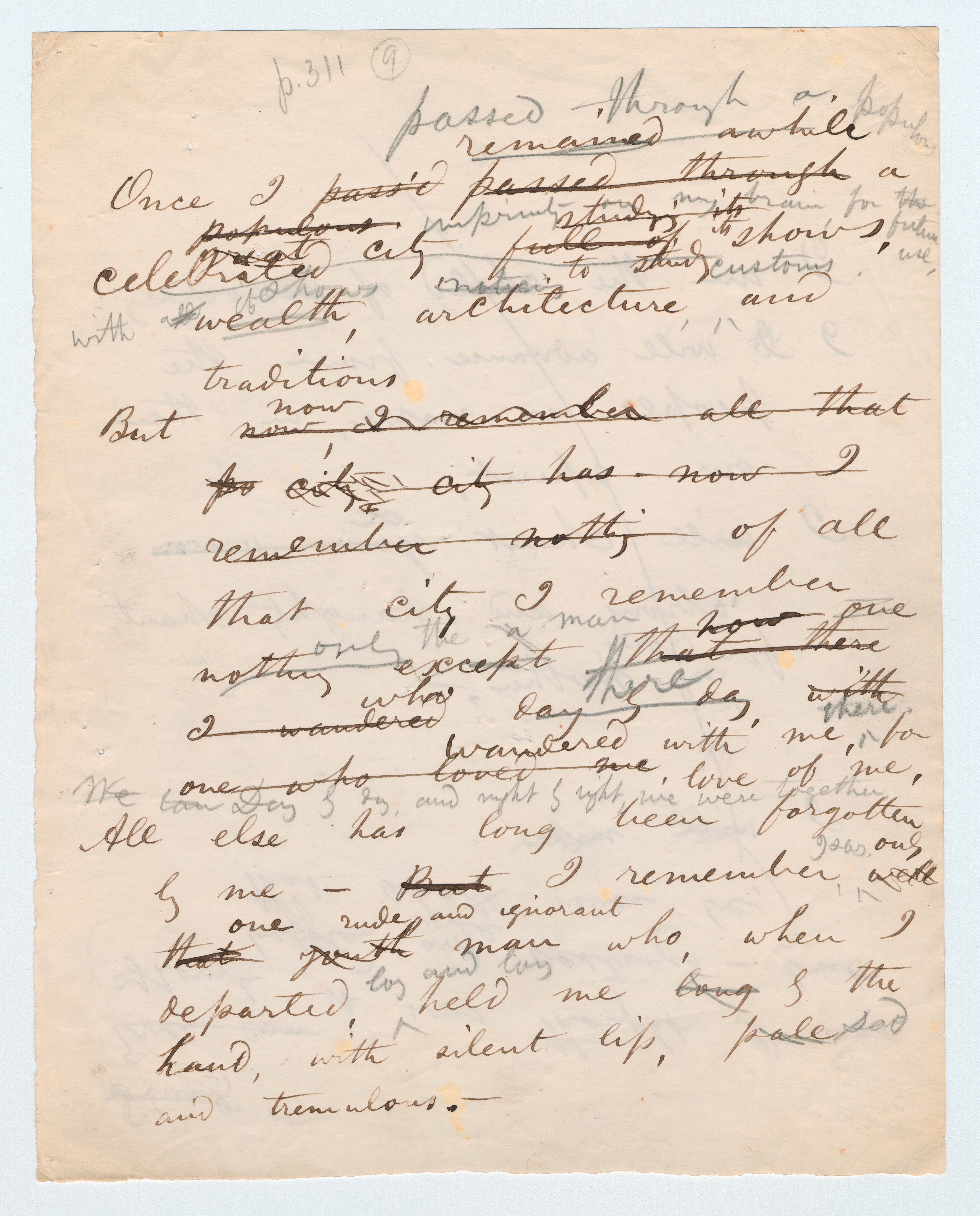
Emory Holloway, in his Whitman: An Interpretation in Narrative (1926), provided the first scholarly biography of the poet, and his experience may stand as an example of the continuing controversy over Whitman. In his research, Holloway happened to run across the manuscript of a “Children of Adam” poem, “Once I Pass’d through a Populous City,” and discovered that it had originally been addressed to a man—and therefore “belonged” in the “Calamus” cluster. He was the first biographer to agonize over how to write about Whitman’s sexuality. A revealing footnote to Holloway’s biography is that he later became obsessed with demonstrating that Whitman was telling the truth in his claims to fatherhood in his letter to Symonds; his obsession led to his publication, after long years of research, of Free and Lonesome Heart: The Secret of Walt Whitman (1960), claiming discovery of “Whitman’s son.”

20140223-225719.jpg

Holloway’s discovery here lies the interesting part of “Once I Pass’d.” Originally, this poem was addressed not to a woman but to a man, as I have done above. Nearly every place that I looked for the text of the poem used the published version which used feminine forms.

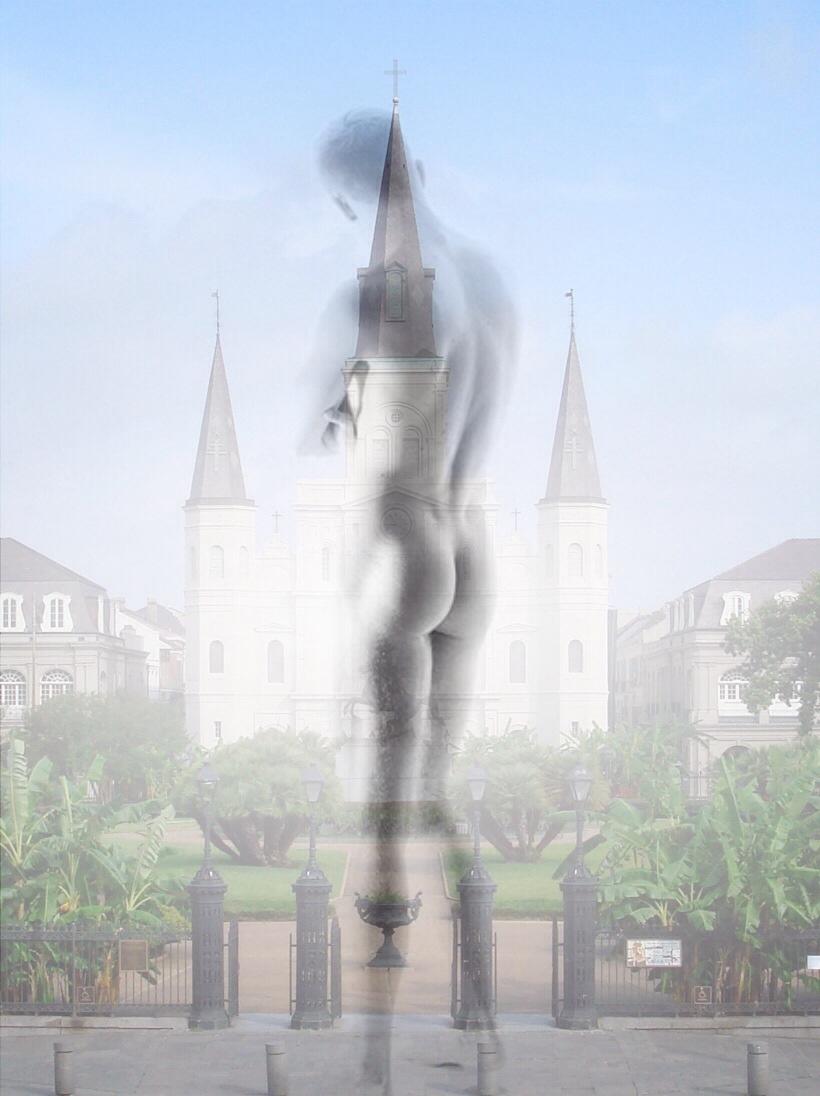
The original story behind the poem states that in 1848, at age 29, Whitman visited New Orleans, the populous city in the poem. There he met a man, who became the inspiration for the poem. Most scholars now reject the idea that Whitman was involved with a Creole woman of higher social rank than his own and that his sudden exit from New Orleans was due to complications deriving from this relationship. The theory of a New Orleans romance, started by Henry Bryan Binns in his A Life of Walt Whitman (1905), proposes to explain the mystery of Whitman’s letter to John Addington Symonds in which he discussed his life down South and mentioned six illegitimate children (for which there is no documented evidence). It is also used to explain the dramatic change in Whitman after the New Orleans trip, his sexual awakening, and the inspiration for the first edition of Leaves of Grass (1855). Some biographers think the lines “O Magnet-South! O glistening, perfumed South! My South! / O quick mettle, rich blood, impulse and love! good and evil! O all dear to me!” in “Longings for Home” (later “O Magnet-South”) suggest a New Orleans romance. Some quote the first five lines of “I Saw in Louisiana a Live-Oak Growing” as support for the idea. Basil De Selincourt asserts in his 1914 critical study of Whitman that “Out of the Cradle Endlessly Rocking” bemoans the death of one who was all but wife to him—the genteel New Orleans lady. Still others see further evidence in “Once I Pass’d through a Populous City,” in which Whitman penned, “Yet now of all that city I remember only a woman I casually met there who detain’d me for love of me . . . who passionately clung to me.” However, Whitman’s earlier manuscript, which read “the man” instead of “a woman,” is telling.

When Walt looked back on his New Orleans passion, he penned a poem, “Once I Pass’d Through a Populous City” that was branded “obscene” when it was published. But when it was published, it hid the truth. In 1925 Emory Holloway discovered the original hand-written manuscript of “Once I Pass’d Through A Populous City,” showing the poet had changed the gender before the poem was published. Only eight letters make the difference between the original and the published version. In my opinion, those eight letters tell a completely different story. It seems that there was a romance during the three months (from 25 February to 25 May in 1848) that Whitman spent in New Orleans, but not with a creole woman, but a man.

New Orleans has always had a long history of homosexuals, or at least fluid sexuality, so why would it be surprising that the young Whitman came into his sexual being in New Orleans, “A Populous City.”

Source of the Whitman’s original manuscript: Walt Whitman Poetry Manuscripts in the Papers of Walt Whitman, Clifton Waller Barrett Library of American Literature, Albert and Shirley Small Special Collections Library, University of Virginia