Category Archives: Poetry

You, Therefore

How does a person say “I love you” in our post-ironic age and not sound greeting-card vapid? In “You, Therefore,” Reginald Shepherd (b. 1963) manages the trick. He doesn’t avoid romantic clichés: you’ll find the moon and stars, scads of flowers, a rain-speckled bower, the heaving sea, strawberries, and a soft-focus snowbound bedroom vignette. Shepherd takes these hoary materials, however, and presents them with the awkwardness, stuttering, and pseudologic of a man choked by passion. The poem is a single meandering sentence with peculiar repetitions (“if I say to you, ‘To you I say’”); faulty grammar (“you” are “a kind of dwell and welcome”); odd puns (“you . . . have come to be my night”—oh Lancelot!); overheated sound play (“like the sea, salt-sweet . . . trees and seas have flown away”); and attempts to qualify or take back things just asserted (“the snow was you, / when there was snow”). The style saves the subject by roughening and skewing it, giving it the feel of authenticity (a little like antiquing a piece of furniture, perhaps). Shepherd conveys persuasively the way somebody can “fall from the sky” into your life and renew it utterly, giving you the home you’d been seeking for years.

You, Therefore
By Reginald Shepherd

For Robert Philen

You are like me, you will die too, but not today:   
you, incommensurate, therefore the hours shine:   
if I say to you “To you I say,” you have not been   
set to music, or broadcast live on the ghost   
radio, may never be an oil painting or
Old Master’s charcoal sketch: you are
a concordance of person, number, voice,
and place, strawberries spread through your name
as if it were budding shrubs, how you remind me   
of some spring, the waters as cool and clear
(late rain clings to your leaves, shaken by light wind),   
which is where you occur in grassy moonlight:   
and you are a lily, an aster, white trillium
or viburnum, by all rights mine, white star   
in the meadow sky, the snow still arriving
from its earthwards journeys, here where there is   
no snow (I dreamed the snow was you,
when there was snow), you are my right,
have come to be my night (your body takes on   
the dimensions of sleep, the shape of sleep   
becomes you): and you fall from the sky
with several flowers, words spill from your mouth
in waves, your lips taste like the sea, salt-sweet (trees   
and seas have flown away, I call it
loving you): home is nowhere, therefore you,   
a kind of dwell and welcome, song after all,   
and free of any eden we can name

Reprinted from Fata Morgana by Reginald Shepherd, published by the University of Pittsburgh Press. Copyright © 2007 by Reginald Shepherd.

Source: Fata Morgana (2007)

Reginald Shepherd

Poet and editor Reginald Shepherd was born in New York City in 1963 and grew up in the Bronx. He earned a BA from Bennington College and studied at Brown University and the Iowa Writers’ Workshop. His first collection, Some Are Drowning (1994), won the Associated Writing Program’s Award in Poetry; his fourth, Otherhood (2003), was a finalist for the Lenore Marshall Poetry Prize; and his last book, Fata Morgana (2007), won a Silver Medal in the Florida Book Awards. Shepherd’s work is known for its elegance, beauty, and critical acumen. As Ron Silliman wrote in a tribute to Shepherd, who died in 2008, “Shepherd took from all schools and created something entirely his own.” Shepherd was the author of a book of essays, Orpheus in the Bronx: Essays on Identity, Politics, and the Freedom of Poetry (2008), and the editor of two anthologies, The Iowa Anthology of New American Poetries (2004) and Lyric Postmodernisms (2008). He was also an active blogger, helping to shape an emerging forum for poetics.


Oscar Wilde and Lord Alfred Douglas

Oscar and Bosie, as his friends called Lord Alfred Douglas, met in Chelsea when Bosie was 22 and Wilde 15 years his elder. Oscar immediately became enamored with Bosie who was thrilled that such a literary genius was interested in him.  Bosie referred to Wilde as “the most chivalrous friend in the world” and was willing to forsake his birthright for the friendship. They exchanged letters, with some of Wilde’s containing what could be interpreted as expressions of passionate love.

“It is a marvel that those red-roseleaf lips of yours should be made no less for the madness of music and song than for the madness of kissing,” Wilde wrote to Lord Alfred in 1893. “Your slim gilt soul walks between passion and poetry.”

Bosie knew of Wilde’s affection for him early on and succeeded in using it to his advantage. He relied on Wilde’s money when his own ran out and would pout and threaten self-injury when Wilde complained of his behavior or criticized his literary skills. For the length of their relationship, Lord Alfred used Oscar’s love for him as a means to get what he wanted. In the end, Wilde sacrificed himself to protect Lord Alfred, who remained a loyal, yet manipulative, friend.

For Wilde, who was much more low-key about his sexuality, it was a love-hate relationship, almost akin to the moth and flame. He lusted for Lord Alfred, but knew that Bosie would only hurt him. His head told him the cost of Bosie’s love was too expensive, his heart considered it a bargain.

“Wilde wanted a consuming passion,” Ellman wrote. “He got it and was consumed by it.”

When Wilde was put on trial for his homosexuality, Edward Carson questioned Wilde about two poems written by Lord Douglas that appeared in the issue of The Chameleon that contained Wilde’s “Phrases and Philosophies for the Use of the Young.”  The two poems were “Two Loves” and “In Praise of Shame.”

Two Loves
Lord Alfred Douglas

I dreamed I stood upon a little hill,
And at my feet there lay a ground, that seemed
Like a waste garden, flowering at its will
With buds and blossoms. There were pools that dreamed
Black and unruffled; there were white lilies
A few, and crocuses, and violets
Purple or pale, snake-like fritillaries
Scarce seen for the rank grass, and through green nets
Blue eyes of shy peryenche winked in the sun.
And there were curious flowers, before unknown,
Flowers that were stained with moonlight, or with shades
Of Nature’s willful moods; and here a one
That had drunk in the transitory tone
Of one brief moment in a sunset; blades
Of grass that in an hundred springs had been
Slowly but exquisitely nurtured by the stars,
And watered with the scented dew long cupped
In lilies, that for rays of sun had seen
Only God’s glory, for never a sunrise mars
The luminous air of Heaven. Beyond, abrupt,
A grey stone wall. o’ergrown with velvet moss
Uprose; and gazing I stood long, all mazed
To see a place so strange, so sweet, so fair.
And as I stood and marvelled, lo! across
The garden came a youth; one hand he raised
To shield him from the sun, his wind-tossed hair
Was twined with flowers, and in his hand he bore
A purple bunch of bursting grapes, his eyes
Were clear as crystal, naked all was he,
White as the snow on pathless mountains frore,
Red were his lips as red wine-spilith that dyes
A marble floor, his brow chalcedony.
And he came near me, with his lips uncurled
And kind, and caught my hand and kissed my mouth,
And gave me grapes to eat, and said, ‘Sweet friend,
Come I will show thee shadows of the world
And images of life. See from the South
Comes the pale pageant that hath never an end.’
And lo! within the garden of my dream
I saw two walking on a shining plain
Of golden light. The one did joyous seem
And fair and blooming, and a sweet refrain
Came from his lips; he sang of pretty maids
And joyous love of comely girl and boy,
His eyes were bright, and ‘mid the dancing blades
Of golden grass his feet did trip for joy;
And in his hand he held an ivory lute
With strings of gold that were as maidens’ hair,
And sang with voice as tuneful as a flute,
And round his neck three chains of roses were.
But he that was his comrade walked aside;
He was full sad and sweet, and his large eyes
Were strange with wondrous brightness, staring wide
With gazing; and he sighed with many sighs
That moved me, and his cheeks were wan and white
Like pallid lilies, and his lips were red
Like poppies, and his hands he clenched tight,
And yet again unclenched, and his head
Was wreathed with moon-flowers pale as lips of death.
A purple robe he wore, o’erwrought in gold
With the device of a great snake, whose breath
Was fiery flame: which when I did behold
I fell a-weeping, and I cried, ‘Sweet youth,
Tell me why, sad and sighing, thou dost rove
These pleasent realms? I pray thee speak me sooth
What is thy name?’ He said, ‘My name is Love.’
Then straight the first did turn himself to me
And cried, ‘He lieth, for his name is Shame,
But I am Love, and I was wont to be
Alone in this fair garden, till he came
Unasked by night; I am true Love, I fill
The hearts of boy and girl with mutual flame.’
Then sighing, said the other, ‘Have thy will,
I am the love that dare not speak its name.’

In Praise of Shame

Lord Alfred Douglas

Last night unto my bed bethought there came
Our lady of strange dreams, and from an urn
She poured live fire, so that mine eyes did burn
At the sight of it.  Anon the floating fame
Took many shapes, and one cried: “I am shame
That walks with Love, I am most wise to turn
Cold lips and limbs to fire; therefore discern
And see my loveliness, and praise my name.”

And afterwords, in radiant garments dressed
With sound of flutes and laughing of glad lips,
A pomp of all the passions passed along
All the night through; till the white phantom ships
Of dawn sailed in. Whereat I said this song,
“Of all sweet passions Shame is the loveliest.”

At the trial, Wilde was asked if he saw any improper suggestions in the two poems.  Wilde’s response to Carson’s question as to what was “the love that dare not speak its name” provided one of the most memorable moments of a memorable trial.

What is “the love that dares not speak its name?”

Wilde: “The love that dares not speak its name” in this century is such a great affection of an elder for a younger man as there was between David and Jonathan, such as Plato made the very basis of his philosophy, and such as you find in the sonnets of Michelangelo and Shakespeare. It is that deep spiritual affection that is as pure as it is perfect. It dictates and pervades great works of art, like those of Shakespeare and Michelangelo, and those two letters of mine, such as they are. It is in this century misunderstood, so much misunderstood that it may be described as “The love that dares not speak its name,” and on that account of it I am placed where I am now. It is beautiful, it is fine, it is the noblest form of affection. There is nothing unnatural about it. It is intellectual, and it repeatedly exists between an older and a younger man, when the older man has intellect, and the younger man has all the joy, hope and glamour of life before him. That it should be so, the world does not understand. The world mocks at it, and sometimes puts one in the pillory for it.

Since Saturday is St. Patrick’s day, I wanted to post poetry by Ireland’s most famous literary homosexual.  The poems above are by Lord Alfred Douglas, Wilde’s lover, but I also wanted to add a poem by Wilde himself, and this is one of my favorites.

The True Knowledge
Oscar Wilde

Thou knowest all; I seek in vain
What lands to till or sow with seed –
The land is black with briar and weed,
Nor cares for falling tears or rain.

Thou knowest all; I sit and wait
With blinded eyes and hands that fail,
Till the last lifting of the veil
And the first opening of the gate.

Thou knowest all; I cannot see.
I trust I shall not live in vain,
I know that we shall meet again
In some divine eternity.


Schrödinger’s Cat

Big Bang Theory is by far my favorite show on TV right now.  It is smart and funny without being mean-spirited or too bawdy.  On one of the earlier episodes, Leonard has asked Penny out on a date.  Neither knows whether or not they should go through with it, and both end up asking the socially inept Sheldon for advice. Sheldon’s answer to their queries is the story of Schrödinger’s Cat.  If you would like to see the clip in which Sheldon explains Schrödinger’s Cat, click this link here.  After seeing the episode several times, I decided that I would do a little research into Schrödinger’s Cat and I came across the following explanatory poem from The Straight Dope.  I hope that you enjoy it as much as I did.

A STRAIGHT DOPE CLASSIC FROM CECIL’S STOREHOUSE OF HUMAN KNOWLEDGE
The story of Schroedinger’s cat (an epic poem)

May 7, 1982
Dear Cecil:

Cecil, you’re my final hope
Of finding out the true Straight Dope
For I have been reading of Schroedinger’s cat
But none of my cats are at all like that.
This unusual animal (so it is said)
Is simultaneously live and dead!
What I don’t understand is just why he
Can’t be one or other, unquestionably.
My future now hangs in between eigenstates.
In one I’m enlightened, the other I ain’t.
If you understand, Cecil, then show me the way
And rescue my psyche from quantum decay.
But if this queer thing has perplexed even you,
Then I will and won’t see you in Schroedinger’s zoo.

— Randy F., Chicago

Cecil replies:

Schroedinger, Erwin! Professor of physics!
Wrote daring equations! Confounded his critics!
(Not bad, eh? Don’t worry. This part of the verse
Starts off pretty good, but it gets a lot worse.)
Win saw that the theory that Newton’d invented
By Einstein’s discov’ries had been badly dented.
What now? wailed his colleagues. Said Erwin, “Don’t panic,
No grease monkey I, but a quantum mechanic.
Consider electrons. Now, these teeny articles
Are sometimes like waves, and then sometimes like particles.
If that’s not confusing, the nuclear dance
Of electrons and suchlike is governed by chance!
No sweat, though — my theory permits us to judge
Where some of ’em is and the rest of ’em was.”
Not everyone bought this. It threatened to wreck
The comforting linkage of cause and effect.
E’en Einstein had doubts, and so Schroedinger tried
To tell him what quantum mechanics implied.
Said Win to Al, “Brother, suppose we’ve a cat,
And inside a tube we have put that cat at —
Along with a solitaire deck and some Fritos,
A bottle of Night Train, a couple mosquitoes
(Or something else rhyming) and, oh, if you got ’em,
One vial prussic acid, one decaying ottom
Or atom — whatever — but when it emits,
A trigger device blasts the vial into bits
Which snuffs our poor kitty. The odds of this crime
Are 50 to 50 per hour each time.
The cylinder’s sealed. The hour’s passed away. Is
Our pussy still purring — or pushing up daisies?
Now, you’d say the cat either lives or it don’t
But quantum mechanics is stubborn and won’t.
Statistically speaking, the cat (goes the joke),
Is half a cat breathing and half a cat croaked.
To some this may seem a ridiculous split,
But quantum mechanics must answer, “Tough shit.
We may not know much, but one thing’s fo’ sho’:
There’s things in the cosmos that we cannot know.
Shine light on electrons — you’ll cause them to swerve.
The act of observing disturbs the observed —
Which ruins your test. But then if there’s no testing
To see if a particle’s moving or resting
Why try to conjecture? Pure useless endeavor!
We know probability — certainty, never.’
The effect of this notion? I very much fear
‘Twill make doubtful all things that were formerly clear.
Till soon the cat doctors will say in reports,
“We’ve just flipped a coin and we’ve learned he’s a corpse.”‘
So saith Herr Erwin. Quoth Albert, “You’re nuts.
God doesn’t play dice with the universe, putz.
I’ll prove it!” he said, and the Lord knows he tried —
In vain — until fin’ly he more or less died.
Win spoke at the funeral: “Listen, dear friends,
Sweet Al was my buddy. I must make amends.
Though he doubted my theory, I’ll say of this saint:
Ten-to-one he’s in heaven — but five bucks says he ain’t.”

— Cecil Adams


Teach Me

TEACH ME
By Donald (Grady) Davidson

Teach me, old World, your passion of slow change,
    Your calm of stars, watching the turn of earth,
Patient of man, and never thinking strange
    The mad red crash of each new system’s birth.

Teach me, for I would know your beauty’s way
    That waits and changes with each changing sun,
No dawn so fair but promises a day
    Of other perfectness than men have won.

Teach me, old World, not as vain men have taught,
    —Unpatient song, nor words of hollow brass,
Nor men’s dismay whose powerfullest thought
    Is woe that they and worlds alike must pass.

Nothing I learn by any mortal rule;
Teach me, old World, I would not be man’s fool.

from The Fugitive, 1922

Donald (Grady) Davidson
1893–1968

Poet Donald (Grady) Davidson was born in Tennessee and was a member of both the Fugitive and Agrarian groups at Vanderbilt University. He received his B.A. and M.A. degrees from Vanderbilt University and remained at the University his entire professional career (1920 – 1968) teaching English. In addition to being a teacher, Davidson enjoyed an international reputation as a poet, essayist, novelist, and critic. His first book of poems, The Outland Piper, was published in 1924. From 1931-1967 he spent his summers teaching at Bread Loaf School of English in Ripton, Vermont. He served in the military during World War I May 1917- June 1919. In June of 1918 he married Theresa Sherrer, a legal scholar and artist. He was a member of Phi Beta Kappa, American Folklore Society, American Academy of Political and Social Sciences, South Atlantic Modern Language Association, and the Tennessee Federation for Constitutional Government.


Edwin Arlington Robinson

I recently made my American Literature students read some of the poems of Edwin Arlington Robinson.  I will admit that I was not terribly familiar with him, but we are studying American poetry, and he was one of the poets.  The poems were fairly short and fairly straightforward, meaning that it would be easy for the kids to interpret.  I read the poems and fell in love with them.  Since then, I have gone back and read a few more of Robinson’s poems, and enjoyed them.  The two poems that we read, sort of resonated with me in a special way.

On December 22, 1869, Edwin Arlington Robinson was born in Head Tide, Maine. His family moved to Gardiner, Maine, in 1870, which renamed “Tilbury Town,” became the backdrop for many of Robinson’s poems.  His poems are sketches about different people in the town.  If you have never read the two poems below, I hope that you will read them now, or if you have read them before, I hope that you will enjoy them all over again.

The first poem is Richard Cory:

Richard Cory
by Edwin Arlington Robinson

Whenever Richard Cory went down town,
We people on the pavement looked at him:
He was a gentleman from sole to crown,
Clean favored and imperially slim.

And he was always quietly arrayed,
And he was always human when he talked,
But still he fluttered pulses when he said,
“Good-morning,” and he glittered when he walked.

And he was rich–yes, richer than a king–
And admirably schooled in every grace:
In fine, we thought that he was everything
To make us wish that we were in his place.

So on we worked, and waited for the light,
And went without the meat and cursed the bread;
And Richard Cory, one calm summer night,
Went home and put a bullet through his head.

The two major things in this poem the wealth of Richard Cory and his suicide at the end are not what draws me to this poem.  I am not rich nor do I contemplate suicide.  This poem, which first appeared in The Children of the Night and remains one of Robinson’s most popular poems, recalls the economic depression of 1893. At that time, people could not afford meat and had a diet mainly of bread, often day-old bread selling for less than freshly baked goods. This hard-times experience made the townspeople even more aware of Richard’s difference from them, so much so that they treated him as royalty.  I think what I get out of this poem is how he doesn’t fit in because of something extraordinary about him.  In his case it is his wealth.  In my case, people often see me as smart and don’t often see me as a regular person.  I can tell a dirty joke, drink a beer, and be just as normal as the next person, but sometimes, people see my intelligence and often think, “He’s too smart for me.”  Or maybe because I am gay (or perceived as gay for those who don’t know for sure), people think that I do not enjoy sports, fishing, or other “manly” pursuits.  To truth is, I am just a normal guy who is smart and gay.  Neither of those are the central things about me.  We all have something that distinguishes us, but should that separate us from the crowd.  Maybe sometimes it does, and sometimes we want it to, but all in all, we are just people like everyone else.  Sadly, the people of Tilbury Town did not realize this about Richard Cory.

The other poem is the way I sometimes feel when I am studying particular periods in history.

Miniver Cheevy
by Edwin Arlington Robinson

Miniver Cheevy, child of scorn,
     Grew lean while he assailed the seasons;
He wept that he was ever born,
     And he had reasons.

Miniver loved the days of old
     When swords were bright and steeds were prancing;
The vision of a warrior bold
     Would set him dancing.

Miniver sighed for what was not,
     And dreamed, and rested from his labors;
He dreamed of Thebes and Camelot,
     And Priam’s neighbors.

Miniver mourned the ripe renown
     That made so many a name so fragrant;
He mourned Romance, now on the town,
     And Art, a vagrant.

Miniver loved the Medici,
     Albeit he had never seen one;
He would have sinned incessantly
     Could he have been one.

Miniver cursed the commonplace
     And eyed a khaki suit with loathing;
He missed the mediæval grace
     Of iron clothing.

Miniver scorned the gold he sought
     But sore annoyed was he without it;
Miniver thought, and thought, and thought,
     And thought about it.

Miniver Cheevy, born too late,
     Scratched his head and kept on thinking;
Miniver coughed, and called it fate,
     And kept on drinking.

We may not take it as far as Miniver Cheevy, but I think all people who study history sometimes feel that they were born in the wrong time.  Then again, there have been very few times in history when it was as acceptable to be gay as it in this day and age, but then again who wouldn’t have loved to witness the Olympic Games of Ancient Greece, or traveled down the canals of Venice when the city was in its full glory, or any number of periods or events in history.  Personally, though I would love to visit those time periods, I like my modern conveniences and air conditioning.  Then again, the Roaring Twenties when I could have possibly partied with F. Scott and Zelda Fitzgerald and Tallulah Bankhead or sat on the Seine with the Lost Generation or gone to the Cotton Club in Harlem at the height of the Harlem Renaissance.  Come to think of it, maybe, I was born out of time. I think I would have loved the 1920s (just not the Great Depression that followed).

How many of you have felt that you were born in the wrong time? Or that people didn’t appreciate you for who you are?


Happy Valentine’s Day

I started to do a post on the origins of Valentine’s Day and end with a favorite love poem. However, I changed my mind. The origins of Valentine’s Day is just a bit depressing with the martyrdom of two different men named Valentine in the third century (if you want to read about the origins, click on this article form NPR: The Dark Origins Of Valentine’s Day), so then I looked for a poem. After looking at several different poems, I had to come back to my favorites, even though they are a bit corny/sappy, and I couldn’t choose just one. I happen to think that sonnets are the most beautiful form of poetry, and so the first two are sonnets, one from Elizabeth Barrett Browning and the other from Shakespeare. I am sure that all of you have read both of these first two, and I absolutely love them.

How Do I Love Thee? (Sonnet 43)
by Elizabeth Barrett Browning

How do I love thee? Let me count the ways.
I love thee to the depth and breadth and height
My soul can reach, when feeling out of sight
For the ends of being and ideal grace.
I love thee to the level of every day’s
Most quiet need, by sun and candle-light.
I love thee freely, as men strive for right.
I love thee purely, as they turn from praise.
I love thee with the passion put to use
In my old griefs, and with my childhood’s faith.
I love thee with a love I seemed to lose
With my lost saints. I love thee with the breath,
Smiles, tears, of all my life; and, if God choose,
I shall but love thee better after death.

Shall I Compare Thee To A Summer’s Day? (Sonnet 18)
by William Shakespeare

Shall I compare thee to a summer’s day?
Thou art more lovely and more temperate:
Rough winds do shake the darling buds of May,
And summer’s lease hath all too short a date:
Sometime too hot the eye of heaven shines,
And often is his gold complexion dimm’d;
And every fair from fair sometime declines,
By chance or nature’s changing course untrimm’d;
But thy eternal summer shall not fade
Nor lose possession of that fair thou owest;
Nor shall Death brag thou wander’st in his shade,
When in eternal lines to time thou growest:
So long as men can breathe or eyes can see,
So long lives this and this gives life to thee.

The last poem, I found in a list of author’s favorite love poems for Valentine’s Day. This one is from Blake Morrison, a British poet and author whose greatest success came with the publication of his memoirs And When Did You Last See Your Father? In his offering of a love poem, he states:

Love poems may be addressed to someone in particular but the “you” invariably remains unidentified or is represented only by a body part or item of dress – a sleeping head, a naked foot, an air-blue gown. Thom Gunn’s “Touch” is an extreme example of this. His lover is no more than a mound of bedclothes and embraces him in sleepy oblivion (“do / you know who / I am or am I / your mother or / the nearest human being”). This feeling of anonymity is important: it links the two lovers to the rest of us: they’re part of a “realm where we walk with everyone”. But the poem is also intimate and domestic: here are two people (plus cat) in their own bed – naked, cocooned, “ourselves alone”. Gunn was gay but his lover’s gender isn’t specified, since the theme is the inclusiveness of touch: the way it breaks down the “resilient chilly hardness” we all adopt to function in the outside world. The syllabic form enacts this dissolution or slippage, as the words seep gently from line to line, without the hardness of end stops. The word “love” isn’t used; the words “dark” and “darkness” recur three times. But the poem exudes warmth, familiarity and how it feels to lie naked with a fellow creature, whoever he or she may be.

Touch
by Thom Gunn

You are already
asleep. I lower
myself in next to
you, my skin slightly
numb with the restraint
of habits, the patina of
self, the black frost
of outsideness, so that even
unclothed it is
a resilient chilly
hardness, a superficially
malleable, dead
rubbery texture.

You are a mound
of bedclothes, where the cat
in sleep braces
its paws against your
calf through the blankets,
and kneads each paw in turn.

Meanwhile and slowly
I feel a is it
my own warmth surfacing or
the ferment of your whole
body that in darkness beneath
the cover is stealing
bit by bit to break
down that chill.

You turn and
hold me tightly, do
you know who
I am or am I
your mother or
the nearest human being to
hold on to in a
dreamed pogrom.

What I, now loosened,
sink into is an old
big place, it is
there already, for
you are already
there, and the cat
got there before you, yet
it is hard to locate.
What is more, the place is
not found but seeps
from our touch in
continuous creation, dark
enclosing cocoon round
ourselves alone, dark
wide realm where we
walk with everyone.

May each and every one of you have a happy and perfectly lovely Valentine’s Day!
It doesn’t matter if you are with someone or alone, know that I am sending my love, hugs, and kisses on this Valentine’s Day.

XOXO

Under the Weather

Common Cold
Ogden Nash
Go hang yourself, you old M.D.!
You shall not sneer at me.
Pick up your hat and stethoscope,
Go wash your mouth with laundry soap;
I contemplate a joy exquisite
I’m not paying you for your visit.
I did not call you to be told
My malady is a common cold.
By pounding brow and swollen lip;
By fever’s hot and scaly grip;
By those two red redundant eyes
That weep like woeful April skies;
By racking snuffle, snort, and sniff;
By handkerchief after handkerchief;
This cold you wave away as naught
Is the damnedest cold man ever caught!
Give ear, you scientific fossil!
Here is the genuine Cold Colossal;
The Cold of which researchers dream,
The Perfect Cold, the Cold Supreme.
This honored system humbly holds
The Super-cold to end all colds;
The Cold Crusading for Democracy;
The Führer of the Streptococcracy.
Bacilli swarm within my portals
Such as were ne’er conceived by mortals,
But bred by scientists wise and hoary
In some Olympic laboratory;
Bacteria as large as mice,
With feet of fire and heads of ice
Who never interrupt for slumber
Their stamping elephantine rumba.
A common cold, gadzooks, forsooth!
Ah, yes. And Lincoln was jostled by Booth;
Don Juan was a budding gallant,
And Shakespeare’s plays show signs of talent;
The Arctic winter is fairly coolish,
And your diagnosis is fairly foolish.
Oh what a derision history holds
For the man who belittled the Cold of Colds!
Mr. Nash describes very well how I feel right now, though mine is sinus problems. This stanza is the best description:
By pounding brow and swollen lip;
By fever’s hot and scaly grip;
By those two red redundant eyes
That weep like woeful April skies;
By racking snuffle, snort, and sniff;
By handkerchief after handkerchief;
This cold you wave away as naught
Is the damnedest cold man ever caught!
I’m still going to school today, so my students will get to be quiet and do some busy work (I hate giving busy work) and y’all get a relatively short post, with what I consider to be a cute little poem.
If you are wondering why I don’t just call in sick, it seems that we have a several other teachers out and we are having a problem finding enough substitutes.  So since I am not contagious, I will go to school and make it through the day, so that I can use the weekend to rest.

On A Dream


ON A DREAM
By John Keats

As Hermes once took to his feathers light,
    When lulled Argus, baffled, swoon’d and slept,
So on a Delphic reed, my idle spright
    So play’d, so charm’d, so conquer’d, so bereft
The dragon-world of all its hundred eyes;
    And seeing it asleep, so fled away,
Not to pure Ida with its snow-cold skies,
    Nor unto Tempe where Jove griev’d that day;
But to that second circle of sad Hell,
    Where in the gust, the whirlwind, and the flaw
Of rain and hail-stones, lovers need not tell
    Their sorrows—pale were the sweet lips I saw,
Pale were the lips I kiss’d, and fair the form
I floated with, about that melancholy storm.


The Ballad of Hua Mulan

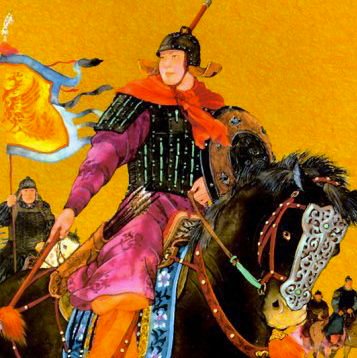
This poem was composed in the fifth or sixth century CE. At the time, China was divided between north and south. The rulers of the northern dynasties were from non-Han ethnic groups, most of them from Turkic peoples such as the Toba (Tuoba, also known as Xianbei), whose Northern Wei dynasty ruled most of northern China from 386–534. This background explains why the character Mulan refers to the Son of Heaven as “Khan” — the title given to rulers among the pastoral nomadic people of the north, including the Xianbei — one of the many reasons why the images conveyed in the movie “Mulan” of a stereotypically Confucian Chinese civilization fighting against the barbaric “Huns” to the north are inaccurate.

Tsiek tsiek and again tsiek tsiek,
Mulan weaves, facing the door.
You don’t hear the shuttle’s sound,
You only hear Daughter’s sighs.
They ask Daughter who’s in her heart,
They ask Daughter who’s on her mind.
“No one is on Daughter’s heart,
No one is on Daughter’s mind.
Last night I saw the draft posters,
The Khan is calling many troops,
The army list is in twelve scrolls,
On every scroll there’s Father’s name.
Father has no grown-up son,
Mulan has no elder brother.
I want to buy a saddle and horse,
And serve in the army in Father’s place.

In the East Market she buys a spirited horse,
In the West Market she buys a saddle,
In the South Market she buys a bridle,
In the North Market she buys a long whip.
At dawn she takes leave of Father and Mother,
In the evening camps on the Yellow River’s bank.
She doesn’t hear the sound of Father and Mother calling,
She only hears the Yellow River’s flowing water cry tsien tsien.

At dawn she takes leave of the Yellow River,
In the evening she arrives at Black Mountain.
She doesn’t hear the sound of Father and Mother calling,
She only hears Mount Yen’s nomad horses cry tsiu tsiu.
She goes ten thousand miles on the business of war,
She crosses passes and mountains like flying.
Northern gusts carry the rattle of army pots,
Chilly light shines on iron armor.
Generals die in a hundred battles,
Stout soldiers return after ten years.

On her return she sees the Son of Heaven,
The Son of Heaven sits in the Splendid Hall.
He gives out promotions in twelve ranks
And prizes of a hundred thousand and more.
The Khan asks her what she desires.
“Mulan has no use for a minister’s post.
I wish to ride a swift mount
To take me back to my home.”

When Father and Mother hear Daughter is coming
They go outside the wall to meet her, leaning on each other.
When Elder Sister hears Younger Sister is coming
She fixes her rouge, facing the door.
When Little Brother hears Elder Sister is coming
He whets the knife, quick quick, for pig and sheep.
“I open the door to my east chamber,
I sit on my couch in the west room,
I take off my wartime gown
And put on my old-time clothes.”
Facing the window she fixes her cloudlike hair,
Hanging up a mirror she dabs on yellow flower powder
She goes out the door and sees her comrades.
Her comrades are all amazed and perplexed.
Traveling together for twelve years
They didn’t know Mulan was a girl.
“The he-hare’s feet go hop and skip,
The she-hare’s eyes are muddled and fuddled.
Two hares running side by side close to the ground,
How can they tell if I am he or she?”


The Seven Sages of the Bamboo Grove

The Seven Sages of the Bamboo Grove

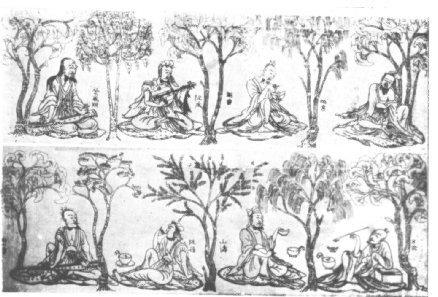
As is traditionally depicted, a certain group of seven scholar/musician/poets wishing to escape the intrigues, corruption and stifling atmosphere of court life during the politically fraught Three Kingdoms period of Chinese history habitually gathered in the obscurity of a bamboo grove near the house of Xi Kang in Shanyang (now in Henan province). Here they enjoyed practicing their works, and enjoying the simple, rustic life, always with too much Chinese alcoholic beverage (sometimes referred to as “wine”). This was contrasted with the theoretically and Confucian certified honorable and joyful duty of serving ones country; but, which at this time would have actually meant living (at least briefly) a life of attempting to perform governmental service amid the deadly dangerous political quagmires of the seats of power and changes of government. Rather than attempt to stay loyal to Wei through the rise of Jin by their active, personal involvement, the Seven Sages of the Bamboo Grove instead stressed the enjoyment of ale, personal freedom, spontaneity and a celebration of nature — together with political avoidance.

The complexity of homosexual relationships inevitably led to the creation of poetic works immortalizing conflicting sentiments. Ruan Ji is usually mentioned first among the Seven Sages of the Bamboo Grove. The other sages were Xi Kang his lover, Shan Tao, Liu Ling, Ruan Xian, Xiang Xiu, Wang Rong. They created an image of wise men enjoying life rather uninhibitedly, realizing the old dream of a Daoist concord of free men who are gifted with hidden wisdom “to be together, not being together” and “act jointly, not acting jointly”. The wine goblet, which became a symbol of being accustomed to “contemplating many wonders” pertaining to Daoism, united them even more than any principles. Ruan Ji talked in his works about “remote” things but about the “Bamboo Groove” he remained silent, although the group became the main focus of his searches for free and frank friendship.  Ruan Ji was one of the most famous poets to apply his brush to a homosexual theme. This work, one of several dealing with homosexuality from the “Jade Terrace,” a collection of love poetry, beautifully illustrates the stock imagery on which men of his time could draw in conceptualizing and describing love for another man.

In days of old there were many blossom boys —
An Ling and Long Yang.
Young peach and plum blossoms,
Dazzling with glorious brightness.
Joyful as nine springtimes;
Pliant as if bowed by autumn frost.
Roving glances gave rise to beautiful seductions;
Speech and laughter expelled fragrance.
Hand in hand they shared love’s rapture,
Sharing coverlcts and bedclothes.

Couples of birds in flight,
Paired wings soaring.
Cinnabar and green pigments record a vow:
“I’ll never forget you for all eternity. “