Category Archives: Poetry

Moment of Zen: Body, Remember….

tumblr_lffyg7yHbd1qe7y73o1_1280
Body, Remember….
C.P. Cavafy
Body, remember not only how much you were loved,
not only the beds you lay on,
but also those desires that glowed openly
in eyes that looked at you,
trembled for you in the voices—
only some chance obstacle frustrated them.
Now that it’s all finally in the past,
it seems almost as if you gave yourself
to those desires too—how they glowed,
remember, in eyes that looked at you,
remember, body, how they trembled for you in those voices.
(C.P. Cavafy, Collected Poems. Translated by Edmund Keeley and Philip Sherrard. Edited by George Savidis. Revised Edition. Princeton University Press, 1992)

David Hockney’s "Illustrations for Fourteen Poems from C P Cavafy"

Two Young Men, 23 to 24 Years Old
Bild 047He’d been sitting in the café since ten-thirty
expecting him to turn up any minute.
Midnight went by, and he was still waiting for him.
It was now after one-thirty, and the café was almost deserted.
He’d grown tired of reading newspapers
mechanically. Of his three lonely shillings
only one was left: waiting that long,
he’d spent the others on coffees and brandy.
He’d smoked all his cigarettes.
So much waiting had worn him out. Because
alone like that for so many hours,
he’d also begun to have disturbing thoughts
about the immoral life he was living.

But when he saw his friend come in—
weariness, boredom, thoughts vanished at once.

His friend brought unexpected news.
He’d won sixty pounds playing cards.

Their good looks, their exquisite youthfulness,
the sensitive love they shared
were refreshed, livened, invigorated
by the sixty pounds from the card table.
Now all joy and vitality, feeling and charm,
they went—not to the homes of their respectable families
(where they were no longer wanted anyway)—
they went to a familiar and very special
house of debauchery, and they asked for a bedroom
and expensive drinks, and they drank again.

And when the expensive drinks were finished
and it was close to four in the morning,
happy, they gave themselves to love.


Following the Recipe of Ancient Greco-Syrian Magicians
Bild 051Said an aesthete: “What distillation from magic herbs
can I find—what distillation, following the recipe
of ancient Greco-Syrian magicians—
that will bring back to me for one day (if its power
doesn’t last longer) or even for a few hours,
my twenty-third year,
bring back to me my friend of twenty-two,
his beauty, his love.
What distillation, following the recipe
of ancient Greco-Syrian magicians, can be found
to bring back also—as part of this return of things past—
even the little room we shared.”


In an Old Book
Bild 052Forgotten between the leaves of an old book—
almost a hundred years old—
I found an unsigned watercolor.
It must have been the work of a powerful artist.
Its title: “Representation of Love.”
“…love of extreme sensualists” would have been more to the point.
Because it became clear as you looked at the work
(it was easy to see what the artist had in mind)
that the young man in the painting
was not designated for those
who love in ways that are more or less healthy,
inside the bounds of what is clearly permissible—
with his deep chestnut eyes,
the rare beauty of his face,
the beauty of anomalous charm,
with those ideal lips that bring
sensual delight to the body loved,
those ideal limbs shaped for beds
that common morality calls shameless.


In the Boring Village
DavidHockney_InTheDullVillage_LGIn the boring village where he works—
clerk in a textile shop, very young—
and where he’s waiting out the two or three months ahead,
another two or three months until business falls off
so he can leave for the city and plunge headlong
into its action, its entertainment;
in the boring village where he’s waiting out the time—
he goes to bed tonight full of sexual longing,
all his youth on fire with the body’s passion,
his lovely youth given over to a fine intensity.
And in his sleep pleasure comes to him;
in his sleep he sees and has the figure, the flesh he longed for…


Their Beginning
hockn_beginningTheir illicit pleasure has been fulfilled.
They get up and dress quickly, without a word.
They come out of the house separately, furtively;
and as they move along the street a bit unsettled,
it seems they sense that something about them betrays
what kind of bed they’ve just been lying on.
But what profit for the life of the artist:
tomorrow, the day after, or years later, he’ll give voice
to the strong lines that had their beginning here.


One Night
P1188The room was cheap and sordid,
hidden above the suspect taverna.
From the window you could see the alley,
dirty and narrow. From below
came the voices of workmen
playing cards, enjoying themselves.
And there on that common, humble bed
I had love’s body, had those intoxicating lips,
red and sensual,
red lips of such intoxication
that now as I write, after so many years,
in my lonely house, I’m drunk with passion again.


In Despair
P1189He lost him completely. And he now tries to find
his lips in the lips of each new lover,
he tries in the union with each new lover
to convince himself that it’s the same young man,
that it’s to him he gives himself.
He lost him completely, as though he never existed.
He wanted, his lover said, to save himself
from the tainted, unhealthy form of sexual pleasure,
the tainted, shameful form of sexual pleasure.
There was still time, he said, to save himself.
He lost him completely, as though he never existed.
Through fantasy, through hallucination,
he tries to find his lips in the lips of other young men,
he longs to feel his kind of love once more.


David Hockney has enjoyed international fame ever since the early 1960s. He began his artistic training in 1953 to 1957 at the Bradford College of Art and continued studying at the Royal College of Art in London from 1959 to 1962. He exhibited his first works in 1960 and participated in the exhibition of the ‘London Group 1960’ in 1960 and was also presented for the first time with the ‘Young Contemporaries’ at the R.B.A. Galleries in London. He was awarded the Royal College Drawing Prize in the year he graduated. Hockney began working on his first engraved cycle ‘A Rake’s Progress’ as early as in 1961 – it was published in 1963. Hockney traveled to New York, Berlin and Egypt after having finished his studies, in order to find ideas for his illustrations. His friend, Henry Geldzahler, the curator at the Metropolitan Museum of Art in New York, encouraged him to move to Los Angeles in 1964. Hockney was offered a teaching post at the University of Iowa in the summer of the same year. His first one-man exhibition in the USA was successfully opened in the same year at the Alan Gallery in New York. He had other teaching posts until 1967 at the University of Colorado in Boulder, in Los Angeles and in Berkeley.
Hockney came across the Greek poet Konstantinos Kavafis, also called Cafavy, as early as in his studies. He was fascinated by Cafavy’s clear and unpretentious way of writing about homosexuality. Thus the idea for a cycle of etchings was born, which was, however, not solely due to his fascination for the Greek poet, but also because of his basic desire to create literature etchings. The project was not put into practice before 1966, as the translation of the poems which was in existence then could not be used for legal reasons. This is why Hockney decided to entrust his friend Stephen Spender, an English poet, and his colleague Nikos Stangos with a new translation of the poems. The project was completed in just 6 months. In general, the works of the cycle were not intended to be exact illustrations of the poem, but rather visual interpretations of Cafy’s poetry.
Hockney accepted a post as a guest professor at the Kunsthochschule in Hamburg in 1969. His international fame increased with his invitations to exhibit at the documenta 4 and 6 in Kassel in 1968 and 1977. He made numerous stage stets for ballets and operas by Mozart, Strawinsky, Wagner and Strauss from the mid 1970s to the 1990s. In 1982 Hockney began making Polaroid collages in a Cubist manner. He also began making color-copy prints, abstract computer graphics and fax drawings at the end of the 1980s. Hockney is often associated with Pop-Art, but he refuses to accept this labeling of his art.
Sources:

I only used seven of the fourteen poems featured in Hockney’s work, but these were the seven I found most intriguing. Each of the above poems were translated by Edmund Keeley/Philip Sherrard.  In Hockey’s book, they were translated by Stephen Spender and Nikos Stangos.


Constantine Cavafy

Duane Michals-The Adventures of Constantine CavafyDuane Michals. “The Adventures of Constantine Cavafy”

Born 29 April 1863 – 29 April 1933

Background: Constantine P. Cavafy was born Konstantinos Petrou Kavafis (or Kabaphs) in Alexandria, Egypt, into a wealthy merchant family. Originally the family came from Constantinople, Turkey, where Cavafy lived from 1880 to 1885. After his father’s death in 1872 he was taken to Liverpool, England, for five years. Apart from the years in Istanbul (1882-85), he spent the rest of his life in Alexandria. “Whatever war-damage it’s suffered, / however much smaller it’s become, / it’s still a wonderful city,” Cavafy once wrote of his cosmopolitan home town – perhaps not without ironic attitude.

cavafy50Work: When the family’s prosperity declined, Cavafy worked 34 years intermittently as journalist, broker, and in the Irrigation Service, from which he retired in 1922.

Enjoying his family’s respectable position in the cosmopolitan society of Alexandria, Cavafy led an uneventful life of routine, which was interrupted only by short trips to Athens, France, England, and Italy. His first book was published when he was 41, and reissued five years later with additional seven poems. He published no further works during his lifetime.

As a writer Cavafy was perfectionist – he printed his poems by himself and delivered them only to close friends. The poems had sometimes handwritten corrections. Main themes in his works were homosexual love, art, and politics. He started writing poetry under the influence of late-Victorian and Decadent European models, but then abandoned his attempts to compose in foreign tongues.

Fourteen of Cavafy’s poems appeared in a pamphlet in 1904. The edition was enlarged in 1910. Several dozens appeared subsequent years in a number of privately printed booklets and broadsheets. These editions contained mostly the same poems, first arranged thematically, and then chronologically. Close to one third of his poems were never printed in any form while he lived. ‘One Night,’ written 1907, was one of the erotic poems Cavafy wrote during the years in Alexandria, and referred to a passing sexual encounter. It showed the poet’s devotion to a sensual pleasure, free and joyous.

And there on that common, humble bed,
I had love’s body, hand those intoxicating lips,
red and sensual, red lips of such intoxication
that now as I write, after so many years,
in my lonely house, I’m drunk with passion again.

In book form Cavafy’s poems were first published without dates before World War II and reprinted in 1949. PIIMATA (The Poems of Constantine P. Cavafy) appeared posthumously in 1935 in Alexandria. Cavafy died on April 29, 1933 in Alexandria. Nowadays the cafés that the poet frequented on the Rue Misalla (now Safiya Zaghlul) have been largely replaced by shops.

prt09973_david_hockney_signed_print_portrait_of_cavafy_in_alexandria_iCavafy composed rhymed as well as free verse, but never loose, unstructured, or irregular poems. He used iambic, eleven-syllable measures, including the popular fifteen-syllable verse of the demotic tradition. After giving up experiments with different literary models, Cavafy mixed the demotic and pure Greek called katharevousa, and used his wide knowledge of the history of East Roman and Byzantine empires as the basis of his themes.

Like in Oscar Wilde, aestheticism and skepticism marked Cavafy’s work. One of his central motifs was regret for old age: Past and present, East and West, Greek and ‘barbarian’ were fused into sophisticated commentaries on paganism, Christianity, and decadent modern world. Cavafy sketched a rich gallery of historical, semi-obscure, or fictitious characters, whom he used as personae acting, or being discussed, in the episodes of his poems. Often his style was dramatic, as in the famous ‘Waiting for the Barbarians.’ Among his confessional poems with homosexual theme is ‘The Bandaged Shoulder,’ much admired by Lawrence Durrell.

Friends & Relationships: His first love affair was with his cousin, George Psilliary, in 1882. he would often visit male brothels or the Café Al Salam where there were plenty of available young men – in particular a handsome young car mechanic called Toto. His only long-term lover was Alexander Singopoulos whom he made his heir and literary executor. Although he was upset when Alexander got married he later became fond of his wife Rika.
Cavafy held afternoons from 5 until 7 at his flat with metses and ouzo or whisky and he would observe quietly his friends and his handsome youths.
Cavafy lived in West London for three years from 1873 – 1876. He died on his seventieth birthday after a long fight against throat cancer. His last act was to place a dot into the center of a circle he had drawn. In Hidden Things he predicted:

Later, in a more perfect society, Someone else made just like me
Is certain to appear and act freely.

http://www.circa-club.com/gallery/gay_history_icons_constantine_cavafy.php


The Ides of March

by Constantine P Cavafy

julcaehlFear grandeurs, O soul.
And if you cannot overcome
your ambitions, pursue them with hesitation
and caution. And the more you advance,
the more inquisitive, careful you must be.

And when you reach your peak, Caesar at last;
when you assume the form of a famous man,
then above all beware when you go out in the street,
a conspicuous ruler with followers,
if by chance from the mob approaches
some Artemidorus*, bringing a letter
and says hastily ‘Read this immediately,
these are grave matters that concern you,’
do not fail to stop; do not fail to push aside
all those who salute and kneel
(you can see them later); let even the Senate
itself wait, and immediately recognize
the grave writings of Artemidorus.

Vincenzo Camuccini, "Morte di Cesare", 1798,
Greek Original (for any of you who know Greek):

Μάρτιαι Ειδοί
Τα μεγαλεία να φοβάσαι, ω ψυχή.
Και τες φιλοδοξίες σου να υπερνικήσεις
αν δεν μπορείς, με δισταγμό και προφυλάξεις
να τες ακολουθείς. Κι όσο εμπροστά προβαίνεις,
τόσο εξεταστική, προσεκτική να είσαι.

Κι όταν θα φθάσεις στην ακμή σου, Καίσαρ πια·
έτσι περιωνύμου ανθρώπου σχήμα όταν λάβεις,
τότε κυρίως πρόσεξε σαν βγεις στον δρόμον έξω,
εξουσιαστής περίβλεπτος με συνοδεία,
αν τύχει και πλησιάσει από τον όχλο
κανένας Αρτεμίδωρος, που φέρνει γράμμα,
και λέγει βιαστικά «Διάβασε αμέσως τούτα,
είναι μεγάλα πράγματα που σ’ ενδιαφέρουν»,
μη λείψεις να σταθείς· μη λείψεις τους διαφόρους
που χαιρετούν και προσκυνούν να τους παραμερίσεις
(τους βλέπεις πιο αργά· ας περιμένει ακόμη
κ’ η Σύγκλητος αυτή, κ’ ευθύς να τα γνωρίσεις
τα σοβαρά γραφόμενα του Αρτεμιδώρου.

Constantine P Cavafy

(1863 – 1933)

[Cavafy]Cavafy, one of the most prominent Greek poets, was born on April 29, 1863 and died on the same date in 1933 in Alexandria (Egypt). Here’s a short biographical note by the poet himself:

I am from Constantinople by descent, but I was born in Alexandria — at a house on Seriph Street; I left very young, and spent much of my childhood in England. Subsequently I visited this country as an adult, but for a short period of time. I have also lived in France. During my adolescence I lived over two years in Constantinople. It has been many years since I last visited Greece.

My last employment was as a clerk at a government office under the Ministry of Public Works of Egypt. I know English, French, and a little Italian.

Constantine P. Cavafy, also known as Konstantin or Konstantinos Petrou Kavafis, orKavaphes (Greek: Κωνσταντίνος Π. Καβάφης) (April 29, 1863 – April 29, 1933) was a renowned Greek poet who lived in Alexandria and worked as a journalist and civil servant. In his poetry he examined critically some aspects of Christianity, patriotism, and homosexuality, though he was not always comfortable with his role as a nonconformist. He published 154 poems; dozens more remained incomplete or in sketch form. His most important poetry was written after his fortieth birthday.

After finding this poem, I did some research on Cavafy, who seems to be a very interesting poet.  Cavafy, a homosexual, wrote many sexually explicit poems. W. H. Auden noted as much in his introduction to the 1961 volume The Complete Poems of C. P. Cavafy when he wrote, “Cavafy was a homosexual, and his erotic poems make no attempt to conceal the fact.” Auden added: “As a witness, Cavafy is exceptionally honest. He neither bowdlerizes nor glamorizes nor giggles. The erotic world he depicts is one of casual pickups and short-lived affairs. Love, there, is rarely more than physical passion. . . . At the same time, he refuses to pretend that his memories of moments of sensual pleasure are unhappy or spoiled by feelings of guilt.”

More about Cavafy will be posted this week.

*Julius Caesar – Act 2, Scene 3 by William Shakespeare

SCENE III. A street near the Capitol.

   Enter ARTEMIDORUS, reading a paper

ARTEMIDORUS
    ‘Caesar, beware of Brutus; take heed of Cassius;
    come not near Casca; have an eye to Cinna, trust not
    Trebonius: mark well Metellus Cimber: Decius Brutus
    loves thee not: thou hast wronged Caius Ligarius.
    There is but one mind in all these men, and it is
    bent against Caesar. If thou beest not immortal,
    look about you: security gives way to conspiracy.
    The mighty gods defend thee! Thy lover,
    ‘ARTEMIDORUS.’
    Here will I stand till Caesar pass along,
    And as a suitor will I give him this.
    My heart laments that virtue cannot live
    Out of the teeth of emulation.
    If thou read this, O Caesar, thou mayst live;
    If not, the Fates with traitors do contrive.

    Exit


In Praise of Limestone

NCP25058843801In Praise of Limestone” is a poem written by W. H. Auden in Italy in May 1948. Central to his canon and one of Auden’s finest poems, it has been the subject of diverse scholarly interpretations. Auden’s limestone landscape has been interpreted as an allegory of Mediterranean civilization and of the human body. The poem, sui generis, is not easily classified. As a topographical poem, it describes a landscape and infuses it with meaning. It has been called the “first … postmodern pastoral”. In a letter, Auden wrote of limestone and the poem’s theme that “that rock creates the only human landscape.”

In December 1948, a few months after he had celebrated the maternal aspects of the flesh in “In Praise of Limestone,” Auden celebrated the male flesh in a less sacramental style. “Deciding that there ought to be one in the Auden corpus” — his choice of the noun is deliberate — “I am writing a purely pornographic poem, The Platonic Blow,” he told Kallman. He borrowed the nameless syncopated metre (“It was a Spring day, a day for a lay, when the air / Smelled like a locker-room”) invented by Charles Williams for the poems of his highly sacramental Taliessin through Logres, but the word “Platonic” in Auden’s title was an ironic spoof. The sexual act described by the poem in microscopic physiological detail is “Platonic” only in the popular sense that it is perfect of its kind — Auden asked friends to contribute their relevant ideas of perfection — and not in the sense that the bodies that perform the act are in any way transcended.


In Praise Of Limestone

Tuke,_Henry_Scott_(1858–1929)_-_1920_-_Youth_on_beachIf it form the one landscape that we, the inconstant ones,
Are consistently homesick for, this is chiefly
Because it dissolves in water. Mark these rounded slopes
With their surface fragrance of thyme and, beneath,
A secret system of caves and conduits; hear the springs
That spurt out everywhere with a chuckle,
Each filling a private pool for its fish and carving
Its own little ravine whose cliffs entertain
The butterfly and the lizard; examine this region
Of short distances and definite places:
What could be more like Mother or a fitter background
For her son, the flirtatious male who lounges
Against a rock in the sunlight, never doubting
That for all his faults he is loved; whose works are but
Extensions of his power to charm? From weathered outcrop
To hill-top temple, from appearing waters to
Conspicuous fountains, from a wild to a formal vineyard,
Are ingenious but short steps that a child’s wish
To receive more attention than his brothers, whether
By pleasing or teasing, can easily take.

Watch, then, the band of rivals as they climb up and down
Their steep stone gennels in twos and threes, at times
Arm in arm, but never, thank God, in step; or engaged
On the shady side of a square at midday in
Voluble discourse, knowing each other too well to think
There are any important secrets, unable
To conceive a god whose temper-tantrums are moral
And not to be pacified by a clever line
Tuke,_Henry_Scott_(1858–1929)_-_1921_-_Boys_bathing_on_rocksOr a good lay: for accustomed to a stone that responds,
They have never had to veil their faces in awe
Of a crater whose blazing fury could not be fixed;
Adjusted to the local needs of valleys
Where everything can be touched or reached by walking,
Their eyes have never looked into infinite space
Through the lattice-work of a nomad’s comb; born lucky,
Their legs have never encountered the fungi
And insects of the jungle, the monstrous forms and lives
With which we have nothing, we like to hope, in common.
So, when one of them goes to the bad, the way his mind works
Remains incomprehensible: to become a pimp
Or deal in fake jewellery or ruin a fine tenor voice
For effects that bring down the house, could happen to all
But the best and the worst of us…
That is why, I suppose,
The best and worst never stayed here long but sought
Immoderate soils where the beauty was not so external,
The light less public and the meaning of life
Something more than a mad camp. ‘Come!’ cried the granite wastes,
“How evasive is your humour, how accidental
Your kindest kiss, how permanent is death.” (Saints-to-be
Slipped away sighing.) “Come!” purred the clays and gravels,
“On our plains there is room for armies to drill; rivers
Wait to be tamed and slaves to construct you a tomb
In the grand manner: soft as the earth is mankind and both
Need to be altered.” (Intendant Caesars rose and
Left, slamming the door.) But the really reckless were fetched
By an older colder voice, the oceanic whisper:
“I am the solitude that asks and promises nothing;
That is how I shall set you free. There is no love;
Tuke_Henry_Scott_1858–1929_-_1914_ca_-_Two_boys_and_a_dogThere are only the various envies, all of them sad.”

They were right, my dear, all those voices were right
And still are; this land is not the sweet home that it looks,
Nor its peace the historical calm of a site
Where something was settled once and for all: A back ward
And dilapidated province, connected
To the big busy world by a tunnel, with a certain
Seedy appeal, is that all it is now? Not quite:
It has a worldy duty which in spite of itself
It does not neglect, but calls into question
All the Great Powers assume; it disturbs our rights. The poet,
Admired for his earnest habit of calling
The sun the sun, his mind Puzzle, is made uneasy
By these marble statues which so obviously doubt
His antimythological myth; and these gamins,
Pursuing the scientist down the tiled colonnade
With such lively offers, rebuke his concern for Nature’s
Remotest aspects: I, too, am reproached, for what
And how much you know. Not to lose time, not to get caught,
Not to be left behind, not, please! to resemble
The beasts who repeat themselves, or a thing like water
Or stone whose conduct can be predicted, these
Are our common prayer, whose greatest comfort is music
Which can be made anywhere, is invisible,
And does not smell. In so far as we have to look forward
SunBather_TukeTo death as a fact, no doubt we are right: But if
Sins can be forgiven, if bodies rise from the dead,
These modifications of matter into
Innocent athletes and gesticulating fountains,
Made solely for pleasure, make a further point:
The blessed will not care what angle they are regarded from,
Having nothing to hide. Dear, I know nothing of
Either, but when I try to imagine a faultless love
Or the life to come, what I hear is the murmur
Of underground streams, what I see is a limestone landscape.

W.H. Auden

The paintings are by Henry Scott Tuke.


Limericks by Auden

tumblr_lgkxjaakHO1qcptz0o1_500As the poets have mournfully sung,
Death takes the innocent young,
The rolling-in-money,
The screamingly-funny,
And those who are very well hung.

— W. H. Auden


tumblr_lgzhvgaNau1qb7pqeo1_500After vainly invoking the Muse,
A poet cried “Hell! What’s the use?
“There is more inspiration
“At Grand Central Station–
“I shall go there this moment and cruise.”

— W. H. Auden


tumblr_le81xcgxvw1qbgs6do1_500A friend, who is not an ascetic,
Says: “Ireland, my dear, is magnetic!
“No snakes; lots of elves,
“Who just offer themselves–
“Rather small, but most sympathetic.”

— W. H. Auden


"The Platonic Blow" – W. H. Auden

How Dirty Is That Auden Poem That Was Too Dirty for the ‘Times Book Review’?


Courtesy of Scribner
The highlight of the March 17, 2008 New York Times Book Review is Dan Chiasson’s highly entertaining review of The Best American Erotic Poems, a new anthology of humpy verse edited by David Lehman. After calling John Updike’s “Fellatio” “perhaps the worst poem ever written on any subject,” Chiasson gleefully quotes the poem: “It is beautiful to think / that each of these clean secretaries / at night, to please her lover, takes / a fountain into her mouth.” But Chiasson teases us with his description of the dirtiest poem in the anthology, W.H. Auden’s “The Platonic Blow,” which Chiasson can only call “is the dirtiest verse written since Rochester — I can’t even talk about it here.”
So how dirty is it, really?
It is really, really, really, really dirty. Like a Penthouse Forum letter, except in lively verse, and with no women. It’s sort of great, and also sort of cheesy and awful, and also occasionally hilarious. (“‘Shall I rim you?’ I whispered. He shifted his limbs in assent.”) We feel compelled to reprint the entire thing, just because we never had any idea that W.H. Auden wrote an unbelievably filthy poem about an anonymous blow job.
According to the editor’s note, Auden wrote the poem in 1948, and copies were circulated among friends and fans for years, before Ed Sanders (of the Fugs) printed an unauthorized version in 1965. Auden publicly denied authorship, which is why we can reprint this without permission and with impunity (as does the anthology, which doesn’t include Auden’s poem on its copyright page). Enjoy!

The Platonic Blow
by W. H. Auden

It was a spring day, a day for a lay, when the air
Smelled like a locker-room, a day to blow or get blown;
Returning from lunch I turned my corner and there
On a near-by stoop I saw him standing alone.

I glanced as I advanced. The clean white T-shirt outlined
A forceful torso, the light-blue denims divulged
Much. I observed the snug curves where they hugged the behind,
I watched the crotch where the cloth intriguingly bulged.

Our eyes met. I felt sick. My knees turned weak.
I couldn’t move. I didn’t know what to say.
In a blur I heard words, myself like a stranger speak
“Will you come to my room?” Then a husky voice, “O.K.”

I produced some beer and we talked. Like a little boy
He told me his story. Present address: next door.
Half Polish, half Irish. The youngest. From Illinois.
Profession: mechanic. Name: Bud. Age: twenty-four.

He put down his glass and stretched his bare arms along
The back of my sofa. The afternoon sunlight struck
The blond hairs on the wrist near my head. His chin was strong.
His mouth sucky. I could hardly believe my luck.

And here he was sitting beside me, legs apart.
I could bear it no longer. I touched the inside of his thigh.
His reply was to move closer. I trembled, my heart
Thumped and jumped as my fingers went to his fly.

I opened a gap in the flap. I went in there.
I sought for a slit in the gripper shorts that had charge
Of the basket I asked for. I came to warm flesh then to hair.
I went on. I found what I hoped. I groped. It was large.

He responded to my fondling in a charming, disarming way:
Without a word he unbuckled his belt while I felt.
And lolled back, stretching his legs. His pants fell away.
Carefully drawing it out, I beheld what I held.

The circumcised head was a work of mastercraft
With perfectly beveled rim of unusual weight
And the friendliest red. Even relaxed, the shaft
Was of noble dimensions with the wrinkles that indicate

Singular powers of extension. For a second or two,
It lay there inert, then suddenly stirred in my hand,
Then paused as if frightened or doubtful of what to do.
And then with a violent jerk began to expand.

By soundless bounds it extended and distended, by quick
Great leaps it rose, it flushed, it rushed to its full size.
Nearly nine inches long and three inches thick,
A royal column, ineffably solemn and wise.

I tested its length and strength with a manual squeeze.
I bunched my fingers and twirled them about the knob.
I stroked it from top to bottom. I got on my knees.
I lowered my head. I opened my mouth for the job.

But he pushed me gently away. He bent down. He unlaced
His shoes. He removed his socks. Stood up. Shed
His pants altogether. Muscles in arms and waist
Rippled as he whipped his T-shirt over his head.

I scanned his tan, enjoyed the contrast of brown
Trunk against white shorts taut around small
Hips. With a dig and a wriggle he peeled them down.
I tore off my clothes. He faced me, smiling. I saw all.

The gorgeous organ stood stiffly and straightly out
With a slight flare upwards. At each beat of his heart it threw
An odd little nod my way. From the slot of the spout
Exuded a drop of transparent viscous goo.

The lair of hair was fair, the grove of a young man,
A tangle of curls and whorls, luxuriant but couth.
Except for a spur of golden hairs that fan
To the neat navel, the rest of the belly was smooth.

Well hung, slung from the fork of the muscular legs,
The firm vase of his sperm, like a bulging pear,
Cradling its handsome glands, two herculean eggs,
Swung as he came towards me, shameless, bare.

We aligned mouths. We entwined. All act was clutch,
All fact contact, the attack and the interlock
Of tongues, the charms of arms. I shook at the touch
Of his fresh flesh, I rocked at the shock of his cock.

Straddling my legs a little I inserted his divine
Person between and closed on it tight as I could.
The upright warmth of his belly lay all along mine.
Nude, glued together for a minute, we stood.

I stroked the lobes of his ears, the back of his head
And the broad shoulders. I took bold hold of the compact
Globes of his bottom. We tottered. He fell on the bed.
Lips parted, eyes closed, he lay there, ripe for the act.

Mad to be had, to be felt and smelled. My lips
Explored the adorable masculine tits. My eyes
Assessed the chest. I caressed the athletic hips
And the slim limbs. I approved the grooves of the thighs.

I hugged, I snuggled into an armpit. I sniffed
The subtle whiff of its tuft. I lapped up the taste
Of its hot hollow. My fingers began to drift
On a trek of inspection, a leisurely tour of the waist.

Downward in narrowing circles they playfully strayed.
Encroached on his privates like poachers, approached the prick,
But teasingly swerved, retreated from meeting. It betrayed
Its pleading need by a pretty imploring kick.

“Shall I rim you?” I whispered. He shifted his limbs in assent.
Turned on his side and opened his legs, let me pass
To the dark parts behind. I kissed as I went
The great thick cord that ran back from his balls to his arse.

Prying the buttocks aside, I nosed my way in
Down the shaggy slopes. I came to the puckered goal.
It was quick to my licking. He pressed his crotch to my chin.
His thighs squirmed as my tongue wormed in his hole.

His sensations yearned for consummation. He untucked
His legs and lay panting, hot as a teen-age boy.
Naked, enlarged, charged, aching to get sucked,
Clawing the sheet, all his pores open to joy.

I inspected his erection. I surveyed his parts with a stare
From scrotum level. Sighting along the underside
Of his cock, I looked through the forest of pubic hair
To the range of the chest beyond rising lofty and wide.

I admired the texture, the delicate wrinkles and the neat
Sutures of the capacious bag. I adored the grace
Of the male genitalia. I raised the delicious meat
Up to my mouth, brought the face of its hard-on to my face.

Slipping my lips round the Byzantine dome of the head,
With the tip of my tongue I caressed the sensitive groove.
He thrilled to the trill. “That’s lovely!” he hoarsely said.
“Go on! Go on!” Very slowly I started to move.

Gently, intently, I slid to the massive base
Of his tower of power, paused there a moment down
In the warm moist thicket, then began to retrace
Inch by inch the smooth way to the throbbing crown.

Indwelling excitements swelled at delights to come
As I descended and ascended those thick distended walls.
I grasped his root between left forefinger and thumb
And with my right hand tickled his heavy voluminous balls.

I plunged with a rhythmical lunge steady and slow,
And at every stroke made a corkscrew roll with my tongue.
His soul reeled in the feeling. He whimpered “Oh!”
As I tongued and squeezed and rolled and tickled and swung.

Then I pressed on the spot where the groin is joined to the cock,
Slipped a finger into his arse and massaged him from inside.
The secret sluices of his juices began to unlock.
He melted into what he felt. “O Jesus!” he cried.

Waves of immeasurable pleasures mounted his member in quick
Spasms. I lay still in the notch of his crotch inhaling his sweat.
His ring convulsed round my finger. Into me, rich and thick,
His hot spunk spouted in gouts, spurted in jet after jet.

http://nymag.com/daily/entertainment/2008/03/how_dirty_is_that_auden_poem_t.html

As you know, I generally add pictures to poems, but due to the explicit eroticism of “The Platonic Blow” also known as“A Day for a Lay,” I have decided to do a companion post of pictures on my other blog.


W.H. Auden

This week I am going to focus on W. H. Auden.  You probably know by now how much I love poetry, and Auden is a beautiful poet.  The poem that I will feature tomorrow on this blog is the main reason that I decided to devote a week to Auden and his poetry.

W. H. Auden, (1907-1973)

Described by Edward Mendelson as “the most inclusive poet of the twentieth century, its most technically skilled, and its most truthful,” Auden is the first major poet to incorporate modern psychological insights and paradigms as a natural element of his work and thought. The foremost religious poet of his age, the most variously learned, and the one most preoccupied with existentialism, Auden is also an important love poet.

Although particularly concerned with the relationship of Eros and Agape and characteristically practicing a “poetry of reticence,” Auden celebrates erotic love as a significant element in his geography of the heart.

Born into an upper middle-class professional family in York in 1907 and educated at Christ Church College, Oxford, from which he received his B.A. in 1928, Wystan Hugh Auden was the third son of a physician and a nurse, from whom he imbibed scientific, religious, and musical interests and a love of the Norse sagas. Following his graduation, he spent a year in Berlin, where he enjoyed the city’s homosexual demimonde and absorbed German culture. He returned to teach in public schools in Scotland and England from 1930 to 1935.

In 1938, he married Erika Mann, daughter of the German novelist Thomas Mann, in order to enable her to obtain a British visa and escape Nazi Germany; the marriage was not consummated. In January 1939, disillusioned with the left-wing politics they had embraced, Auden and his friend and frequent collaborator, Christopher Isherwood, emigrated to the United States.

Settling in New York City, Auden soon fell in love with a precocious eighteen-year-old from Brooklyn, Chester Kallman, with whom he maintained a relationship for the rest of his life, sharing apartments in New York and, later, summer residences in first Ischia and then Austria. Auden died in Vienna on September 29, 1973.

Auden dominated the British literary scene of the 1930s, quickly emerging as the leading voice of his generation. With the publication of The Orators (1932) and the enlarged edition of Poems (1933), Auden became, by his mid-twenties, firmly established as an important literary presence, the leader of the “Auden Gang” that included Isherwood, Stephen Spender, C. Day Lewis, and Louis MacNeice.

Auden’s early poetry breathed an air of revolutionary freshness. In language at once exotic and earthy, alternately banal and elegant, colloquial yet faintly archaic, Auden’s verse diagnosed psychic disturbances with an extraordinary resonance. Although most of his early poems have their origins in his personal anxieties, especially those related to his homosexuality and his search for psychic healing, they seemed to voice the fears and uncertainties of his entire generation.

Auden may have initially regarded his gayness as a psychic wound, but he came to see it as a liberating force. In the prose poem “Letter to a Wound” (1932), he writes,

Thanks to you, I have come to see a profound significance in relations I never dreamt of considering before, an old lady’s affection for a small dog, the Waterhouses and their retriever, the curious bond between Offal and Snig, the partners in the hardware shop on the front. Even the close-ups in the films no longer disgust nor amuse me. On the contrary, they sometimes make me cry; knowing you has made me understand.

Auden’s acceptance of his gayness thus leads him to new insight into the universal impulse to love and enlarges his understanding of all kinds of relationships. At the same time, however, Auden is acutely aware of the limitations of eroticism.

His earliest love poems complain of his lack of sexual success, but his poems from the later 1930s such as “May with its light behaving” lament an emotional isolation that accompanies physical intimacy. In the poem beginning “Easily, my dear, you move,” erotic love and feverish political activity are both depicted as expressions of vanity and the desire for power. Auden finally reaches the conclusion that Eros and Agape are interdependent.

Auden’s recognition of the interdependence of Eros and Agape is at the heart of perhaps the greatest love poem of the century, the grave and tender “Lullaby” ([“Lay your sleeping head”] 1937), which moves so nimbly and with such grace among abstractions evoked so subtly that it may well be regarded as the premiere example of the poet’s intellectual lyricism. The luminous moment of fulfillment that the poem celebrates is placed in a context of mutability and decay that poignantly underlines the fragility of a love endangered from within by guilt, promiscuity, and betrayal, and from without by the “pedantic boring cry” of homophobic “fashionable madmen.”

Auden’s marriage to Kallman was not to prove entirely happy (primarily due to Kallman’s promiscuity), but it provided the poet with loving companionship and helped seal the permanence of his self-exile. Auden’s first flush of passion for Kallman immediately inspired several poems of fulfilled erotic love, including “The Prophets,” “Like a Vocation,” “The Riddle,” “Law Like Love,” and “Heavy Date,” in which he tells his lover, “I have / Found myself in you.”

Kallman introduced Auden to opera, an interest that would shape the curve of his career. The partners collaborated on several original libretti, including one for Stravinsky’s The Rake’s Progress (1951), and on translating others.

Auden movingly celebrates his relationship with Kallman in “The Common Life” (1965), which tellingly declares that “every home should be a fortress.” Also among Auden’s late poems is “Glad,” a light but deeply felt account of his relationship with a male hustler, “for a decade now / My bed-visitor, / An unexpected blessing / In a lucky life.”
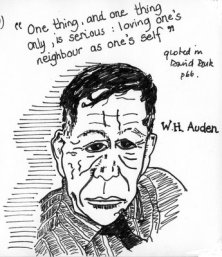
In “Since,” a poem probably inspired by his relationship with Kallman, Auden suddenly remembers an August noon thirty years ago and “You as then you were.” He juxtaposes the memory of his youthful love-making with an account of the failures of Eros and Agape in the world since then and finds sustenance in the memory: “round your image / there is no fog, and the Earth / can still astonish.”

In a remarkable conclusion that bravely faces the issue of aging with unsentimental wit, he concludes, “I at least can learn / to live with obesity / and a little fame.” A stunning achievement, “Since” validates the vision of Eros as a life-sustaining experience that can compensate at least in part even for the inevitable failures of Agape.

Auden’s homosexuality is also expressed throughout his canon in the camp wit that discerns defensive fun in serious fear, as in the limerick “The Aesthetic Point of View” (1960). Moreover, the humorous self-revelations of the “Shorts” (1960), the “Marginalia” (1969), or “Profile” (1969), as well as the bawdy verse–such as “A Day for a Lay”–circulated among friends, helped establish for Auden a persona that has been particularly influential on younger gay poets, such as James Merrill, Richard Howard, and Howard Moss. In Merrill’s series of adventures with the Ouija board, for example, Auden is a ghostly presence, the embodiment of a homosexual artistic sensibility.

An essay by Claude J. Summers

Summers, Claude J., “Auden, W. H., ” glbtq: An Encyclopedia of Gay, Lesbian, Bisexual, Transgender, and Queer Culture, 2002.  URL: http://www.glbtq.com/literature/auden_wh.html.


Bibliography

Callan, Edward. Auden: A Carnival of Intellect. New York: Oxford University Press, 1983.

Carpenter, Humphrey. W.H. Auden: A Biography. London: Allen & Unwin, 1981.

Farnin, Dorothy J. Auden in Love. New York: Simon & Schuster, 1984.

Mendelson, Edward. Early Auden. New York: Viking, 1981.

Spender, Stephen, ed. W.H. Auden: A Tribute. New York: Macmillan, 1975.

Summers, Claude J. “American Auden.” Columbia History of American Poetry. Jay Parini, ed. New York: Columbia University Press, 1993.

_____. “‘And the Earth Can Still Astonish’: W.H. Auden and the Landscape of Eros.” The Windless Orchard 32 (1978): 27-36.

Wright, George T. W.H. Auden. Rev. ed. Boston: Twayne Publishers, 1981.


Stopping by Woods on a Snowy Evening

Winter only has a few more weeks left.  The cold is almost over, and it certainly feels like its over here, with our 80 degree weather.  We had to turn the air conditioners back on today.  I dread the heat.  I always love the fall and the winter because we have a respite from the oppressive heat and humidity of the Deep South.  So before winter ends, I have to add one of my favorite winter poems:
Stopping by Woods on a Snowy Evening
by Robert Frost (1923)!000000aaa001a0000aawintry_mix10
Whose woods these are I think I know.
His house is in the village though;
He will not see me stopping here
To watch his woods fill up with snow.

My little horse must think it queer
To stop without a farmhouse near
Between the woods and frozen lake
!000000aaa001a0000aaaasnow-a038The darkest evening of the year.

He gives his harness bells a shake
To ask if there is some mistake.
The only other sound’s the sweep
Of easy wind and downy flake.

The woods are lovely, dark and deep.
But I have promises to keep,
!000000aaa001a0000groupsnow-a040And miles to go before I sleep,
And miles to go before I sleep.


Walk in the Woods

Walk in the Woods  by Shyaners

Walking through
the trees with
no where to go.

Seeing all of the
animals scurrying
to and fro.

Thinking about
all that has happened
through my life.

tumblr_lgvypkNsBd1qf57cco1_400Who has come in and
who has gone out.

Having doubts about
my beauty, doubts
about my soul.

Doubts about my
happiness, doubts
about my whole.

Knowing that at
any second it could
all be over and done.

No way to go back and
redo what I regret.

No way to go back and
change the many times
I fret.

All I know is that I can
only live one day at a
time.

Leaving people who
get into my way
sadly behind.

I found this poem when trying to find one that would go with the picture above.  When I came across this poem, I fell in love with.  It is perfect simplicity at its finest.


