
 Duane Michals. “The Adventures of Constantine Cavafy”
Born 29 April 1863 – 29 April 1933
Background: Constantine P. Cavafy was born Konstantinos Petrou Kavafis (or Kabaphs) in Alexandria, Egypt, into a wealthy merchant family. Originally the family came from Constantinople, Turkey, where Cavafy lived from 1880 to 1885. After his father’s death in 1872 he was taken to Liverpool, England, for five years. Apart from the years in Istanbul (1882-85), he spent the rest of his life in Alexandria. “Whatever war-damage it’s suffered, / however much smaller it’s become, / it’s still a wonderful city,” Cavafy once wrote of his cosmopolitan home town – perhaps not without ironic attitude.
 Work: When the family’s prosperity declined, Cavafy worked 34 years intermittently as journalist, broker, and in the Irrigation Service, from which he retired in 1922.
Enjoying his family’s respectable position in the cosmopolitan society of Alexandria, Cavafy led an uneventful life of routine, which was interrupted only by short trips to Athens, France, England, and Italy. His first book was published when he was 41, and reissued five years later with additional seven poems. He published no further works during his lifetime.
As a writer Cavafy was perfectionist – he printed his poems by himself and delivered them only to close friends. The poems had sometimes handwritten corrections. Main themes in his works were homosexual love, art, and politics. He started writing poetry under the influence of late-Victorian and Decadent European models, but then abandoned his attempts to compose in foreign tongues.
Fourteen of Cavafy’s poems appeared in a pamphlet in 1904. The edition was enlarged in 1910. Several dozens appeared subsequent years in a number of privately printed booklets and broadsheets. These editions contained mostly the same poems, first arranged thematically, and then chronologically. Close to one third of his poems were never printed in any form while he lived. ‘One Night,’ written 1907, was one of the erotic poems Cavafy wrote during the years in Alexandria, and referred to a passing sexual encounter. It showed the poet’s devotion to a sensual pleasure, free and joyous.
And there on that common, humble bed,
I had love’s body, hand those intoxicating lips,
red and sensual, red lips of such intoxication
that now as I write, after so many years,
in my lonely house, I’m drunk with passion again.
In book form Cavafy’s poems were first published without dates before World War II and reprinted in 1949. PIIMATA (The Poems of Constantine P. Cavafy) appeared posthumously in 1935 in Alexandria. Cavafy died on April 29, 1933 in Alexandria. Nowadays the cafés that the poet frequented on the Rue Misalla (now Safiya Zaghlul) have been largely replaced by shops.
 Cavafy composed rhymed as well as free verse, but never loose, unstructured, or irregular poems. He used iambic, eleven-syllable measures, including the popular fifteen-syllable verse of the demotic tradition. After giving up experiments with different literary models, Cavafy mixed the demotic and pure Greek called katharevousa, and used his wide knowledge of the history of East Roman and Byzantine empires as the basis of his themes.
Like in Oscar Wilde, aestheticism and skepticism marked Cavafy’s work. One of his central motifs was regret for old age: Past and present, East and West, Greek and ‘barbarian’ were fused into sophisticated commentaries on paganism, Christianity, and decadent modern world. Cavafy sketched a rich gallery of historical, semi-obscure, or fictitious characters, whom he used as personae acting, or being discussed, in the episodes of his poems. Often his style was dramatic, as in the famous ‘Waiting for the Barbarians.’ Among his confessional poems with homosexual theme is ‘The Bandaged Shoulder,’ much admired by Lawrence Durrell.
Friends & Relationships: His first love affair was with his cousin, George Psilliary, in 1882. he would often visit male brothels or the Café Al Salam where there were plenty of available young men – in particular a handsome young car mechanic called Toto. His only long-term lover was Alexander Singopoulos whom he made his heir and literary executor. Although he was upset when Alexander got married he later became fond of his wife Rika.
Cavafy held afternoons from 5 until 7 at his flat with metses and ouzo or whisky and he would observe quietly his friends and his handsome youths.
Cavafy lived in West London for three years from 1873 – 1876. He died on his seventieth birthday after a long fight against throat cancer. His last act was to place a dot into the center of a circle he had drawn. In Hidden Things he predicted:
Later, in a more perfect society, Someone else made just like me
Is certain to appear and act freely.
http://www.circa-club.com/gallery/gay_history_icons_constantine_cavafy.php


![[Cavafy]](https://i0.wp.com/users.hol.gr/~barbanis/cavafy/cavafy.jpg) Cavafy, one of the most prominent Greek poets, was born on April 29, 1863 and died on the same date in 1933 in Alexandria (Egypt). Here’s a short biographical note by the poet himself:
Cavafy, one of the most prominent Greek poets, was born on April 29, 1863 and died on the same date in 1933 in Alexandria (Egypt). Here’s a short biographical note by the poet himself: 


 , a new anthology of humpy verse edited by David Lehman. After calling John Updike’s “Fellatio” “perhaps the worst poem ever written on any subject,” Chiasson gleefully quotes the poem: “It is beautiful to think / that each of these clean secretaries / at night, to please her lover, takes / a fountain into her mouth.” But Chiasson teases us with his description of the dirtiest poem in the anthology, W.H. Auden’s “The Platonic Blow,” which Chiasson can only call “is the dirtiest verse written since Rochester — I can’t even talk about it here.”
  Described by Edward Mendelson as “the most inclusive poet of the twentieth century, its most technically skilled, and its most truthful,” Auden is the first major poet to incorporate modern psychological insights and paradigms as a natural element of his work and thought. The foremost religious poet of his age, the most variously learned, and the one most preoccupied with existentialism, Auden is also an important love poet.
  Auden dominated the British literary scene of the 1930s, quickly emerging as the leading voice of his generation. With the publication of The Orators (1932) and the enlarged edition of Poems (1933), Auden became, by his mid-twenties, firmly established as an important literary presence, the leader of the “Auden Gang” that included Isherwood, Stephen Spender, C. Day Lewis, and Louis MacNeice.
  His earliest love poems complain of his lack of sexual success, but his poems from the later 1930s such as “May with its light behaving” lament an emotional isolation that accompanies physical intimacy. In the poem beginning “Easily, my dear, you move,” erotic love and feverish political activity are both depicted as expressions of vanity and the desire for power. Auden finally reaches the conclusion that Eros and Agape are interdependent.
 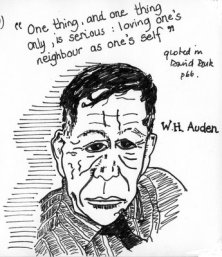 In “Since,” a poem probably inspired by his relationship with Kallman, Auden suddenly remembers an August noon thirty years ago and “You as then you were.” He juxtaposes the memory of his youthful love-making with an account of the failures of Eros and Agape in the world since then and finds sustenance in the memory: “round your image / there is no fog, and the Earth / can still astonish.”


 Samuel Taylor Coleridge was famous for dreamy and somewhat creepy poems like The Rime of the Ancient Mariner, Christabel and Kubla Khan (the last of which he allegedly wrote subconsciously during a fever dream). Coleridge and poet William Wordsworth were close pals and their collection of poetry titled Lyrical Ballads (1798) was an early pillar of what became known as the Romantic movement in poetry and art. Coleridge is probably best known for a poem from that collection, The Rime of the Ancient Mariner, which describes a sailor who curses himself and his ship by killing an albatross. Coleridge is also remembered for his turbulent personal life, especially his decades-long addiction to opium.


 Joe
Joe





 The Closet Professor