To fling my arms wide In some place of the sun, To whirl and to dance Till the white day is done. Then rest at cool evening Beneath a tall tree While night comes on gently, Dark like me— That is my dream! To fling my arms wide In the face of the sun, Dance! Whirl! Whirl! Till the quick day is done. Rest at pale evening . . . A tall, slim tree . . . Night coming tenderly Black like me.
About the Poem
“Dream Variations” by Langston Hughes is a powerful poem that reflects themes of freedom, identity, and racial pride. In the poem, Hughes contrasts the oppressive reality faced by African Americans in the early 20th century with the speaker’s dream of a world where they can freely express themselves and live without fear.
The poem is an expression of Hughes’ vision for racial equality and his longing for a world where Black individuals can live freely, with pride in their heritage and identity. The “dream” in the poem represents not only personal freedom but also the collective aspirations of African Americans during the Harlem Renaissance, a time when many Black artists, writers, and thinkers sought to redefine their place in society.
Through “Dream Variations,” Hughes communicates a yearning for both freedom from oppression (represented by the day) and a peaceful self-acceptance (represented by the night).
About the Poet
Langston Hughes (1902–1967) was an influential American poet, social activist, novelist, playwright, and one of the key figures of the Harlem Renaissance, a cultural and artistic movement in the 1920s and 1930s that celebrated African American heritage. Known for his powerful and accessible writing, Hughes is regarded as one of the most important literary voices of the 20th century, especially in capturing the Black experience in America.
Hughes is often celebrated for being one of the first Black writers to make a living from his work and for championing the richness of Black culture as worthy of artistic expression.
Not marble nor the gilded monuments (Sonnet 55) By William Shakespeare
Not marble nor the gilded monuments Of princes shall outlive this powerful rhyme, But you shall shine more bright in these contents Than unswept stone besmeared with sluttish time. When wasteful war shall statues overturn, And broils root out the work of masonry, Nor Mars his sword nor war’s quick fire shall burn The living record of your memory. ’Gainst death and all-oblivious enmity Shall you pace forth; your praise shall still find room Even in the eyes of all posterity That wear this world out to the ending doom. So, till the Judgement that yourself arise, You live in this, and dwell in lovers’ eyes.
That time of year thou mayst in me behold (Sonnet 73) By William Shakespeare
That time of year thou mayst in me behold When yellow leaves, or none, or few, do hang Upon those boughs which shake against the cold, Bare ruined choirs, where late the sweet birds sang. In me thou see’st the twilight of such day As after sunset fadeth in the west; Which by and by black night doth take away, Death’s second self, that seals up all in rest. In me thou see’st the glowing of such fire, That on the ashes of his youth doth lie, As the deathbed whereon it must expire, Consumed with that which it was nourished by. This thou perceiv’st, which makes thy love more strong, To love that well which thou must leave ere long.
About the Poem
If you have been a longtime reader of this blog, you may remember that I love sonnets. When I used to teach British literature, my students and I spent a lot of time studying sonnets, their various forms, themes, meter, etc. I was talking to a friend yesterday and brought up Shakespeare’s Sonnet 55 (“Not marble nor the gilded monuments”) to tell him about taking my students to a cemetery to as a way to look at the sonnet’s themes of time and immortalization. This made me think of other sonnets by Shakespeare, while I knew there was a sonnet about autumn, I had to use the Academy of American Poets’ find a poem feature and search for a poem with an “autumn” theme in a “sonnet” form. Sonnet 73 was the result. This sonnet focuses on three metaphors: Autumn, the passing of a day, and the dying out of a fire.
Sonnets 55 and 73 are part of a sequence of Shakespeare’s sonnets (1-126) that talk about the “Fair Youth,” unnamed young man addressed in these sonnets who is handsome, self-centered, universally admired, and much sought after. The sequence begins with the poet urging the young man to marry and father children (sonnets 1–17). It continues with the friendship developing with the poet’s loving admiration, which at times is homoerotic in nature. Then comes a set of betrayals by the young man, as he is seduced by the Dark Lady, and they maintain a liaison (sonnets 133, 134 & 144), all of which the poet struggles to abide. It concludes with the poet’s own act of betrayal, resulting in his independence from the fair youth (sonnet 152).
“Sonnet 55” is all about the endurance of love, preserved within the words of the sonnet itself. It will outlive material things such as grand palaces, royal buildings and fine, sculptured stone; it will outlive war and time itself, even to judgement day. This is because the poem will always be a “living record”; the memory of love will stay alive within the sonnet, come what may. The effects of time, the destructive forces of war—they count for nothing.
“Sonnet 73 is one of the four sonnets Shakespeare wrote on the subject of time, the aging process and mortality. It’s a thoughtful, reflective sonnet, the voice of a person getting older, aimed at a partner whose love the speaker obviously needs. You can imagine Shakespeare writing this in late autumn (fall) or early winter when the leaves are turning yellow, orange and red, when cold weather makes the bare branches tremble and summer is long gone. The speaker hints that the music has changed along with the season.
About the Poet
William Shakespeare, regarded as the foremost dramatist of his time, wrote more than thirty plays and more than one hundred sonnets, all written in the form of three quatrains and a couplet that is now recognized as Shakespearean.
Health Update
A quick update on my health. I was able to see one of the nurse practitioners at my doctor’s office yesterday. My doctor did not have any available appointments. She believes that I have a stomach or intestinal infection, probably enteritis. She drew blood to be tested in an effort to narrow down what has been causing this pain. When I asked her if I could go back to work, she said “Absolutely not!” She said, “You obviously look like you don’t feel good and that alone is good enough reason not to let you return to work, but I also want to see what these tests show and make sure you are not contagious before I release you to return to work.” She said even if the tests come back fine, it doesn’t mean that I am not sick, it just means that it’s clearing up, and I should be back to normal in a day or so. So, I am home today awaiting the results from the blood tests.
And if my heart be scarred and burned, The safer, I, for all I learned; The calmer, I, to see it true That ways of love are never new— The love that sets you daft and dazed Is every love that ever blazed; The happier, I, to fathom this: A kiss is every other kiss. The reckless vow, the lovely name, When Helen walked, were spoke the same; The weighted breast, the grinding woe, When Phaon fled, were ever so. Oh, it is sure as it is sad That any lad is every lad, And what’s a girl, to dare implore Her dear be hers forevermore? Though he be tried and he be bold, And swearing death should he be cold, He’ll run the path the others went.… But you, my sweet, are different.
About the Poem
“Incurable” is part of Dorothy Parker’s poetry collection Sunset Gun (Boni & Liveright, 1928). In 1934, The English Journal published Mark Van Doren’s essay “Dorothy Parker.” Van Doren criticized Parker’s poetics, stating, “[Her] poetry is of a consistent and unvarying sort, differing little from volume to volume. Enough Rope (1926) contains eerie measure and every theme employed either in Sunset Gun (1928) or in Death and Taxes (1931), the only novelty being that each volume has been shorter than its predecessor, and, perhaps, in view of its refusal to cut any new paths, less interesting. Mrs. Parker’s poetry, then, may be seen at once to have its unity and its wholeness. What should be said of it? It is neat and clear, and it is mordant; it is also—and this may be the reason for its popularity—sentimental.” Unable to gauge Parker’s contribution to American poetry and her longstanding impact on literature, Van Doren went on to say, “She may please many people at the moment, but considering what English poetry can be and has been there is not the slightest chance, unless she sets out deliberately to improve her product, that she will be numbered among the good.”
About the Poet
Dorothy Parker, born on August 22, 1893, in West End, New Jersey, was an editor, writer, and early Modernist poet. She authored several literary works, including the poetry collection, Enough Rope (Boni & Liveright, 1926). Parker, best known as a key member of the famed Algonquin Round Table, was inducted into the American Academy of Arts and Letters in 1959. She died on June 6, 1967.
translated from the Spanish by Alice Stone Blackwell
With graceful waves, ye waters, frolic free; Uplift your liquid songs, ye eddies bright, And you, loquacious bubblings, day and night, Hold converse with the wind and leaves in glee! O’er the deep cut, ye jets, gush sportively. And rend yourselves to foamy tatters white, And dash on boulders curved and rocks upright, Golconda’s pearls and diamonds rich to see! I am your sire, the River. Lo, my hair Is moonbeams pale: of yon cerulean sky Mine eyes are mirrors, as I sweep along. Of molten spray is my forehead fair; Transparent mosses for my beard have I; The laughter of the Naiads’ is my song.
El río
Soneto
Triscad, oh linfas, con la grácil onda, gorgoritas, alzad vuestras canciones. y vosotros, parleros borbollones, dialogad con el viento y con la fronda.
Chorro garrulador, sobre la honda cóncava quiebra, rómpete en jirones y estrella contra riscos y peñones tus diamantes y perlas de Golconda.
Soy vuestro padre el río. Mis cabellos son de la luna pálidos destellos, cristal mis ojos del cerúleo manto.
Es de musgo mi barba transparente, ópalos desleídos son mi frente y risa de las náyades mi canto.
About this Poem
“The River” first appeared as “El río” in Noche rústica de Walpurgis (Imprenta de Ignacio Escalante, 1907). Later, an English translation of the poem by Alice Stone Blackwell was published in Hispanic Anthology: Poems Translated from the Spanish by English and North American Poets, edited by Thomas Walsh (G. P. Putnam’s Sons, 1920). In Mexican Poetry: An Anthology, edited by Octavio Paz and translated by Samuel Beckett (Grove Press, 1985), Paz notes in the foreword that “Manuel José Othón is an inheritor of the academic tradition. There is no attempt at innovation in his work. If he shunned romanticism, he showed little taste for the ‘modernistic’ rhetoric which was carrying all before it at the end of his life. Much of his work is indeed indistinguishable in theme and intention from that of [Joaquín Arcadio] Pagaza, a poet to whom he is related not only by a community of taste but also by a similar aesthetic outlook.”
About the Poet
Manuel José Othón, born on June 14, 1858, was a Mexican editor, dramatist, and poet famous for his sonnet sequences. He authored several poetry collections, such as Nuevas poesías (San Luis Potosí, B. E. García Typography, 1883) and Noche rústica de Walpurgis [Rustic Night of Walpurgis]. The latter was published posthumously in 1907 by Imprenta de Ignacio Escalante. Othón died on November 28, 1906.
About the Translator
Alice Stone Blackwell, born on September 14, 1857, in East Orange, New Jersey, was a journalist, translator, women’s rights activist, and civil rights activist. She is the translator of Studies in Spanish-American Literature (Brentano’s Publishers, 1920) and Armenian Poems: Rendered into English Verse (Roberts Brothers, 1896), among other titles. She died on March 15, 1950.
Like him who met his own eyes in the river, The poet trembles at his own long gaze That meets him through the changing nights and days From out great Nature; all her waters quiver With his fair image facing him for ever; The music that he listens to betrays His own heart to his ears; by trackless ways His wild thoughts tend to him in long endeavour.
His dreams are far among the silent hills; His vague voice calls him from the darkened plain With winds at night; strange recognition thrills His lonely heart with piercing love and pain; He knows his sweet mirth in the mountain rills, His weary tears that touch him with the rain.
About the Poem
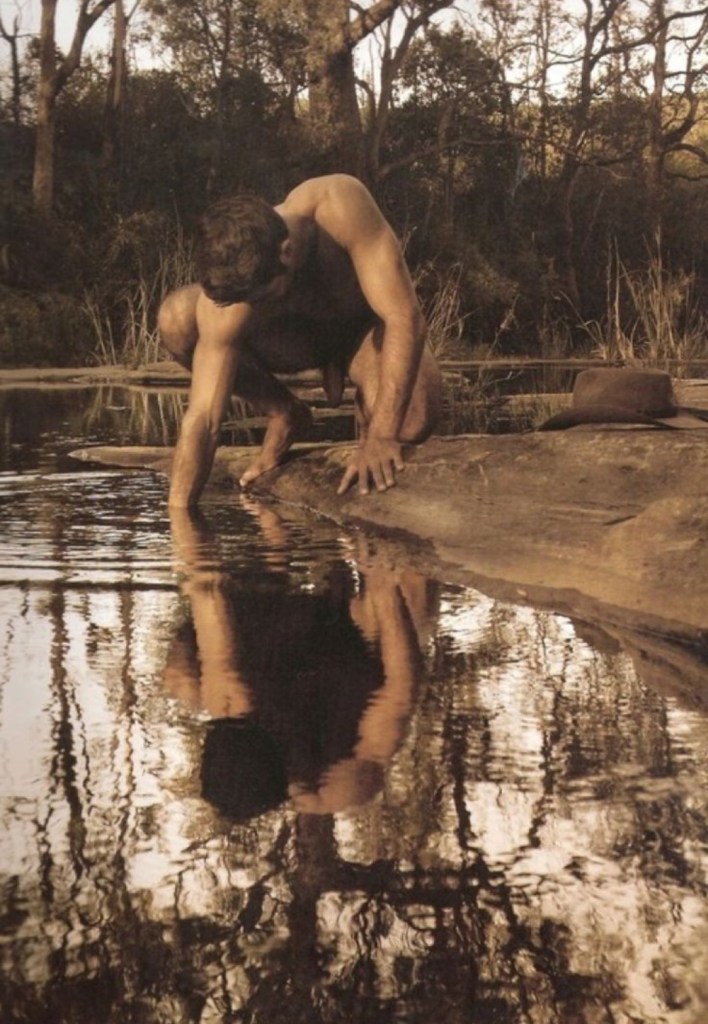
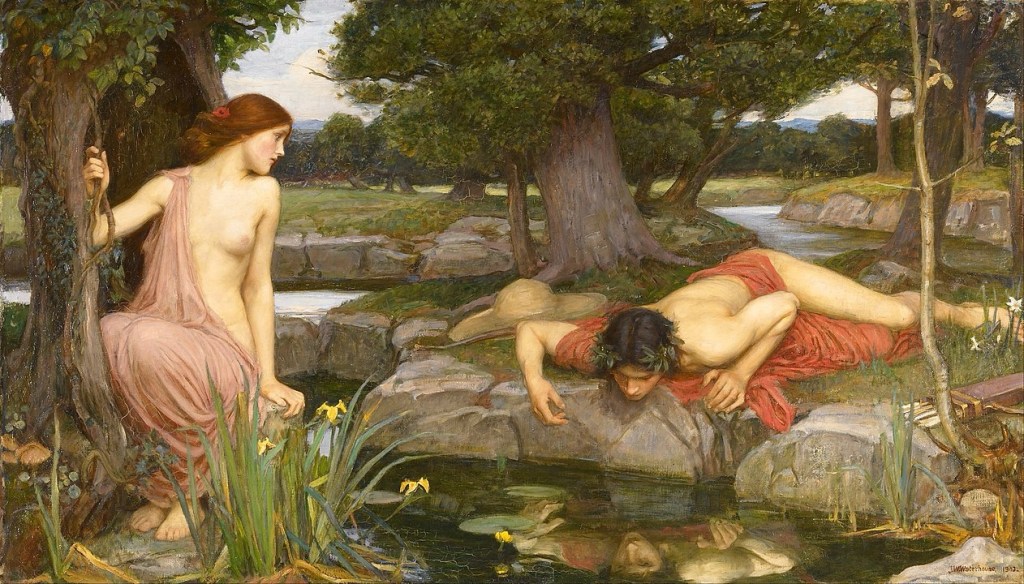
If you are not familiar with the Greek myth about Narcissus, he was born in Thespiae in Boeotia, the son of Cephissus (the personification of the Boeotian river of the same name) and the nymph Liriope. His mother was warned one day by the seer Teiresias that her son would live a long life as long as “he never knows himself.” Narcissus was known for his incredible beauty, and as he reached his teenage years, the handsome youth never found anyone that could pull his heartstrings. He left in his wake a long trail of distressed and broken-hearted maidens and even spurned the affections of one or two young men. Then, one day, he chanced to see his own reflection in a pool of water and, thus, discovered the ultimate in unrequited love: he fell in love with himself. Naturally, this one-way relationship went nowhere, and Narcissus, unable to draw himself away from the pool, pined away in despair until he finally died of thirst and starvation. Immortality, at least of a kind, was assured, though, when his corpse (or in some versions the blood from his self-inflicted stab wound) turned into the flowers which, thereafter, bore his name.
Echo and Narcissus by John William Waterhouse (1903 oil painting)
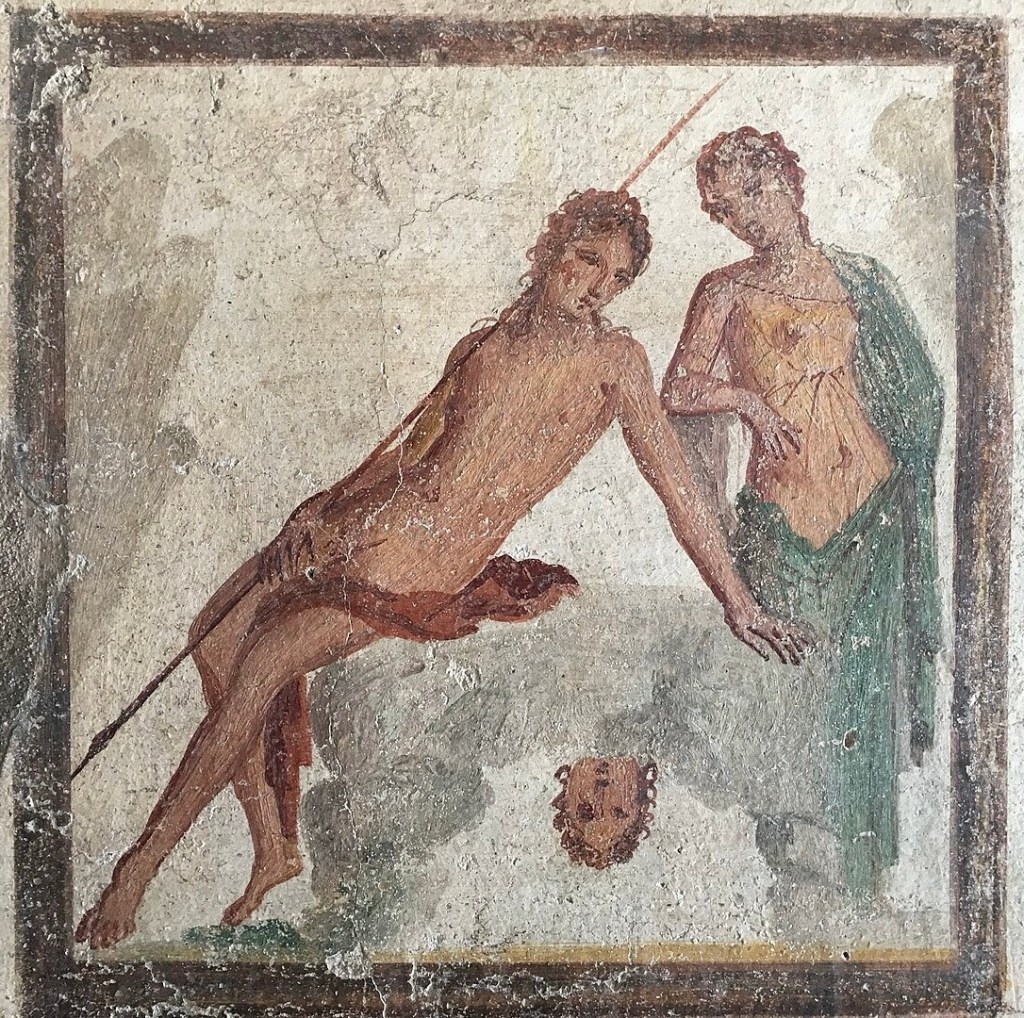
Narcissus appears in other myths as well, especially the myths surrounding mountain nymph Echo. Another version of the myth appears in the work of the Roman writer Ovid. In this telling, Narcissus is as handsome as ever but cruelly refuses the advances of Echo. The lovely nymph, heartbroken, wastes away and dies with only her voice remaining to echo her plight. As a punishment for his neglect, Narcissus is then killed. Another version has Echo punished by Hera because she kept the goddess distracted with stories while the lovers of her husband Zeus, the mountain nymphs, escaped Mt. Olympus without notice. This explains why Echo could only repeat what others said to her. It is Echo in this form that Narcissus comes across one day while hunting deer in the forest. After a useless exchange of repeated words and statements, Echo tries to embrace the youth, but he rejects her and dashes off back home. Echo then pines away in the forest so that her body eventually perishes and only her voice remains.
Echo (right) with Narcissus, from a fresco in Pompeii
Unlike for Greek artists, the Roman version of Narcissus and Echo was a very popular subject in Roman art and is seen in almost 50 wall paintings at Pompeii alone. Renaissance art also took a shine to Narcissus; the story involving light, and reflection proved irresistible to Caravaggio, who captured the myth in his celebrated 16th-century CE oil painting. Finally, his name lives on today in psychoanalysis where narcissism refers to the personality disorder of excessive self-admiration and preoccupation with one’s appearance.
In the poem above, Meynell describes a poet as being similar to Narcissus looking back on himself through his poetry as a form of vanity. In this way, similar to Narcissus who lives on as the flower, the poet lives on forever through his poetry.
About the Poet
Alice Christiana Gertrude Meynell was born on October 11, 1847, in Barnes, west London, to Thomas Thompson, a lover of literature and friend of Charles Dickens, and Christiana Weller, a noted painter and concert pianist. Thompson insisted on a classical education for his children, who were homeschooled. This education, as well as the verses of Elizabeth Barrett Browning and Christina Rossetti, inspired Meynell to try writing poetry as a teen.
Her poetry is characterized by its formal precision and intellectual rigor. She often explores themes of faith, nature, and the human condition with a restrained and understated elegance. Her focus on the musicality of language and concise imagery makes her work continue to be studied and enjoyed today.
Meynell suffered from poor health throughout her childhood and adolescence. In 1868, while she was recuperating from one of these bouts of illness, she converted to Roman Catholicism. It was also during this time that she fell in love with Father Augustus Dignam, a young Jesuit who had helped with her conversion and received her into the church. Dignam inspired some of her early love poems, including “After a Parting” and the popular “Renouncement.” Meynell and Dignam continued to correspond for two years until they fell out of touch.
She was influenced by the Pre-Raphaelite poets, an artistic movement founded in 1848 by the poet and painter Dante Gabriel Rossetti and the painters John Everett Millais and William Holman Hunt, who is often credited with the group’s name, which indicates not a dismissal of the Italian painter Raphael, but rejection of strict aesthetic adherence to the principles of composition and light characteristic of his style. The Pre-Raphaelites’ commitment to sincerity, simplicity, and moral seriousness is evident in the contemplative but uncomplicated subjects of its poetry and in the religious, mythical, and literary subjects depicted in its paintings. Meynell shared their interest in symbolism and aesthetic beauty, but her poetry also displays a strong intellectual and spiritual depth influenced by her Catholic faith. Meynell’s work was admired by contemporaries such as George Meredith, Coventry Patmore, and John Ruskin, and she played a significant role in shaping the literary landscape of her time.
In 1875, Meynell published her first poetry collection, Preludes (Henry S. King & Co.), which was received with great success. English poet and novelist Walter de la Mare called her one of the few poets “who actually think in verse.” Two years later she married Wilfred Meynell, another Catholic convert who was working as a journalist for a number of Catholic periodicals in London. He soon became the successful editor of the monthly magazine Merry England. Alice Meynell joined her husband at Merry England as coeditor, helping to keep the magazine at the helm of the Catholic literary revival. Her writing won her the recognition of other members of the literary elite of the time, such as Coventry Patmore, Francis Thompson, Oscar Wilde, and W. B. Yeats.
Meynell balanced her time between her journalism work with Merry England, her social life among the literati, her home life (she mothered eight children, one of whom died as an infant), and her social activism. She worked to improve slum conditions and prevent cruelty to animals, but she was best known for her work for women’s rights. Meynell worked with the Women’s Suffrage Movement and fought for workers’ rights for women. During this busy period, Meynell did not write much poetry; her second book, Poems (Elkin Matthews & John Lane, 1893), was published nearly two decades after the release of her debut. She published several more poetry collections in her lifetime: Ten Poems (Romney Street Press, 1915); Collected Poems of Alice Meynell (Burns and Oates, 1913); Later Poems (John Lane, 1901); and Other Poems, which was self-published in 1896. Restrained, subtle, and conventional in form, Meynell’s poems are reflections on religious spirit and belief, love, nature, and war.
She was twice considered for the post of Poet Laureate of England—upon the deaths of Alfred, Lord Tennyson, in 1892 and Alfred Austin in 1913. Elizabeth Barrett Browning is the only other woman who had been considered for the post up to that point. Meynell continued writing until her death. After a series of illnesses, she died on November 27, 1922. A final collection, Last Poems (Burns and Oates), was published posthumously a year later.
what to call you who i’ve slept beside through so many apocalypses
the kind that occur nightly in this late stage of the collapsing west
boyfriend was fine even though we are neither boys nor men but love
how it makes us sudden infants in the eyes of any listener—how
it brings us back to some childhood we never got to live. that was,
at the time, unlivable. my sweetheart. my excised sheep’s-heart.
my fled garden. my metal garter. after yet another man calls his wife
his partner at the dog park it’s clearly time to find another name for you—
he says it’smy partner’s birthday we’re going to buca di beppo then key largo—
and wild how quick a name becomes yet another vehicle
through which to reproduce violence. partner fit like a skin and then
that skin tightened and tore off—you who are neither my chain
italian restaurant nor my all-inclusive vacation spot. not my owner
or my only or my own. not my down payment or my dowery
of sheep and crop. not lost. not loss. apophasis is a way of naming
what is by what is not—but what is? my boutonniere. my goofy queer.
my salt. my silk. my silt. my slit. my top and my basement. my vanquished
prostate. my battered apostate. my memory. my memory. my meteor.
all these names for what exactly? to introduce what is to those
who don’t know. this is my whole. this is my hole. take part of me.
About This Poem
Some of you may not be too fond of this poem because it’s modern poetry, but occasionally, I think modern poetry can really make us think. Then, sometimes, it just doesn’t make sense at all, even after the poet discusses what it means. “My Hole. My Whole.” is one of those poems that is easy to understand, is quite interesting, and makes you think.
pSam Sax wrote about what inspired this poem. He said, “This poem began, as many do, struggling with the limitations of language. Being in a long-term, queer, poly, nonbinary relationship, we often find ourselves pushing against the terminology we inherited for how to name ourselves and our love(s), how to become legible to ourselves and to others. Both queerness and poetry can offer ways of breaking with the past and searching for strange syntax and improper nouns, not just to define an already lived experience but to eke out a space to imagine new possible futures. This poem struggles with this question of naming, of possibility, of fluidity. It offers up one way of honoring the flexibility and specificity of our loves.”
About the Poet
Sam Sax is a queer Jewish writer and educator. They are the author of Pig (Scribner, 2023); Bury It (Wesleyan University Press, 2018), which received the 2017 James Laughlin Award; and Madness (Penguin Books, 2017), winner of the National Poetry Series. They are also the author of the novel, Yr Dead (McSweeney’s, 2024).
Of Sax’s work, James Laughlin Award judge Tyehimba Jess writes,
Bury It, Sam Sax’s urgent, thriving excavation of desire, is lit with imagery and purpose that surprises and jolts at every turn. Exuberant, wild, tightly knotted mesmerisms of discovery inhabit each poem in this seethe of hunger and sacred toll of toil. A vitalizing and necessary book of poems that dig hard and lift luminously.
Sax has received fellowships from the National Endowment for the Arts, the Poetry Foundation, Lambda Literary, MacDowell, Stanford University, and Yaddo. They are also the two-time Bay Area Grand Slam Champion.
Sax has served as the poetry editor at BOAAT Press, and they are currently serving as a lecturer in the ITALIC program at Stanford University.
When the spent sun throws up its rays on cloud And goes down burning into the gulf below, No voice in nature is heard to cry aloud At what has happened. Birds, at least, must know It is the change to darkness in the sky. Murmuring something quiet in its breast, One bird begins to close a faded eye; Or overtaken too far from its nest, Hurrying low above the grove, some waif Swoops just in time to his remembered tree. At most he thinks or twitters softly, “Safe! Now let the night be dark for all of me. Let the night be too dark for me to see Into the future. Let what will be be.”
About this Poem
“Acceptance” appears in Robert Frost’s poetry collection, West-Running Brook (Henry Holt and Company, 1928). In his article, “The Use of Irony in Robert Frost,” author, professor of English, and director of graduate studies at the University of South Carolina, Donald J. Greiner wrote: “The sonnet ‘Acceptance’ deals entirely with this balance of trust and mistrust, but its tone seems much darker than that of the other poems of ironic acceptance. […] The bird twitters ‘safe,’ but Frost shows that he does not consider this any great victory when he qualifies ‘safe’ with ‘at most.’ This bird strikes no boastful pose, utters no bragging words; ‘at most’ it notes to itself that it is safe. But the irony comes from the rest of its statement. […] As in so many of Frost’s poems, the fear stems from the recognition that some unknown force is at work in the universe. The title ‘Acceptance’ is almost bitterly ironic, for the bird accepts only because it can do nothing else. Its safety is a night-by-night struggle, and its only defense against overwhelming fear is acceptance of its predicament.”
About the Poet
One of the most celebrated figures in American poetry, Robert Frost was the author of numerous poetry collections, including New Hampshire (Henry Holt and Company, 1923). Born in San Francisco in 1874, he lived and taught for many years in Massachusetts and Vermont. He died in Boston in 1963.
And was it I that hoped to rattle A broken lance against iron laws? Was it I that asked to go down in battle For a lost cause? Fool! Must there be new deaths to cry for When only rottenness survives? Here are enough lost causes to die for Through twenty lives. What have we learned? That the familiar Lusts are the only things that endure; That for an age grown blinder and sillier, There is no cure. And man? Free of one kind of fetter, He runs to gaudier shackles and brands; Deserving, for all his groans, no better Than he demands. The flat routine of bed and barter, Birth and burial, holds the lot… Was it I that dreamed of being a martyr? How—and for what? Yet, while this unconcern runs stronger As life shrugs on without meaning or shape, Let me know flame and the teeth of hunger; Storm—not escape.
About the Poem
In the poem “He Goads Himself” by Louis Untermeyer the speaker explores feelings of disappointment and the struggle against the rooted systems and beliefs. The complexity of the poem emerges from exploring how the speaker’s understanding of themselves and the world evolves over time of about the general beliefs about life.
About the Poet
Louis Untermeyer, born October 1, 1885, in New York City, was a poet, essayist, critic, and anthologist. The author and editor of many collections, including the popular anthology of children’s verse, The Golden Treasury of Poetry (Golden Press, 1959), he served as the fourteenth consultant in poetry to the Library of Congress, known today as the United States poet laureate. He died on December 18, 1977.
Think of the records you have held: For one second, you were the world’s youngest person.
It was a long time ago, but still. At this moment, you are living
In the farthest thousandth-of-a-second in the history of time. You have beaten yesterday’s record, again.
You were perhaps the only participant, But in the race to get from your bedroom to the bathroom,
You won. You win so much, all the time in all things.
Your heart simply beats and beats and beats— It does not lose, although perhaps one day.
Nevertheless, the lists of firsts for you is endless— Doing what you have not done before,
Tasting sake and mole, smelling bergamot, hearing Less well than you used to—
Not all records are for the scrapbook, of course— Sometimes you are the best at being the worst.
Some records are secret—you know which ones. Some records you’re not even aware of.
In general, however, at the end of a long day, you are— Unlikely as it may seem—the record holder of note.
About the Poem
I enjoy the theme of this poem because it says we are all winners, and we should celebrate our own little victories. In a historical note, just like the 100 meters, was an official Olympic competition from 1912 to 1948. Sadly, the names of the medal winners are not listed on the International Olympic Committee’s rosters. Art competitions were part of the Olympic program from 1912 to 1948, but were discontinued due to concerns about amateurism and professionalism. Medals were awarded in five categories (architecture, literature, music, painting, and sculpture), for works inspired by sport-related themes.
About the Poet
Born in 1952, Alberto Ríos is the inaugural state poet laureate of Arizona and the author of many poetry collections, including A Small Story about the Sky (Copper Canyon Press, 2015). In 1981, he received the Walt Whitman Award for his collection Whispering to Fool the Wind (Sheep Meadow Press, 1982). He served as a Chancellor of the Academy of American Poets from 2014 to 2020.
I used to think my body craved annihilation. An inevitability, like the slow asphyxiation of the earth. Yoked to this body by beauty, its shallow promises I was desperate to believe, too fearful to renounce my allegiance even with its hand closing around my throat. When I chose myself, I chose surrender. God is the river that remakes me in its image. I didn’t know what was waiting on the other side. I swam through it anyway.
About This Poem
“I contemplated transitioning for many years before I took the leap, but I let fear—of violence and rejection, of how I would be perceived, of my own masculinity and masculinity in general—hold me back. This poem is a celebration of the divine and liberating act of choosing one’s happiness despite that fear.” —Ally Ang
Ally Ang is a gaysian poet and editor based in Seattle. They are the author of Let the Moon Wobble, forthcoming from Alice James Books in Fall 2025.
Ang’s work has been published in Queer Nature: A Poetry Anthology (Autumn House Press 2022), Nepantla: An Anthology Dedicated to Queer Poets of Color (Nightboat Books 2018), The Margins, The Journal, and elsewhere. They are a 2023 National Endowment for the Arts Creative Writing Fellow, a 2023 MacDowell fellow, a 2022 Jack Straw Writers Program Fellow and a 2022 Tin House Summer Workshop participant.
Ang is an editor with Game Over Books, the author of the chapbook Monstrosity (Damaged Goods Press 2016), and the co-editor of an anthology of Southeast Asian art and writing titled All the Oils: On Friendship, Sex, and Other Warmths (Ginger Bug Press 2021).












 Joe
Joe




 The Closet Professor