Category Archives: Politics

Finally…

20140618-004058-2458883.jpg

While many states are battling over same-sex marriage, Alabama has only just ruled that prohibiting homosexual sex is unconstitutional. Civil rights organizations in Alabama are cheering a state appeals court ruling that declared part of a state sexual misconduct law as unconstitutional.

Under the statute, consensual oral and anal sex was banned in what the court determined was an act aimed at criminalizing homosexual activities. Furthermore, the statute has been traditionally interpreted to criminalize all sexual practices other than the missionary position between one man and one woman. The portion of the law cited in the Alabama Court of Criminal Appeals ruling includes: “Consent is no defense to a prosecution under this subdivision.” The sixteen page ruling by the Court of Criminal Appeals can be read in it’s entirety by following this link. (It’s well worth reading, and I found it quite interesting. Plus I’d love to know silvereagle’s opinion on this case and the ruling.)

The ruling was unanimous in the case of Dewayne Williams vs. State of Alabama. Williams, a Dallas County, Ala., man, who, although was not convicted in 2010 of first-degree sodomy, was convicted of the “lesser-included offense” of sexual misconduct, according to the ruling. Williams acknowledged he had taken part in the sodomy but argued it was consensual, the ruling states.

Alabama is one of a dozen states that still have laws prohibiting consensual homosexual sex, according to a survey by the Human Rights Campaign, a national group advocating for lesbian, gay, bisexual and transgender rights.

Susan Watson, executive director of the American Civil Liberties Union of Alabama, applauded the ruling. “Aiming to ban consensual sex is flat out wrong,” she said Saturday. “A person’s sexual orientation shouldn’t matter. Consensual sex is consensual sex.”

Ben Cooper, chairman for Equality Alabama, also lauded the ruling and added the law was “settled years ago” under Lawrence v. Texas, a case the Alabama court referenced in its decision. In the 2003 case, the crime for two persons of the same sex to engage in certain intimate sexual conduct was determined to violate the due process clause of the 14th Amendment.

“Each and every person, no matter their sexual orientation or gender identity, is entitled to equal protection under the law,” Cooper said in a statement. “The Alabama court’s unanimous decision overturning the statute is a step in the right direction and makes us optimistic for future and ongoing equal rights through the continued elimination of unconstitutional provisions in our state’s constitution that violate privacy and equal protections.”

Michael Jackson, the prosecutor in the Williams case, said Monday that he understood why the appeals court ruled the way it did, and said the decision would probably be upheld if appealed to the Alabama Supreme Court. But he said the victim is not getting a fair result because the sex in the case he was prosecuting wasn’t consensual.

“He got attacked by another man and he had sex he didn’t want to have,” said Jackson. He said Alabama’s sodomy law still applies in cases of forced sex. For the record, Jackson has no business prosecuting sexual misconduct. As District Attorney for Fourth Judicial Circuit of Alabama, Jackson has often hired female prosecutors based on their ample breasts and how often they will go to bed with him. Jackson himself should be tried for sexual misconduct and sexual harassment. He is a further disgrace to the already disgraceful Alabama judicial system.

The state of Alabama also was denied its request to remove the language on consent from the law and remand Williams’ case for a new trial. The Alabama appeals court explained in its ruling that a remand of the case would violate the double jeopardy clauses of the Fifth Amendment to the U.S. Constitution and the Alabama Constitution and that by amending the statute the Court would be creating and ex post facto law that would further violate the U.S. Constitution.

The question does remain as to whether the sex between the two men, Williams and the unnamed clerk at the Jamison Inn Hotel, was consensual as Williams claims in his defense. However, because the prosecution knew they could not convict Williams of first degree sodomy, which had been struck down by Lawrence v. Texas, they chose an obscure section of the clause which made the question of consent moot. The clause used stated that “Consent is no defense to a prosecution under this subdivision.” Therefore the prosecution cannot have the trial remanded because Williams would be tried twice for a crime in which he has already been convicted.

There are two things that really surprise me about this whole case. First, that Jackson attempted to prosecute Williams in the first place for sodomy, when if he is going to claim that no consent was given, then he should have charged Jackson with rape and assault. Instead, he charged him with sodomy and sexual misconduct. For me this proves, not only Jackson’s incompetence as a prosecutor, but also that there was insufficient evidence that the sex between Williams and the hotel clerk was not consensual.

Second, the other, and actually most surprising thing, considering that Roy Moore is the head of the Alabama Judicial System, is that the all Republican Alabama Court of Criminal Appeals actual made a ruling that made sense and followed the law. Moore’s philosophy of justice is that whatever laws he deems appropriate in his head are the only ones that need to be followed, so for a lower court under his authority to make a ruling that actually follows the law is astounding. Maybe there is hope for Alabama’s Republican controlled judicial system after all.

Building a Better Tomorrow: Project One America

20140613-013504-5704849.jpg

The Human Rights Campaign, or HRC, was in Montgomery, Alabama, last night to discuss the launch of a new gay rights campaign targeting three Southern states: Arkansas, Mississippi, and Alabama. The Project One America, as it’s called, is a three year, $8.5 million dollar effort to secure marriage rights and other protections, such as employment non-discrimination against LGBT people, at the state and local level. I attended the meeting, but my post today is not going to be to talk about all that was discussed there. We were asked not to blog or tweet about issues and personal stories shared at the meeting, so that the meeting could be an open and inviting place to talk. I was a bit disappointed because that is what I had planned my blog topic to be today, so instead I am going to discuss the new HRC program, Project One America, which was behind the meeting last night.

The President of the HRC, Chad Griffin grew up in Arkansas and much of his family is still there. With a Southerner at the helm, the HRC has finally decided to pay attention to the South, which it has largely ignored during much of its existence, except for a source of campaign contributions. When asked if him being a southerner had anything to do with why HRC is launching a campaign in the South, Griffin replied:

No, it doesn’t, but I can certainly tell you that it informed this work. There is no question that my experience growing up as a kid of the South, deeply closeted, growing up Southern Baptist, going to church Sunday mornings, Sunday nights, and usually Wednesday nights too certainly informs my experiences and how I approach this work.

But the reason we are going to these three states specifically is there are a few things that are unique about these states. Number one, these three states are – unlike other states across the country, including the South – three states that have no fully-resourced statewide LGBT groups. So, no full time paid staff that are working day in and day out on behalf of equality.

The second, and really important and unique difference about these three states is that they’re the only three states where there’s no statewide non-discrimination protection, there’s not even a single city or municipality that has workplace non-discrimination, or public accommodation, or housing non-discrimination ordinances or laws.

So, those two things make these three states uniquely situated and, quite frankly, these three states need this work and need this investment. They have been dramatically underresourced, and we intend to change that.

Unlike other states in the South — including Texas, Georgia, Kentucky and North Carolina — these three states lack fully resourced and staffed LGBT statewide equality campaigns. According to a report by Funders for LGBTQ Issues, in 2011-2012, grant funding for LGBT advocacy totaled $10.10 for per LGBT adult in the Northeast. That number was only $1.71 per LGBT adult in the South. In these three states, the numbers are $0.71 per LGBT adult in Mississippi, $0.35 per LGBT adult in Arkansas, and $0.31 per LGBT adult in Alabama.

The HRC has nine launch goals for Alabama:

1. Empower LGBT people (and straight allies) to come out.
2. Raise the visibility of LGBT people and issues with the general public.
3. Create safer environments for LGBT young people.
4. Build partnerships with faith communities, communities of color, business communities, and conservatives.
5. Create a more inclusive workplace for LGBT people
6. Build support for enduring legal protections that ensure LGBT equality.
7. Expand participation in HRC’s Municipal Equality Index in these three states.
8. Create a more inclusive healthcare environment for LGBT people
9. Equip LGBT people and non-traditional allies as spokespeople.

For the HRC to be successful they will have to number one, and first and foremost, change the hearts and minds of Alabamians. They can change hearts and minds by building bridges and by having a conversation with business leaders, with faith and religious leaders, with community leaders, and also with elected officials at the community level and at the state level. The HRC plans to accomplish this by having organizers: community organizers, organizers in the business community, organizers in the faith and religious community. Ultimately, our goal will be to bring about the much needed protections at the local, as well as ultimately at the state level.

A greater presence in the South is something Griffin has talked about since He became HRC President. The Human Rights Campaign is also the single largest organizer in the South. One-third of our members are from the South – which is a surprising number to me. That’s over 500,000 HRC members who are from the South, including over 60,000 just in these three states alone.

So after the Supreme Court made that historic decision just a year ago, it became quite clear that we have two Americas when it comes to equality. We have the ‘haves,’ largely situated along the coast with a couple of bright spots in the middle, and then we have the ‘have-nots’ when it comes to legal equality, and that’s places like Arkansas, Mississippi, and Alabama. So, Project One America is designed to specifically close that gap.

Chad Griffin says that he is absolutely optimistic that the South is, in fact, ready for equality. But he said he wanted to underscore that this is hard work. It will be a lot of work, and it won’t be easy. The South is not going to become a place for LGBT equality overnight, but with the right education, involvement, and momentum, it will happen.


Do I Sound Gay?

20140430-232834.jpg

Confession: I’ve always been self-conscious about “sounding gay.” It’s one of the main things that “gives me away” as gay. I knew that my anxiety came from my internalized homophobia telling me: Gay = bad, so sounding gay = bad. A compelling new documentary is bringing together some of the biggest lesbian, gay, bisexual and transgender (LGBT) celebrities to discuss a question that probably crosses the mind of every gay man at some point in his life: Do I sound gay?

From director David Thorpe, “Do I Sound Gay?” aims to present an intelligent and and provocative cultural analysis of the “gay voice.” Throughout this process, Thorpe talks to linguists, celebrities, historians, voice coaches and total strangers to share their own thoughts and experiences surrounding the idea of ‘sounding gay.’

In the tradition of funny-but-serious first-person movies like Supersize Me, Roger and Me and Good Hair, Thorpe encounters a colorful cast of linguists, historians, voice coaches, speech therapists, friends, family, and total strangers on the street, gay and non-gay, who share their wisdom and touching, funny stories about the “gay voice.” There are also intimate confessions and hilarious anecdotes from LGBT icons – Margaret Cho, Tim Gunn, Don Lemon, Dan Savage, David Sedaris and George Takei – as they open up about the “gay voice.” Over the course of three years, Thorpe did 165 interviews in four countries.

Here are five reasons. David Thorpe gives for making this film and a few comments from me:

Reason No. 1:

Some gay men are self-conscious about “sounding gay,” even famous ones like David Sedaris. Let’s start hashing out this whole “sounding gay” thing, so we can all be OURSELVES in this small but crucial way. It’s something about me that I’ve come to own and make it my own.

Reason No. 2:

“Sounding gay” is still a trigger for mockery, bullying and violence. LGBT kids are far more likely to commit suicide or drop out of school because they feel unsafe. Zach King, one of our brave young subjects, was viciously assaulted at school. I was always made fun of for my “gay voice,” sometimes I still am, and it has always, even to this day, raises my hackles.

Reason No. 3:

Hard to believe, but nobody has comprehensively explored the phenomenon of “sounding gay.” Voice and sexuality – two fundamental features of human existence, and yet most people don’t have a clue how they’re related. Instead, we have stupid stereotypes. Let’s toss ‘em in the trash. Knowledge is power.

Reason No. 4:

A lot of people think it’s okay to be gay as long as you don’t act – or sound – that way. The daily pressure to cover, hide or “pass” affects many minorities. Let’s relieve the pressure.

Reason No. 5:

Our title isn’t just a title. Combined with our rainbow tongue logo, it’s an empowerment icon, a sneaky, fun, viral way to say it’s OK to sound – and be – gay. When the movie gets made, you’ll see rainbow tongues everywhere, asking, “Do I Sound Gay?”

The film is currently engaged in a Kickstarter campaign in order to fund post-production. Visit the project’s Kickstarter for more information.


Reductio ad Hitlerum

20140408-223801.jpg

Lesbian, gay, bisexual and transgender (LGBT) rights advocates are part of a “radical homosexual movement” that mirrors elements of Nazi Germany, Rick Wiles is claiming.

As Right Wing Watch is reporting, the TruNews host blasted the LGBT community in a heated broadcast with Pastor Jeff Allen, who has previously evoked Nazi imagery while condemning gay rights.

“It’s not an exaggeration to say ‘homofascist’ because the German Nazi Party was homosexual,” Wiles said. “Hitler was a homosexual, the top Nazi leadership, all of them were homosexuals…they were creating a homosexual special race.”

Wiles went on to note, “It wasn’t this thing about an Aryan race of white people, blue-eyed, blonde-haired, white people, Hitler was trying to create a race of super gay male soldiers … It will end up in America just like it was in Germany, but it won’t be the Jews that will be slaughtered. It will be the Christians.”

In February, Wiles’ guest offered up similar sentiments.

“Many [LGBT rights advocates] really do console themselves with fantasies of their own Kristallnacht, in which Christians are euphemistically ‘taken out of the way’ as part of the ‘gay’-stapo’s ‘final solution’ to the ‘Christian problem,'”Allen wrote in an Op-Ed for Liberty Counsel attorney Matt Barber’s website Barbwire.

Similarly, the American Family Association’s Bryan Fischer referred to LGBT rights advocates as “Nazi stormtroopers” who are “totalitarian and repressive” in a 2013 broadcast.

Wiles’ TruNews promotes itself on its website as “the world’s leading news source that reports, analyzes, and comments on global events and trends with a conservative, orthodox Christian worldview.”

Comparison with Nazis is so overdone that there’s even a name for it: Godwin’s Law. In this case the more appropriate name might be the older dog Latin term Reductio ad Hitlerum, a term coined by conservative philosopher Leo Strauss in 1951. According to Strauss, the Reductio ad Hitlerum is an informal fallacy that consists of trying to refute an opponent’s view by comparing it to a view that would be held by Adolf Hitler or the Nazi Party. According to Strauss, Reductio ad Hitlerum is a form of ad hominem or ad misericordiam, a fallacy of irrelevance, in which a conclusion is suggested based solely on something’s or someone’s origin rather than its current meaning. The suggested rationale is one of guilt by association. Its name is a variation on the term reductio ad absurdum.

It is not the first time that someone has compared equal rights advocates to fascists or nazism, but merely another example in a long line of accusations. The arguments are ridiculous and those who use reductio ad Hitlerum are using poor fallacies because they are so uneducated and unable to make a credible argument. All they want to do is rule people up by using the comparison to fascism. Vladimir Putin recently did that to describe the Ukrainian government in order to invade the Crimea. The use of such fallacies can also be called argumentum ad Nazium a variant derived from argumentum ad nauseam, meaning arguing to the the point of nausea.

If Rick Wiles wanted to compare LGBT advocacy groups to the Nazis, he picked a horrible comparison. LGBT groups, and all equal rights groups, want equal rights for all, someone that Hitler and his followers never came close to believing in.

20140408-223841.jpg


Tea Partier Actually Thinks The Common Core Will Destroy ‘Traditional’ America

20140312-232149.jpg

I wasn’t aware that the Common Core State Standards had anything to with homosexuality or religion, but Alabama Tea Party leader Dr. Terry Bratton seems convinced the new education measure has a specific and radical agenda. By the way, even though I teach at a private school, we do follow state curriculum standards, so I am quite familiar with Common Core, so I have been following this debate on the news. However, an article on the Huffington Post pointed out Bratton’s lunatic rant about the Common Core.

Bratton spoke to the state Senate Education Committee about his fears on the Common Core at a public hearing Tuesday. The committee was considering, and eventually approved, a bill that allows school districts to opt out of the Common Core, according to Right Wing Watch.

In case you don’t know, the Common Core is a set of new education standards that have been adopted in more than 40 states, including Alabama, in an effort to make sure students around the country are being held to the same benchmarks. While the Common Core Standards are designed to emphasize critical thinking and deeper learning and aim to better prepare students for college and careers, they do not take a stance on homosexuality or religion.

Nevertheless, a video of Bratton shows him accusing the Standards of promoting “acceptance of homosexuality, alternate lifestyles, radical feminism, abortion, illegal immigration and the redistribution of wealth.”

“Alabama places a priority on family and Christian values. We don’t want our kids to be taught to be anti-Christian and anti-Catholic and anti-America,” said Bratton. “We don’t want our kids to lose their innocence, beginning in preschool and kindergarten, told that homosexuality is okay and should be experienced at an early age.”

Bratton also railed against what he called ideas of “social justice” woven into the Standards. He said such teachings are “contrary to traditional American notions of justice in the United States Constitution” and claimed they teach kids that “America is an unjust and oppressive society that should be changed.”

However, when asked by Alabama outlet The Anniston Star where he found such ideas in the Standards, he said they were in the “reading lists” associated with the Core’s English standards. According to the Common Core website, the reading lists are meant to “serve as useful guideposts in helping educators select texts of similar complexity, quality, and range for their own classrooms,” but teachers are not required to teach these suggested texts.

Finally, Bratton told the state senators that voting against the opt-out bill could impact them for all eternity.

“Do you want this on your record when you come to the End of Days, knowing the Master Teacher said, ‘As much as you’ve done to the little ones, you’ve done it unto me?’” he asked of the meeting’s attendees.

While the bill passed the Education Committee, Sen. Scott Beason (R-Gardendale) told local outlet Montgomery Advisor that he did not think it would have enough votes to pass the Senate floor. Honestly, there is very little chance that it will pass. The Alabama Education Association, the state teacher’s union and advocacy group is against Beason’s bill. The AEA is probably one of, if not the strongest and wealthiest lobbying organization in Alabama. When they want a bill dead, even the Republican majority legislature can’t stop them, because all Alabama legislatures have their price and the AEA knows it.

And as a fellow teacher told me at lunch yesterday when discussing allowing local Alabama school boards to choose to use Common Core or not, “Well, we all know how good Alabama is at education decisions.” Alabama is ranked 46th in education, according to Education Week. At least we are no longer at the very bottom, but it shows that Alabama is not very good at the whole education business. If you want my honest opinion, there are two main reasons for it, (1) white legislatures do not want to fund education for minority students and (2) the AEA safeguards a lot of teachers who are quite honestly only qualified to teach on paper, but have no business in the classroom.

Although the Common Core State Standards have increasingly faced backlash as states begin the implementation process, a majority of Americans still do not know what they are. According to a recent poll from education reform advocacy group 50CAN, 58 percent of those surveyed did not know what the Common Core was, while 31 percent supported the Standards and 12 percent opposed them.


King and Buchanan: America’s Gay VP and President?

20140216-204129.jpg

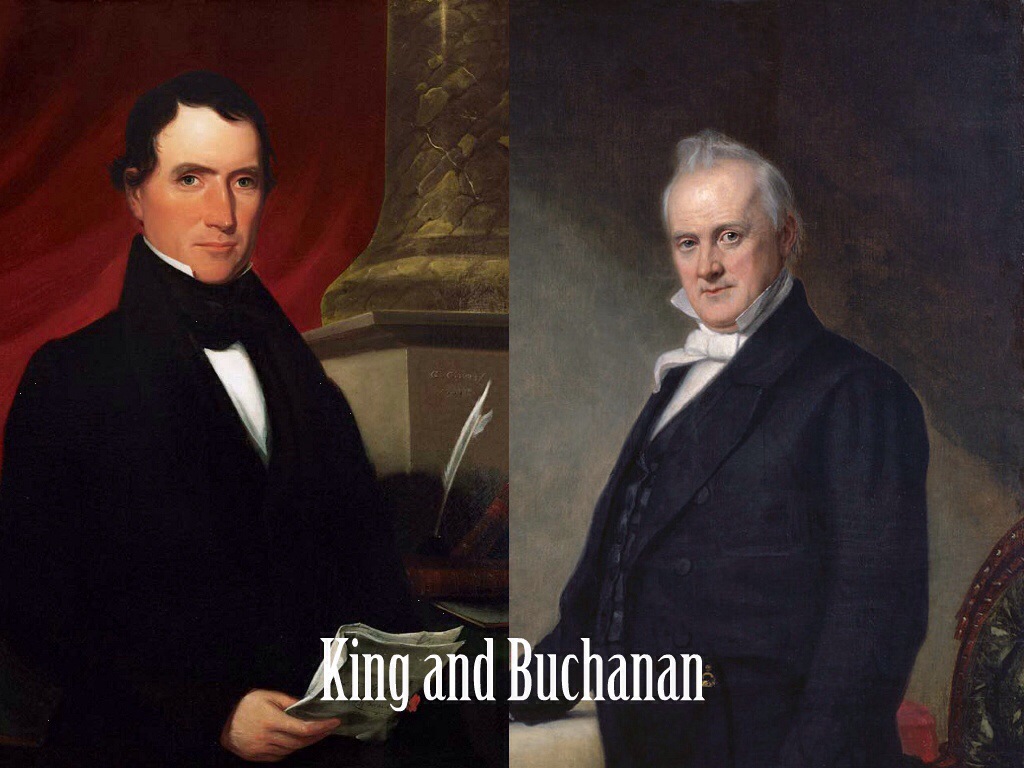
In honor of Presidents’ Day, let’s discuss two men, a US president and vice-president who may have been gay. While Abraham Lincoln has stolen the limelight with rumors about his furtive sex life, some historians have proclaimed that America’s first gay president was really his predecessor, the now-obscure James Buchanan. (He was the 15th president, serving from 1857 to 1861). Buchanan is the only bachelor to ever have held America’s top office, and his private life raised many eyebrows while he was alive. There are some who think that, yes, there was a gay president. Historian James W. Loewen is one of those who thinks that both James Buchanan (15th President of the United States) and William Rufus King (13th Vice President of the United States) were not only gay but also lovers.

More than 150 years before America elected its first black president, Barack Obama, it most likely had its first gay president, James Buchanan (1791-1868). Buchanan, a Democrat from Lancaster County, Pa., was a lifelong bachelor (throughout American history this was often code for homosexual). He served as president from 1857-61, tumultuous years leading up to the Civil War. Loewen has done extensive research into Buchanan’s personal life, and he’s convinced Buchanan was gay. Loewen is the author of the acclaimed book Lies Across America which examines how historical sites inaccurately portray figures and events and Lies My Teacher Told Me which examines how history books have been marred by an embarrassing combination of blind patriotism, mindless optimism, sheer misinformation, and outright lies.

In 1819, Buchanan was engaged to Ann Caroline Coleman, the daughter of a wealthy iron manufacturing businessman and sister-in-law of Philadelphia judge Joseph Hemphill, one of Buchanan’s colleagues from the House of Representatives. Buchanan spent little time with her during the courtship: he was extremely busy with his law firm and political projects during the Panic of 1819, which took him away from Coleman for weeks at a time. Conflicting rumors abounded, suggesting that he was marrying her for her money, because his own family was less affluent, or that he was involved with other women. Buchanan never publicly spoke of his motives or feelings, but letters from Ann revealed she was paying heed to the rumors.

After Buchanan paid a visit to the wife of a friend, Ann broke off the engagement. She died soon afterward, on December 9, 1819. The records of a Dr. Chapman, who looked after her in her final hours, and who said just after her death that this was “the first instance he ever knew of hysteria producing death”, reveal that he theorized, despite the absence of any valid evidence, the woman’s demise was caused by an overdose of laudanum, a concentrated tincture of opium.

His fiancée’s death struck Buchanan a terrible blow. In a letter to her father, which was returned to him unopened, Buchanan wrote “It is now no time for explanation, but the time will come when you will discover that she, as well as I, have been much abused. God forgive the authors of it […] . I may sustain the shock of her death, but I feel that happiness has fled from me forever.” The Coleman family became bitter towards Buchanan and denied him a place at Ann’s funeral. Buchanan vowed he would never marry, though he continued to be flirtatious. Some pressed him to seek a wife; in response, Buchanan said, “Marry I could not, for my affections were buried in the grave.” He preserved Ann Coleman’s letters, keeping them with him throughout his life; at his request, they were burned upon his death.

“I’m sure that Buchanan was gay,” Loewen said. “There is clear evidence that he was gay. And since I haven’t seen any evidence that he was heterosexual, I don’t believe he was bisexual.” According to Loewen, Buchanan shared a residence with William Rufus King, a Democratic senator from Alabama, for several years in Washington, D.C. Loewen also said Buchanan was “fairly open” about his relationship with King, causing some colleagues to view the men as a couple. For example, Aaron Brown, a prominent Democrat, writing to Mrs. James K. Polk, referred to King as Buchanan’s “better half,” “his wife” and “Aunt Fancy … rigged out in her best clothes.” Brown may have been trying to slander King in this letter. He was a friend of the Polks and was James K. Polk’s law partner, but he was also an early proponent of secession after his years as Governor of Tennessee. Most accounts by historians of King’s political career portray him as a moderate southerner who supported slavery while emerging as a strong unionist. King voiced opposition calls by some of his fellow southerners for the South to secede from the United States during the tense decade prior to the Civil War. King was always considered a moderate Democrat who was a staunch Unionist, which probably led to some political disagreements between Brown and King.

William Rufus DeVane King, the 13th United States vice president, has the distinction of having served in that office for less time than any other vice president and for being the only U.S. official to be sworn in on foreign soil. He died of tuberculosis on April 18, 1853, just 25 days after being sworn into office while in Cuba on March 24, 1853. Some historians have speculated that King holds yet another distinction — the likely status of being the first gay U.S. vice president and possibly one of the first gay members of the U.S. House of Representatives and the U.S. Senate.

King (1786-1853) served in the House of Representatives from North Carolina for six years beginning in 1811 and later served in the Senate from the newly created state of Alabama from 1819-44, when he became U.S. minister to France. He returned to the Senate in 1848, where he served until he resigned after winning election in November 1852 as vice president on the ticket of Franklin Pierce.

When in 1844 King was appointed minister to France, he wrote Buchanan, “I am selfish enough to hope you will not be able to procure an associate who will cause you to feel no regret at our separation.” Loewen also said a letter Buchanan wrote to a friend after King went to France shows the depth of his feeling for King. “I am now solitary and alone, having no companion in the house with me,” Buchanan wrote. “I have gone a wooing to several gentlemen, but have not succeeded with any one of them. I feel that it is not good for man to be alone; and should not be astonished to find myself married to some old maid who can nurse me when I am sick provide good dinners for me when I am well, and not expect from me any very ardent or romantic affection.” Loewen said their relationship — though interrupted due to foreign-service obligations — ended only with King’s death in 1853.

Even though his vice presidency was short, fraught with illness, and uneventful, William King is remembered as a perceptive decision maker with the utmost integrity … and also, possibly, as the nation’s only gay Vice President! There is no direct evidence that William R. King was in any kind of relationship with President James Buchanan, who was also a bachelor. However, they were referred to as “Siamese twins” by many people in Congress (which was a slang for homosexuals in those days.) Also, King was the only unmarried vice president in history. King actually lived as Buchanan’s house companion for many, many years. Andrew Jackson invented the nicknames “Miss Nancy” and “Aunt Fancy” for King, while Aaron V. Brown referred to King as “Buchanan’s wife.” The only evidence that could have been salvaged were the numerous letters written back and forth between the two.

Some of the contemporary press also speculated about Buchanan’s and King’s relationship, but the two men’s nieces destroyed their uncles’ correspondence, leaving some questions about their relationship; but the length and intimacy of surviving letters illustrate “the affection of a special friendship”, and Buchanan wrote of his “communion” with his housemate. In May 1844, during one of King’s absences that resulted from King’s appointment as minister to France, Buchanan wrote to a Mrs. Roosevelt, “I am now ‘solitary and alone’, having no companion in the house with me. I have gone a wooing to several gentlemen, but have not succeeded with any one of them. I feel that it is not good for man to be alone, and [I] should not be astonished to find myself married to some old maid who can nurse me when I am sick, provide good dinners for me when I am well, and not expect from me any very ardent or romantic affection.”

Circumstances surrounding Buchanan’s and King’s close emotional ties have led to speculation that Buchanan was homosexual. Buchanan’s correspondence during this period with Thomas Kittera, however, mentions his romance with Mary K. Snyder. In Buchanan’s letter to Mrs. Francis Preston Blair, he declines an invitation and expresses an expectation of marriage. The only President to remain a bachelor, Buchanan turned to Harriet Lane, an orphaned niece, whom he had earlier adopted, to act as his official hostess.

Loewen said many historians rate Buchanan as one of the worst U.S. presidents. Buchanan was part of the pro-slavery wing of the Democratic Party, and corruption plagued his administration. But Loewen said those flaws shouldn’t discourage members of the LGBT community from acknowledging Buchanan’s status as a gay man. “If we only admit that really great people are gay, what kind of history is that?” Truthfully though, even the letters written by Buchanan do not really point to more than merely a great friendship and affection that was common between men of the nineteenth century, especially during a time when women were still seen as intellectual inferiors.

A lifelong bachelor, King lived for 15 years in the home of future U.S. president James Buchanan while the two served in the Senate. In a time when Congress was only in session part of the year, and senators often returned home when not in session, it would not have been that unusual for two senators to share a home. King’s relationship with Buchanan, who was from Pennsylvania, could have been a factor in Buchanan’s sympathy for the South.

From the research I have done about King, he seems to be a fairly boring and moderate politician, as most Vice Presidents in history have been. Like many men of his status, he traveled widely in Europe during his life, often as a diplomat. He also sent his nephews and nieces to Europe as well to round out their education. The only evidence I have seen is what Brown stated to Mrs. Polk in his letter and in the way that Buchanan pines for him in his letters.

Is this really enough evidence to be the proof that Loewen claims to have? I personally think that either man would be a wonderful addition to the list of LGBT historical figures, especially King, who I have long admired. What do you think?


Roy Moore Is At It Again

20140207-000237.jpg

Roy Moore, the Alabama chief justice who reached national prominence for fighting the removal of the Ten Commandments from the state judicial building, has found a new cause: gay marriage.

Mr. Moore sent letters to all 50 governors, calling on them to pressure lawmakers at the state level to amend the U.S. Constitution to reflect that lawful marriages are only those between a man and woman, The Associated Press reported. Moore wants a states-led constitutional amendment defining the institution as a union between one man and one woman.

“The moral foundation of our country is under attack,” Chief Justice Roy Moore said in an interview with The Associated Press. Moore said the only way to stop judges who are finding new rights for gay unions is with a state-initiated constitutional amendment. “Government has become oppressive, and judges are warping the law,” Moore said.

Mr. Moore says he’s taking the campaign to the states because the country’s moral base faces concerted attack. He also said an Article V amendment to the Constitution is the only way to turn the tide on the attack — though courts have never upheld any Article V attempt, AP said.

His campaign has already sparked fire.

One openly gay lawmaker in Alabama — who just married her longtime lesbian partner — doubted the amendment idea would take root. Rep. Patricia Todd, a Democrat, said in the AP report that the tide has turned on gay marriage and most people in the public now support it. Todd says she expects most governors to toss Moore’s letter, which is basically what Alabama’s own governor has done. Governor Bentley stated that while Moore has the right to voice his opinion, he believes that marriage equality is a state issue not a federal one. “I am a states’ rights person. Marriage licenses are issued by the state. I do believe that most things should be left on a state level,” Bentley said.

“He’s fighting a losing battle, and he probably knows that,” Todd said in an interview. She said the chief justice should recognize Americans’ view and the courts’ views about the issue and how it has changed in recent years. “Get over it, buddy,” Todd said.

Michael Hansen with Equality Alabama said he doesn’t see governors giving the letter much thought. “This letter won’t really have any effect that ultimately it’s the last gasp effort to rally his base,” said Hansen, who heard about the letter Thursday morning.

“There’s nothing conservative about discrimination and marriage equality actually aligns up with conservative principals and that the foundation of our nation is strengthening when we allow more people the freedom to marry and protect their families and their kids,” Hansen said.
Hansen said the odds are already against Moore for such an amendment to pass.

“I don’t think he has any hope. The math is not on their side with 17 states directly supporting same sex marriage and others on the cusp of doing the same,” said Hansen.

Susan Watson, executive director of the American Civil Liberties Union of Alabama, said in response to Moore’s letters:

“Chief Justice Roy Moore said that government has become oppressive and this is yet another perfect example of his contributions to the matter. His definition of marriage as one man-one woman is a religious one. We support everyone’s rights to have their own religious beliefs, but he is chronically imposing his beliefs on others… Times are changing and he needs to get with it. People here think that marriage equality in Alabama will never happen. But I think it will.”

A lawyer with the American Civil Liberties Union said the 17 states that allow gay marriage aren’t likely to reverse their positions and call for a constitutional amendment. “I think the chief justice has a math problem ahead of him,” said James Esseks, director of the ACLU’s Lesbian, Gay, Bisexual and Transgender Project.

Others say attitudes have changed in Alabama since the law’s enactment. Last year, the leader of the College Republican Federation of Alabama supported the U.S. Supreme Court’s decision overturning the Defense of Marriage Act. That upset the state Republican Party chairman, who proposed a rule change aimed at keeping party leaders from taking public positions contrary to party policy. The state GOP executive committee wouldn’t approve it.

“That is a great example of where the country is moving,” Esseks said.

Moore is no stranger to controversy. In 2003, he was kicked out of office for disobeying a federal court order calling for him to take down a monument of the Ten Commandments he had installed at the state judicial building. Moore was re-elected in 2012. One of the greatest political blunders of the Alabama voting public was to elect Roy Moore to a second term after he had been kicked out of office one time already. And even if his blatant disregard for the law was not enough, Moore has done more harm to the Alabama Judicial System then any Chief Justice in history.

The Chief Justice of the Court serves as the administrative head of the Alabama Judicial System. The court makes all rules governing administration, practice, and procedure for all Alabama courts. The exercise of this authority eliminates technicalities which usually cause delays in trial courts and reversals in appellate courts. Moore, through massive mismanagement of the Alabama Judicial System, has caused the greatest backlog of cases because of massive lay-offs he created with court clerks and administrative staff. Judges are forced to share court clerks with other judges and often are forced to conduct court without a clerk in the courtroom. Moore was a disaster as the administrator of the Alabama court system, the most important job of the Chief Justice. In the midst of yet another fight over the adequacy of court funding in August of 2001, Moore unilaterally filed suit in Montgomery Circuit Court against the Governor, State Comptroller, and State Finance Director accusing them of violating Alabama law and the Alabama constitution by not adequately funding the state courts in that year’s budget. In addition, Moore’s lawsuit claimed that the courts should be permitted to operate independently of legislative or executive budgeting and oversight.

Moore has routinely taken extreme positions that are outside of mainstream Alabamians. For example, Moore publicly supported an Army doctor (Lt. Col. Terrence Lakin) who was court-martialed for refusing to return to Afghanistan to care for our troops because he did not believe that President Obama was born in the United States. In 2002, Moore authored an opinion in a child custody case in which he stated that the mother’s sexual preference automatically disqualified her as a parent, even though the father had a history of physical abuse. Moore wrote that the state should use “the power of the sword” to punish gays and lesbians. Moore has also opposed amending Alabama’s constitution to remove segregationist language. Finally, in a column dated December 13, 2006, Moore argued that Keith Ellison of Minnesota, the first Muslim to have been elected to the United States House of Representatives, should be barred from sitting in Congress because in his view, a Muslim could not honestly take the oath of office.

The greatest problem with Roy Moore is that he is not only the Chief Justice, but also the Chief Bigot, the Chief Idiot, the Chief Clown, etc. I could continue with other adjectives to describe him, but they are all basically the same. The head of the Alabama Judicial System should have to follow the law in his rulings, but over and over again, he has made rulings with a total disregard for the law. The American political establishment (just like the political establishments in every country in the world) has imbeciles who should learn to keep their mouth shuts and should have never been allowed in a position of power in the first place. As much as I dislike most politicians, Roy Moore ranks as one of those I dislike the most. He is a duplicitous egomaniac and will do and say anything to get in the news and try to get more votes. Alabama has always had some crooked public figures, but Roy Moore takes the prize as the worst in my book.


Affordable Care Act

20131218-220225.jpg

Let me just start this post with a simple statement: I AM PISSED OFF! Two things have made me incredibly mad in the past few days. The first thing was that on Monday, I helped a lady register with healthcare.gov (in Alabama, we have to use the government’s website because our governor would not allow the state’s insurance commission to activate the website they had been designing which would have made it easier to sign up for insurance). And the second is Duck Dynasty’s Phil Robertson’s ignorant and unchristian comments in GQ magazines about homosexuality. The former is the subject of today’s post. I will deal with Mr. Robertson when my blood stops boiling, and I can write rationally on the subject.

Last week, I signed up for health insurance through healthcare.gov. I have not had health insurance in a year because my insurance company nearly doubled my premiums last year, and I could no longer afford it. I work for a small private school, which offers no benefits and a meager salary, so I had no choice but to let my insurance lapse. With the tax credit that I am qualified for, my insurance premium was cut in half by signing up through healthcare.gov. I also have to tell you that I am constantly surrounded by Republicans who hate anything associated with President Obama. I have heard many nasty and untrue remarks about the Affordable Care Act such as:

“The blacks are all for Obamacare because it’s something free from Obama.”

“All Obamacare will do is raise our premiums.”


“The insurance companies are raising rates because they are forced to by the government.”


“I don’t like the government telling me what I have to do.”

The list of remarks go on and on. I have consistently said that it would save most of us money. When the government shutdown occurred, I did a massive amount of research on the affordable Care Act, so that I could explain it to my students and answer their questions about the government shutdown. When the website officially opened, I did try to go ahead and sign up; however, there were numerous glitches. Obama told Americans that it would be fixed by November 30, so I waited. All websites and software have problems when initially launched, that’s why updates are created. If you have an Apple or Microsoft product, you will constantly have updates to be downloaded and installed. If you run a blog, there will be issues from time to time. It’s the nature of technology; none of it is perfect.

When I did go to healthcare.gov to sign up, it was incredibly easy. A few clicks and 30 minutes later I had the same insurance (actually slightly better) than I had before, and with the same company at nearly half he price I had been paying. I could have taken a cheaper plan, but the deductible was so high that it was not worth having the insurance. Since I know a fair number of people who are nearly completely computer illiterate, I have helped two other people navigate the website. Mainly because they have no idea even how to use a mouse. I read each question and typed in the answers for them. For both of them, the registration process was easy.

What makes me angry though is that one of them is an older black lady who works at the school. A gentle and kind-hearted woman who has very little education because the segregated school systems of her youth in Alabama failed her. She works very hard to support herself and her daughter with no government assistance of any kind and an even more meager salary than I have. One of the provisions that many people have complained about with the Affordable Care Act is that the poor, those that make under about $17,000 a year will get free health insurance through Medicaid. They complain that everyone who has insurance will be paying for them to have insurance. This has been a particular point for Alabama Republicans who want to get rid of all entitlement programs that assist the poor, especially entitlement programs that assist the poverty stricken African-American population of Alabama.

The woman I was helping register was far below the $17,000 mark and should have qualified for Medicaid through the Affordable Care Act. However, there was a problem. Alabama’s Governor Robert Bentley (who’s a doctor by the way, albeit a dermatologist) refused to expand Medicaid in Alabama. Therefore, if this poor woman wants insurance, she will be forced to pay nearly four times what I will be paying for a monthly premium. It angers me to no end that people will complain about who’s getting what for free, yet they have no idea what they are talking about. This woman works very hard for little pay to take care of a bunch of spoiled rotten little white kids (and thankfully their appreciative teachers) to be told sorry, we won’t help you because we are afraid you might get something that we don’t or that we might have to pay for you to have a little better quality to your life. In America, we far too often don’t care about the poor.

Her saving grace, though, is two-fold. One, because Alabama refused to expand Medicaid, she is exempt from having to meet the insurance requirement of the Affordable Care Act, meaning she won’t have to pay the penalty (or tax, as the U.S. Supreme Court declared it) for not having insurance. Two, we are fortunate in this part of Alabama to have a healthcare company that caters to the uninsured and under-insured, so she can still see these doctors for treatment. Truthfully, they have some of the best healthcare professionals in the area. I even use their clinics because of the superior health and dental care they provide. They have wonderful social workers who work with people to get them the medical attention that they are unable to provide, and they work tirelessly to gain grants for community health to keep the cost of healthcare to a minimum at their clinics, they are not perfect in many ways, they have some major problems with their administration; however, it does not affect the quality of healthcare provided.

By the way, while we are discussing the Affordable Care Act, I saw this on the blog Queer Landia about healthcare for America’s LGBT:

Out2Enroll is a coalition of organizations who want to help lesbian, gay, bisexual, and transgender people stay healthy by making sure that one of the major benefits of the Affordable Care Act — access to affordable, comprehensive health insurance coverage — reaches LGBT communities. Get Enrolled is a holiday parody, produced by our friends at Full Frontal Freedom, which aims to bring awareness to the final week of health marketplace enrollment. For more information, go to http://www.out2enroll.org.

So I encourage you, if you have not done so and don’t have health insurance, go sign up at healthcare.gov. It’s not as bad as everyone has reported. I have been through the process three times with myself and two others, and it is a very smooth process. I know that some of my readers are not Obama supporters; however, I do not believe that the Affordable Care Act is the end of the world. It is not what I would have done to fix America’s healthcare problems, but it’s what Congress passed. I would have preferred that the government take on the rising cost of healthcare in other ways, particularly by not allowing doctors to charge patients without insurance more than the insurance companies pay for those who have insurance.

That is all. That is my rant for today. Be prepared for another one tomorrow. I promise though that I will more than make up for my two days of rants with my Moment of Zen on Saturday.


Political Negativity

20131208-210358.jpg

Yesterday, I spoke about negative attitudes toward religion. Today, I want to address the negative attitudes toward politics. Quite frankly, I have a negative attitude when it comes to politics. I have a quite simple reason for this: politicians are negative people.

Politicians love to tell people what they are against, but they rarely ever tell constituents what they are for. When they do tell people what they are “for,”. It’s generally a prohibition or a cut. They never seem to tell us, “I am for….” Instead, they tell us, “I am against….”

The political cartoon above is a prime example. (Thank you Sean for posting this on your blog Just a Jeep Guy.) Though it shows the negativity of Republicans, it could just as easily be any other political party in United States. The Democrats are not immune to negativity. It’s too often the role of the minority party to be the most negative.

I have been discussing political parties a lot in my civics and government classes the past few weeks. When you teach about a political party’s platform, and you list the many things that political parties are against, students will often ask, “What is the party in favor of?” When you say that they are for cuts in Medicare, food stamps, subsidies for farmers, keeping the minimum wage as is, etc., the smart kids in the class will ask, “Aren’t those all negatives as well?”

When I teach politics, I do my best to remain neutral. It’s the most difficult thing I have to do as a teacher, but I do my research so that I can present both sides of an issue. I believe in teaching my students that they should be informed citizens. If one is well versed in the issues and researches the politicians, then they are likely to be an informed voter.

I know that I am one voice among millions, but shouldn’t we take a more positive attitude in life and hold our politicians accountable for being more positive. If politicians only tell us what they are not going to do, then how do we know what they will do. Politics in the United States has become so negative about what they will not do that our Congress is in a constant state of deadlock. Isn’t it time we tell our politicians to be more optimistic.

I honestly believe that optimism can be contagious. Considering that most people dread Mondays, what better day to start with an optimistic view for the week. Let your optimism spread and maybe by New Years will be a more optimistic place.


The Eleven Nations of America

20131117-220820.jpg

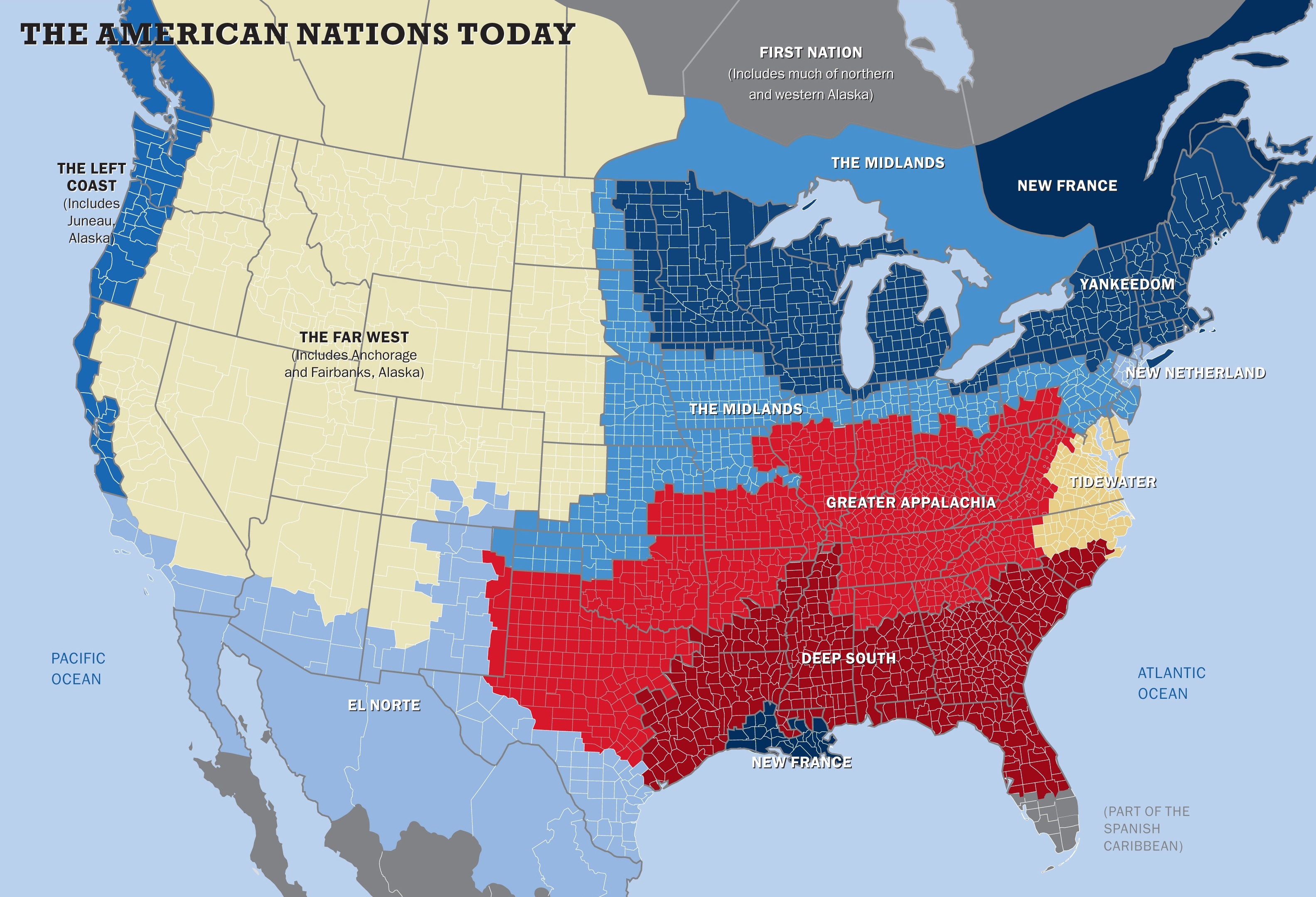
For hundreds of years, this nation has been known as the United States of America. But according to author and journalist Colin Woodard, the country is neither united, nor made up of 50 states. Woodward has studied American voting patterns, demographics and public opinion polls going back to the days of the first settlers, and says that his research shows America is really made up of 11 different nations.

Woodard says that while individual residents will have their own opinions, each region has become more segregated by ideology in recent years. In fact, he says the mobility of American citizens has increased this partisan isolation as people tend to self-segregate into like-minded communities. Woodard lays out his map in the new book “American Nations: A History of the Eleven Rival Regional Cultures of North America.” Here’s how he breaks down the continent:

YANKEEDOM. Founded on the shores of Massachusetts Bay by radical Calvinists as a new Zion, Yankeedom has, since the outset, put great emphasis on perfecting earthly civilization through social engineering, denial of self for the common good, and assimilation of outsiders. It has prized education, intellectual achievement, communal empowerment, and broad citizen participation in politics and government, the latter seen as the public’s shield against the machinations of grasping aristocrats and other would-be tyrants. Since the early Puritans, it has been more comfortable with government regulation and public-sector social projects than many of the other nations, who regard the Yankee utopian streak with trepidation.

NEW NETHERLAND. Established by the Dutch at a time when the Netherlands was the most sophisticated society in the Western world, New Netherland has always been a global commercial culture—materialistic, with a profound tolerance for ethnic and religious diversity and an unflinching commitment to the freedom of inquiry and conscience. Like seventeenth-century Amsterdam, it emerged as a center of publishing, trade, and finance, a magnet for immigrants, and a refuge for those persecuted by other regional cultures, from Sephardim (Jews of Spanish and Portuguese descent; I had to look it up, so I thought I’d share the definition) in the seventeenth century to gays, feminists, and bohemians in the early twentieth. Unconcerned with great moral questions, it nonetheless has found itself in alliance with Yankeedom to defend public institutions and reject evangelical prescriptions for individual behavior.

THE MIDLANDS. America’s great swing region was founded by English Quakers, who believed in humans’ inherent goodness and welcomed people of many nations and creeds to their utopian colonies like Pennsylvania on the shores of Delaware Bay. Pluralistic and organized around the middle class, the Midlands spawned the culture of Middle America and the Heartland, where ethnic and ideological purity have never been a priority, government has been seen as an unwelcome intrusion, and political opinion has been moderate. An ethnic mosaic from the start—it had a German, rather than British, majority at the time of the Revolution—it shares the Yankee belief that society should be organized to benefit ordinary people, though it rejects top-down government intervention.

TIDEWATER. Built by the younger sons of southern English gentry in the Chesapeake country and neighboring sections of Delaware and North Carolina, Tidewater was meant to reproduce the semifeudal society of the countryside they’d left behind. Standing in for the peasantry were indentured servants and, later, slaves. Tidewater places a high value on respect for authority and tradition, and very little on equality or public participation in politics. It was the most powerful of the American nations in the eighteenth century, but today it is in decline, partly because it was cut off from westward expansion by its boisterous Appalachian neighbors and, more recently, because it has been eaten away by the expanding federal halos around D.C. and Norfolk.

GREATER APPALACHIA. Founded in the early eighteenth century by wave upon wave of settlers from the war-ravaged borderlands of Northern Ireland, northern England, and the Scottish lowlands, Appalachia has been lampooned by writers and screenwriters as the home of hillbillies and rednecks. It transplanted a culture formed in a state of near constant danger and upheaval, characterized by a warrior ethic and a commitment to personal sovereignty and individual liberty. Intensely suspicious of lowland aristocrats and Yankee social engineers alike, Greater Appalachia has shifted alliances depending on who appeared to be the greatest threat to their freedom. It was with the Union in the Civil War. Since Reconstruction, and especially since the upheavals of the 1960s, it has joined with Deep South to counter federal overrides of local preference.

DEEP SOUTH. Established by English slave lords from Barbados, Deep South was meant as a West Indies–style slave society. This nation offered a version of classical Republicanism modeled on the slave states of the ancient world, where democracy was the privilege of the few and enslavement the natural lot of the many. Its caste systems smashed by outside intervention, it continues to fight against expanded federal powers, taxes on capital and the wealthy, and environmental, labor, and consumer regulations.

EL NORTE. The oldest of the American nations, El Norte consists of the borderlands of the Spanish American empire, which were so far from the seats of power in Mexico City and Madrid that they evolved their own characteristics. Most Americans are aware of El Norte as a place apart, where Hispanic language, culture, and societal norms dominate. But few realize that among Mexicans, norteños have a reputation for being exceptionally independent, self-sufficient, adaptable, and focused on work. Long a hotbed of democratic reform and revolutionary settlement, the region encompasses parts of Mexico that have tried to secede in order to form independent buffer states between their mother country and the United States.

THE LEFT COAST. A Chile-shaped nation wedged between the Pacific Ocean and the Cascade and Coast mountains, the Left Coast was originally colonized by two groups: New Englanders (merchants, missionaries, and woodsmen who arrived by sea and dominated the towns) and Appalachian midwesterners (farmers, prospectors, and fur traders who generally arrived by wagon and controlled the countryside). Yankee missionaries tried to make it a “New England on the Pacific,” but were only partially successful. Left Coast culture is a hybrid of Yankee utopianism and Appalachian self-expression and exploration—traits recognizable in its cultural production, from the Summer of Love to the iPad. The staunchest ally of Yankeedom, it clashes with Far Western sections in the interior of its home states.

THE FAR WEST. The other “second-generation” nation, the Far West occupies the one part of the continent shaped more by environmental factors than ethnographic ones. High, dry, and remote, the Far West stopped migrating easterners in their tracks, and most of it could be made habitable only with the deployment of vast industrial resources: railroads, heavy mining equipment, ore smelters, dams, and irrigation systems. As a result, settlement was largely directed by corporations headquartered in distant New York, Boston, Chicago, or San Francisco, or by the federal government, which controlled much of the land. The Far West’s people are often resentful of their dependent status, feeling that they have been exploited as an internal colony for the benefit of the seaboard nations. Their senators led the fight against trusts in the mid-twentieth century. Of late, Far Westerners have focused their anger on the federal government, rather than their corporate masters.

NEW FRANCE. Occupying the New Orleans area and southeastern Canada, New France blends the folkways of ancien régime northern French peasantry with the traditions and values of the aboriginal people they encountered in northeastern North America. After a long history of imperial oppression, its people have emerged as down-to-earth, egalitarian, and consensus driven, among the most liberal on the continent, with unusually tolerant attitudes toward gays and people of all races and a ready acceptance of government involvement in the economy. The New French influence is manifest in Canada, where multiculturalism and negotiated consensus are treasured.

FIRST NATION. First Nation is populated by native American groups that generally never gave up their land by treaty and have largely retained cultural practices and knowledge that allow them to survive in this hostile region on their own terms. The nation is now reclaiming its sovereignty, having won considerable autonomy in Alaska and Nunavut and a self-governing nation state in Greenland that stands on the threshold of full independence. Its territory is huge—far larger than the continental United States—but its population is less than 300,000, most of whom live in Canada.

“The borders of my eleven American nations are reflected in many different types of maps — including maps showing the distribution of linguistic dialects, the spread of cultural artifacts, the prevalence of different religious denominations, and the county-by-county breakdown of voting in virtually every hotly contested presidential race in our history,” Woodard writes in the Fall 2013 issue of Tufts University’s alumni magazine. “Our continent’s famed mobility has been reinforcing, not dissolving, regional differences, as people increasingly sort themselves into like-minded communities.”

His main thesis seems to be that the culture of violence is one of the main dividing factors between the “11 Nations.” Though Woodward says that clashes between the 11 nations play out in every way, from politics to social values. He particularly notes that states with the highest rates of violent deaths are in the Deep South, Tidewater and Greater Appalachia, regions that value independence and self-sufficiency. States with lower rates of violent deaths are in Yankeedom, New Netherland and the Midlands, where government intervention is viewed with less skepticism. States in the Deep South are much more likely to have stand-your-ground laws than states in the northern “nations.” And more than 95 percent of executions in the United States since 1976 happened in the Deep South, Greater Appalachia, Tidewater and the Far West. States in Yankeedom and New Netherland have executed a collective total of just one person.

Woodward does point out that while these particular “11 Nations” are original to him, others have suggested similar divisions, which include maps showing the distribution of linguistic dialects, the spread of cultural artifacts, the prevalence of different religious denominations, and the county-by-county breakdown of voting in virtually every hotly contested presidential race in our history. Woodward writes that “Our continent’s famed mobility has been reinforcing, not dissolving, regional differences, as people increasingly sort themselves into like-minded communities, a phenomenon analyzed by Bill Bishop and Robert Cushing in The Big Sort (2008). Even waves of immigrants did not fundamentally alter these nations, because the children and grandchildren of immigrants assimilated into whichever culture surrounded them.”

He also makes the following distinctive point:

Before I describe the nations, I should underscore that my observations refer to the dominant culture, not the individual inhabitants, of each region. In every town, city, and state you’ll likely find a full range of political opinions and social preferences. Even in the reddest of red counties and bluest of blue ones, twenty to forty percent of voters cast ballots for the “wrong” team. It isn’t that residents of one or another nation all think the same, but rather that they are all embedded within a cultural framework of deep-seated preferences and attitudes—each of which a person may like or hate, but has to deal with nonetheless. Because of slavery, the African American experience has been different from that of other settlers and immigrants, but it too has varied by nation, as black people confronted the dominant cultural and institutional norms of each.

Though Woodward makes some interesting points, and I will admit that I have not read his new book American Nations: A History of the Eleven Rival Regional Cultures of North America, I think he has oversimplified the issue by erring on political correctness and gun control debates. The areas that he claims are more violent are often either more racially diverse or more economically divided. Yet, Woodward does not discuss this in any meaningful way in his article in Tuft Magazine. I hope he does in his book.my biggest problem, however, is that he completely ignores Hawaii and south Florida, both of which he dismisses as not being part of the United States. It seems to me that it would have been a better choice to have 13 Nations, not 11, which would have been more in line with the historical distinction of the Thirteen Colonies. Then he could have included south Florida as part of the Spanish Caribbean and Hawaii as a culture distinct of its own. Yet, I’m not sure that Hawaii shouldn’t be aligned with the Left Coast, bit Woodward simply does not consider it.

No matter what the problems with Woodward’s thesis is, it is an interesting debate, especially considering how he pits the two superpowers of the eleven nations against each other. He ends his article in Tufts Magazine by writing:

Among the eleven regional cultures, there are two superpowers, nations with the identity, mission, and numbers to shape continental debate: Yankeedom and Deep South. For more than two hundred years, they’ve fought for control of the federal government and, in a sense, the nation’s soul. Over the decades, Deep South has become strongly allied with Greater Appalachia and Tidewater, and more tenuously with the Far West. Their combined agenda—to slash taxes, regulations, social services, and federal powers—is opposed by a Yankee-led bloc that includes New Netherland and the Left Coast. Other nations, especially the Midlands and El Norte, often hold the swing vote, whether in a presidential election or a congressional battle over health care reform. Those swing nations stand to play a decisive role on violence-related issues as well.

For now, the country will remain split on how best to make its citizens safer, with Deep South and its allies bent on deterrence through armament and the threat of capital punishment, and Yankeedom and its allies determined to bring peace through constraints such as gun control. The deadlock will persist until one of these camps modifies its message and policy platform to draw in the swing nations. Only then can that camp seize full control over the levers of federal power—the White House, the House, and a filibuster-proof Senate majority—to force its will on the opposing nations. Until then, expect continuing frustration and division.

In many ways he’s correct, the great American divide is still between the North and the South. In every major American conflict from the American Revolution to the Civil War and from the Civil Rights Movement to the modern Gay Rights Movement, the North and South are still pitted against one another.

Links:

“Up in Arms” by Colin Woodward, Tufts Magazine

“Which of the 11 American nations do you live in?” by Reid Wilson, The Washington Post.

“Forget The 50 States; The U.S. Is Really 11 Nations, Author Says” NPR