Category Archives: Politics

Elections, Gaydar, Etc.

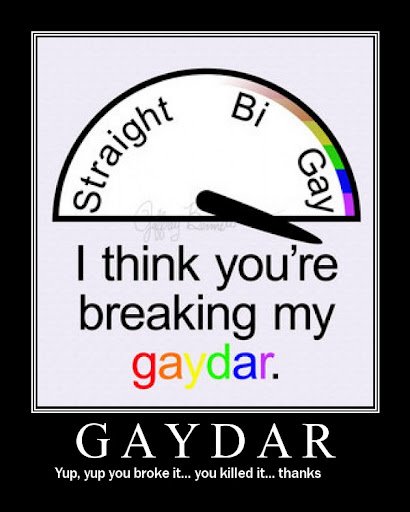
Yesterday was the primary elections in my state.  What an eventful night it was!  First of all, I have never lived just around the corner from the courthouse before, and in a rural town like mine, it is the place to get the local results.  I live less than a block from the courthouse, and it was rockin’ last night.  There were parties all around the courthouse square.

I was hanging out with a friend of mine while her husband was over at one of the election parties.  We decided to drive by the courthouse and see what was going on, when I spotted who I thought was her husband at one of the offices near the courthouse.  She called him, just to see what he was doing and really to check and see if that was him (it wasn’t like he was somewhere he wasn’t supposed to be, she just wanted to make sure that was him).  It turns out that it was him, so we came back by so that we could take him some beer.  We parked and he and another guy walked up to the car.  As soon as the guy with my friend’s husband walked up, my gaydar went off immediately, but I didn’t say anything.  I thought I would see where this was going.  The stranger was quite cute, a bit young (he was 21), and very drunk.  They were talking, and it was quite obvious that he was one of those people who thought he was “someone” mainly because he had family political connections.  In other words, he was a total douche, and I don’t use that word very often.  Once he figured out that my friend was the wife of the guy he had, as I found out later, been hitting on all night, he was not a very nice person to her. Like I said, he was a douche.  It was not a good confrontation since my friends husband did not take well to the fact that he was disrespecting his wife.  Nothing happened, but the guy finally figured out that he had been barking up the wrong tree.

So let me back up a bit and explain what had happened the previous two hours before we got there. Apparently, this guy had become real friendly with my friend’s husband and they had been having a good time.  I suspect the guy is in the closet and has not had enough experience at 21 to hone his gaydar skills, because there is nothing even remotely gay about my friend’s husband.  Growing up in the rural South, you develop a good gaydar so that you don’t hit on the wrong guy, and mine has never failed me.  Though my friend’s husband is quite attractive and has one of the finest butts in the country, if not the state, the stranger had barked up the wrong tree with this one.  My friend got pretty mad about the whole thing until I explained to her that he was obviously a closet case, who was drunk and had been raised to be a prick (this particular political family are all pricks, if I told you who they were you would understand immediately). Once she realized that the real reason that he was rude to her was not because he was looking down on her or anything, but the fact was he had gotten cock-blocked by the wife and didn’t like it.  In fact, he was probably a bit embarrassed.  My friends husband is a bit clueless about these things, but he had never figured out that the guy had been hitting on him for the past two hours.  And if you are wondering what tipped of my gaydar, there were a few stereotypical things about his mannerism, but the fact that he never once looked at my friend, even though he was talking to her, but checking out the husband and then evaluating me to see if I was worth moving on to, but he didn’t get quite that far. Even if I think he could have been a fun little fling, the only thing I would have gotten out of that deal was to be able to say I screwed “insert asshole political family here” instead of them screwing us as they have for nearly twenty years.

Hideous Monument
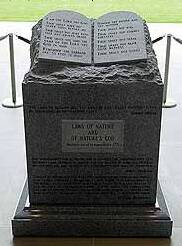
So that was my interesting night, or sort of interesting.  Not a lot goes on in this town, but I was amazed at how busy the courthouse and surrounding area was tonight.  In other news, I can’t believe that Rick Santorum  won my state’s Republican Primary.  I had thought Newt would have won here.  I voted in the Democratic Primary because of some local races for which I needed to vote for the candidates.  The other things that I cannot understand is that for Chief Justice of the State Supreme Court, the Republicans voted for Roy “the Ten Commandments Judge”  Moore.  First of all, he was the state Chief Justice until he defied a court order about removing that hideous Ten Commandments Monument, and had subsequently been removed from office  for violating federal laws and state ethics codes.  Yet, these dumbass Republicans (sorry if you are a Republican that read this) voted for him again.  I do hope that the Democrats have a viable candidate that can defeat him in the general election.

Gay Marry-Land

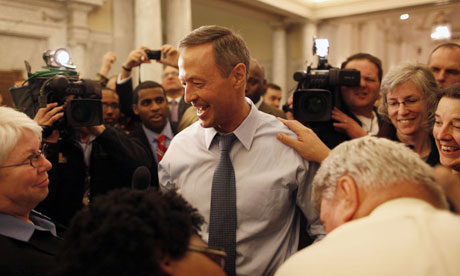
Maryland Governor Martin O’Malley, centre, greets supporters and members of the House of Delegates after the House passed a gay marriage bill in Annapolis, Maryland

Gay marriage is all but legalised in the state of Maryland after the legislature gave its final agreement on Thursday to the law that’s being sent to the governor, who said he expects to sign it sometime this week.

The state senate voted 25-22 for the law. The vote comes less than a week after the House of Delegates barely passed the measure.

Maryland will become the eighth state to allow gay marriage when Governor Martin O’Malley who sponsored the bill signs the legislation. The Democrat made the measure a priority this session after it stalled last year.

Six states allow gay couples to wed Connecticut, New Hampshire, Iowa, Massachusetts, New York and Vermont as well as the Washington capital district. The governor of Washington signed a bill this month that would make that state the seventh.

Opponents in Maryland have vowed to bring the measure to referendum in November. They will need to gather at least 55,726 valid signatures of Maryland voters to put it on the ballot and can begin collecting names now that the bill has passed both chambers.

Some churches and clergy members have spoken out against the bill, saying it threatens religious freedoms and violates their tradition of defining marriage as between a man and a woman.

“The enormous public outcry that this legislation has generated voiced by Marylanders that span political, racial, social and religious backgrounds demonstrates a clear need to take this issue to a vote of the people,” Maryland Catholic Conference spokeswoman Kathy Dempsey said in a statement. “Every time this issue has been brought to a statewide vote, the people have upheld traditional marriage.”

Leaders at the Human Rights Campaign, a group that joined a coalition of organisations to advocate for the bill, said they expect opponents will gather the required number of signatures.

Senator Allan Kittleman, the only senate Republican to vote in favuor of the legislation, said he is proud of his decision and not concerned about political consequences down the road.

“You don’t worry about politics when you’re dealing with the civil rights issue of your generation,” said Kittleman, R-Howard, the son of the late Senator Robert Kittleman, who was known for civil rights advocacy.

Gay marriage remains on hold in California after opponents petitioned a federal appeals court on Tuesday to review a split decision by three of its judges that struck down a voter-approved measure that limited marriage to a man and woman.


Buchanan and King: A 19th Century (Gay) Power Couple?

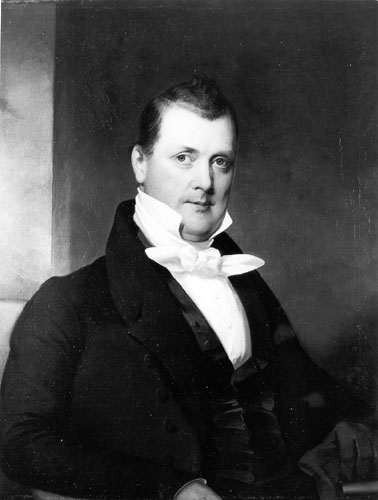
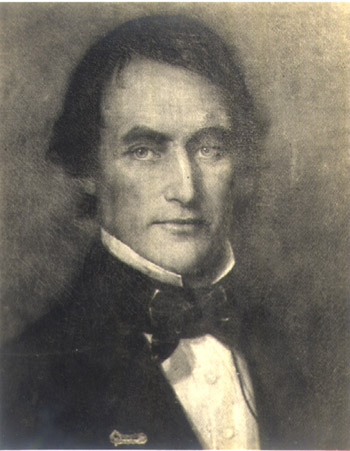
There are some who think that, yes, there were.  Historian James W. Loewen is one of those who thinks that both James Buchanan (15th President of the United States) and William Rufus King (13th Vice President of the United States)  were not only gay but also lovers.  Though I have heard the historic rumors about Buchanan, this was the first time I had heard about King, who I have done a fair amount of research, since he lived just down the road from me.

More than 150 years before America elected its first black president, Barack Obama, it most likely had its first gay president, James Buchanan (1791-1868). Buchanan, a Democrat from Lancaster County, Pa., was  a lifelong bachelor (throughout American history this was often code for homosexual). He served as president from 1857-61, tumultuous years leading up to the Civil War.  Loewen has done extensive research into Buchanan’s personal life, and he’s convinced Buchanan was gay. Loewen is the author of the acclaimed book Lies Across America which examines how historical sites inaccurately portray figures and events and Lies My Teacher Told Me which examines how history books have been marred by an embarrassing combination of blind patriotism, mindless optimism, sheer misinformation, and outright lies.  I have always enjoyed reading Loewen, but I am not for sure how accurate he is in this instance.

In 1819, Buchanan was engaged to Ann Caroline Coleman, the daughter of a wealthy iron manufacturing businessman and sister-in-law of Philadelphia judge Joseph Hemphill, one of Buchanan’s colleagues from the House of Representatives. Buchanan spent little time with her during the courtship: he was extremely busy with his law firm and political projects during the Panic of 1819, which took him away from Coleman for weeks at a time. Conflicting rumors abounded, suggesting that he was marrying her for her money, because his own family was less affluent, or that he was involved with other women. Buchanan never publicly spoke of his motives or feelings, but letters from Ann revealed she was paying heed to the rumors.

After Buchanan paid a visit to the wife of a friend, Ann broke off the engagement. She died soon afterward, on December 9, 1819. The records of a Dr. Chapman, who looked after her in her final hours, and who said just after her death that this was “the first instance he ever knew of hysteria producing death”, reveal that he theorized, despite the absence of any valid evidence, the woman’s demise was caused by an overdose of laudanum, a concentrated tincture of opium.

His fiancée’s death struck Buchanan a terrible blow. In a letter to her father, which was returned to him unopened, Buchanan wrote “It is now no time for explanation, but the time will come when you will discover that she, as well as I, have been much abused. God forgive the authors of it […] . I may sustain the shock of her death, but I feel that happiness has fled from me forever.” The Coleman family became bitter towards Buchanan and denied him a place at Ann’s funeral. Buchanan vowed he would never marry, though he continued to be flirtatious. Some pressed him to seek a wife; in response, Buchanan said, “Marry I could not, for my affections were buried in the grave.” He preserved Ann Coleman’s letters, keeping them with him throughout his life; at his request, they were burned upon his death.

“I’m sure that Buchanan was gay,” Loewen said. “There is clear evidence that he was gay. And since I haven’t seen any evidence that he was heterosexual, I don’t believe he was bisexual.”  According to Loewen, Buchanan shared a residence with William Rufus King, a Democratic senator from Alabama, for several years in Washington, D.C.  Loewen also said Buchanan was “fairly open” about his relationship with King, causing some colleagues to view the men as a couple. For example, Aaron Brown, a prominent Democrat, writing to Mrs. James K. Polk, referred to King as Buchanan’s “better half,” “his wife” and “Aunt Fancy … rigged out in her best clothes.”  Brown may have been trying to slander King in this letter.  He was a friend of the Polks and was James K. Polk’s law partner, but he was also an early proponent of secession after his years as Governor of Tennessee.  Most accounts by historians of King’s political career portray him as a moderate southerner who supported slavery while emerging as a strong unionist. King voiced opposition calls by some of his fellow southerners for the South to secede from the United States during the tense decade prior to the Civil War.  King was always considered a moderate Democrat who was a staunch Unionist, which probably led to some political disagreements between Brown and King.

William Rufus DeVane King, the 13th United States vice president, has the distinction of having served in that office for less time than any other vice president and for being the only U.S. official to be sworn in on foreign soil.  He died of tuberculosis on April 18, 1853, just 25 days after being sworn into office while in Cuba on March 24, 1853.  Some historians have speculated that King holds yet another distinction — the likely status of being the first gay U.S. vice president and possibly one of the first gay members of the U.S. House of Representatives and the U.S. Senate.
King (1786-1853) served in the House of Representatives from North Carolina for six years beginning in 1811 and later served in the Senate from the newly created state of Alabama from 1819-44, when he became U.S. minister to France.  He returned to the Senate in 1848, where he served until he resigned after winning election in November 1852 as vice president on the ticket of Franklin Pierce.

When in 1844 King was appointed minister to France, he wrote Buchanan, “I am selfish enough to hope you will not be able to procure an associate who will cause you to feel no regret at our separation.”  Loewen also said a letter Buchanan wrote to a friend after King went to France shows the depth of his feeling for King.  “I am now solitary and alone, having no companion in the house with me,” Buchanan wrote. “I have gone a wooing to several gentlemen, but have not succeeded with any one of them. I feel that it is not good for man to be alone; and should not be astonished to find myself married to some old maid who can nurse me when I am sick provide good dinners for me when I am well, and not expect from me any very ardent or romantic affection.”  Loewen said their relationship — though interrupted due to foreign-service obligations — ended only with King’s death in 1853.

Some of the contemporary press also speculated about Buchanan’s and King’s relationship. The two men’s nieces destroyed their uncles’ correspondence, leaving some questions about their relationship; but the length and intimacy of surviving letters illustrate “the affection of a special friendship”, and Buchanan wrote of his “communion” with his housemate. In May 1844, during one of King’s absences that resulted from King’s appointment as minister to France, Buchanan wrote to a Mrs. Roosevelt, “I am now ‘solitary and alone’, having no companion in the house with me. I have gone a wooing to several gentlemen, but have not succeeded with any one of them. I feel that it is not good for man to be alone, and [I] should not be astonished to find myself married to some old maid who can nurse me when I am sick, provide good dinners for me when I am well, and not expect from me any very ardent or romantic affection.”

Circumstances surrounding Buchanan’s and King’s close emotional ties have led to speculation that Buchanan was homosexual. Buchanan’s correspondence during this period with Thomas Kittera, however, mentions his romance with Mary K. Snyder. In Buchanan’s letter to Mrs. Francis Preston Blair, he declines an invitation and expresses an expectation of marriage. The only President to remain a bachelor, Buchanan turned to Harriet Lane, an orphaned niece, whom he had earlier adopted, to act as his official hostess.

Loewen said many historians rate Buchanan as one of the worst U.S. presidents. Buchanan was part of the pro-slavery wing of the Democratic Party, and corruption plagued his administration.  But Loewen said those flaws shouldn’t discourage members of the LGBT community from acknowledging Buchanan’s status as a gay man.  “If we only admit that really great people are gay, what kind of history is that?”  Truthfully though, even the letters written by Buchanan do not really point to more than merely a great friendship and affection that was common between men of the nineteenth century, especially during a time when women were still seen as intellectual inferiors.

A lifelong bachelor, King lived for 15 years in the home of future U.S. president James Buchanan while the two served in the Senate. In a time when Congress was only in session part of the year, and senators often returned home when not in session, it would not have been that unusual for two senators to share a home. King’s relationship with Buchanan, who was from Pennsylvania, could have been a factor in Buchanan’s sympathy for the South.

From the research I have done about King, he seems to be a fairly boring and moderate politician, as most Vice Presidents in history have been.  Like many men of his status, he traveled widely in Europe during his life, often as a diplomat.  He also sent his nephews and nieces to Europe as well to round out their education. The only evidence I have seen is what Brown stated to Mrs. Polk in his letter and in the way that Buchanan pines for him in his letters.

Is this really enough evidence to be the proof that Loewen claims to have?  I personally think that either man would be a wonderful addition to the list of LGBT historical figures, especially King, who I have long admired.  What do you think?


The Bistro at the Bijou

I am going to break with my Asian Homosexuality posts for a quick post tonight.  As I was getting ready for bed tonight, I was checking my email and came across a post by LargeTony at his new blog The Third Leg.  I will give you a short excerpt from the post, you can read the whole thing by using the link in this post.

Regular readers might remember me talking, back last summer, about a Tennessee state senator named Stacey Campfield from down in Knoxville. You know, the never-married late 30′s/early 40′s state senator, who is sponsoring a “Don’t Say Gay Bill.”
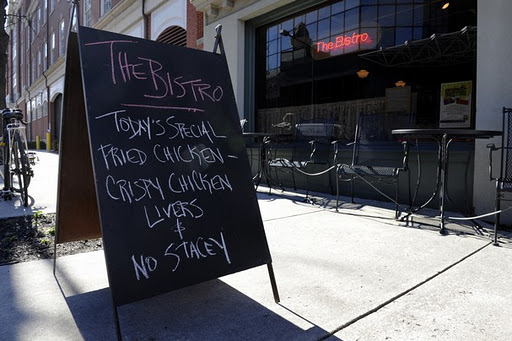
Well, it turns out that over the weekend he was refused service by the owner of a Knoxville restaurant because of his recent ignorant comments that HIV originated from “gay men having sex with monkeys” and that it is “virtually impossible” to become infected through hetero sex.

 I went to the link and read the story from Tony’s post, and that led me to reading the comments people left.  Now, I think as long as someone does not refuse service for race, religion, or sex, then every owner by law has the right to refuse service to anyone.  Martha Boggs, the owner of The Bistro at the Bijou and refused service to the state senator, is, in my opinion, perfectly within her rights to do so.  I probably would have done the same thing.  I do not tolerate fools or bigots lightly, you could as any of my students about that.  As I was reading the comments which range from full support for Mrs. Boggs to slanderous slop, I have to share one comment that I read that goes to a whole new level of misunderstanding that I just couldn’t leave alone, and since there were already over 500 comments on the article I decided to blog about it instead of posting a comment of my own.  Here is the remark that really bothered me:

Number69 writes:

in response to Tea_Time:
Leave it to ignorant southerner to revamp…”we reserve the right to refuse service” slogan straight out of the 1960’s…
If the food isn’t that great to spur business…try controversy!!

This lady (owner) must be to young to remember when a group of black kids sat at a counter in downtown Kvle and the police came in and made them leave. It all goes back to the fact that there is no link to the civil rights movement and homosexuals. Sorry gay kids, but you never marched with dogs on you, fire houses nocking you down and waves of crazy white crackers blowing up your churches. Truth be told the NAACP should picket the heck out of the bistro first thing tomorrow. NAACP won the RIGHT for folks to eat where they want and they should defend that right. Bistro is not a bad place to eat for lunch..after 5 the drunk lawyers get a bit on the loud side and it is certainly no place for a family to take their child.

 I have put in bold what I find most problematic for me in this comment (I find the whole comment to be problematic, but this really bothered me).  For the commenter, who I doubt will ever read this, gay people did march with dogs on them, because they marched beside African Americans during the Civil Rights Movement.  For the same reason, they had fire hoses knocking them down.  Gay people may not have had churches blown up, but we were thrown out of churches.  Furthermore, we were burned at the stake, put to death in numerous different ways, imprisoned, and tortured for our homosexuality.  There is most definitely a link between the Civil Rights Movement and homosexuals, just as there is a link with all movements for equality.  Gays have been persecuted throughout history.  We are still persecuted today.  Bigots like Campfield , bigots like Santorum, bigots like all the people who condemn us for who we are.  I find great sadness in bigotry.  I merely wish that all people could follow the example of the Golden Rule and treat others as they want to be treated.  Maybe Mrs. Boggs did not do this, but if I were an ignorant bigot, I would hope that someone would tell me.

Tennessee is not alone with the problems of having bigoted politicians.  We have them in Alabama too.  Former Chief Justice Roy Moore is running for Alabama Supreme Court Chief Justice again (after he had been removed from office for violating a federal court order.)  Moore is the so-called “Ten Commandments Judge” who snuck a (tacky and ludicrous) marble monument of the Ten Commandments into the Alabama Judicial Building in the middle of the night.  When he was ordered to remove it, and it should have been removed for its tackiness alone, he refused and was forced out of office.  Moore is the same judge who wrote the Alabama Supreme Court opinion that took custody from a lesbian mother, simply because she was lesbian, and gave custody to the abusive father.  Okay, I have bitched about Moore enough, but it does piss me off every time I see one of his campaign signs.

I got a little off topic there, sorry.  It is after midnight and time for me to go to bed.

Back to our regularly scheduled program in the morning…


A Major Benchmarks in LGBT History?

I came across this article last week, and thought that I would pass it along to you.  This is the first half of an article titled “Two Major benchmarks in LGBT history.”  You can read the rest of the article by clicking the link below. I hope that you will read it, and let me know what you think.

Major benchmarks in LGBT historyby Mark SegalBay Windows contributor
If you sneezed last week, you might have missed them. Two major changes in the fight for LGBT equality took place — and they literally will change the playing field forever.
During the Republican presidential debate last Sunday on NBC’s “Meet the Press,” before the New Hampshire primary, a new benchmark in LGBT equality — at least for Republicans — was christened. And the surprise was who set it and who shrugged it off. The frontrunner, former Massachusetts Gov. Mitt Romney, did the honors.
Here’s the thumbnail version. One of the moderators quoted a pro-gay equality statement from Romney that was published in Boston’s LGBT newspaper Bay Windows, then asked Romney what he will do for nondiscrimination. (A well-phrased question, journalists should note.) Romney, who, it seems during this nomination process has cast aside his previous limited LGBT equality record, stated very clearly that he supports nondiscrimination and that, as governor, he appointed LGBT people to his administration and as judges. He then said clearly that he does not discriminate on the basis of sexual orientation. So he answered the question and you’d think that was it, but the journalist — this guy was good — then asked: “But what will you do to further the rights of LGBT people?” (Again, journalists please note the phrasing of the question.) Romney clearly says, “I just did that.” Applause. He adds that the only difference he has with the gay community is that he believes “marriage” is solely between a man and a woman. Applause from the audience again.
Here’s the surprise, and why this is a moment that will be marked as the beginning of the long road to reality for Republicans: They then went to Santorum with the question. He attempted to make a joke but it was obvious that the audience was not amused, so he sidestepped the question that has been a hallmark of his campaign. It was his chance to stand out and he knew that disparaging gays would no longer work. And so did every candidate standing up there, since no one took Romney on.
How serious of a change is this? The Obama campaign was quick to send out a press release Monday morning suggesting that Romney was stepping away from comments made at the debate, but that was based on a 2002 flyer that Romney’s team had disavowed. Point is, the handwriting is on the wall and Republicans see the inevitable. Americans are tired of them trashing the gay community. So the frontrunner has drawn a new line in the sand: We believe in nondiscrimination up to the issue of marriage.
So enjoy the next few months and watch the dying gasps of the anti-equality Republican rhetoric, since this is the last presidential race you’ll hear it. They won’t go quietly, but Romney’s statements, if he’s nominated, make that change inevitable.

Mark Segal, PGN publisher, is the nation’s most-award-winning commentator in LGBT media. He can be reached atmark@epgn.com.

With Newt Gingrich’s win in South Carolina yesterday, is this really “the dying gasps of the anti-equality Republican rhetoric?”  I honestly do not think so.  The Republicans have had three Primaries and three different winners, Santorum (after a recount in Iowa), Romney (NH), and Gingrich (SC).  Trends show that since no Democrat has won in South Carolina since Jimmy Carter in 1976, that it is the trend setter for the Republican nomination.  Since 1980, the winner of the South Carolina Republican Primary has soldiered ahead and captured the Republican Presidential nomination.  So I have three questions for you:

  1. Do you think that Romney’s comments in the debate mentioned above really was  “the dying gasps of the anti-equality Republican rhetoric”?
  2. Do you think that winning the Republican Primary in South Carolina will give Gingrich the push to win the nomination?
  3. How can the religious right and family values Republicans support a candidate, i.e. Gingrich, who has had two failed marriages because of infidelity and is currently on his third marriage?

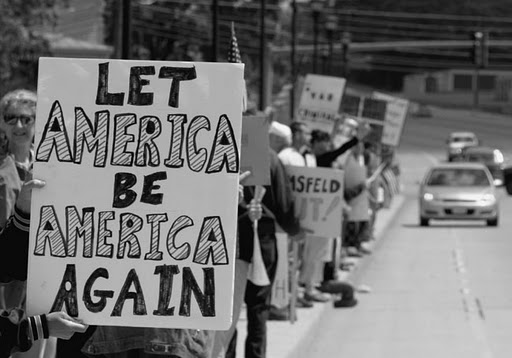
Let America Be America Again

Let America Be America Again
by Langston Hughes

Let America be America again.
Let it be the dream it used to be.
Let it be the pioneer on the plain
Seeking a home where he himself is free.

(America never was America to me.)

Let America be the dream the dreamers dreamed–
Let it be that great strong land of love
Where never kings connive nor tyrants scheme
That any man be crushed by one above.

(It never was America to me.)

O, let my land be a land where Liberty
Is crowned with no false patriotic wreath,
But opportunity is real, and life is free,
Equality is in the air we breathe.

(There’s never been equality for me,
Nor freedom in this “homeland of the free.”)

Say, who are you that mumbles in the dark?
And who are you that draws your veil across the stars?

I am the poor white, fooled and pushed apart,
I am the Negro bearing slavery’s scars.
I am the red man driven from the land,
I am the immigrant clutching the hope I seek–
And finding only the same old stupid plan
Of dog eat dog, of mighty crush the weak.

I am the young man, full of strength and hope,
Tangled in that ancient endless chain
Of profit, power, gain, of grab the land!
Of grab the gold! Of grab the ways of satisfying need!
Of work the men! Of take the pay!
Of owning everything for one’s own greed!

I am the farmer, bondsman to the soil.
I am the worker sold to the machine.
I am the Negro, servant to you all.
I am the people, humble, hungry, mean–
Hungry yet today despite the dream.
Beaten yet today–O, Pioneers!
I am the man who never got ahead,
The poorest worker bartered through the years.

Yet I’m the one who dreamt our basic dream
In the Old World while still a serf of kings,
Who dreamt a dream so strong, so brave, so true,
That even yet its mighty daring sings
In every brick and stone, in every furrow turned
That’s made America the land it has become.
O, I’m the man who sailed those early seas
In search of what I meant to be my home–
For I’m the one who left dark Ireland’s shore,
And Poland’s plain, and England’s grassy lea,
And torn from Black Africa’s strand I came
To build a “homeland of the free.”

The free?

Who said the free? Not me?
Surely not me? The millions on relief today?
The millions shot down when we strike?
The millions who have nothing for our pay?
For all the dreams we’ve dreamed
And all the songs we’ve sung
And all the hopes we’ve held
And all the flags we’ve hung,
The millions who have nothing for our pay–
Except the dream that’s almost dead today.

O, let America be America again–
The land that never has been yet–
And yet must be–the land where every man is free.
The land that’s mine–the poor man’s, Indian’s, Negro’s, ME–
Who made America,
Whose sweat and blood, whose faith and pain,
Whose hand at the foundry, whose plow in the rain,
Must bring back our mighty dream again.

Sure, call me any ugly name you choose–
The steel of freedom does not stain.
From those who live like leeches on the people’s lives,
We must take back our land again,
America!

O, yes,
I say it plain,
America never was America to me,
And yet I swear this oath–
America will be!

Out of the rack and ruin of our gangster death,
The rape and rot of graft, and stealth, and lies,
We, the people, must redeem
The land, the mines, the plants, the rivers.
The mountains and the endless plain–
All, all the stretch of these great green states–
And make America again!

In Rick Santorum’s bid for the Republican nomination, he had used a line that echoed this poem as a campaign slogan. His slogan was “Fighting to make America America again.”  The line was apparently removed, when Santorum, a well-known conservative, backed away from the phrase — saying he had “nothing to do” with it — after being told it derives from a poem by Langston Hughes. Apparently, using a phrase by one of America’s greatest African-American (and probably most disturbing to Santorum) gay poets.

Hughes, who died in 1967, was an African American Communist who advocated for civil rights and social justice. A key figure in the Harlem Renaissance, evidence suggests that Hughes was gay; some of his poems were homoerotic and others defended gay rights.

Personally, I think Santorum and all politicians in America could learn from this poem.  Though the poem only alludes to the closet of homosexuality and the fight for equal right for the GLBT community.  If I were to add to this poem, it might look something like this:

I am the gay man, full of love and compassion,
Tangled in the rainbow of desire.
I am the American who begs for equality,
Who struggles each day in and out of the closet.
Where is the America for us?
Where is the America we were promised?

However, I am not much of a poet, so forgive me for the added stanza.


Politics and Homosexuality

Issues such as same-sex marriage and gays serving in the military have played an important role in American politics for at least the past 10 years and may do so again in next year’s presidential and congressional elections.

During such an era, gay life is inevitably touched by the politics that surround it, but has it been overly influenced by it?

And we have done more in the two and a half years that I’ve been in here than the previous 43 Presidents to uphold that principle, whether it’s ending “don’t ask, don’t tell,” making sure that gay and lesbian partners can visit each other in hospitals, making sure that federal benefits can be provided to same-sex couples.
Barack Obama

We must make it clear that a platform of ‘I hate gay men and women’ is not a way to become president of the United States.
Jimmy Carter

From a religious point of view, if God had thought homosexuality is a sin, he would not have created gay people.
Howard Dean

There is so much work to be done to treat gays and lesbians and gay and lesbian couples with the respect that they’re entitled to. They deserve, in my judgment, partnership benefits. They deserve to be treated fairly when it comes to adoption and immigration.
John Edwards

I’m used to being in the minority. I’m a left-handed gay Jew. I’ve never felt, automatically, a member of any majority.
Barney Frank


Political Questions

In my last two posts, I have discussed the Republican presidential candidates.  The comments have me wondering, what should I be looking for in a candidate?  Several people have either commented that one issue was more important than the other, or on the other side of the coin, responders have stated that we should look at a broader picture.  I never look at just one thing when choosing a candidate.  There are, however, certain issues that rank higher in my choice.  How a candidate treats GLBT issues is usually at the top of my list.  I also want to know what that candidate intends to do if/when he is elected.  The economy is no doubt an important issue, but is not really an issue that I look at for a presidential candidate.  You might be wondering why I say that, and the answer for me is quite simple.  As a historian, I look at historical trends, and history shows us that a president has no immediate impact on the economy.  Usually it takes 5-10 years for a presidential decision to actually affect the economy as a whole.  Even when Franklin D. Roosevelt had nearly carte blanche to do what he deemed necessary during the Great Depression, his policies never truly affected the nation’s economy.  Only the Second World War, and America’s decision to enter that war ended the Great Depression.  That is merely one example.  It is in my opinion that the policies of Ronald Reagan during the 1980s eventually caused the economic downturn that was the cause for the end of George H.W. Bush’s presidency.  Subsequently, it was the policies of Bill Clinton along with George W. Bush’s economic policies coupled with their foreign policy, i.e. numerous wars and conflicts without the help of a total war economy, that has caused much of the current crisis to be extended.

Now quite frankly, this is my own brainstorming and truly what I believe; however, it points to my reasons for looking at more social issues as opposed to economic issues that causes me to question the current political landscape of Republican candidates.  Quite frankly, and excuse my bluntness, but we seem to be “up shit creek without a paddle” and, needless to say, our choices for presidential candidates stink to high heaven.  There is so much rhetoric and sound-bite pandering, until we look as if we have a group of the ridiculous running against the even more ridiculous.  So my questions are:

  1. What are we to do? 
  2. What issues should we be looking at?
  3. If politics really is about the lesser of two evils, who is the least evil?
  4. Can we afford to have a Republican who is going to do all he can to roll back the major steps we have made in GLBT rights?
  5. What are your opinions on the issues?
  6. What are you looking for in a candidate?
  7. Will you merely settle for the incumbent Democrat, Obama?
  8. Why can’t we find a third alternative?
  9. Shouldn’t there be some moderates out there, since both the Democrats and Republicans are taking things to the extremes on the Left and Right?
I am eager to hear what you guys have to say.  I have never, since I first voted, had such a quandary of who to vote for.  And the be completely honest, I sincerely doubt that I will vote in the Republican Primary.  I have always voted in the Democratic Primary, but where I live, the important ballot will be the Alabama Republican Primary on March 13, 2012, though there are some important local and state races, so I will have to decide when the sample ballots are posted, which primary I will vote in.

Santorum’s Homophobia Problem

I read this article last night, and found it an appropriate follow-up to my post yesterday.  So I hope that you find it as interesting as I did.  Also, thanks for you comments yesterday.  While I agree that we should not focus on only one issue, this is an GLBT blog and so I wanted to focus on this issue.  Also, no matter what happens with the economy or any other issues, I am still a gay man who will worry about GLBT issues.  And yes, Obama has done more for our community than any other president in history, I have to agree with the comment that Obama is not qualified to be president of anything.  Furthermore, I do not feel that the old Republican ways will get us out of this current financial crisis.  There must be a solution out there, but is there anyone running who can find that solution?

Santorum’s Homophobia Problem

by Jay Michaelson 

Author of God vs. Gay? The Religious Case for Equality

LGBT people awoke with a sense of dread to the news of Rick Santorum’s near-tie with Mitt Romney in the Iowa caucuses. Santorum is not just the butt (pun intended) of a deservingly dirty joke; he has long been ahead of the curve when it comes to bashing gay people for political gain. He is the poster child for political homophobia.
And yet, this near-win is different, because America is different. Santorum represents not the resurgence of gay-baiting, but its last, self-defeating gasp.
Only a few years ago, homophobia was a great uniter. Short on campaign cash? Need to fire up the base? Why, flash a few images of the latest pride parade, compare same-sex marriage to bestiality, and the checks and self-rightous blog posts would flow like milk and honey. And while religiously-soaked gay-bashing wasn’t the rhetoric of choice for neo-conservatives and fiscal conservatives, they went along with it, building a strong coalition between corporate capitalists and Christian conservatives.
Indeed, it has been remarked that this was Reaganism’s great innovation: using social issues to convince working class people to vote against their economic interests. At first, it was the “Southern strategy,” making use of coded racism. Later, it grew into gay-baiting, making use of overt homophobia. For at least twenty years, it was the winning formula for the Republican party. Enrich the rich by enraging the working poor.
Only now, things are different. Last May, a Gallup poll found a majority of Americans supported legalizing same-sex marriage. Last September, a large majority supported the end of the military’s “Don’t Ask/Don’t Tell” policy. And over the last year, we’ve seen a dramatic increase of LGBT (including T) people in the media, in politics, and in our communities.
As a result of these dramatic changes, Santorum’s homophobia is more a liability than an asset. Gay people may be horrified at his near-win in Iowa, but we needn’t be. His bigotry still plays to his base — but it’s only the base, only the extremists, who still soak it up.
Of course, public opinion could always turn against gay people. But I don’t think that’s likely, because it changed, over time, due to a very resilient and powerful force: truth. Straight folks have seen, in their own personal experience, that gay people are no more or less ethical than they are. There are lusty, libertine gays, and quiet, conservative ones. Gay people are atheist and religious, of all ethnic backgrounds, young and old, wild and mild. The stereotypes that all gay people are a certain way (lewd, anti-family, demonic, whatever) are simply not true, and anyone who bothers to — no, allows themselves to — get to know their gay neighbors realizes this.
And they’ve seen, too, that sexual orientation is a trait, not (as it has been variously labeled) a sin, pathology, “lifestyle choice,” neurosis, or dysfunction. Sexuality is just part of who we are — a good part.
That kind of truth isn’t subject to the whims of political opinion. Once you see that stereotypes are lies, you don’t go back to them later, especially when — as poll after poll has shown us — that knowledge comes first-hand. The lesbian couple in church, or the gay man raising a child, is far more potent an opinion-shifter than the latest fundraising santorum from the likes of Rick Santorum.
And by the way, this is even true within Santorum’s base itself. In evangelical communities across the country, there are moderate voices questioning the way in which gay people have been singled out by the so-called Christian Right. While most evangelicals remain committed to a broad reading of Scripture regarding homosexuality, increasing numbers are voicing misgivings about whether it’s really Christian to stigmatize gay people. Who Would Jesus Hate, after all?
Given the money and the races ahead in the Republican primary, there’s no way Rick Santorum will be the party’s nominee. Mitt Romney’s PACs will destroy him just as they destroyed Newt Gingrich in Iowa, burying him under an avalanche of negative ads. But as depressing as Santorum’s rise may seem to LGBT folks, this time really is different. We are not about to be victims again. On the contrary, if the polling data is accurate, the biggest victim of Santorum’s homophobia will be Santorum himself.

Jay Michaelson is a writer, scholar and activist whose work addresses the intersections of religion, sexuality, spirituality and law. His newest book is “God vs. Gay?: The Religious Case for Equality (Queer Action/Queer Ideas),” available October 2011 from Beacon Press.
Jay is is the author of three other books and more than 200 articles, essays, and works of fiction. He is the Associate Editor of Religion Dispatches, a Contributing Editor to the Forward newspaper, and Founding Editor of Zeek magazine. His work on behalf of sexual minorities in religious communities has been featured in the New York Times, CNN and NPR, as well as several anthologies.
Jay has held teaching positions at Boston University Law School, City College of New York and Yale University. He holds a J.D. from Yale Law School, an M.A. in Religious Studies from Hebrew University, an M.F.A. in writing from Sarah Lawrence College, and a B.A. magna cum laude from Columbia, and is completing his Ph.D. at Hebrew University of Jerusalem. He has been a scholar-in-residence at dozens of universities, synagogues and other institutions.
In 2009, Jay was included on the “Forward 50″ list of “the men and women who are leading the American Jewish community into the 21st century,” and in June, 2010, he won the New York Society for Professional Journalists “Deadline Club” award for opinion writing.

While I do not completely agree with all that Michaelson says in this article, I do think he makes some valid points.  I think that he dismisses Santorum’s homophobia too quickly as an issue that will work against him.  There are still many people who will vote for him just for his homophobic stance (sadly, my mother is one of them).  Some people will take his Christian conservatism, especially with Bachmann out of the race, as a reason to vote for him.  The other candidates who will attempt to garner the same vote are Gingrich and Perry, though I do not feel that Perry can sustain a campaign and Gingrich has too many marital skeletons in his closet to be a viable candidate for the Christian right.  So do you think that Santorum can actually give Romney a run for his money, or is it really just new media hype in order to have something to talk about in an otherwise boring Republican Primary season?


SOURCE: http://www.huffingtonpost.com/jay-michaelson/rick-santorum-homophobia_b_1182857.html


2012 Republican Candidates

I know that every time I write about politics, I piss off several people, but as I watch the Iowa Caucus results roll in, I feel a sense of doom that I have felt since the current list of Republican candidates emerged.  Frankly, I am not Obama’s biggest fan, though there are things he has done for the GLBT community, there is still much more that he could do.  I do not believe that any of the current Republican candidates will do anything positive for the GLBT community and that it is quite possible that they will backtrack on GLBT issues in a fight against out rights.  So I thought that I would show a list of the candidates and how they stand on GLBT issues.

Our Congress passed the Defense of Marriage Act in 1996 that prohibits giving recognition to same-sex marriages. The decision received widespread approval among American citizens at the time, with many citing morality and religion as the primary consideration behind their decision. Fast forward almost 15 years later, and a completely different picture emerges.

Most Americans have favored same-sex marriage since mid-2010. The latest Gallup poll on 29 May 2011 showed 53% of Americans saying same-sex marriage should be legalized with all the same rights as other marriages, vs. 45% saying it should not. Over the last 12 years, 21 states covering 130 million Americans chose some form of marriage equality: 7 have same-sex marriage (CT, DC, IA, MA, NH, NY, VT), 5 have civil union (DE, HI, IL, NJ, RI), and 9 have domestic partnership (CA, CO, MD, ME, NV, NM, OR, WA, WI). In 2012, legislators and/or citizens will vote on same-sex marriage in 7 states (ME, MD, MN, NH, NC, RI, WA).

According to Roll Call, gay rights could become the Republican Party’s silent nod to social conservatives and culture warriors in 2012. Several states, including the early GOP primary duo of Iowa and New Hampshire, have become key battleground states in the fight over gay marriage. Others, like New York, have also amplified the discussion by allowing gay marriage. During an earlier GOP primary debate, audience members booed a gay soldier.  The tactic of raising a ruckus over social issues dear to conservatives drove voter turnout for George W. Bush in 2000 and 2004, when gay marriage and abortion became a wink-nudge to Christian voters who came out in droves.

According to a survey — from CBS News in August 2010 — just 37 percent of Republican voters hold the position that gay couples should have no legal recognition. Instead, 59 percent of Republicans supported either civil unions or gay marriage.

No other survey has shown numbers that broke down quite like that, and the CBS poll may have been a modest outlier. The broader trend, nevertheless, suggests that only about 45 percent of the Republican electorate will be opposed to any form of legal recognition for gay couples by the time the first primaries begin to take place.

Rick Santorum

Santorum has made numerous negative comments about the GLBT community. The controversy arose over Santorum’s statements about homosexuality and the right to privacy. In an interview with the Associated Press (AP) taped on April 7, 2003, and published April 20, 2003, Santorum stated that he believed mutually consenting adults do not have a constitutional right to privacy with respect to sexual acts. Santorum described the ability to regulate consensual homosexual acts as comparable to the states’ ability to regulate other consensual and non-consensual sexual behavior, such as adultery, polygamy, child molestation, incest, sodomy, and bestiality, whose decriminalization he believed would threaten society and the family, as they are not monogamous and heterosexual.

Many Democratic politicians, gay rights advocates, the Log Cabin Republicans, and progressive commentators condemned the statements as homophobic and bigoted, while some conservatives supported Santorum’s beliefs. The controversy carried over into Santorum’s presidential campaign.

Mitt Romney

Mitt Romney’s position on gay rights doesn’t quite lend itself to a bumper sticker. Depending on whom you ask, it is either too thoughtful and nuanced, or too inconsistent and politically expedient. Either way, it’s definitely got the GOP presidential candidate on the defensive. As governor of Massachusetts, Romney did everything he could to stop gay marriage there after the state’s high court allowed it. Romney responded to the 2003 Massachusetts Supreme Judicial Court decision by vowing to keep the state from becoming, as he put it, “the Las Vegas of gay marriage.” At the time, Romney stated: “I agree with 3,000 years of recorded history. … Marriage is an institution between a man and a woman.” But back during his first political run in 1994, Romney aggressively courted gay voters, promising to do more for “full equality” for gays and lesbians than his Massachusetts opponent, Democratic Sen. Ted Kennedy. Today, Romney denies any inconsistency.

Ron Paul
His states’ rights stand makes it difficult for same-sex couples to peg Ron Paul’s opinion on gay marriage. The Human Rights Campaign points out that the candidate did “support the repeal of DADT (Don’t Ask, Don’t Tell), but at the same time he also comes out in support of DOMA (Defense of Marriage Act). It is his unwillingness to favor a marriage equality amendment that makes him a difficult candidate to love for socially progressives.

In fact, a 2004 brief before the House of Representatives highlights that even though Paul opposes “federal efforts to redefine marriage as something other than a union between one man and one woman,” he concurrently does not favor an amendment to the Constitution that would protect the current definition of marriage. He continues to point out that marriage was instituted by the people entering into the covenant, not the governments that oversee them.

In addition, new issues have recently surfaced about Ron Paul’s stance on GLBT rights. A direct-mail solicitation for Ron Paul’s political and investment newsletters two decades ago warned of a “coming race war in our big cities” and of a “federal-homosexual cover-up” to play down the impact of AIDS. The eight-page letter, which appears to carry Paul’s signature at the end, also warns that the U.S. government’s redesign of currency to include different colors – a move aimed at thwarting counterfeiters – actually was part of a plot to allow the government to track Americans using the “new money.” The letter urges readers to subscribe to Paul’s newsletters so that he could “tell you how you can save yourself and your family” from an overbearing government.

Newt Gingrich
Gingrich opposes domestic partnership benefits for same-sex couples. He wants a constitutional amendment to protect the traditional family. He believes that same sex couples should have some sort of legal rights so that they can leave their estates to their partners or visit them in the hospital. Gingrich believes that homosexuality is a sin. He thinks that same sex couples should not be able to adopt children. He thinks that gays and lesbians should be able to teach as there are many good and decent people who happen to be gay and children will encounter them in everyday life.

Michele Bachmann

I don’t think that I need to say too much about Michele Bachmann. I said a fair amount in this post. However, I will sum up a few points. Bachmann was first in line to sign a pledge affirming her belief that gay men are a public health risk, that gay parents are inferior to straight parents, and that homosexuality is a choice. The pledge — titled “The Marriage Vow: A Declaration of Dependence Upon Marriage and Family” — is a stringing together of myths. For example, a footnote on “human mortality” claims nearly half of gay and bisexual men won’t reach their 65th birthday. But the journal that released the study, based on research conducted during the height of the HIV/AIDS epidemic, has said in a statement issued 10 years ago that the information is regularly taken out of context by “homophobic groups” and “we do not condone the use of our research in a manner that restricts the political or human rights of gay and bisexual men or any other group.” Rick Santorum also signed “The Marriage Vow.”

Rick Perry

Texas Gov. Rick Perry has said that using foreign aid to combat human rights abuses against homosexuals in foreign countries is “not in America’s interests” and attacked President Obama’s decision to require U.S. agencies operating abroad to promote equal rights for gays as part of the administration’s “war on traditional American values.” In a new and controversial ad, Perry has tossed up a political bomb by comparing the repeal of “Don’t Ask Don’t Tell” with keeping prayer out of school. Wearing what is becoming a trademark beige Carhartt jacket and audacious big belt buckle, the Texas governor promises to fight the scourge of secularism plaguing the political landscape.

“Rick Perry has made no secret of his dislike for LGBT Americans – but his most recent remarks are outrageous even by his own standards,” said HRC President Joe Solmonese in a statement. “It is bewildering that someone who wants to be President of the United States wouldn’t want to see our nation be a global leader in universal human rights. This is further proof that Rick Perry doesn’t want to represent the best interests of all Americans – he wants to advance an extremist, anti-gay agenda that represents the fringe views of a very small few.”

John Huntsman

Jon M. Huntsman Jr. has a number of hurdles to overcome if he is to become the Republican nominee for president — including his service in President Obama’s administration as ambassador to China and his comparatively liberal positions on several issues.

But Mr. Huntsman’s positions on gay rights — while to the left of most of his opponents — are likely to be among the least of his concerns. In fact, Mr. Huntsman’s views on gay rights are very close to those of the typical Republican voter — closer than those of someone like Tim Pawlenty.

In 2009, Mr. Huntsman endorsed civil unions as an alternative to gay marriage. He is perhaps the most noteworthy potential Republican candidate to have done so, although the libertarian-leaning Gary Johnson shares his position, and a minor candidate, Fred Karger, supports full marriage rights for gay and lesbian couples.