Category Archives: Politics

I’d Like to Hear Your Opinion on This

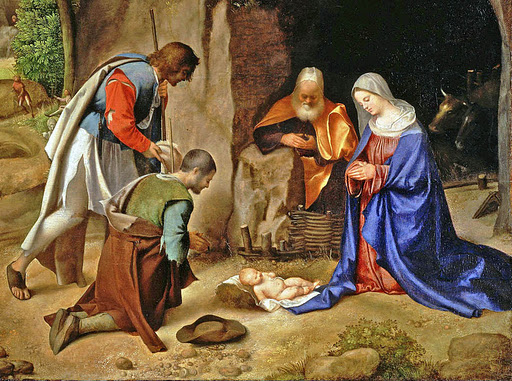
Anbetung der Hirten (Adoration of the Shepherds) (c. 1500–10), by Italian painter Giorgio da Castelfranco

I read this article, and thought that the whole thing was a bit ridiculous. I know that not all of my readers will agree with me about this, but I do hope that you will read it.

‘Silent Night’ in school Christmas play could lead to lawsuit
TUSCUMBIA, AL (WAFF) – A Tuscumbia elementary school plans on keeping “Silent Night” a part of their holiday program.
A Washington DC group has threatened legal action if students sing the song.
The non-profit said the song violates federal law and the separation of church and state.
Florence City Schools have had a front row seat to two of these separation of church and state issues.
Earlier this year, Brooks High School came under fire for public prayer at football games.
Now there’s the controversial decision to sing “Silent Night” at G.W. Trenholm Primary School in Tuscumbia.
Florence City Schools Superintendent Dr. Janet Womack said every program her district does is checked by the district’s attorney.
She said the district is always keeping up to date with court decisions.
She also said watching what’s going on in these other districts is a reminder of how important communication needs to be between school employees, administration, and the central office.
“It’s always being willing to ask for guidance instead of stepping into a gray area asking for guidance first so that we don’t create a landmine for ourselves that would take and deter away the attention from what our main focus is,” she said.
WAFF 48 News spoke to the group in Washington DC, and they told us what they plan to do next.
They said this is the only public school they know of where a religious message is being relayed in an elementary school play. And they said that’s why they’ve targeted this school.
They’ve already sent a letter to the Tuscumbia City School Board.
That letter says the school needs to edit the play and get rid of the song “Silent Night.”
The district told us Wednesday they don’t plan on making any edits to the program.
Americans United for the Separation of Church and State said that means they’ll take legal action.
“I hope that cooler heads prevail and people understand that this is a significant constitutional issue and they don’t go along with the idea of continuing the plans to sing this hymn as part of what should be a secular public school event,” said Barry Lynn, executive director of the nonprofit group.

There are several things that I see wrong with what  the group Americans United for the Separation of Church and State are doing.  First of all, let me state that I am a firm believer in the separation of church and state.  I don’t believe that anyone should tell me how to worship.  That being said, Christmas is first and foremost a religious holiday.  It is for the Mass of Christ’s birth, regardless of whether or not it had it origins in pagan rituals or that it become more and more commercial each year.  Also, “Silent Night” is one of the most popular Christmas songs.  It has always been one of my favorites.  Furthermore, Tuscumbia, Alabama, is a small north Alabama town of less than 9,000 people, which is most famous for being the birthplace of Helen Keller.  Why would the Americans United for the Separation of Church and State be worried about a small north Alabama elementary school.  I guess my point is that if they are going to have a Christmas program, which school all over the country have, then why should they not be allowed to sing about the origins of the holiday?  Anyway, I would love to hear your opinion on this, whether you agree with me or not.

I hope that you are all having a wonderful holiday season.


Courage Is Our Virtue and Freedom Is Our Goal


The UN Combating Discrimination Based on Sexual Orientation and Gender Identity


“As men and women of conscience, we reject discrimination in general, and in particular discrimination based on sexual orientation and gender identity…  Where there is tension between cultural attitudes and universal human rights, universal human rights must carry the day”

— UN Secretary-General Ban Ki-moon, New York, 10 December 2010.

Every day, around the world, individuals suffer discrimination, vilification and violent attack because they are lesbian, gay, bisexual, transgender or intersex (LGBTI). In more than 70 countries, homosexuality remains a criminal offence, exposing gay men and lesbians to the risk of arrest, imprisonment and, in some cases, torture or the death penalty.

While the Universal Declaration of Human Rights and United Nations human rights treaties do not explicitly mention “sexual orientation” or “gender identity”, they do establish an obligation on the part of States to protect people from discrimination, including on the basis of “sex … or other status.” UN treaty bodies, whose role is to monitor and support States’ compliance with treaty obligations, have issued a series of decisions or general comments[1] all confirming that such language is sufficiently broad as to encompass “sexual orientation,” effectively establishing sexual orientation as a prohibited ground of discrimination under relevant human rights treaties. This view has also been endorsed by 17 special procedures (independent experts appointed by the Human Rights Council to monitor and report on various human rights issues), as well as by the UN High Commissioner for Human Rights and the UN Secretary-General.

In a landmark speech on the subject delivered on Human Rights Day (10 December) 2010, the Secretary-General noted that “As men and women of conscience, we reject discrimination in general, and in particular discrimination based on sexual orientation and gender identity. When individuals are attacked, abused or imprisoned because of their sexual orientation, we must speak out…” He pledged to put himself “on the line,” promising “to rally support for the decriminalization of homosexuality everywhere in the world.”

Activities of the human rights office

OHCHR is committed to working with States, national human rights institutions and civil society to achieve progress towards the worldwide decriminalization of homosexuality and further measures to protect people from violence and discrimination on grounds of their sexual orientation or gender identity. While this work is still in its infancy within OHCHR, planned activities include:
  • Privately raising concerns and putting forward recommendations for reform in the context of dialogue with Governments.
  • Monitoring and bringing to light patterns of human rights violations affecting LGBTI persons in public reporting, including reporting produced by OHCHR field presences.
  • Engaging in public advocacy of decriminalization and other measures necessary to strengthen human rights protection for LGBTI persons, including through participation in events, speeches and press statements and newspaper articles.
  • Working with UN partners to implement various public information and related educational activities intended to counter homophobia and violence motivated by animosity towards LGBTI persons.
  • Providing support for the special procedures mandate-holders in the context of their fact-finding activities and confidential communications with Government.
  • Supporting the human rights treaty bodies, a number of which have addressed the issue of discrimination linked to sexual orientation in previous general comments and concluding observations and continue to highlight steps that individual States should take in order to comply with their international treaty obligations in this respect.
  • Providing support for the Universal Periodic Review, which provides a forum for concerns regarding the rights of LGBTI persons to be aired and for recommendations to be developed.
The Office’s work on LGBTI human rights is coordinated from OHCHR-New York.


1. Human Rights Committee (inter alia, Toonen v. Australia, 1994, Young v. Australia, 2003, Joslin v New Zealand, 2002, and X v. Colombia, 2007); Committee on Economic, Social and Cultural Rights (General Comment No. 14 of 2000, General Comment No. 15 of 2002, General Comment No. 18 of 2005); Committee on the Rights of the Child (General Comment No. 4 of 2003); Committee against Torture (General Comment No. 2 of 2008); Committee on the Elimination of Discrimination against Women (General Comment No. 28 of 2010)

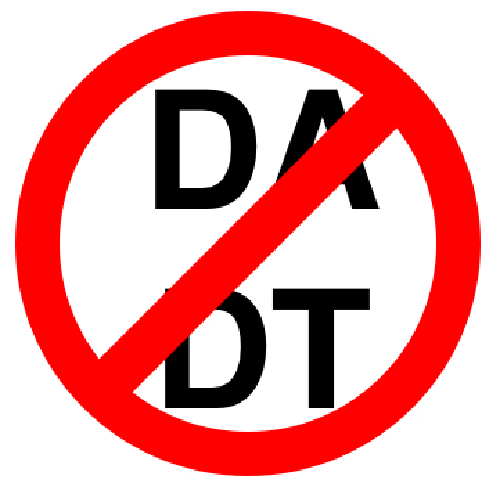
The End of DADT

‘Don’t ask, don’t tell’ repeal will be big relief for civilian partners of gay servicemembers
Article by: DAVID CRARY , Associated Press Updated: September 18, 2011 – 6:47 PM

NEW YORK – After 19 years hiding her relationship with an active-duty Army captain, Cathy Cooper is getting ready to exhale. On Tuesday, the policy known as “don’t ask, don’t tell” will expire. And Cooper will dare speak her love’s name in public.

“This is life-changing,” said Cooper, choking up. “I just want to be able to breathe — knowing I can call my partner at work and have a conversation without it having to be in code.”

Much has been reported about the burdens that “don’t ask” placed on gay and lesbian service members who risked discharge under the 1993 policy if their sexual orientation became known in the ranks. There’s been less attention focused on their civilian partners, who faced distinctive, often relentless stresses of their own.

In interviews with The Associated Press, five partners recalled past challenges trying to conceal their love affairs, spoke of the joy and relief accompanying repeal, and wondered about the extent that they would be welcomed into the broader military family in the future.

Even with repeal imminent, the partners — long accustomed to secrecy — did not want to reveal the full identity of their active-duty loved ones before Tuesday.

Cooper, who works for a large private company, moved from the Midwest to northern Virginia to be near her partner’s current Army post, yet couldn’t fully explain to friends and colleagues why she moved. “It’s been really difficult — it’s really isolated us,” she said. “I became much more introverted, more evasive.”

Cooper said her partner’s Army career is thriving, though she’s had to hide a major component of her personal life.

“I don’t know any of her co-workers,” Cooper said. “She says, `You’re the best part of me and I have to pretend you don’t exist.'”

Looking ahead, Cooper is unsure how same-sex partners will be welcomed by the military establishment.

“Will it be, `Hey, come join all the family support programs’?” she wondered. “I’m not going to be so naive as to think that … I’m just hoping the door is open.”
___

During the long, arduous campaign to repeal “don’t ask, don’t tell,” activists and advocacy groups tended to downplay issues related to post-repeal benefits for civilian partners. “It’s not something we’ve been pushing very hard for yet, but it’s obviously going to be the next front in the ongoing battle for equality,” said Alex Nicholson, executive director of Servicemembers United.

Nicholson’s organization, which advocates on behalf of gay and lesbian military personnel, conducted a survey of same-sex partners last year to gauge their concerns. One widespread hope, he said, was the military might issue ID cards to same-sex civilian partners so they could gain access to bases, commissaries and support services on their own.

In general, same-sex partners will not get the same benefits that the Pentagon grants to heterosexual married couples to ease the costs of medical care, travel, housing and other living expenses. The Pentagon says the 1996 federal Defense of Marriage Act — which defines marriage as a legal union between a man and woman — precludes extending those benefits to gay couples, even if they are married legally in certain states.

Same-sex partners can be listed as the person to be notified in case a service member is killed or injured, but current regulations prevent anyone other than immediate family — not same-sex spouses — from learning the details of the death.

Some activists predict that gay couples will remain second-class citizens in the military’s eyes as long as the Defense of Marriage Act is in force. It is currently under challenge in several court cases, and the Obama administration has said it will not defend DOMA in court.

In the meantime, some activists suggest the military could allow all its personnel — gay or straight — to be eligible for subsidized off-base housing, emergency leaves and other benefits by virtue of a relationship with an unmarried partner.

Heather Lamb, an IBM software engineer in northern Virginia, looks ahead to the post-repeal era and hopes that eventually, same-sex couples receive the same support as other military families.

How will the military handle the changes? “I think it will be like any neighborhood or city in America,” she said. “There will be people in the military who are very open and accepting, and there will be people who will not be.”

The advent of repeal emboldened Lamb to propose earlier this month to her partner of six years, an Air Force officer named Adrianna.

No wedding date is set, but Lamb, 35, is excited in part because marriage — impossible under “don’t ask, don’t tell” — offers a more secure future for their son, Jacob, who she gave birth to in April.

Adrianna took leave from her post near Washington, D.C., to be present for Jacob’s birth, Lamb said, but “don’t ask, don’t tell” nonetheless took its toll.

“Most people at work share the news of a birth,” Lamb said. “When Adrianna went back, she couldn’t get congratulations. It was one of the sad things — she had to keep quiet about it.”

___

For Ariana Bostian-Kentes, repeal comes at an already emotional time. Her partner of nearly five years, an Army medical supply officer named Nicole, has just started a 12-month deployment in Afghanistan with the 1st Armored Division from Fort Bliss, Texas.

Before repeal became certain, Nicole was leaning toward leaving the military after the deployment, Bostian-Kentes said. Now, there’s more of a chance she’ll stay in the service, and the two are discussing the possibility of marrying after Nicole returns to the U.S.

“She might go back in, since she won’t have to hide her private life,” Bostian-Kentes said. “Before, it was let’s get out as soon as we can, and not have to lie to our family and friends.”

The two women, both 28, met in 2006 while on a rugby team at the University of Michigan in Ann Arbor, where Bostian-Kentes now works at the university’s center serving gay, lesbian and transgender students. At that stage, Nicole was in the ROTC program, and Bostian-Kentes had to learn the intricacies of dating someone governed by “don’t ask, don’t tell.”

“I’d never had to be in the closet, but I happened to fall in love with someone in the military and had to create a closet that didn’t exist before,” she said. “We couldn’t hold hands walking down the street, couldn’t write this or that on my Facebook site — it was a huge learning curve for me.”

There was a brief scare last October, when a fellow reveler at a Halloween party posted a photo on Facebook of Ariana and Nicole embracing.

“I freaked out and called the guy who posted it and said, `Take it down. This could ruin her career,'” Bostian-Kentes recalled. “The guy did take it down — but it was a terrifying two hours of my life.”

Bostian-Kentes, who co-founded an advocacy group called the Military Partners and Families Coalition, is hopeful that repeal will enable her to be an active part of the military community and its various support systems.

“It’s so much more difficult to shoulder the burden of deployment without support,” she said. “It’s exhausting, it’s scary — the continuous web of lies that’s being weaved. I can’t wait to come out of that, to come out as a military spouse.”

___

The repeal process has been watched closely by Catherine Crisp, a professor of social work at the University of Arkansas, Little Rock, who endured “don’t ask, don’t tell” for 15 years as partner of a career Army officer, Kaye McKinzie.

McKinzie, 47, a West Point graduate, retired two years ago after being promoted to colonel, and now teaches in the University of Central Arkansas College of Business.

“I felt like I spent 15 years holding my breath,” Crisp said. “I did not realize until Kaye retired what a toll it had taken on both of us, that we lived in constant fear that became a part of who we were.”

Crisp, 46, said both she and McKinzie were dedicated to their careers, lived apart for long stretches, and often took exhausting steps to conceal their relationship.

“In hindsight it seems ludicrous that we had to spend time and energy on stuff like that,” Crisp said. “We lived in fear not of `the enemy’ but of our government and the fear of disclosure and discovery under this horrible policy.”

There were delicate moments along the way, said Crisp, who noted that much of her academic research has focused on topics related to gays and lesbians. She taught about “don’t ask, don’t tell” in some of her classes, and challenged her students to think about the plight of civilian same-sex partners.

But her own experience went unmentioned.

___

Stephen Peters, 31, knows the strains of “don’t ask, don’t tell” from two perspectives. He’s a former Marine discharged under the policy in 2007 after telling his commander he was fed up with having to lie constantly about himself.

As Peters was leaving the military, he met an active-duty Marine who’s been his partner ever since. Peters recently followed him from Hawaii to a posting in the San Diego area.

“I had to go to work and lie to people, and say I was single,” Peters said. “I made up excuses about why I had to move — made it seem I was crazy.”

Throughout their relationship, Peters said, there were recurring fears of being seen together by his partner’s Marine colleagues.

“We’d see people he worked with and he’d make up some story about who I was, constantly creating a profile that wasn’t real,” Peters said.

Peters said his partner, who is 38, hopes to stay in the Marines. Peters is unsure how easy it would be for them to live together if the partner is deployed overseas, given that he would not be officially recognized as family.

On a less weighty matter, Peters wonders how he’ll respond if the opportunity arises to attend a Marine Corps ball with his partner.

“Personally, I don’t feel a desire to go,” he said. “But maybe it’s important for my partner, given everything he’s sacrificed, for his family to be part of that community.”

___

Online:

Servicemembers United: http://www.servicemembers.org/

Servicemembers Legal Defense Network: http://www.sldn.org/

The Campaign for Military Partners: http://militarypartners.org/

___

David Crary can be reached at http://twitter.com/CraryAP
http://www.startribune.com/nation/130067228.html?page=all&prepage=1&c=y#continue


A "D" for Congress

Disdain, disinterest, disrespect…Shame on the US Congress during last night’s speech by the President.  I give them a solid D, and I think that is being very generous.  I am not writing to debate the merits of the President’s job’s plan, though much of it did seem to sound good, but was it just Washington rhetoric?  I don’t know, but I do know what three of the greatest problems with America’s politicians is…disdain, disinterest, disrespect, which is precisely what I saw in the faces of many of the members of Congress last night.

Why does this bother me so much?  I deal with this day in and day out.  How can we expect our students to succeed when what they see from America’s leaders  some of the major problems that teachers face in the schools?  Students, and sadly and increasingly parents, think that school is a babysitting service.  The students are disinterested in learning; they show disdain for authority, and they show disrespect for teachers and education as a whole.

Is it really so hard to show interest and respect for the most powerful man in the world?  You don’t have to agree with him, you don’t even have to like him, but you should show him the respect that he deserves.  You shouldn’t be rolling your eyes as you sit behind the President.  You shouldn’t be looking completely bored or like you would rather be anywhere else in the world.  Why is it so hard to show respect and good manners?  Maybe Congress should learn about the Golden Rule, and more importantly they should take their jobs seriously.  Read the Constitution and understand the importance of your job.  They are the leaders of the free world and should act like it instead of like petulant children.


Sodomy and the States

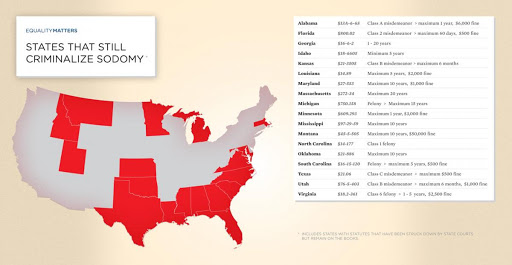
Eight years after the US Supreme Court ruled Texas’ sodomy laws unconstitutional in Lawrence v. Texas (2003)—a decision that technically made all sodomy laws invalid—eighteen states still continue to enforce legislation designed to criminalize any form of non-vaginal sex—butt, mouth, eye and nose—between consenting same-sex adults.

Some states push these anti-gay statutes through tight-lipped loopholes in the Lawrence ruling, while others decide to completely ignore it altogether.

For instance, Michigan can prosecute gay men under “Abominable and Detestable Crimes Against Nature” and “Gross Indecency” laws, which carry 15 year maximum prison sentences. Montana can issue a $50,000 fine to any penis inside anything but a vagina. And Virginia and South Carolina can hand those same penises a fat felony charge, as if to prove to the moral majority that oral and anal gay sex stands equal to aggravated assault, arson, battery, grand theft, rape and murder.

Over at Equality Matters, Alexis Agathocleous—staff attorney with the Center for Constitutional Rights—says: “Laws actually criminalizing the community, many people assumed, were a relic of the past. And accordingly, the LGBT rights movement shifted gears. Litigation, lobbying, advocacy, and resources, in the years since Lawrence, have overwhelmingly focused on civil institutions such as marriage and visibility in the mainstream media. In short, the mainstream LGBT community stopped talking about criminal justice.”

Despite whatever reasons these states would love to make you believe, they all bleed the same color of homophobia from their twisted, judicial hands.  Notice that in four states, sodomy is a felony punishable of up to 15 years.  The worst penalty, however, is Massachusetts which has a 20 year prison term for sodomy.  In a state where gay marriage is legal, apparently gay men cannot have sex.

Click to Enlarge

In Alabama, the penalty for breaking sodomy laws is a Class A Misdemeanor with a maximum penalty of one year in jail and a $6,000 fine.  This particular law on the books in Alabama, though no longer valid because of   Lawrence v. Texas is still on the books because it takes a statewide vote to repeal an amendment, of which all Alabama statues are.  Only in the last few years did the state of Alabama vote to repeal laws prohibiting interracial marriage (2000); however, the Constitution still requires racially segregated education in the state. Section 182 of the Constitution of Alabama disenfranchizes all “idiots and insane persons,” men who interracially married and those convicted of “crime against nature” (homosexuality).  Since the statute in Alabama states that only missionary position vaginal sex is legal in the state, my sister who is married to a 350 lb man (she is only about 125 lbs.) used to joke that they could only have sex by breaking the law.  As she says, “If we had sex in the missionary position, he would crush her.”  Yet it is still just as illegal to have sex with her husband with her on top as it is for me to have sex with a man.

At 340,136 words, the document is 12 times longer than the average state constitution, 40 times longer than the U.S. Constitution, and is the longest still-operative constitution anywhere in the world. (The English translation of the Constitution of India, the longest national constitution, is about 117,369 words long, a third of the length.) There is a growing movement for democratic reform of the Alabama constitution. It is spearheaded by the non-profit organization Alabama Citizens for Constitutional Reform (ACCR), which was formed out of a rally in Tuscaloosa in 2000. Alabama is not unique in having outdated and obsolete laws as part of its Constitution, but because of its length, there is just too much to correct without writing a new constitution. The ACCR has found little success in its efforts at reform.


Born This Way?

The following was posted on Brainstorm, The Chronicle of Higher Education’s blog about Ideas and Culture, as a guest post by Suzanna Danuta Walters, Professor of Gender Studies, Indiana University*

Spending time in Provincetown – Cape Cod’s mecca of all things homosexual – is both a thrilling inversion of everyday life where queerness is the banal majority and a depressing reminder that normative ideologies can seep into even the most festive of gay milieu. As New York made history by approving same-sex marriage, Ptown vacationers congratulated each other as they slathered sunscreen on their finely chiseled bodies and circuit-partied until the sun came up. But pro-marriage T-shirts (“Put a ring on it”) were soon eclipsed by the T-shirt slogan de jour “Born this Way.”
Now, I’m the last person to dis the wondrous Lady Gaga, but her well-meaning ode to immutability is less helpful to gay rights than Guiliani in drag. If marriage and military access are conjured as the Oz of queer liberation, then biological and genetic arguments are the yellow brick road, providing the route and the rationale for civil rights. The medicalization of sexual identity – and the search for a cause if not a cure – has a long and infamous history. This history includes well-meaning attempts by social activists to create a safe life for same-sex desire through the designation of homosexuality as biologically predetermined but also, more ominously, includes the sordid history of incarceration, medication, electroshock “therapy” and numerous other attempts to rid the body (and mind) of its desires.
Notions of homosexuality as “inbred,” innate and immutable were endorsed by a wide variety of thinkers and activists, including progressive reformers such as Havelock Ellis and not so progressive conservatives, eager to assert same-sex love as nature’s mistake. Richard von Krafft-Ebing in the 1880s and Magnus Hirschfeld in the 1903s – both pioneer sexologists and generally advocates of “toleration”– came to believe in some notion of “innate” homosexuality, whether through theories of a kind of brain inversion or through vague references to hormonal imbalances. These theories mostly had little traction, and no evidence whatsoever, and were further undermined during the heyday of the early gay movement which included a deep commitment to the depathologization and demedicalization of homosexuality, manifested in a long-term attempt to remove “homosexuality” as a disease category in the DSM.
Theories of biological origins of “gayness” have ebbed and flowed during different historical and social moments, most obviously intersecting with the rise of eugenics and other determinist frameworks in the early part of the last century. There is no question that the romance with biological and/or genetic explanations for sexual “orientation” has ratcheted up in recent years, due in no small part to the combined force of the gay marriage debates and the increasing “medicalization” and “geneticization” of behavior and identity, spurred on by the initiation of the human genome project in 1989 which furthered the already booming interest in genetic bases for behavior, personality, disease, etc.
This turning of the century seems to provide a “perfect storm” moment in which the idea of immutability takes hold of the public imagination. Even the hit Broadway musical Avenue Q couldn’t avoid having its homo puppets chime in:
TO TELL YOU IT’S OKAY,
YOU WERE JUST BORN
THAT WAY,
AND, AS THEY SAY,
IT’S IN YOUR DNA,
YOU’RE GAY!
No cultural moment sums it up like the otherwise quite illuminating debate that took place in August of 2007. Logo – the all-gay cable network – joined with the Human Rights Campaign to host the first ever Democratic primary presidential debate. At one point, host Melissa Etheridge asked the inevitable “born with it” question to Bill Richardson who clearly answered “wrong” when he responded that he didn’t know and even uttered the awful word “choice” in speaking about gay identities. Etheridge was quick to correct him, for how or why – she asked – would anyone choose to be gay?
Three years earlier, John Kerry made the same case in speaking of Dick Cheney’s lesbian daughter. “We’re all God’s children,” said Kerry when asked a “gay” question by the moderator. Referring to Mary Cheney, the lesbian daughter of Vice President Dick Cheney, Mr. Kerry said, “She would tell you that she’s being … who she was born as. I think if you talk to anybody, it’s not choice.” Strangely enough, it was George Bush who said, “I just don’t know,” once again demarcating the “choice” position as the conservative one!
In our present political context, gay volition is like Voldemort – dangerous even to be uttered. This “born with it” ideology encompasses gay marriage, gay genes, gayness as “trait” and is used by both gay rights activists and anti-gay activists to make arguments for equality (or against it). This is bad science (mistaking the possibility of biological factors with wholesale causation) and bad politics (hinging rights on immutability and etiology). Causality is – of course – the wrong question and will only get muddled answers. The framing of “gayness” as an issue of nature vs. nurture or destiny vs. choice misses the point about (fluid, chaotic) sexuality and about civil rights. It’s not our genes that matter here, but rather our ethics.

*Suzanna Danuta Walters, author of All the Rage: The Story of Gay Visibility in America and the forthcoming The Tolerance Trap: What’s Wrong With Gay Rights.


I understand Professor Walters’s argument, though I don’t agree with her argument that our sexual identity/orientation is not genetic or inborn.  Yes, there is little if any scientific evidence that there is a gay gene, but just because there is not evidence does it make it untrue.  I believe in God, but I have no hard scientific evidence that he exists, just faith.  Quintus Tullius Cicero, from 63 BC until his death in 43 BC, told everyone he knew that the end of the Roman Republic was near. Not only did he uncover the Cataline Conspiracy, but he believed that Julius Caesar would cause the end of the Republic.  He never was able to get hard evidence of what Caesar was planning, but we all know that he was right.  Caesar ushered in the end of the Roman Empire (sorry for the tangent, but I have been reading Robert Harris’s book Conspirita). The point is, that just because we don’t have hard evidence doesn’t make it false.  That being said, I do not believe that I am the only one who thinks this way.  There were many comments to this post, and here is one that I found very poignant.
OK–someone help me out here. I understand the author’s argument to be that gay rights should not be based on identity–ie, one’s right should not be limited by what or who someone is (including race, sex, ethnicity, gender, or other innate/inborn quality)–but on the premise that we should not restrict somone’s rights on the basis of their sexual behavior–ie, persons should have the same right to engage in sexual activity with members of the same sex or to marry members of the same sex, etc. regardless of whether this is a matter of choice or a matter of inborn preference. To put it somewhat crudely, my right to do something shouldn’t be based on whether I can help doing it or not. Do I understand that correctly?
If I do understand this argument correctly, then it appears to become a sort of libertarian argument that I should be able to do whatever I want to do (in matters of sex, in the case) regardless why I want to do so. But if that’s the case, then isn’t the argument susceptible to the same sort of arguments for limitation with which libertarian arguments are always addressed: You can do whatever you want to “as long as . . . (you don’t hurt someone else, you conform to the general/religious/ethical standards of society, you don’t break any laws/you do so in private, etc.).”
It seems to me that while there may be strong philosophical reasons to support the position that permission for certain behavior (or even the idea that certain behavior requires permission) should not necessarily depend on the reasons for that behavior–in particular, on the premise that the behavior is inborn–that in practical terms the legal status of the behavior most likely depends on an appeal to the argument that “I was born this way (and I can’t change it)” and should therefore not be penalized or restricted for it.” That this position is also then liberating for persons who engage in the behavior by choice is a bonus.
Human rights are premised on identity. Human rights become civil rights as the result of legislation, but these civil rights depend ultimately on some foundational belief based on human identity. “I was born this way” is another way of saying “my sexual idenity is part of my humanity and therefore must be respected.” Laws removing restrictions based on sexual orientation are based, like those desgregating insitutions or removing voting and property restrictions based on race and gender, on an expanding sense of what it may mean to be fully human, on, that is, a fuller sense of who you may be. They affect behavior, but they are based on identity. To jettison this premise is, I think, dangerous.
(NB: And as I write this it occurs to me that the issue may be whether human identity is based on more than [simple] biology.)

So what do you guys think about the nurture v. nature/gay gene/born this way debate?  I would love to hear your opinions.


California Gay History Law

SACRAMENTO, Calif. — Gov. Jerry Brown has signed a bill making California the first state in the nation to add lessons about gays and lesbians to social studies classes in public schools.
Brown, a Democrat, signed the landmark bill requiring public schools to include the contributions of people who are gay, lesbian, bisexual and transgender in social studies curriculum. The Democratic-majority Legislature had passed the bill last week on a largely party-line vote.
“History should be honest,” the governor said in a statement Thursday. “This bill revises existing laws that prohibit discrimination in education and ensures that the important contributions of Americans from all backgrounds and walks of life are included in our history books.”
Brown signed the bill Wednesday, but announced on Thursday that he had done so.
The bill has drawn criticism from some churches and conservative groups that argue such instruction would expose students to a subject that some parents find objectionable.
Republican lawmakers who opposed the bill had called it a well-intentioned but ill-conceived bill. Some raised concerns that it would indoctrinate children to accept homosexuality.
State Sen. Mark Leno, a Democrat from San Francisco and the bill’s author, hailed the bill signing as a step toward teaching tolerance. Supporters say the bill will teach students to be more accepting of gays and lesbians in light of the bullying that happens to gay students.
“Today we are making history in California by ensuring that our textbooks and instructional materials no longer exclude the contributions of LGBT Americans,” Leno said in a statement.
California law already requires schools to teach about women, African Americans, Mexican Americans, entrepreneurs, Asian Americans, European Americans, American Indians and labor. The Legislature over the years also has prescribed specific lessons about the Irish potato famine and the Holocaust, among other topics.
The new law, SB48, requires the California Board of Education and local school districts to adopt textbooks and other teaching materials that cover the contributions and roles of sexual minorities, as soon as the 2013-2014 school year.
The legislation leaves it to local school boards to decide how to implement the requirement. It does not specify a grade level for the instruction to begin.
Randy Thomasson, president of SaveCalifornia.com, a conservative family group, said under the new law parents will have no choice but to take their children out of public school and homeschool them to avoid what he said was “immoral indoctrination.” The new law applies only to public schools, not private schools or families who homeschool.
“Jerry Brown has trampled the parental rights of the overwhelming majority of California fathers and mothers who don’t want their children to be sexually brainwashed at school,” Thomasson said. “This new law will prohibit textbooks and teachers from telling children the facts that homosexuality is neither healthy nor biological.”
The bill was supported by gay rights organizations including Equality California and the Gay-Straight Alliance Network. Teacher groups also said the bill would help students prepare for a diverse and evolving society.
“There is no room for discrimination of any kind in our classrooms, our communities or our state,” said Dean Vogel, president of the California Teachers Association.

The Aftermath of the Repeal of DADT

Gay couples denied military spouse benefits

By Julie Watson – The Associated Press

SAN DIEGO — Gay service members from Army soldiers to Air Force officers are planning to celebrate the official end of the military’s 17-year policy that forced them to hide their sexual orientation with another official act — marriage.
A 27-year-old Air Force officer from Ohio said he can’t wait to wed his partner of two years and slip on a ring that he won’t have to take off or lie about when he goes to work each day once “don’t ask, don’t tell” is repealed. He plans to wed his boyfriend, a federal employee, in Washington D.C. where same-sex marriages are legal.
He asked not to be identified, following the advice of the Servicemembers Legal Defense Network, a national organization representing gay troops, including the Air Force officer, that has cautioned those on active duty from coming out until the ban is off the books.

“I owe it to him and myself,” the officer said of getting married. “I don’t want to do it in the dark. I think that taints what it’s supposed to be about — which is us, our families, and our government.”

But in the eyes of the military the marriage will not be recognized and the couple will still be denied most of the benefits the Defense Department gives to heterosexual couples to ease the costs of medical care, travel, housing and other living expenses.
The Pentagon says the 1996 federal Defense of Marriage Act — which defines marriage for federal program purposes as a legal union between a man and woman — prohibits the Defense Department from extending those benefits to gay couples, even if they are married legally in certain states.
That means housing allowances and off-base living space for gay service members with partners could be decided as if they were living alone. Base transfers would not take into account their spouses. If two gay service members are married to each other they may be transferred to two different states or regions of the world. For heterosexual couples, the military tries to avoid that from happening.
Gay activists and even some commanders say the discrepancy will create a two-tier system in an institution built on uniformity.
“It’s not going to work,” said Army Reserve Capt. R. Clarke Cooper, who heads up the Log Cabin Republicans, a gay rights group that sued the Justice Department to stop the enforcement of the “don’t ask, don’t tell” policy. “Taking care of our soldiers is necessary to ensure morale and unit cohesion. This creates a glaring stratification in the disbursement of support services and benefits.”
Cooper said he also plans to marry his boyfriend, a former Navy officer, in a post-repeal era.
The Obama administration has said it believes the ban could be fully lifted within weeks. A federal appeals court ruling July 6 ordered the government to immediately cease its enforcement. After the Department of Justice filed an emergency motion asking the court to reconsider its order, the court on Friday reinstated the law but with a caveat that prevents the government from investigating or penalizing anyone who is openly gay.
The Justice Department in its motion argued ending the ban abruptly now would pre-empt the “orderly process” for rolling back the policy as outlined in the law passed and signed by the president in December.
The military’s staunchly traditional, tight-knit society, meanwhile, has been quickly adapting to the social revolution: Many gay officers say they have already come out to their commanders and fellow troops, and now discuss their weekend plans without a worry.
The Air Force officer says he has dropped the code words “Red Solo Cups” — the red plastic cups used at parties — that he slipped into conversations for years to tell his partner he loved him when troops were within earshot. He now feels comfortable saying “I love you” on the phone, no longer fearful he will be interrogated by peers.
One male soldier, who also asked not to be identified, said after Congress approved repealing the law, he listed his boyfriend on his Army forms as his emergency contact and primary beneficiary of his military life insurance in case he dies in Afghanistan.
He said when he was transferred to South Korea, he and his partner had to pay for his partner’s move.
“But we were able to stay together,” the soldier wrote in an e-mail to The Associated Press from Afghanistan. “During the move, I realized I needed to make sure my partner in life was taken care of if something, the worst, ever happened to me, especially knowing I was about to deploy.”
The soldier said when he added his boyfriend’s name to the paperwork as a primary beneficiary and identified him as a friend, the non-commissioned officer in charge shut his office door and told him: “Unlike the inherent benefits to being married in the Army, such as housing and sustenance allowances, our life insurance and will don’t discriminate.”
Same-sex partners can be listed as the person to be notified in case a service member is killed, injured, or missing, but current regulations prevent anyone other than immediate family — not same-sex spouses — from learning the details of the death. Same-sex spouses also will not be eligible for travel allowances to attend repatriation ceremonies if their military spouses are killed in action.
Gay spouses also will be denied military ID cards. That means they will not be allowed on bases unless they are accompanied by a service member and they cannot shop at commissaries or exchanges that have reduced prices for groceries and clothing, nor can they be treated at military medical facilities. They also will be excluded from base programs providing recreation and other such kinds of support.
Military officials say some hardship cases may be handled on an individual basis. Activists warn such an approach will create an administrative nightmare and leave the military vulnerable to accusations of making inconsistent decisions that favor some and not others.
Military families enjoy assistance from the Defense Department to compensate for the hardship of having a mother or father or both deployed to war zones and moved frequently.
“It strains a relationship when you’re gone for over a year,” said Navy medical corpsman Andrew James, 27, who lived two years apart from his same-sex partner, who could not afford to move with him when he was transferred from San Diego to Washington. “But straight couples have support so their spouses are able to be taken care of, with financial issues, and also they are able to talk to the chain of command, whereas gays can’t. They don’t have any support at all financially or emotionally, and that is really devastating.”
He said he was lucky that his relationship survived and now that he is in the Reserves, they are together again in San Diego.
The benefits issue came up repeatedly during training sessions to prepare troops for the policy change.
“There are inconsistencies,” Maj. Daryl Desimone told a class of Marines at Camp Pendleton, north of San Diego, after being asked about benefits for gay military personnel. “Anyone who looks at it logically will see there are some things that need to be worked out in the future.”
The military’s policy denying benefits to same-sex couples could change if legal challenges to the Defense of Marriage Act prove successful. The Obama administration has said it will not defend DOMA in court.
Earlier this month, the Justice Department filed a legal brief in federal court in San Francisco in support of a lesbian federal employee’s lawsuit claiming the government wrongly denied health coverage to her same-sex spouse. The brief said the lawsuit should not be dismissed because DOMA violates the constitution’s guarantee of equal protection and was motivated by hostility toward gays and lesbians.

How Ignorant Can Americans Be?

Rep. Michele and Dr. Marcus Bachmann

I love my country, but sometimes, I have to wonder just how ignorant many of my fellow citizens can be.  I thought this when George W. Bush was elected for a second time.  I thought this after the last midterm election, in which my state replaced all Democrats in state offices with Republicans and replaced my Democratic Congressman with a woman whose only platform was that she would personally would remove Nancy Pelosi as Speaker of the House (not that she alone would have the power to do so, but voters in my district apparently did not understand this).  And now, according to various new sources, the front runner of the 2012 Republican Presidential Nomination is Michele Bachmann.  Really America?
True to her recent form, Rep. Michele Bachmann kicked off her presidential campaign with a highly-publicized gaffe: She said the wrong John Wayne was from her hometown of Waterloo, Iowa. The iconic cowboy actor was not from Waterloo, but notorious serial killer John Wayne Gacy did live there–likely not who the presidential hopeful wants to be compared with.
Her gaffes, however, aren’t confined to misidentifying the state where the Battle of Lexington and Concord occurred, or misidentifying John Quincy Adams as a Founding Father.  Those are just two examples.  She claimed that the Founding Fathers “worked tirelessly until slavery was no more in the United States.”  All of the Founding Fathers of this country had been long since dead when slavery was finally abolished.  One of her most recent controversies is her signing of the Marriage Vow, along with the ultra-homophobic Sen. Rick Santorum.   Part of that incredible document states:

Slavery had a disastrous impact on African-American families, yet sadly a child born into slavery in 1860 was more likely to be raised by his mother and father in a two-parent household than was an African-American baby born after the election of the USA’s first African-American President.

Fact-checking website Politifact.com has rated 23 of Bachmann’s statements since 2009 and found only one true, six half or barely true, and 16 false or “pants on fire.” 
But her popularity in Iowa and some national polls continues to grow, suggesting her base may not mind her historical misspeaking so much—at least not so far. And her admission on CNN Tuesday helped. “People can make mistakes, and I wish I could be perfect every time I say something, but I can’t,” Bachmann said. “One thing people know about me is that I’m a substantive, serious person.”  I tend not to consider someone as substantive when they make statements that an average fifth grader could dispute and correct.  Serious, she may be, but it is seriously ignorant.
Not only is she ignorant about basic knowledge of American civics and history, but she is also married to what I can best describe as a certifiable nutcase.  Bachmann’s husband, Marcus, turns out to not just think gays are “barbarians” who need to be disciplined and educated, but a clinical psychologist who runs two Christian-based therapy clinics in Minnesota that do a steady trade in homosexual conversion therapies. Marcus Bachmann’s clinics, which received more than $160,000 in tax dollars, try to set gays on the straight and narrow by getting them to see that God intends us all to be hetero. According to one former patient, who as an openly gay high-school student was forced to attend therapy sessions by his conservative-Christian stepfather, a therapist at Bachmann’s clinic tried to turn him straight by getting him to pray, read relevant (anti-sodomy) Biblical verses, and even tried to get him to date an “ex-lesbian.”
Since Bachmann declared her presidential candidacy, Dr. Marcus Bachmann—her gay-barbarian discipline-advocating therapist-husband—has been drawing heightened attention on his own. Some people, including famous-type ones, think maybe Bachmann’s a gay barbarian as well.  Notable Bachmann sexuality commentators include:
  • Cher, who used her Twitter the other day to riff on Bachmann (as the gay news website Towleroad noticed).
  • Pundit Andrew Sullivan, who called Bachmann a “ssuper-sserial hunter of gays” and then compared him to Waiting for Guffman character Corky St. Clair.
  • The Daily Show co-creator and satirist Lizz Winstead, who tweeted that Bachmann is “the white Al Reynolds.”
  • James Urbaniak of The Venture Brothers, who Tumbled: “It’s pretty much a given that the most vociferously homophobic men are usually repressing something. But, oh Mary, Michele Bachmann’s husband Marcus takes the ever-loving cake. He’s a cure-the-gay therapist out of a John Waters movie. I haven’t seen flames this high since the last California wildfire…”
  • Kids in the Hall comic and television actor Dave Foley, who asked via Twitter: “How can Michele Bachman be opposed to gay marriage when she is married to gay man.” Foley made a few other tweets about Bachmann, using “#MarcusBachmanIsSoGay“; the hashtag got a bit of traction.
  • Keith Olbermann referred to Bachmann as a “bizarre-sounding man who’s calling gays ‘barbarians'” and wonders how you can “hide” him without putting him in some sort of closet.

Also, someone has created a @DrMarcusBachman Twitter feed. And at least one blogger believes Bachmann would make a “fine First Lady of the United States.” Remember this post.

People started questioning Bachmann’s sexuality well before his wife announced her presidential campaign. Back in September 2010, for example, Truth Wins Out—a nonprofit whose mission is to fight “anti-gay religious extremism”—posted on its website a YouTube of Bachmann with the comment, “Comment not necessary.” That vid got people talking, but not at the level we’re now seeing. Will his sexuality become a bigger issue as Mrs. B’s campaign churns along? We’ll see.
Why are so many Americans so politically ignorant?  Why can’t they see past her Tea Party rhetoric and realize that she is filled with pure ignorance?  One of the things that I teach my government students is how to research political candidates.  I have them download a voter’s guide and research each and every candidate on the ballot.  I have them do news searches of the candidates, so that they can see what the media is saying about a candidate, and I have them find the candidates websites, so that they can look at what the candidate says about his or her own political platform.  I, personally, do this for every election.  I want to be informed about the person I vote for.  I may most of the time end up voting for the Democratic Party candidates, but not all Democrats are progressive, especially in the South.  I, however, have never voted straight ticket without regard to the candidates.  I want to know what my candidate stands for, what he/she will do when in office, and how much I can trust what that candidate says.  They are politicians, so most of what they are saying is not true, but I at least want someone who will stand up for what is right, not what is politically convenient.  Americans need to wake up, quit listening to political spin doctors, and learn the truth about candidates.
 For further reading on the topic of Michele and Marcus Bachmann, click “read more” below.


Suggested and Further Reading:
  1. All Kinds of People Weighing in on Marcus ‘Mr. Michele’ Bachmann’s Sexuality” http://gawker.com/5817774/all-kinds-of-people-weighing-in-on-marcus-mr-michele-bachmanns-sexuality
  2. Michele Bachmann’s First Dude” http://www.thedailybeast.com/articles/2011/06/16/michele-bachmann-s-first-dude-husband-marcus-bachmann.html
  3. Bachmann’s Gaffes and Lies Mean She’s Unfit for White House” http://www.usnews.com/opinion/blogs/leslie-marshall/2011/06/29/bachmanns-gaffes-and-lies-mean-shes-unfit-for-white-house
  4. “For Michele Bachmann, a pattern of getting facts wrong” http://www.politico.com/news/stories/0311/51179.html

Expostulation and Reply

Expostulation and Reply
WHY, William, on that old grey stone,
Thus for the length of half a day,
Why, William, sit you thus alone,
And dream your time away?

"Where are your books?--that light bequeathed
To Beings else forlorn and blind!
Up! up! and drink the spirit breathed
From dead men to their kind.

"You look round on your Mother Earth,
As if she for no purpose bore you;
As if you were her first-born birth,
And none had lived before you!"

One morning thus, by Esthwaite lake,
When life was sweet, I knew not why,
To me my good friend Matthew spake,
And thus I made reply:

"The eye--it cannot choose but see;
We cannot bid the ear be still;
Our bodies feel, where'er they be,
Against or with our will.

"Nor less I deem that there are Powers
Which of themselves our minds impress;
That we can feed this mind of ours
In a wise passiveness.

"Think you, 'mid all this mighty sum
Of things for ever speaking,
That nothing of itself will come,
But we must still be seeking?

"--Then ask not wherefore, here, alone,
Conversing as I may,
I sit upon this old grey stone,
And dream my time away.
William Wordsworth (1798)

Jeff Wilfahrt always reads a poem by William Wordsworth when he visits his son’s grave.

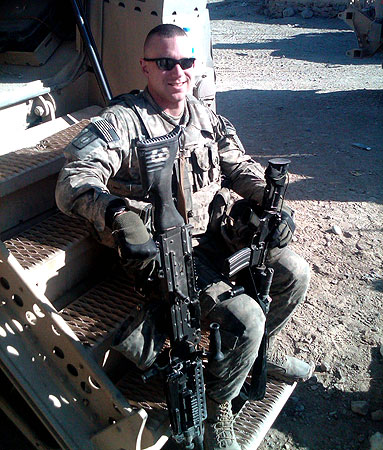
On January 27, 2011, America lost it’s first known gay soldier since the repeal of DADT.  Cpl. Andrew Wilfahrt, a gay Minnesota man who went back in the closet to join the military, died while on patrol in Afghanistan when an IED exploded during an attack on his unit. He was 31. And his mother loved him very, very much.

Believed to be the first gay Minnesota soldier to die in the Iraq and Afghanistan wars, Wilfahrt (pronounced WIHL’-furt), who enlisted in the Army in January 2009 and was deployed to Afghanistan that July, “was a gentle soul,” says his mother Lori. “He was very kind and compassionate. He was interested in a lot of things, but more at a level of detail than what I think most people pursue something. He was fascinated with numbers, and patterns with numbers and palindromes. He would often spot a series of numbers and say, ‘Well, if you add up your birthday and your birthday it equals this.’ Or, ‘All of our birthday dates combined equals our home address.’ Just odd things like that.”
He joined the military, Lori says, because he “tried to grow up. He really turned out to be an interesting, wonderful young man. But I think he still sought something else. He was looking for a purpose, a life of meaning.”
As for his sexuality, being gay and joining the military concerned Lori “a lot. I think it concerned him as well. He spent a lot of time thinking about it and he came to terms with it. He knew he would have to go back in the closet, that he would have to keep that to himself. And he did, for at least part of his stay in the Army. But when I talked to him (or when he wrote maybe) when he was in Afghanistan, he said nobody cares. He said, ‘Everybody knows, nobody cares.’ He said, ‘Even the really conservative, religious types, they didn’t care either.’ He said it’s about something else.”
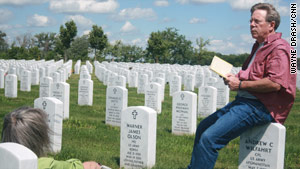
I used the poem above because his father, who along with Wilfahrt mother are fighting for gay marriage in Minnesota, reads a Wordsworth poem each time he visits his son’s grave.  A lover of literature, Jeff, Andrew’s father, always brings a collection of William Wordsworth.  As he sits on the marble stone commemorating his son, he reads aloud from a collection of Wordsworth. His wife Lori sits on the ground nearby.
Lori and Jeff Wilfahrt, parents of Andrew Wilfahrt, a gay Army Corporal killed in Afghanistan earlier this year, continue honoring their son’s memory in the best way possible: fighting for LGBT equality, especially in Minnesota, a state that may vote to ban gay marriage in 2012.


“I hope my son didn’t die for human beings, for Americans, for Minnesotans who would deny him civil rights,” Mr. Wilfahrt recently said in a speech about Andrew.

Watch as the Wilfahrts discuss their son’s life, including being accepted as openly gay in the army, and explain why they’re playing the “trump card” to get straight people on board with pro-gay policies.


Read more: